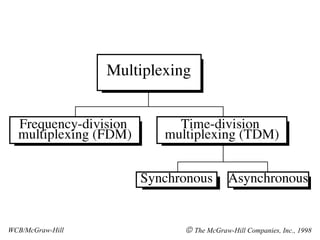
Multiplexing Many to one/one to many Types of multiplexing WCB/McGraw-Hill    The McGraw-Hill Companies, Inc., 1998
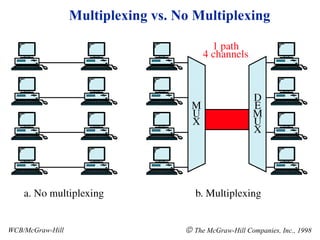
Multiplexing Multiplexing is the set of techniques that allows the simultaneous transmission of multiple signals across a single data link i.e. Dividing link into channels WCB/McGraw-Hill    The McGraw-Hill Companies, Inc., 1998
WCB/McGraw-Hill    The McGraw-Hill Companies, Inc., 1998 Multiplexing vs. No Multiplexing
WCB/McGraw-Hill    The McGraw-Hill Companies, Inc., 1998
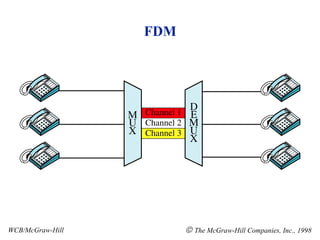
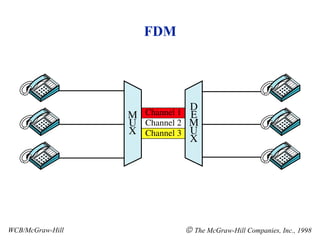
FDM WCB/McGraw-Hill    The McGraw-Hill Companies, Inc., 1998
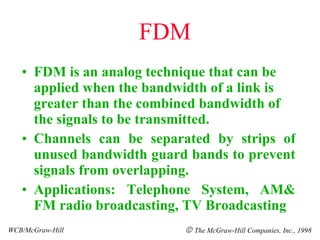
FDM FDM is an analog technique that can be applied when the bandwidth of a link is greater than the combined bandwidth of the signals to be transmitted. Channels can be separated by strips of unused bandwidth guard bands to prevent signals from overlapping. Applications: Telephone System, AM& FM radio broadcasting, TV Broadcasting WCB/McGraw-Hill    The McGraw-Hill Companies, Inc., 1998
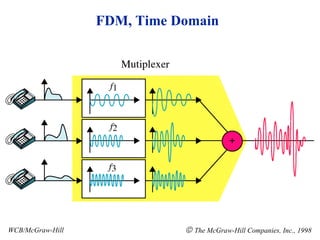
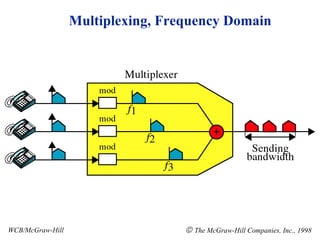
Multiplexing process Each source generates a signal of  a similar frequency range. Inside a MUX, these similar signals modulates different carrier frequencies The resulting modulated signals are the combined into a single composite signals that is sent over a media link
WCB/McGraw-Hill    The McGraw-Hill Companies, Inc., 1998 FDM, Time Domain
WCB/McGraw-Hill    The McGraw-Hill Companies, Inc., 1998 Multiplexing, Frequency Domain
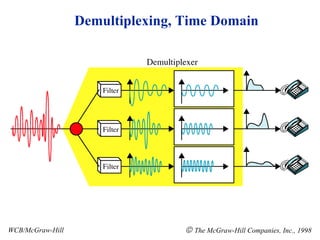
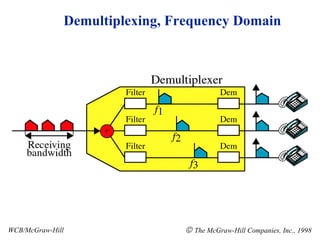
Demultiplexing process The demultiplexer uses a series of filters to decompose the multiplexed signals into its constituent  signals. The individual signals are then passed to a demodulator that separates them from their carriers and passes them to the output lines
WCB/McGraw-Hill    The McGraw-Hill Companies, Inc., 1998 Demultiplexing, Time Domain
WCB/McGraw-Hill    The McGraw-Hill Companies, Inc., 1998 Demultiplexing, Frequency Domain
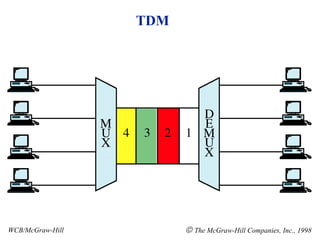
TDM WCB/McGraw-Hill    The McGraw-Hill Companies, Inc., 1998
TDM TDM is a digital multiplexing technique for combining several low rate channels into one high rate one. It is a digital process which allows several connections to share the high bandwidth of a link. Instead of sharing a portion of the BW as in FDM, time is shared WCB/McGraw-Hill    The McGraw-Hill Companies, Inc., 1998
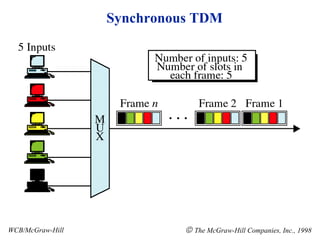
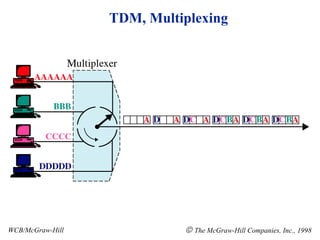
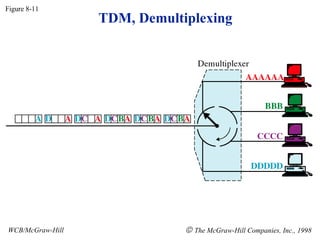
Synchronous TDM In this the data flow is divided into units where each input connection is divided into units where each input occupies one input time slot. A unit can be 1 bit, I character or 1 block of data If the input time slot is Ts then o/p time slot will be T/n where n is no of connections TDM can be visualized as two fast rotating switches, one on the multiplexing side another on demultiplexing side
Synchronous TDM WCB/McGraw-Hill    The McGraw-Hill Companies, Inc., 1998
WCB/McGraw-Hill    The McGraw-Hill Companies, Inc., 1998 TDM, Multiplexing
Figure 8-11 WCB/McGraw-Hill    The McGraw-Hill Companies, Inc., 1998 TDM, Demultiplexing
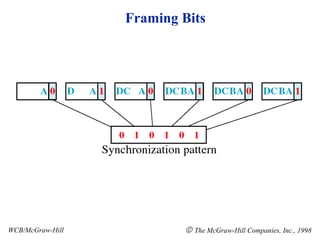
Framing Bits WCB/McGraw-Hill    The McGraw-Hill Companies, Inc., 1998
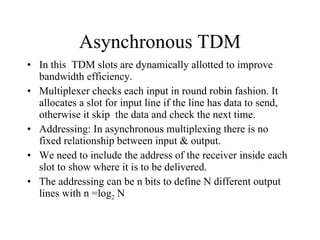
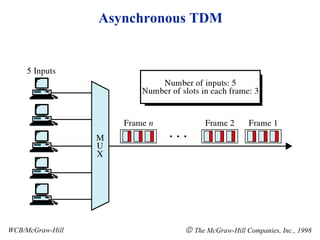
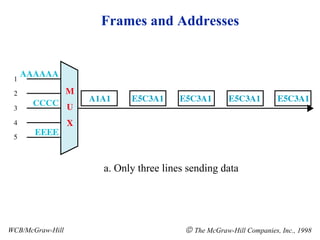
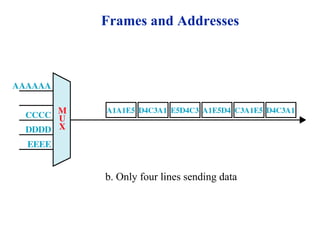
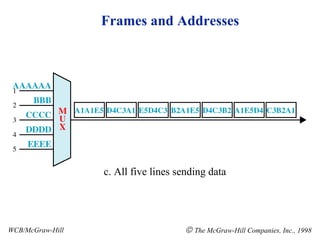
Asynchronous TDM In this  TDM slots are dynamically allotted to improve bandwidth efficiency. Multiplexer checks each input in round robin fashion. It allocates a slot for input line if the line has data to send, otherwise it skip  the data and check the next time. Addressing: In asynchronous multiplexing there is no fixed relationship between input & output. We need to include the address of the receiver inside each slot to show where it is to be delivered. The addressing can be n bits to define N different output lines with n =log 2  N
Asynchronous TDM WCB/McGraw-Hill    The McGraw-Hill Companies, Inc., 1998
Frames and Addresses WCB/McGraw-Hill    The McGraw-Hill Companies, Inc., 1998 a. Only three lines sending data
Frames and Addresses b. Only four lines sending data
Frames and Addresses WCB/McGraw-Hill    The McGraw-Hill Companies, Inc., 1998 c. All five lines sending data

Ch08 1

  • 1.
    Multiplexing Many toone/one to many Types of multiplexing WCB/McGraw-Hill  The McGraw-Hill Companies, Inc., 1998
  • 2.
    Multiplexing Multiplexing isthe set of techniques that allows the simultaneous transmission of multiple signals across a single data link i.e. Dividing link into channels WCB/McGraw-Hill  The McGraw-Hill Companies, Inc., 1998
  • 3.
    WCB/McGraw-Hill  The McGraw-Hill Companies, Inc., 1998 Multiplexing vs. No Multiplexing
  • 4.
    WCB/McGraw-Hill  The McGraw-Hill Companies, Inc., 1998
  • 5.
    FDM WCB/McGraw-Hill  The McGraw-Hill Companies, Inc., 1998
  • 6.
    FDM WCB/McGraw-Hill  The McGraw-Hill Companies, Inc., 1998
  • 7.
    FDM FDM isan analog technique that can be applied when the bandwidth of a link is greater than the combined bandwidth of the signals to be transmitted. Channels can be separated by strips of unused bandwidth guard bands to prevent signals from overlapping. Applications: Telephone System, AM& FM radio broadcasting, TV Broadcasting WCB/McGraw-Hill  The McGraw-Hill Companies, Inc., 1998
  • 8.
    Multiplexing process Eachsource generates a signal of a similar frequency range. Inside a MUX, these similar signals modulates different carrier frequencies The resulting modulated signals are the combined into a single composite signals that is sent over a media link
  • 9.
    WCB/McGraw-Hill  The McGraw-Hill Companies, Inc., 1998 FDM, Time Domain
  • 10.
    WCB/McGraw-Hill  The McGraw-Hill Companies, Inc., 1998 Multiplexing, Frequency Domain
  • 11.
    Demultiplexing process Thedemultiplexer uses a series of filters to decompose the multiplexed signals into its constituent signals. The individual signals are then passed to a demodulator that separates them from their carriers and passes them to the output lines
  • 12.
    WCB/McGraw-Hill  The McGraw-Hill Companies, Inc., 1998 Demultiplexing, Time Domain
  • 13.
    WCB/McGraw-Hill  The McGraw-Hill Companies, Inc., 1998 Demultiplexing, Frequency Domain
  • 14.
    TDM WCB/McGraw-Hill  The McGraw-Hill Companies, Inc., 1998
  • 15.
    TDM TDM isa digital multiplexing technique for combining several low rate channels into one high rate one. It is a digital process which allows several connections to share the high bandwidth of a link. Instead of sharing a portion of the BW as in FDM, time is shared WCB/McGraw-Hill  The McGraw-Hill Companies, Inc., 1998
  • 16.
    Synchronous TDM Inthis the data flow is divided into units where each input connection is divided into units where each input occupies one input time slot. A unit can be 1 bit, I character or 1 block of data If the input time slot is Ts then o/p time slot will be T/n where n is no of connections TDM can be visualized as two fast rotating switches, one on the multiplexing side another on demultiplexing side
  • 17.
    Synchronous TDM WCB/McGraw-Hill The McGraw-Hill Companies, Inc., 1998
  • 18.
    WCB/McGraw-Hill  The McGraw-Hill Companies, Inc., 1998 TDM, Multiplexing
  • 19.
    Figure 8-11 WCB/McGraw-Hill The McGraw-Hill Companies, Inc., 1998 TDM, Demultiplexing
  • 20.
    Framing Bits WCB/McGraw-Hill The McGraw-Hill Companies, Inc., 1998
  • 21.
    Asynchronous TDM Inthis TDM slots are dynamically allotted to improve bandwidth efficiency. Multiplexer checks each input in round robin fashion. It allocates a slot for input line if the line has data to send, otherwise it skip the data and check the next time. Addressing: In asynchronous multiplexing there is no fixed relationship between input & output. We need to include the address of the receiver inside each slot to show where it is to be delivered. The addressing can be n bits to define N different output lines with n =log 2 N
  • 22.
    Asynchronous TDM WCB/McGraw-Hill The McGraw-Hill Companies, Inc., 1998
  • 23.
    Frames and AddressesWCB/McGraw-Hill  The McGraw-Hill Companies, Inc., 1998 a. Only three lines sending data
  • 24.
    Frames and Addressesb. Only four lines sending data
  • 25.
    Frames and AddressesWCB/McGraw-Hill  The McGraw-Hill Companies, Inc., 1998 c. All five lines sending data