2-1
2-2 2 
A Strategic Management 
Approach to HRM 
McGraw-Hill/Irwin 
Human Resource Management, 10/e © 2007 The McGraw-Hill Companies, Inc. All rights reserved.
2-3 Introduction 
Taking a strategic HRM approach means: 
Making human resources management a top priority 
Integrating HRM with the company’s strategy, 
mission, and goals 
HRM can make significant contributions if included 
in the strategic planning process from the outset 
The strategic management process helps determine: 
What must be done to achieve priority objectives 
How they will be achieved
2-4 Introduction 
Many strategic plans use: 
A three to five year timeline 
Annual monitoring and 
modification 
Good HR strategy results in a fit between organiza-tional 
strategy and HRM policies and programs 
Recruitment, selection, outsourcing, telecommuting, 
performance evaluation, compensation
2-5 A Model to Organize HRM 
ARDM means: 
Acquiring 
Rewarding 
Developing 
Maintaining and protecting 
The goals of the ARDM model are: 
Socially responsible and ethical practices
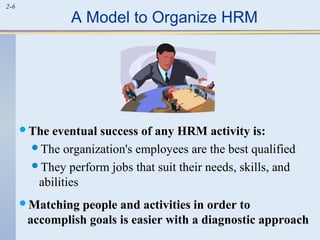
2-6 A Model to Organize HRM 
The eventual success of any HRM activity is: 
The organization's employees are the best qualified 
They perform jobs that suit their needs, skills, and 
abilities 
Matching people and activities in order to 
accomplish goals is easier with a diagnostic approach
2-7 Taking a Diagnostic Approach to HRM 
The ARDM model has four specific steps: 
Diagnosis 
Prescription 
Implementation 
Evaluation 
Managers typically diagnose a work situation by 
observing and identifying key factors 
A prescription is then made to translate the diagnosis 
into action 
Most human resource problems are too complex to 
have a single correct prescription
2-8 Taking a Diagnostic Approach to HRM 
Implementing a solution is the next step, followed by 
evaluation 
Evaluation tells managers whether improvement in 
the ARDM process is needed 
If an organization teaches its members to focus on 
ARDM plus the environment, it is likely to achieve: 
Socially responsible, ethical behaviors 
Competitive, high-quality products and services 
The ARDM model calls for thorough, timely, and 
systematic review of each situation
2-9 External Environmental Influences 
HRM processes are influenced by both the internal 
and external environments 
External influences include: 
Government laws and regulations 
Union procedures and requirements 
Economic conditions 
The labor force 
HR planning must operate within: 
Guidelines 
Limits of available resources 
Competencies
2-10 External Environmental Influences 
HRM is one important function among others: 
Finance 
Accounting 
Research and development 
Marketing 
Production 
The interaction of these internal programs sets the 
tone for the entire organizational system
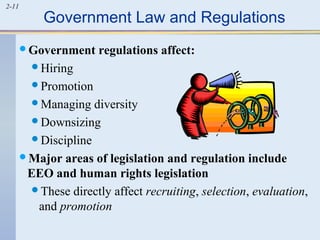
2-11 Government Law and Regulations 
Government regulations affect: 
Hiring 
Promotion 
Managing diversity 
Downsizing 
Discipline 
Major areas of legislation and regulation include 
EEO and human rights legislation 
These directly affect recruiting, selection, evaluation, 
and promotion
2-12 Government Law and Regulations 
EEO and human rights legislation indirectly affects: 
Employment planning 
Orientation 
Career planning 
Training 
Employee development
2-13 Government Law and Regulations 
Other areas of legislation and regulation include: 
Employment of illegal aliens 
Discrimination based on sex, age, and disability 
Compensation regulation 
Benefits regulation 
Workers' compensation and safety laws 
Labor relations laws and regulations 
Privacy laws
2-14 Government Law and Regulations 
Government regulation has increased substantially 
In 1940, the U.S. Dept. of Labor administered 
18 regulatory programs 
In 2004, it administered more than 135 
And that is just one government agency
2-15 Government Law and Regulations 
Government regulation impacts a manager’s job: 
Regulation encourages simplistic thinking on 
complicated issues 
Designing and administering regulations is 
complex, leading to slow decision making 
Regulation leads to complicated legal maneuvering 
Many regulations are out of date and serve little 
social purpose 
There is regulatory overlap and contradiction among 
regulatory agencies
2-16 The Union 
A union directly affects most aspects of HRM, 
including: 
Working conditions 
Wages and salaries 
Fringe benefits 
Employees’ rights 
Grievance processes 
Work hours 
There are cooperative unions and combative unions
2-17 The Union 
Unions were once concentrated in a few sectors of 
the economy 
Today, the fastest-growing sectors are the public 
sector and the third sector 
It is no longer useful to think of unionized employees 
as blue-collar factory workers 
Engineers, nurses, teachers, secretaries, salespersons, 
college professors, professional football players, and 
even physicians belong to unions
2-18 Economic Conditions 
Two economic factors affect HRM programs: 
Productivity 
The work sector of the organization 
Productivity is: 
An important part of a nation's economic condition 
Representative of an organization’s overall efficiency 
The output of goods and services per unit of input 
(resources) used in a production process
2-19 Economic Conditions 
Before productivity can be managed and improved, 
it must be measured 
Isolate the outputs 
Determine the costs that went into producing the 
output 
Compare the current year's figures with those of the 
previous year 
Productivity measures are crude and subject to 
short-term error, but over time can show a trend
2-20 Economic Conditions 
Suggested solutions for increasing productivity: 
Reduce government controls 
Develop more favorable income tax incentives 
Reindustrialize the business-industrial complex 
Reducing legislative controls can adversely affect the 
quality of life and society for decades to come 
 Toxic waste, radiation, air pollution, and other forms 
of destruction must be carefully controlled
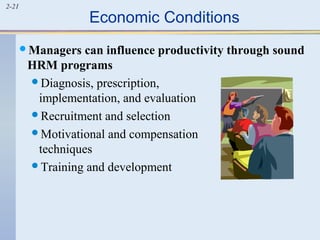
2-21 Economic Conditions 
Managers can influence productivity through sound 
HRM programs 
Diagnosis, prescription, 
implementation, and evaluation 
Recruitment and selection 
Motivational and compensation 
techniques 
Training and development
2-22 The Work Sector of HRM 
60 percent of HR specialists work in the private 
sector 
30 percent work in the public sector; 
10 percent work in the third sector 
Private- and third-sector HRM are structured 
similarly 
HRM in the public sector is structurally different 
A manager moving from the private or third sector 
to the public sector finds a more complicated job 
Politicians, the public, special interest groups, and 
reporters all exert outside pressure
2-23 Competitiveness 
At the macroeconomic level, competitiveness is: 
The degree to which a nation can, under free and fair 
market conditions, produce goods and services that 
meet the test of international markets while 
simultaneously maintaining or expanding the real 
incomes of its citizens 
If you substitute organization for nation, and 
employees for citizens, you have the definition of 
organizational competitiveness
2-24 Competitiveness 
At the organizational level, competitiveness is an 
important issue 
How effectively do workers produce the product? 
How good is the quality of the services or goods? 
Can employees handle new technology and produce 
the product at lower costs? 
Does the firm have the human resources needed to 
increase manufacturing to a global level? 
Will the push to work harder and faster raise 
turnover, absenteeism, and the number of defects?
2-25 Competitiveness 
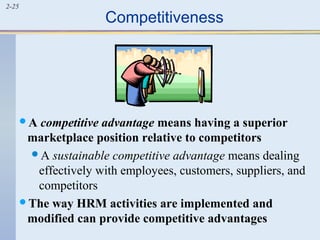
A competitive advantage means having a superior 
marketplace position relative to competitors 
A sustainable competitive advantage means dealing 
effectively with employees, customers, suppliers, and 
competitors 
The way HRM activities are implemented and 
modified can provide competitive advantages
2-26 Competitiveness 
Activities that can enhance and sustain competitive 
advantage: 
Employment security 
Selective recruiting 
High wages 
Incentive pay 
Employee ownership 
Information sharing 
Participation and empowerment 
Teams and job redesign
2-27 Competitiveness 
Activities that can enhance and sustain competitive 
advantage (continued): 
Training as skill development 
Cross-utilization and cross-training 
Symbolic egalitarianism 
Wage compression 
Promotion from within 
Long-term perspective 
Measurement of practices 
Overarching philosophy
2-28 Competitiveness 
Competitors can adopt and/or improve on successful 
HRM activities 
A firm with fair and equitable treatment of human 
resources is less susceptible to losing its competitive 
advantage 
A few HRM activities can be copied, but imitation of 
an entire culture and system of HRM is difficult
2-29 Composition & Diversity of Labor Force 
The labor force of the United States comprises all 
people age 16 years or older who are: 
Not in the military 
Employed or actively seeking work 
As of 2004, over 146 million Americans were in the 
workforce
2-30 Women in the Workforce 
In 2002, about 47 percent of the full-time U.S. 
workforce consisted of women 
This is a 235 percent increase since 1947 
The number of married male employees has increased 
by only 30 percent 
Women should have equal job opportunities 
However, they still face workplace discrimination 
There are signs that more women will have 
professional jobs
2-31 Minorities in the Workforce 
The situation for racial and ethnic minorities in the 
U.S. is similar to that for women 
Few Hispanics, African-Americans, or Native 
Americans are found in high-status, high-paying jobs 
Historically, the most recent immigrant groups take 
the lowest-level jobs 
Minorities were living in the U.S. long before the 
immigrants arrived
2-32 Older Employees 
The percent of older employees is growing 
One of the toughest employment problems today is 
the older employee who loses a job through no 
personal fault 
Higher insurance premiums for older employees 
make them more costly to employ 
As we age, we lose some of our faculties 
This is an ongoing process 
The key is to match employees with jobs
2-33 Older Employees 
Contrary to stereotypes: 
Employees 45+ have no 
more accidents than 
younger ones 
Until age 55, absenteeism rates are the same or lower 
Employees under 35 have the worst accident rate 
When total performance is considered, older 
employees are just as effective as younger ones
2-34 Employment Projection 
The ten fastest-growing occupations: 
Computer software, engineers, applicants 
Computer support specialists 
Computer software, engineers, systems software 
Network and computer system administrators 
Network systems and data communication analysts 
Desktop publishers 
Database administrators 
Personal and home care aides 
Computer systems analysts 
Medical assistants
2-35Geographic Location of the Organization 
The location of the organization influences hiring 
practices and HRM activities 
Rural versus urban 
International versus local 
Education 
Behavior 
Legal-political factors 
Economics 
Inter-cultural training
2-36 Internal Environmental Influences 
HRM programs are influenced by: 
Strategy 
Goals 
Organizational culture 
Nature of the task 
Work groups 
The leader’s style and experience
2-37 Strategy 
A strategy: 
Indicates what an organization's key executives hope 
to accomplish in the long run 
Is concerned with competition and aligning the 
resources of the firm 
Some companies believe long-term success is linked 
to helping employees achieve work-life balance
2-38 Goals 
Organizational goals differ within and among 
departments 
Most departments have similar goals 
Differences arise from the importance placed on the 
goals 
In organizations where profits take precedence, 
HRM goals receive little attention 
This results in effectiveness problems (absenteeism, 
performance decrements, high grievance rates)
2-39 Goals 
Diversity refers to any mixture of themes 
characterized by differences and similarities 
Diversity in organizations is more than demographics 
Dealing with workforce diversity means focusing on 
the collective picture of differences and similarities
2-40 Goals 
Wisconsin Power and Light uses a six-step approach 
to diversity training: 
Form a diversity steering team 
Create a diversity training team 
Select a diversity training project manager 
Complete a cultural audit 
Design a training program 
Implement and evaluate the training
2-41 Organization Culture 
A firm's organizational culture is shown by: 
The way it does business 
How it treats customers and employees 
The autonomy or freedom that exists in the 
departments or offices 
The degree of loyalty expressed by employees
2-42 Organization Culture 
Organization culture represents the perceptions held 
by the employees 
There is no one "best" culture for the development of 
human resources 
Culture can: 
Impact behavior, productivity, expectations 
Provide a benchmark for standards of performance
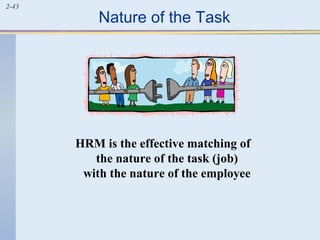
2-43 Nature of the Task 
HRM is the effective matching of 
the nature of the task (job) 
with the nature of the employee
2-44 Nature of the Task 
Job factors that attract or repel workers: 
Degree of knowledge and ability to use information 
Degree of empowerment 
Degree of physical exertion 
Degree of environmental unpleasantness 
Physical location of work 
Time dimension of work 
Human interaction on the job 
Degree of variety in the task 
Task identity 
Task differences and job design
2-45 Work Group 
An employee’s experiences are largely influenced by 
the work group 
A group is two or more people who: 
Consider themselves a group 
Work interdependently to accomplish a purpose 
Communicate and interact with one another on a 
continuous basis 
In many cases, work next to each other
2-46 Work Group 
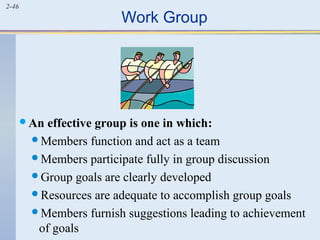
An effective group is one in which: 
Members function and act as a team 
Members participate fully in group discussion 
Group goals are clearly developed 
Resources are adequate to accomplish group goals 
Members furnish suggestions leading to achievement 
of goals
2-47 Work Group 
Most most effective work groups: 
Are small (7 to 14 members) 
Have stable membership 
Members: 
Have eye contact and work closely together 
Have similar backgrounds 
Depend on the group to satisfy their needs 
Effective groups support management and the 
organization's goals, unless it conflicts with their 
own
2-48 Work Group 
 Changing the group's norms and behavior requires: 
The manager's leadership 
The manager's power to reward or discipline 
The transfer of some group members 
Work groups are directly related to the success of 
HRM activities 
If a group opposes HRM programs, it can ruin them 
Consider permitting work-group participation in 
designing and implementing HRM
2-49 Leader’s Style and Experience 
The experience and leadership style of the operating 
manager directly affects HRM activities 
Orchestrating the skills, experiences, personalities, 
and motives of individuals 
Facilitating interaction within work groups 
Providing direction, encouragement, and authority to 
evoke desired behaviors 
Reinforcing desirable behavior
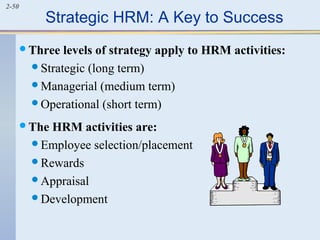
2-50 Strategic HRM: A Key to Success 
Three levels of strategy apply to HRM activities: 
Strategic (long term) 
Managerial (medium term) 
Operational (short term) 
The HRM activities are: 
Employee selection/placement 
Rewards 
Appraisal 
Development
2-51 Strategic HRM: A Key to Success 
Strategic HRM planning leads to: 
Growth 
Profits 
Survival 
Planning also: 
Expands awareness of possibilities 
Identifies strengths and weaknesses 
Reveals opportunities 
Points to the need to evaluate the impact of internal 
and external forces
2-52 Strategic HRM: A Key to Success 
Organizational strategic plans permit HR to prepare 
for internal and external environment changes 
Each organization should adopt a strategy that best 
fits its goals, environment, resources, and people 
An organization must match its: 
Strategic plan 
Employees' characteristics 
HRM activities
2-53 Strategic HRM: A Key to Success 
The days of viewing HRM as only a highly 
specialized and technical staff are over 
HRM must be involved in all aspects of an 
organization's operation 
It must make everyday contributions to the 
organization 
HRM programs must be: 
Comprehensive 
Adapted to the organization's culture 
Responsive to employee needs
2-54 Strategic Challenges Facing HRM 
Global competition has become intense 
HRM professionals are now being asked to optimize 
the skills, talents, and creativity of every employee 
Failure to do so will mean the firm cannot compete in 
a globally interconnected world
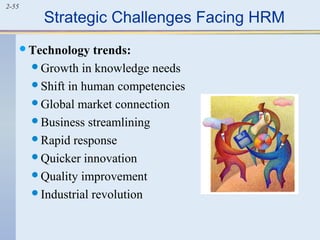
2-55 Strategic Challenges Facing HRM 
Technology trends: 
Growth in knowledge needs 
Shift in human competencies 
Global market connection 
Business streamlining 
Rapid response 
Quicker innovation 
Quality improvement 
Industrial revolution
2-56 Building a Cooperative Workforce 
The U.S. workforce is changing in dramatic ways: 
There is a slower increase in the number of Caucasian 
workers than other groups 
By 2006, white males will no longer dominate the 
workforce 
Women are entering the workforce in record numbers 
The number of Hispanic, Asian, and older workers 
will continue to rise
2-57 Building a Cooperative Workforce 
The changing look, age, and needs of the workforce 
have resulted in more concern about: 
Child care 
Elder care 
Diversity understanding and training 
Understanding diversity is an obvious need 
Most firms are not yet "diversity-friendly” 
The negative financial impact can be significant 
There will be increased demand for fair, ethical, and 
prompt handling of diversity issues
2-58 Caliber of the Workforce 
Recruiting and developing skilled labor is important 
A growing number of jobs require higher levels of 
education, language, math, and reasoning skills 
Strategic HR planning models must carefully weigh 
deficiencies and shortages in skills 
The skills gap impacts more than HRM 
Whole societies must face the consequences of not 
having the workforce needed to compete in a global 
economy
2-59 Restructuring and Downsizing 
Facts about downsizing: 
Half of all downsized firms end up with at least as 
many employees again within a few years 
Downsizing in manufacturing is not new 
It is positively correlated to foreign competition 
It encourages firms to reduce their costs 
Profits increase in the short-run, but not productivity 
It leads to lower compensation/wages within the 
downsized firm
2-60 Restructuring and Downsizing 
Restructuring means changing the reporting and 
authority relationships within a firm 
Downsizing is a reduction in a company's workforce 
Downsizing has a human face and can result in stress-related 
health problems 
There is a growing sense that job security is a thing 
of the past
2-61 Contingent Workers 
Contingent workers include: 
Temporaries 
Part-timers 
Contract or leased workers 
Others who are hired to handle extra tasks or 
workloads 
The number of contingent workers has increased 
steadily since the early 1970s
2-62 Contingent Workers 
Outsourcing means hiring another firm to do work 
This includes HRM activities 
The outsource firm provides the employees to 
complete the job 
Professional employee organizations (PEOs) are 
growing in popularity because they can: 
Save a firm money 
Reduce its risks 
Improve efficiency 
Allow the company to focus on its core business
2-63 
People & the HRM Diagnostic Framework 
Employees are the most important concern in the 
diagnostic model 
Even the best HRM activities can backfire if 
adjustments for individual differences aren’t built in 
People differ in their: 
Abilities 
Attitudes and preferences 
Styles 
Intellectual capacities 
Ways of doing the job
2-64 Abilities of Employees 
Abilities or skills are classified as: 
Mechanical 
Motor coordination 
Mental 
Creative 
Abilities that are the result of genetic factors can 
rarely be changed through training 
Abilities such as interpersonal skills and leadership 
are more subject to change
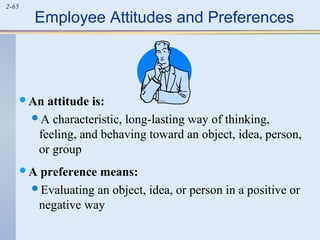
2-65 Employee Attitudes and Preferences 
An attitude is: 
A characteristic, long-lasting way of thinking, 
feeling, and behaving toward an object, idea, person, 
or group 
A preference means: 
Evaluating an object, idea, or person in a positive or 
negative way
2-66 Employee Attitudes and Preferences 
Work: 
Allows for the expression of both aggressive and 
pleasure-seeking drives 
Offers a way to channel energy 
Provides income 
Offers a justification for existence 
Is a way to achieve self-esteem and self-worth 
The amount of energy directed toward work 
is related to the amount directed to family, interpersonal 
relations, and recreation
2-67 Motivation of Employees 
Motivation is a set of attitudes that predisposes a 
person to act in a specific, goal-directed way 
It is an inner state that energizes, channels, and 
sustains human behavior to achieve goals 
Work motivation channels a person's behavior toward 
work and away from recreation or other areas of life 
The motivation to work changes as other life 
activities change
2-68 Motivation of Employees 
Managers who can determine the work motivations 
of employees will make better HRM decisions 
Work-oriented, hard working employees are usually 
motivated by incentive compensation systems 
Those consciously motivated to do a better job 
benefit from performance evaluation techniques
2-69 Personality of Employees 
Personality is how a person thinks and behaves 
It includes the person's: 
Traits 
Values 
Motives 
Genetic blue print 
Attitudes 
Emotional reactivity 
Abilities 
Self-image 
Intelligence 
Visible behavior patterns 
Because each employee 
has a unique personality, 
it is unlikely that a single 
set of HRM activities or 
leadership approaches 
will be equally successful 
for all employees
2-70 Personality of Employees 
Behavioral scientists have found that: 
The employee is both rational and intuitive 
A person acts in response to internal inclinations, 
choices, and environmental influences 
Each person is unique and acts/thinks in a certain 
way because of: 
 Personality 
Abilities 
Attitudes 
Motives
2-71 Desirable End Results 
HRM must make decisions and solve problems in a 
socially responsible and ethically sound way 
It must help the firm satisfy its customers and 
employees 
It is a demanding job, but an exciting challenge
2-72 Comments to Reflect On 
Organizational effectiveness is critically influenced 
by HR management practices 
Improvements in productivity, quality, and customer 
satisfaction typically depend on changes in multiple 
management systems 
HR management systems drive behavior; they must 
align with other management systems 
It is hard to improve organizational performance 
without paying attention to HR management 
The HR department must be a central player in a 
company's competitive efforts

Chapter02

  • 1.
  • 2.
    2-2 2 AStrategic Management Approach to HRM McGraw-Hill/Irwin Human Resource Management, 10/e © 2007 The McGraw-Hill Companies, Inc. All rights reserved.
  • 3.
    2-3 Introduction Takinga strategic HRM approach means: Making human resources management a top priority Integrating HRM with the company’s strategy, mission, and goals HRM can make significant contributions if included in the strategic planning process from the outset The strategic management process helps determine: What must be done to achieve priority objectives How they will be achieved
  • 4.
    2-4 Introduction Manystrategic plans use: A three to five year timeline Annual monitoring and modification Good HR strategy results in a fit between organiza-tional strategy and HRM policies and programs Recruitment, selection, outsourcing, telecommuting, performance evaluation, compensation
  • 5.
    2-5 A Modelto Organize HRM ARDM means: Acquiring Rewarding Developing Maintaining and protecting The goals of the ARDM model are: Socially responsible and ethical practices
  • 6.
    2-6 A Modelto Organize HRM The eventual success of any HRM activity is: The organization's employees are the best qualified They perform jobs that suit their needs, skills, and abilities Matching people and activities in order to accomplish goals is easier with a diagnostic approach
  • 7.
    2-7 Taking aDiagnostic Approach to HRM The ARDM model has four specific steps: Diagnosis Prescription Implementation Evaluation Managers typically diagnose a work situation by observing and identifying key factors A prescription is then made to translate the diagnosis into action Most human resource problems are too complex to have a single correct prescription
  • 8.
    2-8 Taking aDiagnostic Approach to HRM Implementing a solution is the next step, followed by evaluation Evaluation tells managers whether improvement in the ARDM process is needed If an organization teaches its members to focus on ARDM plus the environment, it is likely to achieve: Socially responsible, ethical behaviors Competitive, high-quality products and services The ARDM model calls for thorough, timely, and systematic review of each situation
  • 9.
    2-9 External EnvironmentalInfluences HRM processes are influenced by both the internal and external environments External influences include: Government laws and regulations Union procedures and requirements Economic conditions The labor force HR planning must operate within: Guidelines Limits of available resources Competencies
  • 10.
    2-10 External EnvironmentalInfluences HRM is one important function among others: Finance Accounting Research and development Marketing Production The interaction of these internal programs sets the tone for the entire organizational system
  • 11.
    2-11 Government Lawand Regulations Government regulations affect: Hiring Promotion Managing diversity Downsizing Discipline Major areas of legislation and regulation include EEO and human rights legislation These directly affect recruiting, selection, evaluation, and promotion
  • 12.
    2-12 Government Lawand Regulations EEO and human rights legislation indirectly affects: Employment planning Orientation Career planning Training Employee development
  • 13.
    2-13 Government Lawand Regulations Other areas of legislation and regulation include: Employment of illegal aliens Discrimination based on sex, age, and disability Compensation regulation Benefits regulation Workers' compensation and safety laws Labor relations laws and regulations Privacy laws
  • 14.
    2-14 Government Lawand Regulations Government regulation has increased substantially In 1940, the U.S. Dept. of Labor administered 18 regulatory programs In 2004, it administered more than 135 And that is just one government agency
  • 15.
    2-15 Government Lawand Regulations Government regulation impacts a manager’s job: Regulation encourages simplistic thinking on complicated issues Designing and administering regulations is complex, leading to slow decision making Regulation leads to complicated legal maneuvering Many regulations are out of date and serve little social purpose There is regulatory overlap and contradiction among regulatory agencies
  • 16.
    2-16 The Union A union directly affects most aspects of HRM, including: Working conditions Wages and salaries Fringe benefits Employees’ rights Grievance processes Work hours There are cooperative unions and combative unions
  • 17.
    2-17 The Union Unions were once concentrated in a few sectors of the economy Today, the fastest-growing sectors are the public sector and the third sector It is no longer useful to think of unionized employees as blue-collar factory workers Engineers, nurses, teachers, secretaries, salespersons, college professors, professional football players, and even physicians belong to unions
  • 18.
    2-18 Economic Conditions Two economic factors affect HRM programs: Productivity The work sector of the organization Productivity is: An important part of a nation's economic condition Representative of an organization’s overall efficiency The output of goods and services per unit of input (resources) used in a production process
  • 19.
    2-19 Economic Conditions Before productivity can be managed and improved, it must be measured Isolate the outputs Determine the costs that went into producing the output Compare the current year's figures with those of the previous year Productivity measures are crude and subject to short-term error, but over time can show a trend
  • 20.
    2-20 Economic Conditions Suggested solutions for increasing productivity: Reduce government controls Develop more favorable income tax incentives Reindustrialize the business-industrial complex Reducing legislative controls can adversely affect the quality of life and society for decades to come  Toxic waste, radiation, air pollution, and other forms of destruction must be carefully controlled
  • 21.
    2-21 Economic Conditions Managers can influence productivity through sound HRM programs Diagnosis, prescription, implementation, and evaluation Recruitment and selection Motivational and compensation techniques Training and development
  • 22.
    2-22 The WorkSector of HRM 60 percent of HR specialists work in the private sector 30 percent work in the public sector; 10 percent work in the third sector Private- and third-sector HRM are structured similarly HRM in the public sector is structurally different A manager moving from the private or third sector to the public sector finds a more complicated job Politicians, the public, special interest groups, and reporters all exert outside pressure
  • 23.
    2-23 Competitiveness Atthe macroeconomic level, competitiveness is: The degree to which a nation can, under free and fair market conditions, produce goods and services that meet the test of international markets while simultaneously maintaining or expanding the real incomes of its citizens If you substitute organization for nation, and employees for citizens, you have the definition of organizational competitiveness
  • 24.
    2-24 Competitiveness Atthe organizational level, competitiveness is an important issue How effectively do workers produce the product? How good is the quality of the services or goods? Can employees handle new technology and produce the product at lower costs? Does the firm have the human resources needed to increase manufacturing to a global level? Will the push to work harder and faster raise turnover, absenteeism, and the number of defects?
  • 25.
    2-25 Competitiveness Acompetitive advantage means having a superior marketplace position relative to competitors A sustainable competitive advantage means dealing effectively with employees, customers, suppliers, and competitors The way HRM activities are implemented and modified can provide competitive advantages
  • 26.
    2-26 Competitiveness Activitiesthat can enhance and sustain competitive advantage: Employment security Selective recruiting High wages Incentive pay Employee ownership Information sharing Participation and empowerment Teams and job redesign
  • 27.
    2-27 Competitiveness Activitiesthat can enhance and sustain competitive advantage (continued): Training as skill development Cross-utilization and cross-training Symbolic egalitarianism Wage compression Promotion from within Long-term perspective Measurement of practices Overarching philosophy
  • 28.
    2-28 Competitiveness Competitorscan adopt and/or improve on successful HRM activities A firm with fair and equitable treatment of human resources is less susceptible to losing its competitive advantage A few HRM activities can be copied, but imitation of an entire culture and system of HRM is difficult
  • 29.
    2-29 Composition &Diversity of Labor Force The labor force of the United States comprises all people age 16 years or older who are: Not in the military Employed or actively seeking work As of 2004, over 146 million Americans were in the workforce
  • 30.
    2-30 Women inthe Workforce In 2002, about 47 percent of the full-time U.S. workforce consisted of women This is a 235 percent increase since 1947 The number of married male employees has increased by only 30 percent Women should have equal job opportunities However, they still face workplace discrimination There are signs that more women will have professional jobs
  • 31.
    2-31 Minorities inthe Workforce The situation for racial and ethnic minorities in the U.S. is similar to that for women Few Hispanics, African-Americans, or Native Americans are found in high-status, high-paying jobs Historically, the most recent immigrant groups take the lowest-level jobs Minorities were living in the U.S. long before the immigrants arrived
  • 32.
    2-32 Older Employees The percent of older employees is growing One of the toughest employment problems today is the older employee who loses a job through no personal fault Higher insurance premiums for older employees make them more costly to employ As we age, we lose some of our faculties This is an ongoing process The key is to match employees with jobs
  • 33.
    2-33 Older Employees Contrary to stereotypes: Employees 45+ have no more accidents than younger ones Until age 55, absenteeism rates are the same or lower Employees under 35 have the worst accident rate When total performance is considered, older employees are just as effective as younger ones
  • 34.
    2-34 Employment Projection The ten fastest-growing occupations: Computer software, engineers, applicants Computer support specialists Computer software, engineers, systems software Network and computer system administrators Network systems and data communication analysts Desktop publishers Database administrators Personal and home care aides Computer systems analysts Medical assistants
  • 35.
    2-35Geographic Location ofthe Organization The location of the organization influences hiring practices and HRM activities Rural versus urban International versus local Education Behavior Legal-political factors Economics Inter-cultural training
  • 36.
    2-36 Internal EnvironmentalInfluences HRM programs are influenced by: Strategy Goals Organizational culture Nature of the task Work groups The leader’s style and experience
  • 37.
    2-37 Strategy Astrategy: Indicates what an organization's key executives hope to accomplish in the long run Is concerned with competition and aligning the resources of the firm Some companies believe long-term success is linked to helping employees achieve work-life balance
  • 38.
    2-38 Goals Organizationalgoals differ within and among departments Most departments have similar goals Differences arise from the importance placed on the goals In organizations where profits take precedence, HRM goals receive little attention This results in effectiveness problems (absenteeism, performance decrements, high grievance rates)
  • 39.
    2-39 Goals Diversityrefers to any mixture of themes characterized by differences and similarities Diversity in organizations is more than demographics Dealing with workforce diversity means focusing on the collective picture of differences and similarities
  • 40.
    2-40 Goals WisconsinPower and Light uses a six-step approach to diversity training: Form a diversity steering team Create a diversity training team Select a diversity training project manager Complete a cultural audit Design a training program Implement and evaluate the training
  • 41.
    2-41 Organization Culture A firm's organizational culture is shown by: The way it does business How it treats customers and employees The autonomy or freedom that exists in the departments or offices The degree of loyalty expressed by employees
  • 42.
    2-42 Organization Culture Organization culture represents the perceptions held by the employees There is no one "best" culture for the development of human resources Culture can: Impact behavior, productivity, expectations Provide a benchmark for standards of performance
  • 43.
    2-43 Nature ofthe Task HRM is the effective matching of the nature of the task (job) with the nature of the employee
  • 44.
    2-44 Nature ofthe Task Job factors that attract or repel workers: Degree of knowledge and ability to use information Degree of empowerment Degree of physical exertion Degree of environmental unpleasantness Physical location of work Time dimension of work Human interaction on the job Degree of variety in the task Task identity Task differences and job design
  • 45.
    2-45 Work Group An employee’s experiences are largely influenced by the work group A group is two or more people who: Consider themselves a group Work interdependently to accomplish a purpose Communicate and interact with one another on a continuous basis In many cases, work next to each other
  • 46.
    2-46 Work Group An effective group is one in which: Members function and act as a team Members participate fully in group discussion Group goals are clearly developed Resources are adequate to accomplish group goals Members furnish suggestions leading to achievement of goals
  • 47.
    2-47 Work Group Most most effective work groups: Are small (7 to 14 members) Have stable membership Members: Have eye contact and work closely together Have similar backgrounds Depend on the group to satisfy their needs Effective groups support management and the organization's goals, unless it conflicts with their own
  • 48.
    2-48 Work Group  Changing the group's norms and behavior requires: The manager's leadership The manager's power to reward or discipline The transfer of some group members Work groups are directly related to the success of HRM activities If a group opposes HRM programs, it can ruin them Consider permitting work-group participation in designing and implementing HRM
  • 49.
    2-49 Leader’s Styleand Experience The experience and leadership style of the operating manager directly affects HRM activities Orchestrating the skills, experiences, personalities, and motives of individuals Facilitating interaction within work groups Providing direction, encouragement, and authority to evoke desired behaviors Reinforcing desirable behavior
  • 50.
    2-50 Strategic HRM:A Key to Success Three levels of strategy apply to HRM activities: Strategic (long term) Managerial (medium term) Operational (short term) The HRM activities are: Employee selection/placement Rewards Appraisal Development
  • 51.
    2-51 Strategic HRM:A Key to Success Strategic HRM planning leads to: Growth Profits Survival Planning also: Expands awareness of possibilities Identifies strengths and weaknesses Reveals opportunities Points to the need to evaluate the impact of internal and external forces
  • 52.
    2-52 Strategic HRM:A Key to Success Organizational strategic plans permit HR to prepare for internal and external environment changes Each organization should adopt a strategy that best fits its goals, environment, resources, and people An organization must match its: Strategic plan Employees' characteristics HRM activities
  • 53.
    2-53 Strategic HRM:A Key to Success The days of viewing HRM as only a highly specialized and technical staff are over HRM must be involved in all aspects of an organization's operation It must make everyday contributions to the organization HRM programs must be: Comprehensive Adapted to the organization's culture Responsive to employee needs
  • 54.
    2-54 Strategic ChallengesFacing HRM Global competition has become intense HRM professionals are now being asked to optimize the skills, talents, and creativity of every employee Failure to do so will mean the firm cannot compete in a globally interconnected world
  • 55.
    2-55 Strategic ChallengesFacing HRM Technology trends: Growth in knowledge needs Shift in human competencies Global market connection Business streamlining Rapid response Quicker innovation Quality improvement Industrial revolution
  • 56.
    2-56 Building aCooperative Workforce The U.S. workforce is changing in dramatic ways: There is a slower increase in the number of Caucasian workers than other groups By 2006, white males will no longer dominate the workforce Women are entering the workforce in record numbers The number of Hispanic, Asian, and older workers will continue to rise
  • 57.
    2-57 Building aCooperative Workforce The changing look, age, and needs of the workforce have resulted in more concern about: Child care Elder care Diversity understanding and training Understanding diversity is an obvious need Most firms are not yet "diversity-friendly” The negative financial impact can be significant There will be increased demand for fair, ethical, and prompt handling of diversity issues
  • 58.
    2-58 Caliber ofthe Workforce Recruiting and developing skilled labor is important A growing number of jobs require higher levels of education, language, math, and reasoning skills Strategic HR planning models must carefully weigh deficiencies and shortages in skills The skills gap impacts more than HRM Whole societies must face the consequences of not having the workforce needed to compete in a global economy
  • 59.
    2-59 Restructuring andDownsizing Facts about downsizing: Half of all downsized firms end up with at least as many employees again within a few years Downsizing in manufacturing is not new It is positively correlated to foreign competition It encourages firms to reduce their costs Profits increase in the short-run, but not productivity It leads to lower compensation/wages within the downsized firm
  • 60.
    2-60 Restructuring andDownsizing Restructuring means changing the reporting and authority relationships within a firm Downsizing is a reduction in a company's workforce Downsizing has a human face and can result in stress-related health problems There is a growing sense that job security is a thing of the past
  • 61.
    2-61 Contingent Workers Contingent workers include: Temporaries Part-timers Contract or leased workers Others who are hired to handle extra tasks or workloads The number of contingent workers has increased steadily since the early 1970s
  • 62.
    2-62 Contingent Workers Outsourcing means hiring another firm to do work This includes HRM activities The outsource firm provides the employees to complete the job Professional employee organizations (PEOs) are growing in popularity because they can: Save a firm money Reduce its risks Improve efficiency Allow the company to focus on its core business
  • 63.
    2-63 People &the HRM Diagnostic Framework Employees are the most important concern in the diagnostic model Even the best HRM activities can backfire if adjustments for individual differences aren’t built in People differ in their: Abilities Attitudes and preferences Styles Intellectual capacities Ways of doing the job
  • 64.
    2-64 Abilities ofEmployees Abilities or skills are classified as: Mechanical Motor coordination Mental Creative Abilities that are the result of genetic factors can rarely be changed through training Abilities such as interpersonal skills and leadership are more subject to change
  • 65.
    2-65 Employee Attitudesand Preferences An attitude is: A characteristic, long-lasting way of thinking, feeling, and behaving toward an object, idea, person, or group A preference means: Evaluating an object, idea, or person in a positive or negative way
  • 66.
    2-66 Employee Attitudesand Preferences Work: Allows for the expression of both aggressive and pleasure-seeking drives Offers a way to channel energy Provides income Offers a justification for existence Is a way to achieve self-esteem and self-worth The amount of energy directed toward work is related to the amount directed to family, interpersonal relations, and recreation
  • 67.
    2-67 Motivation ofEmployees Motivation is a set of attitudes that predisposes a person to act in a specific, goal-directed way It is an inner state that energizes, channels, and sustains human behavior to achieve goals Work motivation channels a person's behavior toward work and away from recreation or other areas of life The motivation to work changes as other life activities change
  • 68.
    2-68 Motivation ofEmployees Managers who can determine the work motivations of employees will make better HRM decisions Work-oriented, hard working employees are usually motivated by incentive compensation systems Those consciously motivated to do a better job benefit from performance evaluation techniques
  • 69.
    2-69 Personality ofEmployees Personality is how a person thinks and behaves It includes the person's: Traits Values Motives Genetic blue print Attitudes Emotional reactivity Abilities Self-image Intelligence Visible behavior patterns Because each employee has a unique personality, it is unlikely that a single set of HRM activities or leadership approaches will be equally successful for all employees
  • 70.
    2-70 Personality ofEmployees Behavioral scientists have found that: The employee is both rational and intuitive A person acts in response to internal inclinations, choices, and environmental influences Each person is unique and acts/thinks in a certain way because of:  Personality Abilities Attitudes Motives
  • 71.
    2-71 Desirable EndResults HRM must make decisions and solve problems in a socially responsible and ethically sound way It must help the firm satisfy its customers and employees It is a demanding job, but an exciting challenge
  • 72.
    2-72 Comments toReflect On Organizational effectiveness is critically influenced by HR management practices Improvements in productivity, quality, and customer satisfaction typically depend on changes in multiple management systems HR management systems drive behavior; they must align with other management systems It is hard to improve organizational performance without paying attention to HR management The HR department must be a central player in a company's competitive efforts