
11
HUMAN RESOURCE
MANAGEMENT:
AN OVERVIEW
22
Chapter Objectives
 Explain human capital management.
 Define human resource management.
 Identify the human resource management
functions.
 Identify the external environmental factors
that affect human resource management.
 Explain who performs the human resource
management tasks.
33
Chapter Objectives (Continued)
 Explain the need for human resources to
be a strategic partner.
 Describe the various human resource
classifications including executives,
generalists, and specialists.
 Describe the changes that occur in theDescribe the changes that occur in the
human resource function as a firm growshuman resource function as a firm grows
larger and more complex and the evolvinglarger and more complex and the evolving
HR organization.HR organization.
44
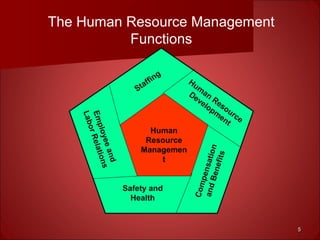
Human Resource Management
 Utilization of individuals to achieve
organizational objectives
 All managers at every level must
concern themselves with human
resource management.
 Five functions
55
1
Human
Resource
Managemen
t
Hum
an
Resource
Developm
ent
Compensation
andBenefits
Staffing
Employeeand
LaborRelations
Safety and
Health
The Human Resource Management
Functions
66
Staffing
 Job Analysis
 Human Resource Planning
(HRP)
 Recruitment
 Selection
77
Staffing (Continued)
 Staffing - Process through which an
organization ensures that it always has
proper number of employees with
appropriate skills in right jobs at right
time to achieve organization’s objectives
 Job analysis - Systematic process of
determining skills, duties, and
knowledge required for performing jobs
in an organization
88
Staffing (Continued)
 Human resource planning - Process of
systematically reviewing human
resource requirements to ensure that
required numbers of employees, with
required skills, are available when
needed.
 Recruitment - Process of attracting
qualified individuals and encouraging
them to apply for work with organization
99
Staffing (Continued)
 Selection - Process through which
organization chooses, from a group of
applicants, those individuals best suited
both for open positions and for the
company
1010
Human Resource Development
 Training
 Development
 Career Planning
 Career Development
 Organizational Development
1111
Human Resource
Development (Continued)
 TrainingTraining - Designed to provide- Designed to provide
learners with the knowledge andlearners with the knowledge and
skills needed for their present jobs.skills needed for their present jobs.
 DevelopmentDevelopment - Involves learning- Involves learning
that goes beyond today's job; it hasthat goes beyond today's job; it has
a more long-term focusa more long-term focus
1212
Human Resource
Development (Continued)
 Career planningCareer planning - An ongoing process- An ongoing process
whereby individual sets career goals andwhereby individual sets career goals and
identifies means to achieve themidentifies means to achieve them
 Career developmentCareer development - Formal approach- Formal approach
used by organization to ensure that peopleused by organization to ensure that people
with proper qualifications and experienceswith proper qualifications and experiences
are available when neededare available when needed
1313
Human Resource
Development (Continued)
 Organization developmentOrganization development – Organization– Organization
wide application of behavioral science towide application of behavioral science to
planned development and support ofplanned development and support of
strategies, structures and processes forstrategies, structures and processes for
improving firm’s effectivenessimproving firm’s effectiveness
1414
Compensation and Benefits
CompensationCompensation --
All rewards thatAll rewards that
individuals receiveindividuals receive
as a result of theiras a result of their
employmentemployment
1515
Compensation & Benefits
Pay - Money that a person receives for
performing a job
Benefits - Additional financial rewards,
other than base pay such as sick leave,
vacations, holidays and medical insurance
Nonfinancial Rewards
 The Job
 Pleasant working environment
1616
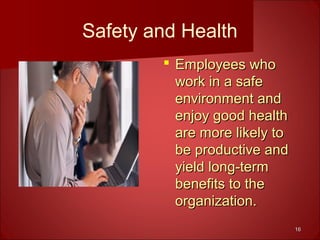
Safety and Health
 Employees whoEmployees who
work in a safework in a safe
environment andenvironment and
enjoy good healthenjoy good health
are more likely toare more likely to
be productive andbe productive and
yield long-termyield long-term
benefits to thebenefits to the
organization.organization.
1717
Safety and Health
 Safety - Involves protecting employees
from injuries caused by work-related
accidents
 Health - Refers to the employees'
freedom from illness and their general
physical and mental well being
1818
Employee and Labor Relations
Business required byBusiness required by
law to recognizelaw to recognize
union and bargainunion and bargain
with it in good faith ifwith it in good faith if
firm’s employeesfirm’s employees
want unionwant union
representation.representation.
1919
Human Resource Research
 Human resource
research is not a
separate function.
 It pervades all HR
functional areas.
2020
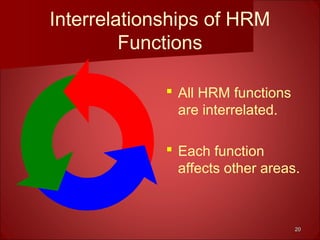
Interrelationships of HRM
Functions
 All HRM functions
are interrelated.
 Each function
affects other areas.
2121
The Dynamic Human
Resource
Management
Environment
2222
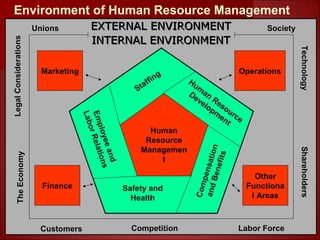
Environment of Human Resource Management
EXTERNAL ENVIRONMENTEXTERNAL ENVIRONMENT
INTERNAL ENVIRONMENTINTERNAL ENVIRONMENT
1
Human
Resource
Managemen
t
Other
Functiona
l Areas
OperationsMarketing
Finance
LegalConsiderationsTheEconomy
Technology
Society
Shareholders
Unions
Customers Competition Labor Force
Hum
an
Resource
Developm
ent
Compensation
andBenefits
Staffing
Employeeand
LaborRelations
Safety and
Health
2323
Labor Force
Pool of individualsPool of individuals
external to firmexternal to firm
from whichfrom which
organizationorganization
obtains its workersobtains its workers
2424
Legal Considerations
 Federal, stateFederal, state
and localand local
legislationlegislation
 Court decisionsCourt decisions
 PresidentialPresidential
executive ordersexecutive orders
2525
Society
 Social responsibilitySocial responsibility – Implied, enforced– Implied, enforced
or felt obligation of managers to serve oror felt obligation of managers to serve or
protect interests of groups other thanprotect interests of groups other than
themselvesthemselves
 EthicsEthics –– Discipline dealing with what isDiscipline dealing with what is
good and bad, or right and wrong, or withgood and bad, or right and wrong, or with
moral duty and obligationmoral duty and obligation
2626
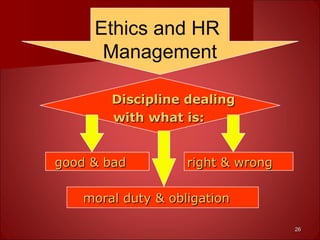
Ethics and HR
Management
Discipline dealingDiscipline dealing
with what is:with what is:
good & bad right & wronggood & bad right & wrong
moral duty & obligationmoral duty & obligation
2727
Unions
Group of employeesGroup of employees
who have joinedwho have joined
together for purposetogether for purpose
of dealingof dealing
collectively with theircollectively with their
employeremployer
2828
Shareholders
 Owners of a corporationOwners of a corporation
 Because they haveBecause they have
invested money in a firm,invested money in a firm,
they may at timesthey may at times
challenge programschallenge programs
considered byconsidered by
management to bemanagement to be
beneficial to thebeneficial to the
organizationorganization
2929
Customers
Because sales criticalBecause sales critical
to firm’s survival,to firm’s survival,
management mustmanagement must
ensure employmentensure employment
practices do notpractices do not
antagonize theantagonize the
customers they servecustomers they serve
3030
Competition
In order toIn order to
succeed, grow andsucceed, grow and
prosper, a firmprosper, a firm
must be able tomust be able to
maintain a supplymaintain a supply
of competentof competent
employees.employees.
3131
Technology
As technology changes:As technology changes:
 Certain skills no longer requiredCertain skills no longer required
 New skills neededNew skills needed
Necessitates some retraining of currentNecessitates some retraining of current
workforceworkforce
3232
The Economy
In general, whenIn general, when
economy is booming,economy is booming,
it is often more difficultit is often more difficult
to recruit qualifiedto recruit qualified
workers.workers.
3333
HR’s Changing Role:
Who Performs Human
Resource Management Tasks?
 Human Resource Managers
 Shared Service Centers
 Outsourcing Firms
 Line Managers
3434
Human Resource Manager
 Acts in advisory or staff
capacity
 Works with other managers to
help them deal with human
resource matters
3535
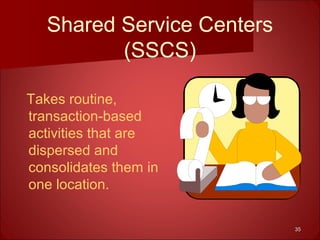
Shared Service Centers
(SSCS)
Takes routine,
transaction-based
activities that are
dispersed and
consolidates them in
one location.
3636
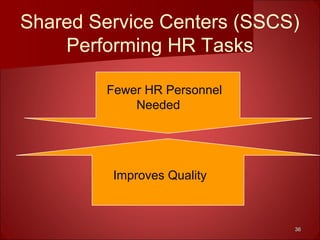
Shared Service Centers (SSCS)
Performing HR Tasks
Fewer HR Personnel
Needed
HR Managers Assume
a More Strategic RoleImproves Quality
3737
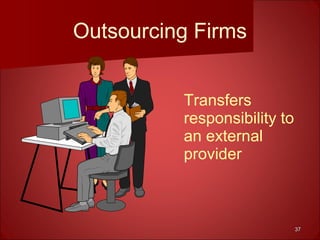
Outsourcing Firms
Transfers
responsibility to
an external
provider
3838
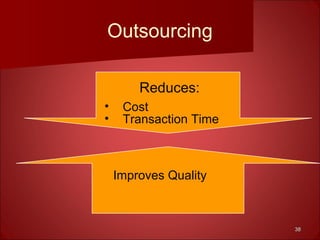
Outsourcing
Reduces:
• Cost
• Transaction Time
Improves Quality
3939
Line Managers Performing
HR Tasks
Involved with humanInvolved with human
resources by nature of theirresources by nature of their
jobsjobs
4040
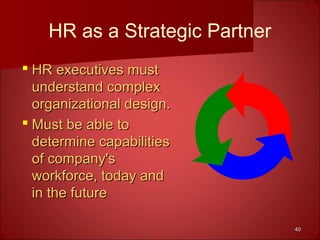
HR as a Strategic Partner
 HR executives mustHR executives must
understand complexunderstand complex
organizational design.organizational design.
 Must be able toMust be able to
determine capabilitiesdetermine capabilities
of company'sof company's
workforce, today andworkforce, today and
in the futurein the future
4141
Human Resource
Designations
4242
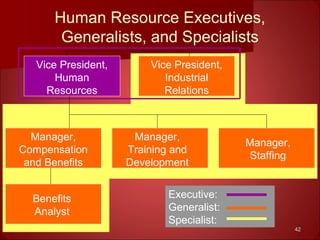
Human Resource Executives,
Generalists, and Specialists
Vice President,
Human
Resources
Vice President,
Industrial
Relations
Manager,
Compensation
and Benefits
Manager,
Staffing
Manager,
Training and
Development
Benefits
Analyst
Executive:
Generalist:
Specialist:
4343
Characteristics of an HR
Executive
 Performs one or more HR functions
 A top-level manager
 Reports directly to the corporation's CEO or
head of major division
4444
Characteristics of an HR
Generalist
 Often an executive
 Performs tasks in various HR related
areas
 Involved in several, or all, of the five
HRM functions
4545
Characteristics of an HR
Specialist
 May be an HR executive, manager, or
non-manager
 Typically concerned with only one of the
five functional areas
4646
The Human Resource
Function In
Organizations Of
Various Sizes
4747
HR in Small Businesses
 Seldom have a formal HR unit
 Focuses on hiring & retaining capable
employees
 Some aspects of HR function may be
more significant in smaller firms than in
larger ones.
4848
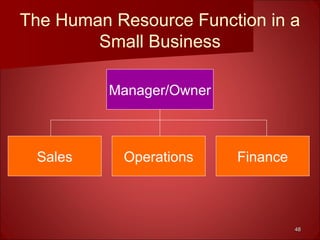
The Human Resource Function in a
Small Business
Manager/Owner
Sales Operations Finance
4949
HR in a Medium-sized Firm
 Little specialization
 HR manager is essentially the
entire department.
5050
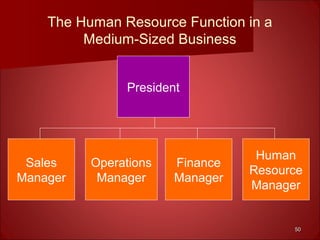
The Human Resource Function in a
Medium-Sized Business
Sales
Manager
President
Operations
Manager
Finance
Manager
Human
Resource
Manager
5151
Traditional Human Resource
Functions in a Large Firm
 Separate sections are often created
 Placed under an HR Manager
 Each HR function may have a supervisor
& staff
 HR Manager works closely with top
management in formulating policy
5252
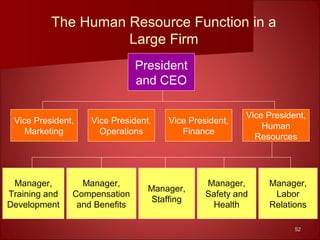
The Human Resource Function in a
Large Firm
President
and CEO
Vice President,
Marketing
Vice President,
Operations
Vice President,
Finance
Vice President,
Human
Resources
Manager,
Training and
Development
Manager,
Compensation
and Benefits
Manager,
Staffing
Manager,
Safety and
Health
Manager,
Labor
Relations
5353
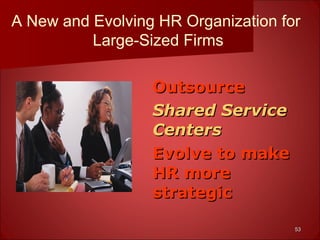
A New and Evolving HR Organization for
Large-Sized Firms
OutsourceOutsource
Shared ServiceShared Service
CentersCenters
Evolve to makeEvolve to make
HR moreHR more
strategicstrategic
5454
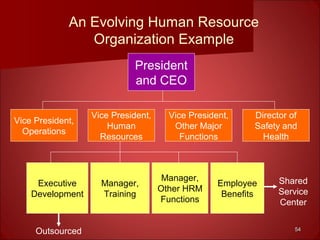
An Evolving Human Resource
Organization Example
President
and CEO
Vice President,
Operations
Vice President,
Human
Resources
Vice President,
Other Major
Functions
Director of
Safety and
Health
Executive
Development
Manager,
Training
Manager,
Other HRM
Functions
Employee
Benefits
Shared
Service
Center
Outsourced
5555

Chapter 1 introduction_to_hrm_dis13

  • 1.
  • 2.
    22 Chapter Objectives  Explainhuman capital management.  Define human resource management.  Identify the human resource management functions.  Identify the external environmental factors that affect human resource management.  Explain who performs the human resource management tasks.
  • 3.
    33 Chapter Objectives (Continued) Explain the need for human resources to be a strategic partner.  Describe the various human resource classifications including executives, generalists, and specialists.  Describe the changes that occur in theDescribe the changes that occur in the human resource function as a firm growshuman resource function as a firm grows larger and more complex and the evolvinglarger and more complex and the evolving HR organization.HR organization.
  • 4.
    44 Human Resource Management Utilization of individuals to achieve organizational objectives  All managers at every level must concern themselves with human resource management.  Five functions
  • 5.
  • 6.
    66 Staffing  Job Analysis Human Resource Planning (HRP)  Recruitment  Selection
  • 7.
    77 Staffing (Continued)  Staffing- Process through which an organization ensures that it always has proper number of employees with appropriate skills in right jobs at right time to achieve organization’s objectives  Job analysis - Systematic process of determining skills, duties, and knowledge required for performing jobs in an organization
  • 8.
    88 Staffing (Continued)  Humanresource planning - Process of systematically reviewing human resource requirements to ensure that required numbers of employees, with required skills, are available when needed.  Recruitment - Process of attracting qualified individuals and encouraging them to apply for work with organization
  • 9.
    99 Staffing (Continued)  Selection- Process through which organization chooses, from a group of applicants, those individuals best suited both for open positions and for the company
  • 10.
    1010 Human Resource Development Training  Development  Career Planning  Career Development  Organizational Development
  • 11.
    1111 Human Resource Development (Continued) TrainingTraining - Designed to provide- Designed to provide learners with the knowledge andlearners with the knowledge and skills needed for their present jobs.skills needed for their present jobs.  DevelopmentDevelopment - Involves learning- Involves learning that goes beyond today's job; it hasthat goes beyond today's job; it has a more long-term focusa more long-term focus
  • 12.
    1212 Human Resource Development (Continued) Career planningCareer planning - An ongoing process- An ongoing process whereby individual sets career goals andwhereby individual sets career goals and identifies means to achieve themidentifies means to achieve them  Career developmentCareer development - Formal approach- Formal approach used by organization to ensure that peopleused by organization to ensure that people with proper qualifications and experienceswith proper qualifications and experiences are available when neededare available when needed
  • 13.
    1313 Human Resource Development (Continued) Organization developmentOrganization development – Organization– Organization wide application of behavioral science towide application of behavioral science to planned development and support ofplanned development and support of strategies, structures and processes forstrategies, structures and processes for improving firm’s effectivenessimproving firm’s effectiveness
  • 14.
    1414 Compensation and Benefits CompensationCompensation-- All rewards thatAll rewards that individuals receiveindividuals receive as a result of theiras a result of their employmentemployment
  • 15.
    1515 Compensation & Benefits Pay- Money that a person receives for performing a job Benefits - Additional financial rewards, other than base pay such as sick leave, vacations, holidays and medical insurance Nonfinancial Rewards  The Job  Pleasant working environment
  • 16.
    1616 Safety and Health Employees whoEmployees who work in a safework in a safe environment andenvironment and enjoy good healthenjoy good health are more likely toare more likely to be productive andbe productive and yield long-termyield long-term benefits to thebenefits to the organization.organization.
  • 17.
    1717 Safety and Health Safety - Involves protecting employees from injuries caused by work-related accidents  Health - Refers to the employees' freedom from illness and their general physical and mental well being
  • 18.
    1818 Employee and LaborRelations Business required byBusiness required by law to recognizelaw to recognize union and bargainunion and bargain with it in good faith ifwith it in good faith if firm’s employeesfirm’s employees want unionwant union representation.representation.
  • 19.
    1919 Human Resource Research Human resource research is not a separate function.  It pervades all HR functional areas.
  • 20.
    2020 Interrelationships of HRM Functions All HRM functions are interrelated.  Each function affects other areas.
  • 21.
  • 22.
    2222 Environment of HumanResource Management EXTERNAL ENVIRONMENTEXTERNAL ENVIRONMENT INTERNAL ENVIRONMENTINTERNAL ENVIRONMENT 1 Human Resource Managemen t Other Functiona l Areas OperationsMarketing Finance LegalConsiderationsTheEconomy Technology Society Shareholders Unions Customers Competition Labor Force Hum an Resource Developm ent Compensation andBenefits Staffing Employeeand LaborRelations Safety and Health
  • 23.
    2323 Labor Force Pool ofindividualsPool of individuals external to firmexternal to firm from whichfrom which organizationorganization obtains its workersobtains its workers
  • 24.
    2424 Legal Considerations  Federal,stateFederal, state and localand local legislationlegislation  Court decisionsCourt decisions  PresidentialPresidential executive ordersexecutive orders
  • 25.
    2525 Society  Social responsibilitySocialresponsibility – Implied, enforced– Implied, enforced or felt obligation of managers to serve oror felt obligation of managers to serve or protect interests of groups other thanprotect interests of groups other than themselvesthemselves  EthicsEthics –– Discipline dealing with what isDiscipline dealing with what is good and bad, or right and wrong, or withgood and bad, or right and wrong, or with moral duty and obligationmoral duty and obligation
  • 26.
    2626 Ethics and HR Management DisciplinedealingDiscipline dealing with what is:with what is: good & bad right & wronggood & bad right & wrong moral duty & obligationmoral duty & obligation
  • 27.
    2727 Unions Group of employeesGroupof employees who have joinedwho have joined together for purposetogether for purpose of dealingof dealing collectively with theircollectively with their employeremployer
  • 28.
    2828 Shareholders  Owners ofa corporationOwners of a corporation  Because they haveBecause they have invested money in a firm,invested money in a firm, they may at timesthey may at times challenge programschallenge programs considered byconsidered by management to bemanagement to be beneficial to thebeneficial to the organizationorganization
  • 29.
    2929 Customers Because sales criticalBecausesales critical to firm’s survival,to firm’s survival, management mustmanagement must ensure employmentensure employment practices do notpractices do not antagonize theantagonize the customers they servecustomers they serve
  • 30.
    3030 Competition In order toInorder to succeed, grow andsucceed, grow and prosper, a firmprosper, a firm must be able tomust be able to maintain a supplymaintain a supply of competentof competent employees.employees.
  • 31.
    3131 Technology As technology changes:Astechnology changes:  Certain skills no longer requiredCertain skills no longer required  New skills neededNew skills needed Necessitates some retraining of currentNecessitates some retraining of current workforceworkforce
  • 32.
    3232 The Economy In general,whenIn general, when economy is booming,economy is booming, it is often more difficultit is often more difficult to recruit qualifiedto recruit qualified workers.workers.
  • 33.
    3333 HR’s Changing Role: WhoPerforms Human Resource Management Tasks?  Human Resource Managers  Shared Service Centers  Outsourcing Firms  Line Managers
  • 34.
    3434 Human Resource Manager Acts in advisory or staff capacity  Works with other managers to help them deal with human resource matters
  • 35.
    3535 Shared Service Centers (SSCS) Takesroutine, transaction-based activities that are dispersed and consolidates them in one location.
  • 36.
    3636 Shared Service Centers(SSCS) Performing HR Tasks Fewer HR Personnel Needed HR Managers Assume a More Strategic RoleImproves Quality
  • 37.
  • 38.
  • 39.
    3939 Line Managers Performing HRTasks Involved with humanInvolved with human resources by nature of theirresources by nature of their jobsjobs
  • 40.
    4040 HR as aStrategic Partner  HR executives mustHR executives must understand complexunderstand complex organizational design.organizational design.  Must be able toMust be able to determine capabilitiesdetermine capabilities of company'sof company's workforce, today andworkforce, today and in the futurein the future
  • 41.
  • 42.
    4242 Human Resource Executives, Generalists,and Specialists Vice President, Human Resources Vice President, Industrial Relations Manager, Compensation and Benefits Manager, Staffing Manager, Training and Development Benefits Analyst Executive: Generalist: Specialist:
  • 43.
    4343 Characteristics of anHR Executive  Performs one or more HR functions  A top-level manager  Reports directly to the corporation's CEO or head of major division
  • 44.
    4444 Characteristics of anHR Generalist  Often an executive  Performs tasks in various HR related areas  Involved in several, or all, of the five HRM functions
  • 45.
    4545 Characteristics of anHR Specialist  May be an HR executive, manager, or non-manager  Typically concerned with only one of the five functional areas
  • 46.
    4646 The Human Resource FunctionIn Organizations Of Various Sizes
  • 47.
    4747 HR in SmallBusinesses  Seldom have a formal HR unit  Focuses on hiring & retaining capable employees  Some aspects of HR function may be more significant in smaller firms than in larger ones.
  • 48.
    4848 The Human ResourceFunction in a Small Business Manager/Owner Sales Operations Finance
  • 49.
    4949 HR in aMedium-sized Firm  Little specialization  HR manager is essentially the entire department.
  • 50.
    5050 The Human ResourceFunction in a Medium-Sized Business Sales Manager President Operations Manager Finance Manager Human Resource Manager
  • 51.
    5151 Traditional Human Resource Functionsin a Large Firm  Separate sections are often created  Placed under an HR Manager  Each HR function may have a supervisor & staff  HR Manager works closely with top management in formulating policy
  • 52.
    5252 The Human ResourceFunction in a Large Firm President and CEO Vice President, Marketing Vice President, Operations Vice President, Finance Vice President, Human Resources Manager, Training and Development Manager, Compensation and Benefits Manager, Staffing Manager, Safety and Health Manager, Labor Relations
  • 53.
    5353 A New andEvolving HR Organization for Large-Sized Firms OutsourceOutsource Shared ServiceShared Service CentersCenters Evolve to makeEvolve to make HR moreHR more strategicstrategic
  • 54.
    5454 An Evolving HumanResource Organization Example President and CEO Vice President, Operations Vice President, Human Resources Vice President, Other Major Functions Director of Safety and Health Executive Development Manager, Training Manager, Other HRM Functions Employee Benefits Shared Service Center Outsourced
  • 55.