

Strategic
Human Resource Management
(Week 1)
LEARNING OBJECTIVES
1. Explain what Human Resource Management is and
how it relates to the management process
2. The trends shaping HR Management
3. Important Trends in HR management
4. Managing Ethics
HUMAN RESOURCE MANAGEMENT
&
ITS IMPORTANCE
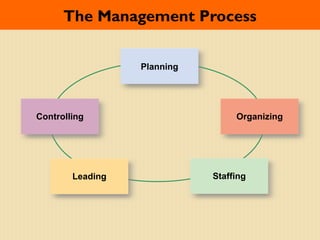
The Management Process
Planning
Organizing
Leading Staffing
Controlling
What is Human Resource Management
(HRM)?
The policies and practices involved in carrying out the
“people” or human resource aspects of a management
position, including:
 Recruiting,
 Screening,
 Training,
 Rewarding,
 Appraising etc
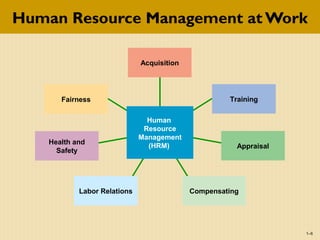
Human Resource Management at Work
1–6
Acquisition
Training
Appraisal
CompensatingLabor Relations
Health and
Safety
Fairness
Human
Resource
Management
(HRM)
Personnel Aspects of a Manager’s Job
 Conducting job analyses
 Planning labor needs and recruiting job candidates
 Selecting job candidates
 Orienting and training new employees
 Managing wages and salaries
 Providing incentives and benefits
 Appraising performance
 Communicating
 Training and developing managers
 Building employee commitment
Personnel Mistakes
 Hire the wrong person for the job
 Experience high turnover
 Have your people not doing their best
 Waste time with useless interviews
 Have your company in court because of discriminatory actions
 Have your company cited by labor inspectors for unsafe practices
 Have some employees think their salaries are unfair and inequitable
relative to others in the organization
 Allow a lack of training to undermine your department’s effectiveness
 Commit any unfair labor practices
Basic HR Concepts
The bottom line of managing: Getting results
HR creates value by engaging in activities that produce
the employee behaviors that the company needs to
achieve its strategic goals:
• Lower Costs
• Improve Productivity
• Increase Organizational Effectiveness
Line and Staff Aspects of HRM
Line Manager
◦ A manager who is authorized to direct the work of
subordinates and is responsible for accomplishing the
organization’s tasks.
Staff Manager
◦ A manager who assists and advises line managers.
Line Managers’ HRM Responsibilities
1. Placing the right person on the right job
2. Starting new employees in the organization (orientation)
3. Training employees for jobs that are new to them
4. Improving the job performance of each person
5. Gaining creative cooperation and developing smooth working
relationships
6. Interpreting the firm’s policies and procedures
7. Controlling labor costs
8. Developing the abilities of each person
9. Creating and maintaining department morale
10. Protecting employees’ health and physical condition
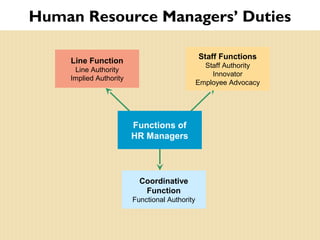
Human Resource Managers’ Duties
Functions of
HR Managers
Line Function
Line Authority
Implied Authority
Staff Functions
Staff Authority
Innovator
Employee Advocacy
Coordinative
Function
Functional Authority
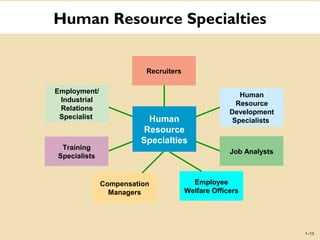
Human Resource Specialties
1–13
Recruiters
Human
Resource
Development
Specialists
Employment/
Industrial
Relations
Specialist
Training
Specialists
Job Analysts
Compensation
Managers
Human
Resource
Specialties
Employee
Welfare Officers
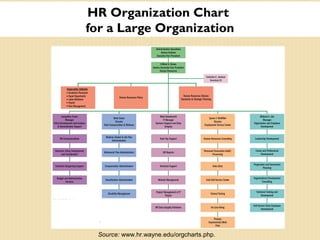
HR Organization Chart
for a Large Organization
Source: www.hr.wayne.edu/orgcharts.php.
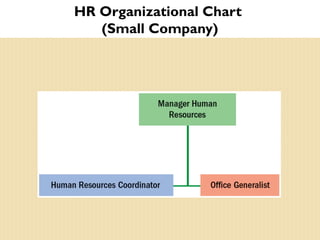
HR Organizational Chart
(Small Company)
TRENDS SHAPING
HUMAN RESOURCE MANAGEMENT
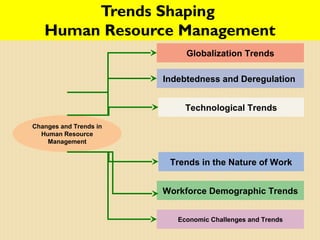
Globalization Trends
Trends in the Nature of Work
Workforce Demographic Trends
Economic Challenges and Trends
Changes and Trends in
Human Resource
Management
Trends Shaping
Human Resource Management
Indebtedness and Deregulation
Technological Trends
Globalization refers to the tendency of firms to extend
their sales, ownership, and/or manufacturing to markets
abroad.
Triggered changes in organization, management and use
of HR Departments
Means more competition, more pressure to lower
costs, making employees more productive and do
better things less expensively
Globalization and Competition Trends
Government stipends stripped away rules and regulations.
e.g. In the US and EU, the rules that prevented
commercial banks from expanding into new businesses,
such as stock brokering, were relaxed.
Indebtedness and Deregulation
Technological Applications for HR
• Application Service Providers (ASPs) and technology
outsourcing
• Web portals
• PCs and high-speed access
• Streaming desktop video
• The mobile Web and wireless net access
• E-procurement
Technological Applications for HR
• Internet- and network-monitoring software
• Bluetooth
• Electronic signatures
• Electronic bill presentment and payment
• Data warehouses and computerized analytical
programs
Jobs are changing due to new technological demands.
 Dramatic increases in productivity have allowed
manufacturers to produce more with fewer employees.
Nontraditional workers, such as those who hold multiple
jobs, “contingent” or part-time workers, or people
working in alternative work arrangements, enable
employers to keep costs down.
Trends in the Nature of Work
• High-Tech Jobs – More jobs have gone high tech, requiring
workers to have more education and skills. Even traditional blue-
collar jobs require more math, reading, writing, and computer skills
than ever before.
• Service Jobs – Most newly created jobs are and will
continue to be in the service sector.
• Knowledge Work and Human Capital – This refers to
the knowledge, education, training, skills, and expertise of a firm’s
workers. The HR function must employ more sophisticated and
creative means to identify, attract, select, train, and motivate the
required workforce.
Trends in the Nature of Work
 The labor force is getting older and more multi-ethnic
 The aging labor force presents significant changes in terms of
potential labor shortages
 Many firms are instituting new policies aimed at encouraging
aging employees to stay, or at attracting previously retired employees
 Growing numbers of workers with eldercare responsibilities
 High rates of immigration also present challenges and
opportunities for HR managers
Workforce Demographic Trends
 New economies growing
 Free trade agreements and Zones
Economic Challenges and Trends
IMPORTANTTRENDS IN
HUMAN RESOURCE MANAGEMENT
• Companies are competing in a very challenging new
environment.
• Globalization, competition, technology, workforce
trends, and economic upheaval confront employers
with new challenges.
• In that context, they expect and demand that their
human resource managers exhibit the competencies
required to help the company address these new
challenges proactively
THE NEW HUMAN RESOURCE
MANAGEMENT
STRATEGIC HUMAN RESOURCE
MANAGEMENT
• Management expects HR to provide measurable,
benchmark-based evidence
• for its current efficiency and effectiveness
• for the expected efficiency and effectiveness of new
or proposed HR programs
• Management expects solid, quantified evidence that
HR is contributing in a meaningful and positive way to
achieving the firm’s strategic aims.
High-Performance Work System
Practices
Employment security
Selective hiring
Extensive training
Self-managed teams/decentralized decision making
Reduced status distinctions
Information sharing
Contingent (pay-for-performance) rewards
Transformational leadership
Measurement of management practices
Emphasis on high-quality work
Benefits of a High-Performance Work
System (HPWS)
Generate more job applicants
Screen candidates more effectively
Provide more and better training
Link pay more explicitly to performance
Provide a safer work environment
Produce more qualified applicants per position
Hiring based on validated selection tests
Provide more hours of training for new employees
Conduct more performance appraisals
It is the use of
• Data
• Facts
• Analytics
• Scientific Rigor
• Critical Evaluation
• Critically Evaluated Research/Case Studies
to support human resource management proposals,
decisions, practices, and conclusions
Evidence-Based Human Resource
Management
The Human Resource Manager’s
Proficiencies
New Proficiencies
• HR proficiencies
Business proficiencies
• Leadership proficiencies
• Learning proficiencies
The Human Resource Manager’s Proficiencies
(continued)
Managing within the Law
• Equal employment laws
• Industrial Disputes laws
• Occupational safety and health laws
• Other labor laws
Managing Ethics
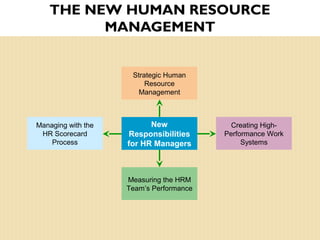
THE NEW HUMAN RESOURCE
MANAGEMENT
New
Responsibilities
for HR Managers
Measuring the HRM
Team’s Performance
Managing with the
HR Scorecard
Process
Creating High-
Performance Work
Systems
Strategic Human
Resource
Management
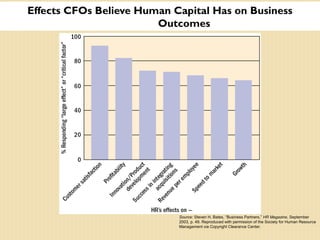
Effects CFOs Believe Human Capital Has on Business
Outcomes
Source: Steven H. Bates, “Business Partners,” HR Magazine, September
2003, p. 49. Reproduced with permission of the Society for Human Resource
Management via Copyright Clearance Center.
BasicThemes
HRM is the responsibility of every manager.
HR managers must defend their plans and
contributions in measurable terms.
All personnel actions and decisions have strategic
implications.
All managers rely on information technology.
Virtually every personnel decision has legal
implications.

Week 1(1)

  • 1.
  • 2.
    LEARNING OBJECTIVES 1. Explainwhat Human Resource Management is and how it relates to the management process 2. The trends shaping HR Management 3. Important Trends in HR management 4. Managing Ethics
  • 3.
  • 4.
  • 5.
    What is HumanResource Management (HRM)? The policies and practices involved in carrying out the “people” or human resource aspects of a management position, including:  Recruiting,  Screening,  Training,  Rewarding,  Appraising etc
  • 6.
    Human Resource Managementat Work 1–6 Acquisition Training Appraisal CompensatingLabor Relations Health and Safety Fairness Human Resource Management (HRM)
  • 7.
    Personnel Aspects ofa Manager’s Job  Conducting job analyses  Planning labor needs and recruiting job candidates  Selecting job candidates  Orienting and training new employees  Managing wages and salaries  Providing incentives and benefits  Appraising performance  Communicating  Training and developing managers  Building employee commitment
  • 8.
    Personnel Mistakes  Hirethe wrong person for the job  Experience high turnover  Have your people not doing their best  Waste time with useless interviews  Have your company in court because of discriminatory actions  Have your company cited by labor inspectors for unsafe practices  Have some employees think their salaries are unfair and inequitable relative to others in the organization  Allow a lack of training to undermine your department’s effectiveness  Commit any unfair labor practices
  • 9.
    Basic HR Concepts Thebottom line of managing: Getting results HR creates value by engaging in activities that produce the employee behaviors that the company needs to achieve its strategic goals: • Lower Costs • Improve Productivity • Increase Organizational Effectiveness
  • 10.
    Line and StaffAspects of HRM Line Manager ◦ A manager who is authorized to direct the work of subordinates and is responsible for accomplishing the organization’s tasks. Staff Manager ◦ A manager who assists and advises line managers.
  • 11.
    Line Managers’ HRMResponsibilities 1. Placing the right person on the right job 2. Starting new employees in the organization (orientation) 3. Training employees for jobs that are new to them 4. Improving the job performance of each person 5. Gaining creative cooperation and developing smooth working relationships 6. Interpreting the firm’s policies and procedures 7. Controlling labor costs 8. Developing the abilities of each person 9. Creating and maintaining department morale 10. Protecting employees’ health and physical condition
  • 12.
    Human Resource Managers’Duties Functions of HR Managers Line Function Line Authority Implied Authority Staff Functions Staff Authority Innovator Employee Advocacy Coordinative Function Functional Authority
  • 13.
  • 14.
    HR Organization Chart fora Large Organization Source: www.hr.wayne.edu/orgcharts.php.
  • 15.
  • 16.
  • 17.
    Globalization Trends Trends inthe Nature of Work Workforce Demographic Trends Economic Challenges and Trends Changes and Trends in Human Resource Management Trends Shaping Human Resource Management Indebtedness and Deregulation Technological Trends
  • 18.
    Globalization refers tothe tendency of firms to extend their sales, ownership, and/or manufacturing to markets abroad. Triggered changes in organization, management and use of HR Departments Means more competition, more pressure to lower costs, making employees more productive and do better things less expensively Globalization and Competition Trends
  • 19.
    Government stipends strippedaway rules and regulations. e.g. In the US and EU, the rules that prevented commercial banks from expanding into new businesses, such as stock brokering, were relaxed. Indebtedness and Deregulation
  • 20.
    Technological Applications forHR • Application Service Providers (ASPs) and technology outsourcing • Web portals • PCs and high-speed access • Streaming desktop video • The mobile Web and wireless net access • E-procurement
  • 21.
    Technological Applications forHR • Internet- and network-monitoring software • Bluetooth • Electronic signatures • Electronic bill presentment and payment • Data warehouses and computerized analytical programs
  • 22.
    Jobs are changingdue to new technological demands.  Dramatic increases in productivity have allowed manufacturers to produce more with fewer employees. Nontraditional workers, such as those who hold multiple jobs, “contingent” or part-time workers, or people working in alternative work arrangements, enable employers to keep costs down. Trends in the Nature of Work
  • 23.
    • High-Tech Jobs– More jobs have gone high tech, requiring workers to have more education and skills. Even traditional blue- collar jobs require more math, reading, writing, and computer skills than ever before. • Service Jobs – Most newly created jobs are and will continue to be in the service sector. • Knowledge Work and Human Capital – This refers to the knowledge, education, training, skills, and expertise of a firm’s workers. The HR function must employ more sophisticated and creative means to identify, attract, select, train, and motivate the required workforce. Trends in the Nature of Work
  • 24.
     The laborforce is getting older and more multi-ethnic  The aging labor force presents significant changes in terms of potential labor shortages  Many firms are instituting new policies aimed at encouraging aging employees to stay, or at attracting previously retired employees  Growing numbers of workers with eldercare responsibilities  High rates of immigration also present challenges and opportunities for HR managers Workforce Demographic Trends
  • 25.
     New economiesgrowing  Free trade agreements and Zones Economic Challenges and Trends
  • 26.
  • 27.
    • Companies arecompeting in a very challenging new environment. • Globalization, competition, technology, workforce trends, and economic upheaval confront employers with new challenges. • In that context, they expect and demand that their human resource managers exhibit the competencies required to help the company address these new challenges proactively THE NEW HUMAN RESOURCE MANAGEMENT
  • 28.
    STRATEGIC HUMAN RESOURCE MANAGEMENT •Management expects HR to provide measurable, benchmark-based evidence • for its current efficiency and effectiveness • for the expected efficiency and effectiveness of new or proposed HR programs • Management expects solid, quantified evidence that HR is contributing in a meaningful and positive way to achieving the firm’s strategic aims.
  • 29.
    High-Performance Work System Practices Employmentsecurity Selective hiring Extensive training Self-managed teams/decentralized decision making Reduced status distinctions Information sharing Contingent (pay-for-performance) rewards Transformational leadership Measurement of management practices Emphasis on high-quality work
  • 30.
    Benefits of aHigh-Performance Work System (HPWS) Generate more job applicants Screen candidates more effectively Provide more and better training Link pay more explicitly to performance Provide a safer work environment Produce more qualified applicants per position Hiring based on validated selection tests Provide more hours of training for new employees Conduct more performance appraisals
  • 31.
    It is theuse of • Data • Facts • Analytics • Scientific Rigor • Critical Evaluation • Critically Evaluated Research/Case Studies to support human resource management proposals, decisions, practices, and conclusions Evidence-Based Human Resource Management
  • 32.
    The Human ResourceManager’s Proficiencies New Proficiencies • HR proficiencies Business proficiencies • Leadership proficiencies • Learning proficiencies
  • 33.
    The Human ResourceManager’s Proficiencies (continued) Managing within the Law • Equal employment laws • Industrial Disputes laws • Occupational safety and health laws • Other labor laws Managing Ethics
  • 34.
    THE NEW HUMANRESOURCE MANAGEMENT New Responsibilities for HR Managers Measuring the HRM Team’s Performance Managing with the HR Scorecard Process Creating High- Performance Work Systems Strategic Human Resource Management
  • 35.
    Effects CFOs BelieveHuman Capital Has on Business Outcomes Source: Steven H. Bates, “Business Partners,” HR Magazine, September 2003, p. 49. Reproduced with permission of the Society for Human Resource Management via Copyright Clearance Center.
  • 36.
    BasicThemes HRM is theresponsibility of every manager. HR managers must defend their plans and contributions in measurable terms. All personnel actions and decisions have strategic implications. All managers rely on information technology. Virtually every personnel decision has legal implications.