Introduction
of surveying
PREPARED BY:
HAFIZ SHAKEEL AHMAD
OUTLINE
 Surveying – introduction
 Objectives / purposes of surveying
 Uses of surveying
 Primary divisions of surveying
 Classification of surveying
 Principle of surveying
SURVEYING
 Surveying is the art of determining the relative
positions of points on, above or beneath the
surface of the earth.
 The relative positions are determined by
measuring horizontal distances, vertical distances,
horizontal angles and vertical angles accurately
using various surveying instruments.
 Levelling is a branch of surveying dealing with
determination of relative heights of the point on
the surface of the earth in a vertical plane.
PURPOSE OF SURVEYING
 To take measurements, to determine the relative
positions of the points on, above or beneath the
surface of the earth.
 To determine areas and volumes.
 To mark the positions of the proposed structures
on the ground. e.g. building, canal, road.
 To prepare a map or plan to show the relative
positions of the objects on the surface of the
earth.
 To fix the boundaries of districts, states and
countries.
USES OF SURVEYING
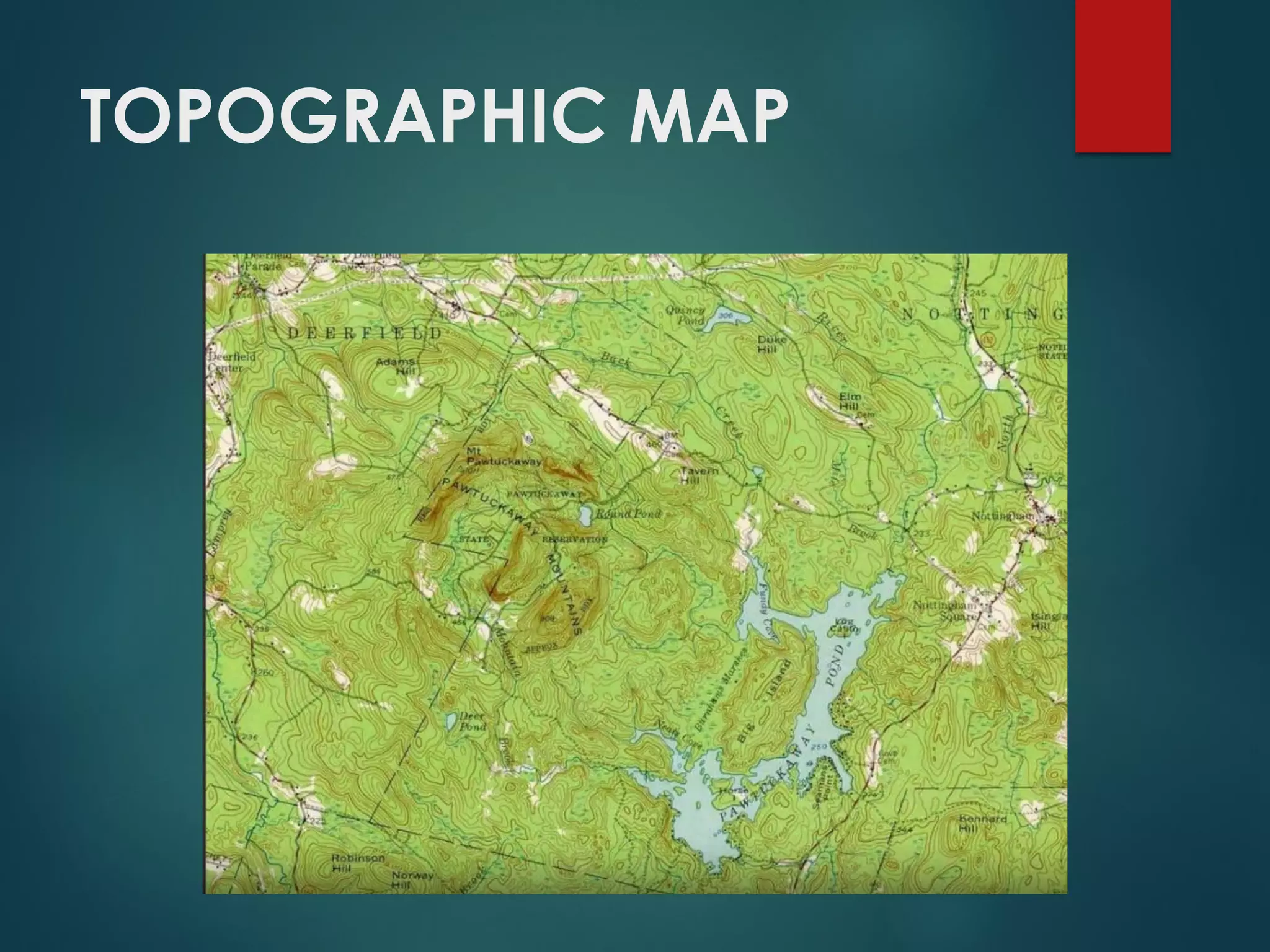
 To prepare a topographical map which shows
natural features of a country such as rivers,
streams, lakes, hills, valleys forests.
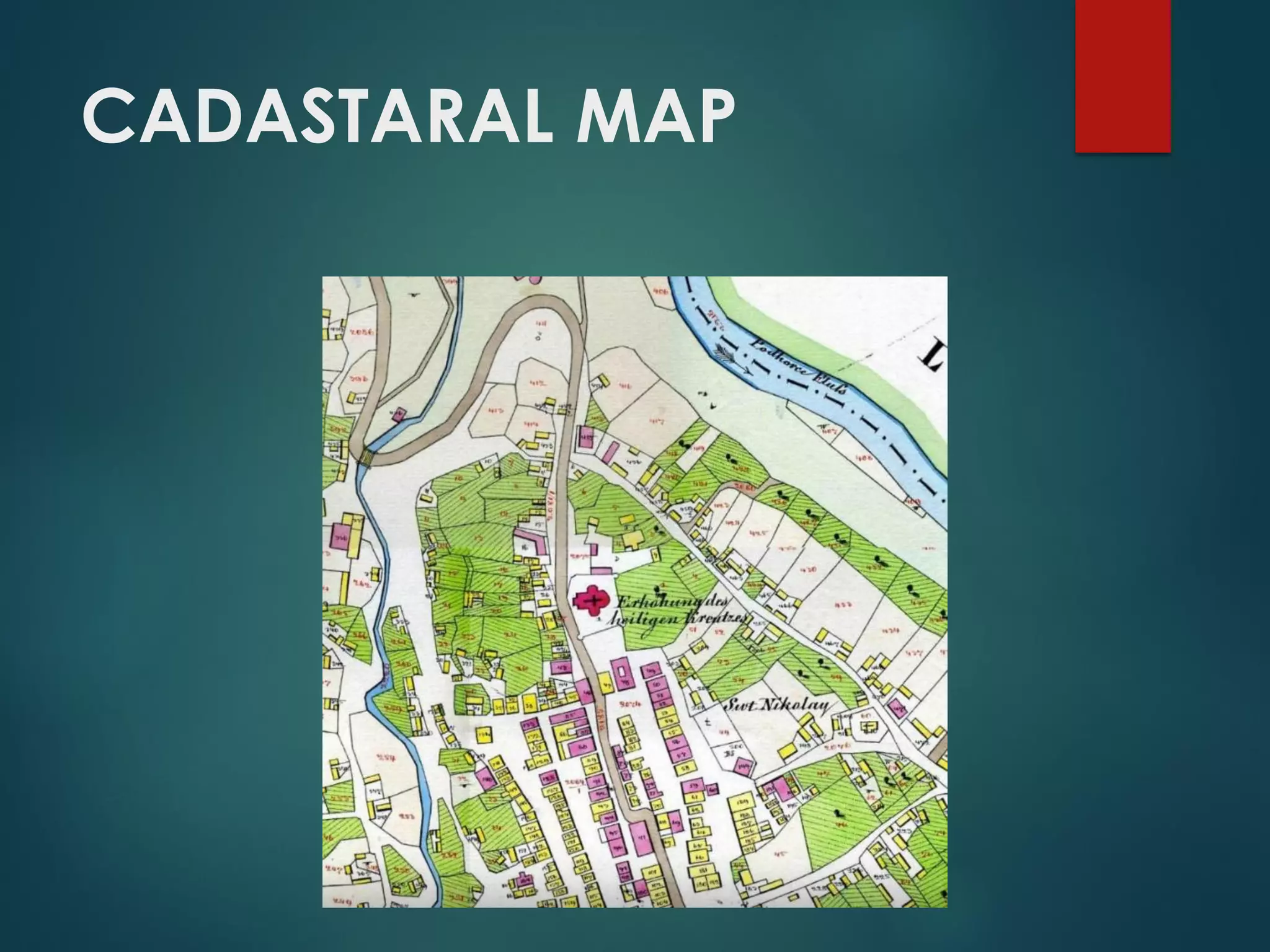
 To prepare a cadastral map which show the
boundaries of fields, plots.
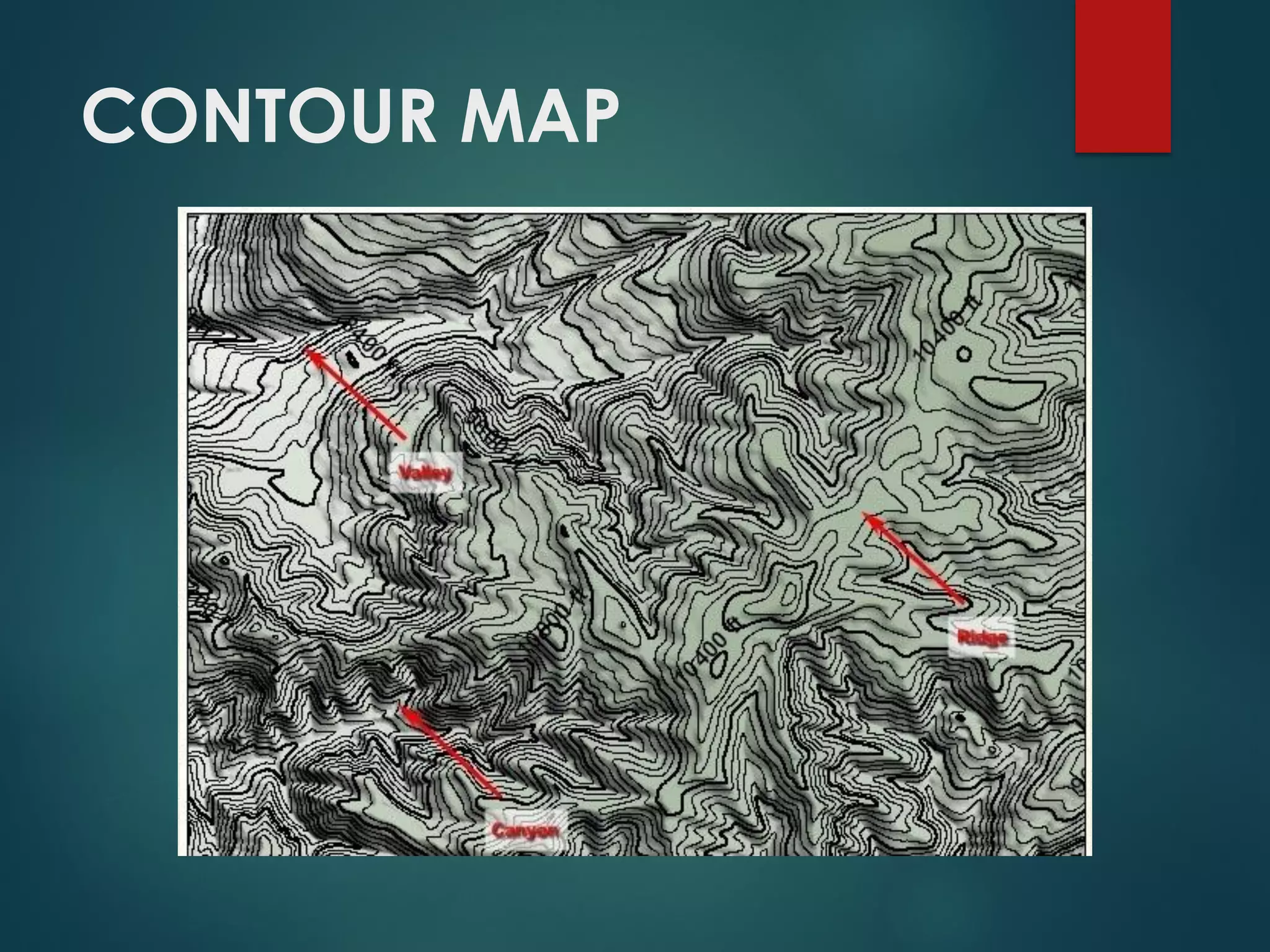
 To prepare contour map to know the topography
of the area to find out the best possible site for
dam, canals, buildings, roads, railways, bridges.
 Route surveys are conducted to fix the alignment
of road, railway, canal, electric tower line, tunnel,
bridge on the ground.
USES OF SURVEYING
(CONTD)
 To plot irregular boundaries of plots and existing
structures on paper.
 To lay particular slope for water supply, drainage,
gas line or road.
 To carry out survey on lakes, rivers and sea to
study the bed profile.
 Finding out level difference between various
points on the ground surface.
 Military survey is used for determining points of
strategic importance.
USES OF SURVEYING
(CONTD)
 Mine survey is used for the exploring mineral
wealth.
 City survey is used for planning streets, water
supply systems, sewers.
 Remote sensing is useful to determine agricultural
soil, forest cover, waterbodies.
TOPOGRAPHIC MAP
CADASTARAL MAP
CONTOUR MAP
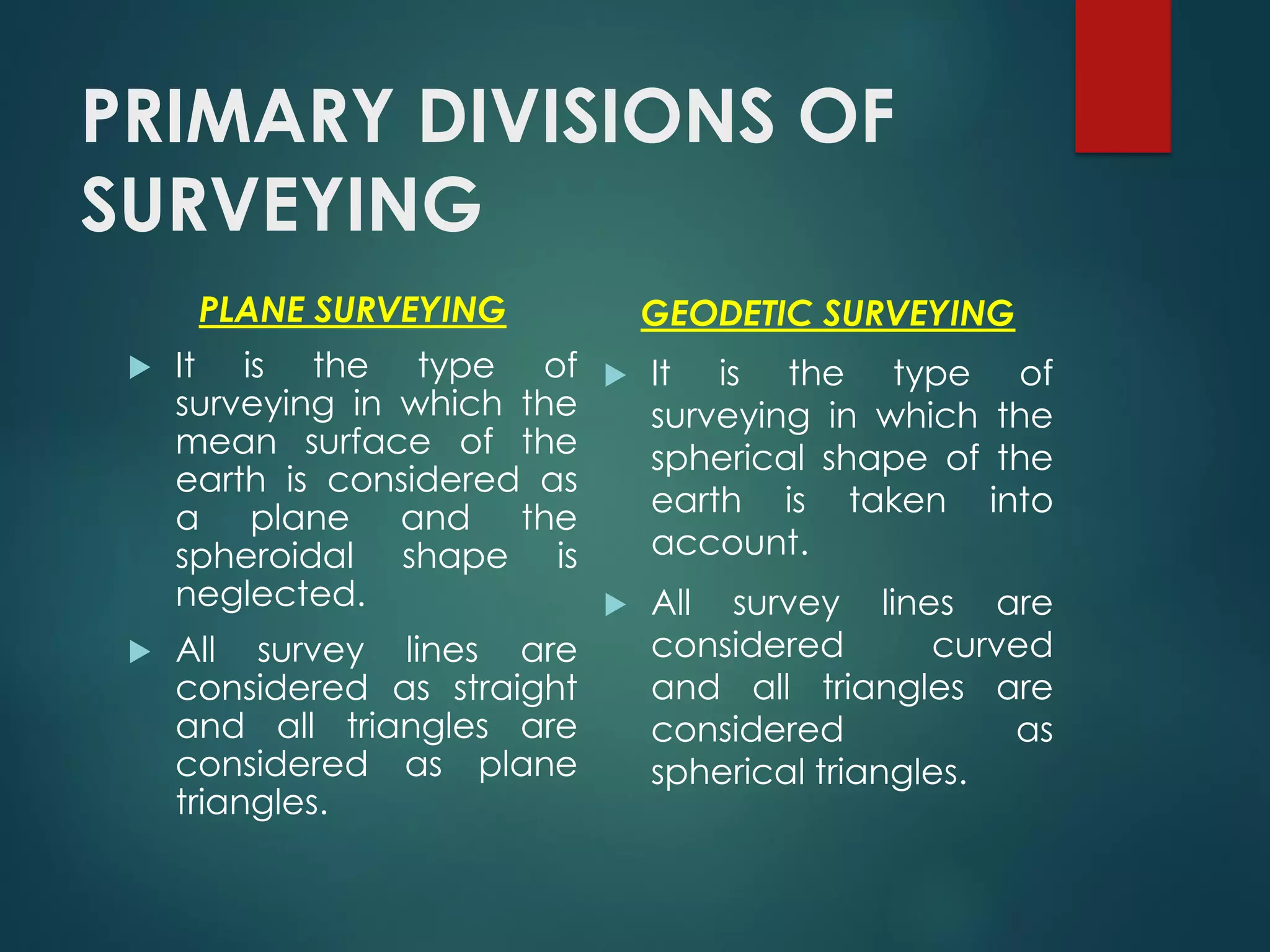
PRIMARY DIVISIONS OF
SURVEYING
 Surveying can be divided in to two groups.
 Plane Surveying
 Geodetic Surveying
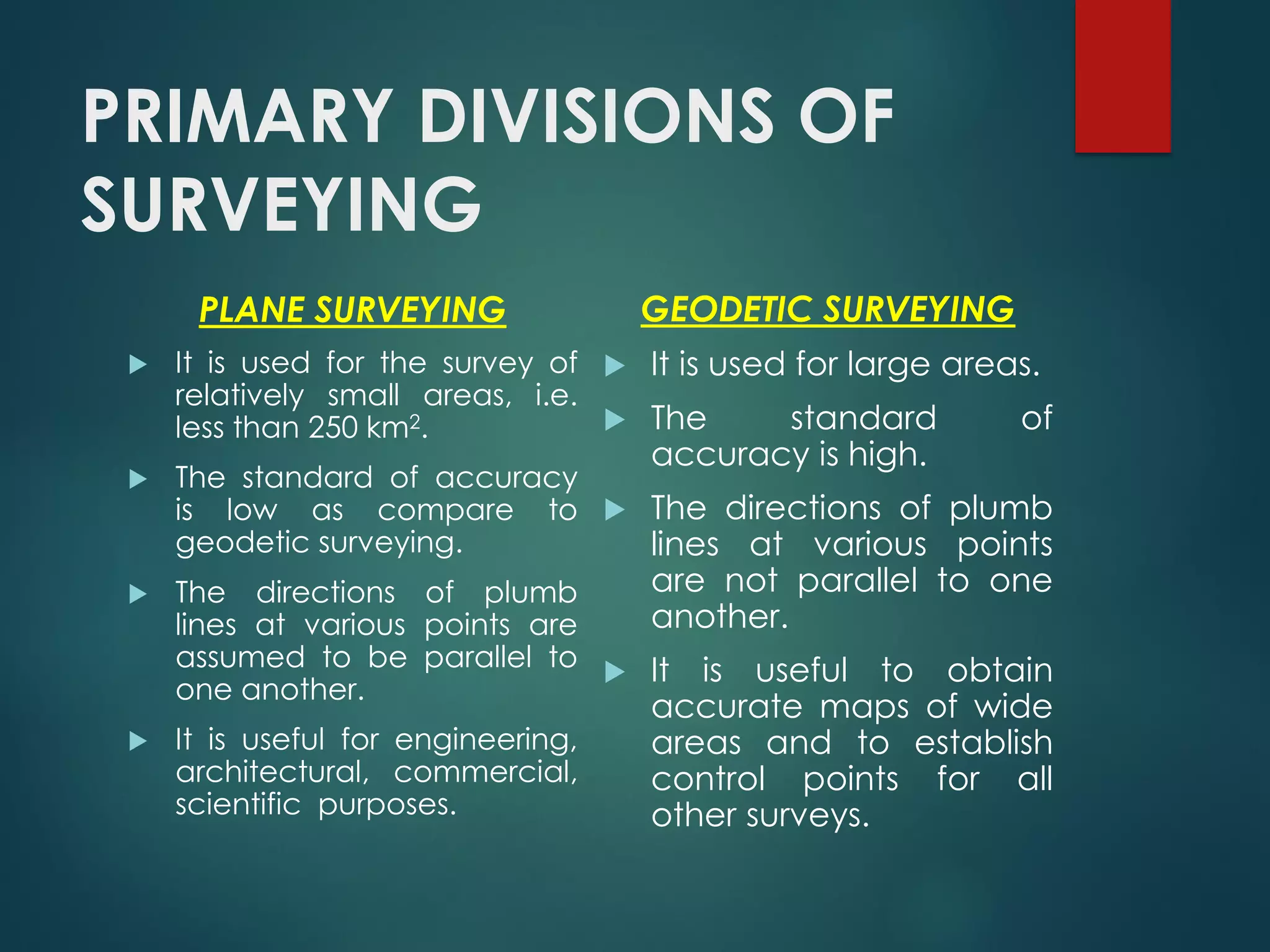
PRIMARY DIVISIONS OF
SURVEYING
PRIMARY DIVISIONS OF
SURVEYING
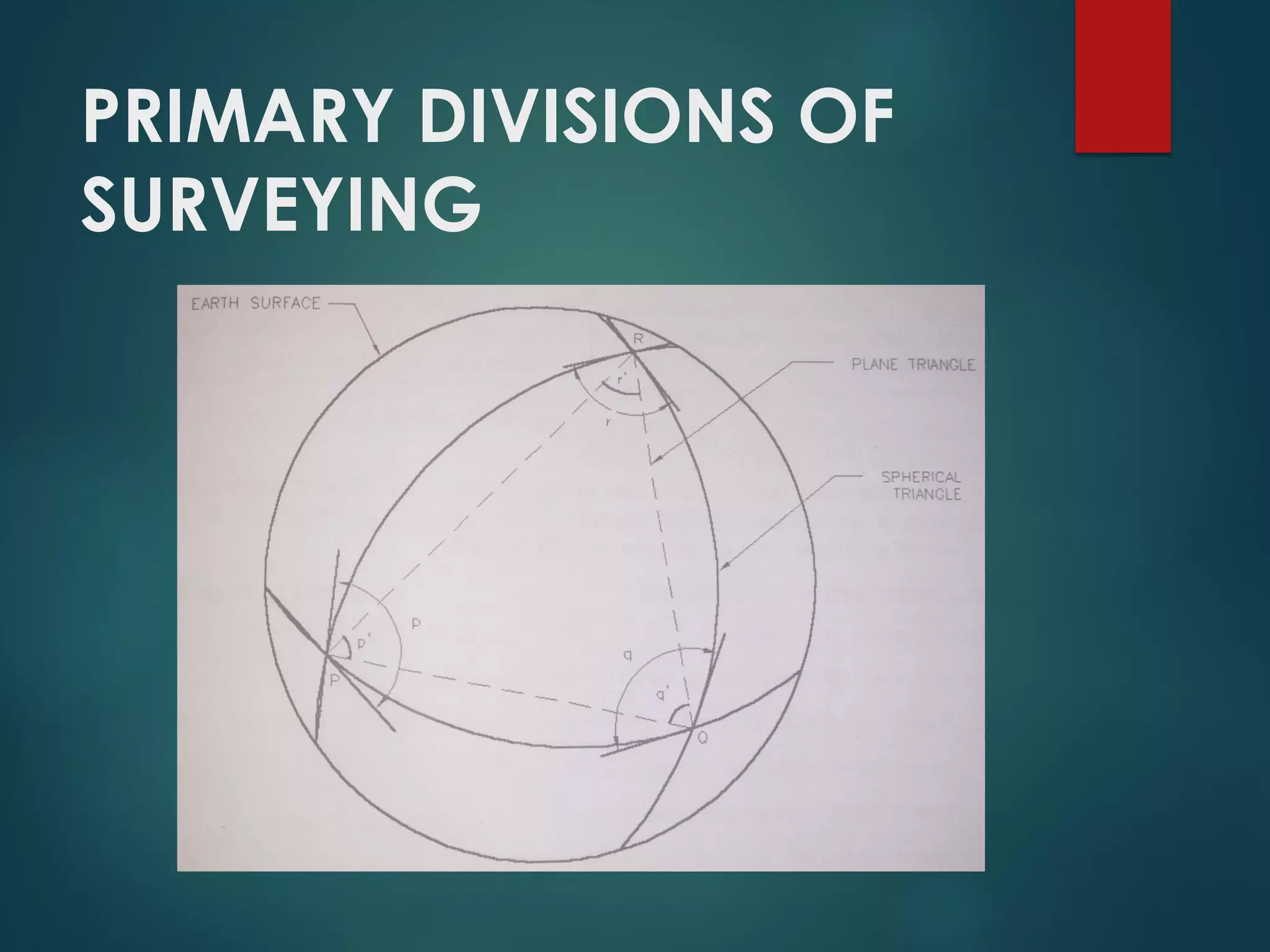
PLANE SURVEYING
 It is the type of
surveying in which the
mean surface of the
earth is considered as
a plane and the
spheroidal shape is
neglected.
 All survey lines are
considered as straight
and all triangles are
considered as plane
triangles.
GEODETIC SURVEYING
 It is the type of
surveying in which the
spherical shape of the
earth is taken into
account.
 All survey lines are
considered curved
and all triangles are
considered as
spherical triangles.
PRIMARY DIVISIONS OF
SURVEYING
PLANE SURVEYING
 It is used for the survey of
relatively small areas, i.e.
less than 250 km2.
 The standard of accuracy
is low as compare to
geodetic surveying.
 The directions of plumb
lines at various points are
assumed to be parallel to
one another.
 It is useful for engineering,
architectural, commercial,
scientific purposes.
GEODETIC SURVEYING
 It is used for large areas.
 The standard of
accuracy is high.
 The directions of plumb
lines at various points
are not parallel to one
another.
 It is useful to obtain
accurate maps of wide
areas and to establish
control points for all
other surveys.
CLASSIFICATION OF
SURVEYING
 Surveying can be classified as follows;
 Based upon the nature of field of survey
 Based upon object of survey
 Based upon instrument used
 Based upon the method applied
CLASSIFICATION BASED
UPON NATURE OF FIELD
 Land Survey:
Conducted on the earth’s surface.
 Marine Survey:
Conducted on water bodies like ocean, rivers.
 Astronomical Survey:
Conducted to study the position and movement of
celestial bodies.
CLASSIFICATION BASED
UPON OBJECT OF SURVEY
 Archaeological Survey:
Conducted for unearthing relics of antiquity.
 Geotechnical/Geographical Survey:
Conducted for determining the different strata in
earth’s crust.
 Mine Survey:
Conducted to study the mineral deposits on or
beneath the surface of the earth.
 Military Survey:
Conducted for military purpose.
CLASSIFICATION BASED
UPON OBJECT OF SURVEY
 Control Survey:
Conducted for establishing a network of control points
which serve as reference frame work.
 Route Survey:
Conducted to determine the alignment of highway,
railway, canal, pipelines, transmission lines.
 Engineering Survey:
Conducted for collecting data for engineering
purposes like design of dam, road, bridges.
 Construction Survey:
Conducted for location of construction works, giving
line, fixing grades.
CLASSIFICATION BASED
UPON OBJECT OF SURVEY
 Topographic Survey:
Conducted to determine the nature of features of hills,
river, lakes, towns, villages, buildings, roads, railways.
 Cadastral Survey:
Conducted to determine the details of boundaries of
fields, houses and other private and public properties.
CLASSIFICATION BASED
UPON INSTRUMENT USED
 Chain Survey:
Chain or tape is used for linear distance measurement.
 Compass Survey:
Compass is used for measurement of horizontal
angles.
 Plane Table Survey:
Plane table is used for preparing plan of given area
and collecting details during the survey.
 Theodolite Survey:
Theodolite is used for measuring vertical and horizontal
angles.
CLASSIFICATION BASED
UPON INSTRUMENT USED
 Tachometric Survey:
Tachometer is used for measuring horizontal and vertical
distance.
 Aerial Survey:
Photographs taken from higher altitude are used for
collecting the details of earth’s features.
 Electronic Distance Measurement Survey:
Device working on the principles of electronic distance
measurement is used for determining the distance
between two indivisible object.
 Remote Sensing:
Data collected from satellites are used for determining
the position of earth’s features.
CLASSIFICATION BASED
UPON METHOD APPLIED
 Triangulation Survey:
The area is covered with a network of triangles and
details are collected.
 Traverse Survey:
The area is covered by a series of survey lines forming
traverse and details are collected.
PRINCIPLES OF SURVEYING
 The two fundamental principles of surveying are;
 To work from whole to part
 To fix positions of new points by at least two
measurements.
TO WORK FROM WHOLE TO
PART
 This principle states that it is essential to first
establish control points with high precision.
 They are further subdivided into smaller areas,
with slightly less precision.
 The object of this is to prevent the accumulation
of errors.
 According to this principle, first of all control points
A, B, C are fixed with great care and the
framework ABC is prepared.
TO WORK FROM WHOLE TO
PART
TO FIX POSITIONS OF NEW POINTS
BY AT LEAST TWO MEASUREMENTS
TO FIX POSITIONS OF NEW POINTS
BY AT LEAST TWO MEASUREMENTS
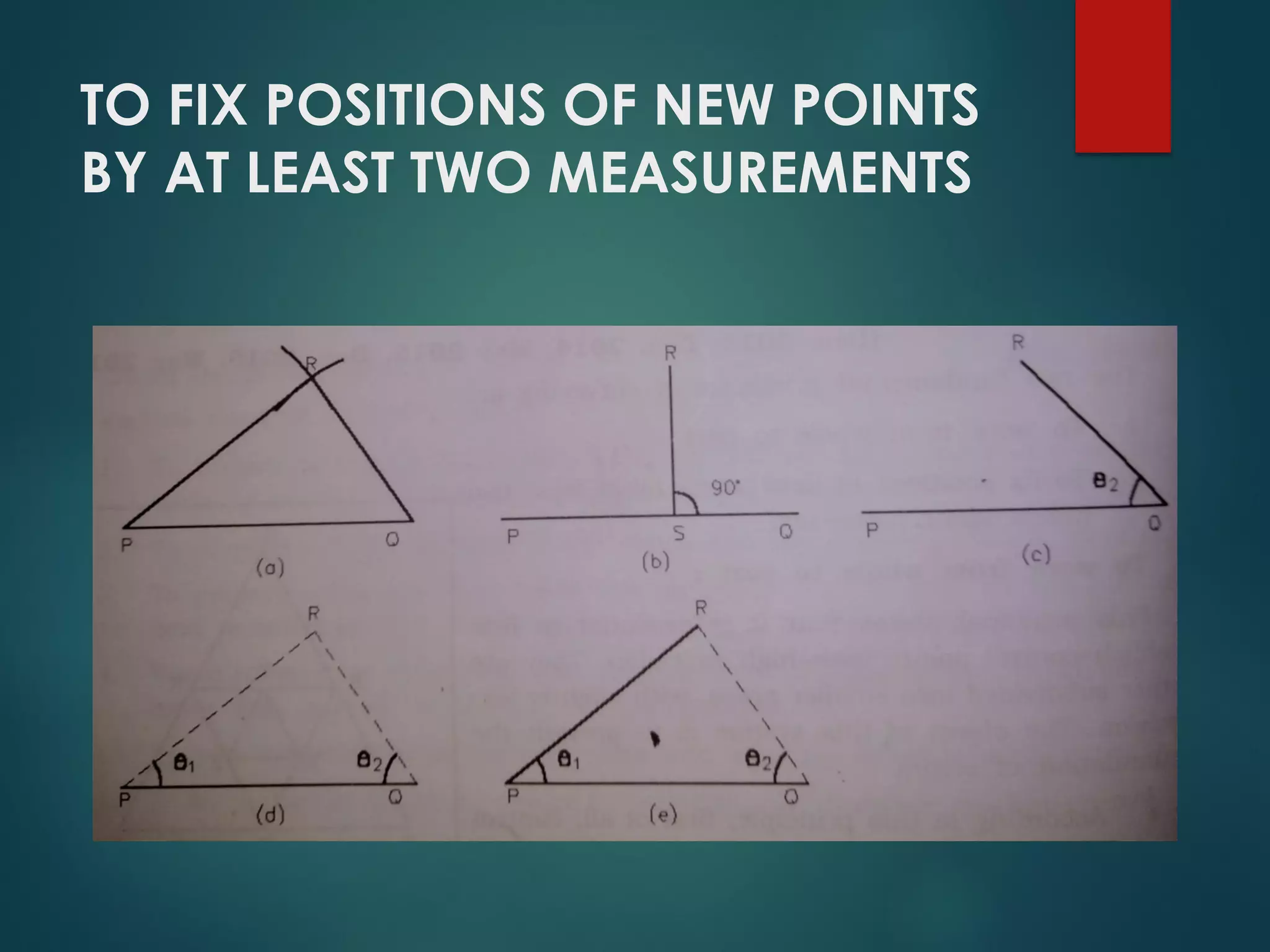
 The fixation of a new point in relation to the point
already located can be done by either linear
measurement or angular measurement or both
linear and angular measurements. For example,
various possible methods of locating a point R,
with respect to points P and Q.
 A. distance PR and QR are measured.
 B. angle QSR is a right angle and distances QS
and SR are measured.
 C. angle PQR and distance QR are measured.
 D. angle PQR and QPR are measured.
 E. angle PQR and distance PR are measure.
THANK YOU

1. Introduction of surveying.pdf

  • 1.
  • 2.
    OUTLINE  Surveying –introduction  Objectives / purposes of surveying  Uses of surveying  Primary divisions of surveying  Classification of surveying  Principle of surveying
  • 3.
    SURVEYING  Surveying isthe art of determining the relative positions of points on, above or beneath the surface of the earth.  The relative positions are determined by measuring horizontal distances, vertical distances, horizontal angles and vertical angles accurately using various surveying instruments.  Levelling is a branch of surveying dealing with determination of relative heights of the point on the surface of the earth in a vertical plane.
  • 4.
    PURPOSE OF SURVEYING To take measurements, to determine the relative positions of the points on, above or beneath the surface of the earth.  To determine areas and volumes.  To mark the positions of the proposed structures on the ground. e.g. building, canal, road.  To prepare a map or plan to show the relative positions of the objects on the surface of the earth.  To fix the boundaries of districts, states and countries.
  • 5.
    USES OF SURVEYING To prepare a topographical map which shows natural features of a country such as rivers, streams, lakes, hills, valleys forests.  To prepare a cadastral map which show the boundaries of fields, plots.  To prepare contour map to know the topography of the area to find out the best possible site for dam, canals, buildings, roads, railways, bridges.  Route surveys are conducted to fix the alignment of road, railway, canal, electric tower line, tunnel, bridge on the ground.
  • 6.
    USES OF SURVEYING (CONTD) To plot irregular boundaries of plots and existing structures on paper.  To lay particular slope for water supply, drainage, gas line or road.  To carry out survey on lakes, rivers and sea to study the bed profile.  Finding out level difference between various points on the ground surface.  Military survey is used for determining points of strategic importance.
  • 7.
    USES OF SURVEYING (CONTD) Mine survey is used for the exploring mineral wealth.  City survey is used for planning streets, water supply systems, sewers.  Remote sensing is useful to determine agricultural soil, forest cover, waterbodies.
  • 8.
  • 9.
  • 10.
  • 11.
    PRIMARY DIVISIONS OF SURVEYING Surveying can be divided in to two groups.  Plane Surveying  Geodetic Surveying
  • 12.
  • 13.
    PRIMARY DIVISIONS OF SURVEYING PLANESURVEYING  It is the type of surveying in which the mean surface of the earth is considered as a plane and the spheroidal shape is neglected.  All survey lines are considered as straight and all triangles are considered as plane triangles. GEODETIC SURVEYING  It is the type of surveying in which the spherical shape of the earth is taken into account.  All survey lines are considered curved and all triangles are considered as spherical triangles.
  • 14.
    PRIMARY DIVISIONS OF SURVEYING PLANESURVEYING  It is used for the survey of relatively small areas, i.e. less than 250 km2.  The standard of accuracy is low as compare to geodetic surveying.  The directions of plumb lines at various points are assumed to be parallel to one another.  It is useful for engineering, architectural, commercial, scientific purposes. GEODETIC SURVEYING  It is used for large areas.  The standard of accuracy is high.  The directions of plumb lines at various points are not parallel to one another.  It is useful to obtain accurate maps of wide areas and to establish control points for all other surveys.
  • 15.
    CLASSIFICATION OF SURVEYING  Surveyingcan be classified as follows;  Based upon the nature of field of survey  Based upon object of survey  Based upon instrument used  Based upon the method applied
  • 16.
    CLASSIFICATION BASED UPON NATUREOF FIELD  Land Survey: Conducted on the earth’s surface.  Marine Survey: Conducted on water bodies like ocean, rivers.  Astronomical Survey: Conducted to study the position and movement of celestial bodies.
  • 17.
    CLASSIFICATION BASED UPON OBJECTOF SURVEY  Archaeological Survey: Conducted for unearthing relics of antiquity.  Geotechnical/Geographical Survey: Conducted for determining the different strata in earth’s crust.  Mine Survey: Conducted to study the mineral deposits on or beneath the surface of the earth.  Military Survey: Conducted for military purpose.
  • 18.
    CLASSIFICATION BASED UPON OBJECTOF SURVEY  Control Survey: Conducted for establishing a network of control points which serve as reference frame work.  Route Survey: Conducted to determine the alignment of highway, railway, canal, pipelines, transmission lines.  Engineering Survey: Conducted for collecting data for engineering purposes like design of dam, road, bridges.  Construction Survey: Conducted for location of construction works, giving line, fixing grades.
  • 19.
    CLASSIFICATION BASED UPON OBJECTOF SURVEY  Topographic Survey: Conducted to determine the nature of features of hills, river, lakes, towns, villages, buildings, roads, railways.  Cadastral Survey: Conducted to determine the details of boundaries of fields, houses and other private and public properties.
  • 20.
    CLASSIFICATION BASED UPON INSTRUMENTUSED  Chain Survey: Chain or tape is used for linear distance measurement.  Compass Survey: Compass is used for measurement of horizontal angles.  Plane Table Survey: Plane table is used for preparing plan of given area and collecting details during the survey.  Theodolite Survey: Theodolite is used for measuring vertical and horizontal angles.
  • 21.
    CLASSIFICATION BASED UPON INSTRUMENTUSED  Tachometric Survey: Tachometer is used for measuring horizontal and vertical distance.  Aerial Survey: Photographs taken from higher altitude are used for collecting the details of earth’s features.  Electronic Distance Measurement Survey: Device working on the principles of electronic distance measurement is used for determining the distance between two indivisible object.  Remote Sensing: Data collected from satellites are used for determining the position of earth’s features.
  • 22.
    CLASSIFICATION BASED UPON METHODAPPLIED  Triangulation Survey: The area is covered with a network of triangles and details are collected.  Traverse Survey: The area is covered by a series of survey lines forming traverse and details are collected.
  • 23.
    PRINCIPLES OF SURVEYING The two fundamental principles of surveying are;  To work from whole to part  To fix positions of new points by at least two measurements.
  • 24.
    TO WORK FROMWHOLE TO PART  This principle states that it is essential to first establish control points with high precision.  They are further subdivided into smaller areas, with slightly less precision.  The object of this is to prevent the accumulation of errors.  According to this principle, first of all control points A, B, C are fixed with great care and the framework ABC is prepared.
  • 25.
    TO WORK FROMWHOLE TO PART
  • 26.
    TO FIX POSITIONSOF NEW POINTS BY AT LEAST TWO MEASUREMENTS
  • 27.
    TO FIX POSITIONSOF NEW POINTS BY AT LEAST TWO MEASUREMENTS  The fixation of a new point in relation to the point already located can be done by either linear measurement or angular measurement or both linear and angular measurements. For example, various possible methods of locating a point R, with respect to points P and Q.  A. distance PR and QR are measured.  B. angle QSR is a right angle and distances QS and SR are measured.  C. angle PQR and distance QR are measured.  D. angle PQR and QPR are measured.  E. angle PQR and distance PR are measure.
  • 28.