• TYPOLOGY is a classification
according to general type, especially in
archaeology, psychology, or the social
sciences. The study and interpretation
of types and symbols.
• It is the study of types or the systematic
classification of the types of something
according to their common
characteristics. Typology is the act of
finding, counting and classification
facts with the help of eyes, other senses
and logic.
• If applied to architecture,
particularly Islamic Architecture
typology means what were or what
are the types of buildings built by
Islam.
• In Islamic Architecture we have
two types of buildings in general
classification.
• 1. Religious buildings
• 2. Secular buildings
• Religious buildings are:
• 1. Mosques
• 2. Tomb-mosques
• 3. Tombs
• 4. Darsgahs, Khanqahs ‘Igahs.
• 5. Imambargahs and Zari’s.
• Secular buildings are:
• 1. Forts
• 2. Palaces
• 3. Caravansarai’s
• 4. Baolis
• 5. Commemorative Minarets
• 6. Bridges and Roads
• 7. Gardens, Baradaris and
• 8. Landscape architecture
• 6. Bridges, Roads and Kosminaras
• 7. Gardens, Baradaris and
• 8. Landscape architecture
• 9. Town Planning
• Before going into details of
these monuments let us, as
a prologue, talk about them
briefly.
• Temple (from Latin templum ‘open
or consecrated space’).
• is a building devoted to the
worship of a god or gods. Any place
of worship of any religion is
temple. Muslims’ temple is
mosque.
• Mosque is simply a place of
worship of Muslims. Anywhere a
Muslim is praying that place is
mosque, building or no building.
• Christians temple is Church.
• Hindus temple is Mandir.
• Jews temple is Synagogue.
• Sikhs temple is Gurudwara.
• Zoroastrians temple is Agiary or
Atishkadeh.
• Surah al-Tawbah – Verse 18
•
َ‫م‬‫ا‬َ‫ء‬ ْ‫ن‬َ‫م‬ ِ ‫ه‬
‫ّللا‬ َ‫د‬ ِ‫اج‬َ‫س‬َ‫م‬ ُ‫ر‬ُ‫م‬ْ‫ع‬َ‫ي‬ ‫ا‬َ‫م‬َّ‫ن‬ِ‫إ‬
ِ
‫ر‬ ِ‫خ‬َ‫ال‬‫ا‬ ِ‫م‬ ْ‫و‬َ‫ي‬ْ‫ل‬‫ا‬َ‫و‬ ِ ‫ه‬
‫اّلل‬ِ‫ب‬ َ‫ن‬
َ‫م‬‫ا‬َََََ‫و‬
•
َ
‫ش‬ْ‫خ‬َ‫ي‬ ْ‫م‬َ‫ل‬َ‫و‬ َ‫ة‬‫ا‬َ‫ك‬َّ‫الز‬ ‫ى‬َ‫ت‬‫ا‬َ‫ء‬‫و‬ َ‫ة‬َ‫ال‬َّ‫ص‬‫ال‬
َ‫ل‬ ْ‫و‬ُ‫ا‬ ‫ى‬َ‫س‬َ‫ع‬َ‫ف‬ َ ‫ه‬
‫ّللا‬ َّ‫ال‬ِ‫إ‬
‫ن‬ََ َ‫ك‬ِ‫ئ‬
•
َ‫ين‬ِ‫د‬َ‫ت‬ْ‫ه‬ُ‫م‬ْ‫ل‬‫ا‬ َ‫ن‬ِ‫م‬ ‫وا‬ُ‫ن‬‫ُو‬‫ك‬َ‫ي‬
“ Only he shall maintain the mosques of Allah who believes in
Allah and the Last Day, and performs the prayer, and pays
the alms (zakāt), and fears none but Allah. They, hopefully,
will be among the guided.”
Surah, also spelled sura, Arabic surah,
a chapter in the holy Qur’an. Each of
the 114 surahs, which vary in length
from several pages to several words,
encompasses one or more revelations
received by Prophet Muhammad from
Allah.
• Ayat is a feminine name that comes
from an Islamic word which refers to
the verses of holy Quran. It is
of Arabic origin. It also has the
associative meanings of ‘miracle’ or
‘proof’ or ‘sign’ or ‘prodigy’ that
describe the verses in the Quran.
• The Holy Prophet (PBUH) said
that anyone who makes a mosque
in this world Allah will make a
house for him in Paradise. So the
Qur’an and Hadith both
emphasize on this fact.
• The commandments for praying in
the mosque are almost similar than
those to pray at home or at work,
but the reward is 23 times better
and to pray in the Kaaah, the
House of Allah, the reward is
100000 times better.
Men and women, both are allowed
to enter the mosque to pray. So
even though the Holy Prophet
(PBUH) has said “The world, the
whole of it, is a Mosque.” And
Allah has said “Wherever you
turn, there is the face of God.” We
must remember that the greatest
reward is praying in the mosque.
• Prophet’s house was a place of worship too,
after death he was buried in Hazrat A’isha’s
chamber. This ultimately became the first
tomb-mosque in history of Islamic Islamic
architecture.
• A tomb-mosque is a tomb with a mosque or
a mosque with a tomb.
1. Platform for Ahl-i Suffah. 2. Sanctaury.
3. Wives’ chambers. 4. Entrances.
Masjid-i Nabavi is also a tomb-mosque,
Prophet’s grave is under the green dome.
• The Sanctuary of Hazrat 'Ali also
known as the Mosque of 'Ali,
located in Najaf, Iraq, is a mosque
housing the tomb of Hazrat 'Ali
ibn Abi Talib, the cousin of Prophet
Muhammad and the the fourth of
Khulafa-i Rashidin.
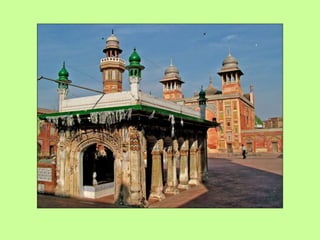
• In Lahore we have lot many
mazars of saints that have mosques
with them. Two particular
examples are:
• Mazar of Hazrat Ali Hajveri
commonly known as Data Ganj-i
Bakhsh, and
• Mazar of Hazrat Ishaq Gazruni.
• Tomb is simply a burial place but
when we study history of tombs
normally we focus on major tombs,
tombs of royalties, tombs of
emperors and queens.
• There are several varieties of
Islamic tombs, that we discuss
later.
Yamīn al-Dawlah Abul-Qāṣim Maḥmūd Ibn Sebüktegīn
• A khanqah or khangah is a
building designed specifically for
gatherings of a Sufi brotherhood or
tariqa and is a place for spiritual
retreat and character reformation.
In the past, and to a lesser extent
nowadays, they often served as
hospices for saliks, murids and
talibs.
• Also a khanqah is a sufi lodge
which may be used as a rest house
for travellers and as a place where
people come to discuss spiritual
matters, get saints' blessings and
hear sufi music.
• A dargah is the tomb of a sufi saint.
• An Eidgah is an open prayer place
for Muslims primarily built for Eid
prayers.
• A darasgah is an association,
institute, organization, seminary,
university or a school (madrassah)
Imambargah, or Imambara, is a
congregation hall for Twelver Shia
Muslim commemoration
ceremonies, especially those
associated with the mourning in
the month of Muharram.
• Imambargah means (House of
Imam or Court of Imam); this
word is of North Indian origin.
An Imambara is also known as
Hussaniya or Ashurkhana.
An Imambara is a place or a
building with a hall where people
assemble for "Majlis" (Mourning
Congregations) of Imam Husain
and Martyrs of Karbala.
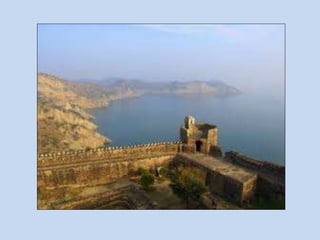
• A Fort is a strong or fortified place
especially occupied only by troops
and surrounded with such works
as a ditch, rampart, and parapet :
fortification, a permanent army
post.
• A Palace is only palace if it is
exceptionally lavish and built with
the intention of being a residence of
king or raja or maharaja. We
cannot call any old building
a palace just because royalty
decided to live there for a while; it
had to have been built for that
purpose.
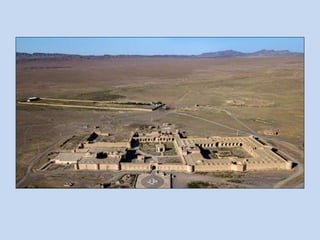
• A caravanserai was a
roadside inn where travelers could
rest and recover from the day's
journey. They supported the flow
of commerce, information and
people across the network of trade
routes covering Asia, North
Africa and Southeast Europe, most
notably the Silk Road.
Caravanserais were also
historically common throughout
the Islamic world, though they
were often called by other names
such as khan, han, wikala,
or funduq or ribat.
A baoli is a stepwell also called
vav or baori. It is a subterranean
edifice and water source, an
architectural form that was long
popular throughout the
subcontinent. Baolis over the time
became majestic and part of royal
residences.
• Commemorative minarets were
built in Islamic world to celebrate
certain events like victories in the
war or to celebrate a particular
occasion. In the west arches were
built to celebrate such occasions.
• Bridges and Roads
• With the introduction of
caravansarais roads and bridges
became a necessity. Also several
sections of silk route wee also
contributed bu Muslim rulers.
Abbasids provided a major boost
and contribution in this regard.
• Landscape Architecture Gardens
and Baradaris
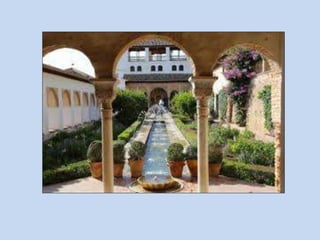
• Islamic gardens were intended for
rest, reflection, and contemplation.
A major focus of the Islamic
gardens was to provide a sensory
experience, which was
accomplished through the use of
water and aromatic plants.
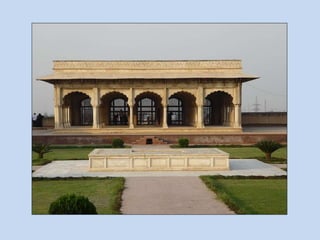
Baradari also Bara-dari is a building
or pavilion with twelve doors designed
to allow free flow of air. Normally the
structure has three doorways on every
side of the square-shaped structure.
They were also well-suited for live
performances and private concerts by
various musicians and poets in front of
the ruling kings.
• They were also valued for their
fresh air during hot summers of
the subcontinent. Baradaris were
also often used to host religious
congregations, particularly in the
Muslim communities like Fridays
and Eid prayers.
Islamic
Town Planning
And finally the
HAVELIS
• Haveli architecture is a unique
vernacular architecture form that
flourished in the 18th and 19th
century in the pre-Partition
western India, particularly in
Rajasthan and Gujarat and parts
of undivided Punjab.
Thatisallfortoda
y
Dr. Shaukat Mahmood
MA. Fine Arts, Gold Medalist, Punjab University
MSc. Architectural Conservation, Heriot-Watt University
PhD, Islamic Architecture, Edinburgh University
Academic Roll of Honour, Govt. College, Lahore
Gold Medal for research in Islamic Calligraphy
President Medal for Pride of Performance 2001
Sitara-i Imtiaz 2010
HEC Professor & Coordinator Research & Ph.D. Programme
College of Art & Design, Punjab University, Lahore. 2010-20.
Email : drshaukatmahmood@gmail.com
cartoonist.maxim@hotmail.com
Cell & WhatsApp : 0345 4038 445.

B.Arch-Islamic Architecture-1.ppt

  • 4.
    • TYPOLOGY isa classification according to general type, especially in archaeology, psychology, or the social sciences. The study and interpretation of types and symbols.
  • 5.
    • It isthe study of types or the systematic classification of the types of something according to their common characteristics. Typology is the act of finding, counting and classification facts with the help of eyes, other senses and logic.
  • 6.
    • If appliedto architecture, particularly Islamic Architecture typology means what were or what are the types of buildings built by Islam.
  • 7.
    • In IslamicArchitecture we have two types of buildings in general classification. • 1. Religious buildings • 2. Secular buildings
  • 8.
    • Religious buildingsare: • 1. Mosques • 2. Tomb-mosques • 3. Tombs • 4. Darsgahs, Khanqahs ‘Igahs. • 5. Imambargahs and Zari’s.
  • 9.
    • Secular buildingsare: • 1. Forts • 2. Palaces • 3. Caravansarai’s • 4. Baolis • 5. Commemorative Minarets
  • 10.
    • 6. Bridgesand Roads • 7. Gardens, Baradaris and • 8. Landscape architecture • 6. Bridges, Roads and Kosminaras • 7. Gardens, Baradaris and • 8. Landscape architecture • 9. Town Planning
  • 11.
    • Before goinginto details of these monuments let us, as a prologue, talk about them briefly.
  • 12.
    • Temple (fromLatin templum ‘open or consecrated space’). • is a building devoted to the worship of a god or gods. Any place of worship of any religion is temple. Muslims’ temple is mosque.
  • 13.
    • Mosque issimply a place of worship of Muslims. Anywhere a Muslim is praying that place is mosque, building or no building.
  • 14.
    • Christians templeis Church. • Hindus temple is Mandir. • Jews temple is Synagogue. • Sikhs temple is Gurudwara. • Zoroastrians temple is Agiary or Atishkadeh.
  • 16.
    • Surah al-Tawbah– Verse 18 • َ‫م‬‫ا‬َ‫ء‬ ْ‫ن‬َ‫م‬ ِ ‫ه‬ ‫ّللا‬ َ‫د‬ ِ‫اج‬َ‫س‬َ‫م‬ ُ‫ر‬ُ‫م‬ْ‫ع‬َ‫ي‬ ‫ا‬َ‫م‬َّ‫ن‬ِ‫إ‬ ِ ‫ر‬ ِ‫خ‬َ‫ال‬‫ا‬ ِ‫م‬ ْ‫و‬َ‫ي‬ْ‫ل‬‫ا‬َ‫و‬ ِ ‫ه‬ ‫اّلل‬ِ‫ب‬ َ‫ن‬ َ‫م‬‫ا‬َََََ‫و‬ • َ ‫ش‬ْ‫خ‬َ‫ي‬ ْ‫م‬َ‫ل‬َ‫و‬ َ‫ة‬‫ا‬َ‫ك‬َّ‫الز‬ ‫ى‬َ‫ت‬‫ا‬َ‫ء‬‫و‬ َ‫ة‬َ‫ال‬َّ‫ص‬‫ال‬ َ‫ل‬ ْ‫و‬ُ‫ا‬ ‫ى‬َ‫س‬َ‫ع‬َ‫ف‬ َ ‫ه‬ ‫ّللا‬ َّ‫ال‬ِ‫إ‬ ‫ن‬ََ َ‫ك‬ِ‫ئ‬ • َ‫ين‬ِ‫د‬َ‫ت‬ْ‫ه‬ُ‫م‬ْ‫ل‬‫ا‬ َ‫ن‬ِ‫م‬ ‫وا‬ُ‫ن‬‫ُو‬‫ك‬َ‫ي‬ “ Only he shall maintain the mosques of Allah who believes in Allah and the Last Day, and performs the prayer, and pays the alms (zakāt), and fears none but Allah. They, hopefully, will be among the guided.”
  • 17.
    Surah, also spelledsura, Arabic surah, a chapter in the holy Qur’an. Each of the 114 surahs, which vary in length from several pages to several words, encompasses one or more revelations received by Prophet Muhammad from Allah.
  • 18.
    • Ayat isa feminine name that comes from an Islamic word which refers to the verses of holy Quran. It is of Arabic origin. It also has the associative meanings of ‘miracle’ or ‘proof’ or ‘sign’ or ‘prodigy’ that describe the verses in the Quran.
  • 21.
    • The HolyProphet (PBUH) said that anyone who makes a mosque in this world Allah will make a house for him in Paradise. So the Qur’an and Hadith both emphasize on this fact.
  • 22.
    • The commandmentsfor praying in the mosque are almost similar than those to pray at home or at work, but the reward is 23 times better and to pray in the Kaaah, the House of Allah, the reward is 100000 times better.
  • 23.
    Men and women,both are allowed to enter the mosque to pray. So even though the Holy Prophet (PBUH) has said “The world, the whole of it, is a Mosque.” And Allah has said “Wherever you turn, there is the face of God.” We must remember that the greatest reward is praying in the mosque.
  • 25.
    • Prophet’s housewas a place of worship too, after death he was buried in Hazrat A’isha’s chamber. This ultimately became the first tomb-mosque in history of Islamic Islamic architecture. • A tomb-mosque is a tomb with a mosque or a mosque with a tomb.
  • 26.
    1. Platform forAhl-i Suffah. 2. Sanctaury. 3. Wives’ chambers. 4. Entrances.
  • 27.
    Masjid-i Nabavi isalso a tomb-mosque, Prophet’s grave is under the green dome.
  • 28.
    • The Sanctuaryof Hazrat 'Ali also known as the Mosque of 'Ali, located in Najaf, Iraq, is a mosque housing the tomb of Hazrat 'Ali ibn Abi Talib, the cousin of Prophet Muhammad and the the fourth of Khulafa-i Rashidin.
  • 30.
    • In Lahorewe have lot many mazars of saints that have mosques with them. Two particular examples are: • Mazar of Hazrat Ali Hajveri commonly known as Data Ganj-i Bakhsh, and • Mazar of Hazrat Ishaq Gazruni.
  • 35.
    • Tomb issimply a burial place but when we study history of tombs normally we focus on major tombs, tombs of royalties, tombs of emperors and queens. • There are several varieties of Islamic tombs, that we discuss later.
  • 39.
    Yamīn al-Dawlah Abul-QāṣimMaḥmūd Ibn Sebüktegīn
  • 43.
    • A khanqahor khangah is a building designed specifically for gatherings of a Sufi brotherhood or tariqa and is a place for spiritual retreat and character reformation. In the past, and to a lesser extent nowadays, they often served as hospices for saliks, murids and talibs.
  • 45.
    • Also akhanqah is a sufi lodge which may be used as a rest house for travellers and as a place where people come to discuss spiritual matters, get saints' blessings and hear sufi music.
  • 46.
    • A dargahis the tomb of a sufi saint. • An Eidgah is an open prayer place for Muslims primarily built for Eid prayers. • A darasgah is an association, institute, organization, seminary, university or a school (madrassah)
  • 47.
    Imambargah, or Imambara,is a congregation hall for Twelver Shia Muslim commemoration ceremonies, especially those associated with the mourning in the month of Muharram.
  • 48.
    • Imambargah means(House of Imam or Court of Imam); this word is of North Indian origin. An Imambara is also known as Hussaniya or Ashurkhana. An Imambara is a place or a building with a hall where people assemble for "Majlis" (Mourning Congregations) of Imam Husain and Martyrs of Karbala.
  • 52.
    • A Fortis a strong or fortified place especially occupied only by troops and surrounded with such works as a ditch, rampart, and parapet : fortification, a permanent army post.
  • 55.
    • A Palaceis only palace if it is exceptionally lavish and built with the intention of being a residence of king or raja or maharaja. We cannot call any old building a palace just because royalty decided to live there for a while; it had to have been built for that purpose.
  • 59.
    • A caravanseraiwas a roadside inn where travelers could rest and recover from the day's journey. They supported the flow of commerce, information and people across the network of trade routes covering Asia, North Africa and Southeast Europe, most notably the Silk Road.
  • 60.
    Caravanserais were also historicallycommon throughout the Islamic world, though they were often called by other names such as khan, han, wikala, or funduq or ribat.
  • 64.
    A baoli isa stepwell also called vav or baori. It is a subterranean edifice and water source, an architectural form that was long popular throughout the subcontinent. Baolis over the time became majestic and part of royal residences.
  • 68.
    • Commemorative minaretswere built in Islamic world to celebrate certain events like victories in the war or to celebrate a particular occasion. In the west arches were built to celebrate such occasions.
  • 70.
    • Bridges andRoads • With the introduction of caravansarais roads and bridges became a necessity. Also several sections of silk route wee also contributed bu Muslim rulers. Abbasids provided a major boost and contribution in this regard.
  • 76.
    • Landscape ArchitectureGardens and Baradaris • Islamic gardens were intended for rest, reflection, and contemplation. A major focus of the Islamic gardens was to provide a sensory experience, which was accomplished through the use of water and aromatic plants.
  • 80.
    Baradari also Bara-dariis a building or pavilion with twelve doors designed to allow free flow of air. Normally the structure has three doorways on every side of the square-shaped structure. They were also well-suited for live performances and private concerts by various musicians and poets in front of the ruling kings.
  • 81.
    • They werealso valued for their fresh air during hot summers of the subcontinent. Baradaris were also often used to host religious congregations, particularly in the Muslim communities like Fridays and Eid prayers.
  • 86.
  • 88.
  • 89.
    • Haveli architectureis a unique vernacular architecture form that flourished in the 18th and 19th century in the pre-Partition western India, particularly in Rajasthan and Gujarat and parts of undivided Punjab.
  • 93.
  • 94.
    Dr. Shaukat Mahmood MA.Fine Arts, Gold Medalist, Punjab University MSc. Architectural Conservation, Heriot-Watt University PhD, Islamic Architecture, Edinburgh University Academic Roll of Honour, Govt. College, Lahore Gold Medal for research in Islamic Calligraphy President Medal for Pride of Performance 2001 Sitara-i Imtiaz 2010 HEC Professor & Coordinator Research & Ph.D. Programme College of Art & Design, Punjab University, Lahore. 2010-20. Email : drshaukatmahmood@gmail.com cartoonist.maxim@hotmail.com Cell & WhatsApp : 0345 4038 445.