The Solar System
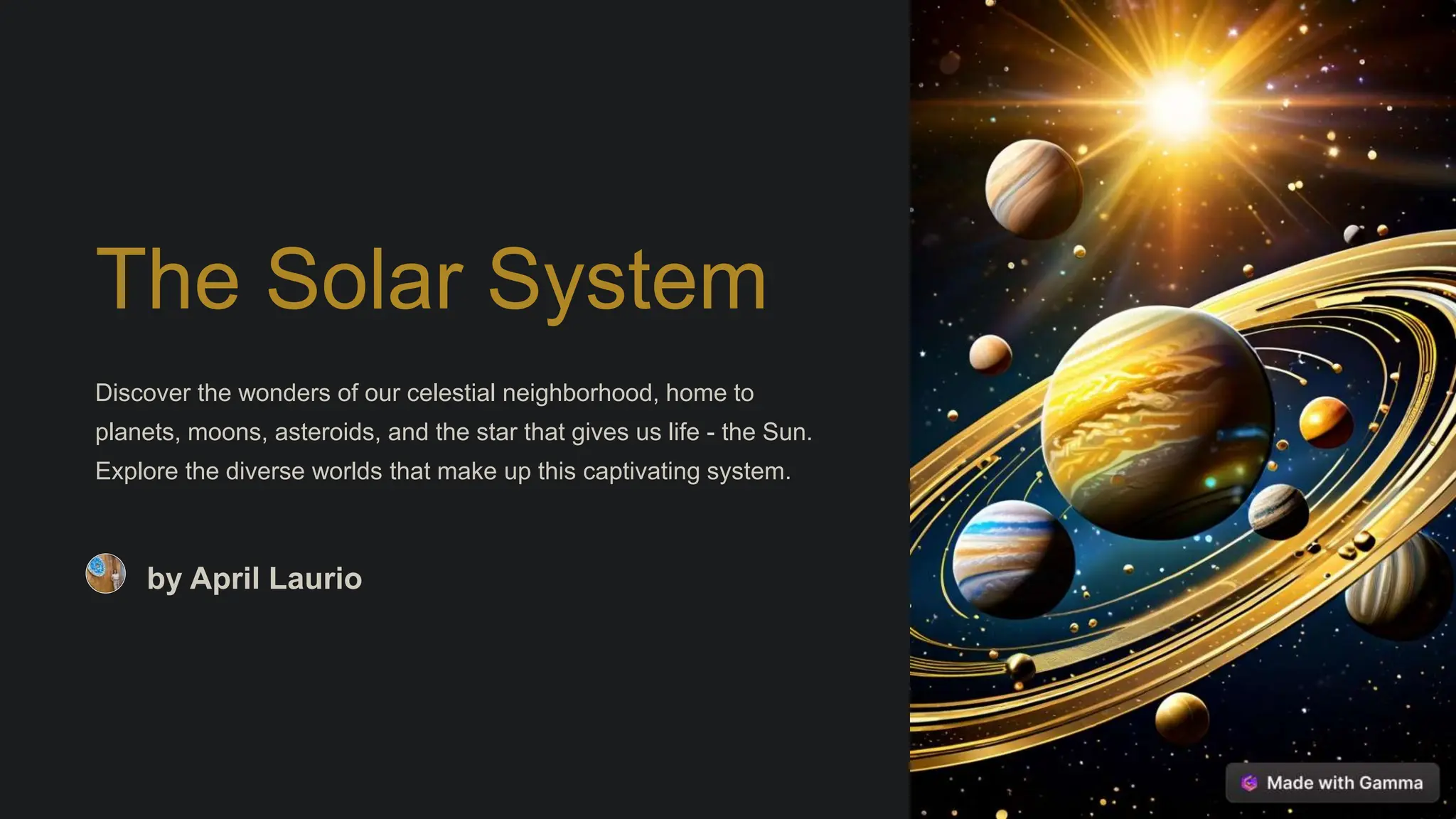
Discover the wonders of our celestial neighborhood, home to
planets, moons, asteroids, and the star that gives us life - the Sun.
Explore the diverse worlds that make up this captivating system.
by April Laurio
The Sun
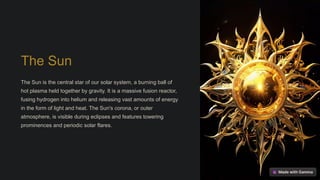
The Sun is the central star of our solar system, a burning ball of
hot plasma held together by gravity. It is a massive fusion reactor,
fusing hydrogen into helium and releasing vast amounts of energy
in the form of light and heat. The Sun's corona, or outer
atmosphere, is visible during eclipses and features towering
prominences and periodic solar flares.
The Planets
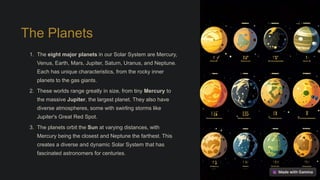
1. The eight major planets in our Solar System are Mercury,
Venus, Earth, Mars, Jupiter, Saturn, Uranus, and Neptune.
Each has unique characteristics, from the rocky inner
planets to the gas giants.
2. These worlds range greatly in size, from tiny Mercury to
the massive Jupiter, the largest planet. They also have
diverse atmospheres, some with swirling storms like
Jupiter's Great Red Spot.
3. The planets orbit the Sun at varying distances, with
Mercury being the closest and Neptune the farthest. This
creates a diverse and dynamic Solar System that has
fascinated astronomers for centuries.
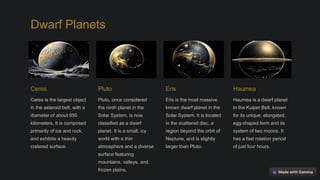
Dwarf Planets
Ceres
Ceres is the largest object
in the asteroid belt, with a
diameter of about 950
kilometers. It is composed
primarily of ice and rock,
and exhibits a heavily
cratered surface.
Pluto
Pluto, once considered
the ninth planet in the
Solar System, is now
classified as a dwarf
planet. It is a small, icy
world with a thin
atmosphere and a diverse
surface featuring
mountains, valleys, and
frozen plains.
Eris
Eris is the most massive
known dwarf planet in the
Solar System. It is located
in the scattered disc, a
region beyond the orbit of
Neptune, and is slightly
larger than Pluto.
Haumea
Haumea is a dwarf planet
in the Kuiper Belt, known
for its unique, elongated,
egg-shaped form and its
system of two moons. It
has a fast rotation period
of just four hours.
Moons
1
Formation
Moons form from the same material that
created their parent planets, often
coalescing from leftover debris or captured
asteroids.
2 Diverse Characteristics
Moons come in a wide variety of shapes,
sizes, and compositions, from small, rocky
satellites to large, icy moons with subsurface
oceans.
3
Importance in the Solar System
Moons play crucial roles, influencing the
tides, stabilizing their planets' rotations, and
providing valuable insights into the history
and formation of the Solar System.
Asteroids
What are
Asteroids?
Asteroids are rocky,
irregularly-shaped
objects that orbit the
Sun, but are much
smaller than planets.
They are remnants
from the formation of
our solar system about
4.6 billion years ago.
Types of Asteroids
Asteroids are classified
into three main types
based on their
composition: C-type
(carbon-rich), S-type
(stony), and M-type
(metallic). Each type
provides clues about
the early solar system.
Asteroid Belts
The main asteroid belt
lies between the orbits
of Mars and Jupiter.
This region contains
millions of rocky
objects, ranging from
tiny pebbles to dwarf
planet-sized bodies.
Asteroid Impacts
Asteroids occasionally
collide with planets,
moons, and each other,
causing impact craters.
Larger impacts can
have devastating
effects, as seen with
the dinosaur extinction
event.
Comets
1
Icy Bodies
Comets are icy objects that orbit the Sun.
2
Long Tails
As they approach the Sun, comets develop long tails of gas and
dust.
3
Periodic Visitors
Some comets, like Halley's Comet, return to the inner
solar system periodically.
Comets are fascinating celestial objects that originate from the outer reaches of the solar system. As they approach the
Sun, the intense heat causes their icy cores to release gases and dust, forming the characteristic long tails that trail
behind them. While some comets are one-time visitors, others like the famous Halley's Comet return to the inner solar
system on a regular schedule, delighting skywatchers with their dazzling displays.
Meteors and Meteorites
What are Meteors?
Meteors are pieces of space debris that enter Earth's atmosphere and create a
brief flash of light as they burn up. They are small fragments of asteroids or
comets.
Meteorites
Meteorites are the parts of meteors that survive the fiery descent through the
atmosphere and land on the Earth's surface. They provide valuable insights
into the composition of our solar system.
Meteor Showers
Periodic meteor showers occur when Earth passes through the debris trail of a
comet, resulting in a spectacular display of shooting stars streaking across the
night sky.
The Kuiper Belt
The Kuiper Belt is a region of the Solar System beyond the orbit of Neptune, extending from about 30 to 50
astronomical units (AU) from the Sun. It is a vast, sparsely populated region of icy bodies and dwarf planets,
including the distant dwarf planet Pluto.
30
Trillion
The Kuiper Belt is estimated to contain over 30 trillion
objects, ranging from tiny chunks of ice and rock to
larger dwarf planets.
5
Billion
The Kuiper Belt is believed to contain around 5 billion
comets, serving as a source for many of the comets
observed in the inner Solar System.
The Oort Cloud
Vast Expanse
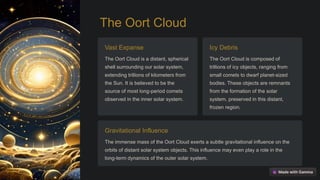
The Oort Cloud is a distant, spherical
shell surrounding our solar system,
extending trillions of kilometers from
the Sun. It is believed to be the
source of most long-period comets
observed in the inner solar system.
Icy Debris
The Oort Cloud is composed of
trillions of icy objects, ranging from
small comets to dwarf planet-sized
bodies. These objects are remnants
from the formation of the solar
system, preserved in this distant,
frozen region.
Gravitational Influence
The immense mass of the Oort Cloud exerts a subtle gravitational influence on the
orbits of distant solar system objects. This influence may even play a role in the
long-term dynamics of the outer solar system.

The-Solar-System.powerpoint presentation

  • 1.
    The Solar System Discoverthe wonders of our celestial neighborhood, home to planets, moons, asteroids, and the star that gives us life - the Sun. Explore the diverse worlds that make up this captivating system. by April Laurio
  • 2.
    The Sun The Sunis the central star of our solar system, a burning ball of hot plasma held together by gravity. It is a massive fusion reactor, fusing hydrogen into helium and releasing vast amounts of energy in the form of light and heat. The Sun's corona, or outer atmosphere, is visible during eclipses and features towering prominences and periodic solar flares.
  • 3.
    The Planets 1. Theeight major planets in our Solar System are Mercury, Venus, Earth, Mars, Jupiter, Saturn, Uranus, and Neptune. Each has unique characteristics, from the rocky inner planets to the gas giants. 2. These worlds range greatly in size, from tiny Mercury to the massive Jupiter, the largest planet. They also have diverse atmospheres, some with swirling storms like Jupiter's Great Red Spot. 3. The planets orbit the Sun at varying distances, with Mercury being the closest and Neptune the farthest. This creates a diverse and dynamic Solar System that has fascinated astronomers for centuries.
  • 4.
    Dwarf Planets Ceres Ceres isthe largest object in the asteroid belt, with a diameter of about 950 kilometers. It is composed primarily of ice and rock, and exhibits a heavily cratered surface. Pluto Pluto, once considered the ninth planet in the Solar System, is now classified as a dwarf planet. It is a small, icy world with a thin atmosphere and a diverse surface featuring mountains, valleys, and frozen plains. Eris Eris is the most massive known dwarf planet in the Solar System. It is located in the scattered disc, a region beyond the orbit of Neptune, and is slightly larger than Pluto. Haumea Haumea is a dwarf planet in the Kuiper Belt, known for its unique, elongated, egg-shaped form and its system of two moons. It has a fast rotation period of just four hours.
  • 5.
    Moons 1 Formation Moons form fromthe same material that created their parent planets, often coalescing from leftover debris or captured asteroids. 2 Diverse Characteristics Moons come in a wide variety of shapes, sizes, and compositions, from small, rocky satellites to large, icy moons with subsurface oceans. 3 Importance in the Solar System Moons play crucial roles, influencing the tides, stabilizing their planets' rotations, and providing valuable insights into the history and formation of the Solar System.
  • 6.
    Asteroids What are Asteroids? Asteroids arerocky, irregularly-shaped objects that orbit the Sun, but are much smaller than planets. They are remnants from the formation of our solar system about 4.6 billion years ago. Types of Asteroids Asteroids are classified into three main types based on their composition: C-type (carbon-rich), S-type (stony), and M-type (metallic). Each type provides clues about the early solar system. Asteroid Belts The main asteroid belt lies between the orbits of Mars and Jupiter. This region contains millions of rocky objects, ranging from tiny pebbles to dwarf planet-sized bodies. Asteroid Impacts Asteroids occasionally collide with planets, moons, and each other, causing impact craters. Larger impacts can have devastating effects, as seen with the dinosaur extinction event.
  • 7.
    Comets 1 Icy Bodies Comets areicy objects that orbit the Sun. 2 Long Tails As they approach the Sun, comets develop long tails of gas and dust. 3 Periodic Visitors Some comets, like Halley's Comet, return to the inner solar system periodically. Comets are fascinating celestial objects that originate from the outer reaches of the solar system. As they approach the Sun, the intense heat causes their icy cores to release gases and dust, forming the characteristic long tails that trail behind them. While some comets are one-time visitors, others like the famous Halley's Comet return to the inner solar system on a regular schedule, delighting skywatchers with their dazzling displays.
  • 8.
    Meteors and Meteorites Whatare Meteors? Meteors are pieces of space debris that enter Earth's atmosphere and create a brief flash of light as they burn up. They are small fragments of asteroids or comets. Meteorites Meteorites are the parts of meteors that survive the fiery descent through the atmosphere and land on the Earth's surface. They provide valuable insights into the composition of our solar system. Meteor Showers Periodic meteor showers occur when Earth passes through the debris trail of a comet, resulting in a spectacular display of shooting stars streaking across the night sky.
  • 9.
    The Kuiper Belt TheKuiper Belt is a region of the Solar System beyond the orbit of Neptune, extending from about 30 to 50 astronomical units (AU) from the Sun. It is a vast, sparsely populated region of icy bodies and dwarf planets, including the distant dwarf planet Pluto. 30 Trillion The Kuiper Belt is estimated to contain over 30 trillion objects, ranging from tiny chunks of ice and rock to larger dwarf planets. 5 Billion The Kuiper Belt is believed to contain around 5 billion comets, serving as a source for many of the comets observed in the inner Solar System.
  • 10.
    The Oort Cloud VastExpanse The Oort Cloud is a distant, spherical shell surrounding our solar system, extending trillions of kilometers from the Sun. It is believed to be the source of most long-period comets observed in the inner solar system. Icy Debris The Oort Cloud is composed of trillions of icy objects, ranging from small comets to dwarf planet-sized bodies. These objects are remnants from the formation of the solar system, preserved in this distant, frozen region. Gravitational Influence The immense mass of the Oort Cloud exerts a subtle gravitational influence on the orbits of distant solar system objects. This influence may even play a role in the long-term dynamics of the outer solar system.