

© A. Weinberg
Comparing – means looking for similarities (What is the same?)
Contrasting – means looking for differences (What is different?)
© A. Weinberg
By Ms. Weinberg
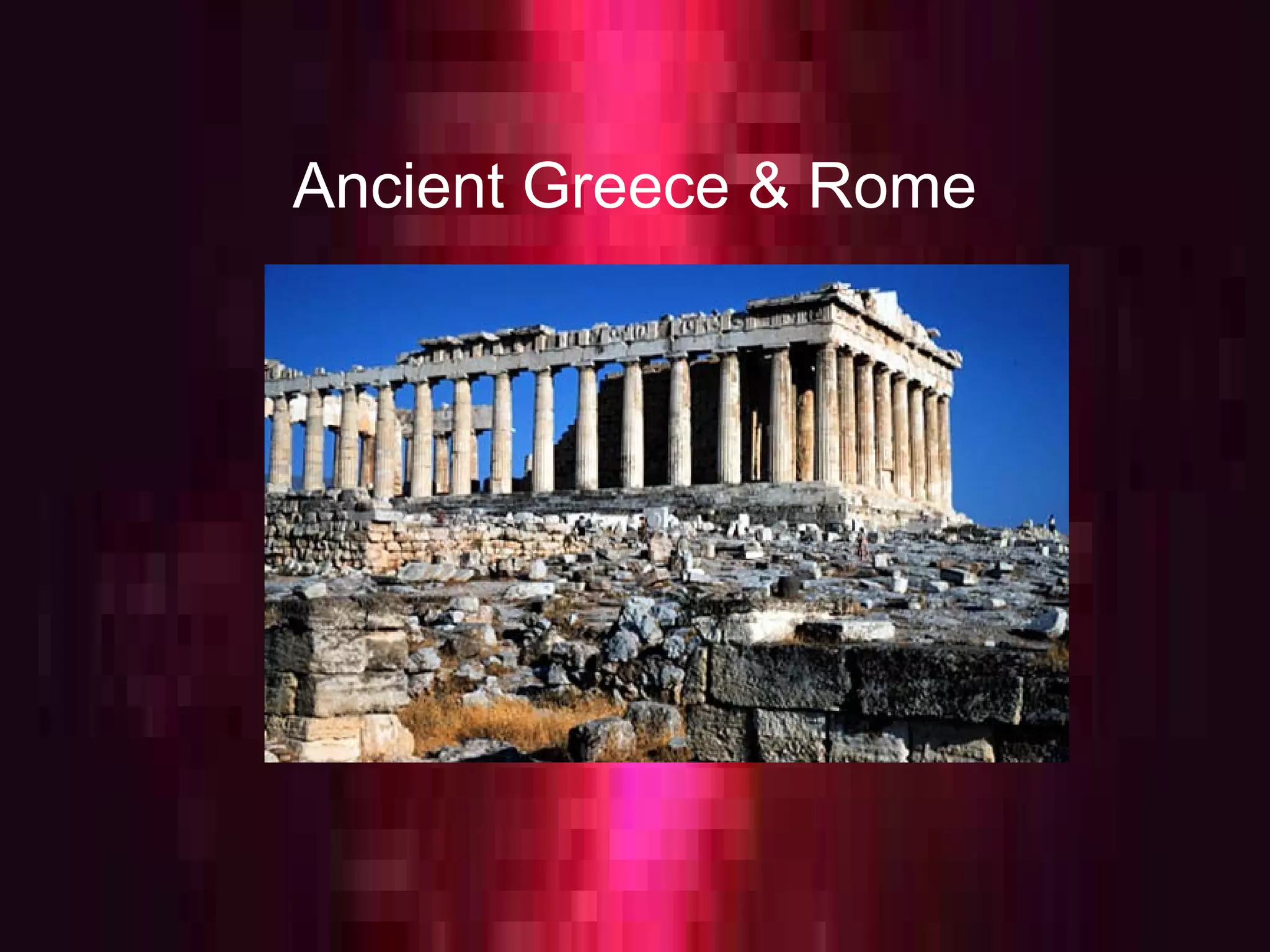
Ancient Greece & Rome
© A. Weinberg
The people of Ancient Greece &
Rome made many contributions to
today’s society.
Some of those contributions were in:
Architecture
government
Sport s
© A. Weinberg
A contribution is
the act of giving or doing something
***The ancient Greeks & Romans made
contributions
by giving people today ideas for architecture,
government, and sports.
© A. Weinberg
The Greeks used columns when they
designed many buildings.
This is a picture of the Parthenon in
Greece.
This is a column
© A. Weinberg
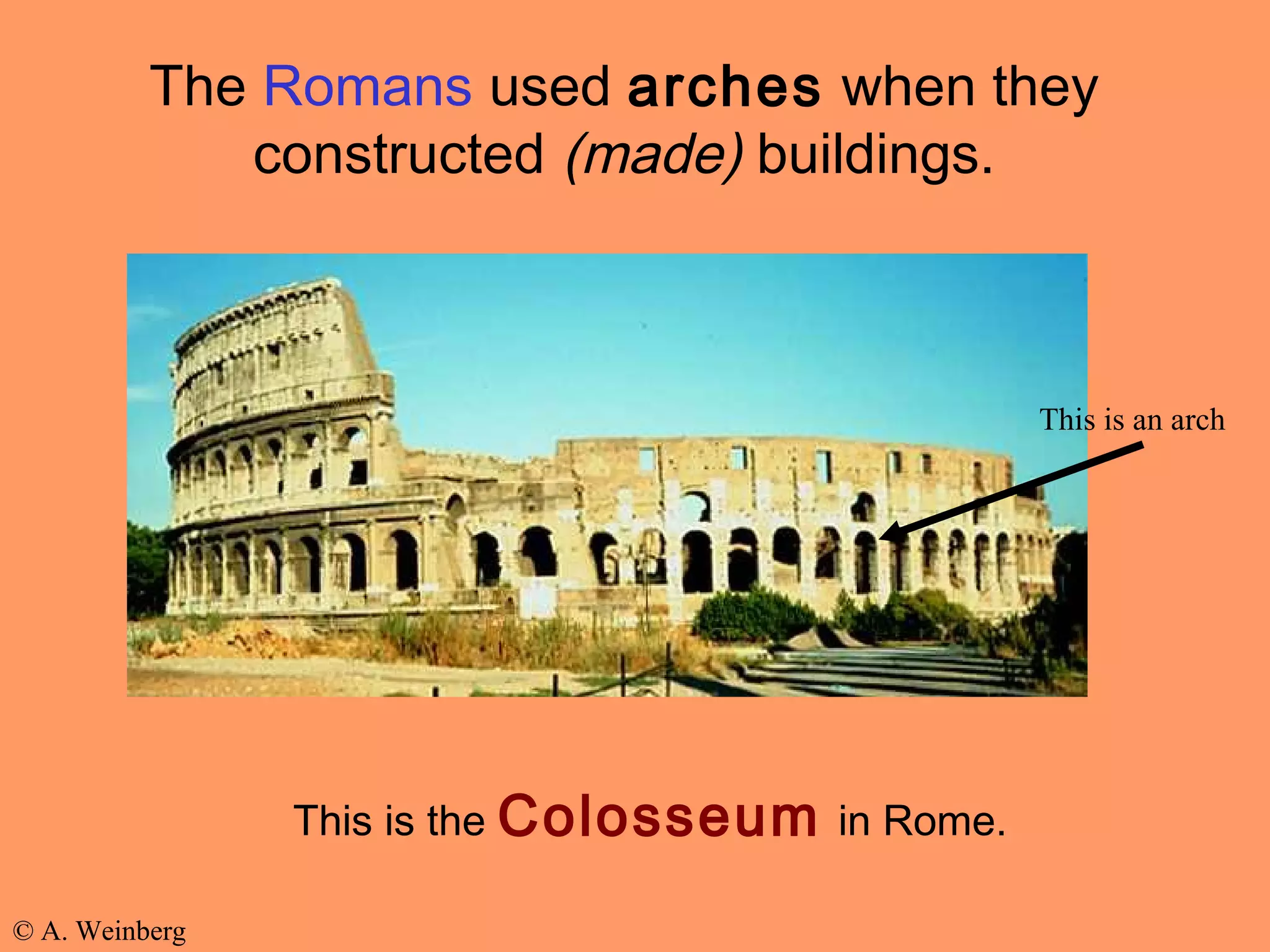
The Romans used arches when they
constructed (made) buildings.
This is the Colosseum in Rome.
This is an arch
© A. Weinberg
This is an arch
The Romans used arches when they
constructed (made) aqueducts.
© A. Weinberg
Not only did the people of Ancient Greece &
Rome influence architecture, they also
influenced Art.
Many Greek & Roman buildings display mosaics
and sculptures.
Can you
see the
many
tiles in
this
mosaic?
© A. Weinberg
Have you ever heard of the Olympics?
You have probably enjoyed watching the
athletes compete in the Winter Olympics as
well as the Summer Olympics.
The Olympic Games began back in Ancient
Greece.
© A. Weinberg
So far we have learned how the Greeks
and Romans influenced architecture
and sports. We will learn about one
more way they made a contribution to
the people of today.
© A. Weinberg
***Our government is based on ideas
from Ancient Greece & Rome.
***We call Greece “The Birthplace of
Democracy.”
***A democracy is a government ruled by the
people.
                    
© A. Weinberg
The people of Greece used a
Direct Democracy.
A Direct Democracy is a government where
people vote to make their own rules & laws.
     
© A. Weinberg
***The Romans used a
Republican form of Government -
Representative Democracy.
A Representative Democracy is a government in
which the people elect (vote for) a smaller group to
make the rules & laws for everyone.
© A. Weinberg
Which kind of government do we have in the
United States?
Do we have a Direct Democracy?
Do we have a Representative Democracy?
This one is correct!
© A. Weinberg
Now that we have learned about the
contributions of the Greeks and Romans, let’s
focus on where these places were located and
find out about the people who lived there.
© A. Weinberg
***Both Greece and Rome are located on the
continent of Europe. They are both located on
the Mediterranean Sea. Both places have
many hills, too.
***Pelopennesus – a mountainous peninsula in southern Europe
© A. Weinberg
Almost 2000 islands surrounded Peloponnesus – Villages were isolated, cut off from each other
© A. Weinberg
***Where did ancient Greek
civilization begin?
***On the Peloponnesus and the islands surrounding this
mountainous peninsula
© A. Weinberg
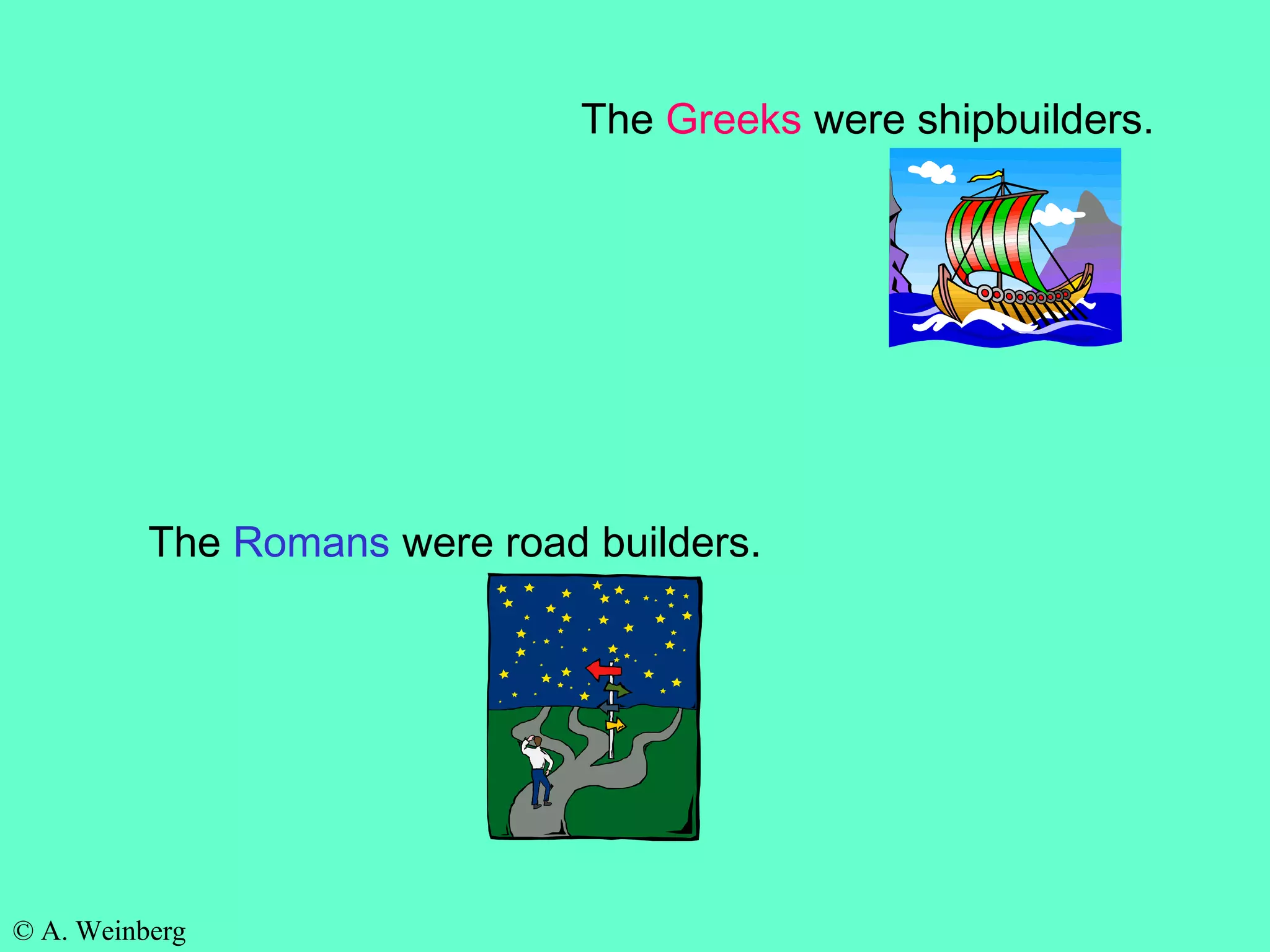
The Greeks were shipbuilders.
The Romans were road builders.
© A. Weinberg
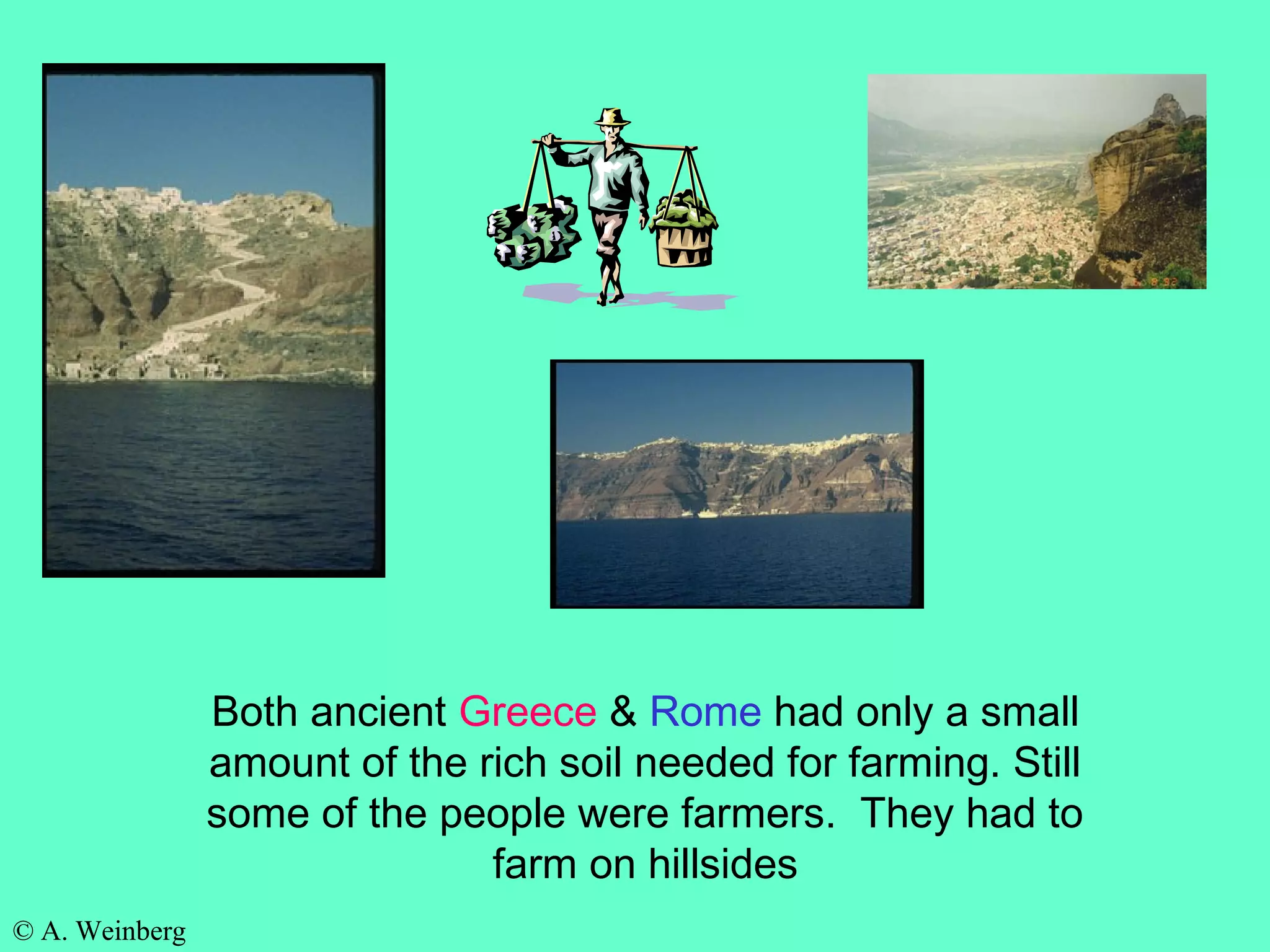
Both ancient Greece & Rome had only a small
amount of the rich soil needed for farming. Still
some of the people were farmers. They had to
farm on hillsides
© A. Weinberg
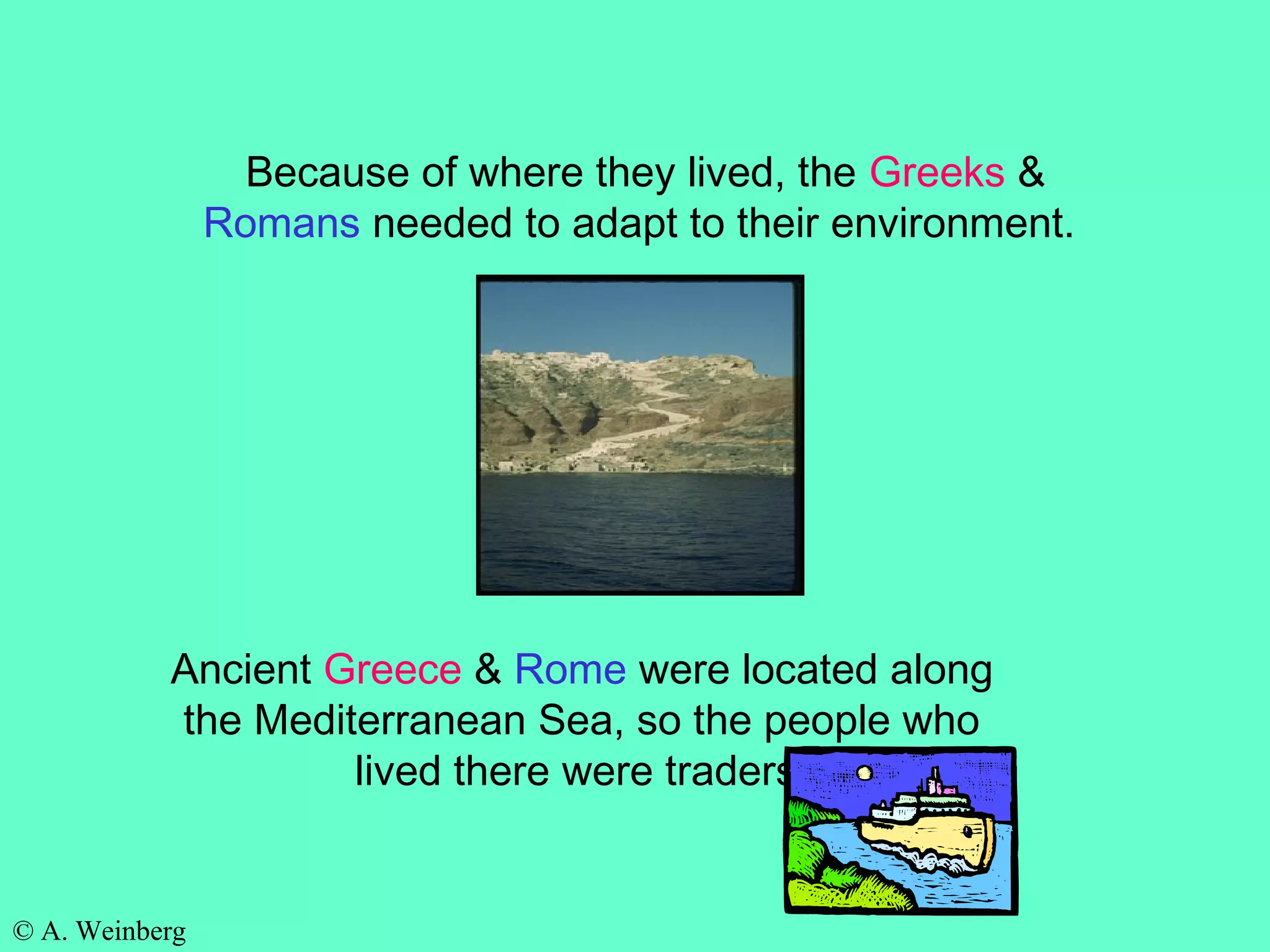
Because of where they lived, the Greeks &
Romans needed to adapt to their environment.
Ancient Greece & Rome were located along
the Mediterranean Sea, so the people who
lived there were traders.
© A. Weinberg
Since there were many mountains & hills, the
Greeks built many, small communities.
***Political units made up of a city
and surrounding villages sprung up
called “city-states.”
© A. Weinberg
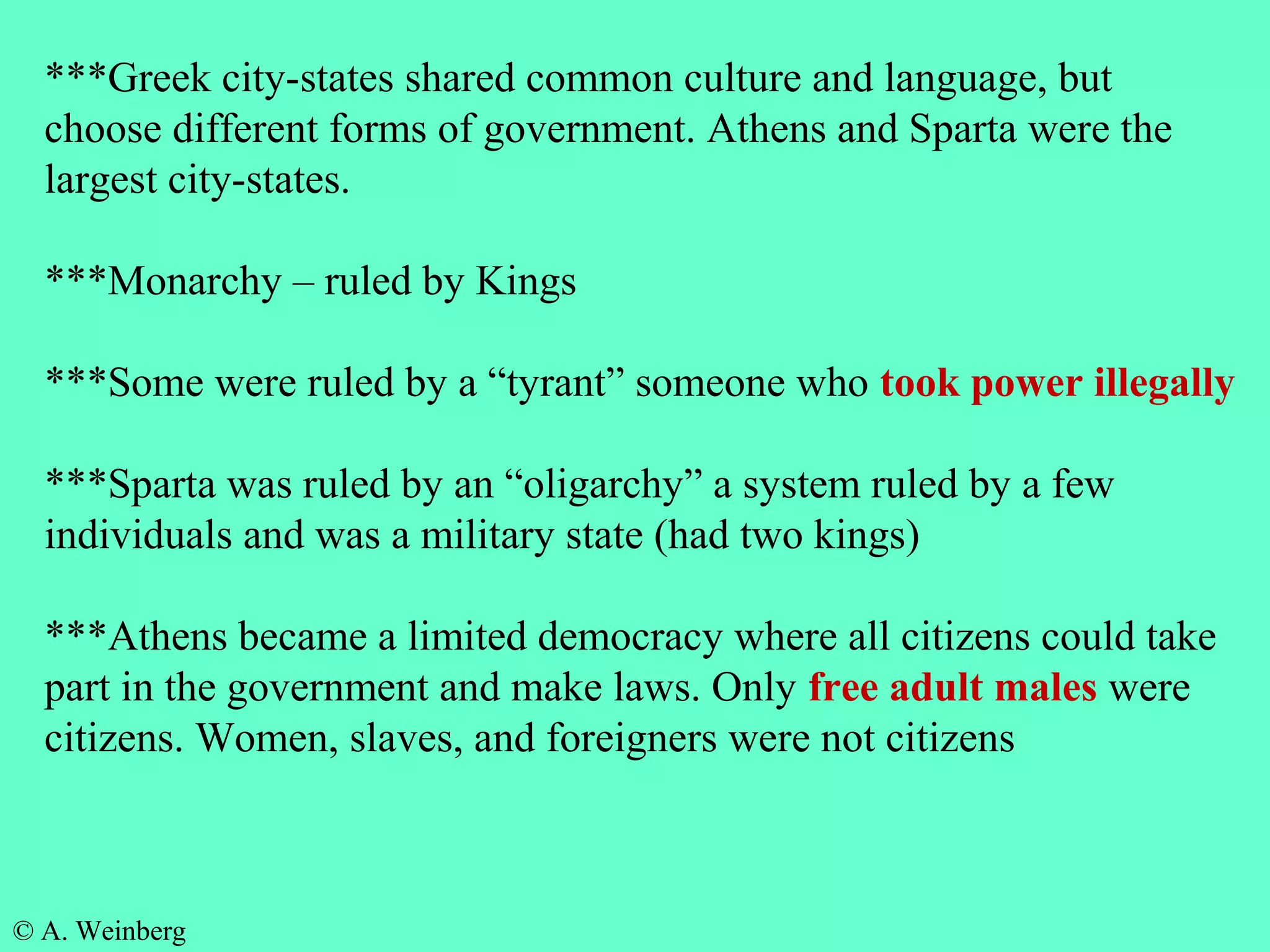
***Greek city-states shared common culture and language, but
choose different forms of government. Athens and Sparta were the
largest city-states.
***Monarchy – ruled by Kings
***Some were ruled by a “tyrant” someone who took power illegally
***Sparta was ruled by an “oligarchy” a system ruled by a few
individuals and was a military state (had two kings)
***Athens became a limited democracy where all citizens could take
part in the government and make laws. Only free adult males were
citizens. Women, slaves, and foreigners were not citizens
© A. Weinberg
***In the early 5th
century B.C., Greece was invaded by Persia
(which is now Iran)
***Athens and Sparta joined forces. The Greeks won!
***Decades later Athens & Sparta fought each other in the
Peloponnesian War – Sparta won
The city-states were so busy focusing on the war between Sparta and
Athens they didn’t notice their neighbor Macedonia was building an
army to invade Greece.
***Alexander the Great from Macedonia conquered territories from
North Africa, Middle East and Asia spreading Greek culture.
© A. Weinberg
Who was Pericles?
Pericles was an Athenian statesman, so influential in
Athenian history that the period of his power is called the
Age of Pericles.
In Athenian politics Pericles sought to enable all citizens to
take an active part in the government. Payment of citizens for
their services to the state was introduced, and members of the
council were chosen by lot from the entire body of Athenians.
Pericles believed anyone who neglects Athens is useless
Pericles believed anyone who fights for their state should
have a say in state affairs
© A. Weinberg
***ANCIENT ROME
***Overthrew their Monarchy
***Created a “republic” a form of government in which citizens elect
representatives to rule in their name
***All male citizens could vote but only “patricians” members of rich and
powerful families could hold the highest government offices.
***Farmers, merchants, and craftspeople made up the class known as
“plebeians.”
***The Roman Republic grew to fast and there was so much conflict that
they allowed Octavian (Augustus) to take control and formed the “Roman
Empire” under his complete control.
© A. Weinberg
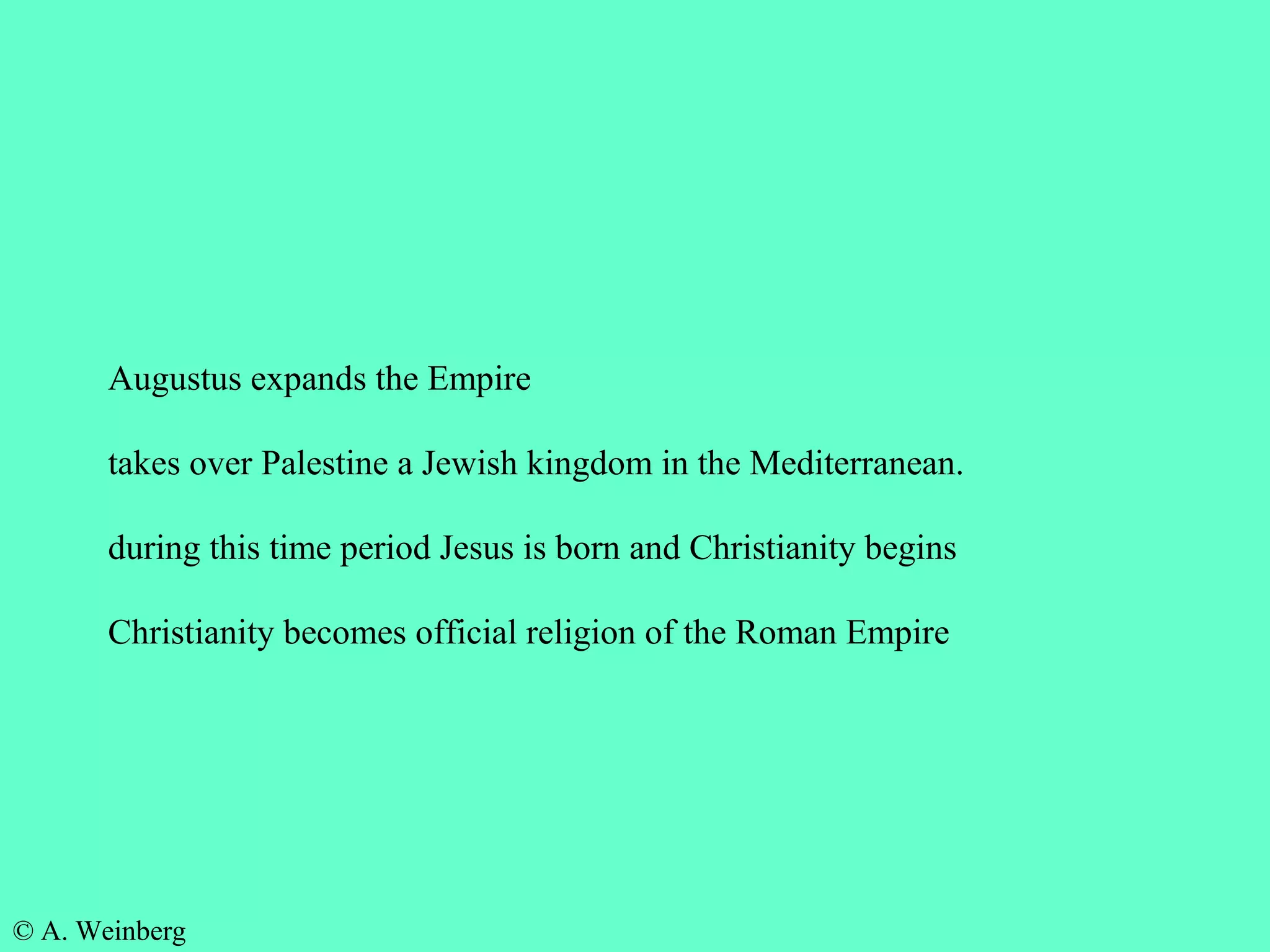
Augustus expands the Empire
takes over Palestine a Jewish kingdom in the Mediterranean.
during this time period Jesus is born and Christianity begins
Christianity becomes official religion of the Roman Empire
© A. Weinberg
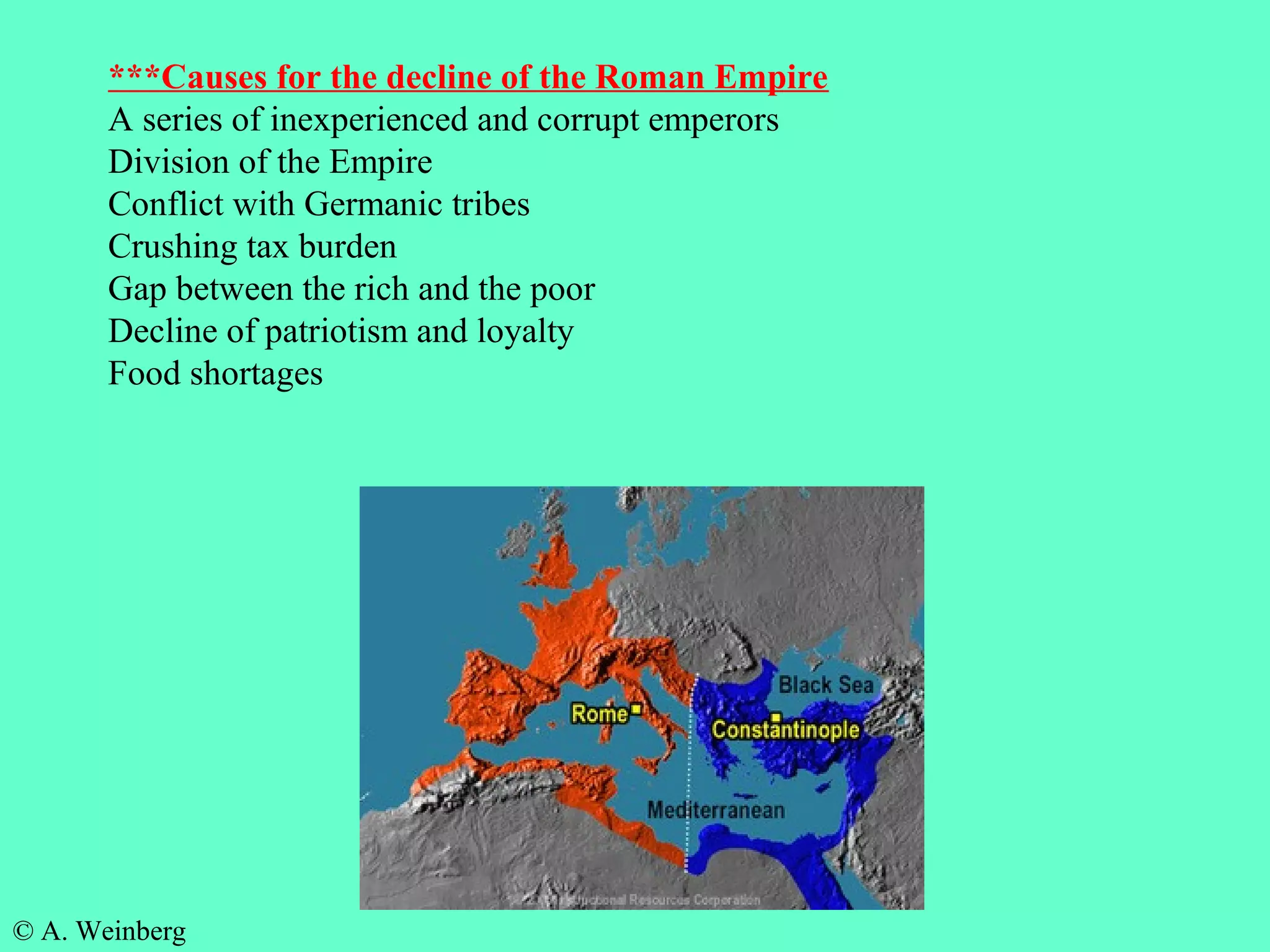
***Causes for the decline of the Roman Empire
A series of inexperienced and corrupt emperors
Division of the Empire
Conflict with Germanic tribes
Crushing tax burden
Gap between the rich and the poor
Decline of patriotism and loyalty
Food shortages
© A. Weinberg
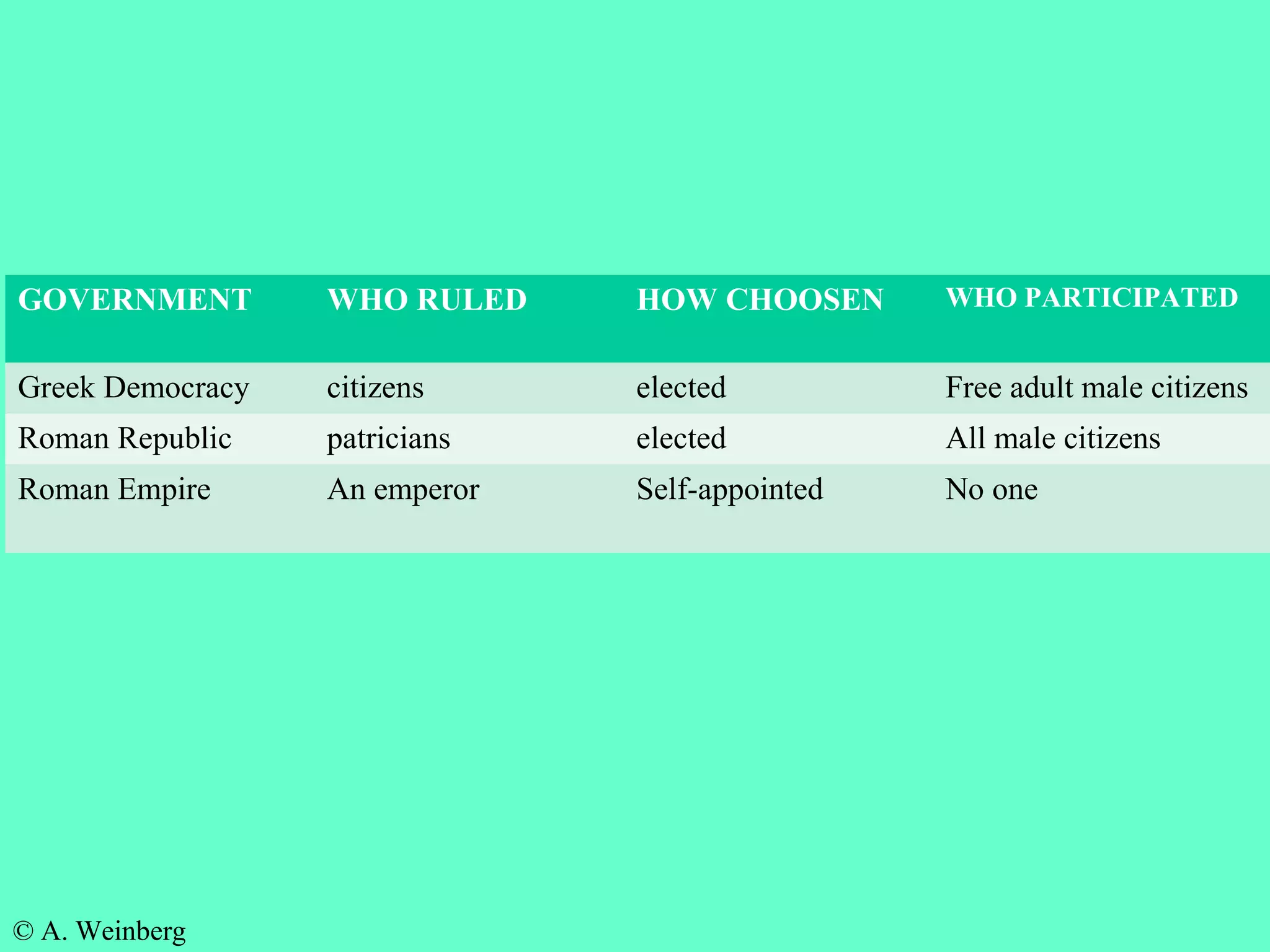
GOVERNMENT WHO RULED HOW CHOOSEN WHO PARTICIPATED
Greek Democracy citizens elected Free adult male citizens
Roman Republic patricians elected All male citizens
Roman Empire An emperor Self-appointed No one
© A. Weinberg
What’s this?
What’s this?
The Parthenon
The ColosseumWhere can it be found?
Greece Where can it be found?
Rome
© A. Weinberg
We have learned about the many contributions that the
Ancient Greeks &
Romans made to the world.
We can thank the Greeks & Romans for:
Greeks
artists, writers and philosophers
theater, science, and government
Democracy – giving people a
voice in government
Romans
roads, aqueducts, and public buildings
idea of a republic and created written
code of law
Legal systems today still influenced by
the republic of Rome
© A. Weinberg
http://www.youtube.com/watch?v=-U8N3f4toDo
http://www.youtube.com/watch?v=0iDRyINEScw
© A. Weinberg

Greece --rome-ppt

  • 1.
    © A. Weinberg Comparing– means looking for similarities (What is the same?) Contrasting – means looking for differences (What is different?)
  • 2.
    © A. Weinberg ByMs. Weinberg Ancient Greece & Rome
  • 3.
    © A. Weinberg Thepeople of Ancient Greece & Rome made many contributions to today’s society. Some of those contributions were in: Architecture government Sport s
  • 4.
    © A. Weinberg Acontribution is the act of giving or doing something ***The ancient Greeks & Romans made contributions by giving people today ideas for architecture, government, and sports.
  • 5.
    © A. Weinberg TheGreeks used columns when they designed many buildings. This is a picture of the Parthenon in Greece. This is a column
  • 6.
    © A. Weinberg TheRomans used arches when they constructed (made) buildings. This is the Colosseum in Rome. This is an arch
  • 7.
    © A. Weinberg Thisis an arch The Romans used arches when they constructed (made) aqueducts.
  • 8.
    © A. Weinberg Notonly did the people of Ancient Greece & Rome influence architecture, they also influenced Art. Many Greek & Roman buildings display mosaics and sculptures. Can you see the many tiles in this mosaic?
  • 9.
    © A. Weinberg Haveyou ever heard of the Olympics? You have probably enjoyed watching the athletes compete in the Winter Olympics as well as the Summer Olympics. The Olympic Games began back in Ancient Greece.
  • 10.
    © A. Weinberg Sofar we have learned how the Greeks and Romans influenced architecture and sports. We will learn about one more way they made a contribution to the people of today.
  • 11.
    © A. Weinberg ***Ourgovernment is based on ideas from Ancient Greece & Rome. ***We call Greece “The Birthplace of Democracy.” ***A democracy is a government ruled by the people.                     
  • 12.
    © A. Weinberg Thepeople of Greece used a Direct Democracy. A Direct Democracy is a government where people vote to make their own rules & laws.      
  • 13.
    © A. Weinberg ***TheRomans used a Republican form of Government - Representative Democracy. A Representative Democracy is a government in which the people elect (vote for) a smaller group to make the rules & laws for everyone.
  • 14.
    © A. Weinberg Whichkind of government do we have in the United States? Do we have a Direct Democracy? Do we have a Representative Democracy? This one is correct!
  • 15.
    © A. Weinberg Nowthat we have learned about the contributions of the Greeks and Romans, let’s focus on where these places were located and find out about the people who lived there.
  • 16.
    © A. Weinberg ***BothGreece and Rome are located on the continent of Europe. They are both located on the Mediterranean Sea. Both places have many hills, too. ***Pelopennesus – a mountainous peninsula in southern Europe
  • 17.
    © A. Weinberg Almost2000 islands surrounded Peloponnesus – Villages were isolated, cut off from each other
  • 18.
    © A. Weinberg ***Wheredid ancient Greek civilization begin? ***On the Peloponnesus and the islands surrounding this mountainous peninsula
  • 19.
    © A. Weinberg TheGreeks were shipbuilders. The Romans were road builders.
  • 20.
    © A. Weinberg Bothancient Greece & Rome had only a small amount of the rich soil needed for farming. Still some of the people were farmers. They had to farm on hillsides
  • 21.
    © A. Weinberg Becauseof where they lived, the Greeks & Romans needed to adapt to their environment. Ancient Greece & Rome were located along the Mediterranean Sea, so the people who lived there were traders.
  • 22.
    © A. Weinberg Sincethere were many mountains & hills, the Greeks built many, small communities. ***Political units made up of a city and surrounding villages sprung up called “city-states.”
  • 23.
    © A. Weinberg ***Greekcity-states shared common culture and language, but choose different forms of government. Athens and Sparta were the largest city-states. ***Monarchy – ruled by Kings ***Some were ruled by a “tyrant” someone who took power illegally ***Sparta was ruled by an “oligarchy” a system ruled by a few individuals and was a military state (had two kings) ***Athens became a limited democracy where all citizens could take part in the government and make laws. Only free adult males were citizens. Women, slaves, and foreigners were not citizens
  • 24.
    © A. Weinberg ***Inthe early 5th century B.C., Greece was invaded by Persia (which is now Iran) ***Athens and Sparta joined forces. The Greeks won! ***Decades later Athens & Sparta fought each other in the Peloponnesian War – Sparta won The city-states were so busy focusing on the war between Sparta and Athens they didn’t notice their neighbor Macedonia was building an army to invade Greece. ***Alexander the Great from Macedonia conquered territories from North Africa, Middle East and Asia spreading Greek culture.
  • 25.
    © A. Weinberg Whowas Pericles? Pericles was an Athenian statesman, so influential in Athenian history that the period of his power is called the Age of Pericles. In Athenian politics Pericles sought to enable all citizens to take an active part in the government. Payment of citizens for their services to the state was introduced, and members of the council were chosen by lot from the entire body of Athenians. Pericles believed anyone who neglects Athens is useless Pericles believed anyone who fights for their state should have a say in state affairs
  • 26.
    © A. Weinberg ***ANCIENTROME ***Overthrew their Monarchy ***Created a “republic” a form of government in which citizens elect representatives to rule in their name ***All male citizens could vote but only “patricians” members of rich and powerful families could hold the highest government offices. ***Farmers, merchants, and craftspeople made up the class known as “plebeians.” ***The Roman Republic grew to fast and there was so much conflict that they allowed Octavian (Augustus) to take control and formed the “Roman Empire” under his complete control.
  • 27.
    © A. Weinberg Augustusexpands the Empire takes over Palestine a Jewish kingdom in the Mediterranean. during this time period Jesus is born and Christianity begins Christianity becomes official religion of the Roman Empire
  • 28.
    © A. Weinberg ***Causesfor the decline of the Roman Empire A series of inexperienced and corrupt emperors Division of the Empire Conflict with Germanic tribes Crushing tax burden Gap between the rich and the poor Decline of patriotism and loyalty Food shortages
  • 29.
    © A. Weinberg GOVERNMENTWHO RULED HOW CHOOSEN WHO PARTICIPATED Greek Democracy citizens elected Free adult male citizens Roman Republic patricians elected All male citizens Roman Empire An emperor Self-appointed No one
  • 30.
    © A. Weinberg What’sthis? What’s this? The Parthenon The ColosseumWhere can it be found? Greece Where can it be found? Rome
  • 31.
    © A. Weinberg Wehave learned about the many contributions that the Ancient Greeks & Romans made to the world. We can thank the Greeks & Romans for: Greeks artists, writers and philosophers theater, science, and government Democracy – giving people a voice in government Romans roads, aqueducts, and public buildings idea of a republic and created written code of law Legal systems today still influenced by the republic of Rome
  • 32.
  • 33.