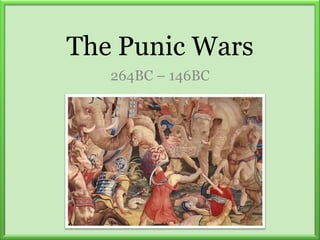
The Punic Wars
264BC – 146BC
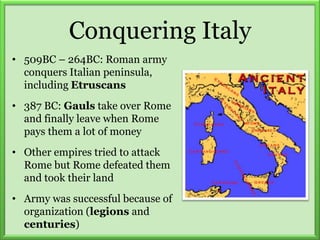
Conquering Italy
• 509BC – 264BC: Roman army
conquers Italian peninsula,
including Etruscans
• 387 BC: Gauls take over Rome
and finally leave when Rome
pays them a lot of money
• Other empires tried to attack
Rome but Rome defeated them
and took their land
• Army was successful because of
organization (legions and
centuries)
The First Punic War
• Punic Wars: series of wars between Rome and
Carthage, a city in northern Africa
• Punic: Latin for Phoenician
• Rome wanted Spain and Sicily which were
controlled by Carthage
• Carthage sent army to defend Sicily, Rome sent
army too
• Fought mostly at sea
• 241BC: Last major battle, Rome took Sicily and
other islands in victory
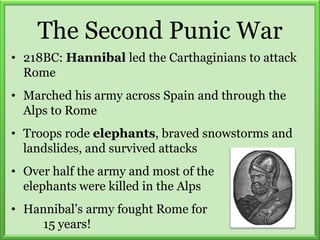
• 218BC: Hannibal led the Carthaginians to attack
Rome
• Marched his army across Spain and through the
Alps to Rome
• Troops rode elephants, braved snowstorms and
landslides, and survived attacks
• Over half the army and most of the
elephants were killed in the Alps
• Hannibal’s army fought Rome for
15 years!
The Second Punic War
• 202BC: Hannibal returned home to defend
Carthage against the Roman army, led by
Scipio
• Scipio defeats Hannibal at the Battle of Zama
• Hannibal goes into exile
• Carthage had to give up Spain and a huge
amount of money
• Led to a period of peace that lasted 50 years
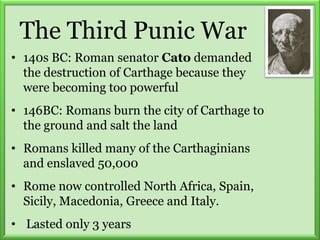
The Third Punic War
• 140s BC: Roman senator Cato demanded
the destruction of Carthage because they
were becoming too powerful
• 146BC: Romans burn the city of Carthage to
the ground and salt the land
• Romans killed many of the Carthaginians
and enslaved 50,000
• Rome now controlled North Africa, Spain,
Sicily, Macedonia, Greece and Italy.
• Lasted only 3 years
The Aftermath
• Rome expanded its power and territory,
gained riches and slaves
• Families mourned the death of fallen soldiers
• Hannibal had burned many Roman farms, so
many people lost their living and moved to
Rome
• These farms were replaced by imports and
large estates run by the Patricians and worked
by slaves
The Punic Wars Lecture

The Punic Wars Lecture

  • 1.
  • 2.
    Conquering Italy • 509BC– 264BC: Roman army conquers Italian peninsula, including Etruscans • 387 BC: Gauls take over Rome and finally leave when Rome pays them a lot of money • Other empires tried to attack Rome but Rome defeated them and took their land • Army was successful because of organization (legions and centuries)
  • 4.
    The First PunicWar • Punic Wars: series of wars between Rome and Carthage, a city in northern Africa • Punic: Latin for Phoenician • Rome wanted Spain and Sicily which were controlled by Carthage • Carthage sent army to defend Sicily, Rome sent army too • Fought mostly at sea • 241BC: Last major battle, Rome took Sicily and other islands in victory
  • 5.
    • 218BC: Hanniballed the Carthaginians to attack Rome • Marched his army across Spain and through the Alps to Rome • Troops rode elephants, braved snowstorms and landslides, and survived attacks • Over half the army and most of the elephants were killed in the Alps • Hannibal’s army fought Rome for 15 years! The Second Punic War
  • 7.
    The Second PunicWar • 202BC: Hannibal returned home to defend Carthage against the Roman army, led by Scipio • Scipio defeats Hannibal at the Battle of Zama • Hannibal goes into exile • Carthage had to give up Spain and a huge amount of money • Led to a period of peace that lasted 50 years
  • 8.
    The Third PunicWar • 140s BC: Roman senator Cato demanded the destruction of Carthage because they were becoming too powerful • 146BC: Romans burn the city of Carthage to the ground and salt the land • Romans killed many of the Carthaginians and enslaved 50,000 • Rome now controlled North Africa, Spain, Sicily, Macedonia, Greece and Italy. • Lasted only 3 years
  • 9.
    The Aftermath • Romeexpanded its power and territory, gained riches and slaves • Families mourned the death of fallen soldiers • Hannibal had burned many Roman farms, so many people lost their living and moved to Rome • These farms were replaced by imports and large estates run by the Patricians and worked by slaves

Editor's Notes

  • #3 Legion: up to 6,000 menCentury: 100 menAllowed flexibility of fighting as a large group or many smaller groups
  • #5 Carthage had been a Phoenician colony, hence the name
  • #6 Hannibal was a very smart general who hated RomeRoman soldiers left space between each other to minimize damage by the elephantsBlew trumpets and yelled to distract elephants
  • #8 During exile, Hannibal joins up with an Asian army to fight the Romans; when his army loses, he commits suicide rather than be taken prisoner by the Romans