EPEE – The European Partnership for Energy and
               the Environment

                   The EU F-Gas Regulation:
                     The way forward
          By Andrea Voigt – EPEE Director General


       Disclaimer: The information contained in this presentation represents
    EPEE’s point of view and not in any way that of the European Union as such.
Who is EPEE ?
                  The full value chain of the
    Refrigeration, Air Conditioning and Heat Pump sector


A major part of the European RAC & HP industry
• > 200,000 employees in Europe
• > € 30 billion turnover in Europe
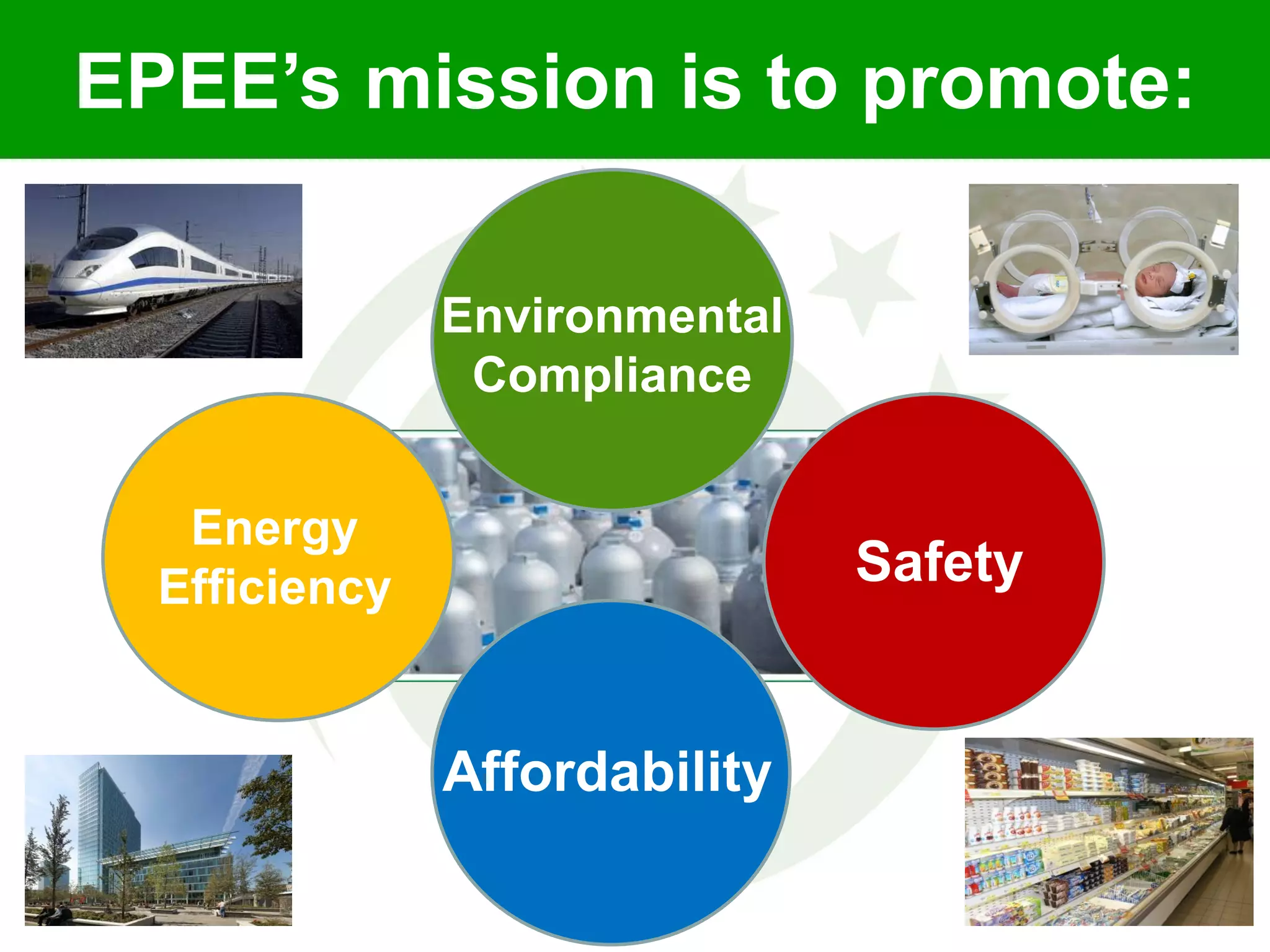
EPEE’s mission is to promote:

               Environmental
                Compliance


   Energy
  Efficiency                   Safety


               Affordability
EPEE’s main current fields of activities
• Promote Energy Efficiency
   –   Ecodesign Directive
   –   Energy Efficiency Directive
   –   Eco Label and Energy Label
   –   Energy Performance of Buildings Directive
   –   Renewable Energies Directive …

• The F-Gas Regulation and its revision
   – Maintain and strengthen the F-Gas Regulation
   – Support a technically and economically feasible phase-down

• Raise awareness on Market Surveillance
   – Importance of properly enforcing and policing legislation

• Promote an HVACR association network at EU level
Who is the EU? The three Institutions
            European Commission: Starts policy formulation
            • Sole right of Legislative Initiative
            • Enforces Community law
            • Administers & implements policies & legislation
            • Voice of the EU & negotiates international agreements


            European Parliament: Co-legislates with the Council
            • 736 elected national politicians from 27 Member States
            • Elected every five years – last elections in 2009
            • Largest political group: conservatives
            • Largest delegations: GER, FR; UK; IT; SP; PL
            • MEPs work in Brussels, Strasbourg and home const.


            European Council: Co-legislates with the Parliament
            • Represents the Member States via Ministers and
               Permanent Representatives
            • Amends and adopts proposals
            • UK, FR, G (IT, SP, POL) = Key larger countries      5
Main EU initiatives & EPEE priorities
        DG Energy                   DG Climate Action       DG Environment
    Commissioner Oettinger       Commissioner Hedegaard   Commissioner Potocnik


                                                            The Roadmap for a
    The Energy Efficiency        The Roadmap to a low        ressource efficient
          Action Plan            carbon economy in 2050           Europe


                    ENERGY                      EFFICIENCY

•     Ecodesign              •   F-Gas Regulation           •   WEEE
•     EPBD                   •   Renewable                  •   RoHS...
•     Energy label ...           Energies Directive..
More concretely:
The EU 20 – 20 – 20 target
The current F-Gas Regulation:
              Main requirements
Containment & recovery                   Reporting obligations
• Preventive tightness checks:           • F-gas to be reported:
  Frequency depends on the amount of       with main categories of
  F-gas contained                          applications
• Leak detection systems:                • Applies to:
  For applications containing 300kg or     producers, importers and exporters
  more of F-gases                          of quantities > 1to

• Record keeping (logbooks)              • Member States to establish
                                           reporting systems.
• Recovery, recycling or
  destruction                            Labelling
Training and certification
                                         • For new equipment:
• Adequate training of personnel              Chemical abbreviation of F-gas
  handling F-gases                            Weight of the refrigerant
                                              Kyoto protocol-covered
• Mutual recognition in the EU                Where applicable: product is
• Minimum requirements only                   hermetically sealed.
  agreed upon in July 2007               • Further information in the
                                           manual (e.g. GWP)
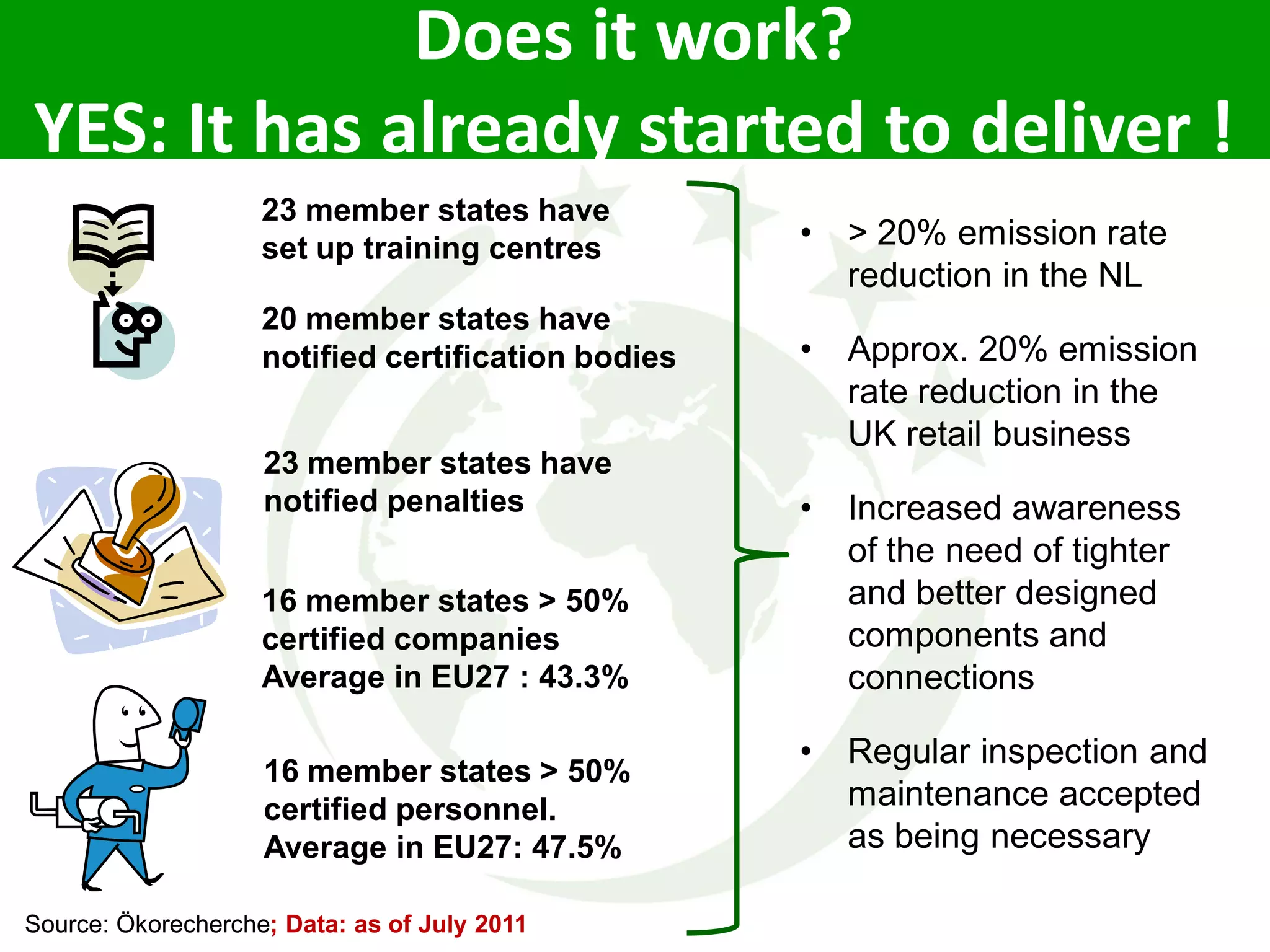
Does it work?
YES: It has already started to deliver !
                    23 member states have
                    set up training centres         •   > 20% emission rate
                                                        reduction in the NL
                    20 member states have
                    notified certification bodies   •   Approx. 20% emission
                                                        rate reduction in the
                                                        UK retail business
                    23 member states have
                    notified penalties              •   Increased awareness
                                                        of the need of tighter
                    16 member states > 50%              and better designed
                    certified companies                 components and
                    Average in EU27 : 43.3%             connections

                                                    •   Regular inspection and
                    16 member states > 50%
                    certified personnel.                maintenance accepted
                    Average in EU27: 47.5%              as being necessary

Source: Ökorecherche; Data: as of July 2011
Will it reduce emissions?
                 YES: substantially !
                                                     Source:
                                                               - 46%
                                             - 44%
                                     - 28%


Source: Commission report Oct 2011
If all provisions of F-Gas Regulation and MAC Directive are fully
applied, emissions will at least stabilise at todays levels
The predecessor of the F-Gas Regulation:
The Dutch STEK scheme, in place since 1992
                                    Higher productivity:
                                Installers increase productivity of
                                own activities due to high quality
                                         HVACR systems

      Cost savings:                                                        Higher reliabilty:
  Refrigerant, spare part and                                           Manufacturers and installers
energy savings for owners due                                         increased quality of equipment
   to regular maintenance                                                       & service


               Increased awareness:
                                                          Reduced emission rates:
                Industry and operators
             understand the environmental                     From 20-25% to 3.5%
                  impact of HVACR


                 Cost of STEK: EUR 0.33 / hour / service engineer
A practical example on
implementation: Hungary
         •   Hungarian Monitoring &
             Certification Body
         •   > 7600 certified personel; 1200
             certified companies; > 2000
             registered operators; > 22000
             registered refrigeration circuits
         •   ODS and F-Gas regulations merged
             into one global registration and
             certification system
         •   Web-based registration and
             certification system
         •   Barcode-ID and circuit labelling
         •   Online track-keeping of all services
             (leakage checks, maintenance, etc.)
         •   Access to the database by
             authorities
Lessons learned so far…
1. Co-operation between national governments
   and the industry is essential
   • A recipe for success (i.e. the UK, Hungary, Slovakia, the
     Netherlands).
   • It is essential to ensure that the obligations of the F-Gas
     Regulation are communicated to all those affected and are
     being understood correctly.
   • The UK F-Gas Support is a prime example for successful
     communication: removes hurdles and stimulates compliance

2. The implementation of a complex piece of
   legislation such as the F-Gas Regulation takes
   time:
   • It took 5 years for the STEK system to be fully understood and
     implemented by all actors in the Netherlands.  Several of the
     implementing measures under the F-Gas Regulation (labelling,
     training) only entered into force in 2008.
Lessons learned so far…
3. Containment works
• Unfortunately there is a lack of available data -- little
  time has passed since the implementation of the F-Gas
  Regulation.

• STEK showed a major improvement in leakage:
     From 25% emissions to 3,5% emissions in 7 years
     time with even lower emissions percentages known
     today (in 2011, VRF systems in the Netherlands
     reached less than 0.5% emissions).

• AREA (contractors) /EPEE survey:
    When and where the F-Gas Regulation has been
    implemented correctly contractors observe a clear
    decrease in refrigerant emission rates.

• The F-Gas Regulation has clearly lead to better
  awareness among users.
Lessons learned so far…
4. The bigger picture…
 • The HVACR industry is extremely diverse:
     Any regulatory measure needs to take into account this diversity.

 • The choice of a refrigerant depends on a range of factors:
     Climate, application, energy efficiency, safety, cost, technical viability, direct and indirect
     emissions, etc.

 • Implementation takes time:
     The EU has 23 official working languages and 27 Member States with their own national
     legislative regimes.
Lessons learned so far…


5. The F-Gas Regulation has boosted innovation
 • New alternatives have been developed (HFOs)
 • Improvements in HFC technology (lower GWP), e.g. cascades, micro-channel,
   etc.
 • Other sectors using HFCs are keen to be included under the F-Gas Regulation (i.e.
   refrigerated transport sector). Some countries have done so already (FR, NL, ES)
The revision of the F-Gas Regulation
                               Art. 10 of the F-Gas Regulation 842 / 2006:
•         By 4 July 2011, the Commission shall publish a report based on the experience of the
          application of this Regulation.
•         Where necessary, the Commission shall present appropriate proposals for revision of the
          relevant provisions of this Regulation.


               Ökorecherche                           COMMISSION REPORT 
                  report                   Experience with 842/2006 & Need for further action
Q4 2011


               Stakeholders
                                           YES: Revision                      NO: Revision
Q1 2012


                Öko-Institut
                  report                                COMMISSION REPORT
                                              Impact assessment on different policy options
Q2 2012


              Stakeholders

                                                    COMMISSION legislative proposal
The Commission Report:
Public Consultation launched until Dec 19
Key points:                                         Suggestions to further reduce emissions:

1.   It is still too early to quantify the effect
     of the Regulation’s containment and
                                                    1.   Drive transition to technologies with lower
     recovery provisions                                 GWP. Savings potential up to 70 mt CO2eq:
                                                         –   Phase-down: cost estimated to be < 20€/to CO2eq
                                                         –   Bans
2.   If all provisions are fully applied in all          –   Voluntary agreements
     Member States, the Regulation & the
     MAC Directive would stabilise EU-27            2.   Improve containment and recovery
     emissions at today’s levels of 110                  provisions:
     million tonnes of CO2eq – despite the               –   Cost effectiveness questioned: 41€/to CO2eq
     growing use of HFCs                                 –   Full implementation required
                                                         –   Extension to transport refrigeration considered
3.   In the context of the overall EU-objective
     to cut emissions by 80-95% by 2050,            3.   Improve monitoring
     stabilising the F-Gas emissions at                  –   Extend to pre-charged products and equipment
     today’s level is not adequate. More                     imported or exported from EU
     efforts are required.                               –   Enhance MS reporting systems for emission data

                                                    4. Take account of latest scientific information
4.   The Commission supports global                      –   Fluids to be considered
     action under the MP to phase-down                   –   GWP values to be considered (4th IPCC)
     HFCs
The importance of the global context


Source: Ökorecherche
HFC market growth takes place in the developping world !
The F-Gas Regulation and its revision:
       Benefits & objectives
The F-gas regulation:                The revision:
Its main benefits:
• Strong EU-wide legal
                                     EPEE‘s objectives:
    framework
• Lower emissions via                1. Full implementation of
    containment                         the Regulation
• Monitoring of emissions
• Freedom of refrigerant             2. A realistic and
    choice for highest efficiency,      balanced global
    safety, and lowest                  phase-down
    emissions.
                                     3. No sacrifice on energy
In the longer term:                     efficiency, safety and
• Pushes innovation                     affordability
• High-skilled workforce
• Improved quality of
    equipment, education and
    training
EPEE‘s priorities on top of the current
          F-Gas Regulation…
•   Improving awareness, surveillance and control
     Assignment of trained control bodies in the member states
     Awareness campaigns at operator level
     Controls at installer level

•   Broadening of the F-Gas Regulation’s scope
     Controls at retail sales channel level
     Include transport refrigeration

•   Recovery and reuse of HFCs
     Incentives for installers and operators, e.g. deposit schemes
     Allow recovery and transportation of HFCs by certified
      companies

•   Harmonization of certification
     Harmonized CEN standard EN 13313
     Create EU wide databases

•   Leakage rate targets
     Harmonized CEN standard EN 15834
     EU methodology to determine relative refrigerant loss
The EPEE roadmap for emission
          reduction

Low carbon
 economy                Phase down


 2020
targets
                       Improvement


                            Full
                       implementation
A one size-fits-all solution ?


… There is no perfect refrigerant !
Phase-Down:
        A soft landing


TODAY

           2020

                     2030

                            2050
Phase-Out:
 A high-risk command and control policy
Phase-down                         Phase-out

What is it?                        What is it?
A gradual reduction                Makes products illegal

The benefits:                      The risks:
• Achieves climate goals           • Technology prescriptve
• Allows for flexibility and       • Jeopardizes 2020 & future targets
   affordability                       – Heat pumps & geothermal
• Fosters innovation                      plants use f-gases
• Strengthens competitiveness          – Loss of energy efficiency
• Conserves resources              • Undermines competitiveness
• Promotes recycling               • Can lead to unsafe practice
• Can be a global solution         • Plant closures & job losses in EU
• Encourages containment           • High costs to society
   principle set by F-gas policy
EPEE’s five main recommendations for legislators

1. EPEE calls for a holistic approach with a focus on
   overall CO2 emissions
2. Four attributes (Safety, Environment, Economy and
   Energy Efficiency) must be taken into consideration
   when making decisions
3. Energy efficiency is key for industry and society
4. A realistic and balanced phase-down provides
   regulatory certainty on CO2 equivalents => along with
   energy efficiency mandates, this ensures success for
   2020 and for future targets
5. No prescriptive bans or GWP cut offs as these are
   counter productive for energy efficient systems
Thank your for your attention !
        For more information, please contact:

 EPEE – The European Partnership for Energy and the
         Environment: www.epeeglobal.org

                Avenue des Arts 46
                  1000 Brussels

             secretariat@epeeglobal.org
               a.voigt@epeeglobal.org

The EU F-Gas Regulation

  • 1.
    EPEE – TheEuropean Partnership for Energy and the Environment The EU F-Gas Regulation: The way forward By Andrea Voigt – EPEE Director General Disclaimer: The information contained in this presentation represents EPEE’s point of view and not in any way that of the European Union as such.
  • 2.
    Who is EPEE? The full value chain of the Refrigeration, Air Conditioning and Heat Pump sector A major part of the European RAC & HP industry • > 200,000 employees in Europe • > € 30 billion turnover in Europe
  • 3.
    EPEE’s mission isto promote: Environmental Compliance Energy Efficiency Safety Affordability
  • 4.
    EPEE’s main currentfields of activities • Promote Energy Efficiency – Ecodesign Directive – Energy Efficiency Directive – Eco Label and Energy Label – Energy Performance of Buildings Directive – Renewable Energies Directive … • The F-Gas Regulation and its revision – Maintain and strengthen the F-Gas Regulation – Support a technically and economically feasible phase-down • Raise awareness on Market Surveillance – Importance of properly enforcing and policing legislation • Promote an HVACR association network at EU level
  • 5.
    Who is theEU? The three Institutions European Commission: Starts policy formulation • Sole right of Legislative Initiative • Enforces Community law • Administers & implements policies & legislation • Voice of the EU & negotiates international agreements European Parliament: Co-legislates with the Council • 736 elected national politicians from 27 Member States • Elected every five years – last elections in 2009 • Largest political group: conservatives • Largest delegations: GER, FR; UK; IT; SP; PL • MEPs work in Brussels, Strasbourg and home const. European Council: Co-legislates with the Parliament • Represents the Member States via Ministers and Permanent Representatives • Amends and adopts proposals • UK, FR, G (IT, SP, POL) = Key larger countries 5
  • 6.
    Main EU initiatives& EPEE priorities DG Energy DG Climate Action DG Environment Commissioner Oettinger Commissioner Hedegaard Commissioner Potocnik The Roadmap for a The Energy Efficiency The Roadmap to a low ressource efficient Action Plan carbon economy in 2050 Europe ENERGY EFFICIENCY • Ecodesign • F-Gas Regulation • WEEE • EPBD • Renewable • RoHS... • Energy label ... Energies Directive..
  • 7.
    More concretely: The EU20 – 20 – 20 target
  • 8.
    The current F-GasRegulation: Main requirements Containment & recovery Reporting obligations • Preventive tightness checks: • F-gas to be reported: Frequency depends on the amount of with main categories of F-gas contained applications • Leak detection systems: • Applies to: For applications containing 300kg or producers, importers and exporters more of F-gases of quantities > 1to • Record keeping (logbooks) • Member States to establish reporting systems. • Recovery, recycling or destruction Labelling Training and certification • For new equipment: • Adequate training of personnel Chemical abbreviation of F-gas handling F-gases Weight of the refrigerant Kyoto protocol-covered • Mutual recognition in the EU Where applicable: product is • Minimum requirements only hermetically sealed. agreed upon in July 2007 • Further information in the manual (e.g. GWP)
  • 9.
    Does it work? YES:It has already started to deliver ! 23 member states have set up training centres • > 20% emission rate reduction in the NL 20 member states have notified certification bodies • Approx. 20% emission rate reduction in the UK retail business 23 member states have notified penalties • Increased awareness of the need of tighter 16 member states > 50% and better designed certified companies components and Average in EU27 : 43.3% connections • Regular inspection and 16 member states > 50% certified personnel. maintenance accepted Average in EU27: 47.5% as being necessary Source: Ökorecherche; Data: as of July 2011
  • 10.
    Will it reduceemissions? YES: substantially ! Source: - 46% - 44% - 28% Source: Commission report Oct 2011 If all provisions of F-Gas Regulation and MAC Directive are fully applied, emissions will at least stabilise at todays levels
  • 11.
    The predecessor ofthe F-Gas Regulation: The Dutch STEK scheme, in place since 1992 Higher productivity: Installers increase productivity of own activities due to high quality HVACR systems Cost savings: Higher reliabilty: Refrigerant, spare part and Manufacturers and installers energy savings for owners due increased quality of equipment to regular maintenance & service Increased awareness: Reduced emission rates: Industry and operators understand the environmental From 20-25% to 3.5% impact of HVACR Cost of STEK: EUR 0.33 / hour / service engineer
  • 12.
    A practical exampleon implementation: Hungary • Hungarian Monitoring & Certification Body • > 7600 certified personel; 1200 certified companies; > 2000 registered operators; > 22000 registered refrigeration circuits • ODS and F-Gas regulations merged into one global registration and certification system • Web-based registration and certification system • Barcode-ID and circuit labelling • Online track-keeping of all services (leakage checks, maintenance, etc.) • Access to the database by authorities
  • 13.
    Lessons learned sofar… 1. Co-operation between national governments and the industry is essential • A recipe for success (i.e. the UK, Hungary, Slovakia, the Netherlands). • It is essential to ensure that the obligations of the F-Gas Regulation are communicated to all those affected and are being understood correctly. • The UK F-Gas Support is a prime example for successful communication: removes hurdles and stimulates compliance 2. The implementation of a complex piece of legislation such as the F-Gas Regulation takes time: • It took 5 years for the STEK system to be fully understood and implemented by all actors in the Netherlands.  Several of the implementing measures under the F-Gas Regulation (labelling, training) only entered into force in 2008.
  • 14.
    Lessons learned sofar… 3. Containment works • Unfortunately there is a lack of available data -- little time has passed since the implementation of the F-Gas Regulation. • STEK showed a major improvement in leakage: From 25% emissions to 3,5% emissions in 7 years time with even lower emissions percentages known today (in 2011, VRF systems in the Netherlands reached less than 0.5% emissions). • AREA (contractors) /EPEE survey: When and where the F-Gas Regulation has been implemented correctly contractors observe a clear decrease in refrigerant emission rates. • The F-Gas Regulation has clearly lead to better awareness among users.
  • 15.
    Lessons learned sofar… 4. The bigger picture… • The HVACR industry is extremely diverse: Any regulatory measure needs to take into account this diversity. • The choice of a refrigerant depends on a range of factors: Climate, application, energy efficiency, safety, cost, technical viability, direct and indirect emissions, etc. • Implementation takes time: The EU has 23 official working languages and 27 Member States with their own national legislative regimes.
  • 16.
    Lessons learned sofar… 5. The F-Gas Regulation has boosted innovation • New alternatives have been developed (HFOs) • Improvements in HFC technology (lower GWP), e.g. cascades, micro-channel, etc. • Other sectors using HFCs are keen to be included under the F-Gas Regulation (i.e. refrigerated transport sector). Some countries have done so already (FR, NL, ES)
  • 17.
    The revision ofthe F-Gas Regulation Art. 10 of the F-Gas Regulation 842 / 2006: • By 4 July 2011, the Commission shall publish a report based on the experience of the application of this Regulation. • Where necessary, the Commission shall present appropriate proposals for revision of the relevant provisions of this Regulation. Ökorecherche COMMISSION REPORT  report Experience with 842/2006 & Need for further action Q4 2011 Stakeholders YES: Revision  NO: Revision Q1 2012 Öko-Institut report COMMISSION REPORT Impact assessment on different policy options Q2 2012 Stakeholders COMMISSION legislative proposal
  • 18.
    The Commission Report: PublicConsultation launched until Dec 19 Key points: Suggestions to further reduce emissions: 1. It is still too early to quantify the effect of the Regulation’s containment and 1. Drive transition to technologies with lower recovery provisions GWP. Savings potential up to 70 mt CO2eq: – Phase-down: cost estimated to be < 20€/to CO2eq – Bans 2. If all provisions are fully applied in all – Voluntary agreements Member States, the Regulation & the MAC Directive would stabilise EU-27 2. Improve containment and recovery emissions at today’s levels of 110 provisions: million tonnes of CO2eq – despite the – Cost effectiveness questioned: 41€/to CO2eq growing use of HFCs – Full implementation required – Extension to transport refrigeration considered 3. In the context of the overall EU-objective to cut emissions by 80-95% by 2050, 3. Improve monitoring stabilising the F-Gas emissions at – Extend to pre-charged products and equipment today’s level is not adequate. More imported or exported from EU efforts are required. – Enhance MS reporting systems for emission data 4. Take account of latest scientific information 4. The Commission supports global – Fluids to be considered action under the MP to phase-down – GWP values to be considered (4th IPCC) HFCs
  • 19.
    The importance ofthe global context Source: Ökorecherche HFC market growth takes place in the developping world !
  • 20.
    The F-Gas Regulationand its revision: Benefits & objectives The F-gas regulation: The revision: Its main benefits: • Strong EU-wide legal EPEE‘s objectives: framework • Lower emissions via 1. Full implementation of containment the Regulation • Monitoring of emissions • Freedom of refrigerant 2. A realistic and choice for highest efficiency, balanced global safety, and lowest phase-down emissions. 3. No sacrifice on energy In the longer term: efficiency, safety and • Pushes innovation affordability • High-skilled workforce • Improved quality of equipment, education and training
  • 21.
    EPEE‘s priorities ontop of the current F-Gas Regulation… • Improving awareness, surveillance and control  Assignment of trained control bodies in the member states  Awareness campaigns at operator level  Controls at installer level • Broadening of the F-Gas Regulation’s scope  Controls at retail sales channel level  Include transport refrigeration • Recovery and reuse of HFCs  Incentives for installers and operators, e.g. deposit schemes  Allow recovery and transportation of HFCs by certified companies • Harmonization of certification  Harmonized CEN standard EN 13313  Create EU wide databases • Leakage rate targets  Harmonized CEN standard EN 15834  EU methodology to determine relative refrigerant loss
  • 22.
    The EPEE roadmapfor emission reduction Low carbon economy Phase down 2020 targets Improvement Full implementation
  • 23.
    A one size-fits-allsolution ? … There is no perfect refrigerant !
  • 24.
    Phase-Down: A soft landing TODAY 2020 2030 2050
  • 25.
    Phase-Out: A high-riskcommand and control policy Phase-down Phase-out What is it? What is it? A gradual reduction Makes products illegal The benefits: The risks: • Achieves climate goals • Technology prescriptve • Allows for flexibility and • Jeopardizes 2020 & future targets affordability – Heat pumps & geothermal • Fosters innovation plants use f-gases • Strengthens competitiveness – Loss of energy efficiency • Conserves resources • Undermines competitiveness • Promotes recycling • Can lead to unsafe practice • Can be a global solution • Plant closures & job losses in EU • Encourages containment • High costs to society principle set by F-gas policy
  • 26.
    EPEE’s five mainrecommendations for legislators 1. EPEE calls for a holistic approach with a focus on overall CO2 emissions 2. Four attributes (Safety, Environment, Economy and Energy Efficiency) must be taken into consideration when making decisions 3. Energy efficiency is key for industry and society 4. A realistic and balanced phase-down provides regulatory certainty on CO2 equivalents => along with energy efficiency mandates, this ensures success for 2020 and for future targets 5. No prescriptive bans or GWP cut offs as these are counter productive for energy efficient systems
  • 27.
    Thank your foryour attention ! For more information, please contact: EPEE – The European Partnership for Energy and the Environment: www.epeeglobal.org Avenue des Arts 46 1000 Brussels secretariat@epeeglobal.org a.voigt@epeeglobal.org