Initiatives to strengthen countries’ capacity in environmental justice and enforcement - Brainstorming symposium on Integrated Capacity Building of the Enforcement Chain to combat illegal trade in ODS, Paris, 9-10 June 2011 Masa Nagai Acting Deputy Director Division of Environmental Law and Conventions, UNEP
Montevideo Programme Montevideo Programme I (1981) catalyzed international actions to develop  Multilateral Environmental Agreements Montevideo Programme II (1993), III (2001) and IV (2010) have progressively addressed the need for strengthening countries’ capacities for enforcing environmental law Increasing emphasis on the linkage between compliance with Multilateral Environmental Agreements and  enforcement of the relevant national environmental law
Shifts in direction of technical assistance Since mid 1970s:  Assist executive branch of the Government to develop national environmental legislation and strengthen national institutions Since mid 1990s: Support awareness building and capacity building of the judiciary in environmental matter Currently: Extend support to strengthen capacities of all relevant actors active in environmental enforcement against the backdrop of the need for a more integrated approach for environmental justice Address gaps between commitment and implementation (Bali Strategic Plan for Technology Support and Capacity-building )
UNEP Programme of Work 2010-2011, 2012-2013 Countries’ judicial and enforcement capacity to implement environmental law is enhanced through training, awareness-raising, information exchange and legal advisory services to reinforce the integration of the environment in the rule of law for achieving environmental justice
Problems in environmental enforcement  Lack of full appreciation by policy-makers of the value of the environment Lack of adequate environmental awareness and knowledge on environmental matters Fragmented environmental and environment-related laws and regulations  Relatively weak power of the environmental authority within the government
Problems (2) Lack of adequate access to environmental information and access to justice by the public Need for coordination and cooperation between enforcement officers Corruption in enforcement of environmental law Lack of human, technical and financial resources for implementing environmental law
UNEP Judges Programme Started in 1995 as a regional initiative, replicated in all regions 2002 Global Judges Symposium (pre-WSSD event), catalyzing further action by judges action – recently supreme courts in some countries decided to designate environmental courts as concrete results Judges handbook, compendium of judicial decisions, training manual, database (ECOLEX)
Strengthen national legal basis UNEP has continued supporting developing countries and countries with economies in transition to further develop environmental law Legal advisory services Strengthen  capacities of relevant stakeholders through training programmes and workshops
Facilitate compliance and enforcement UNEP has been working closely with partners active in the promotion of compliance with and enforcement of MEAs (such as INECE, IUCN, AECEN) Training workshops and programmes for Government officials and other relevant stakeholders to raise awareness and facilitate progressive action towards compliance and enforcement
Advocate environmental justice UNEP convenes conferences, workshops and symposiums for judges, government officials,  prosecutors, parliamentarians, and other legal stakeholders to exchange views and share experiences to advance environmental justice with Governments or partner organizations e.g. Asian Justice Conference in 2007,  Asian Development Bank-UNEP Asia-Pacific Judges Symposium in 2010
Guidelines Guidelines on compliance/enforcement of MEAs Guidelines for the development of national legislation on access to information, public participation and access to justice in environmental matters Guidelines for the development of domestic legislation on liability, response action and compensation for damage caused by activities dangerous to the environment
Thematic Initiatives Endangered wildlife and related products (CITES), including the International consortium on combating wildlife crime Hazardous wastes (Basel) ODS (Montreal Protocol), including the Capacity Assistance Programme
Trade/Border control  Green Customs Initiative PATROL project (Asia) In partnership with UNODC, NGOs (Traffic, etc.)
Transnational environmental crime  Transnational environmental crime initiative To provide an integrated international platform for enhancing cooperation, international information exchange and assistance to  strengthen capacity of developing countries (including South-South cooperation) In cooperation with Governments and partner organizations (e.g. INTERPOL), building upon the existing initiatives
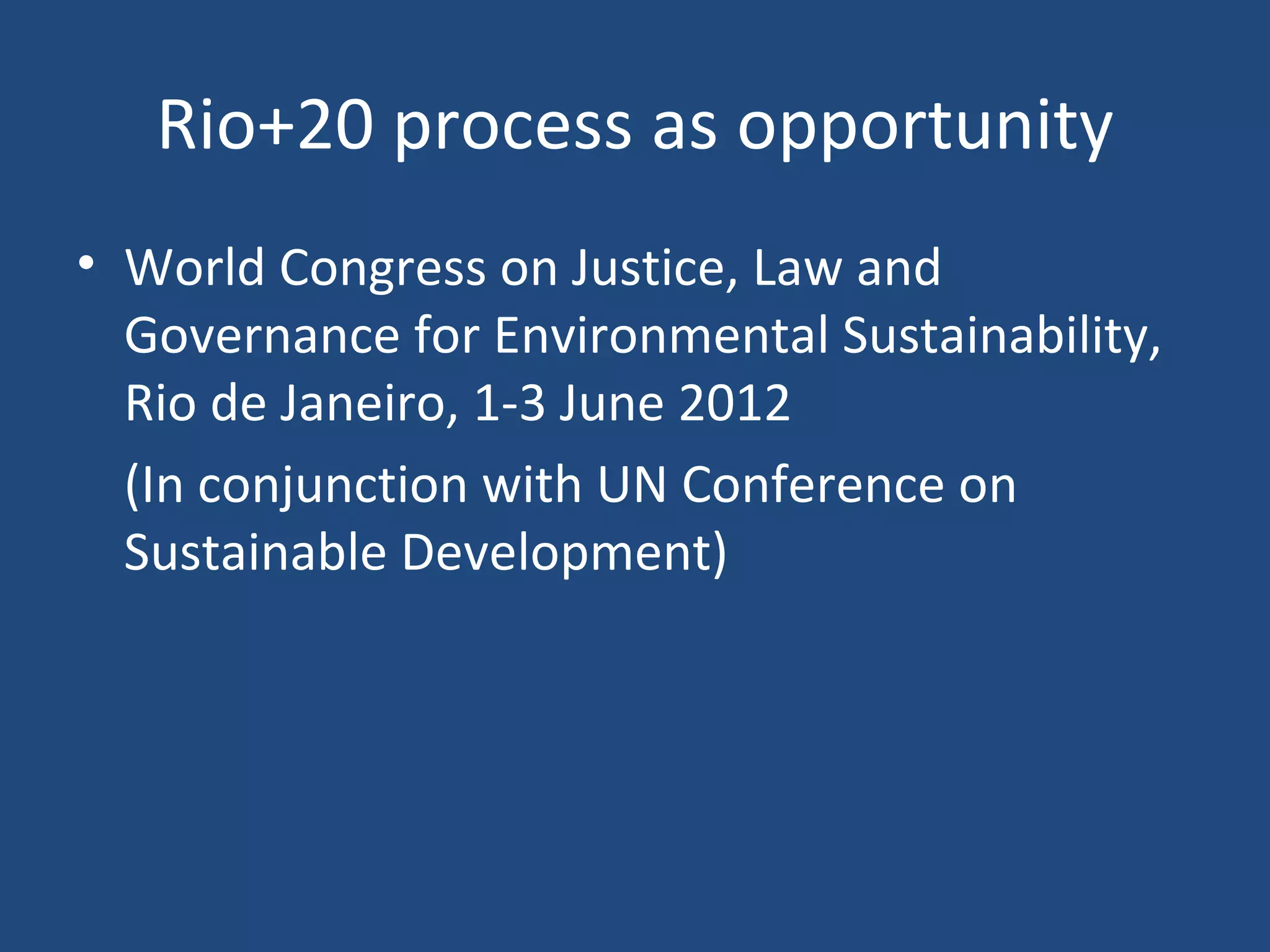
Rio+20 process as opportunity World Congress on Justice, Law and Governance for Environmental Sustainability, Rio de Janeiro, 1-3 June 2012 (In conjunction with UN Conference on  Sustainable Development)

Unep’s initiatives enforcement

  • 1.
    Initiatives to strengthencountries’ capacity in environmental justice and enforcement - Brainstorming symposium on Integrated Capacity Building of the Enforcement Chain to combat illegal trade in ODS, Paris, 9-10 June 2011 Masa Nagai Acting Deputy Director Division of Environmental Law and Conventions, UNEP
  • 2.
    Montevideo Programme MontevideoProgramme I (1981) catalyzed international actions to develop Multilateral Environmental Agreements Montevideo Programme II (1993), III (2001) and IV (2010) have progressively addressed the need for strengthening countries’ capacities for enforcing environmental law Increasing emphasis on the linkage between compliance with Multilateral Environmental Agreements and enforcement of the relevant national environmental law
  • 3.
    Shifts in directionof technical assistance Since mid 1970s: Assist executive branch of the Government to develop national environmental legislation and strengthen national institutions Since mid 1990s: Support awareness building and capacity building of the judiciary in environmental matter Currently: Extend support to strengthen capacities of all relevant actors active in environmental enforcement against the backdrop of the need for a more integrated approach for environmental justice Address gaps between commitment and implementation (Bali Strategic Plan for Technology Support and Capacity-building )
  • 4.
    UNEP Programme ofWork 2010-2011, 2012-2013 Countries’ judicial and enforcement capacity to implement environmental law is enhanced through training, awareness-raising, information exchange and legal advisory services to reinforce the integration of the environment in the rule of law for achieving environmental justice
  • 5.
    Problems in environmentalenforcement Lack of full appreciation by policy-makers of the value of the environment Lack of adequate environmental awareness and knowledge on environmental matters Fragmented environmental and environment-related laws and regulations Relatively weak power of the environmental authority within the government
  • 6.
    Problems (2) Lackof adequate access to environmental information and access to justice by the public Need for coordination and cooperation between enforcement officers Corruption in enforcement of environmental law Lack of human, technical and financial resources for implementing environmental law
  • 7.
    UNEP Judges ProgrammeStarted in 1995 as a regional initiative, replicated in all regions 2002 Global Judges Symposium (pre-WSSD event), catalyzing further action by judges action – recently supreme courts in some countries decided to designate environmental courts as concrete results Judges handbook, compendium of judicial decisions, training manual, database (ECOLEX)
  • 8.
    Strengthen national legalbasis UNEP has continued supporting developing countries and countries with economies in transition to further develop environmental law Legal advisory services Strengthen capacities of relevant stakeholders through training programmes and workshops
  • 9.
    Facilitate compliance andenforcement UNEP has been working closely with partners active in the promotion of compliance with and enforcement of MEAs (such as INECE, IUCN, AECEN) Training workshops and programmes for Government officials and other relevant stakeholders to raise awareness and facilitate progressive action towards compliance and enforcement
  • 10.
    Advocate environmental justiceUNEP convenes conferences, workshops and symposiums for judges, government officials, prosecutors, parliamentarians, and other legal stakeholders to exchange views and share experiences to advance environmental justice with Governments or partner organizations e.g. Asian Justice Conference in 2007, Asian Development Bank-UNEP Asia-Pacific Judges Symposium in 2010
  • 11.
    Guidelines Guidelines oncompliance/enforcement of MEAs Guidelines for the development of national legislation on access to information, public participation and access to justice in environmental matters Guidelines for the development of domestic legislation on liability, response action and compensation for damage caused by activities dangerous to the environment
  • 12.
    Thematic Initiatives Endangeredwildlife and related products (CITES), including the International consortium on combating wildlife crime Hazardous wastes (Basel) ODS (Montreal Protocol), including the Capacity Assistance Programme
  • 13.
    Trade/Border control Green Customs Initiative PATROL project (Asia) In partnership with UNODC, NGOs (Traffic, etc.)
  • 14.
    Transnational environmental crime Transnational environmental crime initiative To provide an integrated international platform for enhancing cooperation, international information exchange and assistance to strengthen capacity of developing countries (including South-South cooperation) In cooperation with Governments and partner organizations (e.g. INTERPOL), building upon the existing initiatives
  • 15.
    Rio+20 process asopportunity World Congress on Justice, Law and Governance for Environmental Sustainability, Rio de Janeiro, 1-3 June 2012 (In conjunction with UN Conference on Sustainable Development)