OECD/ECLAC 
REGIONAL 
CONSULTATION 
Inclusive Growth in Latin America and the Caribbean 
A MULTIDIMENSIONAL APPROACH TO 
POVERTY MEASUREMENT IN LATIN 
AMERICA
OBJECTIVES AND SCOPE 
• ECLAC is exploring a multidimensional approach to 
poverty measurement for Latin American countries. 
• Using the methodology proposed by Alkire & Foster, 
several dimensions, cut-offs and ways of aggregation 
of dimensions are analyzed. 
• Two multidimensional indexes are tested: 
– The first uses the dimensions and indicators from the 
Unsatisfied Basic Needs (UBN) approach: 
– Housing (construction materials and overcrowding), 
Water, Sanitation, Education (school attendance and 
minimum years of schooling, Energy (electricity and 
cooking fuel). 
– The second adds indicators of insufficient incomes and 
social exclusion to the basic needs core.
METHODOLOGY 
• Weights for dimensions (W) 
– There is no clear consensus for assigning higher or lower 
weights for different measures of critical deprivations. 
– Following most standard practices, the dimensions are 
weighted equally. 
• Value of multidimensional cut-off (k) 
– The intersection approach (k = all deprivations) 
increases the risk of exclusion error. 
– The union approach (k = one or more deprivation) 
increases the risk of inclusion error. 
– We choose a value of k between both extremes, but 
closer to the union approach: k=2 (two deprivations or 
more) 
• Unit of analysis: households
The measure based on basic needs has a 
reasonable robustness. The ordering of countries 
tends to be independent from k-values. 
Latin America (17 countries). Adjusted Headcount Index (M0) and different K values , 2011 
0.45 
0.40 
0.35 
0.30 
0.25 
0.20 
0.15 
0.10 
0.05 
0.00 
m0_10p m0_20p m0_30p m0_40p m0_60p m0_70p m0_80p m0_90p 
Source: ECLAC. 
ARG 
BOL 
BRA 
CHL 
COL 
CRI 
ECU 
GUA 
HON 
MEX 
NIC 
PRY 
PER 
RDO 
SAL 
URY 
VEN
The higher the poverty headcount rate (H), the 
higher the intensity of poverty (A) 
LatinAmerica (17 countries). Intensity (A) and incidence (H) of poverty , 2011 
(percentages) 
Source: ECLAC. 
CHL 
ARG 
URY 
VEN 
CRI 
BRA 
ECU 
COL 
RDO 
MEX 
BOL HON 
PER SAL 
PRY 
NIC 
GUA 
60 
55 
50 
45 
40 
35 
30 
25 
20 
0 10 20 30 40 50 60 70 80 
Intensity 
Incidence
Income and non-income poverty measures tend to identify 
different people as poor. The divergencies are higher in 
countries with lower poverty rates. 
Latin America (17 countries). Poverty incidence measured by monetary and non-monetary methods/a. , 
2011 
100 
90 
80 
70 
60 
50 
40 
30 
20 
10 
0 
Poor by the two methods Poor just by one method Non-poor 
Source: ECLAC. 
a. Income poverty includes both extreme and non extreme poor. ECLAC estimations for all countries, except Perú. Non income 
poverty is measured by critical deprivations (BNI), with k=2.
INCLUDING ADDITIONAL DIMENSIONS 
OF WELFARE 
• Measures based on critical deprivations have a low 
analytical capacity in LA countries where most basic 
needs are generally satisfied. 
• It makes sense to complement indicators of basic needs 
with other dimensions: 
– Lack of income (income below cost of food basket) decreases 
the probability of errors of exclusion, particularly in countries 
with a lower incidence of non monetary deprivations, and may 
act as a proxy for inadequate food consumption. 
– Aspects of social exclusion such as young people that neither 
study nor work or lack of social protection (affiliation to health 
insurance, affiliation to pension funds, access to old-age 
pensions) are very relevant to understanding poverty.
Relatively speaking, the higher differences are 
verified in countries with the lower incidences 
of basic needs. 
LatinAmerica (16 countries). Headcount poverty Index (H) by countries, 2011 
(percentages) 
2.2 
9.6 
90 
80 
70 
60 
50 
40 
30 
20 
10 
Sources: ECLAC. 
a. 2006 data 
11 
13.2 
15.5 15.5 
21 
23.9 24.8 
31.9 
40.5 
46.6 
48 48.1 
63.4 63.6 
11.2 
15.5 
24.2 
30.4 
26.1 
29.9 
45.1 
39.4 
53 
48.5 
53.1 
70.3 
66.8 65.6 
80.6 
79 
0 
Chl Ury Arg Ven Bra Cri Ecu Col Rdo Mex Per Pry Els Bol Hon Gua/b. 
BNI BNI+Incomes+Social Exclusion
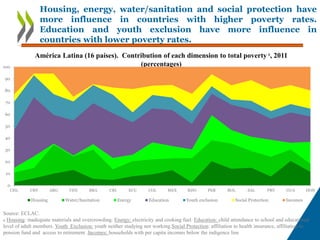
Housing, energy, water/sanitation and social protection have 
more influence in countries with higher poverty rates. 
Education and youth exclusion have more influence in 
countries with lower poverty rates. 
América Latina (16 países). Contribution of each dimension to total poverty a, 2011 
(percentages) 
100 
90 
80 
70 
60 
50 
40 
30 
20 
10 
0 
CHL URY ARG VEN BRA CRI ECU COL MEX RDO PER BOL SAL PRY GUA HON 
Housing Water/Sanitation Energy Education Youth exclusion Social Protection Incomes 
Source: ECLAC. 
a Housing: inadequate materials and overcrowding. Energy: electricity and cooking fuel. Education: child attendance to school and educational 
level of adult members. Youth Exclusion: youth neither studying nor working.Social Protection: affiliation to health insurance, affiliation to 
pension fund and access to retirement .Incomes: households with per capita incomes below the indigence line
Pascual Gerstenfeld, Director, Statistics Division, 
ECLAC, pascual.gerstenfeld@cepal.org

2013.11.15_OECD-ECLAC Regional Consultation_pascual gerstenfeld

  • 1.
    OECD/ECLAC REGIONAL CONSULTATION Inclusive Growth in Latin America and the Caribbean A MULTIDIMENSIONAL APPROACH TO POVERTY MEASUREMENT IN LATIN AMERICA
  • 2.
    OBJECTIVES AND SCOPE • ECLAC is exploring a multidimensional approach to poverty measurement for Latin American countries. • Using the methodology proposed by Alkire & Foster, several dimensions, cut-offs and ways of aggregation of dimensions are analyzed. • Two multidimensional indexes are tested: – The first uses the dimensions and indicators from the Unsatisfied Basic Needs (UBN) approach: – Housing (construction materials and overcrowding), Water, Sanitation, Education (school attendance and minimum years of schooling, Energy (electricity and cooking fuel). – The second adds indicators of insufficient incomes and social exclusion to the basic needs core.
  • 3.
    METHODOLOGY • Weightsfor dimensions (W) – There is no clear consensus for assigning higher or lower weights for different measures of critical deprivations. – Following most standard practices, the dimensions are weighted equally. • Value of multidimensional cut-off (k) – The intersection approach (k = all deprivations) increases the risk of exclusion error. – The union approach (k = one or more deprivation) increases the risk of inclusion error. – We choose a value of k between both extremes, but closer to the union approach: k=2 (two deprivations or more) • Unit of analysis: households
  • 4.
    The measure basedon basic needs has a reasonable robustness. The ordering of countries tends to be independent from k-values. Latin America (17 countries). Adjusted Headcount Index (M0) and different K values , 2011 0.45 0.40 0.35 0.30 0.25 0.20 0.15 0.10 0.05 0.00 m0_10p m0_20p m0_30p m0_40p m0_60p m0_70p m0_80p m0_90p Source: ECLAC. ARG BOL BRA CHL COL CRI ECU GUA HON MEX NIC PRY PER RDO SAL URY VEN
  • 5.
    The higher thepoverty headcount rate (H), the higher the intensity of poverty (A) LatinAmerica (17 countries). Intensity (A) and incidence (H) of poverty , 2011 (percentages) Source: ECLAC. CHL ARG URY VEN CRI BRA ECU COL RDO MEX BOL HON PER SAL PRY NIC GUA 60 55 50 45 40 35 30 25 20 0 10 20 30 40 50 60 70 80 Intensity Incidence
  • 6.
    Income and non-incomepoverty measures tend to identify different people as poor. The divergencies are higher in countries with lower poverty rates. Latin America (17 countries). Poverty incidence measured by monetary and non-monetary methods/a. , 2011 100 90 80 70 60 50 40 30 20 10 0 Poor by the two methods Poor just by one method Non-poor Source: ECLAC. a. Income poverty includes both extreme and non extreme poor. ECLAC estimations for all countries, except Perú. Non income poverty is measured by critical deprivations (BNI), with k=2.
  • 7.
    INCLUDING ADDITIONAL DIMENSIONS OF WELFARE • Measures based on critical deprivations have a low analytical capacity in LA countries where most basic needs are generally satisfied. • It makes sense to complement indicators of basic needs with other dimensions: – Lack of income (income below cost of food basket) decreases the probability of errors of exclusion, particularly in countries with a lower incidence of non monetary deprivations, and may act as a proxy for inadequate food consumption. – Aspects of social exclusion such as young people that neither study nor work or lack of social protection (affiliation to health insurance, affiliation to pension funds, access to old-age pensions) are very relevant to understanding poverty.
  • 8.
    Relatively speaking, thehigher differences are verified in countries with the lower incidences of basic needs. LatinAmerica (16 countries). Headcount poverty Index (H) by countries, 2011 (percentages) 2.2 9.6 90 80 70 60 50 40 30 20 10 Sources: ECLAC. a. 2006 data 11 13.2 15.5 15.5 21 23.9 24.8 31.9 40.5 46.6 48 48.1 63.4 63.6 11.2 15.5 24.2 30.4 26.1 29.9 45.1 39.4 53 48.5 53.1 70.3 66.8 65.6 80.6 79 0 Chl Ury Arg Ven Bra Cri Ecu Col Rdo Mex Per Pry Els Bol Hon Gua/b. BNI BNI+Incomes+Social Exclusion
  • 9.
    Housing, energy, water/sanitationand social protection have more influence in countries with higher poverty rates. Education and youth exclusion have more influence in countries with lower poverty rates. América Latina (16 países). Contribution of each dimension to total poverty a, 2011 (percentages) 100 90 80 70 60 50 40 30 20 10 0 CHL URY ARG VEN BRA CRI ECU COL MEX RDO PER BOL SAL PRY GUA HON Housing Water/Sanitation Energy Education Youth exclusion Social Protection Incomes Source: ECLAC. a Housing: inadequate materials and overcrowding. Energy: electricity and cooking fuel. Education: child attendance to school and educational level of adult members. Youth Exclusion: youth neither studying nor working.Social Protection: affiliation to health insurance, affiliation to pension fund and access to retirement .Incomes: households with per capita incomes below the indigence line
  • 10.
    Pascual Gerstenfeld, Director,Statistics Division, ECLAC, pascual.gerstenfeld@cepal.org