Global Poverty  Allison Zellers “ Human development is about much more than the rise or fall of national incomes. It is about creating an environment in which people can develop their full potential and lead productive, creative lives in accord with their needs and interests. People are the real wealth of nations. Development is thus about expanding the choices people have to lead lives that they value. And it is thus about much more than economic growth, which is only a means- if a very important one- of enlarging people’s choices.” — Human Development Reports, United Nations Development Program
What is Poverty?   One of the central challenges in today’s economy and society that demands our immediate attention UN’s World Summit on Social Development (1995): The ‘Copenhagen Declaration’ described poverty as “…a condition characterized by severe deprivation of basic human needs, including food, safe, drinking water, sanitation facilities, health, shelter, education, and information.”
Definitions of Poverty Social Definition of Poverty Lacking essential items: food, clothing, water, shelter, education, access to health care Statistical Definitions of Poverty:  consumption vs. income Relative Poverty : the extent of poverty in individual countries; entire population is ranked in order of income per capita.  The bottom 10% considered ‘poor’ or ‘impoverished’  Absolute Poverty : sets ‘poverty line’ at certain income or consumption amount per year, based on the estimated value of a ‘basket of goods’ (food, shelter, water, etc.) necessary for proper living Used for developing countries where majority survives with the bare minimum or less  Global Poverty :  Line first created in 1990; set at $2/day or less  ( Extreme Poverty-  $1/day or less)  More developed countries- set higher (i.e. 2005 line in US: $26.19 a day)
How is it measured? Poverty lines separating the poor from the non-poor: Relative or Absolute  Non-Monetary  dimensions of well-being: Health/Nutrition : nutritional status of children, incidence of disease, life expectancy Education : literacy levels, specific test scores, years of schooling Composite indices : income, health, assets, education all considered  Subjective perceptions : question households about their perceived situations, minimum standards, and poverty rankings in community Monetary  dimensions: use consumption as better indicator than income Easier/more reliable to estimate; Better picture of standards of living The poverty measure : statistical function translating comparison of well-being indicator and poverty line into one aggregate number for a part or whole of  the population  Incidence of poverty:  those whose income and consumption are below the poverty line Depth of poverty (poverty gap):  total resources needed to meet needs  of certain individuals below the line (divided by total population) Poverty severity (squared poverty gap):  inequality among  the poor (with higher weight placed on those further away from line) Vulnerability : probability/risk of being or falling deeper into poverty Different Levels: non, transiently, chronically, and persistently poor
Poverty Statistics 2001 : 1.1 billion people with incomes less than $1/day and 2.7 billion people with incomes less than $2/day August 2008 : World Bank presented a major overhaul to their estimates of global poverty with better and new data Higher  than past estimates due to underestimated cost of living in developing countries  International Poverty Line : changed from  $1  a day to  $1.25  a day; $2 to $2.50 (due to inflation) With revised $1.25/day : 1.4 billion: live at poverty line or below  110 million children: out of school 31 million: infected with HIV/AIDS At least 80% of humanity: live on less than $10/day 95% of them in developing countries Almost half the world (over 3 billion): still less than $2.50/day  These figures do not reflect the recent global food crisis and rising cost of energy:  could bring another 100 million into poverty
Unequal Distribution of Wealth Poorest  40% of world population consumes 5 % of global income/ The  richest  20%  consumes 75% of global income  Industrialized nations: do not have as many in absolute poverty but relative poverty/inequality  is high Organization for Economic and Cooperative Development (Oct. 2008):  Stated that the gap between rich/poor has grown in more than 75% of wealthy countries since the mid-1980s Canada, Germany, Norway, and U.S. are most affected (Greece/UK have shrinking gaps) Worst countries: Mexico : rich/poor income ratio is 25/1,  Turkey : 17/1,  US : 16/1 (plus Portugal and Poland) Hardest hit sector:  children/young adults have poverty rates around 25% higher than population average “ The widening gaps between rich and poor within nations is morally outrageous, economically wasteful, and potentially socially explosive” -  Michel Camdessus,   former      head of the International    Monetary Fund
Causes of Poverty Insecurities:  Based on   UN’s  Universal Declaration of Human Rights (1948) Economic-  poor markets/jobs difficult to access  Education-  limited access/no information about improving quality of life Poor health-  inadequate nutrition/hygiene/health services Unforeseen events-  73% of poorest billion people have lived through or are involved in violent conflict; natural disasters; global warming Structural Influences : Major factors “ Corporate Globalization”:  wealthier companies/nations are able to determine rules, shape the international institutions, and influence communication mechanisms that disseminate information to people. Powerful subjugating the poor:  protect their “national interests”  while exploiting others Corrupt governments: Democracies with limited economic choices/Local political groups in Third World purchasing loyalty Violent oppression from ruling elites if they are threatened Unequal access to trade, land, and resources:  “flood up” vs. “trickle down” Global economic model : rapid flow of capital is mainly borne by poor All of these factors : make shocks harder/more impossible for people to break out of poverty and reduce dependency on IMF and World Bank
How to Reduce Poverty? Those above the poverty level: insist that they are honest and productive  Industrialized nations: Don’t recognize that they have 30-70% more workers than is necessary in the workforce or that the displaced should have an equal share of jobs/income Cold War Period : poorer country governments failed to improve the poor’s situation due to the risk of looking communist, facing external pressures, external meddling in international affairs, or even military intervention Overseas Development Institute (ODI):  Described poverty reduction as a twin function of the rate of growth and changes in income distribution Differing Views of Wealthy Nations : Political Left : inequality is a matter of moral obligation and social justice in order to avoid a weakening society Political Right:  inequality has already been overcome; it is the responsibility of individuals to help themselves (US: one of the worst inequality levels) Underlying theme of both:  Social cohesion  is at risk
Reductions: What Can Be Done?  In general: Establish strong institutions, non-corrupt democracies, an impartial media, equitable distribution of land, and well-structured judicial system Address poverty at different levels: Country Level :  Directly affects lives of the poor Focus on  Opportunity  for all,  Voice  in decision making,  Protection  from shocks Policies for low inflation, realistic/stable exchange rates, effective integration into the global economy and private sector Investments in adequate schooling/skill development, secured nutrition, preventive health care, rural infrastructure, and credit  Resources toward priority areas/avoiding unproductive spending  Social protection in times of local/national crises Global Level :  Factors of globalization, commodity prices, availability of knowledge, and flow of capital  Steady global economic expansion to provide demand  conditions for developing countries Research/dissemination of vaccines for diseases (HIV/AIDS, TB, malaria, etc.) Assist with agricultural advances for tropical and  semi-arid conditions  Demilitarization, demobilization, and rehabilitation Debt relief to the poorest countries: Global financial and  economic stability
Proposals to Ponder:  Global Issues Humanitarian Aid/Debt Relief: Jeffrey Sachs Doubling global international assistance to $160 billion (0.5% GNP of rich countries) This figure will grow to 0.7% by 2015 How Realistic is this? Is foreign aid money lost?   Getting rid of the ideology of Development: William Easterly Outdated and cannot offer a comprehensive final answer to all of society’s problems Supports world goals vs. autonomies of individual societies- needs to change Should individual governments be free to use time-tested ideas to find their own success? Grameen Bank: Muhammed Yunus 1983: New bank for very poorest of borrowers- required no collateral  Two members at a time had to repay loans  1999: 2.4 million borrowers/ 94% of them were women 5% of members rise above the poverty level each year (125,000 families)  Is self-employment the only solution to realize potential?  “ Environmentally friendly” companies: Tom Knudson For example, Starbucks growing coffee beans in Ethiopia With motto of “Good coffee, doing good”, using painted vs. real images Deforestation, Family income: 66 cents/day,  Selective and ineffective health care, No Land Use Policy Should we value our coffee over the quality of human life?
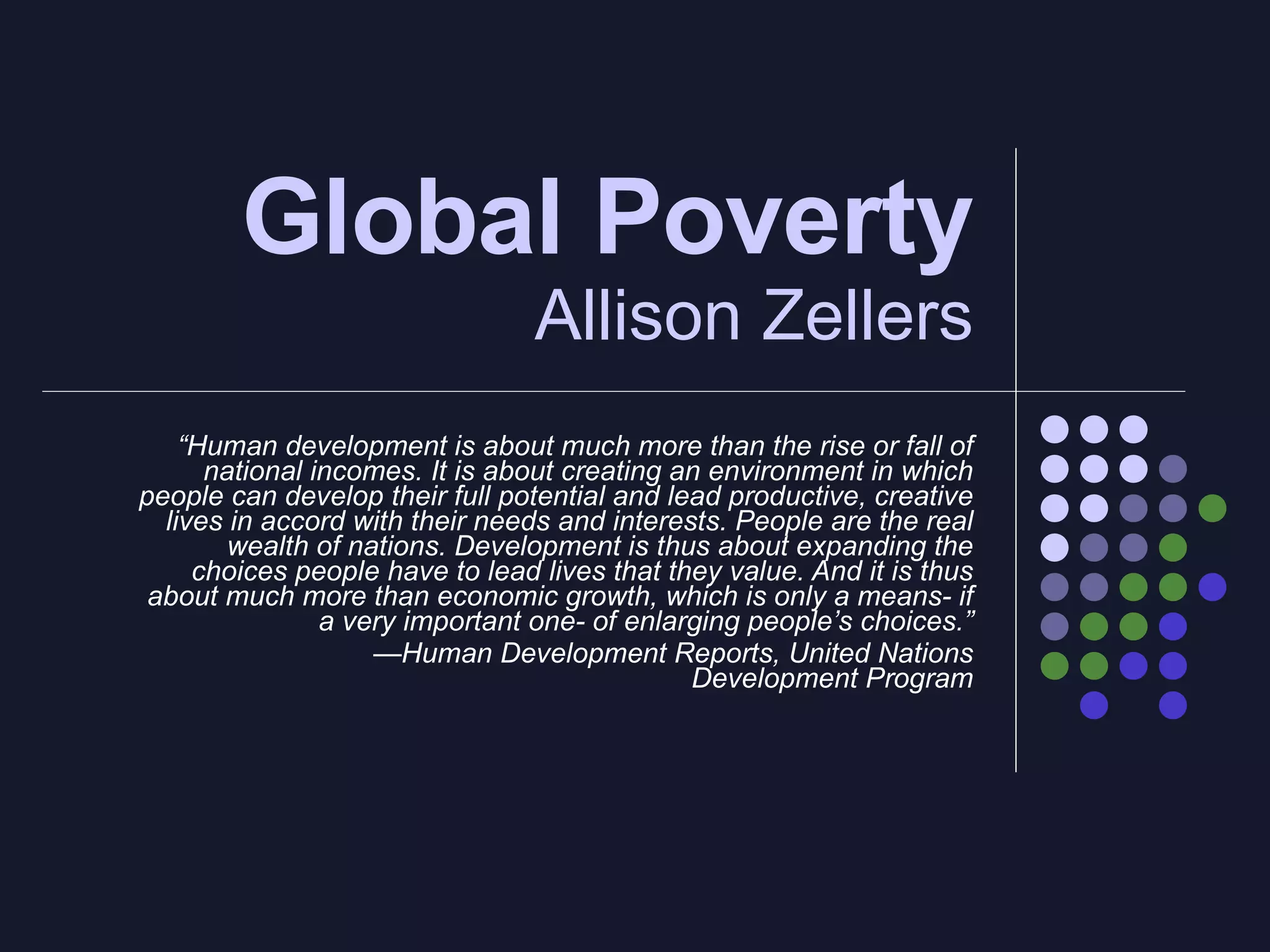
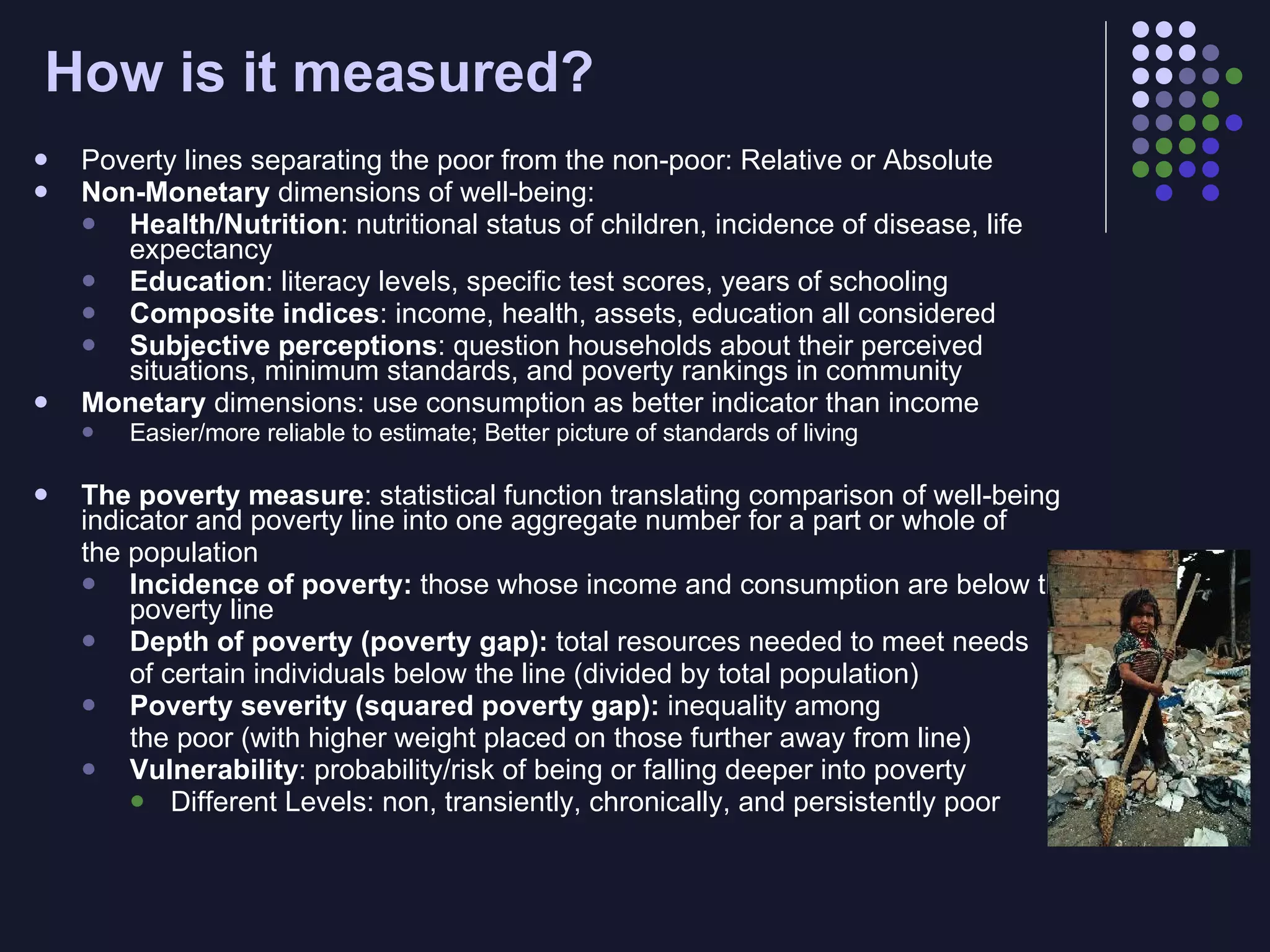
Current Trends In Poverty Proportion of people living in poverty: went from 29 % in 1987 to 26 % in 1998 (total #: still 1.2 billion) Reduction in incidence of global poverty : due to progress in East Asia (especially  China ) 2005 - Poverty rate fell by over 600 million  Although reversed during the recent Asian economic/environmental crisis Moderate/no declines :  Sub-Saharan Africa :  HIGHEST INCIDENCE IN WORLD - additional 74 million poor (total of 291 million) Latin America : from 64 to 78 million South Asia : 522 million Eastern Europe/Central Asia : from 2 to 5 % (24 million people) Today's poor: primarily in rural areas and urban sector Pressures from both areas: Life more insecure  Women/girls are most affected Africa:  may be the only continent where problems of poverty, urban as well as rural, will continue to worsen
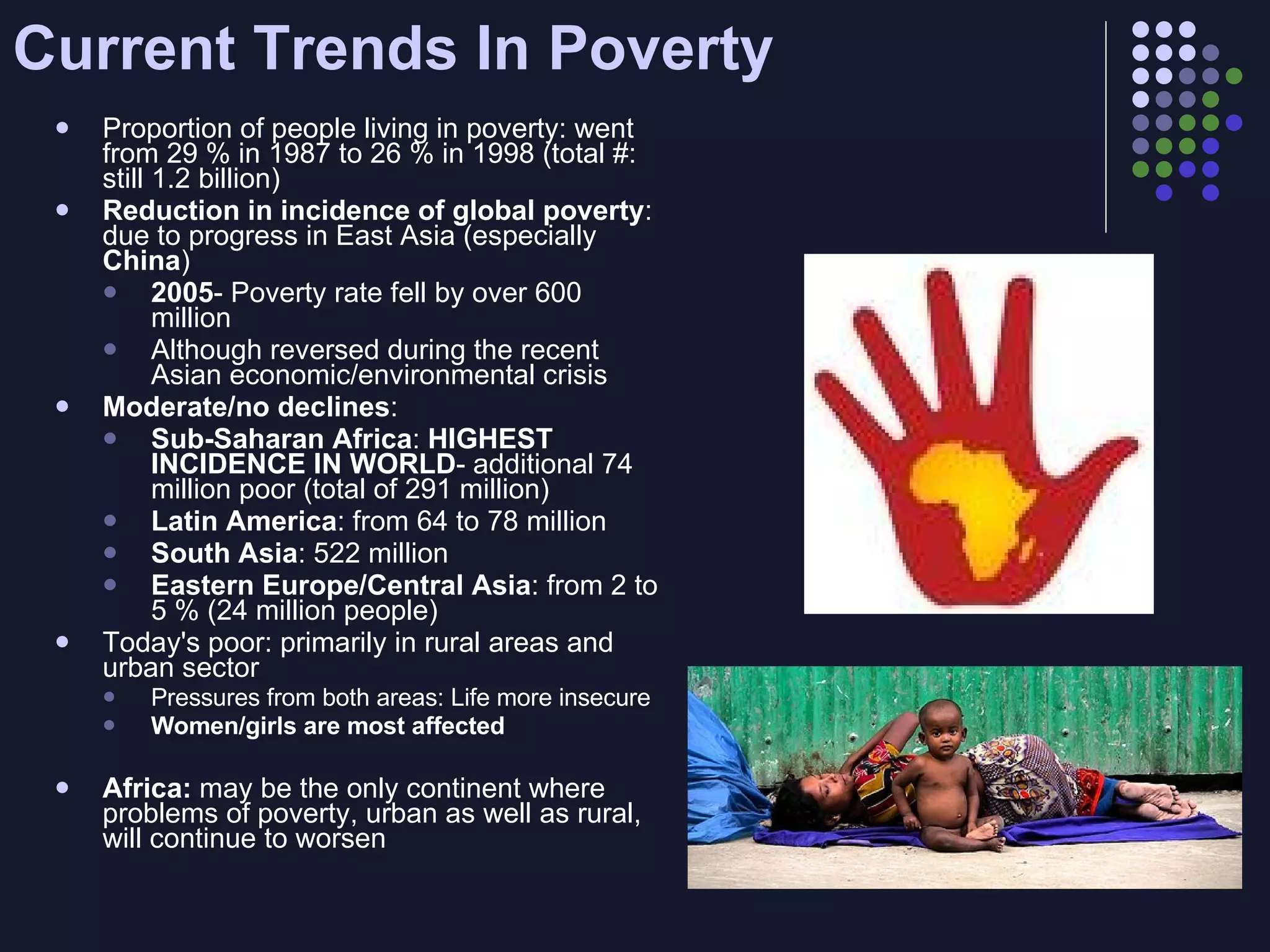
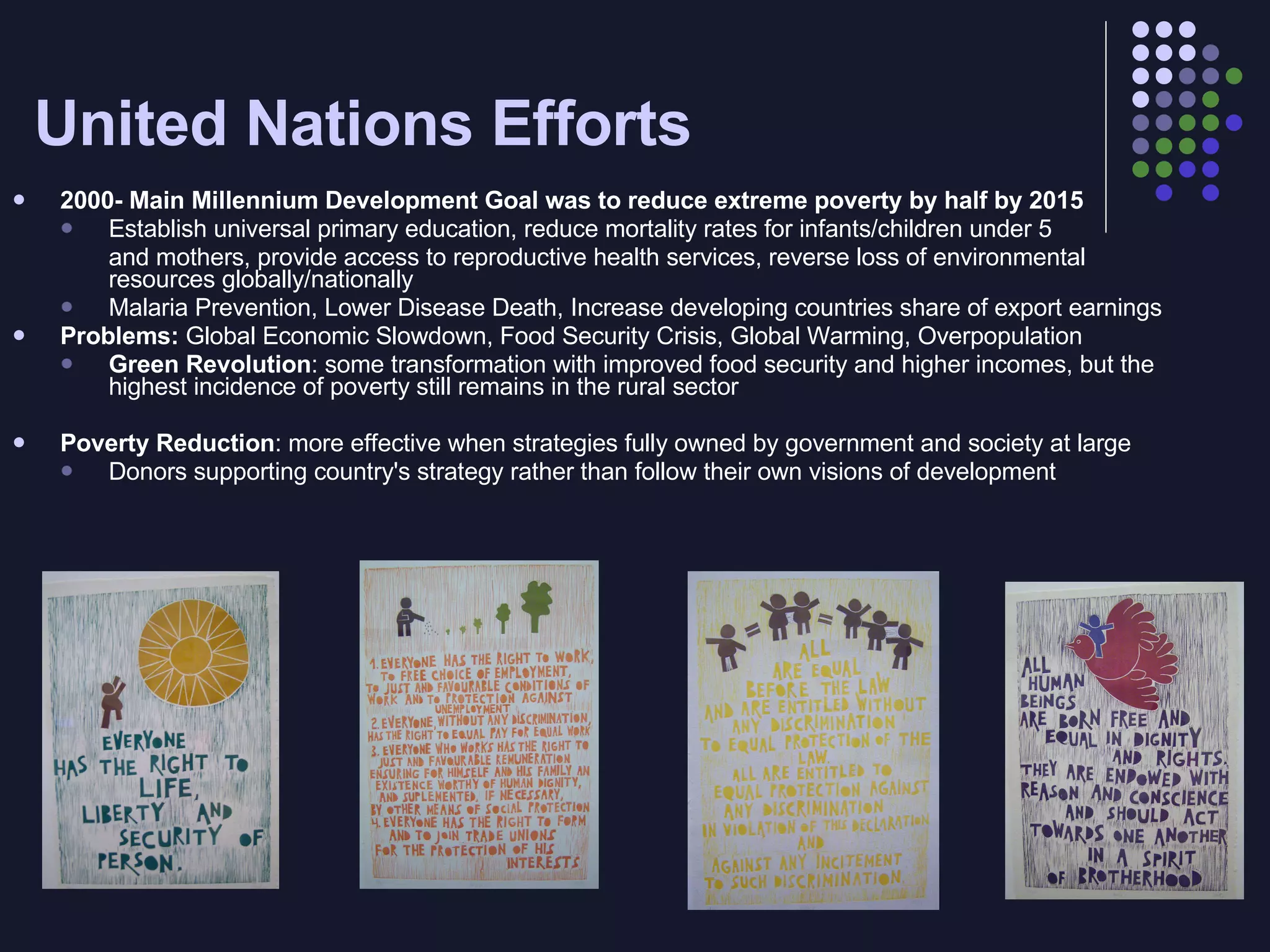
United Nations Efforts 2000- Main Millennium Development Goal was to reduce extreme poverty by half by 2015 Establish universal primary education, reduce mortality rates for infants/children under 5  and mothers, provide access to reproductive health services, reverse loss of environmental resources globally/nationally Malaria Prevention, Lower Disease Death, Increase developing countries share of export earnings Problems:  Global Economic Slowdown, Food Security Crisis, Global Warming, Overpopulation Green Revolution : some transformation with improved food security and higher incomes, but the highest incidence of poverty still remains in the rural sector Poverty Reduction : more effective when strategies fully owned by government and society at large Donors supporting country's strategy rather than follow their own visions of development
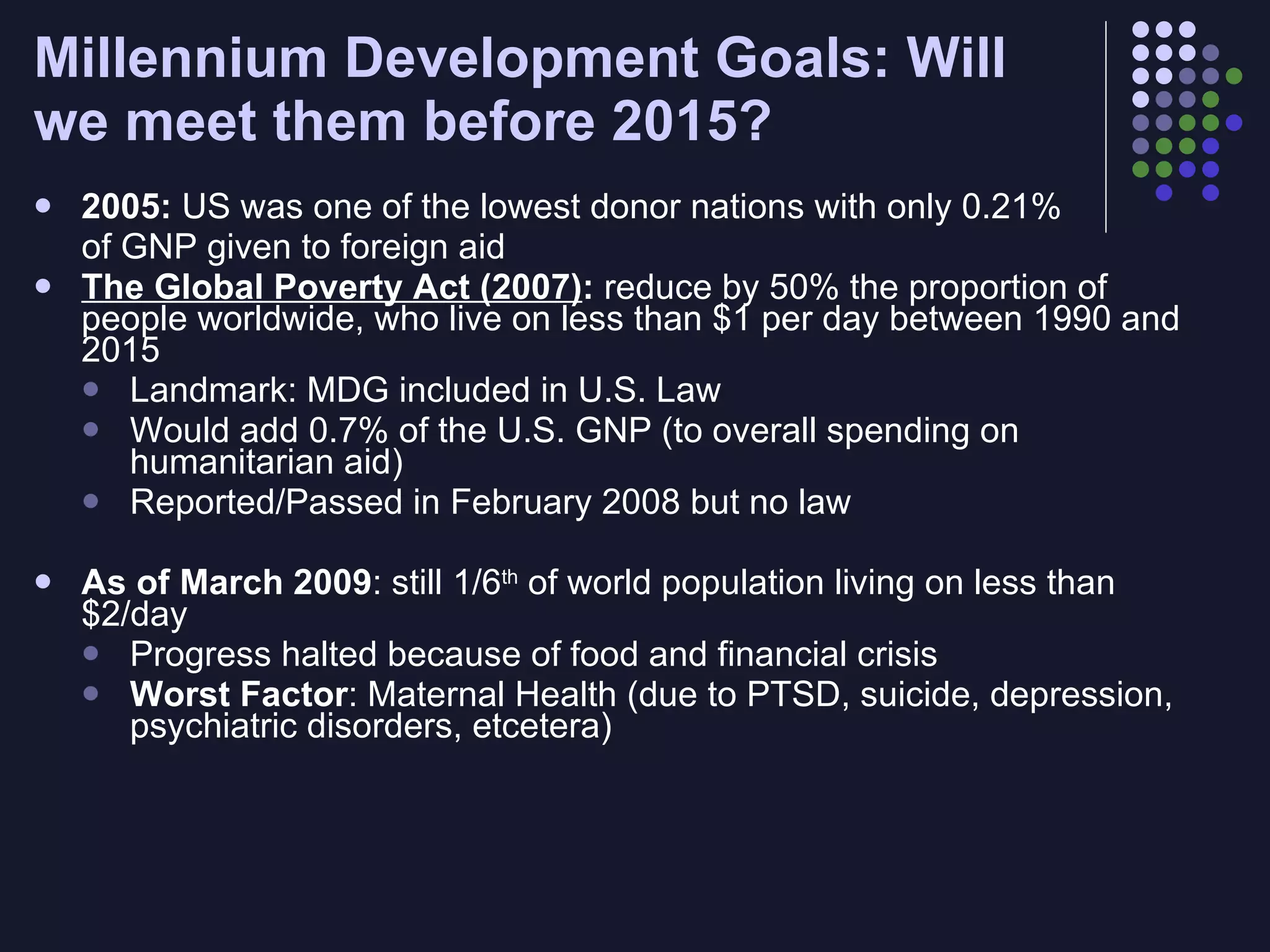
Millennium Development Goals: Will we meet them before 2015? 2005:  US was one of the lowest donor nations with only 0.21%  of GNP given to foreign aid The Global Poverty Act (2007) :  reduce by 50% the proportion of people worldwide, who live on less than $1 per day between 1990 and 2015 Landmark: MDG included in U.S. Law Would add 0.7% of the U.S. GNP (to overall spending on humanitarian aid) Reported/Passed in February 2008 but no law As of March 2009 : still 1/6 th  of world population living on less than $2/day  Progress halted because of food and financial crisis Worst Factor : Maternal Health (due to PTSD, suicide, depression, psychiatric disorders, etcetera)
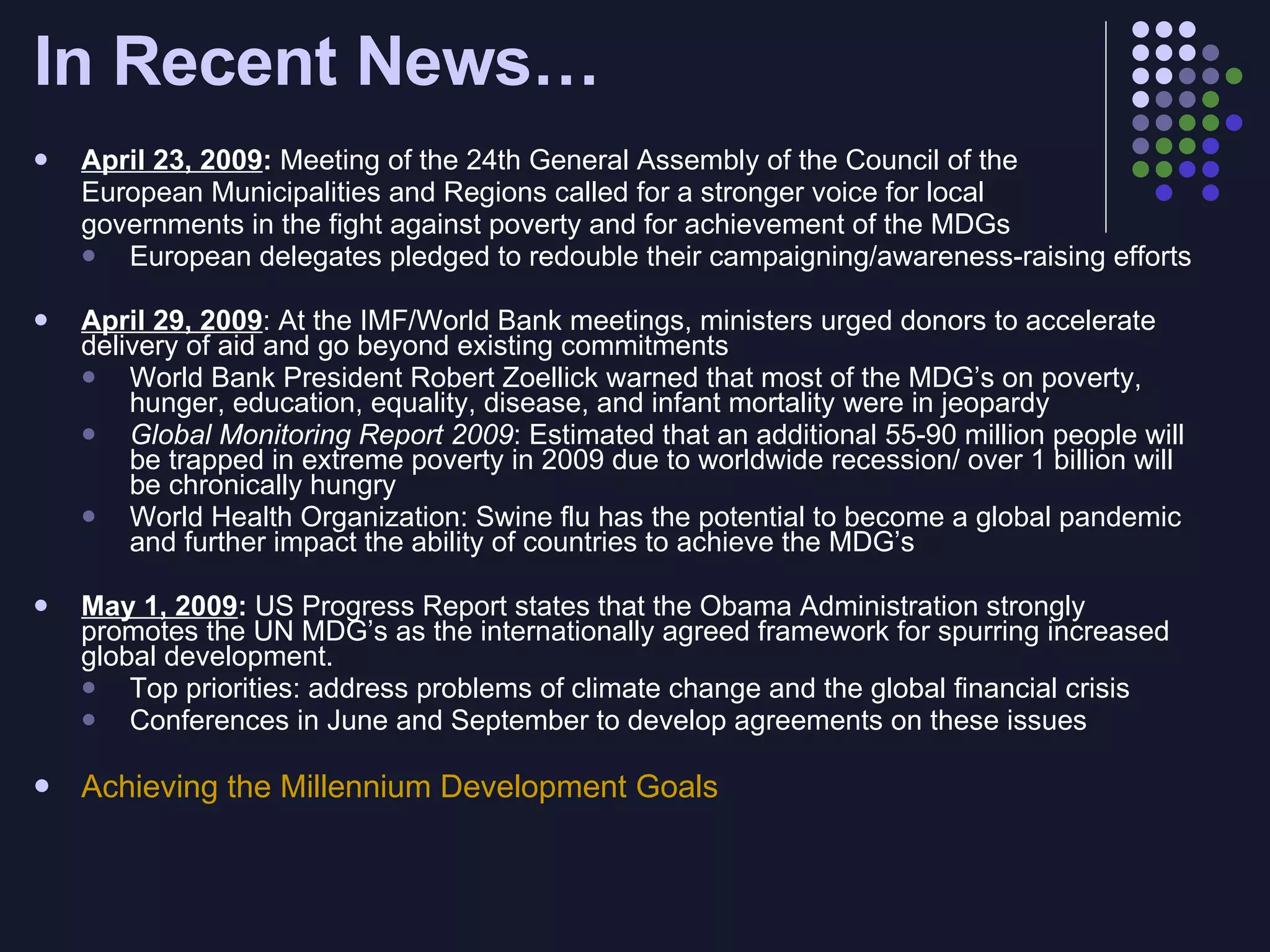
In Recent News… April 23, 2009 :  Meeting of the 24th General Assembly of the Council of the  European Municipalities and Regions called for a stronger voice for local  governments in the fight against poverty and for achievement of the MDGs European delegates pledged to redouble their campaigning/awareness-raising efforts  April 29, 2009 : At the IMF/World Bank meetings, ministers urged donors to accelerate delivery of aid and go beyond existing commitments World Bank President Robert Zoellick warned that most of the MDG’s on poverty, hunger, education, equality, disease, and infant mortality were in jeopardy Global Monitoring Report 2009 : Estimated that an additional 55-90 million people will be trapped in extreme poverty in 2009 due to worldwide recession/ over 1 billion will be chronically hungry World Health Organization: Swine flu has the potential to become a global pandemic and further impact the ability of countries to achieve the MDG’s May 1, 2009 :  US Progress Report states that the Obama Administration strongly promotes the UN MDG’s as the internationally agreed framework for spurring increased global development. Top priorities: address problems of climate change and the global financial crisis  Conferences in June and September to develop agreements on these issues Achieving the Millennium Development Goals
Hope for the Future  Poverty : unacceptable human condition but doesn’t have to be inevitable Main goal of development : eliminate poverty and reduce social imbalances Achievement of the MDG’s may be growing elusive, but they are still within our reach Now more important than ever that local authorities unite their voices to put pressure on national governments and define concrete ways to strengthen their role in the fight against poverty Ensure sustainable economic growth, cohesion, and stability for humanity at large The Mobilization to End Poverty “ Ours is the generation that can achieve the development goals and free our fellow men, women and children from the abject and dehumanizing conditions of extreme poverty.” –  Report of the Secretary-General on  the Work of the Organization,   2007
 
References Sachs, Jeffrey (2005). “Can Extreme Poverty Be Eliminated?”.  Global Issues,  3,12-16.  Easterly, William (2007). “The Ideology of Development”.  Global  Issues, 4,17-19. Knudson, Tom (2007). “Promises and Poverty”.  Global Issues , 20, 86-91. Yunnus, Muhammad (1999). “The Grameen Bank”.  Global Issues , 36, 157-160. http://www.globalissues.org/article/26/poverty-facts-and-stats http://econ.worldbank.org/external/default/main?pagePK=64165259&piPK=64165421&theSitePK=469372&menuPK=64166093&entityID=000158349_20080826113239 http://www.worldbank.org/html/extdr/extme/G8_poverty2000.pdf http://www.usccb.org/sdwp/globalpoverty/ccgp_issues_peace.shtml http://library.thinkquest.org/05aug/00282/over_whatis.htm http://www.endpoverty2015.org/north-america/news/highlights-us-progress-report/01/may/09

Global Poverty

  • 1.
    Global Poverty Allison Zellers “ Human development is about much more than the rise or fall of national incomes. It is about creating an environment in which people can develop their full potential and lead productive, creative lives in accord with their needs and interests. People are the real wealth of nations. Development is thus about expanding the choices people have to lead lives that they value. And it is thus about much more than economic growth, which is only a means- if a very important one- of enlarging people’s choices.” — Human Development Reports, United Nations Development Program
  • 2.
    What is Poverty? One of the central challenges in today’s economy and society that demands our immediate attention UN’s World Summit on Social Development (1995): The ‘Copenhagen Declaration’ described poverty as “…a condition characterized by severe deprivation of basic human needs, including food, safe, drinking water, sanitation facilities, health, shelter, education, and information.”
  • 3.
    Definitions of PovertySocial Definition of Poverty Lacking essential items: food, clothing, water, shelter, education, access to health care Statistical Definitions of Poverty: consumption vs. income Relative Poverty : the extent of poverty in individual countries; entire population is ranked in order of income per capita. The bottom 10% considered ‘poor’ or ‘impoverished’ Absolute Poverty : sets ‘poverty line’ at certain income or consumption amount per year, based on the estimated value of a ‘basket of goods’ (food, shelter, water, etc.) necessary for proper living Used for developing countries where majority survives with the bare minimum or less Global Poverty : Line first created in 1990; set at $2/day or less ( Extreme Poverty- $1/day or less) More developed countries- set higher (i.e. 2005 line in US: $26.19 a day)
  • 4.
    How is itmeasured? Poverty lines separating the poor from the non-poor: Relative or Absolute Non-Monetary dimensions of well-being: Health/Nutrition : nutritional status of children, incidence of disease, life expectancy Education : literacy levels, specific test scores, years of schooling Composite indices : income, health, assets, education all considered Subjective perceptions : question households about their perceived situations, minimum standards, and poverty rankings in community Monetary dimensions: use consumption as better indicator than income Easier/more reliable to estimate; Better picture of standards of living The poverty measure : statistical function translating comparison of well-being indicator and poverty line into one aggregate number for a part or whole of the population Incidence of poverty: those whose income and consumption are below the poverty line Depth of poverty (poverty gap): total resources needed to meet needs of certain individuals below the line (divided by total population) Poverty severity (squared poverty gap): inequality among the poor (with higher weight placed on those further away from line) Vulnerability : probability/risk of being or falling deeper into poverty Different Levels: non, transiently, chronically, and persistently poor
  • 5.
    Poverty Statistics 2001: 1.1 billion people with incomes less than $1/day and 2.7 billion people with incomes less than $2/day August 2008 : World Bank presented a major overhaul to their estimates of global poverty with better and new data Higher than past estimates due to underestimated cost of living in developing countries International Poverty Line : changed from $1 a day to $1.25 a day; $2 to $2.50 (due to inflation) With revised $1.25/day : 1.4 billion: live at poverty line or below 110 million children: out of school 31 million: infected with HIV/AIDS At least 80% of humanity: live on less than $10/day 95% of them in developing countries Almost half the world (over 3 billion): still less than $2.50/day These figures do not reflect the recent global food crisis and rising cost of energy: could bring another 100 million into poverty
  • 6.
    Unequal Distribution ofWealth Poorest 40% of world population consumes 5 % of global income/ The richest 20% consumes 75% of global income Industrialized nations: do not have as many in absolute poverty but relative poverty/inequality is high Organization for Economic and Cooperative Development (Oct. 2008): Stated that the gap between rich/poor has grown in more than 75% of wealthy countries since the mid-1980s Canada, Germany, Norway, and U.S. are most affected (Greece/UK have shrinking gaps) Worst countries: Mexico : rich/poor income ratio is 25/1, Turkey : 17/1, US : 16/1 (plus Portugal and Poland) Hardest hit sector: children/young adults have poverty rates around 25% higher than population average “ The widening gaps between rich and poor within nations is morally outrageous, economically wasteful, and potentially socially explosive” - Michel Camdessus, former head of the International Monetary Fund
  • 7.
    Causes of PovertyInsecurities: Based on UN’s Universal Declaration of Human Rights (1948) Economic- poor markets/jobs difficult to access Education- limited access/no information about improving quality of life Poor health- inadequate nutrition/hygiene/health services Unforeseen events- 73% of poorest billion people have lived through or are involved in violent conflict; natural disasters; global warming Structural Influences : Major factors “ Corporate Globalization”: wealthier companies/nations are able to determine rules, shape the international institutions, and influence communication mechanisms that disseminate information to people. Powerful subjugating the poor: protect their “national interests” while exploiting others Corrupt governments: Democracies with limited economic choices/Local political groups in Third World purchasing loyalty Violent oppression from ruling elites if they are threatened Unequal access to trade, land, and resources: “flood up” vs. “trickle down” Global economic model : rapid flow of capital is mainly borne by poor All of these factors : make shocks harder/more impossible for people to break out of poverty and reduce dependency on IMF and World Bank
  • 8.
    How to ReducePoverty? Those above the poverty level: insist that they are honest and productive Industrialized nations: Don’t recognize that they have 30-70% more workers than is necessary in the workforce or that the displaced should have an equal share of jobs/income Cold War Period : poorer country governments failed to improve the poor’s situation due to the risk of looking communist, facing external pressures, external meddling in international affairs, or even military intervention Overseas Development Institute (ODI): Described poverty reduction as a twin function of the rate of growth and changes in income distribution Differing Views of Wealthy Nations : Political Left : inequality is a matter of moral obligation and social justice in order to avoid a weakening society Political Right: inequality has already been overcome; it is the responsibility of individuals to help themselves (US: one of the worst inequality levels) Underlying theme of both: Social cohesion is at risk
  • 9.
    Reductions: What CanBe Done? In general: Establish strong institutions, non-corrupt democracies, an impartial media, equitable distribution of land, and well-structured judicial system Address poverty at different levels: Country Level : Directly affects lives of the poor Focus on Opportunity for all, Voice in decision making, Protection from shocks Policies for low inflation, realistic/stable exchange rates, effective integration into the global economy and private sector Investments in adequate schooling/skill development, secured nutrition, preventive health care, rural infrastructure, and credit Resources toward priority areas/avoiding unproductive spending Social protection in times of local/national crises Global Level : Factors of globalization, commodity prices, availability of knowledge, and flow of capital Steady global economic expansion to provide demand conditions for developing countries Research/dissemination of vaccines for diseases (HIV/AIDS, TB, malaria, etc.) Assist with agricultural advances for tropical and semi-arid conditions Demilitarization, demobilization, and rehabilitation Debt relief to the poorest countries: Global financial and economic stability
  • 10.
    Proposals to Ponder: Global Issues Humanitarian Aid/Debt Relief: Jeffrey Sachs Doubling global international assistance to $160 billion (0.5% GNP of rich countries) This figure will grow to 0.7% by 2015 How Realistic is this? Is foreign aid money lost? Getting rid of the ideology of Development: William Easterly Outdated and cannot offer a comprehensive final answer to all of society’s problems Supports world goals vs. autonomies of individual societies- needs to change Should individual governments be free to use time-tested ideas to find their own success? Grameen Bank: Muhammed Yunus 1983: New bank for very poorest of borrowers- required no collateral Two members at a time had to repay loans 1999: 2.4 million borrowers/ 94% of them were women 5% of members rise above the poverty level each year (125,000 families) Is self-employment the only solution to realize potential? “ Environmentally friendly” companies: Tom Knudson For example, Starbucks growing coffee beans in Ethiopia With motto of “Good coffee, doing good”, using painted vs. real images Deforestation, Family income: 66 cents/day, Selective and ineffective health care, No Land Use Policy Should we value our coffee over the quality of human life?
  • 11.
    Current Trends InPoverty Proportion of people living in poverty: went from 29 % in 1987 to 26 % in 1998 (total #: still 1.2 billion) Reduction in incidence of global poverty : due to progress in East Asia (especially China ) 2005 - Poverty rate fell by over 600 million Although reversed during the recent Asian economic/environmental crisis Moderate/no declines : Sub-Saharan Africa : HIGHEST INCIDENCE IN WORLD - additional 74 million poor (total of 291 million) Latin America : from 64 to 78 million South Asia : 522 million Eastern Europe/Central Asia : from 2 to 5 % (24 million people) Today's poor: primarily in rural areas and urban sector Pressures from both areas: Life more insecure Women/girls are most affected Africa: may be the only continent where problems of poverty, urban as well as rural, will continue to worsen
  • 12.
    United Nations Efforts2000- Main Millennium Development Goal was to reduce extreme poverty by half by 2015 Establish universal primary education, reduce mortality rates for infants/children under 5 and mothers, provide access to reproductive health services, reverse loss of environmental resources globally/nationally Malaria Prevention, Lower Disease Death, Increase developing countries share of export earnings Problems: Global Economic Slowdown, Food Security Crisis, Global Warming, Overpopulation Green Revolution : some transformation with improved food security and higher incomes, but the highest incidence of poverty still remains in the rural sector Poverty Reduction : more effective when strategies fully owned by government and society at large Donors supporting country's strategy rather than follow their own visions of development
  • 13.
    Millennium Development Goals:Will we meet them before 2015? 2005: US was one of the lowest donor nations with only 0.21% of GNP given to foreign aid The Global Poverty Act (2007) : reduce by 50% the proportion of people worldwide, who live on less than $1 per day between 1990 and 2015 Landmark: MDG included in U.S. Law Would add 0.7% of the U.S. GNP (to overall spending on humanitarian aid) Reported/Passed in February 2008 but no law As of March 2009 : still 1/6 th of world population living on less than $2/day Progress halted because of food and financial crisis Worst Factor : Maternal Health (due to PTSD, suicide, depression, psychiatric disorders, etcetera)
  • 14.
    In Recent News…April 23, 2009 : Meeting of the 24th General Assembly of the Council of the European Municipalities and Regions called for a stronger voice for local governments in the fight against poverty and for achievement of the MDGs European delegates pledged to redouble their campaigning/awareness-raising efforts April 29, 2009 : At the IMF/World Bank meetings, ministers urged donors to accelerate delivery of aid and go beyond existing commitments World Bank President Robert Zoellick warned that most of the MDG’s on poverty, hunger, education, equality, disease, and infant mortality were in jeopardy Global Monitoring Report 2009 : Estimated that an additional 55-90 million people will be trapped in extreme poverty in 2009 due to worldwide recession/ over 1 billion will be chronically hungry World Health Organization: Swine flu has the potential to become a global pandemic and further impact the ability of countries to achieve the MDG’s May 1, 2009 : US Progress Report states that the Obama Administration strongly promotes the UN MDG’s as the internationally agreed framework for spurring increased global development. Top priorities: address problems of climate change and the global financial crisis Conferences in June and September to develop agreements on these issues Achieving the Millennium Development Goals
  • 15.
    Hope for theFuture Poverty : unacceptable human condition but doesn’t have to be inevitable Main goal of development : eliminate poverty and reduce social imbalances Achievement of the MDG’s may be growing elusive, but they are still within our reach Now more important than ever that local authorities unite their voices to put pressure on national governments and define concrete ways to strengthen their role in the fight against poverty Ensure sustainable economic growth, cohesion, and stability for humanity at large The Mobilization to End Poverty “ Ours is the generation that can achieve the development goals and free our fellow men, women and children from the abject and dehumanizing conditions of extreme poverty.” – Report of the Secretary-General on the Work of the Organization, 2007
  • 16.
  • 17.
    References Sachs, Jeffrey(2005). “Can Extreme Poverty Be Eliminated?”. Global Issues, 3,12-16. Easterly, William (2007). “The Ideology of Development”. Global Issues, 4,17-19. Knudson, Tom (2007). “Promises and Poverty”. Global Issues , 20, 86-91. Yunnus, Muhammad (1999). “The Grameen Bank”. Global Issues , 36, 157-160. http://www.globalissues.org/article/26/poverty-facts-and-stats http://econ.worldbank.org/external/default/main?pagePK=64165259&piPK=64165421&theSitePK=469372&menuPK=64166093&entityID=000158349_20080826113239 http://www.worldbank.org/html/extdr/extme/G8_poverty2000.pdf http://www.usccb.org/sdwp/globalpoverty/ccgp_issues_peace.shtml http://library.thinkquest.org/05aug/00282/over_whatis.htm http://www.endpoverty2015.org/north-america/news/highlights-us-progress-report/01/may/09