Declining 
Inequality 
in 
La0n 
America 
Nora 
Lus)g 
Tulane 
University 
Nonresident 
Fellow 
CGD 
and 
IAD 
CEPAL-­‐OECD 
Paris 
– 
May 
21, 
2014
Inequality 
in 
La0n 
America 
is 
high… 
…but 
has 
been 
declining 
since 
around 
2000 
• Decline 
is 
pervasive 
and 
significant 
• Larger 
than 
the 
rise 
in 
inequality 
in 
1990s 
• Important 
contribu)on 
to 
the 
decline 
in 
poverty 
• Contributed 
to 
the 
rise 
of 
the 
middle-­‐class 
• In 
countries 
with 
high 
growth 
& 
low 
growth 
• In 
countries 
with 
leQ 
and 
nonleQ 
governments 
• In 
commodity 
exporters 
and 
commodity 
importers 
2
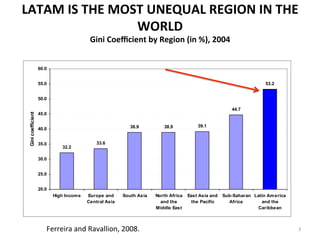
LATAM 
IS 
THE 
MOST 
UNEQUAL 
REGION 
IN 
THE 
WORLD 
Gini 
Coefficient 
by 
Region 
(in 
%), 
2004 
coefficient 
38.9 38.9 39.1 
Gini 33.6 
32.2 
and the 
Caribbean 44.7 
53.2 
60.0 
55.0 
50.0 
45.0 
40.0 
35.0 
30.0 
25.0 
20.0 
High Income Europe and 
Central Asia 
South Asia North Africa 
and the 
Middle East 
East Asia and 
the Pacific 
Sub-Saharan 
Africa 
Latin America 
Ferreira 
and 
Ravallion, 
2008. 
3
Inequality 
declined 
during 
the 
2000’s 
La)n 
America: 
Declining 
income 
inequality 
by 
country: 
2000-­‐2011 
(Annual 
Change 
of 
Gini 
in 
%) 
4 
-2.64 
-2.05 -1.99 
-1.30 -1.24 -1.17 -1.07 -1.03 -0.91 -0.79 -0.74 -0.72 
-0.47 -0.39 
-0.20 -0.10 
0.61 
-0.95 
2.12 
0.82 0.77 
0.40 
3.00 
2.00 
1.00 
0.00 
-1.00 
-2.00 
-3.00 
Nicaragua 
Bolivia 
Ecuador 
Argentina 
El Salvador 
Mexico 
Venezuela 
Brazil 
Peru 
Dom. Rep. 
Panama 
Chile 
Costa Rica 
Paraguay 
Uruguay 
Guatemala 
Honduras 
LAC-17 
China 
South Africa 
India 
USA
The 
decline 
of 
income 
inequality 
in 
the 
2000s 
has 
been 
higher 
that 
the 
rise 
in 
the 
1990s 
(Annual 
average 
change 
in 
Gini 
in 
%) 
8.2$ 
%10.1$ 
1.8$ 
Change$in$Gini$coefficient,$expressed$in$percentage$points$ Average$of$increase$ Average$of$decrease$ 
%4.2$ 
4.1$ 
%5.4$ 
0.8$ 
%3.5$ 
0.1$ 
%4.8$ 
2.9$ 
%7.0$ 
3.1$ 
%6.8$ 
1.5$ 
%4.6$ 
0.2$ 
%4.5$ 
0.4$ 
%7.0$ 
4.9$ 
2.5$ 
%6.1$ 
%8.7$ 
10.0$ 
5.0$ 
0.0$ 
%5.0$ 
%10.0$ 
%15.0$ 
1992%2002$ 
2002%2011$ 
1997%2002$ 
2002%2008$ 
1985%1998$ 
1998%2009$ 
1992%1998$ 
1998%2009$ 
2000%2003$ 
2003%2010$ 
1995%2001$ 
2001%2010$ 
1989%1996$ 
1996%2010$ 
1989%2001$ 
2001%2010$ 
1997%2003$ 
2003%2010$ 
1997%2003$ 
2003%2010$ 
1989%2002$ 
2002%2010$ 
Argen3na$ Bolivia$ Brazil$ Chile$ Dominican$ 
Rep.$ 
El$Salvador$ Mexico$ Panama$ Paraguay$ Peru$ Venezuela$
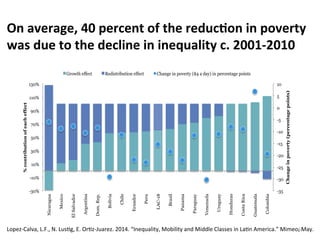
On 
average, 
40 
percent 
of 
the 
reduc0on 
in 
poverty 
was 
due 
to 
the 
decline 
in 
inequality 
c. 
2001-­‐2010 
6 
10 
5 
0 
-5 
-10 
-15 
-20 
-25 
-30 
-35 
130% 
110% 
90% 
70% 
50% 
30% 
10% 
-10% 
-30% 
Nicaragua 
Mexico 
El Salvador 
Argentina 
Dom. Rep. 
Bolivia 
Chile 
Ecuador 
Peru 
LAC-18 
Brazil 
Panama 
Paraguay 
Venezuela 
Uruguay 
Honduras 
Costa Rica 
Guatemala 
Colombia 
Change in poverty (percentage points) 
% contribution of each effect 
Growth effect Redistribution effect Change in poverty ($4 a day) in percentage points 
Lopez-­‐Calva, 
L.F., 
N. 
Lus)g, 
E. 
Or)z-­‐Juarez. 
2014. 
“Inequality, 
Mobility 
and 
Middle 
Classes 
in 
La)n 
America.” 
Mimeo, 
May.
Declining 
inequality 
has 
contributed 
to 
the 
expansion 
of 
the 
“middle-­‐class” 
Ferreira 
et 
al., 
2012. 
7
The 
faster 
the 
decline 
in 
inequality, 
the 
faster 
the 
growth 
of 
the 
middle-­‐class 
Lopez-­‐Calva, 
L.F., 
N. 
Lus)g, 
E. 
Or)z-­‐Juarez. 
2014. 
“Inequality, 
Mobility 
and 
Middle 
Classes 
in 
La)n 
America.” 
Mimeo,8M 
ay.
Determinants 
of 
the 
decline 
in 
inequality 
• Declining 
inequality 
of 
hourly 
labor 
income 
• Larger 
and 
more 
progressive 
transfers 
• Lower 
dependency 
ra)os 
& 
higher 
par)cipa)on 
rates 
of 
adults 
9
Contribu0on 
of 
proximate 
determinants 
to 
the 
decline 
in 
inequality 
(%) 
La)n 
America, 
c. 
2000-­‐2010 
10 
11 4 
2 
9 15 
10 
Occupation share 
Adult population 
21 
Capital 
Pensions 
Other non-labor income 
Transfers 
54 
Labor income LABOR 
17 
62 
-1 
-4 
120 
100 
80 
60 
40 
20 
0 
-20 
TRANSFERS 
LABOR 
INCOME 
INCOME 
Non-parametric Parametric 
Source: 
Non-­‐parametric 
decomposi)on 
results 
from 
Azevedo 
et 
al. 
(2013a); 
and 
parametric 
results 
provided 
by 
CEDLAS, 
based 
on 
data 
from 
SEDLAC 
(CEDLAS 
and 
The 
World 
Bank).
Decomposing 
Decline 
in 
Inequality 
Labor 
(red); 
Transfers 
(Green); 
Demog 
(Blue) 
(Azevedo 
et 
al. 
2012) 
100%% 
80%% 
60%% 
40%% 
20%% 
0%% 
Argen/na% 
!20%% 
!40%% 
!60%% 
Brazil% 
Costa%Rica% 
Dominican%Rep.% 
Chile% 
Colombia% 
Mexico% 
Panama% 
Honduras% 
El%Salvador% 
Ecuador% 
Paraguay% 
Peru% 
Uruguay% 
LAC!14% 
!80%% 11
Determinants 
of 
declining 
inequality 
in 
hourly 
labor 
earnings: 
Decline 
in 
return 
s 
to 
post-­‐secondary 
educa)on 
(aka. 
skill 
premium) 
• Supply 
• Demand 
• Labor 
Market 
Ins)tu)ons 
• Declining 
“quality” 
in 
workers 
with 
ter)ary 
degree 
12
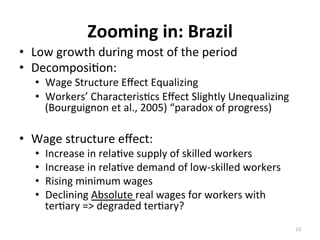
Zooming 
in: 
Brazil 
• Low 
growth 
during 
most 
of 
the 
period 
• Decomposi)on: 
• Wage 
Structure 
Effect 
Equalizing 
• Workers’ 
Characteris)cs 
Effect 
Slightly 
Unequalizing 
(Bourguignon 
et 
al., 
2005) 
“paradox 
of 
progress) 
• Wage 
structure 
effect: 
• Increase 
in 
rela)ve 
supply 
of 
skilled 
workers 
• Increase 
in 
rela)ve 
demand 
of 
low-­‐skilled 
workers 
• Rising 
minimum 
wages 
• Declining 
Absolute 
real 
wages 
for 
workers 
with 
ter)ary 
=> 
degraded 
ter)ary? 
13
Brazil: 
Decline 
in 
Wage 
Inequality 
Wang, 
Yang. 
2013. 
“Decomposing 
the 
Changes 
in 
Male 
Wage 
Distribu)on 
in 
Brazil.” 
Tulane 
University, 
Ph.D. 
field 
paper 
14
15 
.4 
.3 
.2 
.1 
0 
-.1 
Fig.10: RIF Decomposition: 2002-2011 Male 
1 11 21 31 41 51 61 71 81 91 100 
quantile 
Log Wage Difference Composition Effect 
Wage Structure Effect 
Brazil 
(RIF) 
Decomposi)on 
(2002-­‐2011): 
• 
Changes 
in 
Wage 
Structure 
Equalizing 
• Changes 
in 
Workers’ 
Characteris)cs 
Slightly 
Unequalizing 
Wang, 
Yang. 
2013. 
“Decomposing 
the 
Changes 
in 
Male 
Wage 
Distribu)on 
in 
Brazil.” 
Tulane 
University, 
Ph.D. 
field 
paper
Brazil: 
Decline 
in 
rela0ve 
returns 
to 
educa0on 
or 
“skill 
premium” 
16 
Fig.8: Relative Return to Education 
0 .5 1 1.5 2 4-7 8-10 11-14 15+ 
2002 
2002 2011 
2011 
Wang, 
Yang. 
2013. 
“Decomposing 
the 
Changes 
in 
Male 
Wage 
Distribu)on 
in 
Brazil.” 
Tulane 
University, 
Ph.D. 
field 
paper
Brazil: 
Decline 
in 
skill 
premium 
coincides 
with 
the 
expansion 
of 
the 
rela)ve 
supply 
of 
workers 
with 
post 
secondary 
educa)on 
Wang, 
Yang. 
2013. 
“Decomposing 
the 
Changes 
in 
Male 
Wage 
Distribu)on 
in 
Brazil.” 
Tulane 
University, 
Ph.D. 
field 
paper 
17 
Rela)ve 
Returns 
To 
Educa)on 
Rela)ve 
Supply 
of 
Workers 
w/ 
Post-­‐ 
secondary
Brazil: 
Rising 
minimum 
wage 
18 
400 
350 
300 
250 
200 
Minimum Wage in 2002 Reais 
Fig.13: Minimum Wage in Reais: 2002 Price 
2002 2003 2004 2005 2006 2007 2008 2009 2010 2011 
Wang, 
Yang. 
2013. 
“Decomposing 
the 
Changes 
in 
Male 
Wage 
Distribu)on 
in 
Brazil.” 
Tulane 
University, 
Ph.D. 
field 
paper
Brazil: 
Decline 
in 
absolute 
wages 
for 
workers 
with 
ter0ary 
19 
14 15 16 17 18 
Fig. 6: Average Hourly Wage of Tertiary Group: 2002-2011 Male 
2002 2003 2004 2005 2006 2007 2008 2009 2010 2011 
Wang, 
Yang. 
2013. 
“Decomposing 
the 
Changes 
in 
Male 
Wage 
Distribu)on 
in 
Brazil.” 
Tulane 
University, 
Ph.D. 
field 
paper
“Degraded” 
Ter)ary? 
Brazil 
2002-­‐2011 
Wang, 
Yang. 
2013. 
“Decomposing 
the 
Changes 
in 
Male 
Wage 
Distribu)on 
in 
Brazil.” 
Tulane 
University, 
Ph.D. 
field 
paper 
20 
Kdensity of Log Hourly Wage: Tertiary 
0 .1 .2 .3 .4 .5 
kdensity log_hwage 
0 2 4 6 
2002 2011
Zooming 
in: 
Mexico 
• Low 
growth 
• Decomposi)on: 
• Wage 
Structure 
Effect 
Equalizing 
• Composi)on 
Effect 
Slightly 
Unequalizing 
(Bourguignon 
et 
al., 
2005) 
“paradox 
of 
progress) 
• Wage 
structure 
effect: 
• Increase 
in 
rela)ve 
supply 
of 
skilled 
workers 
• Minimum 
wages 
and 
unioniza)on 
no 
effect 
• Degraded 
ter)ary? 
21
Mexico: 
Decline 
in 
Inequality 
(Gini) 
22 
Campos, 
R., 
G. 
Esquivel 
and 
N. 
Lus)g. 
2014. 
“The 
Rise 
and 
Fall 
of 
Income 
Inequality 
in 
Mexico, 
1989–2010,” 
Chapter 
7 
in 
Giovanni 
Andrea 
Cornia, 
ed., 
Falling 
Inequality 
in 
La3n 
America: 
Policy 
Changes 
and 
Lesssons, 
WIDER 
Studies 
in 
Development 
Economics, 
Oxford 
University 
Press, 
Hourly 
Wage
23 
-.5 -.2 .1 .4 .7 1 
Log wage effects 
0 5 10 15 20 25 30 35 40 45 50 55 60 65 70 75 80 85 90 95 100 
Quantile 
Total differential Effects of Characteristics 
Effects of Returns 
Mexico 
(RIF) 
Decomposi)on 
(1996-­‐2010): 
• Changes 
in 
workers 
characteris)cs 
• => 
unequalizing 
• Wage 
Structure 
Effect 
=> 
Equalizing 
Campos, 
R., 
G. 
Esquivel 
and 
N. 
Lus)g. 
2014. 
“The 
Rise 
and 
Fall 
of 
Income 
Inequality 
in 
Mexico, 
1989–2010,” 
Chapter 
7 
in 
Giovanni 
Andrea 
Cornia, 
ed., 
Falling 
Inequality 
in 
La3n 
America: 
Policy 
Changes 
and 
Lesssons, 
WIDER 
Studies 
in 
Development 
Economics, 
Oxford 
University 
Press,
In 
contrast 
to 
Brazil, 
in 
Mexico 
minimum 
wages 
did 
not 
increase 
at 
all… 
Real Minimum Wage and Unionization: 1988-2010 
A. Real Minimum Wage Index (December 
2010=100) 
B. Unionization Rate 
100 120 140 160 180 200 
1988m1 1992m1 1996m1 2000m1 2004m1 2008m1 2010m12 
Year 
.1 .12 .14 .16 .18 .2 
Unionization Rate 
1988 1990 1992 1994 1996 1998 2000 2002 2004 2006 2008 2010 
Year 
ENIGH ENOE 
Campos, 
R., 
G. 
Esquivel 
and 
N. 
Lus)g. 
2014. 
“The 
Rise 
and 
Fall 
of 
Income 
Inequality 
in 
Mexico, 
1989–2010,” 
Chapter 
7 
in 
Giovanni 
Andrea 
Cornia, 
ed., 
Falling 
Inequality 
in 
La3n 
America: 
Policy 
Changes 
and 
Lesssons, 
WIDER 
Studies 
in 
Development 
Economics, 
Oxford 
University 
Press,
Mexico: Relative returns and relative supply, 1989-2010 
(High school and more vs. secondary or less) 
Campos, 
R., 
G. 
Esquivel 
and 
N. 
Lus)g. 
2014. 
“The 
Rise 
and 
Fall 
of 
Income 
Inequality 
in 
Mexico, 
1989–2010,” 
Chapter 
7 
in 
Giovanni 
Andrea 
Cornia, 
ed., 
Falling 
Inequality 
in 
La3n 
America: 
Policy 
Changes 
and 
Lesssons, 
WIDER 
Studies 
in 
Development 
Economics, 
Oxford 
University 
Press, 
Mexico: 
Decline 
in 
skill 
premium 
coincides 
with 
the 
expansion 
of 
the 
rela)ve 
supply 
of 
workers 
with 
post 
secondary 
educa)on
How 
redistribu0ve 
are 
La0n 
American 
governments? 
• Decomposi)on 
of 
changes 
in 
inequality 
by 
income 
source 
show 
that 
transfers 
is, 
on 
average, 
the 
second 
most 
important 
proximate 
determinant 
of 
decline 
in 
overall 
inequality 
• Social 
spending 
and 
tax 
incidence 
analysis 
for 
14 
countries 
(8 
from 
La)n 
America) 
• www.commitmentoequity.org 
26
Redistribu0on 
in 
the 
rich 
and 
developing 
countries 
0.00 
-­‐0.02 
-­‐0.04 
-­‐0.06 
-­‐0.08 
-­‐0.10 
-­‐0.12 
-­‐0.14 
-­‐0.16 
Sources: 
Immervoll 
et 
al. 
(2009) 
for 
EU 
and 
for 
CEQ 
countries 
see 
Lus)g 
(2014) 
and 
slides 
at 
the 
end. 
Note: 
in 
these 
calcula)ons 
contributory 
pensions 
are 
part 
of 
market 
income 
and 
NOT 
treated 
as 
a 
government 
transfer. 
27 
-­‐0.18 
Change 
in 
Gini: 
Disposable 
vs. 
Market 
(in 
percentage 
points) 
DEVELOPING 
COUNTRIES 
RICH 
COUNTRIES
Zooming 
in 
(CEQ 
14 
countries; 
LA 
8 
in 
red) 
0.00 
-­‐0.01 
-­‐0.02 
-­‐0.03 
-­‐0.04 
-­‐0.05 
-­‐0.06 
-­‐0.07 
Sources: 
Lus)g 
(2014) 
and 
slides 
at 
the 
end. 
Note: 
in 
these 
calcula)ons 
contributory 
pensions 
are 
part 
of 
market 
income 
and 
NOT 
treated 
as 
a 
government 
transfer. 
28 
GUA 
ELS 
BOL 
PER 
CRI 
MEX 
-­‐0.08 
Change 
in 
Gini: 
Disposable 
vs. 
Market 
(in 
percentage 
points) 
URY 
BRA
29 
Argen0na: 
Rising 
role 
of 
transfers 
Argen/na(Reduc/on%in%Inequality:%Market%(blue)%vs.% 
124%% 
Redistribu/on%(red)%% 
58%% 
(24%% 
43%% 
2003$06& 2006$09& 
Redistribu1on& 
Market& 
Lus)g, 
N. 
and 
C. 
Pessino. 
2014.
30 
Argen-na&Reduc-on$in$Poverty:$Market$(blue)$vs.$ 
110%$ 
Redistribu-on$(red)$$ 
12%$ 
&10%$ 
88%$ 
$ 
2003$06& 2006$09& 
Redistribu1on& 
Market& 
Lus)g, 
N. 
and 
C. 
Pessino. 
2014.
Mexico: 
Rising 
role 
of 
transfers 
Mexico: The impact of cash transfers on inequality and poverty, 1996, 2000 and 2010 
Net market income Disposable income 
1996 Gini 0.522 0.520 
% change with respect to net market income –– -0.4% 
Headcount index ($2.5 PPP) 30.2% 29.9% 
% change wrt net market income –– -1.0% 
2000 Gini 0.544 0.539 
% change wrt net market income –– -0.9% 
Headcount index ($2.5 PPP) 22.1% 21.6% 
% change with respect to net market income –– -2.3% 
2010 Gini 0.503 0.495 
% change wrt net market income –– -1.7% 
Headcount index ($2.5 PPP) 13.8% 11% 
% change with respect to net market income –– -20.1% 
Campos, 
R., 
G. 
Esquivel 
and 
N. 
Lus)g. 
2014. 
“The 
Rise 
and 
Fall 
of 
Income 
Inequality 
in 
Mexico, 
1989–2010,” 
Chapter 
7 
in 
Giovanni 
Andrea 
Cornia, 
ed., 
Falling 
Inequality 
in 
La3n 
America: 
Policy 
Changes 
and 
Lesssons, 
WIDER 
Studies 
in 
Development 
Economics, 
Oxford 
University 
Press,
Thank 
you! 
32
References 
• Azevedo, 
Joao 
Pedro, 
Maria 
Eugenia 
Dávalos, 
Carolina 
Diaz-­‐Bonilla, 
Bernardo 
Atuesta, 
and 
Raul 
Andres 
Castañeda. 
2013. 
“FiQeen 
Years 
of 
Inequality 
in 
La)n 
America: 
How 
Have 
Labor 
Markets 
Helped?” 
Policy 
Research 
Working 
Paper 
6384, 
The 
World 
Bank. 
• Bourguignon, 
F., 
F. 
Ferreira 
and 
N. 
Lus)g. 
2005. 
The 
Microeconomics 
of 
Income 
Distribu3on 
Dynamics 
in 
East 
Asia 
and 
La3n 
America, 
Oxford 
University 
Press, 
Washington, 
DC. 
• Campos, 
R., 
G. 
Esquivel 
and 
N. 
Lus)g. 
2014. 
“The 
Rise 
and 
Fall 
of 
Income 
Inequality 
in 
Mexico, 
1989– 
2010,” 
Chapter 
7 
in 
Giovanni 
Andrea 
Cornia, 
ed., 
Falling 
Inequality 
in 
La3n 
America: 
Policy 
Changes 
and 
Lesssons, 
WIDER 
Studies 
in 
Development 
Economics, 
Oxford 
University 
Press, 
Oxford, 
United 
Kingdom 
. 
• Ferreira, 
Francisco 
H.G, 
Julian 
Messina, 
Jamele 
Rigolini, 
Luis 
F. 
Lopez-­‐Calva, 
Maria 
Ana 
Lugo 
and 
Renos 
Vakis. 
2013. 
“Economic 
Mobility 
and 
the 
Rise 
of 
the 
La)n 
American 
Middle 
Class.” 
Washington, 
D.C: 
The 
World 
Bank. 
• Gasparini, 
Leonardo, 
Sebas)an 
Galiani, 
Guillermo 
Cruces, 
and 
Pablo 
Acosta. 
2011. 
“Educa)onal 
Upgrading 
and 
Returns 
to 
Skills 
in 
La)n 
America. 
Evidence 
from 
a 
Supply-­‐Demand 
Framework, 
1990–2010.” 
Policy 
Research 
Working 
Paper 
5921, 
The 
World 
Bank. 
• Lopez-­‐Calva, 
L. 
F. 
and 
N. 
Lus)g. 
2010. 
Declining 
Inequality 
in 
La3n 
America: 
A 
Decade 
of 
Progress?, 
Brookings 
Ins)tu)on 
Press 
and 
UNDP. 
• Lopez-­‐Calva, 
L.F., 
N. 
Lus)g, 
E. 
Or)z-­‐Juarez. 
2014. 
“Inequality, 
Mobility 
and 
Middle 
Classes 
in 
La)n 
America.” 
Mimeo, 
May. 
• Lus)g, 
N., 
L. 
F. 
Lopez-­‐Calva, 
E. 
Or)z-­‐Juarez. 
2014. 
“Deconstruc)ng 
the 
Decline 
in 
Inequality 
in 
La)n 
America,” 
chapter 
in 
Devlin, 
Machinea, 
Chavarria 
(eds.), 
(published 
in 
Spanish) 
• Lus)g, 
Nora. 
2014. 
“Taxes, 
Transfers, 
Inequality 
and 
the 
Poor 
in 
the 
Developing 
World. 
Round 
1.” 
CEQ 
Working 
Paper 
No. 
23, 
Center 
for 
Inter-­‐American 
Policy 
and 
Research 
and 
Department 
of 
Economics, 
Tulane 
University 
and 
Inter-­‐American 
Dialogue 
• Lus)g, 
N. 
and 
C. 
Pessino. 
2014. 
“Social 
Spending 
and 
Income 
Redistribu)on 
in 
Argen)na 
in 
the 
2000s: 
the 
Rising 
Role 
of 
Noncontributory 
Pensions,” 
in 
Public 
Finance 
Review, 
May 
2014, 
Volume 
42, 
Issue 
3 
Lus)g, 
N., 
C. 
Pessino 
and 
J. 
Scow. 
2014. 
“The 
Redistribu)ve 
Impact 
of 
Taxes 
and 
Social 
Spending 
in 
La)n 
America. 
Special 
Issue.” 
Public 
Finance 
Review, 
May, 
Volume 
42, 
Issue 
3. 
• Wang, 
Yang. 
2013. 
“Decomposing 
the 
Changes 
in 
Male 
Wage 
Distribu)on 
in 
Brazil.” 
Tulane 
University, 
Ph.D. 
field 
paper. 
33
CEQ 
Teams 
(Year 
of 
Survey; 
C=consump0on 
& 
I=income)(MWB 
Version) 
1. Argen0na 
(2009, 
I): 
Nora 
Lus)g 
and 
Carola 
Pessino 
(CEQ 
Web 
Dec 
2013) 
Public 
Finance 
Review, 
May 
2014, 
Volume 
42, 
Issue 
3 
2. Bolivia 
(2009; 
I): 
Veronica 
Paz 
Arauco, 
George 
Gray-­‐Molina, 
Wilson 
Jimenez 
and 
Ernesto 
Yañez 
(CEQ 
Web 
Dec 
2013) 
Public 
Finance 
Review, 
May 
2014, 
Volume 
42, 
Issue 
3 
3. Brazil 
(2009; 
I): 
Sean 
Higgins 
and 
Claudiney 
Pereira 
(CEQ 
Web 
Dec 
2013) 
Public 
Finance 
Review, 
May 
2014, 
Volume 
42, 
Issue 
3 
4. Costa 
Rica 
(2010; 
I): 
Pablo 
Sauma 
and 
Juan 
Diego 
Trejos 
(February 
2014; 
paper) 
5. El 
Salvador 
(2011; 
I): 
Margarita 
Beneke, 
Nora 
Lus)g 
and 
Jose 
Andres 
Oliva 
(March 
11, 
2014) 
6. Guatemala 
(2011; 
I): 
Maynor 
Cabrera, 
Nora 
Lus)g 
and 
Hilcias 
E. 
Moran 
(April 
13, 
2014) 
34
CEQ 
Teams 
(Year 
of 
Survey; 
C=consump0on 
& 
I=income)(MWB 
Version) 
10 Mexico 
(2010; 
I): 
John 
Scow 
(CEQ 
Web 
Dec 
2013) 
Public 
Finance 
Review, 
May 
2014, 
Volume 
42, 
Issue 
3 
11 Peru 
(2009; 
I): 
Miguel 
Jaramillo 
(CEQ 
Web 
Dec 
2013) 
Public 
Finance 
Review, 
May 
2014, 
Volume 
42, 
Issue 
3 
12 United 
States 
(2011; 
I): 
Sean 
Higgins, 
Nora 
Lus)g, 
Whitney 
Ruble 
and 
Timothy 
Smeeding 
13 Uruguay 
(2009; 
I): 
Marisa 
Bucheli, 
Nora 
Lus)g, 
Maximo 
Rossi 
and 
Florencia 
Amabile 
(CEQ 
Web 
Dec 
2013) 
Public 
Finance 
Review, 
May 
2014, 
Volume 
42, 
Issue 
3 
• Research 
Assistant: 
Yang 
Wang, 
Tulane 
University 
35

2014_05-21_OECD-ECLAC-PSE EU-LAC Forum_lustig

  • 1.
    Declining Inequality in La0n America Nora Lus)g Tulane University Nonresident Fellow CGD and IAD CEPAL-­‐OECD Paris – May 21, 2014
  • 2.
    Inequality in La0n America is high… …but has been declining since around 2000 • Decline is pervasive and significant • Larger than the rise in inequality in 1990s • Important contribu)on to the decline in poverty • Contributed to the rise of the middle-­‐class • In countries with high growth & low growth • In countries with leQ and nonleQ governments • In commodity exporters and commodity importers 2
  • 3.
    LATAM IS THE MOST UNEQUAL REGION IN THE WORLD Gini Coefficient by Region (in %), 2004 coefficient 38.9 38.9 39.1 Gini 33.6 32.2 and the Caribbean 44.7 53.2 60.0 55.0 50.0 45.0 40.0 35.0 30.0 25.0 20.0 High Income Europe and Central Asia South Asia North Africa and the Middle East East Asia and the Pacific Sub-Saharan Africa Latin America Ferreira and Ravallion, 2008. 3
  • 4.
    Inequality declined during the 2000’s La)n America: Declining income inequality by country: 2000-­‐2011 (Annual Change of Gini in %) 4 -2.64 -2.05 -1.99 -1.30 -1.24 -1.17 -1.07 -1.03 -0.91 -0.79 -0.74 -0.72 -0.47 -0.39 -0.20 -0.10 0.61 -0.95 2.12 0.82 0.77 0.40 3.00 2.00 1.00 0.00 -1.00 -2.00 -3.00 Nicaragua Bolivia Ecuador Argentina El Salvador Mexico Venezuela Brazil Peru Dom. Rep. Panama Chile Costa Rica Paraguay Uruguay Guatemala Honduras LAC-17 China South Africa India USA
  • 5.
    The decline of income inequality in the 2000s has been higher that the rise in the 1990s (Annual average change in Gini in %) 8.2$ %10.1$ 1.8$ Change$in$Gini$coefficient,$expressed$in$percentage$points$ Average$of$increase$ Average$of$decrease$ %4.2$ 4.1$ %5.4$ 0.8$ %3.5$ 0.1$ %4.8$ 2.9$ %7.0$ 3.1$ %6.8$ 1.5$ %4.6$ 0.2$ %4.5$ 0.4$ %7.0$ 4.9$ 2.5$ %6.1$ %8.7$ 10.0$ 5.0$ 0.0$ %5.0$ %10.0$ %15.0$ 1992%2002$ 2002%2011$ 1997%2002$ 2002%2008$ 1985%1998$ 1998%2009$ 1992%1998$ 1998%2009$ 2000%2003$ 2003%2010$ 1995%2001$ 2001%2010$ 1989%1996$ 1996%2010$ 1989%2001$ 2001%2010$ 1997%2003$ 2003%2010$ 1997%2003$ 2003%2010$ 1989%2002$ 2002%2010$ Argen3na$ Bolivia$ Brazil$ Chile$ Dominican$ Rep.$ El$Salvador$ Mexico$ Panama$ Paraguay$ Peru$ Venezuela$
  • 6.
    On average, 40 percent of the reduc0on in poverty was due to the decline in inequality c. 2001-­‐2010 6 10 5 0 -5 -10 -15 -20 -25 -30 -35 130% 110% 90% 70% 50% 30% 10% -10% -30% Nicaragua Mexico El Salvador Argentina Dom. Rep. Bolivia Chile Ecuador Peru LAC-18 Brazil Panama Paraguay Venezuela Uruguay Honduras Costa Rica Guatemala Colombia Change in poverty (percentage points) % contribution of each effect Growth effect Redistribution effect Change in poverty ($4 a day) in percentage points Lopez-­‐Calva, L.F., N. Lus)g, E. Or)z-­‐Juarez. 2014. “Inequality, Mobility and Middle Classes in La)n America.” Mimeo, May.
  • 7.
    Declining inequality has contributed to the expansion of the “middle-­‐class” Ferreira et al., 2012. 7
  • 8.
    The faster the decline in inequality, the faster the growth of the middle-­‐class Lopez-­‐Calva, L.F., N. Lus)g, E. Or)z-­‐Juarez. 2014. “Inequality, Mobility and Middle Classes in La)n America.” Mimeo,8M ay.
  • 9.
    Determinants of the decline in inequality • Declining inequality of hourly labor income • Larger and more progressive transfers • Lower dependency ra)os & higher par)cipa)on rates of adults 9
  • 10.
    Contribu0on of proximate determinants to the decline in inequality (%) La)n America, c. 2000-­‐2010 10 11 4 2 9 15 10 Occupation share Adult population 21 Capital Pensions Other non-labor income Transfers 54 Labor income LABOR 17 62 -1 -4 120 100 80 60 40 20 0 -20 TRANSFERS LABOR INCOME INCOME Non-parametric Parametric Source: Non-­‐parametric decomposi)on results from Azevedo et al. (2013a); and parametric results provided by CEDLAS, based on data from SEDLAC (CEDLAS and The World Bank).
  • 11.
    Decomposing Decline in Inequality Labor (red); Transfers (Green); Demog (Blue) (Azevedo et al. 2012) 100%% 80%% 60%% 40%% 20%% 0%% Argen/na% !20%% !40%% !60%% Brazil% Costa%Rica% Dominican%Rep.% Chile% Colombia% Mexico% Panama% Honduras% El%Salvador% Ecuador% Paraguay% Peru% Uruguay% LAC!14% !80%% 11
  • 12.
    Determinants of declining inequality in hourly labor earnings: Decline in return s to post-­‐secondary educa)on (aka. skill premium) • Supply • Demand • Labor Market Ins)tu)ons • Declining “quality” in workers with ter)ary degree 12
  • 13.
    Zooming in: Brazil • Low growth during most of the period • Decomposi)on: • Wage Structure Effect Equalizing • Workers’ Characteris)cs Effect Slightly Unequalizing (Bourguignon et al., 2005) “paradox of progress) • Wage structure effect: • Increase in rela)ve supply of skilled workers • Increase in rela)ve demand of low-­‐skilled workers • Rising minimum wages • Declining Absolute real wages for workers with ter)ary => degraded ter)ary? 13
  • 14.
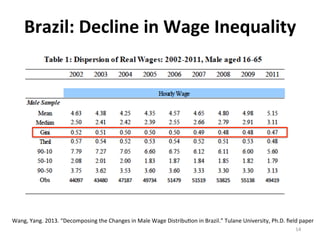
    Brazil: Decline in Wage Inequality Wang, Yang. 2013. “Decomposing the Changes in Male Wage Distribu)on in Brazil.” Tulane University, Ph.D. field paper 14
  • 15.
    15 .4 .3 .2 .1 0 -.1 Fig.10: RIF Decomposition: 2002-2011 Male 1 11 21 31 41 51 61 71 81 91 100 quantile Log Wage Difference Composition Effect Wage Structure Effect Brazil (RIF) Decomposi)on (2002-­‐2011): • Changes in Wage Structure Equalizing • Changes in Workers’ Characteris)cs Slightly Unequalizing Wang, Yang. 2013. “Decomposing the Changes in Male Wage Distribu)on in Brazil.” Tulane University, Ph.D. field paper
  • 16.
    Brazil: Decline in rela0ve returns to educa0on or “skill premium” 16 Fig.8: Relative Return to Education 0 .5 1 1.5 2 4-7 8-10 11-14 15+ 2002 2002 2011 2011 Wang, Yang. 2013. “Decomposing the Changes in Male Wage Distribu)on in Brazil.” Tulane University, Ph.D. field paper
  • 17.
    Brazil: Decline in skill premium coincides with the expansion of the rela)ve supply of workers with post secondary educa)on Wang, Yang. 2013. “Decomposing the Changes in Male Wage Distribu)on in Brazil.” Tulane University, Ph.D. field paper 17 Rela)ve Returns To Educa)on Rela)ve Supply of Workers w/ Post-­‐ secondary
  • 18.
    Brazil: Rising minimum wage 18 400 350 300 250 200 Minimum Wage in 2002 Reais Fig.13: Minimum Wage in Reais: 2002 Price 2002 2003 2004 2005 2006 2007 2008 2009 2010 2011 Wang, Yang. 2013. “Decomposing the Changes in Male Wage Distribu)on in Brazil.” Tulane University, Ph.D. field paper
  • 19.
    Brazil: Decline in absolute wages for workers with ter0ary 19 14 15 16 17 18 Fig. 6: Average Hourly Wage of Tertiary Group: 2002-2011 Male 2002 2003 2004 2005 2006 2007 2008 2009 2010 2011 Wang, Yang. 2013. “Decomposing the Changes in Male Wage Distribu)on in Brazil.” Tulane University, Ph.D. field paper
  • 20.
    “Degraded” Ter)ary? Brazil 2002-­‐2011 Wang, Yang. 2013. “Decomposing the Changes in Male Wage Distribu)on in Brazil.” Tulane University, Ph.D. field paper 20 Kdensity of Log Hourly Wage: Tertiary 0 .1 .2 .3 .4 .5 kdensity log_hwage 0 2 4 6 2002 2011
  • 21.
    Zooming in: Mexico • Low growth • Decomposi)on: • Wage Structure Effect Equalizing • Composi)on Effect Slightly Unequalizing (Bourguignon et al., 2005) “paradox of progress) • Wage structure effect: • Increase in rela)ve supply of skilled workers • Minimum wages and unioniza)on no effect • Degraded ter)ary? 21
  • 22.
    Mexico: Decline in Inequality (Gini) 22 Campos, R., G. Esquivel and N. Lus)g. 2014. “The Rise and Fall of Income Inequality in Mexico, 1989–2010,” Chapter 7 in Giovanni Andrea Cornia, ed., Falling Inequality in La3n America: Policy Changes and Lesssons, WIDER Studies in Development Economics, Oxford University Press, Hourly Wage
  • 23.
    23 -.5 -.2.1 .4 .7 1 Log wage effects 0 5 10 15 20 25 30 35 40 45 50 55 60 65 70 75 80 85 90 95 100 Quantile Total differential Effects of Characteristics Effects of Returns Mexico (RIF) Decomposi)on (1996-­‐2010): • Changes in workers characteris)cs • => unequalizing • Wage Structure Effect => Equalizing Campos, R., G. Esquivel and N. Lus)g. 2014. “The Rise and Fall of Income Inequality in Mexico, 1989–2010,” Chapter 7 in Giovanni Andrea Cornia, ed., Falling Inequality in La3n America: Policy Changes and Lesssons, WIDER Studies in Development Economics, Oxford University Press,
  • 24.
    In contrast to Brazil, in Mexico minimum wages did not increase at all… Real Minimum Wage and Unionization: 1988-2010 A. Real Minimum Wage Index (December 2010=100) B. Unionization Rate 100 120 140 160 180 200 1988m1 1992m1 1996m1 2000m1 2004m1 2008m1 2010m12 Year .1 .12 .14 .16 .18 .2 Unionization Rate 1988 1990 1992 1994 1996 1998 2000 2002 2004 2006 2008 2010 Year ENIGH ENOE Campos, R., G. Esquivel and N. Lus)g. 2014. “The Rise and Fall of Income Inequality in Mexico, 1989–2010,” Chapter 7 in Giovanni Andrea Cornia, ed., Falling Inequality in La3n America: Policy Changes and Lesssons, WIDER Studies in Development Economics, Oxford University Press,
  • 25.
    Mexico: Relative returnsand relative supply, 1989-2010 (High school and more vs. secondary or less) Campos, R., G. Esquivel and N. Lus)g. 2014. “The Rise and Fall of Income Inequality in Mexico, 1989–2010,” Chapter 7 in Giovanni Andrea Cornia, ed., Falling Inequality in La3n America: Policy Changes and Lesssons, WIDER Studies in Development Economics, Oxford University Press, Mexico: Decline in skill premium coincides with the expansion of the rela)ve supply of workers with post secondary educa)on
  • 26.
    How redistribu0ve are La0n American governments? • Decomposi)on of changes in inequality by income source show that transfers is, on average, the second most important proximate determinant of decline in overall inequality • Social spending and tax incidence analysis for 14 countries (8 from La)n America) • www.commitmentoequity.org 26
  • 27.
    Redistribu0on in the rich and developing countries 0.00 -­‐0.02 -­‐0.04 -­‐0.06 -­‐0.08 -­‐0.10 -­‐0.12 -­‐0.14 -­‐0.16 Sources: Immervoll et al. (2009) for EU and for CEQ countries see Lus)g (2014) and slides at the end. Note: in these calcula)ons contributory pensions are part of market income and NOT treated as a government transfer. 27 -­‐0.18 Change in Gini: Disposable vs. Market (in percentage points) DEVELOPING COUNTRIES RICH COUNTRIES
  • 28.
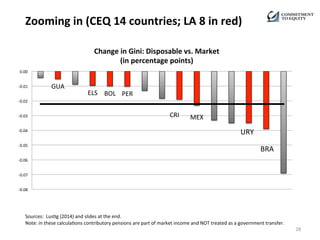
    Zooming in (CEQ 14 countries; LA 8 in red) 0.00 -­‐0.01 -­‐0.02 -­‐0.03 -­‐0.04 -­‐0.05 -­‐0.06 -­‐0.07 Sources: Lus)g (2014) and slides at the end. Note: in these calcula)ons contributory pensions are part of market income and NOT treated as a government transfer. 28 GUA ELS BOL PER CRI MEX -­‐0.08 Change in Gini: Disposable vs. Market (in percentage points) URY BRA
  • 29.
    29 Argen0na: Rising role of transfers Argen/na(Reduc/on%in%Inequality:%Market%(blue)%vs.% 124%% Redistribu/on%(red)%% 58%% (24%% 43%% 2003$06& 2006$09& Redistribu1on& Market& Lus)g, N. and C. Pessino. 2014.
  • 30.
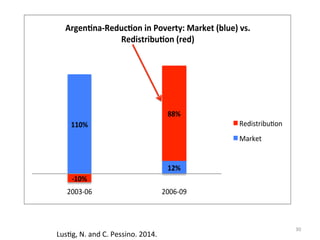
    30 Argen-na&Reduc-on$in$Poverty:$Market$(blue)$vs.$ 110%$ Redistribu-on$(red)$$ 12%$ &10%$ 88%$ $ 2003$06& 2006$09& Redistribu1on& Market& Lus)g, N. and C. Pessino. 2014.
  • 31.
    Mexico: Rising role of transfers Mexico: The impact of cash transfers on inequality and poverty, 1996, 2000 and 2010 Net market income Disposable income 1996 Gini 0.522 0.520 % change with respect to net market income –– -0.4% Headcount index ($2.5 PPP) 30.2% 29.9% % change wrt net market income –– -1.0% 2000 Gini 0.544 0.539 % change wrt net market income –– -0.9% Headcount index ($2.5 PPP) 22.1% 21.6% % change with respect to net market income –– -2.3% 2010 Gini 0.503 0.495 % change wrt net market income –– -1.7% Headcount index ($2.5 PPP) 13.8% 11% % change with respect to net market income –– -20.1% Campos, R., G. Esquivel and N. Lus)g. 2014. “The Rise and Fall of Income Inequality in Mexico, 1989–2010,” Chapter 7 in Giovanni Andrea Cornia, ed., Falling Inequality in La3n America: Policy Changes and Lesssons, WIDER Studies in Development Economics, Oxford University Press,
  • 32.
  • 33.
    References • Azevedo, Joao Pedro, Maria Eugenia Dávalos, Carolina Diaz-­‐Bonilla, Bernardo Atuesta, and Raul Andres Castañeda. 2013. “FiQeen Years of Inequality in La)n America: How Have Labor Markets Helped?” Policy Research Working Paper 6384, The World Bank. • Bourguignon, F., F. Ferreira and N. Lus)g. 2005. The Microeconomics of Income Distribu3on Dynamics in East Asia and La3n America, Oxford University Press, Washington, DC. • Campos, R., G. Esquivel and N. Lus)g. 2014. “The Rise and Fall of Income Inequality in Mexico, 1989– 2010,” Chapter 7 in Giovanni Andrea Cornia, ed., Falling Inequality in La3n America: Policy Changes and Lesssons, WIDER Studies in Development Economics, Oxford University Press, Oxford, United Kingdom . • Ferreira, Francisco H.G, Julian Messina, Jamele Rigolini, Luis F. Lopez-­‐Calva, Maria Ana Lugo and Renos Vakis. 2013. “Economic Mobility and the Rise of the La)n American Middle Class.” Washington, D.C: The World Bank. • Gasparini, Leonardo, Sebas)an Galiani, Guillermo Cruces, and Pablo Acosta. 2011. “Educa)onal Upgrading and Returns to Skills in La)n America. Evidence from a Supply-­‐Demand Framework, 1990–2010.” Policy Research Working Paper 5921, The World Bank. • Lopez-­‐Calva, L. F. and N. Lus)g. 2010. Declining Inequality in La3n America: A Decade of Progress?, Brookings Ins)tu)on Press and UNDP. • Lopez-­‐Calva, L.F., N. Lus)g, E. Or)z-­‐Juarez. 2014. “Inequality, Mobility and Middle Classes in La)n America.” Mimeo, May. • Lus)g, N., L. F. Lopez-­‐Calva, E. Or)z-­‐Juarez. 2014. “Deconstruc)ng the Decline in Inequality in La)n America,” chapter in Devlin, Machinea, Chavarria (eds.), (published in Spanish) • Lus)g, Nora. 2014. “Taxes, Transfers, Inequality and the Poor in the Developing World. Round 1.” CEQ Working Paper No. 23, Center for Inter-­‐American Policy and Research and Department of Economics, Tulane University and Inter-­‐American Dialogue • Lus)g, N. and C. Pessino. 2014. “Social Spending and Income Redistribu)on in Argen)na in the 2000s: the Rising Role of Noncontributory Pensions,” in Public Finance Review, May 2014, Volume 42, Issue 3 Lus)g, N., C. Pessino and J. Scow. 2014. “The Redistribu)ve Impact of Taxes and Social Spending in La)n America. Special Issue.” Public Finance Review, May, Volume 42, Issue 3. • Wang, Yang. 2013. “Decomposing the Changes in Male Wage Distribu)on in Brazil.” Tulane University, Ph.D. field paper. 33
  • 34.
    CEQ Teams (Year of Survey; C=consump0on & I=income)(MWB Version) 1. Argen0na (2009, I): Nora Lus)g and Carola Pessino (CEQ Web Dec 2013) Public Finance Review, May 2014, Volume 42, Issue 3 2. Bolivia (2009; I): Veronica Paz Arauco, George Gray-­‐Molina, Wilson Jimenez and Ernesto Yañez (CEQ Web Dec 2013) Public Finance Review, May 2014, Volume 42, Issue 3 3. Brazil (2009; I): Sean Higgins and Claudiney Pereira (CEQ Web Dec 2013) Public Finance Review, May 2014, Volume 42, Issue 3 4. Costa Rica (2010; I): Pablo Sauma and Juan Diego Trejos (February 2014; paper) 5. El Salvador (2011; I): Margarita Beneke, Nora Lus)g and Jose Andres Oliva (March 11, 2014) 6. Guatemala (2011; I): Maynor Cabrera, Nora Lus)g and Hilcias E. Moran (April 13, 2014) 34
  • 35.
    CEQ Teams (Year of Survey; C=consump0on & I=income)(MWB Version) 10 Mexico (2010; I): John Scow (CEQ Web Dec 2013) Public Finance Review, May 2014, Volume 42, Issue 3 11 Peru (2009; I): Miguel Jaramillo (CEQ Web Dec 2013) Public Finance Review, May 2014, Volume 42, Issue 3 12 United States (2011; I): Sean Higgins, Nora Lus)g, Whitney Ruble and Timothy Smeeding 13 Uruguay (2009; I): Marisa Bucheli, Nora Lus)g, Maximo Rossi and Florencia Amabile (CEQ Web Dec 2013) Public Finance Review, May 2014, Volume 42, Issue 3 • Research Assistant: Yang Wang, Tulane University 35