Latin American regional integration: 
State of play and main challenges 
Osvaldo Rosales 
Chief, Division of International Trade and Integration 
ECLAC 
2nd Europe – Latin America Economic Forum 
ECLAC, OCDE, Ecole d’Economie de Paris. 
Paris, 20 May 2014
Outline 
 The region’s external economic environment 
 The evolving architecture and dynamics of 
regional (economic) integration in LAC 
 Why is regional integration important for LAC? 
 Stocktaking and suggestions for the way 
forward 
2
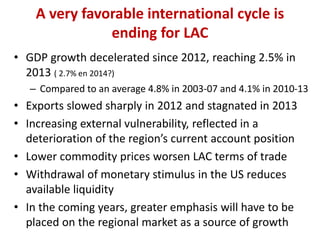
A very favorable international cycle is 
ending for LAC 
• GDP growth decelerated since 2012, reaching 2.5% in 
2013 ( 2.7% en 2014?) 
– Compared to an average 4.8% in 2003-07 and 4.1% in 2010-13 
• Exports slowed sharply in 2012 and stagnated in 2013 
• Increasing external vulnerability, reflected in a 
deterioration of the region’s current account position 
• Lower commodity prices worsen LAC terms of trade 
• Withdrawal of monetary stimulus in the US reduces 
available liquidity 
• In the coming years, greater emphasis will have to be 
placed on the regional market as a source of growth
Regional exports slowed sharply 
in 2012 and 2013 
LATIN AMERICA: ANNUAL GROWTH OF THE VALUE OF EXPORTS, 2000-2013 
(Percentages) 
Source: Economic Commission for Latin America and the Caribbean (ECLAC), on the basis of official figures .
The region’s terms of trade are declining 
LATIN AMERICA: ESTIMATED RATE OF VARIATION IN THE TERMS OF TRADE, 2011-2013a 
(Percentages) 
Source: Economic Commission for Latin America and the Caribbean (ECLAC) on the basis of official figures 
a The figures relating to 2013 are projections.
Very modest growth is predicted for the region 
for the remainder of the decade 
DEVELOPING REGIONS: PROJECTED ANNUAL GDP VARIATION, 2014-2019 
(Percentages) 
Source: International Monetary Fund, World Economic Outlook database, April 2014.
Main trends in the global context 
Rapid technological 
change 
• Information 
technology, cloud 
computing, cyber-servicies, 
“smart 
cities” 
• 3-D printing, 
robotics, remote-controlled 
vehicles 
• Biology, 
nanosciences and 
information 
sciences interface 
• Energy, water and 
natural resources 
complex 
Emergence of the 
developing countries 
• In growth, 
trade, FDI, rise 
of the middle 
class, patents, 
new 
technologies 
• This process is 
highly 
concentrated 
in China/Asia 
• LAC lags 
behind 
Value chains 
• Three major 
factories: 
• North 
America 
• Europe 
• East Asia 
Mega-regional 
trade agreements 
• TPP 
• TTIP 
• EU-Japan 
• ASEAN+6 
(Regional 
Comprehensive 
Economic 
Partnership) 
Need to address climate change and ensure that growth is environmentally sustainable 
Need to address the drastic increase in inequality worldwide
LAC’s main strengths and weaknesses in the 
global economy 
• Attractive and growing consumer 
market; expansion of the middle 
class 
• Abundance of renewable and 
non-renewable natural resources 
Strengths 
• Limited involvement in 
the knowledge economy, low and 
heterogeneous productivity 
• Strong concentration of exports: 
(i) in raw materials and assembly 
manufactures; and (ii) in a small 
number of large companies 
Weaknesses
The architecture of LAC economic integration in 
the early 2000s was (relatively) simple… 
Dominican 
Republic 
9 
Andean 
Community 
(1969) 
Mexico 
MERCOSUR 
(1991) 
Central American 
Common Market 
(1960) 
CARICOM 
Panama (1973) 
Chile 
NAFTA 
(1994) 
Cuba 
ALADI 
(1980)
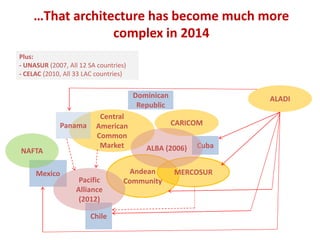
…That architecture has become much more 
complex in 2014 
Central 
American 
Common 
Market 
Panama CARICOM 
Andean 
Community 
Mexico MERCOSUR 
Chile 
NAFTA 
Cuba 
Dominican 
Republic 
ALADI 
Pacific 
Alliance 
(2012) 
ALBA (2006) 
Plus: 
- UNASUR (2007, All 12 SA countries) 
- CELAC (2010, All 33 LAC countries)
The dynamics and emphasis of LAC regional 
integration have greatly changed in the last decade 
• Several governments have a critical view of “the primacy of 
trade” in LAC regional integration during the 1990s 
• Greater primacy is given now to the political and social 
dimensions, along with production integration (mainly rhetorical) 
• New initiatives (CELAC, UNASUR, ALBA, Pacific Alliance); crisis in 
several traditional integration bodies; overlapping memberships 
• These trends have been more marked in South America than in 
Mexico, Central America and the Caribbean 
• Traditional shortcomings (ex. low intra-regional trade and 
production integration) coexist with increasing “de facto” 
integration (migration, tourism, FDI, etc.)
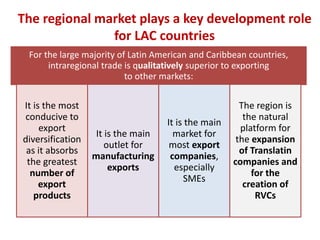
The regional market plays a key development role 
for LAC countries 
For the large majority of Latin American and Caribbean countries, 
intraregional trade is qualitatively superior to exporting 
to other markets: 
It is the most 
conducive to 
export 
diversification 
as it absorbs 
the greatest 
number of 
export 
products 
It is the main 
outlet for 
manufacturing 
exports 
It is the main 
market for 
most export 
companies, 
especially 
SMEs 
The region is 
the natural 
platform for 
the expansion 
of Translatin 
companies and 
for the 
creation of 
RVCs
The regional market is the most conducive to 
export diversification 
NUMBER OF PRODUCTS EXPORTED BY LATIN AMERICAN COUNTRIES TO SELECTED MARKETS, 2012 
Latin America 
and the 
Caribbean 
United States European Union China Japan 
Argentina 3 591 1 465 1 712 407 388 
Brazil 3 929 2 762 2 991 1 389 1 247 
Chile 3 014 1 275 1 296 362 313 
Colombia 3 239 1 708 1 250 253 201 
Costa Rica 2 821 1 792 1 095 260 188 
El Salvador 2 522 1 004 396 45 35 
Guatemala 3 274 1 321 721 142 155 
Jamaica 607 888 467 73 44 
Mexico 3 857 4 164 2 803 1 367 1 272 
Peru 3 037 1 796 1 602 266 575 
Source: ECLAC, on the basis of COMTRADE.
Excluding Mexico, the regional market is the main outlet 
for manufactures exported from LAC 
LATIN AMERICA AND THE CARIBBEAN: SHARE OF MEDIUM- AND HIGH-TECHNOLOGY MANUFACTURES 
EXPORTED WITHIN THE REGION, 2012 a 
(Percentages) 
Source: ECLAC, on the basis of information from the United Nations Commodity Trade Database (COMTRADE). 
a The figures for the Bolivarian Republic of Venezuela, Panama and Suriname are from 2011.
However, Latin America trades little with itself 
when compared to other regions 
Selected groupings: Share of intra-group exports in total merchandise exports, 2008-2012 
(In percentages) 
Region or grouping 2008 2009 2010 2011 2012 Average 
2008-2012 
Latin America 19,5 19,9 19,7 19,4 18,5 19,4 
Latin America (excluding Mexico) 25,6 26,6 26,3 24,9 24,1 25,5 
Intra-Andean Community 7,4 7,4 8,0 7,0 7,5 7,5 
Intra-MERCOSUR 14,9 15,1 15,7 15,2 14,4 15,1 
Intra-Central America 29,5 26,6 26,7 26,2 23,0 26,4 
Intra EU 66,3 65,9 64,4 63,4 62,2 64,4 
Intra NAFTA 49,3 47,6 48,3 48,0 48,4 48,3 
Intra ASEAN+5 (*) 47,0 48,4 49,4 49,7 50,5 49,0 
Fuente: CEPAL, sobre la base de COMTRADE y estadísticas oficiales de los países de América Latina. 
(*) Incluye a ASEAN (10), China, Japón, la República de Corea, la Región Administrativa Especial china de Hong Kong y la Provincia china de 
Taiwán.
Intermediate goods account for a small share of 
intraregional trade in LAC, a sign of limited production 
integration 
SELECTED GROUPINGS: PARTS AND COMPONENTS AS A SHARE OF INTRA-GROUP EXPORTS, 2000-2012 
(Percentages) 
Source: ECLAC, on the basis of COMTRADE. 
a North American Free Trade Agreement. 
b Includes China, Japan, the Republic of Korea, the 10 member countries of the Association of Southeast Asian Nations (ASEAN), 
Hong Kong Special Administrative Region of China and Taiwan Province of China.
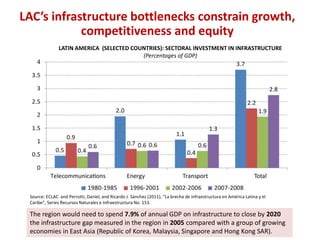
LAC’s infrastructure bottlenecks constrain growth, 
competitiveness and equity 
LATIN AMERICA (SELECTED COUNTRIES): SECTORAL INVESTMENT IN INFRASTRUCTURE 
(Percentages of GDP) 
Source: ECLAC and Perrotti, Daniel, and Ricardo J. Sánchez (2011), “La brecha de infraestructura en América Latina y el 
Caribe”, Series Recursos Naturales e Infraestructura No. 153. 
The region would need to spend 7.9% of annual GDP on infrastructure to close by 2020 
the infrastructure gap measured in the region in 2005 compared with a group of growing 
economies in East Asia (Republic of Korea, Malaysia, Singapore and Hong Kong SAR).
Regional economic integration: Taking stock 
Strengths 
• Substantial progress in 
reducing tariff barriers to 
intraregional trade 
• Some regional cooperation in 
infrastructure (roads, energy, 
internet access, etc.) 
• Some progress on easing 
people mobility 
• Some financial cooperation 
(Latin American Reserve 
Fund, integration of stock 
exchanges of Chile, Colombia 
and Peru) 
Shortcomings/challenges 
• Insufficient regulatory 
harmonization: investment, 
services, technical standards, 
public procurement, trade 
facilitation, IPRs 
• Weak dispute settlement 
mechanisms 
• Missing trade links, notably a 
Mexico-Mercosur FTA 
• Complex integration 
architecture, membership 
overlaps
LAC trade integration: Taking stock (2) 
• Geography and factor endowment also limit intra-regional trade: 
– Mexico, Central America & Caribbean gravitate towards the US market 
– Resource-rich South America increasingly gravitates towards Asia 
• Lags in infrastructure, red tape are a tax on intraregional trade 
• Policies aimed at export diversification, SME internationalization 
have proved insufficient 
– A few large firms, mostly in energy & mining, account for the bulk of LAC 
exports 
– Those firms export mostly outside the region 
• The region remains mostly out of value chain trade 
– Exceptions: Mexico, Central America with US; Argentina-Brazil auto trade 
• Mega regional trade agreements may reinforce this situation 
– South America in particular may become further entrenched in commodity 
exports
Which way forward? 
 LAC needs to maximize the benefits of intraregional trade, as it is: 
 The most conducive to the creation of high-quality employment 
 The most SME-friendly 
 And thus the most conducive to structural change, socially cohesive growth 
 Start by not doing harm: respect the agreed rules 
 Be pragmatic: small, incremental steps in areas of common interest 
often deliver more than grand projects with no follow-up 
 Further trade liberalization remains controversial within the region, 
but there is much that can be done in other areas: 
 Regional cooperation in infrastructure, energy, trade facilitation, joint export 
promotion 
 Promoting production integration through cumulation of origin, 
harmonization or mutual recognition of technical & SPS standards 
 Ensuring adequate financing for intraregional trade, especially for SMEs
The centrality of industrial policy 
• LAC needs a modern industrial policy that fosters: 
– Participation in regional and global value chains 
– Moving up the VC hierarchy, transitioning to more sophisticated activities 
in goods and services 
• The promotion of regional value chains opens up scope for 
industrial policy with plurinational components, for example: 
– Programs that help SMEs to meet the requirements of their potential 
buyers (quality, safety, sustainability, etc.) 
– Joint programs for the development of specialized human resources 
– Joint research, development of technology hubs in areas of shared 
interest (renewable energy, biotechnology applied to agriculture and 
mining, etc.) 
• None of this means “leaving natural resources behind” 
– On the contrary, it means adding knowledge and value to them, and 
strengthening their linkages with the rest of the economy
Due to their economic size, the Pacific Alliance and 
MERCOSUR are the two key players for the future 
convergence of LAC integration efforts 
Pacific Alliance, MERCOSUR and LAC: Selected indicators (2012) 
Grouping GDP 
(US$ trillion) 
Population 
(Millions) 
Exports 
(US$ billion) 
FDI inflows 
(US$ billion) 
Pacific Alliance (PA) 2,0 209 554 71 
MERCOSUR 3,3 278 436 84 
PA + MERCOSUR 5,3 487 990 155 
Latin America and 
Caribbean 
5,8 596 1.092 173 
Share of PA+MERCOSUR 91% 82% 91% 90% 
Source: ECLAC (exports and FDI), IMF, World Economic Outlook Database (GDP and population). 
Therefore, they need to reach out to each other and begin exploring areas for cooperation 
and possible convergence
Thank you – Gracias - Merci

2014.05.20_OECD-ECLAC-PSE Forum_rosales

  • 1.
    Latin American regionalintegration: State of play and main challenges Osvaldo Rosales Chief, Division of International Trade and Integration ECLAC 2nd Europe – Latin America Economic Forum ECLAC, OCDE, Ecole d’Economie de Paris. Paris, 20 May 2014
  • 2.
    Outline  Theregion’s external economic environment  The evolving architecture and dynamics of regional (economic) integration in LAC  Why is regional integration important for LAC?  Stocktaking and suggestions for the way forward 2
  • 3.
    A very favorableinternational cycle is ending for LAC • GDP growth decelerated since 2012, reaching 2.5% in 2013 ( 2.7% en 2014?) – Compared to an average 4.8% in 2003-07 and 4.1% in 2010-13 • Exports slowed sharply in 2012 and stagnated in 2013 • Increasing external vulnerability, reflected in a deterioration of the region’s current account position • Lower commodity prices worsen LAC terms of trade • Withdrawal of monetary stimulus in the US reduces available liquidity • In the coming years, greater emphasis will have to be placed on the regional market as a source of growth
  • 4.
    Regional exports slowedsharply in 2012 and 2013 LATIN AMERICA: ANNUAL GROWTH OF THE VALUE OF EXPORTS, 2000-2013 (Percentages) Source: Economic Commission for Latin America and the Caribbean (ECLAC), on the basis of official figures .
  • 5.
    The region’s termsof trade are declining LATIN AMERICA: ESTIMATED RATE OF VARIATION IN THE TERMS OF TRADE, 2011-2013a (Percentages) Source: Economic Commission for Latin America and the Caribbean (ECLAC) on the basis of official figures a The figures relating to 2013 are projections.
  • 6.
    Very modest growthis predicted for the region for the remainder of the decade DEVELOPING REGIONS: PROJECTED ANNUAL GDP VARIATION, 2014-2019 (Percentages) Source: International Monetary Fund, World Economic Outlook database, April 2014.
  • 7.
    Main trends inthe global context Rapid technological change • Information technology, cloud computing, cyber-servicies, “smart cities” • 3-D printing, robotics, remote-controlled vehicles • Biology, nanosciences and information sciences interface • Energy, water and natural resources complex Emergence of the developing countries • In growth, trade, FDI, rise of the middle class, patents, new technologies • This process is highly concentrated in China/Asia • LAC lags behind Value chains • Three major factories: • North America • Europe • East Asia Mega-regional trade agreements • TPP • TTIP • EU-Japan • ASEAN+6 (Regional Comprehensive Economic Partnership) Need to address climate change and ensure that growth is environmentally sustainable Need to address the drastic increase in inequality worldwide
  • 8.
    LAC’s main strengthsand weaknesses in the global economy • Attractive and growing consumer market; expansion of the middle class • Abundance of renewable and non-renewable natural resources Strengths • Limited involvement in the knowledge economy, low and heterogeneous productivity • Strong concentration of exports: (i) in raw materials and assembly manufactures; and (ii) in a small number of large companies Weaknesses
  • 9.
    The architecture ofLAC economic integration in the early 2000s was (relatively) simple… Dominican Republic 9 Andean Community (1969) Mexico MERCOSUR (1991) Central American Common Market (1960) CARICOM Panama (1973) Chile NAFTA (1994) Cuba ALADI (1980)
  • 10.
    …That architecture hasbecome much more complex in 2014 Central American Common Market Panama CARICOM Andean Community Mexico MERCOSUR Chile NAFTA Cuba Dominican Republic ALADI Pacific Alliance (2012) ALBA (2006) Plus: - UNASUR (2007, All 12 SA countries) - CELAC (2010, All 33 LAC countries)
  • 11.
    The dynamics andemphasis of LAC regional integration have greatly changed in the last decade • Several governments have a critical view of “the primacy of trade” in LAC regional integration during the 1990s • Greater primacy is given now to the political and social dimensions, along with production integration (mainly rhetorical) • New initiatives (CELAC, UNASUR, ALBA, Pacific Alliance); crisis in several traditional integration bodies; overlapping memberships • These trends have been more marked in South America than in Mexico, Central America and the Caribbean • Traditional shortcomings (ex. low intra-regional trade and production integration) coexist with increasing “de facto” integration (migration, tourism, FDI, etc.)
  • 12.
    The regional marketplays a key development role for LAC countries For the large majority of Latin American and Caribbean countries, intraregional trade is qualitatively superior to exporting to other markets: It is the most conducive to export diversification as it absorbs the greatest number of export products It is the main outlet for manufacturing exports It is the main market for most export companies, especially SMEs The region is the natural platform for the expansion of Translatin companies and for the creation of RVCs
  • 13.
    The regional marketis the most conducive to export diversification NUMBER OF PRODUCTS EXPORTED BY LATIN AMERICAN COUNTRIES TO SELECTED MARKETS, 2012 Latin America and the Caribbean United States European Union China Japan Argentina 3 591 1 465 1 712 407 388 Brazil 3 929 2 762 2 991 1 389 1 247 Chile 3 014 1 275 1 296 362 313 Colombia 3 239 1 708 1 250 253 201 Costa Rica 2 821 1 792 1 095 260 188 El Salvador 2 522 1 004 396 45 35 Guatemala 3 274 1 321 721 142 155 Jamaica 607 888 467 73 44 Mexico 3 857 4 164 2 803 1 367 1 272 Peru 3 037 1 796 1 602 266 575 Source: ECLAC, on the basis of COMTRADE.
  • 14.
    Excluding Mexico, theregional market is the main outlet for manufactures exported from LAC LATIN AMERICA AND THE CARIBBEAN: SHARE OF MEDIUM- AND HIGH-TECHNOLOGY MANUFACTURES EXPORTED WITHIN THE REGION, 2012 a (Percentages) Source: ECLAC, on the basis of information from the United Nations Commodity Trade Database (COMTRADE). a The figures for the Bolivarian Republic of Venezuela, Panama and Suriname are from 2011.
  • 15.
    However, Latin Americatrades little with itself when compared to other regions Selected groupings: Share of intra-group exports in total merchandise exports, 2008-2012 (In percentages) Region or grouping 2008 2009 2010 2011 2012 Average 2008-2012 Latin America 19,5 19,9 19,7 19,4 18,5 19,4 Latin America (excluding Mexico) 25,6 26,6 26,3 24,9 24,1 25,5 Intra-Andean Community 7,4 7,4 8,0 7,0 7,5 7,5 Intra-MERCOSUR 14,9 15,1 15,7 15,2 14,4 15,1 Intra-Central America 29,5 26,6 26,7 26,2 23,0 26,4 Intra EU 66,3 65,9 64,4 63,4 62,2 64,4 Intra NAFTA 49,3 47,6 48,3 48,0 48,4 48,3 Intra ASEAN+5 (*) 47,0 48,4 49,4 49,7 50,5 49,0 Fuente: CEPAL, sobre la base de COMTRADE y estadísticas oficiales de los países de América Latina. (*) Incluye a ASEAN (10), China, Japón, la República de Corea, la Región Administrativa Especial china de Hong Kong y la Provincia china de Taiwán.
  • 16.
    Intermediate goods accountfor a small share of intraregional trade in LAC, a sign of limited production integration SELECTED GROUPINGS: PARTS AND COMPONENTS AS A SHARE OF INTRA-GROUP EXPORTS, 2000-2012 (Percentages) Source: ECLAC, on the basis of COMTRADE. a North American Free Trade Agreement. b Includes China, Japan, the Republic of Korea, the 10 member countries of the Association of Southeast Asian Nations (ASEAN), Hong Kong Special Administrative Region of China and Taiwan Province of China.
  • 17.
    LAC’s infrastructure bottlenecksconstrain growth, competitiveness and equity LATIN AMERICA (SELECTED COUNTRIES): SECTORAL INVESTMENT IN INFRASTRUCTURE (Percentages of GDP) Source: ECLAC and Perrotti, Daniel, and Ricardo J. Sánchez (2011), “La brecha de infraestructura en América Latina y el Caribe”, Series Recursos Naturales e Infraestructura No. 153. The region would need to spend 7.9% of annual GDP on infrastructure to close by 2020 the infrastructure gap measured in the region in 2005 compared with a group of growing economies in East Asia (Republic of Korea, Malaysia, Singapore and Hong Kong SAR).
  • 18.
    Regional economic integration:Taking stock Strengths • Substantial progress in reducing tariff barriers to intraregional trade • Some regional cooperation in infrastructure (roads, energy, internet access, etc.) • Some progress on easing people mobility • Some financial cooperation (Latin American Reserve Fund, integration of stock exchanges of Chile, Colombia and Peru) Shortcomings/challenges • Insufficient regulatory harmonization: investment, services, technical standards, public procurement, trade facilitation, IPRs • Weak dispute settlement mechanisms • Missing trade links, notably a Mexico-Mercosur FTA • Complex integration architecture, membership overlaps
  • 19.
    LAC trade integration:Taking stock (2) • Geography and factor endowment also limit intra-regional trade: – Mexico, Central America & Caribbean gravitate towards the US market – Resource-rich South America increasingly gravitates towards Asia • Lags in infrastructure, red tape are a tax on intraregional trade • Policies aimed at export diversification, SME internationalization have proved insufficient – A few large firms, mostly in energy & mining, account for the bulk of LAC exports – Those firms export mostly outside the region • The region remains mostly out of value chain trade – Exceptions: Mexico, Central America with US; Argentina-Brazil auto trade • Mega regional trade agreements may reinforce this situation – South America in particular may become further entrenched in commodity exports
  • 20.
    Which way forward?  LAC needs to maximize the benefits of intraregional trade, as it is:  The most conducive to the creation of high-quality employment  The most SME-friendly  And thus the most conducive to structural change, socially cohesive growth  Start by not doing harm: respect the agreed rules  Be pragmatic: small, incremental steps in areas of common interest often deliver more than grand projects with no follow-up  Further trade liberalization remains controversial within the region, but there is much that can be done in other areas:  Regional cooperation in infrastructure, energy, trade facilitation, joint export promotion  Promoting production integration through cumulation of origin, harmonization or mutual recognition of technical & SPS standards  Ensuring adequate financing for intraregional trade, especially for SMEs
  • 21.
    The centrality ofindustrial policy • LAC needs a modern industrial policy that fosters: – Participation in regional and global value chains – Moving up the VC hierarchy, transitioning to more sophisticated activities in goods and services • The promotion of regional value chains opens up scope for industrial policy with plurinational components, for example: – Programs that help SMEs to meet the requirements of their potential buyers (quality, safety, sustainability, etc.) – Joint programs for the development of specialized human resources – Joint research, development of technology hubs in areas of shared interest (renewable energy, biotechnology applied to agriculture and mining, etc.) • None of this means “leaving natural resources behind” – On the contrary, it means adding knowledge and value to them, and strengthening their linkages with the rest of the economy
  • 22.
    Due to theireconomic size, the Pacific Alliance and MERCOSUR are the two key players for the future convergence of LAC integration efforts Pacific Alliance, MERCOSUR and LAC: Selected indicators (2012) Grouping GDP (US$ trillion) Population (Millions) Exports (US$ billion) FDI inflows (US$ billion) Pacific Alliance (PA) 2,0 209 554 71 MERCOSUR 3,3 278 436 84 PA + MERCOSUR 5,3 487 990 155 Latin America and Caribbean 5,8 596 1.092 173 Share of PA+MERCOSUR 91% 82% 91% 90% Source: ECLAC (exports and FDI), IMF, World Economic Outlook Database (GDP and population). Therefore, they need to reach out to each other and begin exploring areas for cooperation and possible convergence
  • 23.
    Thank you –Gracias - Merci