The power and limits of integration: 
Growth Effects of EU Membership 
Fabrizio Coricelli 1 
1Paris School of Economics and CEPR 
Paris, OECD May 20, 2014
Outline 
Motivation 
Measuring the economic benefits of EU membership 
Synthetic counterfactual method 
Contribution of our paper 
Main results 
Economic integration and liberalization not enough
Motivation 
I As economic integration deepened political integration 
lagged behing 
I Alesina et al (AER 2000) argued that deeper economic 
integration may induce political disintegration (see also 
Brou and Ruta (JEEA 2011)) 
I Enjoying the benefits of economic integration, countries 
have little incentives to move on political integration, which 
requires both income redistribution and abandoning 
national sovereignity 
I The Great Recession and the euro-debt crisis made even 
more dramatic the tension between economic and political 
integration, putting under stress the sustainability of the 
European project 
I Economic benefits of the EU and the euro are increasingly 
questioned
Motivation 2 
I EU integration unique experience: Four major 
enlargements (from 1970s to 2000s) taking place at 
I Sharply different outside context in terms of "globalization", 
trade integration at the world level (1970s vs 1990s and 
2000s) 
I This may help understanding benefits from integration 
under different global conditions 
I Very different levels of incomes per capita of new entrants 
relative to incumbents 
I Radically different context of financial integration 
(liberalization of capital account)
Measuring the economic benefits of EU membership 
I In such a context, measuring the benefits of EU entry is 
crucial 
I Are the countries that joined the European Integration 
project better-off? 
I How much do countries actually benefit from membership 
in the European Union (EU)? 
I EU membership estimates: few and widespread 
I Range of estimates (Eichengreen to Badinger): w/o 
integration, per capita incomes would be 2-20 per cent 
lower, though estimates often “not completely robust”
Hard to measure the benefits: Need a good 
counterfactual 
I Our research question: 
I What would have been the levels of per capita income (and 
productivity) if a given country had not become a 
full-fledged member of the EU? 
I Answer based on Synthetic control methods for causal 
inference in comparative case studies or “synthetic 
counterfactuals” (SCM), Abadie et al: AER 2003, JASA 
2009, AJPS 2014 
I SCM estimates the effect of a given intervention by 
comparing the evolution of an aggregate outcome variable 
for a country “treated” to its evolution for a synthetic control 
group
Synthetic counterfactual method 
I SCM minimizes the pre-treatment distance (mean squared 
error of pre-treatment outcomes) between the vector of 
treated country’s characteristics and the vector of potential 
synthetic control characteristics 
I Specify: (1) treatment, (2) set of matching covariates, and 
(3) “donor pool” 
I Advantages: 
I It allows the study of the dynamic effects, not just average 
pre and post treatment 
I It is designed for case-study, so we can analyze individual 
country experiences
Contribution of our paper 
I Campos, Coricelli and Moretti (2014) 
I We apply Synthetic counterfactuals method to estimate 
growth and productivity payoffs of EU membership 
I Our "treatment" entry in the EU 
I Analyze all enlargements: 1973, 1980s, 1995, 2004
Specification 
I Year treatment starts (EU membership): 1973: IRL, DK, 
UK; 1980s: Greece, SP, Port; 1995: Austria, Fin, Sweden; 
2004: Poland CZ etc 
I Matching over which covariates? Follow Abadie et al 2003: 
investment, labour, agriculture in GDP, level of secondary 
and tertiary education, initial GDP pc 
I Donor pool: Used various pools ranging from whole world 
to neighbours, report upper middle income sample (from 
Bover and Turrini, 2010)
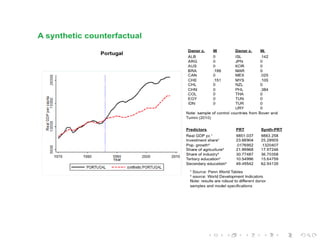
Example of bad outcome 
Greece: EU entry
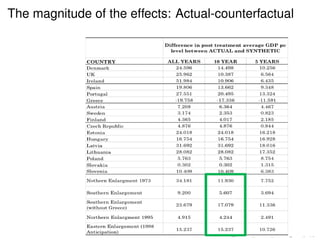
The magnitude of the effects: Actual-counterfactual
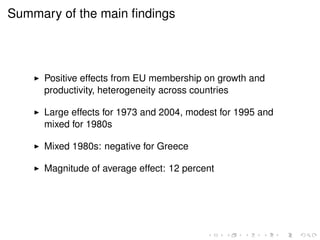
Summary of the main findings 
I Positive effects from EU membership on growth and 
productivity, heterogeneity across countries 
I Large effects for 1973 and 2004, modest for 1995 and 
mixed for 1980s 
I Mixed 1980s: negative for Greece 
I Magnitude of average effect: 12 percent
Preliminay explanations 
I Given so similar “income gaps at entry,” why are 1973 and 
1995 payoffs so different? Role of institutions and 
institutional development 
I Why are EU membership benefits for Greece relatively 
low? Structural reforms avoidance 
I What helps to explain post accession payoffs? Trade 
integration and financial liberalization, but also structural 
reforms and institutional development
Economic integration and liberalization not enough 
I Institutional developments and structural reforms seem 
crucial to exploit growth benefits of membership 
I Trade integration powerful but not sufficient 
I Financial sector development and financial integration very 
relevant and they are more "institution intensive" than trade 
liberalization (rule of law, contract enforcement) 
I The recent crisis may have negative effects in this regard
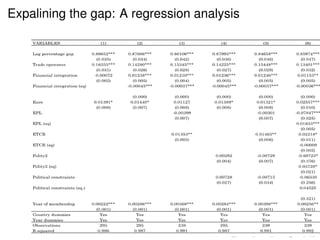
Expalining the gap: A regression analysis
European Integration Today 
I Now to understand European Integration focus has to shift 
from trade, agriculture and EU norms to: 
I There are potentially large positive effect from EU 
membership, well beyond trade integration: Need to better 
understand them (case studies of Italy and possibly Italy 
today would be very instructive) 
I Political economy: political disintegration and North-South 
divide 
I Need to emphasize more coordinated, common policies, 
including macro policies with immediate effects in this crisis 
period 
I Economic growth: again, North can prosper while the South 
struggles (the Italian Mezzogirono a possibly relevant 
parallel) 
I Financial development: True banking union may play a key 
role
References 
I Alesina, Spolaore and Wacziarg (American Economic 
Review, 2000), “Economic Integration and Political 
Disintegration” 
I Brou and Ruta (Journal of European Economic 
Association 2011), “Economic Integration, Political 
Integration, or Both?” 
I Campos, Coricelli and Moretti (CEPR Discussion Paper 
2014), "Economic Growth and Political Integration: 
Estimating the Benefits from Membership in the European 
Union Using the Synthetic Counterfactuals Methods"

2014.05.20_OECD-ECLAC-PSE Forum_coricelli

  • 1.
    The power andlimits of integration: Growth Effects of EU Membership Fabrizio Coricelli 1 1Paris School of Economics and CEPR Paris, OECD May 20, 2014
  • 2.
    Outline Motivation Measuringthe economic benefits of EU membership Synthetic counterfactual method Contribution of our paper Main results Economic integration and liberalization not enough
  • 3.
    Motivation I Aseconomic integration deepened political integration lagged behing I Alesina et al (AER 2000) argued that deeper economic integration may induce political disintegration (see also Brou and Ruta (JEEA 2011)) I Enjoying the benefits of economic integration, countries have little incentives to move on political integration, which requires both income redistribution and abandoning national sovereignity I The Great Recession and the euro-debt crisis made even more dramatic the tension between economic and political integration, putting under stress the sustainability of the European project I Economic benefits of the EU and the euro are increasingly questioned
  • 4.
    Motivation 2 IEU integration unique experience: Four major enlargements (from 1970s to 2000s) taking place at I Sharply different outside context in terms of "globalization", trade integration at the world level (1970s vs 1990s and 2000s) I This may help understanding benefits from integration under different global conditions I Very different levels of incomes per capita of new entrants relative to incumbents I Radically different context of financial integration (liberalization of capital account)
  • 5.
    Measuring the economicbenefits of EU membership I In such a context, measuring the benefits of EU entry is crucial I Are the countries that joined the European Integration project better-off? I How much do countries actually benefit from membership in the European Union (EU)? I EU membership estimates: few and widespread I Range of estimates (Eichengreen to Badinger): w/o integration, per capita incomes would be 2-20 per cent lower, though estimates often “not completely robust”
  • 6.
    Hard to measurethe benefits: Need a good counterfactual I Our research question: I What would have been the levels of per capita income (and productivity) if a given country had not become a full-fledged member of the EU? I Answer based on Synthetic control methods for causal inference in comparative case studies or “synthetic counterfactuals” (SCM), Abadie et al: AER 2003, JASA 2009, AJPS 2014 I SCM estimates the effect of a given intervention by comparing the evolution of an aggregate outcome variable for a country “treated” to its evolution for a synthetic control group
  • 7.
    Synthetic counterfactual method I SCM minimizes the pre-treatment distance (mean squared error of pre-treatment outcomes) between the vector of treated country’s characteristics and the vector of potential synthetic control characteristics I Specify: (1) treatment, (2) set of matching covariates, and (3) “donor pool” I Advantages: I It allows the study of the dynamic effects, not just average pre and post treatment I It is designed for case-study, so we can analyze individual country experiences
  • 8.
    Contribution of ourpaper I Campos, Coricelli and Moretti (2014) I We apply Synthetic counterfactuals method to estimate growth and productivity payoffs of EU membership I Our "treatment" entry in the EU I Analyze all enlargements: 1973, 1980s, 1995, 2004
  • 9.
    Specification I Yeartreatment starts (EU membership): 1973: IRL, DK, UK; 1980s: Greece, SP, Port; 1995: Austria, Fin, Sweden; 2004: Poland CZ etc I Matching over which covariates? Follow Abadie et al 2003: investment, labour, agriculture in GDP, level of secondary and tertiary education, initial GDP pc I Donor pool: Used various pools ranging from whole world to neighbours, report upper middle income sample (from Bover and Turrini, 2010)
  • 11.
    Example of badoutcome Greece: EU entry
  • 12.
    The magnitude ofthe effects: Actual-counterfactual
  • 13.
    Summary of themain findings I Positive effects from EU membership on growth and productivity, heterogeneity across countries I Large effects for 1973 and 2004, modest for 1995 and mixed for 1980s I Mixed 1980s: negative for Greece I Magnitude of average effect: 12 percent
  • 14.
    Preliminay explanations IGiven so similar “income gaps at entry,” why are 1973 and 1995 payoffs so different? Role of institutions and institutional development I Why are EU membership benefits for Greece relatively low? Structural reforms avoidance I What helps to explain post accession payoffs? Trade integration and financial liberalization, but also structural reforms and institutional development
  • 15.
    Economic integration andliberalization not enough I Institutional developments and structural reforms seem crucial to exploit growth benefits of membership I Trade integration powerful but not sufficient I Financial sector development and financial integration very relevant and they are more "institution intensive" than trade liberalization (rule of law, contract enforcement) I The recent crisis may have negative effects in this regard
  • 16.
    Expalining the gap:A regression analysis
  • 17.
    European Integration Today I Now to understand European Integration focus has to shift from trade, agriculture and EU norms to: I There are potentially large positive effect from EU membership, well beyond trade integration: Need to better understand them (case studies of Italy and possibly Italy today would be very instructive) I Political economy: political disintegration and North-South divide I Need to emphasize more coordinated, common policies, including macro policies with immediate effects in this crisis period I Economic growth: again, North can prosper while the South struggles (the Italian Mezzogirono a possibly relevant parallel) I Financial development: True banking union may play a key role
  • 18.
    References I Alesina,Spolaore and Wacziarg (American Economic Review, 2000), “Economic Integration and Political Disintegration” I Brou and Ruta (Journal of European Economic Association 2011), “Economic Integration, Political Integration, or Both?” I Campos, Coricelli and Moretti (CEPR Discussion Paper 2014), "Economic Growth and Political Integration: Estimating the Benefits from Membership in the European Union Using the Synthetic Counterfactuals Methods"