Europe and the Crisis 
Convergence and Divergence 
André Sapir 
Professor of Economics, Université Libre de Bruxelles 
Senior Fellow, Bruegel
Before the crisis 
2 
 Economic diversity, measured by the dispersion of income or consumption 
per capita, has been an important feature of the EU, at least since the 1980s 
 Before the crisis, diversity was not viewed as a major problem 
 On the contrary , the capacity of the EU 
» to enlarge to lower income countries, first from Southern Europe and then to 
Central and Eastern Europe, 
» and to create conditions for their convergence 
was rightly regarded as one of its biggest achievements 
 This success story has been widely acknowledged
The crisis has changed our view on convergence 
3 
 The crisis hit more the periphery than the core countries 
 The crisis first hit the EU Eastern periphery 
» Sudden stop in capital inflows 
» But generally healthy fundamentals => Fairly speedy adjustment and recovery, 
even in countries with fixed ER regimes 
 The crisis then hit the EU Southern periphery 
» Their economic model was flawed and EZ membership precluded ER change => 
Slow adjustment and recovery
The lesson from the crisis 
4 
 Economic diversity may not be a problem for the EU as a whole but it is 
definitely a problem for those countries that belong to the eurozone 
 The problem in the eurozone comes from a combination of three incompatible 
features
The incompatible trio 
5 
 An EMU with 
» Important economic and social differences between countries 
» Financial integration 
» Lack of common fiscal and banking policies and institutions 
is what led to the current EZ sovereign debt and banking crisis
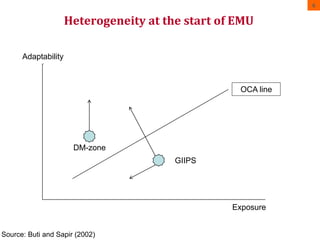
Heterogeneity at the start of EMU 
6 
Adaptability 
Exposure 
Source: Buti and Sapir (2002) 
GIIPS 
DM-zone 
OCA line
7 
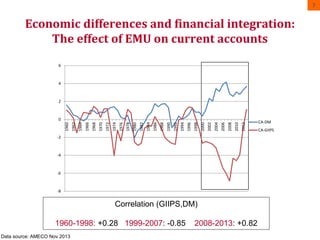
Economic differences and financial integration: 
The effect of EMU on current accounts 
6 
4 
2 
0 
-2 
-4 
-6 
-8 
1960 
1962 
1964 
1966 
1968 
1970 
1972 
1974 
1976 
1978 
1980 
1982 
1984 
1986 
1988 
1990 
1992 
1994 
1996 
1998 
2000 
2002 
2004 
2006 
2008 
2010 
2012 
Data source: AMECO Nov 2013 
Correlation (GIIPS,DM) 
1960-1998: +0.28 1999-2007: -0.85 2008-2013: +0.82 
CA-DM 
CA-GIIPS
Public debts have gone in the opposite direction: 
convergence before the crisis, then divergence 
8 
140 
120 
100 
80 
60 
40 
20 
0 
1991 1992 1993 1994 1995 1996 1997 1998 1999 2000 2001 2002 2003 2004 2005 2006 2007 2008 2009 2010 2011 2012 2013 
B-DM 
B-GIIPS 
Data source: AMECO Nov 2013
The Southern eurozone countries have big problems 
9 
 Their growth model, is based on 
» Small firms that don’t invest enough in human capital and R&D 
» Low trade openness (small closed economies) 
» High business regulation 
» Inefficient and inequitable social systems, 
 Their model was already flawed 10-15 years ago due to 
» Increased global competition from emerging countries (EMEs) 
» Increased competition within Europe from the NMS. 
 But they managed to avoid the necessary adjustment thanks to their 
adoption of the euro which permitted large net external debt positions, 
whereas the euro should have been an impetus for reform. 
 Now these countries have two problems 
» A competitiveness problem, inside the eurozone and vis-à-vis the NMS and EMEs 
» A (public and private) debt and a high unemployment problem
10 
The eurozone: United in diversity? 
 Diversity among EZ countries is very large 
 The EZ was not an OCA at the start of EMU 
 Convergence has not taken place 
 Now we have a double problem 
 Competitiveness 
 Debt overhang and high unemployment 
 Diversity is not only economic but also social and political 
 The main eurozone policy tool is inadequate/insufficient
Conventional ECB monetary policy cannot help much 
11 
 The ECB’s policy is about right for the eurozone aggregate… 
 …but it’s not for many individual EZ members because of their diversity 
Source: Darvas, April 2014
Conventional ECB monetary policy cannot help much 
12 
 In fact, divergences in macro (p, U) conditions in the eurozone were always 
fairly large but have increased substantially with the crisis 
Standard deviations of Taylor-rule recommendations for eurozone countries 
Based on Darvas and Merler, Nov 2013
Implications 
13 
 Economic diversity may not be a problem for the EU as a whole but it is 
definitely a problem for those countries that belong to the eurozone 
 What to do? More or better Europe?
Two views about what went wrong and how to fix it 
14 
 Diagnosis. The system was fundamentally flawed: a monetary 
union needs a political union 
 Remedy: “more Europe”, with some centralized economic policies 
besides monetary policy 
 Diagnosis: The system was not fundamentally flawed: a monetary 
union among sovereign states can work, provided each state 
respects the rules and keeps its house in order 
 Remedy: “better Europe”, with no centralized economic policies 
except monetary policy and strict application of rules
My own view: more but also better Europe 
15 
 More Europe: banking union and (some) fiscal union 
 Better Europe: concentrate on where Europe can really have an added 
value and create the conditions to foster growth and convergence
The way forward: Two tracks 
16 
 Track 1: A European growth strategy to overcome the debt and 
unemployment problems 
 Track 2: Reforming the EU and EMU
Track 1: A European growth strategy 
17 
 The growth strategy must combine two elements, besides the 
cleaning up of banks (SSM, AQR, SRM) 
 Demand measures (to close the output gap) 
» Fiscal policy 
» Monetary policy 
 Supply-side measures (to increase potential output) 
» EU level: Single market 
» National level: structural reforms which would also reduce EZ heterogeneity)
Too much heterogeneity in the EZ 
18 
Eurozone economies 
Ease of Doing Business Rank 
2014 
Finland 12 
Ireland 15 
Germany 21 
Estonia 22 
Netherlands 28 
Austria 30 
Portugal 31 
Slovenia 33 
Belgium 36 
France 38 
Slovak Republic 49 
Spain 52 
Italy 65 
Greece 72
Track 2: Reforming EMU and EU 
19 
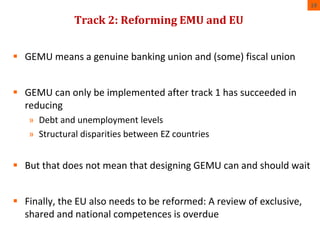
 GEMU means a genuine banking union and (some) fiscal union 
 GEMU can only be implemented after track 1 has succeeded in 
reducing 
» Debt and unemployment levels 
» Structural disparities between EZ countries 
 But that does not mean that designing GEMU can and should wait 
 Finally, the EU also needs to be reformed: A review of exclusive, 
shared and national competences is overdue

2014.05.20_OECD-ECLAC-PSE Forum_sapir

  • 1.
    Europe and theCrisis Convergence and Divergence André Sapir Professor of Economics, Université Libre de Bruxelles Senior Fellow, Bruegel
  • 2.
    Before the crisis 2  Economic diversity, measured by the dispersion of income or consumption per capita, has been an important feature of the EU, at least since the 1980s  Before the crisis, diversity was not viewed as a major problem  On the contrary , the capacity of the EU » to enlarge to lower income countries, first from Southern Europe and then to Central and Eastern Europe, » and to create conditions for their convergence was rightly regarded as one of its biggest achievements  This success story has been widely acknowledged
  • 3.
    The crisis haschanged our view on convergence 3  The crisis hit more the periphery than the core countries  The crisis first hit the EU Eastern periphery » Sudden stop in capital inflows » But generally healthy fundamentals => Fairly speedy adjustment and recovery, even in countries with fixed ER regimes  The crisis then hit the EU Southern periphery » Their economic model was flawed and EZ membership precluded ER change => Slow adjustment and recovery
  • 4.
    The lesson fromthe crisis 4  Economic diversity may not be a problem for the EU as a whole but it is definitely a problem for those countries that belong to the eurozone  The problem in the eurozone comes from a combination of three incompatible features
  • 5.
    The incompatible trio 5  An EMU with » Important economic and social differences between countries » Financial integration » Lack of common fiscal and banking policies and institutions is what led to the current EZ sovereign debt and banking crisis
  • 6.
    Heterogeneity at thestart of EMU 6 Adaptability Exposure Source: Buti and Sapir (2002) GIIPS DM-zone OCA line
  • 7.
    7 Economic differencesand financial integration: The effect of EMU on current accounts 6 4 2 0 -2 -4 -6 -8 1960 1962 1964 1966 1968 1970 1972 1974 1976 1978 1980 1982 1984 1986 1988 1990 1992 1994 1996 1998 2000 2002 2004 2006 2008 2010 2012 Data source: AMECO Nov 2013 Correlation (GIIPS,DM) 1960-1998: +0.28 1999-2007: -0.85 2008-2013: +0.82 CA-DM CA-GIIPS
  • 8.
    Public debts havegone in the opposite direction: convergence before the crisis, then divergence 8 140 120 100 80 60 40 20 0 1991 1992 1993 1994 1995 1996 1997 1998 1999 2000 2001 2002 2003 2004 2005 2006 2007 2008 2009 2010 2011 2012 2013 B-DM B-GIIPS Data source: AMECO Nov 2013
  • 9.
    The Southern eurozonecountries have big problems 9  Their growth model, is based on » Small firms that don’t invest enough in human capital and R&D » Low trade openness (small closed economies) » High business regulation » Inefficient and inequitable social systems,  Their model was already flawed 10-15 years ago due to » Increased global competition from emerging countries (EMEs) » Increased competition within Europe from the NMS.  But they managed to avoid the necessary adjustment thanks to their adoption of the euro which permitted large net external debt positions, whereas the euro should have been an impetus for reform.  Now these countries have two problems » A competitiveness problem, inside the eurozone and vis-à-vis the NMS and EMEs » A (public and private) debt and a high unemployment problem
  • 10.
    10 The eurozone:United in diversity?  Diversity among EZ countries is very large  The EZ was not an OCA at the start of EMU  Convergence has not taken place  Now we have a double problem  Competitiveness  Debt overhang and high unemployment  Diversity is not only economic but also social and political  The main eurozone policy tool is inadequate/insufficient
  • 11.
    Conventional ECB monetarypolicy cannot help much 11  The ECB’s policy is about right for the eurozone aggregate…  …but it’s not for many individual EZ members because of their diversity Source: Darvas, April 2014
  • 12.
    Conventional ECB monetarypolicy cannot help much 12  In fact, divergences in macro (p, U) conditions in the eurozone were always fairly large but have increased substantially with the crisis Standard deviations of Taylor-rule recommendations for eurozone countries Based on Darvas and Merler, Nov 2013
  • 13.
    Implications 13 Economic diversity may not be a problem for the EU as a whole but it is definitely a problem for those countries that belong to the eurozone  What to do? More or better Europe?
  • 14.
    Two views aboutwhat went wrong and how to fix it 14  Diagnosis. The system was fundamentally flawed: a monetary union needs a political union  Remedy: “more Europe”, with some centralized economic policies besides monetary policy  Diagnosis: The system was not fundamentally flawed: a monetary union among sovereign states can work, provided each state respects the rules and keeps its house in order  Remedy: “better Europe”, with no centralized economic policies except monetary policy and strict application of rules
  • 15.
    My own view:more but also better Europe 15  More Europe: banking union and (some) fiscal union  Better Europe: concentrate on where Europe can really have an added value and create the conditions to foster growth and convergence
  • 16.
    The way forward:Two tracks 16  Track 1: A European growth strategy to overcome the debt and unemployment problems  Track 2: Reforming the EU and EMU
  • 17.
    Track 1: AEuropean growth strategy 17  The growth strategy must combine two elements, besides the cleaning up of banks (SSM, AQR, SRM)  Demand measures (to close the output gap) » Fiscal policy » Monetary policy  Supply-side measures (to increase potential output) » EU level: Single market » National level: structural reforms which would also reduce EZ heterogeneity)
  • 18.
    Too much heterogeneityin the EZ 18 Eurozone economies Ease of Doing Business Rank 2014 Finland 12 Ireland 15 Germany 21 Estonia 22 Netherlands 28 Austria 30 Portugal 31 Slovenia 33 Belgium 36 France 38 Slovak Republic 49 Spain 52 Italy 65 Greece 72
  • 19.
    Track 2: ReformingEMU and EU 19  GEMU means a genuine banking union and (some) fiscal union  GEMU can only be implemented after track 1 has succeeded in reducing » Debt and unemployment levels » Structural disparities between EZ countries  But that does not mean that designing GEMU can and should wait  Finally, the EU also needs to be reformed: A review of exclusive, shared and national competences is overdue