Gametogenesis & Fertilization
Somatic and Germline cells
• Development of a fertilized egg into an adult results
in two distinct types of cells
– Somatic cells
• These create all tissues and organs of the adult except for cells
destined to become sperm or egg
• They can only undergo mitosis
– Germline cells
• The final differentiated form of these cells are mature gametes:
the sperm and egg
• These cells undergo mitosis until gametogenesis
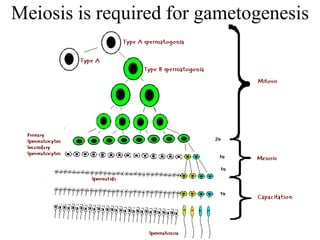
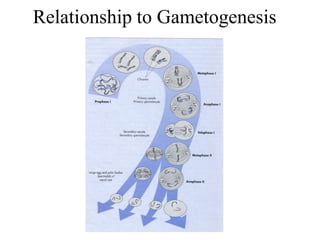
Meiosis is required for gametogenesis
Relationship to Gametogenesis
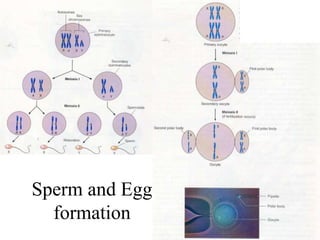
Sperm and Egg
formation
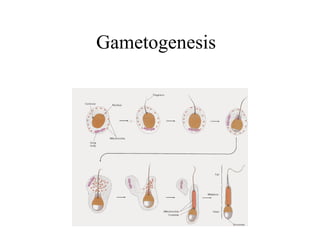
Gametogenesis
Fertilization
• Entry of a single sperm into an egg prevents entry of
other sperm
• The DNA of sperm and egg are initially kept
separate in “pronuclei” of the zygote
• Timing of a pregnancy extends from the “last
menstrual period” (LMP) rather than the time of
fertilization
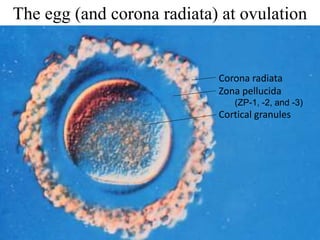
Corona radiata
Zona pellucida
(ZP-1, -2, and -3)
Cortical granules
The egg (and corona radiata) at ovulation
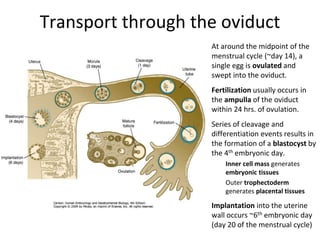
Transport through the oviduct
At around the midpoint of the
menstrual cycle (~day 14), a
single egg is ovulated and
swept into the oviduct.
Fertilization usually occurs in
the ampulla of the oviduct
within 24 hrs. of ovulation.
Series of cleavage and
differentiation events results in
the formation of a blastocyst by
the 4th embryonic day.
Inner cell mass generates
embryonic tissues
Outer trophectoderm
generates placental tissues
Implantation into the uterine
wall occurs ~6th embryonic day
(day 20 of the menstrual cycle)
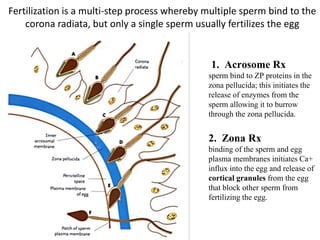
1. Acrosome Rx
sperm bind to ZP proteins in the
zona pellucida; this initiates the
release of enzymes from the
sperm allowing it to burrow
through the zona pellucida.
2. Zona Rx
binding of the sperm and egg
plasma membranes initiates Ca+
influx into the egg and release of
cortical granules from the egg
that block other sperm from
fertilizing the egg.
Fertilization is a multi-step process whereby multiple sperm bind to the
corona radiata, but only a single sperm usually fertilizes the egg
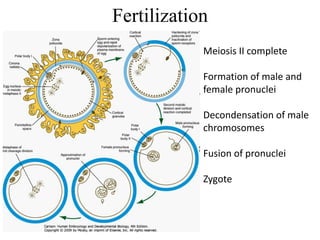
Meiosis II complete
Formation of male and
female pronuclei
Decondensation of male
chromosomes
Fusion of pronuclei
Zygote
Fertilization
Week 1: days 1-6
• Fertilization, day 1
• Cleavage, day 2-3
• Compaction, day 3
• Formation of blastocyst, day 4
• Ends with implantation, day 6
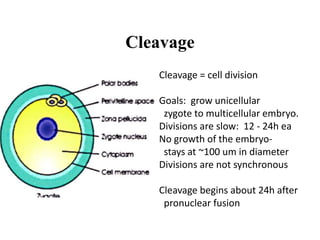
Cleavage
Cleavage = cell division
Goals: grow unicellular
zygote to multicellular embryo.
Divisions are slow: 12 - 24h ea
No growth of the embryo-
stays at ~100 um in diameter
Divisions are not synchronous
Cleavage begins about 24h after
pronuclear fusion
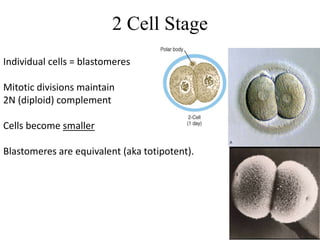
2 Cell Stage
Individual cells = blastomeres
Mitotic divisions maintain
2N (diploid) complement
Cells become smaller
Blastomeres are equivalent (aka totipotent).
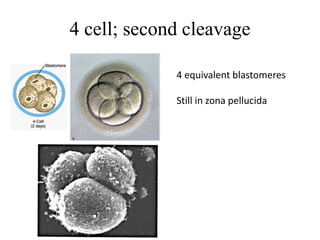
4 cell; second cleavage
4 equivalent blastomeres
Still in zona pellucida
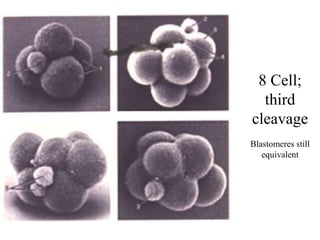
8 Cell;
third
cleavage
Blastomeres still
equivalent
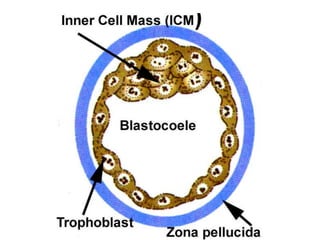
Embryo undergoes compaction after 8-cell stage:
first differentiation of embryonic lineages
Caused by increased cell-cell adhesion
Cells that are forced to the outside of the morula are destined
to become trophoblast--cells that will form placenta
The inner cells will form the embryo proper and are called
the inner cell mass (ICM).
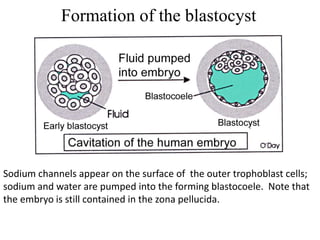
Formation of the blastocyst
Sodium channels appear on the surface of the outer trophoblast cells;
sodium and water are pumped into the forming blastocoele. Note that
the embryo is still contained in the zona pellucida.
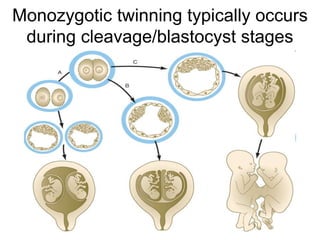
Monozygotic twinning typically occurs
during cleavage/blastocyst stages

07 gametogenesis n fertilization

  • 1.
  • 2.
    Somatic and Germlinecells • Development of a fertilized egg into an adult results in two distinct types of cells – Somatic cells • These create all tissues and organs of the adult except for cells destined to become sperm or egg • They can only undergo mitosis – Germline cells • The final differentiated form of these cells are mature gametes: the sperm and egg • These cells undergo mitosis until gametogenesis
  • 3.
    Meiosis is requiredfor gametogenesis
  • 4.
  • 5.
  • 6.
  • 7.
    Fertilization • Entry ofa single sperm into an egg prevents entry of other sperm • The DNA of sperm and egg are initially kept separate in “pronuclei” of the zygote • Timing of a pregnancy extends from the “last menstrual period” (LMP) rather than the time of fertilization
  • 8.
    Corona radiata Zona pellucida (ZP-1,-2, and -3) Cortical granules The egg (and corona radiata) at ovulation
  • 9.
    Transport through theoviduct At around the midpoint of the menstrual cycle (~day 14), a single egg is ovulated and swept into the oviduct. Fertilization usually occurs in the ampulla of the oviduct within 24 hrs. of ovulation. Series of cleavage and differentiation events results in the formation of a blastocyst by the 4th embryonic day. Inner cell mass generates embryonic tissues Outer trophectoderm generates placental tissues Implantation into the uterine wall occurs ~6th embryonic day (day 20 of the menstrual cycle)
  • 10.
    1. Acrosome Rx spermbind to ZP proteins in the zona pellucida; this initiates the release of enzymes from the sperm allowing it to burrow through the zona pellucida. 2. Zona Rx binding of the sperm and egg plasma membranes initiates Ca+ influx into the egg and release of cortical granules from the egg that block other sperm from fertilizing the egg. Fertilization is a multi-step process whereby multiple sperm bind to the corona radiata, but only a single sperm usually fertilizes the egg
  • 11.
    Meiosis II complete Formationof male and female pronuclei Decondensation of male chromosomes Fusion of pronuclei Zygote Fertilization
  • 12.
    Week 1: days1-6 • Fertilization, day 1 • Cleavage, day 2-3 • Compaction, day 3 • Formation of blastocyst, day 4 • Ends with implantation, day 6
  • 13.
    Cleavage Cleavage = celldivision Goals: grow unicellular zygote to multicellular embryo. Divisions are slow: 12 - 24h ea No growth of the embryo- stays at ~100 um in diameter Divisions are not synchronous Cleavage begins about 24h after pronuclear fusion
  • 14.
    2 Cell Stage Individualcells = blastomeres Mitotic divisions maintain 2N (diploid) complement Cells become smaller Blastomeres are equivalent (aka totipotent).
  • 15.
    4 cell; secondcleavage 4 equivalent blastomeres Still in zona pellucida
  • 16.
  • 17.
    Embryo undergoes compactionafter 8-cell stage: first differentiation of embryonic lineages Caused by increased cell-cell adhesion Cells that are forced to the outside of the morula are destined to become trophoblast--cells that will form placenta The inner cells will form the embryo proper and are called the inner cell mass (ICM).
  • 18.
    Formation of theblastocyst Sodium channels appear on the surface of the outer trophoblast cells; sodium and water are pumped into the forming blastocoele. Note that the embryo is still contained in the zona pellucida.
  • 20.
    Monozygotic twinning typicallyoccurs during cleavage/blastocyst stages