PULP PROTECTION By: dr shabeel pn
Pulp is a specialized connective tissue that occupies the pulp chamber .It comprises of nerves ,vessels ,lymph channels etc. Mainly 4 functions Formative/Developmental Nutritive Sensory Defensive/Reparative Knowledge of the size and contour of the pulp cavity is essential during tooth preparation.
If leakage of chemical irritants from biomaterials or bacteria occurs , there causes irritation to pulp. VARIOUS TYPES OF IRRITANTS -Microbial irritation -Mechanical irritation -Thermal irritation -Chemical irritation -Radiant irritation
MICROBIAL IRRITATION Bacteria that survive drying under the filling material remain viable for many years .Such dormant bacteria can become active when moisture is reintroduced as a result of marginal percolation of various filling materials , poor marginal seals improper condensation of fillings etc.
MECHANICAL AND THERMAL IRRITATION It depends on  - Speed of rotation  - Size & Shape of bur  - Amount of moisture / water - Coolant
CHEMICAL IRRITANTS  They are  - Various filling materials  - Various medicaments used for desensitization or dehydration of dentin - Dentin sterilizing agents such as phenol, silver nitrate, eugenol etc.
RADIANT IRRITANTS  X ray radiation, laser beam, uptake of radium containing water cause radiant irritation.
INFLAMMATION Is the complex vascular and lymphatic reaction as well as local tissue destruction. Involve macrophages , plasma cells & lymphocytes. Pulpal irritation leads to pulp inflammation. INFECTION Invasion of micro organisms in to the region of injury is called infection.
PULP PROTECTION To protect the pulp against those irritants we give  - chemical protection  - electrical protection - thermal protection - mechanical protection - pulp medication
In case of exposure of pulp we give  - Pulp capping - Pulpotomy
LINERS It is used to provide a barrier against the passage of irritants from cements or other restorative material and to reduce the sensitivity of freshly cut dentin. They are usually suspensions of calcium hydroxide in a volatile solvents. composition: suspension of CaOH in an organic liquid such as methyl ethyl ketone or ethyl alcohol.
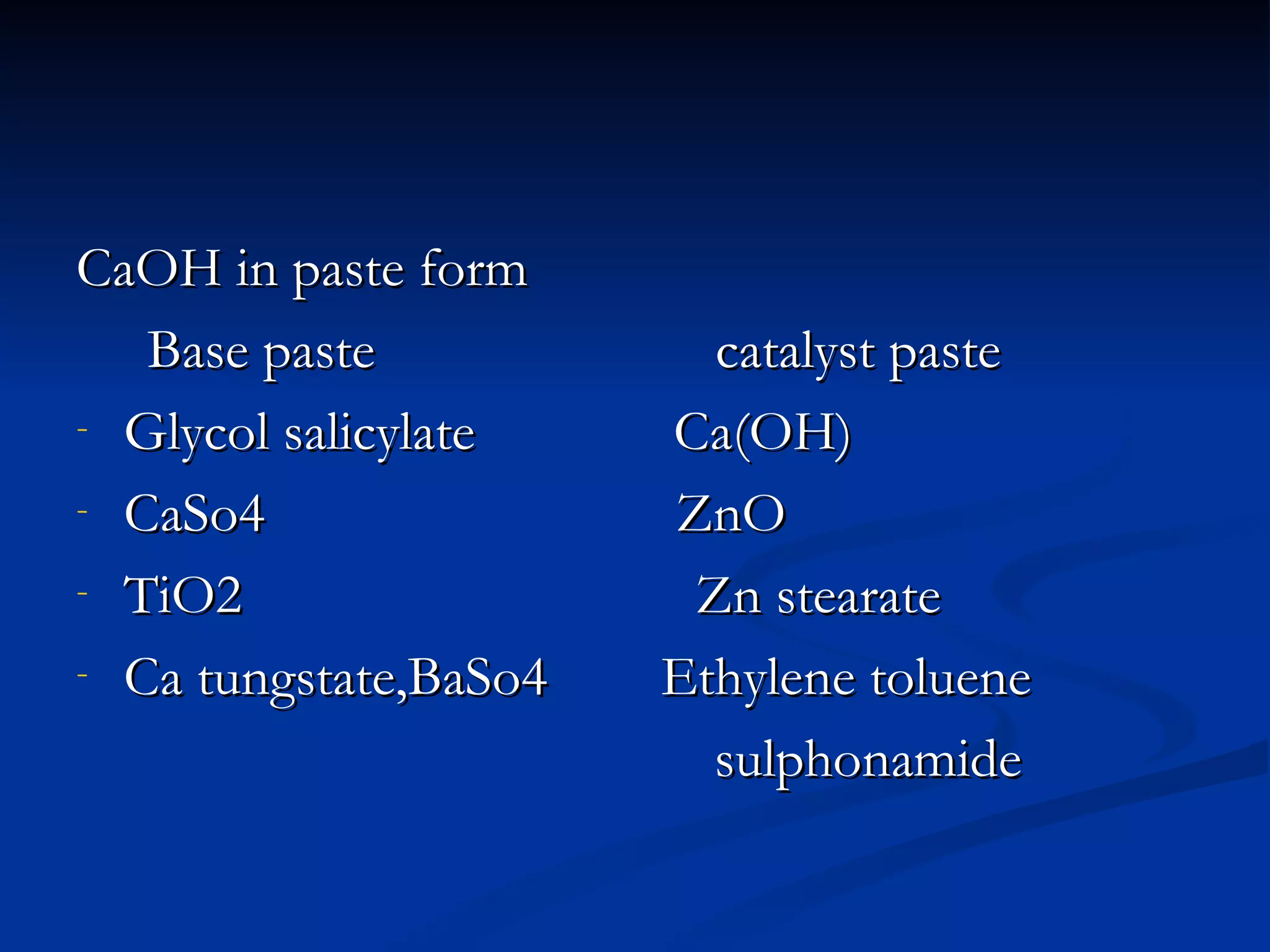
CaOH in paste form Base paste  catalyst paste Glycol salicylate  Ca(OH) CaSo4  ZnO TiO2  Zn stearate Ca tungstate,BaSo4  Ethylene toluene sulphonamide
OTHER LINERS - Type III GIC - Type IV ZOE
CAVITY VARNISH Cavity varnish is a solution of one or more resins which when applied onto the cavity walls , evaporates leaving a thin resin film, that serves as a barrier between the restoration and the dentinal tubules .
Composition:Natuaral gum such as copal, rosin, or synthetic resin dissolved in an organic solvent such as alcohol, acetone  or ether . Applied by using a brush ,wire loop, or a small pledget of cotton. Indication: In silicate or silico phosphate restoration – varnish  confined to dentin.
Contra Indication:  Composite resins  Glass ionomer Therapeutic action from overlying cement.
BASES A Base is a layer of cement placed beneath the permanent restoration to encourage recovery of the injured pulp and to protect it against numerous types of insults to which it may be subjected.The insults may be thermal or chemical or galvanic.
TYPES - High Strength Bases Provide thermal protection for pulp & mechanical support for the restoration. Eg:Zn phosphate,Zn poly carboxylate,Glass ionomer,RMGI
Low Strength Bases Have min strength & rigidity Act as a barrier to irritating chemicals and to provide  therapeutic effect to pulp. eg: Ca Hydroxide, ZnOE In case of deep excavation its necessary to overlay CaOH with RMGI or a srong base.
PULP MEDICATION Liners are also formulated to provide pulpal medication .Main aspects are - Relief of pulpal inflammation -Facilitation of dentinal bridging for physiologic protection.
PULP CAPPING Pulp capping is a process of placing a specialised agent in contact with or in close proximity to the pulp with the intention of encouraging formation of new dentin & promote the healing of the pulp .eg: Calcium Hydroxide Cement . CRITERIA: -Pulp should be healthy & uninfected.
- Area of exposure should be not more than 0.5mm - After exposure isolate the tooth immediately to prevent contamination. TYPES Direct pulp capping : Placement of the agent directly on the exposed pulp. - accidental exposure of pulp when excavating deep caries.
-Traumatic fracture of tooth. - Iatrogenic exposure during cavity preparation. -Iatrogenic exposure during crown preparation.
Indirect pulp capping: Secondary dentin formation can be induced even when the pulp is not exposed but near exposure. Indication: - Deep carious lesion close  to pulp. - excessive crown preparation. - Traumatic tooth fracture.
PULPOTOMY When pulp of young teeth have been exposed by dentinal caries ,pulpotomy is indicated.Infected coronal pulp tissue is removed. - safe in patients with history of rheumatic fever. -preferable in decidous teeth with chronic pulpitis.
DRUGS:  CalciumHydroxide,dentin shaving,gluteraldehyde,tetracyclin,penicilin
THANK YOU

Pulp Protection

  • 1.
    PULP PROTECTION By:dr shabeel pn
  • 2.
    Pulp is aspecialized connective tissue that occupies the pulp chamber .It comprises of nerves ,vessels ,lymph channels etc. Mainly 4 functions Formative/Developmental Nutritive Sensory Defensive/Reparative Knowledge of the size and contour of the pulp cavity is essential during tooth preparation.
  • 3.
    If leakage ofchemical irritants from biomaterials or bacteria occurs , there causes irritation to pulp. VARIOUS TYPES OF IRRITANTS -Microbial irritation -Mechanical irritation -Thermal irritation -Chemical irritation -Radiant irritation
  • 4.
    MICROBIAL IRRITATION Bacteriathat survive drying under the filling material remain viable for many years .Such dormant bacteria can become active when moisture is reintroduced as a result of marginal percolation of various filling materials , poor marginal seals improper condensation of fillings etc.
  • 5.
    MECHANICAL AND THERMALIRRITATION It depends on - Speed of rotation - Size & Shape of bur - Amount of moisture / water - Coolant
  • 6.
    CHEMICAL IRRITANTS They are - Various filling materials - Various medicaments used for desensitization or dehydration of dentin - Dentin sterilizing agents such as phenol, silver nitrate, eugenol etc.
  • 7.
    RADIANT IRRITANTS X ray radiation, laser beam, uptake of radium containing water cause radiant irritation.
  • 8.
    INFLAMMATION Is thecomplex vascular and lymphatic reaction as well as local tissue destruction. Involve macrophages , plasma cells & lymphocytes. Pulpal irritation leads to pulp inflammation. INFECTION Invasion of micro organisms in to the region of injury is called infection.
  • 9.
    PULP PROTECTION Toprotect the pulp against those irritants we give - chemical protection - electrical protection - thermal protection - mechanical protection - pulp medication
  • 10.
    In case ofexposure of pulp we give - Pulp capping - Pulpotomy
  • 11.
    LINERS It isused to provide a barrier against the passage of irritants from cements or other restorative material and to reduce the sensitivity of freshly cut dentin. They are usually suspensions of calcium hydroxide in a volatile solvents. composition: suspension of CaOH in an organic liquid such as methyl ethyl ketone or ethyl alcohol.
  • 12.
    CaOH in pasteform Base paste catalyst paste Glycol salicylate Ca(OH) CaSo4 ZnO TiO2 Zn stearate Ca tungstate,BaSo4 Ethylene toluene sulphonamide
  • 13.
    OTHER LINERS -Type III GIC - Type IV ZOE
  • 14.
    CAVITY VARNISH Cavityvarnish is a solution of one or more resins which when applied onto the cavity walls , evaporates leaving a thin resin film, that serves as a barrier between the restoration and the dentinal tubules .
  • 15.
    Composition:Natuaral gum suchas copal, rosin, or synthetic resin dissolved in an organic solvent such as alcohol, acetone or ether . Applied by using a brush ,wire loop, or a small pledget of cotton. Indication: In silicate or silico phosphate restoration – varnish confined to dentin.
  • 16.
    Contra Indication: Composite resins Glass ionomer Therapeutic action from overlying cement.
  • 17.
    BASES A Baseis a layer of cement placed beneath the permanent restoration to encourage recovery of the injured pulp and to protect it against numerous types of insults to which it may be subjected.The insults may be thermal or chemical or galvanic.
  • 18.
    TYPES - HighStrength Bases Provide thermal protection for pulp & mechanical support for the restoration. Eg:Zn phosphate,Zn poly carboxylate,Glass ionomer,RMGI
  • 19.
    Low Strength BasesHave min strength & rigidity Act as a barrier to irritating chemicals and to provide therapeutic effect to pulp. eg: Ca Hydroxide, ZnOE In case of deep excavation its necessary to overlay CaOH with RMGI or a srong base.
  • 20.
    PULP MEDICATION Linersare also formulated to provide pulpal medication .Main aspects are - Relief of pulpal inflammation -Facilitation of dentinal bridging for physiologic protection.
  • 21.
    PULP CAPPING Pulpcapping is a process of placing a specialised agent in contact with or in close proximity to the pulp with the intention of encouraging formation of new dentin & promote the healing of the pulp .eg: Calcium Hydroxide Cement . CRITERIA: -Pulp should be healthy & uninfected.
  • 22.
    - Area ofexposure should be not more than 0.5mm - After exposure isolate the tooth immediately to prevent contamination. TYPES Direct pulp capping : Placement of the agent directly on the exposed pulp. - accidental exposure of pulp when excavating deep caries.
  • 23.
    -Traumatic fracture oftooth. - Iatrogenic exposure during cavity preparation. -Iatrogenic exposure during crown preparation.
  • 24.
    Indirect pulp capping:Secondary dentin formation can be induced even when the pulp is not exposed but near exposure. Indication: - Deep carious lesion close to pulp. - excessive crown preparation. - Traumatic tooth fracture.
  • 25.
    PULPOTOMY When pulpof young teeth have been exposed by dentinal caries ,pulpotomy is indicated.Infected coronal pulp tissue is removed. - safe in patients with history of rheumatic fever. -preferable in decidous teeth with chronic pulpitis.
  • 26.
    DRUGS: CalciumHydroxide,dentinshaving,gluteraldehyde,tetracyclin,penicilin
  • 27.