Materials used
in VPT
Cairo University
Faculty of Dentistry
Department of Endodontics
outlines
Recent advances
Bioactive
bioceramic
pulp capping
materials
Calcium
hydroxide
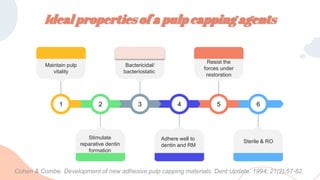
pulp capping agents
1
Maintain pulp
vitality
Bactericidal/
bacteriostatic
3 5
Resist the
forces under
restoration
2
Stimulate
reparative dentin
formation
4
Adhere well to
dentin and RM
6
Sterile & RO
Ideal properties of a pulp capping agents
Cohen & Combe. Development of new adhesive pulp capping materials. Dent Update. 1994; 21(2):57-62.
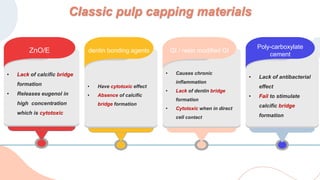
ZnO/E
• Lack of calcific bridge
formation
• Releases eugenol in
high concentration
which is cytotoxic
dentin bonding agents
• Have cytotoxic effect
• Absence of calcific
bridge formation
GI / resin modified GI
• Causes chronic
inflammation
• Lack of dentin bridge
formation
• Cytotoxic when in direct
cell contact
Poly-carboxylate
cement
• Lack of antibacterial
effect
• Fail to stimulate
calcific bridge
formation
Classic pulp capping materials
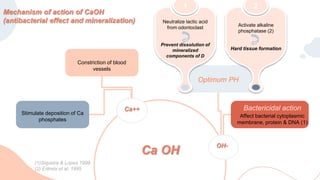
Calcium hydroxide
OH-
Ca++
Stimulate deposition of Ca
phosphates
Constriction of blood
vessels
Optimum PH
Bactericidal action
Affect bacterial cytoplasmic
membrane, protein & DNA (1)
Ca OH
1
Neutralize lactic acid
from odontoclast
Prevent dissolution of
mineralized
components of D
2
Activate alkaline
phosphatase (2)
Hard tissue formation
Mechanism of action of CaOH
(antibacterial effect and mineralization)
(1)Siqueira & Lopes 1999
(2) Estrela et al. 1995
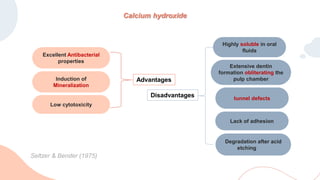
Highly soluble in oral
fluids
Low cytotoxicity
Lack of adhesion
Excellent Antibacterial
properties
Extensive dentin
formation obliterating the
pulp chamber
Induction of
Mineralization
tunnel defects
Degradation after acid
etching
Seltzer & Bender (1975)
Advantages
Disadvantages
Calcium hydroxide
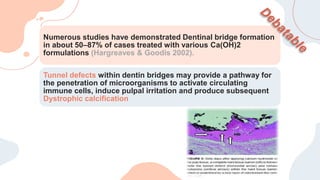
Numerous studies have demonstrated Dentinal bridge formation
in about 50–87% of cases treated with various Ca(OH)2
formulations (Hargreaves & Goodis 2002).
Tunnel defects within dentin bridges may provide a pathway for
the penetration of microorganisms to activate circulating
immune cells, induce pulpal irritation and produce subsequent
Dystrophic calcification
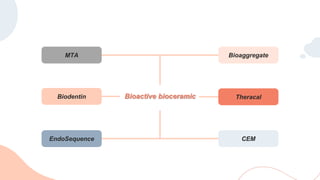
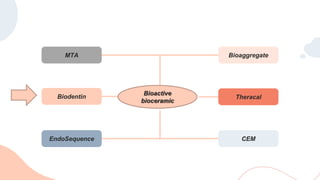
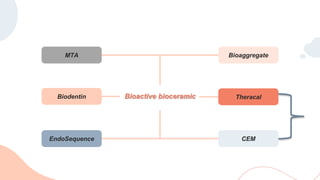
Bioaggregate
EndoSequence
MTA
Theracal
CEM
Biodentin Bioactive bioceramic
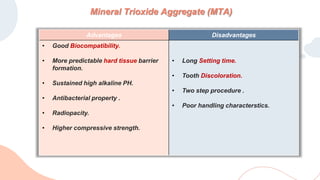
Mineral Trioxide Aggregate (MTA)
Advantages Disadvantages
• Good Biocompatibility.
• More predictable hard tissue barrier
formation.
• Sustained high alkaline PH.
• Antibacterial property .
• Radiopacity.
• Higher compressive strength.
• Long Setting time.
• Tooth Discoloration.
• Two step procedure .
• Poor handling characterstics.
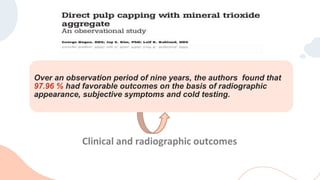
Over an observation period of nine years, the authors found that
97.96 % had favorable outcomes on the basis of radiographic
appearance, subjective symptoms and cold testing.
Clinical and radiographic outcomes
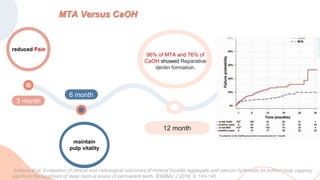
3 month
6 month
12 month
reduced Pain
maintain
pulp vitality
96% of MTA and 76% of
CaOH showed Reparative
dentin formation.
MTA Versus CaOH
Sultana et al. Evaluation of clinical and radiological outcomes of mineral trioxide aggregate and calcium hydroxide as indirect pulp capping
agents in the treatment of deep carious lesion of permanent teeth. BSMMU J 2016; 9: 140-145
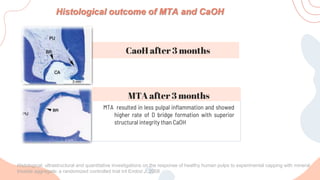
MTA resulted in less pulpal inflammation and showed
higher rate of D bridge formation with superior
structural integrity than CaOH
CaoH after 3 months
Histological outcome of MTA and CaOH
MTA after 3 months
Histological, ultrastructural and quantitative investigations on the response of healthy human pulps to experimental capping with mineral
trioxide aggregate: a randomized controlled trial Int Endod J. 2008
Bioaggregate
EndoSequence
MTA
Theracal
CEM
Biodentin Bioactive bioceramic
Bioactive
bioceramic
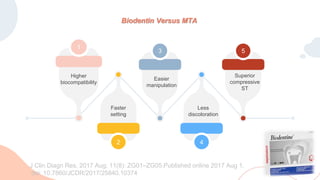
1
Higher
biocompatibility
3
Easier
manipulation
5
Superior
compressive
ST
4
Less
discoloration
2
Faster
setting
J Clin Diagn Res. 2017 Aug; 11(8): ZG01–ZG05.Published online 2017 Aug 1.
doi: 10.7860/JCDR/2017/25840.10374
Biodentin Versus MTA
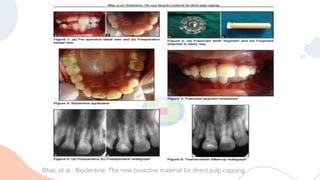
Bhat, et al.: Biodentine: The new bioactive material for direct pulp capping
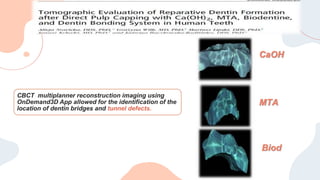
CaOH
MTA
Biod
CBCT multiplanner reconstruction imaging using
OnDemand3D App allowed for the identification of the
location of dentin bridges and tunnel defects.
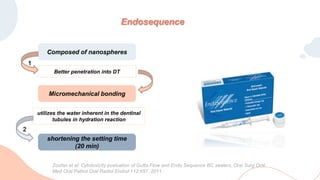
Composed of nanospheres
Micromechanical bonding
shortening the setting time
(20 min)
Better penetration into DT
utilizes the water inherent in the dentinal
tubules in hydration reaction
1
2
Zoufan et al: Cytotoxicity evaluation of Gutta Flow and Endo Sequence BC sealers, Oral Surg Oral
Med Oral Pathol Oral Radiol Endod 112:657, 2011.
Endosequence
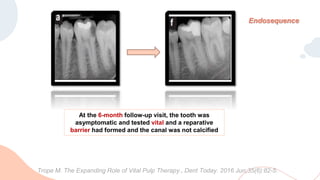
At the 6-month follow-up visit, the tooth was
asymptomatic and tested vital and a reparative
barrier had formed and the canal was not calcified
Endosequence
Trope M. The Expanding Role of Vital Pulp Therapy., Dent Today. 2016 Jun;35(6):82-5.
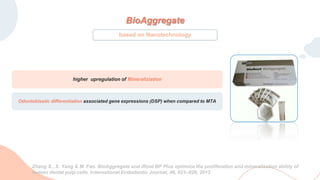
higher upregulation of Mineraliziation
Odontoblastic differentiation associated gene expressions (DSP) when compared to MTA
BioAggregate
Zhang S., X. Yang & M. Fan. BioAggregate and iRoot BP Plus optimize the proliferation and mineralization ability of
human dental pulp cells. International Endodontic Journal, 46, 923–929, 2013
based on Nanotechnology
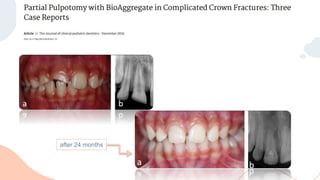
after 24 months
Bioaggregate
EndoSequence
MTA
Theracal
CEM
Biodentin Bioactive bioceramic
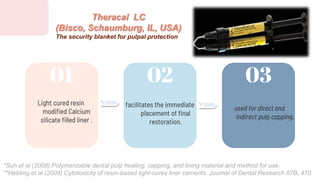
01 02 03
Light cured resin
modified Calcium
silicate filled liner .
facilitates the immediate
placement of final
restoration.
used for direct and
indirect pulp capping.
Theracal LC
(Bisco, Schaumburg, IL, USA)
The security blanket for pulpal protection
*Suh et al (2008) Polymerizable dental pulp healing, capping, and lining material and method for use.
**Hebling et al (2009) Cytotoxicity of resin-based light-cures liner cements. Journal of Dental Research 87B, 470.
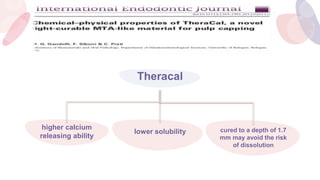
Theracal
higher calcium
releasing ability
cured to a depth of 1.7
mm may avoid the risk
of dissolution
lower solubility
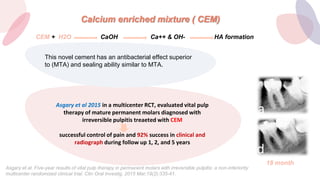
CEM + H2O CaOH Ca++ & OH- HA formation
Calcium enriched mixture ( CEM)
Asgary et al 2015 in a multicenter RCT, evaluated vital pulp
therapy of mature permanent molars diagnosed with
irreversible pulpitis treaeted with CEM
successful control of pain and 92% success in clinical and
radiograph during follow up 1, 2, and 5 years
18 month
Asgary et al. Five-year results of vital pulp therapy in permanent molars with irreversible pulpitis: a non-inferiority
multicenter randomized clinical trial. Clin Oral Investig. 2015 Mar;19(2):335-41.
This novel cement has an antibacterial effect superior
to (MTA) and sealing ability similar to MTA.
01
03
02
04
Propolis Lasers
(PRF) Resolvins
Recent advances
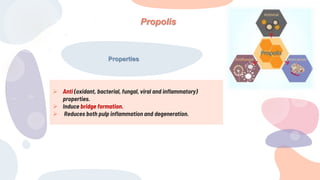
 Anti (oxidant, bacterial, fungal, viral and inflammatory)
properties.
 Induce bridge formation.
 Reduces both pulp inflammation and degeneration.
Propolis
Properties
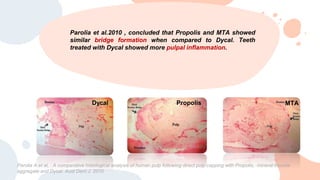
Parolia et al.2010 , concluded that Propolis and MTA showed
similar bridge formation when compared to Dycal. Teeth
treated with Dycal showed more pulpal inflammation.
Dycal Propolis MTA
Parolia A et al, . A comparative histological analysis of human pulp following direct pulp capping with Propolis, mineral trioxide
aggregate and Dycal. Aust Dent J. 2010
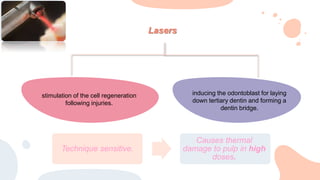
stimulation of the cell regeneration
following injuries.
inducing the odontoblast for laying
down tertiary dentin and forming a
dentin bridge.
Lasers
Technique sensitive.
Causes thermal
damage to pulp in high
doses.
A meta analysis conducted by Yang et al, in 2016 evaluated the use of Laser in pulp
capping.
Results showed that the success rate of the laser group was 89.9% while the control
groups (Ca OH) was 67.2%
Lasers
Yang Deng, et al. Laser use in direct pulp capping : A meta-analysis Journal of American Dental Association,
147, Issue 12, December 2016, Pages 935–942
PRF
Resolvins
RV showed great promises regarding the potential to resolve
pulpitis and subsequently enhance dental pulp tissue regeneration.
Caution Unfavorable host
reaction
Inflammation and
Necrosis of the tissue.
“ a treatment established to preserve and
sustain the healthy state of pulp tissue that has
been jeopardized by either restorative
procedures, trauma or caries.”
conclution
THANKS

vital pulp therapy.pptx

  • 1.
    Materials used in VPT CairoUniversity Faculty of Dentistry Department of Endodontics
  • 2.
  • 3.
  • 4.
    1 Maintain pulp vitality Bactericidal/ bacteriostatic 3 5 Resistthe forces under restoration 2 Stimulate reparative dentin formation 4 Adhere well to dentin and RM 6 Sterile & RO Ideal properties of a pulp capping agents Cohen & Combe. Development of new adhesive pulp capping materials. Dent Update. 1994; 21(2):57-62.
  • 5.
    ZnO/E • Lack ofcalcific bridge formation • Releases eugenol in high concentration which is cytotoxic dentin bonding agents • Have cytotoxic effect • Absence of calcific bridge formation GI / resin modified GI • Causes chronic inflammation • Lack of dentin bridge formation • Cytotoxic when in direct cell contact Poly-carboxylate cement • Lack of antibacterial effect • Fail to stimulate calcific bridge formation Classic pulp capping materials
  • 6.
  • 7.
    OH- Ca++ Stimulate deposition ofCa phosphates Constriction of blood vessels Optimum PH Bactericidal action Affect bacterial cytoplasmic membrane, protein & DNA (1) Ca OH 1 Neutralize lactic acid from odontoclast Prevent dissolution of mineralized components of D 2 Activate alkaline phosphatase (2) Hard tissue formation Mechanism of action of CaOH (antibacterial effect and mineralization) (1)Siqueira & Lopes 1999 (2) Estrela et al. 1995
  • 8.
    Highly soluble inoral fluids Low cytotoxicity Lack of adhesion Excellent Antibacterial properties Extensive dentin formation obliterating the pulp chamber Induction of Mineralization tunnel defects Degradation after acid etching Seltzer & Bender (1975) Advantages Disadvantages Calcium hydroxide
  • 9.
    Numerous studies havedemonstrated Dentinal bridge formation in about 50–87% of cases treated with various Ca(OH)2 formulations (Hargreaves & Goodis 2002). Tunnel defects within dentin bridges may provide a pathway for the penetration of microorganisms to activate circulating immune cells, induce pulpal irritation and produce subsequent Dystrophic calcification
  • 10.
  • 11.
    Mineral Trioxide Aggregate(MTA) Advantages Disadvantages • Good Biocompatibility. • More predictable hard tissue barrier formation. • Sustained high alkaline PH. • Antibacterial property . • Radiopacity. • Higher compressive strength. • Long Setting time. • Tooth Discoloration. • Two step procedure . • Poor handling characterstics.
  • 12.
    Over an observationperiod of nine years, the authors found that 97.96 % had favorable outcomes on the basis of radiographic appearance, subjective symptoms and cold testing. Clinical and radiographic outcomes
  • 13.
    3 month 6 month 12month reduced Pain maintain pulp vitality 96% of MTA and 76% of CaOH showed Reparative dentin formation. MTA Versus CaOH Sultana et al. Evaluation of clinical and radiological outcomes of mineral trioxide aggregate and calcium hydroxide as indirect pulp capping agents in the treatment of deep carious lesion of permanent teeth. BSMMU J 2016; 9: 140-145
  • 14.
    MTA resulted inless pulpal inflammation and showed higher rate of D bridge formation with superior structural integrity than CaOH CaoH after 3 months Histological outcome of MTA and CaOH MTA after 3 months Histological, ultrastructural and quantitative investigations on the response of healthy human pulps to experimental capping with mineral trioxide aggregate: a randomized controlled trial Int Endod J. 2008
  • 15.
  • 16.
    1 Higher biocompatibility 3 Easier manipulation 5 Superior compressive ST 4 Less discoloration 2 Faster setting J Clin DiagnRes. 2017 Aug; 11(8): ZG01–ZG05.Published online 2017 Aug 1. doi: 10.7860/JCDR/2017/25840.10374 Biodentin Versus MTA
  • 17.
    Bhat, et al.:Biodentine: The new bioactive material for direct pulp capping
  • 18.
    CaOH MTA Biod CBCT multiplanner reconstructionimaging using OnDemand3D App allowed for the identification of the location of dentin bridges and tunnel defects.
  • 19.
    Composed of nanospheres Micromechanicalbonding shortening the setting time (20 min) Better penetration into DT utilizes the water inherent in the dentinal tubules in hydration reaction 1 2 Zoufan et al: Cytotoxicity evaluation of Gutta Flow and Endo Sequence BC sealers, Oral Surg Oral Med Oral Pathol Oral Radiol Endod 112:657, 2011. Endosequence
  • 20.
    At the 6-monthfollow-up visit, the tooth was asymptomatic and tested vital and a reparative barrier had formed and the canal was not calcified Endosequence Trope M. The Expanding Role of Vital Pulp Therapy., Dent Today. 2016 Jun;35(6):82-5.
  • 21.
    higher upregulation ofMineraliziation Odontoblastic differentiation associated gene expressions (DSP) when compared to MTA BioAggregate Zhang S., X. Yang & M. Fan. BioAggregate and iRoot BP Plus optimize the proliferation and mineralization ability of human dental pulp cells. International Endodontic Journal, 46, 923–929, 2013 based on Nanotechnology
  • 22.
  • 23.
  • 24.
    01 02 03 Lightcured resin modified Calcium silicate filled liner . facilitates the immediate placement of final restoration. used for direct and indirect pulp capping. Theracal LC (Bisco, Schaumburg, IL, USA) The security blanket for pulpal protection *Suh et al (2008) Polymerizable dental pulp healing, capping, and lining material and method for use. **Hebling et al (2009) Cytotoxicity of resin-based light-cures liner cements. Journal of Dental Research 87B, 470.
  • 25.
    Theracal higher calcium releasing ability curedto a depth of 1.7 mm may avoid the risk of dissolution lower solubility
  • 26.
    CEM + H2OCaOH Ca++ & OH- HA formation Calcium enriched mixture ( CEM) Asgary et al 2015 in a multicenter RCT, evaluated vital pulp therapy of mature permanent molars diagnosed with irreversible pulpitis treaeted with CEM successful control of pain and 92% success in clinical and radiograph during follow up 1, 2, and 5 years 18 month Asgary et al. Five-year results of vital pulp therapy in permanent molars with irreversible pulpitis: a non-inferiority multicenter randomized clinical trial. Clin Oral Investig. 2015 Mar;19(2):335-41. This novel cement has an antibacterial effect superior to (MTA) and sealing ability similar to MTA.
  • 27.
  • 28.
     Anti (oxidant,bacterial, fungal, viral and inflammatory) properties.  Induce bridge formation.  Reduces both pulp inflammation and degeneration. Propolis Properties
  • 29.
    Parolia et al.2010, concluded that Propolis and MTA showed similar bridge formation when compared to Dycal. Teeth treated with Dycal showed more pulpal inflammation. Dycal Propolis MTA Parolia A et al, . A comparative histological analysis of human pulp following direct pulp capping with Propolis, mineral trioxide aggregate and Dycal. Aust Dent J. 2010
  • 30.
    stimulation of thecell regeneration following injuries. inducing the odontoblast for laying down tertiary dentin and forming a dentin bridge. Lasers Technique sensitive. Causes thermal damage to pulp in high doses.
  • 31.
    A meta analysisconducted by Yang et al, in 2016 evaluated the use of Laser in pulp capping. Results showed that the success rate of the laser group was 89.9% while the control groups (Ca OH) was 67.2% Lasers Yang Deng, et al. Laser use in direct pulp capping : A meta-analysis Journal of American Dental Association, 147, Issue 12, December 2016, Pages 935–942

  • 32.
  • 33.
    Resolvins RV showed greatpromises regarding the potential to resolve pulpitis and subsequently enhance dental pulp tissue regeneration. Caution Unfavorable host reaction Inflammation and Necrosis of the tissue.
  • 34.
    “ a treatmentestablished to preserve and sustain the healthy state of pulp tissue that has been jeopardized by either restorative procedures, trauma or caries.” conclution
  • 35.

Editor's Notes

  • #14 Sultana et al 2016 assessed the outcomes of MTA and CaOH in 50 permanent teeth having deep carious lesions with reversible pulpitis