© 2011 Cengage South-Western
       © 2007 Thomson South-Western
BETWEEN MONOPOLY AND
PERFECT COMPETITION
• Imperfect competition refers to those market
  structures that fall between perfect competition
  and pure monopoly.
• Imperfect competition includes industries in
  which firms have competitors but do not face
  so much competition that they are price takers.


                                       © 2011Thomson South-Western
                                       © 2007 Cengage South-Western
BETWEEN MONOPOLY AND
PERFECT COMPETITION
• Types of Imperfectly Competitive Markets
  – Oligopoly
     • Only a few sellers, each offering a similar or identical
       product to the others.
  – Monopolistic Competition
     • Many firms selling products that are similar but not
       identical.


                                                   © 2011Thomson South-Western
                                                   © 2007 Cengage South-Western
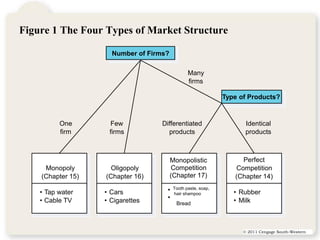
Figure 1 The Four Types of Market Structure

                     Number of Firms?

                                                Many
                                                firms

                                                              Type of Products?


          One       Few            Differentiated                    Identical
          firm      firms            products                        products


                                        Monopolistic               Perfect
     Monopoly        Oligopoly          Competition              Competition
    (Chapter 15)   (Chapter 16)         (Chapter 17)             (Chapter 14)

    • Tap water    • Cars           •    Tooth paste, soap,
                                         hair shampoo            • Rubber
    • Cable TV     • Cigarettes     •                            • Milk
                                          Bread


                                                                    © 20112007 Thomson South-Western
                                                                        © Cengage South-Western
MARKETS WITH ONLY A FEW
SELLERS
• Because of the few sellers, the key feature of
  oligopoly is the tension between cooperation
  and self-interest.
• Characteristics of an Oligopoly Market
  – Few sellers offering similar or identical products
  – Interdependent firms
  – Best off cooperating and acting like a monopolist
    by producing a small quantity of output and
    charging a price above marginal cost

                                            © 2011Thomson South-Western
                                            © 2007 Cengage South-Western
A Duopoly Example

• A duopoly is an oligopoly with only two
  members. It is the simplest type of oligopoly.


                                        © 2011 Cengage South-Western
                                           © 2007 Thomson South-Western
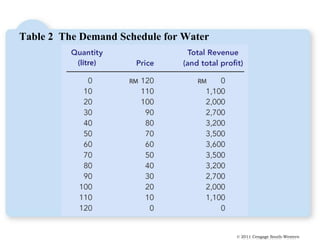
Table 2 The Demand Schedule for Water


                                        © 2011 Cengage South-Western
                                           © 2007 Thomson South-Western
A Duopoly Example

• Price and Quantity Supplied
  • The price of water in a perfectly competitive market
    would be driven to where the marginal cost is zero:
     • P = MC = RM0
     • Q = 120 litres
  • The price and quantity in a monopoly market would
    be where total profit is maximized:
     • P = RM60
     • Q = 60 litres


                                            © 2011 Cengage South-Western
                                               © 2007 Thomson South-Western
A Duopoly Example

• Price and Quantity Supplied
  • The socially efficient quantity of water is 120 litres,
    but a monopolist would produce only 60 litres of
    water.
  • So what outcome then could be expected from
    duopolists?


                                               © 2011 Cengage South-Western
                                                  © 2007 Thomson South-Western
The Market for Water
  Cost
                  In a competitive market, quantity
RM120             would equal 120 and P = MC = RM0.


                         A monopoly would produce 60
                         gallons and charge RM60. Note
                         that P > MC.
  RM60
                                             Total industry output
                                             with a duopoly will
                                  Demand     probably exceed 60,
                                             but be less than 120.

                                              MC is constant and =
                                              RM0.
     0              60                 120   Quantity of Output
                           Marginal
                           Revenue                 © 20112007 Thomson South-Western
                                                       © Cengage South-Western
Competition, Monopolies, and Cartels

• The duopolists may agree on a monopoly
  outcome.
  • Collusion
     • An agreement among firms in a market about quantities
       to produce or prices to charge.
  • Cartel
     • A group of firms acting in unison.


                                                 © 2011 Cengage South-Western
                                                    © 2007 Thomson South-Western
Competition, Monopolies, and Cartels

• Although oligopolists would like to form cartels
  and earn monopoly profits, often that is not
  possible. Antitrust laws prohibit explicit
  agreements among oligopolists as a matter of
  public policy.


                                        © 2011 Cengage South-Western
                                           © 2007 Thomson South-Western
The Equilibrium for an Oligopoly

• A Nash equilibrium is a situation in which
  economic actors interacting with one another
  each choose their best strategy given the
  strategies that all the others have chosen.


                                       © 2011 Cengage South-Western
                                          © 2007 Thomson South-Western
The Equilibrium for an Oligopoly

• When firms in an oligopoly individually choose
  production to maximize profit, they produce
  quantity of output greater than the level
  produced by monopoly and less than the level
  produced by competition.
• The oligopoly price is less than the monopoly
  price but greater than the competitive price
  (which equals marginal cost).


                                      © 2011 Cengage South-Western
                                         © 2007 Thomson South-Western
Equilibrium for an Oligopoly

• Summary
  • Possible outcome if oligopoly firms pursue their
    own self-interests:
     • Joint output is greater than the monopoly quantity but
       less than the competitive industry quantity.
     • Market prices are lower than monopoly price but greater
       than competitive price.
     • Total profits are less than the monopoly profit.


                                                  © 2011 Cengage South-Western
                                                     © 2007 Thomson South-Western
How the Size of an Oligopoly Affects the
Market Outcome
• How increasing the number of sellers affects
  the price and quantity:
  • The output effect: Because price is above marginal
    cost, selling more at the going price raises profits.
  • The price effect: Raising production will increase
    the amount sold, which will lower the price and the
    profit per unit on all units sold.


                                              © 2011 Cengage South-Western
                                                 © 2007 Thomson South-Western
How the Size of an Oligopoly Affects the
Market Outcome
• As the number of sellers in an oligopoly grows
  larger, an oligopolistic market looks more and
  more like a competitive market.
• The price approaches marginal cost, and the
  quantity produced approaches the socially
  efficient level.


                                       © 2011 Cengage South-Western
                                          © 2007 Thomson South-Western
GAME THEORY AND THE
ECONOMICS OF COOPERATION
• Game theory is the study of how people
  behave in strategic situations.
• Strategic decisions are those in which each
  person, in deciding what actions to take, must
  consider how others might respond to that
  action.


                                      © 2011Thomson South-Western
                                      © 2007 Cengage South-Western
GAME THEORY AND THE
ECONOMICS OF COOPERATION

• Because the number of firms in an
  oligopolistic market is small, each firm must
  act strategically.
• Each firm knows that its profit depends not
  only on how much it produces but also on how
  much the other firms produce.


                                     © 2011Thomson South-Western
                                     © 2007 Cengage South-Western
The Prisoners’ Dilemma

• The prisoners’ dilemma provides insight into
  the difficulty in maintaining cooperation.
• Often people (firms) fail to cooperate with one
  another even when cooperation would make
  them better off.


                                        © 2011 Cengage South-Western
                                           © 2007 Thomson South-Western
The Prisoners’ Dilemma

• The prisoners’ dilemma is a particular “game”
  between two captured prisoners that illustrates
  why cooperation is difficult to maintain even
  when it is mutually beneficial.


                                        © 2011 Cengage South-Western
                                           © 2007 Thomson South-Western
Figure 2 The Prisoners’ Dilemma


                                           Bonnie’ s Decision

                              Confess                           Remain Silent

                             Bonnie gets 8 years                Bonnie gets 20 years


           Confess

Clyde’s              Clyde gets 8 years              Clyde goes free
Decision                        Bonnie goes free                  Bonnie gets 1 year

           Remain
            Silent

                     Clyde gets 20 years             Clyde gets 1 year


                                                                       © 20112007 Thomson South-Western
                                                                           © Cengage South-Western
Oligopolies as a Prisoners’ Dilemma

• The dominant strategy is the best strategy for a
  player to follow regardless of the strategies
  chosen by the other players.
• Cooperation is difficult to maintain, because
  cooperation is not in the best interest of the
  individual player.


                                         © 2011 Cengage South-Western
                                            © 2007 Thomson South-Western
Figure 3 Ah Chun and Ah Seng’s Oligopoly Game


                                                  Ah Chun’s Decision

                        High Production: 40 Gal.           Low Production: 30 gal.
                              Ah Chun gets RM1,600                Jack gets $1,500 profit
                                 profit
              High
           Production
            40 gal.
Ah Seng’s
                        Ah Seng gets RM1,600                Jill gets $2,000 profit
Decision
                        profit
                               Jack gets $2,000 profit            Jack gets $1,800 profit

              Low
           Production
            30 gal.
                        Jill gets $1,500 profit             Jill gets $1,800 profit


                                                                           © 20112007 Thomson South-Western
                                                                               © Cengage South-Western
Oligopolies as a Prisoners’ Dilemma

• Self-interest makes it difficult for the oligopoly
  to maintain a cooperative outcome with low
  production, high prices, and monopoly profits.


                                          © 2011 Cengage South-Western
                                             © 2007 Thomson South-Western
Figure 4 An Arms-Race Game


                                       Decision of the United States (U.S.)

                                   Arm                              Disarm

                                           U.S. at risk          U.S. at risk and weak

               Arm

Decision
                        USSR at risk                      USSR safe and powerful
of the
Soviet Union                 U.S. safe and powerful                             U.S. safe
(USSR)


               Disarm
                        USSR at risk and weak             USSR safe


                                                                        © 20112007 Thomson South-Western
                                                                            © Cengage South-Western
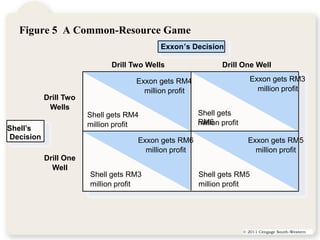
Figure 5 A Common-Resource Game
                                           Exxon’s Decision

                             Drill Two Wells                 Drill One Well

                                    Exxon gets RM4                     Exxon gets RM3
                                      million profit                     million profit
           Drill Two
            Wells
                       Shell gets RM4                  Shell gets
                       million profit                  RM6 profit
                                                       million
Shell’s
Decision                            Exxon gets RM6                    Exxon gets RM5
                                      million profit                    million profit
           Drill One
             Well
                       Shell gets RM3                  Shell gets RM5
                       million profit                  million profit


                                                                    © 20112007 Thomson South-Western
                                                                        © Cengage South-Western
Why People Sometimes Cooperate

• Firms that care about future profits will
  cooperate in repeated games rather than
  cheating in a single game to achieve a one-time
  gain.


                                       © 2011 Cengage South-Western
                                          © 2007 Thomson South-Western
PUBLIC POLICY TOWARD
OLIGOPOLIES
• Cooperation among oligopolists is
  undesirable from the standpoint of society as
  a whole because it leads to production that is
  too low and prices that are too high.


                                       © 2011Thomson South-Western
                                       © 2007 Cengage South-Western
Restraint of Trade and the Antitrust Laws

• Antitrust laws make it illegal to restrain trade or
  attempt to monopolize a market.
  • Sherman Antitrust Act of 1890
  • Clayton Antitrust Act of 1914


                                          © 2011 Cengage South-Western
                                             © 2007 Thomson South-Western
Controversies over Antitrust Policy

• Antitrust policies sometimes may not allow
  business practices that have potentially positive
  effects:
  • Resale price maintenance
  • Predatory pricing
  • Tying


                                         © 2011 Cengage South-Western
                                            © 2007 Thomson South-Western
Controversies over Antitrust Policy

• Resale Price Maintenance (or fair trade)
  • occurs when suppliers (like wholesalers) require
    retailers to charge a specific amount
• Predatory Pricing
  • occurs when a large firm begins to cut the price of
    its product(s) with the intent of driving its
    competitor(s) out of the market
• Tying
  • when a firm offers two (or more) of its products
    together at a single price, rather than separately

                                              © 2011 Cengage South-Western
                                                 © 2007 Thomson South-Western
Summary

• Oligopolists maximize their total profits by
  forming a cartel and acting like a monopolist.
• If oligopolists make decisions about
  production levels individually, the result is a
  greater quantity and a lower price than under
  the monopoly outcome.


                                        © 2011Thomson South-Western
                                        © 2007 Cengage South-Western
Summary

• The prisoners’ dilemma shows that self-
  interest can prevent people from maintaining
  cooperation, even when cooperation is in their
  mutual self-interest.
• The logic of the prisoners’ dilemma applies in
  many situations, including oligopolies.


                                      © 2011 Thomson South-Western
                                      © 2007 Cengage South-Western
Summary

• Policymakers use the antitrust laws to prevent
  oligopolies from engaging in behavior that
  reduces competition.


                                      © 2011 Thomson South-Western
                                      © 2007 Cengage South-Western

Chapter 16

  • 1.
    © 2011 CengageSouth-Western © 2007 Thomson South-Western
  • 2.
    BETWEEN MONOPOLY AND PERFECTCOMPETITION • Imperfect competition refers to those market structures that fall between perfect competition and pure monopoly. • Imperfect competition includes industries in which firms have competitors but do not face so much competition that they are price takers. © 2011Thomson South-Western © 2007 Cengage South-Western
  • 3.
    BETWEEN MONOPOLY AND PERFECTCOMPETITION • Types of Imperfectly Competitive Markets – Oligopoly • Only a few sellers, each offering a similar or identical product to the others. – Monopolistic Competition • Many firms selling products that are similar but not identical. © 2011Thomson South-Western © 2007 Cengage South-Western
  • 4.
    Figure 1 TheFour Types of Market Structure Number of Firms? Many firms Type of Products? One Few Differentiated Identical firm firms products products Monopolistic Perfect Monopoly Oligopoly Competition Competition (Chapter 15) (Chapter 16) (Chapter 17) (Chapter 14) • Tap water • Cars • Tooth paste, soap, hair shampoo • Rubber • Cable TV • Cigarettes • • Milk Bread © 20112007 Thomson South-Western © Cengage South-Western
  • 5.
    MARKETS WITH ONLYA FEW SELLERS • Because of the few sellers, the key feature of oligopoly is the tension between cooperation and self-interest. • Characteristics of an Oligopoly Market – Few sellers offering similar or identical products – Interdependent firms – Best off cooperating and acting like a monopolist by producing a small quantity of output and charging a price above marginal cost © 2011Thomson South-Western © 2007 Cengage South-Western
  • 6.
    A Duopoly Example •A duopoly is an oligopoly with only two members. It is the simplest type of oligopoly. © 2011 Cengage South-Western © 2007 Thomson South-Western
  • 7.
    Table 2 TheDemand Schedule for Water © 2011 Cengage South-Western © 2007 Thomson South-Western
  • 8.
    A Duopoly Example •Price and Quantity Supplied • The price of water in a perfectly competitive market would be driven to where the marginal cost is zero: • P = MC = RM0 • Q = 120 litres • The price and quantity in a monopoly market would be where total profit is maximized: • P = RM60 • Q = 60 litres © 2011 Cengage South-Western © 2007 Thomson South-Western
  • 9.
    A Duopoly Example •Price and Quantity Supplied • The socially efficient quantity of water is 120 litres, but a monopolist would produce only 60 litres of water. • So what outcome then could be expected from duopolists? © 2011 Cengage South-Western © 2007 Thomson South-Western
  • 10.
    The Market forWater Cost In a competitive market, quantity RM120 would equal 120 and P = MC = RM0. A monopoly would produce 60 gallons and charge RM60. Note that P > MC. RM60 Total industry output with a duopoly will Demand probably exceed 60, but be less than 120. MC is constant and = RM0. 0 60 120 Quantity of Output Marginal Revenue © 20112007 Thomson South-Western © Cengage South-Western
  • 11.
    Competition, Monopolies, andCartels • The duopolists may agree on a monopoly outcome. • Collusion • An agreement among firms in a market about quantities to produce or prices to charge. • Cartel • A group of firms acting in unison. © 2011 Cengage South-Western © 2007 Thomson South-Western
  • 12.
    Competition, Monopolies, andCartels • Although oligopolists would like to form cartels and earn monopoly profits, often that is not possible. Antitrust laws prohibit explicit agreements among oligopolists as a matter of public policy. © 2011 Cengage South-Western © 2007 Thomson South-Western
  • 13.
    The Equilibrium foran Oligopoly • A Nash equilibrium is a situation in which economic actors interacting with one another each choose their best strategy given the strategies that all the others have chosen. © 2011 Cengage South-Western © 2007 Thomson South-Western
  • 14.
    The Equilibrium foran Oligopoly • When firms in an oligopoly individually choose production to maximize profit, they produce quantity of output greater than the level produced by monopoly and less than the level produced by competition. • The oligopoly price is less than the monopoly price but greater than the competitive price (which equals marginal cost). © 2011 Cengage South-Western © 2007 Thomson South-Western
  • 15.
    Equilibrium for anOligopoly • Summary • Possible outcome if oligopoly firms pursue their own self-interests: • Joint output is greater than the monopoly quantity but less than the competitive industry quantity. • Market prices are lower than monopoly price but greater than competitive price. • Total profits are less than the monopoly profit. © 2011 Cengage South-Western © 2007 Thomson South-Western
  • 16.
    How the Sizeof an Oligopoly Affects the Market Outcome • How increasing the number of sellers affects the price and quantity: • The output effect: Because price is above marginal cost, selling more at the going price raises profits. • The price effect: Raising production will increase the amount sold, which will lower the price and the profit per unit on all units sold. © 2011 Cengage South-Western © 2007 Thomson South-Western
  • 17.
    How the Sizeof an Oligopoly Affects the Market Outcome • As the number of sellers in an oligopoly grows larger, an oligopolistic market looks more and more like a competitive market. • The price approaches marginal cost, and the quantity produced approaches the socially efficient level. © 2011 Cengage South-Western © 2007 Thomson South-Western
  • 18.
    GAME THEORY ANDTHE ECONOMICS OF COOPERATION • Game theory is the study of how people behave in strategic situations. • Strategic decisions are those in which each person, in deciding what actions to take, must consider how others might respond to that action. © 2011Thomson South-Western © 2007 Cengage South-Western
  • 19.
    GAME THEORY ANDTHE ECONOMICS OF COOPERATION • Because the number of firms in an oligopolistic market is small, each firm must act strategically. • Each firm knows that its profit depends not only on how much it produces but also on how much the other firms produce. © 2011Thomson South-Western © 2007 Cengage South-Western
  • 20.
    The Prisoners’ Dilemma •The prisoners’ dilemma provides insight into the difficulty in maintaining cooperation. • Often people (firms) fail to cooperate with one another even when cooperation would make them better off. © 2011 Cengage South-Western © 2007 Thomson South-Western
  • 21.
    The Prisoners’ Dilemma •The prisoners’ dilemma is a particular “game” between two captured prisoners that illustrates why cooperation is difficult to maintain even when it is mutually beneficial. © 2011 Cengage South-Western © 2007 Thomson South-Western
  • 22.
    Figure 2 ThePrisoners’ Dilemma Bonnie’ s Decision Confess Remain Silent Bonnie gets 8 years Bonnie gets 20 years Confess Clyde’s Clyde gets 8 years Clyde goes free Decision Bonnie goes free Bonnie gets 1 year Remain Silent Clyde gets 20 years Clyde gets 1 year © 20112007 Thomson South-Western © Cengage South-Western
  • 23.
    Oligopolies as aPrisoners’ Dilemma • The dominant strategy is the best strategy for a player to follow regardless of the strategies chosen by the other players. • Cooperation is difficult to maintain, because cooperation is not in the best interest of the individual player. © 2011 Cengage South-Western © 2007 Thomson South-Western
  • 24.
    Figure 3 AhChun and Ah Seng’s Oligopoly Game Ah Chun’s Decision High Production: 40 Gal. Low Production: 30 gal. Ah Chun gets RM1,600 Jack gets $1,500 profit profit High Production 40 gal. Ah Seng’s Ah Seng gets RM1,600 Jill gets $2,000 profit Decision profit Jack gets $2,000 profit Jack gets $1,800 profit Low Production 30 gal. Jill gets $1,500 profit Jill gets $1,800 profit © 20112007 Thomson South-Western © Cengage South-Western
  • 25.
    Oligopolies as aPrisoners’ Dilemma • Self-interest makes it difficult for the oligopoly to maintain a cooperative outcome with low production, high prices, and monopoly profits. © 2011 Cengage South-Western © 2007 Thomson South-Western
  • 26.
    Figure 4 AnArms-Race Game Decision of the United States (U.S.) Arm Disarm U.S. at risk U.S. at risk and weak Arm Decision USSR at risk USSR safe and powerful of the Soviet Union U.S. safe and powerful U.S. safe (USSR) Disarm USSR at risk and weak USSR safe © 20112007 Thomson South-Western © Cengage South-Western
  • 27.
    Figure 5 ACommon-Resource Game Exxon’s Decision Drill Two Wells Drill One Well Exxon gets RM4 Exxon gets RM3 million profit million profit Drill Two Wells Shell gets RM4 Shell gets million profit RM6 profit million Shell’s Decision Exxon gets RM6 Exxon gets RM5 million profit million profit Drill One Well Shell gets RM3 Shell gets RM5 million profit million profit © 20112007 Thomson South-Western © Cengage South-Western
  • 28.
    Why People SometimesCooperate • Firms that care about future profits will cooperate in repeated games rather than cheating in a single game to achieve a one-time gain. © 2011 Cengage South-Western © 2007 Thomson South-Western
  • 29.
    PUBLIC POLICY TOWARD OLIGOPOLIES •Cooperation among oligopolists is undesirable from the standpoint of society as a whole because it leads to production that is too low and prices that are too high. © 2011Thomson South-Western © 2007 Cengage South-Western
  • 30.
    Restraint of Tradeand the Antitrust Laws • Antitrust laws make it illegal to restrain trade or attempt to monopolize a market. • Sherman Antitrust Act of 1890 • Clayton Antitrust Act of 1914 © 2011 Cengage South-Western © 2007 Thomson South-Western
  • 31.
    Controversies over AntitrustPolicy • Antitrust policies sometimes may not allow business practices that have potentially positive effects: • Resale price maintenance • Predatory pricing • Tying © 2011 Cengage South-Western © 2007 Thomson South-Western
  • 32.
    Controversies over AntitrustPolicy • Resale Price Maintenance (or fair trade) • occurs when suppliers (like wholesalers) require retailers to charge a specific amount • Predatory Pricing • occurs when a large firm begins to cut the price of its product(s) with the intent of driving its competitor(s) out of the market • Tying • when a firm offers two (or more) of its products together at a single price, rather than separately © 2011 Cengage South-Western © 2007 Thomson South-Western
  • 33.
    Summary • Oligopolists maximizetheir total profits by forming a cartel and acting like a monopolist. • If oligopolists make decisions about production levels individually, the result is a greater quantity and a lower price than under the monopoly outcome. © 2011Thomson South-Western © 2007 Cengage South-Western
  • 34.
    Summary • The prisoners’dilemma shows that self- interest can prevent people from maintaining cooperation, even when cooperation is in their mutual self-interest. • The logic of the prisoners’ dilemma applies in many situations, including oligopolies. © 2011 Thomson South-Western © 2007 Cengage South-Western
  • 35.
    Summary • Policymakers usethe antitrust laws to prevent oligopolies from engaging in behavior that reduces competition. © 2011 Thomson South-Western © 2007 Cengage South-Western