Chapter 6
Types of variables
Variables
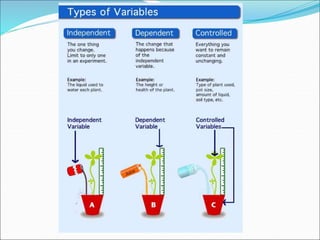
 An experiment generally has three types:
independent, dependent and controlled.
When choosing your variables, keep in mind that
good variables are usually those that you can
measure with a number (e.g., concentrations of
pollutants, time of day, temperature) or observe
objectively (e.g., colors).
 Subjective qualities, like whether noise pollution
makes local birds happy or sad, are not appropriate
variable
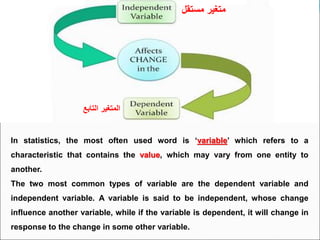
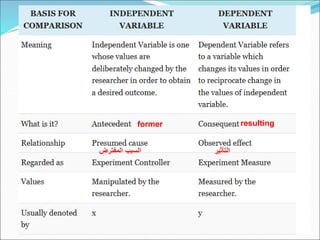
In statistics, the most often used word is ‘variable’ which refers to a
characteristic that contains the value, which may vary from one entity to
another.
The two most common types of variable are the dependent variable and
independent variable. A variable is said to be independent, whose change
influence another variable, while if the variable is dependent, it will change in
response to the change in some other variable.
‫مستقل‬ ‫متغير‬
‫التابع‬ ‫المتغير‬
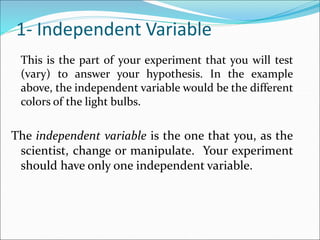
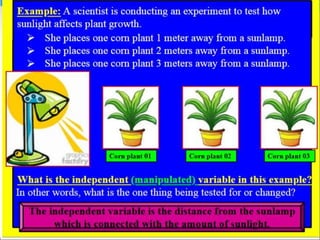
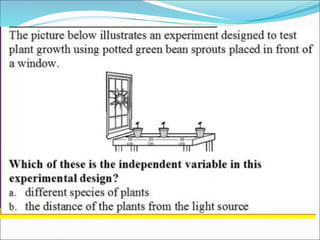
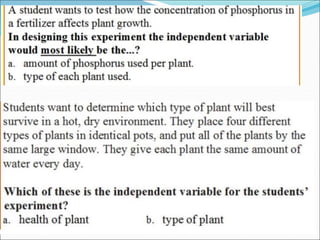
1- Independent Variable
This is the part of your experiment that you will test
(vary) to answer your hypothesis. In the example
above, the independent variable would be the different
colors of the light bulbs.
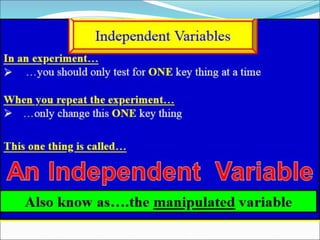
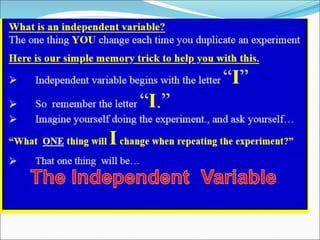
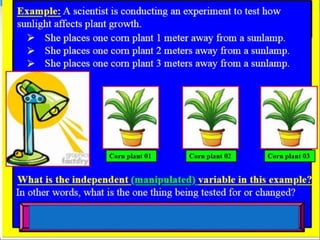
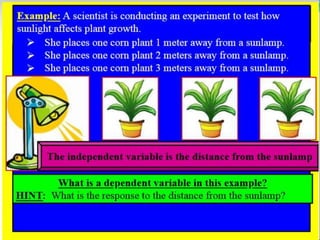
The independent variable is the one that you, as the
scientist, change or manipulate. Your experiment
should have only one independent variable.
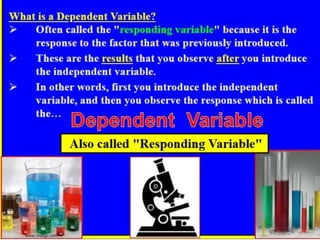
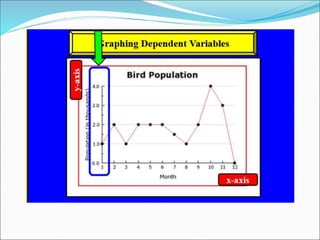
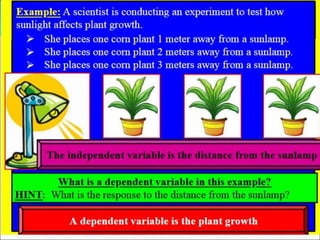
This is what occurs in response to the changing
independent variable.
2- Dependent Variable
‫المفترض‬ ‫السبب‬ ‫التأثير‬
former resulting
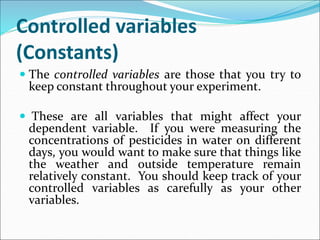
Controlled variables
(Constants)
 The controlled variables are those that you try to
keep constant throughout your experiment.
 These are all variables that might affect your
dependent variable. If you were measuring the
concentrations of pesticides in water on different
days, you would want to make sure that things like
the weather and outside temperature remain
relatively constant. You should keep track of your
controlled variables as carefully as your other
variables.
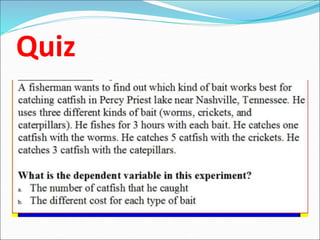
Quiz
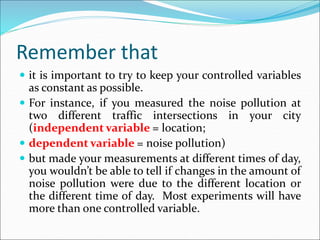
Remember that
 it is important to try to keep your controlled variables
as constant as possible.
 For instance, if you measured the noise pollution at
two different traffic intersections in your city
(independent variable = location;
 dependent variable = noise pollution)
 but made your measurements at different times of day,
you wouldn’t be able to tell if changes in the amount of
noise pollution were due to the different location or
the different time of day. Most experiments will have
more than one controlled variable.
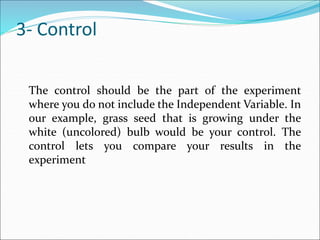
The control should be the part of the experiment
where you do not include the Independent Variable. In
our example, grass seed that is growing under the
white (uncolored) bulb would be your control. The
control lets you compare your results in the
experiment
3- Control

06 chapter 4 Types of variables.ppt

  • 1.
  • 2.
    Variables  An experimentgenerally has three types: independent, dependent and controlled. When choosing your variables, keep in mind that good variables are usually those that you can measure with a number (e.g., concentrations of pollutants, time of day, temperature) or observe objectively (e.g., colors).  Subjective qualities, like whether noise pollution makes local birds happy or sad, are not appropriate variable
  • 3.
    In statistics, themost often used word is ‘variable’ which refers to a characteristic that contains the value, which may vary from one entity to another. The two most common types of variable are the dependent variable and independent variable. A variable is said to be independent, whose change influence another variable, while if the variable is dependent, it will change in response to the change in some other variable. ‫مستقل‬ ‫متغير‬ ‫التابع‬ ‫المتغير‬
  • 4.
    1- Independent Variable Thisis the part of your experiment that you will test (vary) to answer your hypothesis. In the example above, the independent variable would be the different colors of the light bulbs. The independent variable is the one that you, as the scientist, change or manipulate. Your experiment should have only one independent variable.
  • 11.
    This is whatoccurs in response to the changing independent variable. 2- Dependent Variable
  • 16.
  • 17.
    Controlled variables (Constants)  Thecontrolled variables are those that you try to keep constant throughout your experiment.  These are all variables that might affect your dependent variable. If you were measuring the concentrations of pesticides in water on different days, you would want to make sure that things like the weather and outside temperature remain relatively constant. You should keep track of your controlled variables as carefully as your other variables.
  • 19.
  • 21.
    Remember that  itis important to try to keep your controlled variables as constant as possible.  For instance, if you measured the noise pollution at two different traffic intersections in your city (independent variable = location;  dependent variable = noise pollution)  but made your measurements at different times of day, you wouldn’t be able to tell if changes in the amount of noise pollution were due to the different location or the different time of day. Most experiments will have more than one controlled variable.
  • 22.
    The control shouldbe the part of the experiment where you do not include the Independent Variable. In our example, grass seed that is growing under the white (uncolored) bulb would be your control. The control lets you compare your results in the experiment 3- Control