Hydropower Projects in Nepal:
Status, Issues and Solutions
National Workshop on Small Hydro Power Projects-its Role, Issues and Prospects in the
Changing Energy and Environmental Landscapes
5th & 6th January 2017
Energy Management Centre,
Sreekaryam, Thiruvananthapuram, Kerala, India
Prof. Dr. Hari K. Shrestha (Nepal Engineering College)
Er. Komal Nath Atreya ( Nepal Electricity Authority)
Outline
• Country Background
• Energy Consumption Situation in Nepal
• Government Priority for Renewable Energy
• Hydropower Potential and Its Current Status
• Rural Electrification Model Adopted
• Opportunities for Renewable Energy in Nepal
• Economic Growth Activities- Photos
• R&D
Country Background
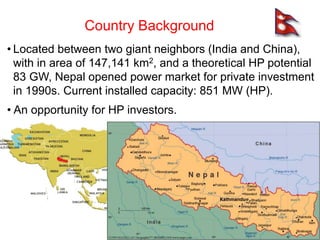
• Located between two giant neighbors (India and China),
with in area of 147,141 km2, and a theoretical HP potential
83 GW, Nepal opened power market for private investment
in 1990s. Current installed capacity: 851 MW (HP).
• An opportunity for HP investors.
3
Energy Consumption Status
• Per capita energy consumption: 16 GJ
• Per capita electricity consumption: 120 kWh (225 kWh
in Developing Countries)
• Access to electricity: 76%, (61% grid, 15% renewable)
• Electricity as % of total energy consumed: 3%, mainly
from Hydropower.
• Grid Power capacity: 904.4 MW (851 hydro+53.4 diesel)
• Generates 525MW in winter (peak demand: 1414MW)
Classification of Hydropower in Nepal
- Pico Hydro: < 10 kW
- Micro Hydro: 10 - 100 kW
- Mini Hydro: 100 kW - 1 MW
- Small Hydro: 1 - 10 MW
- Medium Hydro: 10 - 50 MW
- Large Hydro: > 50 MW
In comparison to India’s classification
- Pico Hydro: < 5 kW
- Micro Hydro: 5 - 100 kW
- Mini Hydro: 100 kW - 1 MW
- Small Hydro: 1 - 25 MW
- Medium Hydro: 25 - 100 MW
- Large Hydro: > 100 MW
Legal and Policy Environment
• Government has adopted the Hydropower
Development Policy of 2001 and encourages both local
as well as foreign investment, especially for the
development of SHP
Highlights of the Hydropower Development
Policy, Nepal 2001
• Development at an affordable price
• Uplift the living standard of the rural community
• Efforts to reduce the risk of investment
• To open market for sale of electricity both at
national and international level.
• Easy acess for foreigners to work in the country in
relation to the project implementation
Legal and Policy Environment
Government Agencies in the power sector
i. Ministry of Energy (MoE)
ii. Water and Energy Commission Secretariat (WECS) –
planning and policy research.
iii. Department of Electricity Development (DoED) –
licensing, facilitation, promotion, compliance monitoring
and project study (regulating body under Ministry of Energy).
iv. Nepal Electricity Authority (NEA) – public utility for
generation, transmission and distribution of electricity
(Government of Nepal undertaking company under Ministry of Energy).
v. Electricity Tariff Fixation Commission (ETFC) – tariff
setting
Legal and Policy Environment
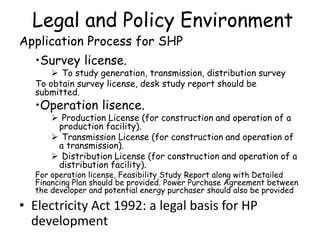
Application Process for SHP
•Survey license.
 To study generation, transmission, distribution survey
To obtain survey license, desk study report should be
submitted.
•Operation lisence.
 Production License (for construction and operation of a
production facility).
 Transmission License (for construction and operation of
a transmission).
 Distribution License (for construction and operation of a
distribution facility).
For operation license, Feasibility Study Report along with Detailed
Financing Plan should be provided. Power Purchase Agreement between
the developer and potential energy purchaser should also be provided
• Electricity Act 1992: a legal basis for HP
development
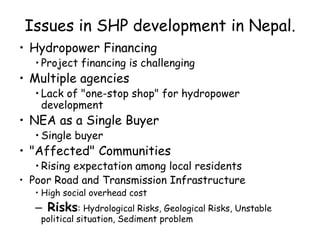
Issues in SHP development in Nepal.
• Hydropower Financing
• Project financing is challenging
• Multiple agencies
• Lack of "one-stop shop" for hydropower
development
• NEA as a Single Buyer
• Single buyer
• "Affected" Communities
• Rising expectation among local residents
• Poor Road and Transmission Infrastructure
• High social overhead cost
– Risks: Hydrological Risks, Geological Risks, Unstable
political situation, Sediment problem
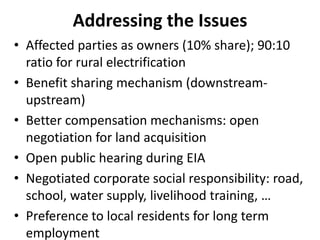
Addressing the Issues
• Affected parties as owners (10% share); 90:10
ratio for rural electrification
• Benefit sharing mechanism (downstream-
upstream)
• Better compensation mechanisms: open
negotiation for land acquisition
• Open public hearing during EIA
• Negotiated corporate social responsibility: road,
school, water supply, livelihood training, …
• Preference to local residents for long term
employment
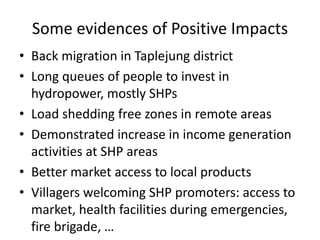
Some evidences of Positive Impacts
• Back migration in Taplejung district
• Long queues of people to invest in
hydropower, mostly SHPs
• Load shedding free zones in remote areas
• Demonstrated increase in income generation
activities at SHP areas
• Better market access to local products
• Villagers welcoming SHP promoters: access to
market, health facilities during emergencies,
fire brigade, …
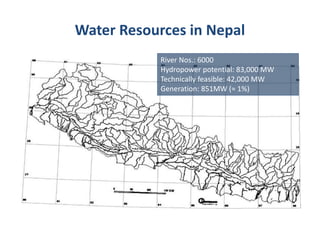
River Nos.: 6000
Hydropower potential: 83,000 MW
Technically feasible: 42,000 MW
Generation: 851MW (≈ 1%)
Water Resources in Nepal
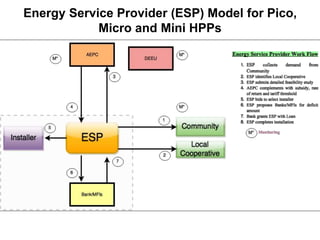
Energy Service Provider (ESP) Model for Pico,
Micro and Mini HPPs
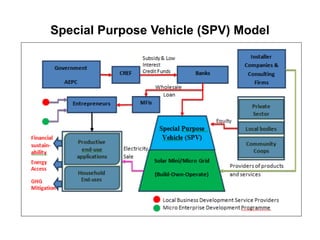
Special Purpose Vehicle (SPV) Model
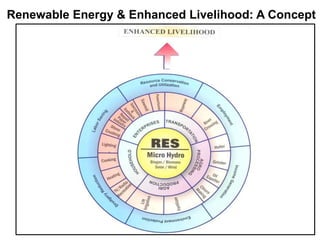
Renewable Energy & Enhanced Livelihood: A Concept
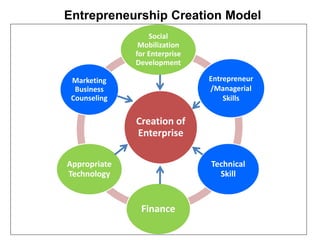
Entrepreneurship Creation Model
Creation of
Enterprise
Social
Mobilization
for Enterprise
Development
Entrepreneur
/Managerial
Skills
Technical
Skill
Finance
Appropriate
Technology
Marketing
Business
Counseling
Key elements of Community Based
Micro Hydro Systems
 Organization Development
 Formation of Community Organizations(COs)and
Functional Groups(FGs)
 Capital Mobilization
 Saving and Credit at Local Level
 Skill Enhancement
 For income generating activities of communities
to pay for electricity charges and to support some
other financial needs
Key Elements of CBMHS contd…
 Technology Promotion
 Promotion of MH technology and electricity driven
productive end uses
 Environment Management
 Community Forestry
 Tree Plantation
 Bio Engineering activities
 Promoting sanitation and toilet construction
 Programmes during world environment day(awareness
creation)
 Empowerment of Women and Dalits
 Positive discrimination to ensure equity to all
disadvantaged group
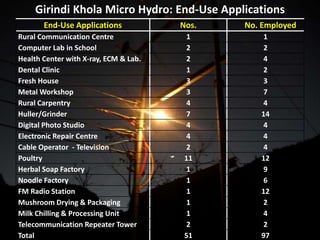
End-Use Applications Nos. No. Employed
Rural Communication Centre 1 1
Computer Lab in School 2 2
Health Center with X-ray, ECM & Lab. 2 4
Dental Clinic 1 2
Fresh House 3 3
Metal Workshop 3 7
Rural Carpentry 4 4
Huller/Grinder 7 14
Digital Photo Studio 4 4
Electronic Repair Centre 4 4
Cable Operator - Television 2 4
Poultry 11 12
Herbal Soap Factory 1 9
Noodle Factory 1 6
FM Radio Station 1 12
Mushroom Drying & Packaging 1 2
Milk Chilling & Processing Unit 1 4
Telecommunication Repeater Tower 2 2
Total 51 97
Girindi Khola Micro Hydro: End-Use Applications
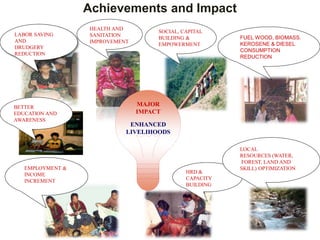
HEALTH AND
SANITATION
IMPROVEMENT
LABOR SAVING
AND
DRUDGERY
REDUCTION
SOCIAL, CAPITAL
BUILDING &
EMPOWERMENT
BETTER
EDUCATION AND
AWARENESS
EMPLOYMENT &
INCOME
INCREMENT
HRD &
CAPACITY
BUILDING
MAJOR
IMPACT
ENHANCED
LIVELIHOODS
FUEL WOOD, BIOMASS.
KEROSENE & DIESEL
CONSUMPTION
REDUCTION
LOCAL
RESOURCES (WATER,
FOREST, LAND AND
SKILL) OPTIMIZATION
Achievements and Impact
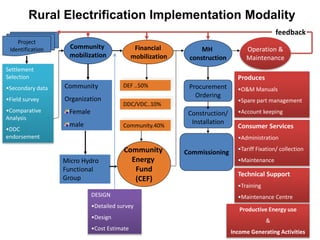
Project
Identification
DESIGN
•Detailed survey
•Design
•Cost Estimate
Settlement
Selection
•Secondary data
•Field survey
•Comparative
Analysis
•DDC
endorsement
Community
mobilization
Community
Organization
Female
male
Micro Hydro
Functional
Group
Financial
mobilization
Community
Energy
Fund
(CEF)
DEF ..50%
DDC/VDC..10%
Community.40%
MH
construction
Procurement
Ordering
Construction/
Installation
Commissioning
Operation &
Maintenance
Produces
•O&M Manuals
•Spare part management
•Account keeping
Consumer Services
•Administration
•Tariff Fixation/ collection
•Maintenance
Technical Support
•Training
•Maintenance Centre
feedback
Rural Electrification Implementation Modality
Productive Energy use
&
Income Generating Activities
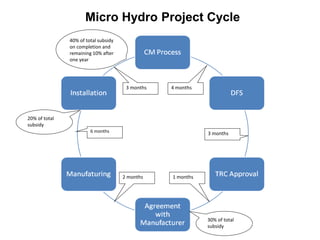
Micro Hydro Project Cycle
4 months3 months
6 months
2 months 1 months
3 months
30% of total
subsidy
40% of total subsidy
on completion and
remaining 10% after
one year
20% of total
subsidy
Opportunities for Renewable Energy in Nepal
• 12-14(last year) hours of load shedding during
winter months
• More than 42000MW of untapped Hydro
Potential
• Government has taken ambitious target to
achieve 10,000 MW in Ten years, including 10%
from renewable (200MW of wind and solar by
2017)
• Open to 100% foreign direct investment
• Enhanced investment climate foreseen in near
future with recent promulgation of constitution
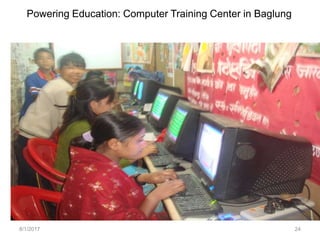
Powering Education: Computer Training Center in Baglung
8/1/2017 24
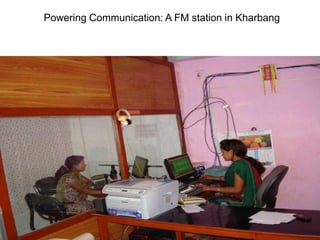
Powering Communication: A FM station in Kharbang
8/1/2017 25
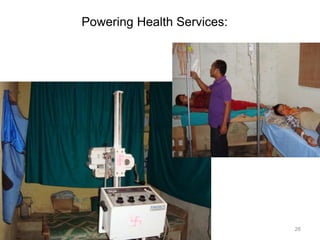
Powering Health Services:
8/1/2017 26
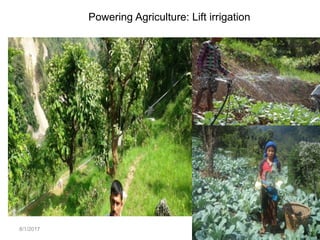
Powering Agriculture: Lift irrigation
8/1/2017 27
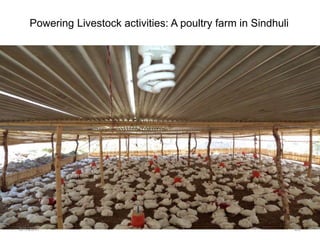
Powering Livestock activities: A poultry farm in Sindhuli
8/1/2017 28
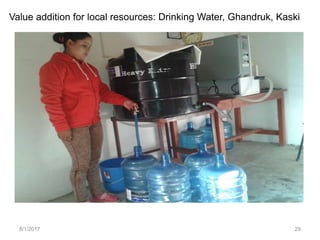
Value addition for local resources: Drinking Water, Ghandruk, Kaski
8/1/2017 29
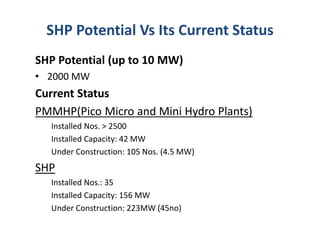
SHP Potential Vs Its Current Status
SHP Potential (up to 10 MW)
• 2000 MW
Current Status
PMMHP(Pico Micro and Mini Hydro Plants)
Installed Nos. > 2500
Installed Capacity: 42 MW
Under Construction: 105 Nos. (4.5 MW)
SHP
Installed Nos.: 35
Installed Capacity: 156 MW
Under Construction: 223MW (45no)
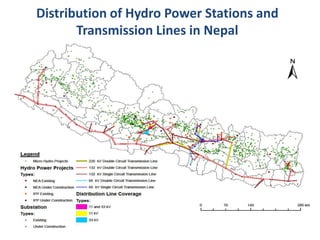
Distribution of Hydro Power Stations and
Transmission Lines in Nepal
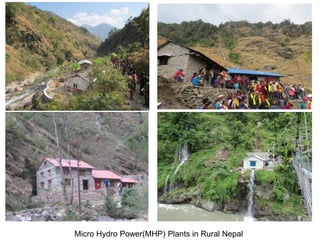
Micro Hydro Power(MHP) Plants in Rural Nepal
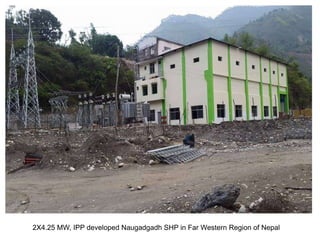
2X4.25 MW, IPP developed Naugadgadh SHP in Far Western Region of Nepal
In country Technical Experience
• 22MW indigenously designed HEP in
operation for more than a decade
• Local Civil Contractors are able to construct
projects in the SHP range including tunneling
• Design and fabrication of 92kW Francis
turbine
Technical Experience contd…
• Manufacture of up to 5MVA, 33kV Class Power
Transformer
• Fabrication and erection of Spiral Casing, Draft
Tube for 2*35MW Plant on behalf of VOITH
• Fabrication and erection of 18mx12m radial
gates
• Fabrication of Penstock Pipes, Expansion
Joints Gates, Trash Racks etc for large hydro
power plants
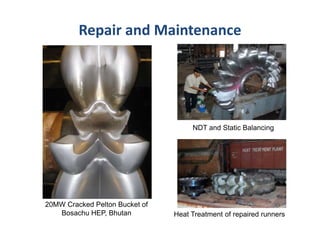
Repair and Maintenance
Heat Treatment of repaired runners
20MW Cracked Pelton Bucket of
Bosachu HEP, Bhutan
NDT and Static Balancing
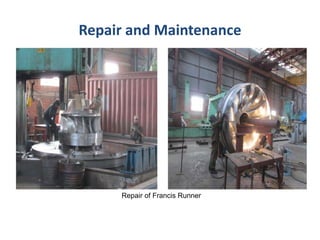
Repair and Maintenance
Repair of Francis Runner
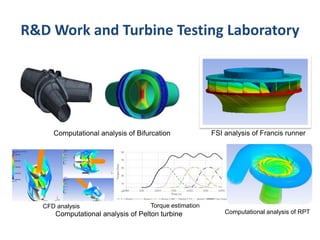
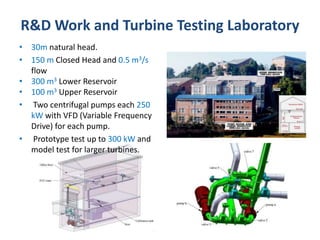
R&D Work and Turbine Testing Laboratory
• 30m natural head.
• 150 m Closed Head and 0.5 m3/s
flow
• 300 m3 Lower Reservoir
• 100 m3 Upper Reservoir
• Two centrifugal pumps each 250
kW with VFD (Variable Frequency
Drive) for each pump.
• Prototype test up to 300 kW and
model test for larger turbines.
Computational analysis of Bifurcation
Computational analysis of Pelton turbine
CFD analysis Torque estimation
Computational analysis of RPT
FSI analysis of Francis runner
R&D Work and Turbine Testing Laboratory
Opportunities for SHP in Nepal
• 12-14 hours (last year) of load shedding during winter
months
• More than 42000 MW of untapped Hydro Potential
• Open to 100% foreign direct investment
• Enhanced investment climate foreseen in near future
with recent promulgation of constitution
• Government positive in facilitating SHP: from take and
pay to take of pay
• Rs. 5 Million/MW VAT exemption approved by cabinet
• Higher purchase rate for peak energy
• SHP can be made multipurpose with flood control, dry
season irrigation, drinking water… and contribute in
reducing carbon footprint
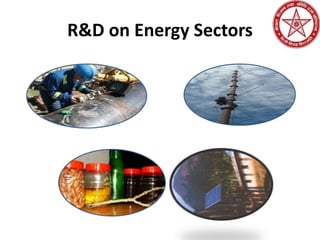
R&D on Energy Sectors
R&D Areas by Govt. Agencies
Research on Hydro power includes
• Digital ELC, Turbines, SCADA system, Energy and Internet
(Tele linking), Study on sediments impact on turbines
Research on Solar System,
• Dye synthesis solar PV, Solar PV Cleaning Mechanism, Solar
Mapping, Used Lead Acid Battery Management System
Research on Small Wind Energy
• Design on PM generator, wind blade for small and wind
mapping, Energy and Internet
Research on Biofuels
• Electricity from biofuels including waste cooking oil
Research on Mini grid system
•Study on Grid Impact Study, Smart inverter and net metering, pre-
paid meter
•Nepal Solar Calculator- Android and iOS
TESTING
• Testing of Renewable Energy Technologies (Solar
Panel, Batteries, Lamps, Inverter, Solar Thermal,
etc.) by “Renewable Energy Test Station” under
Nepal Academy of Science and Technology
(NAST).
• Non Destructive Test for Electro-mechanical
Components at Small Hydro laboratory, NAST
• Turbine Testing Lab at Kathmandu University
(KU).
• Electrical Resistivity Tomography (ERT) by NEA
• Transformer Testing (Hi-pot Test) at Institute of
Engineering (IOE).
Hydropower projects in Nepal_Country Report

Hydropower projects in Nepal_Country Report

  • 1.
    Hydropower Projects inNepal: Status, Issues and Solutions National Workshop on Small Hydro Power Projects-its Role, Issues and Prospects in the Changing Energy and Environmental Landscapes 5th & 6th January 2017 Energy Management Centre, Sreekaryam, Thiruvananthapuram, Kerala, India Prof. Dr. Hari K. Shrestha (Nepal Engineering College) Er. Komal Nath Atreya ( Nepal Electricity Authority)
  • 2.
    Outline • Country Background •Energy Consumption Situation in Nepal • Government Priority for Renewable Energy • Hydropower Potential and Its Current Status • Rural Electrification Model Adopted • Opportunities for Renewable Energy in Nepal • Economic Growth Activities- Photos • R&D
  • 3.
    Country Background • Locatedbetween two giant neighbors (India and China), with in area of 147,141 km2, and a theoretical HP potential 83 GW, Nepal opened power market for private investment in 1990s. Current installed capacity: 851 MW (HP). • An opportunity for HP investors. 3
  • 4.
    Energy Consumption Status •Per capita energy consumption: 16 GJ • Per capita electricity consumption: 120 kWh (225 kWh in Developing Countries) • Access to electricity: 76%, (61% grid, 15% renewable) • Electricity as % of total energy consumed: 3%, mainly from Hydropower. • Grid Power capacity: 904.4 MW (851 hydro+53.4 diesel) • Generates 525MW in winter (peak demand: 1414MW)
  • 5.
    Classification of Hydropowerin Nepal - Pico Hydro: < 10 kW - Micro Hydro: 10 - 100 kW - Mini Hydro: 100 kW - 1 MW - Small Hydro: 1 - 10 MW - Medium Hydro: 10 - 50 MW - Large Hydro: > 50 MW In comparison to India’s classification - Pico Hydro: < 5 kW - Micro Hydro: 5 - 100 kW - Mini Hydro: 100 kW - 1 MW - Small Hydro: 1 - 25 MW - Medium Hydro: 25 - 100 MW - Large Hydro: > 100 MW
  • 6.
    Legal and PolicyEnvironment • Government has adopted the Hydropower Development Policy of 2001 and encourages both local as well as foreign investment, especially for the development of SHP Highlights of the Hydropower Development Policy, Nepal 2001 • Development at an affordable price • Uplift the living standard of the rural community • Efforts to reduce the risk of investment • To open market for sale of electricity both at national and international level. • Easy acess for foreigners to work in the country in relation to the project implementation
  • 7.
    Legal and PolicyEnvironment Government Agencies in the power sector i. Ministry of Energy (MoE) ii. Water and Energy Commission Secretariat (WECS) – planning and policy research. iii. Department of Electricity Development (DoED) – licensing, facilitation, promotion, compliance monitoring and project study (regulating body under Ministry of Energy). iv. Nepal Electricity Authority (NEA) – public utility for generation, transmission and distribution of electricity (Government of Nepal undertaking company under Ministry of Energy). v. Electricity Tariff Fixation Commission (ETFC) – tariff setting
  • 8.
    Legal and PolicyEnvironment Application Process for SHP •Survey license.  To study generation, transmission, distribution survey To obtain survey license, desk study report should be submitted. •Operation lisence.  Production License (for construction and operation of a production facility).  Transmission License (for construction and operation of a transmission).  Distribution License (for construction and operation of a distribution facility). For operation license, Feasibility Study Report along with Detailed Financing Plan should be provided. Power Purchase Agreement between the developer and potential energy purchaser should also be provided • Electricity Act 1992: a legal basis for HP development
  • 9.
    Issues in SHPdevelopment in Nepal. • Hydropower Financing • Project financing is challenging • Multiple agencies • Lack of "one-stop shop" for hydropower development • NEA as a Single Buyer • Single buyer • "Affected" Communities • Rising expectation among local residents • Poor Road and Transmission Infrastructure • High social overhead cost – Risks: Hydrological Risks, Geological Risks, Unstable political situation, Sediment problem
  • 10.
    Addressing the Issues •Affected parties as owners (10% share); 90:10 ratio for rural electrification • Benefit sharing mechanism (downstream- upstream) • Better compensation mechanisms: open negotiation for land acquisition • Open public hearing during EIA • Negotiated corporate social responsibility: road, school, water supply, livelihood training, … • Preference to local residents for long term employment
  • 11.
    Some evidences ofPositive Impacts • Back migration in Taplejung district • Long queues of people to invest in hydropower, mostly SHPs • Load shedding free zones in remote areas • Demonstrated increase in income generation activities at SHP areas • Better market access to local products • Villagers welcoming SHP promoters: access to market, health facilities during emergencies, fire brigade, …
  • 12.
    River Nos.: 6000 Hydropowerpotential: 83,000 MW Technically feasible: 42,000 MW Generation: 851MW (≈ 1%) Water Resources in Nepal
  • 13.
    Energy Service Provider(ESP) Model for Pico, Micro and Mini HPPs
  • 14.
  • 15.
    Renewable Energy &Enhanced Livelihood: A Concept
  • 16.
    Entrepreneurship Creation Model Creationof Enterprise Social Mobilization for Enterprise Development Entrepreneur /Managerial Skills Technical Skill Finance Appropriate Technology Marketing Business Counseling
  • 17.
    Key elements ofCommunity Based Micro Hydro Systems  Organization Development  Formation of Community Organizations(COs)and Functional Groups(FGs)  Capital Mobilization  Saving and Credit at Local Level  Skill Enhancement  For income generating activities of communities to pay for electricity charges and to support some other financial needs
  • 18.
    Key Elements ofCBMHS contd…  Technology Promotion  Promotion of MH technology and electricity driven productive end uses  Environment Management  Community Forestry  Tree Plantation  Bio Engineering activities  Promoting sanitation and toilet construction  Programmes during world environment day(awareness creation)  Empowerment of Women and Dalits  Positive discrimination to ensure equity to all disadvantaged group
  • 19.
    End-Use Applications Nos.No. Employed Rural Communication Centre 1 1 Computer Lab in School 2 2 Health Center with X-ray, ECM & Lab. 2 4 Dental Clinic 1 2 Fresh House 3 3 Metal Workshop 3 7 Rural Carpentry 4 4 Huller/Grinder 7 14 Digital Photo Studio 4 4 Electronic Repair Centre 4 4 Cable Operator - Television 2 4 Poultry 11 12 Herbal Soap Factory 1 9 Noodle Factory 1 6 FM Radio Station 1 12 Mushroom Drying & Packaging 1 2 Milk Chilling & Processing Unit 1 4 Telecommunication Repeater Tower 2 2 Total 51 97 Girindi Khola Micro Hydro: End-Use Applications
  • 20.
    HEALTH AND SANITATION IMPROVEMENT LABOR SAVING AND DRUDGERY REDUCTION SOCIAL,CAPITAL BUILDING & EMPOWERMENT BETTER EDUCATION AND AWARENESS EMPLOYMENT & INCOME INCREMENT HRD & CAPACITY BUILDING MAJOR IMPACT ENHANCED LIVELIHOODS FUEL WOOD, BIOMASS. KEROSENE & DIESEL CONSUMPTION REDUCTION LOCAL RESOURCES (WATER, FOREST, LAND AND SKILL) OPTIMIZATION Achievements and Impact
  • 21.
    Project Identification DESIGN •Detailed survey •Design •Cost Estimate Settlement Selection •Secondarydata •Field survey •Comparative Analysis •DDC endorsement Community mobilization Community Organization Female male Micro Hydro Functional Group Financial mobilization Community Energy Fund (CEF) DEF ..50% DDC/VDC..10% Community.40% MH construction Procurement Ordering Construction/ Installation Commissioning Operation & Maintenance Produces •O&M Manuals •Spare part management •Account keeping Consumer Services •Administration •Tariff Fixation/ collection •Maintenance Technical Support •Training •Maintenance Centre feedback Rural Electrification Implementation Modality Productive Energy use & Income Generating Activities
  • 22.
    Micro Hydro ProjectCycle 4 months3 months 6 months 2 months 1 months 3 months 30% of total subsidy 40% of total subsidy on completion and remaining 10% after one year 20% of total subsidy
  • 23.
    Opportunities for RenewableEnergy in Nepal • 12-14(last year) hours of load shedding during winter months • More than 42000MW of untapped Hydro Potential • Government has taken ambitious target to achieve 10,000 MW in Ten years, including 10% from renewable (200MW of wind and solar by 2017) • Open to 100% foreign direct investment • Enhanced investment climate foreseen in near future with recent promulgation of constitution
  • 24.
    Powering Education: ComputerTraining Center in Baglung 8/1/2017 24
  • 25.
    Powering Communication: AFM station in Kharbang 8/1/2017 25
  • 26.
  • 27.
    Powering Agriculture: Liftirrigation 8/1/2017 27
  • 28.
    Powering Livestock activities:A poultry farm in Sindhuli 8/1/2017 28
  • 29.
    Value addition forlocal resources: Drinking Water, Ghandruk, Kaski 8/1/2017 29
  • 30.
    SHP Potential VsIts Current Status SHP Potential (up to 10 MW) • 2000 MW Current Status PMMHP(Pico Micro and Mini Hydro Plants) Installed Nos. > 2500 Installed Capacity: 42 MW Under Construction: 105 Nos. (4.5 MW) SHP Installed Nos.: 35 Installed Capacity: 156 MW Under Construction: 223MW (45no)
  • 31.
    Distribution of HydroPower Stations and Transmission Lines in Nepal
  • 32.
    Micro Hydro Power(MHP)Plants in Rural Nepal
  • 33.
    2X4.25 MW, IPPdeveloped Naugadgadh SHP in Far Western Region of Nepal
  • 34.
    In country TechnicalExperience • 22MW indigenously designed HEP in operation for more than a decade • Local Civil Contractors are able to construct projects in the SHP range including tunneling • Design and fabrication of 92kW Francis turbine
  • 35.
    Technical Experience contd… •Manufacture of up to 5MVA, 33kV Class Power Transformer • Fabrication and erection of Spiral Casing, Draft Tube for 2*35MW Plant on behalf of VOITH • Fabrication and erection of 18mx12m radial gates • Fabrication of Penstock Pipes, Expansion Joints Gates, Trash Racks etc for large hydro power plants
  • 36.
    Repair and Maintenance HeatTreatment of repaired runners 20MW Cracked Pelton Bucket of Bosachu HEP, Bhutan NDT and Static Balancing
  • 37.
  • 38.
    R&D Work andTurbine Testing Laboratory • 30m natural head. • 150 m Closed Head and 0.5 m3/s flow • 300 m3 Lower Reservoir • 100 m3 Upper Reservoir • Two centrifugal pumps each 250 kW with VFD (Variable Frequency Drive) for each pump. • Prototype test up to 300 kW and model test for larger turbines.
  • 39.
    Computational analysis ofBifurcation Computational analysis of Pelton turbine CFD analysis Torque estimation Computational analysis of RPT FSI analysis of Francis runner R&D Work and Turbine Testing Laboratory
  • 40.
    Opportunities for SHPin Nepal • 12-14 hours (last year) of load shedding during winter months • More than 42000 MW of untapped Hydro Potential • Open to 100% foreign direct investment • Enhanced investment climate foreseen in near future with recent promulgation of constitution • Government positive in facilitating SHP: from take and pay to take of pay • Rs. 5 Million/MW VAT exemption approved by cabinet • Higher purchase rate for peak energy • SHP can be made multipurpose with flood control, dry season irrigation, drinking water… and contribute in reducing carbon footprint
  • 41.
  • 42.
    R&D Areas byGovt. Agencies Research on Hydro power includes • Digital ELC, Turbines, SCADA system, Energy and Internet (Tele linking), Study on sediments impact on turbines Research on Solar System, • Dye synthesis solar PV, Solar PV Cleaning Mechanism, Solar Mapping, Used Lead Acid Battery Management System Research on Small Wind Energy • Design on PM generator, wind blade for small and wind mapping, Energy and Internet Research on Biofuels • Electricity from biofuels including waste cooking oil Research on Mini grid system •Study on Grid Impact Study, Smart inverter and net metering, pre- paid meter •Nepal Solar Calculator- Android and iOS
  • 43.
    TESTING • Testing ofRenewable Energy Technologies (Solar Panel, Batteries, Lamps, Inverter, Solar Thermal, etc.) by “Renewable Energy Test Station” under Nepal Academy of Science and Technology (NAST). • Non Destructive Test for Electro-mechanical Components at Small Hydro laboratory, NAST • Turbine Testing Lab at Kathmandu University (KU). • Electrical Resistivity Tomography (ERT) by NEA • Transformer Testing (Hi-pot Test) at Institute of Engineering (IOE).