Stat310
         Discrete random variables


                           Hadley Wickham
Tuesday, 26 January 2010
Homework
                    • Don’t forget to pledge!
                    • Model answers up v. soon, and on track
                      to get your homeworks back on
                      Thursday.
                    • Homework help session Tuesday &
                      Wednesday 4-5pm. Details on webpage.
                    • Will be other extra credit opportunities


Tuesday, 26 January 2010
Data visualisation
                             mini course
                    Feb 13 (Saturday). 10am - 3pm.
                    http://www.ece.rice.edu/ece/
                    datavis2010.html
                    The applied side of statistics - getting
                    data and figuring out what is going on.
                    No maths, lots of graphics and
                    programming


Tuesday, 26 January 2010
1. Independence example
                2. Random variables
                      1. Bernoulli
                      2. Binomial
                3. Mean and variance


Tuesday, 26 January 2010
Are the wearing glasses and
 wearing hat events independent?


 21 Dennis Washingtons in total
Tuesday, 26 January 2010
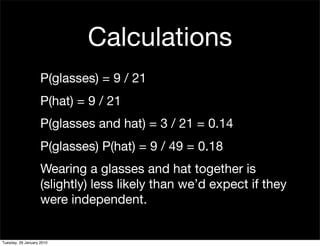
Calculations
                    P(glasses) = 9 / 21
                    P(hat) = 9 / 21
                    P(glasses and hat) = 3 / 21 = 0.14
                    P(glasses) P(hat) = 9 / 49 = 0.18
                    Wearing a glasses and hat together is
                    (slightly) less likely than we’d expect if they
                    were independent.


Tuesday, 26 January 2010
Definitions
                    A random variable is a random experiment
                    with a numeric sample space. Usually given
                    a capital letter like X, Y or Z.
                    (More formally a random variable is a function
                    that converts outcomes from a random
                    experiment into numbers)
                    The space (or support) of a random variable
                    is the range of the function (cf. sample space)


Tuesday, 26 January 2010
Definitions

                    If the size of the support is finite or
                    countably infinite, then the random
                    variable is discrete.
                    If the size of the support is uncountably
                    infinite, then the random variable is
                    continuous.


Tuesday, 26 January 2010
pmf/pdf
                    Every random experiment has a probability
                    function.
                    Every discrete random variable as
                    probability mass function (pmf).
                    Every continuous random variable has
                    probability density function (pdf).
                    Different ways of defining the function that
                    says how likely each outcome is.


Tuesday, 26 January 2010
This week: discrete
                Next week: continuous
                           This diverges from the book, but I think
                              it’s easier to work with one set of
                                  mathematical tools at a time


Tuesday, 26 January 2010
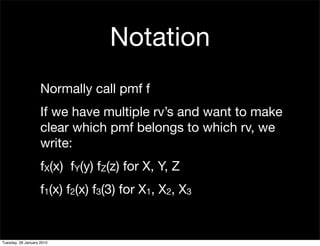
Notation
                    Normally call pmf f
                    If we have multiple rv’s and want to make
                    clear which pmf belongs to which rv, we
                    write:
                    fX(x) fY(y) fZ(z) for X, Y, Z
                    f1(x) f2(x) f3(3) for X1, X2, X3


Tuesday, 26 January 2010
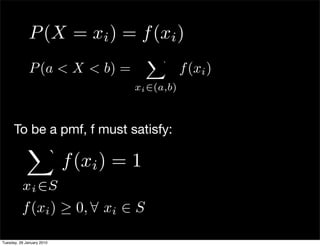
P (X = xi ) = f (xi )
                                         
              P (a  X  b) =                    f (xi )
                                     xi ∈(a,b)


      To be a pmf, f must satisfy:
            
                           f (xi ) = 1
          xi ∈S
          f (xi ) ≥ 0, ∀ xi ∈ S

Tuesday, 26 January 2010
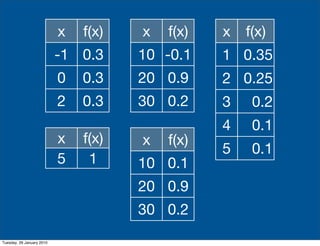
x   f(x)   x   f(x)   x   f(x)
                           -1 0.3     10 -0.1    1 0.35
                           0   0.3    20 0.9     2 0.25
                           2   0.3    30 0.2     3    0.2
                                                 4    0.1
                           x   f(x)   x   f(x)
                                                 5    0.1
                           5    1     10 0.1
                                      20 0.9
                                      30 0.2
Tuesday, 26 January 2010
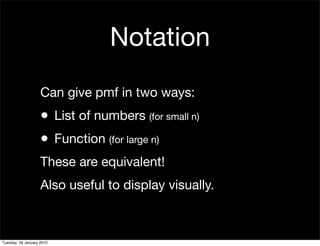
Notation
                    Can give pmf in two ways:
                    •      List of numbers (for small n)
                    •      Function (for large n)
                    These are equivalent!
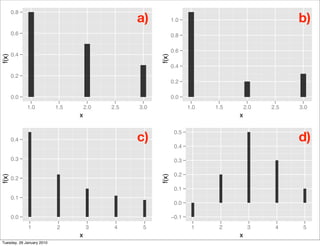
                    Also useful to display visually.


Tuesday, 26 January 2010
a)                                              b)
       0.8
                                                              1.0

       0.6                                                    0.8

                                                              0.6
       0.4
f(x)


                                                       f(x)
                                                              0.4
       0.2
                                                              0.2

       0.0                                                    0.0
             1.0           1.5       2.0   2.5   3.0                 1.0   1.5       2.0   2.5   3.0
                                 x                                               x


                                                 c)                                              d)
                                                               0.5
       0.4
                                                               0.4

       0.3                                                     0.3

                                                               0.2
f(x)


                                                       f(x)
       0.2
                                                               0.1
       0.1
                                                               0.0

       0.0                                                    −0.1
             1             2         3      4     5                   1     2         3     4     5
                                 x                                               x
Tuesday, 26 January 2010
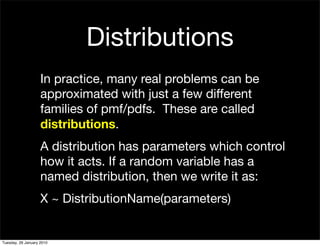
Distributions
                    In practice, many real problems can be
                    approximated with just a few different
                    families of pmf/pdfs. These are called
                    distributions.
                    A distribution has parameters which control
                    how it acts. If a random variable has a
                    named distribution, then we write it as:
                    X ~ DistributionName(parameters)


Tuesday, 26 January 2010
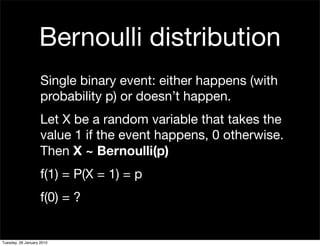
Bernoulli distribution
                    Single binary event: either happens (with
                    probability p) or doesn’t happen.
                    Let X be a random variable that takes the
                    value 1 if the event happens, 0 otherwise.
                    Then X ~ Bernoulli(p)
                    f(1) = P(X = 1) = p
                    f(0) = ?


Tuesday, 26 January 2010
Wait, is that a pmf?


Tuesday, 26 January 2010
Binomial distribution

                    n independent Bernoulli trials with the
                    same probability of success. Let X be the
                    number of successes.
                    Then we say X ~ Binomial(n, p)
                    P(X = x) = f(x) = ??


Tuesday, 26 January 2010
Wait, is that a pmf?
                    Random mathematical fact.
                    Need to check the two conditions.
                    First easy, second a bit harder.


                    (If I ever give you a random mathematical
                    fact you can expect to use it. Main
                    challenge is recognising where it is needed)


Tuesday, 26 January 2010
Example
                    Let X be the number of babies that a
                    woman has in the next 5 years. Assume
                    the chance of having a baby in a given year
                    is a constant 10%.
                    What additional assumption do we need to
                    use the binomial distribution? Is it
                    reasonable?
                    What is f(0)? What is f(1)? What is P(X  0)?


Tuesday, 26 January 2010
Mean  variance
                    Mean summarises the “middle” of the
                    distribution. Variance summarise the
                    “spread” of the distribution.
                    Mean = E(X) = “Sum” of all outcomes,
                    weighted by their probability.
                    Variance = Var(X) = E[ (X - E[X])2) ] =
                    expected squared distance from mean


Tuesday, 26 January 2010
Intuition for mean


                    Imagine the number line as a beam with
                    weights of f(x) at position x. The balance
                    point is the mean.


Tuesday, 26 January 2010
Example


                    Assume 95% of you have 0 stds. 4% of
                    you have 1 std. 1% have 2 stds. What is
                    the expected number of stds?


http://www.cdc.gov/mmwr/preview/mmwrhtml/ss5806a1.htm
Tuesday, 26 January 2010
Mean of a binomial
                            random variable
                    For named distributions we can usually
                    work out the mean (and variance) as
                    functions of the parameters.
                    This is typically a little tricky, but once
                    we’ve done it, we can use a simple
                    formula every time we see that
                    distribution.


Tuesday, 26 January 2010
Another way


                    http://www.wolframalpha.com/input/?
                    i=sum_(x%3D0)^(n)+(x+n!+/+(x!+(n-x)!)
                    +p^x+(1-p)^(n-x))


Tuesday, 26 January 2010

05 Random Variables

  • 1.
    Stat310 Discrete random variables Hadley Wickham Tuesday, 26 January 2010
  • 2.
    Homework • Don’t forget to pledge! • Model answers up v. soon, and on track to get your homeworks back on Thursday. • Homework help session Tuesday & Wednesday 4-5pm. Details on webpage. • Will be other extra credit opportunities Tuesday, 26 January 2010
  • 3.
    Data visualisation mini course Feb 13 (Saturday). 10am - 3pm. http://www.ece.rice.edu/ece/ datavis2010.html The applied side of statistics - getting data and figuring out what is going on. No maths, lots of graphics and programming Tuesday, 26 January 2010
  • 4.
    1. Independence example 2. Random variables 1. Bernoulli 2. Binomial 3. Mean and variance Tuesday, 26 January 2010
  • 5.
  • 6.
    Are the wearingglasses and wearing hat events independent? 21 Dennis Washingtons in total Tuesday, 26 January 2010
  • 7.
    Calculations P(glasses) = 9 / 21 P(hat) = 9 / 21 P(glasses and hat) = 3 / 21 = 0.14 P(glasses) P(hat) = 9 / 49 = 0.18 Wearing a glasses and hat together is (slightly) less likely than we’d expect if they were independent. Tuesday, 26 January 2010
  • 8.
    Definitions A random variable is a random experiment with a numeric sample space. Usually given a capital letter like X, Y or Z. (More formally a random variable is a function that converts outcomes from a random experiment into numbers) The space (or support) of a random variable is the range of the function (cf. sample space) Tuesday, 26 January 2010
  • 9.
    Definitions If the size of the support is finite or countably infinite, then the random variable is discrete. If the size of the support is uncountably infinite, then the random variable is continuous. Tuesday, 26 January 2010
  • 10.
    pmf/pdf Every random experiment has a probability function. Every discrete random variable as probability mass function (pmf). Every continuous random variable has probability density function (pdf). Different ways of defining the function that says how likely each outcome is. Tuesday, 26 January 2010
  • 11.
    This week: discrete Next week: continuous This diverges from the book, but I think it’s easier to work with one set of mathematical tools at a time Tuesday, 26 January 2010
  • 12.
    Notation Normally call pmf f If we have multiple rv’s and want to make clear which pmf belongs to which rv, we write: fX(x) fY(y) fZ(z) for X, Y, Z f1(x) f2(x) f3(3) for X1, X2, X3 Tuesday, 26 January 2010
  • 13.
    P (X =xi ) = f (xi ) P (a X b) = f (xi ) xi ∈(a,b) To be a pmf, f must satisfy: f (xi ) = 1 xi ∈S f (xi ) ≥ 0, ∀ xi ∈ S Tuesday, 26 January 2010
  • 14.
    x f(x) x f(x) x f(x) -1 0.3 10 -0.1 1 0.35 0 0.3 20 0.9 2 0.25 2 0.3 30 0.2 3 0.2 4 0.1 x f(x) x f(x) 5 0.1 5 1 10 0.1 20 0.9 30 0.2 Tuesday, 26 January 2010
  • 15.
    Notation Can give pmf in two ways: • List of numbers (for small n) • Function (for large n) These are equivalent! Also useful to display visually. Tuesday, 26 January 2010
  • 16.
    a) b) 0.8 1.0 0.6 0.8 0.6 0.4 f(x) f(x) 0.4 0.2 0.2 0.0 0.0 1.0 1.5 2.0 2.5 3.0 1.0 1.5 2.0 2.5 3.0 x x c) d) 0.5 0.4 0.4 0.3 0.3 0.2 f(x) f(x) 0.2 0.1 0.1 0.0 0.0 −0.1 1 2 3 4 5 1 2 3 4 5 x x Tuesday, 26 January 2010
  • 17.
    Distributions In practice, many real problems can be approximated with just a few different families of pmf/pdfs. These are called distributions. A distribution has parameters which control how it acts. If a random variable has a named distribution, then we write it as: X ~ DistributionName(parameters) Tuesday, 26 January 2010
  • 18.
    Bernoulli distribution Single binary event: either happens (with probability p) or doesn’t happen. Let X be a random variable that takes the value 1 if the event happens, 0 otherwise. Then X ~ Bernoulli(p) f(1) = P(X = 1) = p f(0) = ? Tuesday, 26 January 2010
  • 19.
    Wait, is thata pmf? Tuesday, 26 January 2010
  • 20.
    Binomial distribution n independent Bernoulli trials with the same probability of success. Let X be the number of successes. Then we say X ~ Binomial(n, p) P(X = x) = f(x) = ?? Tuesday, 26 January 2010
  • 21.
    Wait, is thata pmf? Random mathematical fact. Need to check the two conditions. First easy, second a bit harder. (If I ever give you a random mathematical fact you can expect to use it. Main challenge is recognising where it is needed) Tuesday, 26 January 2010
  • 22.
    Example Let X be the number of babies that a woman has in the next 5 years. Assume the chance of having a baby in a given year is a constant 10%. What additional assumption do we need to use the binomial distribution? Is it reasonable? What is f(0)? What is f(1)? What is P(X 0)? Tuesday, 26 January 2010
  • 23.
    Mean variance Mean summarises the “middle” of the distribution. Variance summarise the “spread” of the distribution. Mean = E(X) = “Sum” of all outcomes, weighted by their probability. Variance = Var(X) = E[ (X - E[X])2) ] = expected squared distance from mean Tuesday, 26 January 2010
  • 24.
    Intuition for mean Imagine the number line as a beam with weights of f(x) at position x. The balance point is the mean. Tuesday, 26 January 2010
  • 25.
    Example Assume 95% of you have 0 stds. 4% of you have 1 std. 1% have 2 stds. What is the expected number of stds? http://www.cdc.gov/mmwr/preview/mmwrhtml/ss5806a1.htm Tuesday, 26 January 2010
  • 26.
    Mean of abinomial random variable For named distributions we can usually work out the mean (and variance) as functions of the parameters. This is typically a little tricky, but once we’ve done it, we can use a simple formula every time we see that distribution. Tuesday, 26 January 2010
  • 27.
    Another way http://www.wolframalpha.com/input/? i=sum_(x%3D0)^(n)+(x+n!+/+(x!+(n-x)!) +p^x+(1-p)^(n-x)) Tuesday, 26 January 2010