Stat310              Moments


                            Hadley Wickham
Saturday, 30 January 2010
Engineer Your Career
                    Monday, February 15
                    7:00 PM - 8:30 PM
                    McMurtry Auditorium
                    Find out what you can do with a degree in
                    engineering from a panel of successful Rice
                    engineering graduates who have gone into a
                    variety of professions. (Plus get dessert!)
                    http://engineering.rice.edu/EventsList.aspx?
                    EventRecord=13137


Saturday, 30 January 2010
Homework
                    Due today.
                    From now on, if late, put in Xin Zhao’s
                    mail box in the DH mailroom.
                    Another one due next Thursday
                    Buy a stapler
                    Use official name


Saturday, 30 January 2010
1. Finish off proof
                2. More about expectation
                3. Variance and other moments
                4. The moment generating function
                5. The Poisson distribution
                6. Feedback


Saturday, 30 January 2010
Proof, continued


Saturday, 30 January 2010
Expectation
                            of a function


Saturday, 30 January 2010
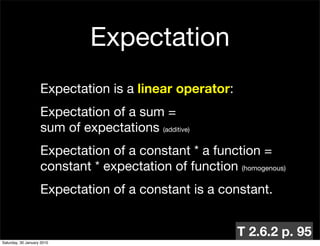
Expectation
                    Expectation is a linear operator:
                    Expectation of a sum =
                    sum of expectations (additive)
                    Expectation of a constant * a function =
                    constant * expectation of function (homogenous)
                    Expectation of a constant is a constant.


                                                         T 2.6.2 p. 95
Saturday, 30 January 2010
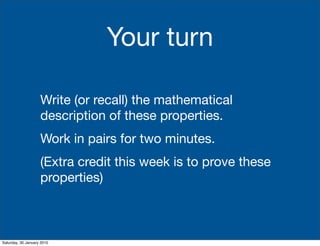
Your turn

                    Write (or recall) the mathematical
                    description of these properties.
                    Work in pairs for two minutes.
                    (Extra credit this week is to prove these
                    properties)


Saturday, 30 January 2010
Moments

                    The ith moment of a random variable is
                    defined as E(X i) = μ' . The ith central
                                         i
                    moment is defined as E[(X - E(X))   i] = μ
                                                              i

                    The mean is the ________ moment. The
                    variance is the ________ moment.


Saturday, 30 January 2010
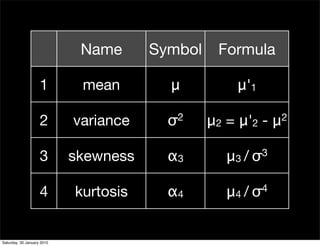
Name      Symbol    Formula

                    1        mean        μ           μ'1

                    2       variance     σ2     μ2 = μ'2 -    μ 2


                    3       skewness     α3        μ3   /σ3


                    4       kurtosis     α4        μ4   /σ4


Saturday, 30 January 2010
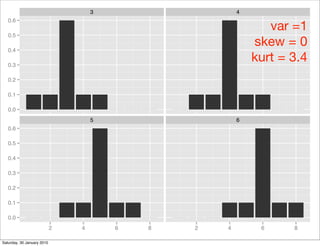
3                   4

                                                               var =1
   0.6

   0.5

   0.4
                                                            skew = 0
   0.3
                                                            kurt = 3.4
   0.2

   0.1

   0.0
                                    5                   6
   0.6

   0.5

   0.4

   0.3

   0.2

   0.1

   0.0
                            2   4       6   8   2   4        6     8

Saturday, 30 January 2010
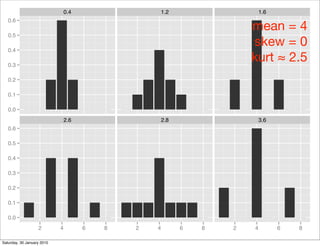
0.4                   1.2                   1.6

                                                                        mean = 4
   0.6

   0.5

   0.4
                                                                        skew = 0
   0.3
                                                                        kurt ≈ 2.5
   0.2

   0.1

   0.0
                                2.6                   2.8                   3.6
   0.6

   0.5

   0.4

   0.3

   0.2

   0.1

   0.0
                   2        4         6   8   2   4         6   8   2   4         6   8

Saturday, 30 January 2010
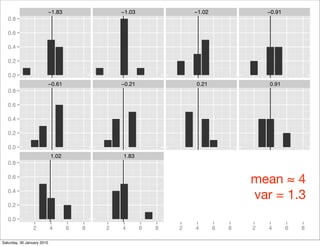
−1.83               −1.03               −1.02               −0.91
   0.8

   0.6

   0.4

   0.2

   0.0
                            −0.61               −0.21               0.21                0.91
   0.8

   0.6

   0.4

   0.2

   0.0
                            1.02                1.83
   0.8

   0.6
                                                                                    mean ≈ 4
   0.4
                                                                                    var = 1.3
   0.2

   0.0
                2           4       6   8   2   4       6   8   2   4       6   8   2   4       6   8

Saturday, 30 January 2010
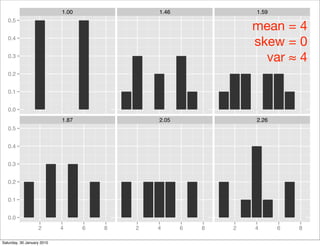
1.00               1.46               1.59

                                                                  mean = 4
   0.5


   0.4
                                                                  skew = 0
   0.3
                                                                    var ≈ 4
   0.2


   0.1


   0.0
                            1.87               2.05               2.26
   0.5


   0.4


   0.3


   0.2


   0.1


   0.0
                   2        4      6   8   2   4      6   8   2   4      6   8

Saturday, 30 January 2010
mgf
                    The moment generating function (mgf)
                    is Mx(t) = E(eXt)
                    (Provided it is finite in a neighbourhood of 0)

                    Why is it called the mgf? (What happens if
                    you differentiate it multiple times).
                    Useful property: If MX(t) = MY(t) then X and
                    Y have the same pmf.


Saturday, 30 January 2010
Plus, once we’ve got it, it
                can make it much easier to
                find the mean and variance


Saturday, 30 January 2010
Expectation of
                            binomial (take 2)
                    Figure out mgf.
                    (Random mathematical fact: binomial theorem)

                    Differentiate & set to zero.


                    Then work out variance.


Saturday, 30 January 2010
Your turn


                    Compute mean and variance of the
                    binomial. Remember the variance is the
                    2nd central moment, not the 2nd moment.


Saturday, 30 January 2010
Poisson


                                      3.2.2 p. 119
Saturday, 30 January 2010
Poisson distribution
                    X = Number of times some event happens
                    (1) If number of events occurring in non-
                    overlapping times is independent, and
                    (2) probability of exactly one event
                    occurring in short interval of length h is ∝
                    λh, and
                    (3) probability of two or more events in a
                    sufficiently short internal is basically 0

Saturday, 30 January 2010
Poisson

                    X ~ Poisson(λ)
                    Sample space: positive integers
                    λ ∈ [0, ∞)


Saturday, 30 January 2010
Examples

                    Number of calls to a switchboard
                    Number of eruptions of a volcano
                    Number of alpha particles emitted from a
                    radioactive source
                    Number of defects in a roll of paper


Saturday, 30 January 2010
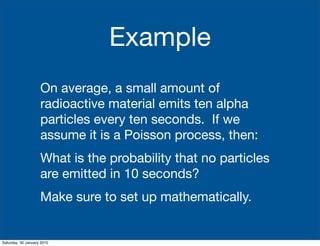
Example
                    On average, a small amount of
                    radioactive material emits ten alpha
                    particles every ten seconds. If we
                    assume it is a Poisson process, then:
                    What is the probability that no particles
                    are emitted in 10 seconds?
                    Make sure to set up mathematically.


Saturday, 30 January 2010
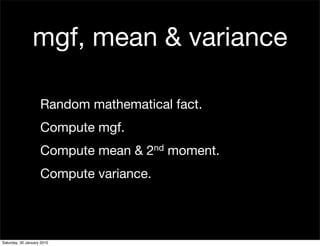
mgf, mean & variance

                    Random mathematical fact.
                    Compute mgf.
                    Compute mean &   2 nd   moment.
                    Compute variance.


Saturday, 30 January 2010
Next week

                    Repeat for continuous variables.
                    Make absolutely sure you have read 2.5
                    and 2.6. (hint hint)


Saturday, 30 January 2010
Feedback


Saturday, 30 January 2010

06 Moments

  • 1.
    Stat310 Moments Hadley Wickham Saturday, 30 January 2010
  • 2.
    Engineer Your Career Monday, February 15 7:00 PM - 8:30 PM McMurtry Auditorium Find out what you can do with a degree in engineering from a panel of successful Rice engineering graduates who have gone into a variety of professions. (Plus get dessert!) http://engineering.rice.edu/EventsList.aspx? EventRecord=13137 Saturday, 30 January 2010
  • 3.
    Homework Due today. From now on, if late, put in Xin Zhao’s mail box in the DH mailroom. Another one due next Thursday Buy a stapler Use official name Saturday, 30 January 2010
  • 4.
    1. Finish offproof 2. More about expectation 3. Variance and other moments 4. The moment generating function 5. The Poisson distribution 6. Feedback Saturday, 30 January 2010
  • 5.
  • 6.
    Expectation of a function Saturday, 30 January 2010
  • 7.
    Expectation Expectation is a linear operator: Expectation of a sum = sum of expectations (additive) Expectation of a constant * a function = constant * expectation of function (homogenous) Expectation of a constant is a constant. T 2.6.2 p. 95 Saturday, 30 January 2010
  • 8.
    Your turn Write (or recall) the mathematical description of these properties. Work in pairs for two minutes. (Extra credit this week is to prove these properties) Saturday, 30 January 2010
  • 9.
    Moments The ith moment of a random variable is defined as E(X i) = μ' . The ith central i moment is defined as E[(X - E(X)) i] = μ i The mean is the ________ moment. The variance is the ________ moment. Saturday, 30 January 2010
  • 10.
    Name Symbol Formula 1 mean μ μ'1 2 variance σ2 μ2 = μ'2 - μ 2 3 skewness α3 μ3 /σ3 4 kurtosis α4 μ4 /σ4 Saturday, 30 January 2010
  • 11.
    3 4 var =1 0.6 0.5 0.4 skew = 0 0.3 kurt = 3.4 0.2 0.1 0.0 5 6 0.6 0.5 0.4 0.3 0.2 0.1 0.0 2 4 6 8 2 4 6 8 Saturday, 30 January 2010
  • 12.
    0.4 1.2 1.6 mean = 4 0.6 0.5 0.4 skew = 0 0.3 kurt ≈ 2.5 0.2 0.1 0.0 2.6 2.8 3.6 0.6 0.5 0.4 0.3 0.2 0.1 0.0 2 4 6 8 2 4 6 8 2 4 6 8 Saturday, 30 January 2010
  • 13.
    −1.83 −1.03 −1.02 −0.91 0.8 0.6 0.4 0.2 0.0 −0.61 −0.21 0.21 0.91 0.8 0.6 0.4 0.2 0.0 1.02 1.83 0.8 0.6 mean ≈ 4 0.4 var = 1.3 0.2 0.0 2 4 6 8 2 4 6 8 2 4 6 8 2 4 6 8 Saturday, 30 January 2010
  • 14.
    1.00 1.46 1.59 mean = 4 0.5 0.4 skew = 0 0.3 var ≈ 4 0.2 0.1 0.0 1.87 2.05 2.26 0.5 0.4 0.3 0.2 0.1 0.0 2 4 6 8 2 4 6 8 2 4 6 8 Saturday, 30 January 2010
  • 15.
    mgf The moment generating function (mgf) is Mx(t) = E(eXt) (Provided it is finite in a neighbourhood of 0) Why is it called the mgf? (What happens if you differentiate it multiple times). Useful property: If MX(t) = MY(t) then X and Y have the same pmf. Saturday, 30 January 2010
  • 16.
    Plus, once we’vegot it, it can make it much easier to find the mean and variance Saturday, 30 January 2010
  • 17.
    Expectation of binomial (take 2) Figure out mgf. (Random mathematical fact: binomial theorem) Differentiate & set to zero. Then work out variance. Saturday, 30 January 2010
  • 18.
    Your turn Compute mean and variance of the binomial. Remember the variance is the 2nd central moment, not the 2nd moment. Saturday, 30 January 2010
  • 19.
    Poisson 3.2.2 p. 119 Saturday, 30 January 2010
  • 20.
    Poisson distribution X = Number of times some event happens (1) If number of events occurring in non- overlapping times is independent, and (2) probability of exactly one event occurring in short interval of length h is ∝ λh, and (3) probability of two or more events in a sufficiently short internal is basically 0 Saturday, 30 January 2010
  • 21.
    Poisson X ~ Poisson(λ) Sample space: positive integers λ ∈ [0, ∞) Saturday, 30 January 2010
  • 22.
    Examples Number of calls to a switchboard Number of eruptions of a volcano Number of alpha particles emitted from a radioactive source Number of defects in a roll of paper Saturday, 30 January 2010
  • 23.
    Example On average, a small amount of radioactive material emits ten alpha particles every ten seconds. If we assume it is a Poisson process, then: What is the probability that no particles are emitted in 10 seconds? Make sure to set up mathematically. Saturday, 30 January 2010
  • 24.
    mgf, mean &variance Random mathematical fact. Compute mgf. Compute mean & 2 nd moment. Compute variance. Saturday, 30 January 2010
  • 25.
    Next week Repeat for continuous variables. Make absolutely sure you have read 2.5 and 2.6. (hint hint) Saturday, 30 January 2010
  • 26.