 was a classical Greek(Athenian) philosopher 
 has become renowned for his contribution to the field 
of ethics. 
 most important contribution toWestern thoughts 
his dialectic method of inquiry, known as the Socratic 
method or method of "elenchus“(a logical refutation, 
especially the Socratic method of eliciting truth by Question and 
answer) 
 To solve a problem, it would be broken down into a 
series of questions, the answers to which gradually 
distill the answer a person would seek 
 To illustrate the use of the Socratic method; a series 
of questions are posed to help a person or group to 
determine their underlying beliefs and the extent of 
their knowledge.
 Socrates frequently says his ideas are not his own, but 
his teachers'. He mentions several influences. Xenophon, he 
was a teleologist 
so-called Socratic Paradoxes: 
 No one desires evil. 
 No one errs or does wrong willingly or knowingly. 
 Virtue—all virtue—is knowledge. 
 Virtue is sufficient for happiness. 
Politics 
It is argued that Socrates believed "ideals belong in 
a world only the wise man can understand",making 
the philosopher the only type of person suitable to 
govern others.
 "Socratic paradox" can also refer to a self-referential 
paradox, originating in Socrates' utterance, 
"what I do not know I do not think I know, often 
paraphrased as "I know that I know nothing.“ 
Virtue 
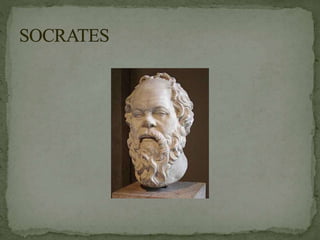
 Bust of Socrates in the Palermo Archaeological Museum. 
 Socrates believed the best way for people to live was to 
focus on the pursuit of virtue rather than the pursuit, for 
instance, of material wealth. He always invited others to try 
to concentrate more on friendships and a sense of true 
community, for Socrates felt this was the best way for 
people to grow together as a populace.
Politics 
 It is argued that Socrates believed "ideals belong in a 
world only the wise man can understand", making the 
philosopher the only type of person suitable to govern 
others.
 Greek philosopher 
 Disciple of Socrates 
 Author of more than 30 
philosophical dialogues 
 Founder of the objective idealism 
 Was active defending the idealistic 
world outlook against the teachings 
of the Materialism
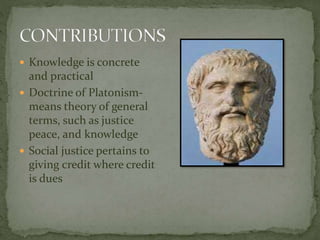
 Knowledge is concrete 
and practical 
 Doctrine of Platonism-means 
theory of general 
terms, such as justice 
peace, and knowledge 
 Social justice pertains to 
giving credit where credit 
is dues
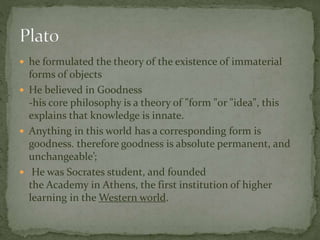
 he formulated the theory of the existence of immaterial 
forms of objects 
 He believed in Goodness 
-his core philosophy is a theory of "form "or "idea", this 
explains that knowledge is innate. 
 Anything in this world has a corresponding form is 
goodness. therefore goodness is absolute permanent, and 
unchangeable’; 
 He was Socrates student, and founded 
the Academy in Athens, the first institution of higher 
learning in theWestern world.
The role of dialectic in Plato's thought is contested but there are two 
main interpretations: a type of reasoning and a method of intuition. 
Simon Blackburn adopts the first, saying that Plato's dialectic is "the 
process of eliciting the truth by means of questions aimed at opening out 
what is already implicitly known, or at exposing the contradictions and 
muddles of an opponent's position. 
Platonic epistemology 
Many have interpreted Plato as stating—even having been 
the first to write—that knowledge is justified true belief, 
an influential view that informed future developments in 
epistemology. This interpretation is partly based on a 
reading of the Theaetetus wherein Plato argues that 
knowledge is distinguished from mere true belief by the 
knower having an "account" of the object of her or his true 
belief
 whose name means "the 
best purpose",[8] was born in 
384 BCE 
in Stagira, Chalcidice 
 Founder of science of 
Logic
 was a Greek philosopher and scientist born in Stagirus, 
northern Greece 
 His writings cover many subjects – 
including physics, biology, 
zoology, metaphysics, logic, ethics, aesthetics, poetry, 
theater, music, rhetoric, linguistics, politics and 
government – and constitute the first comprehensive 
system ofWestern philosophy. 
 Teaching Alexander the Great gave Aristotle many 
opportunities and an abundance of supplies. He 
established a library in the Lyceum which aided in the 
production of many of his hundreds of books.
 VIRTUE IS A STATE OF 
MIND 
 God is the first cause and 
the source of change 
 Reality and Performance 
 Are the highest functions 
 The goal of human life is 
Happiness 
 The greatest good for 
human being is the 
exercise of rational 
faculties
1. the theoretical aspect as dealing with being, its 
components, causes, and origin 
2.The practical as dealing with human activity 
3.The poetic as dealing with creativity 
He recognizes prime causes: 
1.Matter 
2.Form 
3.The beginning of motion 
4.aim
 According to him 
Knowledge comes from perception 
-one has to experience something in order to acquire 
knowledge
 Natural evil is due to 
Satan’s misuse of his 
freewill. 
 All men are born in sin and 
redemption is possible 
with the grace of God. 
 Man is a great mystery 
 He advocated the figurative 
interpretation of the bible 
 Devotion to God is the 
greatest devotion
 Italian theologian and a philosopher 
 A priest who became the Archbishop of Canterbury. 
 He believed that God exist by priori argument. God 
exists in reality the understanding of men but not 
physically. 
 Natural theology and science have no connection. 
 God’s existence is not to discover God’s existence by 
reason but just to use reason to understand what one 
believes in.
 Monologion (Sololiguz) 
and 
Proslogion(Discourses) – 
these are various 
arguments proving God’s 
existence 
 Quality of perfection is 
an only attribute that 
applies to God.
 A distinction between 
philosophy and theology 
 There are no innate but 
knowledge must proceed 
from senses 
 The dependence of the 
universe on a Supreme 
God 
 reason and faith can 
lead to truth
 Born in Florence 
 A political adviser, was 
exiled when the republic 
failed 
 His works the “prince”, 
exposed the ruthless 
strategy to obtain, 
maintain, sustain, and 
extend power.
 Never show humility 
arrogance is more 
effective 
 Morality and Ethics are 
for the weak. 
 It is better to be feared 
than to be loved
 Born in France 
 a Philosopher and 
mathematician 
 He introduced analytical 
geometry 
 He was famous for his 
Evil Genius Hypothesis ( 
he distinguished spirit 
from matter)
 He discovered the law of 
refraction in optic 
 Meditation , a work on 
epistomological 
scepticism
 German Philosopher 
 An epistemologist and a 
moral philosopher. 
 Believed the Gospel as 
the proper guide to life. 
 Had a high regard for 
moral duties and human 
dignity. 
 Moral responsibilty is a 
common knowledge.
 British moralist and 
famous proponent of 
Aristotle’s ideas. 
 Claimed that intuitions 
enable people recognize 
prima facie duties unless 
a supreme one overrules 
them. 
 He maintained that our 
moral insights provide us 
information to stand on 
something .
 A French philosophical 
thinker. 
 Built his 
“phenomenological 
ontology” on a radical 
antithesis of being and 
consciousness. The 
separation of being from 
consciousness leads to 
dualism. 
 Expounded on 
existentialism which tells 
that man has radical 
freedom to create 
himself. 
 Claimed that man is 
responsible not only for 
himself but for all men. 
 Believes that one can 
only have a political 
freedom if he enjoys 
personal liberty.
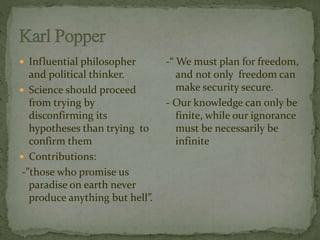
 Influential philosopher 
and political thinker. 
 Science should proceed 
from trying by 
disconfirming its 
hypotheses than trying to 
confirm them 
 Contributions: 
-”those who promise us 
paradise on earth never 
produce anything but hell”. 
-“ We must plan for freedom, 
and not only freedom can 
make security secure. 
- Our knowledge can only be 
finite, while our ignorance 
must be necessarily be 
infinite

Report philosophers

  • 3.
     was aclassical Greek(Athenian) philosopher  has become renowned for his contribution to the field of ethics.  most important contribution toWestern thoughts his dialectic method of inquiry, known as the Socratic method or method of "elenchus“(a logical refutation, especially the Socratic method of eliciting truth by Question and answer)  To solve a problem, it would be broken down into a series of questions, the answers to which gradually distill the answer a person would seek  To illustrate the use of the Socratic method; a series of questions are posed to help a person or group to determine their underlying beliefs and the extent of their knowledge.
  • 4.
     Socrates frequentlysays his ideas are not his own, but his teachers'. He mentions several influences. Xenophon, he was a teleologist so-called Socratic Paradoxes:  No one desires evil.  No one errs or does wrong willingly or knowingly.  Virtue—all virtue—is knowledge.  Virtue is sufficient for happiness. Politics It is argued that Socrates believed "ideals belong in a world only the wise man can understand",making the philosopher the only type of person suitable to govern others.
  • 5.
     "Socratic paradox"can also refer to a self-referential paradox, originating in Socrates' utterance, "what I do not know I do not think I know, often paraphrased as "I know that I know nothing.“ Virtue  Bust of Socrates in the Palermo Archaeological Museum.  Socrates believed the best way for people to live was to focus on the pursuit of virtue rather than the pursuit, for instance, of material wealth. He always invited others to try to concentrate more on friendships and a sense of true community, for Socrates felt this was the best way for people to grow together as a populace.
  • 6.
    Politics  Itis argued that Socrates believed "ideals belong in a world only the wise man can understand", making the philosopher the only type of person suitable to govern others.
  • 7.
     Greek philosopher  Disciple of Socrates  Author of more than 30 philosophical dialogues  Founder of the objective idealism  Was active defending the idealistic world outlook against the teachings of the Materialism
  • 8.
     Knowledge isconcrete and practical  Doctrine of Platonism-means theory of general terms, such as justice peace, and knowledge  Social justice pertains to giving credit where credit is dues
  • 9.
     he formulatedthe theory of the existence of immaterial forms of objects  He believed in Goodness -his core philosophy is a theory of "form "or "idea", this explains that knowledge is innate.  Anything in this world has a corresponding form is goodness. therefore goodness is absolute permanent, and unchangeable’;  He was Socrates student, and founded the Academy in Athens, the first institution of higher learning in theWestern world.
  • 10.
    The role ofdialectic in Plato's thought is contested but there are two main interpretations: a type of reasoning and a method of intuition. Simon Blackburn adopts the first, saying that Plato's dialectic is "the process of eliciting the truth by means of questions aimed at opening out what is already implicitly known, or at exposing the contradictions and muddles of an opponent's position. Platonic epistemology Many have interpreted Plato as stating—even having been the first to write—that knowledge is justified true belief, an influential view that informed future developments in epistemology. This interpretation is partly based on a reading of the Theaetetus wherein Plato argues that knowledge is distinguished from mere true belief by the knower having an "account" of the object of her or his true belief
  • 11.
     whose namemeans "the best purpose",[8] was born in 384 BCE in Stagira, Chalcidice  Founder of science of Logic
  • 12.
     was aGreek philosopher and scientist born in Stagirus, northern Greece  His writings cover many subjects – including physics, biology, zoology, metaphysics, logic, ethics, aesthetics, poetry, theater, music, rhetoric, linguistics, politics and government – and constitute the first comprehensive system ofWestern philosophy.  Teaching Alexander the Great gave Aristotle many opportunities and an abundance of supplies. He established a library in the Lyceum which aided in the production of many of his hundreds of books.
  • 13.
     VIRTUE ISA STATE OF MIND  God is the first cause and the source of change  Reality and Performance  Are the highest functions  The goal of human life is Happiness  The greatest good for human being is the exercise of rational faculties
  • 14.
    1. the theoreticalaspect as dealing with being, its components, causes, and origin 2.The practical as dealing with human activity 3.The poetic as dealing with creativity He recognizes prime causes: 1.Matter 2.Form 3.The beginning of motion 4.aim
  • 15.
     According tohim Knowledge comes from perception -one has to experience something in order to acquire knowledge
  • 17.
     Natural evilis due to Satan’s misuse of his freewill.  All men are born in sin and redemption is possible with the grace of God.  Man is a great mystery  He advocated the figurative interpretation of the bible  Devotion to God is the greatest devotion
  • 18.
     Italian theologianand a philosopher  A priest who became the Archbishop of Canterbury.  He believed that God exist by priori argument. God exists in reality the understanding of men but not physically.  Natural theology and science have no connection.  God’s existence is not to discover God’s existence by reason but just to use reason to understand what one believes in.
  • 19.
     Monologion (Sololiguz) and Proslogion(Discourses) – these are various arguments proving God’s existence  Quality of perfection is an only attribute that applies to God.
  • 21.
     A distinctionbetween philosophy and theology  There are no innate but knowledge must proceed from senses  The dependence of the universe on a Supreme God  reason and faith can lead to truth
  • 22.
     Born inFlorence  A political adviser, was exiled when the republic failed  His works the “prince”, exposed the ruthless strategy to obtain, maintain, sustain, and extend power.
  • 23.
     Never showhumility arrogance is more effective  Morality and Ethics are for the weak.  It is better to be feared than to be loved
  • 24.
     Born inFrance  a Philosopher and mathematician  He introduced analytical geometry  He was famous for his Evil Genius Hypothesis ( he distinguished spirit from matter)
  • 25.
     He discoveredthe law of refraction in optic  Meditation , a work on epistomological scepticism
  • 26.
     German Philosopher  An epistemologist and a moral philosopher.  Believed the Gospel as the proper guide to life.  Had a high regard for moral duties and human dignity.  Moral responsibilty is a common knowledge.
  • 27.
     British moralistand famous proponent of Aristotle’s ideas.  Claimed that intuitions enable people recognize prima facie duties unless a supreme one overrules them.  He maintained that our moral insights provide us information to stand on something .
  • 28.
     A Frenchphilosophical thinker.  Built his “phenomenological ontology” on a radical antithesis of being and consciousness. The separation of being from consciousness leads to dualism.  Expounded on existentialism which tells that man has radical freedom to create himself.  Claimed that man is responsible not only for himself but for all men.  Believes that one can only have a political freedom if he enjoys personal liberty.
  • 29.
     Influential philosopher and political thinker.  Science should proceed from trying by disconfirming its hypotheses than trying to confirm them  Contributions: -”those who promise us paradise on earth never produce anything but hell”. -“ We must plan for freedom, and not only freedom can make security secure. - Our knowledge can only be finite, while our ignorance must be necessarily be infinite