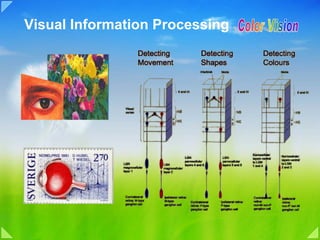
Visual Information Processing
Polarized Light
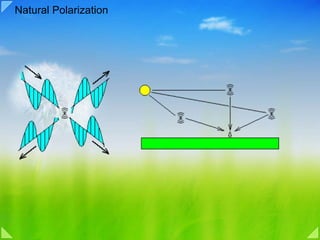
Natural Polarization
Why is Sky Blue?
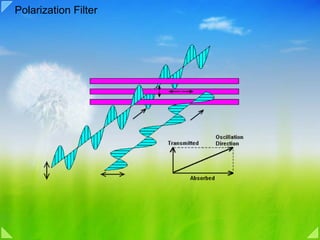
Polarization Filter
Polarization by Reflection
Polaroid filter
Polarized Sun Glasses
3D Movie
Compound eye of Insect
Polarization of Vision of Insect
Honey Bee Dance
Polarization by Refraction
Rainbow is highly Polarized
Leon Battista Alberti 1435-36


Craftsman’s Handbook Cennino Cennini 1390
Newton's theory of Color 1672
Color Confusion


       Subtractive Color   Additive Color
Young Helmhoz Color theory of Trichromatic Color vision 1802
Goethe’s Color theory 1810


   “That I am the only person in this
   century who has the right insight
   into the difficult science of colors,
   that is what I am rather proud of,
   and that is what gives me the
   feeling that I have outstripped
   many.”
   Goethe studies after-images,
   colored shadows and                     Zür Farbenlehre (Theory of Colors)
   complementary colors
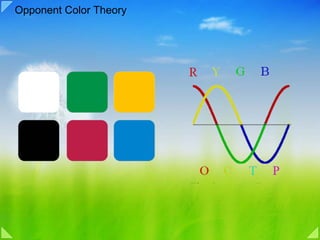
Ewald Hering’s Opponent Color Theory (1834-1918)
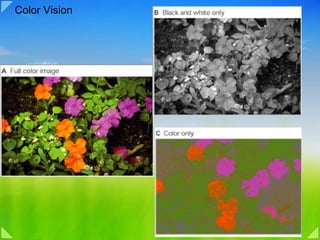
Color Vision
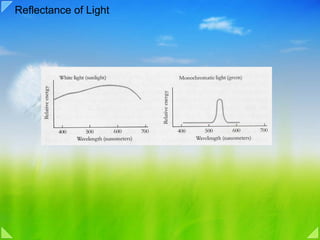
Reflectance of Light
Reflectance of natural pigment
Surface reflectance
Surface reflected from blue vase in sunlight and skylight
Opponent Color Theory
The reflectance function of a natural surface
L+M


L-M


L+M-S
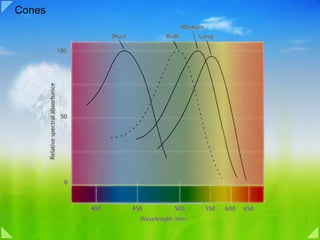
Cones
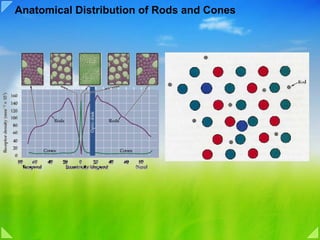
Anatomical Distribution of Rods and Cones
Three types of Cones
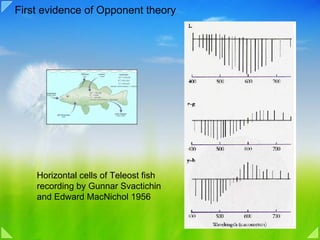
First evidence of Opponent theory


    Horizontal cells of Teleost fish
    recording by Gunnar Svactichin
    and Edward MacNichol 1956
Geniculate Ganglion Color Channel


Russell De Valois 1958
Hering’s Red Green Channel
Hering’s Blue Yellow Channel
Horizontal Cells
Amicrine Cells
Receptive field of Ganglion Cells
Receptive field of Primate Ganglion Cells for Color
The Lateral Geniculate Nucleus
Color Vision in Visual Cortex
Color Vision beyond Striate Cortex
AIT = anterior inferior temporal area; CIT = central inferior temporal area; LIP = lateral
intraparietal area; Magno = magnocellular layers of the lateral geniculate nucleus; MST =
medial superior temporal area; MT = middle temporal area; Parvo = parvocellular layers of the
lateral geniculate nucleus; PIT = posterior inferior temporal area; VIP = ventral intraparietal
area.) (Based on Merigan and Maunsell 1993.)
Color blindness


         Normal        Protanope


         Deuteranope   Tritanope
Ishihara Chart for Color blindness testing


                              21, 2

04c visual signal processing color vision