INTEGRATINGINTEGRATING
RISK MANAGEMENTRISK MANAGEMENT
WITH COSTWITH COST
CONTROL&CONTROL&
COMMUNICATIONCOMMUNICATION
helpdesk@construction-productivity.co.uk
htt://www.construction-productivity.co.uk
RISK MANAGEMENT
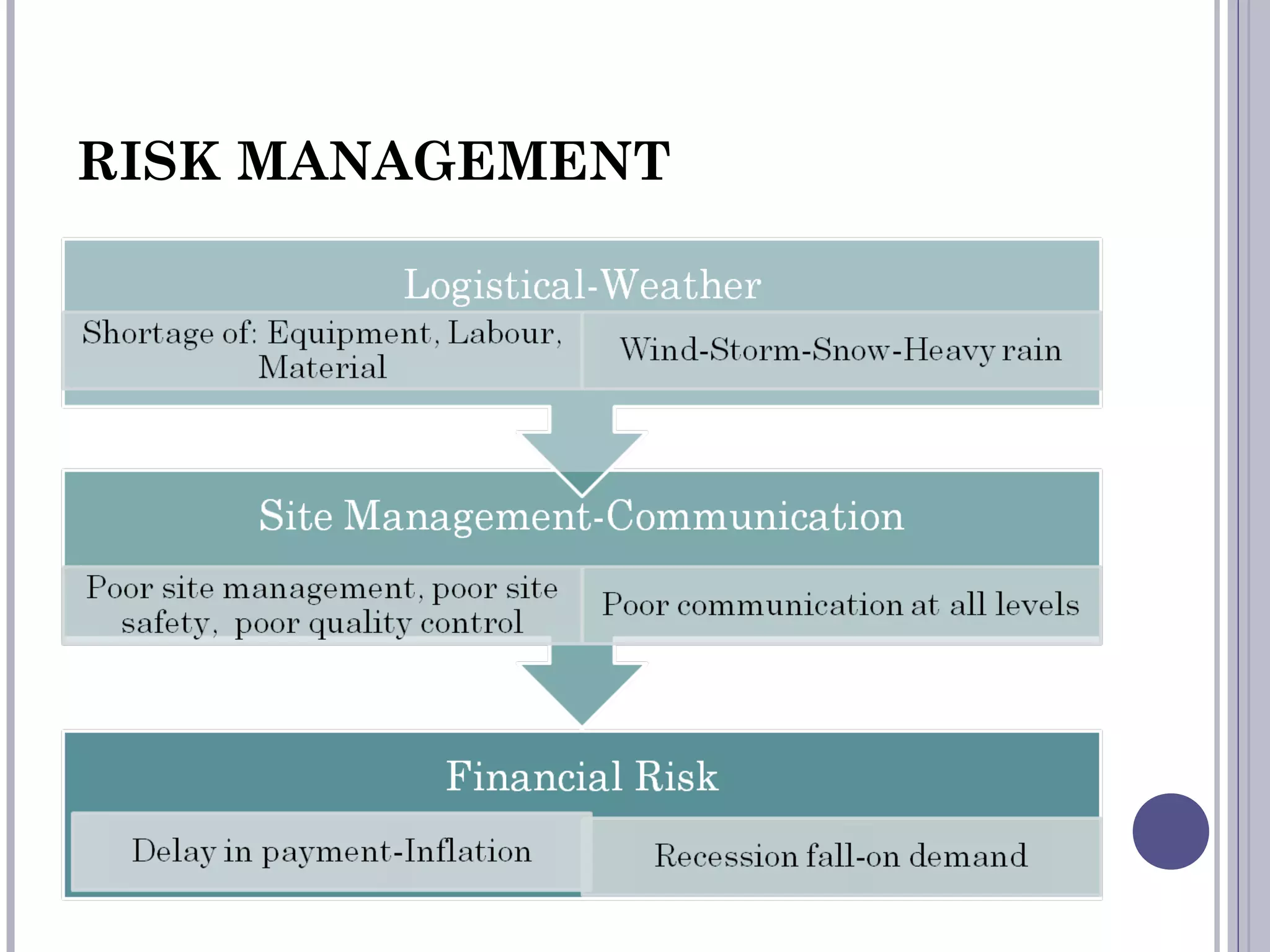
 Risks have a significant impact on a
construction project’s performance in
terms of:
 cost
 Time
 quality
 Size and complexity of the projects have
increased over the past 30 years.
 The ability to manage risks throughout
the construction process has become a
major factor for preventing risk.
RISK MANAGEMENT
Supply chain must share the risk.
Risk to a large extent is governed by
the procurement option and the
content of the related contract
documents.
Selecting an appropriate project
procurement option is a key issue for
risk reduction.
RISK MANAGEMENT
A systematic process of:
identifying
assessing and responding to project
risk
The aims and objectives of the risk
management process is to maximize
the opportunities and minimize the
consequences of a risk event.
A variety of risk management
models with different numbers of
stages can be obtained.
RISK MANAGEMENT
 The international standard “Project risk
management – Application guidelines”
(IEC 2001) is a good source for risk
management.
IEC suggest a model with 5 steps:
1. risk identification
2. risk assessment
3. risk treatment
4. risk review
5. monitoring
RISK MANAGEMENT
 PMBOK’s model (PMI 2000) is
similar but divides risk assessment
into two processes. They are:
1. qualitative risk analysis
2. quantitative risk analysis
 Baloi and Price (2003) include an
additional step of risk
management process it is:
 communication.
RISK MANAGEMENT
Risk Transfer &
Indemnification
Two most problematic areas
for construction management
teams are:
1.contractual risks
2.the insurability of projects.
RISK MANAGEMENT
 Risk management can reduce risk in the
different procurement options.
 Design and build contracts and
collaborative form of partnering.
 Better understanding is expected to
contribute to a more effective risk
management.
 Therefore, a better project output and
better value for both clients and
contractors.
RISK MANAGEMENT
A clear link between the
procurement option and risk
management
Design-build projects offer better
cooperative work by the architects
and contractors in early phases
Therefore, more thorough risk
management.
RISK MANAGEMENT
effective communication;
information exchange;
open attitudes and good
relationship;
all have open discussion of
project risk and a strong
determinant for project success.
RISK MANAGEMENT
RISK ASSESSMENT-SUPPLY CHAIN
1. identify risks
2. evaluated risks
3. ranked risks
4. use both qualitative and quantitative
methods for assessment
5. based on fuzzy estimates of risk
components or a better option
6. Identify risk to cover all KPI’s (TIME-
COST-QUALITY-CUSTOMER
SATIFACTION-SAFTEY)
RISK MANAGEMENT
RISK MANAGEMENT
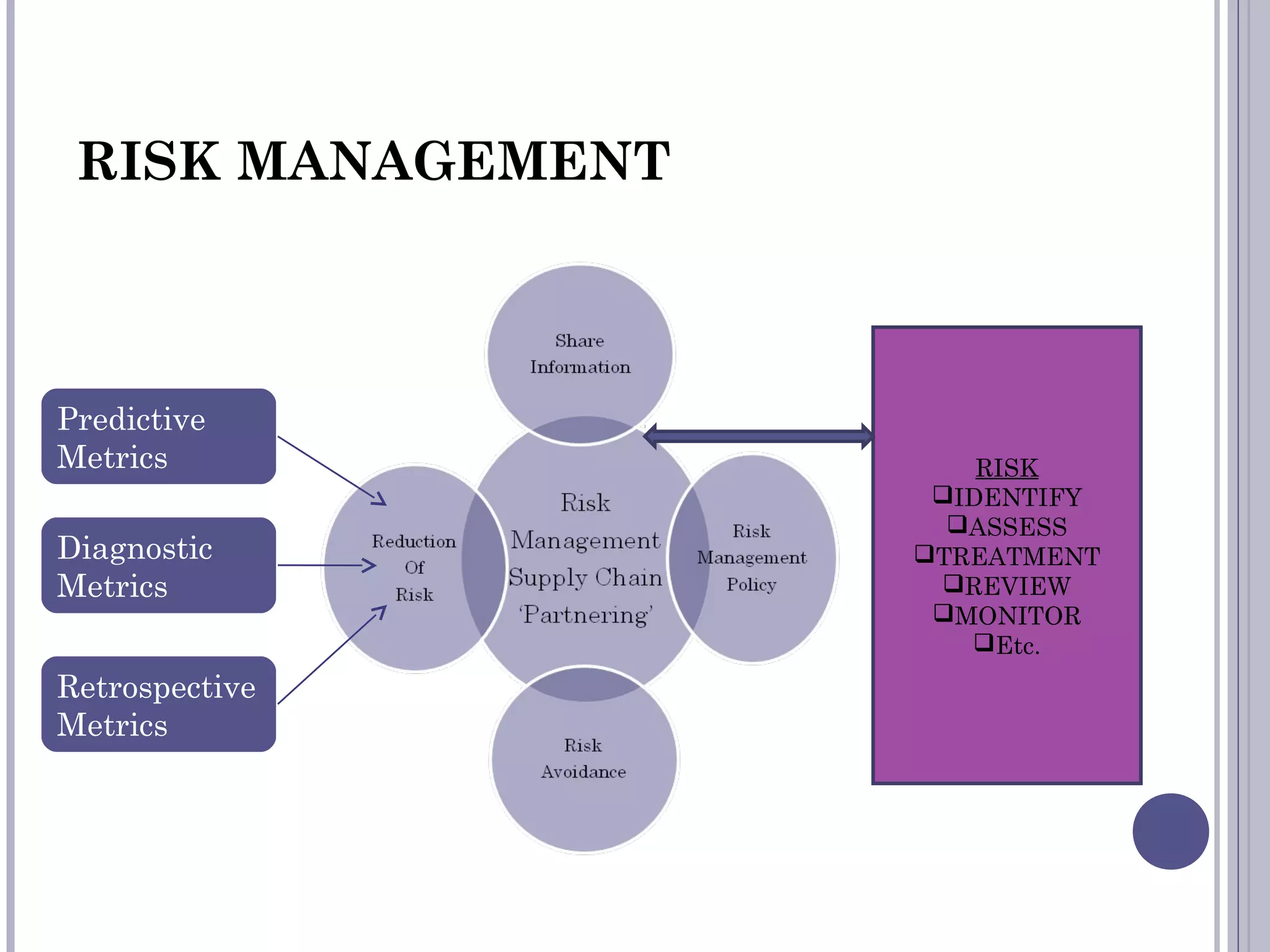
Predictive
Metrics
Diagnostic
Metrics
Retrospective
Metrics
RISK
IDENTIFY
ASSESS
TREATMENT
REVIEW
MONITOR
Etc.
RISK MANAGEMENT
RISK MANAGEMENT
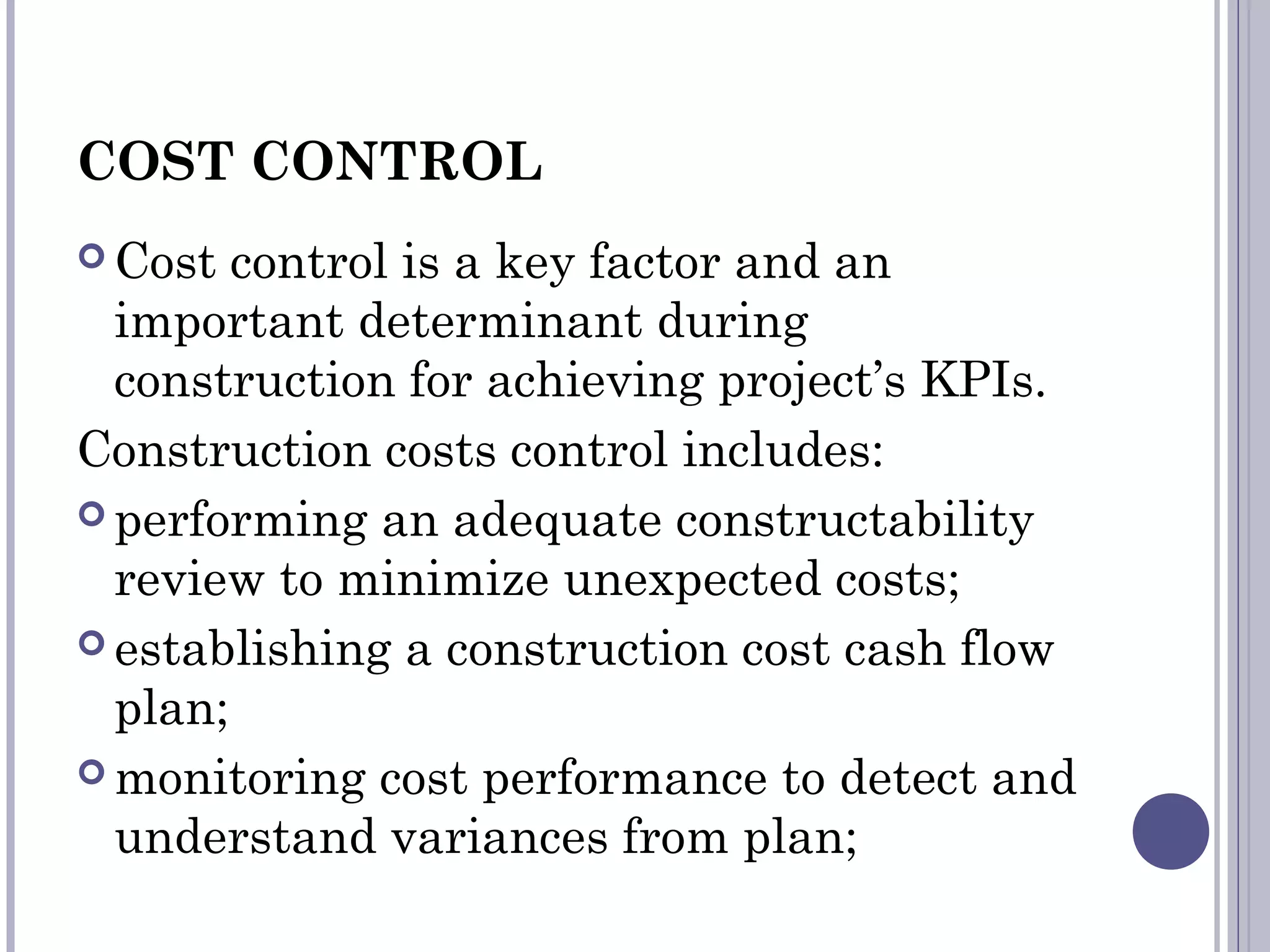
COST CONTROL
 Cost control is a key factor and an
important determinant during
construction for achieving project’s KPIs.
Construction costs control includes:
 performing an adequate constructability
review to minimize unexpected costs;
 establishing a construction cost cash flow
plan;
 monitoring cost performance to detect and
understand variances from plan;
COST CONTROL
ensuring that all appropriate
changes are recorded;
preventing incorrect, inappropriate,
or unauthorized changes from being
included in the project;
Informing appropriate stakeholders
of authorized changes;
Acting to bring expected costs within
acceptable cost limits.
COST CONTROL
Cost control must be thoroughly
integrated with the other control
processes such as:
scope change control;
schedule control and quality
control.
Any inappropriate responses to
cost variations can cause quality
or schedule problems.
COST CONTROL
Removing gang members from
one job to another can increase
the contract duration.
Decreasing gang members can
also increase the cost.
It also can produce an
unacceptable level of risk later
in the project.
COST CONTROL
construction costs include:
contractor costs;
the client cost;
consultant costs;
Any other hidden cost such as in
case of any major dispute
between contractor and the
client.
COST CONTROL
RESPONSIBILITIES
Project Manager (PM): The PM is responsible
for overall project cost control, running of the
project.
 The PM should work closely with the
Construction Site Manager, Site Engineers to
ensure that changes are minimized.
 Make sure the project is completed within
budget.
COST CONTROL
Construction Manager (CM)-Project
manager (PM)-Site Manager (SM)
 Once the construction work starts on site,
the management team on site will be
responsible for day-to-day cost control as
well as other responsibilities.
 The CM,PM, must not only know the
project’s costs to date, but also be able to
project costs For any additional work.
 The CM, PM,.. is responsible for
controlling costs to ensure that
construction is completed within budget.
COST CONTROL
 If any changes are anticipated during
the construction process, immediate
steps must be taken and they are:
1. the CM must notify the senior
management as soon as possible;
2. an informed decision can be made on
whether or not to proceed with the
change;
3. Once the decision is made can the
necessary funding be obtained?
COST CONTROL
COST CONTROL
COST CONTROL
DATA MODEL-ESTIMATED COST
COMPARED TO ACTUAL COST
DATA MODEL FOR LABOUR,
MATERIAL AND MACHINERY
COST OVERRUN
COMMUNICATION
Every year defects in the UK
construction industry cost at least
£20 billion to repair or rebuild
Some of the defects are as the result
issues such as:
 Poor communication;
 Poorly detailed drawing;
 Incorrect instructions or technical
information not being available on time;
COMMUNICATION
Meeting types and frequencies;
Method's of drawing transfer;
Use and control of revised drawings,
or unconfirmed drawings;
Reporting and tracking of defects;
Lack of knowledge in detecting
defects on time.
COMMUNICATION
Single points of contact
Consideration should be given to
appointing defined, single points
of contact at suppliers, design
offices and contractors.
This should help to avoid delays,
confusion and duplication of
effort.
COMMUNICATION
Upwards feedback
 Establish means by which
information can be effectively fed
back up through the formal
management structure.
 Two key areas where this can be
particularly important are as
follows:
COMMUNICATION
1. operatives to site office (e.g.
reporting on an incorrect drawing);
2. Site office to head office (e.g. where
an incorrect detail is discovered;
3. this should be reported back to the
design office and the drawings
corrected).
COMMUNICATION
There are different communication instruments,
such
as:
 e-mail
 document
 telephone
 meeting
 contracts
 specifications
 reports
 manuals
 schedules
 calculations
COMMUNICATION
 drawings
 computer files
 Disks
 print-outs
 photographs
 agenda’s and minutes of meetings
 The management of documentation and
communication used in a project is used
by a number of subcontractors, the
storage and retrieval thereof for further
use.
043 Integrating Risk Management

043 Integrating Risk Management

  • 1.
    INTEGRATINGINTEGRATING RISK MANAGEMENTRISK MANAGEMENT WITHCOSTWITH COST CONTROL&CONTROL& COMMUNICATIONCOMMUNICATION helpdesk@construction-productivity.co.uk htt://www.construction-productivity.co.uk
  • 2.
    RISK MANAGEMENT  Riskshave a significant impact on a construction project’s performance in terms of:  cost  Time  quality  Size and complexity of the projects have increased over the past 30 years.  The ability to manage risks throughout the construction process has become a major factor for preventing risk.
  • 3.
    RISK MANAGEMENT Supply chainmust share the risk. Risk to a large extent is governed by the procurement option and the content of the related contract documents. Selecting an appropriate project procurement option is a key issue for risk reduction.
  • 4.
    RISK MANAGEMENT A systematicprocess of: identifying assessing and responding to project risk The aims and objectives of the risk management process is to maximize the opportunities and minimize the consequences of a risk event. A variety of risk management models with different numbers of stages can be obtained.
  • 5.
    RISK MANAGEMENT  Theinternational standard “Project risk management – Application guidelines” (IEC 2001) is a good source for risk management. IEC suggest a model with 5 steps: 1. risk identification 2. risk assessment 3. risk treatment 4. risk review 5. monitoring
  • 6.
    RISK MANAGEMENT  PMBOK’smodel (PMI 2000) is similar but divides risk assessment into two processes. They are: 1. qualitative risk analysis 2. quantitative risk analysis  Baloi and Price (2003) include an additional step of risk management process it is:  communication.
  • 7.
    RISK MANAGEMENT Risk Transfer& Indemnification Two most problematic areas for construction management teams are: 1.contractual risks 2.the insurability of projects.
  • 8.
    RISK MANAGEMENT  Riskmanagement can reduce risk in the different procurement options.  Design and build contracts and collaborative form of partnering.  Better understanding is expected to contribute to a more effective risk management.  Therefore, a better project output and better value for both clients and contractors.
  • 9.
    RISK MANAGEMENT A clearlink between the procurement option and risk management Design-build projects offer better cooperative work by the architects and contractors in early phases Therefore, more thorough risk management.
  • 10.
    RISK MANAGEMENT effective communication; informationexchange; open attitudes and good relationship; all have open discussion of project risk and a strong determinant for project success.
  • 11.
    RISK MANAGEMENT RISK ASSESSMENT-SUPPLYCHAIN 1. identify risks 2. evaluated risks 3. ranked risks 4. use both qualitative and quantitative methods for assessment 5. based on fuzzy estimates of risk components or a better option 6. Identify risk to cover all KPI’s (TIME- COST-QUALITY-CUSTOMER SATIFACTION-SAFTEY)
  • 12.
  • 13.
  • 14.
  • 15.
  • 16.
    COST CONTROL  Costcontrol is a key factor and an important determinant during construction for achieving project’s KPIs. Construction costs control includes:  performing an adequate constructability review to minimize unexpected costs;  establishing a construction cost cash flow plan;  monitoring cost performance to detect and understand variances from plan;
  • 17.
    COST CONTROL ensuring thatall appropriate changes are recorded; preventing incorrect, inappropriate, or unauthorized changes from being included in the project; Informing appropriate stakeholders of authorized changes; Acting to bring expected costs within acceptable cost limits.
  • 18.
    COST CONTROL Cost controlmust be thoroughly integrated with the other control processes such as: scope change control; schedule control and quality control. Any inappropriate responses to cost variations can cause quality or schedule problems.
  • 19.
    COST CONTROL Removing gangmembers from one job to another can increase the contract duration. Decreasing gang members can also increase the cost. It also can produce an unacceptable level of risk later in the project.
  • 20.
    COST CONTROL construction costsinclude: contractor costs; the client cost; consultant costs; Any other hidden cost such as in case of any major dispute between contractor and the client.
  • 21.
    COST CONTROL RESPONSIBILITIES Project Manager(PM): The PM is responsible for overall project cost control, running of the project.  The PM should work closely with the Construction Site Manager, Site Engineers to ensure that changes are minimized.  Make sure the project is completed within budget.
  • 22.
    COST CONTROL Construction Manager(CM)-Project manager (PM)-Site Manager (SM)  Once the construction work starts on site, the management team on site will be responsible for day-to-day cost control as well as other responsibilities.  The CM,PM, must not only know the project’s costs to date, but also be able to project costs For any additional work.  The CM, PM,.. is responsible for controlling costs to ensure that construction is completed within budget.
  • 23.
    COST CONTROL  Ifany changes are anticipated during the construction process, immediate steps must be taken and they are: 1. the CM must notify the senior management as soon as possible; 2. an informed decision can be made on whether or not to proceed with the change; 3. Once the decision is made can the necessary funding be obtained?
  • 24.
  • 25.
  • 26.
  • 27.
  • 28.
    DATA MODEL FORLABOUR, MATERIAL AND MACHINERY COST OVERRUN
  • 29.
    COMMUNICATION Every year defectsin the UK construction industry cost at least £20 billion to repair or rebuild Some of the defects are as the result issues such as:  Poor communication;  Poorly detailed drawing;  Incorrect instructions or technical information not being available on time;
  • 30.
    COMMUNICATION Meeting types andfrequencies; Method's of drawing transfer; Use and control of revised drawings, or unconfirmed drawings; Reporting and tracking of defects; Lack of knowledge in detecting defects on time.
  • 31.
    COMMUNICATION Single points ofcontact Consideration should be given to appointing defined, single points of contact at suppliers, design offices and contractors. This should help to avoid delays, confusion and duplication of effort.
  • 32.
    COMMUNICATION Upwards feedback  Establishmeans by which information can be effectively fed back up through the formal management structure.  Two key areas where this can be particularly important are as follows:
  • 33.
    COMMUNICATION 1. operatives tosite office (e.g. reporting on an incorrect drawing); 2. Site office to head office (e.g. where an incorrect detail is discovered; 3. this should be reported back to the design office and the drawings corrected).
  • 34.
    COMMUNICATION There are differentcommunication instruments, such as:  e-mail  document  telephone  meeting  contracts  specifications  reports  manuals  schedules  calculations
  • 35.
    COMMUNICATION  drawings  computerfiles  Disks  print-outs  photographs  agenda’s and minutes of meetings  The management of documentation and communication used in a project is used by a number of subcontractors, the storage and retrieval thereof for further use.