Project Cost Management

Waleed El-Naggar, MBA, PMP


      Company
      LOGO
Agenda

            1. Definitions

            2. Payback / Time Value of Money

            3. Estimate Cost

            4. Determine Budget

            5. Control Cost

            6. Earned Value Management

5/16/2009             Compiled by: Waleed El-Naggar   2
Project Cost Management

  Cost Management includes the processes
   involved in estimating, budgeting, and controlling
   costs so that the project can be completed within
   the approved budget.
  Project managers must make sure their projects
   are well defined, have accurate time and cost
   estimates and have a realistic budget that they
   were involved in approving
  Costs are usually measured in monetary units
   like dollars
5/16/2009         Compiled by: Waleed El-Naggar         3
Definitions (1)

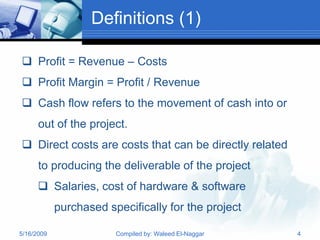
 Profit = Revenue – Costs
 Profit Margin = Profit / Revenue
 Cash flow refers to the movement of cash into or
      out of the project.
 Direct costs are costs that can be directly related
      to producing the deliverable of the project
       Salaries, cost of hardware & software
            purchased specifically for the project

5/16/2009               Compiled by: Waleed El-Naggar   4
Definitions (2)

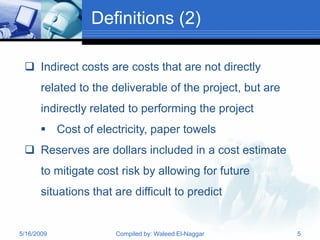
  Indirect costs are costs that are not directly
       related to the deliverable of the project, but are
       indirectly related to performing the project
       Cost of electricity, paper towels
  Reserves are dollars included in a cost estimate
       to mitigate cost risk by allowing for future
       situations that are difficult to predict


5/16/2009              Compiled by: Waleed El-Naggar        5
Definitions (3)

  Sunk cost is money that has been spent in the
       past; when deciding what projects to invest in or
       continue, you should not include sunk costs
       To continue funding a failed project because a
            great deal of money has already been spent
            on it is not a valid way to decide on which
            projects to fund
       Sunk costs should be forgotten


5/16/2009              Compiled by: Waleed El-Naggar       6
Definitions (4)

  Variable Costs: change with the amount of
       production (cost of material).
  Fixed Costs: do not change with production
       (rent, setup costs, … etc)
  Net present value: the total present value (PV) of
       a time series of cash flows. It is a standard
       method for using the time value of money to
       appraise long-term projects


5/16/2009             Compiled by: Waleed El-Naggar     7
Definitions (5)

  Internal Rate of Return: interest rate received for
       an investment consisting of payments and
       income that occur at regular periods
  Opportunity Cost: The cost given up by selecting
       one project over another.
  Payback Period: The time it takes to recover
       your investment in the project before you start
       accumulating profit.


5/16/2009             Compiled by: Waleed El-Naggar      8
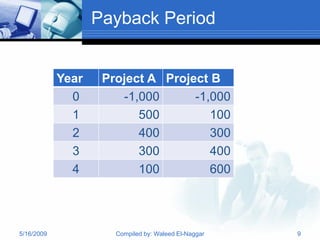
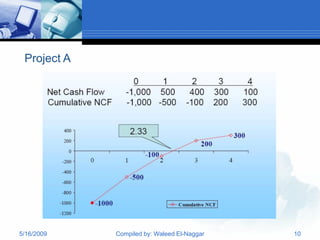
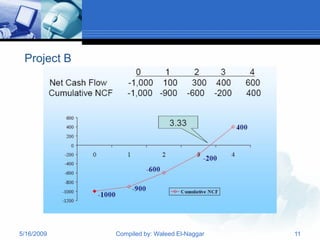
Payback Period


            Year    Project A Project B
              0        -1,000      -1,000
              1           500         100
              2           400         300
              3           300         400
              4           100         600


5/16/2009             Compiled by: Waleed El-Naggar   9
Project A


5/16/2009    Compiled by: Waleed El-Naggar   10
Project B


5/16/2009    Compiled by: Waleed El-Naggar   11
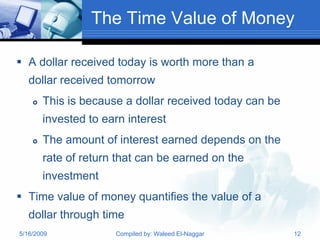
The Time Value of Money

 A dollar received today is worth more than a
   dollar received tomorrow
       This is because a dollar received today can be
        invested to earn interest
       The amount of interest earned depends on the
        rate of return that can be earned on the
        investment
 Time value of money quantifies the value of a
   dollar through time
5/16/2009             Compiled by: Waleed El-Naggar      12
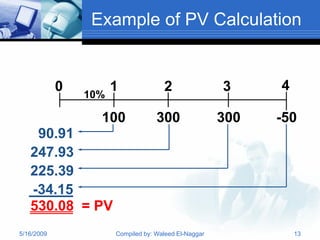
Example of PV Calculation


            0         1              2                3     4
                10%

                  100              300                300   -50
    90.91
   247.93
   225.39
   -34.15
   530.08 = PV
5/16/2009             Compiled by: Waleed El-Naggar             13
7.1 Estimate Costs

  The Process of developing an approximation
   (estimate) for the cost of the resources
   necessary to complete the project activities
  It is also important to develop a cost
   management plan that describes how cost
   variances will be managed on the project
  Pricing: Assessing how much the organization
   will charge for the product or service


5/16/2009        Compiled by: Waleed El-Naggar    14
Estimate Costs: Inputs

 1. Scope Baselines
           Scope Statement
           WBS
           WBS Dictionary
 2. Project Schedule
 3. Human Resource Plan


5/16/2009            Compiled by: Waleed El-Naggar   15
Estimate Costs: Inputs

 4. Risk Register (Risk mitigation costs)

 5. Enterprise Environmental Factors

 6. Organizational Process Assets


5/16/2009         Compiled by: Waleed El-Naggar   16
Estimate Costs: T & T

 1. Expert Judgment

 2. Analogous Estimating (Top down)

 3. Parametric Estimating

 4. Bottom-up estimating

 5. Three-point Estimating


5/16/2009        Compiled by: Waleed El-Naggar   17
Estimate Costs: T & T

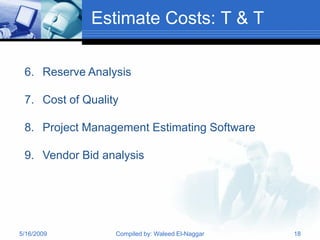
 6. Reserve Analysis

 7. Cost of Quality

 8. Project Management Estimating Software

 9. Vendor Bid analysis


5/16/2009         Compiled by: Waleed El-Naggar   18
Estimate Costs: T & T

1. Activity Cost Estimates
2. Basis of Estimates
           How it was developed
           Estimation Assumptions
           Constraints
           Range of possible estimates (e.g., $100±10%)
           Confidence Level of the estimate
3. Project Document Updates
5/16/2009                 Compiled by: Waleed El-Naggar    19
Quiz

 Analogous estimating:
A. uses bottom-up estimating techniques.
B. is used most frequently during the executing
      processes of the project
C. uses top-down estimating techniques.
D. uses actual detailed historical costs.

                    The answer is: C

5/16/2009           Compiled by: Waleed El-Naggar   20
Quiz

The cost of choosing one project and giving up
another is called:
A. fixed cost.
B. sunk cost.
C. net present value (NPV).
D. opportunity cost.
                 The answer is: D

5/16/2009        Compiled by: Waleed El-Naggar   21
7.2 Determine Budget

 Allocating the overall cost estimate to individual
  activities or work packages, in order to establish a
  cost baseline for measuring project performance
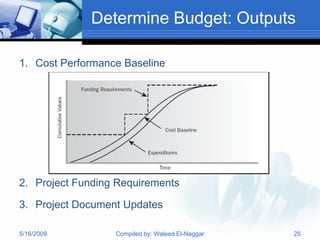
 An important goal is to produce a cost baseline
   A time-phased budget that project managers use
      to measure and monitor cost performance
   Estimating costs for each major project activity
      over time provides management with a foundation
      for project cost control
   Providing info for project funding requirements –at
      what point(s) in time will the money be needed
5/16/2009          Compiled by: Waleed El-Naggar          22
Determine Budget: Inputs

1. Activity Costs Estimates

2. Basis of Estimates

3. Scope Baseline

4. Project Schedule

5. Resource Calendars

6. Contracts

7. Organizational Process Assets


5/16/2009           Compiled by: Waleed El-Naggar   23
Determine Budget: T & T

1. Cost Aggregation

     The work package cost estimates are aggregated for

            the higher component levels of WBS.

2. Reserve Analysis

3. Expert Judgment

4. Historical Relationships

5. Funding Limit Reconcillation


5/16/2009               Compiled by: Waleed El-Naggar     24
Determine Budget: Outputs

1. Cost Performance Baseline


2. Project Funding Requirements

3. Project Document Updates

5/16/2009         Compiled by: Waleed El-Naggar   25
7.3 Control Costs
 The process of monitoring the status of the project costs
  and managing the changes to the cost baseline.
 It includes:
   Monitoring cost performance to detect variances from
     the plan
   Ensuring that all appropriate changes are recorded
   Preventing incorrect, inappropriate, or unauthorized
     changes
   Informing the appropriate stakeholders of authorized
     changes
   Analyzing positive and negative variances and how
     they affect the other control processes
5/16/2009            Compiled by: Waleed El-Naggar            26
Control Costs: Inputs

1. Project Management Plan:

     •      Cost Performance Baseline

     •      Cost Management Plan

2. Project Funding Requirements

3. Work Performance Indicators

4. Organizational Process Assets


5/16/2009               Compiled by: Waleed El-Naggar   27
Control Costs: T & T

1. Earned Value Management

2. Forecasting

3. To-Complete Performance Index

4. Performance Reviews

5. Variance Analysis

6. Project Management Software


5/16/2009           Compiled by: Waleed El-Naggar   28
Control Costs: Outputs

1. Work Performance Measurements

2. Budget Forecasts

3. Organizational Process Assets Updates

4. Change Requests

5. Project Management Plan Updates

6. Project Document Updates


5/16/2009         Compiled by: Waleed El-Naggar   29
Earned Value Management

 EVM is a project performance measurement

     technique that integrates scope, time, & cost data

 Given a baseline, you can determine how well the

     project is meeting its goals

 You must enter actual information periodically to

     use EVM.


5/16/2009            Compiled by: Waleed El-Naggar        30
EVM Terms
 Planned Value (PV), formerly called the budgeted cost of
  work scheduled (BCWS), also called the budget, is that
  portion of the approved total cost estimate planned to be
  spent on an activity during a given period
 Actual Cost (AC), formerly called actual cost of work
  performed (ACWP), is the total of direct & indirect costs
  incurred in accomplishing work on an activity during a
  given period
 Earned Value (EV), formerly called the budgeted cost of
  work performed (BCWP), is the percentage of work
  actually completed multiplied by the planned value
 5/16/2009            Compiled by: Waleed El-Naggar           31
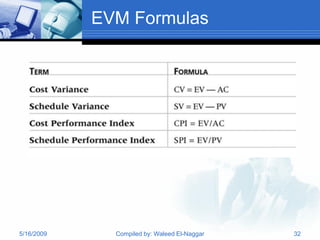
EVM Formulas


5/16/2009     Compiled by: Waleed El-Naggar   32
EVM Example

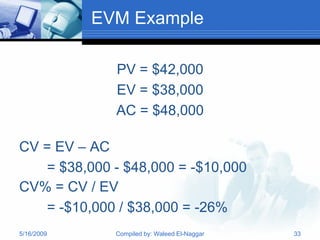
              PV = $42,000
              EV = $38,000
              AC = $48,000

CV = EV – AC
   = $38,000 - $48,000 = -$10,000
CV% = CV / EV
   = -$10,000 / $38,000 = -26%
5/16/2009     Compiled by: Waleed El-Naggar   33
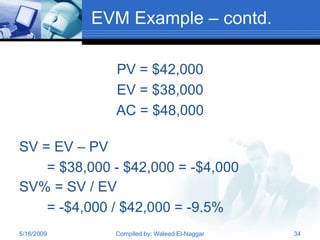
EVM Example – contd.

              PV = $42,000
              EV = $38,000
              AC = $48,000

SV = EV – PV
    = $38,000 - $42,000 = -$4,000
SV% = SV / EV
    = -$4,000 / $42,000 = -9.5%
5/16/2009     Compiled by: Waleed El-Naggar   34
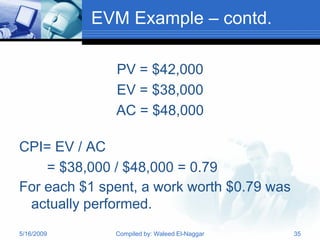
EVM Example – contd.

              PV = $42,000
              EV = $38,000
              AC = $48,000

CPI= EV / AC
    = $38,000 / $48,000 = 0.79
For each $1 spent, a work worth $0.79 was
 actually performed.
5/16/2009     Compiled by: Waleed El-Naggar   35
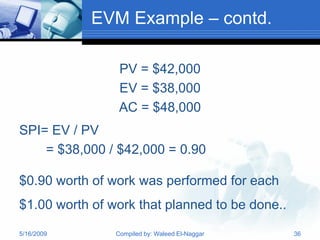
EVM Example – contd.

                 PV = $42,000
                 EV = $38,000
                 AC = $48,000
SPI= EV / PV
    = $38,000 / $42,000 = 0.90

$0.90 worth of work was performed for each
$1.00 worth of work that planned to be done..

5/16/2009       Compiled by: Waleed El-Naggar   36
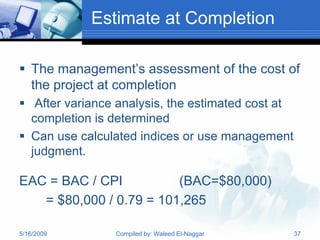
Estimate at Completion

 The management’s assessment of the cost of
  the project at completion
 After variance analysis, the estimated cost at
  completion is determined
 Can use calculated indices or use management
  judgment.

EAC = BAC / CPI          (BAC=$80,000)
   = $80,000 / 0.79 = 101,265

5/16/2009       Compiled by: Waleed El-Naggar      37
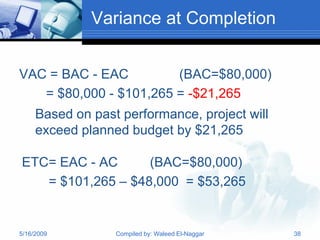
Variance at Completion


VAC = BAC - EAC         (BAC=$80,000)
   = $80,000 - $101,265 = -$21,265
     Based on past performance, project will
     exceed planned budget by $21,265

ETC= EAC - AC      (BAC=$80,000)
   = $101,265 – $48,000 = $53,265


5/16/2009         Compiled by: Waleed El-Naggar   38
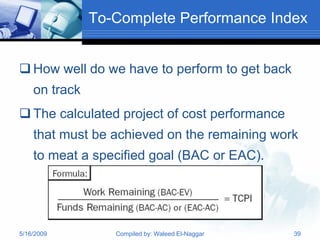
To-Complete Performance Index


 How well do we have to perform to get back
    on track
 The calculated project of cost performance
    that must be achieved on the remaining work
    to meat a specified goal (BAC or EAC).


5/16/2009         Compiled by: Waleed El-Naggar   39
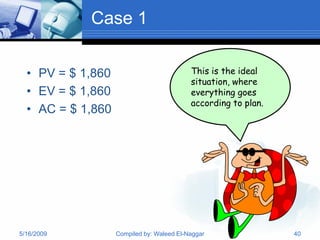
Case 1


  • PV = $ 1,860                           This is the ideal
                                           situation, where
  • EV = $ 1,860                           everything goes
                                           according to plan.
  • AC = $ 1,860


5/16/2009          Compiled by: Waleed El-Naggar                40
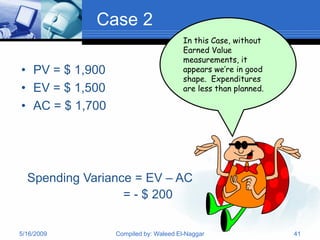
Case 2
                                       In this Case, without
                                       Earned Value
                                       measurements, it
• PV = $ 1,900                         appears we’re in good
                                       shape. Expenditures
• EV = $ 1,500                         are less than planned.

• AC = $ 1,700


  Spending Variance = EV – AC
                  = - $ 200


5/16/2009        Compiled by: Waleed El-Naggar                  41
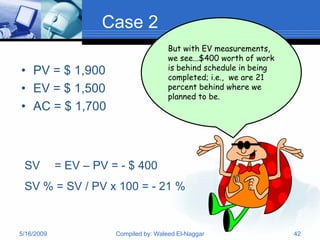
Case 2
                                        But with EV measurements,
                                        we see...$400 worth of work
• PV = $ 1,900                          is behind schedule in being
                                        completed; i.e., we are 21
• EV = $ 1,500                          percent behind where we
                                        planned to be.
• AC = $ 1,700


 SV         = EV – PV = - $ 400
 SV % = SV / PV x 100 = - 21 %


5/16/2009              Compiled by: Waleed El-Naggar                  42
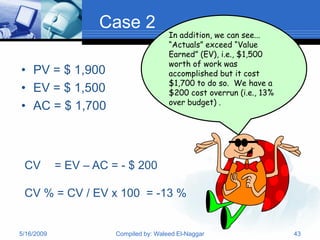
Case 2
                                        In addition, we can see...
                                        “Actuals” exceed “Value
                                        Earned” (EV), i.e., $1,500
                                        worth of work was
• PV = $ 1,900                          accomplished but it cost
                                        $1,700 to do so. We have a
• EV = $ 1,500                          $200 cost overrun (i.e., 13%
                                        over budget) .
• AC = $ 1,700


 CV         = EV – AC = - $ 200

 CV % = CV / EV x 100 = -13 %


5/16/2009              Compiled by: Waleed El-Naggar                   43
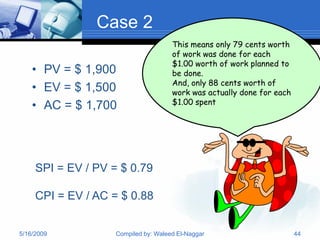
Case 2
                                      This means only 79 cents worth
                                      of work was done for each
                                      $1.00 worth of work planned to
    • PV = $ 1,900                    be done.
                                      And, only 88 cents worth of
    • EV = $ 1,500                    work was actually done for each
                                      $1.00 spent
    • AC = $ 1,700


     SPI = EV / PV = $ 0.79

     CPI = EV / AC = $ 0.88


5/16/2009           Compiled by: Waleed El-Naggar                       44
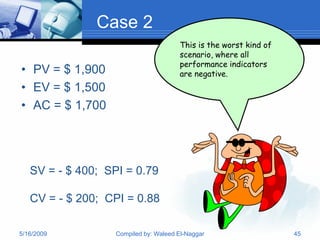
Case 2
                                       This is the worst kind of
                                       scenario, where all
                                       performance indicators
• PV = $ 1,900                         are negative.
• EV = $ 1,500
• AC = $ 1,700


   SV = - $ 400; SPI = 0.79

   CV = - $ 200; CPI = 0.88

5/16/2009          Compiled by: Waleed El-Naggar                   45
Case 3
                                 In this case there is
                                 bad news and good
 PV = $ 2,600                   news.

 EV = $ 2,400
 AC = $ 2,200


5/16/2009    Compiled by: Waleed El-Naggar               46
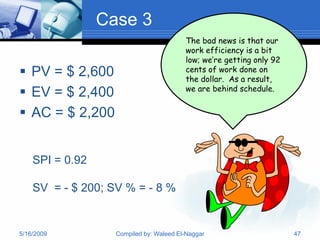
Case 3
                                         The bad news is that our
                                         work efficiency is a bit
                                         low; we’re getting only 92
 PV = $ 2,600                           cents of work done on
                                         the dollar. As a result,
                                         we are behind schedule.
 EV = $ 2,400
 AC = $ 2,200


    SPI = 0.92

    SV = - $ 200; SV % = - 8 %


5/16/2009          Compiled by: Waleed El-Naggar                      47
Case 3
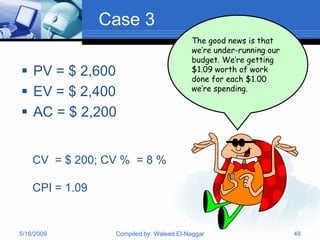
                                          The good news is that
                                          we’re under-running our
                                          budget. We’re getting
 PV = $ 2,600                            $1.09 worth of work
                                          done for each $1.00
                                          we’re spending.
 EV = $ 2,400
 AC = $ 2,200


    CV = $ 200; CV % = 8 %

    CPI = 1.09


5/16/2009         Compiled by: Waleed El-Naggar                     48
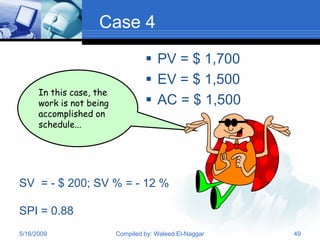
Case 4
                                    PV = $ 1,700
                                    EV = $ 1,500
      In this case, the
      work is not being             AC = $ 1,500
      accomplished on
      schedule...


SV = - $ 200; SV % = - 12 %

SPI = 0.88
5/16/2009                 Compiled by: Waleed El-Naggar   49
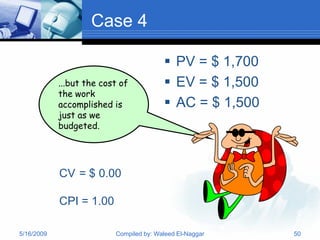
Case 4

                                          PV = $ 1,700
            ...but the cost of            EV = $ 1,500
            the work
            accomplished is               AC = $ 1,500
            just as we
            budgeted.


            CV = $ 0.00

            CPI = 1.00

5/16/2009                 Compiled by: Waleed El-Naggar   50
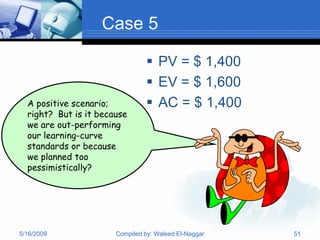
Case 5

                                  PV = $ 1,400
                                  EV = $ 1,600
  A positive scenario;            AC = $ 1,400
  right? But is it because
  we are out-performing
  our learning-curve
  standards or because
  we planned too
  pessimistically?


5/16/2009              Compiled by: Waleed El-Naggar   51
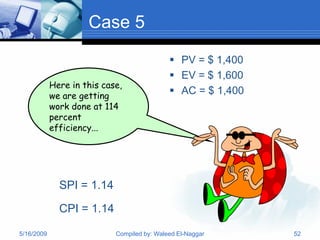
Case 5
                                              PV = $ 1,400
                                              EV = $ 1,600
            Here in this case,
            we are getting
                                              AC = $ 1,400
            work done at 114
            percent
            efficiency...


              SPI = 1.14

              CPI = 1.14

5/16/2009                   Compiled by: Waleed El-Naggar     52
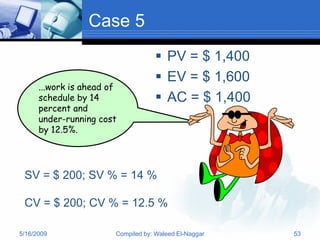
Case 5
                                     PV = $ 1,400
                                     EV = $ 1,600
      ...work is ahead of
      schedule by 14                 AC = $ 1,400
      percent and
      under-running cost
      by 12.5%.


 SV = $ 200; SV % = 14 %

 CV = $ 200; CV % = 12.5 %

5/16/2009               Compiled by: Waleed El-Naggar   53
Text
                    Thank You
            Text   waleed_k@aucegypt.edu


                                                 Text

                   Text


5/16/2009                 Compiled by: Waleed El-Naggar   54

04 project cost managment

  • 1.
    Project Cost Management WaleedEl-Naggar, MBA, PMP Company LOGO
  • 2.
    Agenda 1. Definitions 2. Payback / Time Value of Money 3. Estimate Cost 4. Determine Budget 5. Control Cost 6. Earned Value Management 5/16/2009 Compiled by: Waleed El-Naggar 2
  • 3.
    Project Cost Management  Cost Management includes the processes involved in estimating, budgeting, and controlling costs so that the project can be completed within the approved budget.  Project managers must make sure their projects are well defined, have accurate time and cost estimates and have a realistic budget that they were involved in approving  Costs are usually measured in monetary units like dollars 5/16/2009 Compiled by: Waleed El-Naggar 3
  • 4.
    Definitions (1)  Profit= Revenue – Costs  Profit Margin = Profit / Revenue  Cash flow refers to the movement of cash into or out of the project.  Direct costs are costs that can be directly related to producing the deliverable of the project  Salaries, cost of hardware & software purchased specifically for the project 5/16/2009 Compiled by: Waleed El-Naggar 4
  • 5.
    Definitions (2) Indirect costs are costs that are not directly related to the deliverable of the project, but are indirectly related to performing the project  Cost of electricity, paper towels  Reserves are dollars included in a cost estimate to mitigate cost risk by allowing for future situations that are difficult to predict 5/16/2009 Compiled by: Waleed El-Naggar 5
  • 6.
    Definitions (3) Sunk cost is money that has been spent in the past; when deciding what projects to invest in or continue, you should not include sunk costs  To continue funding a failed project because a great deal of money has already been spent on it is not a valid way to decide on which projects to fund  Sunk costs should be forgotten 5/16/2009 Compiled by: Waleed El-Naggar 6
  • 7.
    Definitions (4) Variable Costs: change with the amount of production (cost of material).  Fixed Costs: do not change with production (rent, setup costs, … etc)  Net present value: the total present value (PV) of a time series of cash flows. It is a standard method for using the time value of money to appraise long-term projects 5/16/2009 Compiled by: Waleed El-Naggar 7
  • 8.
    Definitions (5) Internal Rate of Return: interest rate received for an investment consisting of payments and income that occur at regular periods  Opportunity Cost: The cost given up by selecting one project over another.  Payback Period: The time it takes to recover your investment in the project before you start accumulating profit. 5/16/2009 Compiled by: Waleed El-Naggar 8
  • 9.
    Payback Period Year Project A Project B 0 -1,000 -1,000 1 500 100 2 400 300 3 300 400 4 100 600 5/16/2009 Compiled by: Waleed El-Naggar 9
  • 10.
    Project A 5/16/2009 Compiled by: Waleed El-Naggar 10
  • 11.
    Project B 5/16/2009 Compiled by: Waleed El-Naggar 11
  • 12.
    The Time Valueof Money  A dollar received today is worth more than a dollar received tomorrow  This is because a dollar received today can be invested to earn interest  The amount of interest earned depends on the rate of return that can be earned on the investment  Time value of money quantifies the value of a dollar through time 5/16/2009 Compiled by: Waleed El-Naggar 12
  • 13.
    Example of PVCalculation 0 1 2 3 4 10% 100 300 300 -50 90.91 247.93 225.39 -34.15 530.08 = PV 5/16/2009 Compiled by: Waleed El-Naggar 13
  • 14.
    7.1 Estimate Costs  The Process of developing an approximation (estimate) for the cost of the resources necessary to complete the project activities  It is also important to develop a cost management plan that describes how cost variances will be managed on the project  Pricing: Assessing how much the organization will charge for the product or service 5/16/2009 Compiled by: Waleed El-Naggar 14
  • 15.
    Estimate Costs: Inputs 1. Scope Baselines  Scope Statement  WBS  WBS Dictionary 2. Project Schedule 3. Human Resource Plan 5/16/2009 Compiled by: Waleed El-Naggar 15
  • 16.
    Estimate Costs: Inputs 4. Risk Register (Risk mitigation costs) 5. Enterprise Environmental Factors 6. Organizational Process Assets 5/16/2009 Compiled by: Waleed El-Naggar 16
  • 17.
    Estimate Costs: T& T 1. Expert Judgment 2. Analogous Estimating (Top down) 3. Parametric Estimating 4. Bottom-up estimating 5. Three-point Estimating 5/16/2009 Compiled by: Waleed El-Naggar 17
  • 18.
    Estimate Costs: T& T 6. Reserve Analysis 7. Cost of Quality 8. Project Management Estimating Software 9. Vendor Bid analysis 5/16/2009 Compiled by: Waleed El-Naggar 18
  • 19.
    Estimate Costs: T& T 1. Activity Cost Estimates 2. Basis of Estimates  How it was developed  Estimation Assumptions  Constraints  Range of possible estimates (e.g., $100±10%)  Confidence Level of the estimate 3. Project Document Updates 5/16/2009 Compiled by: Waleed El-Naggar 19
  • 20.
    Quiz Analogous estimating: A.uses bottom-up estimating techniques. B. is used most frequently during the executing processes of the project C. uses top-down estimating techniques. D. uses actual detailed historical costs. The answer is: C 5/16/2009 Compiled by: Waleed El-Naggar 20
  • 21.
    Quiz The cost ofchoosing one project and giving up another is called: A. fixed cost. B. sunk cost. C. net present value (NPV). D. opportunity cost. The answer is: D 5/16/2009 Compiled by: Waleed El-Naggar 21
  • 22.
    7.2 Determine Budget Allocating the overall cost estimate to individual activities or work packages, in order to establish a cost baseline for measuring project performance  An important goal is to produce a cost baseline  A time-phased budget that project managers use to measure and monitor cost performance  Estimating costs for each major project activity over time provides management with a foundation for project cost control  Providing info for project funding requirements –at what point(s) in time will the money be needed 5/16/2009 Compiled by: Waleed El-Naggar 22
  • 23.
    Determine Budget: Inputs 1.Activity Costs Estimates 2. Basis of Estimates 3. Scope Baseline 4. Project Schedule 5. Resource Calendars 6. Contracts 7. Organizational Process Assets 5/16/2009 Compiled by: Waleed El-Naggar 23
  • 24.
    Determine Budget: T& T 1. Cost Aggregation The work package cost estimates are aggregated for the higher component levels of WBS. 2. Reserve Analysis 3. Expert Judgment 4. Historical Relationships 5. Funding Limit Reconcillation 5/16/2009 Compiled by: Waleed El-Naggar 24
  • 25.
    Determine Budget: Outputs 1.Cost Performance Baseline 2. Project Funding Requirements 3. Project Document Updates 5/16/2009 Compiled by: Waleed El-Naggar 25
  • 26.
    7.3 Control Costs The process of monitoring the status of the project costs and managing the changes to the cost baseline.  It includes:  Monitoring cost performance to detect variances from the plan  Ensuring that all appropriate changes are recorded  Preventing incorrect, inappropriate, or unauthorized changes  Informing the appropriate stakeholders of authorized changes  Analyzing positive and negative variances and how they affect the other control processes 5/16/2009 Compiled by: Waleed El-Naggar 26
  • 27.
    Control Costs: Inputs 1.Project Management Plan: • Cost Performance Baseline • Cost Management Plan 2. Project Funding Requirements 3. Work Performance Indicators 4. Organizational Process Assets 5/16/2009 Compiled by: Waleed El-Naggar 27
  • 28.
    Control Costs: T& T 1. Earned Value Management 2. Forecasting 3. To-Complete Performance Index 4. Performance Reviews 5. Variance Analysis 6. Project Management Software 5/16/2009 Compiled by: Waleed El-Naggar 28
  • 29.
    Control Costs: Outputs 1.Work Performance Measurements 2. Budget Forecasts 3. Organizational Process Assets Updates 4. Change Requests 5. Project Management Plan Updates 6. Project Document Updates 5/16/2009 Compiled by: Waleed El-Naggar 29
  • 30.
    Earned Value Management EVM is a project performance measurement technique that integrates scope, time, & cost data  Given a baseline, you can determine how well the project is meeting its goals  You must enter actual information periodically to use EVM. 5/16/2009 Compiled by: Waleed El-Naggar 30
  • 31.
    EVM Terms  PlannedValue (PV), formerly called the budgeted cost of work scheduled (BCWS), also called the budget, is that portion of the approved total cost estimate planned to be spent on an activity during a given period  Actual Cost (AC), formerly called actual cost of work performed (ACWP), is the total of direct & indirect costs incurred in accomplishing work on an activity during a given period  Earned Value (EV), formerly called the budgeted cost of work performed (BCWP), is the percentage of work actually completed multiplied by the planned value 5/16/2009 Compiled by: Waleed El-Naggar 31
  • 32.
    EVM Formulas 5/16/2009 Compiled by: Waleed El-Naggar 32
  • 33.
    EVM Example PV = $42,000 EV = $38,000 AC = $48,000 CV = EV – AC = $38,000 - $48,000 = -$10,000 CV% = CV / EV = -$10,000 / $38,000 = -26% 5/16/2009 Compiled by: Waleed El-Naggar 33
  • 34.
    EVM Example –contd. PV = $42,000 EV = $38,000 AC = $48,000 SV = EV – PV = $38,000 - $42,000 = -$4,000 SV% = SV / EV = -$4,000 / $42,000 = -9.5% 5/16/2009 Compiled by: Waleed El-Naggar 34
  • 35.
    EVM Example –contd. PV = $42,000 EV = $38,000 AC = $48,000 CPI= EV / AC = $38,000 / $48,000 = 0.79 For each $1 spent, a work worth $0.79 was actually performed. 5/16/2009 Compiled by: Waleed El-Naggar 35
  • 36.
    EVM Example –contd. PV = $42,000 EV = $38,000 AC = $48,000 SPI= EV / PV = $38,000 / $42,000 = 0.90 $0.90 worth of work was performed for each $1.00 worth of work that planned to be done.. 5/16/2009 Compiled by: Waleed El-Naggar 36
  • 37.
    Estimate at Completion The management’s assessment of the cost of the project at completion  After variance analysis, the estimated cost at completion is determined  Can use calculated indices or use management judgment. EAC = BAC / CPI (BAC=$80,000) = $80,000 / 0.79 = 101,265 5/16/2009 Compiled by: Waleed El-Naggar 37
  • 38.
    Variance at Completion VAC= BAC - EAC (BAC=$80,000) = $80,000 - $101,265 = -$21,265 Based on past performance, project will exceed planned budget by $21,265 ETC= EAC - AC (BAC=$80,000) = $101,265 – $48,000 = $53,265 5/16/2009 Compiled by: Waleed El-Naggar 38
  • 39.
    To-Complete Performance Index How well do we have to perform to get back on track  The calculated project of cost performance that must be achieved on the remaining work to meat a specified goal (BAC or EAC). 5/16/2009 Compiled by: Waleed El-Naggar 39
  • 40.
    Case 1 • PV = $ 1,860 This is the ideal situation, where • EV = $ 1,860 everything goes according to plan. • AC = $ 1,860 5/16/2009 Compiled by: Waleed El-Naggar 40
  • 41.
    Case 2 In this Case, without Earned Value measurements, it • PV = $ 1,900 appears we’re in good shape. Expenditures • EV = $ 1,500 are less than planned. • AC = $ 1,700 Spending Variance = EV – AC = - $ 200 5/16/2009 Compiled by: Waleed El-Naggar 41
  • 42.
    Case 2 But with EV measurements, we see...$400 worth of work • PV = $ 1,900 is behind schedule in being completed; i.e., we are 21 • EV = $ 1,500 percent behind where we planned to be. • AC = $ 1,700 SV = EV – PV = - $ 400 SV % = SV / PV x 100 = - 21 % 5/16/2009 Compiled by: Waleed El-Naggar 42
  • 43.
    Case 2 In addition, we can see... “Actuals” exceed “Value Earned” (EV), i.e., $1,500 worth of work was • PV = $ 1,900 accomplished but it cost $1,700 to do so. We have a • EV = $ 1,500 $200 cost overrun (i.e., 13% over budget) . • AC = $ 1,700 CV = EV – AC = - $ 200 CV % = CV / EV x 100 = -13 % 5/16/2009 Compiled by: Waleed El-Naggar 43
  • 44.
    Case 2 This means only 79 cents worth of work was done for each $1.00 worth of work planned to • PV = $ 1,900 be done. And, only 88 cents worth of • EV = $ 1,500 work was actually done for each $1.00 spent • AC = $ 1,700 SPI = EV / PV = $ 0.79 CPI = EV / AC = $ 0.88 5/16/2009 Compiled by: Waleed El-Naggar 44
  • 45.
    Case 2 This is the worst kind of scenario, where all performance indicators • PV = $ 1,900 are negative. • EV = $ 1,500 • AC = $ 1,700 SV = - $ 400; SPI = 0.79 CV = - $ 200; CPI = 0.88 5/16/2009 Compiled by: Waleed El-Naggar 45
  • 46.
    Case 3 In this case there is bad news and good  PV = $ 2,600 news.  EV = $ 2,400  AC = $ 2,200 5/16/2009 Compiled by: Waleed El-Naggar 46
  • 47.
    Case 3 The bad news is that our work efficiency is a bit low; we’re getting only 92  PV = $ 2,600 cents of work done on the dollar. As a result, we are behind schedule.  EV = $ 2,400  AC = $ 2,200 SPI = 0.92 SV = - $ 200; SV % = - 8 % 5/16/2009 Compiled by: Waleed El-Naggar 47
  • 48.
    Case 3 The good news is that we’re under-running our budget. We’re getting  PV = $ 2,600 $1.09 worth of work done for each $1.00 we’re spending.  EV = $ 2,400  AC = $ 2,200 CV = $ 200; CV % = 8 % CPI = 1.09 5/16/2009 Compiled by: Waleed El-Naggar 48
  • 49.
    Case 4  PV = $ 1,700  EV = $ 1,500 In this case, the work is not being  AC = $ 1,500 accomplished on schedule... SV = - $ 200; SV % = - 12 % SPI = 0.88 5/16/2009 Compiled by: Waleed El-Naggar 49
  • 50.
    Case 4  PV = $ 1,700 ...but the cost of  EV = $ 1,500 the work accomplished is  AC = $ 1,500 just as we budgeted. CV = $ 0.00 CPI = 1.00 5/16/2009 Compiled by: Waleed El-Naggar 50
  • 51.
    Case 5  PV = $ 1,400  EV = $ 1,600 A positive scenario;  AC = $ 1,400 right? But is it because we are out-performing our learning-curve standards or because we planned too pessimistically? 5/16/2009 Compiled by: Waleed El-Naggar 51
  • 52.
    Case 5  PV = $ 1,400  EV = $ 1,600 Here in this case, we are getting  AC = $ 1,400 work done at 114 percent efficiency... SPI = 1.14 CPI = 1.14 5/16/2009 Compiled by: Waleed El-Naggar 52
  • 53.
    Case 5  PV = $ 1,400  EV = $ 1,600 ...work is ahead of schedule by 14  AC = $ 1,400 percent and under-running cost by 12.5%. SV = $ 200; SV % = 14 % CV = $ 200; CV % = 12.5 % 5/16/2009 Compiled by: Waleed El-Naggar 53
  • 54.
    Text Thank You Text waleed_k@aucegypt.edu Text Text 5/16/2009 Compiled by: Waleed El-Naggar 54