
PROJECT
MANAGEMENT
OVERVIEW
Sunil Guglani,PMP
Project Management
Framework
What is Project?
■ A Project is a:
– Temporary endeavor with a beginning and an end
– Creates a unique/service/result
– Progressively Elaborated, characteristics of the project will be progressively
detailed as the project is better understood.
– Temporary means every project has a definitive beginning and ending.
– Unique means that the deliverables are different in nature even though
recurring elements exist.
– E.g. Construction of a building, bridge, station, development of product,
software, feasibility analysis of requirement, Testing of a product
■ Phase:
– To manage the projects effectively the large projects can be divided into
project phases.
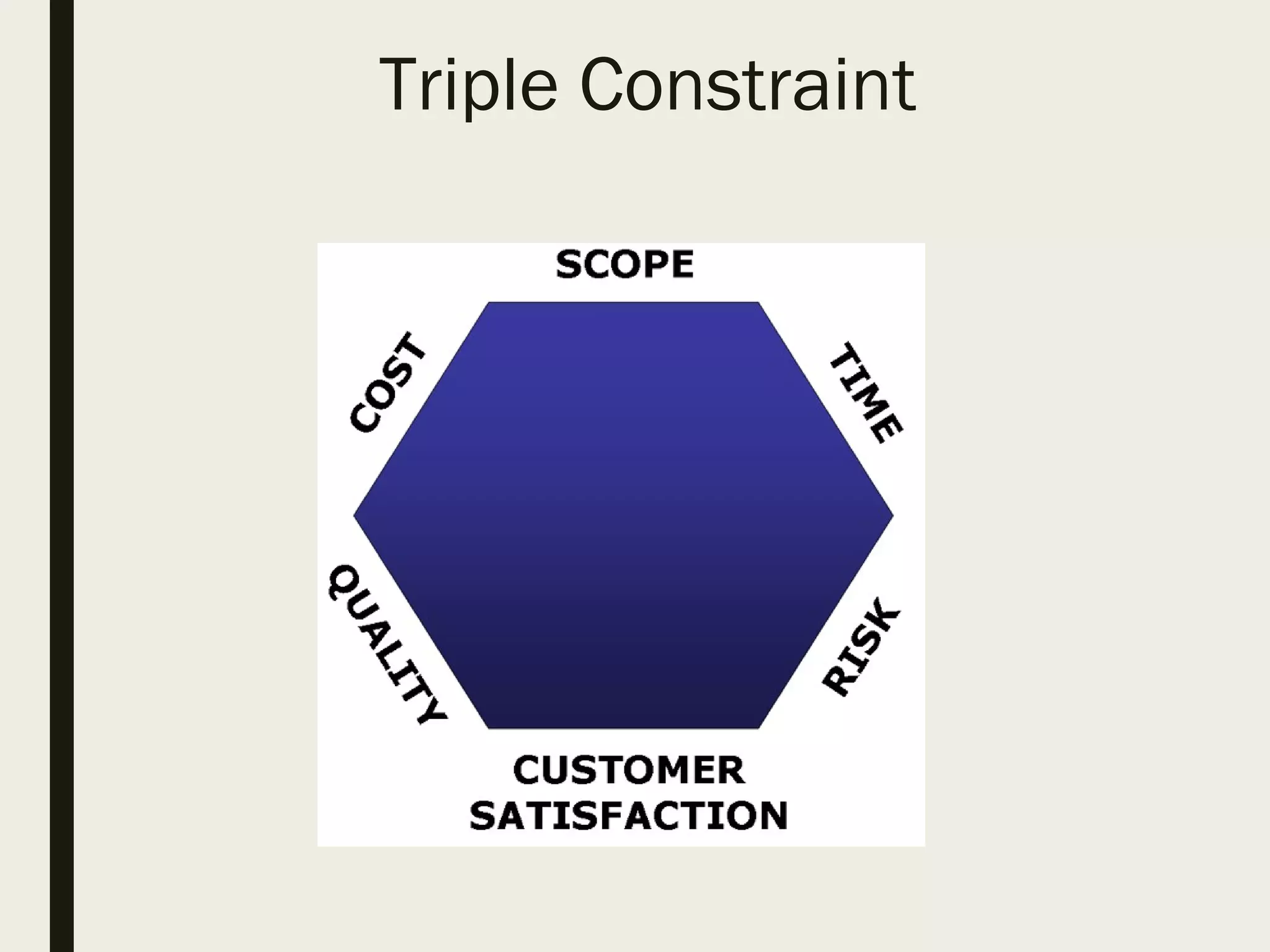
Triple Constraint
Program/Operation
■ Operation:
– Operations are ongoing and repetitive
– Example manufacturing, delivery services, teaching a class
■ A Program is a:
– Group of interrelated projects
– Interrelated could be because sharing resources, result of one is
effecting the other.
– A large projects divided into multiple projects is also called a program.
– This coordination of management provides decreased risk and
improved management which can not be achieved by managing them
individually.
Project Management Office
■ PMO:
– A department that centralizes the management of projects.
– It provides policies, procedures, methodologies, templates, tools and
techniques for project management.
– Provide guidance and training on project management.
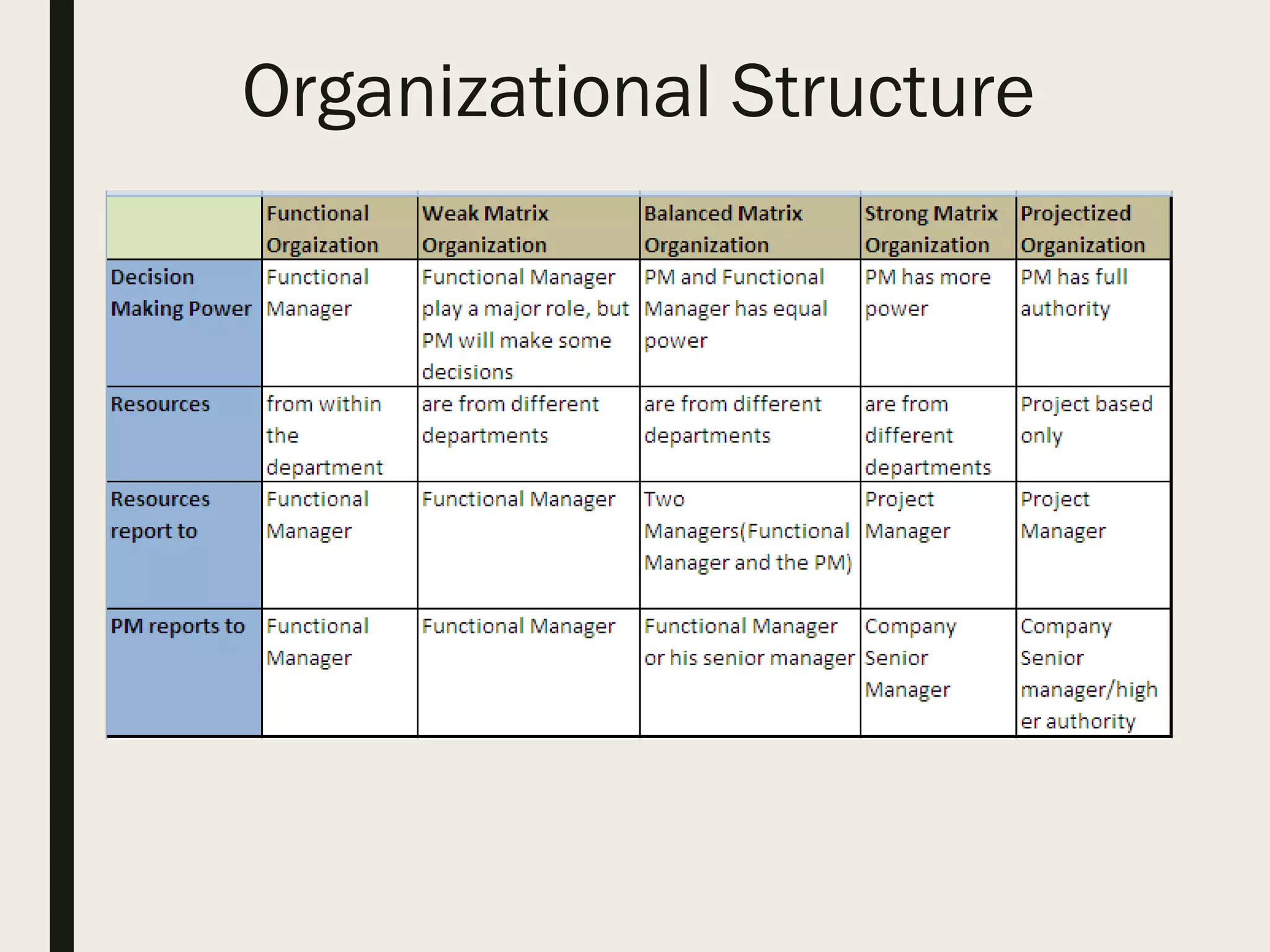
Organizational Structure
Project Stakeholders
Key Stakeholders are:
– Project Manager
– Customer/User
– Performing Organization: The enterprise whose employees
are directly involved in the work of the project
– Project Team Member: The group performing the project
work
– Project Management Team: The member of the project
team directly involved in the management activities.
– Sponsor: The person/group financing the project.
– Influencers: People/group not directly related to
acquisition/use of the project but can positively/negatively
influence the course of the project.
– PMO
Project Stakeholders cont…
■ Stakeholders should be identified in Initiating or Planning
Process group.
■ Identifying the stakeholders in the later stage could impede
the performance of the project.
■ Project Manager is responsible for managing the expectations
of Stakeholders
Role and Responsibilities
Project Sponsor
– Provides Financial resources
– Issue/Approve changes Project Charter
– Provide Statement of Work(SOW)
– Give PM the authority
– Determine the priorities between the triple constraint
components
– Help tradeoffs between crashing, fast tracking and re-
estimating
– Approve or reject changes(Part of change control board)
– Clarify Scope Questions
Role and Responsibilities cont…
Project Manager
– Conduct Stakeholder Analysis
– Communicate to stakeholders
– Identify Quality Standards
– Develop major plans
– Manage, lead and develop team
– Resolve conflicts and issues
– Facilitate risk identification
– Performs or delegates the project management activities.
– Should perform all the core-PM activities by himself.
– Must have authority and accountability to accomplish the
project management work.
– Is accountable for project failure.
Role and Responsibilities cont…
Stakeholders are involved in
– Project Management Plan Development
– Approving project changes
– Scope Management
– Identifying constraints and risks
■ Customer
– Uses the project’s product
– Provides clear requirement
– Participates in stakeholder analysis
– Participates in quality assurance and determining quality
policies
– Do Scope/delivery verification
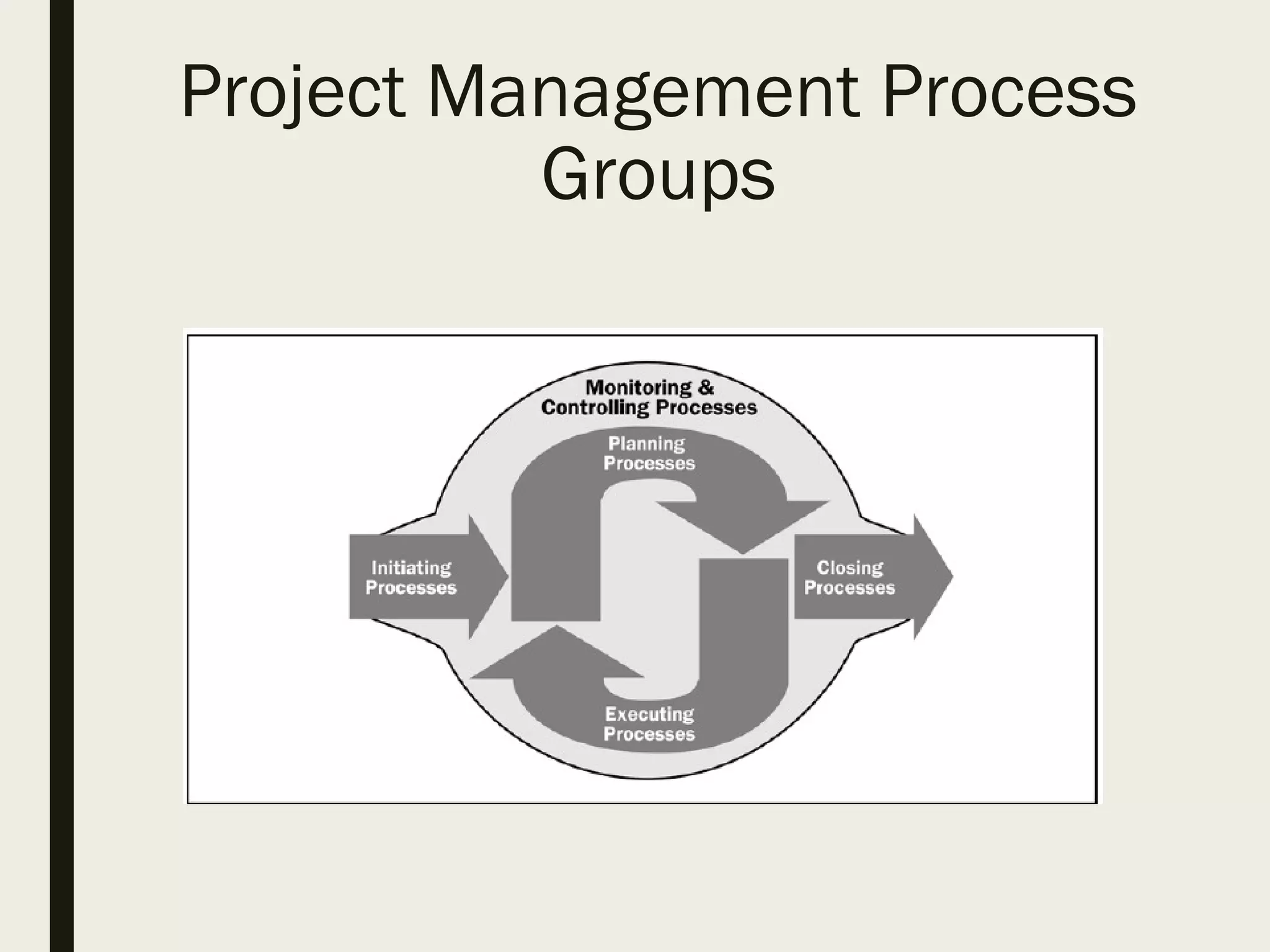
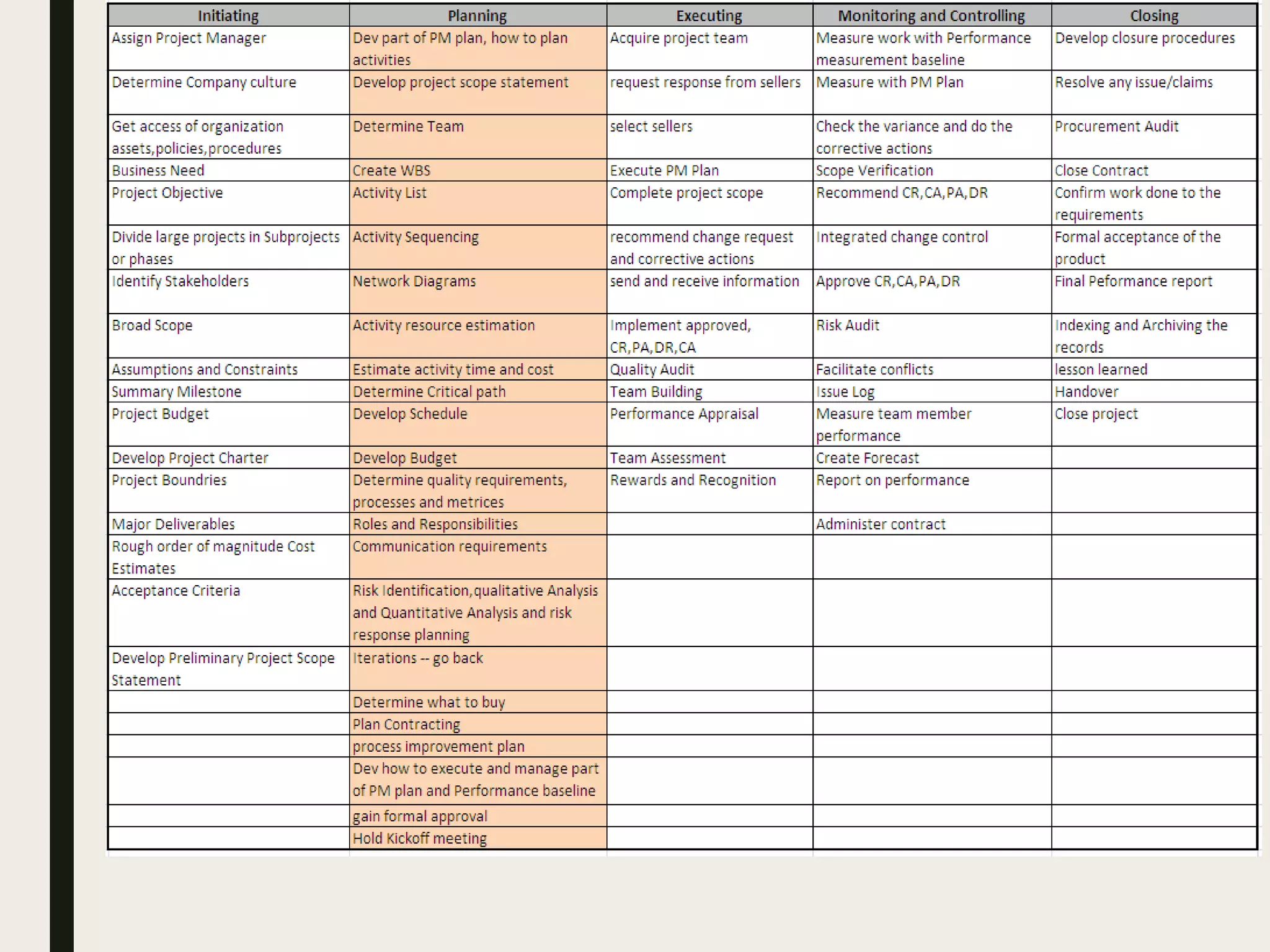
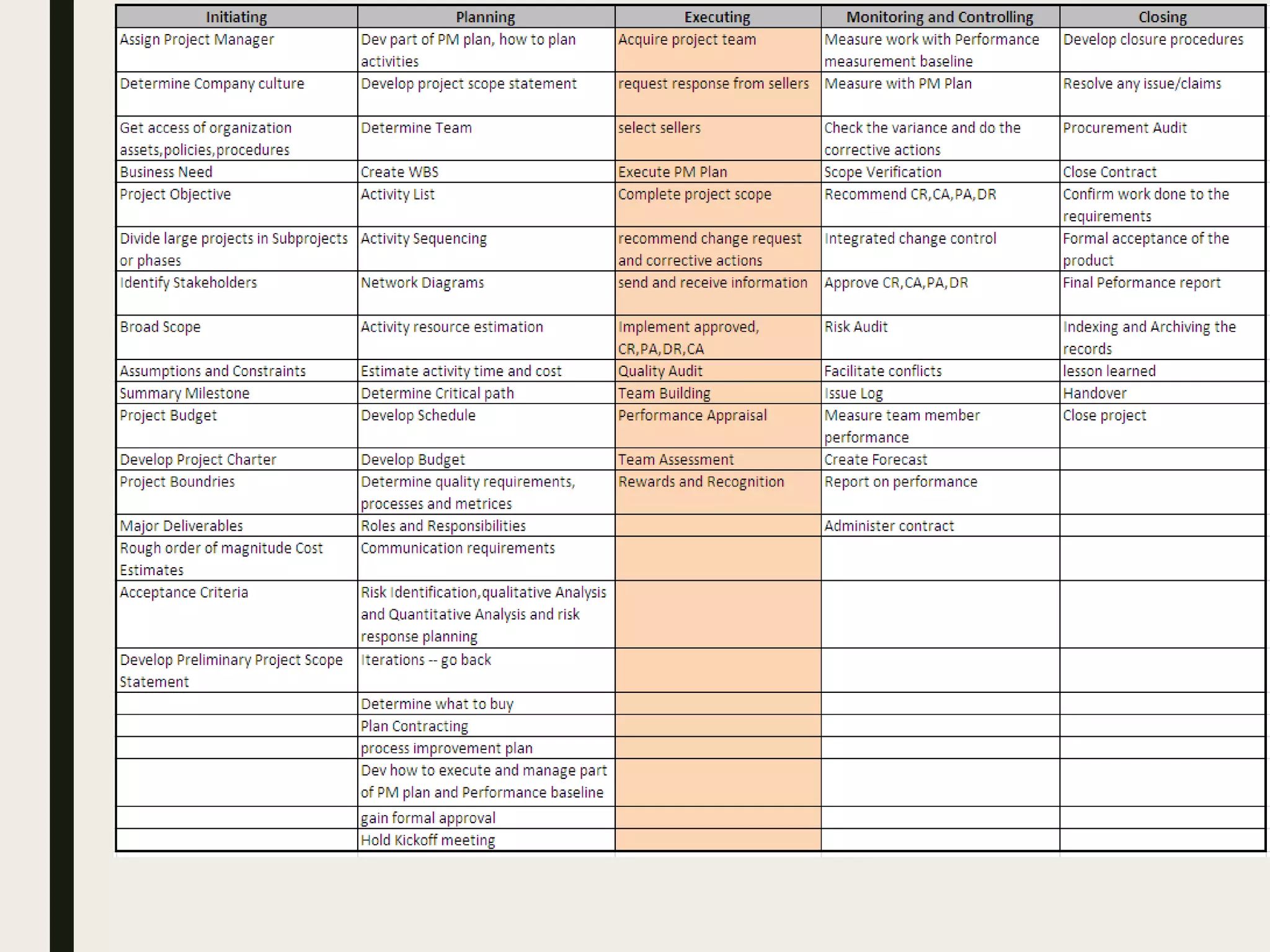
Project Management Process
Groups
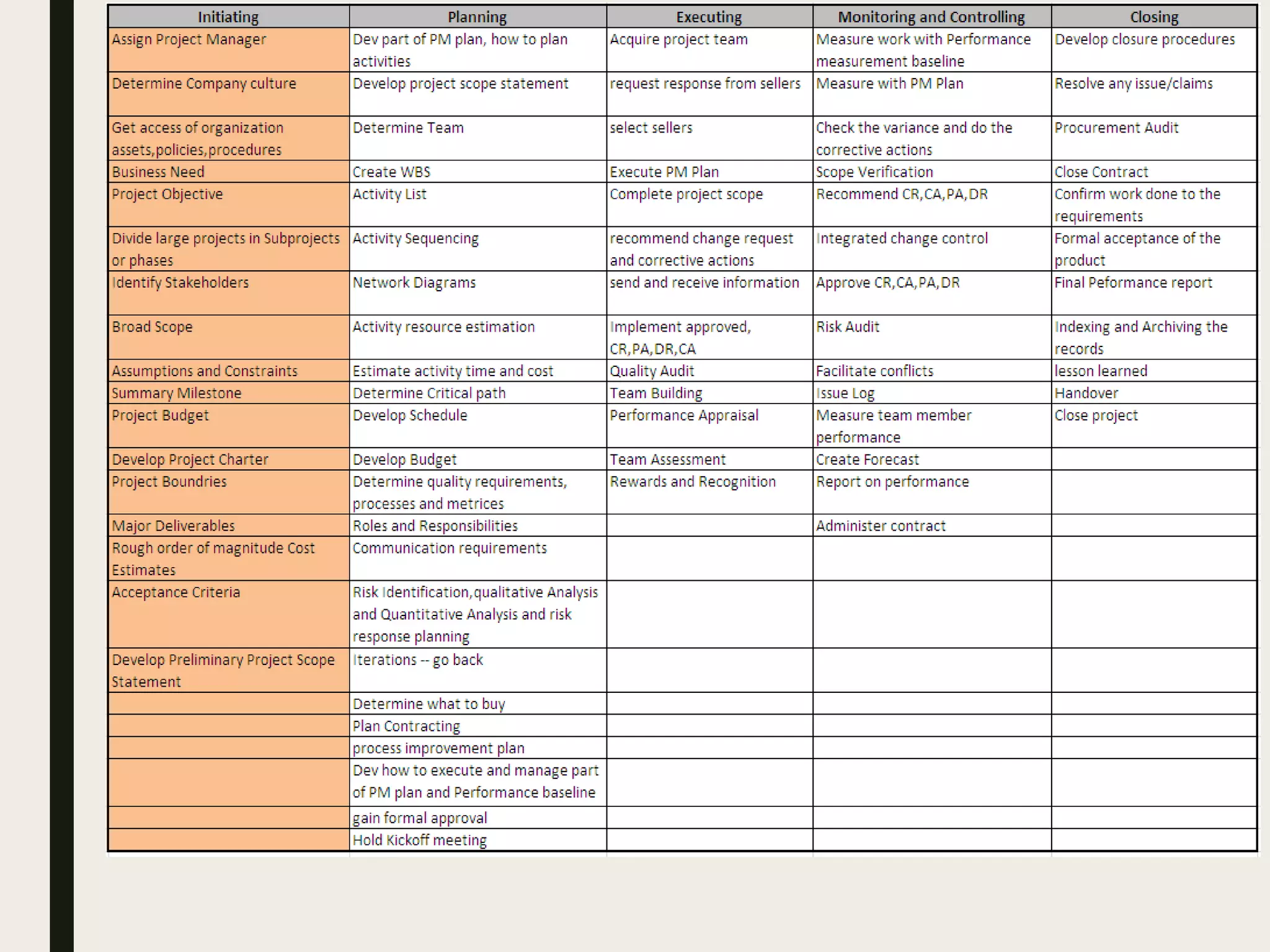
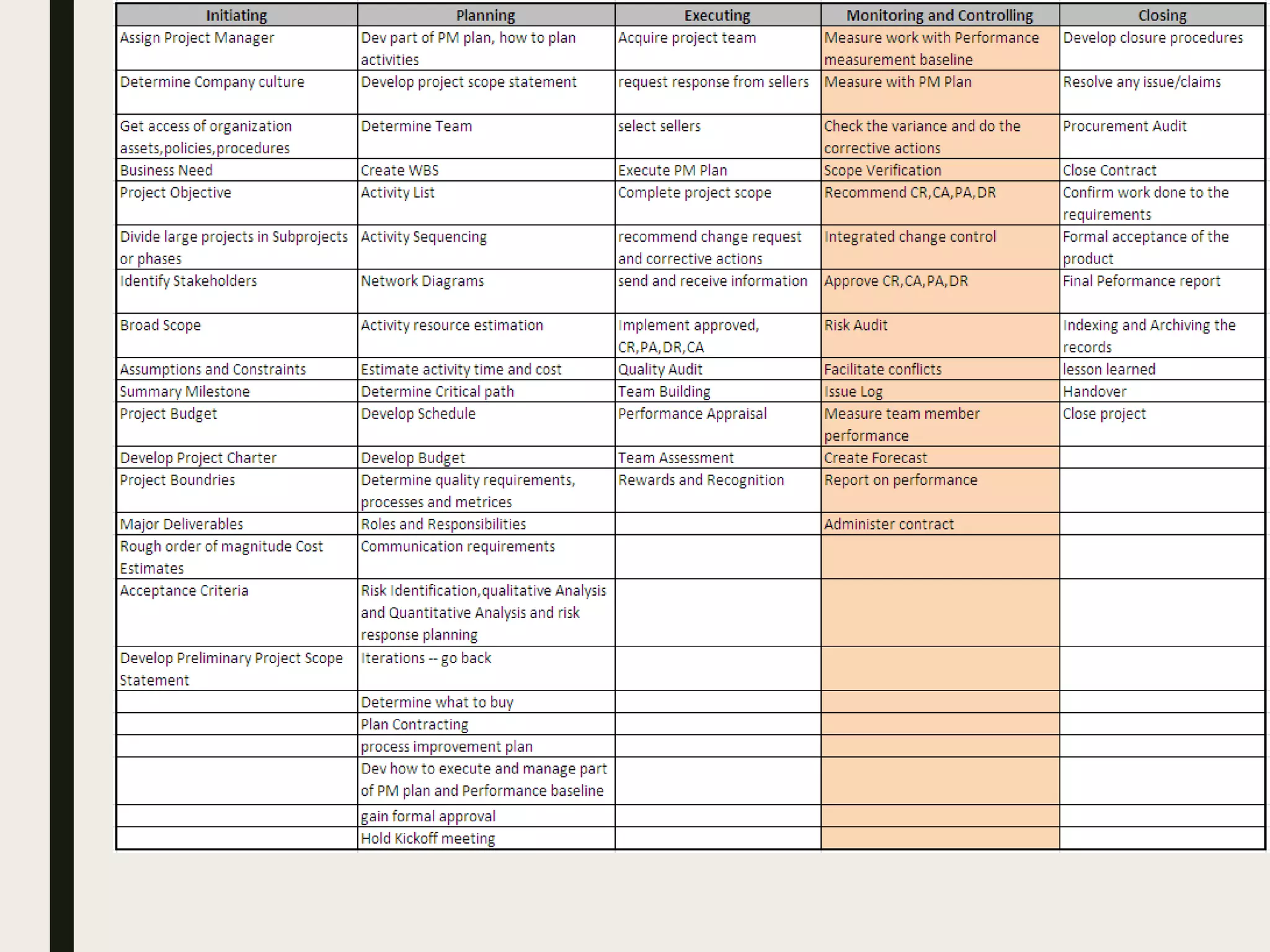
Initiating Process Group
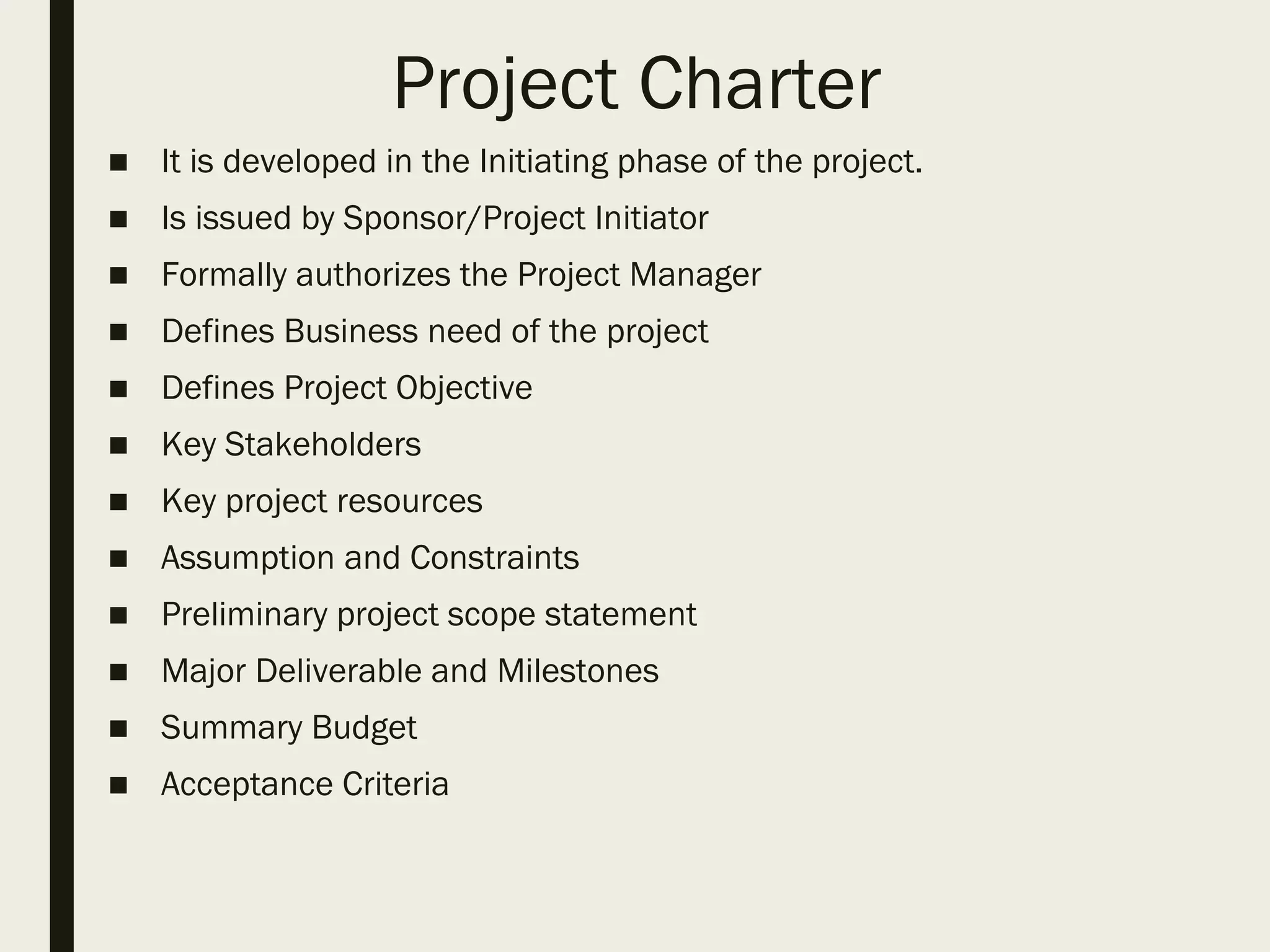
Project Charter
■ It is developed in the Initiating phase of the project.
■ Is issued by Sponsor/Project Initiator
■ Formally authorizes the Project Manager
■ Defines Business need of the project
■ Defines Project Objective
■ Key Stakeholders
■ Key project resources
■ Assumption and Constraints
■ Preliminary project scope statement
■ Major Deliverable and Milestones
■ Summary Budget
■ Acceptance Criteria
Planning Process Group
Project Management Plan
■ Project Mgt Plan is developed in the Planning phase of the project.
■ The high level planning is done in the initiating phase of the project.
■ All the outputs of Planning phase are the part of the project mgt plan.
Project Management Plan cont…
■ Project Plan includes following documents:
– Management Plan to describe how to plan, execute and control for all
the knowledge areas(Scope, Time, Cost, Quality, HR, Communication,
Risk and Procurement)
– Project Scope Statement
– WBS, WBS Dictionary
– Activity List and Activity Network Diagram
– Project Schedule
– Project Budget
– Staffing Management Plan
– RAM,RBS,OBS
– Change Control Plan
– Process Improvement Plan, Quality Metrics, Quality Checklist
– Risk Register
– Procurement Documents(RFP,RFQ, Contract Statement of Work)
Project Scope Management
■ 3 Major documents for project are
– Project Charter- Answers Why
– Scope Statement – Answers What
– Project Management Plan – Answers How
■ Scope Statement
– Is the only work required to be done for the project
– Contains a list of project deliverables
– Also includes
■ Project Objectives and requirements
■ Boundaries and deliverables
■ Constraints and assumptions
■ Acceptance Criteria
Project Scope Management
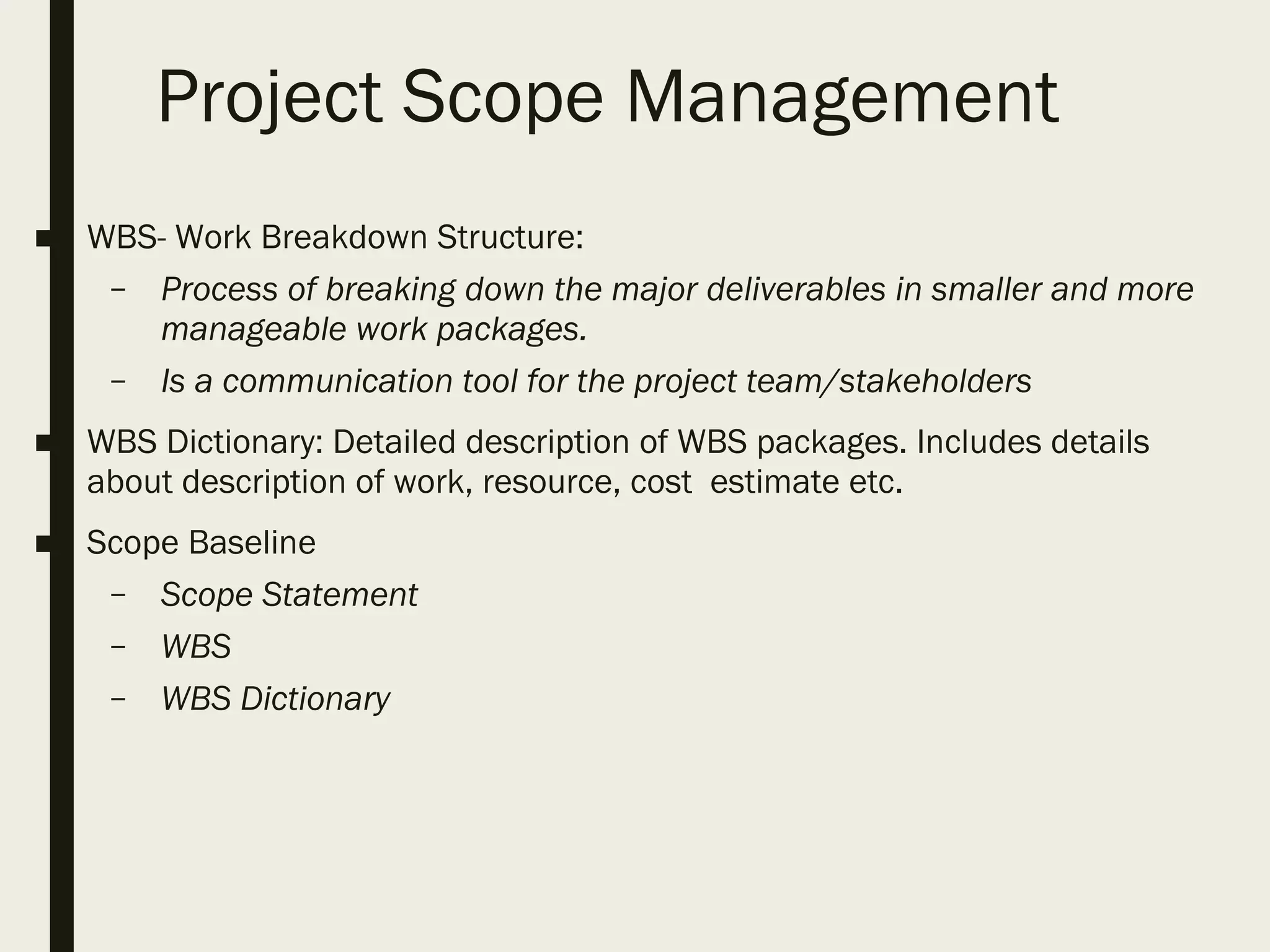
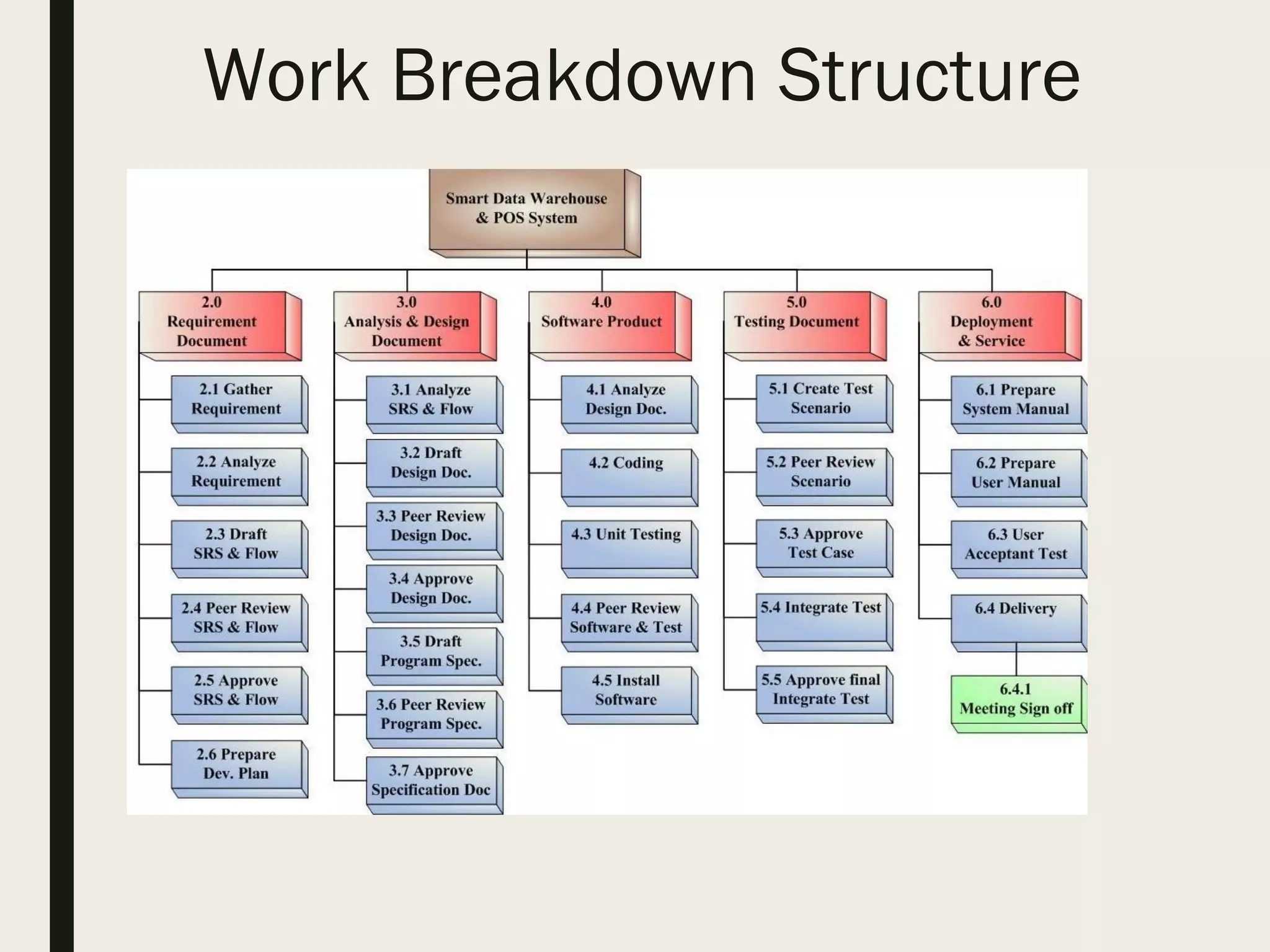
■ WBS- Work Breakdown Structure:
– Process of breaking down the major deliverables in smaller and more
manageable work packages.
– Is a communication tool for the project team/stakeholders
■ WBS Dictionary: Detailed description of WBS packages. Includes details
about description of work, resource, cost estimate etc.
■ Scope Baseline
– Scope Statement
– WBS
– WBS Dictionary
Work Breakdown Structure
Project Time Management
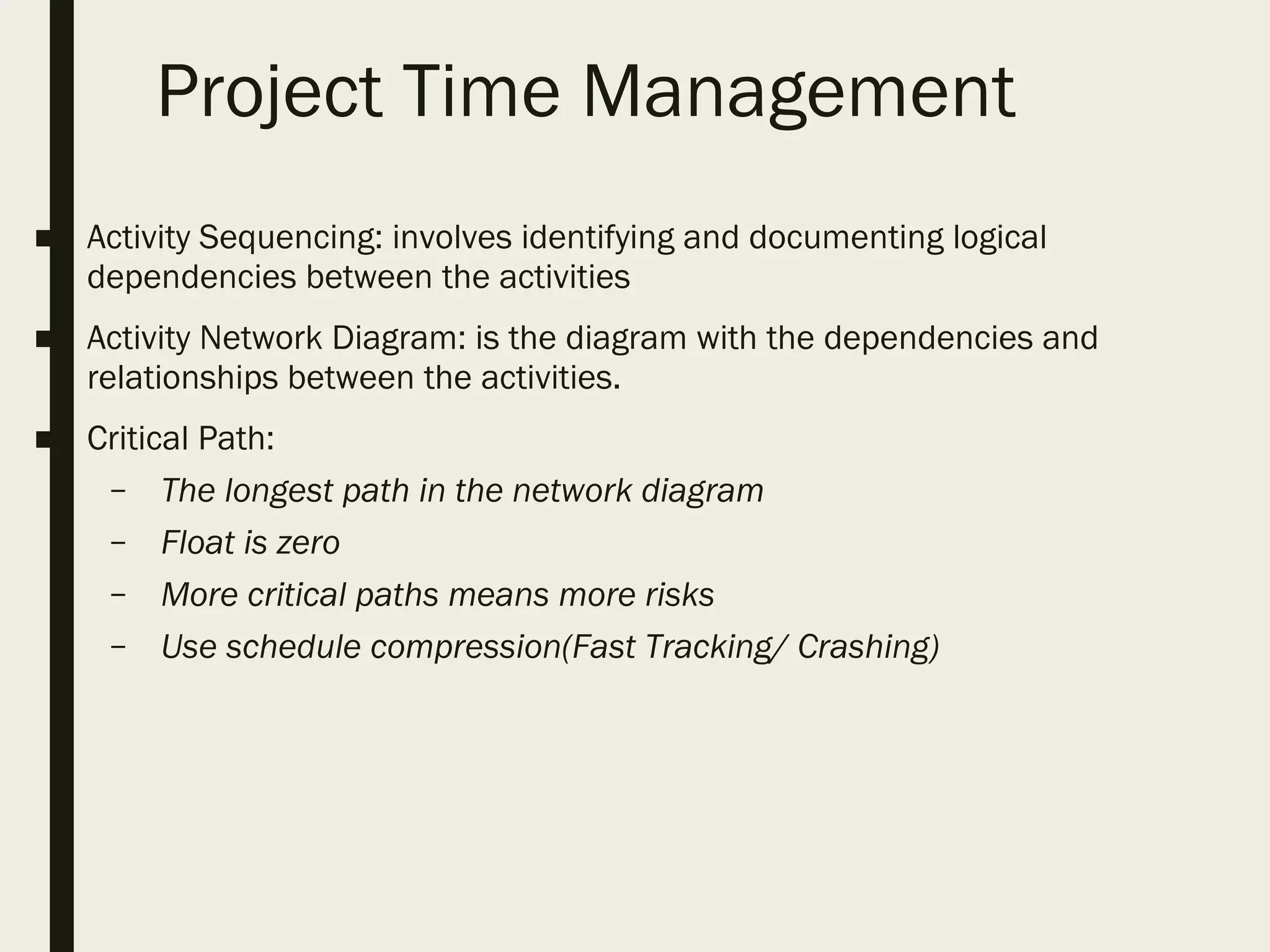
■ Activity Sequencing: involves identifying and documenting logical
dependencies between the activities
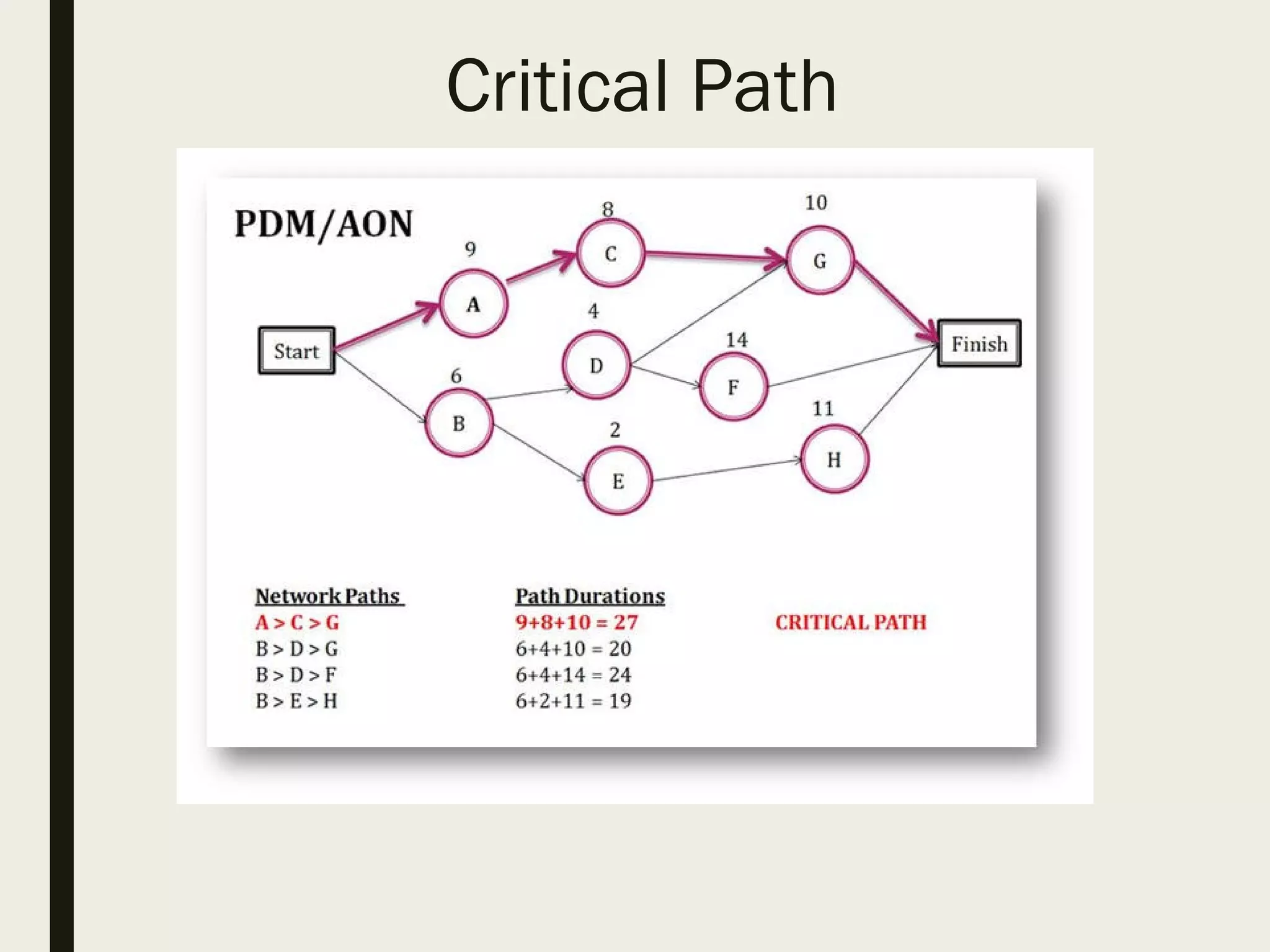
■ Activity Network Diagram: is the diagram with the dependencies and
relationships between the activities.
■ Critical Path:
– The longest path in the network diagram
– Float is zero
– More critical paths means more risks
– Use schedule compression(Fast Tracking/ Crashing)
Critical Path
Project Time Management
■ Top-Down/Analogous Estimate:
– In the initial phase of the project
– Derived using the actual duration of the previous, similar activities.
– When the scope is not well defined
■ Bottom-Up Estimate:
– Uses WBS and Activity List
– To be used when scope of the project is well defined.
– During the later stage of the project
– Time consuming technique
– More accurate
■ Three Point Estimate:
– O – Optimistic, P- Pessimistic, M –Most Likely activity duration estimate
– Standard Average= (O+M+P)/3
Project Time Management
■ Reserve Analysis: Adding additional time to project schedule/activities
– Contingency Reserves: are for known risks
– Management Reserves: are for unknown risks
■ Schedule Compression: Techniques to shorten to project schedule without
changing the scope
– Crashing:
■ Involve more people and resources
■ More cost
– Fast Tracking
■ Doing Activities in parallel
■ More risk
Project Cost Management
■ Activity Cost Estimating: Developing an approximation of the cost of the
resources required to complete the project activity.
■ Cost Baseline= Sum of Cost of all the Activities+ Contingency Reserve
■ Cost Budget= Cost Baseline + Management Reserve
Project Quality Management
■ Define Quality Metrics
■ Process Improvement Plan: Procedure or steps to analyze processes to
identify non-value added processes/activities.
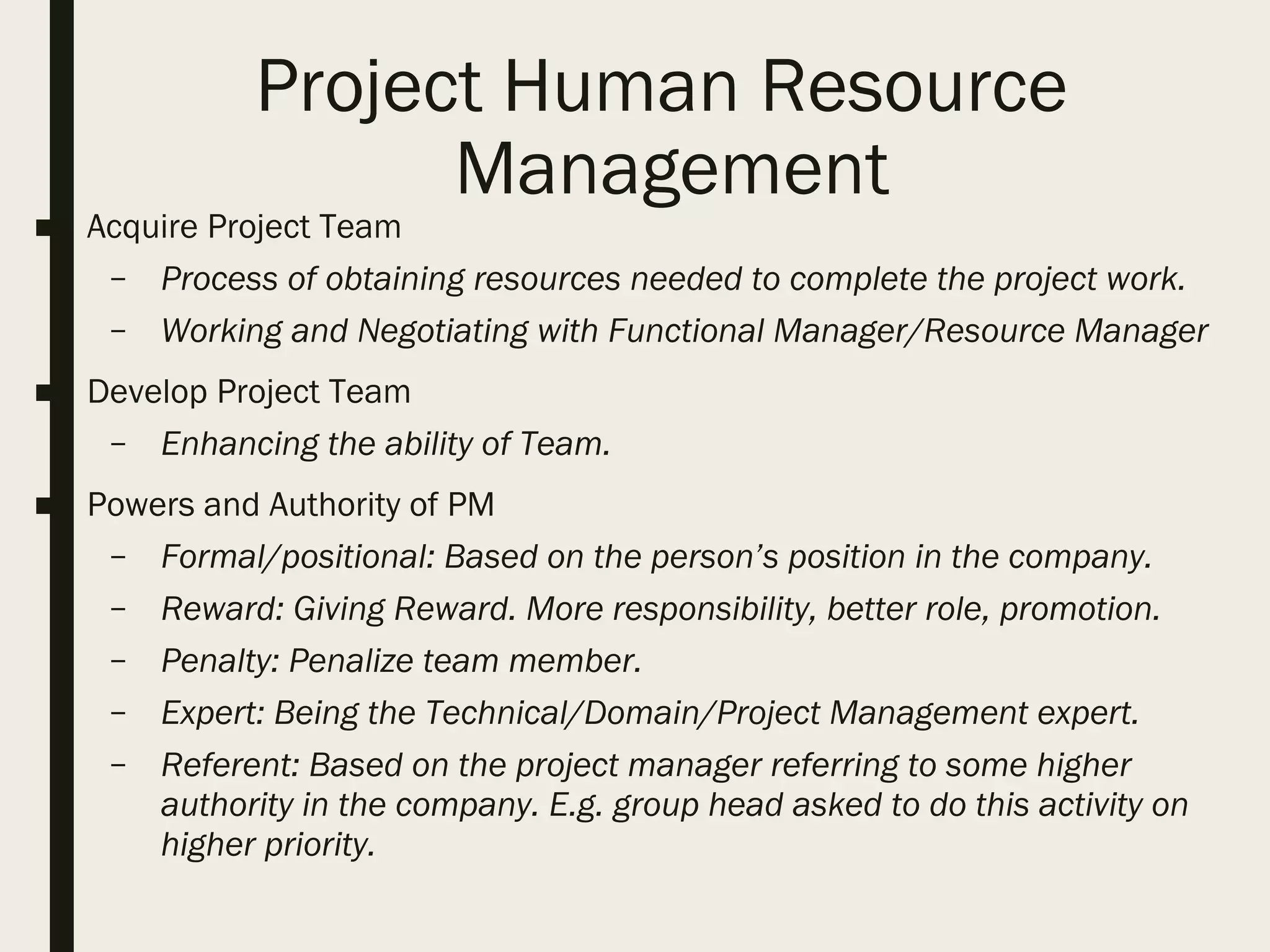
Project Human Resource
Management
■ Staffing Management Plan:
■ How staff will be acquired
■ Timetable for adding staff
■ When and how team member will be added to and released from the
project.
■ Training needs of the team members
■ Recognition and Reward system
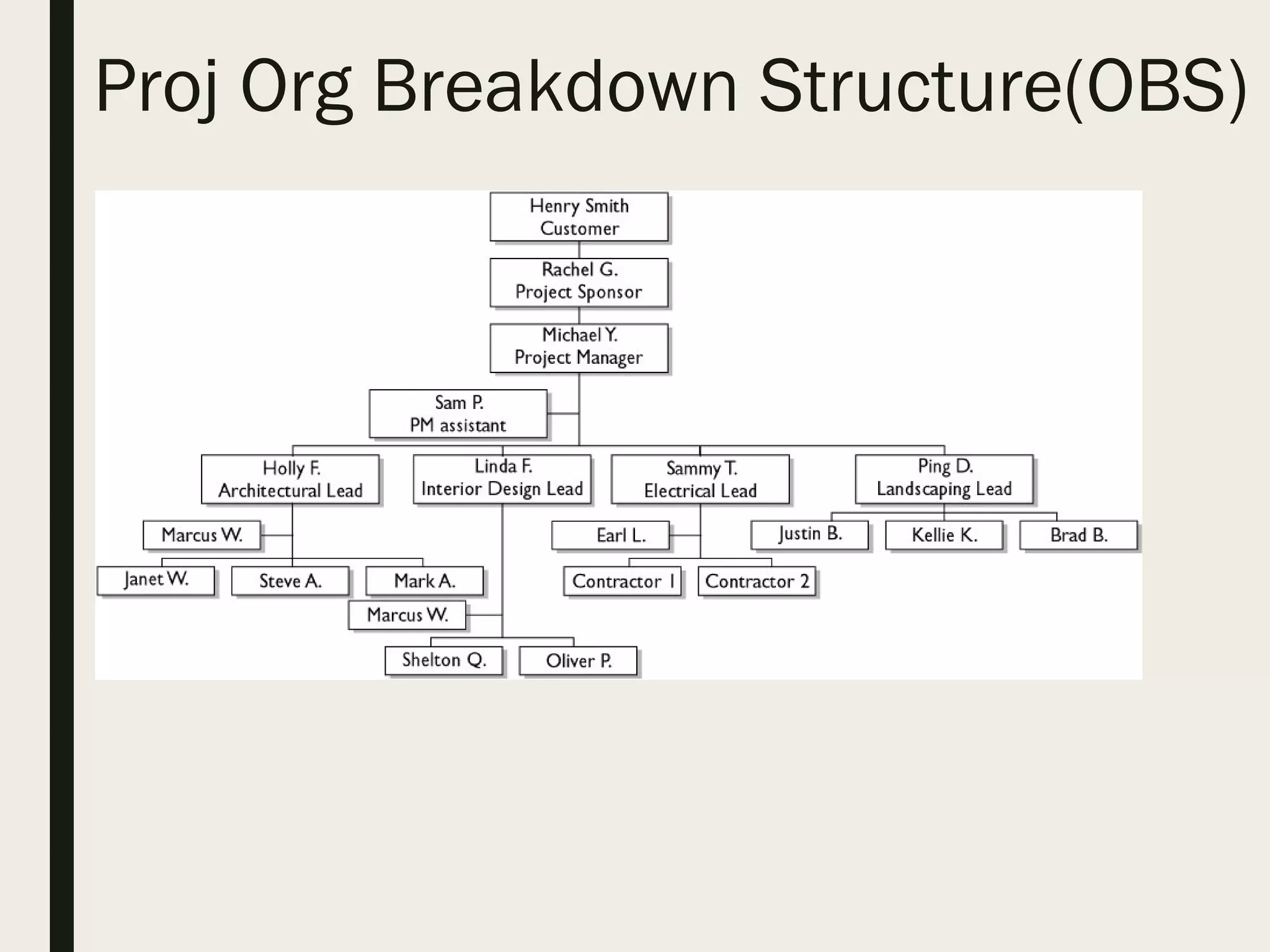
Proj Org Breakdown Structure(OBS)
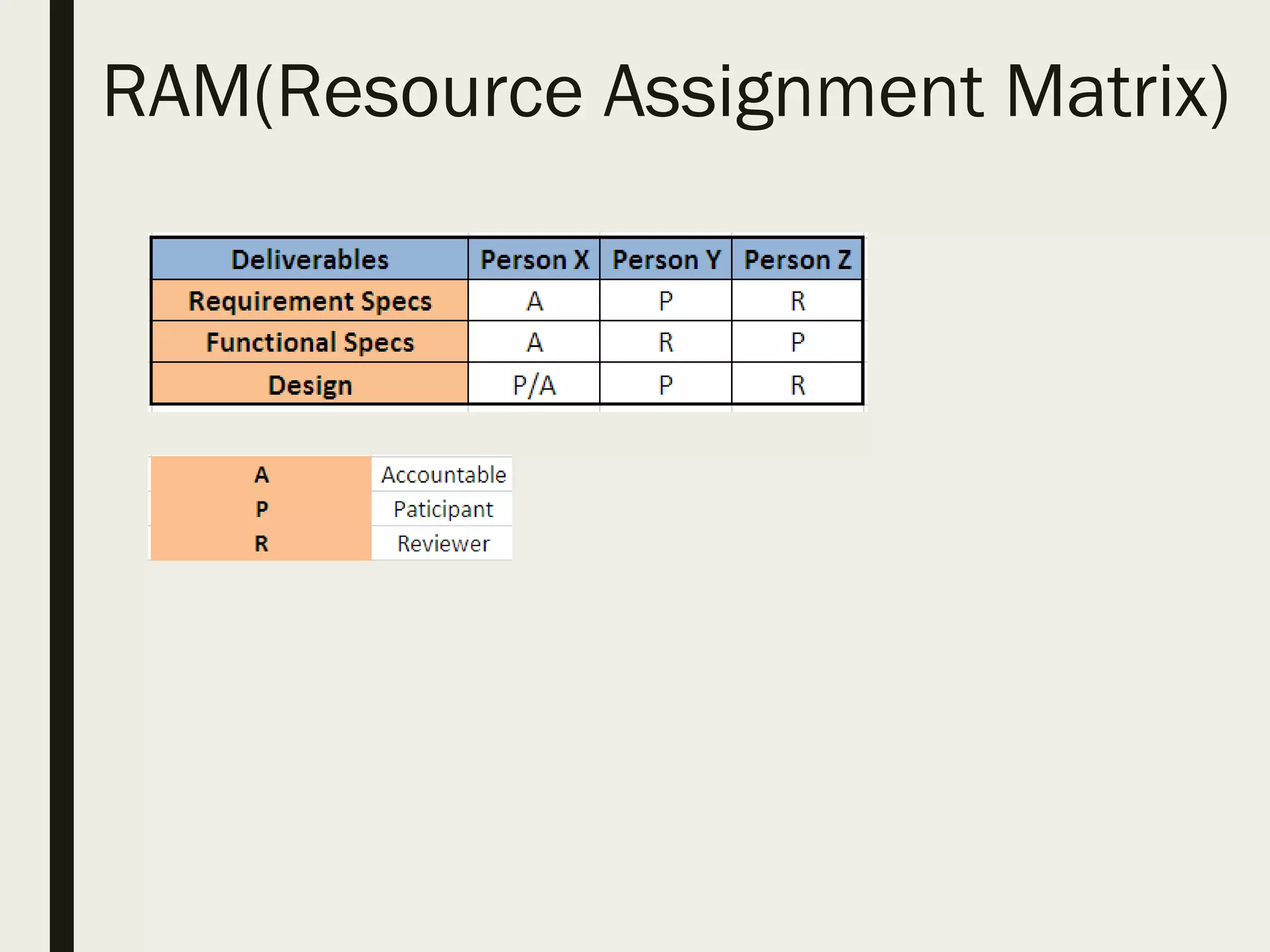
RAM(Resource Assignment Matrix)
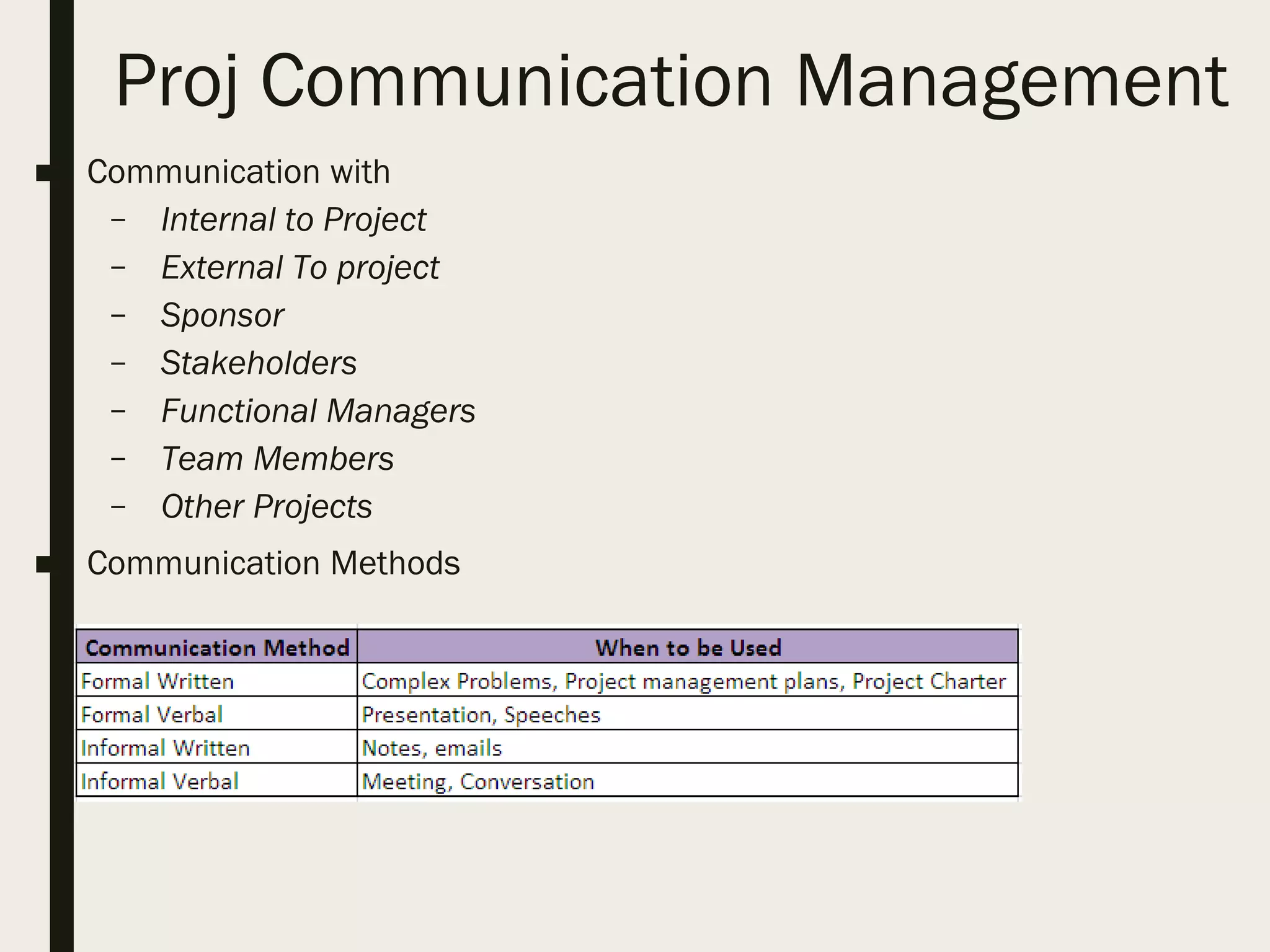
Proj Communication Management
■ Communication with
– Internal to Project
– External To project
– Sponsor
– Stakeholders
– Functional Managers
– Team Members
– Other Projects
■ Communication Methods
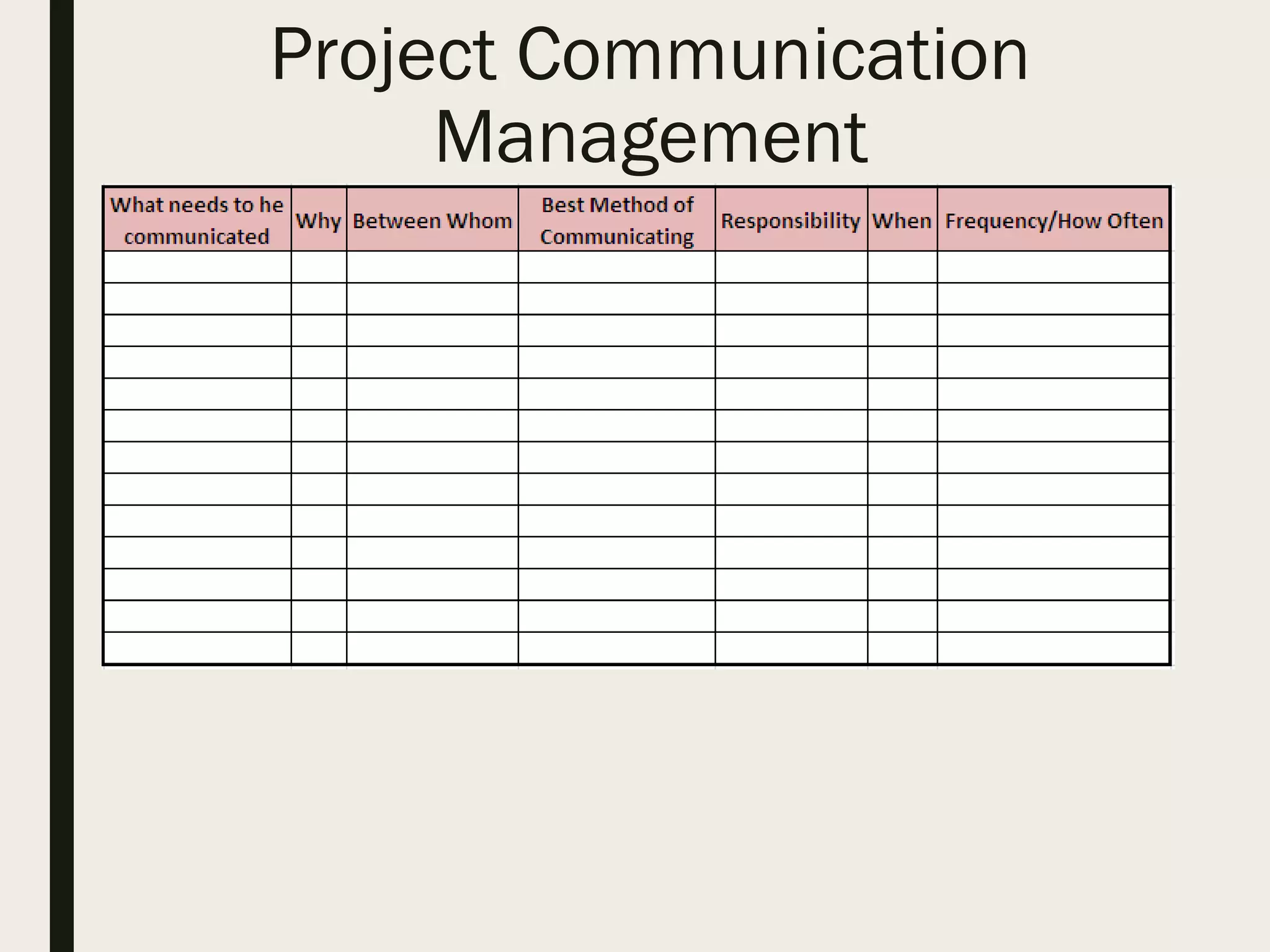
Project Communication
Management
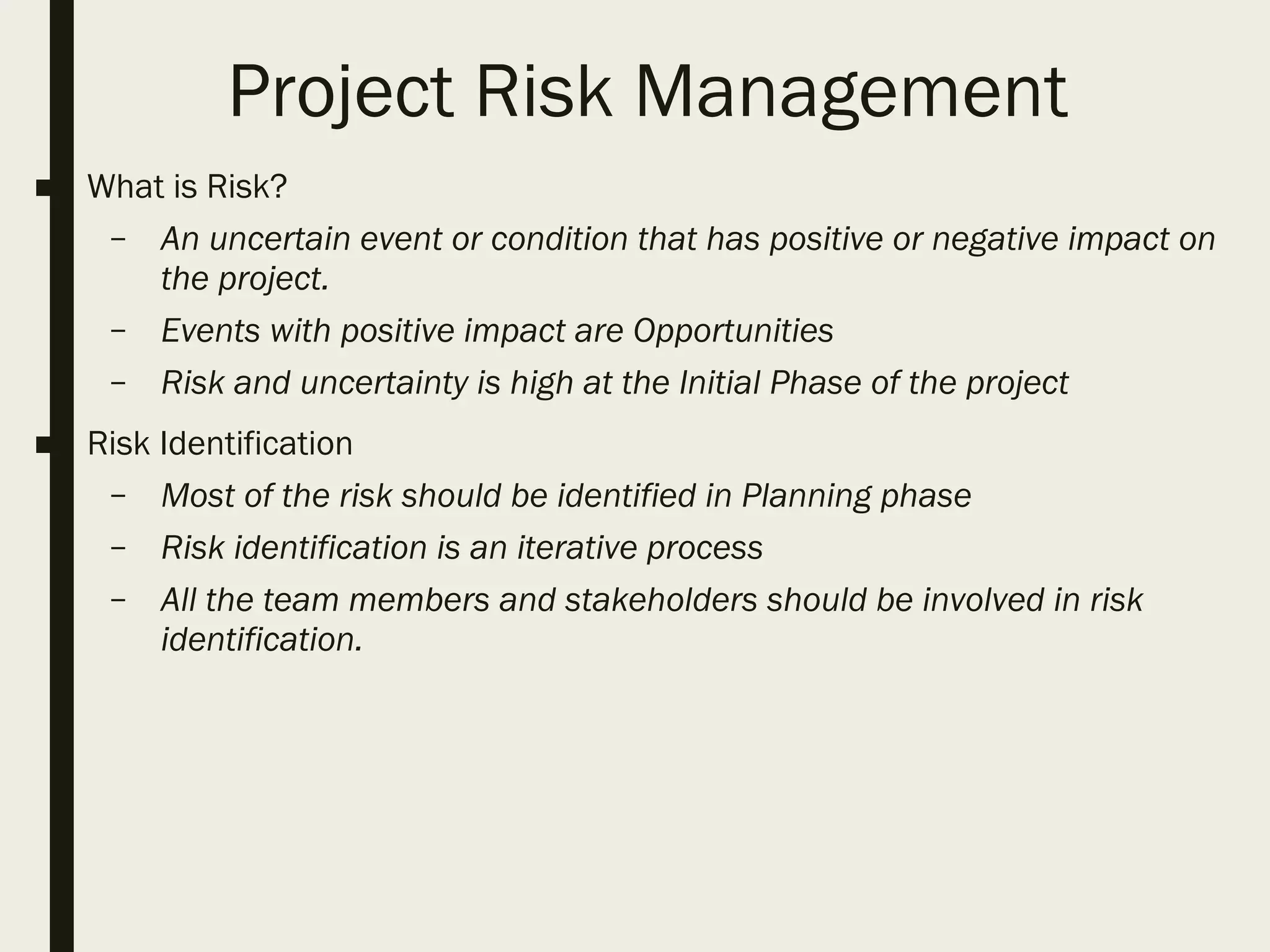
Project Risk Management
■ What is Risk?
– An uncertain event or condition that has positive or negative impact on
the project.
– Events with positive impact are Opportunities
– Risk and uncertainty is high at the Initial Phase of the project
■ Risk Identification
– Most of the risk should be identified in Planning phase
– Risk identification is an iterative process
– All the team members and stakeholders should be involved in risk
identification.
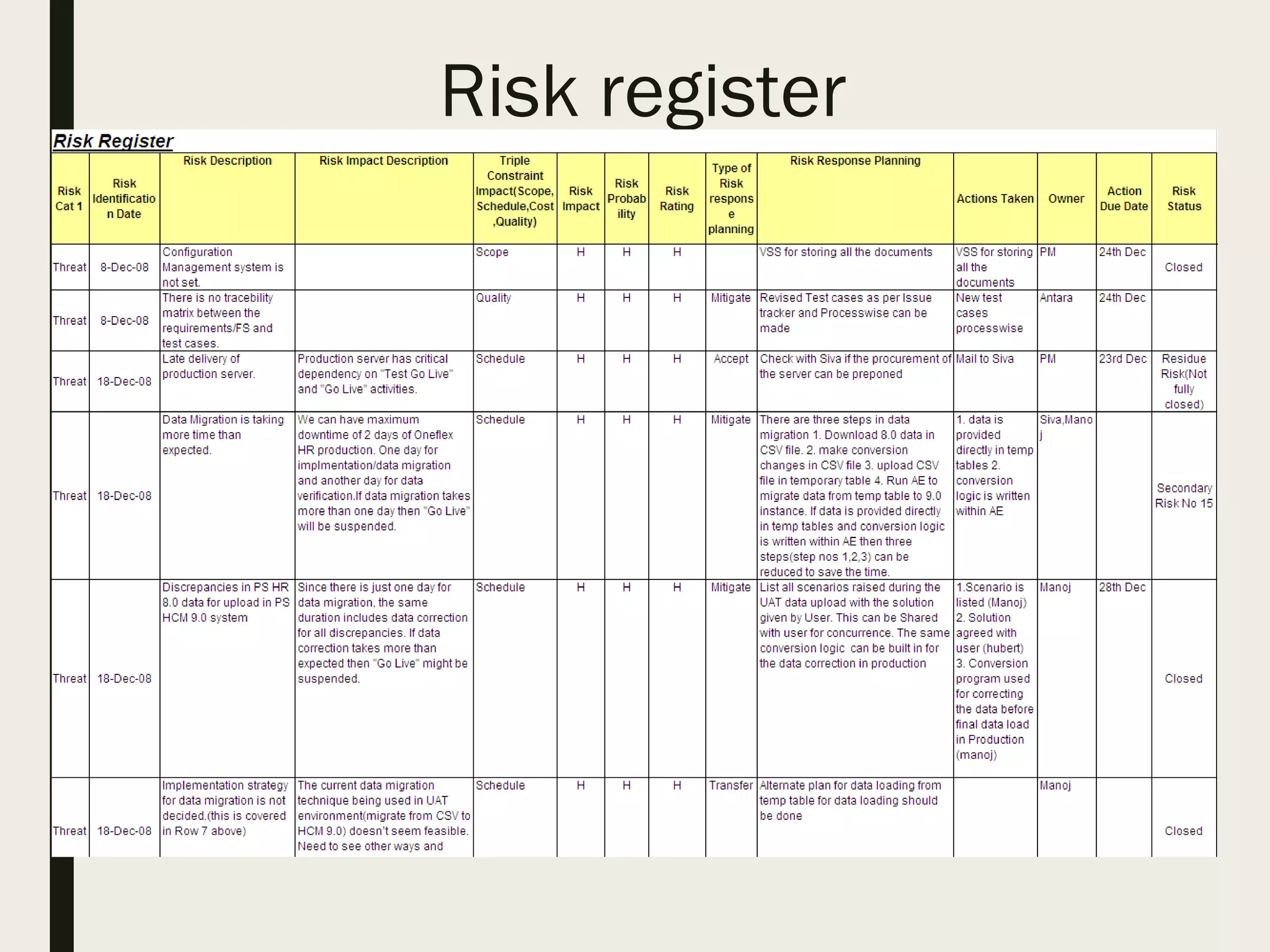
Risk register
Project Risk Management
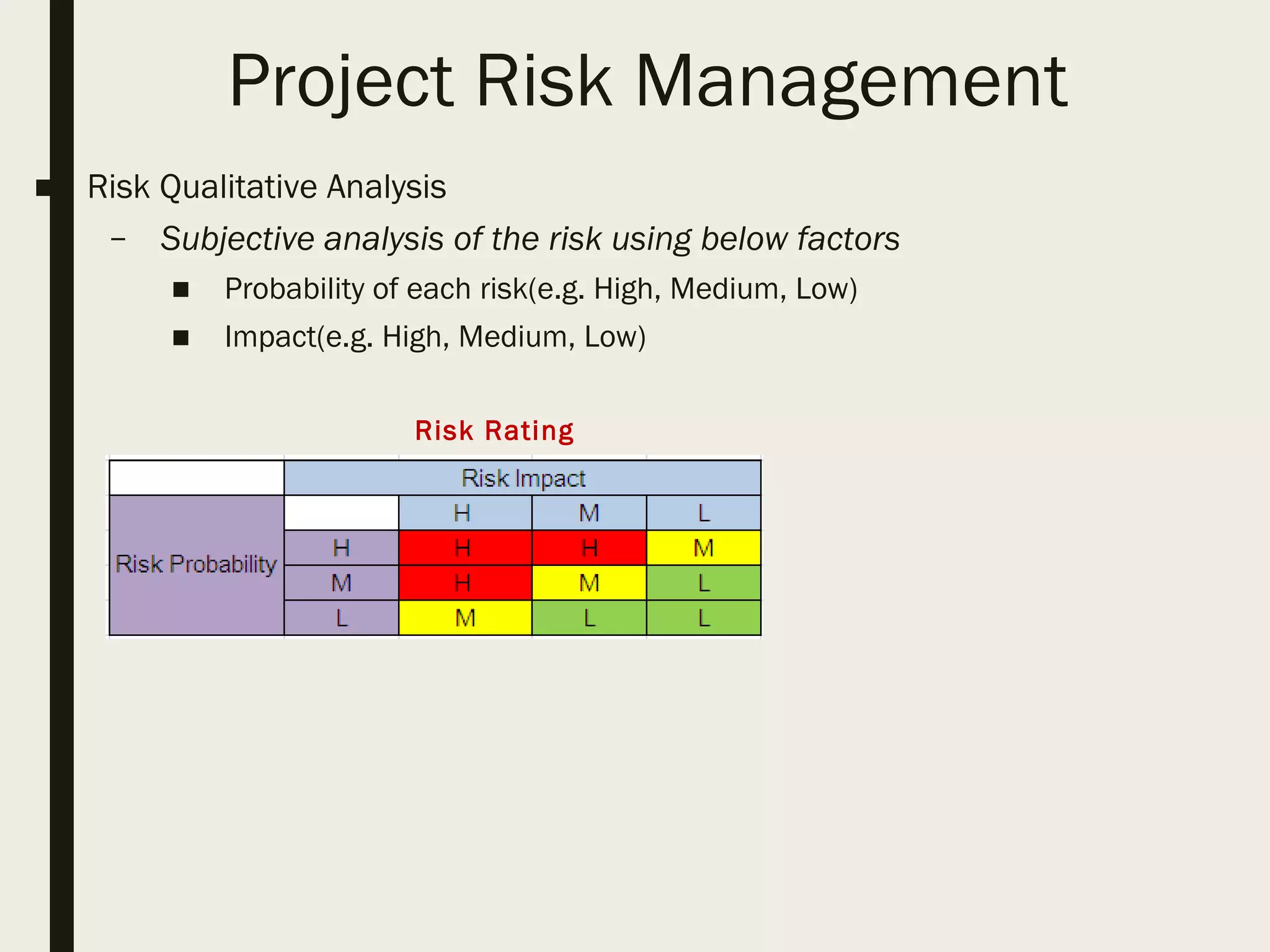
■ Risk Qualitative Analysis
– Subjective analysis of the risk using below factors
■ Probability of each risk(e.g. High, Medium, Low)
■ Impact(e.g. High, Medium, Low)
Risk Rating
Project Risk Management
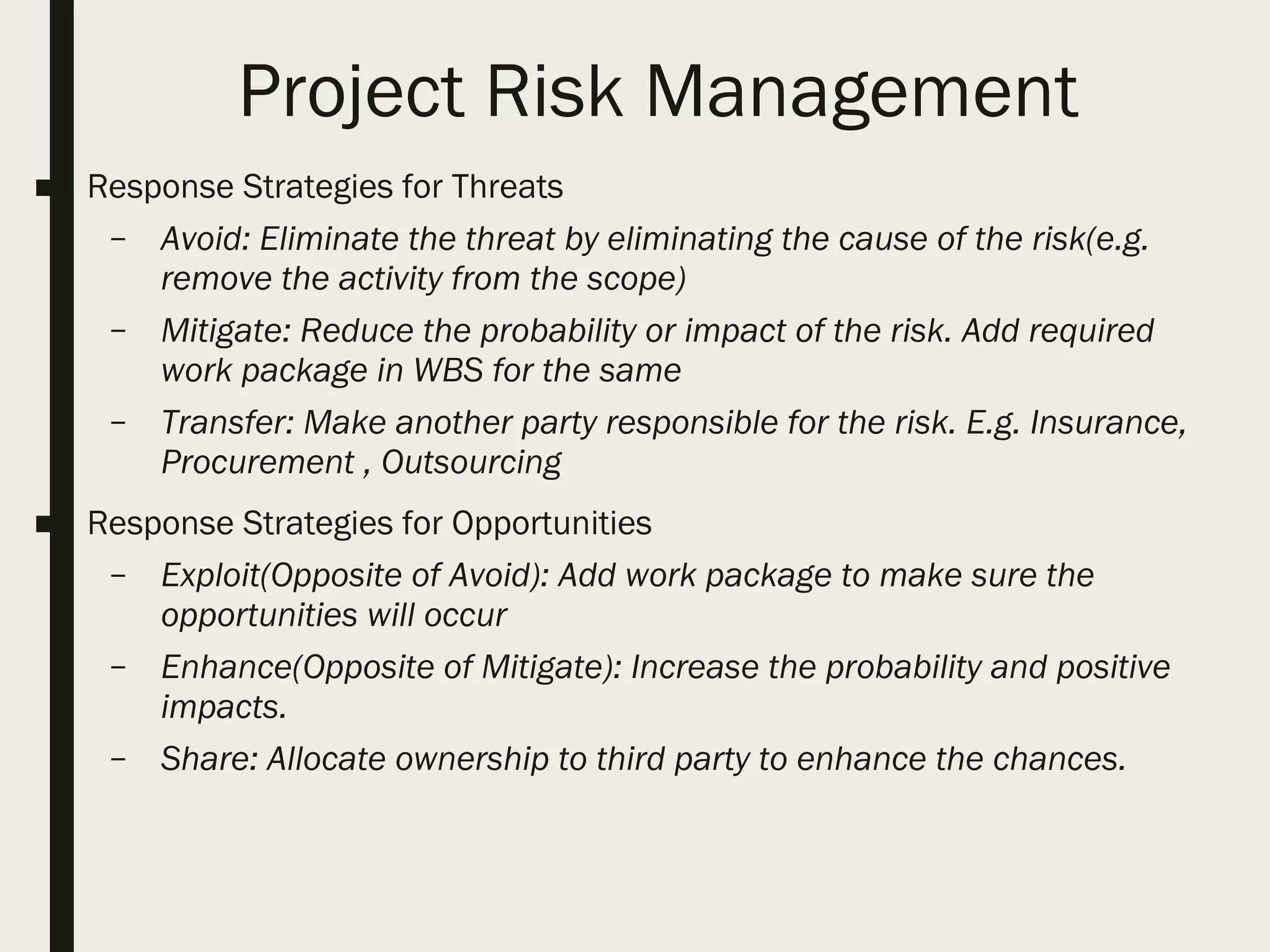
■ Response Strategies for Threats
– Avoid: Eliminate the threat by eliminating the cause of the risk(e.g.
remove the activity from the scope)
– Mitigate: Reduce the probability or impact of the risk. Add required
work package in WBS for the same
– Transfer: Make another party responsible for the risk. E.g. Insurance,
Procurement , Outsourcing
■ Response Strategies for Opportunities
– Exploit(Opposite of Avoid): Add work package to make sure the
opportunities will occur
– Enhance(Opposite of Mitigate): Increase the probability and positive
impacts.
– Share: Allocate ownership to third party to enhance the chances.
Project Procurement Management
■ Make-or-Buy Analysis:
– Buy factors:
■ To decrease the risk
■ Cost of buying Vs Cost of Making
– Make Factors:
■ Cost of buying Vs Cost of Making
■ To retain control
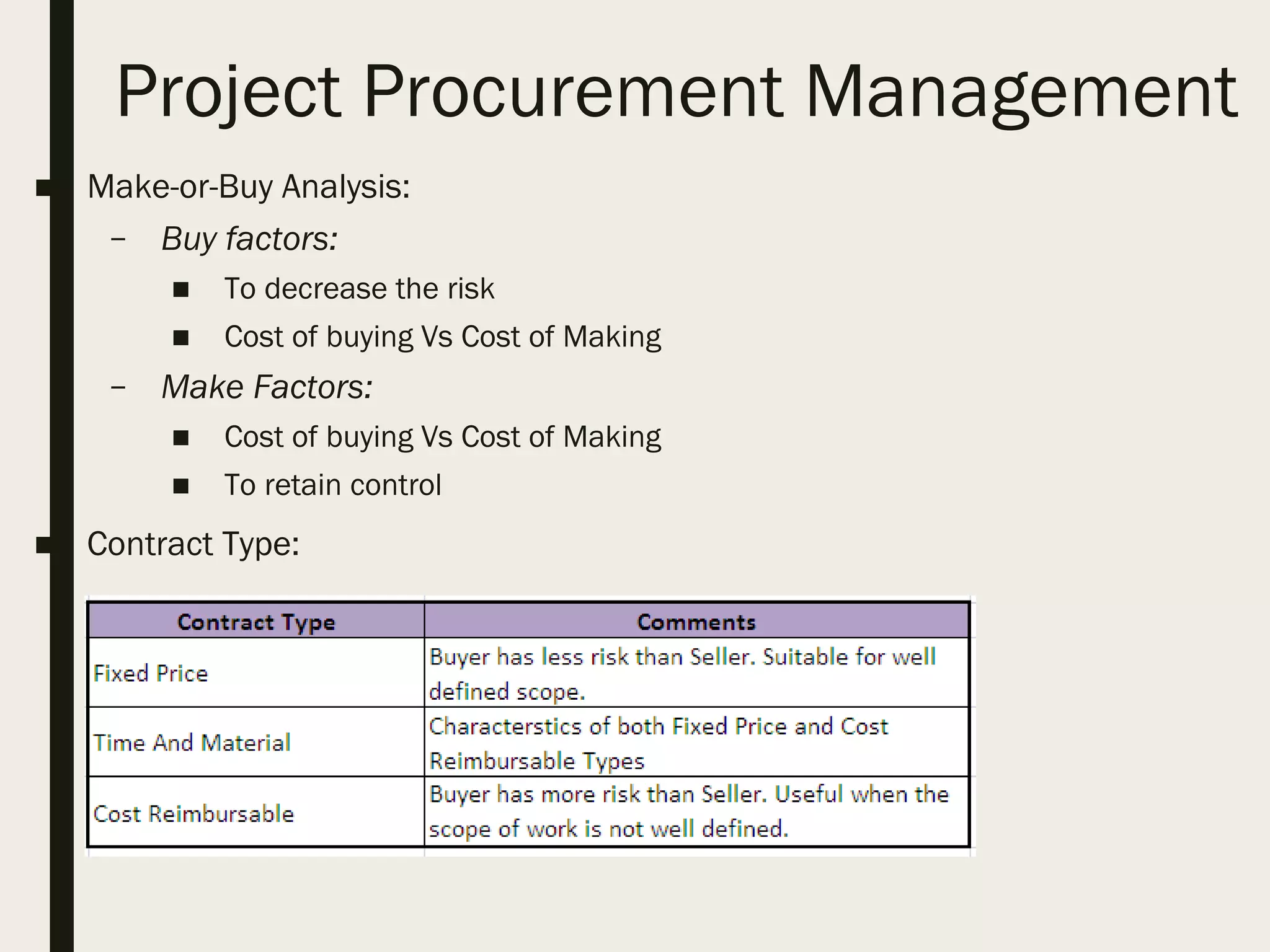
■ Contract Type:
Project Procurement Management
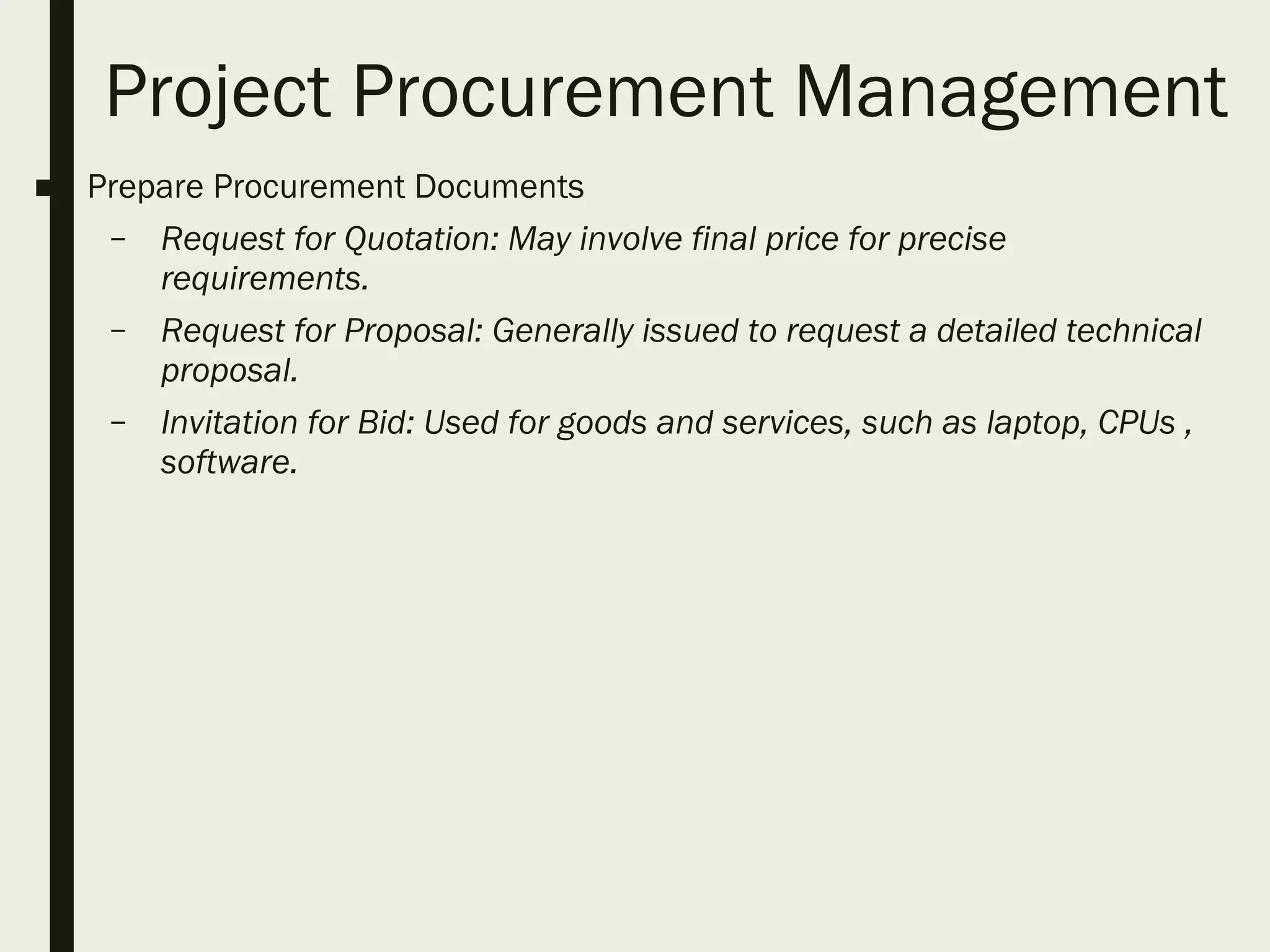
■ Prepare Procurement Documents
– Request for Quotation: May involve final price for precise
requirements.
– Request for Proposal: Generally issued to request a detailed technical
proposal.
– Invitation for Bid: Used for goods and services, such as laptop, CPUs ,
software.
Executing Process Group
Project Human Resource
Management
■ Acquire Project Team
– Process of obtaining resources needed to complete the project work.
– Working and Negotiating with Functional Manager/Resource Manager
■ Develop Project Team
– Enhancing the ability of Team.
■ Powers and Authority of PM
– Formal/positional: Based on the person’s position in the company.
– Reward: Giving Reward. More responsibility, better role, promotion.
– Penalty: Penalize team member.
– Expert: Being the Technical/Domain/Project Management expert.
– Referent: Based on the project manager referring to some higher
authority in the company. E.g. group head asked to do this activity on
higher priority.
Project Quality Management
■ Perform Quality Assurance
■ Perform Quality Audits
■ Recommend Corrective Actions
Monitoring and
Controlling Process
Group
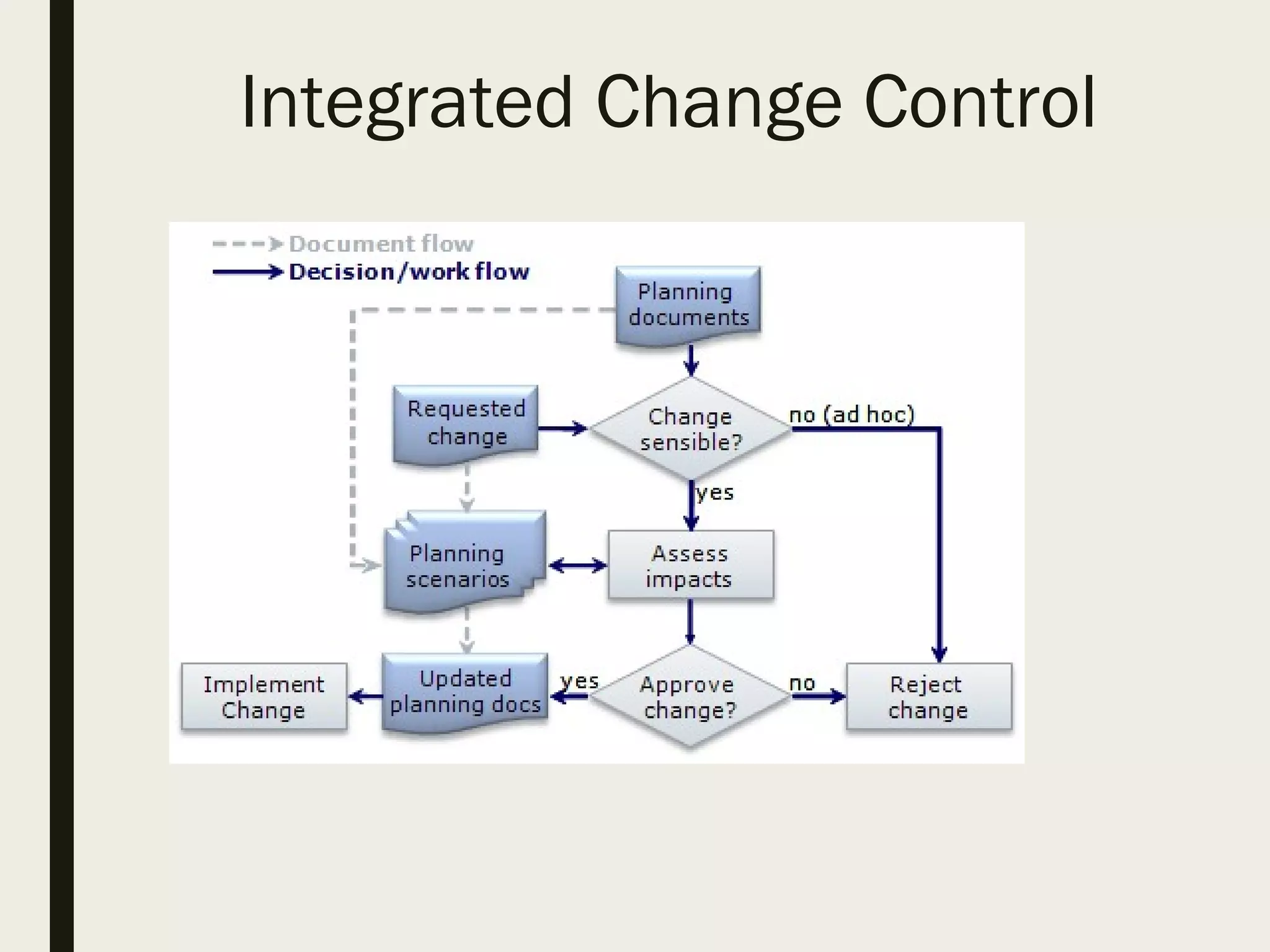
Integrated Change Control
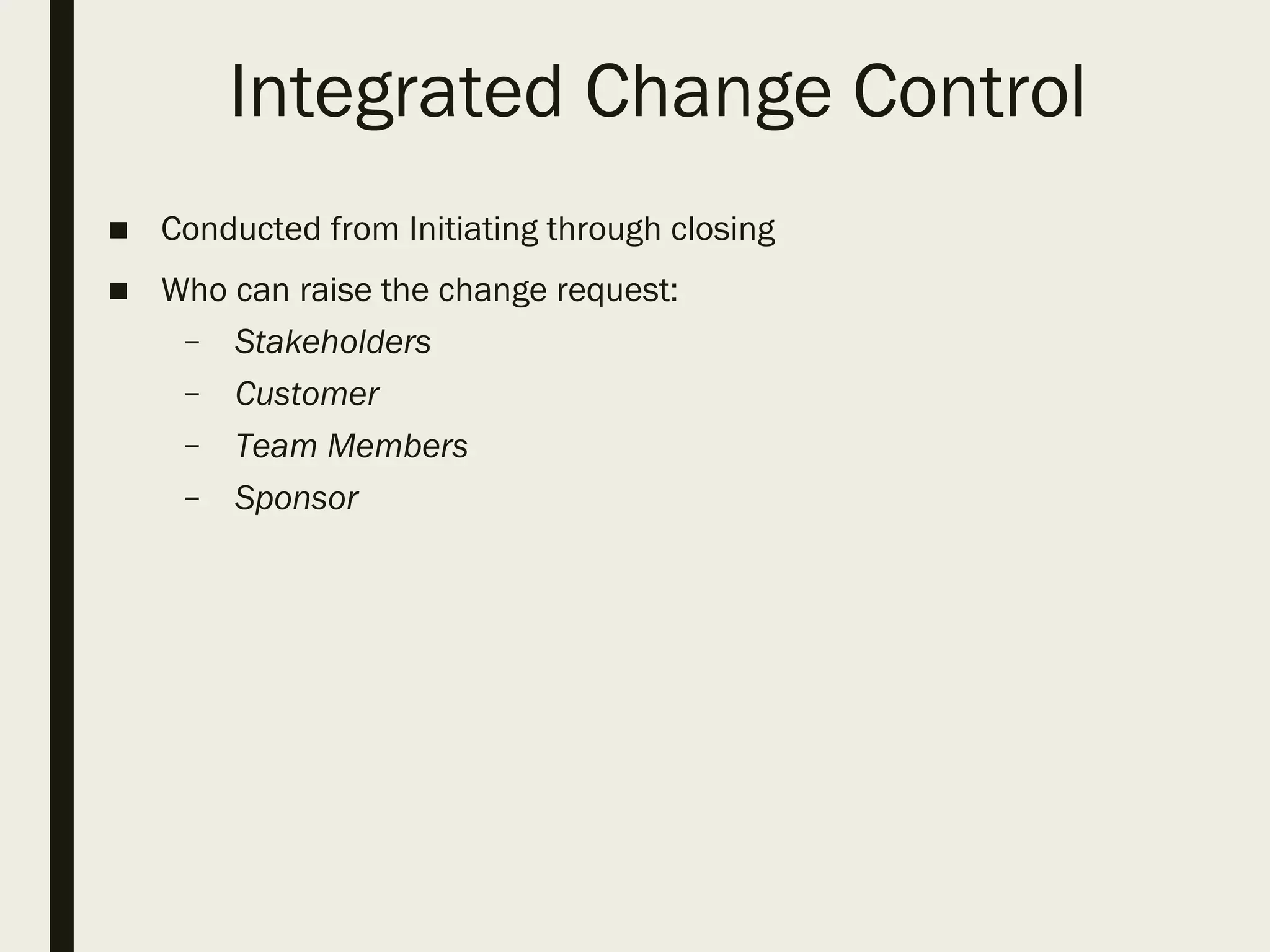
■ Conducted from Initiating through closing
■ Who can raise the change request:
– Stakeholders
– Customer
– Team Members
– Sponsor
Integrated Change Control
■ Impact Analysis needs to be done by Project Manager
■ Project Manger needs to verify Triple Constraint Impact.
■ Decision is taken by Change Control Board.
■ All the required Planning documents and performance
measurement baselines needs to be updated accordingly
Performance Reporting
■ Measure work with Performance Baseline
■ Generate Performance Reports
– Status Report: What is achieved so far.
– Forecast Report: Predicts future project status and
progress.
– Variance Report: Compares actual project results with
planned results. Used to analyze Cost and Schedule
variances.
– Progress Report
■ Scope Verification:
– Process of obtaining formal acceptance of completed
deliverables from Stakeholders
– Scope Baseline(Scope Statement, WBS and WBS
dictionary) is used to inspect and verify.
■ Manage Project Team
– Performance Appraisals
– Conflict Resolutions
■ Sources of Conflicts:
– Schedule
– Project Priorities
– Resources
– Technical Opinions
– Personality
■ Conflict Management Techniques
– Problem Solving: Win-Win
– Forcing: Win-Lose
– Compromising: Lose-Lose
– Smoothening: Lose-yield
– Withdrawal: Lose-Leave
■ Manage Stakeholders
– Resolve stakeholders concerns
Closing Process Group
■ Get Formal acceptance of the product from the customer
■ Close the contract
■ Archive the project records
■ Gather the lesson learned from Team members and
Stakeholders
■ Handover
■ Release the resources
THANKS FOR
YOUR TIME AND
ATTENTION

Project management overview

  • 1.
  • 2.
  • 3.
    What is Project? ■A Project is a: – Temporary endeavor with a beginning and an end – Creates a unique/service/result – Progressively Elaborated, characteristics of the project will be progressively detailed as the project is better understood. – Temporary means every project has a definitive beginning and ending. – Unique means that the deliverables are different in nature even though recurring elements exist. – E.g. Construction of a building, bridge, station, development of product, software, feasibility analysis of requirement, Testing of a product ■ Phase: – To manage the projects effectively the large projects can be divided into project phases.
  • 4.
  • 5.
    Program/Operation ■ Operation: – Operationsare ongoing and repetitive – Example manufacturing, delivery services, teaching a class ■ A Program is a: – Group of interrelated projects – Interrelated could be because sharing resources, result of one is effecting the other. – A large projects divided into multiple projects is also called a program. – This coordination of management provides decreased risk and improved management which can not be achieved by managing them individually.
  • 6.
    Project Management Office ■PMO: – A department that centralizes the management of projects. – It provides policies, procedures, methodologies, templates, tools and techniques for project management. – Provide guidance and training on project management.
  • 7.
  • 8.
    Project Stakeholders Key Stakeholdersare: – Project Manager – Customer/User – Performing Organization: The enterprise whose employees are directly involved in the work of the project – Project Team Member: The group performing the project work – Project Management Team: The member of the project team directly involved in the management activities. – Sponsor: The person/group financing the project. – Influencers: People/group not directly related to acquisition/use of the project but can positively/negatively influence the course of the project. – PMO
  • 9.
    Project Stakeholders cont… ■Stakeholders should be identified in Initiating or Planning Process group. ■ Identifying the stakeholders in the later stage could impede the performance of the project. ■ Project Manager is responsible for managing the expectations of Stakeholders
  • 10.
    Role and Responsibilities ProjectSponsor – Provides Financial resources – Issue/Approve changes Project Charter – Provide Statement of Work(SOW) – Give PM the authority – Determine the priorities between the triple constraint components – Help tradeoffs between crashing, fast tracking and re- estimating – Approve or reject changes(Part of change control board) – Clarify Scope Questions
  • 11.
    Role and Responsibilitiescont… Project Manager – Conduct Stakeholder Analysis – Communicate to stakeholders – Identify Quality Standards – Develop major plans – Manage, lead and develop team – Resolve conflicts and issues – Facilitate risk identification – Performs or delegates the project management activities. – Should perform all the core-PM activities by himself. – Must have authority and accountability to accomplish the project management work. – Is accountable for project failure.
  • 12.
    Role and Responsibilitiescont… Stakeholders are involved in – Project Management Plan Development – Approving project changes – Scope Management – Identifying constraints and risks ■ Customer – Uses the project’s product – Provides clear requirement – Participates in stakeholder analysis – Participates in quality assurance and determining quality policies – Do Scope/delivery verification
  • 13.
  • 14.
  • 16.
    Project Charter ■ Itis developed in the Initiating phase of the project. ■ Is issued by Sponsor/Project Initiator ■ Formally authorizes the Project Manager ■ Defines Business need of the project ■ Defines Project Objective ■ Key Stakeholders ■ Key project resources ■ Assumption and Constraints ■ Preliminary project scope statement ■ Major Deliverable and Milestones ■ Summary Budget ■ Acceptance Criteria
  • 17.
  • 19.
    Project Management Plan ■Project Mgt Plan is developed in the Planning phase of the project. ■ The high level planning is done in the initiating phase of the project. ■ All the outputs of Planning phase are the part of the project mgt plan.
  • 20.
    Project Management Plancont… ■ Project Plan includes following documents: – Management Plan to describe how to plan, execute and control for all the knowledge areas(Scope, Time, Cost, Quality, HR, Communication, Risk and Procurement) – Project Scope Statement – WBS, WBS Dictionary – Activity List and Activity Network Diagram – Project Schedule – Project Budget – Staffing Management Plan – RAM,RBS,OBS – Change Control Plan – Process Improvement Plan, Quality Metrics, Quality Checklist – Risk Register – Procurement Documents(RFP,RFQ, Contract Statement of Work)
  • 21.
    Project Scope Management ■3 Major documents for project are – Project Charter- Answers Why – Scope Statement – Answers What – Project Management Plan – Answers How ■ Scope Statement – Is the only work required to be done for the project – Contains a list of project deliverables – Also includes ■ Project Objectives and requirements ■ Boundaries and deliverables ■ Constraints and assumptions ■ Acceptance Criteria
  • 22.
    Project Scope Management ■WBS- Work Breakdown Structure: – Process of breaking down the major deliverables in smaller and more manageable work packages. – Is a communication tool for the project team/stakeholders ■ WBS Dictionary: Detailed description of WBS packages. Includes details about description of work, resource, cost estimate etc. ■ Scope Baseline – Scope Statement – WBS – WBS Dictionary
  • 23.
  • 24.
    Project Time Management ■Activity Sequencing: involves identifying and documenting logical dependencies between the activities ■ Activity Network Diagram: is the diagram with the dependencies and relationships between the activities. ■ Critical Path: – The longest path in the network diagram – Float is zero – More critical paths means more risks – Use schedule compression(Fast Tracking/ Crashing)
  • 25.
  • 26.
    Project Time Management ■Top-Down/Analogous Estimate: – In the initial phase of the project – Derived using the actual duration of the previous, similar activities. – When the scope is not well defined ■ Bottom-Up Estimate: – Uses WBS and Activity List – To be used when scope of the project is well defined. – During the later stage of the project – Time consuming technique – More accurate ■ Three Point Estimate: – O – Optimistic, P- Pessimistic, M –Most Likely activity duration estimate – Standard Average= (O+M+P)/3
  • 27.
    Project Time Management ■Reserve Analysis: Adding additional time to project schedule/activities – Contingency Reserves: are for known risks – Management Reserves: are for unknown risks ■ Schedule Compression: Techniques to shorten to project schedule without changing the scope – Crashing: ■ Involve more people and resources ■ More cost – Fast Tracking ■ Doing Activities in parallel ■ More risk
  • 28.
    Project Cost Management ■Activity Cost Estimating: Developing an approximation of the cost of the resources required to complete the project activity. ■ Cost Baseline= Sum of Cost of all the Activities+ Contingency Reserve ■ Cost Budget= Cost Baseline + Management Reserve
  • 29.
    Project Quality Management ■Define Quality Metrics ■ Process Improvement Plan: Procedure or steps to analyze processes to identify non-value added processes/activities.
  • 30.
    Project Human Resource Management ■Staffing Management Plan: ■ How staff will be acquired ■ Timetable for adding staff ■ When and how team member will be added to and released from the project. ■ Training needs of the team members ■ Recognition and Reward system
  • 31.
    Proj Org BreakdownStructure(OBS)
  • 32.
  • 33.
    Proj Communication Management ■Communication with – Internal to Project – External To project – Sponsor – Stakeholders – Functional Managers – Team Members – Other Projects ■ Communication Methods
  • 34.
  • 35.
    Project Risk Management ■What is Risk? – An uncertain event or condition that has positive or negative impact on the project. – Events with positive impact are Opportunities – Risk and uncertainty is high at the Initial Phase of the project ■ Risk Identification – Most of the risk should be identified in Planning phase – Risk identification is an iterative process – All the team members and stakeholders should be involved in risk identification.
  • 36.
  • 37.
    Project Risk Management ■Risk Qualitative Analysis – Subjective analysis of the risk using below factors ■ Probability of each risk(e.g. High, Medium, Low) ■ Impact(e.g. High, Medium, Low) Risk Rating
  • 38.
    Project Risk Management ■Response Strategies for Threats – Avoid: Eliminate the threat by eliminating the cause of the risk(e.g. remove the activity from the scope) – Mitigate: Reduce the probability or impact of the risk. Add required work package in WBS for the same – Transfer: Make another party responsible for the risk. E.g. Insurance, Procurement , Outsourcing ■ Response Strategies for Opportunities – Exploit(Opposite of Avoid): Add work package to make sure the opportunities will occur – Enhance(Opposite of Mitigate): Increase the probability and positive impacts. – Share: Allocate ownership to third party to enhance the chances.
  • 39.
    Project Procurement Management ■Make-or-Buy Analysis: – Buy factors: ■ To decrease the risk ■ Cost of buying Vs Cost of Making – Make Factors: ■ Cost of buying Vs Cost of Making ■ To retain control ■ Contract Type:
  • 40.
    Project Procurement Management ■Prepare Procurement Documents – Request for Quotation: May involve final price for precise requirements. – Request for Proposal: Generally issued to request a detailed technical proposal. – Invitation for Bid: Used for goods and services, such as laptop, CPUs , software.
  • 41.
  • 43.
    Project Human Resource Management ■Acquire Project Team – Process of obtaining resources needed to complete the project work. – Working and Negotiating with Functional Manager/Resource Manager ■ Develop Project Team – Enhancing the ability of Team. ■ Powers and Authority of PM – Formal/positional: Based on the person’s position in the company. – Reward: Giving Reward. More responsibility, better role, promotion. – Penalty: Penalize team member. – Expert: Being the Technical/Domain/Project Management expert. – Referent: Based on the project manager referring to some higher authority in the company. E.g. group head asked to do this activity on higher priority.
  • 44.
    Project Quality Management ■Perform Quality Assurance ■ Perform Quality Audits ■ Recommend Corrective Actions
  • 45.
  • 47.
  • 48.
    Integrated Change Control ■Conducted from Initiating through closing ■ Who can raise the change request: – Stakeholders – Customer – Team Members – Sponsor
  • 49.
    Integrated Change Control ■Impact Analysis needs to be done by Project Manager ■ Project Manger needs to verify Triple Constraint Impact. ■ Decision is taken by Change Control Board. ■ All the required Planning documents and performance measurement baselines needs to be updated accordingly
  • 50.
    Performance Reporting ■ Measurework with Performance Baseline ■ Generate Performance Reports – Status Report: What is achieved so far. – Forecast Report: Predicts future project status and progress. – Variance Report: Compares actual project results with planned results. Used to analyze Cost and Schedule variances. – Progress Report
  • 51.
    ■ Scope Verification: –Process of obtaining formal acceptance of completed deliverables from Stakeholders – Scope Baseline(Scope Statement, WBS and WBS dictionary) is used to inspect and verify. ■ Manage Project Team – Performance Appraisals – Conflict Resolutions ■ Sources of Conflicts: – Schedule – Project Priorities – Resources – Technical Opinions – Personality
  • 52.
    ■ Conflict ManagementTechniques – Problem Solving: Win-Win – Forcing: Win-Lose – Compromising: Lose-Lose – Smoothening: Lose-yield – Withdrawal: Lose-Leave ■ Manage Stakeholders – Resolve stakeholders concerns
  • 53.
  • 55.
    ■ Get Formalacceptance of the product from the customer ■ Close the contract ■ Archive the project records ■ Gather the lesson learned from Team members and Stakeholders ■ Handover ■ Release the resources
  • 56.
    THANKS FOR YOUR TIMEAND ATTENTION

Editor's Notes

  • #5 Original Definition includes only Scope, Cost and Time. This is the new definition of Triple Constraint. Change in one may effect some of the others.
  • #29 Cost Budget: Aggregating the estimated costs of individual activities to establish total cost baseline.