Planning, can we do without it?
Kevin Parry FAPM
Programme Director, NHS Digital
Corporate Portfolio Office
24 January 2018
Format
Planning is here to stay.
It isn’t going anywhere.
But first let’s consider the pros and cons starting
with why we shouldn’t waste time doing it
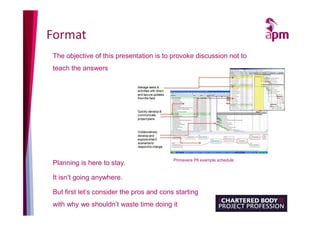
Primavera P6 example schedule
The objective of this presentation is to provoke discussion not to
teach the answers
Planning vs Scheduling
 Scheduling is the sequencing of events and dates back to the pyramids
as a craft system
– Pacific railroads (1850s)
– Henry Gantt invents Gantt Chart (1911)
 Job Specification leads to Work Breakdown Structure
– Hoover Dam construction (1931-36)
– Manhattan Project (1942-1945)
 1950s invention of PERT, PPS and Critical Path Method
 Planning includes other aspects of project and programme management
success factors, such as costs and benefits
 Now includes management science, economics, statistical and
behavioural aspects of delivering and enabling change
 Has evolved to reflect the speed, complexity and dynamics of modern
projects in a globally-connected world
 But there are still reasons not to do it…
Why waste time
planning?
Reason 1 - The future is unpredictable
Natural
disasters
Political
uncertainty
Macro-
economic
impacts
Climate
change
Reason 2 – the scope of projects is
often unclear
Key
Milestones?
Primary
Deliverables?
Project
Goals?
Business
Purpose in
general terms
only
Project Work
Statements
not known
Scope
Add constraints and exclusions….
Cost
TimePerformance
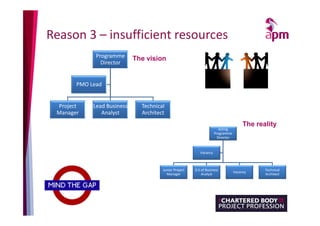
Reason 3 – insufficient resources
Programme
Director
Project
Manager
Lead Business
Analyst
Technical
Architect
PMO Lead
Acting
Programme
Director
Junior Project
Manager
0.5 of Business
Analyst
Vacancy
Technical
Architect
Vacancy
The vision
The reality
Reason 4 – we use a “to-do” list
Human beings are very good at short term planning
using our cognitive skills, we can imagine the
immediate future quite well and handle several
simultaneous tasks.
“We work in a tactical way and so are more
adaptive”
Reason 5 - We are Agile
See reason 4…
Reason 6 – estimating is hard and always wrong
“Estimates are commonly poor predictors of the actual value and viability of
projects, and cannot be trusted as the basis for informed decision-making.
These forecasts frequently misinform decision makers on projects instead of
informing them”
Professor Bent Flyvbjerg, Oxford University Centre for Major Programme Management. Said Business School
Reasons for us to
reconsider
Let’s consider what the evidence says
So, it’s not just about planning?
Strong, consistent leadership, coherent vision,
planning and timescales, E2E investment
= Organisational Capability
+
Accountability (engaging stakeholders+
ensuring sustainability) = Successful change
The future is unpredictable
 It is. But without a plan we don’t know how much it has changed
 And, unless we understand the scope of the project we can’t react to
events
– The #1 reason that projects fail is lack of scope clarity
 To harness the knowledge of the team
– And your team aren’t mind readers
 To manage complexity, time isn’t the only constraint
– Project planning breaks down the problem (and the thinking)
 Digital technology is about bringing about fundamental change which is
exponential but we think in linear ways without planning
– 1, 2, 4, 6, 8, 16, 32, 64 how we think vs
– 1, 2, 4, 16, 256, 65,536, 264, 257, 536 the impact of change
Get the scope clear
Scope drives everything else:
• Objectives
• Approach
• Structure and size of team
• Timescales
• Budget and contingency
• Risk
• Constraints
• Lead times
• Build or buy decisions
However, recognise that it will normally change and that the wrong
solution perfectly delivered is still a failure
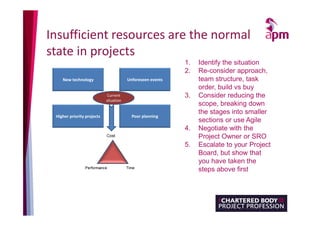
Insufficient resources are the normal
state in projects
New technology Unforeseen events
Higher priority projects Poor planning
Current
situation
1. Identify the situation
2. Re-consider approach,
team structure, task
order, build vs buy
3. Consider reducing the
scope, breaking down
the stages into smaller
sections or use Agile
4. Negotiate with the
Project Owner or SRO
5. Escalate to your Project
Board, but show that
you have taken the
steps above first
Working on a task-directed basis
 Without an estimate everything is a surprise
– Humans are quite good at managing short term tasks in their heads but
not at managing longer term activities. IT can help extend human
mental capacity via planning tools and analysis
 Without a baseline, you don’t know how far the work has drifted off
plan and so can’t take corrective action
 Without tracking you don’t know how far you have come- or still
have to go. In some cases, the consequences can be very serious
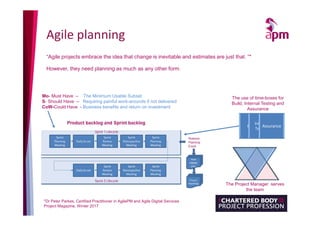
Agile planning
“Agile projects embrace the idea that change is inevitable and estimates are just that. ”*
However, they need planning as much as any other form.
*Dr Peter Parkes, Certified Practitioner in AgilePM and Agile Digital Services
Project Magazine, Winter 2017
Mo- Must Have – The Minimum Usable Subset
S- Should Have – Requiring painful work-arounds if not delivered
CoW-Could Have - Business benefits and return on investment
Build
Internal
Testing
The use of time-boxes for
Build, Internal Testing and
Assurance
Assurance
The Project Manager serves
the team
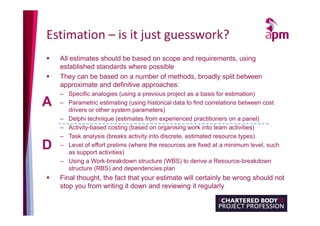
Estimation – is it just guesswork?
 All estimates should be based on scope and requirements, using
established standards where possible
 They can be based on a number of methods, broadly split between
approximate and definitive approaches:
– Specific analogies (using a previous project as a basis for estimation)
– Parametric estimating (using historical data to find correlations between cost
drivers or other system parameters)
– Delphi technique (estimates from experienced practitioners on a panel)
– Activity-based costing (based on organising work into team activities)
– Task analysis (breaks activity into discrete, estimated resource types)
– Level of effort prelims (where the resources are fixed at a minimum level, such
as support activities)
– Using a Work-breakdown structure (WBS) to derive a Resource-breakdown
structure (RBS) and dependencies plan
 Final thought, the fact that your estimate will certainly be wrong should not
stop you from writing it down and reviewing it regularly
A
D
What gets in the way is rarely
knowledge
Cognitive
dissonance
Reinforcement
systems
Lack of
skills
Inconsistent
role models
Leadership
“No-one else is using
what they teach on
the courses here”
“Senior management
aren’t interested in
plans they are
interested in delivery”
“I’ve never really
understood how to use
concepts like WBS or
dependant tasks”
“Our executives made
their names from
presenting the positive
story and keeping
stakeholders onside”
“My Programme Manager/Project
Director/Programme Director tells
me what he or she needs.
We don’t plan together”
The future of planning is likely to be
global and virtual
 Robots and AI – we already use computers to extend our minds
 Information modelling and Big Data – will enable new insights
 Working in global teams – from off-shoring to global collaboration
 Virtual worlds – the death of the Gantt Chart
 Solving the world’s problems – Complex dependency
management will become the norm
 Sustainability and the environment – projects in construction and
energy are leading the way but every project has its carbon
footprint and legacy impact
Planning isn’t optional
 “The core of the illusion is that we believe we understand the past, which
implies that the future should also be knowable, but in fact we understand
the past less than we believe we do.”*
 This is something which affects our hindsight and availability bias.
We give too much weight to what we think we know now.
* Thinking Fast and Slow, Daniel Kahneman, Winner of the Nobel Prize for
Economics Sciences, 2002
Credits
Professor Bent Flyvbjerg, Oxford University
Centre for Major Programme Management
APM Planning, Monitoring and Control SIG
10 Golden Rules of Planning, Vince Hines
Wellingtone
Directing Agile Change, APM Publications,
2016
Project Management Journal, Elevier
(2015)
University of Manchester Library
APM Guide to Planning, Scheduling
Monitoring and Control (2015)

Planning can we do with out it?

  • 1.
    Planning, can wedo without it? Kevin Parry FAPM Programme Director, NHS Digital Corporate Portfolio Office 24 January 2018
  • 2.
    Format Planning is hereto stay. It isn’t going anywhere. But first let’s consider the pros and cons starting with why we shouldn’t waste time doing it Primavera P6 example schedule The objective of this presentation is to provoke discussion not to teach the answers
  • 3.
    Planning vs Scheduling Scheduling is the sequencing of events and dates back to the pyramids as a craft system – Pacific railroads (1850s) – Henry Gantt invents Gantt Chart (1911)  Job Specification leads to Work Breakdown Structure – Hoover Dam construction (1931-36) – Manhattan Project (1942-1945)  1950s invention of PERT, PPS and Critical Path Method  Planning includes other aspects of project and programme management success factors, such as costs and benefits  Now includes management science, economics, statistical and behavioural aspects of delivering and enabling change  Has evolved to reflect the speed, complexity and dynamics of modern projects in a globally-connected world  But there are still reasons not to do it…
  • 4.
  • 5.
    Reason 1 -The future is unpredictable Natural disasters Political uncertainty Macro- economic impacts Climate change
  • 6.
    Reason 2 –the scope of projects is often unclear Key Milestones? Primary Deliverables? Project Goals? Business Purpose in general terms only Project Work Statements not known Scope Add constraints and exclusions…. Cost TimePerformance
  • 7.
    Reason 3 –insufficient resources Programme Director Project Manager Lead Business Analyst Technical Architect PMO Lead Acting Programme Director Junior Project Manager 0.5 of Business Analyst Vacancy Technical Architect Vacancy The vision The reality
  • 8.
    Reason 4 –we use a “to-do” list Human beings are very good at short term planning using our cognitive skills, we can imagine the immediate future quite well and handle several simultaneous tasks. “We work in a tactical way and so are more adaptive”
  • 9.
    Reason 5 -We are Agile See reason 4…
  • 10.
    Reason 6 –estimating is hard and always wrong “Estimates are commonly poor predictors of the actual value and viability of projects, and cannot be trusted as the basis for informed decision-making. These forecasts frequently misinform decision makers on projects instead of informing them” Professor Bent Flyvbjerg, Oxford University Centre for Major Programme Management. Said Business School
  • 11.
    Reasons for usto reconsider
  • 12.
    Let’s consider whatthe evidence says So, it’s not just about planning? Strong, consistent leadership, coherent vision, planning and timescales, E2E investment = Organisational Capability + Accountability (engaging stakeholders+ ensuring sustainability) = Successful change
  • 13.
    The future isunpredictable  It is. But without a plan we don’t know how much it has changed  And, unless we understand the scope of the project we can’t react to events – The #1 reason that projects fail is lack of scope clarity  To harness the knowledge of the team – And your team aren’t mind readers  To manage complexity, time isn’t the only constraint – Project planning breaks down the problem (and the thinking)  Digital technology is about bringing about fundamental change which is exponential but we think in linear ways without planning – 1, 2, 4, 6, 8, 16, 32, 64 how we think vs – 1, 2, 4, 16, 256, 65,536, 264, 257, 536 the impact of change
  • 14.
    Get the scopeclear Scope drives everything else: • Objectives • Approach • Structure and size of team • Timescales • Budget and contingency • Risk • Constraints • Lead times • Build or buy decisions However, recognise that it will normally change and that the wrong solution perfectly delivered is still a failure
  • 15.
    Insufficient resources arethe normal state in projects New technology Unforeseen events Higher priority projects Poor planning Current situation 1. Identify the situation 2. Re-consider approach, team structure, task order, build vs buy 3. Consider reducing the scope, breaking down the stages into smaller sections or use Agile 4. Negotiate with the Project Owner or SRO 5. Escalate to your Project Board, but show that you have taken the steps above first
  • 16.
    Working on atask-directed basis  Without an estimate everything is a surprise – Humans are quite good at managing short term tasks in their heads but not at managing longer term activities. IT can help extend human mental capacity via planning tools and analysis  Without a baseline, you don’t know how far the work has drifted off plan and so can’t take corrective action  Without tracking you don’t know how far you have come- or still have to go. In some cases, the consequences can be very serious
  • 17.
    Agile planning “Agile projectsembrace the idea that change is inevitable and estimates are just that. ”* However, they need planning as much as any other form. *Dr Peter Parkes, Certified Practitioner in AgilePM and Agile Digital Services Project Magazine, Winter 2017 Mo- Must Have – The Minimum Usable Subset S- Should Have – Requiring painful work-arounds if not delivered CoW-Could Have - Business benefits and return on investment Build Internal Testing The use of time-boxes for Build, Internal Testing and Assurance Assurance The Project Manager serves the team
  • 18.
    Estimation – isit just guesswork?  All estimates should be based on scope and requirements, using established standards where possible  They can be based on a number of methods, broadly split between approximate and definitive approaches: – Specific analogies (using a previous project as a basis for estimation) – Parametric estimating (using historical data to find correlations between cost drivers or other system parameters) – Delphi technique (estimates from experienced practitioners on a panel) – Activity-based costing (based on organising work into team activities) – Task analysis (breaks activity into discrete, estimated resource types) – Level of effort prelims (where the resources are fixed at a minimum level, such as support activities) – Using a Work-breakdown structure (WBS) to derive a Resource-breakdown structure (RBS) and dependencies plan  Final thought, the fact that your estimate will certainly be wrong should not stop you from writing it down and reviewing it regularly A D
  • 19.
    What gets inthe way is rarely knowledge Cognitive dissonance Reinforcement systems Lack of skills Inconsistent role models Leadership “No-one else is using what they teach on the courses here” “Senior management aren’t interested in plans they are interested in delivery” “I’ve never really understood how to use concepts like WBS or dependant tasks” “Our executives made their names from presenting the positive story and keeping stakeholders onside” “My Programme Manager/Project Director/Programme Director tells me what he or she needs. We don’t plan together”
  • 20.
    The future ofplanning is likely to be global and virtual  Robots and AI – we already use computers to extend our minds  Information modelling and Big Data – will enable new insights  Working in global teams – from off-shoring to global collaboration  Virtual worlds – the death of the Gantt Chart  Solving the world’s problems – Complex dependency management will become the norm  Sustainability and the environment – projects in construction and energy are leading the way but every project has its carbon footprint and legacy impact
  • 21.
    Planning isn’t optional “The core of the illusion is that we believe we understand the past, which implies that the future should also be knowable, but in fact we understand the past less than we believe we do.”*  This is something which affects our hindsight and availability bias. We give too much weight to what we think we know now. * Thinking Fast and Slow, Daniel Kahneman, Winner of the Nobel Prize for Economics Sciences, 2002
  • 22.
    Credits Professor Bent Flyvbjerg,Oxford University Centre for Major Programme Management APM Planning, Monitoring and Control SIG 10 Golden Rules of Planning, Vince Hines Wellingtone Directing Agile Change, APM Publications, 2016 Project Management Journal, Elevier (2015) University of Manchester Library APM Guide to Planning, Scheduling Monitoring and Control (2015)