DISASTER
MANAGEMENT
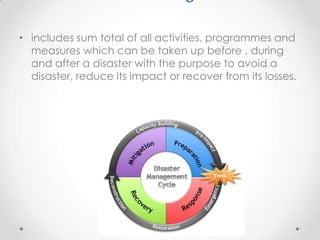
• includes sum total of all activities, programmes and
  measures which can be taken up before , during
  and after a disaster with the purpose to avoid a
  disaster, reduce its impact or recover from its losses.
• Mitigation: Measures to minimize the impacts
   o Like: building codes and zoning; vulnerability analyses; public education.

• Preparedness: Planning how to respond
   o   like: preparedness plans; emergency exercises/training; warning systems.

• Response: Initial actions taken to minimize the
  hazards
   o like: evacuation; search and rescue; emergency relief.

• Recovery: Returning the community to normal
   o like: rehabilitation and reconstruction
• the actions taken to save lives and property and
  prevent further damage
• putting preparedness plans into action
   o   search and rescue
   o    immediate medical help and lifesupport
   o   assisting refugees with transport
   o   food ,clothing& temporary shelter
   o   initial repairs to damaged infrastructure
   o   Preventing immediate disaster
   o   damage assessment
• Aims of disaster response
   o To ensure the survival of the maximum possible number of victims, keeping
     them in the best possible health in the circumstances.
   o To re-establish self-sufficiency and essential services as quickly as possible
     for all population groups, with special attention to the most vulnerable
     and underprivileged.
   o To repair or replace damaged infrastructure and regenerate viable
     economic activities.
• Disaster Response Activities
• Warning- information concerning the nature of the
  danger and imminent disaster threats, to evacuate
  or secure property and prevent further damage.
• Evacuation and migration-relocation of a
  population from zones at risk of an imminent disaster
  to a safer location for protection of life of the
  community and immediate treatment of injured.
   o   For evacuation to work there must be:
   o   A timely and accurate warning system,
   o   Clear identification of escape routes,
   o   community awareness of the plan
• Search and rescue (SAR)-process of identifying the location of disaster
  victims that may be trapped or isolated and bringing them to safety and
  medical attention
o Mountain rescue -in rugged and mountainous terrain
o Ground search and rescue-for persons who are lost or in distress on land
  or inland waterways
o Urban search and rescue-location and rescue of persons from collapsed
  buildings or other urban and industrial entrapments
o Combat search and rescue-carried out during war
   o Air-sea rescue -combined use of aircraft like flying boats, helicopters and
     surface vessels

• Post-disaster assessment-to provide a clear,
  concise picture of the post-disaster situation, to
  identify relief needs and to develop strategies for
  recovery.
• Relief-provision of material aid and emergency
  medical care necessary to save and preserve
  human lives.
• also enables families to meet their basic needs for
  medical and health care, shelter, clothing, water,
  and food
• Logistics and supply-well-organized supply service
  for handling the procurement, storage, and
  dispatch of relief supplies for distribution to disaster
  victims.
• Communication and information management-the
  equipment for information flow & information
  management
• Survivor response and coping
• Security
• protection of the human rights and safety of
  displaced populations and refugees
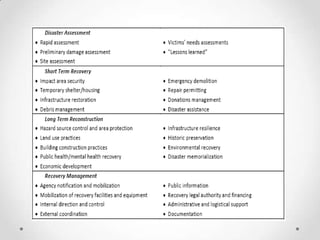
• the actions taken to return the community to
  normal or better following a disaster.
• decisions and actions relative to rebuilding homes,
  replacing property, resuming employment, restoring
  businesses, and permanently repairing and
  rebuilding infrastructure
   o Initial Response (1-7 days)
   o Mid-Term Planning (7-30 days)
   o Long-Term Reconstruction (Several Years)
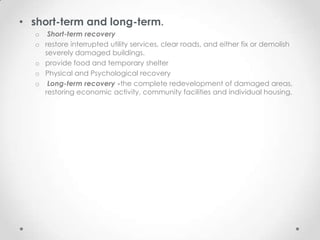
• short-term and long-term.
  o Short-term recovery
  o restore interrupted utility services, clear roads, and either fix or demolish
    severely damaged buildings.
  o provide food and temporary shelter
  o Physical and Psychological recovery
  o Long-term recovery -the complete redevelopment of damaged areas,
    restoring economic activity, community facilities and individual housing.
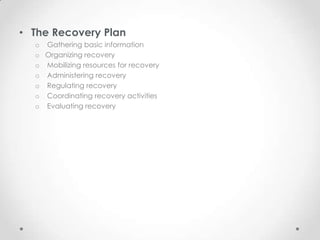
• The Recovery Plan
  o Gathering basic information
  o Organizing recovery
  o Mobilizing resources for recovery
  o Administering recovery
  o Regulating recovery
  o Coordinating recovery activities
  o Evaluating recovery
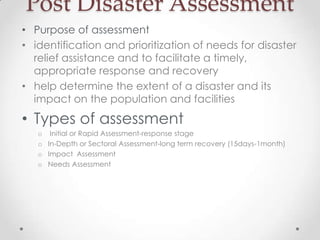
Post Disaster Assessment
• Purpose of assessment
• identification and prioritization of needs for disaster
  relief assistance and to facilitate a timely,
  appropriate response and recovery
• help determine the extent of a disaster and its
  impact on the population and facilities
• Types of assessment
   o Initial or Rapid Assessment-response stage
   o In-Depth or Sectoral Assessment-long term recovery (15days-1month)
   o Impact Assessment
   o Needs Assessment
• Initial or Rapid Assessment
• comprises both situation and needs
  assessment in the early, critical stage of
  disaster to determine the type of relief
  needed for immediate response.
• aim to:
   o Identify the impact a disaster has had on a society and its infrastructure,
     and the ability of that society to cope
   o Identify the most vulnerable segments of the population that need to be
     targeted for assistance;
   o Identify the level of response by the affected country and its internal
     capacity to cope with the situation;
   o Identify the level of response from the international community
o  Identify the most urgent relief needs and potential methods of providing
  them most effectively;
o Make recommendations which define and set priorities on the actions
  and resources needed for immediate response
o Highlight special concerns regarding the development of the situation
o Draw attention to geographical areas / substantive sectors needing in-
  depth assessment
• In-Depth or Sectoral Assessment
  o To determine long term recovery and development requirements
  o Housing and infrastructures, livelihoods, environment and psycho social
    aspects
  o Identify needs for external assistance
• Impact Assessment
  o process of collecting information on the magnitude of the disaster and
    the extent of its impact on both the population and infrastructure of the
    society
  o The area affected by location and size
  o Causes of causalities and damage
  o Human loss and causalities
  o Damage on infrastructure and environment
  o Environmental, health and sanitation threats
  o govt and other agencies and their activities and capacity
• Needs Assessment
  o the level and type of assistance required for the affected population
  o identifies resources and services for immediate emergency measures to
    save and sustain the lives of the affected population.
  o Needs that can be met from within the community and require external
    assistance
  o conducted at the site of a disaster or at the location of a displaced
    population.
Assessment Process
• Human loss and damage
  o   Deaths
  o   Permanent disabilities
  o   Major injuries
  o   Minor injuries and missing

• Assessment Methodology
  o Informal discussions
  o Secondary sources
• Damage to housing
   o   Completely destroyed/ beyond repair
   o   Partially damaged/ repairable
   o   Minor damage
   o   Undamaged
• Data assessed
   o Geographic location
   o Urban / rural
   o Size
   o Typology on the basis of design and structural
     system
   o Types of ownership & functional usage
   o Average dwelling size,no. of inhabitants per
     dwelling
   o Status of house
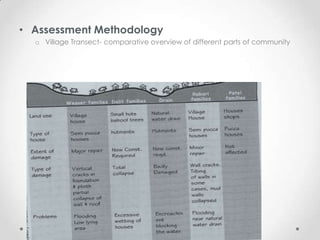
• Assessment Methodology
  o Village Transect- comparative overview of different parts of community
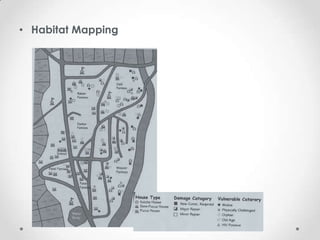
• Habitat Mapping
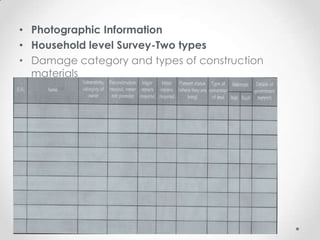
• Photographic Information
• Household level Survey-Two types
• Damage category and types of construction
  materials
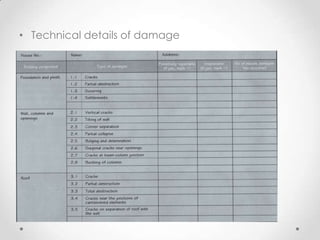
• Technical details of damage
• Damage to community infrastructures
• Methodology
  o Infrastructure mapping
  o Village level Survey
  o Photographic Information

• Environmental damage
  o   Landform change
  o   Change in natural drainage
  o   Soil degradation
  o   Destruction of vegetation
  o   Water contamination
  o   Loss of flora and fauna
• Methodology
  o Resource mapping
  o Village Transect
  o Village survey

• Damage to Livelihood
  o Loss to means and assets
  o Employment and Income

• Methodology
  o Wealth Ranking
  o Occupational network analysis
  o Livelihood survey-nature of assets like land, house, livestock
• Health Damage
• Due to site conditions, population concentration,
  contaminated water, lack of sanitation, lack of
  nutrition, etc
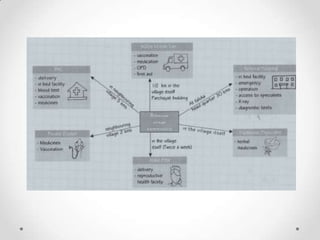
• Methodology
   o Community Health Surveillance: type, magnitude and pattern and trend
     of health problems through monitoring
   o Mobility map for health services
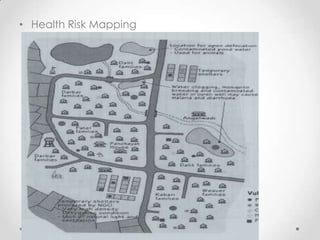
   o Health Risk Mapping
• Health Risk Mapping
• Psycho social impact
    o Psychological disorders
    o PTSD-Post traumatic stress disorder-panic reactions, withdrawal from daily
      activities, outburst

•   Methodology
    o Listening and observing
    o Symptom prevalence matrix
    o Case card

• Women in Disaster
• House hold Survey
• Informal survey-field visit survey
• Formal survey
   o   Simple random sampling
   o   Systematic random sampling
   o   Stratified random sampling
   o   Cluster sampling
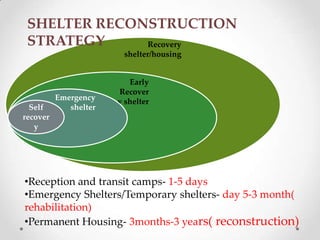
SHELTER RECONSTRUCTION
 STRATEGY     Recovery
                        shelter/housing


                          Early
                       Recover
          Emergency    y shelter
  Self       shelter
recover
   y


•Reception and transit camps- 1-5 days
•Emergency Shelters/Temporary shelters- day 5-3 month(
rehabilitation)
•Permanent Housing- 3months-3 years( reconstruction)
• Emergency Shelters/ Temporary shelters
• during the period between disaster and the
  achievement of a durable shelter solution
• Aim
  o protection and security
  o survival and health
  o social needs, such as privacy and dignity
  o livelihoods
  o natural-resource management
  o communal service infrastructure.
• Types
   odispersed settlement/host families-
    pre-existing households.
   omass shelter- public buildings and
    community Facilities
   ocamps:
       • (a) spontaneous -formed without adequate
         planning
       • (b)planned-purpose built
• dispersed settlement
   o   May not exist in affected areas
   o Relocated people are scattered
   o difficult to keep track and provide services
   o Can reinforce social isolation
• mass shelter-
   o   Cheaper
   o   May not exist in affected areas
   o   they can quickly become overcrowded
   o    sanitation and other services can become overburdened
   o    equipment and structure can be damaged
   o    buildings are no longer available for their original purpose
   o   lack of privacy and increased protection risks.
   o   difficult to keep track and provide services
   o      Can reinforce social isolation

• spontaneous -formed without adequate plan
   o re-location, as early as possible, to well-identified site
   o High density, overburden on resources
• Criteria for planned shelters:
   o   protection from an immediate danger
   o   Quick to supply
   o   Low cost
   o   Buildable- Small and light unit size
   o   Adaptable-Flexible, Cultural Acceptance
   o   Relief motivated but development driven
   o   minimization of environmental impact
   o   Durability- Fire resistance
• Types of shelter system:
• In-situ construction-locally available materials and
  techniques
   o Can evolve to permanent housing
   o Flexibility in location, materials, style
   o Community involvement
   o Requires available, safe, and undisputed land
   o Draining of resources
• Prefabricated
  o   Modular,Standard specifications
  o   Can be built in large quantities offsite
  o    Easy to keep track of relocated people
  o   Can be used for collective relocation (preserving social networks)
  o   Requires available, safe, and undisputed land
  o   Low quality and lack of comfort
  o   Often built in inconvenient locations, far from original homes
  o   If use is prolonged, risks degrading to a slum
• Standards for construction
 o accommodation: in barracks, communal tents with minimum of 3.0
   m2per person
 o sanitation: 20 persons per latrine, 50persons per shower,
 o water supply: absolute minimum provision of 7 litres/person/day plus
   water required for kitchens, cleaning and sanitation;
 o food preparation: approximately 100 m2 per 500 persons;
 o storage: 150 to 200 m3 per 1,000 persons;
 o a public address system;
 o lighting;
 o arrival and departure zones which are separated from accommodation
   zones;
 o arrival zones should include registration and medical clearance facilities
 o administrative offices and staff accommodation;
 o one health post and separate accommodation for quarantine;
 o security fencing
 o Visibility and ease of movement.
• ‘Adequate housing’
   o legal security of tenure
   o availability of services, materials, facilities, and infrastructure
   o affordability
   o habitability
   o accessibility
   o location
   o cultural adequacy.

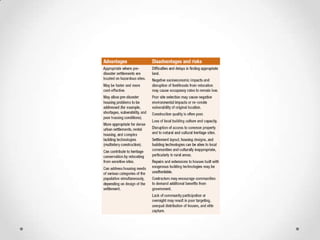
• Onsite Reconstruction / Relocation/Repair
• Onsite reconstruction
• Approaches
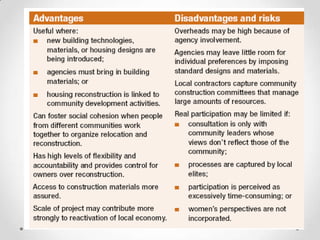
   o   Cash Approach
   o   Owner driven approach
   o   Community-Driven Reconstruction
   o   Agency-Driven Reconstruction in-Situ
   o   Agency-Driven Reconstruction in Relocated Site
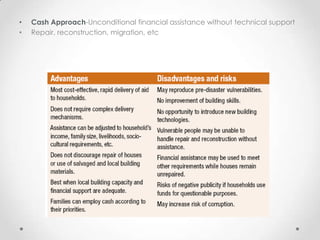
•   Cash Approach-Unconditional financial assistance without technical support
•   Repair, reconstruction, migration, etc
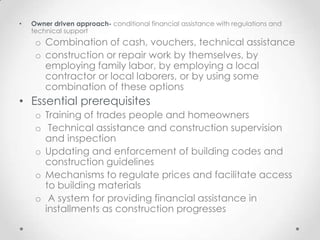
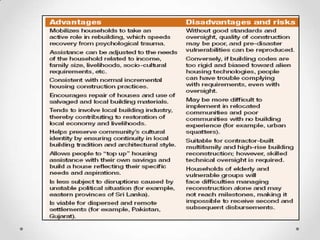
•   Owner driven approach- conditional financial assistance with regulations and
    technical support
     o Combination of cash, vouchers, technical assistance
     o construction or repair work by themselves, by
       employing family labor, by employing a local
       contractor or local laborers, or by using some
       combination of these options
• Essential prerequisites
     o Training of trades people and homeowners
     o Technical assistance and construction supervision
       and inspection
     o Updating and enforcement of building codes and
       construction guidelines
     o Mechanisms to regulate prices and facilitate access
       to building materials
     o A system for providing financial assistance in
       installments as construction progresses
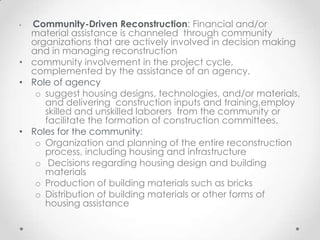
• Community-Driven Reconstruction: Financial and/or
  material assistance is channeled through community
  organizations that are actively involved in decision making
  and in managing reconstruction
• community involvement in the project cycle,
  complemented by the assistance of an agency.
• Role of agency
   o suggest housing designs, technologies, and/or materials,
     and delivering construction inputs and training,employ
     skilled and unskilled laborers from the community or
     facilitate the formation of construction committees.
• Roles for the community:
   o Organization and planning of the entire reconstruction
     process, including housing and infrastructure
   o Decisions regarding housing design and building
     materials
   o Production of building materials such as bricks
   o Distribution of building materials or other forms of
     housing assistance
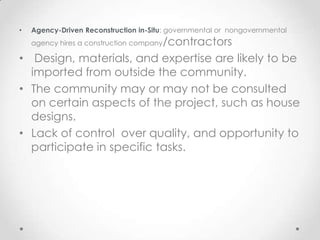
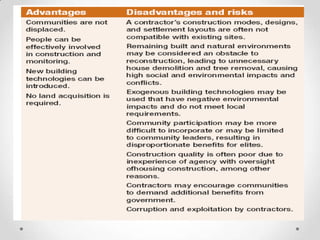
•   Agency-Driven Reconstruction in-Situ: governmental or nongovernmental
                           /contractors
    agency hires a construction company

• Design, materials, and expertise are likely to be
  imported from outside the community.
• The community may or may not be consulted
  on certain aspects of the project, such as house
  designs.
• Lack of control over quality, and opportunity to
  participate in specific tasks.
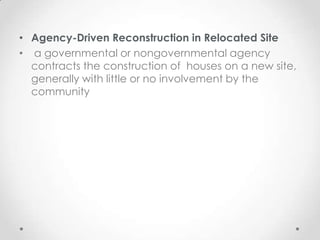
• Agency-Driven Reconstruction in Relocated Site
• a governmental or nongovernmental agency
  contracts the construction of houses on a new site,
  generally with little or no involvement by the
  community
Reconstruction Process
• Planning
  o understanding the context and impact of the disaster
  o understanding the regulatory framework and establishing methods of
    coordination
  o understanding funding teams and timescales
  o determining which method of assistance is most appropriate
  o establishing partnerships with other stakeholders in order to provide
    assistance
  o recognising natural hazards which pose a future risk
  o capturing the objectives, timescales, resources and risks in the
    programme plan
• Design
  o   selection of appropriate sites for reconstruction
  o   resolving issues of land tenure
  o   physical planning of settlements
  o   definition of appropriate quality for reconstruction
  o   identifying appropriate types of construction
  o   minimising the environmental impact of reconstruction
  o   incorporating disaster risk reduction strategies
  o   design of infrastructure facilities
• Construction
  o   different methods of implementation
  o   management of construction projects
  o   specification, procurement and transportation of materials
  o   management of labour and workmanship
  o   handover, maintenance and post-occupancy evaluation of completed
      projects.
• Relocation
  o Rebuilding in new site voluntarily or involuntarily.

• Happens when
  o When the old location is subject to a natural hazard
  o When the old location is completely destroyed and to move the debris
  o new plotting in the old settlement is inconvenient for rapid recovery and
    housing purposes
• Unsuccessful
  o   Inadequacy of new site
  o   Distance from livelihood and social networks
  o   Socio culturally inadequate settlement layout
  o   Lack of community living
  o   Lack of user participation in early decision-making process
  o    Lack of guidance to the beneficiaries during the construction phase of
      the houses.
Mitigation
•   measures that eliminate or reduce the probability of disaster
    occurrence, impacts and risks of hazards of unavoidable disasters
    through proactive measures taken before disaster occurs.
•   Includes
•   Understanding each hazard
    – its causes
    – its geographical distribution, magnitude or severity, and probable
    frequency of occurrence
    – the physical mechanisms of destruction
    – the elements and activities most vulnerable to destruction
    – the possible economic and social consequences of the disaster
•    Vulnerability assessment -physical vulnerability ,vulnerability of social
    institutions and economic activities
•   Mitigation Measures

Dm module ii

  • 1.
  • 2.
    • includes sumtotal of all activities, programmes and measures which can be taken up before , during and after a disaster with the purpose to avoid a disaster, reduce its impact or recover from its losses.
  • 4.
    • Mitigation: Measuresto minimize the impacts o Like: building codes and zoning; vulnerability analyses; public education. • Preparedness: Planning how to respond o like: preparedness plans; emergency exercises/training; warning systems. • Response: Initial actions taken to minimize the hazards o like: evacuation; search and rescue; emergency relief. • Recovery: Returning the community to normal o like: rehabilitation and reconstruction
  • 5.
    • the actionstaken to save lives and property and prevent further damage • putting preparedness plans into action o search and rescue o immediate medical help and lifesupport o assisting refugees with transport o food ,clothing& temporary shelter o initial repairs to damaged infrastructure o Preventing immediate disaster o damage assessment
  • 6.
    • Aims ofdisaster response o To ensure the survival of the maximum possible number of victims, keeping them in the best possible health in the circumstances. o To re-establish self-sufficiency and essential services as quickly as possible for all population groups, with special attention to the most vulnerable and underprivileged. o To repair or replace damaged infrastructure and regenerate viable economic activities.
  • 7.
    • Disaster ResponseActivities • Warning- information concerning the nature of the danger and imminent disaster threats, to evacuate or secure property and prevent further damage. • Evacuation and migration-relocation of a population from zones at risk of an imminent disaster to a safer location for protection of life of the community and immediate treatment of injured. o For evacuation to work there must be: o A timely and accurate warning system, o Clear identification of escape routes, o community awareness of the plan
  • 8.
    • Search andrescue (SAR)-process of identifying the location of disaster victims that may be trapped or isolated and bringing them to safety and medical attention o Mountain rescue -in rugged and mountainous terrain o Ground search and rescue-for persons who are lost or in distress on land or inland waterways o Urban search and rescue-location and rescue of persons from collapsed buildings or other urban and industrial entrapments
  • 9.
    o Combat searchand rescue-carried out during war o Air-sea rescue -combined use of aircraft like flying boats, helicopters and surface vessels • Post-disaster assessment-to provide a clear, concise picture of the post-disaster situation, to identify relief needs and to develop strategies for recovery.
  • 10.
    • Relief-provision ofmaterial aid and emergency medical care necessary to save and preserve human lives. • also enables families to meet their basic needs for medical and health care, shelter, clothing, water, and food • Logistics and supply-well-organized supply service for handling the procurement, storage, and dispatch of relief supplies for distribution to disaster victims. • Communication and information management-the equipment for information flow & information management
  • 11.
    • Survivor responseand coping • Security • protection of the human rights and safety of displaced populations and refugees
  • 12.
    • the actionstaken to return the community to normal or better following a disaster. • decisions and actions relative to rebuilding homes, replacing property, resuming employment, restoring businesses, and permanently repairing and rebuilding infrastructure o Initial Response (1-7 days) o Mid-Term Planning (7-30 days) o Long-Term Reconstruction (Several Years)
  • 13.
    • short-term andlong-term. o Short-term recovery o restore interrupted utility services, clear roads, and either fix or demolish severely damaged buildings. o provide food and temporary shelter o Physical and Psychological recovery o Long-term recovery -the complete redevelopment of damaged areas, restoring economic activity, community facilities and individual housing.
  • 15.
    • The RecoveryPlan o Gathering basic information o Organizing recovery o Mobilizing resources for recovery o Administering recovery o Regulating recovery o Coordinating recovery activities o Evaluating recovery
  • 16.
    Post Disaster Assessment •Purpose of assessment • identification and prioritization of needs for disaster relief assistance and to facilitate a timely, appropriate response and recovery • help determine the extent of a disaster and its impact on the population and facilities • Types of assessment o Initial or Rapid Assessment-response stage o In-Depth or Sectoral Assessment-long term recovery (15days-1month) o Impact Assessment o Needs Assessment
  • 17.
    • Initial orRapid Assessment • comprises both situation and needs assessment in the early, critical stage of disaster to determine the type of relief needed for immediate response. • aim to: o Identify the impact a disaster has had on a society and its infrastructure, and the ability of that society to cope o Identify the most vulnerable segments of the population that need to be targeted for assistance; o Identify the level of response by the affected country and its internal capacity to cope with the situation; o Identify the level of response from the international community
  • 18.
    o Identifythe most urgent relief needs and potential methods of providing them most effectively; o Make recommendations which define and set priorities on the actions and resources needed for immediate response o Highlight special concerns regarding the development of the situation o Draw attention to geographical areas / substantive sectors needing in- depth assessment
  • 19.
    • In-Depth orSectoral Assessment o To determine long term recovery and development requirements o Housing and infrastructures, livelihoods, environment and psycho social aspects o Identify needs for external assistance
  • 20.
    • Impact Assessment o process of collecting information on the magnitude of the disaster and the extent of its impact on both the population and infrastructure of the society o The area affected by location and size o Causes of causalities and damage o Human loss and causalities o Damage on infrastructure and environment o Environmental, health and sanitation threats o govt and other agencies and their activities and capacity
  • 21.
    • Needs Assessment o the level and type of assistance required for the affected population o identifies resources and services for immediate emergency measures to save and sustain the lives of the affected population. o Needs that can be met from within the community and require external assistance o conducted at the site of a disaster or at the location of a displaced population.
  • 22.
    Assessment Process • Humanloss and damage o Deaths o Permanent disabilities o Major injuries o Minor injuries and missing • Assessment Methodology o Informal discussions o Secondary sources
  • 23.
    • Damage tohousing o Completely destroyed/ beyond repair o Partially damaged/ repairable o Minor damage o Undamaged • Data assessed o Geographic location o Urban / rural o Size o Typology on the basis of design and structural system o Types of ownership & functional usage o Average dwelling size,no. of inhabitants per dwelling o Status of house
  • 24.
    • Assessment Methodology o Village Transect- comparative overview of different parts of community
  • 25.
  • 26.
    • Photographic Information •Household level Survey-Two types • Damage category and types of construction materials
  • 27.
  • 28.
    • Damage tocommunity infrastructures • Methodology o Infrastructure mapping o Village level Survey o Photographic Information • Environmental damage o Landform change o Change in natural drainage o Soil degradation o Destruction of vegetation o Water contamination o Loss of flora and fauna
  • 29.
    • Methodology o Resource mapping o Village Transect o Village survey • Damage to Livelihood o Loss to means and assets o Employment and Income • Methodology o Wealth Ranking o Occupational network analysis o Livelihood survey-nature of assets like land, house, livestock
  • 30.
    • Health Damage •Due to site conditions, population concentration, contaminated water, lack of sanitation, lack of nutrition, etc • Methodology o Community Health Surveillance: type, magnitude and pattern and trend of health problems through monitoring o Mobility map for health services o Health Risk Mapping
  • 32.
  • 33.
    • Psycho socialimpact o Psychological disorders o PTSD-Post traumatic stress disorder-panic reactions, withdrawal from daily activities, outburst • Methodology o Listening and observing o Symptom prevalence matrix o Case card • Women in Disaster
  • 34.
    • House holdSurvey • Informal survey-field visit survey • Formal survey o Simple random sampling o Systematic random sampling o Stratified random sampling o Cluster sampling
  • 35.
    SHELTER RECONSTRUCTION STRATEGY Recovery shelter/housing Early Recover Emergency y shelter Self shelter recover y •Reception and transit camps- 1-5 days •Emergency Shelters/Temporary shelters- day 5-3 month( rehabilitation) •Permanent Housing- 3months-3 years( reconstruction)
  • 36.
    • Emergency Shelters/Temporary shelters • during the period between disaster and the achievement of a durable shelter solution • Aim o protection and security o survival and health o social needs, such as privacy and dignity o livelihoods o natural-resource management o communal service infrastructure.
  • 37.
    • Types odispersed settlement/host families- pre-existing households. omass shelter- public buildings and community Facilities ocamps: • (a) spontaneous -formed without adequate planning • (b)planned-purpose built • dispersed settlement o May not exist in affected areas o Relocated people are scattered o difficult to keep track and provide services o Can reinforce social isolation
  • 38.
    • mass shelter- o Cheaper o May not exist in affected areas o they can quickly become overcrowded o sanitation and other services can become overburdened o equipment and structure can be damaged o buildings are no longer available for their original purpose o lack of privacy and increased protection risks. o difficult to keep track and provide services o Can reinforce social isolation • spontaneous -formed without adequate plan o re-location, as early as possible, to well-identified site o High density, overburden on resources
  • 39.
    • Criteria forplanned shelters: o protection from an immediate danger o Quick to supply o Low cost o Buildable- Small and light unit size o Adaptable-Flexible, Cultural Acceptance o Relief motivated but development driven o minimization of environmental impact o Durability- Fire resistance
  • 40.
    • Types ofshelter system: • In-situ construction-locally available materials and techniques o Can evolve to permanent housing o Flexibility in location, materials, style o Community involvement o Requires available, safe, and undisputed land o Draining of resources
  • 41.
    • Prefabricated o Modular,Standard specifications o Can be built in large quantities offsite o Easy to keep track of relocated people o Can be used for collective relocation (preserving social networks) o Requires available, safe, and undisputed land o Low quality and lack of comfort o Often built in inconvenient locations, far from original homes o If use is prolonged, risks degrading to a slum
  • 42.
    • Standards forconstruction o accommodation: in barracks, communal tents with minimum of 3.0 m2per person o sanitation: 20 persons per latrine, 50persons per shower, o water supply: absolute minimum provision of 7 litres/person/day plus water required for kitchens, cleaning and sanitation; o food preparation: approximately 100 m2 per 500 persons; o storage: 150 to 200 m3 per 1,000 persons; o a public address system; o lighting; o arrival and departure zones which are separated from accommodation zones; o arrival zones should include registration and medical clearance facilities o administrative offices and staff accommodation; o one health post and separate accommodation for quarantine; o security fencing o Visibility and ease of movement.
  • 43.
    • ‘Adequate housing’ o legal security of tenure o availability of services, materials, facilities, and infrastructure o affordability o habitability o accessibility o location o cultural adequacy. • Onsite Reconstruction / Relocation/Repair
  • 44.
    • Onsite reconstruction •Approaches o Cash Approach o Owner driven approach o Community-Driven Reconstruction o Agency-Driven Reconstruction in-Situ o Agency-Driven Reconstruction in Relocated Site
  • 45.
    Cash Approach-Unconditional financial assistance without technical support • Repair, reconstruction, migration, etc
  • 46.
    Owner driven approach- conditional financial assistance with regulations and technical support o Combination of cash, vouchers, technical assistance o construction or repair work by themselves, by employing family labor, by employing a local contractor or local laborers, or by using some combination of these options • Essential prerequisites o Training of trades people and homeowners o Technical assistance and construction supervision and inspection o Updating and enforcement of building codes and construction guidelines o Mechanisms to regulate prices and facilitate access to building materials o A system for providing financial assistance in installments as construction progresses
  • 48.
    • Community-Driven Reconstruction:Financial and/or material assistance is channeled through community organizations that are actively involved in decision making and in managing reconstruction • community involvement in the project cycle, complemented by the assistance of an agency. • Role of agency o suggest housing designs, technologies, and/or materials, and delivering construction inputs and training,employ skilled and unskilled laborers from the community or facilitate the formation of construction committees. • Roles for the community: o Organization and planning of the entire reconstruction process, including housing and infrastructure o Decisions regarding housing design and building materials o Production of building materials such as bricks o Distribution of building materials or other forms of housing assistance
  • 50.
    Agency-Driven Reconstruction in-Situ: governmental or nongovernmental /contractors agency hires a construction company • Design, materials, and expertise are likely to be imported from outside the community. • The community may or may not be consulted on certain aspects of the project, such as house designs. • Lack of control over quality, and opportunity to participate in specific tasks.
  • 52.
    • Agency-Driven Reconstructionin Relocated Site • a governmental or nongovernmental agency contracts the construction of houses on a new site, generally with little or no involvement by the community
  • 54.
    Reconstruction Process • Planning o understanding the context and impact of the disaster o understanding the regulatory framework and establishing methods of coordination o understanding funding teams and timescales o determining which method of assistance is most appropriate o establishing partnerships with other stakeholders in order to provide assistance o recognising natural hazards which pose a future risk o capturing the objectives, timescales, resources and risks in the programme plan
  • 55.
    • Design o selection of appropriate sites for reconstruction o resolving issues of land tenure o physical planning of settlements o definition of appropriate quality for reconstruction o identifying appropriate types of construction o minimising the environmental impact of reconstruction o incorporating disaster risk reduction strategies o design of infrastructure facilities
  • 56.
    • Construction o different methods of implementation o management of construction projects o specification, procurement and transportation of materials o management of labour and workmanship o handover, maintenance and post-occupancy evaluation of completed projects.
  • 57.
    • Relocation o Rebuilding in new site voluntarily or involuntarily. • Happens when o When the old location is subject to a natural hazard o When the old location is completely destroyed and to move the debris o new plotting in the old settlement is inconvenient for rapid recovery and housing purposes
  • 58.
    • Unsuccessful o Inadequacy of new site o Distance from livelihood and social networks o Socio culturally inadequate settlement layout o Lack of community living o Lack of user participation in early decision-making process o Lack of guidance to the beneficiaries during the construction phase of the houses.
  • 59.
    Mitigation • measures that eliminate or reduce the probability of disaster occurrence, impacts and risks of hazards of unavoidable disasters through proactive measures taken before disaster occurs. • Includes • Understanding each hazard – its causes – its geographical distribution, magnitude or severity, and probable frequency of occurrence – the physical mechanisms of destruction – the elements and activities most vulnerable to destruction – the possible economic and social consequences of the disaster • Vulnerability assessment -physical vulnerability ,vulnerability of social institutions and economic activities • Mitigation Measures

Editor's Notes

  • #36 Quick glanceKEY MESSAGES to convey: The Shelter Response after a disaster is understood as a continuum process, where all the different components are overlapping and can be developed simultaneity. The first who react/response to a disaster is the people itself, later when mechanism are in place people receive support from government and agencies are they gone trough a process that include all the different components: Emergency, recovery and development. This is NOT a sequential process of one after the other, is a continuum process where each phase include the previous one. Recovery starts on day one after a disaster. Not all the people go to the same speed on this process. Some go directly from self recovery to permanent housing others go through all components/phases… (horizontal diagonal or vertical on this diagram).