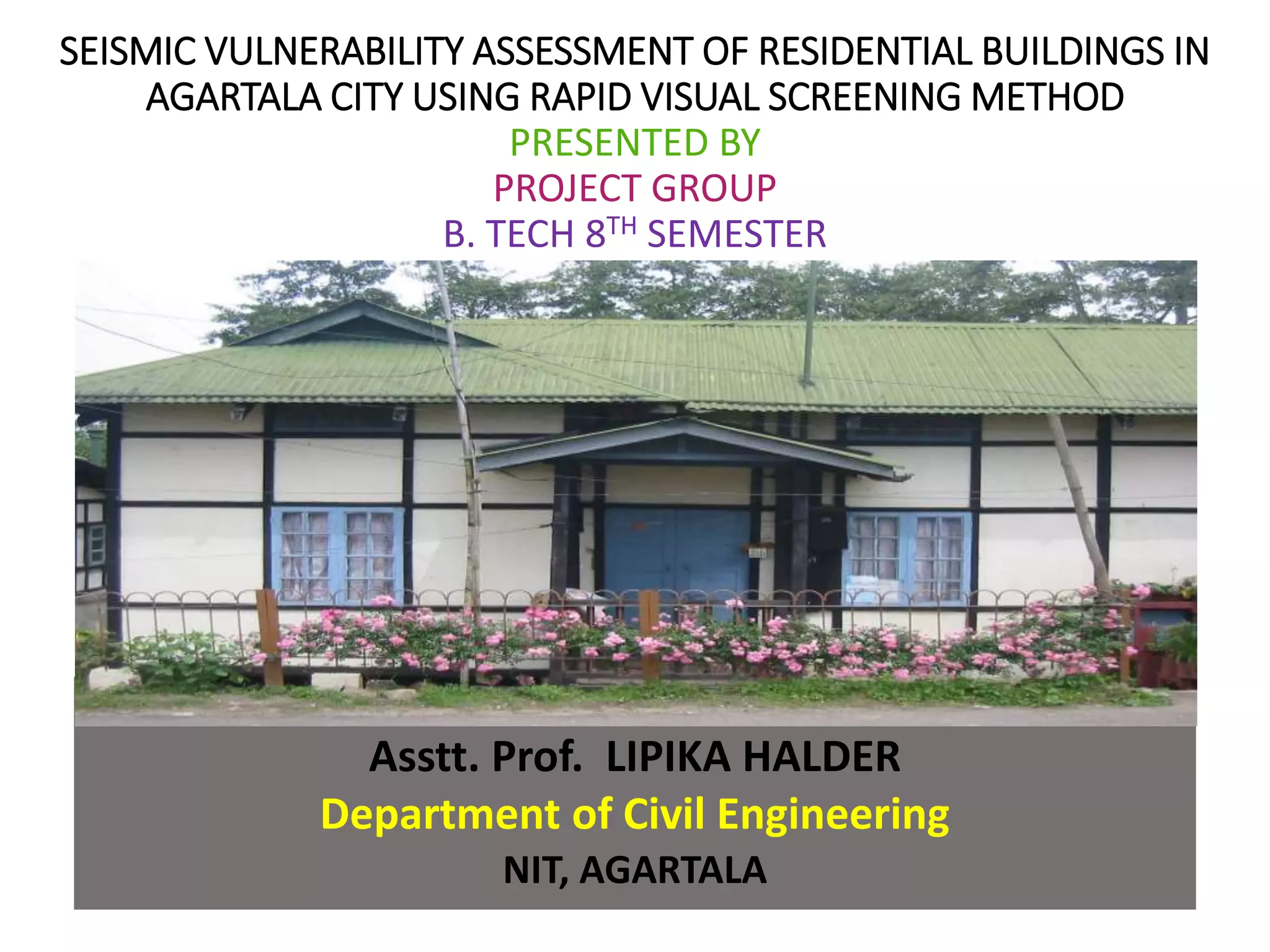

SEISMIC VULNERABILITY ASSESSMENT OF RESIDENTIAL BUILDINGS IN
AGARTALA CITY USING RAPID VISUAL SCREENING METHOD
PRESENTED BY
PROJECT GROUP
B. TECH 8TH SEMESTER
Under the Guidance of
Asstt. Prof. LIPIKA HALDER
Department of Civil Engineering
NIT, AGARTALA
CONTENT
• Introduction
• Objectives of the study
• Methodology
• DETAILS OF CASE STUDIES
• Results and Discussions
• CONCLUSIONS
• FUTURE SCOPE OF THE STUDY
• References
2
INTRODUCTION
• Earthquakes are one of the most devastating
forces in nature. These have been instrumental in
changing the courses of Indian history.
• Some of the most significant disasters in the last
hundred years caused by earthquake results a loss of
about 2,03141 human lives, besides damage to
property and infrastructure.
• Around 60% of the country’s landmass is prone to
moderate, high or severe earthquake risks. North-
east experiences earthquake of average magnitude
>6.0 every year which causes huge losses to
property. 3
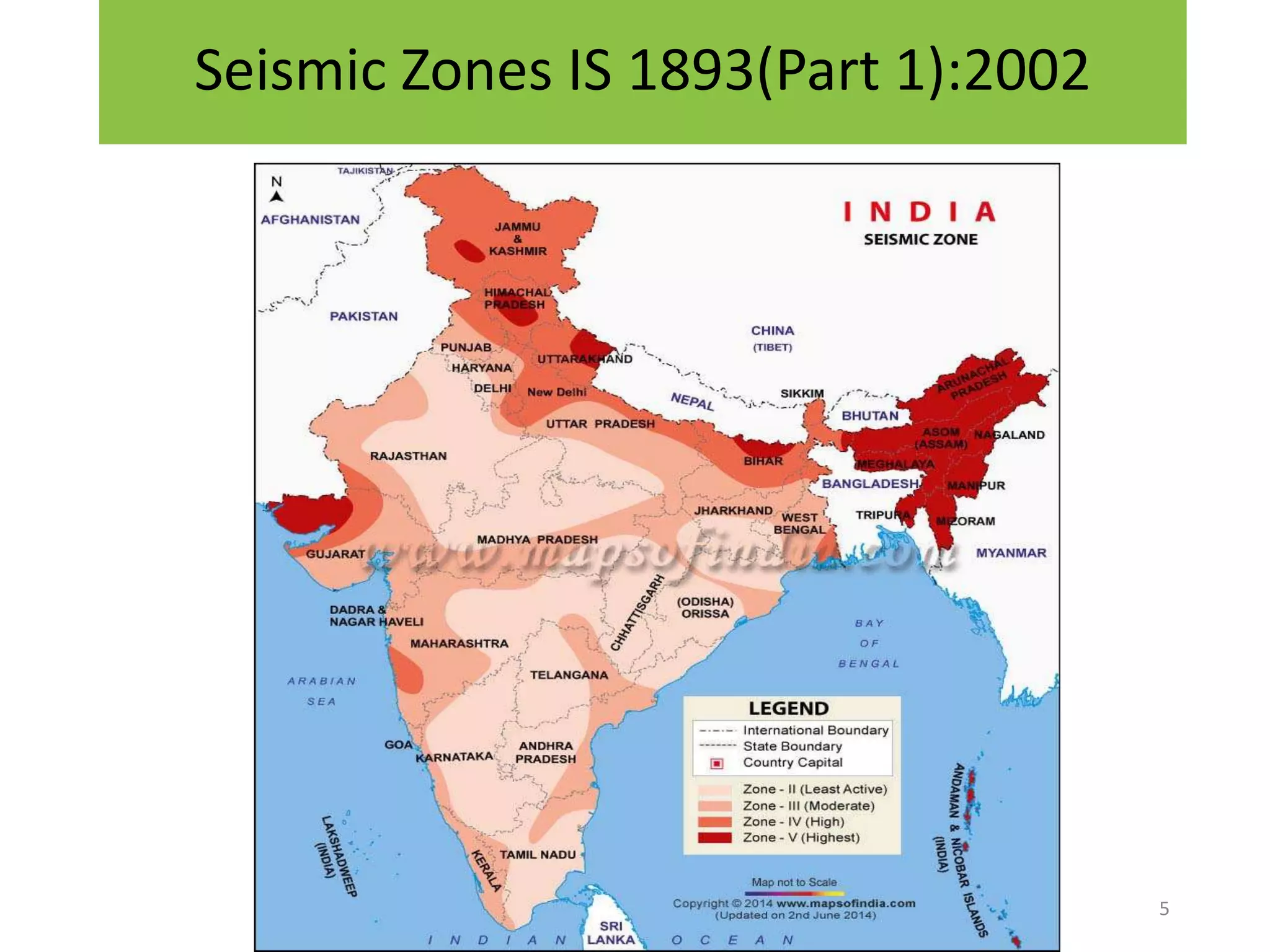
• As Tripura, north-eastern state of India is situated
in seismic zone V which is severe most zone
indicated by the Indian Seismic code IS 1893(Part
1)2002. So this study proposes an approach to
estimate the seismic vulnerability assessment of
residential buildings in Agartala city.
4
Seismic Zones IS 1893(Part 1):2002
5
OBJECTIVES OF THE STUDY
• To assess the seismic vulnerability of residential
buildings in Agartala city using Rapid Visual
Screening Method proposed by FEMA 154 (2015)
• To predict the expected damage grade that may be
observed in the surveyed buildings in future severe
earthquake.
6
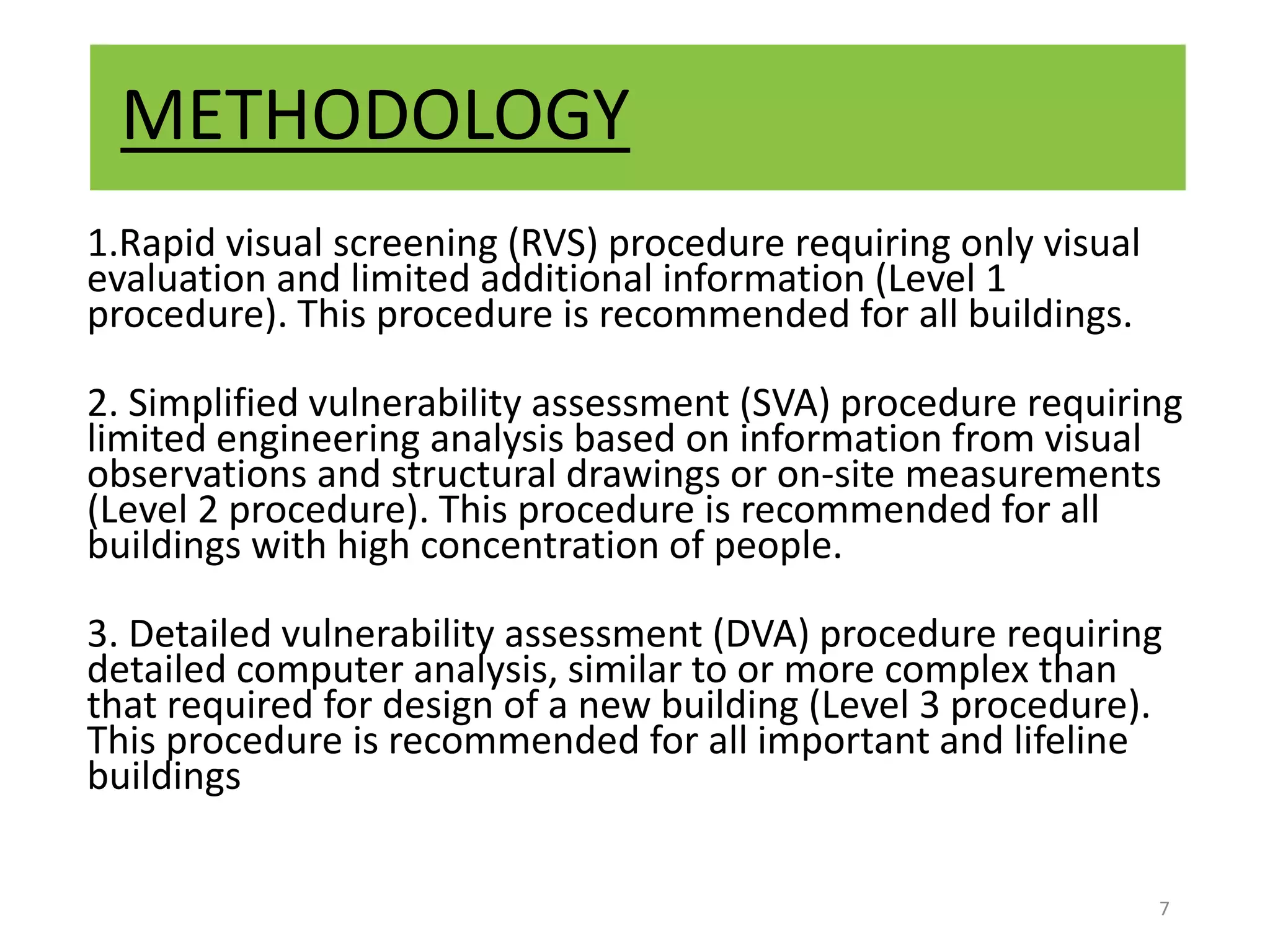
METHODOLOGY
1.Rapid visual screening (RVS) procedure requiring only visual
evaluation and limited additional information (Level 1
procedure). This procedure is recommended for all buildings.
2. Simplified vulnerability assessment (SVA) procedure requiring
limited engineering analysis based on information from visual
observations and structural drawings or on-site measurements
(Level 2 procedure). This procedure is recommended for all
buildings with high concentration of people.
3. Detailed vulnerability assessment (DVA) procedure requiring
detailed computer analysis, similar to or more complex than
that required for design of a new building (Level 3 procedure).
This procedure is recommended for all important and lifeline
buildings
7
RAPID VISUAL SCREENING PROCEDURE
(RVS)
• Rapid visual screening was first proposed in US in
1988 in the FEMA 154 report, which was latest
modified in 2015 to incorporate latest technological
advancements and lessons from earthquake disasters
in the 1990.
• RVS is useful when the number of buildings to be
evaluated is large.
8
SURVEY PARAMETERS
 General Information: Type of building, Number of
stories, Year of construction, Number of occupants,
Maintenance record.
 Structural Irregularities: Vertical irregularities, Plan
irregularities.
 Apparent building quality: Quality of materials &
construction.
 Soil conditions.
 Frame action
 Diaphragm action.
 Heavy overhangs, Soft story, Short column.
9
 Pounding effect: Two Adjacent buildings.
 Openings: Large openings in wall, irregular openings
in walls.
 Bands: Horizontal Bands at plinth level, lintel level,
sill & roof level.
 Falling Hazards.
 Wall thickness at ground floor.
 Water tank at roof: Capacity and location.
10
DETAILS OF CASE STUDIES
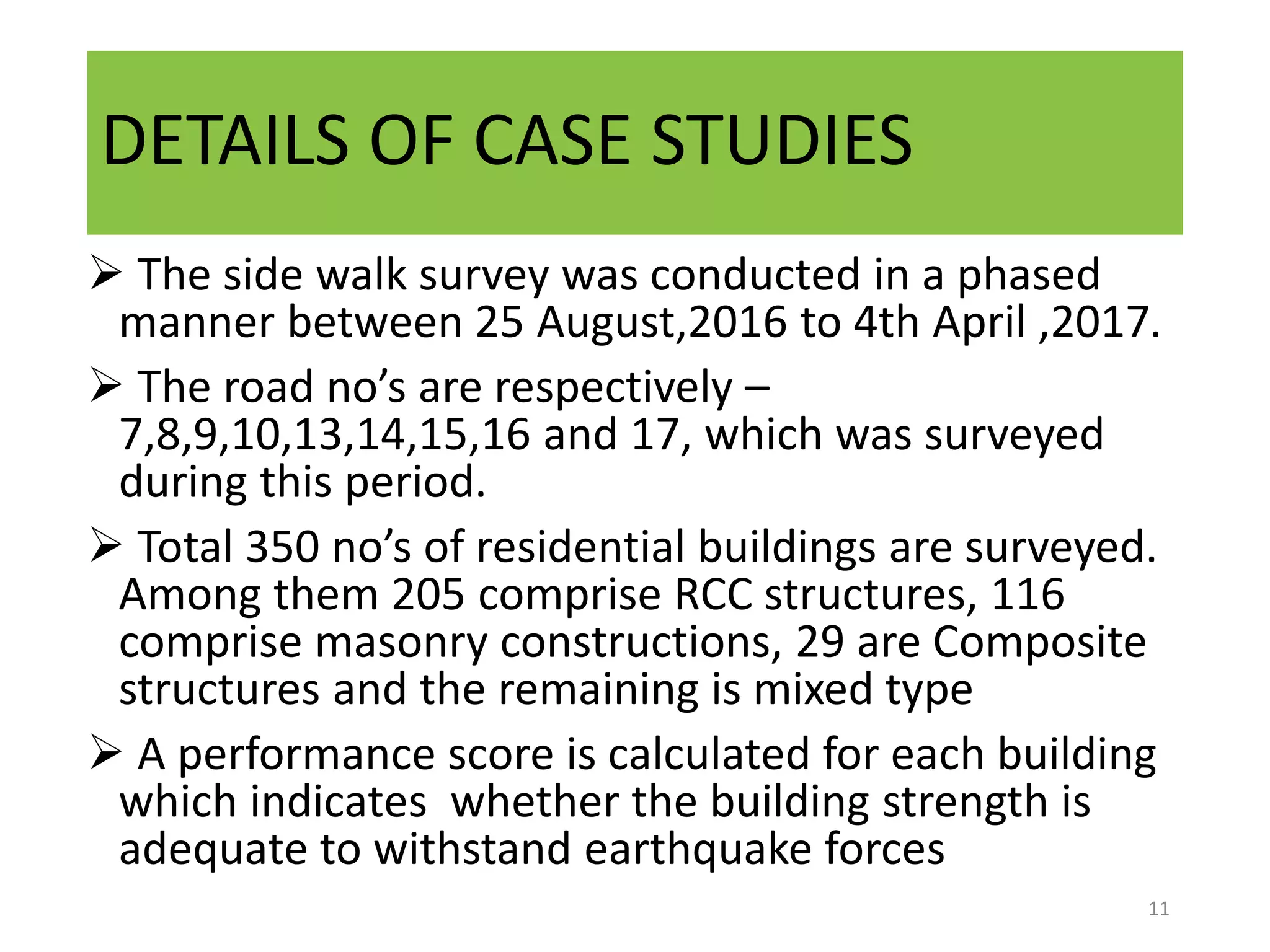
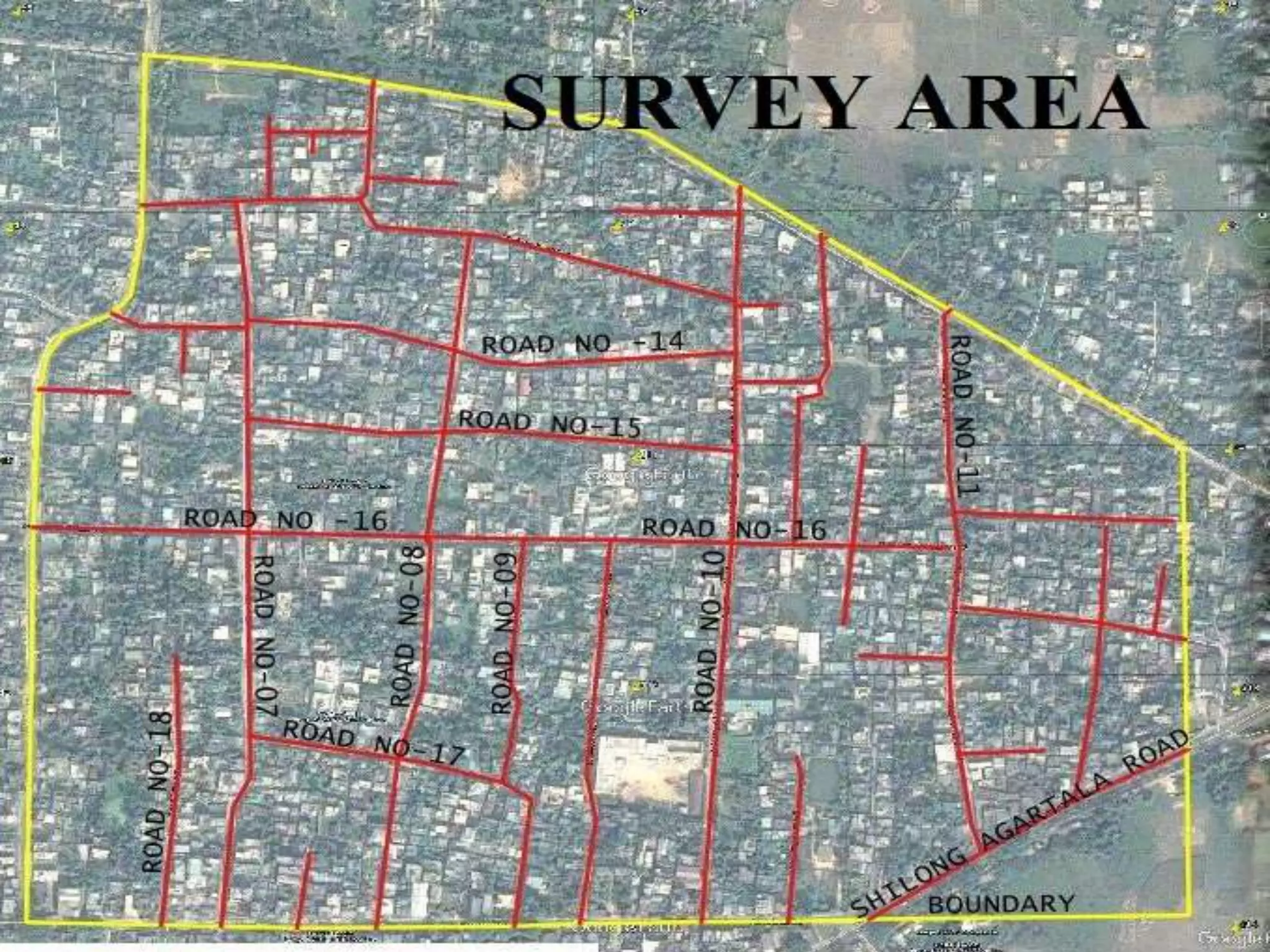
 The side walk survey was conducted in a phased
manner between 25 August,2016 to 4th April ,2017.
 The road no’s are respectively –
7,8,9,10,13,14,15,16 and 17, which was surveyed
during this period.
 Total 350 no’s of residential buildings are surveyed.
Among them 205 comprise RCC structures, 116
comprise masonry constructions, 29 are Composite
structures and the remaining is mixed type
 A performance score is calculated for each building
which indicates whether the building strength is
adequate to withstand earthquake forces
11
12
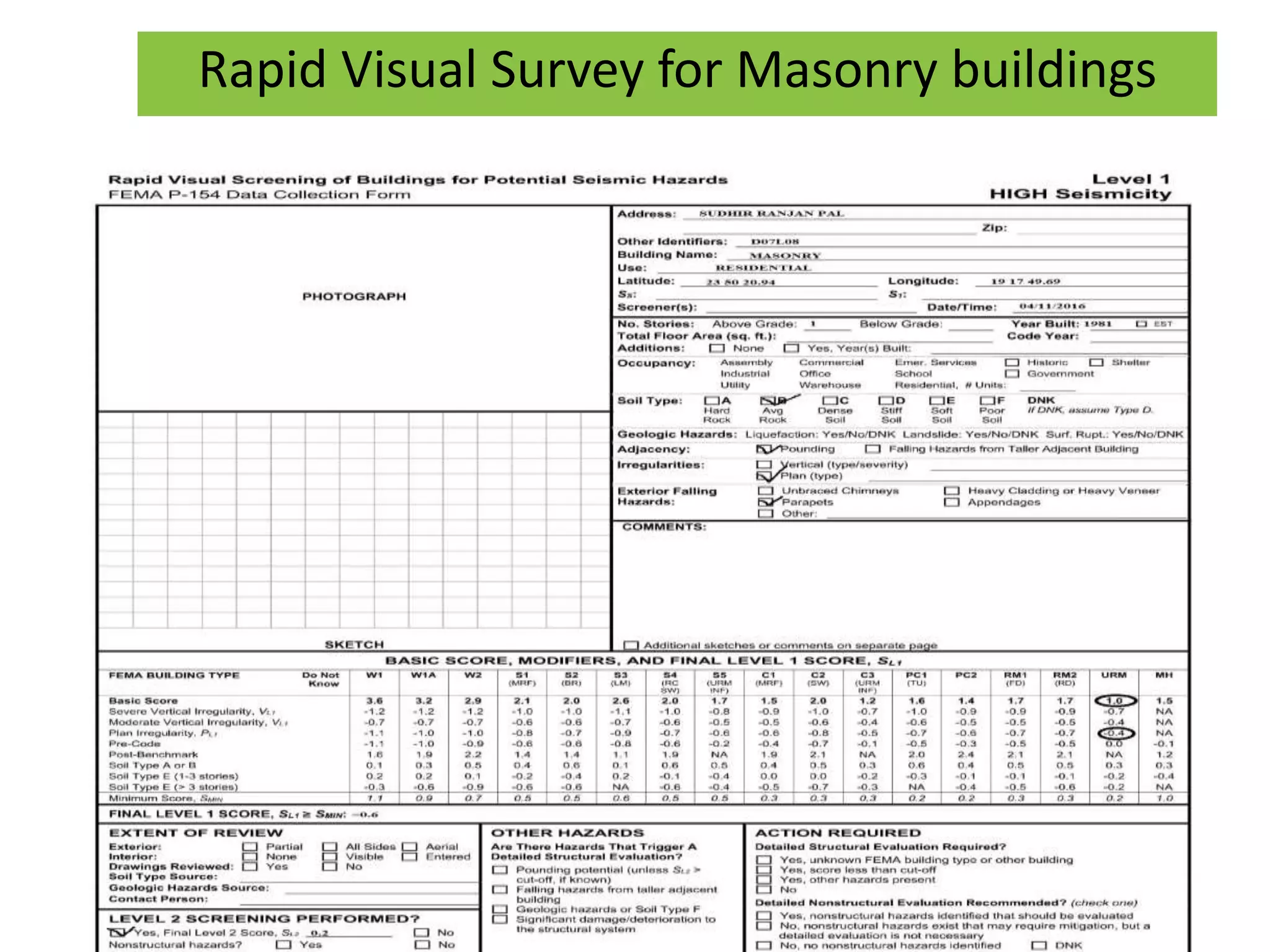
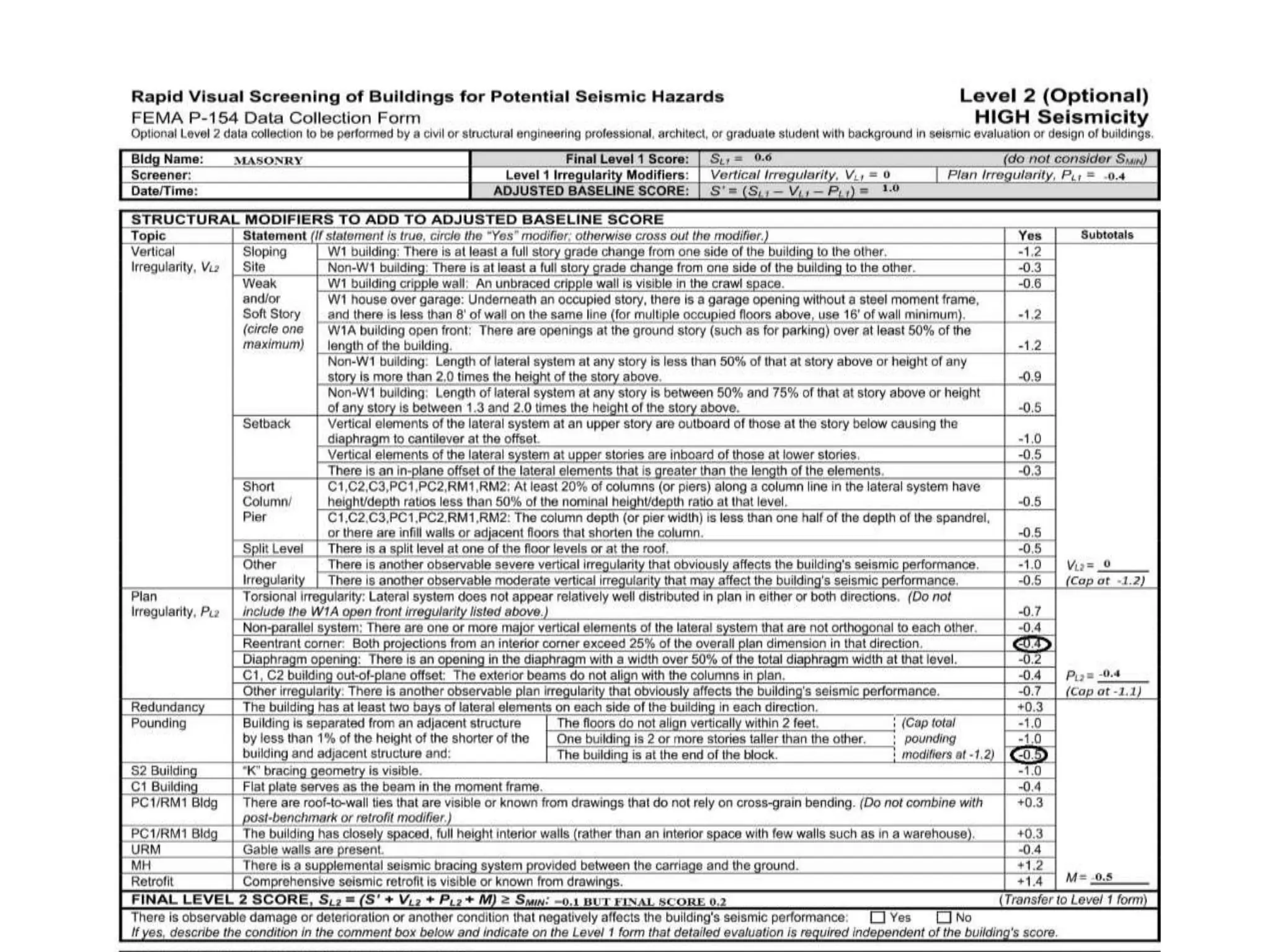
Rapid Visual Survey for Masonry buildings
13
14
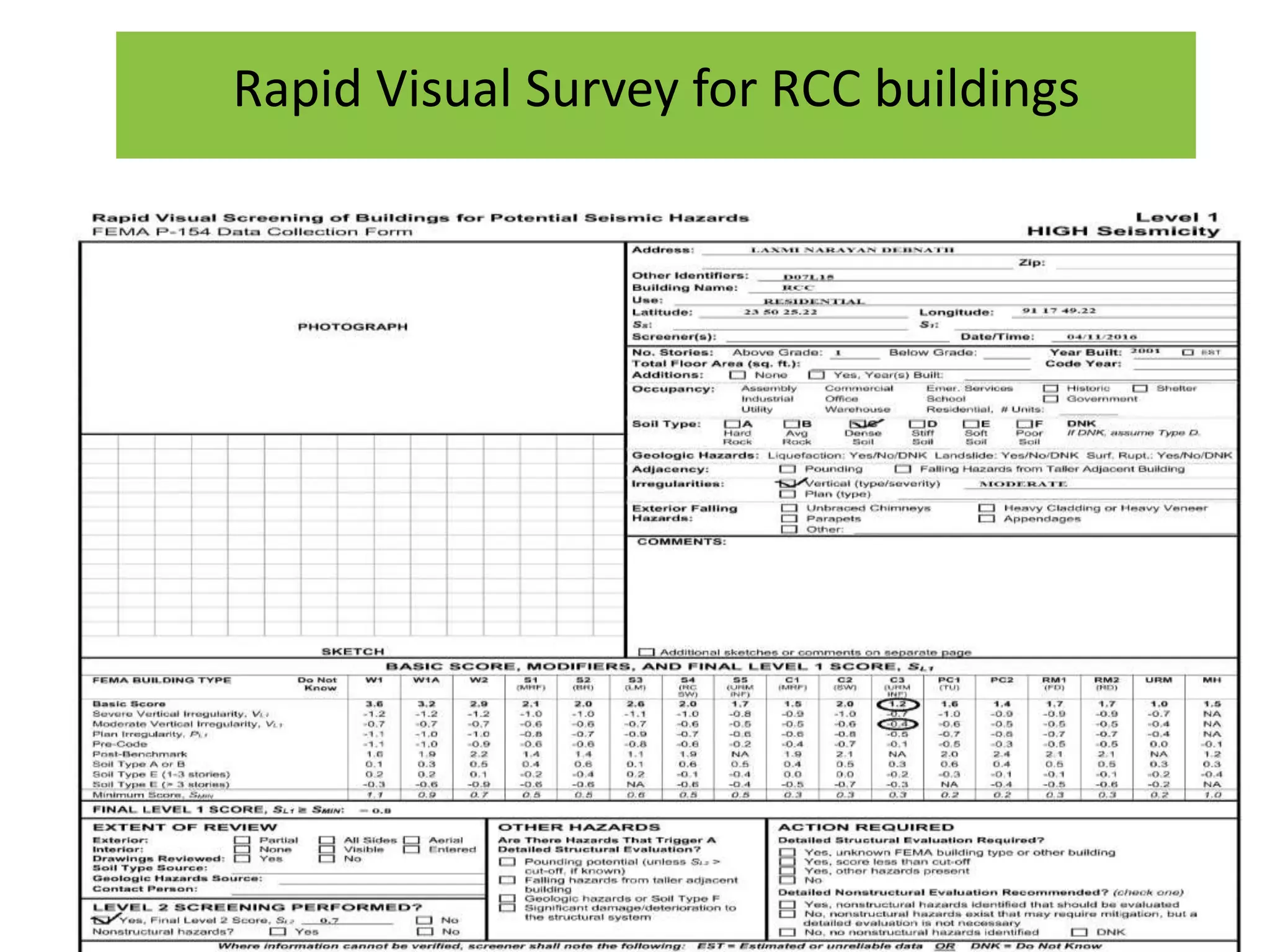
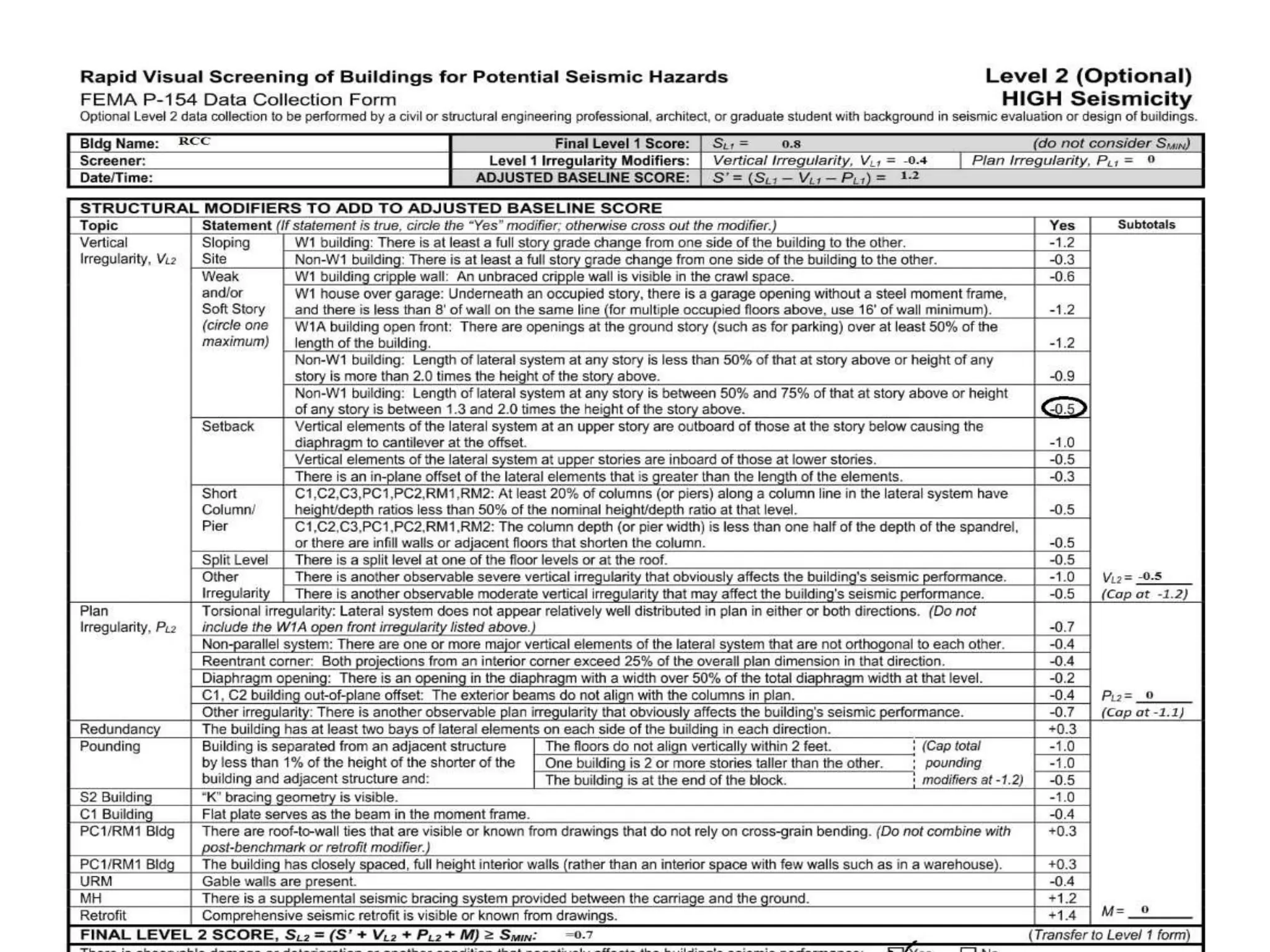
Rapid Visual Survey for RCC buildings
15
16
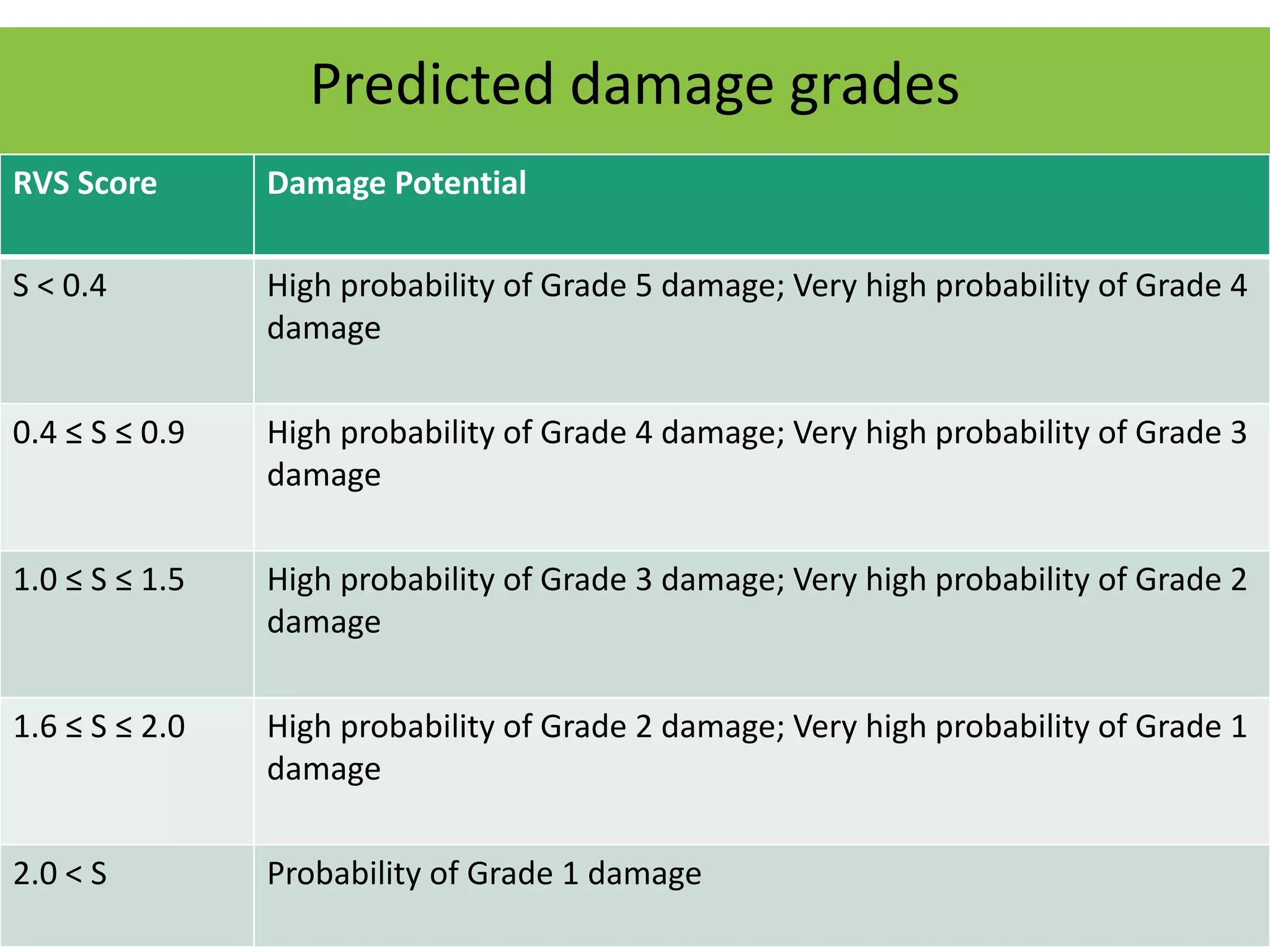
Predicted damage grades
17
RVS Score Damage Potential
S < 0.4 High probability of Grade 5 damage; Very high probability of Grade 4
damage
0.4 ≤ S ≤ 0.9 High probability of Grade 4 damage; Very high probability of Grade 3
damage
1.0 ≤ S ≤ 1.5 High probability of Grade 3 damage; Very high probability of Grade 2
damage
1.6 ≤ S ≤ 2.0 High probability of Grade 2 damage; Very high probability of Grade 1
damage
2.0 < S Probability of Grade 1 damage
18
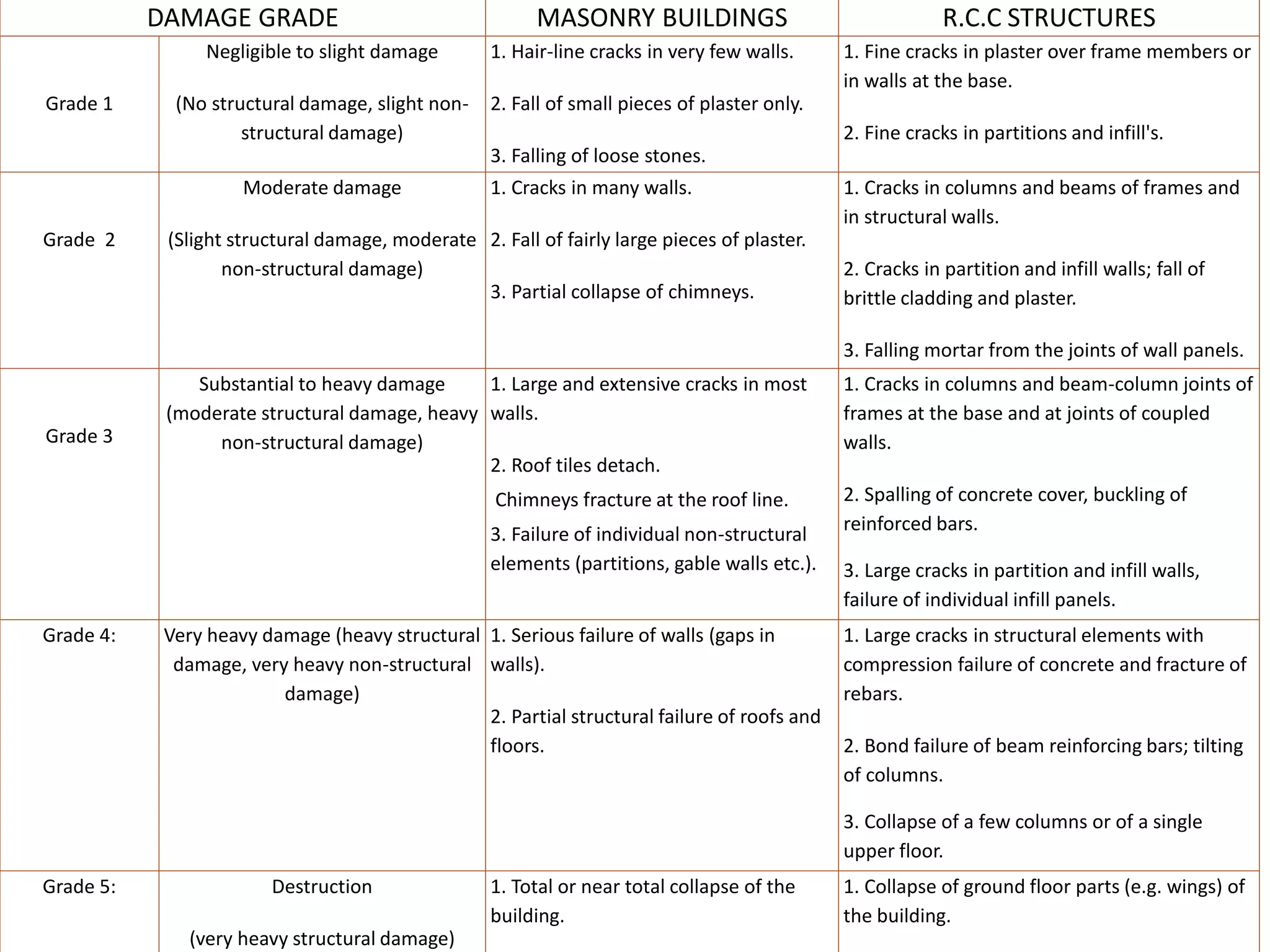
DAMAGE GRADE MASONRY BUILDINGS R.C.C STRUCTURES
Grade 1
Negligible to slight damage
(No structural damage, slight non-
structural damage)
1. Hair-line cracks in very few walls.
2. Fall of small pieces of plaster only.
3. Falling of loose stones.
1. Fine cracks in plaster over frame members or
in walls at the base.
2. Fine cracks in partitions and infill's.
Grade 2
Moderate damage
(Slight structural damage, moderate
non-structural damage)
1. Cracks in many walls.
2. Fall of fairly large pieces of plaster.
3. Partial collapse of chimneys.
1. Cracks in columns and beams of frames and
in structural walls.
2. Cracks in partition and infill walls; fall of
brittle cladding and plaster.
3. Falling mortar from the joints of wall panels.
Grade 3
Substantial to heavy damage
(moderate structural damage, heavy
non-structural damage)
1. Large and extensive cracks in most
walls.
2. Roof tiles detach.
Chimneys fracture at the roof line.
3. Failure of individual non-structural
elements (partitions, gable walls etc.).
1. Cracks in columns and beam-column joints of
frames at the base and at joints of coupled
walls.
2. Spalling of concrete cover, buckling of
reinforced bars.
3. Large cracks in partition and infill walls,
failure of individual infill panels.
Grade 4: Very heavy damage (heavy structural
damage, very heavy non-structural
damage)
1. Serious failure of walls (gaps in
walls).
2. Partial structural failure of roofs and
floors.
1. Large cracks in structural elements with
compression failure of concrete and fracture of
rebars.
2. Bond failure of beam reinforcing bars; tilting
of columns.
3. Collapse of a few columns or of a single
upper floor.
Grade 5: Destruction
(very heavy structural damage)
1. Total or near total collapse of the
building.
1. Collapse of ground floor parts (e.g. wings) of
the building.
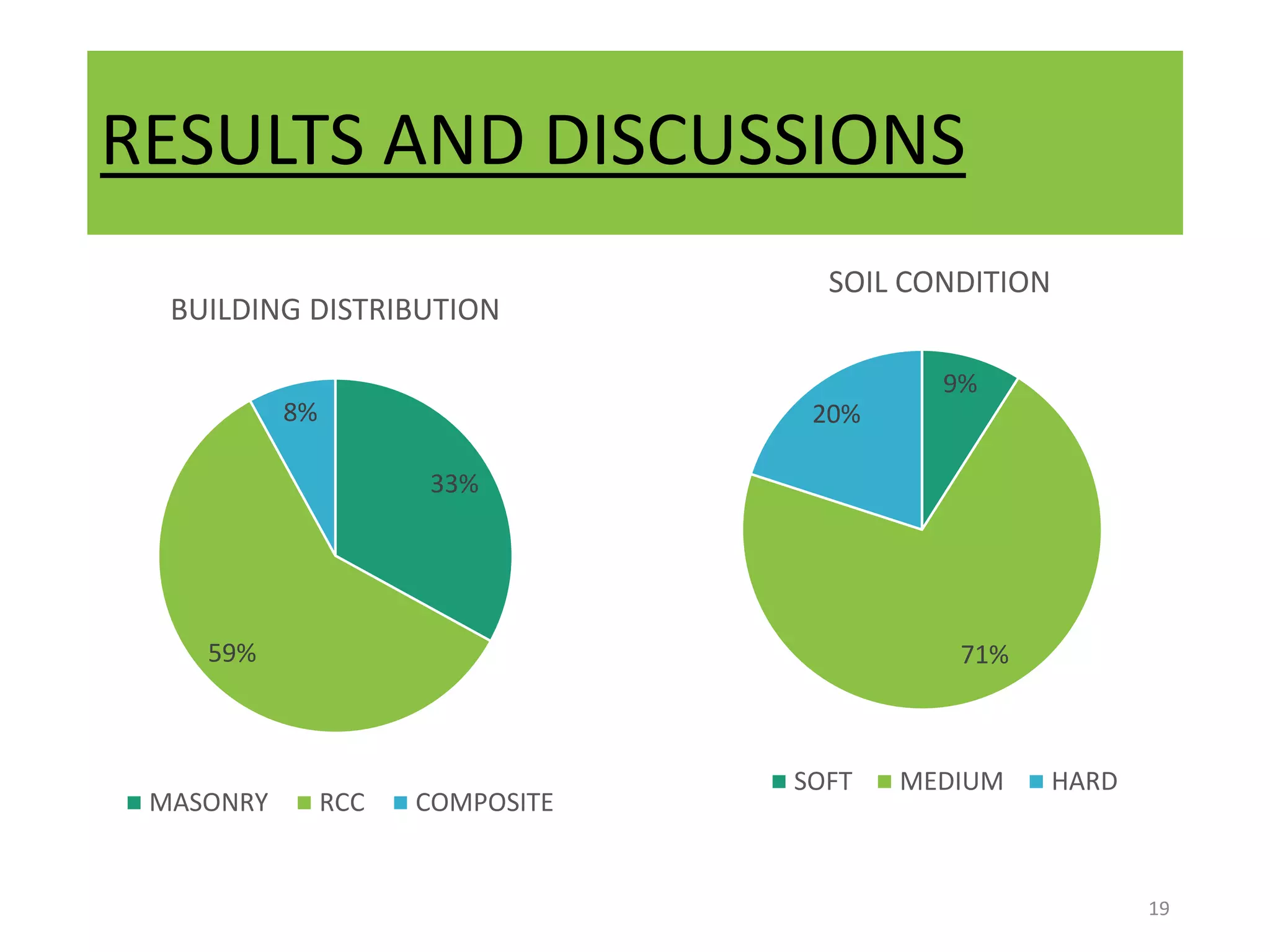
RESULTS AND DISCUSSIONS
19
33%
59%
8%
BUILDING DISTRIBUTION
MASONRY RCC COMPOSITE
9%
71%
20%
SOIL CONDITION
SOFT MEDIUM HARD
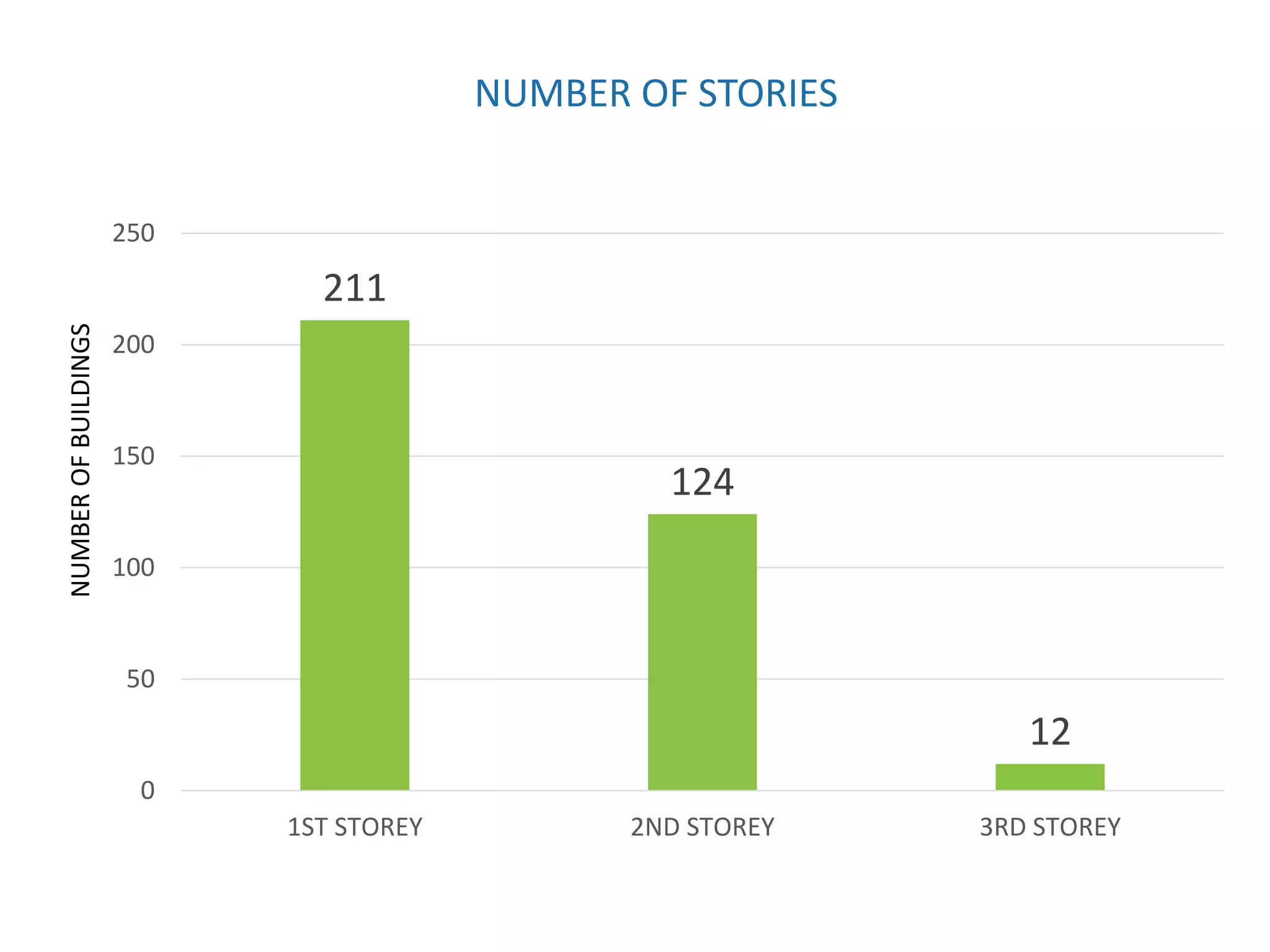
211
124
12
0
50
100
150
200
250
1ST STOREY 2ND STOREY 3RD STOREY
NUMBEROFBUILDINGS
NUMBER OF STORIES
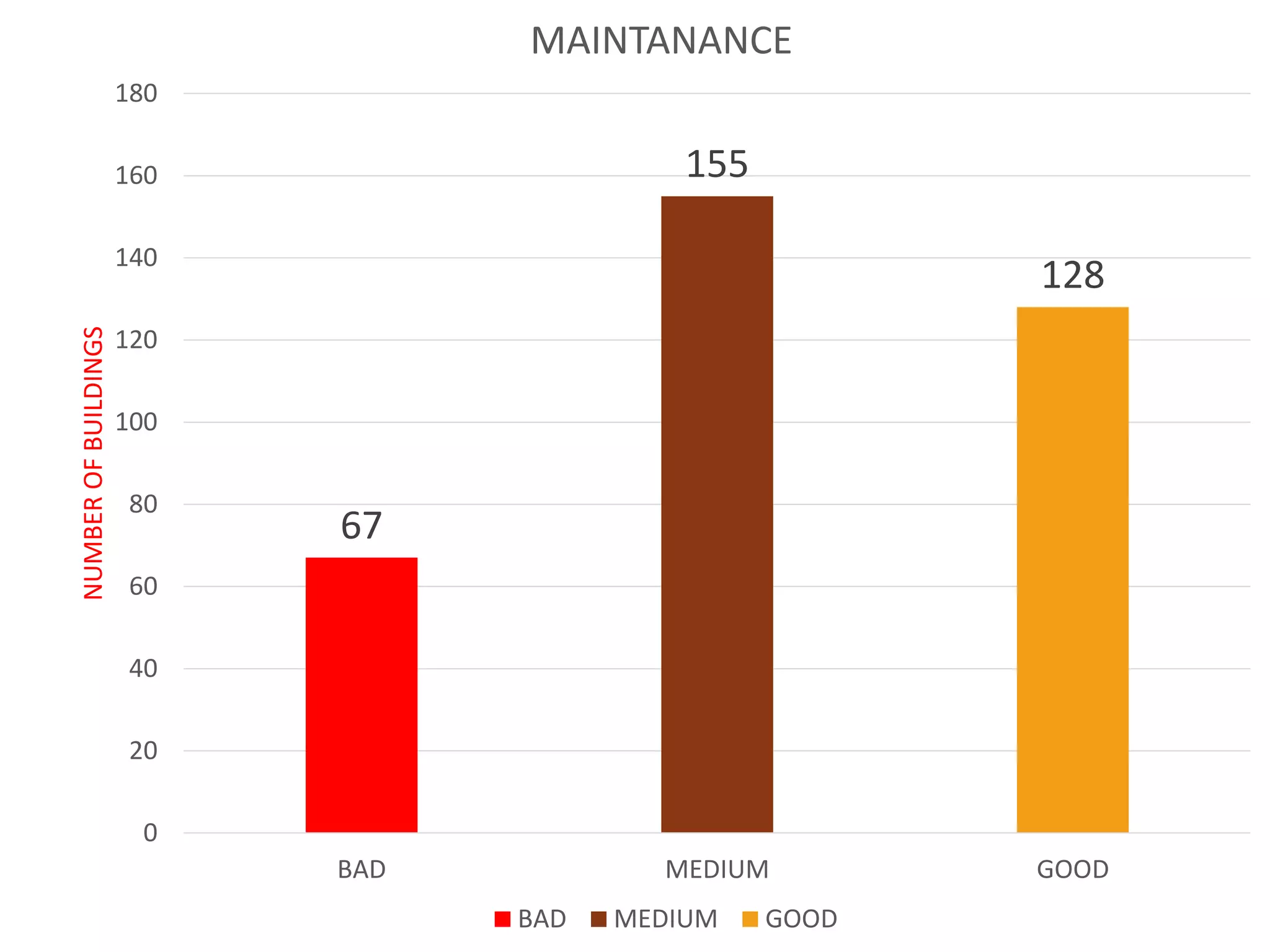
67
155
128
0
20
40
60
80
100
120
140
160
180
BAD MEDIUM GOOD
NUMBEROFBUILDINGS
MAINTANANCE
BAD MEDIUM GOOD
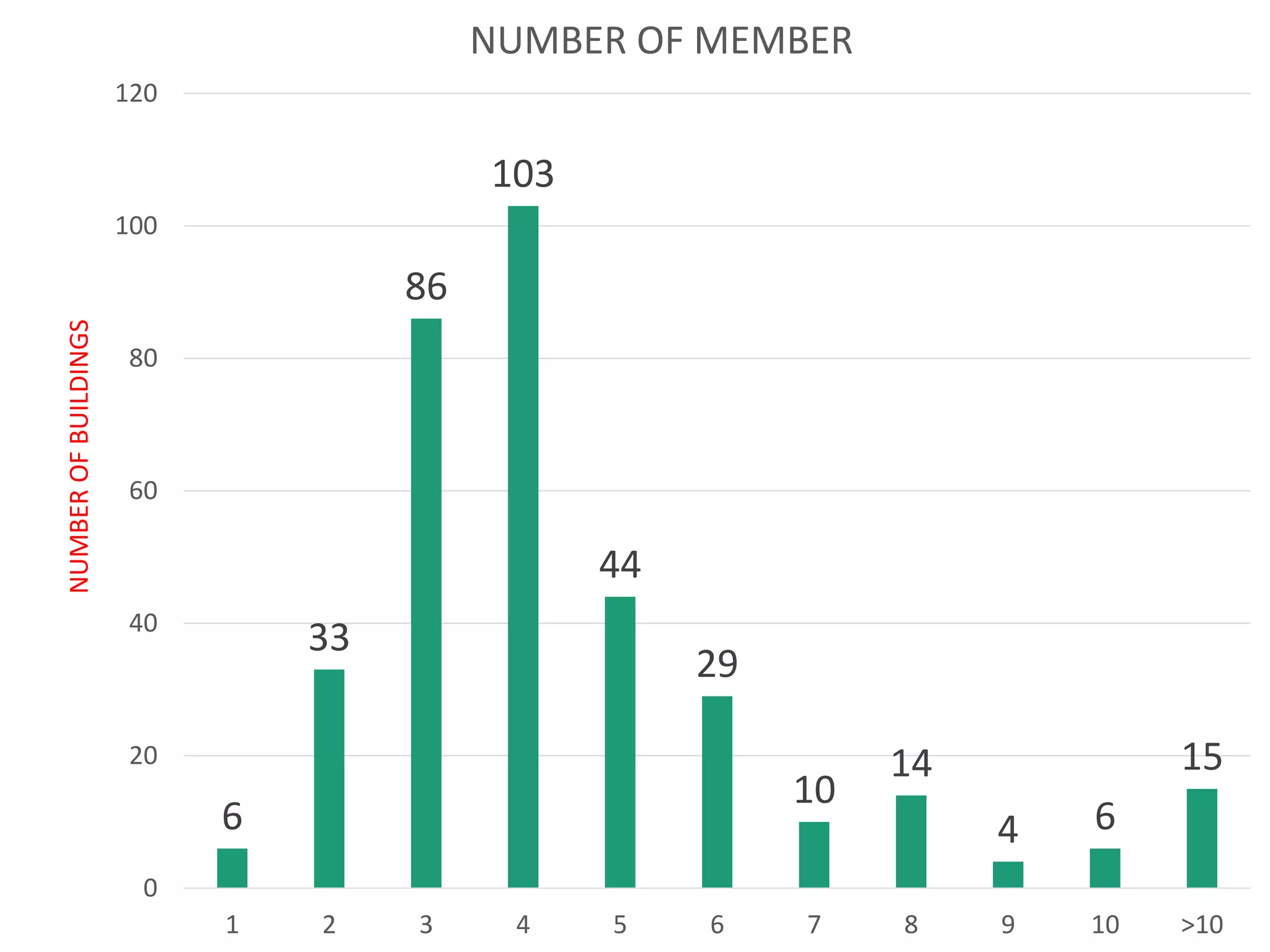
6
33
86
103
44
29
10
14
4 6
15
0
20
40
60
80
100
120
1 2 3 4 5 6 7 8 9 10 >10
NUMBEROFBUILDINGS
NUMBER OF MEMBER
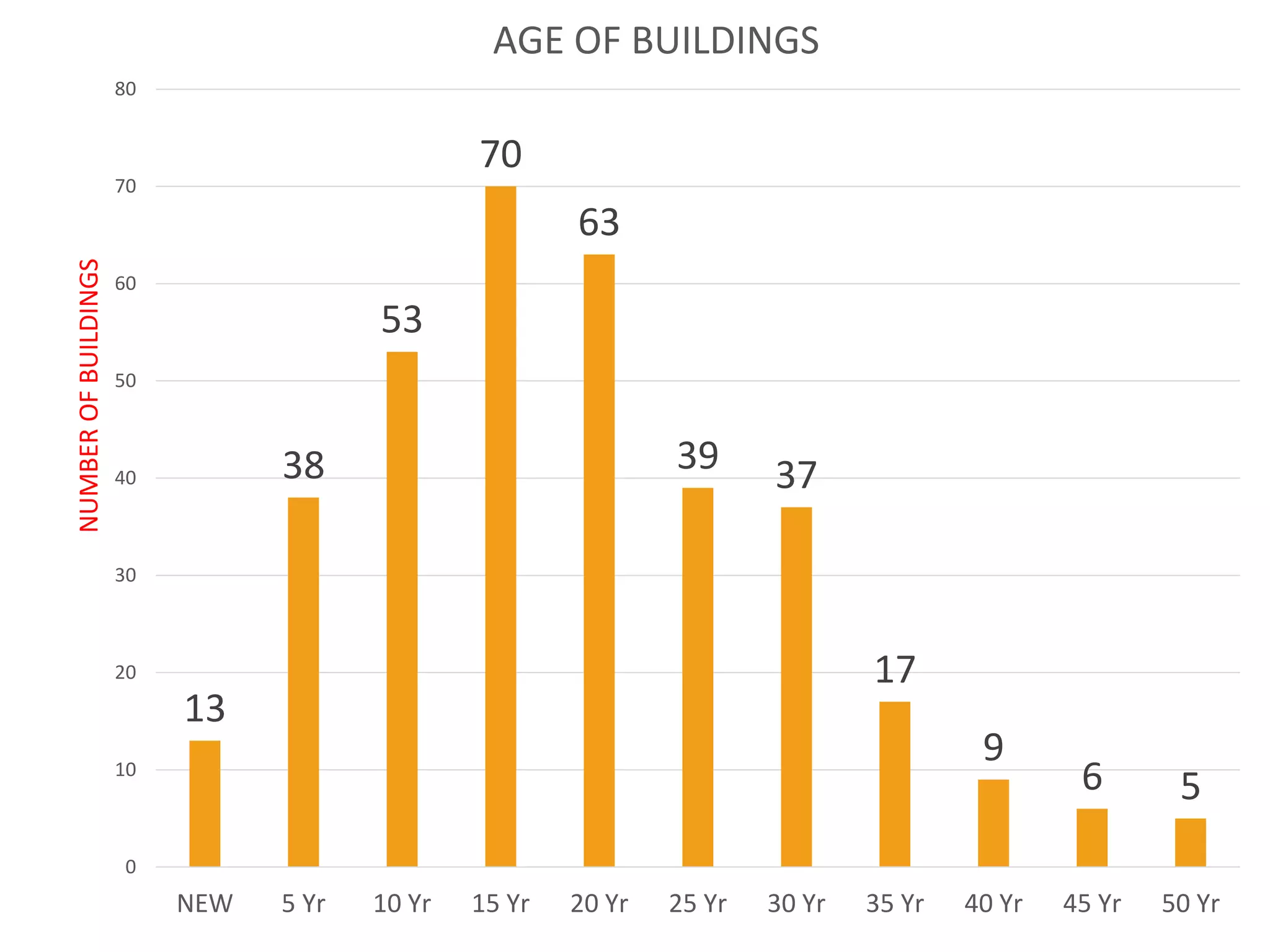
13
38
53
70
63
39 37
17
9
6 5
0
10
20
30
40
50
60
70
80
NEW 5 Yr 10 Yr 15 Yr 20 Yr 25 Yr 30 Yr 35 Yr 40 Yr 45 Yr 50 Yr
NUMBEROFBUILDINGS
AGE OF BUILDINGS
24
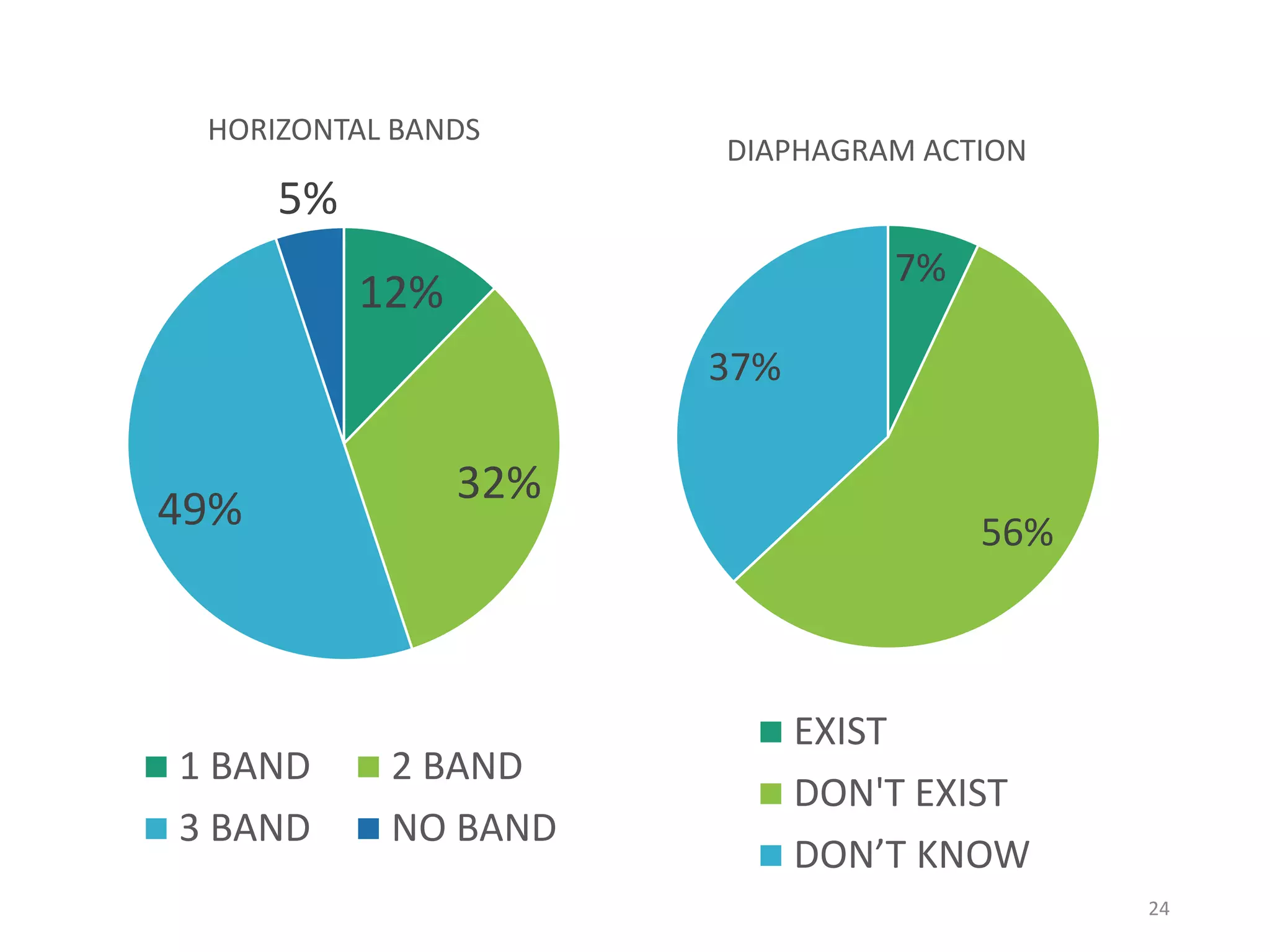
12%
32%
49%
5%
HORIZONTAL BANDS
1 BAND 2 BAND
3 BAND NO BAND
7%
56%
37%
DIAPHAGRAM ACTION
EXIST
DON'T EXIST
DON’T KNOW
36%
64%
FALLING HAZARDS
EXIST DON'T EXIST
19.00
%
81.00
%
POUNDING
EXIST DON'T EXIST
5%
95%
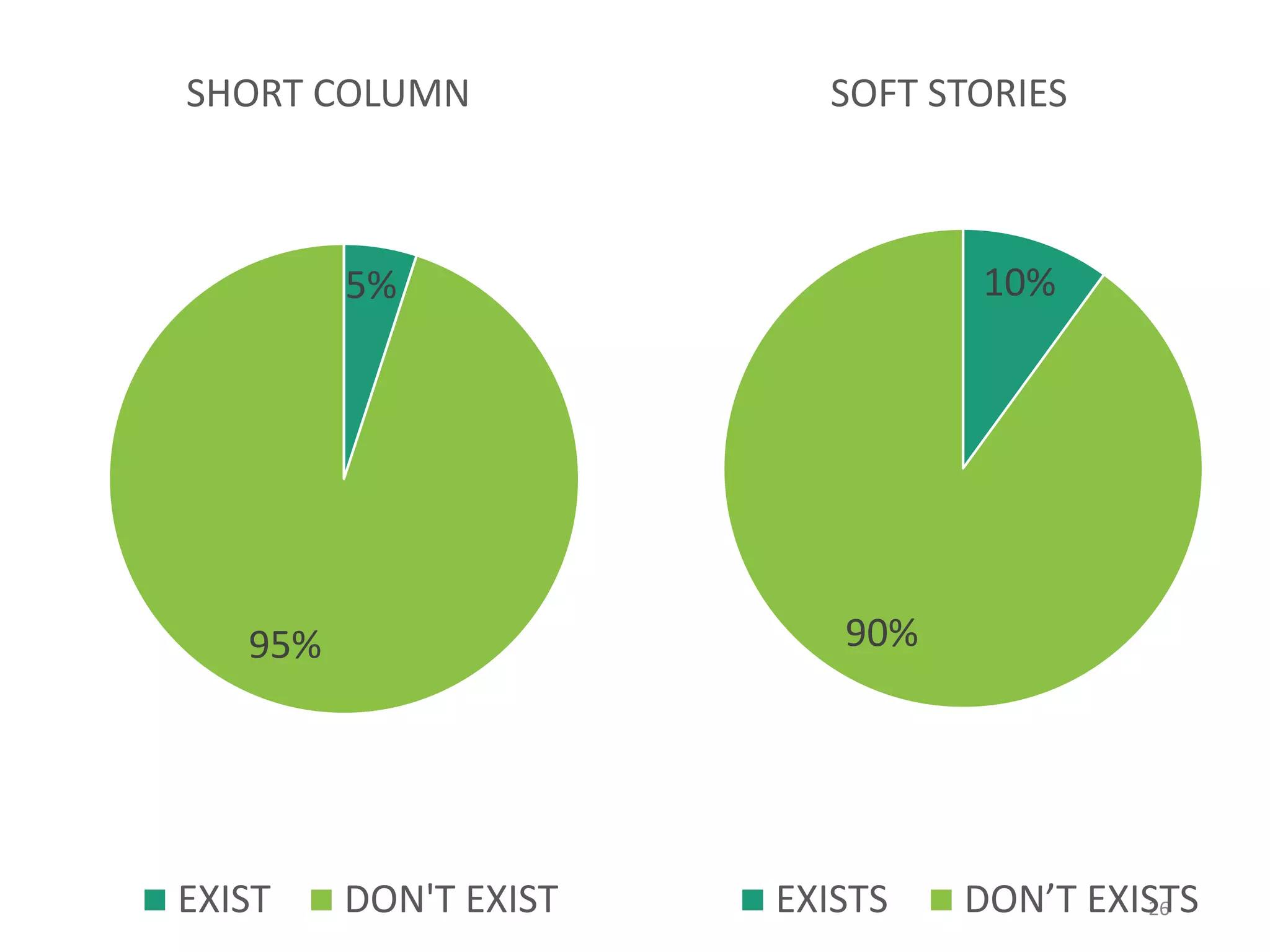
SHORT COLUMN
EXIST DON'T EXIST 26
10%
90%
SOFT STORIES
EXISTS DON’T EXISTS
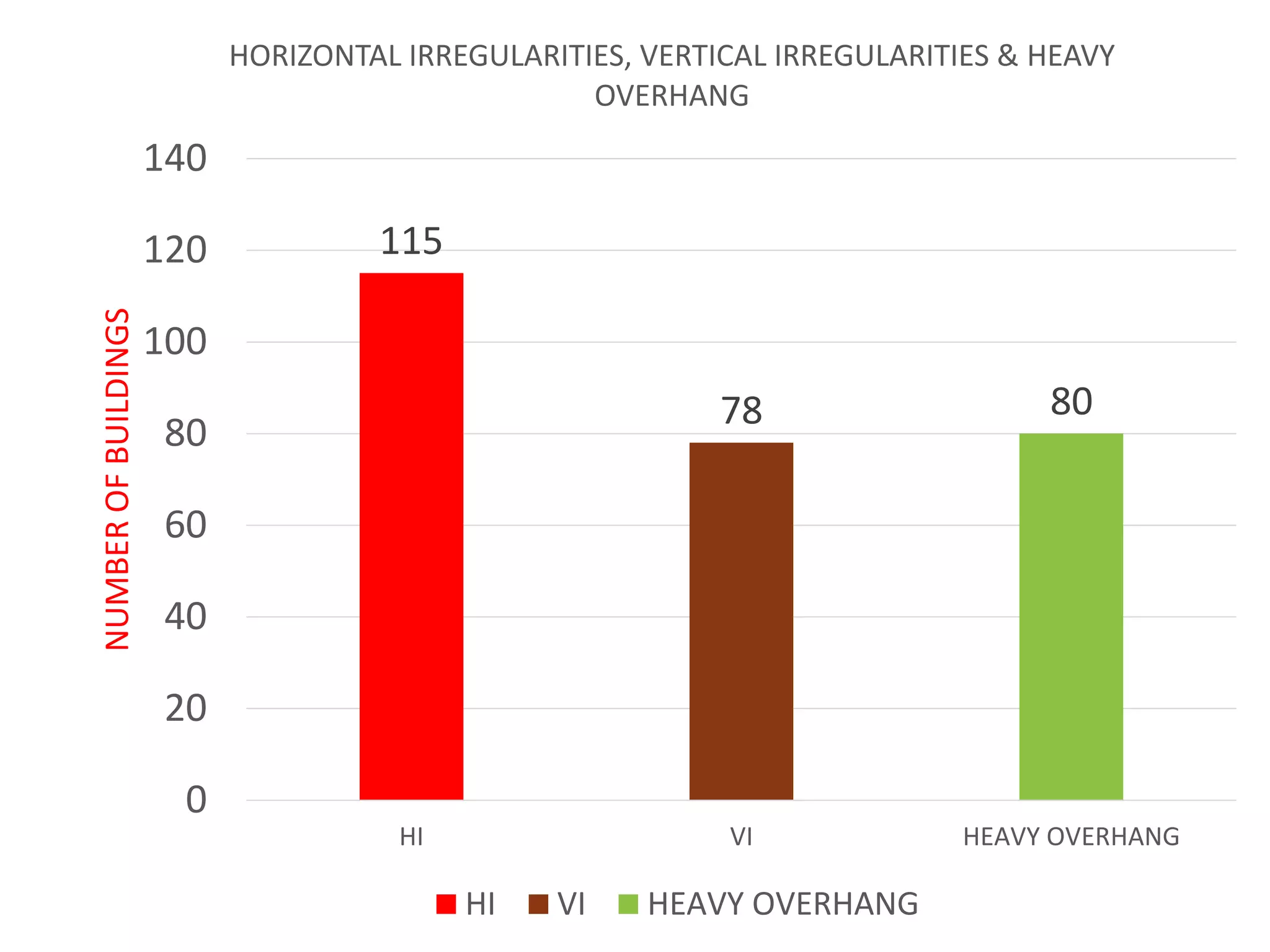
115
78 80
0
20
40
60
80
100
120
140
HI VI HEAVY OVERHANG
NUMBEROFBUILDINGS
HORIZONTAL IRREGULARITIES, VERTICAL IRREGULARITIES & HEAVY
OVERHANG
HI VI HEAVY OVERHANG
0
53
0
9
3
28
6
0
28
7
45
0 0
16
13
3
5
18
10
0
7
2
49
0 0
4
0
2
0
10
20
30
40
50
60
0.2 0.3 0.4 0.5 0.6 0.7 0.8 0.9 1 1.1 1.2 1.3 1.4 1.5
NUMBEROFBULIDINGS
FEMA 154-2015 SCORE ANALYSIS
RCC MASONRY
53
46
96
16
42
49
0
20
40
60
80
100
120
G5 G4 G3
NUMBEROFBUILDINGS
GRADES OF BUILDINGS
RCC MASONRY
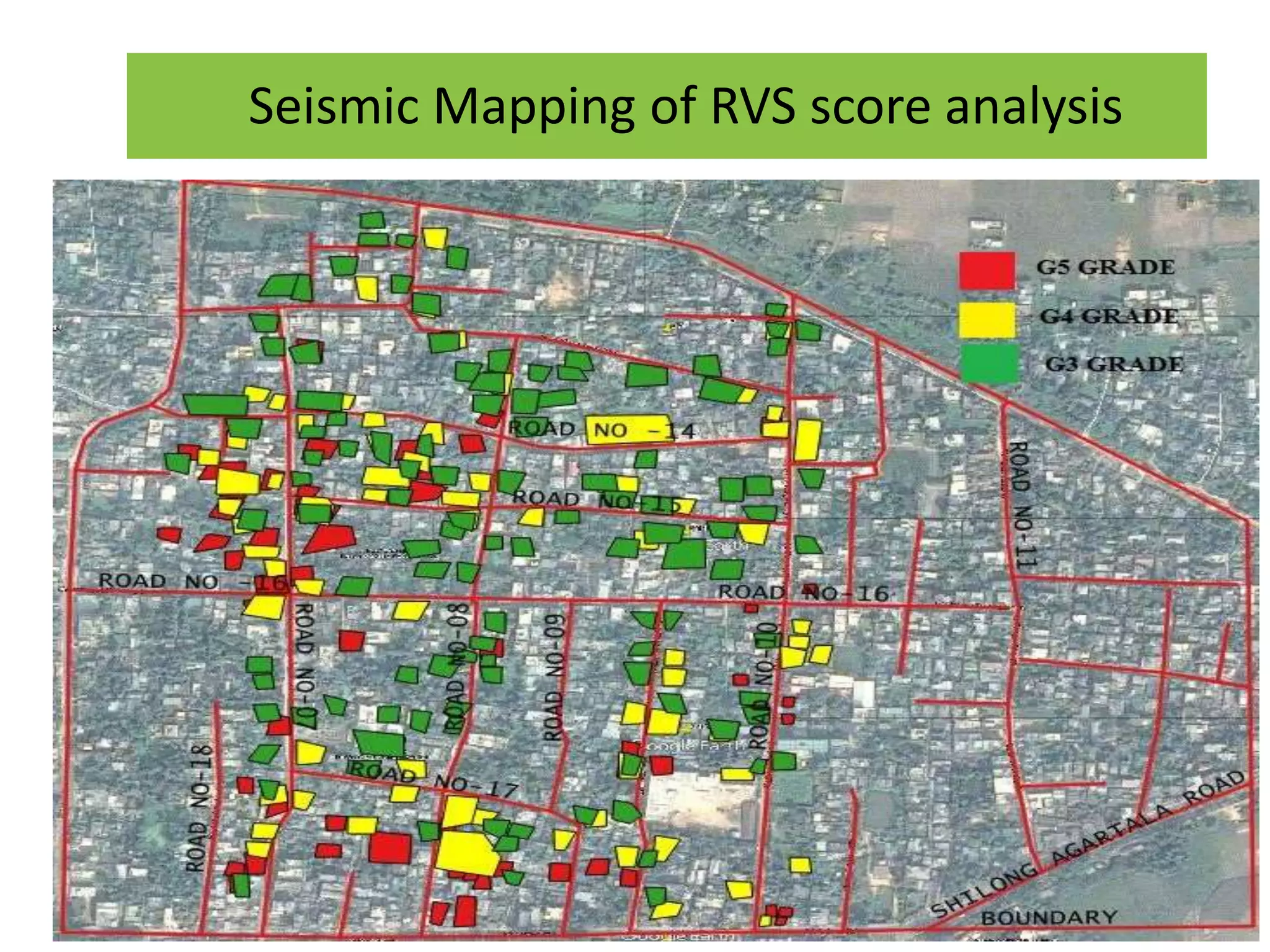
Seismic Mapping of RVS score analysis
30
CONCLUSIONS
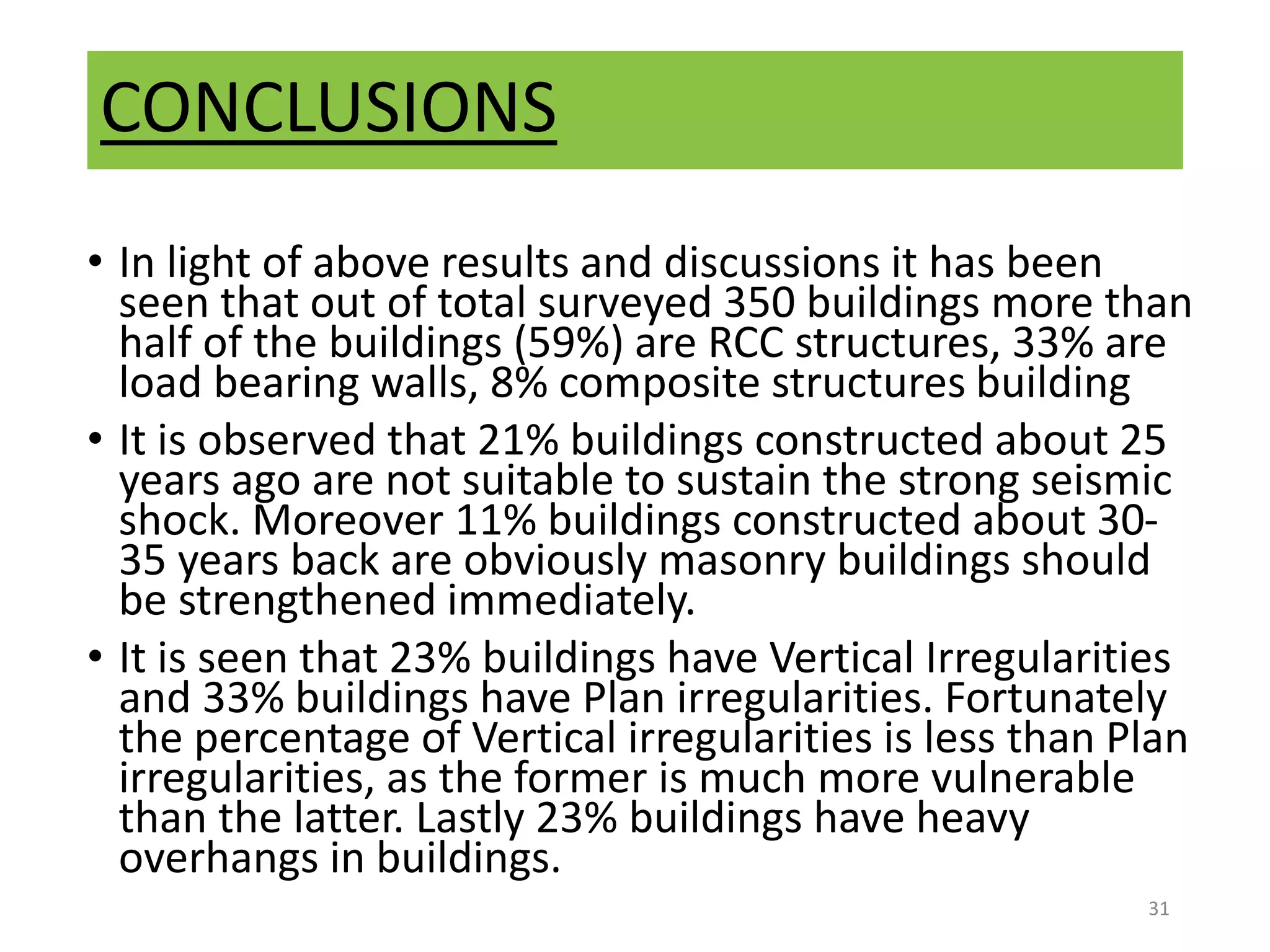
• In light of above results and discussions it has been
seen that out of total surveyed 350 buildings more than
half of the buildings (59%) are RCC structures, 33% are
load bearing walls, 8% composite structures building
• It is observed that 21% buildings constructed about 25
years ago are not suitable to sustain the strong seismic
shock. Moreover 11% buildings constructed about 30-
35 years back are obviously masonry buildings should
be strengthened immediately.
• It is seen that 23% buildings have Vertical Irregularities
and 33% buildings have Plan irregularities. Fortunately
the percentage of Vertical irregularities is less than Plan
irregularities, as the former is much more vulnerable
than the latter. Lastly 23% buildings have heavy
overhangs in buildings.
31
• The performance score of the residential buildings is
calculated by FEMA 154 (2015). it is seen all the
building need further evaluation as the performance
score of all these buildings are less than “2” which is
considered as cut-off score. All buildings belong to G3
to G5 grades.
• Near about 149 buildings may experience G3 type of
damage, 88 numbers of buildings may be
experienced G4 type damage and 69 buildings may
be experience G5 type damage in severe future
earthquake estimated by FEMA 154 (2015).
32
FUTURE SCOPE OF THE STUDY
• The seismic vulnerability assessment of existing
structures is very much essential in the city of
Agartala as it is situated in the seismic zone V, the
worst zone in India.
• All other important building like hospital, school
buildings may be considered for future study
33
REFERENCES
• Bernardini, A.,Giovinazzi, S.,Lagomarsino, S., Parodi, S. (2007). The vulnerability
assessment of current buildings by a macroseismic approach derived from the
EMS-98 scale. 3° National Congress of Earthquake Engineering, Girona, Spain
• Federal Emergency Management Agency (FEMA 154), (1988). Rapid Visual
Screening of Building for Potential Seismic Hazards: A Handbook (FEMA 154, 2015)
• Google Earth for valuable image and QGIS
• Indian Standard 13920:1993 Code of practice for ductile detailing of reinforced
concrete structures subjected to seismic forces Indian Standards, New Delhi
• Indian Standard 456:2000 Code of practice for plain and reinforced concrete Indian
Standards, New Delhi. Indian Standard 1893 (Part 1): 2002 Criteria for earthquake
resistant design of structures (Fifth Revision) Indian Standards, New Delhi.
• Sinha, R., and Goyal, A., (2004). “A National Policy for Seismic Vulnerability
Assessment of Buildings and Procedure for Rapid Visual Screening of Buildings for
Potential Seismic Vulnerability”, Department of Civil Engineering, Indian Institute of
Technology Bombay, India
• Wikipedia.
34
Thank you
35

Rapid Visual Screening of existing residential building of Agartala City

  • 1.
    SEISMIC VULNERABILITY ASSESSMENTOF RESIDENTIAL BUILDINGS IN AGARTALA CITY USING RAPID VISUAL SCREENING METHOD PRESENTED BY PROJECT GROUP B. TECH 8TH SEMESTER Under the Guidance of Asstt. Prof. LIPIKA HALDER Department of Civil Engineering NIT, AGARTALA
  • 2.
    CONTENT • Introduction • Objectivesof the study • Methodology • DETAILS OF CASE STUDIES • Results and Discussions • CONCLUSIONS • FUTURE SCOPE OF THE STUDY • References 2
  • 3.
    INTRODUCTION • Earthquakes areone of the most devastating forces in nature. These have been instrumental in changing the courses of Indian history. • Some of the most significant disasters in the last hundred years caused by earthquake results a loss of about 2,03141 human lives, besides damage to property and infrastructure. • Around 60% of the country’s landmass is prone to moderate, high or severe earthquake risks. North- east experiences earthquake of average magnitude >6.0 every year which causes huge losses to property. 3
  • 4.
    • As Tripura,north-eastern state of India is situated in seismic zone V which is severe most zone indicated by the Indian Seismic code IS 1893(Part 1)2002. So this study proposes an approach to estimate the seismic vulnerability assessment of residential buildings in Agartala city. 4
  • 5.
    Seismic Zones IS1893(Part 1):2002 5
  • 6.
    OBJECTIVES OF THESTUDY • To assess the seismic vulnerability of residential buildings in Agartala city using Rapid Visual Screening Method proposed by FEMA 154 (2015) • To predict the expected damage grade that may be observed in the surveyed buildings in future severe earthquake. 6
  • 7.
    METHODOLOGY 1.Rapid visual screening(RVS) procedure requiring only visual evaluation and limited additional information (Level 1 procedure). This procedure is recommended for all buildings. 2. Simplified vulnerability assessment (SVA) procedure requiring limited engineering analysis based on information from visual observations and structural drawings or on-site measurements (Level 2 procedure). This procedure is recommended for all buildings with high concentration of people. 3. Detailed vulnerability assessment (DVA) procedure requiring detailed computer analysis, similar to or more complex than that required for design of a new building (Level 3 procedure). This procedure is recommended for all important and lifeline buildings 7
  • 8.
    RAPID VISUAL SCREENINGPROCEDURE (RVS) • Rapid visual screening was first proposed in US in 1988 in the FEMA 154 report, which was latest modified in 2015 to incorporate latest technological advancements and lessons from earthquake disasters in the 1990. • RVS is useful when the number of buildings to be evaluated is large. 8
  • 9.
    SURVEY PARAMETERS  GeneralInformation: Type of building, Number of stories, Year of construction, Number of occupants, Maintenance record.  Structural Irregularities: Vertical irregularities, Plan irregularities.  Apparent building quality: Quality of materials & construction.  Soil conditions.  Frame action  Diaphragm action.  Heavy overhangs, Soft story, Short column. 9
  • 10.
     Pounding effect:Two Adjacent buildings.  Openings: Large openings in wall, irregular openings in walls.  Bands: Horizontal Bands at plinth level, lintel level, sill & roof level.  Falling Hazards.  Wall thickness at ground floor.  Water tank at roof: Capacity and location. 10
  • 11.
    DETAILS OF CASESTUDIES  The side walk survey was conducted in a phased manner between 25 August,2016 to 4th April ,2017.  The road no’s are respectively – 7,8,9,10,13,14,15,16 and 17, which was surveyed during this period.  Total 350 no’s of residential buildings are surveyed. Among them 205 comprise RCC structures, 116 comprise masonry constructions, 29 are Composite structures and the remaining is mixed type  A performance score is calculated for each building which indicates whether the building strength is adequate to withstand earthquake forces 11
  • 12.
  • 13.
    Rapid Visual Surveyfor Masonry buildings 13
  • 14.
  • 15.
    Rapid Visual Surveyfor RCC buildings 15
  • 16.
  • 17.
    Predicted damage grades 17 RVSScore Damage Potential S < 0.4 High probability of Grade 5 damage; Very high probability of Grade 4 damage 0.4 ≤ S ≤ 0.9 High probability of Grade 4 damage; Very high probability of Grade 3 damage 1.0 ≤ S ≤ 1.5 High probability of Grade 3 damage; Very high probability of Grade 2 damage 1.6 ≤ S ≤ 2.0 High probability of Grade 2 damage; Very high probability of Grade 1 damage 2.0 < S Probability of Grade 1 damage
  • 18.
    18 DAMAGE GRADE MASONRYBUILDINGS R.C.C STRUCTURES Grade 1 Negligible to slight damage (No structural damage, slight non- structural damage) 1. Hair-line cracks in very few walls. 2. Fall of small pieces of plaster only. 3. Falling of loose stones. 1. Fine cracks in plaster over frame members or in walls at the base. 2. Fine cracks in partitions and infill's. Grade 2 Moderate damage (Slight structural damage, moderate non-structural damage) 1. Cracks in many walls. 2. Fall of fairly large pieces of plaster. 3. Partial collapse of chimneys. 1. Cracks in columns and beams of frames and in structural walls. 2. Cracks in partition and infill walls; fall of brittle cladding and plaster. 3. Falling mortar from the joints of wall panels. Grade 3 Substantial to heavy damage (moderate structural damage, heavy non-structural damage) 1. Large and extensive cracks in most walls. 2. Roof tiles detach. Chimneys fracture at the roof line. 3. Failure of individual non-structural elements (partitions, gable walls etc.). 1. Cracks in columns and beam-column joints of frames at the base and at joints of coupled walls. 2. Spalling of concrete cover, buckling of reinforced bars. 3. Large cracks in partition and infill walls, failure of individual infill panels. Grade 4: Very heavy damage (heavy structural damage, very heavy non-structural damage) 1. Serious failure of walls (gaps in walls). 2. Partial structural failure of roofs and floors. 1. Large cracks in structural elements with compression failure of concrete and fracture of rebars. 2. Bond failure of beam reinforcing bars; tilting of columns. 3. Collapse of a few columns or of a single upper floor. Grade 5: Destruction (very heavy structural damage) 1. Total or near total collapse of the building. 1. Collapse of ground floor parts (e.g. wings) of the building.
  • 19.
    RESULTS AND DISCUSSIONS 19 33% 59% 8% BUILDINGDISTRIBUTION MASONRY RCC COMPOSITE 9% 71% 20% SOIL CONDITION SOFT MEDIUM HARD
  • 20.
    211 124 12 0 50 100 150 200 250 1ST STOREY 2NDSTOREY 3RD STOREY NUMBEROFBUILDINGS NUMBER OF STORIES
  • 21.
  • 22.
    6 33 86 103 44 29 10 14 4 6 15 0 20 40 60 80 100 120 1 23 4 5 6 7 8 9 10 >10 NUMBEROFBUILDINGS NUMBER OF MEMBER
  • 23.
    13 38 53 70 63 39 37 17 9 6 5 0 10 20 30 40 50 60 70 80 NEW5 Yr 10 Yr 15 Yr 20 Yr 25 Yr 30 Yr 35 Yr 40 Yr 45 Yr 50 Yr NUMBEROFBUILDINGS AGE OF BUILDINGS
  • 24.
    24 12% 32% 49% 5% HORIZONTAL BANDS 1 BAND2 BAND 3 BAND NO BAND 7% 56% 37% DIAPHAGRAM ACTION EXIST DON'T EXIST DON’T KNOW
  • 25.
    36% 64% FALLING HAZARDS EXIST DON'TEXIST 19.00 % 81.00 % POUNDING EXIST DON'T EXIST
  • 26.
    5% 95% SHORT COLUMN EXIST DON'TEXIST 26 10% 90% SOFT STORIES EXISTS DON’T EXISTS
  • 27.
    115 78 80 0 20 40 60 80 100 120 140 HI VIHEAVY OVERHANG NUMBEROFBUILDINGS HORIZONTAL IRREGULARITIES, VERTICAL IRREGULARITIES & HEAVY OVERHANG HI VI HEAVY OVERHANG
  • 28.
    0 53 0 9 3 28 6 0 28 7 45 0 0 16 13 3 5 18 10 0 7 2 49 0 0 4 0 2 0 10 20 30 40 50 60 0.20.3 0.4 0.5 0.6 0.7 0.8 0.9 1 1.1 1.2 1.3 1.4 1.5 NUMBEROFBULIDINGS FEMA 154-2015 SCORE ANALYSIS RCC MASONRY
  • 29.
  • 30.
    Seismic Mapping ofRVS score analysis 30
  • 31.
    CONCLUSIONS • In lightof above results and discussions it has been seen that out of total surveyed 350 buildings more than half of the buildings (59%) are RCC structures, 33% are load bearing walls, 8% composite structures building • It is observed that 21% buildings constructed about 25 years ago are not suitable to sustain the strong seismic shock. Moreover 11% buildings constructed about 30- 35 years back are obviously masonry buildings should be strengthened immediately. • It is seen that 23% buildings have Vertical Irregularities and 33% buildings have Plan irregularities. Fortunately the percentage of Vertical irregularities is less than Plan irregularities, as the former is much more vulnerable than the latter. Lastly 23% buildings have heavy overhangs in buildings. 31
  • 32.
    • The performancescore of the residential buildings is calculated by FEMA 154 (2015). it is seen all the building need further evaluation as the performance score of all these buildings are less than “2” which is considered as cut-off score. All buildings belong to G3 to G5 grades. • Near about 149 buildings may experience G3 type of damage, 88 numbers of buildings may be experienced G4 type damage and 69 buildings may be experience G5 type damage in severe future earthquake estimated by FEMA 154 (2015). 32
  • 33.
    FUTURE SCOPE OFTHE STUDY • The seismic vulnerability assessment of existing structures is very much essential in the city of Agartala as it is situated in the seismic zone V, the worst zone in India. • All other important building like hospital, school buildings may be considered for future study 33
  • 34.
    REFERENCES • Bernardini, A.,Giovinazzi,S.,Lagomarsino, S., Parodi, S. (2007). The vulnerability assessment of current buildings by a macroseismic approach derived from the EMS-98 scale. 3° National Congress of Earthquake Engineering, Girona, Spain • Federal Emergency Management Agency (FEMA 154), (1988). Rapid Visual Screening of Building for Potential Seismic Hazards: A Handbook (FEMA 154, 2015) • Google Earth for valuable image and QGIS • Indian Standard 13920:1993 Code of practice for ductile detailing of reinforced concrete structures subjected to seismic forces Indian Standards, New Delhi • Indian Standard 456:2000 Code of practice for plain and reinforced concrete Indian Standards, New Delhi. Indian Standard 1893 (Part 1): 2002 Criteria for earthquake resistant design of structures (Fifth Revision) Indian Standards, New Delhi. • Sinha, R., and Goyal, A., (2004). “A National Policy for Seismic Vulnerability Assessment of Buildings and Procedure for Rapid Visual Screening of Buildings for Potential Seismic Vulnerability”, Department of Civil Engineering, Indian Institute of Technology Bombay, India • Wikipedia. 34
  • 35.