Data Structures
Linear List Array Representation
Andres Mendez-Vazquez
May 6, 2015
1 / 24
Images/cinvestav-
Outline
1 Linear List Array Representation
Operations in Array List
2 Dynamic Arrays
How much we need to expand it...
A Strategy for it
Analysis
2 / 24
Images/cinvestav-
How do we implement the ADT List?
In our first representation will use an array
Use a one-dimensional array element[]:
a b c d e - - - -
0 1 2 3 4 5 6 7 8
The previous array
A representation of L = (a, b, c, d, e) using position i in element[i].
3 / 24
Images/cinvestav-
How do we implement the ADT List?
In our first representation will use an array
Use a one-dimensional array element[]:
a b c d e - - - -
0 1 2 3 4 5 6 7 8
The previous array
A representation of L = (a, b, c, d, e) using position i in element[i].
3 / 24
Images/cinvestav-
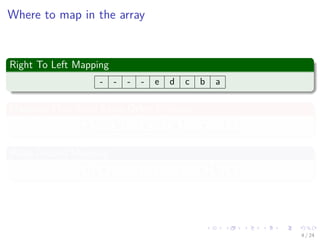
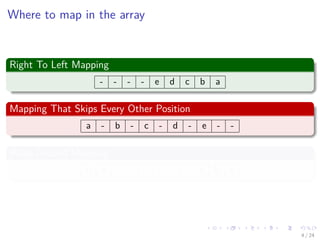
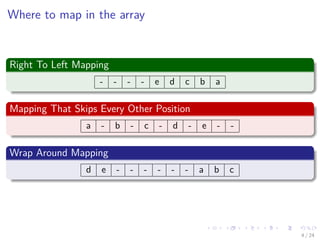
Where to map in the array
Right To Left Mapping
- - - - e d c b a
Mapping That Skips Every Other Position
a - b - c - d - e - -
Wrap Around Mapping
d e - - - - - - a b c
4 / 24
Images/cinvestav-
Where to map in the array
Right To Left Mapping
- - - - e d c b a
Mapping That Skips Every Other Position
a - b - c - d - e - -
Wrap Around Mapping
d e - - - - - - a b c
4 / 24
Images/cinvestav-
Where to map in the array
Right To Left Mapping
- - - - e d c b a
Mapping That Skips Every Other Position
a - b - c - d - e - -
Wrap Around Mapping
d e - - - - - - a b c
4 / 24
Images/cinvestav-
Representation Used In Text
Something Notable
a b c d e - - - -
0 1 2 3 4 5 6 7 8
Size=5
Thus
1 Put element i of list in element[i].
2 Use a variable size to record current number of elements
5 / 24
Images/cinvestav-
Representation Used In Text
Something Notable
a b c d e - - - -
0 1 2 3 4 5 6 7 8
Size=5
Thus
1 Put element i of list in element[i].
2 Use a variable size to record current number of elements
5 / 24
Images/cinvestav-
Code
Our Implementation
p u b l i c c l a s s S i m p l e A r r a y L i s t <Item> implements
L i n e a r L i s t <Item >{
// p r i v a t e elements of implementation
p r o t e c t e d Item element [ ] ;
p r o t e c t e d i n t s i z e ;
p r o t e c t e d f i n a l s t a t i c i n t DEFAULT_SIZE = 10;
// C o n s t r u c t o r s
p u b l i c S i m p l e A r r a y L i s t (){
t h i s . s i z e = 0;
t h i s . element = ( Item [ ] ) new Object [ t h i s . DEFAULT_SIZE ] ;
}
p u b l i c S i m p l e A r r a y L i s t ( i n t NewSize ){
t h i s . s i z e = 0;
t h i s . element = ( Item [ ] ) new Object [ NewSize ] ;
}
6 / 24
Images/cinvestav-
Data Type Of Array element[]
First than anything
Data type of list elements is unknown.
Thus, we used the genericity of Object
1 Then, we use element[] to be of data type Object.
2 Then, we cast to the new “Item.”
However
You cannot put elements of primitive data types (int, float, double, char,
etc.) into our linear lists.
7 / 24
Images/cinvestav-
Data Type Of Array element[]
First than anything
Data type of list elements is unknown.
Thus, we used the genericity of Object
1 Then, we use element[] to be of data type Object.
2 Then, we cast to the new “Item.”
However
You cannot put elements of primitive data types (int, float, double, char,
etc.) into our linear lists.
7 / 24
Images/cinvestav-
Data Type Of Array element[]
First than anything
Data type of list elements is unknown.
Thus, we used the genericity of Object
1 Then, we use element[] to be of data type Object.
2 Then, we cast to the new “Item.”
However
You cannot put elements of primitive data types (int, float, double, char,
etc.) into our linear lists.
7 / 24
Images/cinvestav-
Data Type Of Array element[]
First than anything
Data type of list elements is unknown.
Thus, we used the genericity of Object
1 Then, we use element[] to be of data type Object.
2 Then, we cast to the new “Item.”
However
You cannot put elements of primitive data types (int, float, double, char,
etc.) into our linear lists.
7 / 24
Images/cinvestav-
Outline
1 Linear List Array Representation
Operations in Array List
2 Dynamic Arrays
How much we need to expand it...
A Strategy for it
Analysis
8 / 24
Images/cinvestav-
Operations: Add
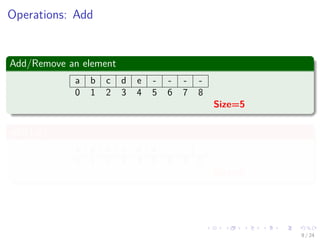
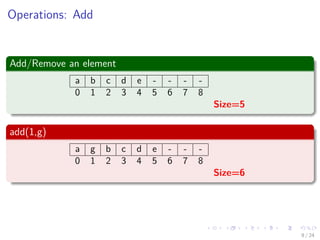
Add/Remove an element
a b c d e - - - -
0 1 2 3 4 5 6 7 8
Size=5
add(1,g)
a g b c d e - - -
0 1 2 3 4 5 6 7 8
Size=6
9 / 24
Images/cinvestav-
Operations: Add
Add/Remove an element
a b c d e - - - -
0 1 2 3 4 5 6 7 8
Size=5
add(1,g)
a g b c d e - - -
0 1 2 3 4 5 6 7 8
Size=6
9 / 24
Images/cinvestav-
Code
Our Implementation
p u b l i c void add ( i n t index , Item myobject ){
// I n i t i a l V a r i a b l e s
i n t i ;
// Always check f o r p o s s i b l e e r r o r s
i f ( t h i s . s i z e == element . len ght ){
System . out . p r i n t l n ( " L i s t ␣ does ␣ not ␣ have ␣ space " ) ;
System . e x i t ( 0 ) ;
}
i f ( index <0 | | index >t h i s . s i z e ){
System . out . p r i n t l n ( " Index ␣ out ␣ of ␣bound " ) ;
System . e x i t ( 0 ) ;
}
// S h i f t p o s t i i o n s as n e c e s s a r y
f o r ( i = t h i s . s i z e ; i >index ; i −−)
element [ i +1]=element [ i ] ;
// copy element i n t o c o n t a i n e r
element [ i +1]=myobject ;
}
10 / 24
Images/cinvestav-
Operations: Get
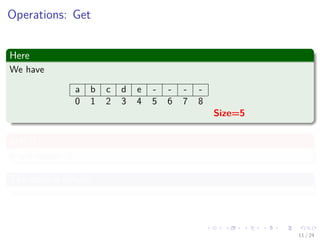
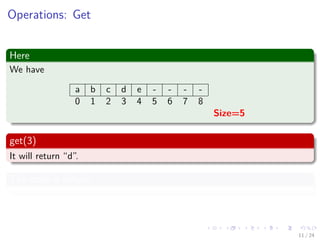
Here
We have
a b c d e - - - -
0 1 2 3 4 5 6 7 8
Size=5
get(3)
It will return “d”.
The code is simple
11 / 24
Images/cinvestav-
Operations: Get
Here
We have
a b c d e - - - -
0 1 2 3 4 5 6 7 8
Size=5
get(3)
It will return “d”.
The code is simple
11 / 24
Images/cinvestav-
Operations: Get
Here
We have
a b c d e - - - -
0 1 2 3 4 5 6 7 8
Size=5
get(3)
It will return “d”.
The code is simple
p u b l i c Item get ( i n t index ){
// Check always
i f ( t h i s . s i z e == 0) r e t u r n n u l l ;
i f ( index <0 | | index >t h i s . s i z e −1){
System . out . p r i n t l n ( " Index ␣ out ␣ of ␣bound " ) ;
System . e x i t ( 0 ) ;
}
r e t u r n element [ index ]
}
11 / 24
Images/cinvestav-
You can implement the rest
Yes
Part of your homework!!!
12 / 24
Images/cinvestav-
Now, we have a common problem
Because
We do not know how many elements will be stored at the list.
We use
An initial length and dynamically increase the size as needed.
13 / 24
Images/cinvestav-
Now, we have a common problem
Because
We do not know how many elements will be stored at the list.
We use
An initial length and dynamically increase the size as needed.
13 / 24
Images/cinvestav-
Example
Example
Length of array element[] is 6:
a b c d e f
First create a new and larger array
NewArray = (Item[]) new Object[12]
- - - - - - - - - - - -
Now copy the new elements into the new array!!!
System.arraycopy(element, 0, newArray, 0, element.length);
a b c d e f - - - - - -
14 / 24
Images/cinvestav-
Example
Example
Length of array element[] is 6:
a b c d e f
First create a new and larger array
NewArray = (Item[]) new Object[12]
- - - - - - - - - - - -
Now copy the new elements into the new array!!!
System.arraycopy(element, 0, newArray, 0, element.length);
a b c d e f - - - - - -
14 / 24
Images/cinvestav-
Example
Example
Length of array element[] is 6:
a b c d e f
First create a new and larger array
NewArray = (Item[]) new Object[12]
- - - - - - - - - - - -
Now copy the new elements into the new array!!!
System.arraycopy(element, 0, newArray, 0, element.length);
a b c d e f - - - - - -
14 / 24
Images/cinvestav-
Example
Finally, rename new array
element = NewArray;
element[0]−→ a b c d e f - - - - - -
15 / 24
Images/cinvestav-
Outline
1 Linear List Array Representation
Operations in Array List
2 Dynamic Arrays
How much we need to expand it...
A Strategy for it
Analysis
16 / 24
Images/cinvestav-
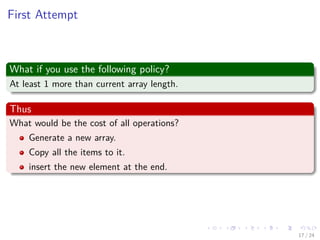
First Attempt
What if you use the following policy?
At least 1 more than current array length.
Thus
What would be the cost of all operations?
Generate a new array.
Copy all the items to it.
insert the new element at the end.
17 / 24
Images/cinvestav-
First Attempt
What if you use the following policy?
At least 1 more than current array length.
Thus
What would be the cost of all operations?
Generate a new array.
Copy all the items to it.
insert the new element at the end.
17 / 24
Images/cinvestav-
First Attempt
What if you use the following policy?
At least 1 more than current array length.
Thus
What would be the cost of all operations?
Generate a new array.
Copy all the items to it.
insert the new element at the end.
17 / 24
Images/cinvestav-
First Attempt
What if you use the following policy?
At least 1 more than current array length.
Thus
What would be the cost of all operations?
Generate a new array.
Copy all the items to it.
insert the new element at the end.
17 / 24
Images/cinvestav-
First Attempt
What if you use the following policy?
At least 1 more than current array length.
Thus
What would be the cost of all operations?
Generate a new array.
Copy all the items to it.
insert the new element at the end.
17 / 24
Images/cinvestav-
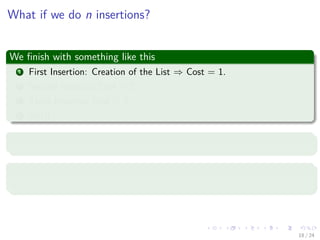
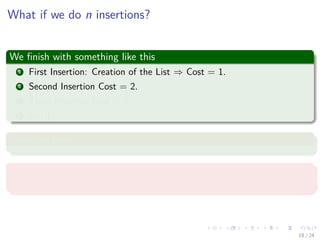
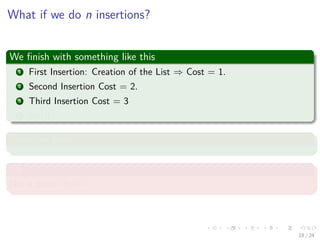
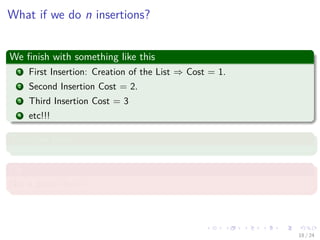
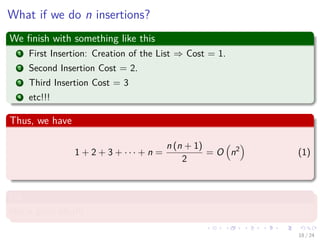
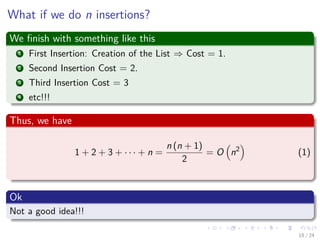
What if we do n insertions?
We finish with something like this
1 First Insertion: Creation of the List ⇒ Cost = 1.
2 Second Insertion Cost = 2.
3 Third Insertion Cost = 3
4 etc!!!
Thus, we have
Ok
Not a good idea!!!
18 / 24
Images/cinvestav-
What if we do n insertions?
We finish with something like this
1 First Insertion: Creation of the List ⇒ Cost = 1.
2 Second Insertion Cost = 2.
3 Third Insertion Cost = 3
4 etc!!!
Thus, we have
Ok
Not a good idea!!!
18 / 24
Images/cinvestav-
What if we do n insertions?
We finish with something like this
1 First Insertion: Creation of the List ⇒ Cost = 1.
2 Second Insertion Cost = 2.
3 Third Insertion Cost = 3
4 etc!!!
Thus, we have
Ok
Not a good idea!!!
18 / 24
Images/cinvestav-
What if we do n insertions?
We finish with something like this
1 First Insertion: Creation of the List ⇒ Cost = 1.
2 Second Insertion Cost = 2.
3 Third Insertion Cost = 3
4 etc!!!
Thus, we have
Ok
Not a good idea!!!
18 / 24
Images/cinvestav-
What if we do n insertions?
We finish with something like this
1 First Insertion: Creation of the List ⇒ Cost = 1.
2 Second Insertion Cost = 2.
3 Third Insertion Cost = 3
4 etc!!!
Thus, we have
1 + 2 + 3 + · · · + n =
n (n + 1)
2
= O n2
(1)
Ok
Not a good idea!!!
18 / 24
Images/cinvestav-
What if we do n insertions?
We finish with something like this
1 First Insertion: Creation of the List ⇒ Cost = 1.
2 Second Insertion Cost = 2.
3 Third Insertion Cost = 3
4 etc!!!
Thus, we have
1 + 2 + 3 + · · · + n =
n (n + 1)
2
= O n2
(1)
Ok
Not a good idea!!!
18 / 24
Images/cinvestav-
Outline
1 Linear List Array Representation
Operations in Array List
2 Dynamic Arrays
How much we need to expand it...
A Strategy for it
Analysis
19 / 24
Images/cinvestav-
A better strategy
Dynamic Array
To avoid incurring the cost of resizing many times, dynamic arrays resize
by an amount a.
In our example we double the size, a = 2
20 / 24
Images/cinvestav-
A better strategy
Dynamic Array
To avoid incurring the cost of resizing many times, dynamic arrays resize
by an amount a.
In our example we double the size, a = 2
Item NewArray [ ] ;
i f ( t h i s . s i z e == element . len ght ){
// Resize the c a p a c i t y
NewArray = ( Item [ ] ) new Object [ 2*this.size ]
f o r ( i n t i =0; i < s i z e ; i ++){
NewArray [ i ]= element [ i ] ;
}
element = NewArray ;
}
20 / 24
Images/cinvestav-
Space Complexity
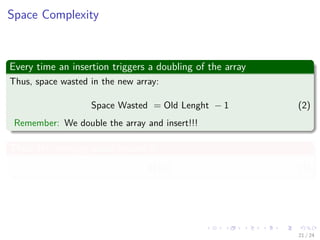
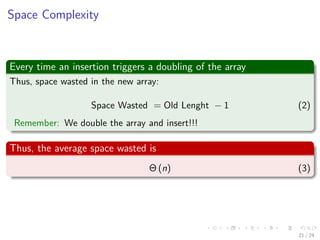
Every time an insertion triggers a doubling of the array
Thus, space wasted in the new array:
Space Wasted = Old Lenght − 1 (2)
Remember: We double the array and insert!!!
Thus, the average space wasted is
Θ (n) (3)
21 / 24
Images/cinvestav-
Space Complexity
Every time an insertion triggers a doubling of the array
Thus, space wasted in the new array:
Space Wasted = Old Lenght − 1 (2)
Remember: We double the array and insert!!!
Thus, the average space wasted is
Θ (n) (3)
21 / 24
Images/cinvestav-
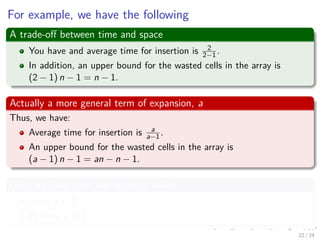
For example, we have the following
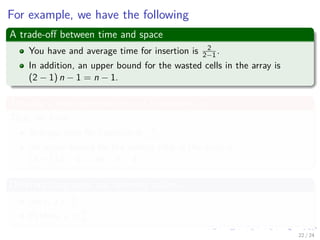
A trade-off between time and space
You have and average time for insertion is 2
2−1 .
In addition, an upper bound for the wasted cells in the array is
(2 − 1) n − 1 = n − 1.
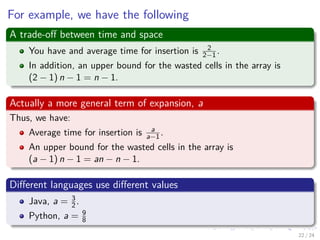
Actually a more general term of expansion, a
Thus, we have:
Average time for insertion is a
a−1 .
An upper bound for the wasted cells in the array is
(a − 1) n − 1 = an − n − 1.
Different languages use different values
Java, a = 3
2 .
Python, a = 9
8
22 / 24
Images/cinvestav-
For example, we have the following
A trade-off between time and space
You have and average time for insertion is 2
2−1 .
In addition, an upper bound for the wasted cells in the array is
(2 − 1) n − 1 = n − 1.
Actually a more general term of expansion, a
Thus, we have:
Average time for insertion is a
a−1 .
An upper bound for the wasted cells in the array is
(a − 1) n − 1 = an − n − 1.
Different languages use different values
Java, a = 3
2 .
Python, a = 9
8
22 / 24
Images/cinvestav-
For example, we have the following
A trade-off between time and space
You have and average time for insertion is 2
2−1 .
In addition, an upper bound for the wasted cells in the array is
(2 − 1) n − 1 = n − 1.
Actually a more general term of expansion, a
Thus, we have:
Average time for insertion is a
a−1 .
An upper bound for the wasted cells in the array is
(a − 1) n − 1 = an − n − 1.
Different languages use different values
Java, a = 3
2 .
Python, a = 9
8
22 / 24
Images/cinvestav-
Outline
1 Linear List Array Representation
Operations in Array List
2 Dynamic Arrays
How much we need to expand it...
A Strategy for it
Analysis
23 / 24
Images/cinvestav-
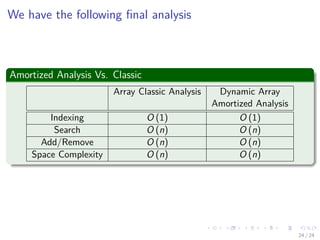
We have the following final analysis
Amortized Analysis Vs. Classic
Array Classic Analysis Dynamic Array
Amortized Analysis
Indexing O (1) O (1)
Search O (n) O (n)
Add/Remove O (n) O (n)
Space Complexity O (n) O (n)
24 / 24

Preparation Data Structures 04 array linear_list

  • 1.
    Data Structures Linear ListArray Representation Andres Mendez-Vazquez May 6, 2015 1 / 24
  • 2.
    Images/cinvestav- Outline 1 Linear ListArray Representation Operations in Array List 2 Dynamic Arrays How much we need to expand it... A Strategy for it Analysis 2 / 24
  • 3.
    Images/cinvestav- How do weimplement the ADT List? In our first representation will use an array Use a one-dimensional array element[]: a b c d e - - - - 0 1 2 3 4 5 6 7 8 The previous array A representation of L = (a, b, c, d, e) using position i in element[i]. 3 / 24
  • 4.
    Images/cinvestav- How do weimplement the ADT List? In our first representation will use an array Use a one-dimensional array element[]: a b c d e - - - - 0 1 2 3 4 5 6 7 8 The previous array A representation of L = (a, b, c, d, e) using position i in element[i]. 3 / 24
  • 5.
    Images/cinvestav- Where to mapin the array Right To Left Mapping - - - - e d c b a Mapping That Skips Every Other Position a - b - c - d - e - - Wrap Around Mapping d e - - - - - - a b c 4 / 24
  • 6.
    Images/cinvestav- Where to mapin the array Right To Left Mapping - - - - e d c b a Mapping That Skips Every Other Position a - b - c - d - e - - Wrap Around Mapping d e - - - - - - a b c 4 / 24
  • 7.
    Images/cinvestav- Where to mapin the array Right To Left Mapping - - - - e d c b a Mapping That Skips Every Other Position a - b - c - d - e - - Wrap Around Mapping d e - - - - - - a b c 4 / 24
  • 8.
    Images/cinvestav- Representation Used InText Something Notable a b c d e - - - - 0 1 2 3 4 5 6 7 8 Size=5 Thus 1 Put element i of list in element[i]. 2 Use a variable size to record current number of elements 5 / 24
  • 9.
    Images/cinvestav- Representation Used InText Something Notable a b c d e - - - - 0 1 2 3 4 5 6 7 8 Size=5 Thus 1 Put element i of list in element[i]. 2 Use a variable size to record current number of elements 5 / 24
  • 10.
    Images/cinvestav- Code Our Implementation p ub l i c c l a s s S i m p l e A r r a y L i s t <Item> implements L i n e a r L i s t <Item >{ // p r i v a t e elements of implementation p r o t e c t e d Item element [ ] ; p r o t e c t e d i n t s i z e ; p r o t e c t e d f i n a l s t a t i c i n t DEFAULT_SIZE = 10; // C o n s t r u c t o r s p u b l i c S i m p l e A r r a y L i s t (){ t h i s . s i z e = 0; t h i s . element = ( Item [ ] ) new Object [ t h i s . DEFAULT_SIZE ] ; } p u b l i c S i m p l e A r r a y L i s t ( i n t NewSize ){ t h i s . s i z e = 0; t h i s . element = ( Item [ ] ) new Object [ NewSize ] ; } 6 / 24
  • 11.
    Images/cinvestav- Data Type OfArray element[] First than anything Data type of list elements is unknown. Thus, we used the genericity of Object 1 Then, we use element[] to be of data type Object. 2 Then, we cast to the new “Item.” However You cannot put elements of primitive data types (int, float, double, char, etc.) into our linear lists. 7 / 24
  • 12.
    Images/cinvestav- Data Type OfArray element[] First than anything Data type of list elements is unknown. Thus, we used the genericity of Object 1 Then, we use element[] to be of data type Object. 2 Then, we cast to the new “Item.” However You cannot put elements of primitive data types (int, float, double, char, etc.) into our linear lists. 7 / 24
  • 13.
    Images/cinvestav- Data Type OfArray element[] First than anything Data type of list elements is unknown. Thus, we used the genericity of Object 1 Then, we use element[] to be of data type Object. 2 Then, we cast to the new “Item.” However You cannot put elements of primitive data types (int, float, double, char, etc.) into our linear lists. 7 / 24
  • 14.
    Images/cinvestav- Data Type OfArray element[] First than anything Data type of list elements is unknown. Thus, we used the genericity of Object 1 Then, we use element[] to be of data type Object. 2 Then, we cast to the new “Item.” However You cannot put elements of primitive data types (int, float, double, char, etc.) into our linear lists. 7 / 24
  • 15.
    Images/cinvestav- Outline 1 Linear ListArray Representation Operations in Array List 2 Dynamic Arrays How much we need to expand it... A Strategy for it Analysis 8 / 24
  • 16.
    Images/cinvestav- Operations: Add Add/Remove anelement a b c d e - - - - 0 1 2 3 4 5 6 7 8 Size=5 add(1,g) a g b c d e - - - 0 1 2 3 4 5 6 7 8 Size=6 9 / 24
  • 17.
    Images/cinvestav- Operations: Add Add/Remove anelement a b c d e - - - - 0 1 2 3 4 5 6 7 8 Size=5 add(1,g) a g b c d e - - - 0 1 2 3 4 5 6 7 8 Size=6 9 / 24
  • 18.
    Images/cinvestav- Code Our Implementation p ub l i c void add ( i n t index , Item myobject ){ // I n i t i a l V a r i a b l e s i n t i ; // Always check f o r p o s s i b l e e r r o r s i f ( t h i s . s i z e == element . len ght ){ System . out . p r i n t l n ( " L i s t ␣ does ␣ not ␣ have ␣ space " ) ; System . e x i t ( 0 ) ; } i f ( index <0 | | index >t h i s . s i z e ){ System . out . p r i n t l n ( " Index ␣ out ␣ of ␣bound " ) ; System . e x i t ( 0 ) ; } // S h i f t p o s t i i o n s as n e c e s s a r y f o r ( i = t h i s . s i z e ; i >index ; i −−) element [ i +1]=element [ i ] ; // copy element i n t o c o n t a i n e r element [ i +1]=myobject ; } 10 / 24
  • 19.
    Images/cinvestav- Operations: Get Here We have ab c d e - - - - 0 1 2 3 4 5 6 7 8 Size=5 get(3) It will return “d”. The code is simple 11 / 24
  • 20.
    Images/cinvestav- Operations: Get Here We have ab c d e - - - - 0 1 2 3 4 5 6 7 8 Size=5 get(3) It will return “d”. The code is simple 11 / 24
  • 21.
    Images/cinvestav- Operations: Get Here We have ab c d e - - - - 0 1 2 3 4 5 6 7 8 Size=5 get(3) It will return “d”. The code is simple p u b l i c Item get ( i n t index ){ // Check always i f ( t h i s . s i z e == 0) r e t u r n n u l l ; i f ( index <0 | | index >t h i s . s i z e −1){ System . out . p r i n t l n ( " Index ␣ out ␣ of ␣bound " ) ; System . e x i t ( 0 ) ; } r e t u r n element [ index ] } 11 / 24
  • 22.
    Images/cinvestav- You can implementthe rest Yes Part of your homework!!! 12 / 24
  • 23.
    Images/cinvestav- Now, we havea common problem Because We do not know how many elements will be stored at the list. We use An initial length and dynamically increase the size as needed. 13 / 24
  • 24.
    Images/cinvestav- Now, we havea common problem Because We do not know how many elements will be stored at the list. We use An initial length and dynamically increase the size as needed. 13 / 24
  • 25.
    Images/cinvestav- Example Example Length of arrayelement[] is 6: a b c d e f First create a new and larger array NewArray = (Item[]) new Object[12] - - - - - - - - - - - - Now copy the new elements into the new array!!! System.arraycopy(element, 0, newArray, 0, element.length); a b c d e f - - - - - - 14 / 24
  • 26.
    Images/cinvestav- Example Example Length of arrayelement[] is 6: a b c d e f First create a new and larger array NewArray = (Item[]) new Object[12] - - - - - - - - - - - - Now copy the new elements into the new array!!! System.arraycopy(element, 0, newArray, 0, element.length); a b c d e f - - - - - - 14 / 24
  • 27.
    Images/cinvestav- Example Example Length of arrayelement[] is 6: a b c d e f First create a new and larger array NewArray = (Item[]) new Object[12] - - - - - - - - - - - - Now copy the new elements into the new array!!! System.arraycopy(element, 0, newArray, 0, element.length); a b c d e f - - - - - - 14 / 24
  • 28.
    Images/cinvestav- Example Finally, rename newarray element = NewArray; element[0]−→ a b c d e f - - - - - - 15 / 24
  • 29.
    Images/cinvestav- Outline 1 Linear ListArray Representation Operations in Array List 2 Dynamic Arrays How much we need to expand it... A Strategy for it Analysis 16 / 24
  • 30.
    Images/cinvestav- First Attempt What ifyou use the following policy? At least 1 more than current array length. Thus What would be the cost of all operations? Generate a new array. Copy all the items to it. insert the new element at the end. 17 / 24
  • 31.
    Images/cinvestav- First Attempt What ifyou use the following policy? At least 1 more than current array length. Thus What would be the cost of all operations? Generate a new array. Copy all the items to it. insert the new element at the end. 17 / 24
  • 32.
    Images/cinvestav- First Attempt What ifyou use the following policy? At least 1 more than current array length. Thus What would be the cost of all operations? Generate a new array. Copy all the items to it. insert the new element at the end. 17 / 24
  • 33.
    Images/cinvestav- First Attempt What ifyou use the following policy? At least 1 more than current array length. Thus What would be the cost of all operations? Generate a new array. Copy all the items to it. insert the new element at the end. 17 / 24
  • 34.
    Images/cinvestav- First Attempt What ifyou use the following policy? At least 1 more than current array length. Thus What would be the cost of all operations? Generate a new array. Copy all the items to it. insert the new element at the end. 17 / 24
  • 35.
    Images/cinvestav- What if wedo n insertions? We finish with something like this 1 First Insertion: Creation of the List ⇒ Cost = 1. 2 Second Insertion Cost = 2. 3 Third Insertion Cost = 3 4 etc!!! Thus, we have Ok Not a good idea!!! 18 / 24
  • 36.
    Images/cinvestav- What if wedo n insertions? We finish with something like this 1 First Insertion: Creation of the List ⇒ Cost = 1. 2 Second Insertion Cost = 2. 3 Third Insertion Cost = 3 4 etc!!! Thus, we have Ok Not a good idea!!! 18 / 24
  • 37.
    Images/cinvestav- What if wedo n insertions? We finish with something like this 1 First Insertion: Creation of the List ⇒ Cost = 1. 2 Second Insertion Cost = 2. 3 Third Insertion Cost = 3 4 etc!!! Thus, we have Ok Not a good idea!!! 18 / 24
  • 38.
    Images/cinvestav- What if wedo n insertions? We finish with something like this 1 First Insertion: Creation of the List ⇒ Cost = 1. 2 Second Insertion Cost = 2. 3 Third Insertion Cost = 3 4 etc!!! Thus, we have Ok Not a good idea!!! 18 / 24
  • 39.
    Images/cinvestav- What if wedo n insertions? We finish with something like this 1 First Insertion: Creation of the List ⇒ Cost = 1. 2 Second Insertion Cost = 2. 3 Third Insertion Cost = 3 4 etc!!! Thus, we have 1 + 2 + 3 + · · · + n = n (n + 1) 2 = O n2 (1) Ok Not a good idea!!! 18 / 24
  • 40.
    Images/cinvestav- What if wedo n insertions? We finish with something like this 1 First Insertion: Creation of the List ⇒ Cost = 1. 2 Second Insertion Cost = 2. 3 Third Insertion Cost = 3 4 etc!!! Thus, we have 1 + 2 + 3 + · · · + n = n (n + 1) 2 = O n2 (1) Ok Not a good idea!!! 18 / 24
  • 41.
    Images/cinvestav- Outline 1 Linear ListArray Representation Operations in Array List 2 Dynamic Arrays How much we need to expand it... A Strategy for it Analysis 19 / 24
  • 42.
    Images/cinvestav- A better strategy DynamicArray To avoid incurring the cost of resizing many times, dynamic arrays resize by an amount a. In our example we double the size, a = 2 20 / 24
  • 43.
    Images/cinvestav- A better strategy DynamicArray To avoid incurring the cost of resizing many times, dynamic arrays resize by an amount a. In our example we double the size, a = 2 Item NewArray [ ] ; i f ( t h i s . s i z e == element . len ght ){ // Resize the c a p a c i t y NewArray = ( Item [ ] ) new Object [ 2*this.size ] f o r ( i n t i =0; i < s i z e ; i ++){ NewArray [ i ]= element [ i ] ; } element = NewArray ; } 20 / 24
  • 44.
    Images/cinvestav- Space Complexity Every timean insertion triggers a doubling of the array Thus, space wasted in the new array: Space Wasted = Old Lenght − 1 (2) Remember: We double the array and insert!!! Thus, the average space wasted is Θ (n) (3) 21 / 24
  • 45.
    Images/cinvestav- Space Complexity Every timean insertion triggers a doubling of the array Thus, space wasted in the new array: Space Wasted = Old Lenght − 1 (2) Remember: We double the array and insert!!! Thus, the average space wasted is Θ (n) (3) 21 / 24
  • 46.
    Images/cinvestav- For example, wehave the following A trade-off between time and space You have and average time for insertion is 2 2−1 . In addition, an upper bound for the wasted cells in the array is (2 − 1) n − 1 = n − 1. Actually a more general term of expansion, a Thus, we have: Average time for insertion is a a−1 . An upper bound for the wasted cells in the array is (a − 1) n − 1 = an − n − 1. Different languages use different values Java, a = 3 2 . Python, a = 9 8 22 / 24
  • 47.
    Images/cinvestav- For example, wehave the following A trade-off between time and space You have and average time for insertion is 2 2−1 . In addition, an upper bound for the wasted cells in the array is (2 − 1) n − 1 = n − 1. Actually a more general term of expansion, a Thus, we have: Average time for insertion is a a−1 . An upper bound for the wasted cells in the array is (a − 1) n − 1 = an − n − 1. Different languages use different values Java, a = 3 2 . Python, a = 9 8 22 / 24
  • 48.
    Images/cinvestav- For example, wehave the following A trade-off between time and space You have and average time for insertion is 2 2−1 . In addition, an upper bound for the wasted cells in the array is (2 − 1) n − 1 = n − 1. Actually a more general term of expansion, a Thus, we have: Average time for insertion is a a−1 . An upper bound for the wasted cells in the array is (a − 1) n − 1 = an − n − 1. Different languages use different values Java, a = 3 2 . Python, a = 9 8 22 / 24
  • 49.
    Images/cinvestav- Outline 1 Linear ListArray Representation Operations in Array List 2 Dynamic Arrays How much we need to expand it... A Strategy for it Analysis 23 / 24
  • 50.
    Images/cinvestav- We have thefollowing final analysis Amortized Analysis Vs. Classic Array Classic Analysis Dynamic Array Amortized Analysis Indexing O (1) O (1) Search O (n) O (n) Add/Remove O (n) O (n) Space Complexity O (n) O (n) 24 / 24