SUSTAINABLE SOLID WASTE
MANAGEMENT IN THE
PHILIPPINES
Grace P. Sapuay
President
Solid Waste Management Association of the Philippines
ASEAN Waste Management Forum 2017
15 December 2017, BITEC, Bangkok,
Thailand
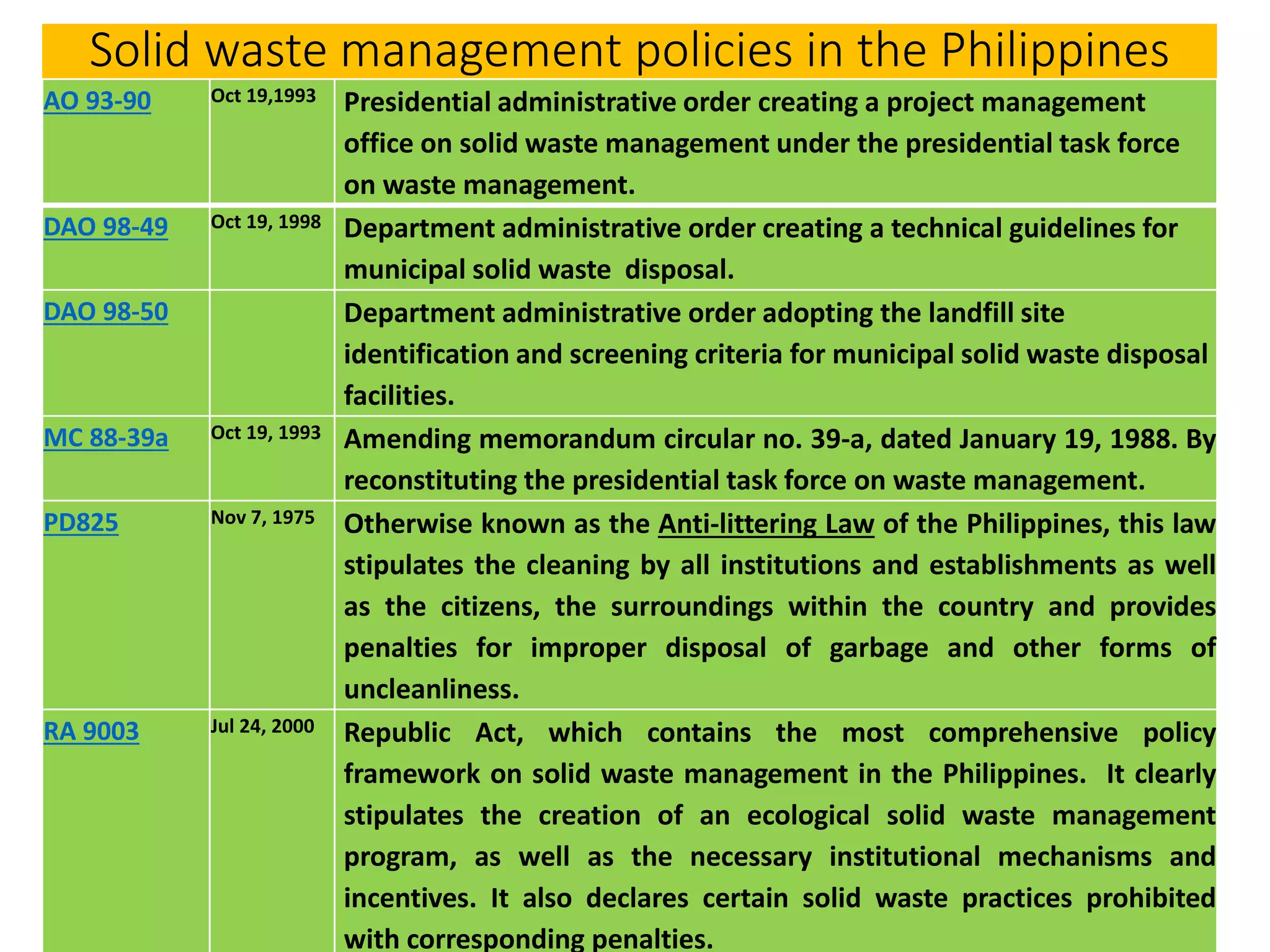
Solid waste management policies in the Philippines
AO 93-90 Oct 19,1993 Presidential administrative order creating a project management
office on solid waste management under the presidential task force
on waste management.
DAO 98-49 Oct 19, 1998 Department administrative order creating a technical guidelines for
municipal solid waste disposal.
DAO 98-50 Department administrative order adopting the landfill site
identification and screening criteria for municipal solid waste disposal
facilities.
MC 88-39a Oct 19, 1993 Amending memorandum circular no. 39-a, dated January 19, 1988. By
reconstituting the presidential task force on waste management.
PD825 Nov 7, 1975 Otherwise known as the Anti-littering Law of the Philippines, this law
stipulates the cleaning by all institutions and establishments as well
as the citizens, the surroundings within the country and provides
penalties for improper disposal of garbage and other forms of
uncleanliness.
RA 9003 Jul 24, 2000 Republic Act, which contains the most comprehensive policy
framework on solid waste management in the Philippines. It clearly
stipulates the creation of an ecological solid waste management
program, as well as the necessary institutional mechanisms and
incentives. It also declares certain solid waste practices prohibited
with corresponding penalties.
Republic act 9003 (Ecological solid waste
management Act 2000)
Contains the most comprehensive policy
framework on solid waste management in the
Philippines.
It clearly stipulates the creation of an ecological
solid waste management program, as well as the
necessary institutional mechanisms and
incentives. It also declares certain solid waste
practices prohibited with corresponding
penalties.
This is the latest law on solid waste
management, overriding all legal stipulations
on SWM that came before it.
TYPES OF WASTE UNDER RA 9003
Under RA 9003 Solid waste shall refer to:
 all discarded household waste;
 commercial waste;
 non-hazardous institutional and industrial
waste;
 street sweepings;
construction debris;
 agricultural waste;
other non-hazardous/non-toxic solid waste
Source: RA 9003
Mandatory Requirements
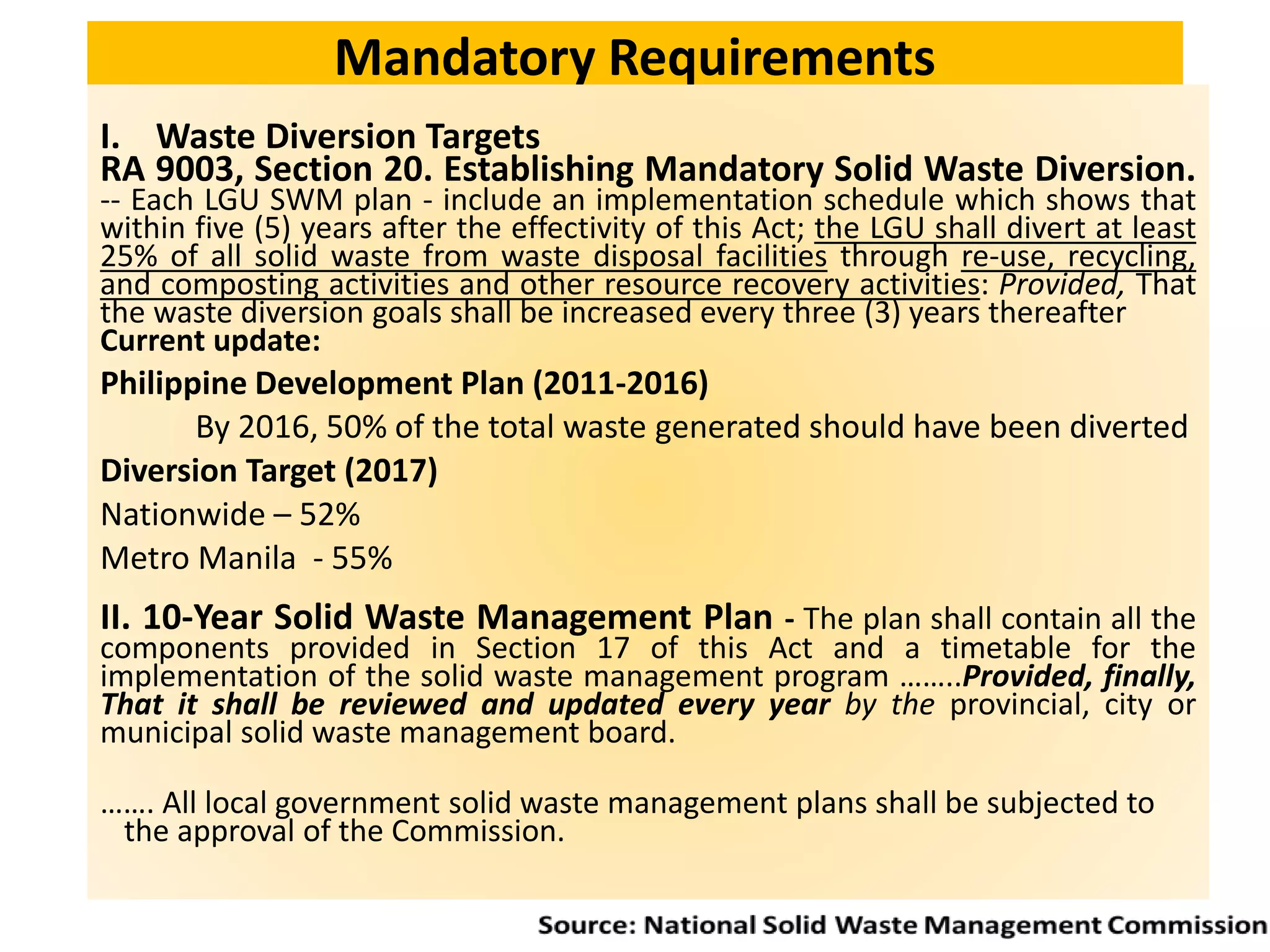
I. Waste Diversion Targets
RA 9003, Section 20. Establishing Mandatory Solid Waste Diversion.
-- Each LGU SWM plan - include an implementation schedule which shows that
within five (5) years after the effectivity of this Act; the LGU shall divert at least
25% of all solid waste from waste disposal facilities through re-use, recycling,
and composting activities and other resource recovery activities: Provided, That
the waste diversion goals shall be increased every three (3) years thereafter
Current update:
Philippine Development Plan (2011-2016)
By 2016, 50% of the total waste generated should have been diverted
Diversion Target (2017)
Nationwide – 52%
Metro Manila - 55%
II. 10-Year Solid Waste Management Plan - The plan shall contain all the
components provided in Section 17 of this Act and a timetable for the
implementation of the solid waste management program ……..Provided, finally,
That it shall be reviewed and updated every year by the provincial, city or
municipal solid waste management board.
……. All local government solid waste management plans shall be subjected to
the approval of the Commission.
Mandatory Requirements
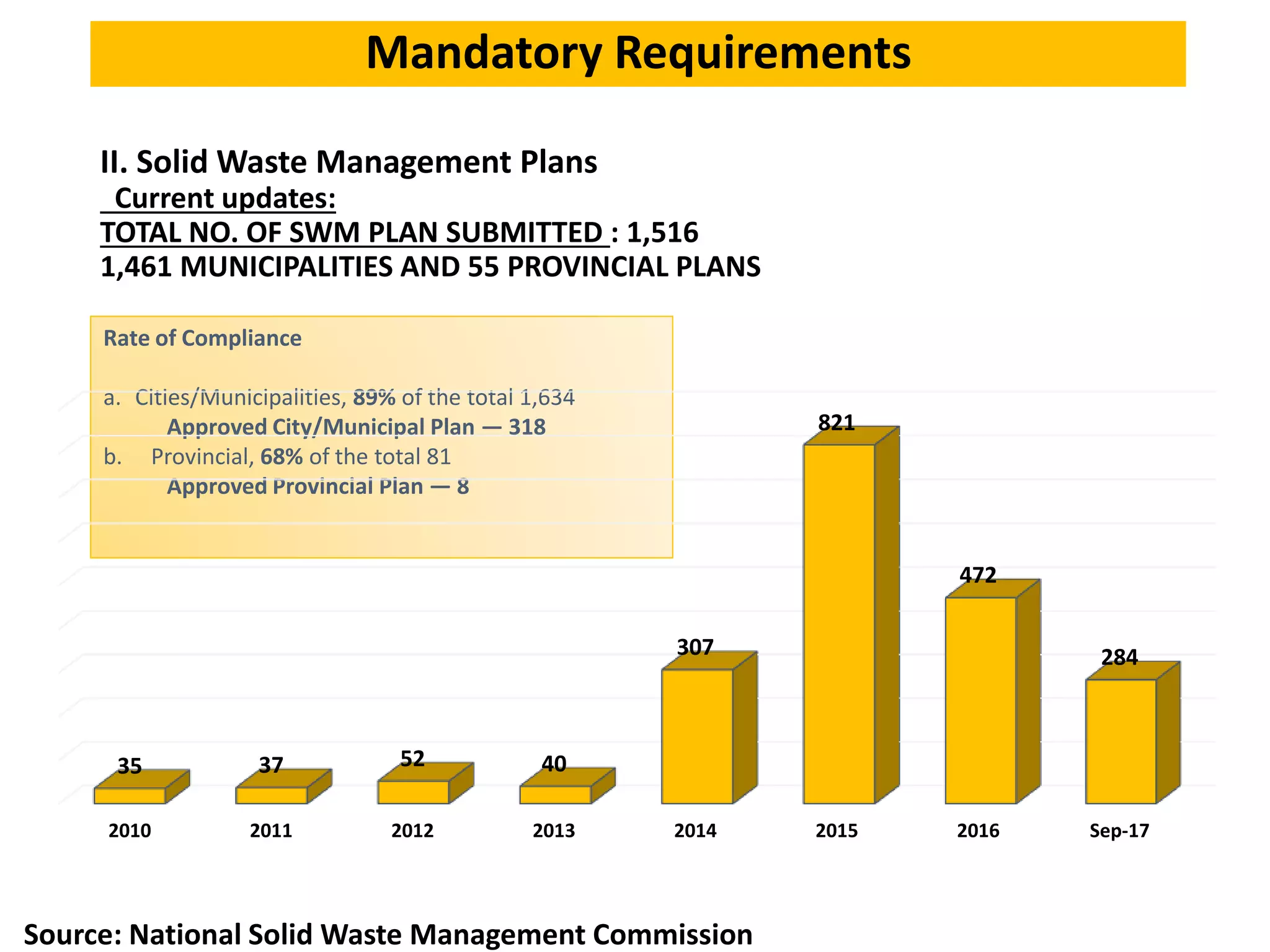
II. Solid Waste Management Plans
Current updates:
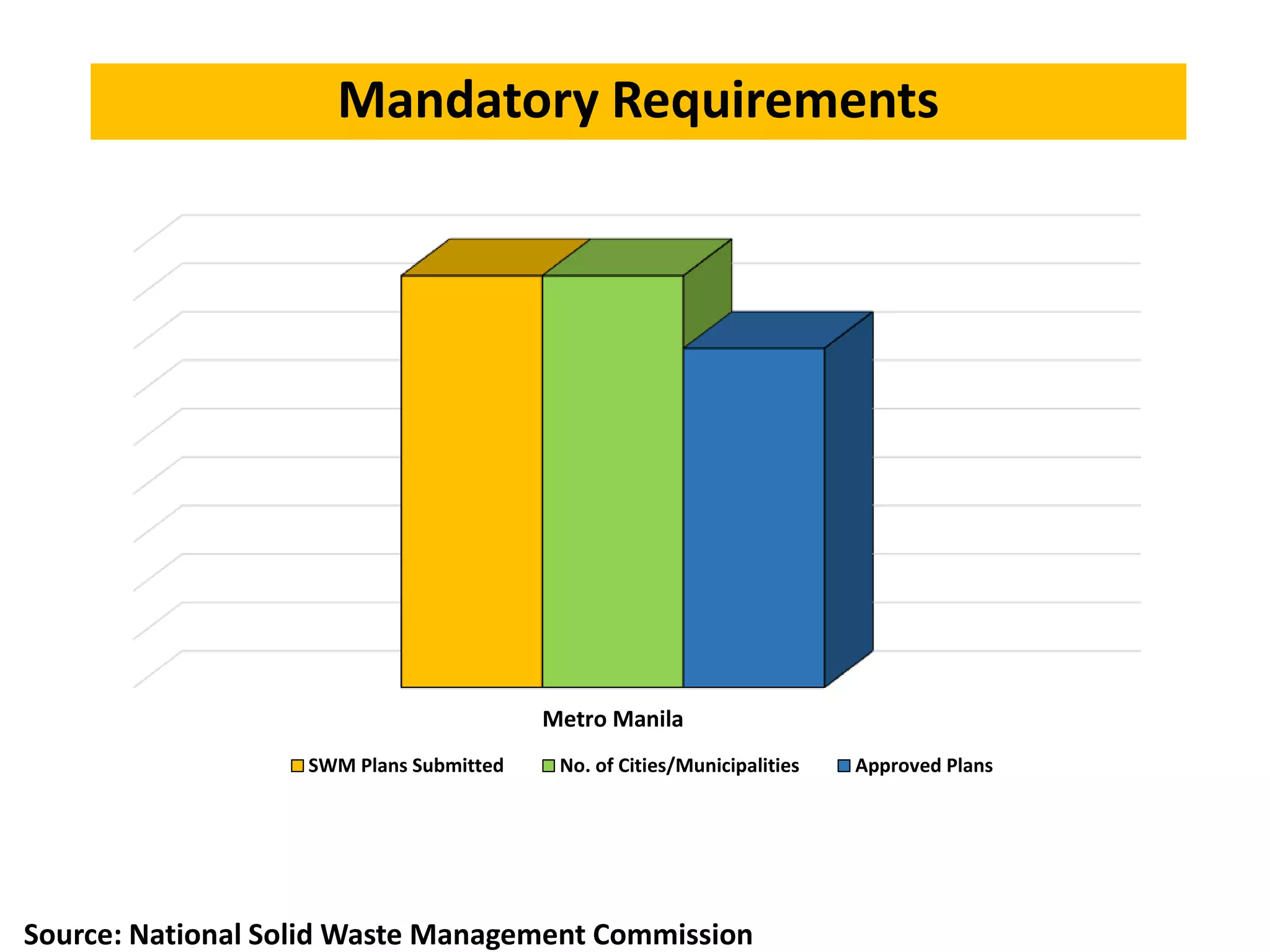
TOTAL NO. OF SWM PLAN SUBMITTED : 1,516
1,461 MUNICIPALITIES AND 55 PROVINCIAL PLANS
Rate of Compliance
a. Cities/Municipalities, 89% of the total 1,634
Approved City/Municipal Plan — 318
b. Provincial, 68% of the total 81
Approved Provincial Plan — 8
2010 2011 2012 2013 2014 2015 2016 Sep-17
35 37 52 40
307
821
472
284
Source: National Solid Waste Management Commission
Mandatory Requirements
Metro Manila
SWM Plans Submitted No. of Cities/Municipalities Approved Plans
Source: National Solid Waste Management Commission
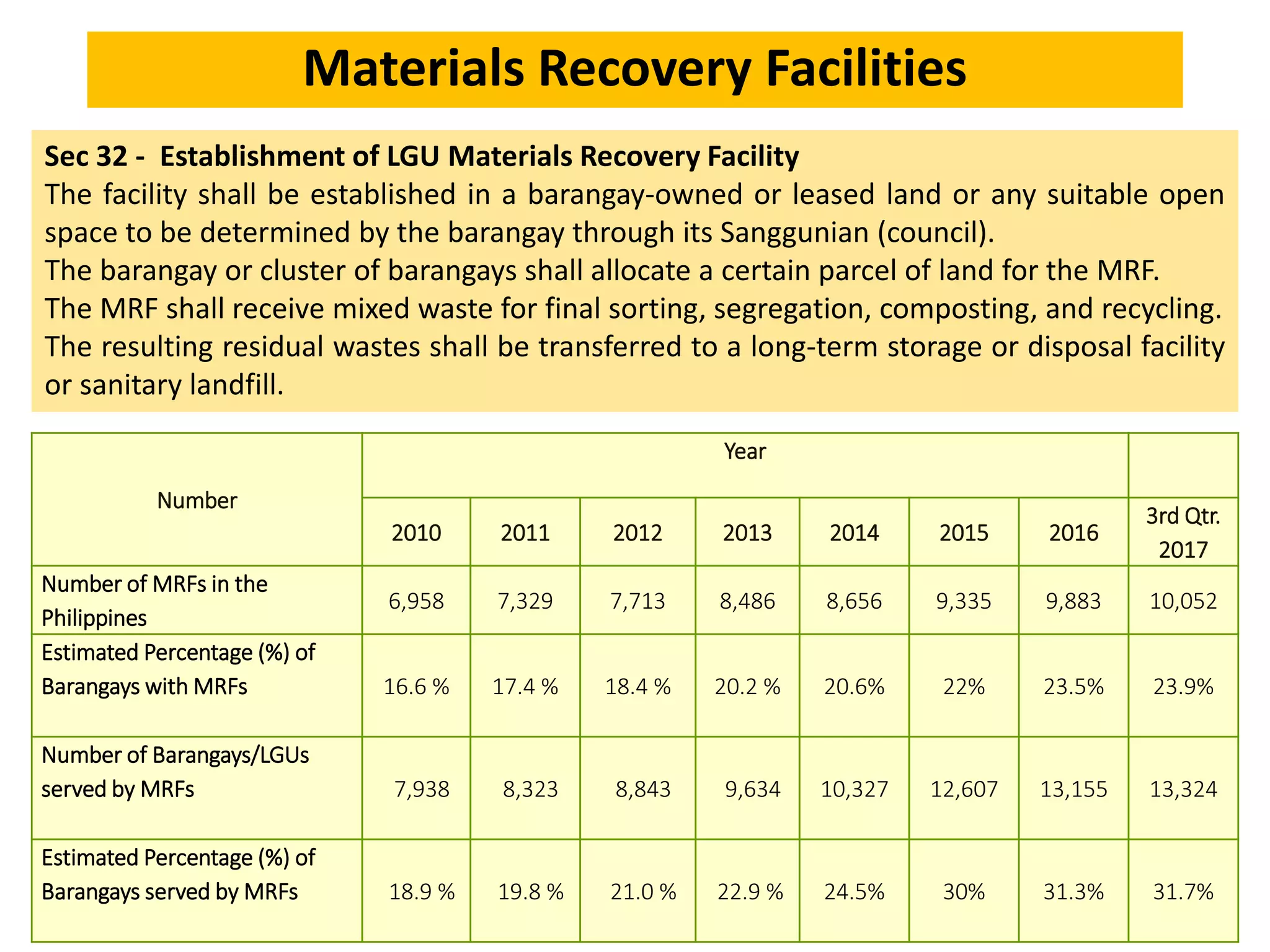
Materials Recovery Facilities
Sec 32 - Establishment of LGU Materials Recovery Facility
The facility shall be established in a barangay-owned or leased land or any suitable open
space to be determined by the barangay through its Sanggunian (council).
The barangay or cluster of barangays shall allocate a certain parcel of land for the MRF.
The MRF shall receive mixed waste for final sorting, segregation, composting, and recycling.
The resulting residual wastes shall be transferred to a long-term storage or disposal facility
or sanitary landfill.
Number
Year
2010 2011 2012 2013 2014 2015 2016
3rd Qtr.
2017
Number of MRFs in the
Philippines
6,958 7,329 7,713 8,486 8,656 9,335 9,883 10,052
Estimated Percentage (%) of
Barangays with MRFs 16.6 % 17.4 % 18.4 % 20.2 % 20.6% 22% 23.5% 23.9%
Number of Barangays/LGUs
served by MRFs 7,938 8,323 8,843 9,634 10,327 12,607 13,155 13,324
Estimated Percentage (%) of
Barangays served by MRFs 18.9 % 19.8 % 21.0 % 22.9 % 24.5% 30% 31.3% 31.7%
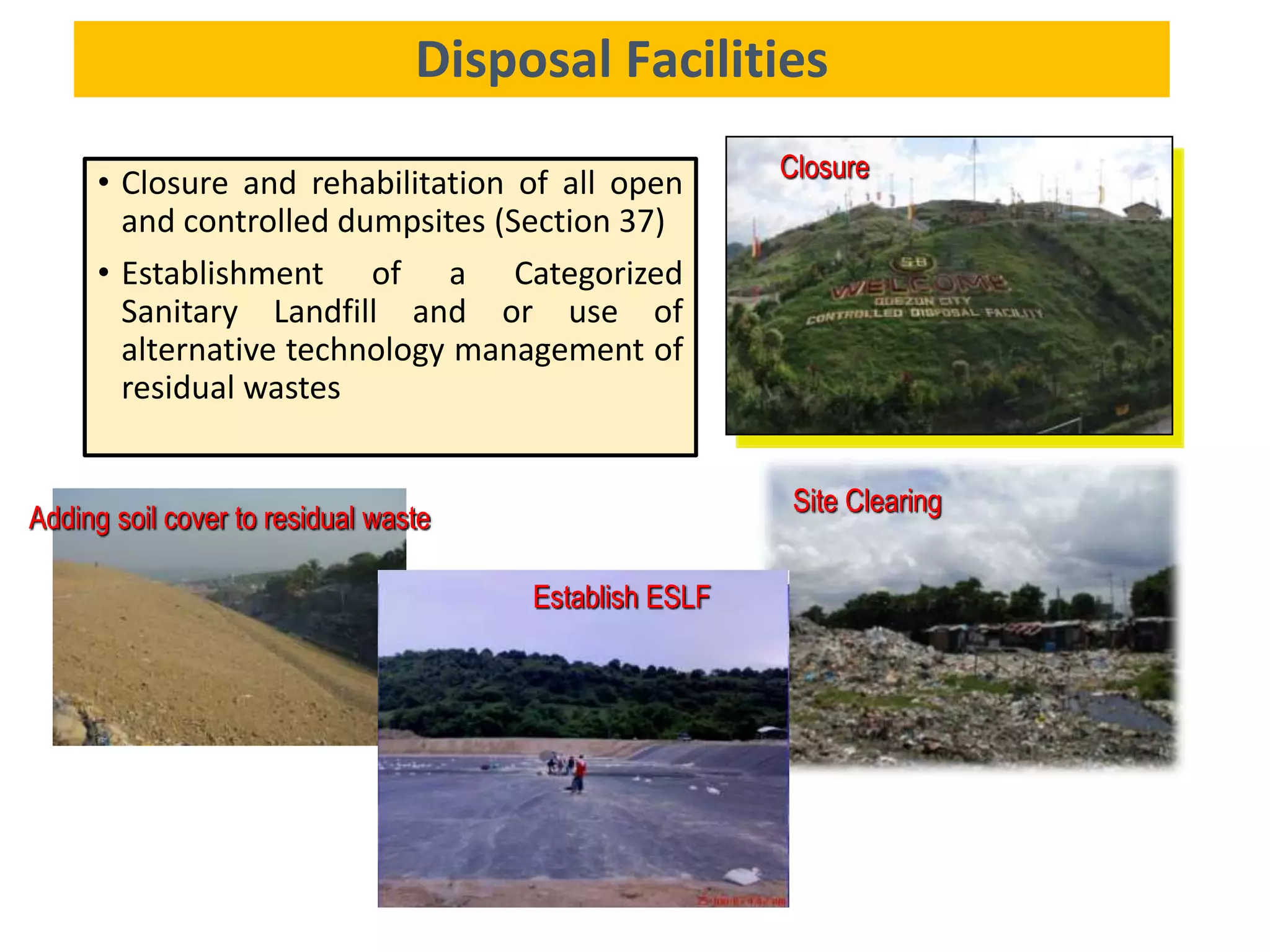
Disposal Facilities
• Closure and rehabilitation of all open
and controlled dumpsites (Section 37)
• Establishment of a Categorized
Sanitary Landfill and or use of
alternative technology management of
residual wastes
Site Clearing
Establish ESLF
Closure
Adding soil cover to residual waste
CURRENT PRACTICES
1. GENERATE AND DISPOSE
2. COLLECT AND DUMP
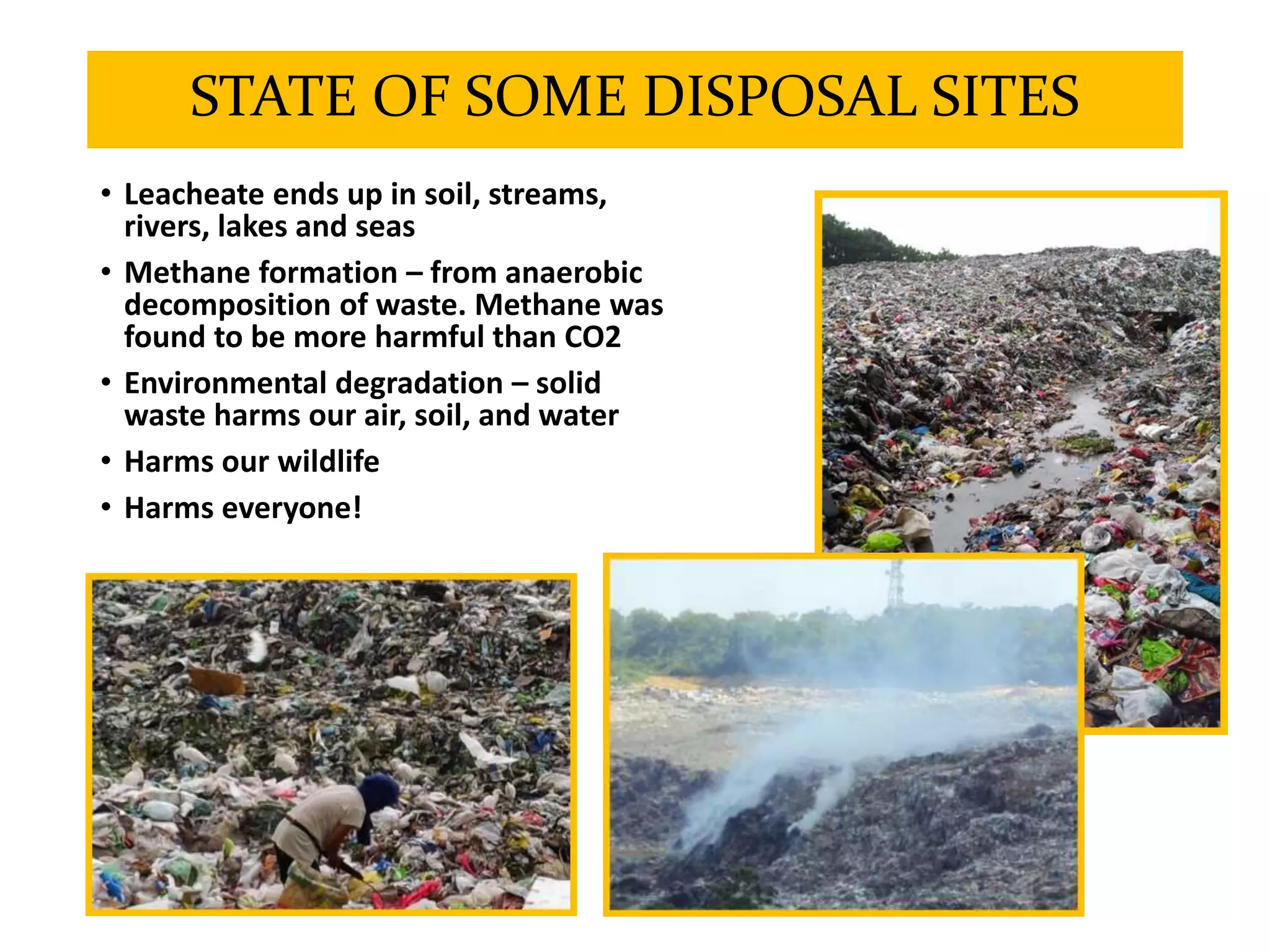
STATE OF SOME DISPOSAL SITES
• Leacheate ends up in soil, streams,
rivers, lakes and seas
• Methane formation – from anaerobic
decomposition of waste. Methane was
found to be more harmful than CO2
• Environmental degradation – solid
waste harms our air, soil, and water
• Harms our wildlife
• Harms everyone!
BEST PRACTICES FOR SUSTAINABLE SOLID WASTE
MANAGEMENT IN SOME CITIES AND MUNICIPALITIES IN THE
PHILIPPINES
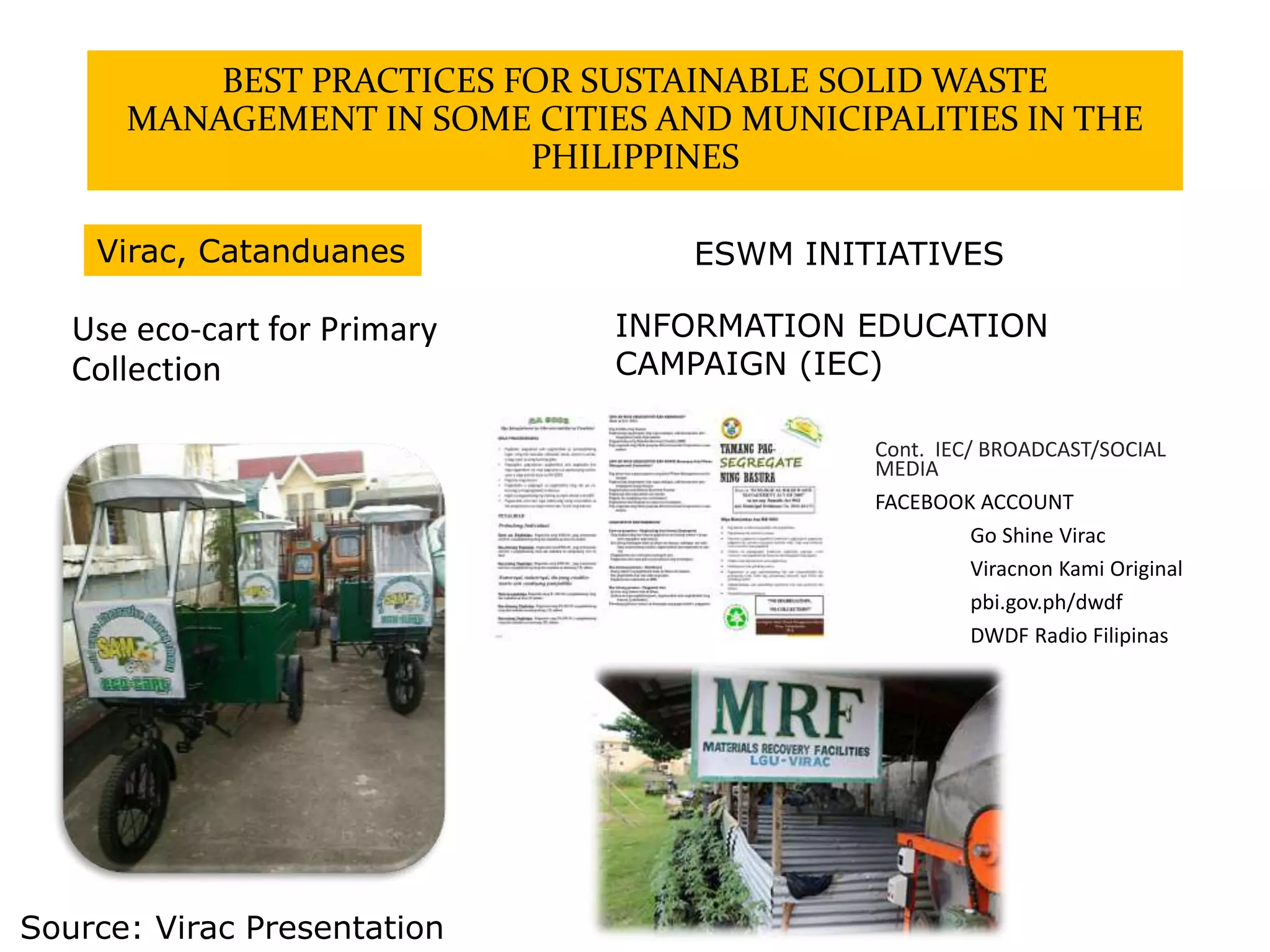
Use eco-cart for Primary
Collection
INFORMATION EDUCATION
CAMPAIGN (IEC)
ESWM INITIATIVES
Cont. IEC/ BROADCAST/SOCIAL
MEDIA
FACEBOOK ACCOUNT
Go Shine Virac
Viracnon Kami Original
pbi.gov.ph/dwdf
DWDF Radio Filipinas
Source: Virac Presentation
Virac, Catanduanes
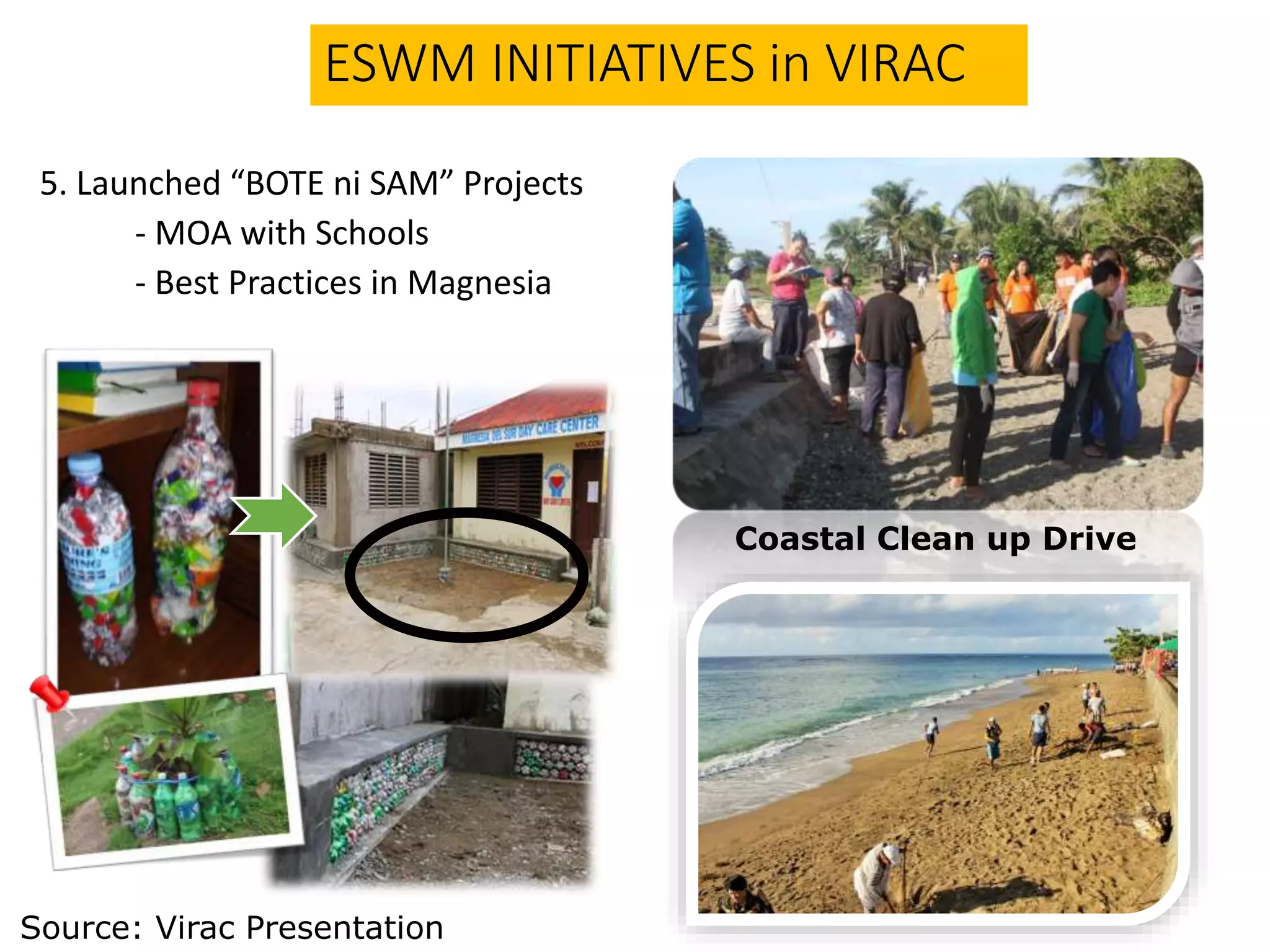
ESWM INITIATIVES in VIRAC
5. Launched “BOTE ni SAM” Projects
- MOA with Schools
- Best Practices in Magnesia
Coastal Clean up Drive
Source: Virac Presentation
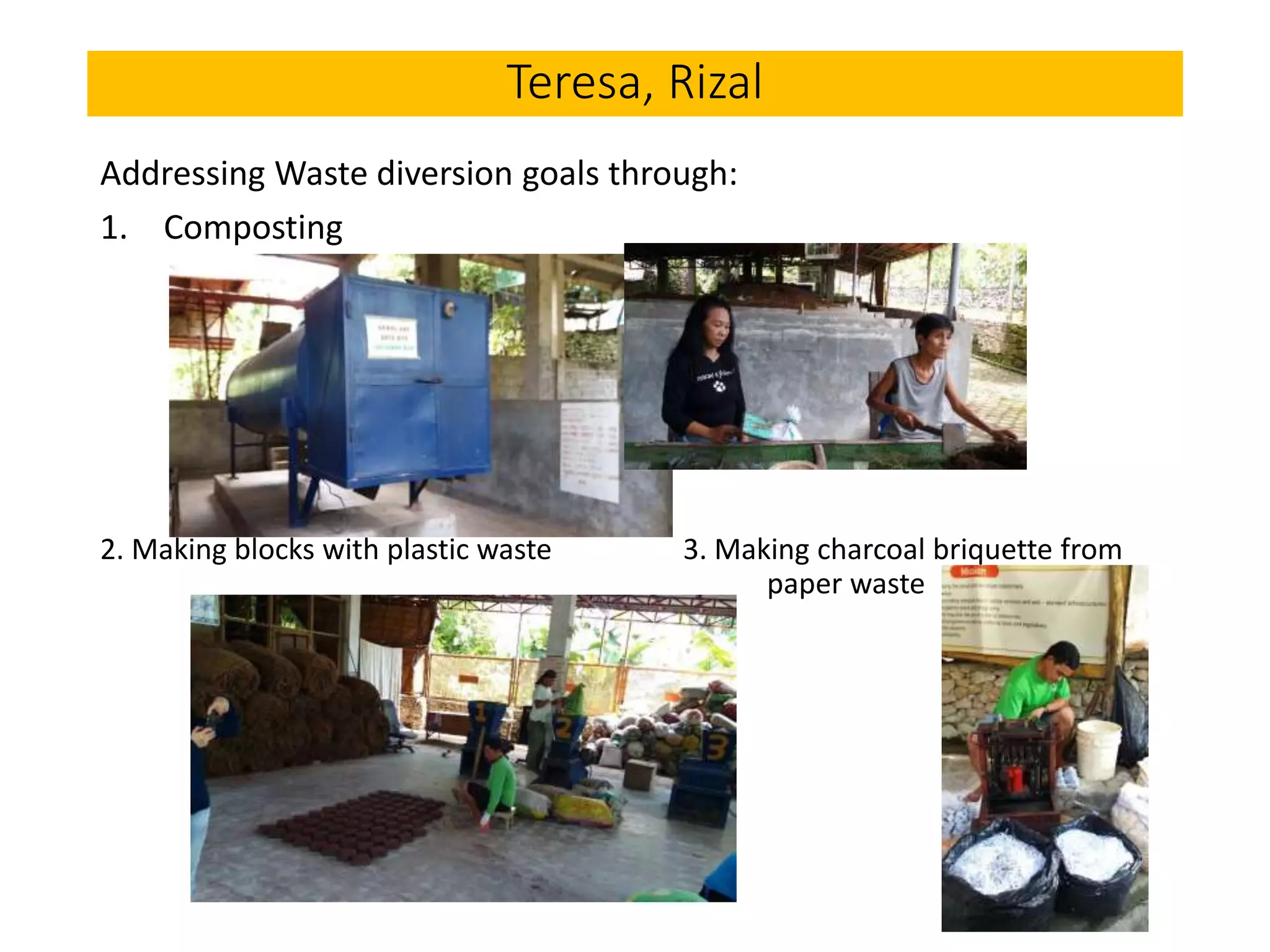
Teresa, Rizal
Addressing Waste diversion goals through:
1. Composting
2. Making blocks with plastic waste 3. Making charcoal briquette from
paper waste
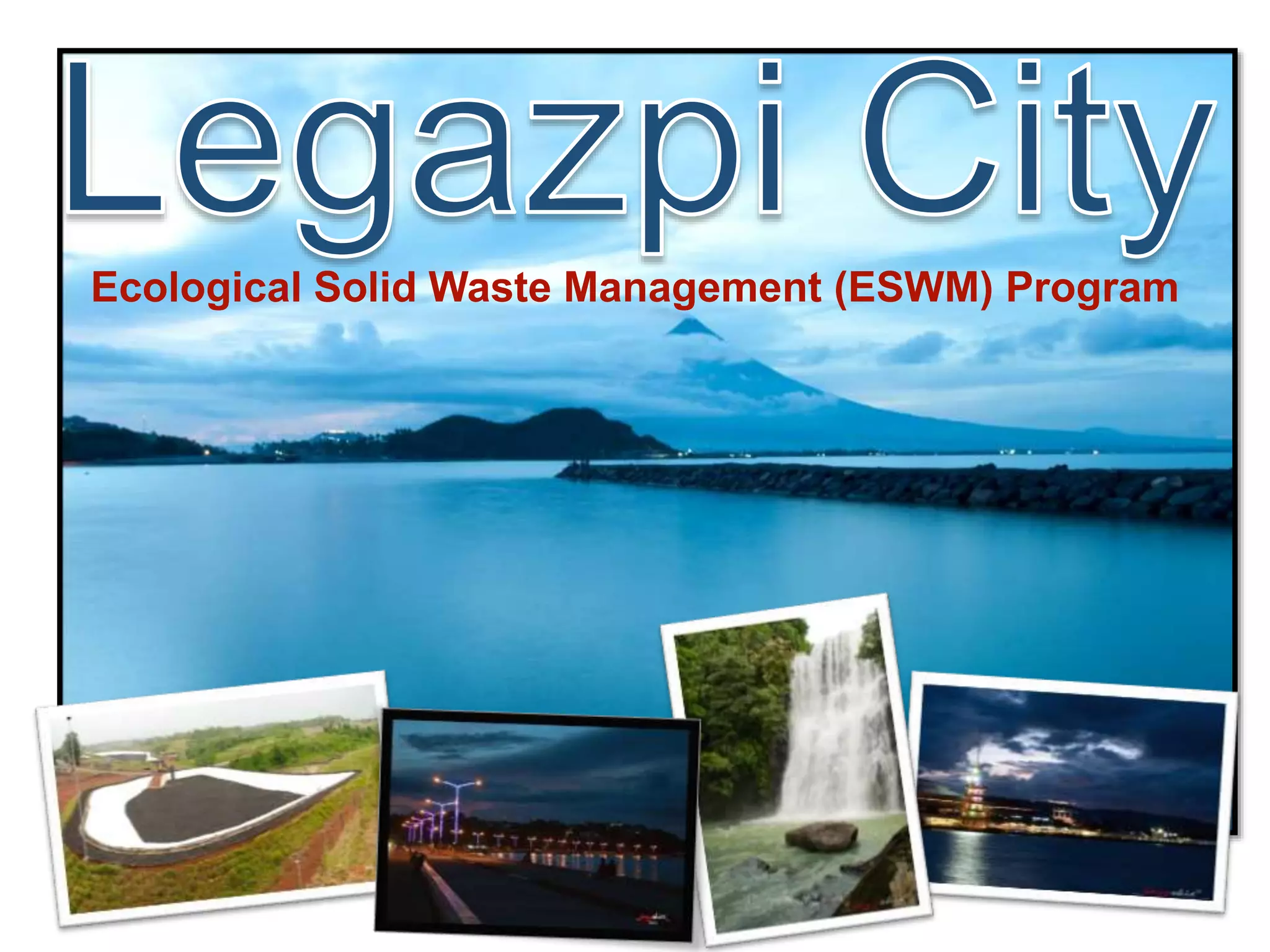
Ecological Solid Waste Management (ESWM) Program
STRATEGIES OF
IMPLEMENTATION
Of RA 9003
POLITICAL
- City Ordinances
- Enforcement Mechanism
SOCIAL
-Continuous IEC
- Network and Linkages
TECHNICAL
-SWM Facilities (SLF, etc)
-- Collection Equipment & Routing
System
GREATER PUBLIC PARTICIPATION
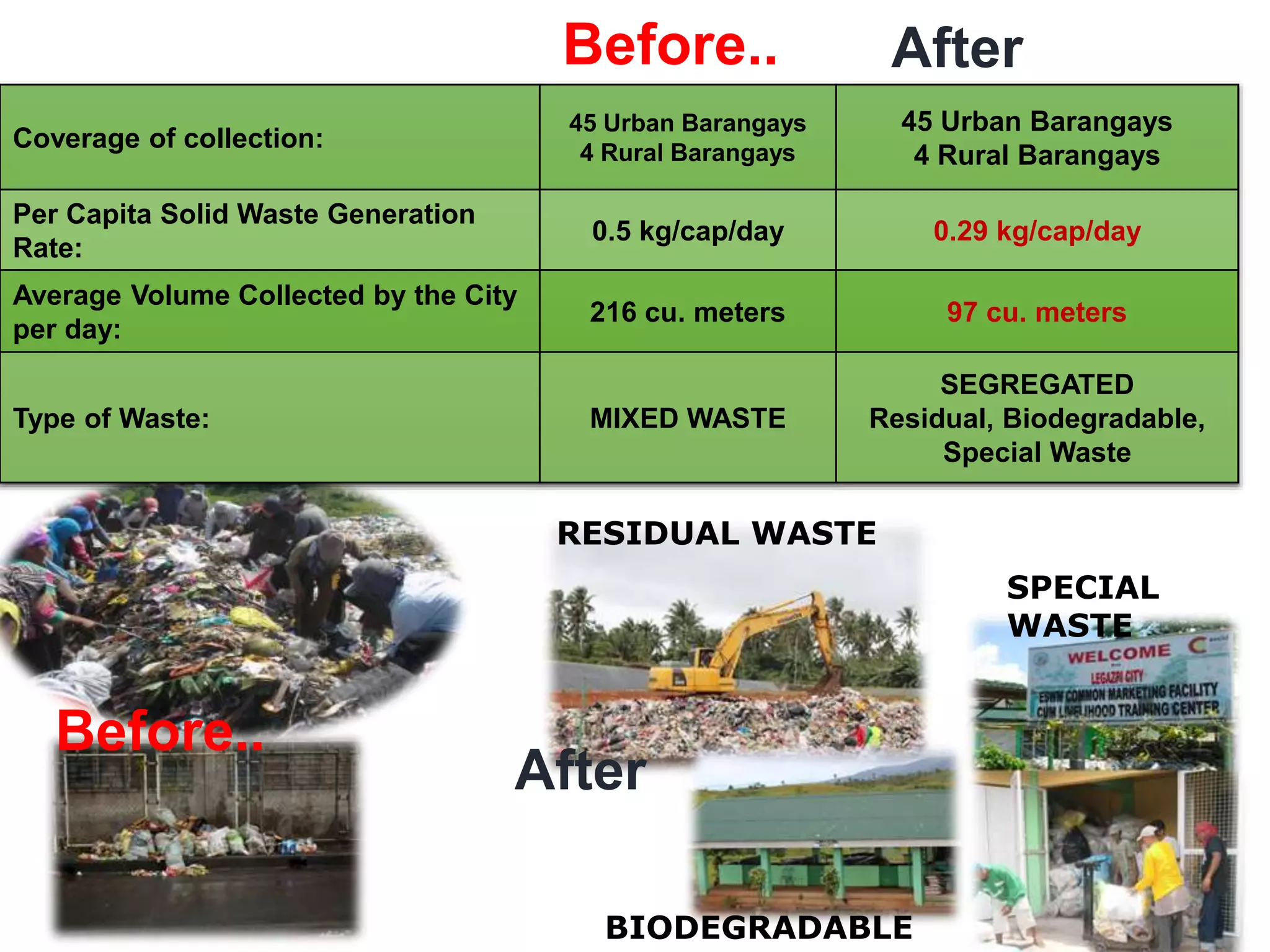
Before..
Coverage of collection:
45 Urban Barangays
4 Rural Barangays
45 Urban Barangays
4 Rural Barangays
Per Capita Solid Waste Generation
Rate:
0.5 kg/cap/day 0.29 kg/cap/day
Average Volume Collected by the City
per day:
216 cu. meters 97 cu. meters
Type of Waste: MIXED WASTE
SEGREGATED
Residual, Biodegradable,
Special Waste
After
SPECIAL
WASTE
BIODEGRADABLE
RESIDUAL WASTE
Before..
After
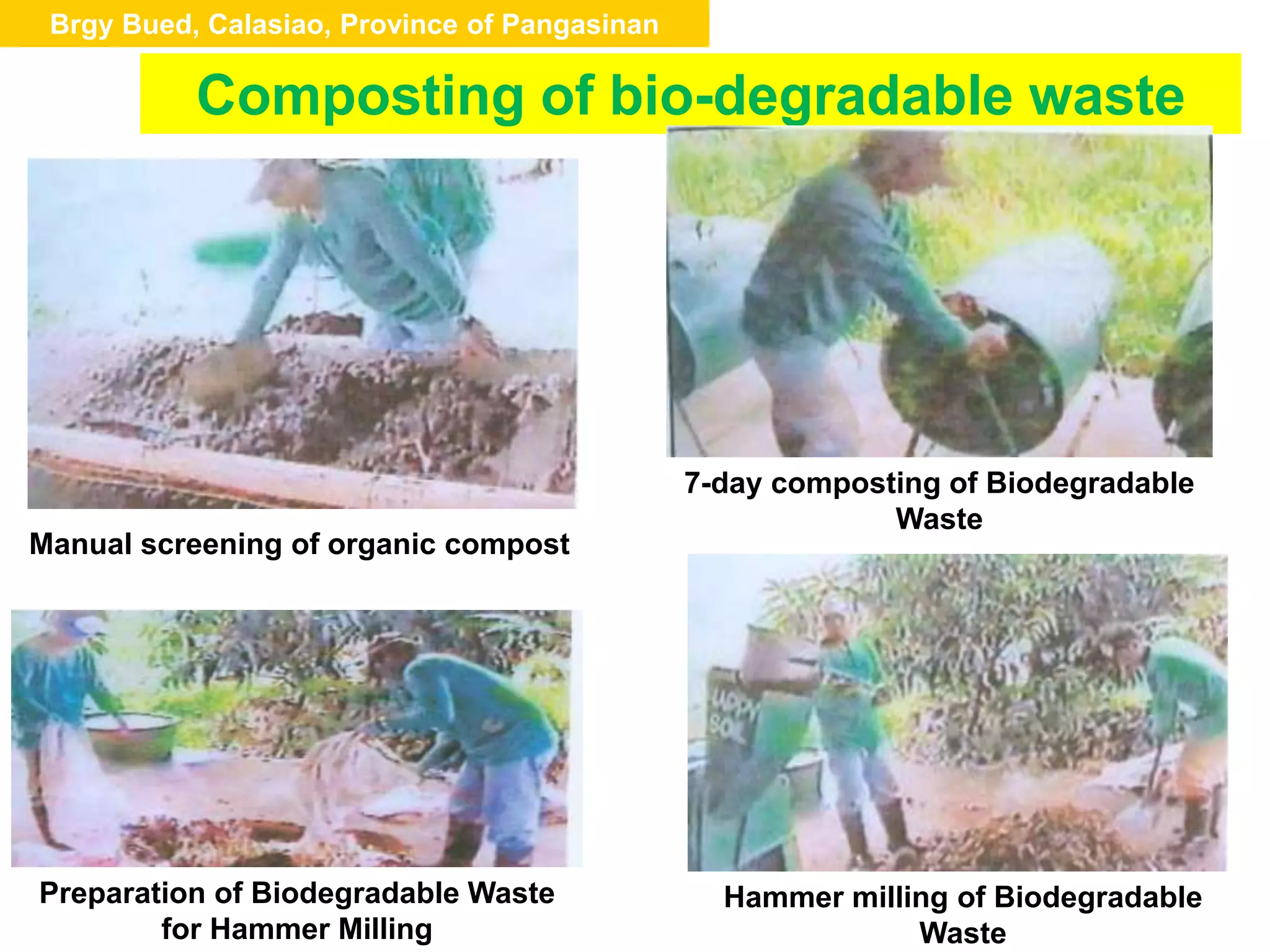
Composting of bio-degradable waste
Manual screening of organic compost
7-day composting of Biodegradable
Waste
Hammer milling of Biodegradable
Waste
Preparation of Biodegradable Waste
for Hammer Milling
Brgy Bued, Calasiao, Province of Pangasinan
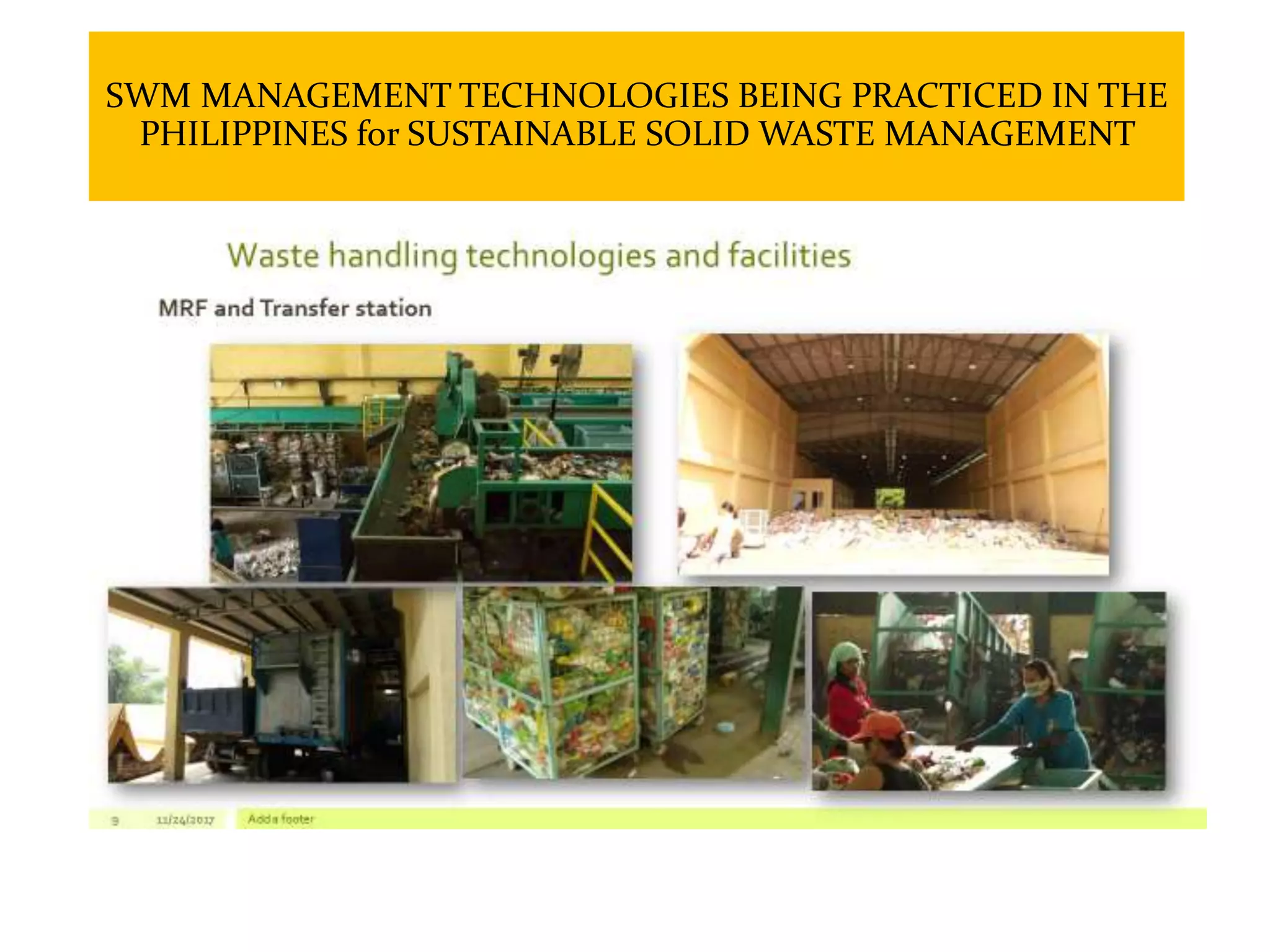
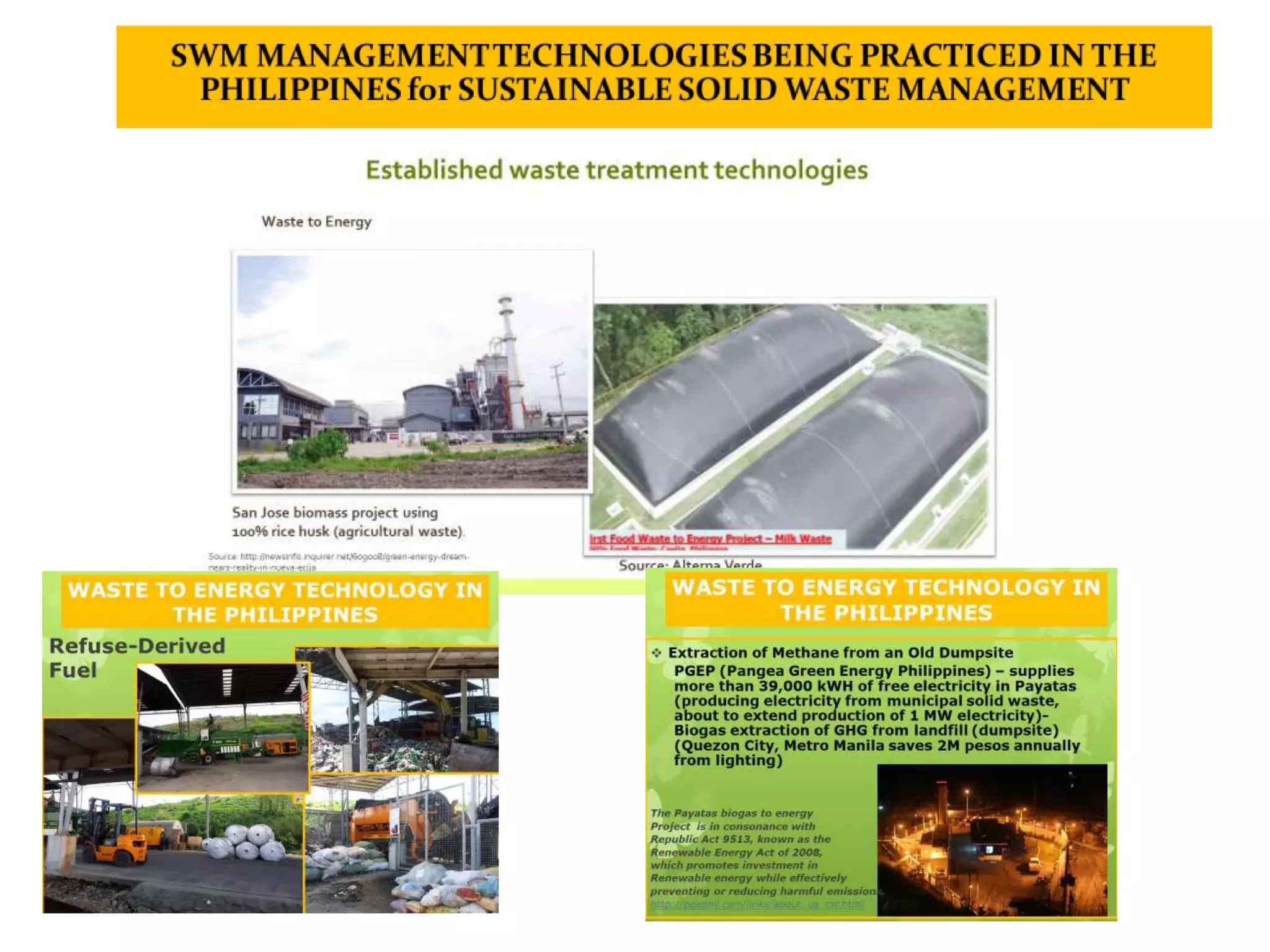
SWM MANAGEMENT TECHNOLOGIES BEING
PRACTICED IN THE PHILIPPINES for SUSTAINABLE
SOLID WASTE MANAGEMENT
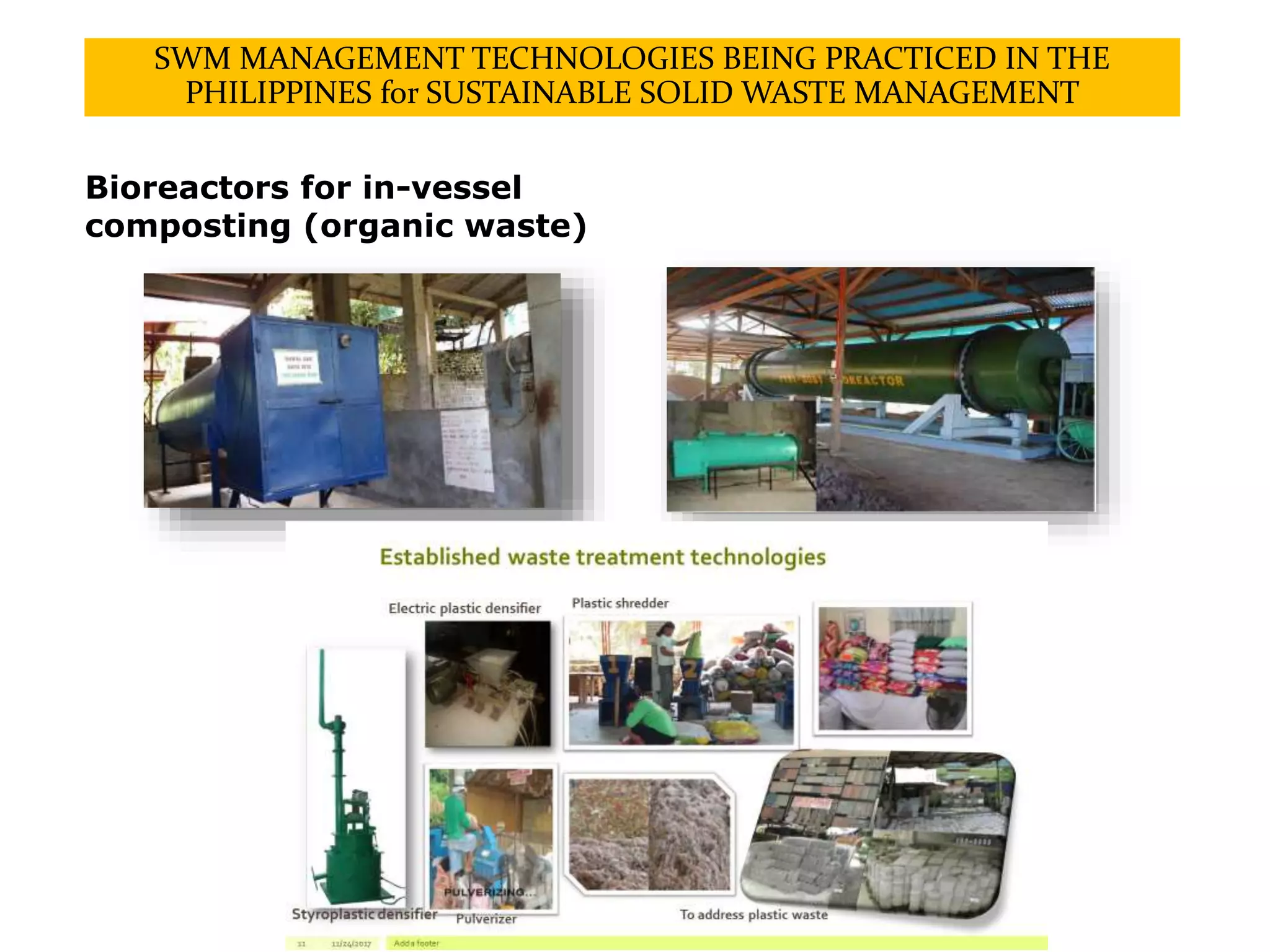
SWM MANAGEMENT TECHNOLOGIES BEING PRACTICED IN THE
PHILIPPINES for SUSTAINABLE SOLID WASTE MANAGEMENT
Bioreactors for in-vessel
composting (organic waste)
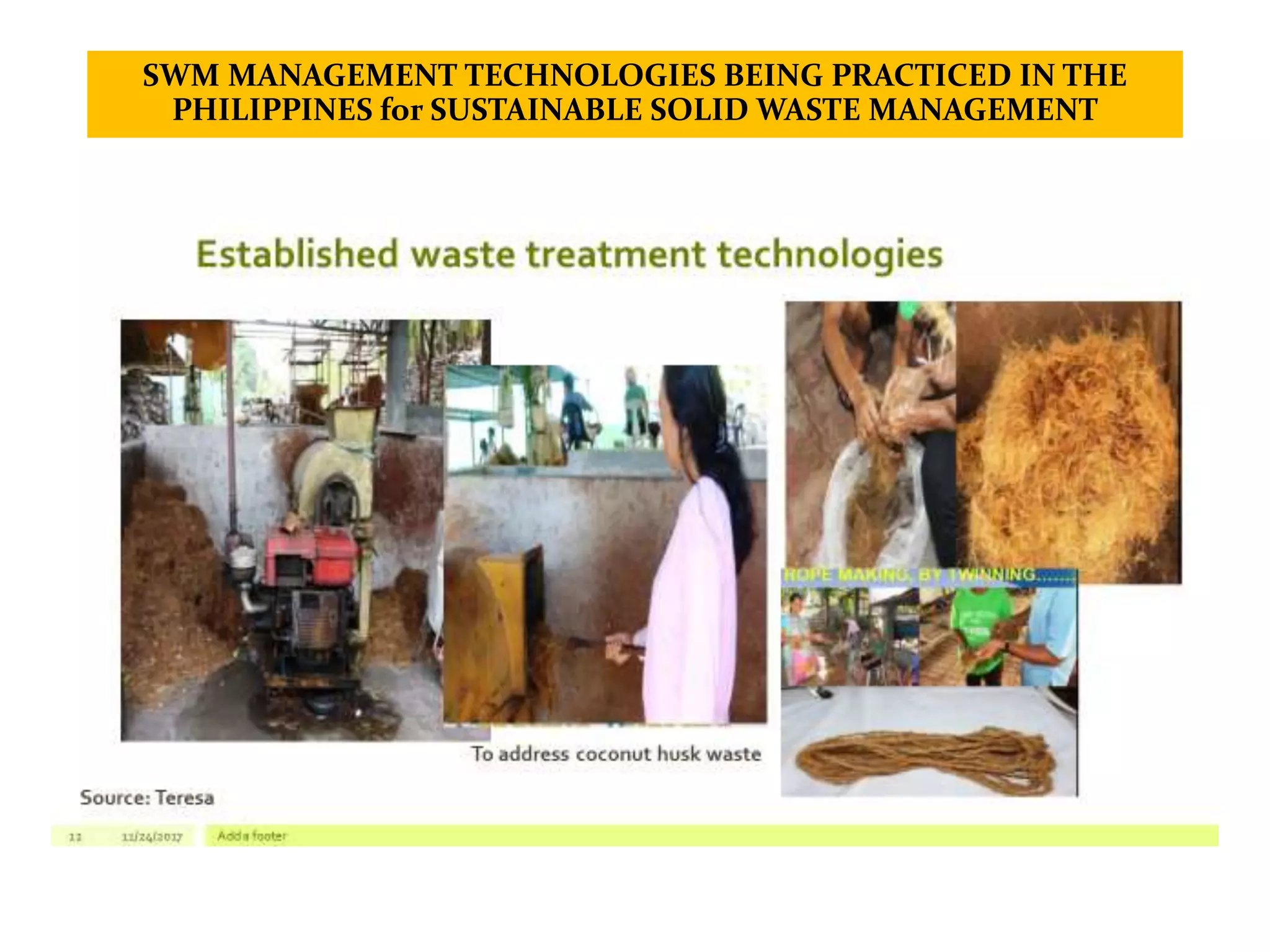
SWM MANAGEMENT TECHNOLOGIES BEING PRACTICED IN THE
PHILIPPINES for SUSTAINABLE SOLID WASTE MANAGEMENT
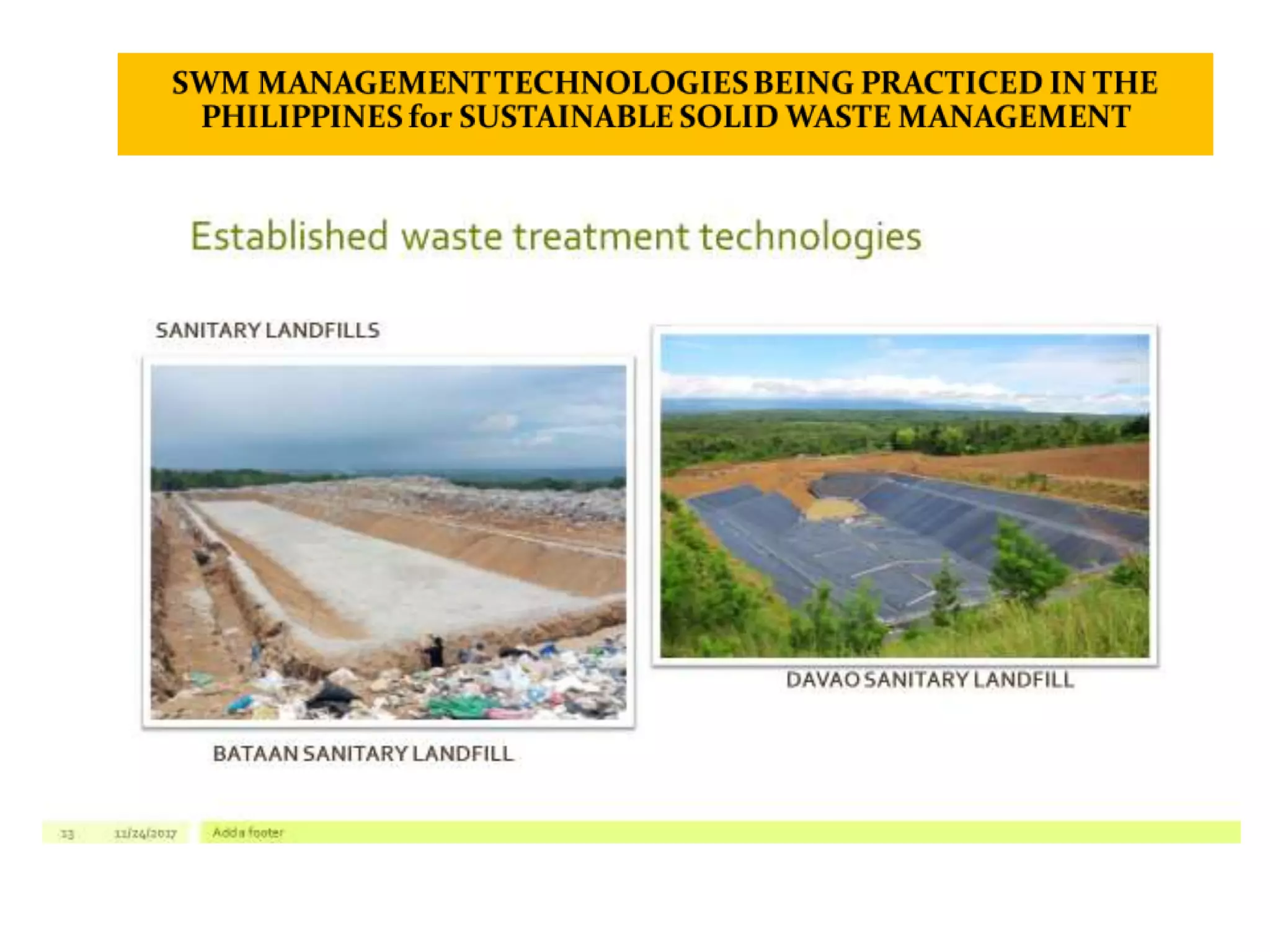
SWM MANAGEMENT TECHNOLOGIES BEING PRACTICED IN THE
PHILIPPINES for SUSTAINABLE SOLID WASTE MANAGEMENT
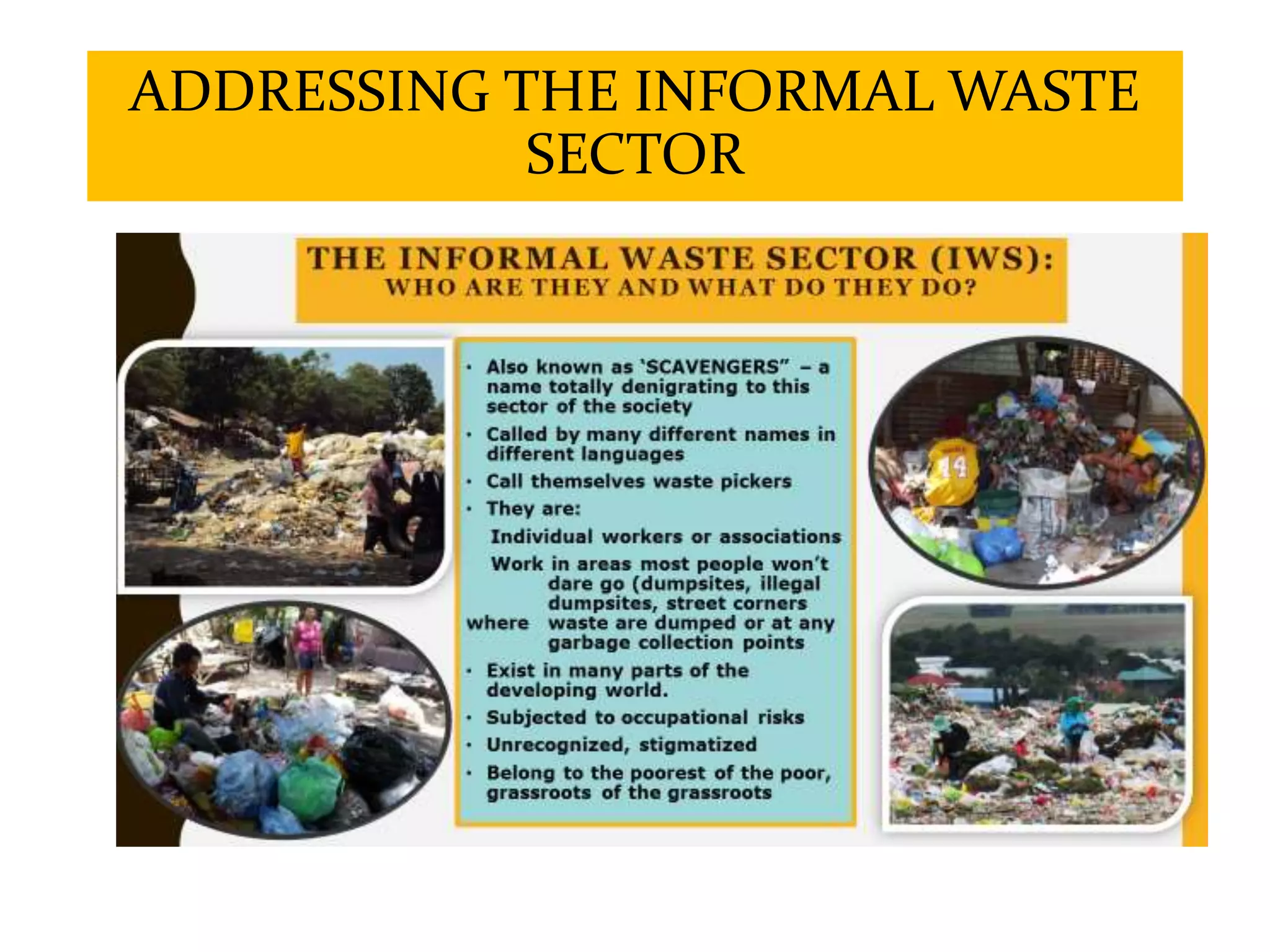
ADDRESSING THE INFORMAL WASTE
SECTOR
SUSTAINABLE SOLID WASTE MANAGEMENT IN THE PHILIPPINES

SUSTAINABLE SOLID WASTE MANAGEMENT IN THE PHILIPPINES

  • 1.
    SUSTAINABLE SOLID WASTE MANAGEMENTIN THE PHILIPPINES Grace P. Sapuay President Solid Waste Management Association of the Philippines ASEAN Waste Management Forum 2017 15 December 2017, BITEC, Bangkok, Thailand
  • 2.
    Solid waste managementpolicies in the Philippines AO 93-90 Oct 19,1993 Presidential administrative order creating a project management office on solid waste management under the presidential task force on waste management. DAO 98-49 Oct 19, 1998 Department administrative order creating a technical guidelines for municipal solid waste disposal. DAO 98-50 Department administrative order adopting the landfill site identification and screening criteria for municipal solid waste disposal facilities. MC 88-39a Oct 19, 1993 Amending memorandum circular no. 39-a, dated January 19, 1988. By reconstituting the presidential task force on waste management. PD825 Nov 7, 1975 Otherwise known as the Anti-littering Law of the Philippines, this law stipulates the cleaning by all institutions and establishments as well as the citizens, the surroundings within the country and provides penalties for improper disposal of garbage and other forms of uncleanliness. RA 9003 Jul 24, 2000 Republic Act, which contains the most comprehensive policy framework on solid waste management in the Philippines. It clearly stipulates the creation of an ecological solid waste management program, as well as the necessary institutional mechanisms and incentives. It also declares certain solid waste practices prohibited with corresponding penalties.
  • 3.
    Republic act 9003(Ecological solid waste management Act 2000) Contains the most comprehensive policy framework on solid waste management in the Philippines. It clearly stipulates the creation of an ecological solid waste management program, as well as the necessary institutional mechanisms and incentives. It also declares certain solid waste practices prohibited with corresponding penalties. This is the latest law on solid waste management, overriding all legal stipulations on SWM that came before it.
  • 4.
    TYPES OF WASTEUNDER RA 9003 Under RA 9003 Solid waste shall refer to:  all discarded household waste;  commercial waste;  non-hazardous institutional and industrial waste;  street sweepings; construction debris;  agricultural waste; other non-hazardous/non-toxic solid waste Source: RA 9003
  • 5.
    Mandatory Requirements I. WasteDiversion Targets RA 9003, Section 20. Establishing Mandatory Solid Waste Diversion. -- Each LGU SWM plan - include an implementation schedule which shows that within five (5) years after the effectivity of this Act; the LGU shall divert at least 25% of all solid waste from waste disposal facilities through re-use, recycling, and composting activities and other resource recovery activities: Provided, That the waste diversion goals shall be increased every three (3) years thereafter Current update: Philippine Development Plan (2011-2016) By 2016, 50% of the total waste generated should have been diverted Diversion Target (2017) Nationwide – 52% Metro Manila - 55% II. 10-Year Solid Waste Management Plan - The plan shall contain all the components provided in Section 17 of this Act and a timetable for the implementation of the solid waste management program ……..Provided, finally, That it shall be reviewed and updated every year by the provincial, city or municipal solid waste management board. ……. All local government solid waste management plans shall be subjected to the approval of the Commission.
  • 6.
    Mandatory Requirements II. SolidWaste Management Plans Current updates: TOTAL NO. OF SWM PLAN SUBMITTED : 1,516 1,461 MUNICIPALITIES AND 55 PROVINCIAL PLANS Rate of Compliance a. Cities/Municipalities, 89% of the total 1,634 Approved City/Municipal Plan — 318 b. Provincial, 68% of the total 81 Approved Provincial Plan — 8 2010 2011 2012 2013 2014 2015 2016 Sep-17 35 37 52 40 307 821 472 284 Source: National Solid Waste Management Commission
  • 7.
    Mandatory Requirements Metro Manila SWMPlans Submitted No. of Cities/Municipalities Approved Plans Source: National Solid Waste Management Commission
  • 8.
    Materials Recovery Facilities Sec32 - Establishment of LGU Materials Recovery Facility The facility shall be established in a barangay-owned or leased land or any suitable open space to be determined by the barangay through its Sanggunian (council). The barangay or cluster of barangays shall allocate a certain parcel of land for the MRF. The MRF shall receive mixed waste for final sorting, segregation, composting, and recycling. The resulting residual wastes shall be transferred to a long-term storage or disposal facility or sanitary landfill. Number Year 2010 2011 2012 2013 2014 2015 2016 3rd Qtr. 2017 Number of MRFs in the Philippines 6,958 7,329 7,713 8,486 8,656 9,335 9,883 10,052 Estimated Percentage (%) of Barangays with MRFs 16.6 % 17.4 % 18.4 % 20.2 % 20.6% 22% 23.5% 23.9% Number of Barangays/LGUs served by MRFs 7,938 8,323 8,843 9,634 10,327 12,607 13,155 13,324 Estimated Percentage (%) of Barangays served by MRFs 18.9 % 19.8 % 21.0 % 22.9 % 24.5% 30% 31.3% 31.7%
  • 9.
    Disposal Facilities • Closureand rehabilitation of all open and controlled dumpsites (Section 37) • Establishment of a Categorized Sanitary Landfill and or use of alternative technology management of residual wastes Site Clearing Establish ESLF Closure Adding soil cover to residual waste
  • 10.
    CURRENT PRACTICES 1. GENERATEAND DISPOSE 2. COLLECT AND DUMP
  • 11.
    STATE OF SOMEDISPOSAL SITES • Leacheate ends up in soil, streams, rivers, lakes and seas • Methane formation – from anaerobic decomposition of waste. Methane was found to be more harmful than CO2 • Environmental degradation – solid waste harms our air, soil, and water • Harms our wildlife • Harms everyone!
  • 12.
    BEST PRACTICES FORSUSTAINABLE SOLID WASTE MANAGEMENT IN SOME CITIES AND MUNICIPALITIES IN THE PHILIPPINES Use eco-cart for Primary Collection INFORMATION EDUCATION CAMPAIGN (IEC) ESWM INITIATIVES Cont. IEC/ BROADCAST/SOCIAL MEDIA FACEBOOK ACCOUNT Go Shine Virac Viracnon Kami Original pbi.gov.ph/dwdf DWDF Radio Filipinas Source: Virac Presentation Virac, Catanduanes
  • 13.
    ESWM INITIATIVES inVIRAC 5. Launched “BOTE ni SAM” Projects - MOA with Schools - Best Practices in Magnesia Coastal Clean up Drive Source: Virac Presentation
  • 14.
    Teresa, Rizal Addressing Wastediversion goals through: 1. Composting 2. Making blocks with plastic waste 3. Making charcoal briquette from paper waste
  • 15.
    Ecological Solid WasteManagement (ESWM) Program
  • 16.
    STRATEGIES OF IMPLEMENTATION Of RA9003 POLITICAL - City Ordinances - Enforcement Mechanism SOCIAL -Continuous IEC - Network and Linkages TECHNICAL -SWM Facilities (SLF, etc) -- Collection Equipment & Routing System GREATER PUBLIC PARTICIPATION
  • 17.
    Before.. Coverage of collection: 45Urban Barangays 4 Rural Barangays 45 Urban Barangays 4 Rural Barangays Per Capita Solid Waste Generation Rate: 0.5 kg/cap/day 0.29 kg/cap/day Average Volume Collected by the City per day: 216 cu. meters 97 cu. meters Type of Waste: MIXED WASTE SEGREGATED Residual, Biodegradable, Special Waste After SPECIAL WASTE BIODEGRADABLE RESIDUAL WASTE Before.. After
  • 18.
    Composting of bio-degradablewaste Manual screening of organic compost 7-day composting of Biodegradable Waste Hammer milling of Biodegradable Waste Preparation of Biodegradable Waste for Hammer Milling Brgy Bued, Calasiao, Province of Pangasinan
  • 22.
    SWM MANAGEMENT TECHNOLOGIESBEING PRACTICED IN THE PHILIPPINES for SUSTAINABLE SOLID WASTE MANAGEMENT
  • 23.
    SWM MANAGEMENT TECHNOLOGIESBEING PRACTICED IN THE PHILIPPINES for SUSTAINABLE SOLID WASTE MANAGEMENT
  • 24.
    Bioreactors for in-vessel composting(organic waste) SWM MANAGEMENT TECHNOLOGIES BEING PRACTICED IN THE PHILIPPINES for SUSTAINABLE SOLID WASTE MANAGEMENT
  • 25.
    SWM MANAGEMENT TECHNOLOGIESBEING PRACTICED IN THE PHILIPPINES for SUSTAINABLE SOLID WASTE MANAGEMENT
  • 28.