REPUBLIC ACT 9003
“The Ecological Solid Waste
Management Act”
MRS. CORAZON GASAPOS
Supervising Environmental Management Specialist
Chief, SWM Section, EMB Calabarzon
SWM SITUATIONER
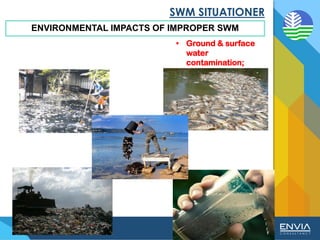
ENVIRONMENTAL IMPACTS OF IMPROPER SWM
• Ground & surface
water
contamination;
SWM SITUATIONER
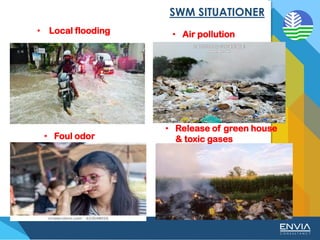
• Local flooding
• Release of green house
& toxic gases
• Foul odor
• Air pollution
SWM SITUATIONER
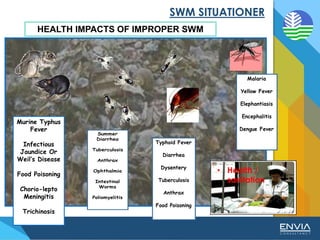
HEALTH IMPACTS OF IMPROPER SWM
Murine Typhus
Fever
Infectious
Jaundice Or
Weil’s Disease
Food Poisoning
Chorio-lepto
Meningitis
Trichinosis
• Health /
sanitation
SWM SITUATIONER
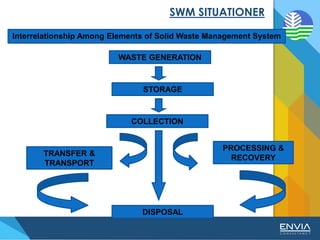
WASTE GENERATION
COLLECTION
TRANSFER &
TRANSPORT
DISPOSAL
STORAGE
PROCESSING &
RECOVERY
Interrelationship Among Elements of Solid Waste Management System
SWM SITUATIONER
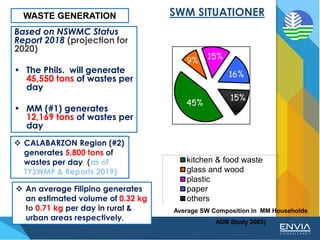
Based on NSWMC Status
Report 2018 (projection for
2020)
• The Phils. will generate
45,550 tons of wastes per
day
• MM (#1) generates
12,169 tons of wastes per
day
WASTE GENERATION
❖ CALABARZON Region (#2)
generates 5,800 tons of
wastes per day (as of
TYSWMP & Reports 2019)
❖ An average Filipino generates
an estimated volume of 0.32 kg
to 0.71 kg per day in rural &
urban areas respectively.
Average SW Composition in MM Households
ADB Study 2003)
kitchen & food waste
glass and wood
plastic
paper
others
SWM SITUATIONER
WASTE GENERATION
Households
Hospitals
Agriculture
School
Office / Building /
Other Establishment
Factories / Industries
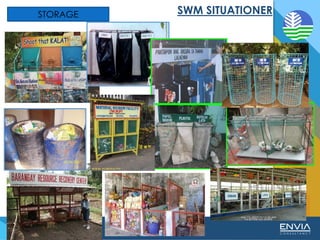
STORAGE SWM SITUATIONER
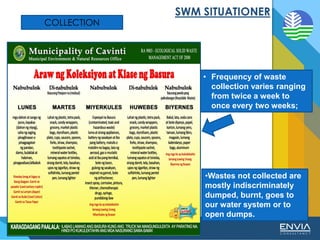
COLLECTION
• Frequency of waste
collection varies ranging
from twice a week to
once every two weeks;
•Wastes not collected are
mostly indiscriminately
dumped, burnt, goes to
our water system or to
open dumps.
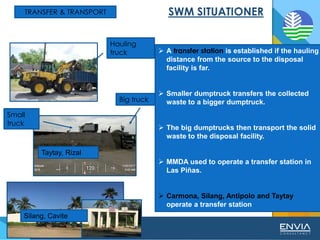
TRANSFER & TRANSPORT
➢ A transfer station is established if the hauling
distance from the source to the disposal
facility is far.
➢ Smaller dumptruck transfers the collected
waste to a bigger dumptruck.
➢ The big dumptrucks then transport the solid
waste to the disposal facility.
➢ MMDA used to operate a transfer station in
Las Piñas.
➢ Carmona, Silang, Antipolo and Taytay
operate a transfer station
Silang, Cavite
Taytay, Rizal
Big truck
Small
truck
Hauling
truck
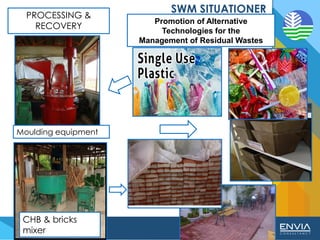
Promotion of Alternative
Technologies for the
Management of Residual Wastes
PROCESSING &
RECOVERY
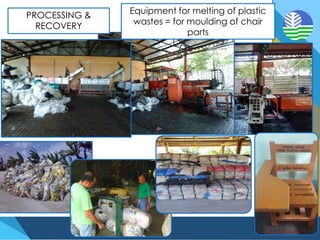
Moulding equipment
CHB & bricks
mixer
Equipment for melting of plastic
wastes = for moulding of chair
parts
PROCESSING &
RECOVERY
PROCESSING &
RECOVERY
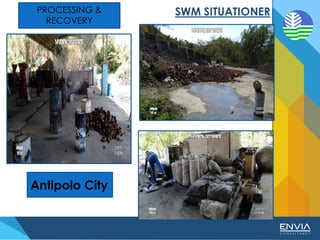
Antipolo City
PROCESSING &
RECOVERY
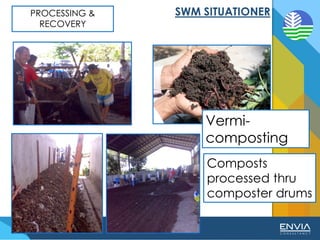
Vermi-
composting
Composts
processed thru
composter drums
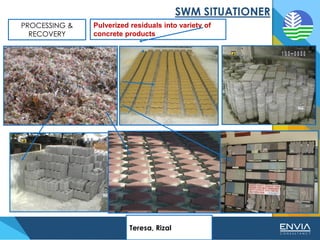
Pulverized residuals into variety of
concrete products
Teresa, Rizal
PROCESSING &
RECOVERY
Paper, cardboards, cartons, tires,
food wrappers
PROCESSING &
RECOVERY
PROCESSING &
RECOVERY
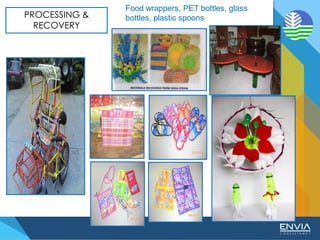
Food wrappers, PET bottles, glass
bottles, plastic spoons
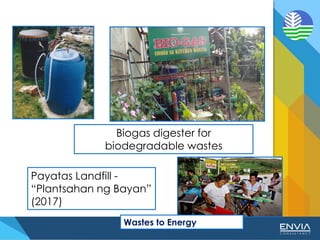
Biogas digester for
biodegradable wastes
Payatas Landfill -
“Plantsahan ng Bayan”
(2017)
Wastes to Energy
DISPOSAL
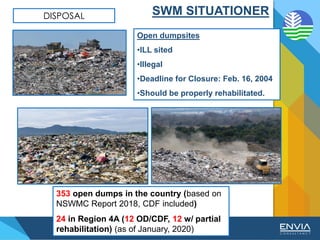
Open dumpsites
•ILL sited
•Illegal
•Deadline for Closure: Feb. 16, 2004
•Should be properly rehabilitated.
353 open dumps in the country (based on
NSWMC Report 2018, CDF included)
24 in Region 4A (12 OD/CDF, 12 w/ partial
rehabilitation) (as of January, 2020)
SWM SITUATIONER
DISPOSAL Controlled Dump Facilities
•Improvement only in the
operation such as provision
of [1] daily soil cover; [2]
drainage system; perimeter
fence; scheduled waste
picking, etc.
•Most are ill-sited.
•Deadline for Closure: Feb.
16, 2006
•Should be properly
rehabilitated.
All CDFs are also considered OD
SWM SITUATIONER
SWM SITUATIONER
DISPOSAL
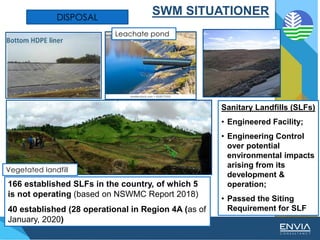
166 established SLFs in the country, of which 5
is not operating (based on NSWMC Report 2018)
40 established (28 operational in Region 4A (as of
January, 2020)
Leachate pond
Vegetated landfill
Sanitary Landfills (SLFs)
• Engineered Facility;
• Engineering Control
over potential
environmental impacts
arising from its
development &
operation;
• Passed the Siting
Requirement for SLF
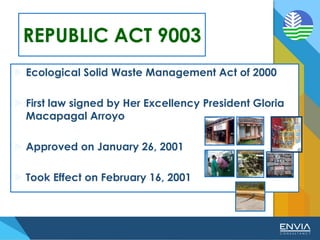
REPUBLIC ACT 9003
 Ecological Solid Waste Management Act of 2000
 First law signed by Her Excellency President Gloria
Macapagal Arroyo
 Approved on January 26, 2001
 Took Effect on February 16, 2001
INSTITUTIONAL MECHANISM
(National Level)
The National Solid Waste Management
Commission (NSWMC)
Oversees the implementation of SWM plans
Prescribe policies to achieve the objectives of
the Act
Composed of 17 members:
14 members from the government sector
3 members from the private sector
NSWMC Members
(Government Sector-14)
1. DENR (Chair);
2. DILG;
3. DOST;
4. DPWH;
5. DOH;
6. DTI;
7. DA;
8. MMDA;
9. LPP;
10. LCP;
11. LMP;
12. Liga ng mga Barangays;
13. TESDA; and
14. PIA
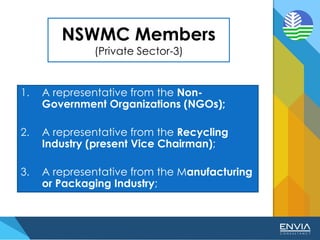
NSWMC Members
(Private Sector-3)
1. A representative from the Non-
Government Organizations (NGOs);
2. A representative from the Recycling
Industry (present Vice Chairman);
3. A representative from the Manufacturing
or Packaging Industry;
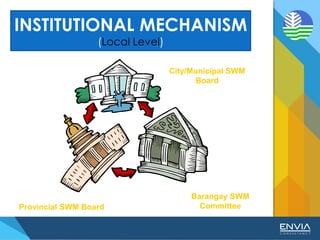
INSTITUTIONAL MECHANISM
(Local Level)
Provincial SWM Board
City/Municipal SWM
Board
Barangay SWM
Committee
recycling
CITY/MUNICIPALITY’S Role
GARDENS/
FARMS
Biodegradable
wastes
Recyclable
Wastes Residual
Wastes
Special
Wastes
BARANGAY’S Role
Separate
Collection
Schedule
or Use of
Compart-
mentalized
Vehicle
JUNKSHOPS/
RECYCLING PLANT TREATER
CONCEPTUAL FRAMEWORK OF RA 9003
Barangay MRF
SLF
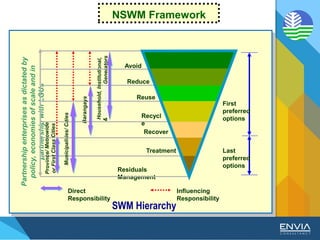
NSWM Framework
Partnership
enterprises
as
dictated
by
policy,
economies
of
scale
and
in
partnership
with
LGUs
Municipalities/
Cities
Direct
Responsibility
Avoid
Reduce
Reuse
Residuals
Management
Treatment
Recycl
e
Recover
Last
preferred
options
First
preferred
options
Influencing
Responsibility
SWM Hierarchy
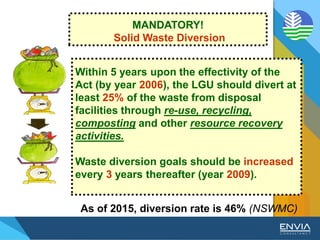
MANDATORY!
Solid Waste Diversion
Within 5 years upon the effectivity of the
Act (by year 2006), the LGU should divert at
least 25% of the waste from disposal
facilities through re-use, recycling,
composting and other resource recovery
activities.
Waste diversion goals should be increased
every 3 years thereafter (year 2009).
As of 2015, diversion rate is 46% (NSWMC)
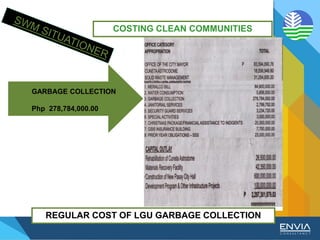
GARBAGE COLLECTION
Php 278,784,000.00
REGULAR COST OF LGU GARBAGE COLLECTION
COSTING CLEAN COMMUNITIES
ANO ANG
DAPATNATING
GAWIN BILANG
MAMAMAYAN?
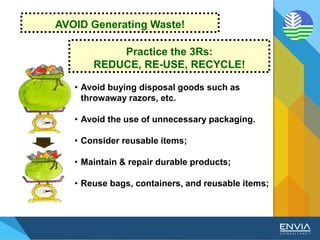
• Avoid buying disposal goods such as
throwaway razors, etc.
• Avoid the use of unnecessary packaging.
• Consider reusable items;
• Maintain & repair durable products;
• Reuse bags, containers, and reusable items;
Practice the 3Rs:
REDUCE, RE-USE, RECYCLE!
AVOID Generating Waste!
• Borrow, rent, or share items used infrequently;
• Sell or donate goods instead of throwing them out;
• Choose recyclable products and
containers and recycle them;
• Select products made form
recyclable materials.
• Compost biodegradable wastes;
Practice the 3Rs:
REDUCE, RE-USE, RECYCLE!
AVOID Generating Waste!
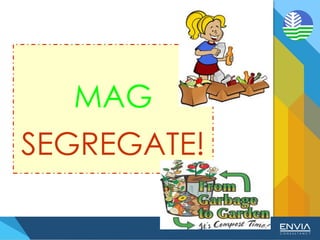
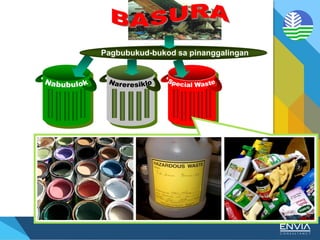
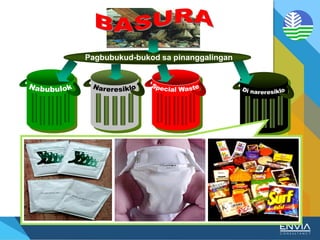
MAG
SEGREGATE!
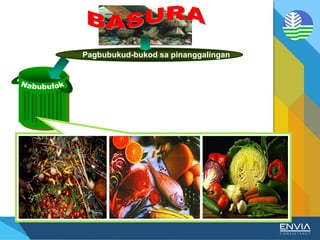
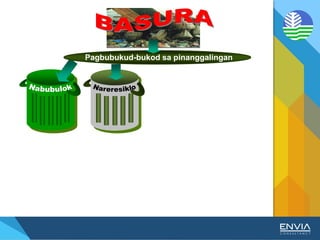
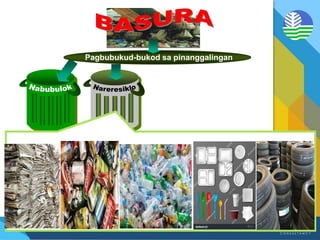
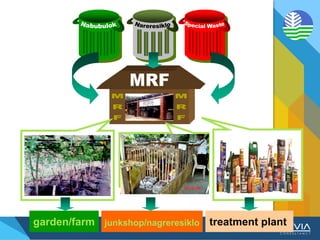
Pagbubukud-bukod sa pinanggalingan
garden/farm junkshop/nagreresiklo treatment plant
Materials Recovery Facility
Partitioned space for recyclables
Proper labelling
Proper enclosure
Covered and secured
Logbook for recording
Sorting area
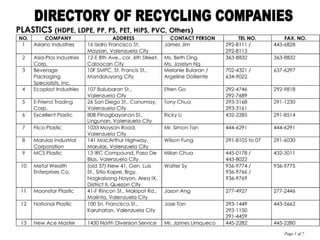
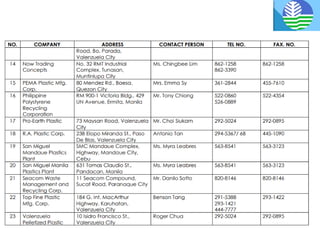
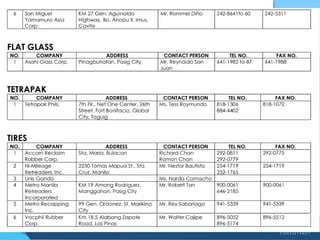
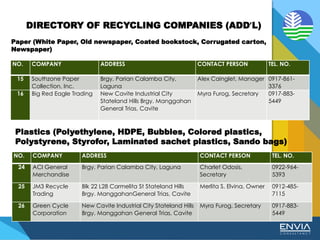
NO. COMPANY ADDRESS CONTACT PERSON TEL. NO.
15 Southzone Paper
Collection, Inc.
Brgy. Parian Calamba City,
Laguna
Alex Cainglet, Manager 0917-861-
3376
16 Big Red Eagle Trading New Cavite Industrial City
Stateland Hills Brgy. Manggahan
General Trias, Cavite
Myra Furog, Secretary 0917-883-
5449
NO. COMPANY ADDRESS CONTACT PERSON TEL. NO.
24 ACI General
Merchandise
Brgy. Parian Calamba City, Laguna Charlet Odosis,
Secretary
0922-964-
5393
25 JM3 Recycle
Trading
Blk 22 L28 Carmelita St Stateland Hills
Brgy. ManggahanGeneral Trias, Cavite
Merlita S. Elvina, Owner 0912-485-
7115
26 Green Cycle
Corporation
New Cavite Industrial City Stateland Hills
Brgy. Manggahan General Trias, Cavite
Myra Furog, Secretary 0917-883-
5449
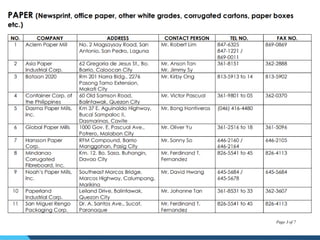
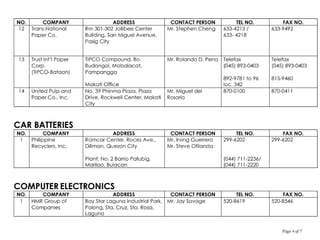
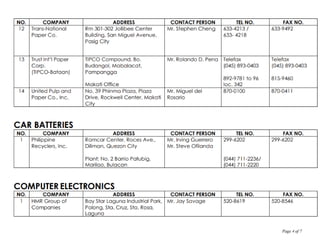
DIRECTORY OF RECYCLING COMPANIES (ADD’L)
Paper (White Paper, Old newspaper, Coated bookstock, Corrugated carton,
Newspaper)
Plastics (Polyethylene, HDPE, Bubbles, Colored plastics,
Polystyrene, Styrofor, Laminated sachet plastics, Sando bags)
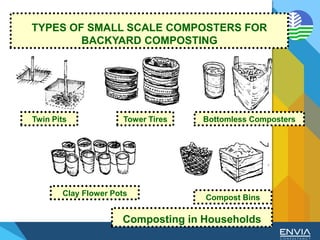
TYPES OF SMALL SCALE COMPOSTERS FOR
BACKYARD COMPOSTING
Twin Pits Tower Tires Bottomless Composters
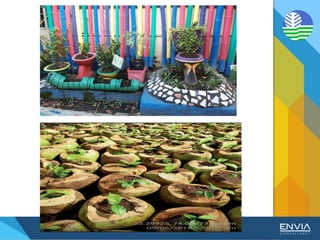
Clay Flower Pots
Compost Bins
Composting in Households
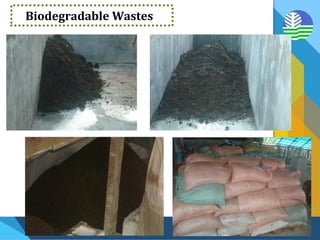
Biodegradable Wastes
Pulverized residuals
Converted into compost
Coco fiber / Coco husk
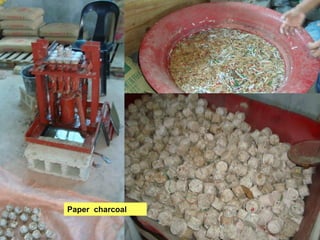
Paper charcoal
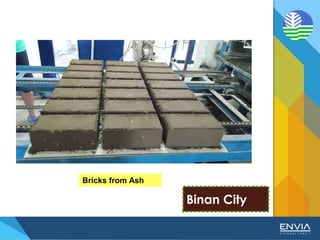
Bricks from Ash
Binan City
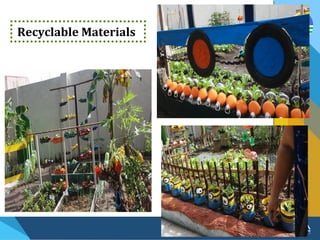
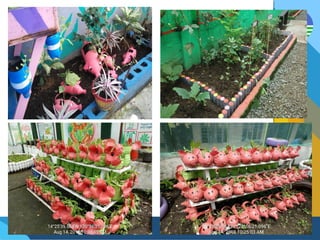
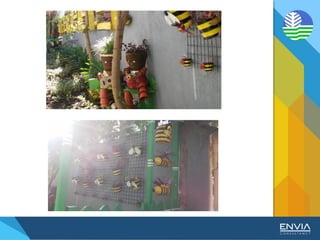
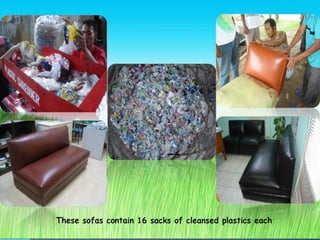
Recyclable Materials
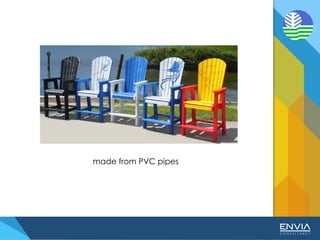
made from PVC pipes
OTHER PRODUCTS DERIVED FROM RECYCLABLE WASTES
Plastic waste
Slab from plastic waste
Construction material
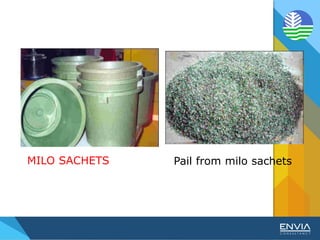
Pail from milo sachets
MILO SACHETS
LAMINATES RECYCLING
SWM IN THE INDUSTRIES
• Committed to comply with their Environmental Management
Plan (EMP)
• Practices / Programs :
1. Implement the 3 R’s, others implement the 5 S
2. Segregated containers, bins are placed in strategic areas;
3. Established MRF within the compound;
4. Assigned persons to check the compliance of sw program;
5. Residual waste - collected by accredited hauler to disposed
to a sanitary landfill;
6. Recyclable wastes - sold to scrap buyers (haulers)
7. Food wastes – collected by concessionaire, accredited
hauler, processed into compost, backyard pit
8. Other biodegradable (garden) wastes – collcted by
accredited hauler, processed into compost , backyard pit
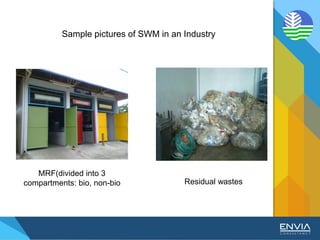
MRF(divided into 3
compartments: bio, non-bio
and hazardous wastes)
Sample pictures of SWM in an Industry
Residual wastes
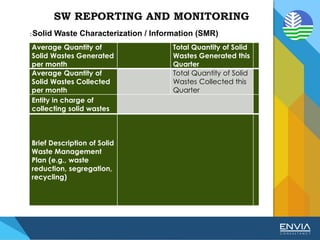
Average Quantity of
Solid Wastes Generated
per month
Total Quantity of Solid
Wastes Generated this
Quarter
Average Quantity of
Solid Wastes Collected
per month
Total Quantity of Solid
Wastes Collected this
Quarter
Entity in charge of
collecting solid wastes
Brief Description of Solid
Waste Management
Plan (e.g., waste
reduction, segregation,
recycling)
:Solid Waste Characterization / Information (SMR)
SW REPORTING AND MONITORING
Sanctions &
Penalties
Fines and Penalties
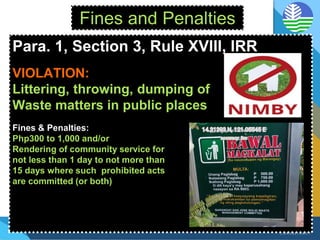
Para. 1, Section 3, Rule XVIII, IRR
VIOLATION:
Littering, throwing, dumping of
Waste matters in public places
Fines & Penalties:
Php300 to 1,000 and/or
Rendering of community service for
not less than 1 day to not more than
15 days where such prohibited acts
are committed (or both)
Fines and Penalties
Para. 2, Section 3, Rule XVIII, IRR
VIOLATION:
Undertaking activities or operating, collecting or
transporting equipment in violation of sanitation
operation and other requirements or permits set
forth in or established pursuant to the Act.
Fines & Penalties:
Php300 to 1,000 and/or
Imprisonment of not less than 1 day to not more than 15 days
(or both)
Fines and Penalties
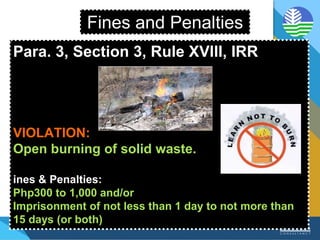
Para. 3, Section 3, Rule XVIII, IRR
VIOLATION:
Open burning of solid waste.
ines & Penalties:
Php300 to 1,000 and/or
Imprisonment of not less than 1 day to not more than
15 days (or both)
Fines and Penalties
Para. 4, Section 3, Rule XVIII, IRR
VIOLATION:
Causing or permitting the
collection of non –
segregated or unsorted
waste.
Fines & Penalties:
Php1,000 to 3,000 and/or imprisonment of not less
than 15 days to not more than 6 months (or both)
Fines and Penalties
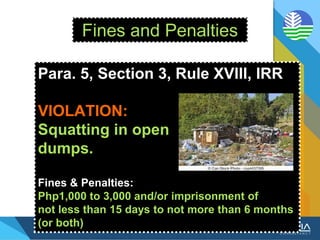
Para. 5, Section 3, Rule XVIII, IRR
VIOLATION:
Squatting in open
dumps.
Fines & Penalties:
Php1,000 to 3,000 and/or imprisonment of
not less than 15 days to not more than 6 months
(or both)
Fines and Penalties
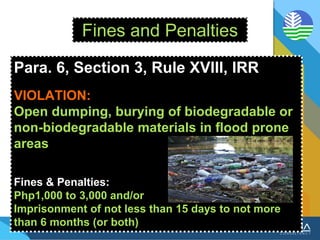
Para. 6, Section 3, Rule XVIII, IRR
VIOLATION:
Open dumping, burying of biodegradable or
non-biodegradable materials in flood prone
areas
Fines & Penalties:
Php1,000 to 3,000 and/or
Imprisonment of not less than 15 days to not more
than 6 months (or both)
Fines and Penalties
Para. 7, Section 3, Rule XVIII, IRR
VIOLATION:
Unauthorized removal of recyclable material
intended for collection by authorized
persons
Fines & Penalties:
Php1,000 to 3,000 and/or
Imprisonment of not less than 15 days to not more
than 6 months (or both)
Fines and Penalties
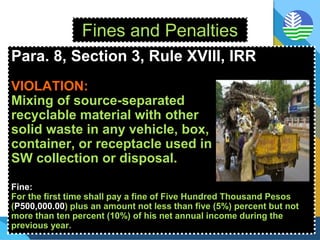
Para. 8, Section 3, Rule XVIII, IRR
VIOLATION:
Mixing of source-separated
recyclable material with other
solid waste in any vehicle, box,
container, or receptacle used in
SW collection or disposal.
Fine:
For the first time shall pay a fine of Five Hundred Thousand Pesos
(P500,000.00) plus an amount not less than five (5%) percent but not
more than ten percent (10%) of his net annual income during the
previous year.
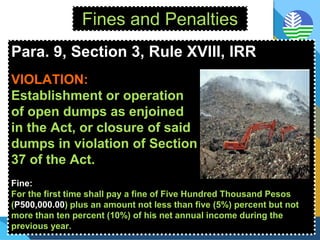
Fines and Penalties
Para. 9, Section 3, Rule XVIII, IRR
VIOLATION:
Establishment or operation
of open dumps as enjoined
in the Act, or closure of said
dumps in violation of Section
37 of the Act.
Fine:
For the first time shall pay a fine of Five Hundred Thousand Pesos
(P500,000.00) plus an amount not less than five (5%) percent but not
more than ten percent (10%) of his net annual income during the
previous year.
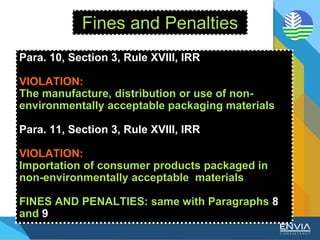
Fines and Penalties
Para. 10, Section 3, Rule XVIII, IRR
VIOLATION:
The manufacture, distribution or use of non-
environmentally acceptable packaging materials
Para. 11, Section 3, Rule XVIII, IRR
VIOLATION:
Importation of consumer products packaged in
non-environmentally acceptable materials
FINES AND PENALTIES: same with Paragraphs 8
and 9
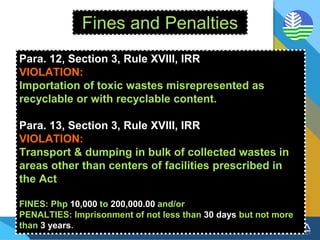
Fines and Penalties
Para. 12, Section 3, Rule XVIII, IRR
VIOLATION:
Importation of toxic wastes misrepresented as
recyclable or with recyclable content.
Para. 13, Section 3, Rule XVIII, IRR
VIOLATION:
Transport & dumping in bulk of collected wastes in
areas other than centers of facilities prescribed in
the Act
FINES: Php 10,000 to 200,000.00 and/or
PENALTIES: Imprisonment of not less than 30 days but not more
than 3 years.
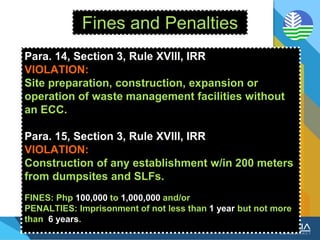
Fines and Penalties
Para. 14, Section 3, Rule XVIII, IRR
VIOLATION:
Site preparation, construction, expansion or
operation of waste management facilities without
an ECC.
Para. 15, Section 3, Rule XVIII, IRR
VIOLATION:
Construction of any establishment w/in 200 meters
from dumpsites and SLFs.
FINES: Php 100,000 to 1,000,000 and/or
PENALTIES: Imprisonment of not less than 1 year but not more
than 6 years.
3. RA 9003 - Ecological Solid Waste Management Act.pdf

3. RA 9003 - Ecological Solid Waste Management Act.pdf

  • 1.
    REPUBLIC ACT 9003 “TheEcological Solid Waste Management Act” MRS. CORAZON GASAPOS Supervising Environmental Management Specialist Chief, SWM Section, EMB Calabarzon
  • 3.
    SWM SITUATIONER ENVIRONMENTAL IMPACTSOF IMPROPER SWM • Ground & surface water contamination;
  • 4.
    SWM SITUATIONER • Localflooding • Release of green house & toxic gases • Foul odor • Air pollution
  • 5.
    SWM SITUATIONER HEALTH IMPACTSOF IMPROPER SWM Murine Typhus Fever Infectious Jaundice Or Weil’s Disease Food Poisoning Chorio-lepto Meningitis Trichinosis • Health / sanitation
  • 6.
    SWM SITUATIONER WASTE GENERATION COLLECTION TRANSFER& TRANSPORT DISPOSAL STORAGE PROCESSING & RECOVERY Interrelationship Among Elements of Solid Waste Management System
  • 7.
    SWM SITUATIONER Based onNSWMC Status Report 2018 (projection for 2020) • The Phils. will generate 45,550 tons of wastes per day • MM (#1) generates 12,169 tons of wastes per day WASTE GENERATION ❖ CALABARZON Region (#2) generates 5,800 tons of wastes per day (as of TYSWMP & Reports 2019) ❖ An average Filipino generates an estimated volume of 0.32 kg to 0.71 kg per day in rural & urban areas respectively. Average SW Composition in MM Households ADB Study 2003) kitchen & food waste glass and wood plastic paper others
  • 8.
    SWM SITUATIONER WASTE GENERATION Households Hospitals Agriculture School Office/ Building / Other Establishment Factories / Industries
  • 9.
  • 10.
    COLLECTION • Frequency ofwaste collection varies ranging from twice a week to once every two weeks; •Wastes not collected are mostly indiscriminately dumped, burnt, goes to our water system or to open dumps.
  • 11.
    TRANSFER & TRANSPORT ➢A transfer station is established if the hauling distance from the source to the disposal facility is far. ➢ Smaller dumptruck transfers the collected waste to a bigger dumptruck. ➢ The big dumptrucks then transport the solid waste to the disposal facility. ➢ MMDA used to operate a transfer station in Las Piñas. ➢ Carmona, Silang, Antipolo and Taytay operate a transfer station Silang, Cavite Taytay, Rizal Big truck Small truck Hauling truck
  • 12.
    Promotion of Alternative Technologiesfor the Management of Residual Wastes PROCESSING & RECOVERY Moulding equipment CHB & bricks mixer
  • 13.
    Equipment for meltingof plastic wastes = for moulding of chair parts PROCESSING & RECOVERY
  • 14.
  • 15.
  • 16.
    Pulverized residuals intovariety of concrete products Teresa, Rizal PROCESSING & RECOVERY
  • 17.
    Paper, cardboards, cartons,tires, food wrappers PROCESSING & RECOVERY
  • 18.
    PROCESSING & RECOVERY Food wrappers,PET bottles, glass bottles, plastic spoons
  • 19.
    Biogas digester for biodegradablewastes Payatas Landfill - “Plantsahan ng Bayan” (2017) Wastes to Energy
  • 20.
    DISPOSAL Open dumpsites •ILL sited •Illegal •Deadlinefor Closure: Feb. 16, 2004 •Should be properly rehabilitated. 353 open dumps in the country (based on NSWMC Report 2018, CDF included) 24 in Region 4A (12 OD/CDF, 12 w/ partial rehabilitation) (as of January, 2020) SWM SITUATIONER
  • 21.
    DISPOSAL Controlled DumpFacilities •Improvement only in the operation such as provision of [1] daily soil cover; [2] drainage system; perimeter fence; scheduled waste picking, etc. •Most are ill-sited. •Deadline for Closure: Feb. 16, 2006 •Should be properly rehabilitated. All CDFs are also considered OD SWM SITUATIONER
  • 22.
    SWM SITUATIONER DISPOSAL 166 establishedSLFs in the country, of which 5 is not operating (based on NSWMC Report 2018) 40 established (28 operational in Region 4A (as of January, 2020) Leachate pond Vegetated landfill Sanitary Landfills (SLFs) • Engineered Facility; • Engineering Control over potential environmental impacts arising from its development & operation; • Passed the Siting Requirement for SLF
  • 24.
    REPUBLIC ACT 9003 Ecological Solid Waste Management Act of 2000  First law signed by Her Excellency President Gloria Macapagal Arroyo  Approved on January 26, 2001  Took Effect on February 16, 2001
  • 25.
    INSTITUTIONAL MECHANISM (National Level) TheNational Solid Waste Management Commission (NSWMC) Oversees the implementation of SWM plans Prescribe policies to achieve the objectives of the Act Composed of 17 members: 14 members from the government sector 3 members from the private sector
  • 26.
    NSWMC Members (Government Sector-14) 1.DENR (Chair); 2. DILG; 3. DOST; 4. DPWH; 5. DOH; 6. DTI; 7. DA; 8. MMDA; 9. LPP; 10. LCP; 11. LMP; 12. Liga ng mga Barangays; 13. TESDA; and 14. PIA
  • 27.
    NSWMC Members (Private Sector-3) 1.A representative from the Non- Government Organizations (NGOs); 2. A representative from the Recycling Industry (present Vice Chairman); 3. A representative from the Manufacturing or Packaging Industry;
  • 28.
    INSTITUTIONAL MECHANISM (Local Level) ProvincialSWM Board City/Municipal SWM Board Barangay SWM Committee
  • 29.
    recycling CITY/MUNICIPALITY’S Role GARDENS/ FARMS Biodegradable wastes Recyclable Wastes Residual Wastes Special Wastes BARANGAY’SRole Separate Collection Schedule or Use of Compart- mentalized Vehicle JUNKSHOPS/ RECYCLING PLANT TREATER CONCEPTUAL FRAMEWORK OF RA 9003 Barangay MRF SLF
  • 30.
  • 32.
    MANDATORY! Solid Waste Diversion Within5 years upon the effectivity of the Act (by year 2006), the LGU should divert at least 25% of the waste from disposal facilities through re-use, recycling, composting and other resource recovery activities. Waste diversion goals should be increased every 3 years thereafter (year 2009). As of 2015, diversion rate is 46% (NSWMC)
  • 33.
    GARBAGE COLLECTION Php 278,784,000.00 REGULARCOST OF LGU GARBAGE COLLECTION COSTING CLEAN COMMUNITIES
  • 34.
  • 35.
    • Avoid buyingdisposal goods such as throwaway razors, etc. • Avoid the use of unnecessary packaging. • Consider reusable items; • Maintain & repair durable products; • Reuse bags, containers, and reusable items; Practice the 3Rs: REDUCE, RE-USE, RECYCLE! AVOID Generating Waste!
  • 36.
    • Borrow, rent,or share items used infrequently; • Sell or donate goods instead of throwing them out; • Choose recyclable products and containers and recycle them; • Select products made form recyclable materials. • Compost biodegradable wastes; Practice the 3Rs: REDUCE, RE-USE, RECYCLE! AVOID Generating Waste!
  • 37.
  • 38.
  • 39.
  • 40.
  • 41.
  • 42.
  • 43.
  • 44.
    Materials Recovery Facility Partitionedspace for recyclables Proper labelling Proper enclosure Covered and secured Logbook for recording Sorting area
  • 50.
    NO. COMPANY ADDRESSCONTACT PERSON TEL. NO. 15 Southzone Paper Collection, Inc. Brgy. Parian Calamba City, Laguna Alex Cainglet, Manager 0917-861- 3376 16 Big Red Eagle Trading New Cavite Industrial City Stateland Hills Brgy. Manggahan General Trias, Cavite Myra Furog, Secretary 0917-883- 5449 NO. COMPANY ADDRESS CONTACT PERSON TEL. NO. 24 ACI General Merchandise Brgy. Parian Calamba City, Laguna Charlet Odosis, Secretary 0922-964- 5393 25 JM3 Recycle Trading Blk 22 L28 Carmelita St Stateland Hills Brgy. ManggahanGeneral Trias, Cavite Merlita S. Elvina, Owner 0912-485- 7115 26 Green Cycle Corporation New Cavite Industrial City Stateland Hills Brgy. Manggahan General Trias, Cavite Myra Furog, Secretary 0917-883- 5449 DIRECTORY OF RECYCLING COMPANIES (ADD’L) Paper (White Paper, Old newspaper, Coated bookstock, Corrugated carton, Newspaper) Plastics (Polyethylene, HDPE, Bubbles, Colored plastics, Polystyrene, Styrofor, Laminated sachet plastics, Sando bags)
  • 51.
    TYPES OF SMALLSCALE COMPOSTERS FOR BACKYARD COMPOSTING Twin Pits Tower Tires Bottomless Composters Clay Flower Pots Compost Bins Composting in Households
  • 52.
  • 53.
    Coco fiber /Coco husk
  • 54.
  • 55.
  • 56.
  • 70.
  • 72.
    OTHER PRODUCTS DERIVEDFROM RECYCLABLE WASTES Plastic waste Slab from plastic waste Construction material
  • 73.
    Pail from milosachets MILO SACHETS LAMINATES RECYCLING
  • 74.
    SWM IN THEINDUSTRIES
  • 75.
    • Committed tocomply with their Environmental Management Plan (EMP) • Practices / Programs : 1. Implement the 3 R’s, others implement the 5 S 2. Segregated containers, bins are placed in strategic areas; 3. Established MRF within the compound; 4. Assigned persons to check the compliance of sw program; 5. Residual waste - collected by accredited hauler to disposed to a sanitary landfill; 6. Recyclable wastes - sold to scrap buyers (haulers) 7. Food wastes – collected by concessionaire, accredited hauler, processed into compost, backyard pit 8. Other biodegradable (garden) wastes – collcted by accredited hauler, processed into compost , backyard pit
  • 76.
    MRF(divided into 3 compartments:bio, non-bio and hazardous wastes) Sample pictures of SWM in an Industry Residual wastes
  • 77.
    Average Quantity of SolidWastes Generated per month Total Quantity of Solid Wastes Generated this Quarter Average Quantity of Solid Wastes Collected per month Total Quantity of Solid Wastes Collected this Quarter Entity in charge of collecting solid wastes Brief Description of Solid Waste Management Plan (e.g., waste reduction, segregation, recycling) :Solid Waste Characterization / Information (SMR) SW REPORTING AND MONITORING
  • 78.
  • 79.
    Fines and Penalties Para.1, Section 3, Rule XVIII, IRR VIOLATION: Littering, throwing, dumping of Waste matters in public places Fines & Penalties: Php300 to 1,000 and/or Rendering of community service for not less than 1 day to not more than 15 days where such prohibited acts are committed (or both)
  • 80.
    Fines and Penalties Para.2, Section 3, Rule XVIII, IRR VIOLATION: Undertaking activities or operating, collecting or transporting equipment in violation of sanitation operation and other requirements or permits set forth in or established pursuant to the Act. Fines & Penalties: Php300 to 1,000 and/or Imprisonment of not less than 1 day to not more than 15 days (or both)
  • 81.
    Fines and Penalties Para.3, Section 3, Rule XVIII, IRR VIOLATION: Open burning of solid waste. ines & Penalties: Php300 to 1,000 and/or Imprisonment of not less than 1 day to not more than 15 days (or both)
  • 82.
    Fines and Penalties Para.4, Section 3, Rule XVIII, IRR VIOLATION: Causing or permitting the collection of non – segregated or unsorted waste. Fines & Penalties: Php1,000 to 3,000 and/or imprisonment of not less than 15 days to not more than 6 months (or both)
  • 83.
    Fines and Penalties Para.5, Section 3, Rule XVIII, IRR VIOLATION: Squatting in open dumps. Fines & Penalties: Php1,000 to 3,000 and/or imprisonment of not less than 15 days to not more than 6 months (or both)
  • 84.
    Fines and Penalties Para.6, Section 3, Rule XVIII, IRR VIOLATION: Open dumping, burying of biodegradable or non-biodegradable materials in flood prone areas Fines & Penalties: Php1,000 to 3,000 and/or Imprisonment of not less than 15 days to not more than 6 months (or both)
  • 85.
    Fines and Penalties Para.7, Section 3, Rule XVIII, IRR VIOLATION: Unauthorized removal of recyclable material intended for collection by authorized persons Fines & Penalties: Php1,000 to 3,000 and/or Imprisonment of not less than 15 days to not more than 6 months (or both)
  • 86.
    Fines and Penalties Para.8, Section 3, Rule XVIII, IRR VIOLATION: Mixing of source-separated recyclable material with other solid waste in any vehicle, box, container, or receptacle used in SW collection or disposal. Fine: For the first time shall pay a fine of Five Hundred Thousand Pesos (P500,000.00) plus an amount not less than five (5%) percent but not more than ten percent (10%) of his net annual income during the previous year.
  • 87.
    Fines and Penalties Para.9, Section 3, Rule XVIII, IRR VIOLATION: Establishment or operation of open dumps as enjoined in the Act, or closure of said dumps in violation of Section 37 of the Act. Fine: For the first time shall pay a fine of Five Hundred Thousand Pesos (P500,000.00) plus an amount not less than five (5%) percent but not more than ten percent (10%) of his net annual income during the previous year.
  • 88.
    Fines and Penalties Para.10, Section 3, Rule XVIII, IRR VIOLATION: The manufacture, distribution or use of non- environmentally acceptable packaging materials Para. 11, Section 3, Rule XVIII, IRR VIOLATION: Importation of consumer products packaged in non-environmentally acceptable materials FINES AND PENALTIES: same with Paragraphs 8 and 9
  • 89.
    Fines and Penalties Para.12, Section 3, Rule XVIII, IRR VIOLATION: Importation of toxic wastes misrepresented as recyclable or with recyclable content. Para. 13, Section 3, Rule XVIII, IRR VIOLATION: Transport & dumping in bulk of collected wastes in areas other than centers of facilities prescribed in the Act FINES: Php 10,000 to 200,000.00 and/or PENALTIES: Imprisonment of not less than 30 days but not more than 3 years.
  • 90.
    Fines and Penalties Para.14, Section 3, Rule XVIII, IRR VIOLATION: Site preparation, construction, expansion or operation of waste management facilities without an ECC. Para. 15, Section 3, Rule XVIII, IRR VIOLATION: Construction of any establishment w/in 200 meters from dumpsites and SLFs. FINES: Php 100,000 to 1,000,000 and/or PENALTIES: Imprisonment of not less than 1 year but not more than 6 years.