Principles of Business, Marketing, andPrinciples of Business, Marketing, and
FinanceFinance
Lesson ThreeLesson Three
Business Operations and Organizational StructuresBusiness Operations and Organizational Structures
UNT in partnership with TEA, Copyright ©. All rights reserved
Business Organization and ManagementBusiness Organization and Management
• How a Company is Run
• Managerial Structures
– Organizational chart-shows how the business is
structured and who is in charge of whom
– Line authority-managers at the top of the organization
are in charge of those beneath them
– Centralized organization-gives authority to a number of
different managers to run their own departments
UNT in partnership with TEA, Copyright ©. All rights reserved 2
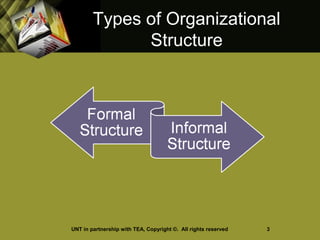
Types of Organizational
Structure
UNT in partnership with TEA, Copyright ©. All rights reserved 3
Guidelines for BusinessesGuidelines for Businesses
• Mission Statement-short specific reason
why the business exists and what it wants
to achieve
• Goal-precise statement of results the
business expects to achieve
• Policies-guidelines used in making
consistent decisions
• Procedures-descriptions of the way work
is to be done
UNT in partnership with TEA, Copyright ©. All rights reserved 4
Principles of EffectivePrinciples of Effective
OrganizationOrganization
• Responsibility-the obligation to complete specific
work
• Authority-right to make decisions about how
responsibilities should be accomplished
• Accountability-taking responsibility for the results
achieved
• Unity of Command-clear reporting relationship for
all staff of a business
UNT in partnership with TEA, Copyright ©. All rights reserved 5
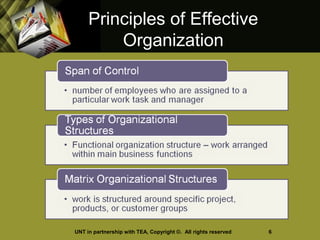
Principles of Effective
Organization
UNT in partnership with TEA, Copyright ©. All rights reserved 6
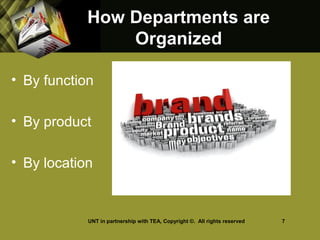
How Departments areHow Departments are
OrganizedOrganized
• By function
• By product
• By location
UNT in partnership with TEA, Copyright ©. All rights reserved 7
Levels of ManagementLevels of Management
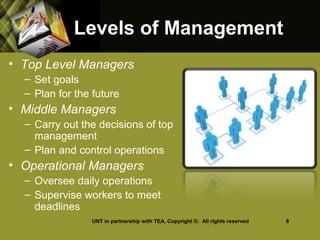
• Top Level Managers
– Set goals
– Plan for the future
• Middle Managers
– Carry out the decisions of top
management
– Plan and control operations
• Operational Managers
– Oversee daily operations
– Supervise workers to meet
deadlines
UNT in partnership with TEA, Copyright ©. All rights reserved 8
PlanningPlanning
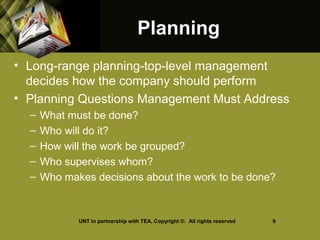
• Long-range planning-top-level management
decides how the company should perform
• Planning Questions Management Must Address
– What must be done?
– Who will do it?
– How will the work be grouped?
– Who supervises whom?
– Who makes decisions about the work to be done?
UNT in partnership with TEA, Copyright ©. All rights reserved 9
Questions of the PlanningQuestions of the Planning
ProcessProcess
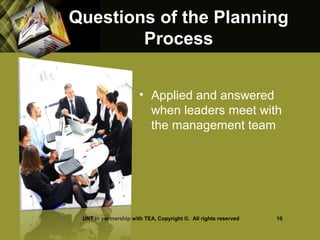
• Applied and answered
when leaders meet with
the management team
UNT in partnership with TEA, Copyright ©. All rights reserved 10
OrganizingOrganizing
• Assign managers different tasks
• Coordinate activities of managers
• Each manager organizes his/her
department and knows what other
managers are doing
• Must determine who makes decisions and
who answers to whom
UNT in partnership with TEA, Copyright ©. All rights reserved 11
LeadingLeading
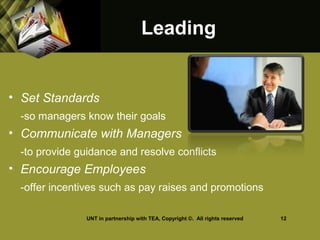
• Set Standards
-so managers know their goals
• Communicate with Managers
-to provide guidance and resolve conflicts
• Encourage Employees
-offer incentives such as pay raises and promotions
UNT in partnership with TEA, Copyright ©. All rights reserved 12
ControllingControlling
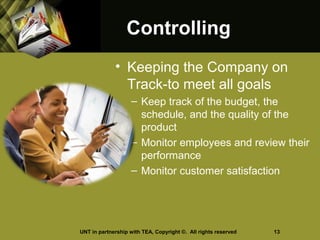
• Keeping the Company on
Track-to meet all goals
– Keep track of the budget, the
schedule, and the quality of the
product
– Monitor employees and review their
performance
– Monitor customer satisfaction
UNT in partnership with TEA, Copyright ©. All rights reserved 13
ManagersManagers
• Most Managers
– Begin their careers as company employees
– Are promoted after they have gained experience and
have shown leadership qualities
• Managerial Qualities
– Ability to perform varied activities
– Ability to work under pressure
– Effective communication
– Interpersonal skills
– Ability to gather and use information
UNT in partnership with TEA, Copyright ©. All rights reserved 14
Advantages Associated withAdvantages Associated with
Being a ManagerBeing a Manager
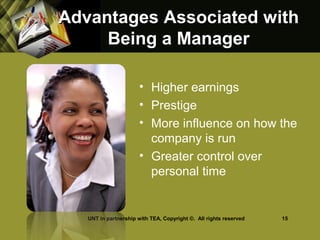
• Higher earnings
• Prestige
• More influence on how the
company is run
• Greater control over
personal time
UNT in partnership with TEA, Copyright ©. All rights reserved 15
Disadvantages AssociatedDisadvantages Associated
with Being a Managerwith Being a Manager
• Take the blame when things go wrong
• Wrong decisions are costly and can affect
numerous employees
• Can have an adverse affect on
relationship with lower-level employees
UNT in partnership with TEA, Copyright ©. All rights reserved 16
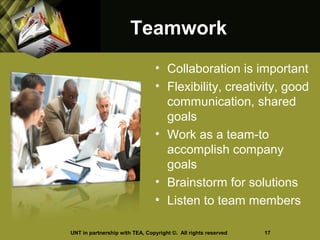
TeamworkTeamwork
• Collaboration is important
• Flexibility, creativity, good
communication, shared
goals
• Work as a team-to
accomplish company
goals
• Brainstorm for solutions
• Listen to team members
UNT in partnership with TEA, Copyright ©. All rights reserved 17

03 bus ops&org

  • 1.
    Principles of Business,Marketing, andPrinciples of Business, Marketing, and FinanceFinance Lesson ThreeLesson Three Business Operations and Organizational StructuresBusiness Operations and Organizational Structures UNT in partnership with TEA, Copyright ©. All rights reserved
  • 2.
    Business Organization andManagementBusiness Organization and Management • How a Company is Run • Managerial Structures – Organizational chart-shows how the business is structured and who is in charge of whom – Line authority-managers at the top of the organization are in charge of those beneath them – Centralized organization-gives authority to a number of different managers to run their own departments UNT in partnership with TEA, Copyright ©. All rights reserved 2
  • 3.
    Types of Organizational Structure UNTin partnership with TEA, Copyright ©. All rights reserved 3
  • 4.
    Guidelines for BusinessesGuidelinesfor Businesses • Mission Statement-short specific reason why the business exists and what it wants to achieve • Goal-precise statement of results the business expects to achieve • Policies-guidelines used in making consistent decisions • Procedures-descriptions of the way work is to be done UNT in partnership with TEA, Copyright ©. All rights reserved 4
  • 5.
    Principles of EffectivePrinciplesof Effective OrganizationOrganization • Responsibility-the obligation to complete specific work • Authority-right to make decisions about how responsibilities should be accomplished • Accountability-taking responsibility for the results achieved • Unity of Command-clear reporting relationship for all staff of a business UNT in partnership with TEA, Copyright ©. All rights reserved 5
  • 6.
    Principles of Effective Organization UNTin partnership with TEA, Copyright ©. All rights reserved 6
  • 7.
    How Departments areHowDepartments are OrganizedOrganized • By function • By product • By location UNT in partnership with TEA, Copyright ©. All rights reserved 7
  • 8.
    Levels of ManagementLevelsof Management • Top Level Managers – Set goals – Plan for the future • Middle Managers – Carry out the decisions of top management – Plan and control operations • Operational Managers – Oversee daily operations – Supervise workers to meet deadlines UNT in partnership with TEA, Copyright ©. All rights reserved 8
  • 9.
    PlanningPlanning • Long-range planning-top-levelmanagement decides how the company should perform • Planning Questions Management Must Address – What must be done? – Who will do it? – How will the work be grouped? – Who supervises whom? – Who makes decisions about the work to be done? UNT in partnership with TEA, Copyright ©. All rights reserved 9
  • 10.
    Questions of thePlanningQuestions of the Planning ProcessProcess • Applied and answered when leaders meet with the management team UNT in partnership with TEA, Copyright ©. All rights reserved 10
  • 11.
    OrganizingOrganizing • Assign managersdifferent tasks • Coordinate activities of managers • Each manager organizes his/her department and knows what other managers are doing • Must determine who makes decisions and who answers to whom UNT in partnership with TEA, Copyright ©. All rights reserved 11
  • 12.
    LeadingLeading • Set Standards -somanagers know their goals • Communicate with Managers -to provide guidance and resolve conflicts • Encourage Employees -offer incentives such as pay raises and promotions UNT in partnership with TEA, Copyright ©. All rights reserved 12
  • 13.
    ControllingControlling • Keeping theCompany on Track-to meet all goals – Keep track of the budget, the schedule, and the quality of the product – Monitor employees and review their performance – Monitor customer satisfaction UNT in partnership with TEA, Copyright ©. All rights reserved 13
  • 14.
    ManagersManagers • Most Managers –Begin their careers as company employees – Are promoted after they have gained experience and have shown leadership qualities • Managerial Qualities – Ability to perform varied activities – Ability to work under pressure – Effective communication – Interpersonal skills – Ability to gather and use information UNT in partnership with TEA, Copyright ©. All rights reserved 14
  • 15.
    Advantages Associated withAdvantagesAssociated with Being a ManagerBeing a Manager • Higher earnings • Prestige • More influence on how the company is run • Greater control over personal time UNT in partnership with TEA, Copyright ©. All rights reserved 15
  • 16.
    Disadvantages AssociatedDisadvantages Associated withBeing a Managerwith Being a Manager • Take the blame when things go wrong • Wrong decisions are costly and can affect numerous employees • Can have an adverse affect on relationship with lower-level employees UNT in partnership with TEA, Copyright ©. All rights reserved 16
  • 17.
    TeamworkTeamwork • Collaboration isimportant • Flexibility, creativity, good communication, shared goals • Work as a team-to accomplish company goals • Brainstorm for solutions • Listen to team members UNT in partnership with TEA, Copyright ©. All rights reserved 17

Editor's Notes

  • #3 Give examples of a line authority and a centralized organization. Conduct class discussion about the pros and cons of each form of organization.
  • #4 Formal Structure-departmentalization divides responsibility among specific units or departments. Informal Structure-used when a business does not need a big marketing or distribution network, does not need a lot of managers
  • #5 Read your school or school district Mission Statement to the class. Break the class into small groups. Each group must choose a business and write a mission statement for the business.
  • #6 Go through an example of a business procedure used by a business where students shop or have a student give an example of a procedure used at the business where he/she is employed.
  • #9 Ask students to draw an organization chart for the business where they are employed or have been employed in the past. If they have never been employed then think about the school system and how the employees and students would fit in an organizational chart starting with the superintendent of the school system down to the students.
  • #10 Ask students to answer Questions #1-5 under Part B for organizing a prom
  • #12 Explain why managers must understand the team concept and why it is important to respect the work completed by other managers
  • #13 Ask students for a list of leadership characteristics. Then ask students to circle the characteristics they possess
  • #14 Ask students why customer satisfaction should be a part of the company organization. Then ask students why customer service should be the #1 priority for the company.
  • #15 Survey the class to determine how many students have jobs. Then ask students to list characteristics needed to be a manager at their workplace.
  • #18 Ask students why listening is so important in the workplace. Then describe the importance of all employees taking ownership in the goals of the company.