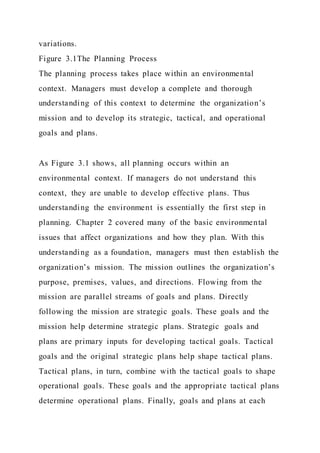
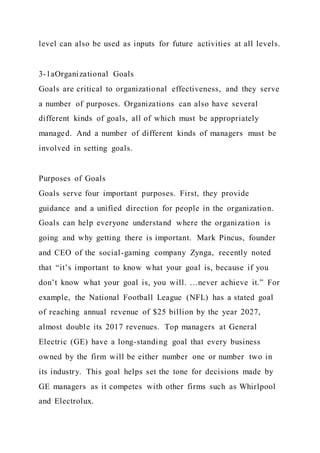
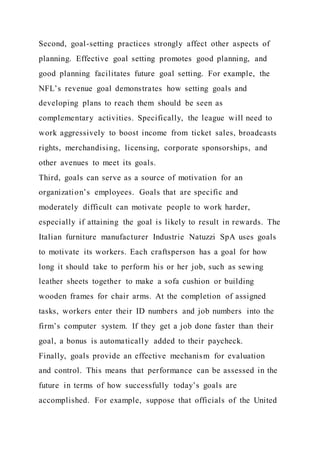
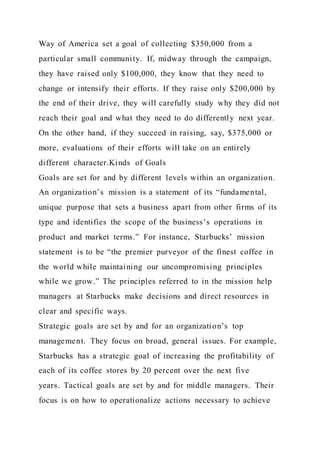
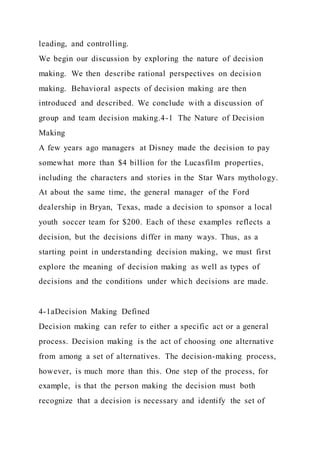
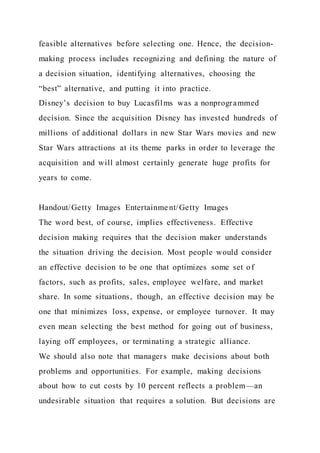
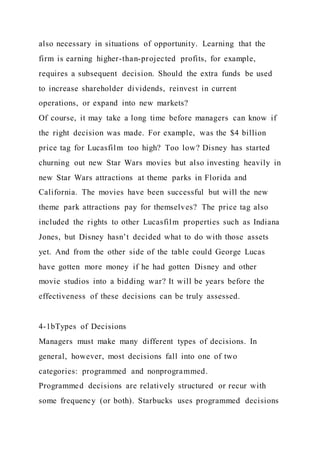
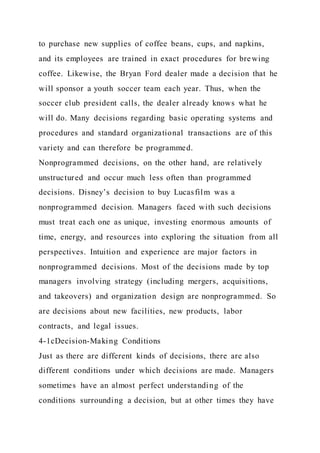
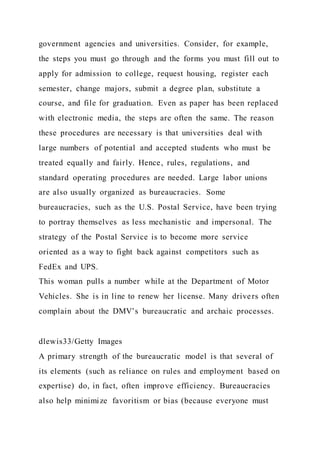
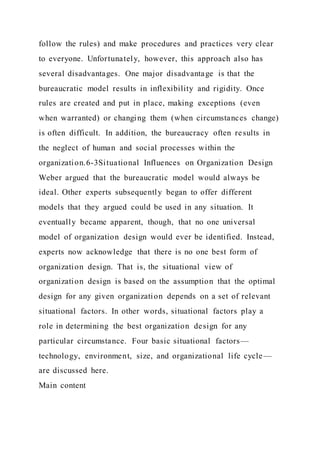
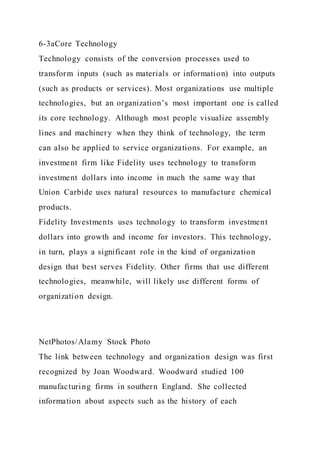
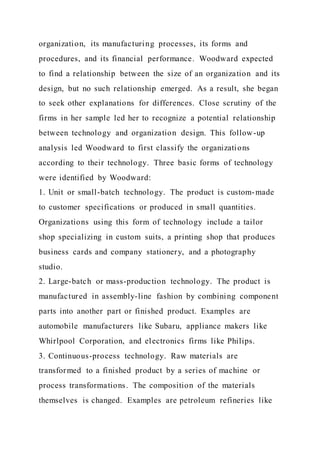
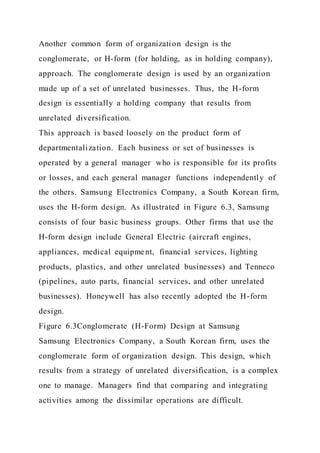
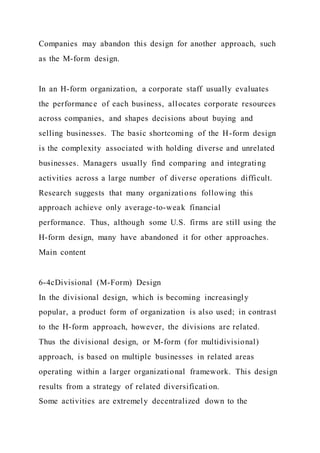
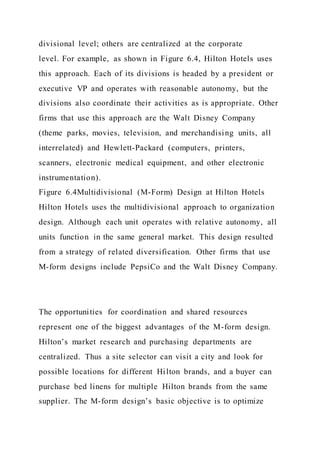
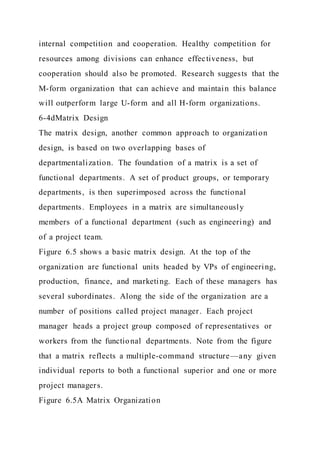
· Chapter Introduction
· 1-1An Introduction to Management
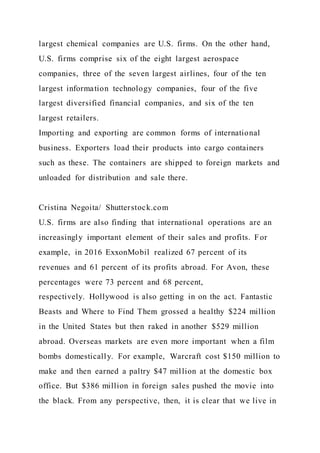
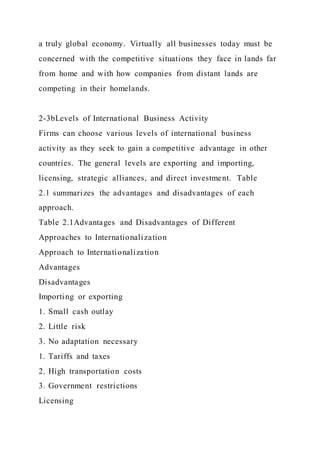
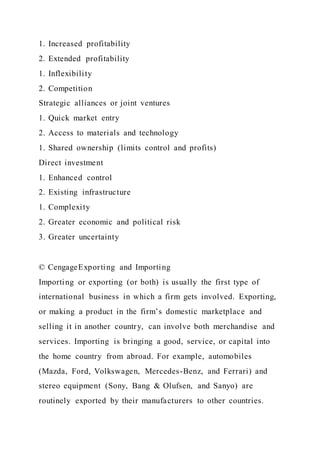
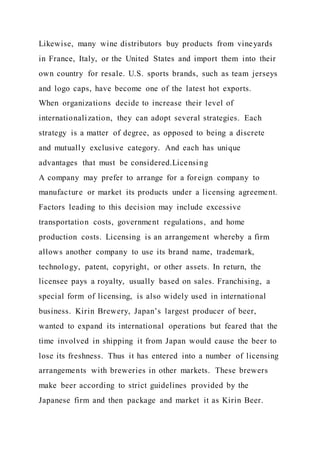
· An organization is a group of people working together in a
structured and coordinated fashion to achieve a set of goals,
which may include profit (Netflix or Starbucks), the discovery
of knowledge (the University of Nebraska or the National
Science Foundation), national defense (the U.S. Navy or
Marines), the coordination of various local charities (the United
Way of America), or social satisfaction (a fraternity or
sorority).
· Managers are responsible for using the organization’s
resources to help achieve its goals. More
precisely, management can be defined as a set of activities
(including planning and decision making, organizing, leading,
and controlling) directed at an organization’s resources (human,
financial, physical, and information) with the aim of achieving
organizational goals in an efficient and effective manner.
A manager, then, is someone whose primary responsibility is to
carry out the management process. By efficient, we mean using
resources wisely in a cost-effective way. By effective, we mean
making the right decisions and successfully implementing them.
In general, successful organizations are both efficient and
effective.
· Today’s managers face myriad interesting and challenging
situations. The average executive works at least 60 hours a
week; has enormous demands placed on his or her time; and
faces increased complexities posed by globalization, domestic
competition, government regulation, shareholder pressure,
emerging technologies, the growing impact of social media, and
other technology-driven uncertainties. Their job is complicated
even more by rapid changes, unexpected disruptions, and both
minor and major crises. The manager’s job is unpredictable and
fraught with challenges, but it is also filled with opportunities
to make a difference. Good managers can propel an organization
into unprecedented realms of success, whereas poor managers
can devastate even the strongest of organizations.
1-1aKinds of Managers
Many different kinds of managers work in organizations
today. Figure 1.1 shows how various kinds of managers within
an organization can be differentiated by level and by area.
Figure 1.1Kinds of Managers by Level and Area
Organizations generally have three levels of management,
represented by top managers, middle managers, and first-line
managers. Regardless of level, managers are also usually
associated with a specific area within the organization, such as
marketing, finance, operations, human resources,
administration, or some other area.
To be effective businesses must produce products that
consumers are willing to buy. A company could very efficiently
produce portable cassette tape players like this one but will not
be successful.
Levels of Management
One way to classify managers is in terms of their level in the
organization. Top managers make up the relatively small group
of executives who manage the overall organization. Titles found
in this group include president, vice president (VP), and chief
executive officer (CEO). Top managers create the
organization’s goals, overall strategy, and operating policies.
They also officially represent the organization to the external
environment by meeting with government officials, executives
of other organizations, and so forth.
Reed Hastings is a top manager. Howard Schultz, CEO of
Starbucks, is also a top manager, as are Michelle Burns and
Rajiv Chandrasekaran, two of the firm’s executive VPs.
Likewise, Sergey Brin and Larry Page (Google’s founders and
top executives), Tim Cook (CEO of Apple), and Mary Barra
(CEO of General Motors) are also top managers. The job of a
top manager is likely to be complex and varied. Top managers
make decisions about activities such as acquiring other
companies, investing in R&D, entering or abandoning various
markets, and building new plants and office facilities. They
often work long hours and spend much of their time in meetings
or on the telephone. In most cases, top managers are also very
well paid. In fact, the elite top managers of very large firms
sometimes make several million dollars a year in salary,
bonuses, and stock. In 2017, Starbucks paid Howard Schultz
$1,500,000 in salary for his work as CEO. Schultz was also
awarded a bonus of $2,250,000, around $13,000,000 in stock
and option awards, and $215,933 in other compensation.
Middle management is probably the largest group of managers
in most organizations. Common middle-management titles
include plant manager, operations manager, and division
head. Middle managers are primarily responsible for
implementing the policies and plans developed by top managers
and for supervising and coordinating the activities of lower -
level managers. Jason Hernandez, a regional manager at
Starbucks responsible for the firm’s operations in three eastern
states, is a middle manager.
First-line managers supervise and coordinate the activities of
operating employees. Common titles for first-line managers are
supervisor, coordinator, and office manager. Positions like these
are often the first held by employees who enter management
from the ranks of operating personnel. Wayne Maxwell and
Jenny Wagner, managers of Starbucks coffee shops in Texas,
are first-line managers. They oversee the day-to-day operations
of their respective stores, hire operating employees to staff
them, and handle other routine administrative duties required of
them by the parent corporation. In contrast to top and middle
managers, first-line managers typically spend a large proportion
of their time supervising the work of their subordinates.
Denise Morrison, CEO of Campbell Soup, is a top manager. She
makes major decisions about the firm’s competitive strategies,
research and development investments, and new facilities.
Managing in Different Areas of the Organization
Regardless of their level, managers may work in various areas
within an organization. In any given firm, for example, these
areas may include marketing, financial, operations, human
resources, administrative, and others.
Marketing managers work in areas related to the marketing
function—getting consumers and clients to buy the
organization’s products or services (be they Samsung
smartphones, Toyota automobiles, Vogue magazines, Associated
Press news reports, streaming video rentals from Netflix, or
lattes at Starbucks). These areas include new product
development, promotion, and distribution. Given the importance
of marketing for virtually all organizations, developing good
managers in this area is critical.
Financial managers deal primarily with an organization’s
financial resources. They are responsible for activities such as
accounting, cash management, and investments. In some
businesses, especially banking and insurance, financial
managers are found in large numbers.
Operations managers are concerned with creating and managing
the systems that create an organization’s products and services.
Typical responsibilities of operations managers include
production control, inventory control, quality control, plant
layout, and site selection.
Human resources managers are responsible for hiring and
developing employees. They are typically involved in human
resource planning, recruiting and selecting employees, training
and development, designing compensation and benefit systems,
formulating performance appraisal systems, and discharging
low-performing and problem employees.
Administrative, or general, managers are not associated with
any particular management specialty. Probably the best example
of an administrative management position is that of a hospital
or clinic administrator. Administrative managers tend to be
generalists; they have some basic familiarity with all functional
areas of management rather than specialized training in any one
area.
Many organizations have specialized management positions in
addition to those already described. Public relations managers,
for example, deal with the public and media for firms such as
Facebook, Instagram, and Unilever to protect and enhance the
image of their organizations. R&D managers coordinate the
activities of scientists and engineers working on scientific
projects in organizations such as Google, Shell Oil, and NASA.
Internal consultants are used in organizations such as Prudential
Insurance to provide specialized expert advice to operating
managers. International operations are often coordinated by
specialized managers in organizations like Walmart and General
Electric. The number, nature, and importance of these
specialized managers vary tremendously from one organization
to another. As contemporary organizations continue to grow in
complexity and size, the number and importance of such
managers are also likely to increase. Our “Tech Watch” feature
highlights one newly emerging management position, the social
media manager.
1-1bBasic Management Functions
Regardless of level or area, management involves the four basic
functions of planning and decision making, organizing, leading,
and controlling. This book is organized around these basic
functions, as shown in Figure 1.2.
Planning and Decision Making
In its simplest form, planning means setting an organization’s
goals and deciding how best to achieve them. Decision making,
a part of the planning process, involves selecting a course of
action from a set of alternatives. Planning and decision making
help managers maintain their effectiveness by serving as guides
for their future activities. In other words, the organization’s
goals and plans clearly help managers know how to allocate
their time and resources. Part 2 of this book is devoted to
planning and decision-making activities and concepts.
Tech Watch“. . . But What Is a Social Media Manager?”
The last few years have been big for social media—technologies
that allow users to create and exchange content. Twitter,
Facebook, Instagram, and YouTube play central roles in the
daily activities of many people today, especially younger
people. Spending on social media advertising is approaching $5
billion per year, up 35 percent from 2012. Seven out of ten
marketers say that they are increasing social media spending
each year (compared to only half who are increasing direct
marketing spending and less than 10 percent who are spending
more on TV advertising).
According to Ashley Coombe, social media strategist for All
Inclusive Marketing, “2013 was the year social media managers
earned legitimacy. . . . Business owners began to realize that
they could no longer hire their friend’s daughter to do their
social media just because she had a lot of friends on Facebook.”
Just what do social media managers do? Why is your friend’s
daughter likely to be in over her head? It’s a pretty new
position, so job descriptions understandably vary. Here,
however, is a generic description crafted by a veteran social
media executive:
· The social media manager will implement the company’s
social media strategy, developing brand awareness, generating
inbound traffic, and encouraging product adoption. This role
coordinates with the internal marketing and PR teams to support
their respective missions, ensuring consistency in voice and
cultivating a social media referral network.
Primarily, social media managers handle information and
communications through social media outlets—tracking trends
and determining posting rates, creating positive
communications, and maintaining a congenial media
relationship with a company’s community of customers. As you
can also see from the job description, a key function of the
position is coordination. Typically, social media managers work
out of marketing departments and perform a variety of
marketing-related tasks—replying to customer inquiries (sales),
responding to customer complaints (customer service), and
handling external communications (public relations). At the
same time, however, because they often manage the use of
social media among all of a company’s employees and
communicate information about all of its activities, the scope of
responsibilities is companywide.
Even so, some social media managers aren’t quite sure how
much “legitimacy” they’ve earned. “At the last place I was a
social manager,” reports one brand specialist at a large
corporation, “high-level VPs would come over and say I was
messing around on the Internet too much.” According to another
veteran of corporate media management, “The biggest
misconception is that, compared to other marketers, we don’t
understand analytics or don’t have the education or background
when it comes to the technical side.” Old-school executives,
charges a third social media strategist, “see [social media] as
the warm and fuzzy side of marketing. In reality,” he says, “it’s
a powerful revenue driver when it’s given proper funding and
attention. . . . When you show them the ROI, people start
changing their minds.”
References: Kelly Clay, “What Social Media Managers Need to
Know about Facebook,” www.forbes.com, accessed on January
4, 2017; Jennifer Beese, “The Top 7 Social Media Stories of
2013,” SproutSocial, December 27,
2013, http://sproutsocial.com, accessed on January 4, 2017; Erik
Sass, “Most Marketers Will Spend More on Social Media in
2014,” The Social Graf, November 19,
2013, www.mediapost.com, accessed on January 4, 2017; The
CMO Survey, “Social Media Spend Continues to
Soar,” www.cmosurvey.org, accessed on January 4, 2017;
Blaise Grimes-Viort, “Social Media Manager Job
Description,” Online Communities and Social
Media, http://blaisegv.com, accessed on January 4, 2017; Julian
Rio, “Social Media Manager: What Role Does He Really
Have?” JulianRio.com Marketing
Solution
s, www.julianrio.com, accessed on January 4, 2017; and
“Confessions of Big Brand Social Media
Managers,” Digiday, http://digiday.com, accessed on January 4,
2017.Organizing
Once a manager has set goals and developed a workable plan,
his or her next management function is to organize people and
the other resources necessary to carry out the plan.
Specifically, organizing involves determining how activities and
resources are to be grouped. Although some people equate this
function with the creation of an organization chart, we will see
in Part 3 that it is actually much more.Leading
The third basic managerial function is leading. Some people
consider leading to be both the most important and the most
challenging of all managerial activities. Leading is the set of
processes used to get members of the organization to work
together to further the interests of the organization. We cover
the leading function in detail in Part 4.
Controlling
The final phase of the management process is controlling, or
monitoring the organization’s progress toward its goals. As the
organization moves toward its goals, managers must monitor
progress to ensure that it is performing in such a way as to
arrive at its “destination” at the appointed time. Part 5 explores
the control function.
1-1cFundamental Management Skills
To carry out these management functions most effectively,
managers rely on a number of different fundamental
management skills of which the most important are technical,
interpersonal, conceptual, diagnostic, communication, decision-
making, and time management skills. Our “Leading the Way”
feature also illustrates how one successful manager has relied
on both the basic management functions and fundamental
management skills to propel herself to the top of a successful
corporation.Technical Skills
Technical skills are necessary to accomplish or understand the
specific kind of work done in an organization. Technical skills
are especially important for first-line managers. These managers
spend much of their time training their subordinates and
answering questions about work-related problems. If they are to
be effective managers, they must know how to perform the tasks
assigned to those they supervise. While Reed Hastings spends
most of his time now dealing with strategic and management
issues, he also keeps abreast of new and emerging technologies
and trends that may affect Netflix.Interpersonal Skills
Managers spend considerable time interacting with people both
inside and outside the organization. For obvious reasons, then,
they also need interpersonal skills—the ability to communicate
with, understand, and motivate both individuals and groups. As
a manager climbs the organizational ladder, he or she must be
able to get along with subordinates, peers, and those at higher
levels of the organization. Because of the multitude of roles that
managers must fulfill, a manager must also be able to work with
suppliers, customers, investors, and others outside the
organization.Conceptual Skills
Conceptual skills depend on the manager’s ability to think in
the abstract. Managers need the mental capacity to understand
the overall workings of the organization and its environment, to
grasp how all the parts of the organization fit together, and to
view the organization in a holistic manner. This ability allows
them to think strategically, to see the “big picture,” and to make
broad-based decisions that serve the overall organization. Reed
Hastings’s idea to extend the paymentmodel used by health
clubs to the video rental market came from his strong
conceptual skills.Diagnostic Skills
Successful managers also possess diagnostic skills or skills that
enable them to visualize the most appropriate response to a
situation. A physician diagnoses a patient’s illness by analyzing
symptoms and determining their probable cause. Similarly, a
manager can diagnose and analyze a problem in the organization
by studying its symptoms and then developing a
solution.Communication Skills
Communication skills refer to the manager’s abilities to both
effectively convey ideas and information to others and
effectively receive ideas and information from others. These
skills enable a manager to transmit ideas to subordinates so that
they know what is expected, to coordinate work with peers and
colleagues so that they work well together, and to keep higher -
level managers informed about what is going on. In addition,
communication skills help the manager listen to what others say
and to understand the real meaning behind e-mails, letters,
reports, and other written communication.Decision-Making
Skills
Effective managers also have good decision-making
skills. Decision-making skills refer to the manager’s ability to
correctly recognize and define problems and opportunities and
to then select an appropriate course of action to solve problems
and capitalize on opportunities. No manager makes the right
decision all the time. However, effective managers make good
decisions most of the time. And, when they do make a bad
decision, they usually recognize their mistake quickly and then
make good decisions to recover with as little cost or damage to
their organization as possible. Managers at Netflix made a poor
decision when they decided to split their mail delivery and
streaming services into two businesses, but they quickly
reversed themselves before things got too bad.Time
Management Skills
Finally, effective managers usually have good time management
skills. Time management skills refer to the manager’s ability to
prioritize work, to work efficiently, and to delegate work
appropriately. As already noted, managers face many different
pressures and challenges. It is too easy for a manager to get
bogged down doing work that can easily be postponed or
delegated to others. When this happens, unfortunately, more
pressing and higher-priority work may get neglected.
1-1dThe Science and the Art of Management
Given the complexity inherent in the manager’s job, a
reasonable question relates to whether management is a science
or an art. In fact, effective management is a blend of both
science and art. And successful executives recognize the
importance of combining both the science and art of
management as they practice their craft.
The Egyptians used basic management functions to construct the
pyramids.
The Science of Management
Many management problems and issues can be approached in
ways that are rational, logical, objective, and systematic.
Managers can gather data, facts, and objective information.
They can use quantitative models and decision-making
techniques to arrive at “correct” decisions. And they need to
take such a scientific approach to solving problems whenever
possible, especially when they are dealing with relatively
routine and straightforward issues. When Starbucks considers
entering a new market, its managers look closely at a wide
variety of objective details as they formulate their plans.
Technical, diagnostic, and decision-making skills are especially
important when approaching a management task or problem
from a scientific perspective.
Leading the Way“On the Fast Track”
Kat Cole started her climb up the corporate ladder in orange
shorts. At 16, she took a part-time job serving chicken wings
and beer at Hooters, and 19 years later—at the relatively young
age of 35—she was president of Cinnabon, a franchise that sells
cinnamon-laced concoctions out of 1,100 locations in 56
countries. Cole now leads a team of employees that ranges over
four generations in age and includes many men who are much
older than she is.
Obviously, it was a fast climb, but Cole didn’t skip any rungs
(except getting a college degree—she dropped out but
eventually earned an MBA). She got started by taking advantage
of opportunities that opened up in the Hooters outlet where she
was waiting tables. “When the cook quit,” Cole reports, “I
learned how to run the kitchen, and when the manager quit, I
learned how to run a shift.” By the time she was 18, her
responsibilities included training new employees. “My general
manager saw the potential in me,” she recalls, “and my role as a
trainer expanded to other stores.”
A year later, while still in college, she was asked to join the
company’s international expansion team, which was headed to
Australia. She spent 40 days with the team in Sydney, and
within 10 days of her return to the United States, Cole was on
her way to open the first Hooters in Central America, “then
ones in South America, Asia, Africa, and Canada. By the time I
was 20, I’d opened up the first Hooters on most continents
outside the U.S. and was failing school. So I quit to become
head of Hooters corporate training.”
It was worth a 50 percent pay cut, because Cole rose quickly
through the ranks, becoming an executive VP at age 26. When
she was 29, mentors urged her to go back to school, and so she
entered the MBA program at Georgia State. Companies like
Cinnabon were already calling, but in 2010, Cole decided to
stay at Hooters long enough to take advantage of one more
opportunity—helping to manage the sale of the company. She
found herself “dealing with analysts, brokers, investors, and the
internal team. . . . I would go to class one day and learn about
transactions, and I would go to work on Monday and be in the
middle of the transaction, and I’d think, ‘Thank God I went to
class that day.’ ”
Later in 2010, at age 32, Cole took the job as chief operating
officer (COO) of Cinnabon, and two months later, she finished
her MBA. She was appointed president of the company in 2011.
Under Cole’s leadership, Cinnabon has opened 200 new outlets
(called “bakeries”) and entered licensing programs with such
franchises as Burger King and Taco Bell. Cole has also
launched a host of branded products, including a cinnamon-
scented air freshener, a cinnamon-flavored vodka, and a
cinnamon-spiced Keurig coffee blend (although she vetoed a
cinnamon-flavored mouthwash). She has also partnered with
international packaged-goods companies such as Pillsbury and
Kellogg’s and such big-box retailers as Costco, Walmart, and
Target. Cinnabon now has 50,000 points of distribution around
the world and is fast approaching $1 billion in annual sales.
“My management style,” she says, “is fast and direct. . . . We
totally celebrate fast failure,” adds Cole, who’s perfectly
willing to launch a product that’s only 75 percent ready for
market. “We move as fast as something feels good.”
Clearly, speed to market isn’t a strategy for the risk averse.
Taking risks means making tough calls, but Cole figures that if
she has to make a tough call, it’s better to make it too soon
rather than too late: “If you don’t take a risk,” she advises,
“your competition will.” Ironically, Cole regards moving fast
and taking risks as good reasons for pausing to get other
people’s opinions. Her thinking? By the time you get around to
making a decision, “there are usually lots of people around you
who’ve known that it’s the right thing to do for a long time. The
key, in business and in leadership, is staying really close to the
other people who kind of know what’s going on so that it
doesn’t take you too long to figure it out.”
References: Catherine Clifford, “How Kat Cole Went from
Hooters Girl to President of Cinnabon by Age
32,” www.entrepreneur.com, accessed on January 3, 2017;
Jenna Goudreau, “From Hooters to Hot Buns: How Kat Cole
Turned Cinnabon into a $1 Billion Brand,” Forbes.com,
November 27, 2012, www.forbes.com, accessed on January 3,
2017; Barbara Babbit Kaufman, “Kat Cole: From Hooters Girl
to CEO, by Age 35,” Atlanta Business Chronicle, August 23,
2013, www.bizjournals.com, accessed on January 3, 2017;
Laura Dunn, “Women in Business: Q&A with Kat Cole,
President of Cinnabon,” Huffington Post, August 8,
2013, www.huffingtonpost.com, accessed on April 28, 2017;
Lydia Dishman, “How Kat Cole Operates Cinnabon Like a Tech
Startup,” Fast Company, April 9, 2014, www.fastcompany.com,
accessed on April 28, 2017; and Blair Chancey, “Leadership:
Kat Cole Style,” QSR Magazine, September
2011, www.qsrmagazine.com, accessed on June April 28,
2017.The Art of Management
Even though managers may try to be scientific as often as
possible, they must frequently make decisions and solve
problems on the basis of intuition, experience, instinct, and
personal insights. Relying heavily on conceptual,
communication, interpersonal, and time management skills, for
example, a manager may have to decide among multiple courses
of action that look equally attractive. And even “objective
facts” may prove to be wrong. When Starbucks was planning its
first store in New York City, market research clearly showed
that New Yorkers strongly preferred drip coffee to more exotic
espresso-style coffees. After first installing more drip coffee
makers and fewer espresso makers than in their other stores,
managers had to backtrack when the New Yorkers lined up
clamoring for espresso. Starbucks now introduces a standard
menu and layout in all its stores, regardless of presumed market
differences, and makes necessary adjustments later. Thus,
managers must blend an element of intuition and personal
insight with hard data and objective facts.1-2The Evolution of
Management
Most managers today recognize the importance of history and
theory in their work. For instance, knowing the origins of their
organization and the kinds of practices that have led to
success—or failure—can be an indispensable tool in managing
the contemporary organization. Thus, in our next section, we
briefly trace the history of management thought. Then we move
forward to the present day by introducing contemporary
management issues and challenges.
1-2aThe Importance of Theory and History
Some people question the value of history and theory. Their
arguments are usually based on the assumptions that history is
not relevant to contemporary society and that theory is abstract
and of no practical use. In reality, however, both theory and
history are important to all managers today.Why Theory?
A theory is simply a conceptual framework for organizing
knowledge and providing a blueprint for action. Although some
theories seem abstract and irrelevant, others appear very simple
and practical. Management theories, which are used to build
organizations and guide them toward their goals, are grounded
in reality. Practically any organization that uses assembly lines
(such as Nissan and Samsung) is drawing on what we describe
later in this chapter as scientific management. Many
organizations, including Nucor and Google, use the behavioral
perspective (also introduced later in this chapter) to improve
employee satisfaction and motivation. And naming a large
company that does not use one or more techniques from the
quantitative management perspective would be difficult. For
example, retailers such as Best Buy and Target routinely use
operations management to determine how many checkout lines
they need to have open at any given time. In addition, most
managers develop and refine their own theories of how they
should run their organizations and manage the behavior of their
employees. James Sinegal, founder and former CEO of Costco
Wholesale, always argued that paying his employees above-
market wages while focusing cost-cutting measure elsewhere
were the key ingredients in the early success for his business.
This belief was essentially based on his personal theory of
competition in the warehouse retailing industry.Why History?
Awareness and understanding of important historical
developments are also important to contemporary
managers. Understanding the historical context of management
provides a sense of heritage and can help managers avoid the
mistakes of others. Most courses in U.S. history devote time to
business and economic developments in this country, including
the Industrial Revolution, the early labor movement, and the
Great Depression, and to captains of U.S. industry such as
Cornelius Vanderbilt (railroads), John D. Rockefeller (oil), and
Andrew Carnegie (steel). The contributions of those and other
industrialists left a profound imprint on contemporary culture.
Many managers are also realizing that they can benefit from a
greater understanding of history in general. For example, Ian M.
Ross of AT&T’s Bell Laboratories cites The Second World
War by Winston Churchill as a major influence on his approach
to leadership. Other books often mentioned by managers for
their relevance to today’s business problems include such
classics as Plato’s Republic, Homer’s Iliad, Sun Tzu’s The Art
of War, and Machiavelli’s The Prince. And recent business
history books have also been directed at women managers and
the lessons they can learn from the past.
Managers at Wells Fargo clearly recognize the value of history.
For example, the company maintains an extensive archival
library of its old banking documents and records, and even
employs a full-time corporate historian. As part of their
orientation and training, new managers at Wells Fargo take
courses to become acquainted with the bank’s
history. Similarly, Shell Oil, Levi Strauss, Walmart, Lloyd’s of
London, Disney, Honda, and Unilever all maintain significant
archives about their pasts and frequently evoke images from
those pasts in their orientation and training programs,
advertising campaigns, and other public relations activities.
1-2bThe Historical Context of Management
The practice of management can be traced back thousands of
years. The Egyptians used the management functions of
planning, organizing, and controlling when they constructed the
pyramids. Alexander the Great employed a staff organization to
coordinate activities during his military campaigns. The Roman
Empire developed a well-defined organizational structure that
greatly facilitated communication and control. Socrates
discussed management practices and concepts in 400 BC, Plato
described job specialization in 350 BC, and the Persian scientist
and philosopher al-Farabi listed several leadership traits in AD
900.
In spite of this history, the serious study of management did not
begin until the nineteenth century. Two of its pioneers were
Robert Owen and Charles Babbage. Owen (1771–1858), a
British industrialist and reformer, was one of the first managers
to recognize the importance of an organization’s human
resources and to express concern for the personal welfare of his
workers. Babbage (1792–1871), an English mathematician,
focused his attention on efficiencies of production. He placed
great faith in the division of labor and advocated the application
of mathematics to such problems as the efficient use of
facilities and materials.
1-2cThe Classical Management Perspective
Early in the twentieth century, the preliminary ideas and
writings of these and other managers and theorists converged
with the emergence and evolution of large-scale businesses and
management practices. This created interest and focused
attention on how businesses should be operated. The first
important ideas to emerge are now called the classical
management perspective, which actually includes two different
viewpoints: scientific management and administrative
management.Scientific Management
Productivity emerged as a serious business problem during the
early years of the twentieth century. Business was expanding
and capital was readily available, but labor was in short supply.
Hence, managers began to search for ways to use existing labor
more efficiently. In response to this need, experts began to
focus on ways to improve the performance of individual
workers. Their work led to the development of scientific
management. Some of the earliest advocates of scientific
management included Frederick W. Taylor (1856–1915), Frank
Gilbreth (1868–1924), and Lillian Gilbreth (1878–1972). Taylor
played the dominant role.
One of Taylor’s first jobs was as a foreman at the Midvale Steel
Company in Philadelphia. There he observed what he
called soldiering—employees deliberately working at a pace
slower than their capabilities. Taylor studied and timed each
element of the steelworkers’ jobs. He determined what each
worker should be producing, and then he designed the most
efficient way of doing each part of the overall task. Next he
implemented a piecework pay system. Rather than paying all
employees the same wage, he began increasing the pay of each
worker who met and exceeded the target level of output set for
his or her job.
Frederick W. Taylor was one of the first management
consultants and helped create scientific management. Time-
andmotion studies and performance-based pay systems were
among the innovations Taylor and his associates introduced.
Mass production assembly line technologies also benefited from
Taylor’s ideas and insights.
After Taylor left Midvale, he worked as a consultant for several
companies, including Simonds Rolling Machine Company and
Bethlehem Steel. At Simonds he studied and redesigned jobs,
introduced rest periods to reduce fatigue, and implemented a
piecework pay system. The results were higher quality and
quantity of output, and improved morale. At Bethlehem Steel,
Taylor studied efficient ways of loading and unloading railcars
and applied his conclusions with equally impressive results.
During these experiences, he formulated the basic ideas that he
called scientific management. Figure 1.3 illustrates the basic
steps Taylor suggested. He believed that managers who
followed his guidelines would improve the efficiency of their
workers.
Figure 1.3Steps in Scientific Management
Frederick Taylor developed this system of scientific
management, which he believed would lead to a more efficient
and productive workforce. Bethlehem Steel was among the first
organizations to profit from scientific management and still
practices some parts of it today.
Taylor’s work had a major impact on U.S. industry. By applying
his principles, many organizations achieved major gains in
efficiency. Taylor was not without his detractors, however.
Labor argued that scientific management was just a device to
get more work from each employee and to reduce the total
number of workers needed by a firm. There was a congressional
investigation into Taylor’s ideas, and evidence suggests that he
falsified some of his findings. Nevertheless, Taylor’s work left
a lasting imprint on business.
Frank and Lillian Gilbreth, contemporaries of Taylor, were a
husband-and-wife team of industrial engineers. One of Frank
Gilbreth’s most interesting contributions was to the craft of
bricklaying. After studying bricklayers at work, he developed
several procedures for doing the job more efficiently. For
example, he specified standard materials and techniques,
including the positioning of the bricklayer, the bricks, and the
mortar at different levels. The results of these changes were a
reduction from 18 separate physical movements to 5 and an
increase in the output of about 200 percent. Lillian Gilbreth
made equally important contributions to several different areas
of work, helped shape the field of industrial psychology, and
made substantive contributions to the field of personnel
management. Working individually and together, the Gilbreths
developed numerous techniques and strategies for eliminating
inefficiency. They applied many of their ideas to their family
and documented their experiences raising 12 children in the
book and original 1950 movie Cheaper by the
Dozen.Administrative Management
Whereas scientific management deals with the jobs of individual
employees, administrative management focuses on managing the
total organization. The primary contributors to administrative
management were Henri Fayol (1841–1925), Lyndall Urwick
(1891–1983), and Max Weber (1864–1920).
Henri Fayol was administrative management’s most articulate
spokesperson. A French industrialist, Fayol was unknown to
U.S. managers and scholars until his most important
work, General and Industrial Management, was translated into
English in 1930. Drawing on his own managerial experience, he
attempted to systematize management practice to provide
guidance and direction to other managers. Fayol was also the
first to identify the specific managerial functions of planning,
organizing, leading, and controlling. He believed that these
functions accurately reflect the core of the management process.
Most contemporary management books (including this one) still
use this framework, and practicing managers agree that these
functions are critical parts of their jobs.
After a career as a British army officer, Lyndall Urwick became
a noted management theorist and consultant. He integrated
scientific management with the work of Fayol and other
administrative management theorists. He also advanced modern
thinking about the functions of planning, organizing, and
controlling. Like Fayol, he developed a list of guidelines for
improving managerial effectiveness. Urwick is noted not so
much for his own contributions as for his synthesis and
integration of the work of others.
Although Max Weber lived and worked at the same time as
Fayol and Taylor, his contributions were not recognized until
some years had passed. Weber was a German sociologist, and
his most important work was not translated into English until
1947. Weber’s work on bureaucracy laid the foundation for
contemporary organization theory, which is discussed in detail
in Chapter 6. The concept of bureaucracy, as we discuss later in
this book, is based on a rational set of guidelines for structuring
organizations in the most efficient manner.The Classical
Management Perspective Today
The classical management perspective provides many
management techniques and approaches that are still relevant
today. For example, many of the job specialization techniques
and scientific methods espoused by Taylor and his
contemporaries are still reflected in how several industrial jobs
are designed today. Moreover, many contemporary
organizations still use some of the bureaucratic procedures
suggested by Weber. Also, these early theorists were the first to
focus attention on management as a meaningful field of study.
Several aspects of the classical perspective are also relevant to
our later discussions of planning, organizing, and controlling.
And recent advances in areas such as business-to-business
(B2B) digital commerce and supply chain management also
have efficiency as their primary goal. On the other hand, the
classical perspective focused on stable, simple organizations;
many organizations today, in contrast, are changing and
complex. They also proposed universal guidelines that we now
recognize do not fit every organization. A third limitation of the
classical management perspective is that it slighted the role of
the individual in organizations. This role was much more fully
developed by advocates of the behavioral management
perspective.
1-2dThe Behavioral Management Perspective
Early advocates of the classical manageme nt perspective viewed
organizations and jobs from an essentially mechanistic point of
view; that is, they essentially sought to conceptualize
organizations as machines and workers as cogs within those
machines. Even though many early writers recognized the role
of individuals, their focus tended to be on how managers could
control and standardize the behavior of their employees. In
contrast, the behavioral management perspective placed much
more emphasis on individual attitudes, behaviors, and group
processes and recognized the importance of behavioral
processes in the workplace.
The behavioral management perspective was stimulated by
many writers and theoretical movements. One of those
movements was industrial psychology, the practice of applying
psychological concepts to industrial settings. Hugo Munsterberg
(1863–1916), a noted German psychologist, is recognized as the
father of industrial psychology. He established a psychological
laboratory at Harvard University in 1892, and his pioneering
book, Psychology and Industrial Efficiency, was translated into
English in 1913. Munsterberg suggested that psychologists
could make valuable contributions to managers in the areas of
employee selection and motivation. Industrial psychology is
still a major course of study at many colleges and universities.
Another early advocate of the behavioral approach to
management was Mary Parker Follett (1868–1933). Follett
worked during the scientific management era but quickly came
to recognize the human element in the workplace. Indeed, her
work clearly anticipated the behavioral management
perspective, and she appreciated the need to understand the role
of behavior in organizations.The Hawthorne Studies
Although Munsterberg and Follett made major contributions to
the development of the behavioral approach to management, its
primary catalyst was a series of studies conducted near Chicago
at Western Electric’s Hawthorne plant between 1927 and 1932.
The research, originally sponsored by General Electric, was
conducted by Elton Mayo and his associates. Mayo was a
faculty member and consultant at Harvard. The first study
involved manipulating illumination for one group of workers
and comparing their subsequent productivity with the
productivity of another group whose illumination was not
changed. Surprisingly, when illumination was increased for the
experimental group, productivity went up in both groups.
Productivity continued to increase in both groups, even when
the lighting for the experimental group was decreased. Not until
the lighting was reduced to the level of moonlight did
productivity begin to decline (and General Electric withdrew its
sponsorship).
Another experiment established a piecework incentive pay plan
for a group of nine men assembling terminal banks for
telephone exchanges. Scientific management would have
predicted that each man would try to maximize his pay by
producing as many units as possible. Mayo and his associates,
however, found that the group itself informally established an
acceptable level of output for its members. Workers who
overproduced were branded rate busters, and underproducers
were labeled chiselers. To be accepted by the group, workers
produced at the accepted level. As they approached this
acceptable level of output, workers slacked off to avoid
overproducing.
Other studies, including an interview program involving several
thousand workers, led Mayo and his associates to conclude that
human behavior was much more important in the workplace than
had been previously believed. In the lighting experi ment, for
example, the results were attributed to the fact that both groups
received special attention and sympathetic supervision for
perhaps the first time. The incentive pay plans did not work
because wage incentives were less important to the individual
workers than was social acceptance in determining output. In
short, individual and social processes played major roles in
shaping worker attitudes and behavior.
The Hawthorne studies were a series of early experiments that
focused on behavior in the workplace. In one experiment
involving this group of workers, for example, researchers
monitored how productivity changed as a result of changes in
working conditions. The Hawthorne studies and subsequent
experiments led scientists to the conclusion that the human
element is very important in the workplace.
The Human Relations Movement
The human relations movement, which grew from the
Hawthorne studies and was a popular approach to management
for many years, proposed that workers respond primarily to the
social context of the workplace, including social conditioning,
group norms, and interpersonal dynamics. A basic assumption
of the human relations movement was that the manager’s
concern for workers would lead to increased satisfaction, which
would in turn result in improved performance. Two writers who
helped advance the human relations movement were Abraham
Maslow (1908–1970) and Douglas McGregor (1906–1964).
In 1943, Maslow advanced a theory suggesting that people are
motivated by a hierarchy of needs, including monetary
incentives and social acceptance. Maslow’s hierarchy, perhaps
the best-known human relations theory, is described in detail
in Chapter 10. Meanwhile, Douglas McGregor’s Theory X and
Theory Y model best represents the essence of the human
relations movement (see Table 1.1). According to McGregor,
Theory X and Theory Y reflect two extreme belief sets that
different managers have about their workers. Theory X is a
relatively pessimistic and negative view of workers and is
consistent with the views of scientific management. Theory Y is
more positive and represents the assumptions made by human
relations advocates. In McGregor’s view, Theory Y was a more
appropriate philosophy for managers to adhere to. Both Maslow
and McGregor notably influenced the thinking of many
practicing managers.
Table 1.1Theory X and Theory Y
Douglas McGregor developed Theory X and Theory Y. He
argued that Theory X best represented the views of scientific
management and Theory Y represented the human relations
approach. McGregor believed that Theory Y was the best
philosophy for all managers.
Theory X Assumptions
1. People do not like work and try to avoid it.
2. People do not like work, so managers have to control, direct,
coerce, and threaten employees to get them to work tow ard
organizational goals.
3. People prefer to be directed, to avoid responsibility, and to
want security; they have little ambition.
Theory Y Assumptions
1. People do not naturally dislike work; work is a natural part of
their lives.
2. People are internally motivated to reach objectives to which
they are committed.
3. People are committed to goals to the degree that they receive
personal rewards when they reach their objectives.
4. People will both seek and accept responsibility under
favorable conditions.
5. People have the capacity to be innovative in solving
organizational problems.
6. People are bright, but under most organizational conditions,
their potential is underutilized.
Source: D. McGregor and W. Bennis, The Human Side
Enterprise: 25th Anniversary Printing, 1960. Copyright © 1960
The McGraw-Hill Companies, Inc. Reprinted with
permission.Contemporary Behavioral Science in Management
Munsterberg, Mayo, Maslow, McGregor, and others have made
valuable contributions to management. Contemporary theori sts,
however, have noted that many of the human relationists’
assertions were simplistic and provided inadequate descriptions
of work behavior. Current behavioral perspectives on
management, known as organizational behavior, acknowledge
that human behavior in organizations is much more complex
than the human relationists realized. The field of organizational
behavior draws from a broad, interdisciplinary base of
psychology, sociology, anthropology, economics, and medicine.
Organizational behavior takes a holistic view of behavior and
addresses individual, group, and organization processes. These
processes are major elements in contemporary management
theory. Important topics in this field include job satisfaction,
stress, motivation, leadership, group dynamics, organizational
politics, interpersonal conflict, and the structure and design of
organizations. A contingency orientation also characterizes the
field (discussed more fully later in this chapter). Our
discussions of organizing (Chapters 6, 7, and 8) and leading
(Chapters 9, 10, 11, 12, and 13) are heavily influenced by
organizational behavior. And, finally, managers need a solid
understanding of human behavior as they address diversity-
related issues such as ethnicity and religion in the workplace.
Indeed, all these topics are useful to help managers better deal
with the consequences of layoffs and job cuts and to motivate
today’s workers.
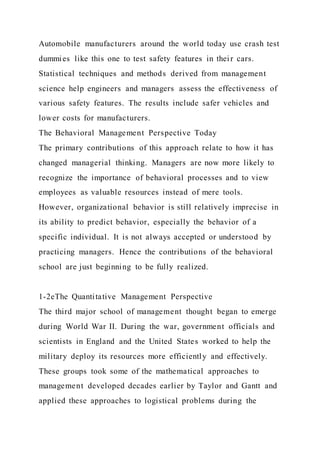
Automobile manufacturers around the world today use crash test
dummies like this one to test safety features in their cars.
Statistical techniques and methods derived from management
science help engineers and managers assess the effectiveness of
various safety features. The results include safer vehicles and
lower costs for manufacturers.
The Behavioral Management Perspective Today
The primary contributions of this approach relate to how it has
changed managerial thinking. Managers are now more likely to
recognize the importance of behavioral processes and to view
employees as valuable resources instead of mere tools.
However, organizational behavior is still relatively imprecise in
its ability to predict behavior, especially the behavior of a
specific individual. It is not always accepted or understood by
practicing managers. Hence the contributions of the behavioral
school are just beginning to be fully realized.
1-2eThe Quantitative Management Perspective
The third major school of management thought began to emerge
during World War II. During the war, government officials and
scientists in England and the United States worked to help the
military deploy its resources more efficiently and effectively.
These groups took some of the mathematical approaches to
management developed decades earlier by Taylor and Gantt and
applied these approaches to logistical problems during the
war. They learned that problems regarding troop, equipment,
and submarine deployment, for example, could all be solved
through mathematical analysis. After the war, companies such
as DuPont and General Electric began to use the same
techniques for deploying employees, choosing plant locations,
and planning warehouses. Basically, then, this perspective is
concerned with applying quantitative techniques to
management. More specifically, the quantitative management
perspective focuses on decision making, cost-effectiveness,
mathematical models, and the use of computers. There are two
branches of the quantitative approach: management science and
operations management.Management Science
Unfortunately, the term management science appears to be
related to scientific management, the approach developed by
Taylor and others early in the twentieth century. But the two
have little in common and should not be confused. Management
science focuses specifically on the development of
mathematical models. A mathematical model is a simplified
representation of a system, process, or relationship.
At its most basic level, management science focuses on models,
equations, and similar representations of reality. For example,
managers at Detroit Edison use mathematical models to
determine how best to route repair crews during blackouts.
Citizens Bank of New England uses models to figure out how
many tellers need to be on duty at each location at various times
throughout the day. In recent years, paralleling the advent of the
personal computer, management science techniques have
become increasingly sophisticated. For example, automobile
manufacturers Daimler AG and General Motors use realistic
computer simulations to study collision damage to cars. These
simulations help them lower costs by crashing actual test cars
only after multiple simulations.Operations Management
Operations management is somewhat less mathematical and
statistically sophisticated than management science, and it can
be applied more directly to managerial situations. Indeed, we
can think of operations management as a form of applied
management science. Operations management techniques are
generally concerned with helping the organization produce its
products or services more efficiently and can be applied to a
wide range of problems.
For example, Unilever and Home Depot, each uses operations
management techniques to manage its inventories. (Inventory
management is concerned with specific inventory problems,
such as balancing carrying costs and ordering costs and
determining the optimal order quantity.) Linear programming
(which involves computing simultaneous solutions to a set of
linear equations) helps United Airlines plan its flight schedules,
Consolidated Freightways develop its shipping routes, and
General Instrument Corporation plan what instruments to
produce at various times. Other operations management
techniques include queuing theory, break-even analysis, and
simulation. All these techniques and procedures apply directly
to operations, but they are also helpful in areas such as finance,
marketing, and human resource management.
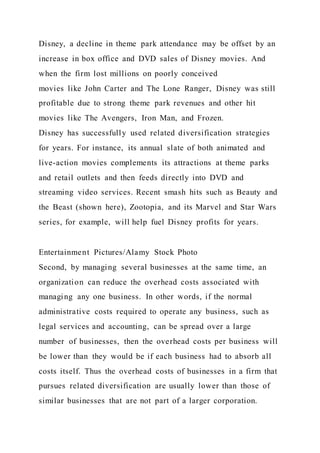
Disney is a master of synergy. The firm’s movies, theme park
attractions, and merchandise, for example, are all linked
together so that each enhances the others. For instance, the
Disney movie Frozen was widely promoted at Disney World and
Disneyland before the movie ever opened. And long after the
movie left theaters, people could still buy Frozen DVDs and
merchandise throughout all Disney retail outlets.
The Quantitative Management Perspective Today
Like the other management perspectives, the quantitative
management perspective has made important contributions and
has certain limitations. It has provided managers with an
abundance of decision-making tools and techniques and has
increased understanding of overall organizational processes.
This perspective has been particularly useful in the areas of
planning and controlling. Relatively new management concepts
such as supply chain management and new techniques such as
enterprise resource planning, both discussed later in this book,
also evolved from the quantitative management perspective.
Even more recently, mathematicians are using tools and
techniques from the quantitative perspective to develop models
that might be helpful in the war against terrorism. However,
mathematical models cannot fully account for individual
behaviors and attitudes. Some believe that the time needed to
develop competence in quantitative techniques retards the
development of other managerial skills. Finally, mathematical
models typically require a set of assumptions that may not be
realistic.1-3Contemporary Management Perspectives
It is important to recognize that the classical, behavioral, and
quantitative approaches to management are not necessarily
contradictory or mutually exclusive. Even though each of the
three perspectives makes very different assumptions and
predictions, each can also complement the others. Indeed, a
complete understanding of management requires an appreciation
of all three perspectives. The systems and contingency
perspectives can help us integrate these earlier approaches and
enlarge our understanding of all three.
1-3aThe Systems Perspective
The systems perspective is one important contemporary
management perspective. A system is an interrelated set of
elements functioning as a whole. As shown in Figure 1.4, by
viewing an organization as a system, we can identify four basic
elements: inputs, transformation processes, outputs, and
feedback. First, inputs are the material, human, financial, and
information resources that an organization gets from its
environment. Next, through technological and managerial
processes, inputs are transformed into outputs. Outputs include
products, services, or both (tangible and intangible); profits,
losses, or both (even not-for-profit organizations must operate
within their budgets); employee behaviors; and information.
Finally, the environment reacts to these outputs and provides
feedback to the system.
Figure 1.4The Systems Perspective of Organizations
By viewing organizations as systems, managers can better
understand the importance of their environment and the level of
interdependence among their organization’s subsystems.
Managers must also understand how their decisions affect and
are affected by the organization’s other subsystems.
Thinking of organizations as systems provides us with a variety
of important viewpoints on organizations, such as the concepts
of open systems, subsystems, synergy, and entropy. Open
systems are systems that interact with their environment,
whereas closed systems do not interact with their environment.
Although organizations are open systems, some make the
mistake of ignoring their environment and behaving as though it
is not important.
The systems perspective also stresses the importance
of subsystems—systems within a broader system. For example,
the marketing, production, and finance functions within Mattel
are systems in their own right but are also subsystems within
the overall organization. Because they are interdependent , a
change in one subsystem can affect other subsystems as well. If
the production department at Mattel lowers the quality of the
toys being made (by buying lower-quality materials, for
example), the effects are felt in finance (improved cash flow in
the short run owing to lower costs) and marketing (decreased
sales in the long run because of customer dissatisfaction).
Managers must therefore remember that although organizational
subsystems can be managed with some degree of autonomy,
their interdependence should not be overlooked. For instance,
recent research has underscored the interdependence of strategy
and operations in businesses.
Synergy suggests that organizational units (or subsystems) may
often be more successful working together than working alone.
The Walt Disney Company, for example, benefits greatly from
synergy. The company’s movies, theme parks, television
programs, and merchandise-licensing programs, all benefit one
another. Children who enjoy Disney movies like Finding
Dory and Frozen want to go to Disney World to see the
attractions and shows based on the movies and their favorite
characters; and when they shop at Target, they see and want to
buy stuffed toys and action figures of the same characters.
Music from the films generates additional revenues for the firm,
as do computer games and other licensing arrangements for
lunchboxes, clothing, and so forth. Synergy is an important
concept for managers because it emphasizes the importance of
working together in a cooperative and coordinated fashion.
Finally, entropy is a normal process that leads to system
decline. When an organization does not monitor feedback from
its environment and make appropriate adjustments, it may fail.
For example, witness the problems and eventual demise of
Blockbuster and Circuit City. Each of these organizations went
bankrupt because it failed to revitalize itself and keep pace with
changes in its environment. A primary objective of
management, from a systems perspective, is to continually
reenergize the organization to avoid entropy.
1-3bThe Contingency Perspective
Another noteworthy recent addition to management thinking is
the contingency perspective. The classical, behavioral, and
quantitative approaches are considered universal
perspectives because they try to identify the “one best way” to
manage organizations. The contingency perspective, in contrast,
suggests that universal theories cannot be applied to
organizations because each organization is unique. Instead, the
contingency perspective suggests that appropriate managerial
behavior in a given situation depends on, or is contingent on,
unique elements in that situation.
Stated differently, effective managerial behavior in one
situation cannot always be generalized to other situations.
Recall, for example, that Frederick Taylor assumed that all
workers would generate the highest possible level of output to
maximize their own personal economic gain. We can imagine
some people being motivated primarily by money—but we can
just as easily imagine other people being motivated by the
desire for leisure time, status, social acceptance, or any
combination of these (as Mayo found at the Hawthorne plant).
When Reed Hastings launched Netflix, he was intimately
involved with virtually every small decision made to get the
company up and running. But as the firm grew into a major
international business he has stepped back and taken on a more
strategic role. Hence, his management style and approach have
changed because the situation in which he manages has
changed.
1-3cContemporary Management Issues and Challenges
Interest in management theory and practice has heightened in
recent years as new issues and challenges have emerged. No
new paradigm has been formulated that replaces the traditional
views, but managers continue to strive toward a better
understanding of how they can better compete and lead their
organizations toward improved effectiveness.Contemporary
Applied Perspectives
Several applied authors have significant influence on modern
management theory and practice. Among the most popular
applied authors today are Peter Senge, Stephen Covey, Tom
Peters, Jim Collins, Michael Porter, John Kotter, and Gary
Hamel. Their books highlight the management practices of
successful firms such as Shell Oil, Ford, and IBM, or they
outline conceptual or theoretical models or frameworks to guide
managers as they formulate strategies or motivate their
employees. Malcolm Gladwell’s books The Tipping
Point, Blink, and Outliers have all caught the attention of many
contemporary managers. Scott Adams, creator of the popular
comic strip Dilbert, also remains popular today. Adams is a
former communications industry worker who developed his strip
to illustrate some of the absurdities that occasionally afflict
contemporary organizational life. The daily strip is routinely e-
mailed and posted outside office doors, above copy machines,
and beside water coolers in hundreds of offices.Contemporary
Management Challenges
Managers today also face an imposing set of challenges as they
guide and direct the fortunes of their companies. Coverage of
each of these challenges is thoroughly integrated throughout
this book. In addition, many of them are highlighted or given
focused coverage in one or more special ways.
One significant challenge (and opportunity) is globalization.
Managing in a global economy poses many different challenges
and opportunities. For example, at a macro level, property
ownership arrangements vary widely. So does the availability of
natural resources and infrastructure components, as well as
government’s role in business. Moreover, behavioral processes
vary widely across cultural and national boundaries. For
example, values, symbols, and beliefs differ sharply among
cultures. Different work norms and the role that work plays in a
person’s life, for example, influence patterns of both work-
related behavior and attitudes toward work. They also affect the
nature of supervisory relationships, decision-making styles and
processes, and organizational configurations. Group and
intergroup processes, responses to stress, and the nature of
political behaviors also differ from culture to culture.
Another management challenge that has taken on renewed
importance is ethics and social responsibility and their
relationship to corporate governance. Unfortunately, business
scandals involving unethical conduct have become almost
commonplace today. For example, the effects of Allen
Stanford’s alleged $7 billion Ponzi scheme ruined the financial
futures of thousands of people. From a social responsibility
perspective, increasing attention has been focused on pollution
and business’s obligation to help clean up our environment,
business contributions to social causes, and so forth. The proper
framework for corporate governance is often at the center of
these debates and discussions.
Quality also continues to pose an important management
challenge today. Quality is an important issue for several
reasons. First, more and more organizations are using quality as
a basis for competition. Lexus, for example, stresses its high
rankings in the J. D. Power survey of customer satisfaction in
its print advertising. Second, improving quality tends to
increase productivity because making higher-quality products
generally results in less waste and rework. Third, enhancing
quality lowers costs. Managers at Whistler Corporation once
realized that the firm was using 100 of its 250 employees to
repair defective radar detectors that had been built incorrectly
in the first place.
The shift toward a service economy also continues to be
important. Traditionally, most U.S. businesses were
manufacturers—using tangible resources like raw materials and
machinery to create tangible products like automobiles and
steel. And manufacturing is indeed still important in the U.S.
economy. In the last few decades, however, the service sector of
the economy has become much more important. Although there
are obviously many similarities between managing in a
manufacturing organization and managing in a service
organization, there are also many fundamental differences.
The economic recession of 2008–2010 and slow recovery in
2011–2017 have also created myriad challenges, as well as some
opportunities, for managers. Most businesses struggled, and
some failed to survive. But some managers also used this period
as a framework for reducing their costs, streamlining their
operating systems and procedures, and fine-tuning their
business strategies. As the economy slowly began to rebound in
2015, firms like Ford, Target, and Delia seemed to be well
positioned for new growth and cautiously began hiring new
employees.
A related challenge for managers is the rapidly changing
workplace. Indeed, this new workplace is accompanied by both
dramatic challenges and amazing opportunities. Among other
things, workplace changes relate in part to both workforce
reductions and expansion. For example, many firms hired large
numbers of new workers during the economic expansion that
was taking place between 2002 and early 2008. But as the
recession of 2008–2010 took hold, many of those same firms
had to reduce their workforces, while others cut hours and pay
and suspended all hiring until conditions showed signs of
improvement. But even more central to the idea of workplace
change are developments such as workforce diversity and the
characteristics of new workers themselves.
The management of diversity continues to be an important
organizational opportunity—and challenge—today. The
term diversity refers to differences among people. Diversity
may be reflected along numerous dimensions, but most
managers tend to focus on age, gender, ethnicity, and physical
abilities and disabilities. For example, the average age of
workers in the United States is gradually increasing. An
increasing number of women have also entered the U.S.
workforce. Fifty years ago, only about one-third of U.S. women
worked outside their homes; today, 60 percent of women aged
16 and older are in the workforce. The ethnic composition of
the workplace is also changing.
Aside from its demographic composition, the workforce today is
changing in other ways. During the 1980s, many people entering
the workforce came to be called yuppies, slang for young urban
professionals. These individuals were highly motivated by
career prospects, sought employment with big corporations, and
often were willing to make work their highest priority. Thus,
they put in long hours and could be expected to remain loyal to
the company, regardless of what happened.
But younger people entering the workforce over the past 20–30
years are frequently quite different from their parents and other
older workers. Generation X, Generation Y, and the Millennials,
as these groups are called, tend to be less devoted to long-term
career prospects and less willing to adapt to a corporate mind-
set that stresses conformity and uniformity. Instead, they often
seek work in smaller, more entrepreneurial firms that allow
flexibility and individuality. They also place a premium on
lifestyle preferences, often putting location high on their list of
priorities when selecting an employer.
Thus, managers are increasingly faced with the challenge of,
first, creating an environment that will be attractive to today’s
worker; and, second, addressing the challenge of providing
new and different incentives to keep people motivated and
interested in their work. They must build enough flexibility into
the organization to accommodate an ever-changing set of
lifestyles and preferences. And, of course, as these generations
eventually move into top spots of major corporations, there may
even be entirely new paradigms for managing that cannot be
foreseen today.
Managers must also be prepared to address organization
change. This has always been a concern, but the rapid, constant
environmental change faced by businesses today has made
change management even more critical. Simply put, an
organization that fails to monitor its environment and to change
to keep pace with that environment is doomed to failure. But
more and more managers are seeing change as an opportunity,
not a cause for alarm. Indeed, some managers think that if
things get too calm in an organization and people start to
become complacent, they should shake things up to get
everyone energized.
New technology, especially as it relates to information, also
poses an increasingly important challenge for managers.
Communications advances such as smartphones and other
wireless communication networks have made it easier than ever
for managers to communicate with one another. Social media
has also quickly established itself as a major force in all walks
of contemporary life. At the same time, these innovations have
increased the work pace for managers, cut into their time for
thoughtful contemplation of decisions, and increased the amount
of information they must process. Issues associated with
employee privacy have also emerged. For instance,
controversies have arisen when businesses take action against
people for things they do in their personal lives—posting
negative comments about their employer on Facebook, for
example.Chapter ReviewSummary of Learning Outcomes and
Key Points
· 1Define management, describe the kinds of managers found in
organizations, identify and explain the four basic management
functions, describe the fundamental management skills, and
comment on management as a science and art.
· •
Management is a set of activities (planning and decision
making, organizing, leading, and controlling) directed at using
an organization’s resources (human, financial, physical, and
information) to achieve organizational goals in an efficient and
effective manner.
· •
A manager is someone whose primary responsibility is to carry
out the management process within an organization.
· •
Managers can be classified by level: top managers, middle
managers, and first-line managers.
· •
Managers can also be classified by area: marketing, finances,
operations, human resources, administration, and specialized.
· •
The basic activities of the management process include planning
and decision making (determining courses of action), organizing
(coordinating activities and resources), leading (motivating and
managing people), and controlling (monitoring and evaluating
activities).
· •
Effective managers also tend to have the following skills:
technical, interpersonal, conceptual, diagnostic, communication,
decision making, and time management.
· •
The effective practice of management requires a synthesis of
science and art: a blend of rational objectivity and intuitive
insight.
· 2Justify the importance of history and theory to managers, and
explain the evolution of management thought through the
classical, behavioral, and quantitative perspectives.
· •
Understanding the historical context and precursors of
management and organizations provides a sense of heritage and
can also help managers avoid repeating the mistakes of others.
· •
The classical management perspective, which paid little
attention to the role of workers, had two major branches:
scientific management (concerned with improving efficiency
and work methods for individual workers) and administrative
management (concerned with how organizations themselves
should be structured and arranged for efficient operations).
· •
The behavioral management perspective, characterized by a
concern for individual and group behavior, emerged primarily
as a result of the Hawthorne studies. The human relations
movement recognized the importance and potential of
behavioral processes in organizations but made many overly
simplistic assumptions about those processes. Organizational
behavior, a more realistic outgrowth of the behavioral
perspective, is of interest to many contemporary managers.
· •
The quantitative management perspective, which attempts to
apply quantitative techniques to decision making and problem
solving, has two components: management science and
operations management. These areas are also of considerable
importance to contemporary managers. Their contributions have
been facilitated by the tremendous increase in the use of
personal computers and integrated information networks.
· 3Identify and discuss key contemporary management
perspectives represented by the systems and contingency
perspectives, and identify the major challenges and
opportunities faced by managers today.
· •
There are two relatively recent additions to management theory
that can serve as frameworks for integrating the other
perspectives: the systems perspective and the contingency
perspective.
· •
The important issues and challenges that contemporary
managers face include globalization, ethics and social
responsibility, product and service quality, the service
economy, the economic recession of 2008–2010, the new
workplace, workforce diversity, organization change, and
technology.
Chapter ReviewDiscussion QuestionsQuestions for Review
1. What are the three basic levels of management that can be
identified in most organizations? How precise are the lines
differentiating these levels? In which of the basic areas do
managers work?
2. What are the four basic functions that make up the
management process? How are they related to one another?
3. Identify several of the important skills that help managers
succeed. Give an example of each. How might the importance of
different skills vary by level and area within an organization?
4. Briefly describe the principles of scientific management and
administrative management. What assumptions do these
perspectives make about workers? To what extent are these
assumptions still valid today?
5. Describe the systems perspective. Why is a business
organization considered an open system?
Chapter ReviewExperiential ExerciseJohari Window
Purpose: This exercise has two purposes: to encourage you to
analyze yourself more accurately and to start you working on
small-group cohesiveness. This exercise encourages you to
share data about yourself and then to assimilate and process
feedback. Small groups are typically more trusting and work
better together, as you will be able to see after this exercise has
been completed. The Johari Window is a particularly good
model for understanding the perceptual process in interpersonal
relationships.
This skill builder focuses on the human resources model and
will help you develop your mentor role. One of the skills of a
mentor is self-awareness.
Introduction: Each individual has four sets of personality
characteristics. One set, which includes such characteristics as
working hard, is well known to the individual and to others. A
second set is unknown to the individual but obvious to others.
For example, in a working situation, a peer group might observe
that your jumping in to move the group off dead center is
appropriate. At other times, you jump in when the group is not
really finished, and you seem to interrupt. A third set of
personality characteristics is known to the individual but not to
others. These are situations that you have elected not to share,
perhaps because of a lack of trust. Finally, there is a fourth set,
which is not known to the individual or to others, such as why
you are uncomfortable at office parties.
Instructions: Look at the Johari Window. In quadrant 1, list
three things that you know about yourself and that you think
others know. List three things in quadrant 3 that others do not
know about you. Finally, in quadrant 2, list three things that
you did not know about yourself last semester that you learned
from others.
Source: Adapted from Joseph Luft, Group Processes: An
Introduction to Group Dynamics (Palo Alto, CA: Mayfield,
1970), pp. 10–11; and William C. Morris and Marshall
Sashkin, Organizational Behavior in Action (St. Paul, MN:
West, 1976), p. 56.Chapter ReviewBuilding Effective Time
Management SkillsExercise Overview
Time management skills refer to the ability to prioritize tasks,
to work efficiently, and to delegate appropriately. This exercise
allows you to assess your own current time management skill s
and to gather some suggestions for how you can improve in this
area.
Exercise Background
As we saw in this chapter, effective managers must be prepared
to switch back and forth among the four basic activities in the
management process. They must also be able to fulfill a number
of different roles in their organizations, and they must exercise
various managerial skills in doing so. On top of everything else,
their schedules are busy and full of tasks—personal and job-
related activities that require them to “switch gears” frequently
throughout the workday.
Stephen Covey, a management consultant and the author of The
7 Habits of Highly Effective People, has developed a system for
prioritizing tasks. First, he divides them into two categories —
urgent and critical. Urgent tasks, such as those with
approaching deadlines, must be performed right
away. Critical tasks are tasks of high importance —say, those
that will affect significant areas of one’s life or work. Next,
Covey plots both types of tasks on a grid with four quadrants: A
task may be urgent, critical, urgent and critical, or not urgent
and not critical.
Most managers, says Covey, spend too much time on tasks that
are urgent when in fact they should be focused on tasks that
are critical. He observes, for example, that managers who
concentrate on urgent tasks meet their deadlines but tend to
neglect critical areas such as long-term planning.
(Unfortunately, the same people are also prone to neglect
critical areas of their personal lives.) In short, effective
managers must learn to balance the demands of urgent tasks
with those of critical tasks by redistributing the amount of time
devoted to each type.Exercise Task
1. Visit one of the websites of Franklin Covey (the firm
cofounded by Stephen Covey) and locate a time management
survey. If you cannot locate one associated with Franklin
Covey, there are many others available through a quick Internet
search. Complete a survey that will provide you with a time
management score.
2. Now spend some time interpreting your score, examine the
assessment of your current use of time and the suggestions for
how you can improve your time management. In what ways do
you agree and disagree with your personal assessment? Explain
your reasons for agreeing or disagreeing.
3. Think of a task that you regularly perform and that, if you
were being perfectly honest, you could label not urgent and not
critical. How much time do you spend on this task? What might
be a more appropriate amount of time? To what other tasks
could you give some of the time that you spend on this not
urgent and not critical task?
4. What one thing can you do today to make better use of your
time? Try it to see if your time management improves.Chapter
ReviewManagement at WorkSome Keys to Making a Steinway
Everybody knows what a grand piano looks like, although it’s
hard to describe its contour as anything other than “piano
shaped.” From a bird’s-eye view, you might recognize
something like a great big holster. The case—the curved lateral
surface that runs around the whole instrument—appears to be a
single continuous piece of wood, but it isn’t really. If you look
carefully at the case of a piano built by Steinway & Sons, you’ll
see that you’re actually looking at a remarkable composite of
raw material, craftsmanship, and technology. The process by
which this component is made—like most of the processes for
making a Steinway grand—is a prime example of a technical,
or task, subsystem at work in a highly specialized factory.
The case starts out as a rim, which is constructed out of separate
slats of wood, mostly maple (eastern rock maple, to be precise).
Once raw boards have been cut and planed, they’re glued along
their lengthwise edges to the width of inches. These composite
pieces are then jointed and glued end to end to form slats 22
feet long—the measure of the piano’s perimeter. Next, a total of
18 separate slats—14 layers of maple and 4 layers of other types
of wood—are glued and stacked together to form a book—one
(seemingly) continuous “board” inches thick. Then comes the
process that’s a favorite of visitors on the Steinway factory
tour—bending this rim into the shape of a piano. Steinway does
it pretty much the same way that it has for more than a
century—by hand and all at once. Because the special glue is in
the process of drying, a crew of six has just 20 minutes to
wrestle the book, with block and tackle and wooden levers and
mallets, into a rim-bending press—”a giant piano-shaped vise,”
as Steinway describes it—which will force the wood to “forget”
its natural inclination to be straight and assume the familiar
contour of a grand piano.
Visitors report the sound of splintering wood, but Steinway
artisans assure them that the specially cured wood isn’t likely to
break or the specially mixed glue to lose its grip. It’s a good
thing, too, both because the wood is expensive and because the
precision Steinway process can’t afford much wasted effort. The
company needs 12 months, 12,000 parts, 450 craftspeople, and
countless hours of skilled labor to produce a grand piano.
Today, the New York factory turns out about 10 pianos in a day
or 2,500 a year. (A mass producer might build 2,000 pianos a
week.) The result of this painstaking task system, according to
one business journalist with a good ear, is “both impossi bly
perfect instruments and a scarcity,” and that’s why Steinways
are so expensive—currently, somewhere between $45,000 and
$110,000.
But Steinway pianos, the company reminds potential buyers,
have always been “built to a standard, not to a price.” “It’s a
product,” says company executive Leo F. Spellman, “that in
some sense speaks to people and will have a legacy long after
we’re gone. What [Steinway] craftsmen work on today will be
here for another 50 or 100 years.” Approximately 90 percent of
all concert pianists prefer the sound of a Steinway, and the
company’s attention to manufacturing detail reflects the fact
that when a piano is being played, the entire instrument
vibrates—and thus affects its sound. In other words—and not
surprisingly—the better the raw materials, design, and
construction, the better the sound.
That’s one of the reasons Steinway craftsmen put so much care
into the construction of the piano’s case: It’s a major factor in
the way the body of the instrument resonates. The maple wood
for the case, for example, arrives at the factory with water
content of 80 percent. It’s then dried, both in the open air and in
kilns, until the water content is reduced to about 10 percent—
suitable for both strength and pliability. To ensure that strength
and pliability remain stable, the slats must be cut so that they’re
horizontally grained and arranged, with the “inside” of one
slat—the side that grew toward the center of the tree—facing
the “outside” of the next one in the book. The case is removed
from the press after one day and then stored for ten weeks in a
humidity-controlled rim-bending room. Afterward, it’s ready to
be sawed, planed, and sanded to specification—a process
called frazing. A black lacquer finish is added, and only then is
the case ready to be installed as a component of a grand piano
in progress.
The Steinway process also puts a premium on skilled workers.
Steinway has always been an employer of immigrant labor,
beginning with the German craftsmen and laborers hired by
founder Henry Steinway in the 1860s and 1870s. Today,
Steinway employees come from much different places—Haitians
and Dominicans in the 1980s, exiles from war-torn Yugoslavia
in the 1990s—and it still takes time to train them. It takes about
a year, for instance, to train a case maker, and “when you lose
one of them for a long period of time,” says Gino Romano, a
senior supervisor hired in 1964, “it has a serious effect on our
output.” Romano recalls one year in mid-June when a case
maker was injured in a car accident and was out for several
weeks. His department fell behind schedule, and it was
September before Romano could find a suitable replacement (an
experienced case maker in Florida who happened to be a
relative of another Steinway worker).
The company’s employees don’t necessarily share Spellman’s
sense of the company’s legacy, but many of them are well aware
of the brand recognition commanded by the products they craft,
according to Romano:
The payback is not in [the factory]. The payback is outside,
when you get the celebrity treatment for building a Steinway,
when you meet somebody for the first time and they ooh and
ahh: “You build Steinways? Wow.” You’re automatically put on
a higher level, and you go, “I didn’t realize I was that
notable.”Case Questions
1. Explain the process by which a Steinway grand piano is
constructed as a subsystem of a larger system. From what the
text tells you, give some examples of how the production
subsystem is affected by the management, financial, and
marketing subsystems.
2. Discuss the Steinway process in terms of the systems
perspective of organizations summarized in Figure 1.4. Explain
the role of each of the three elements highlighted by the
figure—inputs from the environment, the transformation
process, and outputs into the environment.
3. Discuss some of the ways the principles of behavioral
management and operations management can throw light on the
Steinway process. How about the contingency perspective? In
what ways does the Steinway process reflect a universal
perspective, and in what ways does it reflect a contingency
perspective?Case References
· Steinway & Sons, “The Steinway Restoration
Center,” www.steinway.com, accessed on January 3, 2017;
WGBH (Boston), “Note by Note: The Making of Steinway
L1037,” www.wgbh.org, accessed on January 3, 2017; Maya
Roney, “Steinway: Worth Much More than a
Song,” BusinessWeek, www.businessweek.com, accessed on
January 3, 2017; James Barron, “88 Keys, Many Languages,
One Proud Name,” New York Times, www.nytimes.com,
accessed on January 3, 2017; Michael Lenehen, “K 2571: The
Making of a Steinway Grand,” Atlantic Monthly, August
1982, www.sherwinbeach.com, accessed on January 3, 2017;
and Rick Rogers, “Steinway Builds a Legacy with Distinctive
Pianos,” Daily Oklahoman (Oklahoma
City), www.richardhuggins.com, accessed on January 3,
2017.Chapter ReviewYou Make the Call: Reed Hastings Doesn’t
like Standing Still
1. You’re a Netflix employee, and Reed Hastings has just
stopped by your desk. “I’d like to know,” he says, “what you
like most and least about working here.” How do you think you
might respond?
2. You’re a major Netflix stockholder attending the firm’s
annual board meeting. When you bump into Reed Hastings at a
reception, he asks you, “How do you think we’re doing with this
company?” How would you respond?
3. You’re the founder and owner of a small media company, and
Netflix has indicated an interest in buying your business. Reed
Hastings wants you to stay on and run the business as a unit of
Netflix. In addition to price, what other factors (if any) are
important to you?
4. You’ve been contacted by a marketing research company
doing work for Netflix. The researcher asks if you use Netflix
and, if not, why? If you do use Netflix, the researcher asks what
you like and dislike most about it. What would you say?
· Chapter 2 Introduction
· 2-1The Organization’s Environments
· 2-1aThe General Environment
· 2-1bThe Task Environment
· 2-1cThe Internal Environment
· 2-2The Ethical and Social Environment of Management
· 2-2aIndividual Ethics in Organizations
· 2-2bEmerging Ethical Issues
· 2-2cSocial Responsibility in Organizations
· 2-2dManaging Social Responsibility
· 2-3The International Environment of Management
· 2-3aTrends in International Business
· 2-3bLevels of International Business Activity
· 2-3cThe Context of International Business
· 2-4The Organization’s Culture
· 2-4aThe Importance of Organizational Culture
· 2-4bDeterminants of Organizational Culture
· 2-4cManaging Organizational Culture
· Chapter Review
· Summary of Learning Outcomes and Key Points
· Discussion Questions
· Experiential Exercise
· Building Effective Communication Skills
· Management at Work
· You Make the Call: The Canary in Starbucks’ Coal Mine
Chapter IntroductionLearning Outcomes
After studying this chapter, you should be able to:
· 1Discuss the nature of an organization’s environments and
identify the components of its general, task, and internal
environments.
· 2Describe the ethical and social environment of management,
including individual ethics, the concept of social responsibility,
and how organizations can manage social responsibility.
· 3Discuss the international environment of management,
including trends in international business, levels of
international business activities, and the context of international
business.
· 4Describe the importance and determinants of an
organization’s culture, as well as how organizational culture can
be managed.Management in ActionThe Canary in Starbucks’
Coal Mine
“If the only reason you’re invested in sustainability is because
it’s the ‘right thing to do,’ you’re in trouble.”
—Jim Hanna, director of environmental affairs, Starbucks
According to Starbucks VP of Global Responsibility Ben
Packard, the company’s efforts to establish itself as a leading
sustainable brand start with part of its mission: “We aim to take
care of the communities that we depend on for our retail
business by … finding meaningful ways to be engaged with
those communities,” says Packard. “And we aim to take care of
those communities where we source our core products, like
coffee, tea, and cocoa.” It’s a matter of “nurturing the human
spirit,” explains Packard, who adds that incorporating that value
into the firm’s culture has allowed Starbucks to set and meet
“very bold standards” in sustainability.
Starbucks sells hot and cold beverages out of more than 23,000
stores in 64 countries, and those stores account for about 80
percent of the company’s carbon footprint—the total of its
greenhouse gas emissions (primarily carbon dioxide). In order
to reduce its footprint, Starbucks has set a series of realistic
goals to be met by 2020, including the widespread recycling of
the disposable cups that it hands out with almost every beverage
sold—about 4 billion per year. Actually, those cups constitute
only a miniscule fraction of Starbucks’ carbon footprint, but
according to Jim Hanna, the company’s director of
environmental affairs, “perception is reality” when it comes to
disposable cups: What most people see is the litter strewn about
the streets or tumbling out of overflowing trash cans.
Starbucks is dedicated to sustainability as a fundamental part of
its business practices but also believes that these practices
should have visibility in order to build goodwill among
customers and employees. This Starbucks shop in Chicago is
built from recycled shipping containers.
Before we go any further, we should point out that although
Starbucks has incorporated sustainability practices into its
operations since 1990, it hasn’t always been as sensitive to
environmental issues as some people would like. If you were a
regular at Starbucks before 2008, you might have noticed a sink
called a “dipper well.” Baristas used it to quick-rinse
equipment, and the water was kept running to ensure that pipes
stayed clean. Unfortunately, leaving the water running in 10,000
stores worldwide used up more than 6 million gallons of water
per day—enough to fill an Olympic-size swimming pool every
83 minutes. The company had been warned that the dipper-well
system wasn’t good for its environmental reputation, but only
after a blitz of bad PR in the global press did Starbucks finally
turn off the water. Today, says Ben Packard, “we look at water
on the supply side of coffee”—as a resource to be protected—
and Starbucks has plans to cut in-store water consumption by 25
percent.
That goal is part of the company’s Shared Planet Program,
which was launched in 2008. A year later, Starbucks announced
that, as part of the same initiative, all of its new stores would
satisfy certification requirements for LEED (Leadership in
Energy & Environmental Design), a rating system for the
construction and operation of environment-friendly buildings.
Because the guidelines were developed for office buildings,
Starbucks helped to create programs for both new and renovated
retail spaces, and 75 percent of all Starbucks locations opening
in 2014 attained LEED certification. “My dream,” says Hanna,
“is that we solve the cup issue and a customer walks into a store
and says, ‘Look at that ultra-efficient air conditioning unit.’ “
By 2020, Starbucks also plans to “ethically source” 100 percent
of the coffee that it buys from producers. Over the past 40
years, Starbucks has invested more than $70 million in
programs to support sustainable and socially sound agricultural
practices among the roughly 1 million people—most of them in
Latin America—who represent its coffee supply chain.
Programs include loans to help farmers develop not only
sustainable growing practices but forest-conservation practices
as well.
Since 2008, Starbucks has partnered with Conservation
International (CI), a U.S.-based nonprofit environmental
organization, to implement C.A.F.E. (Coffee and Farmer
Equity) practices—a set of independently developed guidelines
for monitoring the economic, social, and environmental impact
of coffee-production programs and practices. By 2012, 98
percent of the small coffee farms operating according to
Starbucks-promoted C.A.F.E. practices had managed to improve
soil fertility, and 100 percent of the school-age children on
those farms were able to attend school.
CI chairman and CEO Peter Seligmann points out that
Starbucks’ sustainability efforts are motivated in large part by
the need to deal with a major issue in the company’s
environment, both business and natural: namely, climate
change—”figuring out how to ensure that coffee farming can be
a part of the climate solution,” as Ben Packard puts it. “The
convergence of climate change and ecosystem deterioration,”
explains Seligmann, “is what creates stress on the ability of
coffee farmers to produce crops.” The coffee bean grows only in
specific climates, and those climates are particularly vulnerable
to rising global temperatures. Thus if Starbucks intends to
survive over the long term, it makes good business sense to
ensure that it has access to its most important ingredient.
“We’re the canary in the coal mine,” quips Jim Hanna, likening
the fate of the first victim of unbreathable air to the company’s
potential fate as one of the first victims of climate change.
Starbucks, then, sees sustainability as a matter of business
survival, and if business isn’t the operative word, at least it’s at
the top of the list. “If the only reason you’re invested in
sustainability is because it’s the ‘right thing to do,’ ” says
Hanna, “you’re in trouble.” A business enterprise needs to see
some return on investment, and as Clarice Turner, VP of
Starbucks of U.S. business, puts it, that return “can manifest
itself in many ways.” Front-of-store recycling, for example,
saves thousands of dollars annually in trash-hauling costs.” Of
course, says Turner, working to reduce the company’s
environmental impact “is the right thing to do,” but she hastens
to add that highly visible sustainability efforts also “put a halo
on your brand and business, which is very real to both
consumers and employees. If done right, those efforts have a
tangible bottom-line impact.”
Organizations exist for a variety of reasons. Some, like
Starbucks, pursue profits. Others exist to serve the public good.
But regardless of its purpose or mission, any organization must
be properly aligned with its environment if it is to be effective.
Of course, there are disparate views on how this alignment
should be achieved and how an organization can legitimately
pursue and then use revenues or profits. Some companies
aggressively seek to maximize their profits, grow at any cost,
and focus on nothing but what is best for the company. Others
take a much different approach to business and actively work
for the betterment of society, even when it means less profit for
the owners. Clearly, then, the environmental context of business
today is changing in unprecedented—and often unpredictable—
ways.2-1The Organization’s Environments
The external environment is everything outside an
organization’s boundaries that might affect it. It is actually
most helpful, though, to talk about two separate external
environments: the general environment and the task
environment. An organization’s internal environment consists of
conditions and forces within the organization.
2-1aThe General Environment
Each of the following dimensions embodies conditions and
events that have the potential to influence the organization in
significant ways.The Economic Dimension
The economic dimension of an organization’s general
environment is the overall health and vitality of the economic
system in which the organization operates. Particularly
important economic factors for business are general economic
growth, inflation, interest rates, and unemployment. After
several strong years of growth, the U.S. economy fell into
recession during 2008 and only began to recover from it in
2012. During this period, energy and related prices jumped,
business and economic growth slowed dramatically, and
unemployment mushroomed as one struggling business after
another made workforce cuts. As the economy began to recover
in 2013, though, prices stabilized, businesses began to grow
again, and unemployment began to decline as companies again
started to hire new employees.
Consider how these factors affect an organization like
McDonald’s. When unemployment is low, McDonald’s may
have difficulty hiring new employees because higher paying
full-time jobs are available elsewhere. But at the same time
more people may be eating at McDonald’s because of its low
prices. Similarly, low inflation means that the prices
McDonald’s must pay for its supplies remain relatively
constant, but it also is somewhat constrained from increasing
the prices it charges consumers for a hamburger or milkshake.
The economic dimension is also important to nonbusiness
organizations. For example, during weak economic conditions,
funding for state universities may drop, and charitable
organizations such as the Salvation Army are asked to provide
greater assistance at the same time that their incoming
contributions dwindle. Similarly, hospitals are affected by the
number of uninsured patients who come to their emergency
rooms for treatment.The Technological Dimension
The technological dimension of the general environment is
made up of the methods available for converting resources into
products or services. Although technology is applied within the
organization, the forms and availability of that technology come
from the general environment. Computer-assisted manufacturing
and design techniques, for example, allowed Boeing to simulate
the more than three miles of hydraulic tubing that runs through
its 787 aircraft. The results include decreased warehouse needs,
higher-quality tube fittings, lower labor costs, and major time
savings. Although some people associate technology with
manufacturing firms, it is also relevant in the service sector. For
example, just as an automobile follows a predetermined path
along an assembly line as it is built, a hamburger at McDonald’s
follows a predefined path as the meat is cooked, the burger
assembled, and the finished product wrapped and bagged for a
customer. The rapid infusion of web-based technologies into all
areas of business also reflects the technological dimension.
Another recent advancement is the rapid growth of integrated
business software systems. Relatively new approaches to
communication, ranging from social media to hardware, are also
influencing businesses in many different ways.
Most people associate the word “technology” with “tangible”
products such as airplanes, smartphones, and so forth. But
technology also applies to service organizations as well. Take
this food service operation, for instance. Workers are preparing
and serving food using assembly-line technology pioneered in
the manufacturing sector.
The Political–Legal Dimension
The political–legal dimension of the general environment
consists of government regulation of business and the
relationship between business and government. This dimension
is important for three basic reasons. First, the legal system
partially defines what an organization can and cannot do.
Although the United States is basically a free-market economy,
major regulation of business activity still exits. McDonald’s, for
example, is subject to a variety of political and legal forces,
including food preparation standards and local zoning
requirements.
Second, pro- or anti-business sentiment in government
influences business activity. For example, during periods of
pro-business sentiment, firms find it easier to compete and have
fewer concerns about antitrust issues. On the other hand, during
a period of anti-business sentiment, firms may find their
competitive strategies more restricted and have fewer
opportunities for mergers and acquisitions because of antitrust
concerns. During the prolonged period of economic growth that
ended in 2008, the U.S. government adopted a very “hands-off”
approach to business, letting market forces determine business
successes and failures. However, as the economy ground to a
halt in 2008 and first one and then another industry began to
stumble, critics began to point to lack of regulation and
oversight as contributing factors. As a result, lawmakers began
to take a much more pronounced interest in adopting new and
stricter regulations for business.
Finally, political stability has ramifications for planning. No
business wants to set up shop in another country unless trade
relationships with that country are relatively well defined and
stable. Hence, U.S. firms are more likely to do business in
Germany, Mexico, and Canada than in Syria and Afghanistan.
Similar issues are relevant to assessments of local and state
governments. A new city council or governor can affect many
organizations, especially small firms that do business in only
one location and are susceptible to deed and zoning restrictions,
property and school taxes, and the like.
McDonald’s has historically competed with other hamburger
chains such as Burger King and Wendy’s. Recently, though, it
has also taken on Starbucks with its line of McCafe premium
coffee products and its more casual and comfortable in-store
seating areas.
2-1bThe Task Environment
Because the general environment’s impact is often vague,
imprecise, and long term, most organizations tend to focus
attention on their task environment, which includes competitors,
customers, suppliers, strategic partners, and regulators.
Although the task environment is also quite complex, it
provides useful information more readily than the general
environment, because the manager can identify environmental
factors of specific interest to the organization, rather than deal
with the more abstract dimensions of the general
environment.Figure 2.1 illustrates the task environment of
McDonald’s.
Figure 2.1McDonald’s Task Environment
An organization’s task environment includes its competitors,
customers, suppliers, strategic partners, and regulators. This
figure clearly highlights how managers at McDonald’s can use
this framework to identify and understand their key
constituents.
© CengageCompetitors
An organization’s competitors are other organizations that
compete with it for resources. The most obvious resources that
competitors vie for are customer dollars. Nike and Under
Armour are competitors, as are Albertson’s, Safeway, and
Kroger. McDonald’s competes with other fast-food operations,
such as Burger King, Wendy’s, Subway, and Dairy Queen; it
has also taken on Starbucks with its McCafe line of premium
coffee products. But competition also occurs between substitute
products. Thus Ford competes with Yamaha (motorcycles),
Schwinn (bicycles), and various public transportation systems
for your transportation dollars; and Walt Disney World,
Carnival Cruise Lines, and the National Park system compete
for your vacation dollars. Nor is competition limited to business
firms. Universities compete with trade schools, the military,
other universities, and the external labor market to attract good
students; and art galleries compete with one another to attract
the best collections and exhibits.Customers
A second dimension of the task environment is customers or
whoever pays money to acquire an organization’s products or
services. Most McDonald’s customers are individuals who buy
food. But customers need not be individuals. Schools, hospitals,
government agencies, wholesalers, retailers, and manufacturers
are just a few of the many kinds of organizations that may be
major customers of other organizations. Some institutional
customers, such as schools, prisons, and hospitals, also buy
food in bulk from restaurants such as McDonald’s.Supplier
Suppliers are organizations that provide resources for other
organizations. McDonald’s buys soft-drink products from Coca-
Cola; individually packaged servings of salt, pepper, and
ketchup from various suppliers; Big Mac ingredients from
wholesale food processors; and napkins, sacks, and sandwich
wrappers from packaging manufacturers. Besides material
resources such as these, businesses also rely on suppliers for
information (such as economic statistics), labor (in the form of
employment agencies), and capital (from lenders such as banks).
Some businesses strive to avoid depending exclusively on
particular suppliers. Others, however, find it beneficial to create
strong relationships with single suppliers.
Organizations can serve a variety of different kinds of
customers. For example, customers can be individuals, the
government, or other businesses. This pizza deliveryman, for
example, is dropping off pizzas for the staff of a hospital
emergency room.
J.P. MOCZULSKI/AFP/NewscomRegulators
Regulators are elements of the task environment that have the
potential to control, legislate, or otherwise influence an
organization’s policies and practices. There are two important
kinds of regulators. Regulatory agencies are created by the
government to protect the public from certain business practices
or to protect organizations from one another. Powerful federal
regulatory agencies include the Environmental Protection
Agency (EPA), the Securities and Exchange Commission (SEC),
the Food and Drug Administration (FDA), and the Equal
Employment Opportunity Commission (EEOC). Many of these
agencies play important roles in protecting the rights of
individuals. The FDA, for example, helps ensure that the food is
free from contaminants; thus it is an important regulator for
McDonald’s and Starbucks. There are also numerous state,
regional, and local regulatory agencies that also affect
businesses. Perhaps not surprisingly, some managers complain
that there is too much government regulation. Most large
companies must dedicate thousands of labor hours and hundreds
of thousands of dollars a year to comply with government
regulations. To complicate managers’ lives even more, different
regulatory agencies sometimes provide inconsistent—and even
contradictory—mandates.
The other basic form of regulator is the interest group.
Prominent interest groups include Mothers Against Drunk
Driving (MADD), the National Rifle Association (NRA), the
League of Women Voters, the Sierra Club, Ralph Nader’s
Center for the Study of Responsive Law, Consumers Union, and
industry self-regulation groups such as the Council of Better
Business Bureaus. Although interest groups lack the official
power of government agencies, they can exert considerable
influence by using the media to call attention to their positions.
MADD, for example, puts considerable pressure on alcoholic-
beverage producers (to put warning labels on their products),
automobile companies (to make it more difficult for intoxicated
people to start their cars), local governments (to stiffen drinking
ordinances), and bars and restaurants (to refuse to sell alcohol
to people who are drinking too much).Strategic Partners
Another dimension of the task environment is strategic
partners (also called strategic allies)—two or more companies
that work together in joint ventures or other partnerships. As
shown in Figure 2.1, McDonald’s has several strategic partners.
For example, it has one arrangement with Walmart whereby
small McDonald’s restaurants are built inside some Walmart
stores. The firm also has a long-term deal with Disney:
McDonald’s promotes Disney movies in its stores, and Disney
has allowed McDonald’s to open restaurants near its resorts.
And many of the firm’s foreign stores are built in collaboration
with local investors. Strategic partnerships help companies get
from other companies the expertise they lack. The partnerships
also help spread risk and open new market opportunities.
Indeed, most strategic partnerships are actually among
international firms. For example, Ford has had strategic
partnerships with Volkswagen (sharing a distribution and
service center in South America) and Nissan (building
minivans in the United States). Even bitter rivals Ford and
General Motors have recently worked together as strategic
partners to design a new 10-speed transmission.
McDonald’s and Walmart have a strategic partnership. Under
the terms of this partnership McDonald’s owns and operates
restaurants inside many Walmart stores. Note, for example, the
distinctive “Golden Arches” on this Walmart sign.
Marianna Day Massey/ZUMA Press/Los
Angeles/CA/USA/Newscom
Doing Business on Planet EarthRaising the CSR Bar
To celebrate its twentieth anniversary, Clif Bar & Co., a maker
of organic nutrition foods and beverages, gave all of its
employees—more than 250 of them—new bicycles. It may not
be the workplace perk for everyone, but it caught the eye of
Leon Kaye, a consultant specializing in corporate social
responsibility (CSR). Kaye put the company’s bicycle giveaway
on his list of the year’s “Top 10 Employee Engagement
Strategies.”
As a matter of fact, bicycles figure prominently in Clif Bar’s
“Cool Commute” program: Employees can take advantage of
financial incentives for riding their bicycles to work, and those
who missed out on a free bike can still get a $500 stipend
toward the purchase of one. Other programs provide incentives
for buying fuel-efficient cars and making eco-friendly home
improvements. In turn, the “Cool Commute” program reflects
two of Clif Bar’s five core values—”Sustaining Our Planet” and
“Sustaining Our People.” The company is also committed to
sustaining its community, business, and brands, and taken
together, these five values constitute its “Five Aspirations.”
Kit Crawford, who co-owns Clif Bar with husband Gary
Erickson, stresses “the interconnectivity of the Five
Aspirations,” which, as she is also quick to point out, serves as
the company’s “five bottom lines.” “Gary and I,” she says, “use
these bottom lines … as a measurement of our return on
investment,” and all five are “of equal importance” in
determining how well the company is using its resources to
achieve its goals. In addition, says Crawford, the five
commitments ensure that “our people have a clear understanding
of Clif Bar’s values.” By providing a clear “decision-making
framework,” they also guide employees in “exploring, creating,
and launching ideas that are in tune with the company’s
priorities.” Finally, they figure into each employee’s annual
review: “Our people,” explains Crawford, “receive specific
feedback on their contributions to each of the Five
Aspirations…. These assessments determine each employee’s
bonus for the year.”
The company itself works out of a state-of-the-art solar-
powered facility in Emeryville, California, where 80 percent of
the waste is reused or recycled. There’s even a staff ecologist
on the payroll. For founder Gary Erickson, the goals of
sustaining the planet and sustaining his company’s people are
inseparable threads in a single fabric of socially responsible
leadership: “We want to sustain a business,” he says, “where
people can live, not just make a living. We believe that if we
provide meaningful work as well as something beyond work,
people will do their jobs well and lead healthier, more balanced
lives.”
Clif Bar thus maintains an elaborate wellness program that
encourages employees to get out and enjoy the natural
environment that they’re working to sustain. Employees who’ve
been with the company for seven years, for instance, can take
six to eight weeks of paid sabbatical, and the Emeryville facility
boasts an in-house fitness center where employees can get paid
time-off to work out under the guidance of full-time personal
trainers.
How has all of this socially responsible conduct affected the
bottom line—that is, the bottom line which is typically defined
as how much money a company makes? In 1992, its first year of
business, Clif Bar had $700,000 in sales. That figure doubled
every year up to 1997, when sales hit $20 million. Since then,
the company has grown rapidly (“stratospherically,” as Leon
Kaye would have it), achieving a remarkable compounded
annual growth rate of 23 percent in the ten years from 2002 to
2011, when sales reached $340 million. A year later, sales
topped $500 million and have continued to grow ever since.
References: Leon Kaye, “Top 10 Employment Engagement
Strategies,” TriplePundit, April 15,
2013, www.triplepundit.com, accessed on January 2, 2017;
Susan McPherson, “The Most Dynamic Social Innovation
Initiatives of 2012,” Forbes.com, December 17,
2012, www.forbes.com, accessed on January 2, 2017; Bob
Vanourek and Gregg Vanourek, “‘Sustainable Leadership’:
Interview with Kit Crawford,” Triple Crown Leadership,
October 18, 2012, triplecrownleadership.com, accessed on
January 2, 2017; Robert Girling, “Good Companies Like Clif
Bar: How They Do It,” TriplePundit, July 17,
2012, www.triplepundit.com, accessed on January 2, 2017;
Great Place to Work, “Clif Bar & Company,” Great Rated,
2014, http://us.greatrated.com, accessed on January 2, 2017;
and Lauren Drell, “Six Companies with Awesome Employee
Perks,” Mashable, August 7, 2011, http://mashable.com,
accessed on January 2, 2017.
2-1cThe Internal Environment
Organizations also have an internal environment that consists of
their owners, board of directors, employees, and physical work
environment. (Another especially important part of the internal
environment is the organization’s culture, discussed separately
later in this chapter.)Owners
The owners of a business are, of course, the people who have
legal property rights to that business. Owners can be a single
individual who establishes and runs a small business, partners
who jointly own the business, individual investors who buy
stock in a corporation, or other organizations. McDonald’s has
853.36 million shares of stock, each of which represents one
unit of ownership in the firm. The family of McDonald’s
founder Ray Kroc stills owns a large block of this stock, as do
several large institutional investors. In addition, there are
thousands of individuals who own just a few shares each.
McDonald’s, in turn, owns other businesses. For example, it
owns several large regional bakeries that supply its restaurants
with buns. Each of these is incorporated as a separate legal
entity and managed as a wholly owned subsidiary by the parent
company. McDonald’s is also a partner in some Russian farms
that grow potatoes to supply regional restaurants with french
fries.Board of Directors
A corporate board of directors is a governing body that is
elected by the stockholders and charged with overseeing a
firm’s general management to ensure that it is run to best serve
the stockholders’ interests. Some boards are relatively passive:
They perform a general oversight function but seldom get
actively involved in how the company is really run. But this
trend is changing, as more and more boards are carefully
scrutinizing the firms they oversee and exerting more influence
over how they are being managed. This trend has been
accelerated by numerous recent business scandals. In some
cases, board members have been accused of wrongdoing. In
other cases, boards have been found negligent for failing to
monitor the actions of the firm’s executives. At issue is the
concept of corporate governance—who is responsible for
governing the actions of a business? McDonald’s has a board of
directors composed of 13 members. This board includes 3 inside
members (full-time executives of the firm) and 10 outside
members (individuals who do not work directly for the firm).
This presumably allows decisions to be made in ways that
protect the interests of diverse stakeholders.Employees
An organization’s employees are also a major element of its
internal environment. Of particular interest to managers today is
the changing nature of the workforce, which is becoming
increasingly more diverse in terms of gender, ethnicity, age, and
other dimensions. Workers are also calling for more job
ownership—either partial ownership in the company or at least
more say in how they perform their jobs. Another trend in many
firms is increased reliance on temporary workers—individuals
hired for short periods of time with no expectation of permanent
employment. Employers often prefer to use “temps” because
they provide greater flexibility, earn lower wages, and often do
not participate in benefits programs. But these managers also
have to deal with what often amounts to a two-class workforce
and with a growing number of employees who have no loyalty
to the organization where they work because they may be
working for a different one tomorrow. Our “Doing Business on
Planet Earth” feature highlights an interesting twist on how one
company is succeeding by providing its employees with some
unusual perks.Physical Work Environment
A final part of the internal environment is the organization’s
actual physical environment and the work that people do. Some
firms have their facilities in downtown skyscrapers, usually
spread across several floors. Others locate in suburban or rural
settings and may have facilities more closely resembling a
college campus. Some facilities have long halls lined with
traditional offices. Others have modular cubicles with partial
walls and no doors. Pitney Bowes Credit Corporation remodeled
its offices to create something like an indoor theme park with
cobblestone look-alike carpet, a town square clock, a café, and a
diner. Increasingly, newer facilities have an even more open
arrangement, where people work in large rooms, moving among
different tables to interact with different people on different
projects. Freestanding computer workstations are available for
those who need them, and a few small rooms might be off to the
side for private business.
Corporate expense accounts are sometimes the subject of ethical
lapses. For instance, these two colleagues are having lunch
together and discussing business. In theory, it may be easy for
one of them to “pad” the lunch expense so as to be reimbursed
for more money than was actually spent.
XiXinXing/ Shutterstock.com
Employee safety and health regulations have caused many
organizations to pay more attention to their internal
environment. This concern, in turn, has also fostered new
business opportunities. Rebecca Boenigk, founder and CEO of
Neutral Posture, turned a small operation in her garage into an
international company selling neutral body posture chairs
designed by her father, Dr. Jerome Congleton.2-2The Ethical
and Social Environment of Management
The ethical and social environment has become an especially
important area for managers in the last few years. In this
section, we first explore the concept of individual ethics and
then describe social responsibility.
2-2aIndividual Ethics in Organizations
We define ethics as an individual’s personal beliefs about
whether a behavior, action, or decision is right or wrong. Note
that we define ethics in the context of the individual—people
have ethics, whereas organizations do not. Likewise, what
constitutes ethical behavior varies from one person to another.
For example, one person who finds a $20 bill on the floor of an
empty room may believe that it is okay to keep it, whereas
another may feel compelled to turn it in to the lost-and-found
department. Further, although ethical behavior is in the eye of
the beholder, the term usually refers to behavior that conforms
to generally accepted social norms. unethical behavior, then, is
behavior that does not conform to generally accepted social
norms.Managerial Ethics
Managerial ethics consists of the standards of behavior that
guide individual managers in their work. One important area of
managerial ethics is the treatment of employees by the
organization. It includes, for example, hiring and firing, wages
and working conditions, and employee privacy and respect. An
example of how different managers might approach this area
involves minimum wages. While the U.S. government sets a
minimum hourly wage, this amount is often not enough to live
above the poverty level in high-cost areas such as New York
and San Francisco. Some managers might say that paying only
the legal minimum is the right business practice, while others
might be inclined to pay a wage more attuned to local
conditions (sometimes called a living wage).
Numerous ethical issues stem from how employees treat the
organization, especially in regard to conflicts of interest,
secrecy and confidentiality, and honesty. A conflict of
interest occurs when an employee’s decision potentially benefits
the individual to the possible detriment of the organization. To
guard against such practices, most companies have policies that
forbid their buyers from accepting gifts from suppliers.
Divulging company secrets is also clearly unethical. A few
employees who work for businesses in highly competitive
industries—electronics, software, and fashion apparel, for
example—have been caught selling information about their
companies’ plans to competitors. Another area of concern is
honesty in general. Relatively common problems in this area
include activities such as using a business telephone to make
personal calls, using social media during work hours, stealing
supplies, and padding expense accounts. Although most
employees are inherently honest, organizations must
nevertheless be vigilant to avoid problems with such behaviors.
Unethical behavior refers to behavior that does not conform to
generally accepted social norms. Bribery is one form of
behavior that is both illegal and unethical. This individual, for
example, might be paying off a building inspector to get a
favorable inspection or a customer to get a big order.
James Lauritz/Digital Vision/Getty Images
Managerial ethics also comes into play in the relationship
between the firm and its employees with other economic agents.
The primary agents of interest include customers, competitors,
stockholders, suppliers, dealers, and unions. The behaviors
between the organization and these agents that may be subject
to ethical ambiguity include advertising and promotions,
financial disclosures, ordering and purchasing, shipping and
solicitations, bargaining and negotiation, and other business
relationships.
For example, state pharmacy boards are charged with
overseeing prescription drug safety in the United States. All
told, almost 300 pharmacists serve on such boards. One study
found that 72 of these pharmacists were actually employees of
major drugstore chains and supermarket pharmacies. These
arrangements, while legal, could create the potential for
conflicts of interest because they might give the pharmacist’s
employers influence over the regulatory system designed to
monitor their own business practices.
Another recent area of concern involves financial reporting by
various e-commerce firms. Because of the complexities inherent
in valuing the assets and revenues of these firms, some of them
have been very aggressive in presenting their financial position
in a highly positive light. And at least a few firms have
substantially overstated their earnings projections to entice
more investment. Moreover, some of today’s accounting
scandals in traditional firms have stemmed from similarly
questionable practices. For example, Diamond Foods, a
distributor of nuts and popcorn snacks, had to restate its
earnings twice because it had improperly accounted for $80
million in payments to almond growers.Managing Ethical
Behavior
Spurred partially by increased awareness of ethics scandals in
business and partially by a sense of enhanced corporate
consciousness about the distinction between ethical and
unethical behaviors, many organizations have reemphasized
ethical behavior on the part of employees. This emphasis takes
many forms, but any effort to enhance ethical behavior must
begin with top management. It is top managers, for example,
who establish the organization’s culture and define what will
and what will not be acceptable behavior. Some companies have
also started offering employees training in how to cope with
ethical dilemmas. At Boeing, for example, line managers lead
training sessions for other employees, and the company has an
ethics committee that reports directly to the board of directors.
The training sessions involve discussions of different ethical
dilemmas that employees might face and how managers might
handle those dilemmas. Chemical Bank, Halliburton, and Xerox
also have ethics training programs for their managers. Still,
issues continue to arise. For instance, one recent study found an
increase in the number of employees who called in sick when
they were not, in fact, ill but just wanted to have a day off.
Organizations are also making greater efforts to formalize their
ethical standards. Some, such as General Mills and Johnson &
Johnson, have prepared guidelines that detail how employees
are to treat suppliers, customers, competitors, and other
constituents. Others, such as Whirlpool, Texas Instruments, and
Hewlett-Packard, have developed formal code of ethics—written
statements of the values and ethical standards that guide the
firms’ actions. Of course, firms must adhere to such codes if
they are to be of value. In one now-infamous case, Enron’s
board of directors voted to set aside the firm’s code of ethics to
implement a business plan that was in violation of that code.
Of course, no code, guideline, or training program can truly
substitute for the quality of an individual’s personal judgment
about what is right behavior and what is wrong behavior in a
particular situation. Such devices may prescribe what people
should do, but they often fail to help people understand and live
with the consequences of their choices. Making ethical choices
may lead to very unpleasant outcomes —firing, rejection by
colleagues, and the forfeiture of monetary gain, to name a few.
Thus, managers must be prepared to confront their own
conscience and weigh the options available when making
difficult ethical decisions.
2-2bEmerging Ethical Issues
Ethical scandals have become almost commonplace in today’s
world. Ranging from business and sports to politics and the
entertainment industry, these scandals have rocked stakeholder
confidence and called into question the moral integrity of our
society. At the same time, most women and men today conduct
themselves and their affairs in accordance with high ethical
standards. Hence, as we summarize several emerging ethical
issues in organizations, it is important to remember that one
cannot judge everyone by the transgressions of a few.Ethical
Leadership
In recent years, the media have been rife with stories about
unscrupulous corporate leaders. For every unethical senior
manager, of course, there are many highly ethical ones. But the
actions of such high-profile deposed executives as Mark Hurd
(Hewlett Packard), Kenneth Lay (Enron), and Allen Stanford
(Stanford Financial Group) have substantially increased the
scrutiny directed at all executives. As a direct result, executives
everywhere are expected to exhibit nothing but the strongest
ethical conduct. This leadership, in turn, is expected to help set
the tone for the rest of the organization and to establish both
norms and a culture that reinforce the importance of ethical
behavior.
How businesses interact with the natural environment plays a
complex role in social responsibility. This scene alone, for
example, shows a wind farm set near an industrial site spewing
black smoke into the environment.
AniphaeS/Getty Images
The basic premise behind ethical leadership is that because
leaders serve as role models for others, their every action is
subject to scrutiny. If a senior executive exercises questionable
judgment, this sends a signal to others that such actions are
acceptable. This signal may, in turn, be remembered by others
when they face similar situations. As a result, CEOs such as
American Express’s Kenneth Chenault and Starbucks’ Howard
Schultz are now being held up as the standard against which
others are being measured. The basic premise is that CEOs must
set their company’s moral tone by being honest and
straightforward and by taking responsibility for any
shortcomings that are identified. To support this view, Congress
passed the Sarbanes–Oxley Act of 2002, requiring CEOs and
CFOs to vouch personally for the truthfulness and fairness of
their firms’ financial disclosures. The law also imposes tough
new measures to deter and punish corporate and accounting
fraud and corruption.Corporate Governance
A related area of emerging concern is ethical issues in corporate
governance. As discussed earlier in this chapter, the board of
directors of a public corporation is expected to ensure that the
business is being properly managed and that the decisions made
by its senior management are in the best interests of
shareholders and other stakeholders. But many of the recent
ethical scandals discussed here actually started with a
breakdown in the corporate governance structure. For instance,
World-Com’s board once approved a personal loan to the firm’s
then-CEO, Bernard Ebbers, for $366 million, even though there
was little evidence that he could repay it. And Tyco’s board
approved a $20 million bonus for one of its own members for
helping with the acquisition of another firm. Boards of directors
are also criticized when they are seen as not being sufficiently
independent from senior management. Only 3 of the 13 directors
at McDonald’s are also members of the firm’s top management
team.Ethics and Information Technology
A final set of issues that has emerged in recent times involves
information technology. Among the specific focal points in this
area are individual rights to privacy and individuals’ potential
abuse of information technology. Indeed, online privacy has
become a hot topic as companies sort out the related ethical and
management issues. Both Facebook and Google have come
under fire in recent years when it was discovered that these
firms were looking into ways to track people’s movement as
individuals logged into the sites.
One way in which management can address these concerns is to
post a privacy policy on the company website. The policy
should explain exactly what data the company collects and who
gets to see the data. It should also allow people a choice about
having their information shared with others and indicate how
people can opt out of data collection. Disney, IBM, and other
companies support this position by refusing to advertise on
websites that have no posted privacy policies.
In addition, companies can offer web surfers the opportunity to
review and correct information that has been collected,
especially medical and financial data. In the offline world,
consumers are legally allowed to inspect their own credit and
medical records. In the online world, this kind of access can be
costly and cumbersome, because data are often spread across
several computer systems. Despite the technical difficulties,
government agencies are already working on online privacy
guidelines, which means that companies will need internal
guidelines, training, and leadership to ensure that they are in
compliance.
2-2cSocial Responsibility in Organizations
As we have seen in this chapter, ethics are associated with
individuals and their decisions and behaviors. Organizations
themselves do not have ethics, but they relate to their
environments in ways that often involve ethical dilemmas and
decisions. These situations are generally referred to within the
context of the organization’s social responsibility. Specifically,
social responsibility is the set of obligations an organization has
to protect and enhance the societal context in which it
functions. Some of the more salient arguments on both sides of
this contemporary debate are summarized in Figure 2.2 and are
further explained in the following sections.
Figure 2.2Arguments for and against Social Responsibility
Although many people want everyone to see social
responsibility as a desirable aim, there are in fact several strong
arguments that can be advanced both for and against social
responsibility. Hence organizations and their managers should
carefully assess their own values, beliefs, and priorities when
deciding which stance and approach to take regarding social
responsibility.
© CengageArguments for Social Responsibility
People who argue in favor of social responsibility claim that—
because organizations create many of the problems that need to
be addressed, such as air and water pollution and resource
depletion—organizations should play a major role in solving
them. They also argue that, because corporations are legally
defined entities with most of the same privileges as private
citizens, businesses should not try to avoid their obligations as
citizens. Advocates of social responsibility point out that,
whereas governmental organizations have stretched their
budgets to the limit, many large businesses often have surplus
revenues that could be used to help solve social problems. For
example, Dell donates surplus computers to schools, and many
restaurants give leftover food to homeless shelters.Arguments
against Social Responsibility
Some people, however, including the famous economist Milton
Friedman, argue that widening the interpretation of social
responsibility will undermine the U.S. economy by detracting
from the basic mission of business: to earn profits for owners.
For example, money that Chevron or General Electric
contributes to social causes or charities is money that could
otherwise be distributed to owners in the form of dividends.
Shareholders of Ben & Jerry’s Homemade Holdings once
expressed outrage when the firm refused to accept a lucrative
exporting deal to Japan simply because the Japanese distributor
did not have a strong social agenda.
Another objection to increasing the social responsibility of
businesses reflects the position that corporations already wield
enormous power and that involvement in social programs gives
them even more power. Still another argument against social
responsibility focuses on the potential for conflicts of interest.
Suppose, for example, that one manager is in charge of deciding
which local social program or charity will receive a large grant
from her business. The local civic opera company (a not-for-
profit organization that relies on contributions for its existence)
might offer her front-row tickets for the upcoming season in
exchange for her support. If opera is her favorite form of music,
she may be tempted to direct the money toward the local
company when it might actually be needed more in other areas.
Finally, critics argue that organizations lack the expertise to
understand how to assess and make decisions about worthy
social programs. How can a company truly know, they ask,
which cause or program is most deserving of its support or how
money might best be spent?
2-2dManaging Social Responsibility
The demands for social responsibility placed on contemporary
organizations by an increasingly sophisticated and educated
public are probably stronger than ever. As we have seen, there
are pitfalls for managers who fail to adhere to high ethical
standards and for companies that try to circumvent their legal
obligations. Organizations therefore need to fashion an
approach to social responsibility in the same way that they
develop any other business strategy. In other words, they should
view social responsibility as a major challenge that requires
careful planning, decision making, consideration, and
evaluation. They may accomplish this through both formal and
informal dimensions of managing social responsibility.Formal
Organizational Dimensions
Some dimensions of managing social responsibility are formal
and planned activities on the part of the organization. The
formal organizational dimensions through which businesses can
manage social responsibility include legal compliance, ethical
compliance, and philanthropic giving.
Legal compliance is the extent to which the organization
conforms to local, state, federal, and international laws. The
task of managing legal compliance is generally assigned to the
appropriate functional managers. For example, the
organization’s top human resource executive is responsible for
ensuring compliance with regulations concerning hiring, pay,
and workplace safety and health. Likewise, the top finance
executive generally oversees compliance with securities and
banking regulations. The organization’s legal department is
likely to contribute to this effort by providing general oversight
and answering queries from managers about the appropriate
interpretation of laws and regulations. Unfortunately, though,
legal compliance may not be enough—in some cases, for
instance, perfectly legal accounting practices have still resulted
in deception and other problems.
Ethical compliance is the extent to which the organization’s
members follow basic ethical (and legal) standards of behavior.
We noted earlier that organizations have increased their efforts
in this area—providing training in ethics and developing
guidelines and codes of conduct, for example. These activities
serve as vehicles for enhancing ethical compliance. Many
organizations also establish formal ethics committees, which
may be asked to review proposals for new projects, to help
evaluate new hiring strategies or to assess a new environmental
protection plan. They might also serve as a peer review panel to
evaluate alleged ethical misconduct by an employee.
Finally, philanthropic giving is the awarding of funds or gifts to
charities or other worthy causes. Target routinely gives a share
pretax income to charity and social programs. Omaha Steaks
gives more than $100,000 per year to support the arts. Giving
across national boundaries is also becoming more common. For
example, Alcoa gave $112,000 to a small town in Brazil to build
a sewage treatment plant. And Japanese firms such as Sony and
Mitsubishi make contributions to many social programs in the
United States. During the recession that began in 2008 many
corporations cutback on their charitable gifts and have only
recently began to increase them again. Moreover, many firms
that make contributions are increasingly targeting them to
programs or areas where the firm will get something in return.
For example, firms today are more likely than they were a few
years ago to give money to job-training programs rather than to
the arts. The logic is that they get a more direct payoff from the
former type of contribution—in this instance, a better-trained
workforce from which to hire new employees.Informal
Organizational Dimensions
In addition to these formal dimensions of managing social
responsibility, there are also informal ones. Leadership,
organizational culture, and how the organization responds to
whistle-blowers all help shape and define people’s perceptions
of the organization’s stance on social responsibility.
Leadership practices and organizational culture can go a long
way toward defining the social responsibility stance an
organization and its members will adopt. As described earlier in
this chapter, for example, ethical leadership often sets the tone
for the entire organization. For example, Johnson & Johnson
executives for years provided a consistent message to
employees that customers, employees, communities where the
company did business, and shareholders were all important —
and primarily in that order. Thus, when packages of poisoned
Tylenol showed up on store shelves, Johnson & Johnson
employees did not need to wait for orders from headquarters to
know what to do: They immediately pulled all the packages
from shelves before any other customers could buy them. From
a different perspective, Walmart was charged with bribing
officials in other countries in order to sidestep local regulations
and expedite building permits for new stores. Investigators
alleged that top managers, including the CEO at the time, knew
about these practices but did nothing to stop them.
Whistle-blowing is an employee’s disclosure of illegal or
unethical conduct by others within the organization. How an
organization responds to this practice often indicates its values
as they relate to social responsibility. Whistle-blowers may
have to proceed through a number of channels to be heard, and
they may even get fired for their efforts. Many organizations,
however, welcome their contributions. A person who observes
questionable behavior typically first reports the incident to his
or her boss. If nothing is done, the whistle-blower may then
inform higher-level managers or an ethics committe e, if one
exists. Eventually, the person may have to go to a regulatory
agency or even the media to be heard. Harry Markopolos, a
portfolio manager at Rampart Investments, spent nine years
trying to convince the SEC that a money management firm run
by Bernard Madoff was falsifying the results it was reporting to
investors. Only when the U.S. economy went into recession in
2008 did the truth about Madoff come out. In response, the SEC
announced plans to overhaul its whistle-blowing system. More
recently, Bradley Birkenfeld provided evidence proving that
Swiss banking giant UBS was evading corporate taxes. UBS
eventually was fined $780 million for its transgressions.2-3The
International Environment of Management
Another important competitive issue for managers today is the
international environment. After describing recent trends in
international business, we examine levels of internationalization
and the international context of business.
Main content
2-3aTrends in International Business
The stage for today’s international business environment was
set at the end of World War II. Businesses in war-torn countries
such as Germany and Japan had no choice but to rebuild from
scratch. Consequently, they had to rethink every facet of their
operations, including technology, production, finance, and
marketing. Although these countries took many years to
recover, they eventually did so, and their economic systems
were subsequently poised for growth. During the same era,
many U.S. companies grew somewhat complacent. Their
customer base was growing rapidly. Increased population,
spurred by the baby boom, and increased affluence resulting
from the postwar economic boom greatly raised the average
person’s standard of living and expectations. The U.S. public
continually wanted newer and better products and services.
Many U.S. companies profited greatly from this pattern, but
most were also guilty of taking it for granted.
U.S. firms are no longer isolated from global competition or the
global market. A few simple numbers help tell the full story of
international trade and industry. First of all, the volume of
international trade increased more than 3,000 percent between
1960 and 2015. Further, although 134 of the world’s largest
corporations are headquartered in the United States, there are
also 68 in Japan, 35 in France, 34 in Germany, and 30 in
Britain. Within certain industries, the preeminence of non-U.S.
firms is even more striking. For example, only three of the
world’s ten largest banks and one of the largest electronics
companies are based in the United States. Only two of the ten
largest chemical companies are U.S. firms. On the other hand,
U.S. firms comprise six of the eight largest aerospace
companies, three of the seven largest airlines, four of the ten
largest information technology companies, four of the five
largest diversified financial companies, and six of the ten
largest retailers.
Importing and exporting are common forms of international
business. Exporters load their products into cargo containers
such as these. The containers are shipped to foreign markets and
unloaded for distribution and sale there.
Cristina Negoita/ Shutterstock.com
U.S. firms are also finding that international operations are an
increasingly important element of their sales and profits. For
example, in 2016 ExxonMobil realized 67 percent of its
revenues and 61 percent of its profits abroad. For Avon, these
percentages were 73 percent and 68 percent,
respectively. Hollywood is also getting in on the act. Fantastic
Beasts and Where to Find Them grossed a healthy $224 million
in the United States but then raked in another $529 million
abroad. Overseas markets are even more important when a film
bombs domestically. For example, Warcraft cost $150 million to
make and then earned a paltry $47 million at the domestic box
office. But $386 million in foreign sales pushed the movie into
the black. From any perspective, then, it is clear that we live in
a truly global economy. Virtually all businesses today must be
concerned with the competitive situations they face in lands far
from home and with how companies from distant lands are
competing in their homelands.
2-3bLevels of International Business Activity
Firms can choose various levels of international business
activity as they seek to gain a competitive advantage in other
countries. The general levels are exporting and importing,
licensing, strategic alliances, and direct investment. Table
2.1 summarizes the advantages and disadvantages of each
approach.
Table 2.1Advantages and Disadvantages of Different
Approaches to Internationalization
Approach to Internationalization
Advantages
Disadvantages
Importing or exporting
1. Small cash outlay
2. Little risk
3. No adaptation necessary
1. Tariffs and taxes
2. High transportation costs
3. Government restrictions
Licensing
1. Increased profitability
2. Extended profitability
1. Inflexibility
2. Competition
Strategic alliances or joint ventures
1. Quick market entry
2. Access to materials and technology
1. Shared ownership (limits control and profits)
Direct investment
1. Enhanced control
2. Existing infrastructure
1. Complexity
2. Greater economic and political risk
3. Greater uncertainty
© CengageExporting and Importing
Importing or exporting (or both) is usually the first type of
international business in which a firm gets involved. Exporting,
or making a product in the firm’s domestic marketplace and
selling it in another country, can involve both merchandise and
services. Importing is bringing a good, service, or capital into
the home country from abroad. For example, automobiles
(Mazda, Ford, Volkswagen, Mercedes-Benz, and Ferrari) and
stereo equipment (Sony, Bang & Olufsen, and Sanyo) are
routinely exported by their manufacturers to other countries.
Likewise, many wine distributors buy products from vineyards
in France, Italy, or the United States and import them into their
own country for resale. U.S. sports brands, such as team jerseys
and logo caps, have become one of the latest hot exports.
When organizations decide to increase their level of
internationalization, they can adopt several strategies. Each
strategy is a matter of degree, as opposed to being a discrete
and mutually exclusive category. And each has unique
advantages that must be considered.Licensing
A company may prefer to arrange for a foreign company to
manufacture or market its products under a licensing agreement.
Factors leading to this decision may include excessive
transportation costs, government regulations, and home
production costs. Licensing is an arrangement whereby a firm
allows another company to use its brand name, trademark,
technology, patent, copyright, or other assets. In return, the
licensee pays a royalty, usually based on sales. Franchising, a
special form of licensing, is also widely used in international
business. Kirin Brewery, Japan’s largest producer of beer,
wanted to expand its international operations but feared that the
time involved in shipping it from Japan would cause the beer to
lose its freshness. Thus it has entered into a number of licensing
arrangements with breweries in other markets. These brewers
make beer according to strict guidelines provided by the
Japanese firm and then package and market it as Kirin Beer.
They pay a royalty to Kirin for each case sold. Molson produces
Kirin in Canada under such an agreement, and the Charles Wells
Brewery does the same in England.Strategic Alliances
In a strategic alliance, two or more firms jointly cooperate for
mutual gain. For example, Unisys and Oracle have a strategic
alliance that provides customers with the service and
technology of Unisys and the enterprise software of Oracle.
A joint venture is special type of strategic alliance in which the
partners actually share ownership of a new enterprise. Strategic
alliances have enjoyed a tremendous upsurge in the past few
years.Direct Investment
Another level of commitment to internationalization is direct
investment. Direct investment occurs when a firm headquartered
in one country builds or purchases operating facilities or
subsidiaries in a foreign country. The foreign operations then
become wholly owned subsidiaries of the firm. Examples are
British Petroleum’s acquisition of Amoco, Dell Computer’s
massive factory in China, and the newest Disney theme park in
Shanghai. Coca-Cola invested $150 million to build a new
bottling and distribution network in India. Similarly, PepsiCo
paid $4.2 billion for a Russian yogurt company. Many U.S.
firms use maquiladoras for the same purpose. Maquiladoras are
light assembly plants built in northern Mexico close to the U.S.
border. The plants are given special tax breaks by the Mexican
government, and the area is populated with workers willing to
work for low wages.
Licensing can allow a company to extend the life of its
technology. For instance, older versions of computer hardwar e
and software that have limited markets in industrialized
countries may still be widely used in lessdeveloped parts of the
world. This Egyptian library, for example, uses computers that
have little market value in the United States.
2-3cThe Context of International Business
Managers involved in international business should also be
aware of the cultural environment, controls on international
trade, the importance of economic communities, and the role of
the GATT and WTO.The Cultural Environment
One significant contextual challenge for the international
manager is the cultural environment and how it affects business.
A country’s culture includes all the values, symbols, beliefs,
and language that guide behavior. Cultural values and beliefs
are often unspoken; they may even be taken for granted by those
who live in a particular country. Cultural factors do not
necessarily cause problems for managers when the cultures of
two countries are similar. Difficulties can arise, however, when
there is little overlap between a manager’s home culture and the
culture of the country in which business is to be conducted. For
example, most U.S. managers find the culture and traditions of
England relatively familiar. The people of both countries speak
the same language and share strong historical roots, and there is
a history of strong commerce between the two countries. When
U.S. managers begin operations in Vietnam, the People’s
Republic of China, or the Middle East, however, many of those
commonalities disappear.
Cultural differences between countries can have a direct impact
on business practice. For example, the religion of Islam teaches
that people should not make a living by exploiting the
misfortune of others; as a result, charging interest is seen as
immoral. This means that in Saudi Arabia, few businesses
provide towing services to transport stalled cars to repair shop
(because doing so would be capitalizing on misfortune), and in
the Sudan, banks cannot pay or charge interest. Given these
cultural and religious constraints, those two businesses—
automobile towing and banking—seem to hold little promise for
international managers in those particular countries!
Some cultural differences between countries can be even more
subtle and yet have a major impact on business activities. For
example, in the United States most managers clearly agree about
the value of time. Most U.S. managers schedule their activities
very tightly and then try hard to adhere to their schedules. Other
cultures do not put such a premium on time. In the Middle East,
managers do not like to set appointments, and they rarely keep
appointments set too far into the future. U.S. managers
interacting with managers from the Middle East might
misinterpret the late arrival of a potential business partner as a
negotiation ploy or an insult, when it is merely a simple
reflection of different views of time and its value.
Language itself can be an important factor. Beyond the obvious
and clear barriers posed when people speak different languages,
subtle differences in meaning can also play a major role. For
example, Imperial Oil of Canada markets gasoline under the
brand name Esso. When the firm tried to sell its gasoline in
Japan, it learned that esso means “stalled car” in Japanese.
Likewise, when Chevrolet first introduced a U.S. model called
the Nova in Latin America, General Motors executives could
not understand why the car sold poorly. They eventually
learned, though, that, in Spanish, no va means “it doesn’t go.”
The color green is used extensively in Muslim countries, but it
signifies death in some other lands. The color associated with
femininity in the United States is pink, but in many other
countries yellow is the most feminine color. And when Disney
was initially promoting one of its theme parks in Hong Kong,
its print ads featured a family consisting of two parents and two
children, failing to consider that the Chinese government limits
most families to a single child. As a result, people who saw the
ad were confused until Disney relaunched the campaign to show
parents and a single child visiting the park.Controls on
International Trade
Another element of the international context that managers need
to consider is the extent to which there are controls on
international trade. These controls include tariffs, quotas,
export restraint agreements, and “buy national” laws. A tariff is
a tax collected on goods shipped across national boundaries.
Tariffs can be collected by the exporting country, by countries
through which goods pass, or by the importing country. Import
tariffs, which are the most common, can be levied to protect
domestic companies by increasing the cost of foreign goods.
Japan charges U.S. tobacco producers a tariff on cigarettes
imported into Japan as a way to keep their prices higher than
the prices charged by domestic firms. Tariffs can also be levied,
usually by less developed countries, to raise money for the
government.
Quotas are the most common form of trade restriction.
A quota is a limit on the number or value of goods that can be
traded. The quota amount is typically designed to ensure that
domestic competitors will be able to maintain a certain market
share. Honda is allowed to import 425,000 autos each year into
the United States. This quota is one reason why Honda opened
manufacturing facilities here. The quota applies to cars
imported into the United States, but the company can produce as
many other cars within U.S. borders as it wants; such cars are
not considered imports. Export restraint agreements are
designed to convince other governments to limit voluntarily the
volume or value of goods exported to or imported from a
particular country. They are, in effect, export quotas. Japanese
steel producers voluntarily limit the amount of steel they send
to the United States each year.
“Buy national” legislation gives preference to domestic
producers through content or price restrictions. Several
countries have this type of legislation. Brazil requires that
Brazilian companies purchase only Brazilian-made computers.
The United States requires that the Department of Defense
purchase military uniforms manufactured only in the United
States, even though the price of foreign uniforms would be only
half as much. Mexico requires that 50 percent of the parts of
cars sold in Mexico be manufactured inside its own borders.
Most countries impose controls on international trade. These
U.S. Customs Inspectors in El Paso, Texas, are verifying that
proper tariffs were paid on merchandise being exported from
Mexico into the United States.
Economic Communities
Just as government policies can either increase or decrease the
political risk that international managers face, trade relations
between countries can either help or hinder international
business. Relations dictated by quotas, tariffs, and so forth can
hurt international trade. There is currently a strong movement
around the world to reduce many of these barriers. This
movement takes its most obvious form in international
economic communities.
An international economic community is a set of countries that
agrees to markedly reduce or eliminate trade barriers among
member nations. The first (and in many ways still the most
important) of these economic communities is the European
Union. The European Union (or EU, as it is often called) can be
traced to 1957 when Belgium, France, Luxembourg, Germany,
Italy, and the Netherlands signed the Treaty of Rome to promote
economic integration. Between 1973 and 1986 these countries
were joined by Denmark, Ireland, the United Kingdom, Greece,
Spain, and Portugal, and the group became known first as the
European Committee and then as the European Union. Austria,
Finland, and Sweden joined the EU in 1995; 12 additional
countries (mostly from the formerly communist-controlled
eastern European region) joined between 2004 and 2007,
bringing the EU’s membership to 27 countries. For years these
countries have followed a basic plan that led to the systematic
elimination of most trade barriers. The new market system
achieved significantly more potential when most of the EU
members eliminated their home currencies (such as French
francs and Italian lira) beginning on January 1, 2002, and
adopted a new common currency called the euro. The EU was
dealt a setback in 2016, however, when the citizens of Great
Britain voted to withdraw from the EU. This withdrawal will
take some time to negotiate, however, and its effects will be
complex and potentially far reaching.
Another important economic community encompasses the
United States, Canada, and Mexico. These countries have long
been major trading partners with one another; more than 80
percent of Mexico’s exports go to the United States, and more
than 50 percent of Mexico’s imports come from the United
States. During the last several years, these countries have
negotiated a variety of agreeme nts to make trade even easier.
The most important of these, the North American Free Trade
Agreement (NAFTA), eliminates many of the trade barriers—
such as quotas and tariffs—that existed previously. During his
campaign for U.S. president in 2016, Donald Trump argued that
NAFTA had hurt the U.S. economy and pledged to work toward
eliminating it.The Role of the GATT and WTO
The context of international business is also increasingly being
influenced by the General Agreement on Tariffs and Trade
(GATT) and the World Trade Organization (WTO). The GATT
was first negotiated following World War II in an effort to
avoid trade wars that would benefit rich nations and harm
poorer ones. Essentially, the GATT is a trade agreement
intended to promote international trade by reducing trade
barriers and making it easier for all nations to compete in
international markets. The GATT was a major stimulus to
international trade after it was first ratified in 1948 by 23
countries; by 1994, a total of 117 countries had signed the
agreement.
One key component of the GATT was the identification of the
so-called most favored national (MFN) principle. This provision
stipulates that if a country extends preferential treatment to any
other nation that has signed the agreement, then that
preferential treatment must be extended to all signatories to the
agreement. Members can extend such treatment to
nonsignatories as well, but they are not required to do so.
The World Trade Organization (WTO) came into existence on
January 1, 1995. The WTO replaced the GATT and absorbed its
mission. The WTO is headquartered in Geneva, Switzerland,
and currently includes 164 member nations and 20 observer
countries. Members are required to open their markets to
international trade and to follow WTO rules. The WTO has
three basic goals:
1. To promote trade flows by encouraging nations to adopt
nondiscriminatory and predictable trade policies
2. To reduce remaining trade barriers through multilateral
negotiations
3. To establish impartial procedures for resolving trade disputes
among its members
The WTO is certain to continue to play a major role in the
evolution of the global economy. At the same time, it has also
become a lightning rod for protesters and other activists, who
argue that the WTO focuses too narrowly on globalization
issues to the detriment of human rights and the environment.2-
4The Organization’s Culture
As we noted earlier in this chapter, an especially important part
of an organization’s internal environment is its
culture. Organizational culture is the set of values, beliefs,
behaviors, customs, and attitudes that helps the organization’s
members understand what it stands for, how it does things, and
what it considers important. The importance of organizational
culture is introduced in our “Leading the Way” feature.
2-4aThe Importance of Organizational Culture
Culture determines the organization’s “feel.” A strong and clear
culture can play an important role in the competitiveness of a
business. At the same time, though, there is no universal culture
that will help all organizations. The stereotypic image of
Microsoft, for example, is that of a workplace where people
dress very casually and work very long hours. In contrast, the
image of Bank of America for some observers is that of a formal
setting with rigid work rules and people dressed in conservative
business attire. And Texas Instruments likes to talk about its
“shirtsleeve” culture, in which ties are avoided and few
managers even wear jackets. Southwest Airlines maintains a
culture that stresses fun and excitement.
Of course, the same culture is not necessarily found throughout
an entire organization. For example, the sales and marketing
department may have a culture quite different from that of the
operations and manufacturing department. Regardless of its
nature, however, culture is a powerful force in organizations,
one that can shape the firm’s overall effectiveness and long-
term success. Companies that can develop and maintain a strong
culture, such as Starbucks and Procter & Gamble, tend to be
more effective than companies that have trouble developing and
maintaining a strong culture, such as Kmart.
Main content
2-4bDeterminants of Organizational Culture
Where does an organization’s culture come from? Typically, it
develops and blossoms over a long period of time. Its starting
point is often the organization’s founder. For example, James
Cash Penney believed in treating employees and customers with
respect and dignity. Employees at JC Penney are still
called associates rather than employees (to reflect partnership),
and customer satisfaction is of paramount importance. The
impact of Sam Walton, Ross Perot, and Walt Disney is still felt
in the organizations they founded. As an organization grows, its
culture is modified, shaped, and refined by symbols, stories,
heroes, slogans, and ceremonies. And many decisions at Walt
Disney Company today are still framed by asking, “What would
Walt have done?”
Corporate success and shared experiences also shape culture.
For example, Hallmark Cards has a strong culture derived from
its years of success in the greeting card industry. Employees
speak of “the Hallmark family” and care deeply about the
company; many have worked there for years. At Kmart, in
contrast, the culture is quite weak, the management team
changes rapidly, and few people sense any direction or purpose
in the company. The differences in culture at Hallmark and
Kmart are in part attributable to past successes and shared
experiences.
2-4cManaging Organizational Culture
How can managers deal with culture, given its clear importance
but intangible nature? Essentially, the manager must understand
the current culture and then decide whether it should be
maintained or changed. By understanding the organization’s
current culture, managers can take appropriate actions. Culture
can also be maintained by rewarding and promoting people
whose behaviors are consistent with the existing culture and by
articulating the culture through slogans, ceremonies, and so
forth.
Leading the WayHappy Fit
Tony Hsieh (pronounced Shay), the son of Taiwanese
immigrants, started his first company in 1996, just after he
graduated from Harvard. LinkExchange was an ingenious
Internet advertising network that permitted members to
exchange ad space on their own sites in exchange for space on
other members’ sites. Two and a half years later, Hsieh and his
partner sold their company to Microsoft for $265 million. It
wasn’t the money, says Hsieh; LinkExchange “just wasn’t a fun
place to work at anymore.”
“It worked great,” he recalls, “until we got to about 15 or 20
people, and then we ran out of friends to hire. So then we
started hiring people who had all the right skill sets but weren’t
necessarily great for the company culture. By the time we got to
100 people, I myself dreaded getting out of bed in the morning.”
He knew it was time to move on, recalls Hsieh, when “the
culture just went completely downhill.”
What does Hsieh want in a company culture? “For me,” he says,
“the initial motivation was what would make me happy…. If I
was going to go to an office, I wanted it to be with people I
would choose to be around even if we didn’t have to work
together.” Fortunately, Hsieh had a choice of the office he
worked in the people he worked with. He originally joined an
online shoe retailer as an investor and advisor but soon became
co-CEO, and the company, now known as Zappos, reached two
of his chief goals by 2008: It topped $1 billion in sales (two
years early) and made Fortune magazine’s list (at #23) of the
top 100 companies to work for.
In November 2009, Hsieh and his partners sold Zappos to
Amazon for $1.2 billion. Amazon agreed to let its new
acquisition operate independently, and Hsieh agreed to stay on
as CEO—for a salary of $36,000. “That’s my way of making
sure that I’m actually there for my own happiness,” explains
Hsieh, “not for the money.” This time, he was determined to
foster the kind of company culture that he deemed optimum for
both personal satisfaction and business success: “I didn’t want
to repeat the same mistake I’d made at” LinkExchange, where,
he admits, we hadn’t “paid any attention to company culture
[because] we just didn’t know any better.”
As far as Hsieh is concerned, “company culture is all about
making employees happy,” and Zappos is certainly an
employee-friendly workplace: cafeteria food is free, for
instance, and the company covers all medical benefits. In
November 2013, however, Hsieh unveiled plans to take his
concept of “company culture” a giant step further: By the end of
2014, he announced, Zappos would be a full-fledged holacracy.
It’s one of the latest concepts in radical management, and,
basically, it calls for two things that should make employees
happy: Bosses quit being bosses, and all employees are
authorized to do whatever they want (especially to experiment
with innovative ideas) until they entirely screw up. The CEO
gives up his or her centralized authority, and the whole
company is reorganized into decentralized teams, usually called
“circles,” that choose their own goals and assign their own roles
in order to perform whatever organizational task needs to be
done.
According to Hsieh, holacracy holds out the possibility of
turning the bureaucratic model of organization into one that
reflects the model of a city. He points out that when cities
double in size, innovation and productivity per citizen go up by
15 percent, whereas corporations that double in size typically
decline on both measures. Why? “In a city,” says Hsieh, “people
are self-organizing.” He wants Zappos to “function more like a
city and less like an organization” because self-organized
employees “actually increase the innovation and productivity of
an organization.” In theory, everyone should be happier.
References: Rob Wallace and Marc Dorian, “More Than Money:
Surprising Stories of the Superrich and How They Gave Back,”
ABC News, October 28, 2011, http://abcnews.go.com, accessed
on January 2, 2017; Peter Hopkins, “Big Think Interview with
Tony Hsieh,” Big Think, October, 11, 2010, http://bigthink.com,
accessed on July 22, 2014; Gregory Ferenstein, “Zappos Just
Abolished Bosses: Inside Tech’s Latest Management
Craze,” Vox, July 11, 2014, www.vox.com, vox.com, accessed
on January 2, 2017; Nicole Leinbach-Reyhle, “Shedding
Hierarchy: Could Zappos Be Setting an Innovative
Trend?” Forbes, July 15, 2014, forbes.com, accessed on January
2, 2017.
But managers must walk a fine line between maintaining a
culture that still works effectively and changing a culture that
has become dysfunctional. For example, many of the firms
already noted, as well as numerous others, take pride in
perpetuating their culture. Shell Oil, for example, has an
elaborate display in the lobby of its Houston headquarters that
tells the story of the firm’s past. But other companies may face
situations in which their culture is no longer a strength. For
example, some critics feel that General Motors’ culture places
too much emphasis on product development and internal
competition among divisions and not enough on marketing and
competition with other firms. They even argue that this culture
was a major contributing factor in the business crisis that
General Motors faced in 2009.
Culture problems sometimes arise from mergers or the growth
of rival factions within an organization. For example, Delta
recently merged with Northwest Airlines. Combining the two
companies led to numerous cases of conflict and operational
difficulties because the cultures of the two firms were so
different. To change culture, managers must have a clear idea of
what they want to create. When United and Continental Airlines
merged, top managers stressed that they wanted the new firm to
personify Continental’s employee-friendly culture and avoid the
old United culture that was fraught with hostility and mistrust
between management and labor.
Main contentChapter ReviewSummary of Learning Outcomes
and Key Points
· 1Discuss the nature of an organization’s environments, and
identify and describe the components of its general, task, and
internal environments.
· •
Managers need to have a thorough understandi ng of the
environment in which they operate and compete. The general
environment consists of the economy, technology, and the
political–legal climate. The task environment consists of
competitors, customers, suppliers, strategic partners, and
regulators.
· •
The internal environment consists of the organization’s owners,
board of directors, employees, physical environment, and
culture. Owners are those who have claims on the property
rights of the organization. The board of directors, elected by
stockholders, is responsible for overseeing a firm’s top
managers. Individual employees are other important parts of the
internal environment. The physical environment, yet another
part of the internal environment, varies greatly across
organizations.
· 2Describe the ethical and social environment of management,
including individual ethics, the concept of social responsibility,
and how organizations can manage social responsibility.
· •
The ethical and social environment of management is also quite
important. Understanding the differences between ethical and
unethical behavior, as well as appreciating the special nature of
managerial ethics, can help guide effective decision making.
Understanding the meaning of and arguments for and against
social responsibility can help a manager effectively address
both the formal and informal dimensions of social
responsibility.
· 3Discuss the international environment of management,
including trends in international business, levels of
international business activities, and the context of international
business.
· •
The international environment of management can be a crucial
one. Current trends have resulted in the increasing globalization
of markets, industries, and businesses. Organizations seeking to
become more international can rely on importing, exporting,
licensing (including franchising), strategic alliances, and direct
investment to do so. National culture, controls on international
trade, economic communities, and the WTO combine to
determine the context of international business.
· 4Describe the importance and determinants of an
organization’s culture, as well as how organizational culture can
be managed.
· •
Organizational culture is the set of values, beliefs, behaviors,
customs, and attitudes that helps the organization’s members
understand what it stands for, how it does things, and what it
considers important. Organizational culture is an important
environmental concern for managers. Managers must understand
that culture is a key determinant of how well their organizati on
will perform. Culture can be assessed and managed in a number
of different ways.Chapter ReviewDiscussion
QuestionsQuestions for Review
1. Identify and discuss each major dimension of the general
environment and the task environment.
2. Do organizations have ethics? Why or why not?
3. What are the arguments for and against social responsibility
on the part of businesses? In your opinion, which set of
arguments is more compelling?
4. Describe the basic levels of international business
involvement. Why might a firm use more than one level at the
same time?
5. Describe various barriers to international trade. Why do such
barriers exist?Questions for Analysis
1. Can you think of dimensions of the task environment that are
not discussed in this chapter? Indicate their linkages to those
that are discussed.
2. What is the relationship between the law and ethical
behavior? Can a behavior be ethical but illegal at the same
time?
3. What is your opinion of whistle-blowing? If you were aware
of criminal activity in your organization but knew that reporting
it would probably cost you your job, what would you do?
4. What industries do you think will feel the greatest impact of
international business in the future? Will some industries
remain relatively unaffected by globalization? If so, which
ones? If not, explain why not.
5. What is the culture of your college, university, or place of
employment? How clear is it? What are its most positive and its
most negative characteristics?Chapter ReviewExperiential
ExerciseAssessing Organizational Culture
Purpose: While organizational culture is intangible, it is not
difficult to observe. This activity will help you improve your
skills in observing and interpreting organizational culture,
which can help to make you a more effective participant and
leader in organizations.
Introduction: Clues to organizational culture may be found by
observing details that relate to member behavior, traditions or
customs, stories, attitudes, values, communication patterns,
organizational structure, employee dress and appearance, and
even office space arrangements. Do members address each other
by first names? Are office doors left open or closed? What do
members wear? How are achievements recognized? Does the
workplace feel energized or laid-back? Do members smile and
laugh often? Does seniority or expertise earn more respect?
Instructions: First, observe clues to organizational behavior at
your school, college, or university. To the extent possible,
observe a diversity of members including students, teaching
faculty, and nonteaching staff. Write down specific examples.
For example, students typically wear blue jeans while
instructors usually wear suits. In the cafeteria, freshmen sit
mainly with other freshmen. A professor may be referred to as
“Doctor” by staff, while he or she may refer to staff by their
first name.
Second, interpret the facts. Use your observations to describe
the organization’s core values. What does it value most? How
did you come to that conclusion?
Third, with the class or in small groups, discuss your facts and
interpretations. Focus especially on areas of disagreement.
Where individuals disagree about the culture, try to understand
why the disagreement occurs. If the facts differ, perhaps the
individuals observed two different groups. For example,
students majoring in business may be different from students in
engineering or education. Or perhaps the organizational culture
tolerates or encourages lots of differences. If there is agreement
on facts but interpretations differ, then perhaps the individuals
making the interpretations can explore their differing
perceptions.
Chapter ReviewBuilding Effective Communication Skills
Exercise Overview
Communication skills consist of a manager’s ability to
effectively receive information and ideas from others and to
effectively convey information and ideas to others. This
exercise will help you develop your communication skills while
also helping you understand the importance of knowing the
customer segments in an organization’s task
environment.Exercise Background
Assume that you are a newly hired middle manager in the
marketing department of a large food manufacturer. You have
just completed your formal study of management and are
excited about the opportunity to apply some of those theories to
the real-life problems of your firm. One problem in particular
intrigues you. Your boss, the marketing VP, recently developed
a consumer survey to solicit feedback about products from
customers. The feedback the firm has received varies
considerably, ranging from 2 to 5 on a scale from 1 to 5, which
gives your firm no helpful data. In addition, sales of your
company’s products have been slowly but steadily declining
over time, and the marketing department is under some pressure
from upper management to determine why. You have an idea
that the survey is not an accurate reflection of consumer
preferences, so you make a suggestion to your boss: “Why don’t
we gather some information about our customers, in order to
understand their needs better? For example, our products are
purchased by individual consumers, schools, restaurants, and
other organizations. Maybe each type of consumer wants
something different from our product.” Your boss’s response is
to stare at you, perplexed, and say, “No. We’re not changing
anything about the survey.” When you ask, “Why?” the boss
responds that the product has been a bestseller for years, that
“good quality is good quality,” and thus that all customers must
want the same thing. He then says, “I’ll spare you the
embarrassment of failure by refusing your request.”Exercise
Task
1. With this background in mind, compose a written proposal
for your boss, outlining your position. Be sure to emphasize
your fundamental concern—that the marketing department must
understand the needs of each customer segment better in order
to provide products that meet those needs. Consider ways to
persuade your boss to change his mind. (Hint: Telling him
bluntly that he is wrong is unlikely to be effective.)
2. On the basis of what you wrote in response to Exercise Task
1, do you think your boss will change his mind? If yes, exactly
what will persuade him to change his mind? If no, what other
actions could you take in a further effort to have your ideas
adopted by the firm?
3. Main content
Chapter ReviewManagement at WorkHarley Invades Africa
With engines thundering, a pack of some 30 chrome-girded
Harleys descends like a squad of nomadic storm troopers on the
sleepy town of San Pedro. The riders are garbed in bandanas,
ripped jeans, studded boots, and black leather bedecked with
emblems of an anarchic motorcycle culture. You can tell,
however, that it’s not your ordinary gang of Hells Angels by the
group’s logo—an elephant in cowboy boots. They call
themselves the Elephant’s Bikers, and they ride the poorly
maintained highways and dusty byways of the West African
nation of Côte d’Ivoire (aka Ivory Coast).
The Elephant’s Bikers club was founded in 2003 to celebrate the
100th birthday of the iconic American motorcycle maker
Harley-Davidson. The members, of course, ride Harleys, even
though they tend to be rather pricey: Taking import costs into
account, the club’s preferred models run from US$8,200 (the
cheapest) to US$52,000. Obviously, club members are fairly
affluent, and they include the son of a former president and a
current cabinet official. “You’ll often see a big boss show up
with ripped jeans and skulls even though he’s in charge of a
highly rated company,” reports one member. “That’s the
paradox among Harley Davidson lovers” in Côte d’Ivoire. In
San Pedro, a port town of about 150,000 in which a few
residents get around on rickety mopeds, a contingent of men,
women, and children turns out to greet the riders and snap
pictures from aging cellphones.
In May 2014, a similar scene played out in Margate, South
Africa—multiplied by a hundred times. The coastal town of
Margate is home to Africa Bike Week, an annual Harley-
sponsored event catering to riders and enthusiasts. The 2014
version—held a year after Harley had hosted a worldwide 110th
anniversary celebration—attracted some 3,000 bikers and a
throng of 110,000 enthusiasts. Located on the southern tip of
the continent some 3,000 miles from Côte d’Ivoire, South
Africa boasts Africa’s second-largest economy (behind Nigeria)
and is one of only four African countries ranked as upper-
middle income by the World Bank.
Harley launched in South Africa in 1996—two years after the
country abandoned the notorious policies of racial segregation
known as apartheid. It was a well-timed move: With the end of
apartheid, the South African economy was finally liberated from
12 years of international sanctions. Since 1996, South
Africa’s gross domestic product (the value of all goods and
services produced annually) has tripled, and a sizable middle
class has emerged.
It’s this growing middle class that interests Harley, particularly
because it includes so many black consumers. According to
Michael Carney, who is in charge of the company’s African
marketing efforts, Harley’s African strategy calls for bypassing
its traditional core market—41-year-old-plus white males—in
favor of “an emerging middle-class black market hungry for the
lifestyle of Harley Davidson…. We foresee this market
becoming our main market in the not too distant future in
Africa.” Harley opened a subsidiary office in Cape Town in
2008, and of 11 authorized dealerships in sub-Saharan Africa, 9
are located in South Africa.
South Africa was a logical point of entry into the African
market. Along with Nigeria, South Africa accounts for more
than half of all spending in sub-Saharan Africa. Perhaps more
importantly, the black middle class has grown from 1.7 billion
in 2004 to 4.2 million in 2013, and its spending power has also
increased significantly: In 2013, black middle-class South
Africans spent US$3.7 billion compared to US$3.0 billion by
their white counterparts. The label “middle class,” however, can
be misleading in South Africa, where the distribution of wealth
along racial lines is extremely unequal. A so-
called actual middle class, for instance, falls in the “actual
middle” of the spread of household incomes. According to one
recent study, this segment consists of households with monthly
income between US$142 and US$426. It is overwhelmingly
black. Some economists also identify an “affluent middle class”
consisting of households with monthly income ranging from
US$523 to US$3,733. Blacks make up 52 percent of this group
and whites 29 percent. (Only 4 percent of South Africans enjoy
higher incomes than this “affluent middle class,” and this group
is 60 percent white and 20 percent black.)
Now consider these numbers in light of the fact that nearly 80
percent of the total South African population is black and less
than 9 percent white. Blacks, therefore, are significantly
underrepresented in both categories of “middle class.” In
reality, concludes one South African economist, “the ‘middle
class’ is not in the middle of the income distribution, and those
who are in the middle are not ‘middle class’ in the sense of
being above some minimum level of affluence…. It follows,” he
adds, “that the differences between the two groups go beyond
income and can be expected to reflect aspects of poverty and
deprivation.” In fact, South Africa has an extremely high rate of
unemployment—about 25 percent. Among blacks, the
unemployment rate is 41 percent; among whites, it’s 6.3
percent.
So why is Harley so bullish on South Africa? Indeed, why does
it have such high expectations for sub-Saharan Africa as a
whole, especially among middle-class consumers? After all, the
sub-Saharan middle class is typically defined as households
with US$2 to US$20 to spend per day. Given the fact that the
cheapest model currently sells in South Africa for US$9,166,
Harleys are clearly out of reach even for “middle-class” sub-
Saharan consumers. Why, then, do so many people flock around
the Elephant’s Bikers club whenever it makes a pit stop in a
town where a rundown moped is a luxury? “We’re sharing a
pleasure, a dream,” explains one club member. “People identify
with that. They see that it’s accessible, that it’s not just on
television.”
Michael Carney sees a similar dynamic at work in the attraction
of Africa Bike Week. The success of the event, he believes, is
due in large part to Harley’s brand image: “Owning and riding a
Harley-Davidson motorcycle,” he says, “is a unique experience
and lifestyle that unites people from all walks of life. As a
brand, we’ve been fulfilling dreams of personal freedom for 110
years.” According to Carney, the Harley image thus appeals to a
key psychographic dimension of the company’s target market—
namely, aspirations of upward social mobility.
Nick Blazquez, head of African operations for the European
beverage company Diageo, agrees that well-known brands
benefit from the personal and social aspirations of middle-class
African consumers: “The African middle class,” he says,
“aspires to improve their lot…. In that regard, they aspire to
brands in the same way as consumers around the world aspire to
brands. I’m just not sure,” Blazquez admits, “what the middle
class is in the context of Africa.”
The influential American investor George Soros, however, is
sure about one thing: The African middle class is the fastest-
growing middle class in the world. That US$2–US$20 in per
diem spending power, for example, represents an increase of
more than 100 percent in less than 20 years. It also represents
123 million people, or 13 percent of the population, and will
include 1.1 billion by 2060 (42 percent). African consumers
spent US$860 billion in 2008 (the most recent year for which
official numbers are available) and will spend US$1.4 trillion in
2020. This trajectory, according to the World Bank, is
“unstoppable,” and Soros calls Africa “one of the few bright
spots on the gloomy global economic horizon.”Case Questions
1. According to Harley-Davidson’s Africa country manager,
Celine Gruizinga, “No one who comes here is going to make a
quick buck. It’s no small feat. It’s a type of commitment that
takes decades.” Let’s say that you’re the CEO of a publicly
owned U.S. company that manufactures fashion footwear.
You’re interested in getting involved in the sub-Saharan Africa
market, which will eventually total 1.1 billion middle-class
consumers—50 years from now. You need to decide which sort
of globalization strategy would work best for
you: exporting, licensing, joint venture (or some other form
of strategic alliance), or direct investment. Generally
speaking—and given Gruizinga’s warning—what are the pros
and cons of each option?
2. As it happens, Celine Gruizinga is also Harley’s first-ever
female country manager. She’s also an avid Harley rider. The
company is targeting women buyers in sub-Saharan Africa, who
already account for 26 percent of Harley riders in a region
where the company reports “a significant increase in the number
of both white and black women riders.” Interestingly, Harley is
also targeting women in the United States. What kinds of
marketing appeals might Harley make to female consumers in
both markets? What kinds of appeals will probably have to be
distinctive for each market? Why do you think more women are
interested in buying Harleys?
3. Nigeria has the largest economy in Africa. It’s oil rich, and
the economy is growing rapidly, driven by agriculture,
telecommunications, and services. The banking sector is strong.
Unfortunately, Nigeria is also a serious security risk. How
should Harley-Davidson proceed with any plans to do business
in Nigeria? (“Cautiously” is a good answer, but try to be more
thorough in analyzing the situation.)Case References
· Joris Fioriti, “Meet the Elephant’s Bikers, Côte d’Ivoire’s
Version of Hells Angels,” Voices of Africa (South Africa),
November 27, 2013, www.voicesofafrica.co.za, accessed on
January 1, 2017; Anthony Volastro, “Harleys, Hogs and Hells
Angels Ride on Africa,” CNBC, December 5,
2013, www.cnbc.com, accessed on January 2, 2017; Elaine
King, “Motorcycling: Harley-Davidson Rides into
Africa,” Financial Mail (South Africa), May 22,
2017, www.financialmail.co.za, accessed on January 2, 2017;
Zwelakhe Shangase, “Mike Rides in for Harley,” The New
Age (South Africa), March 21, 2013, www.thenewage.co.za,
accessed on January 1, 2017; Sulaiman Philip, “South Africa’s
Black Middle Class on the Rise,” Media Club South Africa,
November 22, 2013, www.mediaclubsouthafrica.com, accessed
on January 1, 2017; and “The World’s Fastest-Growing Middle
Class,” UHY International, July 12, 2012, www.uhy.com,
accessed on January 2, 2017.
Main contentChapter ReviewYou Make the Call: The Canary in
Starbucks’ Coal Mine
1. The term sustainability refers generally to the maintenance
and preservation of systems and processes. At what types of
systems and processes are Starbucks’ sustainability efforts
directed?
2. In what ways might Starbucks’ sustainability efforts be
affected by events in each dimension of its general external
environment—economic, technological, sociocultural, political–
legal, and international?
3. In what ways might each group in Starbucks’ task
environment–competitors, customers, suppliers, strategic
partners, and regulators—be involved in its sustainability
efforts? Be sure to include competitors in you answer. List each
group in order of its importance to Starbucks’ sustainability
efforts; explain your ranking.
4. According to Ben Packard, “One of the strengths of
Starbucks’ culture is treating the people and places where our
products come from and are served in a better way. Not
delivering on that vision and mission would be a problem in the
culture of this company.” Why is the management of
its culture important to the success of the company’s
sustainability efforts? In what ways can Starbucks work to
ensure that the values reflected in its sustainability commitment
are embraced by members of the organization?
Week 2 reading
Planning and Strategic Management
· Chapter 3 Introduction
· 3-1Planning and Organizational Goals
· 3-1aOrganizational Goals
· 3-1bKinds of Organizational Plans
· 3-2The Nature of Strategic Management
· 3-2aThe Components of Strategy
· 3-2bTypes of Strategic Alternatives
· 3-3Using Swot Analysis to Formulate Strategy
· 3-3aEvaluating an Organization’s Strengths
· 3-3bEvaluating an Organization’s Weaknesses
· 3-3cEvaluating an Organization’s Opportunities and Threats
· 3-4Formulating Business-Level Strategies
· 3-4aGeneric Strategies
· 3-4bStrategies Based on the Product Life Cycle
· 3-5Formulating Corporate-Level Strategies
· 3-5aSingle-Product Strategy
· 3-5bRelated Diversification
· 3-5cUnrelated Related Diversification
· 3-5dManaging Diversification
· 3-6Tactical Planning
· 3-6aDeveloping Tactical Plans
· 3-6bExecuting Tactical Plans
· 3-7Operational Planning
· 3-7aSingle-Use Plans
· 3-7bStanding Plans
· 3-7cContingency Planning and Crisis Management
· Chapter Review
· Summary of Learning Outcomes and Key Points
· Discussion Questions
· Experiential Exercise
· Discussion Questions
· Building Effective Communication and Interpersonal Skills
· Management at Work
· You Make the Call: Cruise Control
Chapter IntroductionLearning Outcomes
After studying this chapter, you should be able to:
· 1Summarize the planning process and describe organizational
goals.
· 2Discuss the components of strategy and the types of strategic
alternatives.
· 3Describe how to use SWOT analysis in formulating strategy.
· 4Identify and describe various alternative approaches to
business-level strategy formulation.
· 5Identify and describe various alternative approaches to
corporate-level strategy formulation.
· 6Discuss how tactical plans are developed and implemented.
· 7Describe the basic types of operational plans used by
organizations.
Management in ActionCruise Control Isn’t Good Planning
“Is this really smart crisis communications—to get into a p-----g
contest with 3,000 angry customers with full bladders?”
—Crisis management expert Steven Fink
A few years ago passengers aboard the Carnival cruise
ship Triumph were busy texting, tweeting, and posting digital
photographs to document their latest vacation adventures. Most
of the photographs showed overflowing toilets and bags of
human waste lined up in the hallways. “Just on our deck alone,”
reported one passenger, “there were biohazard bags lined up
across the floor. We’re talking about raw sewage. It was
repulsive.” Not exactly what the travel brochure promised.
It all started with a fire in one of the engine rooms, which
caused the ship to lose power, including propulsion, and
the Triumph was left adrift in the Gulf of Mexico for five days.
As passengers took to their cell phones to provide family and
friends with a constant flow of updates, reports and pictures
were quickly relayed to the media and the public was soon
getting news of the so-called poop cruise in virtual real time.
Carnival president Gerry Cahill responded by stating publicly
that passenger reports weren’t entirely accurate: In truth, said
Cahill, toilet facilities, running water, and air conditioning had
been partially restored. True enough, admits crisis management
expert Steven Fink, “but is this really smart crisis
communications—to get into a p-----g contest with 3,000 angry
customers with full bladders?”
Carnival Cruise Lines has had a number of problems in recent
years, most notably with the Carnival Triumph (in the Gulf of
Mexico) and the Costa Concordia (shown here off the coast of
Italy). In both cases Carnival was widely criticized for its poor
approach to crisis management.
ANDREAS SOLARO/Getty Images
The fuel-hose leak that caused the Triumph fire was similar to
the problem that set fire to Carnival’s Costa Allegra one year
earlier. The Costa Allegra drifted for three days in pirate-
infested waters in the Indian Ocean. The propulsion-unit issues
that canceled the cruises of both the Carnival Legend and the
Carnival Elation on the same weekend in March 2013 were
described by the company as “minor.” The generator problem
that stalled the Carnival Dream during the same week was
unrelated.
What did the company have to say for itself about the cruise
ship turned garbage scow? Not much. Fink, who is president of
Lexicon Communications, the country’s oldest crisis
management firm, was reminded of Carnival’s response to
the Costa Concordia disaster of January 2012. The Costa
Concordia hit a rock off the western coast of Italy, tearing a
160-foot gash through which water rushed into the engine room,
cutting off power to the ship’s electrical and propulsion
systems. The Costa Concordia was eventually grounded with
most of her starboard side under water. After a chaotic six-hour
evacuation effort, 32 people were left dead.
Fink recalls (correctly) that Carnival CEO Micky Arison’s crisis
communications from company headquarters in Miami consisted
of “a handful of tweets on his Twitter account as. …the ship’s
personnel and captain pointed fingers. …at each other.”
Meanwhile, Cruise Law News was reporting that “some
Carnival executives have been gallivanting around town at
black-tie gala parties and Miami Heat basketball games.”
Arison, who owns the Heat, apparently did not participate in the
gallivanting, but neither did he consider it necessary to leave
the comfort of his 200-foot yacht, where, five days later, he
tweeted his condolences and “my personal assurance that we
will take care of each & every one of our guests, crew and their
families.”
A week after the accident, Carnival vice chairman and COO
Howard Frank arrived at the crash site with CEO Pier Luigi
Foschi of Costa Cruises, the Carnival subsidiary that operated
the Costa Concordia. It was bad enough that Foschi’s
compensation offer to Concordia passengers was a mere 30
percent off their next Costa cruise. The press and public were
locked on the question posed in a Wall Street Journal headline:
“Where’s Micky?” “Who is this mysterious boss,” wondered the
Italian newspaper La Repubblica, “and how has he managed to
remain like a ghost since the tragedy?”
Adds David Bartlett, senior VP of the crisis management firm
Levick: “Crisis management experts know that customers and
the general public are more likely to judge an organization by
how it handles a problem than how it got into the problem in the
first place.” Executing the crisis management plan, says
Bartlett, means being fast as well as effective—”aggressively
and clearly delivering [the company’s] message now.” The
CEO, says Larry Berg of the media and marketing company
Valassis, should both act with a sense of urgency and focus on
the company’s long-term reputation: “Rebuilding after a crisis,”
he explains, “is all about how you handle the situation as it
occurred. Did you communicate openly to consumers, or were
you evasive and not directly involved. People sense this.”
“No plan survives first contact with the enemy” —historians are
not sure who said this first—Dwight Eisenhower, Napoleon,
Patton, or (most likely) a nineteenth century Prussian field
marshal named Helmuth Von Moltke. The sentiment, however,
is undeniable. No matter how effectively leaders make
decisions, plan, and strategize, it is impossible to predict with
certainty exactly how well those decisions, plans, and strategies
will work once they are set in motion. Unexpected responses by
other businesses, faulty assumptions, human error, or simple
luck can all cause business plans to fail or to succeed far better
than expected. Nevertheless, when leaders do work to make
good decisions and develop effective plans and strategies they
substantially increase their chances of success. Similarly,
though, when leaders like top managers at Carnival make bad
decisions and execute plans poorly when things do go wrong
they will likely make matters far worse.
This chapter discusses how organizations manage strategy and
how managers engage in strategic planning. As we note
in Chapter 1, planning and decision making comprise the first
managerial functions that organizations must address. This
chapter is the first of three that explore planning and decision
making.3-1Planning and Organizational Goals
All organizations engage in planning activities, but no two
organizations plan in exactly the same fashion. Figure 3.1 is a
general representation of the planning process that many
organizations attempt to follow. But although most firms follow
this general framework, each also has its own nuances and
variations.
Figure 3.1The Planning Process
The planning process takes place within an environmental
context. Managers must develop a complete and thorough
understanding of this context to determine the organization’s
mission and to develop its strategic, tactical, and operational
goals and plans.
As Figure 3.1 shows, all planning occurs within an
environmental context. If managers do not understand this
context, they are unable to develop effective plans. Thus
understanding the environment is essentially the first step in
planning. Chapter 2 covered many of the basic environmental
issues that affect organizations and how they plan. With this
understanding as a foundation, managers must then establish the
organization’s mission. The mission outlines the organization’s
purpose, premises, values, and directions. Flowing from the
mission are parallel streams of goals and plans. Directly
following the mission are strategic goals. These goals and the
mission help determine strategic plans. Strategic goals and
plans are primary inputs for developing tactical goals. Tactical
goals and the original strategic plans help shape tactical plans.
Tactical plans, in turn, combine with the tactical goals to shape
operational goals. These goals and the appropriate tactical plans
determine operational plans. Finally, goals and plans at each
level can also be used as inputs for future activities at all levels.
3-1aOrganizational Goals
Goals are critical to organizational effectiveness, and they serve
a number of purposes. Organizations can also have several
different kinds of goals, all of which must be appropriately
managed. And a number of different kinds of managers must be
involved in setting goals.
Purposes of Goals
Goals serve four important purposes. First, they provide
guidance and a unified direction for people in the organization.
Goals can help everyone understand where the organization is
going and why getting there is important. Mark Pincus, founder
and CEO of the social-gaming company Zynga, recently noted
that “it’s important to know what your goal is, because if you
don’t know what your goal is, you will. …never achieve it.” For
example, the National Football League (NFL) has a stated goal
of reaching annual revenue of $25 billion by the year 2027,
almost double its 2017 revenues. Top managers at General
Electric (GE) have a long-standing goal that every business
owned by the firm will be either number one or number two in
its industry. This goal helps set the tone for decisions made by
GE managers as it competes with other firms such as Whirlpool
and Electrolux.
Second, goal-setting practices strongly affect other aspects of
planning. Effective goal setting promotes good planning, and
good planning facilitates future goal setting. For example, the
NFL’s revenue goal demonstrates how setting goals and
developing plans to reach them should be seen as
complementary activities. Specifically, the league will need to
work aggressively to boost income from ticket sales, broadcasts
rights, merchandising, licensing, corporate sponsorships, and
other avenues to meet its goals.
Third, goals can serve as a source of motivation for an
organization’s employees. Goals that are specific and
moderately difficult can motivate people to work harder,
especially if attaining the goal is likely to result in rewards. The
Italian furniture manufacturer Industrie Natuzzi SpA uses goals
to motivate its workers. Each craftsperson has a goal for how
long it should take to perform his or her job, such as sewing
leather sheets together to make a sofa cushion or building
wooden frames for chair arms. At the completion of assigned
tasks, workers enter their ID numbers and job numbers into the
firm’s computer system. If they get a job done faster than their
goal, a bonus is automatically added to their paycheck.
Finally, goals provide an effective mechanism for evaluation
and control. This means that performance can be assessed in the
future in terms of how successfully today’s goals are
accomplished. For example, suppose that officials of the United
Way of America set a goal of collecting $350,000 from a
particular small community. If, midway through the campaign,
they have raised only $100,000, they know that they need to
change or intensify their efforts. If they raise only $200,000 by
the end of their drive, they will carefully study why they did not
reach their goal and what they need to do differently next year.
On the other hand, if they succeed in raising, say, $375,000 or
more, evaluations of their efforts will take on an entirely
different character.Kinds of Goals
Goals are set for and by different levels within an organization.
An organization’s mission is a statement of its “fundamental,
unique purpose that sets a business apart from other firms of its
type and identifies the scope of the business’s operations in
product and market terms.” For instance, Starbucks’ mission
statement is to be “the premier purveyor of the finest coffee in
the world while maintaining our uncompromising principles
while we grow.” The principles referred to in the mission help
managers at Starbucks make decisions and direct resources in
clear and specific ways.
Strategic goals are set by and for an organization’s top
management. They focus on broad, general issues. For example,
Starbucks has a strategic goal of increasing the profitability of
each of its coffee stores by 20 percent over the next five
years. Tactical goals are set by and for middle managers. Their
focus is on how to operationalize actions necessary to achieve
the strategic goals. To achieve Starbucks’ goal of increasing its
per-store profitability, managers are working on tactical goals
related to company-owned versus licensed stores and the global
distribution of stores in different countries. Operational
goals are set by and for lower-level managers. Their concern is
with shorter-term issues associated with the tactical goals. An
operational goal for Starbucks might be to boost the
profitability of a certain number of stores in each of the next
five years. (Some managers use the
words objective and goal interchangeably. When they are
differentiated, however, the term objective is usually used
instead of operational goal.)
3-1bKinds of Organizational Plans
Organizations establish many different kinds of plans. At a
general level, these include strategic, tactical, and operational
plans.Strategic Plan
Strategic plans are developed to achieve strategic goals. More
precisely, a strategic plan is a general plan outlining decisions
about resource allocation, priorities, and action steps necessary
to reach strategic goals. These plans are set by the board of
directors and top management, generally have an extended time
horizon, and address questions of scope, resource deployment,
competitive advantage, and synergy. We discuss strategic
planning further in the next major section of this
chapter.Tactical Plans
A tactical plan, aimed at achieving tactical goals, is developed
to implement specific parts of a strategic plan. Tactical plans
typically involve upper and middle management and, compared
with strategic plans, have a somewhat shorter time horizon and
a more specific and concrete focus. Thus, tactical plans are
concerned more with actually getting things done than with
deciding what to do. Tactical planning is covered in detail later
in this chapter.Operational Plans
An operational plan focuses on carrying out tactical plans to
achieve operational goals. Developed by middle- and lower-
level managers, operational plans have a short-term focus and
are relatively narrow in scope. Each one deals with a fairly
small set of activities. We also cover operational planning in
more detail later in this chapter.3-2The Nature of Strategic
Management
A strategy is a comprehensive plan for accomplishing an
organization’s goals. Strategic management, in turn, is a way of
approaching business opportunities and challenges—it is a
comprehensive and ongoing management process aimed at
formulating and implementing effective strategies.
Finally, effective strategies are those that promote a superior
alignment between the organization and its environment and the
achievement of strategic goals.
Main content
3-2aThe Components of Strategy
In general, a well-conceived strategy addresses three areas:
distinctive competence, scope, and resource deployment.
A distinctive competence is something the organization does
exceptionally well. A distinctive competence of Abercrombie &
Fitch is its speed in moving inventory. It tracks consumer
preferences daily with point-of-sale computers, transmits orders
electronically to suppliers in Hong Kong, charters 747 cargo
plane to fly new products to the United States, and makes
available those products in stores 48 hours later. Because other
retailers take weeks or sometimes months to accomplish the
same things, Abercrombie & Fitch uses this distinctive
competence to remain competitive.
The scope of a strategy specifies the range of markets in which
an organization will compete. Hershey Foods has essentially
restricted its scope to the confectionery business, with a few
related activities in other food-processing areas. In contrast, its
biggest competitor, Mars, has adopted a broader scope by
competing in the pet food business and the electronics industry,
among others. Some organizations, called conglomerates,
compete in dozens or even hundreds of markets.
A strategy should also include an outline of the organization’s
projected resource deployment—how it will distribute its
resources across the areas in which it competes. GE, for
example, has been using profits from its highly successful U.S.
operations to invest heavily in new businesses in Europe and
Asia. Alternatively, the firm might have chosen to invest in
different industries in its domestic market or to invest more
heavily in Latin America. The choices it makes as to where and
how much to invest reflect decisions about resource
deployment.
3-2bTypes of Strategic Alternatives
Most businesses today develop strategies at two distinct levels:
the business level and corporate level. These levels provide a
rich combination of strategic alternatives for
organizations. Business-level strategy is the set of strategic
alternatives from which an organization chooses as it conducts
business in a particular industry or market. Such alternatives
help the organization focus its competitive efforts for each
industry or market in a targeted and focused manner.
Abercrombie and Fitch’s Management Dynamics’ Supply Chain
Visibility makes it possible to manage their 30 trading partners
and international business units, including off shore factories
like this one.
SCPhotos/Alamy Stock Photo
Corporate-level strategy is the set of strategic alternatives from
which an organization chooses as it manages its operations
simultaneously across several industries and several markets.
As we discuss later in this chapter, most large companies today
compete in various industries and markets. Thus, although they
develop business-level strategies for each industry or market,
they also develop an overall strategy that helps define the mix
of industries and markets that are of interest to the firm.
Resource deployment is an essential element of strategic
planning. General Electric is using profits from its U.S.
operations to invest in new business opportunities in Europe and
Asia.
AP Images/Weng lei
Drawing a distinction between strategy formulation and strategy
implementation is also instructive. Strategy formulation is the
set of processes involved in creating or determining the
organization’s strategies, whereas strategy implementation is
the methods by which those strategies are operationalized or
executed. The primary distinction is along the lines of content
versus process: The formulation stage determines what the
strategy is, and the implementation stage focuses on how the
strategy is achieved.
3-3Using Swot Analysis to Formulate Strategy
The starting point in formulating strategy is
usually SWOT (strengths, weaknesses, opportunities, and
threats) analysis. As shown in Figure 3.2, SWOT analysis is a
careful evaluation of an organization’s internal strengths and
weaknesses as well as its environmental opportunities and
threats. In SWOT analysis, the best strategies accomplish an
organization’s mission by
· (1)
exploiting an organization’s opportunities and strengths while
· (2)
neutralizing its threats and
· (3)
avoiding (or correcting) its weaknesses.
Figure 3.2SWOT Analysis
SWOT analysis is one of the most important steps in
formulating strategy. Using the organization’s mission as a
context, managers assess internal strengths (distinctive
competencies) and weaknesses as well as external opportunities
and threats. The goal is then to develop good strategies that
exploit opportunities and strengths, neutralize threats, and avoid
weaknesses.
Main content
3-3aEvaluating an Organization’s Strengths
Organizational strengths are skills and capabilities that enable
an organization to create and implement its strategies. Strengths
may include things like a deep pool of managerial talent,
surplus capital, a unique reputation and/or brand name, and
well-established distribution channels. Sears, for example, has a
nationwide network of trained service employees who repair its
appliances. Jane Thompson, a Sears executive, created a plan to
consolidate repair and home improvement services nationwide
under the well-known Sears brand name and to promote them as
a general repair operation for all appliances, not just those
purchased from Sears. Thus the firm capitalized on existing
capabilities and the strength of its name to launch a new
operation.
A distinctive competence is a strength possessed by only a
small number of competing firms. Industrial Lights & Magic,
founded by George Lucas in 1975, remains a leading provider of
special visual effects for major movies due to its patented
technologies. In addition to all of the Star Wars movies, IL&M
has also contributed to such recent blockbusters as The Great
Gatsby (2013), Noah and Captain America: The Winter
Solder (2014), Avengers: The Age of Ultron and Jurassic
World (2015), and Captain America: Civil War (2016).
Pictorial Press Ltd/Alamy Stock Photo
A distinctive competence, introduced earlier in this chapter, is a
strength possessed by only a small number of competing firms.
Distinctive competencies are rare among a set of competitors.
When George Lucas founded Industrial Light & Magic (ILM),
for example, the new venture brought the cinematic art of
special effects to new heights. Some of ILM’s special effects
can be produced by no other organization; these rare special
effects are thus ILM’s distinctive competencies. Indeed, ILM
(now owned by Disney) had no real competitor until Peter
Jackson formed Weta Digital Effects to help bring The Lord of
the Rings to the screen. But even so, although ILM and Weta
have some of the same competences, each also has proprietary
technology that gives it certain unique advantages.
Organizations that exploit their distinctive competencies often
obtain a competitive advantage and attain above-normal
economic performance. Indeed, a main purpose of SWOT
analysis is to discover an organization’s distinctive
competencies so that the organization can choose and implement
strategies that exploit its unique organizational strengths.
Main content
3-3bEvaluating an Organization’s Weaknesses
Organizational weaknesses are skills and capabilities that do not
enable an organization to choose and implement strategies that
support its mission. An organization has essentially two ways of
addressing weaknesses. First, it may need to make investments
to obtain the strengths required to implement strategies that
support its mission. Second, it may need to modify its mission
so that it can be accomplished with the skills and capabilities
that the organization already possesses.
In practice, organizations have a difficult time focusing on
weaknesses, in part because organization members are often
reluctant to admit that they do not possess all the skills and
capabilities needed. Evaluating weaknesses also calls into
question the judgment of managers who chose the
organization’s mission in the first place and who failed to invest
in the skills and capabilities needed to accomplish it.
American Airlines sought bankruptcy protection a few years ago
in order to restructure itself. Poor labor relations, a reputation
for indifferent customer service, insufficient cash reserves, and
an aging jet fleet were all organizational weaknesses that led to
the firm’s problems.
3-3cEvaluating an Organization’s Opportunities and Threats
Whereas evaluating strengths and weaknesses focuses attention
on the internal workings of an organization, evaluating
opportunities and threats requires analyzing an organization’s
environment. Organizational opportunities are areas that may
generate higher performance. Organizational threats are areas
that increase the difficulty of an organization performing at a
high level. As discussed more fully in our “Tech Watch”
feature, managers are beginning to realize that a strong social
media strategy can be an opportunity whereas the absence of
such a strategy can be a threat.
Tech WatchStarting Conversations
If you run a business and are aware of the fact that 75 percent
of all American adults have a social media account, then you
have undoubtedly arrived at an inescapable conclusion: Your
business needs a social media strategy. What you need, in other
words, is a set of goals and objectives for your social media
marketing efforts, as well as a set of marketing tools and a set
of metrics to figure out if those tools are getting the job done.
Fortunately, there’s no shortage of specialized consultancies out
there ready to help you maximize your social media strategy.
Many of them have even prepared step-by-step procedures for
developing or massaging strategies. The plan of one agency, for
example, promises that you can develop a “Social Media
Strategy in 8 Steps.” Here are a few highlights:
· Build an Ark. “Your social media strategy should be more like
air everywhere) than like water (you have to go get it).”
· What’s Your One Thing? “How will your company appeal to
the heart of your audience rather than the head?”
· How Will You Be Human? “Your company has to act like a
person, not an entity.”
To be fair, some of the plan’s recommendations make common
sense and have obvious practical value. For example: Analyze
Your Audiences: “What are the characteristics of your current
or prospective customers? How does the answer to that question
effect what you can and should attempt in social media?” Jess
Collins, of Type Communications, a full-service ad agency in
Britain, offers an increasingly common answer to these
questions: “It’s not quantity,” she says. “It’s quality. It’s about
attracting fans/followers that are your target market, and so you
need to make sure you’re speaking to real fans rather than
looking popular but not being seen by the people who matter
most.”
“Fans and follower counts are over,” adds Jan Rezab, CEO of
the social media metrics company Socialbakers. “Now it’s about
what is social doing for you and your real business objectives.”
Take, for example, the Ritz-Carlton Hotel Co., which operates
luxury hotels and resorts in 26 countries. In May 2013, the
company bought a series of Facebook ads to promote its brand
page. The ads attracted a large number of fans—too many, as
far as Ritz-Carlton was concerned. “We were fearful that our
engagement and connection with our community was dropping,”
explains VP of global public relations Allison Sitch. Rather
than amassing fans and followers, Ritz-Carlton’s strategy calls
for analyzing its social media conversations—the networks of
connections built and sustained by the most “passionate” users
of a company’s social media—in order to determine what real
customers really do and don’t like about the company’s
products.
Today, even social networking services admit that companies
should start rethinking their social media strategies. Not
surprisingly, for example, Twitter maintains that it’s a good
thing for companies to have big followings, but director of
brand strategy Ross Hoffman hastens to add that “engagement is
the key and. …can in turn further grow your audience.” A
spokesman for Facebook agrees: “Fans,” he says, “should be a
means to positive business outcomes, not the end in
themselves.”
References: Lisa Parkin, “Why Businesses Don’t Need a Social
Media Strategy,” Huffington Post, www.huffingtonpost.com,
accessed on February 1, 2017; Jay Baer, “Social Media Strategy
in Eight Steps,” Convince & Convert
LLC, www.convinceandconvert.com, accessed on February 1,
2017; Jess Collins, “Social Media Strategy: Seven Lessons for
Engaging Your Fanbase,” The Guardian (UK), August 8,
2014, www.theguardian.com, accessed on February 1, 2017; Jeff
Elder, “Social Media Fail to Live Up to Early Marketing
Hype,” Wall Street Journal, June 23,
2014, http://online.wsj.com, accessed on February 1, 2017;
and John Rampton, “Why Most Social Media Strategies
Fail,” Forbes, April 22, 2014, www.forbes.com, accessed on
February 1, 2017.3-4Formulating Business-Level Strategies
A number of frameworks have been developed for identifying
the major strategic alternatives that organizations should
consider when choosing their business-level strategies. Two of
the most important ones are Porter’s generic strategies and
strategies based on the product life cycle.
Rolex has been very successful in using a a differentiation
strategy based on product quality. Its differentiated image, in
turn, allows Rolex to charge premium prices for its watches.
Rolex also maintains its differentiated image through exclusive
partnerships with high-end retailers, celebrity endorsements,
and not offering discounted prices.
Main content
3-4aGeneric Strategies
According to Harvard’s Michael Porter, organizations may
pursue a differentiation, overall cost leadership, or focus
strategy at the business level. An organization that pursues
a differentiation strategy seeks to distinguish itself from
competitors through the quality (broadly defined) of its
products or services. Firms that successfully implement a
differentiation strategy are able to charge more than competitors
because customers are willing to pay more to obtain the extra
value they perceive. Rolex pursues a differentiation strategy.
Rolex watches are handmade of stainless steel and precious
metals such as gold or platinum, and they are subjected to
strenuous tests of quality and reliability. The firm’s reputation
enables it to charge thousands of dollars for its watches. Coca-
Cola and Pepsi compete in the market for bottled water on the
basis of differentiation. Coke touts its Dasani brand on the basis
of its fresh taste, whereas Pepsi promotes its Aquafina brand on
the basis of its purity. Other firms that use differentiation
strategies are Lexus, Godiva, Nikon, Mont Blanc, Apple, and
Ralph Lauren. Retailers such as American Eagle Outfitters,
Quiksilver, and Aéropostale attempt to differentiate on the basis
of style. Similarly, other firms tried to provide strong
differentiation on the basis of outstanding customer service.
An organization implementing an overall cost leadership
strategy attempts to gain a competitive advantage by reducing
its costs below the costs of competing firms. By keeping costs
low, the organization is able to sell its products at low prices
and still make a profit. Timex uses an overall cost leadership
strategy. For decades, this firm has specialized in
manufacturing relatively simple, low-cost watches for the mass
market. The price of Timex watches, starting around $39.95, is
low because of the company’s efficient high-volume
manufacturing capacity. Poland Springs and Crystal Geyser
bottled waters are promoted on the basis of their low cost. Other
firms that implement overall cost leadership strategies are
Hyundai, BIC, Old Navy, and Hershey. When the economy
slumps, Hershey usually experiences a jump in sales—during
hard times, consumers may cut back on high-end chocolate
products from Godiva but aren’t willing to forgo chocolate
altogether. Likewise, other low-cost producers also benefit as
consumers avoid higher-priced brand-name products (i.e., those
with a differentiation strategy) in favor of lower-priced goods.
For instance, both P&G and Colgate may see sales of products
such as Tide, Pampers, and Colgate toothpaste decline, whereas
sales of lower-priced private-label products increase.
The venerable Tropicana casino in Las Vegas lost much of its
market share to newer and glitzier casinos like Winn and The
Mirage. Two savvy investors, however, have rejuvenated the
Tropicana by focusing on middle-aged and older gamblers who
are not interested in high-stakes gambling but instead are drawn
to smaller stakes games.
Gistimages/Alamy Stock Photo
A firm pursuing a focus strategy concentrates on a specific
regional market, product line, or group of buyers. This strategy
may have either a differentiation focus, whereby the firm
differentiates its products in the focus market, or an overall cost
leadership focus, whereby the firm manufactures and sells its
products at low cost in the focus market. In the watch industry,
Tag Heuer follows a focus differentiation strategy by selling
only rugged waterproof watches to active consumers. Tata
Motors follows a focus cost leadership strategy by selling its
inexpensive automobiles only in India. Alfa Romeo uses focus
differentiation to sell its high-performance cars only in markets
where customers can pay over a $100,000 for a car. Fisher -Price
uses focus differentiation to sell electronic calculators with
large, brightly colored buttons to the parents of preschoolers;
stockbroker Edward Jones focuses on small-town settings.
General Mills focuses one part of its new-product development
on consumers who eat meals while driving—its watchword is
“Can we make it ‘one-handed’?” so that drivers can safely eat
or drink it. Two investors realized that most Las Vegas casinos
were targeting either high-end big spenders or the young hip
market. So, they bought the venerable old Tropicana casino,
renovated it, and began marketing it to so-called Middle
America—middle-aged or older gamblers who aren’t into big
dollar wagering. Their occupancy rates have soared, as have
their profits.
Main content
3-4bStrategies Based on the Product Life Cycle
The product life cycle is a model that shows how sales volume
changes over the life of products. Understanding the four stages
in the product life cycle helps managers recognize that
strategies need to evolve over time. As Figure 3.3 shows, the
cycle begins when a new product or technology is first
introduced. In this introduction stage, demand may be very high
and sometimes outpaces the firm’s ability to supply the product.
At this stage, managers need to focus their efforts on “getting
product out the door” without sacrificing quality. Managing
growth by hiring new employees and managing inventories and
cash flow are also concerns during this stage.
Figure 3.3The Product Life Cycle
Managers can use the framework of the product life cycle—
introduction, growth, maturity, and decline—to plot strategy.
For example, management may decide on a differentiation
strategy for a product in the introduction stage and a prospector
approach for a product in the growth stage. By understanding
this cycle and where a particular product falls within it,
managers can develop more effective strategies for extending
product life.
During the growth stage, more firms begin producing the
product, and sales continue to grow. Important management
issues include ensuring quality and delivery and beginning to
differentiate an organization’s product from competitors’
products. Entry into the industry during the growth stage may
threaten an organization’s competitive advantage; thus,
strategies to slow the entry of competitors are important.
Hershey uses an overall cost leadership strategy to promote its
candy bars. By keeping its costs as low as possible, the firm can
provide good-quality snacks at competitive prices. This strategy
benefited the firm during the recent recession as customers cut
back on higher-priced candy, allowing Hershey to gain new
market share.
iStock.com/evemilla
After a period of growth, products enter a third phase. During
this maturity stage, overall demand growth for a product begins
to slow down, and the number of new firms producing the
product begins to decline. The number of established firms
producing the product may also begin to decline. This period of
maturity is essential if an organization is going to survive in the
long run. Product differentiation concerns are still important
during this stage, but keeping costs low and beginning the
search for new products or services are also important strategic
considerations.
In the decline stage, demand for the product or technology
decreases, the number of organizations producing the product
drops, and total sales drop. Demand often declines because all
those who were interested in purchasing a particular product
have already done so. Organizations that fail to anticipate the
decline stage in earlier stages of the life cycle may go out of
business. Those that differentiate their product, keep their costs
low, or develop new products or services may do well during
this stage.3-5Formulating Corporate-Level Strategies
Most large organizations are engaged in several businesses,
industries, and markets. Each business or set of businesses
within such an organization is frequently referred to as
a strategic business unit (SBU). An organization such as GE
operates hundreds of different businesses, making and selling
products as diverse as jet engines, nuclear power plants, and
light bulbs. GE organizes these businesses into approximately
20 SBUs. Even organizations that sell only one product may
operate in several distinct markets.
Decisions about which businesses, industries, and markets an
organization will enter, and how to manage these different
businesses, are based on an organization’s corporate strategy.
The most important strategic issue at the corporate level
concerns the extent and nature of organizational
diversification. Diversification describes the number of
different businesses that an organization is engaged in and the
extent to which these businesses are related to one another.
There are three types of diversification strategies: single-
product strategy, related diversification, and unrelated
diversification.
3-5a Single-Product Strategy
An organization that pursues a single-product
strategy manufactures just one product or service and sells it in
a single geographic market. The WD-40 Company, for example,
basically manufactures one product, WD-40 spray lubricant, and
for years sold it just in North America. WD-40 has started
selling its lubricant in Europe and Asia, but it continues to
center all manufacturing, sales, and marketing efforts on one
product. Similarly, Michelin has remained faithful to the cause
of strictly manufacturing quality tires.
The single-product strategy has one major strength and one
major weakness. By concentrating its efforts so completely on
one product and market, a firm is likely to be very successful in
manufacturing and marketing that product. Because it has
staked its survival on a single product, the organization works
very hard to make sure that the product is a success. Of course,
if the product is not accepted by the market or is replaced by a
new one, the firm will suffer. Typewriters essentially became
obsolete when electronic word processers were introduced.
Main content
3-5bRelated Diversification
Given the disadvantage of the single-product strategy, most
large businesses today operate in several different businesses,
industries, or markets. If the businesses are somehow linked,
that organization is implementing a strategy of related
diversification. Virtually all larger businesses in the United
States use related diversification.
Pursuing a strategy of related diversification has three primary
advantages. First, it reduces an organization’s dependence on
any one of its business activities and thus reduces economic
risk. Even if one or two of a firm’s businesses lose money, the
organization as a whole may still survive because the healthy
businesses will generate enough cash to support the others. At
Disney, a decline in theme park attendance may be offset by an
increase in box office and DVD sales of Disney movies. And
when the firm lost millions on poorly conceived
movies like John Carter and The Lone Ranger, Disney was still
profitable due to strong theme park revenues and other hit
movies like The Avengers, Iron Man, and Frozen.
Disney has successfully used related diversification strategies
for years. For instance, its annual slate of both animated and
live-action movies complements its attractions at theme parks
and retail outlets and then feeds directly into DVD and
streaming video services. Recent smash hits such as Beauty and
the Beast (shown here), Zootopia, and its Marvel and Star Wars
series, for example, will help fuel Disney profits for years.
Entertainment Pictures/Alamy Stock Photo
Second, by managing several businesses at the same time, an
organization can reduce the overhead costs associated with
managing any one business. In other words, if the normal
administrative costs required to operate any business, such as
legal services and accounting, can be spread over a large
number of businesses, then the overhead costs per business will
be lower than they would be if each business had to absorb all
costs itself. Thus the overhead costs of businesses in a firm that
pursues related diversification are usually lower than those of
similar businesses that are not part of a larger corporation.
Third, related diversification allows an organization to exploit
its strengths and capabilities in more than one business. When
organizations do this successfully, they capitalize on synergies,
which are complementary effects that exist among their
businesses. Synergy exists among a set of businesses when the
businesses’ economic value together is greater than their
economic value separately. McDonald’s is using synergy as it
diversifies into other restaurant and food businesses. For
example, both its McCafe premium coffee stands in some
McDonald’s restaurants and its investments in Pret A Manger, a
European chain of sandwich shops, allow the firm to create new
revenue opportunities while using the firm’s existing strengths
in food-product purchasing and distribution. “Leading the Way”
provides another example of effective related diversification.
3-5cUnrelated Related Diversification
Firms that implement a strategy of unrelated
diversification operate multiple businesses that are not logically
associated with one another. At one time, for example, Quaker
Oats owned clothing chains, toy companies, and a restaurant
business. Unrelated diversification was once a very popular
strategy. During that time, several conglomerates such as ITT
and Transamerica grew by acquiring literally hundreds of other
organizations and then running these numerous businesses as
independent entities. Today TRT Holdings is a Dallas-based
company that owns Omni Hotels, Gold’s Gym, Tana Exploration
(an oil and gas exploration company), and Waldo’s Dollar
Martin Mexico. Even if there are potential synergies among
their different businesses, organizations implementing a
strategy of unrelated diversification do not attempt to exploit
them.
Leading the WayThe Beauty of Differentiation
One day an urbane Englishman stopped two Chinese women on
a street in Shanghai. He wanted to know if they used L’Oréal
products to color their hair. No, they replied, they had it done in
a salon. The gentleman promptly escorted them to the nearest
department store, where a couple of models in shimmering
Lycra were dancing in front of a huge backdrop of the New
York City skyline. “This brand comes from America,” intoned a
Chinese saleswoman. “It’s very trendy.” The Englishman
offered the two women that he’d brought with him free hair-
color kits.
The L’Oréal front man was actually the company’s CEO,
Lindsay Owen-Jones, and the hair color was from Maybelline,
which L’Oréal had acquired a few years earlier. “We have made
a conscious effort to diversify the cultural origins of our
brands,” said Owen-Jones at the time. The giant French
cosmetics and beauty company had given Maybelline a radical
makeover, promoting it as “urban American chic” to underscore
both its bold new product line and its U.S. origins.
When he took over L’Oréal in 1988, Owen-Jones (who recently
stepped down) was faced with a problem confronting many
global companies—how to resolve the tension between “global
integration” and “local responsiveness.” Owen-Jones saw the
issue as a question of how far to optimize the mass-market
appeal of L’Oréal’s product lines or how far to diversify them
in an effort to appeal to a range of multicultural markets. He
chose multiculturalism, especially in light of emerging markets
in the Asia Pacific region, Africa, and the Middle East.
The strategy is called “global branding,” and Owen-Jones’s
version called for a two-pronged approach: diversifying
L’Oréal’s brands according to countries of origin (which
include France, Britain, Germany, Italy, and Japan) and then
calling upon the company’s marketing expertise to cultivate the
allure of different cultures and exotic brand offerings in markets
from China to Mexico. Once dominated by French executives,
the company’s management team now features a staff of
professionals with multicultural backgrounds in new product
design. “We like to try stuff,” explains Stéphane Bérubé, chief
marketing officer of L’Oréal Canada, “and we’re not afraid to
go first into testing and new adventures.” When it expanded in
India, for example, L’Oréal was the first company to offer any
hair-color alternatives to black.
Bérubé reports that the company has recently done a lot of
research into three global-market segments: “the South Asian
consumer, the Chinese consumer, and the baby boomers, which
are three booming markets in terms of both growth and buying
power. … We have products from most of our brands,” he adds,
“that are targeted to these three segments,” but he admits that
the company can still do better in two areas which reflect
Owen-Jones’s original two-pronged marketing strategy: “One,
to have more offerings and, two, to better target” selected
consumers.
“The name of the game right now,” says Bérubé, “is to have the
right product at the right time in front of the consumer. And
that,” he states, “can be done through digital or in-store.” Thus
in 2014, L’Oréal signed on with Sitecore, a marketing-
technology firm whose platform can be used to connect across
media and electronic consumer touch points with thousands of
stores and millions of customers, potentially on a one-to-one
basis. “The goal,” says Sitecore chief strategy officer Darren
Guarnaccia, “is understanding the person behind the keyboard
and then delivering experiences that matter.”
References: Hae-Jung Hong and Yves Doz, “L’Oréal Masters
Multiculturalism,” Harvard Business Review, June
2013, http://hbr.org, accessed on February 2, 2017; Gail
Edmondson et al., “L’Oréal: The Beauty of Global
Branding,” Bloomberg Businessweek, June 28,
1999, www.businessweek.com, accessed on February 2,
2017; Tanya Kostiw, “L’Oréal Homes in on a One-on-One
Approach with Shoppers,” Strategy, http://strategyonline.ca,
accessed on February 2, 2017; and John Koetsier, “One-to-One
Marketing, Global Scale: Sitecore Lands L’Oréal to Personalize
Beauty,” VentureBeat, http://venturebeat.com, accessed on
February 2, 2017.
In theory, unrelated diversification has two advantages. First, a
business that uses this strategy should be able to achieve stable
performance over time. During any given period, some
businesses owned by the organization are in a cycle of decline,
whereas others may be in a cycle of growth. Second, unrelated
diversification is also thought to have resource allocation
advantages. Every year, when a corporation allocates capital,
people, and other resources among its various businesses, it
must evaluate information about the future of those businesses
so that it can place its resources where they have the highest
potential for return. Given that it owns the businesses in
question and thus has full access to information about the future
of those businesses, a firm implementing unrelated
diversification should be able to allocate capital to maximize
corporate performance.
Despite these presumed advantages, research suggests that
unrelated diversification usually does not lead to high
performance. First, corporate-level managers in such a company
usually do not know enough about the unrelated businesses to
provide helpful strategic guidance or to allocate capital
appropriately. To make strategic decisions, managers must have
complete and subtle understanding of a business and its
environment. Because corporate managers often have difficulty
fully evaluating the economic importance of investments for all
the businesses under their wing, they tend to concentrate only
on a business’s current performance. This narrow attention at
the expense of broader planning eventually hobbles the entire
organization.
Second, because organizations that implement unrelated
diversification fail to exploit important synergies, they may be
at a competitive disadvantage compared to organizations that
use related diversification. Universal Studios has been at a
competitive disadvantage relative to Disney because its theme
parks, movie studios, and licensing divisions are less integrated
and therefore achieve less synergy.
For these reasons, most companies have abandoned unrelated
diversification as a corporate-level strategy. Transamerica, for
instance, sold off numerous unrelated businesses and now
concentrates on a core set of related businesses and markets.
Large corporations that have not concentrated on a core set of
businesses have eventually been acquired by other companies
and then broken up. Research suggests that these organizations
are often worth more when broken up into smaller pieces than
when joined.
Main content
3-5dManaging Diversification
However, when an organization implements diversification—
whether through internal development, vertical integration, or
mergers and acquisitions—it must monitor and manage its
strategy. Portfolio management techniques are methods that
diversified organizations use to determine which businesses to
engage in and how to manage these businesses to maximize
corporate performance. Two important portfolio management
techniques are the BCG matrix and the GE Business
Screen.BCG Matrix
The BCG (Boston Consulting Group) matrix provides a
framework for evaluating the relative performance of businesses
in which a diversified organization operates. It also prescribes
the preferred distribution of cash and other resources among
these businesses. The BCG matrix uses two factors to evaluate
an organization’s set of businesses: the growth rate of a
particular market and the organization’s share of that market.
The matrix suggests that fast-growing markets in which an
organization has the highest market share are more attractive
business opportunities than slow-growing markets in which an
organization has small market share. Dividing market growth
and market share into two categories (low and high) creates the
simple matrix shown in Figure 3.4.
Figure 3.4The BCG Matrix
The BCG matrix helps managers develop a better understanding
of how different SBUs contribute to the overall organization.
By assessing each SBU on the basis of its market growth rate
and relative market share, managers can make decisions about
whether to commit further financial resources to the SBU or to
sell or liquidate it.
Source: Perspectives, No. 66, “The Product Portfolio.” Adapted
by permission from The Boston Consulting Group, Inc., 1970.
The matrix classifies the types of businesses in which a
diversified organization can engage as dogs, cash cows,
question marks, and stars. Dogs are businesses that have a very
small share of a market that is not expected to grow. Because
these businesses do not hold much economic promise, the BCG
matrix suggests that organizations either should not invest in
them or should consider selling them as soon as possible. Cash
cows are businesses that have a large share of a market that is
not expected to grow substantially. These businesses
characteristically generate high profits that the organization
should use to support question marks and stars. (Cash cows are
“milked” for cash to support businesses in markets that have
greater growth potential.)
Question marks are businesses that have only a small share of a
fast-growing market. The future performance of these
businesses is uncertain. A question mark that is able to capture
increasing amounts of this growing market may be very
profitable. On the other hand, a question mark unable to keep up
with market growth is likely to have low profits. The BCG
matrix suggests that organizations should invest carefully in
question marks. If their performance does not live up to
expectations, question marks should be reclassified as dogs and
divested. Stars are businesses that have the largest share of a
rapidly growing market. Cash generated by cash cows should be
invested in stars to ensure their preeminent position. For
example, BMW bought Rover a few years ago, thinking that its
products would help the German automaker reach
new consumers. But the company was not able to capitalize on
this opportunity, so it ended up selling Rover’s car business to a
British firm and Land Rover to Ford. Ford couldn’t get leverage
out of Rover either and ended up selling it (along with Jaguar)
to India’s Tata Motors.GE Business Screen
Because the BCG matrix is relatively narrow and overly
simplistic, GE developed the GE Business Screen, a more
sophisticated approach to managing diversified business units.
The GE Business Screen is a portfolio management technique
that can also be represented in the form of a matrix. Rather than
focusing solely on market growth and market share, however,
the GE Business Screen considers industry attractiveness and
competitive position. These two factors are divided into three
categories to make the nine-cell matrix shown in Figure
3.5. These cells, in turn, classify business units as winners,
losers, question marks, average businesses, or profit producers.
Figure 3.5The GE Business Screen
The GE Business Screen is a more sophisticated approach to
portfolio management than the BCG matrix. As shown here,
several factors combine to determine a business’s competitive
position and the attractiveness of its industry. These two
dimensions, in turn, can be used to classify businesses as
winners, question marks, average businesses, losers, or profit
producers. Such a classification enables managers to allocate
the organization’s resources more effectively across various
business opportunities.
Source: From Strategy Formulation: Analytical Concepts, 1st
edition, by Charles W. Hofer and Dan Schendel. Copyright ©
1978. Reprinted with permission of South-Western, a division
of Thomson Learning: www.thomsonrights.com.
As Figure 3.5 shows, both market growth and market share
appear in a broad list of factors that determine the overall
attractiveness of an industry and the overall quality of a firm’s
competitive position. Other determinants of an industry’s
attractiveness (in addition to market growth) include market
size, capital requirements, and competitive intensity. In general,
the greater the market growth, the larger the market, the smaller
the capital requirements, and the less the competitive intensity,
the more attractive an industry will be. Other determinants of an
organization’s competitive position in an industry (besides
market share) include technological know-how, product quality,
service network, price competitiveness, and operating costs. In
general, businesses with large market share, technological
know-how, high product quality, a quality service network,
competitive prices, and low operating costs are in a favorable
competitive position.
Think of the GE Business Screen as a way of applying SWOT
analysis to the implementation and management of a
diversification strategy. The determinants of industry
attractiveness are similar to the environmental opportunities and
threats in SWOT analysis, and the determinants of competitive
position are similar to organizational strengths and weaknesses.
By conducting this type of SWOT analysis across several
businesses, a diversified organization can decide how to invest
its resources to maximize corporate performance. In general,
organizations should invest in winners and question marks
(where industry attractiveness and competitive position are both
favorable), should maintain the market position of average
businesses and profit producers (where industry attractiveness
and competitive position are average), and should sell losers.
For example, Unilever recently assessed its business portfolio
using a similar framework and, as a result, decided to sell off
several specialty chemical units that were not contributing to
the firm’s profitability as much as other businesses. The firm
then used the revenues from these divestitures and bought more
related businesses such as the Dollar Shave Club. During the
recent economic recession, many diversified businesses took an
especially aggressive approach to selling or closing
underperforming businesses. For instance, Japan’s Pioneer
electronics business sold its television business, Home Depot
shut down its Expo home-design stores, and Textron closed a
business unit that financed real estate deals.3-6 Tactical
Planning
As we noted earlier in the chapter, tactical plans are developed
to implement specific parts of a strategic plan. You have
probably heard the saying about winning the battle but losing
the war. Tactical plans are to battles what strategy is to a war:
an organized sequence of steps designed to execute strategic
plans. Strategy focuses on resources, environment, and mission,
whereas tactics focus primarily on people and action.
3-6aDeveloping Tactical Plans
Although effective tactical planning depends on many factors,
which vary from one situation to another, we can identify some
basic guidelines. First, the manager needs to recognize that
tactical planning must address a number of tactical goals
derived from a broader strategic goal. An occasional situation
may call for a stand-alone tactical plan, but most of the time
tactical plans flow from and must be consistent with a strategic
plan.
For example, a few years ago Disney developed a strategy
calling for growth through the acquisition of new intellectual
properties. Over the next several years the firm acquired the
Muppets, Pixar, Marvel, and Lucasfilm. After acquiring each of
these properties Disney next needed to create various tactical
plans for developing new sources of revenue for each property.
These tactical plans involved television programs, movies,
theme park attractions, merchandising, and so forth.
Second, although strategies are often stated in general terms,
tactics must specify resources and time frames. A strategy can
call for being number one in a particular market or industry, but
a tactical plan must specify precisely what activities will be
undertaken to achieve that goal. Consider the Disney example
again. Due to a preexisting licensing agreement with Universal,
Disney cannot use Marvel characters in its theme parks in
Orlando. However, it is building major new theme park
attractions in its Hollywood Studios theme park at Disney
World. Each attraction is part of a tactical plan with its own
time frame, budget, and so forth.
Finally, tactical planning requires the use of human resources.
Managers involved in tactical planning spend a great deal of
time working with other people. They must be in a position to
receive information from others within and outside the
organization, process that information most effectively, and
then pass it on to others who might use it. Disney has
designated teams assigned to each of its new intellectual
properties. Each team, in turn, is tasked with looking for ways
to best capitalize on that property.
3-6b Executing Tactical Plans
Regardless of how well a tactical plan is formulated, its
ultimate success depends on the way it is carried out. Successful
implementation, in turn, depends on the astute use of resources,
effective decision making, and insightful steps to ensure that
the right things are done at the right times and in the right ways.
A manager can see an absolutely brilliant idea fail because of
improper execution.
Proper execution depends on a number of important factors.
First, the manager needs to evaluate every possible course of
action in light of the goal it is intended to reach. Next, he or she
needs to make sure that each decision maker has the information
and resources necessary to get the job done. Vertical and
horizontal communication and integration of activities must be
present to minimize conflict and inconsistent activities. And,
finally, the manager must monitor ongoing activities derived
from the plan to make sure they are achieving the desired
results. This monitoring typically takes place within the context
of the organization’s ongoing control systems.
Main content3-7Operational Planning
Another critical element in effective organizational planning is
the development and implementation of operational plans.
Operational plans are derived from tactical plans and are aimed
at achieving operational goals. Thus operational plans tend to
be narrowly focused, have relatively short time horizons, and
involve lower-level managers. The two most basic forms of
operational plans and specific types of each are summarized
in Table 3.1.
Table 3.1Types of Operational Plans
Plan
Description
Single-use plan
Developed to carry out a course of action not likely to be
repeated in the future
Program
Single-use plan for a large set of activities
Project
Single-use plan of less scope and complexity than a program
Standing plan
Developed for activities that recur regularly over a period of
time
Policy
Standing plan specifying the organization’s general response to
a designated problem or situation
Standard operating procedure
Standing plan outlining steps to be followed in particular
circumstances
Rules and regulations
Standing plans describing exactly how specific activities are to
be carried out
Organizations develop various operational plans to hel p achieve
operational goals. In general, there are two types of single-use
plans and three types of standing plans.
Main content
3-7aSingle-Use Plans
A single-use plan is developed to carry out a course of action
that is not likely to be repeated in the future. As Disney planned
its newest theme park in Shanghai, it developed numerous
single-use plans for individual rides, attractions, and hotels.
The two most common forms of single-use plans are programs
and projects.Programs
A program is a single-use plan for a large set of activities. It
might consist of identifying procedures for introducing a new
product line, opening a new facility, or changing the
organization’s mission. When United and Continental Airlines
merged, a program was needed to integrate every facet of the
two firm’s operations. The overall program required the
integration of 1,400 technology systems (600 at Continental and
800 at United) and took three years to complete.Projects
A project is similar to a program but is generally of less scope
and complexity. A project may be a part of a broader program,
or it may be a self-contained single-use plan. During the
United–Continental merger, one project that was handled by the
beverage committee involved deciding what coffee to use on the
new airline. What might seem like a simple decision required
thousands of taste tests and changes in both coffee suppliers and
coffee-making equipment and took over a year. Projects are also
used to introduce a new product within an existing product line
or to add a new benefit option to an existing salary package.
Main content
3-7bStanding Plans
Whereas single-use plans are developed for nonrecurring
situations, a standing plan is used for activities that recur
regularly over a period of time. Standing plans can greatly
enhance efficiency by making decision-making routine.
Policies, standard operating procedures (SOPs), and rules and
regulations are three kinds of standing plans.Policies
As a general guide for action, a policy is the most general form
of standing plan that specifies the organization’s general
response to a designated problem or situation. For example,
McDonald’s has a policy that it will not grant a franchise to an
individual who already owns a competing fast-food restaurant.
Similarly, Starbucks has a policy that it will not franchise to
individuals at all, instead retaining ownership of all Starbucks
coffee shops. Likewise, a university admissions office might
establish a policy that admission will be granted only to
applicants with a minimum SAT score of 1,200 and a ranking in
the top quarter of their high school class. Admissions officers
may routinely deny admission to applicants who fail to reach
these minimums. A policy is also likely to describe how
exceptions are to be handled. The university’s policy statement,
for example, might create an admissions appeals committee to
evaluate applicants who do not meet minimum requirements but
may warrant special consideration.Standard Operating
Procedures
Another type of standing plan is the SOP. An SOP is more
specific than a policy, in that it outlines the steps to be followed
in particular circumstances. The admissions clerk at the
university, for example, might be told that, when an application
is received, he or she should
· (1)
set up an electronic file for the applicant;
· (2)
merge test score records, transcripts, and letters of reference to
the electronic file as they are received; and
· (3)
forward the electronic file to the appropriate admissions
director when it is complete.
Gallo Vineyards in California has a 300-page manual of SOPs.
This planning manual is credited with making Gallo one of the
most efficient wine-making operations in the United States.
McDonald’s has SOPs explaining exactly how Big Macs are to
be cooked, how long they can stay in the warming rack, and so
forth.Rules and Regulations
The narrowest of the standing plans, rules and regulations,
describe exactly how specific activities are to be carried out.
Rather than guiding decision making, rules and regulations
actually take the place of decision making in various situations.
Each McDonald’s restaurant has a rule prohibiting customers
from using its telephones, for example. The university
admissions office might have a rule stipulating that if an
applicant’s file is not complete two months before the beginning
of a semester, the student cannot be admitted until the next
semester. Of course, in most organizations a manager at a
higher level can suspend or bend the rules. If the high school
transcript of the child of a prominent university alumnus and
donor arrives a few days late, the director of admissions might
waive the two-month rule. Indeed, rules and regulations can
become problematic if they are excessive or enforced too
rigidly.
Rules and regulations and SOPs are similar in many ways. They
are both relatively narrow in scope, and each can serve as a
substitute for decision making. An SOP typically describes a
sequence of activities, whereas rules and regulations focus on
one activity. Recall our examples: The admissions SOP
consisted of three activities, whereas the two-month rule related
to only one activity. In an industrial setting, the SOP for
orienting a new employee could involve enrolling the person in
various benefit options, introducing him or her to coworkers
and supervisors, and providing a tour of the facilities. A
pertinent rule for the new employee might involve when to
come to work each day.
Main content
3-7cContingency Planning and Crisis Management
Another important type of planning is contingency planning, or
the determination of alternative courses of action to be taken if
an intended plan of action is unexpectedly disrupted or rendered
inappropriate.Crisis management, a related concept, is the set of
procedures the organization uses in the event of a disaster or
other unexpected calamity. Some elements of crisis management
may be orderly and systematic, whereas others may be more ad
hoc and develop as events unfold.
A classic example of widespread contingency planning occurred
during the late 1990s in anticipation of what was popularly
known as the Y2K bug. Concerns about the impact of technical
glitches in computers stemming from their internal clocks’
changing from 1999 to 2000 resulted in contingency planning
for most organizations. Many banks and hospitals, for example,
had extra staff available; some organizations created backup
computer systems; and some even stockpiled inventory in case
they could not purchase new products or materials.
The devastating hurricanes—Katrina and Rita—that hit the Gulf
Coast in 2005 dramatically underscored the importance of
effective crisis management. For example, inadequate and
ineffective responses by the Federal Emergency Management
Agency (FEMA) illustrated to many people that organization’s
weaknesses in coping with crisis situations. On the other hand,
some organizations responded much more effectively. Walmart
began ramping up its emergency preparedness on the same day
when Katrina was upgraded from a tropical depression to a
tropical storm. In the days before the storm struck, Walmart
stores in the region were supplied with powerful generators and
large supplies of dry ice so they could reopen as quickly as
possible after the storm had passed. In neighboring states, the
firm also had scores of trucks standing by crammed with both
emergency-related inventory for its stores and emergency
supplies it was prepared to donate—bottled water, medical
supplies, and so forth. And Walmart often beat FEMA by
several days in getting those supplies delivered.
Natural disasters like hurricanes and earthquakes can have a
devastating impact on business. Large companies often have
crisis management plans in place to provide at least partial
direction and support for those affected by such a disaster. But
smaller businesses like this one are likely to suffer long-term
financial consequences and many do not survive.
AP Images/GERALD HERBERT
Seeing the consequences of poor crisis management after the
terrorist attacks of September 11, 2001, and the 2005
hurricanes, many firms today are actively working to create new
and better crisis management plans and procedures. For
example, both Reliant Energy and Duke Energy rely on
computer trading centers where trading managers actively buy
and sell energy-related commodities. If a terrorist attack or a
natural disaster such as a hurricane were to strike their trading
centers, they would essentially be out of business. Prior to
September 11, each firm had relatively vague and superficial
crisis plans. But now they and most other companies have much
more detailed and comprehensive plans in the event of another
crisis. Both Reliant and Duke, for example, have created
secondary trading centers at other locations. In the event of a
shutdown at their main trading centers, these firms can quickly
transfer virtually all their core trading activities to their
secondary centers within 30 minutes or less. More recently,
many businesses have developed contingency plans for dealing
with a potential pandemic such as the H1N1 virus.
Unfortunately, however, because it is impossible to forecast the
future precisely, no organization can ever be perfectly prepared
for all crises. For example, due to 2011’s disastrous earthquake
and tsunami in Japan, many U.S. companies faced shortages of
goods and materials imported from that country. General Motors
was the first automaker forced to temporarily shut down one of
its truck plants because it could not get enough Japanese-made
parts. Two months after the disaster, Toyota’s facilities in the
United States were operating at less than 30 percent of capacity
and did not return to full production until several months later.
More recently, United Airlines faced a public relations
nightmare in 2017 when a passenger was forcibly dragged off of
an airplane after refusing to give up his seat to accommodate an
airline employee. Other passengers filmed the scene on
smartphones, their videos went viral, and United’s stock price
plunged. United’s CEO only made things worse when he sent
employees an e-mail praising them for doing a good job. Only
after several days of harsh criticism by the media and
government officials did the airline make what experts
considered to be a true apology and announce procedures to
keep such an event from happening in the future.
The mechanics of contingency planning are shown in Figure
3.6. In relation to an organization’s other plans, contingency
planning comes into play at four action points. At action point
1, management develops the organization’s basic plans. These
may include strategic, tactical, and operational plans. As part of
this development process, managers usually consider various
contingency events. Some management groups even assign
someone the role of devil’s advocate, who asks, “But what if.
…?” about each course of action. A variety of contingencies is
usually considered.
Figure 3.6Contingency Planning
Most organizations develop contingency plans. These plans
specify alternative courses of action to be taken if an intended
plan is unexpectedly disrupted or rendered inappropriate.
At action point 2, the plan that management chooses is put into
effect. The most important contingency events are also defined.
Only the events that are likely to occur and whose effects will
have a substantial impact on the organization are used in the
contingency-planning process. Next, at action point 3, the
company specifies certain indicators or signs that suggest that a
contingency event is about to take place. A bank might decide
that a 2 percent drop in interest rates should be considered a
contingency event. An indicator might be two consecutive
months with a drop of 0.5 percent in each. As indicators of
contingency events are being defined, the contingency plans
themselves should also be developed. Examples of
contingency plans for various situations are delaying plant
construction, developing a new manufacturing process, and
cutting prices.
After this stage, the organization’s managers monitor the
indicators identified at action point 3. If the situation dictates, a
contingency plan is implemented. Otherwise, the primary plan
of action continues in force. Finally, action point 4 marks the
successful completion of either the original or a contingency
plan.
Contingency planning is becoming increasingly important for
most organizations, especially for those operating in
particularly complex or dynamic environments. Few managers
have such an accurate view of the future that they can anticipate
and plan for everything. Contingency planning is a useful
technique for helping managers cope with uncertainty and
change. However, crisis management, by its very nature, is
more difficult to anticipate. But organizations that have a strong
culture, strong leadership, and a capacity to deal with the
unexpected stand a better chance of successfully weathering a
crisis than other organizations.
Chapter ReviewSummary of Learning Outcomes and Key Points
1. Summarize the planning process, and describe organizational
goals.
· The planning process includes understanding the environment,
formulating a mission, and creating goals and plans.
· Goals serve four basic purposes: They provide guidance and
direction, facilitate planning, inspire motivation and
commitment, and promote evaluation and control.
· With an understanding of the environmental context, managers
develop a number of different types of goals and plans,
including strategic, tactical, and operational plans.
2. Discuss the components of strategy and types of strategic
alternatives.
· A strategy is a comprehensive plan for accomplishing the
organization’s goals.
· Effective strategies address three organizational issues:
distinctive competence, scope, and resource deployment.
3. Describe how to use SWOT analysis in formulating strategy.
· SWOT analysis considers an organization’s strengths,
weaknesses, opportunities, and threats.
· Using SWOT analysis, an organization chooses strategies that
support its mission, exploit its opportunities and strengths,
neutralize its threats, and avoid its weaknesses.
4. Identify and describe various alternative approaches to
business-level strategy formulation.
· A business-level strategy is the plan an organization uses to
conduct business in a particular industry or market.
· Porter suggests that businesses may formulate a differentiation
strategy, an overall cost leadership strategy, or a focus strategy.
· Business-level strategies may also take into account the stages
in its products’ life cycles.
5. Identify and describe various alternative approaches to
corporate-level strategy formulation.
· A corporate-level strategy is the plan an organization uses to
manage its operations across several businesses.
· A firm that does not diversify is implementing a single-
product strategy.
· An organization pursues a strategy of related diversification
when it operates a set of businesses that are somehow linked.
· An organization pursues a strategy of unrelated diversification
when it operates a set of businesses that are not logically
associated with one another.
· Organizations manage diversification through the organization
structure that they adopt and through portfolio management
techniques. The BCG matrix classifies an organization’s
diversified businesses as dogs, cash cows, question marks, or
stars according to market share and market growth rate. The GE
Business Screen classifies businesses as winners, losers,
question marks, average businesses, or profit producers
according to industry attractiveness and competitive position.
6. Discuss how tactical plans are developed and executed.
· Tactical plans are at the middle of the organization, have an
intermediate time horizon, and are moderate in scope.
· Tactical plans are developed to implement specific parts of a
strategic plan.
· Tactical plans must flow from strategy, specify resource and
time issues, and commit human resources.
7. Describe the basic types of operational plans used by
organizations.
· Operational plans are at the lower level of the organization,
have a shorter time horizon, and are narrower in scope. They are
derived from a tactical plan and are aimed at achieving one or
more operational goals.
· Two major types of operational plans are single-use and
standing plans. Single-use plans are designed to carry out a
course of action that is not likely to be repeated in the future.
Programs and projects are examples of single-use plans.
Standing plans are designed to carry out a course of action that
is likely to be repeated several times. Policies, SOPs, and rules
and regulations are all standing plans.
· Contingency planning and crisis management are also
emerging as very important forms of operational planning.
Main contentChapter ReviewDiscussion QuestionsQuestions for
Review
1. Describe the nature of organizational goals. Be certain to
include both the purposes and the kinds of goals.
2. Identify and describe Porter’s generic strategies.
3. What are the basic differences among a single-product
strategy, a strategy based on related diversification, and one
based on unrelated diversification?
4. What is tactical planning? What is operational planning?
What are the similarities and differences between them?
5. What is contingency planning? How is it similar to and
different from crisis management?Questions for Analysis
1. Managers are sometimes criticized for focusing too much
attention on the achievement of short-term goals. In your
opinion, how much attention should be given to long-term
versus short-term goals? In the event of a conflict, which should
be given priority? Explain your answers.
2. Which strategy—business or corporate level—should a firm
develop first? Describe the relationship between a firm’s
business- and corporate-level strategies.
3. Volkswagen sold its original Beetle automobile in the United
States until the 1970s. The original Beetle was made of
inexpensive materials, was built using an efficient mass
production technology, and offered few options. Then, in the
1990s, Volkswagen introduced its new Beetle, which has a
distinctive style, provides more optional features, and is priced
for upscale buyers. What was Volkswagen’s strategy with the
original Beetle—product differentiation, low cost, or focus?
Which strategy did Volkswagen implement with its new Beetle?
Explain your answers.
4. What kind of plan—tactical or operational—should be
developed first? Why? Does the order really matter? Why or
why not?
5. Cite examples of operational plans that you use or encounter
(now or in the past) at work, at school, or in your personal
life.Chapter ReviewExperiential ExerciseThe SWOT Analysis
Purpose: The SWOT analysis provides the manager with a
cognitive model of the organization and its environmental
forces. By developing the ability to conduct such an analysis,
the manager builds both process knowledge and a conceptual
skill. This skill builder focuses on the administrative
management model. It will help you develop the coordinator
role of the administrative management model. One of the skills
of the coordinator is the ability to plan.
Introduction: This exercise helps you understand the complex
interrelationships between environmental opportunities and
threats and organizational strengths and weaknesses. Strategy
formulation is facilitated by a SWOT analysis. First, the
organization should study its internal operations to identify its
strengths and weaknesses. Next, the organization should scan
the environment to identify existing and future opportunities
and threats. Then, the organization should identify the
relationships that exist among these strengths, weaknesses,
opportunities, and threats. Finally, major business strategies
usually result from matching an organization’s strengths with
appropriate opportunities or from matching the threats it faces
with weaknesses that have been identified.
Instructions: First, read the short narrative of the Trek Bicycle
Corporation’s external and internal environments found next in
this chapter.
Second, divide into small group, and conduct a SWOT analysis
for Trek based on the short narrative. You may also use your
general knowledge and any information you have about Trek or
the bicycle-manufacturing industry. Then prepare a group
response to the discussion questions.
Third, as a class, discuss both the SWOT analysis and the
groups’ responses to the discussion questions.
Main contentChapter ReviewDiscussion Questions
1. What was the most difficult part of the SWOT analysis?
2. Why do most firms not develop major strategies for matches
between threats and strengths?
3. Under what conditions might a firm develop a major strategy
around a match between an opportunity and a weakness?Trek’s
External and Internal Environments
Today in the United States, inflation, cost of materials, and
unemployment are fairly low and are not increasing. Emerging
economies are growing more rapidly than the U.S. economy in
general. Foreign trade is relatively open, so manufacturers face
intense international and local competition, with pressure to
keep prices low and opportunities to utilize low -cost labor and
raw materials from around the world. New manufacturing
technologies, futuristic materials, and e-commerce are becoming
more prevalent and affordable. The political–legal climate is
favorable to business in the United States and most developing
nations, whereas regulation is higher in the European Union.
The standard of living is stable, the population is aging, and
ethnic diversity is increasing.
Today in the bicycle-manufacturing industry, manufacturers
must invest very heavily in research and development (R&D) to
compete effectively on a global scale. Domestically, the
bicycle-manufacturing industry is fragmented, with the largest
firm, Trek, controlling just 24 percent of sales. The industry’s
customers are primarily local, independent bike retailers, a very
fragmented group. The Internet, and eBay in particular,
provides alternate channels for new and used bike sales. Bike
riders, the ultimate purchasers, are interested in style, comfort,
and high-tech features, as well as environmental and health
issues. Suppliers of many bike components are small, local
manufacturers located in developing countries. However, a few
suppliers are more powerful, such as Shimano, an
internationally known maker of bicycle components and cycling
gear. Regulators are not a significant force for bicycle
manufacturers, but Trek and others have numerous joint
ventures. In one example, Trek teamed with AMD, Nike, and
other companies to produce the high-performance cycle used by
Lance Armstrong in the Tour de France and other races.
Trek has excellent R&D capability and effectively utilizes low -
cost manufacturers in producing the more affordable products in
its broad line of bikes. However, its Wisconsin factory produces
its high-end lines and can customize a bike to a customer’s
exact specifications. Trek is beginning to push to improve the
customer bike-buying experience. The company will limit the
number of retailers it uses and requires retailers to stock a
higher percentage of Trek products. In return, it will provide
training and funds to improve in-store marketing and increase
customer loyalty.
Main contentChapter ReviewBuilding Effective Communication
and Interpersonal SkillsExercise Overview
Interpersonal skills refer to the manager’s ability to
communicate with, understand, and motivate individuals and
groups. Communication skills are used both to convey
information to others effectively and to receive ideas and
information effectively from others. Communicating and
interacting effectively with many different types of individuals
are essential planning skills. This exercise allows you to think
through communication and interaction issues as they relate to
an actual planning situation.Exercise Background
Larger and more complex organizations require greater planning
complexity to achieve their goals. NASA is responsible for the
very complex task of managing U.S. space exploration and
therefore has very complex planning needs.
In April 1970, NASA launched the Apollo 13 manned space
mission, which was charged with exploration of the lunar
surface. On its way to the moon, the ship developed a
malfunction that could have resulted in the death of all the crew
members. The crew members worked with scientists in Houston
to develop a solution to the problem. The capsule was
successful in returning to Earth, and no lives were lost.Exercise
Task
1. Watch and listen to the short clip from Apollo 13. (This
movie was made by Universal Studios in 1995 and was directed
by Ron Howard. The script was based on a memoir by astronaut
and Apollo 13 mission captain Jim Lovell.) Describe the various
types of planning and decision-making activities taking place at
NASA during the unfolding of the disaster.
2. The biggest obstacles to effective planning in the first few
minutes of this crisis were the rapid and unexpected changes
occurring in a dynamic and complex environment. List elements
of the situation that contributed to dynamism (elements that
were rapidly changing). List elements that contributed to
complexity. What kinds of actions did NASA’s planning staff
take to overcome the obstacles presented by the dynamic and
complex environment? Suggest any other useful actions the staff
could have taken.
3. NASA managers and astronauts did not use a formal planning
process in their approach to this situation. Why not? Is there
any part of the formal planning process that could have been
helpful? What does this example suggest to you about the
advantages and limitations of the formal planning process?
Chapter ReviewManagement at WorkThe Ingredients of a
Sustainability Plan
“We can have real impact on the ground.”
—Roland Weening, president of coffee, Mondelēz International
As one of the world’s largest snack food companies, Mondelēz
International operates in more than 80 countries, sourcing
ingredients for coffee products from such countries as Vietnam,
Indonesia, and Brazil and cocoa for chocolate from Côte
d’Ivoire, Ghana, India, and the Dominican Republic. Mondelēz,
which is headquartered in the Chicago suburb of Deerfield,
Illinois, is committed to promoting sustainability throughout its
supply chain and such initiatives as its Cocoa Life and Coffee
Made Happy programs are designed to ensure that agricultural
supplies are sustainably sourced.
In its “2013 Call for Well-Being Progress Report,” for instance,
Mondelēz announced that with 10 percent of its cocoa supply
sustainably sourced, the company is on target to reach its
longer-term goals. In order to reach those goals, Mondelēz plans
to spend $400 million over 10 years to train cocoa farmers in
better agricultural and business practices and to provide them
with access to planting materials. “We’re investing in much
more than farming,” explains Bharat Puri, president of global
chocolate and candy. “It’s about empowering cocoa
communities as a whole so cocoa-farming villages become
places where people want to live.”
President of coffee division Roland Weening agrees: “Together
with our partners,” he says, “we can help farmers solve
challenges and secure a more sustainable coffee supply.” For
Mondelēz, then, working closely with communities of growers
is not simply a matter of improving supply-chain efficiency: It
also reflects the principle that the power of a big company to
contribute to global sustainability can be harnessed most
effectively when it’s extended to the activities of the smaller
organizations with which it does business. “We can have real
impact on the ground,” says Weening.
As of 2013, Weening’s division was sustainably sourcing 56
percent of its coffee and was well on its way to its goal of 70
percent by 2015. As a matter of fact, Mondelēz is big on goal
setting in all of its sustainability initiatives. In wheat, for
example, which is a core ingredient in the company’s line of
biscuits, Mondelēz established the Harmony Charter, a
partnership with members of its wheat supply chain designed to
encourage “more respectful agricultural practices, which
include wheat variety selection, soil management, limiting
fertilizers and pesticides, and smart water use.” The company
has set a goal of using Harmony wheat in 75 percent of its total
biscuit volume by 2015. According to its 2013 report, it has
reached a volume of 44 percent and is on target to meet that
goal.
Mondelēz is also a member of the Roundtable on Sustainable
Palm Oil (RSPO), which was established in 2004 to promote the
production of sustainable oil palm products through the
certification of industry practices. The company set a goal of
having 100 percent of its palm oil supply RSPO certified by
2015, and in 2013, Mondelēz announced that the goal had been
reached two years ahead of schedule. Now that the goal has
been attained, says Dave Brown, VP of global commodities and
strategic sourcing, we recognize the need to go further, so we
also challenged our palm oil suppliers to provide transparency
on the levels of traceability in their palm oil supply chains.
Knowing the sources of palm oil supplies is an essential first
step to enable scrutiny and promote improvements in practice
on the ground.
Not surprisingly, Mondelēz set a goal for ensuring acceptable
levels of supply-chain traceability—the ability to trace an
ingredient through every stage of production and distribution.
The company plans to review suppliers’ traceability practices
and then publish an action plan for giving priority to suppliers
whose practices are consistent with companywide sustainability
principles. The goal is to eliminate all supplies that don’t meet
standards by 2020.
To understand how Mondelēz wants to coordinate the entire
range of its sustainability efforts, we might take a look at one of
its most recent initiatives. In 2014, Mondelēz Ireland announced
a partnership with Bord Bia Origin Green, a nationwide Irish
food-related sustainability program, to promote sustainability
throughout the country’s food sector. “We have already
achieved significant positive change in Ireland,” explains
Patrick Miskelly, manufacturing director of Mondelēz Ireland,
“but we have a lot more goals to achieve,” and the company
sees the Origin Green partnership as the means of taking its
sustainability plans to the next level.
These plans revolve around the three manufacturing plants that
Mondelēz operates in Ireland, and the immediate focus will be
on the supply chain—in particular, the sourcing of raw
materials. The company is already committed to local sourcing.
At one plant, for example, 37 percent of all raw materials
originate locally; another plant uses 21 million gallons of milk
from local cooperatives that have adopted sustainable farming
practices. Origin Green will add independent verification of
farmers’ and food suppliers’ success in setting and achieving
measurable sustainability goals.
Sustainable sourcing, however, is only one aspect of Mondelēz
Ireland’s sustainability strategy. In terms of organizational
planning, sustainable-sourcing programs reflect a set of
carefully developed tactical plans designed to further a
larger strategic plan. Sustainability goals, for example, also
include the protection of Ireland’s rich natural resources and a
reduction of the company’s overall environmental impact.
Between 2005 and 2010, the company reduced waste at all three
Irish plants by 42 percent, and the largest of the three has
already met its goal of diverting all of its waste from Irish
landfills by 2014.
Mondelēz Ireland also plans to reduce carbon emissions from
natural gas consumption by 15 percent by 2016, and like most
sustainability-conscious organizations, Mondelēz International
regards its various sustainability plans as part of an overarching
strategy to reduce its carbon footprint—the total of greenhouse
gas (GHG) emissions for which it’s responsible. Between 2005
and 2010, the company reduced GHG emissions by 18 percent
and then set a goal of another 15 percent reduction by 2015. As
of 2013, it had attained a 9 percent reduction and considered
itself on target. As for reducing energy use, Mondelēz admits
that “more improvement is needed” if it’s to meet its goal of a
15 percent reduction by 2015; as of 2013, it had cut energy use
by only 6 percent. On the upside, the company has exceeded its
2015 goal of reducing manufacturing waste by 15 percent,
having achieved a 46 percent reduction by 2013.Case Questions
1. Here are a series of Mondelēz’s publicly announced
objectives for enhancing sustainability:
· Reducing production waste to landfill sites by 60 percent
· Reducing our energy and GHG in manufacturing
· Educating employees to reuse water and improve processes
· Reducing the impact of our operations
· Addressing child labor in the cocoa supply chain
· Reducing packaging material
· Eliminating 50 million pounds of packaging material
· Buying certified commodities
Which of these are best considered strategic plans? Tactical
plans? Operational plans? Which ones might qualify
as programs? Projects? Policies? Be sure to explain your
reasoning for each item.
2. “Our business success,” says Mondelēz chairman and CEO
Irene Rosenfeld, “is directly linked to enhancing the well -being
of the people who make and enjoy our products and to
supporting the communities where we grow our ingredients.”
· Assume that you’re a Mondelēz representative who’s been
asked to give a presentation to students in an introductory
management class. Explain Rosenfeld’s reasoning or her
“philosophy” of “business success.” Be sure to give some
examples of how and why this approach works at Mondelēz
(which, remember, is a global snack food company).
3. Explain—hypothetically—how the following might emerge
as barriers to sustainability planning at Mondelēz:
· Inappropriate goals
· An improper reward system
· A dynamic and complex environment
· Resistance to change
· Constraints
4. According to a 2014 McKinsey & Co. survey of executives,
36 percent included reputation management—building,
maintaining, or improving corporate reputation—among the top
three reasons for addressing sustainability. Explain how the
following management strategies can help to enhance both
sustainability and reputation:
· Setting aggressive internal goals for sustainability initiatives
· Adopting a unified sustainability strategy with clearly
articulated priorities
· Building a broad leadership coalition in shaping sustainability
strategy
· Ensuring that everyone in the organization understands the
financial benefits of sustainabilityCase References
· Mondelēz International, “Environmental Footprint,”
“Sustainable Resources and Agriculture,” “Agricultural Supply
Chain,” “Cocoa,” 2014, www.mondelezinternational.com,
accessed on September 12, 2014; “Mondelēz International
Releases First Well-Being Progress Report,” Market Watch (PR
Newswire), September 9, 2014, www.marketwatch.com,
accessed on September 12, 2014; “Mondelēz ‘On Target’ to
Meet Sustainability Goals,” Environmental Leader, September
10, 2014, www.environmentalleader.com, accessed on
September 11, 2014; Max Sosland, “Mondelēz on Pace toward
Wellness, Sustainability Goals,” Food Business News,
September 10, 2014, www.foodbusinessnews.net, accessed on
September 11, 2014; Eric Schroeder, “Mondelēz Reaches Palm
Oil Goal Two Years Early,” Food Business News, January 16,
2014, www.foodbusinessnews.net, accessed on September 11,
2014; and Sorcha Corcoran, “Mondelēz Ireland Partners with
Origin Green to Promote Sustainability,” Business &
Leadership, May 9, 2014, www.businessandleadership.com,
accessed on September 11, 2014.
Main contentChapter ReviewYou Make the Call: Cruise Control
1. As a consumer, how has your attitude toward Carnival been
affected by your understanding of this case? How about your
attitude toward the cruise industry as a whole?
2. Says one specialist in digital strategy: In the online era, it
becomes critical for the business of any size to have a social
media crisis management plan—or even better, a crisis
prevention plan—in place for those times when things go
wrong. And it is truly the matter of “when” versus “if.”
Social media played a big role in both the
Carnival Triumph and Costa Concordia crises. In what ways did
the availability of social media undoubtedly make the crises
more difficult for Carnival management to deal with? In what
way could Carnival have used social media as a tool in its crisis
management strategy?
3. Maritime lawyer Jim Walker believes that companies should
be forgiven for such episodes as the grounding of the Costa
Concordia—if they apply what he calls “the ‘three A’s’ of
cruise line crisis management”:
· Companies should be forgiven if they demonstrate a humble
and respectful attitude; if they appear on the scene to take stock
of the problems they caused; and if they take prompt action to
help those injured by their conduct.
In what ways did Carnival fail to apply Walker’s “three A’s”?
What should the company have done in order to apply Walker’s
“three A’s”? Had you been a passenger on either the
Carnival Triumph or Costa Concordia, what would it have taken
for you to “forgive” the company?
4. “After a crisis,” says Andrew Griffin, CEO of the crisis
management company Regester Larkin,
· stakeholders will be re-evaluating their opinions of the
organization, which in turn affects its wider reputation.
Reputations that have been built over many years can be
severely challenged or destroyed in a small number of days. …
This means that reaching out to stakeholders becomes even
more important.
Recall our discussion of “Organizational Stakeholders”
in Chapter 4. Who are the stakeholders of Carnival Cruise
Lines? How is each group of stakeholders affected by such
crises as the Triumph and Costa Concordia? How might each
group affect the company’s reputation? How can the company
deal with each group as part of its crisis management strategy?
Managing Decision Making
· Chapter 4 Introduction
· 4-1The Nature of Decision Making
· 4-1aDecision Making Defined
· 4-1bTypes of Decisions
· 4-1cDecision-Making Conditions
· 4-2Rational Perspectives on Decision Making
· 4-2aThe Classical Model of Decision Making
· 4-2bSteps in Rational Decision Making
· 4-2cEvidence-Based Management
· 4-3Behavioral Aspects of Decision Making
· 4-3aThe Administrative Model
· 4-3bPolitical Forces in Decision Making
· 4-3cIntuition and Escalation of Commitment
· 4-3dRisk Propensity and Decision Making
· 4-3eEthics and Decision Making
· 4-4Group and Team Decision Making in Organizations
· 4-4aForms of Group and Team Decision Making
· 4-4bAdvantages of Group and Team Decision Making
· 4-4cDisadvantages of Group and Team Decision Making
· 4-4dManaging Group and Team Decision-Making Processes
· Chapter Review
· Summary of Learning Outcomes and Key Points
· Discussion Questions
· Experiential Exercise
· Building Effective Conceptual Skills
· Management at Work
· You Make the Call: Moneyball on Steroids
Main contentChapter IntroductionLearning Outcomes
After studying this chapter, you should be able to:
· 1Define decision making and discuss types of decisions and
decision-making conditions.
· 2Discuss rational perspectives on decision making, including
the steps involved.
· 3Describe the behavioral aspects of decision making.
· 4Discuss group and team decision making, including its
advantages and disadvantages and how it can be more
effectively managed.Management in ActionMoneyball on
Steroids
“All we can really control is the process and the decision
making that comes from that.”
—Sig Mejdal, Houston Astros director of decision sciences
Back in 1989 Jeff Luhnow, a Northwestern University MBA
candidate, started dabbling with fantasy baseball. Once a week,
he’d enter USA Today statistics into a personal spreadsheet and
fax copies to team owners. He was also a team owner himself
and reports that he was pretty successful at drafting the right
Major League players to fill out his fantasy roster. “I probably
won the league about four times in the ten years I did it,”
Luhnow recalls. “If you had to punch in every player in the
National League by hand, you got to know them pretty well.”
After finishing his MBA he joined McKinsey and Co., one of
the world’s premier consulting agencies. Luhnow’s specialty
was the application of advanced analytics to business decision
making. In other words, he collected massive amounts of data
and made sense—and use—of it.
The Houston Astros pair their algorithm-oriented management
team, along with the quantitative information that their scouts
and coaches amass. This combination may prove to be a winner
in seasons to come.
Eric Christian Smith/Getty Images
Eventually, though, in 2003 his analytics skills and love of
baseball merged and he left McKinsey to join the scouting
department for the St. Louis Cardinals, who hired him to design
a better system for evaluating players. The challenge, as
Luhnow understood it, was “creating and sustaining a scouting
and player-development pipeline that can consistently produce
Major League players.” One of the first things that he did was
hire former NASA engineer Sig Mejdal to design a system for
organizing all the new data sources that were becoming
available to baseball analysts and executives. “These sorts of
skills,” admits Luhnow, “weren’t valued 10 or 15 years ago—or
really valuable—because the data that you can use today to help
you makes decisions wasn’t available.”
That data are not only more useful—there’s a lot more of it. In
fact, says Luhnow, “it’s overload for any human being.” He
hastens to point out that, however, human beings have to make
decisions at critical points in the process—who to draft, who to
promote, who to re-sign, and who to release. Baseball decision
makers, adds Mejdal, whose NASA research was designed to
uncover the limits of human intuition in making predictions,
must deal with an “overwhelming amount of information from
different sources with different degrees of certainty associated
with each.” Technically speaking, it’s his responsibility,
explains Mejdal, to “identify the attributes that lead to an
understanding of the expectancies and variabilities relevant to a
particular decision. … That’s my job: Creating decision aids
based on the analysis in order to assist our decision makers.”
In 2006, the Cardinals promoted Luhnow to VP of scouting and
player development, and while he oversaw the team’s amateur
draft, no team in baseball selected more players who would
make it to the Majors. In 2009, Luhnow left the Cardinals to
become the general manager of the Houston Astros. He
immediately hired Mejdal as “Director of Decision Sciences.”
New Astros owner Jim Crane had made his fortune in the
logistics business and attributed his success to better data: “If
you have better information,” he says, “you can run your
competitors ragged.” He wanted to turn the Astros into the
Cardinals, and, fortunately, he also brought a wealth of patience
to the task. When Luhnow and Mejdal got their first look at the
numbers, they knew what their strategy had to be: They would
have to be ruthlessly efficient in stripping down the
organization in order to rebuild it. That meant that Crane would
have to put up with a few years of losing both baseball games
and money before things would turn around.
In Luhnow’s first two years, the Astros won 106 games and lost
218. They drew a total of 3.3 million fans—about the same
number as they drew in 2007 alone—and local TV ratings
occasionally came in at 0.0. Even worse, little help was on the
way from the team’s minor league system: In 2010, Baseball
America declared it the worst in baseball. Luhnow, however,
was thinking ahead: “When you’re in 2017,” he hypothesized ,
“you don’t really care that much about whether you lost 98 or
107 games in 2012. You care about how close you are to
winning a championship in 2017.”
The Astros lost 107 games in 2012—and 111 in 2013—but
things started to look up in 2014, when they lost only 92.
Attendance started to pick up, and, more importantly, ESPN
ranked the Houston farm system the best in baseball. Like the
benchmark Cardinals, the Astros want to build a perennial mid-
market contender from within, and 2014 witnessed the first
fruits of that strategy, as young talent from the minor league
system began taking the field with the Major League team.
Mejdal admits, of course, that the Astros’ algorithm-oriented
management team can’t guarantee results over which it has no
control. “All we can really control,” he says, “is the process and
the decision making that comes from that.… Our attention and
energies are focused on the process. There are no guarantees in
baseball, but we feel that if we have a good process, as time
goes on, we will have good results.”
What is that process? “The basis of all our decisions,” explains
Luhnow, “is the reports we get from our scouts.” All of those
reports then go into the team’s proprietary system—dubbed
Ground Control—where they’re collated with scouting reports
from previous years. Some of the data are “hard”—how fast is a
pitcher’s fastball, how fast can a player get to first base—a lot
of it is “soft”—what’s a player’s work ethic, how likely is he to
get injured. An algorithm-driven system translates every piece
of information into a single language and runs regressions
against a database stretching back to the mid-1990s. If a young
pitcher’s mechanics don’t conform to a model described by
reports, the system tells Luhnow and Mejdal how often previous
pitchers with the same variation got hurt. If a young hitter’s
power stroke is similar to that of past players at his age, it tells
them how his swing is likely to develop. The final result is a
numerical projection that gives a quantitative answer to a singl e
bottom-line question: How many runs is a player likely to
produce (or prevent) compared with what the team will probably
have to pay him?
Astro scouts, most of them longtime baseball men, are
apparently comfortable with the system: “They’re not asking us
to be [statisticians],” says one veteran scout. “They’re asking us
to do what we’ve always done.” The difference is the analytics -
driven approach of Luhnow’s front-office team to the synthesis
of quantitative and qualitative information. “How do you
combine the soft information with the hard information,” asks
Luhnow, “in a way that allows you to make the best decisions?
That’s the crux of what we’re trying to do here.” The question,
in other words, is how do you make decision making more
reliable, and the answer—at least for ex-blackjack dealer Sig
Mejdal—is to produce a metric that will make decisions about
baseball players as simple as hit or stay.
Regardless of their industry—banking, retailing, manufacturing,
transportation, health care, or professional sports—all managers
have to make decisions about resource allocations, goals,
options, and strategies. Indeed, making effective decisions, as
well as recognizing when bad decisions have been made and
quickly responding to mistakes, is a key ingredient in
organizational effectiveness. Indeed, some experts believe that
decision making is the most basic and fundamental of all
managerial activities. Thus we discuss it here in the context of
the first management function, planning. Keep in mind,
however, that although decision making is perhaps most closely
linked to the planning function, it is also part of organizing,
leading, and controlling.
We begin our discussion by exploring the nature of decision
making. We then describe rational perspectives on decision
making. Behavioral aspects of decision making are then
introduced and described. We conclude with a discussion of
group and team decision making.4-1 The Nature of Decision
Making
A few years ago managers at Disney made the decision to pay
somewhat more than $4 billion for the Lucasfilm properties,
including the characters and stories in the Star Wars mythology.
At about the same time, the general manager of the Ford
dealership in Bryan, Texas, made a decision to sponsor a local
youth soccer team for $200. Each of these examples reflects a
decision, but the decisions differ in many ways. Thus, as a
starting point in understanding decision making, we must first
explore the meaning of decision making as well as types of
decisions and the conditions under which decisions are made.
4-1aDecision Making Defined
Decision making can refer to either a specific act or a general
process. Decision making is the act of choosing one alternative
from among a set of alternatives. The decision-making process,
however, is much more than this. One step of the process, for
example, is that the person making the decision must both
recognize that a decision is necessary and identify the set of
feasible alternatives before selecting one. Hence, the decision-
making process includes recognizing and defining the nature of
a decision situation, identifying alternatives, choosing the
“best” alternative, and putting it into practice.
Disney’s decision to buy Lucasfilms was a nonprogrammed
decision. Since the acquisition Disney has invested hundreds of
millions of additional dollars in new Star Wars movies and new
Star Wars attractions at its theme parks in order to leverage the
acquisition and will almost certainly generate huge profits for
years to come.
Handout/Getty Images Entertainment/Getty Images
The word best, of course, implies effectiveness. Effective
decision making requires that the decision maker understands
the situation driving the decision. Most people would consider
an effective decision to be one that optimizes some set of
factors, such as profits, sales, employee welfare, and market
share. In some situations, though, an effective decision may be
one that minimizes loss, expense, or employee turnover. It may
even mean selecting the best method for going out of business,
laying off employees, or terminating a strategic alliance.
We should also note that managers make decisions about both
problems and opportunities. For example, making decisions
about how to cut costs by 10 percent reflects a problem—an
undesirable situation that requires a solution. But decisions are
also necessary in situations of opportunity. Learning that the
firm is earning higher-than-projected profits, for example,
requires a subsequent decision. Should the extra funds be used
to increase shareholder dividends, reinvest in current
operations, or expand into new markets?
Of course, it may take a long time before managers can know if
the right decision was made. For example, was the $4 billion
price tag for Lucasfilm too high? Too low? Disney has started
churning out new Star Wars movies but also investing heavily in
new Star Wars attractions at theme parks in Florida and
California. The movies have been successful but will the new
theme park attractions pay for themselves? The price tag also
included the rights to other Lucasfilm properties such as Indiana
Jones, but Disney hasn’t decided what to do with those assets
yet. And from the other side of the table could George Lucas
have gotten more money if he had gotten Disney and other
movie studios into a bidding war? It will be years before the
effectiveness of these decisions can be truly assessed.
4-1bTypes of Decisions
Managers must make many different types of decisions. In
general, however, most decisions fall into one of two
categories: programmed and nonprogrammed.
Programmed decisions are relatively structured or recur with
some frequency (or both). Starbucks uses programmed decisions
to purchase new supplies of coffee beans, cups, and napkins,
and its employees are trained in exact procedures for brewing
coffee. Likewise, the Bryan Ford dealer made a decision that he
will sponsor a youth soccer team each year. Thus, when the
soccer club president calls, the dealer already knows what he
will do. Many decisions regarding basic operating systems and
procedures and standard organizational transactions are of this
variety and can therefore be programmed.
Nonprogrammed decisions, on the other hand, are relatively
unstructured and occur much less often than programmed
decisions. Disney’s decision to buy Lucasfilm was a
nonprogrammed decision. Managers faced with such decisions
must treat each one as unique, investing enormous amounts of
time, energy, and resources into exploring the situation from all
perspectives. Intuition and experience are major factors in
nonprogrammed decisions. Most of the decisions made by top
managers involving strategy (including mergers, acquisitions,
and takeovers) and organization design are nonprogrammed. So
are decisions about new facilities, new products, labor
contracts, and legal issues.
4-1cDecision-Making Conditions
Just as there are different kinds of decisions, there are also
different conditions under which decisions are made. Managers
sometimes have an almost perfect understanding of the
conditions surrounding a decision, but at other times they have
few clues about those conditions. In general, as shown in Figure
4.1, the circumstances that exist for the decision maker are
conditions of certainty, risk, or uncertainty.
Figure 4.1Decision-Making Conditions
Most major organizational decisions today are made under a
state of uncertainty. Managers making decisions in these
circumstances must be sure to learn as much as possible about
the situation and approach the decision from a logical and
rational perspective.
© CengageDecision Making under Certainty
When the decision maker knows with reasonable certainty what
the alternatives are and what conditions are associated with
each alternative, a state of certainty exists. Suppose, for
example, that managers at Singapore Airlines make a decision
to buy five new jumbo jets. Their next decision would be from
whom to buy them. Because there are only two companies in the
world that make jumbo jets, Boeing and Airbus, Singapore
Airlines knows its options exactly. Each has proven products
and will guarantee prices and delivery dates. The airline thus
knows the alternative conditions associated with each. There is
little ambiguity and relatively little chance of making a bad
decision.
Few organizational decisions, however, are made under
conditions of true certainty. The complexity and turbulence of
the contemporary business world make such situations rare.
Even the airplane purchase decision we just considered has less
certainty than it appears. The aircraft companies may not be
able to really guarantee delivery dates, so they may write cost
increase or inflation clauses into contracts. Thus the airline may
be only partially certain of the conditions surrounding each
alternative.
Many bargaining sessions between representatives of
management and labor unions occur under conditions of risk,
especially during the early stages of negotiations. Each side
may take extreme positions, and the other side may be unsure
about how much they may be willing to compromise and about
which issues are more important than others.
Bloomberg/Getty ImagesDecision Making under Risk
A more common decision-making condition is a state of risk.
Under a state of risk, the availability of each alternative and its
potential payoffs and costs are all associated with probability
estimates. Suppose, for example, that a labor contract negotiator
for a company receives a “final” offer from the union right
before a strike deadline. The negotiator will have two
alternatives: to accept or to reject the offer. The risk centers on
whether the union representatives are bluffing. If the company
negotiator accepts the offer, she avoids a strike but commits to
a relatively costly labor contract. If she rejects the contract, she
may get a more favorable contract if the union is bluffing, but
she may provoke a strike if it is not.
On the basis of past experiences, relevant information, the
advice of others, and her own judgment, she may conclude that
there is about a 75 percent chance that union representatives are
bluffing and about a 25 percent chance that they will back up
their threats. Thus she can base a calculated decision on the two
alternatives (accept or reject the contract demands) and the
probable consequences of each. When making decisions under a
state of risk, managers must reasonably estimate the
probabilities associated with each alternative. For example, if
the union negotiators are committed to a strike if their demands
are not met, and the company negotiator rejects their demands
because she guesses they will not strike, her miscalculation will
prove costly. As indicated in Figure 4.1, decision making under
conditions of risk is accompanied by moderate ambiguity and
the chances of a bad decision.Decision Making under
Uncertainty
Most of the major decision making in contemporary
organizations is done under a state of uncertainty, where the
decision maker does not know all the alternatives, the risks
associated with each, or the likely consequences of each
alternative. This uncertainty stems from the complexity and
dynamism of contemporary organizations and their
environments. For example, airlines continually face
uncertainty stemming from fluctuations in fuel costs. In large
part to reduce this uncertainty, Delta Air Lines took the unusual
step of buying its own oil refinery. The emergence of the new
technology and social media as significant forces in today’s
competitive environment has served to increase both revenue
potential and uncertainty for most managers.
To make effective decisions in these circumstances, managers
must acquire as much relevant information as possible and
approach the situation from a logical and rational perspective.
Intuition, judgment, and experience always play major roles in
the decision-making process under conditions of uncertainty.
Even so, uncertainty is the most ambiguous condition for
managers and the one in which they are most prone to
error. Indeed, many of the problems associated with the
downfall of Arthur Andersen resulted from the firm’s apparent
difficulties in responding to ambiguous and uncertain decision
parameters regarding the firm’s moral, ethical, and legal
responsibilities.4-2 Rational Perspectives on Decision Making
Most managers like to think of themselves as rational decision
makers. And, indeed, many experts argue that managers should
try to be as rational as possible in making decisions. This
section highlights the fundamental and rational perspectives on
decision making.
4-2aThe Classical Model of Decision Making
The classical decision model is a prescriptive approach that tells
managers how they should make decisions. It rests on the
assumptions that managers are logical and rational and that they
make decisions that are in the organization’s best
interests. Figure 4.2 shows how the classical model views the
decision-making process:
1. Decision makers have complete information about the
decision situation and possible alternatives.
2. They can effectively eliminate uncertainty to achieve a
decision condition of certainty.
3. They evaluate all aspects of the decision situati on logically
and rationally.
Figure 4.2The Classical Model of Decision Making
© Cengage
As we see later, these conditions rarely, if ever, actually exist.
4-2bSteps in Rational Decision Making
A manager who really wants to approach a decision rationally
and logically should try to follow the steps in rational decision
making, listed in Table 4.1. These steps in rational decision
making help keep the decision maker focused on facts and logic
and help guard against inappropriate assumptions and pitfalls.
Table 4.1Steps in the Rational Decision-Making Process
Step
Detail
Example
1.
Recognizing and defining the decision situation
Some stimulus indicates that a decision must be made. The
stimulus may be positive or negative.
A plant manager sees that employee turnover has increased by 5
percent.
2.
Identifying alternatives
Both obvious and creative alternatives are desired. In general,
the more important the decision, the more alternatives should be
generated.
The plant manager can increase wages, increase benefits, or
change hiring standards.
3.
Evaluating alternatives
Each alternative is evaluated to determine its feasibility, its
satisfactoriness, and its consequences.
Increasing benefits may not be feasible. Increasing wages and
changing hiring standards may satisfy all conditions.
4.
Selecting the best alternative
Consider all situational factors, and choose the alternative that
best fits the manager’s situation.
Changing hiring standards will take an extended period of time
to cut turnover, so increase wages.
5.
Implementing the chosen alternative
The chosen alternative is implemented into the organizational
system.
The plant manager may need permission from corporate
headquarters. The human resources department establishes a
new wage structure.
6.
Following up and evaluating the results
At some time in the future, the manager should ascertain the
extent to which the alternative chosen in Step 4 and
implemented in Step 5 has worked.
The plant manager notes that, six months later, turnover
dropped to its previous level.
© Cengage
Although the presumptions of the classical decision model
rarely exist, managers can still approach decision making with
rationality. By following the steps of rational decision making,
managers ensure that they are learning as much as possible
about the decision situation and its alternatives.Recognizing and
Defining the Decision Situation
The first step in rational decision making is recognizing that a
decision is necessary—that is, there must be some stimulus or
spark to initiate the process. For many decisions and problem
situations, the stimulus may occur without any prior warning.
When equipment malfunctions, the manager must decide
whether to repair or replace it. Or, when a major crisis erupts,
as described in Chapter 3, the manager must quickly decide how
to deal with it. As we already note, the stimulus for a decision
may be either positive or negative. A manager who must decide
how to invest surplus funds, for example, faces a positive
decision situation. A negative financial stimulus could involve
having to trim budgets because of cost overruns.
Inherent in problem recognition is the need to define precisely
what the problem is. The manager must develop a complete
understanding of the problem, its causes, and its relationship to
other factors. This understanding comes from careful analysis
and thoughtful consideration of the situation. Consider the
situation currently being faced in the international air travel
industry. Because of the growth of international travel related to
business, education, and tourism, global carriers such as
Singapore Airlines, KLM, JAL, Emirates, British Airways, and
American Airlines need to increase their capacity for
international travel. Because most major international airports
are already operating at or near capacity, adding a significant
number of new flights to existing schedules is not feasible. As a
result, the most logical alternative is to increase capacity on
existing flights. Thus Boeing and Airbus, the world’s only
manufacturers of large commercial aircraft, recognized an
important opportunity and defined their decision situation as
how to best respond to the need for increased global travel
capacity.
Identifying alternatives sometimes requires managers to
carefully reflect on and consider all aspects of the decision
situation. This process may be based partially on rational
analytical thinking but also requires creativity in many cases.
Peter Ruter/ Shutterstock.comIdentifying Alternatives
Once the decision situation has been recognized and defined,
the second step is to identify alternative courses of effective
action. Developing both obvious, standard alternatives and
creative, innovative alternatives are generally useful. In
general, the more important the decision, the more attention is
directed to developing alternatives. If the decision involves a
multimillion-dollar relocation, a great deal of time and expertise
will be devoted to identifying the best locations. AT&T spent
over a year searching before selecting the Dallas–Fort Worth
area for its new corporate headquarters. If the problem is to
choose a color for the company softball team’s uniforms, less
time and expertise will be brought to bear.
Increased international air travel led both Boeing and Airbus to
decide to invest in new aircraft capable of transporting more
passengers over greater distances. However, the two companies
came to very different decisions about the best kinds of aircraft
to serve this growing demand.
joyfull/ Shutterstock.com
Although managers should seek creative solutions, they must
also recognize that various constraints often limit their
alternatives. Common constraints include legal restrictions,
moral and ethical norms, authority constraints, available
technology, economic considerations, and unofficial social
norms. Boeing and Airbus identified three different alternatives
to address the decision situation of increasing international
airline travel capacity: They could independently develop new
large planes, they could collaborate in a joint venture to create a
single new large plane, or they could modify their largest
existing planes to increase their capacity.Evaluating
Alternatives
The third step in the decision-making process is evaluating each
of the alternatives. Figure 4.3 presents a decision tree that can
be used to judge different alternatives. The figure suggests that
each alternative be evaluated in terms of its feasibility,
satisfactoriness, and consequences. The first question to ask is
whether an alternative is feasible. Is it within the realm of
probability and practicality? For a small, struggling firm, an
alternative requiring a huge financial outlay is probably out of
the question. Other alternatives may not be feasible because of
legal barriers. And limited human, material, and information
resources may make other alternatives impractical.
Figure 4.3Evaluating Alternatives in the Decision-Making
Process
Managers must thoroughly evaluate all the alternatives; this
increases the chances that the alternative that is finally chosen
will be successful. Failure to evaluate an alternative’s
feasibility, satisfactoriness, and consequences can lead to a
wrong decision.
© Cengage
When an alternative has passed the test of feasibility, it must
next be examined to see how well it satisfies the conditions of
the decision situation. For example, a manager searching for
ways to double production capacity might initially consider
purchasing an existing plant from another company. If more
detailed analysis reveals that the new plant would increase
production capacity by only 35 percent, this alternative may not
be satisfactory. Finally, when an alternative has proven both
feasible and satisfactory, its probable consequences must still
be assessed. To what extent will a particular alternative
influence other parts of the organization? What financial and
nonfinancial costs will be associated with such influences? For
example, a plan to boost sales by cutting prices may disrupt
cash flows, require a new advertising program, and alter the
behavior of sales representatives because it requires a different
commission structure. The manager, then, must put “price tags”
on the consequences of each alternative. Even an alternative
that is both feasible and satisfactory must be eliminated if its
consequences are too expensive for the total system. Airbus felt
it would be at a disadvantage if it tried to simply enlarge its
existing planes, because the Boeing 747 was already the largest
aircraft being made and could readily be expanded to remain the
largest. Boeing, meanwhile, was seriously concerned about the
risk inherent in building a new and even larger plane, even if it
shared the risk with Airbus as a joint venture.Selecting the Best
Alternative
Even though many alternatives fail to pass the triple tests of
feasibility, satisfactoriness, and affordable consequences, two
or more alternatives may remain. Choosing the best of these is
the real crux of decision making. One approach is to choose the
alternative with the optimal combination of feasibility,
satisfactoriness, and affordable consequences. Even though
most situations do not lend themselves to objective,
mathematical analysis, the manager can often develop
subjective estimates and weights for choosing an alternative.
Optimization is also a frequent goal. Because a decision is
likely to affect several individuals or units, any feasible
alternative will probably not maximize all of the relevant goals.
Suppose that the manager of the Kansas City Royals needs to
select a new outfielder for the upcoming baseball season. Bill
hits .350 but has difficulty catching fly balls, Joe hits only .175
but is outstanding in the field, and Sam hits .290 and is a solid
but not an outstanding fielder. The manager would probably
select Sam because of the optimal balance of hitting and
fielding. Decision makers should also remember that finding
multiple acceptable alternatives may be possible; selecting just
one alternative and rejecting all the others might not be
necessary. For example, the Royals’ manager might decide that
Sam will start each game, Bill will be retained as a pinch hitter,
and Joe will be retained as a defensive substitute. In many
hiring decisions, the candidates remaining after evaluation are
ranked. If the top candidate rejects the offer, it may be
automatically extended to the number-two candidate and, if
necessary, to the remaining candidates in order. For the reasons
noted earlier, Airbus proposed a joint venture with Boeing.
Boeing, meanwhile, decided that its best course of action was to
modify its existing 747 to increase its capacity. As a result,
Airbus then decided to proceed on its own to develop and
manufacture a new jumbo jet. Boeing, however, also decided
that in addition to modifying its 747, it would also develop a
new plane to offer as an alternative, albeit one not as large as
the 747 or the proposed Airbus plane.Implementing the Chosen
Alternative
After an alternative has been selected, the manager must put it
into effect. In some decision situations, implementation is fairly
easy; in others, it is more difficult. In the case of an acquisition,
for example, managers must decide how to integrate all of the
new business’s activities, including purchasing, human resource
practices, and distribution, into an ongoing organizational
framework. For example, when Hewlett-Packard made the
decision to buy Compaq Computer, managers estimated that it
would take at least a year to integrate the two firms into a
single one. Operational plans, which we discussed in Chapter 3,
are useful in implementing alternatives.
Managers must also consider people’s resistance to change
when implementing decisions. The reasons for such resistance
include insecurity, inconvenience, and fear of the unknown.
Managers should anticipate potential resistance at various
stages of the implementation process. (Resistance to change is
covered in Chapter 7.) Managers should also recognize that
even when all alternatives have been evaluated as precisely as
possible and the consequences of each alternative weighed,
unanticipated consequences are still likely. Any number of
factors—such as unexpected cost increases, a less-than-perfect
fit with existing organizational subsystems, or unpredicted
effects on cash flow or operating expenses—could develop after
implementation has begun. Boeing set its engineers to work
expanding the capacity of its 747 from 416 passengers to as
many as 520 passengers by adding 30 feet to the plane’s body.
The company has also been developing its new plane intended
for international travel, the Boeing 787 Dreamliner. Airbus
engineers, meanwhile, spent years developing and constructing
its new jumbo jet, the A380; it can be equipped with escalators
and elevators, and is capable of carrying 655 passengers.
Airbus’s development costs alone were estimated to be more
than $12 billion.
Airbus and Boeing used rational perspectives to arrive at
different decisions about major investments in development new
long-haul aircraft. Airbus decided to build the A380, the
world’s largest passenger plane. Boeing, on the other hand,
made the decision to build the smaller but much more fuel-
efficient 787 Dreamliner.
Ventura/Shutterstock.com & vaalaa/ Shutterstock.comFollowing
up and Evaluating the Results
The final step in the decision-making process requires that
managers evaluate the effectiveness of their decision—that is,
they should make sure that the chosen alternative has served its
original purpose. If an implemented alternative appears not to
be working, the manager can respond in several ways. Another
previously identified alternative (the original second or third
choice, for instance) could be adopted. Or the manager might
recognize that the situation was not correctly defined to begin
with and start the process all over again. Finally, the manager
might decide that the original alternative is in fact appropriate
but has not yet had time to work or should be implemented in a
different way.
Failure to evaluate decision effectiveness may have serious
consequences. The Pentagon once spent $1.8 billion and eight
years developing the Sergeant York antiaircraft gun. From the
beginning, tests revealed major problems with the weapon
system, but not until it was in its final stages, when it was
demonstrated to be completely ineffective, was the project
scrapped.
At this point, both Boeing and Airbus are still learning about
the consequences of their decisions. Airbus’s A380 has been
placed in commercial service. Airbus estimated that it would
need to sell 420 A380s before it starts making a profit, and it
may never reach that level. A few global airlines bought A380s
but only Emirates has current orders for the plane. Boeing’s
redesigned 747 also stalled out and is being phased out of
passenger service. Meanwhile, it appeared for a while that
Boeing’s commitment to the new 787 might prove to be the best
decision of all. A key element of the new plane is that it is
much more fuel efficient than other international airplanes.
Given the dramatic surge in fuel costs in recent years, a fuel -
efficient option like the 787 is likely to be an enormous success.
However, the 787 suffered from numerous manufacturing
problems and was not available for passenger service until 2012
(over three years late). The plane also experienced problems in
2013 and was grounded for several weeks. Fortunately for
Boeing, however, those issues appear to have been resolved and
the 787 now seems to be performing well.
4-2cEvidence-Based Management
Rational perspectives on decision making have recently been
reformulated under the concept of evidence-based management.
Stanford University professors Jeffrey Pfeffer and Bob Sutton,
authors of Hard Facts, Dangerous Half-Truths, and Total
Nonsense, have put out a call for a renewed reliance on
rationality in managerial decision making—an approach that
they call evidence-based management (EBM). “Management
decisions,” they argue, “[should] be based on the best evidence,
managers [should] systematically learn from experience, and
organizational practices [should] reflect sound principles of
thought and analysis.” They define evidence-based
management as “a commitment to finding and using the best
theory and data available at the time to make decisions,” but
their “Five Principles of Evidence-Based Management” make it
clear that EBM means more than just sifting through data and
crunching numbers. Here’s what they recommend:
1. Face the hard facts and build a culture in which people are
encouraged to tell the truth, even if it’s unpleasant.
2. Be committed to “fact-based” decision making—which means
being committed to getting the best evidence and using it to
guide actions.
3. Treat your organization as an unfinished prototype—
encourage experimentation and learning by doing.
4. Look for the risks and drawbacks in what people recommend
(even the best medicine has side effects).
5. Avoid basing decisions on untested but strongly held beliefs,
what you have done in the past, or uncritical “benchmarking” of
what winners do.
Pfeffer and Sutton are particularly persuasive when they use
EBM to question the outcomes of decisions based on “untested
but strongly held beliefs” or on “uncritical ‘benchmarking.’”
Take, for instance, the popular policy of paying high performers
significantly more than low performers. Pfeffer and Sutton’s
research shows that pay-for-performance policies get good
results when employees work solo or independently. But it’s
another matter altogether when it comes to collaborative
teams—the kind of teams that make so many organizational
decisions today. Under these circumstances, the greater the gap
between highest- and lowest-paid executives, the weaker the
firm’s financial performance. Why? According to Pfeffer and
Sutton, wide disparities in pay often weaken both trust among
team members and the social connectivity that contributes to
strong team-based decision making.
Or consider another policy for evaluating and rewarding talent.
Pioneered at General Electric by the legendary Jack Welch, the
practice of “forced ranking” divides employees into three
groups based on performance—the top 20 percent, middle 70
percent, and bottom 10 percent—and terminates those at the
bottom. Pfeffer and Sutton found that, according to many HR
managers, forced ranking impaired morale and collaboration and
ultimately reduced productivity. They also concluded that
automatically firing the bottom 10 percent resulted too often in
the unnecessary disruption of otherwise effective teamwork.
That’s how they found out that 73 percent of the errors
committed by commercial airline pilots occur on the first day
that reconfigured crews work together.
4-3Behavioral Aspects of Decision Making
If all decision situations were approached as logically as
described in the previous section, more decisions might prove to
be successful. Yet decisions are often made with little
consideration for logic and rationality. Some experts have
estimated that U.S. companies use rational decision-making
techniques less than 20 percent of the time. And, even when
organizations try to be logical, they sometimes fail. For
example, when Starbucks opened its first coffee shop in New
York, it relied on scientific marketing research, taste tests, and
rational deliberation in making a decision to emphasize drip
over espresso coffee. However, that decision still proved wrong,
as New Yorkers strongly preferred the same espresso-style
coffees that were Starbucks mainstays in the West. Hence, the
firm had to hastily reconfigure its stores to better meet customer
preferences.
On the other hand, sometimes when a decision is made with
little regard for logic, it can still turn out to be correct. An
important ingredient in how these forces work is the behavioral
aspect of decision making. The administrative model better
reflects these subjective considerations. Other behavioral
aspects include political forces, intuition and escalation of
commitment, risk propensity, and ethics.
Main content
4-3aThe Administrative Model
Herbert A. Simon was one of the first experts to recognize that
decisions are not always made with rationality and logic. Simon
was subsequently awarded the Nobel Prize in Economics.
Rather than prescribing how decisions should be made, his view
of decision making, now called the administrative model,
describes how decisions often actually are made. As illustrated
in Figure 4.4, the model holds that decision makers
· (1)
use incomplete and imperfect information,
· (2)
are constrained by bounded rationality, and
· (3)
tend to “satisfice” when making decisions.
Figure 4.4The Administrative Model of Decision Making
The administrative model is based on behavioral processes that
affect how managers make decisions. Rather than prescribing
how decisions should be made, it focuses more on describing
how they are made.
© Cengage
The administrative model of decision making acknowledges that
managers are not always logical and rational when they make
decisions. These two managers, for instance, are exchanging
personal information during a meeting. Their personal views, in
turn, may influence how they vote or the position they take on
important organizational decisions.
Mangostar/ Shutterstock.com
Bounded rationality suggests that decision makers are limited
by their values and unconscious reflexes, skills, and habits.
They are also limited by less-than-complete information and
knowledge. Bounded rationality partially explains how U.S.
auto executives allowed Japanese automakers to get such a
strong foothold in the U.S. domestic market several decades
ago. For years, executives at General Motors (GM), Ford, and
Chrysler compared their companies’ performance only to one
another’s and essentially ignored foreign imports. The foreign
“threat” was not acknowledged until the domestic auto market
had been changed forever. If managers had gathered complete
information from the beginning, they might have been better
able to thwart foreign competitors. Essentially, then, the
concept of bounded rationality suggests that although people try
to be rational decision makers, their rationality has limits. This
point is vividly illustrated in our “A World of Difference”
feature.
A World of DifferenceA Verdict on Diversity
Do race, skin color, or language affect how people are viewed?
About how we make decisions? While we would like to think
they do not, in reality these and related factors may indeed play
a role. Consider, for example, a controversial legal case from a
few years ago. On the night of February 26, 2012, George
Zimmerman, a watch volunteer at a gated community in
Sanford, Florida, spotted a young black man in his
neighborhood. His suspicions aroused, he called police,
referring to “f---ing punks,” and despite the warning of the
police dispatcher, continued to follow the “suspect.” The details
of what happened next are murky, but shortly thereafter, 17-
year-old Trayvon Martin was dead. Zimmerman had shot him,
explaining that Martin had jumped out of some bushes and
begun punching him and slamming his head on the concrete
sidewalk.
Zimmerman was indicted for second-degree murder and tried in
July 2013. His lawyers argued that Zimmerman acted in self-
defense, while the prosecution contended that he “didn’t shoot
Trayvon Martin because he had to. He shot him because he
wanted to.” A jury of six women—five of them white and one of
them a minority—found Zimmerman not guilty of either second-
degree murder or manslaughter.
“We’d be intellectually dishonest,” said a lawyer for Martin’s
family, “if we didn’t acknowledge racial undertones in this
case.” One of the prosecution witnesses was Rachel Jeantel,
whom Martin had phoned, complaining about being followed by
“a creepy-a-cracker,” shortly before he was killed. Speaking
after the trial, one jury member, identified only as Juror B37,
admitted that she found Jeantel’s speech “hard to understand;”
her testimony, said Juror B37, was peppered with “phrases I had
never understood before.”
Jeantel, a 19-year-old black woman, comes from a Haitian–
Dominican background, and her English tends to be inflected by
Creole and Spanish. Juror B37, says Richard Gabriel, “could
more easily relate to Zimmerman as the watch volunteer trying
to protect his neighborhood.” Gabriel, president of the
American Society of Trial Consultants, believes that Juror
B37’s decision to vote for Zimmerman’s acquittal was less a
matter of racial bias than of “ingroup-outgroup bias, which is
the tendency to judge members of your own group more
favorably and others more harshly.” The effect of such “implicit
bias,” warns Gabriel, is “a pernicious form of decay in our
justice system.”
Gabriel’s recommendation? “The courts and local
communities,” he says, “would benefit from greater diversity.”
Studies show, he argues, “that diverse juries make better
decisions because the different perspectives make them more
thorough and less likely to make factual errors.” As a matter of
fact, those studies show that racially diverse juries are more
conscientious in their efforts to process information presented
at trials: They engage in deeper analysis of the facts, participate
in lengthier deliberations, and make fewer inaccurate
statements. When issues of race are directly involved, they’re
more likely to discuss relevant race-related topics and entertain
relevant race-related factors.
According to Kathleen Nalty, executive director of the Denver -
based Center for Legal Inclusiveness, studies also demonstrate
that “interacting with people who are different helps interrupt
and reduce unconscious bias.” “Generally speaking,” explains
Katherine Phillips of the Kellogg School for Management,
“people would prefer to spend time with others who agree with
them rather than disagree with them. But diversity often comes
with more cognitive processing and more exchange of
information and more perceptions of conflict.”
References: Greg Botelho, “George Zimmerman Found Not
Guilty of Murder in Trayvon Martin’s Death,” CNN.com, July
14, 2014, www.cnn.com, accessed on February 10, 2017;
Richard Gabriel, “Race, Bias and the Zimmerman
Jury,” CNN.com, www.cnn.com, accessed on February 10,
2017; Sonia Chopra, “Preserving Jury Diversity by Preventing
Illegal Peremptory Challenges,” The Trial
Lawyer, www.njp.com, accessed on February 10, 2017;
Kathleen Nalty and Andrea Juarez, “Diversity Really Does
Matter,” NALP Bulletin, www.legalinclusiveness.org, accessed
on February 10, 2017; and Bunkhuon Chhun, “Better Decisions
through Diversity,” Kellogg
Insight, http://insight.kellogg.northwestern.edu, accessed on
February 10, 2017.
Another important part of the administrative model
is satisficing, which suggests that rather than conducting an
exhaustive search for the best possible alternative, decision
makers tend to search only until they identify an alternative that
meets some minimum standard of sufficiency. A manager
looking for a new plant site, for example, may select the first
site she finds that meets basic requirements for transportation,
utilities, and price, even though further searching might yield a
better location. People satisfice for a variety of reasons.
Managers may simply be unwilling to ignore their own motives
(such as reluctance to spend time making a decision) and
therefore not be able to continue searching after a minimally
acceptable alternative is identified. The decision maker may be
unable to weigh and evaluate large numbers of alternatives and
criteria. Also, subjective and personal considerations often
intervene in decision situations.
Because of the inherent imperfection of information, bounded
rationality, and satisficing, a manager’s decisions may or may
not actually be in the organization’s best interests. A manager
may choose a particular location for a new plant because it
offers the lowest price and best availability of utilities and
transportation. Or she may choose the location because it is
located in a community where she wants to live.
In summary, then, the classical and administrative models paint
quite different pictures of decision making. Which is more
correct? Actually, each can be used to better understand how
managers make decisions. The classical model is prescriptive: It
explains how managers can at least attempt to be more rational
and logical in their approaches to decisions. The administrative
model can be used by managers to develop a better
understanding of their inherent biases and limitations. In the
following sections, we describe more fully other behavioral
forces that can influence decisions.
4-3bPolitical Forces in Decision Making
Political forces are another major element that contributes to the
behavioral nature of decision making. Organizational politics is
covered in Chapter 11, but one major element of politics,
coalitions, is especially relevant to decision making.
A coalition is an informal alliance of individuals or groups
formed to achieve a common goal. This common goal is often a
preferred decision alternative. For example, coalitions of
stockholders frequently band together to force a board of
directors to make a certain decision.
When GM decided to launch Saturn as a new automobile
company several years ago, the idea had the full backing and
support of its CEO, Roger Smith. Saturn was to have its own
factories, design teams, and dealer networks and was to compete
directly with high quality foreign imports such as Toyota and
Honda. Just as the first Saturn cars were being introduced,
however, Smith retired. As it turned out, there was a coalition
of senior GM executives who had opposed the Saturn concept
but had been unable to do anything about it since Smith was
such a powerful product champion. When Smith left GM,
though, the coalition managed to divert resources intended for
Saturn to other GM brands. As a result, new Saturn products
were delayed, the brand received weak marketing support, and it
never lived up to expectations.
The impact of coalitions can be either positive or negative.
They can help astute managers get their organization on a path
toward effectiveness and profitability, or they can strangle well -
conceived strategies and decisions. Managers must recognize
when to use coalitions, how to assess whether coalitions are
acting in the organization’s best interests, and how to constrain
their dysfunctional effects.
4-3cIntuition and Escalation of Commitment
Two other important decision processes that go beyond logic
and rationality are intuition and escalation of commitment to a
chosen course of action.Intuition
Intuition is an innate belief about something without conscious
consideration. Managers sometimes decide to do something
because it “feels right” or they have a “hunch.” This feeling
usually is not arbitrary, however. Rather, it is based on years of
experience and practice in making decisions in similar
situations. An inner sense may help managers make an
occasional decision without going through a full-blown rational
sequence of steps. For example, Kip Tindell, CEO of The
Container Store, emphasizes the use of intuition throughout his
company and urges employees to believe that it is critical in the
workplace. He is quoted as saying, “Intuition is only the sum
total of your life experiences. So why would you want to leave
it at home when you come to work in the morning?” Of course,
all managers, but most especially inexperienced ones, should be
careful not to rely too heavily on intuition. If rationality and
logic are continually flouted for “what feels right,” the odds are
that disaster will strike one day.Escalation of Commitment
Another important behavioral process that influences decision
making is escalation of commitment to a chosen course of
action. In particular, decision makers sometimes make decisions
and then become so committed to the courses of action
suggested by those decisions that they stay with them, even
when the decisions appear to have been wrong. For example,
when people buy stock in a company, they sometimes refuse to
sell it even after repeated drops in price. They choose a course
of action—buying the stock in anticipation of making a profit—
and then stay with it even in the face of increasing losses.
Moreover, after the value drops, they rationalize that they can’t
sell now because they will lose money.
For years Pan American World Airways ruled the skies and used
its profits to diversify into real estate and other businesses. But,
with the advent of deregulation, Pan Am began to struggle and
lose market share to other carriers. When Pan Am managers
finally realized how ineffective their airline operations had
become, experts today point out that the “rational” decision
would have been to sell off the remaining airline operations and
concentrate on the firm’s more profitable businesses. But
because they still saw the company as being first and foremost
an airline, they instead began to slowly sell off the firm’s
profitable holdings to keep the airline flying. Eventually, the
company was left with nothing but an ineffective and inefficient
airline, and then it had to sell off its more profitable routes
before being taken over by Delta. Had Pan Am managers made
the more rational decision years earlier, chances are the firm
could still be a profitable enterprise today, albeit one with no
involvement in the airline industry.
In contrast, a group of investors licensed the use of Hard Rock
logos and trademarks for a large theme park—Hard Rock Park—
to be built in South Carolina. After six years of planning and
construction and an investment of over $400 million, the park in
Myrtle Beach opened to dismal reviews and poor attendance.
Rather than increasing their investment and trying to increase
attendance, owners decided after only nine months to shut down
the park and sell off its assets.
It is both unethical and illegal to make a decision to improperly
dump trash and hazardous waste. Nevertheless, some people
make this decision in order to save time and money. Of course,
others incur additional costs in cleaning up dumping sites such
as this one.
Arterra Picture Library/Alamy Stock Photo
Thus decision makers must walk a fine line. On the one hand,
they must guard against sticking too long with an incorrect
decision. To do so can bring about financial decline. On the
other hand, they should not bail out of a seemingly incorrect
decision too soon.
4-3dRisk Propensity and Decision Making
The behavioral element of risk propensity is the extent to which
a decision maker is willing to gamble when making a decision.
Some managers are cautious about every decision they make.
They try to adhere to the rational model and are extremely
conservative in what they do. Such managers are more likely to
avoid mistakes, and they infrequently make decisions that lead
to big losses. Other managers are extremely aggressive in
making decisions and are willing to take risks. They rely
heavily on intuition, reach decisions quickly, and often risk big
investments on their decisions. As in gambling, these managers
are more likely than their conservative counterparts to achieve
big successes with their decisions; they are also more likely to
incur greater losses. The organization’s culture is a prime
ingredient in fostering different levels of risk propensity.
Main content
4-3eEthics and Decision Making
As we introduced in Chapter 2, individual ethics are personal
beliefs about right and wrong behavior. Ethics are clearly
related to decision making in a number of ways. For example,
suppose that, after careful analysis, a manager realizes that his
company could save money by closing his department and
subcontracting with a supplier for the same services. But to
recommend this course of action would result in the loss of
several jobs, including his own. His own ethical standards will
clearly shape how he proceeds. Indeed, each component of
managerial ethics (relationships of the firm to its employees, of
employees to the firm, and of the firm to other economic
agents) involves a wide variety of decisions, all of which are
likely to have an ethical component. Thus a manager must
remember that, just as behavioral processes such as politics and
risk propensity affect the decisions he makes, so, too, do his
ethical beliefs. The “Doing Business on Plant Earth” feature
examines an interesting situation involving ethics and decision
making.
Doing Business on Planet EarthSealing the Deal
Let’s say that you’re out to dinner with an old high school
friend—we’ll call him Vinny Devine. Vinny has become a
connoisseur of fine wines, so you invite him to make a
selection. After carefully perusing the wine list, he asks the
waiter for a Rodney Strong Pinot Noir 2011, a wine from
Sonoma County, California. “It has a nice toasty vanilla flavor,”
he promises.
When the wine arrives, he shows you the label on the back of
the bottle, which features an array of certification seals. Vinny
explains them one at a time. The first one says “USDA
Organic.” “It means that the grapes are grown without synthetic
pesticides or fertilizers,” says Vinny. Another seal says
“Demeter,” which, according to Vinny, “means Demeter
Certified Biodynamic—the winemaker maintains a healthy
ecosystem.” Then there’s rectangular seal featuring a smiling
fish in a clear blue stream. “Fish Friendly Farming,” says
Vinny, “means that the winegrower conserves natural creek
banks to protect native species.”
The pinot noir is very good, but you’re thinking that perhaps
Vinny knows more about the winery than he needs to know in
order to enjoy drinking the wine. A recent survey, however,
found that 34 percent of all U.S. wine consumers consider a
winemaker’s sustainability practices when selecting a purchase.
Among consumers who identify themselves as buyers of eco-
friendly, environmentally responsible products, 52 percent look
for evidence of sustainable growing and processing practices.
Bottles like the Rodney Strong pinot noir that you’re drinking
feature certification seals because that’s how 66 percent of
environmentally conscious consumers find out what they want
to know about a wine. And that, in turn, is why 70–80 percent
of wine distributors, retailers, and restaurant buyers rely on
certification organizations and the seals they authorize.
“Customers care about sustainability,” says the aptly named
Emily Wines of Kimpton Hotels & Restaurants, “and they look
to retailers and restaurateurs to do the research and make those
wines available.”
It should come as no surprise, then, that the wine industry
recognizes consumer and trade demand for sustainability as a
stimulus for some rational decision making. “Many consumers
and the trade are showing interest in sustainably grown and
produced wines,” says Robert P. Koch, president of the Wine
Institute, an association of California winemakers. “With 1,800
California winegrape growers and winemakers participating in
the California Sustainable Winegrowing Alliance (CSWA)
program,” adds Koch, “it’s clear that we’re committed to
sustainable practices.”
In evaluating the alternatives for meeting its sustainability
goals, Rodney Strong is guided by the “three E’s” of the CSWA:
The vineyard strives to be environmentally sound,
socially equitable, and economically feasible. “Considering the
environment,” says director of winegrowing Douglas McIlroy,
“is part of the core company values and has always been part of
our business practices. … As far as Sonoma County goes, we’re
the poster child for sustainability. We’re not just here
supporting the county since our winemaking business is here—
we also care about the longevity of the community.”
In 2003, for example, Rodney Strong completed construction of
4,032-panel solar array and made the transition to 100 percent
solar power. About half the cost of $980,000 was defrayed by a
state grant, and the almost maintenance-free system has already
paid for the rest. By 2020, Rodney Strong will have reduced its
carbon emissions by nearly 90,000 tons—the equivalent of
planting 2,500 acres of trees or not driving 22 million miles.
“Sustainable farming,” says CEO Tom Klein, led us to install
solar panels to conserve energy, audit our whole winery’s green
practices for immediate and ongoing environmental progress,
and hold ourselves accountable for our carbon footprint. Global
warming is real and one of today’s biggest threats to our future.
This is something we had to do. The whole world needs to get
involved in solving this problem.
References: Rodney Strong Vineyards, “Sustainable Practices:
Our Unwavering Commitment,” 2014, www.rodneystrong.com,
accessed on February 10, 2017; California Sustainable
Winegrowing Alliance, “CCSW—Certified Participants,” 2006–
2017, www.sustainablewinegrowing.org, accessed on February
10, 2017; Wine Institute, “New Research on Sustainability’s
Impact on Wine Buying Decisions,” May 7,
2013, www.wineinstitute.org, accessed on February 10, 2017;
Amy Payne, “Sustainable Sonoma,” FSR Magazine, February 6,
2013, pp. 26–30; Kara DiCarrillo, “California Wineries Switch
to Solar Power,” TreeHugger, June 15,
2005, www.treehugger.com, accessed on February 10, 2017; and
“Rodney Strong Vineyards First Carbon Neutral Winery,” Wine
Country This Week, November 13,
2009, www.winecountrythisweek.com, accessed on February 10,
2017.4-4 Group and Team Decision Making in Organizations
In more and more organizations today, important decisions are
made by groups and teams rather than by individuals. Examples
are the executive committee of Abercrombie & Fitch, product
design teams at Texas Instruments, and marketing planning
groups at Red Lobster. Managers can typically choose whether
to have individuals or groups and teams make a particular
decision. Thus knowing about forms of group and team decision
making and their advantages and disadvantages is important.
4-4aForms of Group and Team Decision Making
The most common methods of group and team decision making
are interacting groups, Delphi groups, and nominal groups.
Increasingly, these methods of group decision making are being
conducted online.Interacting Groups or Teams
Interacting groups or teams are the most common decision-
making group. The format is simple—either an existing or a
newly designated group or team is asked to make a decision.
Existing groups or teams might be functional
departments, regular work teams, or standing committees.
Newly designated groups or teams can be ad hoc committees,
task forces, or newly constituted work teams. The group or team
members talk among themselves, argue, agree, form internal
coalitions, and so forth. Finally, after some period of
deliberation, the group or team makes its decision. An
advantage of this method is that the interaction among people
often sparks new ideas and promotes understanding. A major
disadvantage, though, is that political processes can play too
big a role.
Most organizations use interacting groups or teams such as this
one to make many different kinds of decisions.
Konstantin Chagin/ Shutterstock.comDelphi Groups
A Delphi group is sometimes used to arrive at a consensus of
expert opinion. The Delphi procedure solicits input from a panel
of experts who contribute individually. Their opinions are
combined and, in effect, averaged. Assume, for example, that
the problem is to establish an expected date for a major
technological breakthrough in converting coal into usable
energy. The first step in using the Delphi procedure is to obtain
the cooperation of a panel of experts. For this situation, experts
might include various research scientists, university
researchers, and executives in a relevant energy industry. At
first, the experts are asked to anonymously predict a time frame
for the expected breakthrough. The persons coordinating the
Delphi group collect the responses, average them, and ask the
experts for another prediction. In this round, the experts who
provided unusual or extreme predictions may be asked to justify
them. These explanations may then be relayed to the other
experts. When the predictions stabilize, the average prediction
is taken to represent the decision of the group of experts. The
time, expense, and logistics of the Delphi technique rule out its
use for routine, everyday decisions, but it has been successfully
used for forecasting technological breakthroughs at Boeing,
market potential for new products at GM, research and
development patterns at Eli Lilly, and future economic
conditions by the U.S. government.Nominal Groups
Another useful group and team decision-making technique that
is occasionally used is the nominal group. Unlike the Delphi
method, in which group members do not see one another,
nominal group members are brought together in a face-to-face
setting. The members represent a group in name only, however;
they do not talk to one another freely like the members of
interacting groups. Nominal groups are used most often to
generate creative and innovative alternatives or ideas. To begin,
the manager assembles a group of knowledgeable experts and
outlines the problem to them. The group members are then
asked to individually write down as many alternatives as they
can think of. The members then take turns stating their ideas,
which are recorded on a flip chart or board at the front of the
room. Discussion is limited to simple clarification. After all
alternatives have been listed, more open discussion takes place.
Group members then vote, usually by rank, ordering the various
alternatives. The highest-ranking alternative represents the
decision of the group. Of course, the manager in charge may
retain the authority to accept or reject the group decision.
To increase the chances that a group or team decision will be
successful, managers must learn how to manage the process of
group and team decision making. Federal Express and IBM are
increasingly using groups and teams for decision making.
Nominal groups are sometimes used to make decisions. In a
nominal group members engage in a limited amount of
structured discussion and then members vote to determine on
the alternative to be selected.
Andrey_Popov/ Shutterstock.com
4-4bAdvantages of Group and Team Decision Making
The advantages and disadvantages of group and team decision
making relative to individual decision making are
summarized in Table 4.2. One advantage is simply that more
information is available in a group or team setting—as
suggested by the old axiom, “Two heads are better than one.” A
group or team represents a variety of education, experience, and
perspective. Partly as a result of this increased information,
groups and teams typically can identify and evaluate more
alternatives than can one person. The people involved in a
group or team decision understand the logic and rationale
behind it, are more likely to accept it, and are equipped to
communicate the decision to their work group or
department. Finally, research evidence suggests that groups may
make better decisions than individuals.
Table 4.2Advantages and Disadvantages of Group and Team
Decision Making
Advantages
Disadvantages
More information and knowledge are available.
The process takes longer than individual decision making, so it
is costlier.
More alternatives are likely to be generated.
Compromise decisions resulting from indecisiveness may
emerge.
More acceptance of the final decision is likely.
One person may dominate the group.
Enhanced communication of the decision may result.
Groupthink may occur.
Better decisions generally emerge.
4-4cDisadvantages of Group and Team Decision Making
Perhaps the biggest drawback of group and team decision
making is the additional time and hence the greater expense
entailed. The increased time stems from interaction and
discussion among group or team members. If a given manager’s
time is worth, say, $50 an hour, and if the manager spends two
hours making a decision, the decision “costs” the organization
$100. For the same decision, a group of five managers might
require three hours of time. At the same $50-an-hour rate, the
decision “costs” the organization $750. Assuming the group or
team decision is better, the additional expense may be justified,
but the fact remains that group and team decision making is
more costly.
Group or team decisions may also represent undesirable
compromises. For example, hiring a compromise top manager
may be a bad decision in the long run because he or she may not
be able to respond adequately to various subunits in the
organization and not have everyone’s complete support.
Sometimes one individual dominates the group process to the
point where others cannot make a full contribution. This
dominance may stem from a desire for power or from a
naturally dominant personality. The problem is that what
appears to emerge as a group decision may actually be the
decision of one person.
Finally, a group or team may succumb to a phenomenon known
as groupthink, which occurs when the desire for consensus and
cohesiveness overwhelms the goal of reaching the best possible
decision. Under the influence of groupthink, the group may
arrive at decisions that are made not in the best interests of
either the group or the organization but rather to avoid conflict
among group members. One of the most clearly documented
examples of groupthink involved the space shuttle Challenger
disaster. As NASA was preparing to launch the shuttle,
numerous problems and questions arose. At each step of the
way, however, decision makers argued that there was no reason
to delay and that everything would be fine. Shortly after its
launch, the shuttle exploded, killing all seven crew members.
4-4dManaging Group and Team Decision-Making Processes
Managers can do several things to help promote the
effectiveness of group and team decision making. One is simply
being aware of the pros and cons of having a group or team
make a decision to start with. Time and cost can be managed by
setting a deadline by which the decision must be made final.
Dominance can be at least partially avoided if a special group is
formed just to make the decision. An astute manager, for
example, should know who in the organization may try to
dominate and can either avoid putting that person in the group
or put several strong-willed people together.
To avoid groupthink, each member of the group or team should
critically evaluate all alternatives. So that members present
divergent viewpoints, the leader should not make his or her
position known too early. At least one member of the group or
team might be assigned the role of devil’s advocate. And, after
reaching a preliminary decision, the group or team should hold
a follow-up meeting wherein divergent viewpoints can be raised
again if any group members wish to do so. Gould Paper
Corporation used these methods by assigning managers to two
different teams. The teams then spent an entire day in a
structured debate presenting the pros and cons of each side of
an issue to ensure the best possible decision.
Main contentChapter ReviewSummary of Learning Outcomes
and Key Points
· 1Define decision making, and discuss types of decisions and
decision-making conditions.
· •
Decision making is the act of choosing one alternative from
among a set of alternatives.
· •
The decision-making process includes recognizing and defining
the nature of a decision situation, identifying alternatives,
choosing the “best” alternative, and putting it into practice.
· •
Two common types of decisions are programmed and
nonprogrammed.
· •
Decisions may be made under states of certainty, risk, or
uncertainty.
· 2Discuss rational perspectives on decision making, including
the steps involved.
· •
Rational perspectives on decision making rest on the classical
model.
· •
This model assumes that managers have complete information
and that they will behave rationally. The primary steps in
rational decision making are:
· •
recognizing and defining the situation
· •
identifying alternatives
· •
evaluating alternatives
· •
selecting the best alternative
· •
implementing the chosen alternative
· •
following up and evaluating the effectiveness of the alternative
after it is implemented
· 3Describe the behavioral aspects of decision making.
· •
Behavioral aspects of decision making rely on the
administrative model.
· •
This model recognizes that managers use incomplete
information and do not always behave rationally.
· •
The administrative model also recognizes the concepts of
bounded rationality and satisficing.
· •
Political activities by coalitions, managerial intuition, and the
tendency to become increasingly committed to a chosen course
of action are all important.
· •
Risk propensity is also an important behavioral perspective on
decision making.
· •
Ethics also affect how managers make decisions.
· 4Discuss group and team decision making, including its
advantages and disadvantages and how it can be more
effectively managed.
· •
To help enhance decision-making effectiveness, managers often
use interacting, Delphi, or nominal groups or teams.
· •
Group and team decision making in general has several
advantages and disadvantages relative to individual decision
making.
· •
Managers can adopt a number of strategies to help groups and
teams make better decisions.Chapter ReviewDiscussion
QuestionsQuestions for Review
1. Describe the difference between programmed and
nonprogrammed decisions. What are the implications of these
differences for decision makers?
2. What are the different conditions under which decisions are
made?
3. Describe the behavioral nature of decision making. Be certain
to provide some detail about political forces, risk propensity,
ethics, and commitment in your description.
4. What is meant by the term escalation of commitment? In your
opinion, under what conditions is escalation of commitment
likely to occur?
5. Explain the differences between three common methods of
group decision making—interacting groups, Delphi groups, and
nominal groups.Questions for Analysis
1. Was your decision about what college or university to attend
a rational decision? Did you go through each step in rational
decision making? If not, why not?
2. Most business decisions are made under conditions of either
risk or uncertainty. In your opinion, is it easier to make a
decision under a condition of risk or a condition of uncertainty?
Why?
3. Recall a decision that you recently made that had ethical
implications. Did these implications make the decision easier or
harder?
4. In what ways are escalation of commitment and decision
making under conditions of risk related to one another?
5. Consider the following list of business decisions. Which
decisions would be handled most effectively by group or team
decision making? Which would be handled most effectively by
individual decision making? Explain your answers.
· A decision about switching pencil suppliers
· A decision about hiring a new CEO
· A decision about firing an employee for stealing
· A decision about calling 911 to report a fire in the warehouse
· A decision about introducing a brand-new product
Main contentChapter ReviewExperiential ExerciseDecision
Making with Journaling and Affinity Diagrams
Purpose: This exercise gives you practice in using both
journaling and affinity diagrams, both of which are tools for
effective decision making. These techniques can be used to help
expand and improve your decision making in many areas of
your life, both personal and professional.
Introduction: The chemist Linus Pauling, winner of Nobel
Prizes in both Chemistry and Peace, said, “The best way to have
a good idea is to have a lot of ideas.” Journaling is one
technique to increase the quantity of ideas generated in response
to a decision situation. Affinity diagrams can be used alone or
in conjunction with journaling or other idea-generating
techniques. Affinity diagrams help you to interpret and organize
a quantity of diverse ideas. The diagrams are particularly useful
in decision situations that involve lots of ideas, where the idea s
are very different from each other and the relationships between
the ideas are not well understood, and where the underlying
questions seem overwhelming or too complex to analyze
rationally.
Instructions:
1. Have on hand a number of index cards or sticky notes, at
least 50. Or use several sheets of paper cut into at least 50
smaller slips. Set aside 30 minutes or so of quiet time. Assume
that graduation day is approaching and you are faced with the
decision about where to live. Assume that your options are
broad and that the decision will be for at least five years but
would not necessarily commit you for the rest of your life. You
could choose to live in an urban, suburban, or rural community.
You could choose a large or small community, various regions
of the country or world, and many different types of social and
economic settings.
2. Think about the qualities you desire for your future
hometown. Briefly jot qualities that you desire, putting one
quality on each piece of paper. Relax and visualize your ideal
community, and then commit the ideas to paper. For example,
your ideas might include “ethnic diversity” or “upscale suburb.”
Or something quite different might be important to you. Allow
the answers to just “come to” you. Don’t try to force your
thinking along any one path, and don’t edit yourself or criticize
your thoughts at this point in the process. It’s okay to have
some ideas that don’t seem rational, that are duplicates, or even
that seem meaningless.
If you can, work quickly and without interruption. Try to
generate at least 25 ideas. If that number comes easily to you,
generate some more. Stop when you feel that you’ve exhausted
your supply of ideas. This process is one way to use the
technique known as journaling.
3. Lay out the slips of paper so you can see all of them, and
then read them. Begin to move the slips of paper into groups of
ideas that are similar to each other. Gradually, as you rearrange
the slips, patterns of ideas will emerge. Again, don’t try to be
critical or rational at this point; simply consider the
relationships between the ideas. Keep moving the slips into
different combinations until you find a set of groups that “feels
right.”
Then assign each of these groups a theme that identifies the
common element. For example, you might group the ideas green
housing, good public transportation, and vegetarian
restaurants into a theme called environmentally conscious. Or
you might group good public transportation, short commute to
work, and walk to restaurants and stores into a theme
called convenience. The finished project, a grouping of a
diverse set of ideas into related themes, is called an affinity
diagram.
Follow-Up Questions:
1. Did the techniques of journaling and affinity diagramming
help you generate more ideas and better see the connections
between ideas? If so, explain how. If not, what technique(s)
would have worked better?
2. Note that both techniques explicitly encourage the behavioral
aspects of decision making, especially intuition. Do you think
this is appropriate when making this type of decision? Or would
a more rational approach be more effective?
3. How might a manager use these techniques at work? What
situations would not be appropriate for the use of these
techniques?
Main contentChapter ReviewBuilding Effective Conceptual
SkillsExercise Overview
Conceptual skills refer to the manager’s ability to think in the
abstract. This exercise will aid you in understanding the effects
that nonrational biases and risk propensity can have on decision
making.Exercise Background
Two psychologists, Amos Tversky and Daniel Kahneman,
conducted much of the research that led to our knowledge of
decision-making biases. Tversky and Kahneman found that they
could understand individuals’ real-life choices by presenting
experimental subjects with simulated decisions in a laboratory
setting. They developed a theory called prospect theory, which
uses behavioral psychology to explain why individuals are
nonrational when making economic decisions. Their work has
contributed a great deal to the developing discipline of
behavioral economics. In fact, Kahneman won the 2002 Nobel
Prize in Economics for development of these concepts. (Tversky
could not share in the award because the Nobel Prize cannot be
given posthumously.)
Tversky and Kahneman’s most important finding was that an
individual’s perception of gain or loss in a situation is more
important than an objective measure of gain or loss. Thus
individuals are nonrational—that is, they do not make decisions
based purely on rational criteria.
Related to this conclusion, Tversky and Kahneman found that
humans think differently about gains and losses. This is
called framing. Another finding is that people allow their
perceptions to be skewed positively or negatively, depending on
information they receive. Later, when new information becomes
available, people have a hard time letting go of their initial
perceptions, even if the new information contradicts their
original impressions. This effect is referred to
as anchoring and adjustment.
To answer the following questions, you must be able to
calculate an expected value. To calculate an expected value,
multiply each possible outcome value by the probability of its
occurrence, and then sum all the results. Here is a simple
example: You have a 50 percent chance of earning 80 points on
an exam and a 50 percent chance of earning 70 points. The
expected value can be calculated as (.5 × 80) + (.5 × 70), or a .5
chance of 80 points (equal to 40 points) plus a .5 chance of 70
points (equal to 35 points). Therefore, the expected value of
your exam is 75 points.Exercise Task
1. Answer the list of brief questions that your professor
provides to you. No answer is correct or incorrect; simply
choose your most likely response. Then, when the professor
asks, share your answers with the class.
2. Discuss the answers given by the class. Why do students’
answers differ?
3. What have you learned about decision-making biases and risk
propensity from these experiments?Chapter ReviewManagement
at WorkThe Not-So-Smart Phone Company
“We would say, ‘We know better, and they’ll eventually figure
it out.’”
—Former BlackBerry executive on customer relations at RIM
During the run up to his first inauguration, in 2009, president-
elect Barack Obama was informed by security advisors that his
beloved BlackBerry smartphone was a potential security risk.
Hackers and spy agencies, they warned him, might figure out
how to get into his e-mail. “They’re going to pry it out of my
hands,” joked Obama, but he was adamant about his phone
privileges, and security officials ultimately gave in. For one
thing, BlackBerry was already known for such features as
Secure Work Space and was the phone of choice for business
leaders in security-sensitive positions. In addition, it was
possible to modify the BlackBerry with enhanced encryption,
and Obama soon became the first president to be connected by
e-mail.
In 2014, however, the White House Communications Agency
announced that it was testing smartphones from Samsung and
LG for future use by administration officials. President Obama
would be holding on to his BlackBerry, but the announcement
was bad news for the Canadian maker of Blackberrys, especially
coming on the heels of a $423 million loss for the quarter
ending on March 1. The company’s U.S. market share had also
plunged to 3 percent—down from 43 percent just four years
earlier. What had happened to the corporate inventor of the
smartphone and one of the world’s most influential technology
companies?
Arguably, bad decision making.
In 1999, Research in Motion (RIM), as the company was
originally known, released the first version of its mobile e-mail
device. The RIM 5810, with a tactile keyboard and preinstalled
app for e-mail, became an instant hit—indeed, a cultural icon—
and in the next decade, RIM would become the global leader in
mobile e-mail communications. The BlackBerry was designed
for and marketed to business customers—the executives who ran
corporate IT programs and selected devices for use by all of the
company’s employees who needed to stay in constant touch.
RIM management assumed that mobile e-mail adoption would
follow the same pattern as so much previous technology: Like
the typewriter and the computer, the BlackBerry would win over
business users and then extend its reach to individual
consumers.
Unfortunately, the world was on the verge of a revolution in
technological diffusion: It’s commonly called
the consumerization of IT, and it means that the adoption
process started to flow in the opposite direction—from
consumers to corporate buyers. New products like the iPhone
(which was introduced in 2007) and Androids (2008) caught on
with consumers, and although they came with a lot of
extraneous apps, businesses began to consider them because
employees were so attached to them.
When it was first introduced, RIM co-CEOs Mike Lazaridis and
Jim Balsillie publicly dismissed the iPhone as a potential threat
to their product line. Said Balsillie: “It’s kind of one more
entrant into an already busy space with lots of choice for
consumers. … But in terms of a sea-change for BlackBerry, I
think that’s overstating it.” According to some insiders,
BlackBerry management suspected that iPhone technology was
superior, but Lazaridis and Balsillie continued to express
confidence in the BlackBerry’s security features and, especially,
its tactile QWERTY keyboard: “Try typing a web key on an
iPhone touchscreen,” suggested Lazaridis. “It’s a real
challenge—you can’t see what you type.” As late as 2012,
Lazaridis would hold up a BlackBerry for his board to see: “I
get this,” he’d say. “It’s clearly differentiated.” Then he’d hold
up a touchscreen phone: “I don’t get this,” he would declare.
Lazaridis saw no reason to abandon RIM’s core corporate
customers in order to cater to the perceived needs of consumers
in a rapidly crowding market.
It’s important to point out that the Apple iPhone had been
developed in collaboration with Internet provider AT&T. Its
touchscreen was more responsive, its browser was faster, and it
was loaded with more apps, and it wasn’t long before it was
being touted as a “BlackBerry killer.” As early as July 2007,
RIM had been approached by AT&T competitor Verizon with a
plan to develop an “iPhone killer” (which would feature a
touchscreen and no keyboard). When the BlackBerry Storm was
released in November 2008, however, customers didn’t like it.
The touchscreen was awkward and the processor was slow. “The
technology,” admitted one RIM executive, “was cobbled
together quickly and wasn’t quite ready.” RIM abandoned the
Storm, and Verizon turned to Motorola, which succeeded in
adapting Google’s new Android operating system to its Droid
phone, which came out in 2009 with a user-friendly interface.
Not only was the Droid itself immensely successful, but
Android quickly became the most popular mobile OS, with
Android devices now outselling those with Windows, iOS, and
Mac OS combined. Within 14 months, Android’s market share
had climbed from 5.2 percent to 23.5 percent, while RIM’s
share dropped 10 points, to 31.6 percent. A year later, Android
commanded a 47.3 percent share and RIM a mere 16 percent.
Back in 2007, when he first opened up an iPhone to have a look
inside, Lazaridis, an engineer who’d founded RIM in 1984, was
surprised to find that the device broke most of the rules that
he’d helped to write. For one thing, the iPhone had a fully
Internet capable browser—one of two—and its Android OS took
up 700 megabytes. RIM’s OS, which had been designed in the
1990s, ran on one processor and used 32 megabytes. “I said,
‘How did they get AT&T to allow that?’” Lazaridis later
recalled. He was certain that the iPhone would overstrain the
network of its wireless partner. AT&T, however, was preparing
to ride the consumerization wave. “There was a time,” says
former RIM executive VP Patrick Spence, “when wireless
carriers tried to keep data usage predictable. Then, when the
iPhone became compelling, they shifted to. … trying to drive
much more usage in different packages.”
BlackBerry users told RIM that they wanted features like those
on the iPhone, but RIM held on to the business rationale that it
had pioneered—the one which operated on the assumption that
the value of a smartphone lay in its hardware rather than in its
software applications. Says a former company insider:
We believed we knew better what customer s needed long term
than they did. Consumers would say, “I want a faster browser.”
We might say, “You might think you want a faster browser, but
you don’t want to pay overage on your bill.” “Well, I want a
super-big very responsive touchscreen.” “Well, you might think
you want that, but you don’t want your phone to die at 2 p.m.”
We would say, “We know better, and they’ll eventually figure it
out.”Case Questions
1. Once the iPhone and Androids had penetrated the market,
RIM faced a serious challenge: It had two distinct groups of
customers to which it had to market its products. What were
those two groups, and why were their needs and wants
incompatible? Explain how this situation put RIM in a state of
uncertainty. What risks did it face in making decisions to
respond to this situation?
2. When RIM decided to incorporate personal apps into the
BlackBerry, developers were required to use the company’s
Java-based operating system, which had been created in the
1990s. In addition, they were required to submit apps for prior
approval. Several apps—including Instagram and Tumblr—went
elsewhere. Explain this problem as a problem in bounded
rationality. Judging from what you know about RIM from the
case, in what other ways would you say that RIM decision
makers were hampered by bounded rationality?
3. Hersh Schefrin, a pioneer in the behavioral aspects of
financial decision making, studies how a specific set of
psychological traps snare decision makers, causing them to
make inferior decisions. [Two] of the most common are
excessive optimism [and] overconfidence. … People learn to be
excessively optimistic and overconfident. This means that
successful people over-estimate their past successes, which
feeds these biases.
Judging from the details of the case, show how these two forms
of “bias” affected decision making at RIM. How might RIM’s
“inferior decisions” have been avoided if executives like
Lazaridis and Balsillie had applied the steps in rational decision
making?
4. The workplace is clearly changing. The barrier between work
and home has been eroded, and if people are going to have to be
constantly connected, they at least want to use their own
phones. Companies have quickly come to love consumerization,
too: A recent study. … found that executives like the way it
keeps workers plugged in all day long. And since workers often
end up paying for their own devices, it can also help businesses
cut costs. What about you? Do you ever use your own phone for
work-related activities? If so, what kinds of activities? Do you
sometimes feel that your employer is taking advantage of the
fact that you’re “plugged in all day long”? Or do you feel that
the tradeoff—at least you’re allowed to use your own phone—is
worth it? Do you sometimes take advantage of your employer—
do you use your phone for personal business when you’re at
work?Case References
· Sean Silcoff et al., “Inside the Fall of BlackBerry: How the
Smartphone Inventor Failed to Adapt,” The (Toronto) Globe and
Mail, September 27, 2013, www.theglobeandmail.com, accessed
on February 12, 2017; Jeff de Cagna, “BlackBerry Breakdown:
How a Smartphone Lost Its Way,” Associations
Now, http://associationsnow.com, accessed on February 12,
2017; James Surowiecki, “BlackBerry Season,” The New
Yorker, February 13, 2012, www.newyorker.com, accessed on
February 12, 2017; Jay Yarrow, “All the Dumb Things RIM’s
CEOs Said While Apple and Android Ate Their
Lunch,” Business Insider, September 16,
2011, www.businessinsider.com, accessed on February 12,
2017; “Psychological Traps Snare BlackBerry Decision
Makers,” Forbes, November 7, 2013, www.forbes.com, accessed
on February 12, 2017; and James Surowiecki, “BlackBerry
Season,” The New Yorker, February 13,
2012, www.newyorker.com, accessed on February 12, 2017.
Chapter ReviewYou Make the Call: Moneyball on Steroids
1. As general manager of the Astros, Jeff Luhnow is responsible
for player-related operations. Owner Jim Crane is responsible
for organizational strategy. Describe a few circumstances under
which nonprogrammed decisions made by Crane might affect
Luhnow’s system of highly programmed decision making.
2. What conditions contribute to the state of certainty under
which Luhnow does his job? What conditions contribute to
the state of risk under which he does his job? What conditions
might contribute to the state of uncertainty under which he does
his job? (Remember: Risk and uncertainty are not the same
thing.) Be as specific as you can in giving examples of each set
of conditions.
3. According to Luhnow, “it’s our job in player development to
turn the raw material that the scouts provide into Major League
players. The more efficient and effective we can be at doing
this, the bigger the edge we might have over other teams.”
Recall the distinction that we make
between efficiency and effectiveness in Chapter 1. What must
Luhnow do in order to make sure that his system is
as efficient as possible? What must he do in order to make sure
that it’s as effective as possible?
4. What about you? Is your decision making susceptible to any
of the following behavioral tendencies—bounded
rationality, intuition, escalation of commitment? Do you prefer
to gather information or to accept recommendations? Have you
ever made a decision that you’d like to undo and reconsider?
What steps might you take to improve your overall decision
making?
Week 3 reading
Organization Structure and Design
· Chapter Introduction
· 6-1The Basic Elements of Organizing
· 6-1aJob Specialization
· 6-1bGrouping Jobs: Departmentalization
· 6-1cEstablishing Reporting Relationships
· 6-1dDistributing Authority
· 6-1eCoordinating Activities
· 6-2The Bureaucratic Model of Organization Design
· 6-3Situational Influences on Organization Design
· 6-3aCore Technology
· 6-3bEnvironment
· 6-3cOrganizational Size and Life Cycle
· 6-4Basic Forms of Organization Design
· 6-4aFunctional (U-Form) Design
· 6-4bConglomerate (H-Form) Design
· 6-4cDivisional (M-Form) Design
· 6-4dMatrix Design
· 6-4eHybrid Designs
· 6-5Emerging Issues in Organization Design
· 6-5aThe Team Organization
· 6-5bThe Virtual Organization
· 6-5cThe Learning Organization
· Chapter Review
· Summary of Learning Outcomes and Key Points
· Discussion Questions
· Experiential Exercise
· Building Effective Conceptual Skills
· Management at Work
· You Make the Call: Who’s the Boss?Chapter
IntroductionLearning Outcomes
After studying this chapter, you should be able to:
· 1Identify the basic elements of organizations.
· 2Describe the bureaucratic perspective on organization design.
· 3Identify and explain key situational influences on
organization design.
· 4Describe the basic forms of organization design that
characterize many organizations.
· 5Identify and describe emerging issues in organization
design.Management in ActionWho’s the Boss?
“This is what people do when you put managers over them. The
managers start acting like parents, and the people they’re
managing start acting like children.”
—Ryan Carson, CEO of Treehouse
Ryan Carson and Alan Johnson founded Treehouse as an online
interactive education platform. Officially known as Treehouse
Island Inc., the company produces courses in web development
and programming and business education, using such tools as
videos and interactive code challenges to teach students a range
of technology-related skills. Or, as one journalist put it,
Treehouse is “an online trade school whose mission is to get
students jobs” without having to spend years pursuing expensive
college degrees. Fueled by millions in venture capital,
Treehouse quickly became the largest computer science school
in the world.
Ryan Carson is a co-founder of Treehouse Island, an online
interactive education platform. Treehouse has used several
experimental approaches to management and organization
structure since it was founded. For example, for awhile the firm
did away with all management positions but then found it
necessary to reinstate some of them as the firm grew larger.
The Washington Post/Getty Images
It wasn’t long, however, before Carson and Johnson were
hearing rumblings of discontent from their employees. Recalls
Carson, “We had grown to 60 people with seven managers and
four executives. As we added more people to the team, we
noticed something disconcerting: rumors, politics, and
complaints started appearing.” Putting their joint ears to the
ground, the cofounders learned that some front-line employees
felt that their input was being ignored. The news was disturbing
because Carson and Johnson believed that it was important for
employees to be involved in the decision-making process. “If
they’re feeling disempowered at the bottom,” suggested Carson,
“maybe we have too many managers.” Seven managers didn’t
exactly seem like an army of overseers, but it did amount to
more than 10 percent of the workforce. According to Carson,
Alan and I started exploring possible solutions and consi dered
removing the lowest layer of managers and asking them to go
back into producing. … Then we went up the chain and asked
hard questions about the value of the mid-tier managers. Then
we kept going all the way to the executives at the top.
Eventually, the conversation reached an interesting hypothesis:
“What if we removed all management and simply empowered
everyone to choose what they do every day? We laughed at first
and then the conversation turned serious. We had hired talented
and motivated people. Did they need managers?”
Having reached a logical jumping-off point in their meditations
about management, Carson and Johnson decided to take the
plunge: They wrote up a “manifesto” about how the company
might work without managers, posted it on an internal forum,
and invited everyone to “discuss” the matter. “The company
ground to a halt for two days,” reports Carson, while the
workforce generated 447 comments. When the proposal was put
to a vote, 90 percent of Treehouse employees endorsed a boss -
less workplace.
So, says Carson, “We removed all managers. … We changed the
way the company operated and gave all employees 100 percent
control of their time and let them decide what they work on
each day. From then on, no one would tell anyone what to do,
not even the CEO.” The result? At first, Carson admits, “it was
total chaos,” but Carson and Johnson quickly realized what
we’ll find out in Chapter 12—namely, that much of a manager’s
job involves communication and that subordinates mostly need
managers because they need information.
In short, even if you’ve addressed a problem of
“overmanaging,” running an organization is basically a matter
of coordination. “The chaos,” contends Carson, “came from the
fact that. … non-managers aren’t used to the level of
communication needed to coordinate with other teams and
projects, so there’s often not enough proactive communication
and coordination. We don’t have managers to coordinate across
projects, so it’s up to individuals to take time to communicate
what’s happening on their projects and how it affects other
people.” Thus, one of the first corrective measures taken by the
two (former) top managers was building a new internal-
information tool called Canopy, a sort of open-source Gmail
account that gives everyone the capability to access and
contribute to companywide communications.
Not surprisingly, shared information was also crucial to the
process of getting along without bosses. Projects were proposed
by employees, who used Canopy to circulate the information
needed to get other employees interested. If a proposal attracted
sufficient interest, it moved forward, with the employees
who’ve chosen to get involved selecting a manager for the
project. “There are still going to be managers at Treehouse,”
explained Carson at the time. “There just aren’t titles. The only
way you can be a leader is if you lead and people want to
follow.” The system, of course, had its drawbacks. For one
thing, said Carson, “I can’t make people do things. … I’ve even
had people tell me they don’t have time or aren’t interested in
my ideas. It sucks, but it’s part of running a no-manager
company.”
Needless to say, Carson was also frustrated by the fact that “I
can’t make things happen very fast. There are many times I just
want to say, ‘Do this right now,’ but I can’t. It’s basically
against the rules.” More importantly, it often took quite a while
to get projects off the ground. According to Treehouse rules,
“you have to propose a project, explain it thoroughly, and
convince people to join. The process,” Carson admitted, “can
take weeks or months.” Perhaps the biggest problem, however,
was still ahead. “We have 70 employees now,” said Carson,
“and for a company our size, this model works. However, it’s
probably going to start showing serious signs of trouble at
around 150 people. But then again, we’ll figure it out.”
As it turned out, though, Carson underestimated the impact of
size. As Treehouse approached 100 employees, the manager -less
model really began to show signs of strain. Projects started
taking longer and longer to complete and people began to
grumble about the lack of coordination. And the impact started
showing up on the bottom line. So, in 2015, and with some
admitted reluctance, Carson decided to reintroduce a few middle
managers to Treehouse. In some ways people can still work
under the experimental structure, developing proposals, selling
them to colleagues, and moving them forward with a lot of
autonomy, but there are now managers keeping watch on
things—creating budgets, setting deadlines, and so forth. As a
result, projects are moving forward more quickly and profits are
again on the upswing.
Most organizations are structured into various positions or jobs.
Some jobs are very complex or technical while others may be
simple and straightforward. The working relationships between
jobs and people in a team or organization are some of the most
critical elements in managing an organization. As you will see
in this chapter, addressing the basic frameworks that
organizations use to get their work done—structure and
design—is a fundamental part of the management process.
This chapter, the first of three devoted to organizing, discusses
many of the critical elements of organization structure and
design that managers can control. We first identify and describe
the various elements of organizing. Next we explore how those
elements can be combined to create an overall design for the
organization. Then we introduce situational factors and how
they impact organization design. We conclude by describing
three emerging issues in organization design.6-1The Basic
Elements of Organizing
The term organization structure and design refers to the overall
set of elements that can be used to configure an organization.
This section introduces and describes these elements: job
specialization, departmentalization, reporting relationships,
distribution of authority, and coordination.
6-1aJob Specialization
The first building block of organization structure is job
specialization. Job specialization is the degree to which the
overall task of the organization is broken down and divided into
smaller component parts. For example, when Walt Disney
started his company, he did everything himself—wrote cartoons,
drew them, added the character voices, and then marketed them
to theaters. As the business grew, though, he eventually hired
others to perform many of these same functions. As growth
continued, so, too, did specialization. For example, as animation
artists work on Disney movies today, they may specialize in
generating computer images of a single character or doing only
background scenery. Others provide voices, and marketing
specialists develop promotional campaigns. And today, the Walt
Disney Company has literally thousands of different specialized
jobs. Clearly, no one person could perform them all.Benefits
and Limitations of Specialization
Job specialization provides four basic benefits to
organizations. First, workers performing small, simple tasks
will become very proficient at each task. Second, transfer time
between tasks decreases. If employees perform several different
tasks, some time is lost as they stop doing the first task and
start doing the next. Third, the more narrowly defined a job is,
the easier it is to develop specialized equipment to assist with
that job. Fourth, when an employee who performs a highly
specialized job is absent or resigns, the manager is able to train
someone new at relatively low cost. Although specialization is
generally thought of in terms of operating jobs, organizations
have also extended the basic elements of specialization to
managerial and professional levels.
Job specialization is the basis for mass-production assembly
lines such as this one. Tasks are broken down into small
component elements. Partially assembled products move along
the assembly line as each worker adds to the product by
attaching or building new parts of the product.
BartlomiejMagierowski / Shutterstock.com
On the other hand, job specialization can have negative
consequences. The foremost criticism is that workers who
perform highly specialized jobs quickly become bored and
dissatisfied. The job may be so specialized that it offers no
challenge or stimulation. Boredom and monotony set in,
absenteeism rises, and the quality of work may suffer.
Furthermore, the anticipated benefits of specialization do not
always occur. For example, a classic study conducted at Maytag
found that the time spent moving work in process from one
worker to another was greater than the time needed for the same
individual to change from job to job. Thus, although some
degree of specialization is necessary, it should not be carried to
extremes because of the possible negative consequences.
Managers must be sensitive to situations in which extreme
specialization should be avoided. And indeed, several
alternative approaches to designing jobs have been
developed.Alternatives to Specialization
To counter the problems associated with specialization,
managers have sought other approaches to job design that
achieve a better balance between organizational demands for
efficiency and productivity and individual needs for creativity
and autonomy. Five alternative approaches are job rotation, job
enlargement, job enrichment, job characteristics approach, and
work teams.
By utilizing job rotation, the Transportation Security
Administration (TSA) security can employ less workers. The
screener below, rotating jobs every 15 minutes, will head to the
entryway checkpoint entrance next. Rotation also helps offset
monotony and keeps screeners focused on their tasks.
Wally Skalij/Getty Images
Job rotation involves systematically moving employees from
one job to another. A worker in a warehouse might unload
trucks on Monday, carry incoming inventory to storage on
Tuesday, verify invoices on Wednesday, pull outgoing
inventory from storage on Thursday, and load trucks on Friday.
Thus, the jobs do not change, but instead workers move from
job to job. Unfortunately, for this very reason, job rotation has
not been especially successful in enhancing employee
motivation or satisfaction. Jobs that are amenable to rotation
tend to be relatively standard and routine. Workers who are
rotated to a “new” job may be more satisfied at first, but
satisfaction soon wanes. Although many companies (among
them Raytheon, Ford, and Prudential Insurance) have tried job
rotation, it is most often used today as a training device to
improve worker skills and flexibility. The TSA (Transportation
Security Administration) also rotates security screeners at
airports several times a day to offset problems of boredom that
might set in if the same task were being performed all the time.
Many products like Maytag washers and dryers are
manufactured using job specialization and assembly line
technology. While this approach promotes efficiency, it can also
lead to monotony and worker boredom. To help counter these
negative effects, Maytag has experimented with job enlargement
and other alternatives to job specialization.
Paulo Fridman/Corbis Historical/Getty Images
Job enlargement was developed to increase the total number of
tasks workers perform. As a result, all workers perform a wide
variety of tasks, which presumably reduces the level of job
dissatisfaction. Many organizations have used job enlargement,
including IBM, Detroit Edison, AT&T, the U.S. Civil Service,
and Maytag. At Maytag, for example, the assembly line for
producing washing machine water pumps was systematically
changed so that work that had originally been performed by six
workers, who passed the work sequentially from one person to
another, was performed by four workers, each of whom
assembled a complete pump. Unfortunately, although job
enlargement does have some positive consequences, they are
often offset by some disadvantages:
· (1)
training costs usually increase,
· (2)
unions argued that pay should increase because the worker is
doing more tasks, and
· (3)
in many cases the work tends to remain boring and routine even
after job enlargement.
A more comprehensive approach, job enrichment, assumes that
increasing the range and variety of tasks is not sufficient by
itself to improve employee motivation. Thus, job enrichment
attempts to increase both the number of tasks a worker does and
the control the worker has over the job. To implement job
enrichment, managers remove some controls from the job,
delegate more authority to employees, and structure the work in
complete, natural units. These changes increase subordinates’
sense of responsibility. Another part of job enrichment is to
continually assign new and challenging tasks, thereby
increasing employees’ opportunity for growth and advancement.
AT&T, Texas Instruments, IBM, and General Foods are among
the firms that have used job enrichment. This approach,
however, also has disadvantages. For example, work systems
need to be analyzed before enrichment, but this seldom happens,
and managers rarely ask for employee preferences when
enriching jobs.
The job characteristics approach is an alternative to job
specialization that does take into account the work system and
employee preferences. As illustrated in Figure 6.1, the job
characteristics approach suggests that jobs should be diagnosed
and improved along five core dimensions:
1. Skill variety, the number of things a person does in a job
2. Task identity, the extent to which the worker does a complete
or identifiable portion of the total job
3. Task significance, the perceived importance of the task
4. Autonomy, the degree of control the worker has over how the
work is performed
5. Feedback, the extent to which the worker knows how well the
job is being performed
Figure 6.1The Job Characteristics Approach
The job characteristics approach to job design provides a viable
alternative to job specialization. Five core job dimensions may
lead to critical psychological states that, in turn, may enhance
motivation, performance, and satisfaction while also reducing
absenteeism and turnover.
© Academic Press, Inc. Reprinted by permission of Academic
Press and the authors.
Source: J. R. Hackman and G. R. Oldham, “Motivation through
the Design of Work: Test of a Theory,” Organizational Behavior
and Human Performance, 1976, Vol. 16, pp. 250–279.
Increasing the presence of these dimensions in a job presumably
leads to higher motivation, higher-quality performance, higher
satisfaction, and lower absenteeism and turnover. A large
number of studies have been conducted to test the usefulness of
the job characteristics approach. Prudential Insurance, for
example, implemented this approach in its claims division.
Results included moderate declines in turnover and a small but
measurable improvement in work quality. A few studies,
though, have not supported this approach as strongly. Thus,
although the job characteristics approach is one of the most
promising alternatives to job specialization, it is probably not
the final answer.
Another alternative to job specialization is work teams. Under
this arrangement, a group is given responsibility for designing
the work system to be used in performing an interrelated set of
tasks. In the typical assembly-line system, the work flows from
one worker to the next, and each worker has a specified job to
perform. In a work team, however, the group itself decides how
jobs will be allocated. For example, the work team assigns
specific tasks to members, monitors and controls its own
performance, and has autonomy over work scheduling.
6-1bGrouping Jobs: Departmentalization
The second element of organization structure is the grouping of
jobs according to some logical arrangement. The process of
grouping jobs is called departmentalization. When organizations
are small, the owner-manager can personally oversee everyone
who works there. As an organization grows, however,
personally supervising all the employees becomes more and
more difficult for the owner-manager. Consequently, new
managerial positions are created to supervise the work of
others. Employees are not assigned to particular managers
randomly. Rather, jobs are grouped according to some plan. The
logic embodied in such a plan is the basis for all
departmentalization.
Departmentalization involves grouping jobs according to a
logical arrangement. Individuals needing out-patient services at
this hospital know to follow the directional markers on this
sign, as do patients coming for x-ray services. The hospital will
also have multiple other departments such as emergency,
surgery, physical therapy, and so forth.
Paul Doyle/Alamy Stock PhotoFunctional Departmentalization
The most common base for departmentalization, especially
among smaller organizations, is by function. Functional
departmentalization groups together those jobs involving the
same or similar activities. (The word function is used here to
mean organizational functions such as finance and production,
rather than the basic managerial functions, such as planning or
controlling.) This approach, which is most common in smaller
organizations, has three primary advantages. First, each
department can be staffed by experts in that functional area.
Marketing experts can be hired to run the marketing function,
for example. Second, supervision is facilitated because an
individual manager needs to be familiar with only a relatively
narrow set of skills. And, third, coordinating activities inside
each department is easier.
On the other hand, as an organization begins to grow in size,
several disadvantages of this approach may emerge. For one,
decision making tends to become slower and more bureaucratic.
Employees may also begin to concentrate too narrowly on their
own function and lose sight of the total organizational system.
Finally, accountability and performance become increasingly
difficult to monitor. For example, determining whether a new
product fails because of production deficiencies or a poor
marketing campaign may not be possible.Product
Departmentalization
Product departmentalization, a second common approach,
involves grouping and arranging activities around products or
product groups. Most larger businesses adopt this form of
departmentalization for grouping activities at the business or
corporate level. Product departmentali zation has three major
advantages. First, all activities associated with one product or
product group can be easily integrated and coordinated. Second,
the speed and effectiveness of decision making are enhanced.
Third, the performance of individual products or product groups
can be assessed more easily and objectively, thereby improving
the accountability of departments for the results of their
activities.
Product departmentalization also has two major disadvantages.
For one, managers in each department may focus on their own
product or product group to the exclusion of the rest of the
organization. For example, a marketing manager may see his or
her primary duty as helping the group rather than helping the
overall organization. For another, administrative costs rise
because each department must have its own functional
specialists for areas such as market research and financial
analysis.
Customer Departmentalization
Under customer departmentalization, the organization structures
its activities to respond to and interact with specific customers
or customer groups. The lending activities in most banks, for
example, are usually tailored to meet the needs of different
kinds of customers (business, consumer, mortgage, and
agricultural loans, for instance). The basic advantage of this
approach is that the organization is able to use skilled
specialists to deal with unique customers or customer groups. It
takes one set of skills to evaluate a business’s balance sheet and
lend $5,000,000 for operating capital and a different set of
skills to evaluate an individual’s creditworthiness and lend
$40,000 for a new car. However, a fairly large administrative
staff is required to integrate the activities of the various
departments. In banks, for example, coordination is necessary to
make sure that the organization does not overcommit itself in
any one area and to handle collections on delinquent accounts
from a diverse set of customers.Location Departmentalization
Location departmentalization groups jobs on the basis of
defined geographic sites or areas. The defined sites or areas
may range in size from a hemisphere to only a few blocks of a
large city. Transportation companies, police departments
(precincts represent geographic areas of a city), and the Federal
Reserve Bank all use location departmentalization. The primary
advantage of location departmentalization is that it enables the
organization to respond easily to unique customer and
environmental characteristics in the various regions. On the
negative side, a larger administrative staff may be required if
the organization must keep track of units in scattered locations.
6-1cEstablishing Reporting Relationships
The third basic element of organizing is the establishment of
reporting relationships among positions. The purpose of this
activity is to clarify the chain of command and the span of
management.
This shift of factory workers is leaving the plant floor. They
have just been relieved by the second shift crew.
Sean Gallup/Getty ImagesChain of Command
Chain of command is an old concept, first popularized over a
hundred years ago. For example, early writers about the chain
of command argued that clear and distinct lines of authority
need to be established among all positions in an organization.
The chain of command actually has two components. The first,
called unity of command, suggests that each person within an
organization must have a clear reporting relationship to one and
only one boss (as we see later, newer models of organization
design routinely—and successfully—violate this premise). The
second, called the scalar principle, suggests that there must be a
clear and unbroken line of authority that extends from the
lowest to the highest position in the organization. The popular
saying “The buck stops here” is derived from this idea—
someone in the organization must ultimately be responsible for
every decision.Span of Management
Another part of establishing reporting relationships is
determining how many people will report to each manager. This
defines the span of management (sometimes called the span of
control). For years, managers and researchers sought to
determine the optimal span of management. Today we recognize
that the span of management is a crucial factor in structuring
organizations but that there are no universal, cut-and-dried
prescriptions for an ideal or optimal span.Tall versus Flat
Organizations
In recent years, managers have begun to focus attention on the
optimal number of layers in their organizational hierarchy.
Having more layers results in a taller organization, whereas
having fewer layers results in a flatter organization. What
difference does it make whether the organization is tall or flat?
One early study at Sears found that a flat structure led to higher
levels of employee morale and productivity. Researchers have
also argued that a tall structure is more expensive (because of
the larger number of managers involved) and that it fosters
more communication problems (because of the increased
number of people through whom information must pass). On the
other hand, a wide span of management in a flat organization
may result in a manager having more administrative
responsibility (because there are fewer managers) and more
supervisory responsibility (because there are more subordinates
reporting to each manager). If these additional responsibilities
become excessive, the flat organization may suffer.
Many experts agree that businesses can function effectively
with fewer layers of organization than they currently have. The
Franklin Mint, for example, reduced its number of management
layers from 6 to 4. At the same time, the CEO increased his
span of management from 6 to 12. The British firm Cadbury
PLC, maker of Cadbury Dairy chocolates, Trident gum, and
other confectionary products, eliminated a layer of management
separating the CEO and the firm’s operating units. The specific
reasons for the change were to improve communication between
the CEO and the operating unit heads and to speed up decision
making. One additional reason for this trend is that improved
communication technologies allow managers to stay in touch
with a larger number of subordinates than was possible even
just a few years ago.
Main content
6-1dDistributing Authority
Another important building block in structuring organizations is
the determination of how authority is to be distributed among
positions. Authority is power that has been legitimized by the
organization. Two specific issues that managers must address
when distributing authority are delegation and
decentralization.The Delegation Process
Delegation is the establishment of a pattern of authority
between a superior and one or more subordinates.
Specifically, delegation is the process by which managers
assign a portion of their total workload to others. In concept,
the delegation process involves three steps. First, the manager
assigns responsibility or gives the subordinate a job to do. The
assignment of responsibility might range from telling a
subordinate to prepare a report to placing the person in charge
of a task force. Along with the assignment, the individual is
also given the authority to do the job. The manager may give
the subordinate the power to requisition needed information
from confidential files or to direct a group of other workers.
Finally, the manager establishes the subordinate’s
accountability—that is, the subordinate accepts an obligation to
carry out the task assigned by the manager. For instance, the
CEO of AutoZone will sign off for the company on financial
performance only when the individual manager responsible for
each unit has certified his or her own results as being accurate.
The firm believes that this high level of accountability will help
it avoid the kind of accounting scandal that has hit many
businesses in recent times.
Authority is power that has been legitimized by the
organization. This supply chain manager is using her authority
to instruct one of her subordinates on how to complete a project
at one of the firm’s distribution centers.
wavebreakmedia/ Shutterstock.comDecentralization and
Centralization
Just as authority can be delegated from one individual to
another, organizations also develop patterns of authority across
a wide variety of positions and departments. Decentralization is
the process of systematically delegating power and authorit y
throughout the organization to middle- and lower-level
managers. It is important to remember that decentralization is
actually one end of a continuum anchored at the other end
by centralization, the process of systematically retaining power
and authority in the hands of higher-level managers. Hence, a
decentralized organization is one in which decision-making
power and authority are delegated as far down the chain of
command as possible. Conversely, in a centralized organization,
decision-making power and authority are retained at higher
levels in the organization. Our “Leading the Way” feature
illustrates how one fast-growing restaurant chain has prospered
by moving from a centralized to a decentralized training model
for its restaurants.
Leading the WayFeeding the Chicken
Jessica Webb started working at Zaxby’s, a Georgia-based
franchise chain of fast-casual restaurants, when she was still in
high school. “I didn’t like cleaning up after people,” she admits,
and when she was assigned to the kitchen, she found that she
didn’t like to cook either. “But,” she hastens to add, “it was all
a part of getting more on-the-job training.” Today, she
confesses that “nothing can replace the experience I got in the
kitchen. … I kept trying to improve myself because I was
young, and I needed to learn all I could as fast as I could.” Now
25, Webb has been general manager of the outlet for six years.
When it comes to training new managers (many of whom are
older than she is), “I tell them that it doesn’t make any
difference how long any of us work, there will still be things to
learn.”
It’s an ideal attitude for getting ahead at Zaxby’s, which puts a
premium on employee learning and companywide continuous
improvement. “We want someone who wants to get better every
day,” says COO Robert Baxley. “Success is the development of
people.” Zaxby’s share of success—it’s grown to 640 outlets in
just over two decades—derives in large part from its conviction
that employee training reduces turnover, improves standards of
performance, and, in the process, helps it meet such business
goals as maintaining brand consistency and preserving the
company’s Southern culture. “Our mission,” explains Richard
Fletcher, vice president (VP) of talent management, “is to
attract and retain a talented workforce and provide them with a
supportive learning environment that enhances performance in
alignment with the company’s vision and values.”
Much of Zaxby’s learning and training program is designed for
franchisees, who own 80 percent of those 640 restaurants.
Originally, CEO Zach McLeroy believed that centralized
training was essential to maintaining brand consistency, so a
franchisee’s management candidates traveled to corporate
classrooms and certified training restaurants at the franchisee’s
expense (an average of $6,000 per student). Unfortunately,
trainees were absent from their home restaurants for six weeks.
Many quit during training, while others failed to attain
certification and others were deemed unsuitable. As a result,
certified managers were running only 25 percent of Zaxby’s
outlets, where turnover was a robust 100 percent.
As a matter of fact, those numbers were about par for the
industry, but corporate leadership was unhappy, and so were
franchisees, who wanted more control over training. “We had to
find a way,” recalls Fletcher, “to balance the need for consistent
training with franchisee demand for control over training.” So
in 2012, Zaxby’s unveiled its Licensee Managed Training
Program. It begins with an online licensed management
system (LMS) that allows trainees to customize their learning
plans within a basic modular structure. The company also
provides material pegged to such specific managerial roles as
“front of the house,” “back of the house,” “manager,” and even
“owner.” Franchisees are free to alter materials to suit their own
needs. Finally, the program tracks progress through both
conventional and hands-on tests that allow trainees to
demonstrate the skills that they’ve learned.
A trainee’s success is acknowledged by a program called
“feeding the chicken.” Each individual’s learning plan features
Zaxby’s learning logo—a cartoon chicken sporting a
mortarboard—and as he or she meets a customized goal, the
chicken turns increasingly gold, culminating in a solid-gold
image when training has been completed.
References: Dwight Dana, “Worker Sticks with Zaxby’s for
Nine Years,” SCNow, January 2, 2013, www.scnow.com,
accessed on February 20, 2017; Christine LaFave Grace,
“Chasing Improvement, Not
Trends,” Technomic, http://blogs.technomic.com, accessed on
February 20, 2017; Terry Mayhew, “Zaxby’s Appoints a New
VP of Talent Management,” QSR, November 19,
2012, www.qsrmagazine.com, accessed on February 20, 2017;
John Tabellione, “Zaxby’s CEO McLeroy Drums Up Decades of
Growth,” Savannah CEO, http://savannahceo.com, accessed on
February 20, 2017; and Paul Harris, “’The Chicken’ Rules
Zaxby’s Learning Roost,” T&D, www.astd.org, accessed on
February 20, 2017.
What factors determine an organization’s position on the
decentralization–centralization continuum? One common
determinant is the organization’s external environment. In
general, the greater the complexity and uncertainty of the
environment, the greater is the tendency to decentralize.
Another crucial factor is the history of the organizati on. Firms
have a tendency to do what they have done in the past, so there
is likely to be some relationship between what an organization
did in its early history and what it chooses to do today in terms
of centralization or decentralization. The nature of the decisions
being made is also considered. The costlier and riskier the
decisions, the more pressure there is to centralize. In short,
managers have no clear-cut guidelines for determining whether
to centralize or decentralize. Many successful organizati ons,
such as General Electric and Johnson & Johnson, are quite
decentralized. But many equally successful firms, such as
McDonald’s and Walmart, have remained centralized.
IBM has recently undergone a transformation from using a
highly centralized approach to a much more decentralized
approach to managing its operations. A great deal of decision-
making authority was passed from the hands of a select group of
top executives down to six product and marketing groups. The
reason for the move was to speed up the company’s ability to
make decisions, introduce new products, and respond to
customers. Similarly, Toyota recently announced its intent to
provide more autonomy to country managers, especially those in
the United States. This move came in part because of poor and
slow decision making during a recent quality crisis involving
Toyota products. In contrast, Royal Dutch Shell, long operated
in a highly decentralized manner, has recently gone through
several major changes all intended to make the firm more
centralized. The firm’s new CEO Peter Voser went so far as to
note that “fewer people will make strategic decisions.”
6-1eCoordinating Activities
The fifth major element of organizing is coordination. As we
discussed earlier, job specialization and departmentali zation
involve breaking down jobs into small units and then combining
those jobs into departments. Once this has been accomplished,
the activities of the departments must be linked—systems must
be put into place to keep the activities of each department
focused on the attainment of organizational goals. This is
accomplished by coordination—the process of linking the
activities of the various departments of the organization.The
Need for Coordination
The primary reason for coordination is that departments and
work groups are interdependent—they depend on one another
for information and resources to perform their respective
activities. The greater the interdependence between
departments, the more coordination the organization requires if
departments are to be able to perform effectively. There are
three major forms of interdependence: pooled, sequential, and
reciprocal.
Pooled interdependence represents the lowest level of
interdependence. Units with pooled interdependence operate
with little interaction—the output of the units is pooled at the
organizational level. Old Navy clothing stores operate with
pooled interdependence. Each store is considered a
“department” by the parent corporation. Each has its own
operating budget, staff, and so forth. The profits or losses from
each store are simply “added together” at the organizational
level. The stores are interdependent to the extent that the final
success or failure of one store affects the others, but they do not
generally interact on a day-to-day basis.
In sequential interdependence, the output of one unit becomes
the input for another in a sequential fashion. This creates a
moderate level of interdependence. At Nissan, for example, one
plant assembles engines and then ships them to a final assembly
site at another plant, where the cars are completed. The plants
are interdependent in that the final assembly plant must have
the engines from engine assembly before it can perform its
primary function of producing finished automobiles. But the
level of interdependence is generally one way—the engine plant
is not necessarily dependent on the final assembly plant.
Reciprocal interdependence exists when activities flow both
ways between units. This form is clearly the most complex.
Within a Marriott hotel, for example, the reservations
department, front-desk check-in, and housekeeping are all
reciprocally interdependent. Reservations has to provide front-
desk employees with information about how many guests to
expect each day, and housekeeping needs to know which rooms
require priority cleaning. If any of the three units does not do
its job properly, all the others will be affected. The “Doing
Business on Planet Earth” feature describes an especially
complex set of interdependent activities that require
coordination.
Doing Business on Planet EarthCollaboration, Connection, and
Chromosomal Configuration
Kathrin Winkler is chief sustainability officer (CSO) and senior
VP of EMC Corporation, a worldwide leader in data storage.
She’s been at the job (originally as senior director of corporate
sustainability) since 2008, but she was passionate about the
possibilities of corporate sustainability even before the CSO job
opened up. When the position was announced, recalls Winkler,
“I told my boss I absolutely had to apply for this j ob,” and she’s
still excited today by “those amazing moments of satisfaction
when. … an employee shows pride over a process redesign or
the lights go on in a middle manager’s eyes.” Besides, as she
likes to remind herself, “someone is paying me to try to make
the world a better place.”
Winkler admits, however, that there are “some things I don’t
love so much about my job.” One pet peeve is having to deal
with surveys. “We get lots of surveys from analysts and self-
appointed rating systems,” she explains, most of which have
some really annoying questions that have no regard for the core
purpose of our business. … For example, we’re often docked
points because we don’t have a line of “green” products. But
whenever we find a way to reduce the negative impact or
improve the positive impact of our products, we try to put it
across the entire product line. Isn’t that a good thing?
Likewise—and this may come as a bit of a surprise—Winkler
doesn’t like getting sponsorship requests. Once in a while, she
says, “it’s useful for our customers to know what’s important to
us,” but EMC customers—whether money-center banks,
telecommunications providers, airlines, or educational
institutions—”aren’t often primary audiences for these events.”
In any case, she adds, “I’m not convinced that the best use of
our money is putting our logo on things. Mostly, I try to use the
majority of my budget to fulfill the mission of embedding
sustainability into how we conduct business.”
Clearly, Winkler is a little skeptical when it comes to how much
people know about the job responsibilities of a CSO, especially
at a company like EMC. So, when asked exactly what they are,
Winkler answers with a statement like the following:
I’m responsible for making sure that the interdependencies
between our business, the environment, and society are
identified and explicit in our strategy and that the opportunities
and risks from environmental and social developments are
integrated into our day-to-day decision making.
The goal at EMC is to make sure that sustainability is
considered in every aspect of the company’s business, and
Winkler’s job is ensuring that sustainability goes hand in hand
with company growth. “We want sustainability to be a core
value—like quality and customer responsiveness. It requires a
culture change,” she admits, “and that’s always the hardest
thing to do.” That’s why the reach of EMC’s Office of
Sustainability is designed to embrace the entire organization. “I
have a virtual cross-functional team,” explains Winkler. “There
are many people whose job titles do not include ‘sustainability’
but whose jobs could be framed as sustainable development
roles, such as those who are managing marketing and
communications.”
It’s all about “collaboration and connection,” she says, and she
suspects that women’s leadership styles tend to be especially
open to consultation and collaboration. While I believe that my
chromosomal configuration doesn’t make me any better at my
job or any more attracted to it, there are a number of
characteristics—often considered more prevalent in women than
in men—that are beneficial to the role. For the record, one of
the things that Winkler likes about her job is “collaborating
rather than competing with my counterparts.”
References: Kathrin Winkler, “Ten Challenges of Being the
CSO,” www.greenbiz.com, accessed on February 20, 2017;
Weinreb Group, CSO Backstory: How Chief Sustainability
Officers Reached the C-Suite, www.weinrebgroup.com,
accessed on February 20, 2017; Winkler, “Building a Green
Company Culture, One Day at a Time,” www.greenbiz.com,
accessed on February 20, 2017; Kyle Alspach, “EMC Goes
Green,” Boston Business Journal, July 15,
2011, www.bizjournals.com, accessed on February 20, 2017;
Maya Albanese, “How She Leads: Kathrin Winkler of EMC
Corporation,” www.greenbiz.com, accessed on November 14,
2014; and Kathrin Winkler, “Do Women Make Better
Sustainability Leaders?” The Guardian, May 5,
2015, www.theguardian.com, accessed on November 14,
2014.Structural Coordination Techniques
Because of the obvious coordination requirements that
characterize most organizations, many techniques for achieving
coordination have been developed. Some of the most useful
devices for maintaining coordination among interdependent
units are the managerial hierarchy, rules and procedures, liaison
roles, task forces, and integrating departments.
Organizations that use the hierarchy to achieve coordination
place one manager in charge of interdependent departments or
units. In Walmart distribution centers, major activities include
receiving and unloading bulk shipments from railroad cars and
loading other shipments onto trucks for distribution to retail
outlets. The two groups (receiving and shipping) are
interdependent in that they share the same loading docks and
some equipment. To ensure coordination and minimize conflict,
one manager is in charge of the whole operation.
A warehouse facility like this one often requires considerable
coordination. At any given time shipments are coming in while
other shipments are going out. Boxes and crates are also being
moved from one location to another at the same time that
merchandise is being packed for shipment.
wavebreakmedia/ Shutterstock.com
Routine coordination activities can be handled through rules
and standard procedures. In the Walmart distribution center, an
outgoing truck shipment has priority over an incoming rail
shipment. Thus, when trucks are to be loaded, the shipping unit
is given access to all of the center’s auxiliary forklifts. This
priority is specifically stated in a rule. But, as useful as rules
and procedures often are in routine situations, they are not
particularly effective when coordination problems are complex
or unusual.
As a device for coordination, a manager in a liaison role
coordinates interdependent units by acting as a common point of
contact. This individual may not have any formal authority over
the groups but instead simply facilitates the flow of information
between units. Two engineering groups working on component
systems for a large project might interact through a liaison. The
liaison maintains familiarity with each group as well as with the
overall project. She can answer questions and otherwise serve to
integrate the activities of all the groups.
A task force may be created when the need for coordination is
acute. When interdependence is complex and several units are
involved, a single liaison person may not be sufficient. Instead,
a task force might be assembled by drawing one representative
from each group. The coordination function is thus spread
across several individuals, each of whom has special
information about one of the groups involved. When the project
is completed, task force members return to their original
positions. For example, a college overhauling its degree
requirements might establish a task force made up of
representatives from each department affected by the change.
Each person not only retains his or her regular departmental
affiliation and duties but also serves on the special task force.
After the new requirements are agreed on, the task force is
dissolved.
Integrating departments are occasionally used for high-level
coordination. These are somewhat similar to task forces but are
more permanent. An integrating department generally has some
permanent members as well as members who are assigned
temporarily from units that are particularly in need of
coordination. One study found that successful firms in the
plastics industry, which is characterized by complex and
dynamic environments, used integrating departments to
maintain internal integration and coordination. An integrating
department usually has more authority than a task force and may
even be given some budgetary control by the
organization.Electronic Coordination
Advances in information technology are also providing useful
mechanisms for coordination. Email, for example, makes it
easier for people to communicate with one another. This
communication, in turn, enhances coordination. Similarly, many
people in organizations today use electronic scheduling, at least
some of which is accessible to others. Hence, if someone needs
to set up a meeting with two colleagues, he can often check
their electronic schedules to determine their availability,
making it easier to coordinate their activities.
Local networks, increasingly managed by handheld electronic
devices, are also making it easier to coordinate activities.
Bechtel, for example, now requires its contractors,
subcontractors, and suppliers to use a common web-based
communication system to improve coordination among their
myriad activities. The firm estimates that this improved
coordination technology routinely saves it thousands of dollars
on every big construction project it undertakes. Similarly,
shared communication networks allow people working together
to access, edit, comment, and post documents for everyone to
see.
Main content
6-2The Bureaucratic Model of Organization Design
The various elements of organizing discussed in the previous
section—job specialization, departmentalization, reporting
relationships, distribution of authority, and coordination—are
all parts of an overall organization design. We now turn our
attention to the organization itself. As we will see, managers
can combine these various elements in many different ways to
create an overall organization design that best fits their needs.
We start with a brief look back at some of the early thinking
about organization design.
Max Weber, an influential German sociologist, was a pioneer in
the study of organization design. At the core of Weber’s
writings was what he called the bureaucratic model of
organizations. The Weberian perspective suggests that
a bureaucracy is a model of organization design based on a
legitimate and formal system of authority. Many people
associate bureaucracy with “red tape,” rigidity, and passing the
buck. For example, how many times have you heard people refer
disparagingly to “the federal bureaucracy”? And many U.S.
managers believe that bureaucracy in the Chinese government is
a major impediment to U.S. firms’ ability to do business there.
But Weber originally viewed the bureaucratic form of
organization as logical, rational, and efficient. He offered the
model as a framework to which all organizations should
aspire—the “one best way” of doing things. According to
Weber, the ideal bureaucracy exhibits five basic characteristics:
1. The organization should adopt a distinct division of labor,
and each position should be filled by an expert.
2. The organization should develop a consistent set of rules to
ensure that task performance is uniform.
3. The organization should establish a hierarchy of positions or
offices that creates a chain of command from the top of the
organization to the bottom.
4. Managers should conduct business in an impersonal way and
maintain an appropriate social distance between themselves and
their subordinates.
5. Employment and advancement in the organization should be
based on technical expertise, and employees should be protected
from arbitrary dismissal.
Perhaps the best examples of bureaucracies today are
government agencies and universities. Consider, for example,
the steps you must go through and the forms you must fill out to
apply for admission to college, request housing, register each
semester, change majors, submit a degree plan, substitute a
course, and file for graduation. Even as paper has been replaced
with electronic media, the steps are often the same. The reason
these procedures are necessary is that universities deal with
large numbers of potential and accepted students who must be
treated equally and fairly. Hence, rules, regulations, and
standard operating procedures are needed. Large labor unions
are also usually organized as bureaucracies. Some
bureaucracies, such as the U.S. Postal Service, have been trying
to portray themselves as less mechanistic and impersonal. The
strategy of the Postal Service is to become more service
oriented as a way to fight back against competitors such as
FedEx and UPS.
This woman pulls a number while at the Department of Motor
Vehicles. She is in line to renew her license. Many drivers often
complain about the DMV’s bureaucratic and archaic processes.
dlewis33/Getty Images
A primary strength of the bureaucratic model is that several of
its elements (such as reliance on rules and employment based on
expertise) do, in fact, often improve efficiency. Bureaucracies
also help minimize favoritism or bias (because everyone must
follow the rules) and make procedures and practices very clear
to everyone. Unfortunately, however, this approach also has
several disadvantages. One major disadvantage is that the
bureaucratic model results in inflexibility and rigidity. Once
rules are created and put in place, making exceptions (even
when warranted) or changing them (when circumstances change)
is often difficult. In addition, the bureaucracy often results in
the neglect of human and social processes within the
organization.6-3Situational Influences on Organization Design
Weber argued that the bureaucratic model would always be
ideal. Other experts subsequently began to offer different
models that they argued could be used in any situation. It
eventually became apparent, though, that no one universal
model of organization design would ever be identified. Instead,
experts now acknowledge that there is no one best form of
organization design. That is, the situational view of
organization design is based on the assumption that the optimal
design for any given organization depends on a set of relevant
situational factors. In other words, situational factors play a
role in determining the best organization design for any
particular circumstance. Four basic situational factors—
technology, environment, size, and organizational life cycle—
are discussed here.
Main content
6-3aCore Technology
Technology consists of the conversion processes used to
transform inputs (such as materials or information) into outputs
(such as products or services). Most organizations use multiple
technologies, but an organization’s most important one is called
its core technology. Although most people visualize assembly
lines and machinery when they think of technology, the term
can also be applied to service organizations. For example, an
investment firm like Fidelity uses technology to transform
investment dollars into income in much the same way that
Union Carbide uses natural resources to manufacture chemical
products.
Fidelity Investments uses technology to transform investment
dollars into growth and income for investors. This technology,
in turn, plays a significant role in the kind of organization
design that best serves Fidelity. Other firms that use different
technologies, meanwhile, will likely use different forms of
organization design.
NetPhotos/Alamy Stock Photo
The link between technology and organization design was first
recognized by Joan Woodward. Woodward studied 100
manufacturing firms in southern England. She collected
information about aspects such as the history of each
organization, its manufacturing processes, its forms and
procedures, and its financial performance. Woodward expected
to find a relationship between the size of an organization and its
design, but no such relationship emerged. As a result, she began
to seek other explanations for differences. Close scrutiny of the
firms in her sample led her to recognize a potential relationship
between technology and organization design. This follow-up
analysis led Woodward to first classify the organizations
according to their technology. Three basic forms of technology
were identified by Woodward:
1. Unit or small-batch technology. The product is custom-made
to customer specifications or produced in small quantities.
Organizations using this form of technology include a tailor
shop specializing in custom suits, a printing shop that produces
business cards and company stationery, and a photography
studio.
2. Large-batch or mass-production technology. The product is
manufactured in assembly-line fashion by combining component
parts into another part or finished product. Examples are
automobile manufacturers like Subaru, appliance makers like
Whirlpool Corporation, and electronics firms like Philips.
3. Continuous-process technology. Raw materials are
transformed to a finished product by a series of machine or
process transformations. The composition of the materials
themselves is changed. Examples are petroleum refineries like
ExxonMobil and Shell, and chemical refineries like Dow
Chemical and Hoechst AG.
An organization’s core technology can play an important role in
organization design. A hospital, for example, uses many
different kinds of equipment, and this equipment is often
assigned to specific departments.
Dmitry Kalinovsky/ Shutterstock.com
These forms of technology are listed in order of their assumed
levels of complexity. In other words, unit or small-batch
technology is presumed to be the least complex and conti nuous-
process technology the most complex. Woodward found that
different configurations of organization design were associated
with each technology.
Specifically, Woodward found that the two extremes (unit or
small-batch and continuous-process) tended to have very little
bureaucracy, whereas the middle-range organizations (large-
batch or mass-production) were much more bureaucratic. The
large-batch and mass-production organizations also had a higher
level of specialization. Finally, she found that organizational
success was related to the extent to which organizations
followed the typical pattern. For example, successful
continuous-process organizations tended to have less
bureaucracy, whereas less successful firms with the same
technology tended to be more bureaucratic.
Main content
6-3bEnvironment
Environmental elements and organization design are specifically
linked in a number of ways. The first widely recognized
analysis of environment–organization design linkages was
provided by Tom Burns and G. M. Stalker. Like Woodward,
Burns and Stalker worked in England. Their first step was
identifying two extreme forms of organizational environment:
stable (one that remains relatively constant over time) and
unstable (subject to uncertainty and rapid change). Next they
studied the designs of organizations in each type of
environment. Not surprisingly, they found that organizations in
stable environments tended to have a different kind of design
than organizations in unstable environments. The two kinds of
design that emerged were called mechanistic and organic
organization.
A mechanistic organization, quite similar to the bureaucratic
model, was most frequently found in stable environments. Free
from uncertainty, organizations structured their activities in
rather predictable ways by means of rules, specialized jobs, and
centralized authority. Mechanistic organizations are also quite
similar to bureaucracies. Although no environment is
completely stable, Abercrombie & Fitch and Wendy’s use
mechanistic designs. Each A&F store, for example, has
prescribed methods for store design and merchandise-ordering
processes. Little or no deviation is allowed from these methods.
An organic organization, on the other hand, was most often
found in unstable and unpredictable environments, in which
constant change and uncertainty usually dictate a much higher
level of fluidity and flexibility. Verizon (facing rapid
technological change) and Apple (facing both technological
change and constant change in consumer tastes) both use
organic designs. A manager at Verizon, for example, has
considerable discretion over how work is performed and how
problems can be solved.
These ideas were extended in the United States by Paul R.
Lawrence and Jay W. Lorsch. They agreed that environmental
factors influence organization design but believed that this
influence varies between different units of the same
organization. In fact, they predicted that each organizational
unit has a unique environment and responds by developing
unique attributes. Lawrence and Lorsch suggested that
organizations could be characterized along two primary
dimensions.
One of these dimensions, differentiation, is the extent to which
the organization is broken down into subunits. A firm with
many subunits is highly differentiated; one with few subunits
has a low level of differentiation. The second
dimension, integration, is the degree to which the various
subunits must work together in a coordinated fashion. For
example, if each unit competes in a different market and has its
own production facilities, they may need little integration.
Lawrence and Lorsch reasoned that the degree of differentiation
and integration needed by an organization depends on the
stability of the environments that its subunits face.
Main content
6-3cOrganizational Size and Life Cycle
The size and life cycle of an organization may also affect its
design. Although several definitions of size exist, we
define organizational size as the total number of full-time or
full-time-equivalent employees. A team of researchers at the
University of Aston in Birmingham, England, believed that
Woodward had failed to find a size–structure relationship
(which was her original expectation) because almost all the
organizations she studied were relatively small (three-fourths
had fewer than 500 employees). Thus they decided to undertake
a study of a wider array of organizations to determine how size
and technology both individually and jointly affect an
organization’s design.
Their primary finding was that technology did in fact influence
structural variables in small firms, probably because all their
activities tend to be centered on their core technologies. In
large firms, however, the strong technology–design link broke
down, most likely because technology is not as central to
ongoing activities in large organizations. The Aston studies
yielded a number of basic generalizations: When compared to
small organizations, large organizations tend to be characterized
by higher levels of job specialization, more standard operating
procedures, more rules, more regulations, and a greater degree
of decentralization. Walmart is a good case in point. The firm
expects to continue to grow for the foreseeable future, adding
several thousand new jobs in the next few years. But, as it
grows, the firm acknowledges that it will have to become more
decentralized for its first-line managers to stay in tune with
their customers. Of course, size is not constant. As we noted
in Chapter 5, for example, some small businesses are formed but
soon disappear. Others remain as small, independently operated
enterprises as long as their owner-manager lives. A few, such as
Facebook, JetBlue, and Starbucks, skyrocket to become
organizational giants. And occasionally large organizations
reduce their size through layoffs or divestitures. Marathon Oil,
for instance, split into two independent businesses a few years
ago. One business retained Marathon’s core operations and
name but became a much smaller entity.
Organizational life cycle affects organization design. New and
modern firms such as this one are often designed in ways that
are very different from older, more traditional companies.
Monkey Business Images/ Shutterstock.com
Although no clear pattern explains changes in size, many
organizations progress through a four-stage organizational life
cycle. The first stage is the birth of the organization. The
second stage, youth, is characterized by growth and the
expansion of organizational resources. Midlife is a period of
gradual growth evolving eventually into stability. Finally,
maturity is a period of stability, perhaps eventually evolving
into decline. Firms like NetFlix and Starbucks, for instance, are
still in their youth stage; Halliburton and Chevron are in
midlife; and Ford and Boeing are in maturity. (A key challenge
for managers, of course, is to avoid allowing a mature
organization to begin to decline. Hence, they must be alert for
opportunities to reenergize the organization with new products
and new markets.)
Managers must confront a number of organization design issues
as the organization progresses through these stages. In general,
as an organization passes from one stage to the next, it becomes
bigger, more mechanistic, and more decentralized. It also
becomes more specialized, devotes more attention to planning,
and takes on an increasingly large staff component. Finally,
coordination demands increase, formalization increases,
organizational units become geographically more dispersed, and
control systems become more extensive. Thus an organization’s
size and design are clearly linked, and this link is dynamic
because of the organizational life cycle.6-4Basic Forms of
Organization Design
Because technology, environment, size, and life cycle can all
influence organization design, it should come as no surprise that
organizations adopt many different kinds of designs. Most
designs, however, fall into one of four basic categories. Others
are hybrids based on two or more of the basic forms.
Main content
6-4aFunctional (U-Form) Design
The functional design is an arrangement based on the functional
approach to departmentalization. This design has been termed
the U-form (for unitary) approach. Under the U-form
arrangement, the members and units in the organization are
grouped into functional departments such as marketing and
production.
For the organization to operate efficiently in this design, there
must be considerable coordination across departments. This
integration and coordination are most commonly the
responsibility of the CEO and members of senior
management. Figure 6.2 shows the U-form design applied to the
corporate level of a small manufacturing company. In a U-form
organization, none of the functional areas can survive without
the others. Marketing, for example, needs products from
operations to sell and funds from finance to pay for advertising.
The WD-40 Company, which makes a popular lubricating oil,
and the McIlhenny Company, which makes tabasco sauce, are
both examples of firms that use the U-form design.
Figure 6.2Functional (U-Form) Design for a Small
Manufacturing Company
The U-form design is based on functional departmentalization.
This small manufacturing firm uses managers at the vice
presidential level to coordinate activities within each functional
area of the organization. Note that each functio nal area is
dependent on the others.
In general, this approach shares the basic advantages and
disadvantages of functional departmentalization. Thus it allows
the organization to staff all important positions with functional
experts, and it facilitates coordination and integration. On the
other hand, it also promotes a functional, rather than an
organizational, focus and tends to promote centralization.
Functionally based designs are most commonly used in small
organizations because an individual CEO can easily oversee and
coordinate the entire organization. As an organization grows,
the CEO finds staying on top of all functional areas increasingly
difficult.
6-4bConglomerate (H-Form) Design
Another common form of organization design is the
conglomerate, or H-form (for holding, as in holding company),
approach. The conglomerate design is used by an organization
made up of a set of unrelated businesses. Thus, the H-form
design is essentially a holding company that results from
unrelated diversification.
This approach is based loosely on the product form of
departmentalization. Each business or set of businesses is
operated by a general manager who is responsible for its profits
or losses, and each general manager functions independently of
the others. Samsung Electronics Company, a South Korean firm,
uses the H-form design. As illustrated in Figure 6.3, Samsung
consists of four basic business groups. Other firms that use the
H-form design include General Electric (aircraft engines,
appliances, medical equipment, financial services, lighting
products, plastics, and other unrelated businesses) and Tenneco
(pipelines, auto parts, financial services, and other unrelated
businesses). Honeywell has also recently adopted the H-form
design.
Figure 6.3Conglomerate (H-Form) Design at Samsung
Samsung Electronics Company, a South Korean firm, uses the
conglomerate form of organization design. This design, which
results from a strategy of unrelated diversification, is a complex
one to manage. Managers find that comparing and integrating
activities among the dissimilar operations are difficult.
Companies may abandon this design for another approach, such
as the M-form design.
In an H-form organization, a corporate staff usually evaluates
the performance of each business, allocates corporate resources
across companies, and shapes decisions about buying and
selling businesses. The basic shortcoming of the H-form design
is the complexity associated with holding diverse and unrelated
businesses. Managers usually find comparing and integrating
activities across a large number of diverse operations difficult.
Research suggests that many organizations following this
approach achieve only average-to-weak financial
performance. Thus, although some U.S. firms are still using the
H-form design, many have abandoned it for other approaches.
Main content
6-4cDivisional (M-Form) Design
In the divisional design, which is becoming increasingly
popular, a product form of organization is also used; in contrast
to the H-form approach, however, the divisions are related.
Thus the divisional design, or M-form (for multidivisional)
approach, is based on multiple businesses in related areas
operating within a larger organizational framework. This design
results from a strategy of related diversification.
Some activities are extremely decentralized down to the
divisional level; others are centralized at the corporate
level. For example, as shown in Figure 6.4, Hilton Hotels uses
this approach. Each of its divisions is headed by a president or
executive VP and operates with reasonable autonomy, but the
divisions also coordinate their activities as is appropriate. Other
firms that use this approach are the Walt Disney Company
(theme parks, movies, television, and merchandising units, all
interrelated) and Hewlett-Packard (computers, printers,
scanners, electronic medical equipment, and other electronic
instrumentation).
Figure 6.4Multidivisional (M-Form) Design at Hilton Hotels
Hilton Hotels uses the multidivisional approach to organization
design. Although each unit operates with relative autonomy, all
units function in the same general market. This design resulted
from a strategy of related diversification. Other firms that use
M-form designs include PepsiCo and the Walt Disney Company.
The opportunities for coordination and shared resources
represent one of the biggest advantages of the M-form design.
Hilton’s market research and purchasing departments are
centralized. Thus a site selector can visit a city and look for
possible locations for different Hilton brands, and a buyer can
purchase bed linens for multiple Hilton brands from the same
supplier. The M-form design’s basic objective is to optimize
internal competition and cooperation. Healthy competition for
resources among divisions can enhance effectiveness, but
cooperation should also be promoted. Research suggests that the
M-form organization that can achieve and maintain this balance
will outperform large U-form and all H-form organizations.
6-4dMatrix Design
The matrix design, another common approach to organization
design, is based on two overlapping bases of
departmentalization. The foundation of a matrix is a set of
functional departments. A set of product groups, or temporary
departments, is then superimposed across the functional
departments. Employees in a matrix are simultaneously
members of a functional department (such as engineering) and
of a project team.
Figure 6.5 shows a basic matrix design. At the top of the
organization are functional units headed by VPs of engineering,
production, finance, and marketing. Each of these managers has
several subordinates. Along the side of the organization are a
number of positions called project manager. Each project
manager heads a project group composed of representatives or
workers from the functional departments. Note from the figure
that a matrix reflects a multiple-command structure—any given
individual reports to both a functional superior and one or more
project managers.
Figure 6.5A Matrix Organization
A matrix organization design is created by superimposing a
product form of departmentalization on an existing functional
organization. Project managers coordinate teams of employees
drawn from different functional departments. Thus, a matrix
relies on a multiple-command structure.
The project groups, or teams, are assigned to designated
projects or programs. For example, the company might be
developing a new product. Representatives are chosen from
each functional area to work as a team on the new product. They
also retain membership in the original functional group. At any
given time, a person may be a member of several teams as well
as a member of a functional group. Ford used this approach in
creating its popular Focus automobile. It formed a group called
Team Focus made up of designers, engineers, production
specialists, marketing specialists, and other experts from
different areas of the company. This group facilitated getting a
very successful product to the market at least a year earlier than
would have been possible using Ford’s previous approaches.
Martha Stewart also uses a matrix organization for her lifestyle
business. The company was first organized broadly into media
and merchandising groups, each of which has specific product
and product groups. Layered on top of this structure are teams
of lifestyle experts organized into groups such as cooking,
crafts, and weddings. Each of these groups is targeted toward
specific customer needs, but they work as necessary across all
of the product groups. For example, a wedding expert might
contribute to an article on wedding planning for a Martha
Stewart Living magazine, contribute a story idea for a cable TV
program, and supply content for a Martha Stewart website. This
same individual might also help select fabrics suitable for
wedding gowns for retailing.
The matrix form of organization design is most often used in
one of three situations. First, a matrix may work when there is
strong pressure from the environment. For example, intense
external competition may dictate the sort of strong marketing
thrust that is best spearheaded by a functional department, but
the diversity of a company’s products may argue for product
departments. Second, a matrix may be appropriate when large
amounts of information need to be processed. For example,
creating lateral relationships by means of a matrix is one
effective way to increase the organization’s capacity for
processing information. Third, the matrix design may work
when there is pressure for shared resources. For example, a
company with ten product departments may have resources for
only three marketing specialists. A matrix design would allow
all the departments to share the company’s scarce marketing
resources.
Both advantages and disadvantages are associated with the
matrix design. Researchers have observed six primary
advantages of matrix designs. First, they enhance flexibility
because teams can be created, redefined, and dissolved as
needed. Second, because they assume a major role in decision
making, team members are likely to be highly motivated and
committed to the organization. Third, employees in a matrix
organization have considerable opportunity to learn new skills.
Fourth, the matrix design provides an efficient way for the
organization to take full advantage of its human resources.
Fifth, team members retain membership in their functional unit
so that they can serve as a bridge between the functional unit
and the team, enhancing cooperation. Sixth, the matrix design
gives top management a useful vehicle for decentralization.
Once the day-to-day operations have been delegated, top
management can devote more attention to areas such as long-
range planning.
On the other hand, the matrix design also has some major
disadvantages. Employees may be uncertain about reporting
relationships, especially if they are simultaneously assigned to a
functional manager and to several project managers. To
complicate matters, some managers see the matrix as a form of
anarchy in which they have unlimited freedom. Another set of
problems is associated with the dynamics of group behavior.
Groups take longer than individuals to make decisions, may be
dominated by one individual, and may compromise too much.
They may also get bogged down in discussion and not focus on
their primary objectives. Finally, in a matrix, more time may
also be required for coordinating task-related activities.
6-4eHybrid Designs
Some organizations use a design that represents a hybrid of two
or more of the common forms of organization design. For
example, an organization may have five related divisi ons and
one unrelated division, making its design a cross between an M
form and an H form. Indeed, few companies use a design in its
pure form; most firms have one basic organization design as a
foundation for managing the business but maintain sufficient
flexibility so that temporary or permanent modifications can be
made for strategic purposes. Ford, for example, used the matrix
approach to design the Focus and the newest Mustang, but the
company is basically a U-form organization showing signs of
moving to an M-form design. As we noted earlier, any
combination of factors may dictate the appropriate form of
design for any particular company.6-5Emerging Issues in
Organization Design
In today’s complex and ever-changing environment, it should
come as no surprise that managers continue to explore and
experiment with new forms of organization design. Many
organizations are creating designs for themselves that maximize
their ability to adapt to changing circumstances and to a
changing environment. They try to accomplish this by not
becoming too compartmentalized or too rigid. As we noted
earlier, bureaucratic organizations are hard to change, slow, and
inflexible. To avoid these problems, then, organizations can try
to be as different from bureaucracies as possible—relatively
few rules, general job descriptions, and so forth. This final
section highlights some of the most important emerging issues.
6-5aThe Team Organization
Some organizations today are using the team organization, an
approach to organization design that relies almost exclusively
on project-type teams, with little or no underlying functional
hierarchy. Within such an organization, people float from
project to project as necessitated by their skills and the demands
of those projects. At Cypress Semiconductor, founder and long-
time CEO T. J. Rodgers refused to allow the organization to
grow so large that it could not function this way. Whenever a
unit or group started getting too large, he simply split it into
smaller units. Consequently, all units within the organization
remained small. This allowed them to change direction, explore
new ideas, and try new methods without dealing with a rigid
bureaucratic organizational context. Although few large
organizations are actually able to maintain a pure team
organization, Apple and Facebook have retained a very strong
team orientation in how they structure their work activities.
6-5bThe Virtual Organization
Closely related to the team organization is the virtual
organization that has little or no formal structure. Such an
organization typically has only a handful of permanent
employees and a very small staff and administrative
headquarters facility. As the needs of the organization change,
its managers bring in temporary workers, lease facilities, and
outsource basic support services to meet the demands of each
unique situation. As the situation changes, the temporary
workforce changes in parallel, with some people leaving the
organization and others entering. Facilities and the services
subcontracted to others change as well. Thus, the organization
exists only in response to its needs. And, increasingly, virtual
organizations are conducting most—if not all—of their
businesses online.
For example, TLG Research Inc. was founded as a virtual
organization focused on marketing research for automotive,
aviation, marine, and industrial markets for original
equipment and replacement parts. Currently, the company
consists of an in-house project management staff of ten people
and a virtual network of industry professionals. It also has a
global business and research sources in Europe, Latin America,
and Asia–Pacific to refer to for consulting and research services
as needed.
6-5cThe Learning Organization
Another recent approach to organization design is the so-called
learning organization. Organizations that adopt this approach
work to integrate continuous improvement with continuous
employee learning and development. Specifically, a learning
organization is one that works to facilitate the lifelong learning
and personal development of all its employees while continually
transforming itself to respond to changing demands and needs.
Although managers might approach the concept of a learning
organization from a variety of perspectives, improved quality,
continuous improvement, and performance measurement are
frequent goals. The idea is that the most consistent and logical
strategy for achieving continuous improvement is by constantly
upgrading employee talent, skill, and knowledge. For example,
if each employee in an organization learns one new thing each
day and can translate that knowledge into work-related practice,
continuous improvement will logically follow. Indeed,
organizations that wholeheartedly embrace this approach
believe that only through constant learning by employees can
continuous improvement really occur.
In recent years, many different organizations have implemented
this approach. For example, Shell Oil purchased an executive
conference center north of its headquarters in Houston. The
center boasts state-of-the-art classrooms and instructional
technology, lodging facilities, a restaurant, and recreational
amenities such as a golf course, a swimming pool, and tennis
courts. Line managers at the firm rotate through the Shell
Learning Center, as the facility has been renamed, and serve as
teaching faculty. Such teaching assignments last anywhere from
a few days to several months. At the same time, all Shell
employees routinely attend training programs, seminars, and
related activities, all the while learning the latest information
they need to contribute more effectively to the firm. Recent
seminar topics have ranged from time management, to the
implications of Great Britain’s impending exit from the
European Union, to balancing work and family demands, to
international trade theory. The idea is that by continuously
immersing people in shared learning experiences, the firm will
promote an organic design populated by people with common
knowledge, goals, and expectations.
Main contentChapter ReviewSummary of Learning Outcomes
and Key Points
· 1Identify the basic elements of organizations.
· •
Organizations are made up of a series of elements:
· •
Designing jobs
· •
Grouping jobs
· •
Establishing reporting relationships
· •
Distributing authority
· •
Coordinating activities
· 2Describe the bureaucratic perspective on organization design.
· •
The bureaucratic model attempted to prescribe how all
organizations should be designed.
· •
It is based on the presumed need for legitimate, logical, and
formal rules, regulations, and procedures.
· 3Identify and explain key situational influences on
organization design.
· •
The situational view of organization design is based on the
assumption that the optimal organization design is a function of
situational factors.
· •
Four important situational factors are the following:
· •
Technology
· •
Environment
· •
Size
· •
Organizational life cycle
· 4Describe the basic forms of organization design that
characterize many organizations.
· •
Many organizations today adopt one of four basic organization
designs:
· •
Functional (U form)
· •
Conglomerate (H form)
· •
Divisional (M form)
· •
Matrix
· •
Other organizations use a hybrid design derived from two or
more of these basic designs.
· 5Identify and describe emerging issues in organization design.
· •
Three emerging issues in organization design are the following:
· •
Team organization
· •
Virtual organization
· •
Learning organizationChapter ReviewDiscussion
QuestionsQuestions for Review
1. What is job specialization? What are its advantages and
disadvantages?
2. What is departmentalization? What are its most common
forms?
3. Distinguish between centralization and decentralization, and
comment on their relative advantages and disadvantages.
4. Describe the basic forms of organization design. What are the
advantages and disadvantages of each?
5. Compare and contrast the matrix organization and the team
organization, citing their similarities and differences.Questions
for Analysis
1. How is specialization applied in settings such as a hospital,
restaurant, and church?
2. Learn how your school or business is organized. Analyze the
advantages and disadvantages of this form of
departmentalization, and then comment on how well or how
poorly other forms of organization might work.
3. Identify five ways in which electronic coordination affects
your daily life.
4. Each of the organization designs is appropriate for some
firms but not for others. Describe the characteristics that a firm
using the U form should have. Then do the same for the H form,
the M form, and the matrix design. For each item, explain the
relationship between that set of characteristics and the choice of
organization design.
5. What are the benefits of using the learning organization
approach to design? Now consider that, to learn, organizations
must be willing to tolerate many mistakes because it is only
through the effort of understanding mistakes that learning can
occur. With this statement in mind, what are some of the
potential problems with the use of the learning organization
approach?
Chapter ReviewExperiential Exercise
Purpose: Organization design refers to the overall set of
elements used to configure an organization. The purpose of this
exercise is to give you insights into how managers must make
decisions within the context of creating an organization design.
Introduction: Whenever a new enterprise is started, the owner
must make decisions about how to structure the organization.
For example, he or she must decide what functions are required,
how those functions will be broken down into individual jobs,
how those jobs will be grouped back together into logical
departments, and how authority and responsibility will be
allocated across positions.
Instructions: Assume that you have decided to open a handmade
chocolate business in your local community. Your products will
be traditional bars and novelty-shaped chocolates, truffles, other
chocolate products such as ice cream, and gift baskets and
boxes featuring chocolates. You have hired a talented chef and
believe that her expertise, coupled with your unique designs and
high-quality ingredients, will make your products very popular.
You have also inherited enough money to get your business up
and running and to cover about one year of living expenses (in
other words, you do not need to pay yourself a salary).
You intend to buy food items including chocolate, cocoa, white
chocolate, nuts, and fruit from suppliers who deliver to your
area. Your chef will then turn those ingredients into luscious
products that will then be attractively packaged. Local grocery
store owners and restaurant chefs have seen samples of your
products and indicated a keen interest in selling them. You
know, however, that you will still need to service accounts and
keep your customers happy. At the present time, you are trying
to determine how many people you need to get your business
going and how to group them most effectively into an
organization. You realize that you can start out quite small and
then expand as sales warrant. However, you also worry that if
you are continually adding people and rearranging your
organization, confusion and inefficiency may result.
Under each of the following scenarios, decide how best to
design your organization. Sketch a basic organization chart to
show your thoughts.
· Scenario 1. You will design and sell the products yourself, as
well as oversee production. You will start with a workforce of
five people.
· Scenario 2. You intend to devote all of your time to sales to
increase revenues, leaving all other functions to others. You
will start with a workforce of nine people.
· Scenario 3. You do not intend to handle any one function
yourself but will instead oversee the entire operation and will
start with a workforce of 15 people.
1. After you have created your organization chart, form small
groups of four to five people each. Compare your various
organization charts, focusing on similarities and differences.
2. Working in the same group, assume that five years have
passed and that your business has been a big success. You have
a large factory for making your chocolates and are shipping
them to 15 states. You employ almost 500 people. Create an
organization design that you think fits this organization
best.Discussion Questions
1. How clear (or how ambiguous) were the decisions about
organization design?
2. What are your thoughts about starting out too large to
maintain stability, as opposed to starting small and then
growing?
3. What basic factors did you consider in choosing a design?
Main contentChapter ReviewBuilding Effective Conceptual
SkillsExercise Overview
Conceptual skills require you to think in the abstract. In this
exercise, you’ll use your conceptual skills in analyzing
organizational structure.Exercise Background
Looking at its organization chart allows you to understand a
company’s structure, including its distribution of authority, its
divisional breakdown, its levels of hierarchy, and its reporting
relationships. The reverse is also true: When you understand the
elements of a company’s structure, you can draw up an
organization chart to reflect it. In this exercise, that’s just what
you’ll do: You’ll use the Internet to research a firm’s structure
and then draw an appropriate organization chart.Exercise Task
1. Alone or with a partner, go online to research a publicly
traded U.S. firm in which you’re interested. Focus on
information that will help you understand the company’s
structure. If you research Ford Motor Company, for example,
you should look for information about different types of
vehicles, different regions in which Ford products are sold, and
different functions that the company performs. (Hint: The firm’s
annual report is usually available online and typically contains a
great deal of helpful information. In particular, take a look at
the section containing an editorial message from the chairman
or CEO and the section summarizing financial information. In
many cases, “segment” data reveal a lot about divisional
structure.)
2. Draw an organization chart based on your research.
3. Share your results with another group or with the class as a
whole. Be prepared to explain and justify the decisions that you
made in determining the firm’s structure.
Main contentChapter ReviewManagement at Work
Unstructuring Structure
Many companies have “specialized in innovative ways of saying
no to innovation.”
—Jim Lavoie, cofounder, Rite-

· Chapter Introduction· 1-1An Introduction to Management· An o

  • 1.
    · Chapter Introduction ·1-1An Introduction to Management · An organization is a group of people working together in a structured and coordinated fashion to achieve a set of goals, which may include profit (Netflix or Starbucks), the discovery of knowledge (the University of Nebraska or the National Science Foundation), national defense (the U.S. Navy or Marines), the coordination of various local charities (the United Way of America), or social satisfaction (a fraternity or sorority). · Managers are responsible for using the organization’s resources to help achieve its goals. More precisely, management can be defined as a set of activities (including planning and decision making, organizing, leading, and controlling) directed at an organization’s resources (human, financial, physical, and information) with the aim of achieving organizational goals in an efficient and effective manner. A manager, then, is someone whose primary responsibility is to carry out the management process. By efficient, we mean using resources wisely in a cost-effective way. By effective, we mean making the right decisions and successfully implementing them. In general, successful organizations are both efficient and effective. · Today’s managers face myriad interesting and challenging situations. The average executive works at least 60 hours a week; has enormous demands placed on his or her time; and faces increased complexities posed by globalization, domestic competition, government regulation, shareholder pressure, emerging technologies, the growing impact of social media, and other technology-driven uncertainties. Their job is complicated even more by rapid changes, unexpected disruptions, and both minor and major crises. The manager’s job is unpredictable and fraught with challenges, but it is also filled with opportunities to make a difference. Good managers can propel an organization
  • 2.
    into unprecedented realmsof success, whereas poor managers can devastate even the strongest of organizations. 1-1aKinds of Managers Many different kinds of managers work in organizations today. Figure 1.1 shows how various kinds of managers within an organization can be differentiated by level and by area. Figure 1.1Kinds of Managers by Level and Area Organizations generally have three levels of management, represented by top managers, middle managers, and first-line managers. Regardless of level, managers are also usually associated with a specific area within the organization, such as marketing, finance, operations, human resources, administration, or some other area. To be effective businesses must produce products that consumers are willing to buy. A company could very efficiently produce portable cassette tape players like this one but will not be successful. Levels of Management One way to classify managers is in terms of their level in the organization. Top managers make up the relatively small group of executives who manage the overall organization. Titles found in this group include president, vice president (VP), and chief executive officer (CEO). Top managers create the organization’s goals, overall strategy, and operating policies. They also officially represent the organization to the external environment by meeting with government officials, executives of other organizations, and so forth.
  • 3.
    Reed Hastings isa top manager. Howard Schultz, CEO of Starbucks, is also a top manager, as are Michelle Burns and Rajiv Chandrasekaran, two of the firm’s executive VPs. Likewise, Sergey Brin and Larry Page (Google’s founders and top executives), Tim Cook (CEO of Apple), and Mary Barra (CEO of General Motors) are also top managers. The job of a top manager is likely to be complex and varied. Top managers make decisions about activities such as acquiring other companies, investing in R&D, entering or abandoning various markets, and building new plants and office facilities. They often work long hours and spend much of their time in meetings or on the telephone. In most cases, top managers are also very well paid. In fact, the elite top managers of very large firms sometimes make several million dollars a year in salary, bonuses, and stock. In 2017, Starbucks paid Howard Schultz $1,500,000 in salary for his work as CEO. Schultz was also awarded a bonus of $2,250,000, around $13,000,000 in stock and option awards, and $215,933 in other compensation. Middle management is probably the largest group of managers in most organizations. Common middle-management titles include plant manager, operations manager, and division head. Middle managers are primarily responsible for implementing the policies and plans developed by top managers and for supervising and coordinating the activities of lower - level managers. Jason Hernandez, a regional manager at Starbucks responsible for the firm’s operations in three eastern states, is a middle manager. First-line managers supervise and coordinate the activities of operating employees. Common titles for first-line managers are supervisor, coordinator, and office manager. Positions like these are often the first held by employees who enter management from the ranks of operating personnel. Wayne Maxwell and Jenny Wagner, managers of Starbucks coffee shops in Texas, are first-line managers. They oversee the day-to-day operations of their respective stores, hire operating employees to staff them, and handle other routine administrative duties required of
  • 4.
    them by theparent corporation. In contrast to top and middle managers, first-line managers typically spend a large proportion of their time supervising the work of their subordinates. Denise Morrison, CEO of Campbell Soup, is a top manager. She makes major decisions about the firm’s competitive strategies, research and development investments, and new facilities. Managing in Different Areas of the Organization Regardless of their level, managers may work in various areas within an organization. In any given firm, for example, these areas may include marketing, financial, operations, human resources, administrative, and others. Marketing managers work in areas related to the marketing function—getting consumers and clients to buy the organization’s products or services (be they Samsung smartphones, Toyota automobiles, Vogue magazines, Associated Press news reports, streaming video rentals from Netflix, or lattes at Starbucks). These areas include new product development, promotion, and distribution. Given the importance of marketing for virtually all organizations, developing good managers in this area is critical. Financial managers deal primarily with an organization’s financial resources. They are responsible for activities such as accounting, cash management, and investments. In some businesses, especially banking and insurance, financial managers are found in large numbers. Operations managers are concerned with creating and managing the systems that create an organization’s products and services. Typical responsibilities of operations managers include production control, inventory control, quality control, plant layout, and site selection. Human resources managers are responsible for hiring and developing employees. They are typically involved in human resource planning, recruiting and selecting employees, training and development, designing compensation and benefit systems, formulating performance appraisal systems, and discharging
  • 5.
    low-performing and problememployees. Administrative, or general, managers are not associated with any particular management specialty. Probably the best example of an administrative management position is that of a hospital or clinic administrator. Administrative managers tend to be generalists; they have some basic familiarity with all functional areas of management rather than specialized training in any one area. Many organizations have specialized management positions in addition to those already described. Public relations managers, for example, deal with the public and media for firms such as Facebook, Instagram, and Unilever to protect and enhance the image of their organizations. R&D managers coordinate the activities of scientists and engineers working on scientific projects in organizations such as Google, Shell Oil, and NASA. Internal consultants are used in organizations such as Prudential Insurance to provide specialized expert advice to operating managers. International operations are often coordinated by specialized managers in organizations like Walmart and General Electric. The number, nature, and importance of these specialized managers vary tremendously from one organization to another. As contemporary organizations continue to grow in complexity and size, the number and importance of such managers are also likely to increase. Our “Tech Watch” feature highlights one newly emerging management position, the social media manager. 1-1bBasic Management Functions Regardless of level or area, management involves the four basic functions of planning and decision making, organizing, leading, and controlling. This book is organized around these basic functions, as shown in Figure 1.2. Planning and Decision Making In its simplest form, planning means setting an organization’s goals and deciding how best to achieve them. Decision making,
  • 6.
    a part ofthe planning process, involves selecting a course of action from a set of alternatives. Planning and decision making help managers maintain their effectiveness by serving as guides for their future activities. In other words, the organization’s goals and plans clearly help managers know how to allocate their time and resources. Part 2 of this book is devoted to planning and decision-making activities and concepts. Tech Watch“. . . But What Is a Social Media Manager?” The last few years have been big for social media—technologies that allow users to create and exchange content. Twitter, Facebook, Instagram, and YouTube play central roles in the daily activities of many people today, especially younger people. Spending on social media advertising is approaching $5 billion per year, up 35 percent from 2012. Seven out of ten marketers say that they are increasing social media spending each year (compared to only half who are increasing direct marketing spending and less than 10 percent who are spending more on TV advertising). According to Ashley Coombe, social media strategist for All Inclusive Marketing, “2013 was the year social media managers earned legitimacy. . . . Business owners began to realize that they could no longer hire their friend’s daughter to do their social media just because she had a lot of friends on Facebook.” Just what do social media managers do? Why is your friend’s daughter likely to be in over her head? It’s a pretty new position, so job descriptions understandably vary. Here, however, is a generic description crafted by a veteran social media executive: · The social media manager will implement the company’s social media strategy, developing brand awareness, generating inbound traffic, and encouraging product adoption. This role coordinates with the internal marketing and PR teams to support their respective missions, ensuring consistency in voice and cultivating a social media referral network. Primarily, social media managers handle information and communications through social media outlets—tracking trends
  • 7.
    and determining postingrates, creating positive communications, and maintaining a congenial media relationship with a company’s community of customers. As you can also see from the job description, a key function of the position is coordination. Typically, social media managers work out of marketing departments and perform a variety of marketing-related tasks—replying to customer inquiries (sales), responding to customer complaints (customer service), and handling external communications (public relations). At the same time, however, because they often manage the use of social media among all of a company’s employees and communicate information about all of its activities, the scope of responsibilities is companywide. Even so, some social media managers aren’t quite sure how much “legitimacy” they’ve earned. “At the last place I was a social manager,” reports one brand specialist at a large corporation, “high-level VPs would come over and say I was messing around on the Internet too much.” According to another veteran of corporate media management, “The biggest misconception is that, compared to other marketers, we don’t understand analytics or don’t have the education or background when it comes to the technical side.” Old-school executives, charges a third social media strategist, “see [social media] as the warm and fuzzy side of marketing. In reality,” he says, “it’s a powerful revenue driver when it’s given proper funding and attention. . . . When you show them the ROI, people start changing their minds.” References: Kelly Clay, “What Social Media Managers Need to Know about Facebook,” www.forbes.com, accessed on January 4, 2017; Jennifer Beese, “The Top 7 Social Media Stories of 2013,” SproutSocial, December 27, 2013, http://sproutsocial.com, accessed on January 4, 2017; Erik Sass, “Most Marketers Will Spend More on Social Media in 2014,” The Social Graf, November 19, 2013, www.mediapost.com, accessed on January 4, 2017; The CMO Survey, “Social Media Spend Continues to
  • 8.
    Soar,” www.cmosurvey.org, accessedon January 4, 2017; Blaise Grimes-Viort, “Social Media Manager Job Description,” Online Communities and Social Media, http://blaisegv.com, accessed on January 4, 2017; Julian Rio, “Social Media Manager: What Role Does He Really Have?” JulianRio.com Marketing Solution s, www.julianrio.com, accessed on January 4, 2017; and “Confessions of Big Brand Social Media Managers,” Digiday, http://digiday.com, accessed on January 4, 2017.Organizing Once a manager has set goals and developed a workable plan, his or her next management function is to organize people and the other resources necessary to carry out the plan. Specifically, organizing involves determining how activities and resources are to be grouped. Although some people equate this function with the creation of an organization chart, we will see in Part 3 that it is actually much more.Leading The third basic managerial function is leading. Some people consider leading to be both the most important and the most challenging of all managerial activities. Leading is the set of processes used to get members of the organization to work together to further the interests of the organization. We cover the leading function in detail in Part 4.
  • 9.
    Controlling The final phaseof the management process is controlling, or monitoring the organization’s progress toward its goals. As the organization moves toward its goals, managers must monitor progress to ensure that it is performing in such a way as to arrive at its “destination” at the appointed time. Part 5 explores the control function. 1-1cFundamental Management Skills To carry out these management functions most effectively, managers rely on a number of different fundamental management skills of which the most important are technical, interpersonal, conceptual, diagnostic, communication, decision- making, and time management skills. Our “Leading the Way” feature also illustrates how one successful manager has relied on both the basic management functions and fundamental management skills to propel herself to the top of a successful corporation.Technical Skills Technical skills are necessary to accomplish or understand the specific kind of work done in an organization. Technical skills are especially important for first-line managers. These managers spend much of their time training their subordinates and answering questions about work-related problems. If they are to be effective managers, they must know how to perform the tasks
  • 10.
    assigned to thosethey supervise. While Reed Hastings spends most of his time now dealing with strategic and management issues, he also keeps abreast of new and emerging technologies and trends that may affect Netflix.Interpersonal Skills Managers spend considerable time interacting with people both inside and outside the organization. For obvious reasons, then, they also need interpersonal skills—the ability to communicate with, understand, and motivate both individuals and groups. As a manager climbs the organizational ladder, he or she must be able to get along with subordinates, peers, and those at higher levels of the organization. Because of the multitude of roles that managers must fulfill, a manager must also be able to work with suppliers, customers, investors, and others outside the organization.Conceptual Skills Conceptual skills depend on the manager’s ability to think in the abstract. Managers need the mental capacity to understand the overall workings of the organization and its environment, to grasp how all the parts of the organization fit together, and to view the organization in a holistic manner. This ability allows them to think strategically, to see the “big picture,” and to make broad-based decisions that serve the overall organization. Reed Hastings’s idea to extend the paymentmodel used by health clubs to the video rental market came from his strong conceptual skills.Diagnostic Skills Successful managers also possess diagnostic skills or skills that
  • 11.
    enable them tovisualize the most appropriate response to a situation. A physician diagnoses a patient’s illness by analyzing symptoms and determining their probable cause. Similarly, a manager can diagnose and analyze a problem in the organization by studying its symptoms and then developing a solution.Communication Skills Communication skills refer to the manager’s abilities to both effectively convey ideas and information to others and effectively receive ideas and information from others. These skills enable a manager to transmit ideas to subordinates so that they know what is expected, to coordinate work with peers and colleagues so that they work well together, and to keep higher - level managers informed about what is going on. In addition, communication skills help the manager listen to what others say and to understand the real meaning behind e-mails, letters, reports, and other written communication.Decision-Making Skills Effective managers also have good decision-making skills. Decision-making skills refer to the manager’s ability to correctly recognize and define problems and opportunities and to then select an appropriate course of action to solve problems and capitalize on opportunities. No manager makes the right decision all the time. However, effective managers make good decisions most of the time. And, when they do make a bad decision, they usually recognize their mistake quickly and then
  • 12.
    make good decisionsto recover with as little cost or damage to their organization as possible. Managers at Netflix made a poor decision when they decided to split their mail delivery and streaming services into two businesses, but they quickly reversed themselves before things got too bad.Time Management Skills Finally, effective managers usually have good time management skills. Time management skills refer to the manager’s ability to prioritize work, to work efficiently, and to delegate work appropriately. As already noted, managers face many different pressures and challenges. It is too easy for a manager to get bogged down doing work that can easily be postponed or delegated to others. When this happens, unfortunately, more pressing and higher-priority work may get neglected. 1-1dThe Science and the Art of Management Given the complexity inherent in the manager’s job, a reasonable question relates to whether management is a science or an art. In fact, effective management is a blend of both science and art. And successful executives recognize the importance of combining both the science and art of management as they practice their craft. The Egyptians used basic management functions to construct the pyramids. The Science of Management
  • 13.
    Many management problemsand issues can be approached in ways that are rational, logical, objective, and systematic. Managers can gather data, facts, and objective information. They can use quantitative models and decision-making techniques to arrive at “correct” decisions. And they need to take such a scientific approach to solving problems whenever possible, especially when they are dealing with relatively routine and straightforward issues. When Starbucks considers entering a new market, its managers look closely at a wide variety of objective details as they formulate their plans. Technical, diagnostic, and decision-making skills are especially important when approaching a management task or problem from a scientific perspective. Leading the Way“On the Fast Track” Kat Cole started her climb up the corporate ladder in orange shorts. At 16, she took a part-time job serving chicken wings and beer at Hooters, and 19 years later—at the relatively young age of 35—she was president of Cinnabon, a franchise that sells cinnamon-laced concoctions out of 1,100 locations in 56 countries. Cole now leads a team of employees that ranges over four generations in age and includes many men who are much older than she is. Obviously, it was a fast climb, but Cole didn’t skip any rungs (except getting a college degree—she dropped out but eventually earned an MBA). She got started by taking advantage
  • 14.
    of opportunities thatopened up in the Hooters outlet where she was waiting tables. “When the cook quit,” Cole reports, “I learned how to run the kitchen, and when the manager quit, I learned how to run a shift.” By the time she was 18, her responsibilities included training new employees. “My general manager saw the potential in me,” she recalls, “and my role as a trainer expanded to other stores.” A year later, while still in college, she was asked to join the company’s international expansion team, which was headed to Australia. She spent 40 days with the team in Sydney, and within 10 days of her return to the United States, Cole was on her way to open the first Hooters in Central America, “then ones in South America, Asia, Africa, and Canada. By the time I was 20, I’d opened up the first Hooters on most continents outside the U.S. and was failing school. So I quit to become head of Hooters corporate training.” It was worth a 50 percent pay cut, because Cole rose quickly through the ranks, becoming an executive VP at age 26. When she was 29, mentors urged her to go back to school, and so she entered the MBA program at Georgia State. Companies like Cinnabon were already calling, but in 2010, Cole decided to stay at Hooters long enough to take advantage of one more opportunity—helping to manage the sale of the company. She found herself “dealing with analysts, brokers, investors, and the internal team. . . . I would go to class one day and learn about
  • 15.
    transactions, and Iwould go to work on Monday and be in the middle of the transaction, and I’d think, ‘Thank God I went to class that day.’ ” Later in 2010, at age 32, Cole took the job as chief operating officer (COO) of Cinnabon, and two months later, she finished her MBA. She was appointed president of the company in 2011. Under Cole’s leadership, Cinnabon has opened 200 new outlets (called “bakeries”) and entered licensing programs with such franchises as Burger King and Taco Bell. Cole has also launched a host of branded products, including a cinnamon- scented air freshener, a cinnamon-flavored vodka, and a cinnamon-spiced Keurig coffee blend (although she vetoed a cinnamon-flavored mouthwash). She has also partnered with international packaged-goods companies such as Pillsbury and Kellogg’s and such big-box retailers as Costco, Walmart, and Target. Cinnabon now has 50,000 points of distribution around the world and is fast approaching $1 billion in annual sales. “My management style,” she says, “is fast and direct. . . . We totally celebrate fast failure,” adds Cole, who’s perfectly willing to launch a product that’s only 75 percent ready for market. “We move as fast as something feels good.” Clearly, speed to market isn’t a strategy for the risk averse. Taking risks means making tough calls, but Cole figures that if she has to make a tough call, it’s better to make it too soon rather than too late: “If you don’t take a risk,” she advises,
  • 16.
    “your competition will.”Ironically, Cole regards moving fast and taking risks as good reasons for pausing to get other people’s opinions. Her thinking? By the time you get around to making a decision, “there are usually lots of people around you who’ve known that it’s the right thing to do for a long time. The key, in business and in leadership, is staying really close to the other people who kind of know what’s going on so that it doesn’t take you too long to figure it out.” References: Catherine Clifford, “How Kat Cole Went from Hooters Girl to President of Cinnabon by Age 32,” www.entrepreneur.com, accessed on January 3, 2017; Jenna Goudreau, “From Hooters to Hot Buns: How Kat Cole Turned Cinnabon into a $1 Billion Brand,” Forbes.com, November 27, 2012, www.forbes.com, accessed on January 3, 2017; Barbara Babbit Kaufman, “Kat Cole: From Hooters Girl to CEO, by Age 35,” Atlanta Business Chronicle, August 23, 2013, www.bizjournals.com, accessed on January 3, 2017; Laura Dunn, “Women in Business: Q&A with Kat Cole, President of Cinnabon,” Huffington Post, August 8, 2013, www.huffingtonpost.com, accessed on April 28, 2017; Lydia Dishman, “How Kat Cole Operates Cinnabon Like a Tech Startup,” Fast Company, April 9, 2014, www.fastcompany.com, accessed on April 28, 2017; and Blair Chancey, “Leadership: Kat Cole Style,” QSR Magazine, September 2011, www.qsrmagazine.com, accessed on June April 28,
  • 17.
    2017.The Art ofManagement Even though managers may try to be scientific as often as possible, they must frequently make decisions and solve problems on the basis of intuition, experience, instinct, and personal insights. Relying heavily on conceptual, communication, interpersonal, and time management skills, for example, a manager may have to decide among multiple courses of action that look equally attractive. And even “objective facts” may prove to be wrong. When Starbucks was planning its first store in New York City, market research clearly showed that New Yorkers strongly preferred drip coffee to more exotic espresso-style coffees. After first installing more drip coffee makers and fewer espresso makers than in their other stores, managers had to backtrack when the New Yorkers lined up clamoring for espresso. Starbucks now introduces a standard menu and layout in all its stores, regardless of presumed market differences, and makes necessary adjustments later. Thus, managers must blend an element of intuition and personal insight with hard data and objective facts.1-2The Evolution of Management Most managers today recognize the importance of history and theory in their work. For instance, knowing the origins of their organization and the kinds of practices that have led to success—or failure—can be an indispensable tool in managing the contemporary organization. Thus, in our next section, we
  • 18.
    briefly trace thehistory of management thought. Then we move forward to the present day by introducing contemporary management issues and challenges. 1-2aThe Importance of Theory and History Some people question the value of history and theory. Their arguments are usually based on the assumptions that history is not relevant to contemporary society and that theory is abstract and of no practical use. In reality, however, both theory and history are important to all managers today.Why Theory? A theory is simply a conceptual framework for organizing knowledge and providing a blueprint for action. Although some theories seem abstract and irrelevant, others appear very simple and practical. Management theories, which are used to build organizations and guide them toward their goals, are grounded in reality. Practically any organization that uses assembly lines (such as Nissan and Samsung) is drawing on what we describe later in this chapter as scientific management. Many organizations, including Nucor and Google, use the behavioral perspective (also introduced later in this chapter) to improve employee satisfaction and motivation. And naming a large company that does not use one or more techniques from the quantitative management perspective would be difficult. For example, retailers such as Best Buy and Target routinely use operations management to determine how many checkout lines
  • 19.
    they need tohave open at any given time. In addition, most managers develop and refine their own theories of how they should run their organizations and manage the behavior of their employees. James Sinegal, founder and former CEO of Costco Wholesale, always argued that paying his employees above- market wages while focusing cost-cutting measure elsewhere were the key ingredients in the early success for his business. This belief was essentially based on his personal theory of competition in the warehouse retailing industry.Why History? Awareness and understanding of important historical developments are also important to contemporary managers. Understanding the historical context of management provides a sense of heritage and can help managers avoid the mistakes of others. Most courses in U.S. history devote time to business and economic developments in this country, including the Industrial Revolution, the early labor movement, and the Great Depression, and to captains of U.S. industry such as Cornelius Vanderbilt (railroads), John D. Rockefeller (oil), and Andrew Carnegie (steel). The contributions of those and other industrialists left a profound imprint on contemporary culture. Many managers are also realizing that they can benefit from a greater understanding of history in general. For example, Ian M. Ross of AT&T’s Bell Laboratories cites The Second World War by Winston Churchill as a major influence on his approach to leadership. Other books often mentioned by managers for
  • 20.
    their relevance totoday’s business problems include such classics as Plato’s Republic, Homer’s Iliad, Sun Tzu’s The Art of War, and Machiavelli’s The Prince. And recent business history books have also been directed at women managers and the lessons they can learn from the past. Managers at Wells Fargo clearly recognize the value of history. For example, the company maintains an extensive archival library of its old banking documents and records, and even employs a full-time corporate historian. As part of their orientation and training, new managers at Wells Fargo take courses to become acquainted with the bank’s history. Similarly, Shell Oil, Levi Strauss, Walmart, Lloyd’s of London, Disney, Honda, and Unilever all maintain significant archives about their pasts and frequently evoke images from those pasts in their orientation and training programs, advertising campaigns, and other public relations activities. 1-2bThe Historical Context of Management The practice of management can be traced back thousands of years. The Egyptians used the management functions of planning, organizing, and controlling when they constructed the pyramids. Alexander the Great employed a staff organization to coordinate activities during his military campaigns. The Roman Empire developed a well-defined organizational structure that greatly facilitated communication and control. Socrates
  • 21.
    discussed management practicesand concepts in 400 BC, Plato described job specialization in 350 BC, and the Persian scientist and philosopher al-Farabi listed several leadership traits in AD 900. In spite of this history, the serious study of management did not begin until the nineteenth century. Two of its pioneers were Robert Owen and Charles Babbage. Owen (1771–1858), a British industrialist and reformer, was one of the first managers to recognize the importance of an organization’s human resources and to express concern for the personal welfare of his workers. Babbage (1792–1871), an English mathematician, focused his attention on efficiencies of production. He placed great faith in the division of labor and advocated the application of mathematics to such problems as the efficient use of facilities and materials. 1-2cThe Classical Management Perspective Early in the twentieth century, the preliminary ideas and writings of these and other managers and theorists converged with the emergence and evolution of large-scale businesses and management practices. This created interest and focused attention on how businesses should be operated. The first important ideas to emerge are now called the classical management perspective, which actually includes two different viewpoints: scientific management and administrative
  • 22.
    management.Scientific Management Productivity emergedas a serious business problem during the early years of the twentieth century. Business was expanding and capital was readily available, but labor was in short supply. Hence, managers began to search for ways to use existing labor more efficiently. In response to this need, experts began to focus on ways to improve the performance of individual workers. Their work led to the development of scientific management. Some of the earliest advocates of scientific management included Frederick W. Taylor (1856–1915), Frank Gilbreth (1868–1924), and Lillian Gilbreth (1878–1972). Taylor played the dominant role. One of Taylor’s first jobs was as a foreman at the Midvale Steel Company in Philadelphia. There he observed what he called soldiering—employees deliberately working at a pace slower than their capabilities. Taylor studied and timed each element of the steelworkers’ jobs. He determined what each worker should be producing, and then he designed the most efficient way of doing each part of the overall task. Next he implemented a piecework pay system. Rather than paying all employees the same wage, he began increasing the pay of each worker who met and exceeded the target level of output set for his or her job. Frederick W. Taylor was one of the first management consultants and helped create scientific management. Time-
  • 23.
    andmotion studies andperformance-based pay systems were among the innovations Taylor and his associates introduced. Mass production assembly line technologies also benefited from Taylor’s ideas and insights. After Taylor left Midvale, he worked as a consultant for several companies, including Simonds Rolling Machine Company and Bethlehem Steel. At Simonds he studied and redesigned jobs, introduced rest periods to reduce fatigue, and implemented a piecework pay system. The results were higher quality and quantity of output, and improved morale. At Bethlehem Steel, Taylor studied efficient ways of loading and unloading railcars and applied his conclusions with equally impressive results. During these experiences, he formulated the basic ideas that he called scientific management. Figure 1.3 illustrates the basic steps Taylor suggested. He believed that managers who followed his guidelines would improve the efficiency of their workers. Figure 1.3Steps in Scientific Management Frederick Taylor developed this system of scientific management, which he believed would lead to a more efficient and productive workforce. Bethlehem Steel was among the first organizations to profit from scientific management and still practices some parts of it today.
  • 24.
    Taylor’s work hada major impact on U.S. industry. By applying his principles, many organizations achieved major gains in efficiency. Taylor was not without his detractors, however. Labor argued that scientific management was just a device to get more work from each employee and to reduce the total number of workers needed by a firm. There was a congressional investigation into Taylor’s ideas, and evidence suggests that he falsified some of his findings. Nevertheless, Taylor’s work left a lasting imprint on business. Frank and Lillian Gilbreth, contemporaries of Taylor, were a husband-and-wife team of industrial engineers. One of Frank Gilbreth’s most interesting contributions was to the craft of bricklaying. After studying bricklayers at work, he developed several procedures for doing the job more efficiently. For example, he specified standard materials and techniques, including the positioning of the bricklayer, the bricks, and the mortar at different levels. The results of these changes were a reduction from 18 separate physical movements to 5 and an increase in the output of about 200 percent. Lillian Gilbreth made equally important contributions to several different areas of work, helped shape the field of industrial psychology, and made substantive contributions to the field of personnel management. Working individually and together, the Gilbreths developed numerous techniques and strategies for eliminating inefficiency. They applied many of their ideas to their family
  • 25.
    and documented theirexperiences raising 12 children in the book and original 1950 movie Cheaper by the Dozen.Administrative Management Whereas scientific management deals with the jobs of individual employees, administrative management focuses on managing the total organization. The primary contributors to administrative management were Henri Fayol (1841–1925), Lyndall Urwick (1891–1983), and Max Weber (1864–1920). Henri Fayol was administrative management’s most articulate spokesperson. A French industrialist, Fayol was unknown to U.S. managers and scholars until his most important work, General and Industrial Management, was translated into English in 1930. Drawing on his own managerial experience, he attempted to systematize management practice to provide guidance and direction to other managers. Fayol was also the first to identify the specific managerial functions of planning, organizing, leading, and controlling. He believed that these functions accurately reflect the core of the management process. Most contemporary management books (including this one) still use this framework, and practicing managers agree that these functions are critical parts of their jobs. After a career as a British army officer, Lyndall Urwick became a noted management theorist and consultant. He integrated scientific management with the work of Fayol and other administrative management theorists. He also advanced modern
  • 26.
    thinking about thefunctions of planning, organizing, and controlling. Like Fayol, he developed a list of guidelines for improving managerial effectiveness. Urwick is noted not so much for his own contributions as for his synthesis and integration of the work of others. Although Max Weber lived and worked at the same time as Fayol and Taylor, his contributions were not recognized until some years had passed. Weber was a German sociologist, and his most important work was not translated into English until 1947. Weber’s work on bureaucracy laid the foundation for contemporary organization theory, which is discussed in detail in Chapter 6. The concept of bureaucracy, as we discuss later in this book, is based on a rational set of guidelines for structuring organizations in the most efficient manner.The Classical Management Perspective Today The classical management perspective provides many management techniques and approaches that are still relevant today. For example, many of the job specialization techniques and scientific methods espoused by Taylor and his contemporaries are still reflected in how several industrial jobs are designed today. Moreover, many contemporary organizations still use some of the bureaucratic procedures suggested by Weber. Also, these early theorists were the first to focus attention on management as a meaningful field of study. Several aspects of the classical perspective are also relevant to
  • 27.
    our later discussionsof planning, organizing, and controlling. And recent advances in areas such as business-to-business (B2B) digital commerce and supply chain management also have efficiency as their primary goal. On the other hand, the classical perspective focused on stable, simple organizations; many organizations today, in contrast, are changing and complex. They also proposed universal guidelines that we now recognize do not fit every organization. A third limitation of the classical management perspective is that it slighted the role of the individual in organizations. This role was much more fully developed by advocates of the behavioral management perspective. 1-2dThe Behavioral Management Perspective Early advocates of the classical manageme nt perspective viewed organizations and jobs from an essentially mechanistic point of view; that is, they essentially sought to conceptualize organizations as machines and workers as cogs within those machines. Even though many early writers recognized the role of individuals, their focus tended to be on how managers could control and standardize the behavior of their employees. In contrast, the behavioral management perspective placed much more emphasis on individual attitudes, behaviors, and group processes and recognized the importance of behavioral processes in the workplace.
  • 28.
    The behavioral managementperspective was stimulated by many writers and theoretical movements. One of those movements was industrial psychology, the practice of applying psychological concepts to industrial settings. Hugo Munsterberg (1863–1916), a noted German psychologist, is recognized as the father of industrial psychology. He established a psychological laboratory at Harvard University in 1892, and his pioneering book, Psychology and Industrial Efficiency, was translated into English in 1913. Munsterberg suggested that psychologists could make valuable contributions to managers in the areas of employee selection and motivation. Industrial psychology is still a major course of study at many colleges and universities. Another early advocate of the behavioral approach to management was Mary Parker Follett (1868–1933). Follett worked during the scientific management era but quickly came to recognize the human element in the workplace. Indeed, her work clearly anticipated the behavioral management perspective, and she appreciated the need to understand the role of behavior in organizations.The Hawthorne Studies Although Munsterberg and Follett made major contributions to the development of the behavioral approach to management, its primary catalyst was a series of studies conducted near Chicago at Western Electric’s Hawthorne plant between 1927 and 1932. The research, originally sponsored by General Electric, was conducted by Elton Mayo and his associates. Mayo was a
  • 29.
    faculty member andconsultant at Harvard. The first study involved manipulating illumination for one group of workers and comparing their subsequent productivity with the productivity of another group whose illumination was not changed. Surprisingly, when illumination was increased for the experimental group, productivity went up in both groups. Productivity continued to increase in both groups, even when the lighting for the experimental group was decreased. Not until the lighting was reduced to the level of moonlight did productivity begin to decline (and General Electric withdrew its sponsorship). Another experiment established a piecework incentive pay plan for a group of nine men assembling terminal banks for telephone exchanges. Scientific management would have predicted that each man would try to maximize his pay by producing as many units as possible. Mayo and his associates, however, found that the group itself informally established an acceptable level of output for its members. Workers who overproduced were branded rate busters, and underproducers were labeled chiselers. To be accepted by the group, workers produced at the accepted level. As they approached this acceptable level of output, workers slacked off to avoid overproducing. Other studies, including an interview program involving several thousand workers, led Mayo and his associates to conclude that
  • 30.
    human behavior wasmuch more important in the workplace than had been previously believed. In the lighting experi ment, for example, the results were attributed to the fact that both groups received special attention and sympathetic supervision for perhaps the first time. The incentive pay plans did not work because wage incentives were less important to the individual workers than was social acceptance in determining output. In short, individual and social processes played major roles in shaping worker attitudes and behavior. The Hawthorne studies were a series of early experiments that focused on behavior in the workplace. In one experiment involving this group of workers, for example, researchers monitored how productivity changed as a result of changes in working conditions. The Hawthorne studies and subsequent experiments led scientists to the conclusion that the human element is very important in the workplace. The Human Relations Movement The human relations movement, which grew from the Hawthorne studies and was a popular approach to management for many years, proposed that workers respond primarily to the social context of the workplace, including social conditioning, group norms, and interpersonal dynamics. A basic assumption of the human relations movement was that the manager’s concern for workers would lead to increased satisfaction, which would in turn result in improved performance. Two writers who
  • 31.
    helped advance thehuman relations movement were Abraham Maslow (1908–1970) and Douglas McGregor (1906–1964). In 1943, Maslow advanced a theory suggesting that people are motivated by a hierarchy of needs, including monetary incentives and social acceptance. Maslow’s hierarchy, perhaps the best-known human relations theory, is described in detail in Chapter 10. Meanwhile, Douglas McGregor’s Theory X and Theory Y model best represents the essence of the human relations movement (see Table 1.1). According to McGregor, Theory X and Theory Y reflect two extreme belief sets that different managers have about their workers. Theory X is a relatively pessimistic and negative view of workers and is consistent with the views of scientific management. Theory Y is more positive and represents the assumptions made by human relations advocates. In McGregor’s view, Theory Y was a more appropriate philosophy for managers to adhere to. Both Maslow and McGregor notably influenced the thinking of many practicing managers. Table 1.1Theory X and Theory Y Douglas McGregor developed Theory X and Theory Y. He argued that Theory X best represented the views of scientific management and Theory Y represented the human relations approach. McGregor believed that Theory Y was the best philosophy for all managers. Theory X Assumptions
  • 32.
    1. People donot like work and try to avoid it. 2. People do not like work, so managers have to control, direct, coerce, and threaten employees to get them to work tow ard organizational goals. 3. People prefer to be directed, to avoid responsibility, and to want security; they have little ambition. Theory Y Assumptions 1. People do not naturally dislike work; work is a natural part of their lives. 2. People are internally motivated to reach objectives to which they are committed. 3. People are committed to goals to the degree that they receive personal rewards when they reach their objectives. 4. People will both seek and accept responsibility under favorable conditions. 5. People have the capacity to be innovative in solving organizational problems. 6. People are bright, but under most organizational conditions, their potential is underutilized. Source: D. McGregor and W. Bennis, The Human Side Enterprise: 25th Anniversary Printing, 1960. Copyright © 1960 The McGraw-Hill Companies, Inc. Reprinted with permission.Contemporary Behavioral Science in Management Munsterberg, Mayo, Maslow, McGregor, and others have made
  • 33.
    valuable contributions tomanagement. Contemporary theori sts, however, have noted that many of the human relationists’ assertions were simplistic and provided inadequate descriptions of work behavior. Current behavioral perspectives on management, known as organizational behavior, acknowledge that human behavior in organizations is much more complex than the human relationists realized. The field of organizational behavior draws from a broad, interdisciplinary base of psychology, sociology, anthropology, economics, and medicine. Organizational behavior takes a holistic view of behavior and addresses individual, group, and organization processes. These processes are major elements in contemporary management theory. Important topics in this field include job satisfaction, stress, motivation, leadership, group dynamics, organizational politics, interpersonal conflict, and the structure and design of organizations. A contingency orientation also characterizes the field (discussed more fully later in this chapter). Our discussions of organizing (Chapters 6, 7, and 8) and leading (Chapters 9, 10, 11, 12, and 13) are heavily influenced by organizational behavior. And, finally, managers need a solid understanding of human behavior as they address diversity- related issues such as ethnicity and religion in the workplace. Indeed, all these topics are useful to help managers better deal with the consequences of layoffs and job cuts and to motivate today’s workers.
  • 34.
    Automobile manufacturers aroundthe world today use crash test dummies like this one to test safety features in their cars. Statistical techniques and methods derived from management science help engineers and managers assess the effectiveness of various safety features. The results include safer vehicles and lower costs for manufacturers. The Behavioral Management Perspective Today The primary contributions of this approach relate to how it has changed managerial thinking. Managers are now more likely to recognize the importance of behavioral processes and to view employees as valuable resources instead of mere tools. However, organizational behavior is still relatively imprecise in its ability to predict behavior, especially the behavior of a specific individual. It is not always accepted or understood by practicing managers. Hence the contributions of the behavioral school are just beginning to be fully realized. 1-2eThe Quantitative Management Perspective The third major school of management thought began to emerge during World War II. During the war, government officials and scientists in England and the United States worked to help the military deploy its resources more efficiently and effectively. These groups took some of the mathematical approaches to management developed decades earlier by Taylor and Gantt and applied these approaches to logistical problems during the
  • 35.
    war. They learnedthat problems regarding troop, equipment, and submarine deployment, for example, could all be solved through mathematical analysis. After the war, companies such as DuPont and General Electric began to use the same techniques for deploying employees, choosing plant locations, and planning warehouses. Basically, then, this perspective is concerned with applying quantitative techniques to management. More specifically, the quantitative management perspective focuses on decision making, cost-effectiveness, mathematical models, and the use of computers. There are two branches of the quantitative approach: management science and operations management.Management Science Unfortunately, the term management science appears to be related to scientific management, the approach developed by Taylor and others early in the twentieth century. But the two have little in common and should not be confused. Management science focuses specifically on the development of mathematical models. A mathematical model is a simplified representation of a system, process, or relationship. At its most basic level, management science focuses on models, equations, and similar representations of reality. For example, managers at Detroit Edison use mathematical models to determine how best to route repair crews during blackouts. Citizens Bank of New England uses models to figure out how many tellers need to be on duty at each location at various times
  • 36.
    throughout the day.In recent years, paralleling the advent of the personal computer, management science techniques have become increasingly sophisticated. For example, automobile manufacturers Daimler AG and General Motors use realistic computer simulations to study collision damage to cars. These simulations help them lower costs by crashing actual test cars only after multiple simulations.Operations Management Operations management is somewhat less mathematical and statistically sophisticated than management science, and it can be applied more directly to managerial situations. Indeed, we can think of operations management as a form of applied management science. Operations management techniques are generally concerned with helping the organization produce its products or services more efficiently and can be applied to a wide range of problems. For example, Unilever and Home Depot, each uses operations management techniques to manage its inventories. (Inventory management is concerned with specific inventory problems, such as balancing carrying costs and ordering costs and determining the optimal order quantity.) Linear programming (which involves computing simultaneous solutions to a set of linear equations) helps United Airlines plan its flight schedules, Consolidated Freightways develop its shipping routes, and General Instrument Corporation plan what instruments to produce at various times. Other operations management
  • 37.
    techniques include queuingtheory, break-even analysis, and simulation. All these techniques and procedures apply directly to operations, but they are also helpful in areas such as finance, marketing, and human resource management. Disney is a master of synergy. The firm’s movies, theme park attractions, and merchandise, for example, are all linked together so that each enhances the others. For instance, the Disney movie Frozen was widely promoted at Disney World and Disneyland before the movie ever opened. And long after the movie left theaters, people could still buy Frozen DVDs and merchandise throughout all Disney retail outlets. The Quantitative Management Perspective Today Like the other management perspectives, the quantitative management perspective has made important contributions and has certain limitations. It has provided managers with an abundance of decision-making tools and techniques and has increased understanding of overall organizational processes. This perspective has been particularly useful in the areas of planning and controlling. Relatively new management concepts such as supply chain management and new techniques such as enterprise resource planning, both discussed later in this book, also evolved from the quantitative management perspective. Even more recently, mathematicians are using tools and techniques from the quantitative perspective to develop models that might be helpful in the war against terrorism. However,
  • 38.
    mathematical models cannotfully account for individual behaviors and attitudes. Some believe that the time needed to develop competence in quantitative techniques retards the development of other managerial skills. Finally, mathematical models typically require a set of assumptions that may not be realistic.1-3Contemporary Management Perspectives It is important to recognize that the classical, behavioral, and quantitative approaches to management are not necessarily contradictory or mutually exclusive. Even though each of the three perspectives makes very different assumptions and predictions, each can also complement the others. Indeed, a complete understanding of management requires an appreciation of all three perspectives. The systems and contingency perspectives can help us integrate these earlier approaches and enlarge our understanding of all three. 1-3aThe Systems Perspective The systems perspective is one important contemporary management perspective. A system is an interrelated set of elements functioning as a whole. As shown in Figure 1.4, by viewing an organization as a system, we can identify four basic elements: inputs, transformation processes, outputs, and feedback. First, inputs are the material, human, financial, and information resources that an organization gets from its environment. Next, through technological and managerial
  • 39.
    processes, inputs aretransformed into outputs. Outputs include products, services, or both (tangible and intangible); profits, losses, or both (even not-for-profit organizations must operate within their budgets); employee behaviors; and information. Finally, the environment reacts to these outputs and provides feedback to the system. Figure 1.4The Systems Perspective of Organizations By viewing organizations as systems, managers can better understand the importance of their environment and the level of interdependence among their organization’s subsystems. Managers must also understand how their decisions affect and are affected by the organization’s other subsystems. Thinking of organizations as systems provides us with a variety of important viewpoints on organizations, such as the concepts of open systems, subsystems, synergy, and entropy. Open systems are systems that interact with their environment, whereas closed systems do not interact with their environment. Although organizations are open systems, some make the mistake of ignoring their environment and behaving as though it is not important. The systems perspective also stresses the importance of subsystems—systems within a broader system. For example, the marketing, production, and finance functions within Mattel are systems in their own right but are also subsystems within
  • 40.
    the overall organization.Because they are interdependent , a change in one subsystem can affect other subsystems as well. If the production department at Mattel lowers the quality of the toys being made (by buying lower-quality materials, for example), the effects are felt in finance (improved cash flow in the short run owing to lower costs) and marketing (decreased sales in the long run because of customer dissatisfaction). Managers must therefore remember that although organizational subsystems can be managed with some degree of autonomy, their interdependence should not be overlooked. For instance, recent research has underscored the interdependence of strategy and operations in businesses. Synergy suggests that organizational units (or subsystems) may often be more successful working together than working alone. The Walt Disney Company, for example, benefits greatly from synergy. The company’s movies, theme parks, television programs, and merchandise-licensing programs, all benefit one another. Children who enjoy Disney movies like Finding Dory and Frozen want to go to Disney World to see the attractions and shows based on the movies and their favorite characters; and when they shop at Target, they see and want to buy stuffed toys and action figures of the same characters. Music from the films generates additional revenues for the firm, as do computer games and other licensing arrangements for lunchboxes, clothing, and so forth. Synergy is an important
  • 41.
    concept for managersbecause it emphasizes the importance of working together in a cooperative and coordinated fashion. Finally, entropy is a normal process that leads to system decline. When an organization does not monitor feedback from its environment and make appropriate adjustments, it may fail. For example, witness the problems and eventual demise of Blockbuster and Circuit City. Each of these organizations went bankrupt because it failed to revitalize itself and keep pace with changes in its environment. A primary objective of management, from a systems perspective, is to continually reenergize the organization to avoid entropy. 1-3bThe Contingency Perspective Another noteworthy recent addition to management thinking is the contingency perspective. The classical, behavioral, and quantitative approaches are considered universal perspectives because they try to identify the “one best way” to manage organizations. The contingency perspective, in contrast, suggests that universal theories cannot be applied to organizations because each organization is unique. Instead, the contingency perspective suggests that appropriate managerial behavior in a given situation depends on, or is contingent on, unique elements in that situation. Stated differently, effective managerial behavior in one situation cannot always be generalized to other situations.
  • 42.
    Recall, for example,that Frederick Taylor assumed that all workers would generate the highest possible level of output to maximize their own personal economic gain. We can imagine some people being motivated primarily by money—but we can just as easily imagine other people being motivated by the desire for leisure time, status, social acceptance, or any combination of these (as Mayo found at the Hawthorne plant). When Reed Hastings launched Netflix, he was intimately involved with virtually every small decision made to get the company up and running. But as the firm grew into a major international business he has stepped back and taken on a more strategic role. Hence, his management style and approach have changed because the situation in which he manages has changed. 1-3cContemporary Management Issues and Challenges Interest in management theory and practice has heightened in recent years as new issues and challenges have emerged. No new paradigm has been formulated that replaces the traditional views, but managers continue to strive toward a better understanding of how they can better compete and lead their organizations toward improved effectiveness.Contemporary Applied Perspectives Several applied authors have significant influence on modern management theory and practice. Among the most popular
  • 43.
    applied authors todayare Peter Senge, Stephen Covey, Tom Peters, Jim Collins, Michael Porter, John Kotter, and Gary Hamel. Their books highlight the management practices of successful firms such as Shell Oil, Ford, and IBM, or they outline conceptual or theoretical models or frameworks to guide managers as they formulate strategies or motivate their employees. Malcolm Gladwell’s books The Tipping Point, Blink, and Outliers have all caught the attention of many contemporary managers. Scott Adams, creator of the popular comic strip Dilbert, also remains popular today. Adams is a former communications industry worker who developed his strip to illustrate some of the absurdities that occasionally afflict contemporary organizational life. The daily strip is routinely e- mailed and posted outside office doors, above copy machines, and beside water coolers in hundreds of offices.Contemporary Management Challenges Managers today also face an imposing set of challenges as they guide and direct the fortunes of their companies. Coverage of each of these challenges is thoroughly integrated throughout this book. In addition, many of them are highlighted or given focused coverage in one or more special ways. One significant challenge (and opportunity) is globalization. Managing in a global economy poses many different challenges and opportunities. For example, at a macro level, property ownership arrangements vary widely. So does the availability of
  • 44.
    natural resources andinfrastructure components, as well as government’s role in business. Moreover, behavioral processes vary widely across cultural and national boundaries. For example, values, symbols, and beliefs differ sharply among cultures. Different work norms and the role that work plays in a person’s life, for example, influence patterns of both work- related behavior and attitudes toward work. They also affect the nature of supervisory relationships, decision-making styles and processes, and organizational configurations. Group and intergroup processes, responses to stress, and the nature of political behaviors also differ from culture to culture. Another management challenge that has taken on renewed importance is ethics and social responsibility and their relationship to corporate governance. Unfortunately, business scandals involving unethical conduct have become almost commonplace today. For example, the effects of Allen Stanford’s alleged $7 billion Ponzi scheme ruined the financial futures of thousands of people. From a social responsibility perspective, increasing attention has been focused on pollution and business’s obligation to help clean up our environment, business contributions to social causes, and so forth. The proper framework for corporate governance is often at the center of these debates and discussions. Quality also continues to pose an important management challenge today. Quality is an important issue for several
  • 45.
    reasons. First, moreand more organizations are using quality as a basis for competition. Lexus, for example, stresses its high rankings in the J. D. Power survey of customer satisfaction in its print advertising. Second, improving quality tends to increase productivity because making higher-quality products generally results in less waste and rework. Third, enhancing quality lowers costs. Managers at Whistler Corporation once realized that the firm was using 100 of its 250 employees to repair defective radar detectors that had been built incorrectly in the first place. The shift toward a service economy also continues to be important. Traditionally, most U.S. businesses were manufacturers—using tangible resources like raw materials and machinery to create tangible products like automobiles and steel. And manufacturing is indeed still important in the U.S. economy. In the last few decades, however, the service sector of the economy has become much more important. Although there are obviously many similarities between managing in a manufacturing organization and managing in a service organization, there are also many fundamental differences. The economic recession of 2008–2010 and slow recovery in 2011–2017 have also created myriad challenges, as well as some opportunities, for managers. Most businesses struggled, and some failed to survive. But some managers also used this period as a framework for reducing their costs, streamlining their
  • 46.
    operating systems andprocedures, and fine-tuning their business strategies. As the economy slowly began to rebound in 2015, firms like Ford, Target, and Delia seemed to be well positioned for new growth and cautiously began hiring new employees. A related challenge for managers is the rapidly changing workplace. Indeed, this new workplace is accompanied by both dramatic challenges and amazing opportunities. Among other things, workplace changes relate in part to both workforce reductions and expansion. For example, many firms hired large numbers of new workers during the economic expansion that was taking place between 2002 and early 2008. But as the recession of 2008–2010 took hold, many of those same firms had to reduce their workforces, while others cut hours and pay and suspended all hiring until conditions showed signs of improvement. But even more central to the idea of workplace change are developments such as workforce diversity and the characteristics of new workers themselves. The management of diversity continues to be an important organizational opportunity—and challenge—today. The term diversity refers to differences among people. Diversity may be reflected along numerous dimensions, but most managers tend to focus on age, gender, ethnicity, and physical abilities and disabilities. For example, the average age of workers in the United States is gradually increasing. An
  • 47.
    increasing number ofwomen have also entered the U.S. workforce. Fifty years ago, only about one-third of U.S. women worked outside their homes; today, 60 percent of women aged 16 and older are in the workforce. The ethnic composition of the workplace is also changing. Aside from its demographic composition, the workforce today is changing in other ways. During the 1980s, many people entering the workforce came to be called yuppies, slang for young urban professionals. These individuals were highly motivated by career prospects, sought employment with big corporations, and often were willing to make work their highest priority. Thus, they put in long hours and could be expected to remain loyal to the company, regardless of what happened. But younger people entering the workforce over the past 20–30 years are frequently quite different from their parents and other older workers. Generation X, Generation Y, and the Millennials, as these groups are called, tend to be less devoted to long-term career prospects and less willing to adapt to a corporate mind- set that stresses conformity and uniformity. Instead, they often seek work in smaller, more entrepreneurial firms that allow flexibility and individuality. They also place a premium on lifestyle preferences, often putting location high on their list of priorities when selecting an employer. Thus, managers are increasingly faced with the challenge of, first, creating an environment that will be attractive to today’s
  • 48.
    worker; and, second,addressing the challenge of providing new and different incentives to keep people motivated and interested in their work. They must build enough flexibility into the organization to accommodate an ever-changing set of lifestyles and preferences. And, of course, as these generations eventually move into top spots of major corporations, there may even be entirely new paradigms for managing that cannot be foreseen today. Managers must also be prepared to address organization change. This has always been a concern, but the rapid, constant environmental change faced by businesses today has made change management even more critical. Simply put, an organization that fails to monitor its environment and to change to keep pace with that environment is doomed to failure. But more and more managers are seeing change as an opportunity, not a cause for alarm. Indeed, some managers think that if things get too calm in an organization and people start to become complacent, they should shake things up to get everyone energized. New technology, especially as it relates to information, also poses an increasingly important challenge for managers. Communications advances such as smartphones and other wireless communication networks have made it easier than ever for managers to communicate with one another. Social media has also quickly established itself as a major force in all walks
  • 49.
    of contemporary life.At the same time, these innovations have increased the work pace for managers, cut into their time for thoughtful contemplation of decisions, and increased the amount of information they must process. Issues associated with employee privacy have also emerged. For instance, controversies have arisen when businesses take action against people for things they do in their personal lives—posting negative comments about their employer on Facebook, for example.Chapter ReviewSummary of Learning Outcomes and Key Points · 1Define management, describe the kinds of managers found in organizations, identify and explain the four basic management functions, describe the fundamental management skills, and comment on management as a science and art. · • Management is a set of activities (planning and decision making, organizing, leading, and controlling) directed at using an organization’s resources (human, financial, physical, and information) to achieve organizational goals in an efficient and effective manner. · • A manager is someone whose primary responsibility is to carry out the management process within an organization. · • Managers can be classified by level: top managers, middle
  • 50.
    managers, and first-linemanagers. · • Managers can also be classified by area: marketing, finances, operations, human resources, administration, and specialized. · • The basic activities of the management process include planning and decision making (determining courses of action), organizing (coordinating activities and resources), leading (motivating and managing people), and controlling (monitoring and evaluating activities). · • Effective managers also tend to have the following skills: technical, interpersonal, conceptual, diagnostic, communication, decision making, and time management. · • The effective practice of management requires a synthesis of science and art: a blend of rational objectivity and intuitive insight. · 2Justify the importance of history and theory to managers, and explain the evolution of management thought through the classical, behavioral, and quantitative perspectives. · • Understanding the historical context and precursors of management and organizations provides a sense of heritage and can also help managers avoid repeating the mistakes of others.
  • 51.
    · • The classicalmanagement perspective, which paid little attention to the role of workers, had two major branches: scientific management (concerned with improving efficiency and work methods for individual workers) and administrative management (concerned with how organizations themselves should be structured and arranged for efficient operations). · • The behavioral management perspective, characterized by a concern for individual and group behavior, emerged primarily as a result of the Hawthorne studies. The human relations movement recognized the importance and potential of behavioral processes in organizations but made many overly simplistic assumptions about those processes. Organizational behavior, a more realistic outgrowth of the behavioral perspective, is of interest to many contemporary managers. · • The quantitative management perspective, which attempts to apply quantitative techniques to decision making and problem solving, has two components: management science and operations management. These areas are also of considerable importance to contemporary managers. Their contributions have been facilitated by the tremendous increase in the use of personal computers and integrated information networks. · 3Identify and discuss key contemporary management
  • 52.
    perspectives represented bythe systems and contingency perspectives, and identify the major challenges and opportunities faced by managers today. · • There are two relatively recent additions to management theory that can serve as frameworks for integrating the other perspectives: the systems perspective and the contingency perspective. · • The important issues and challenges that contemporary managers face include globalization, ethics and social responsibility, product and service quality, the service economy, the economic recession of 2008–2010, the new workplace, workforce diversity, organization change, and technology. Chapter ReviewDiscussion QuestionsQuestions for Review 1. What are the three basic levels of management that can be identified in most organizations? How precise are the lines differentiating these levels? In which of the basic areas do managers work? 2. What are the four basic functions that make up the management process? How are they related to one another? 3. Identify several of the important skills that help managers succeed. Give an example of each. How might the importance of different skills vary by level and area within an organization?
  • 53.
    4. Briefly describethe principles of scientific management and administrative management. What assumptions do these perspectives make about workers? To what extent are these assumptions still valid today? 5. Describe the systems perspective. Why is a business organization considered an open system? Chapter ReviewExperiential ExerciseJohari Window Purpose: This exercise has two purposes: to encourage you to analyze yourself more accurately and to start you working on small-group cohesiveness. This exercise encourages you to share data about yourself and then to assimilate and process feedback. Small groups are typically more trusting and work better together, as you will be able to see after this exercise has been completed. The Johari Window is a particularly good model for understanding the perceptual process in interpersonal relationships. This skill builder focuses on the human resources model and will help you develop your mentor role. One of the skills of a mentor is self-awareness. Introduction: Each individual has four sets of personality
  • 54.
    characteristics. One set,which includes such characteristics as working hard, is well known to the individual and to others. A second set is unknown to the individual but obvious to others. For example, in a working situation, a peer group might observe that your jumping in to move the group off dead center is appropriate. At other times, you jump in when the group is not really finished, and you seem to interrupt. A third set of personality characteristics is known to the individual but not to others. These are situations that you have elected not to share, perhaps because of a lack of trust. Finally, there is a fourth set, which is not known to the individual or to others, such as why you are uncomfortable at office parties. Instructions: Look at the Johari Window. In quadrant 1, list three things that you know about yourself and that you think others know. List three things in quadrant 3 that others do not know about you. Finally, in quadrant 2, list three things that you did not know about yourself last semester that you learned from others. Source: Adapted from Joseph Luft, Group Processes: An Introduction to Group Dynamics (Palo Alto, CA: Mayfield, 1970), pp. 10–11; and William C. Morris and Marshall Sashkin, Organizational Behavior in Action (St. Paul, MN: West, 1976), p. 56.Chapter ReviewBuilding Effective Time Management SkillsExercise Overview Time management skills refer to the ability to prioritize tasks,
  • 55.
    to work efficiently,and to delegate appropriately. This exercise allows you to assess your own current time management skill s and to gather some suggestions for how you can improve in this area. Exercise Background As we saw in this chapter, effective managers must be prepared to switch back and forth among the four basic activities in the management process. They must also be able to fulfill a number of different roles in their organizations, and they must exercise various managerial skills in doing so. On top of everything else, their schedules are busy and full of tasks—personal and job- related activities that require them to “switch gears” frequently throughout the workday. Stephen Covey, a management consultant and the author of The 7 Habits of Highly Effective People, has developed a system for prioritizing tasks. First, he divides them into two categories — urgent and critical. Urgent tasks, such as those with approaching deadlines, must be performed right away. Critical tasks are tasks of high importance —say, those that will affect significant areas of one’s life or work. Next, Covey plots both types of tasks on a grid with four quadrants: A task may be urgent, critical, urgent and critical, or not urgent and not critical. Most managers, says Covey, spend too much time on tasks that
  • 56.
    are urgent whenin fact they should be focused on tasks that are critical. He observes, for example, that managers who concentrate on urgent tasks meet their deadlines but tend to neglect critical areas such as long-term planning. (Unfortunately, the same people are also prone to neglect critical areas of their personal lives.) In short, effective managers must learn to balance the demands of urgent tasks with those of critical tasks by redistributing the amount of time devoted to each type.Exercise Task 1. Visit one of the websites of Franklin Covey (the firm cofounded by Stephen Covey) and locate a time management survey. If you cannot locate one associated with Franklin Covey, there are many others available through a quick Internet search. Complete a survey that will provide you with a time management score. 2. Now spend some time interpreting your score, examine the assessment of your current use of time and the suggestions for how you can improve your time management. In what ways do you agree and disagree with your personal assessment? Explain your reasons for agreeing or disagreeing. 3. Think of a task that you regularly perform and that, if you were being perfectly honest, you could label not urgent and not critical. How much time do you spend on this task? What might be a more appropriate amount of time? To what other tasks could you give some of the time that you spend on this not
  • 57.
    urgent and notcritical task? 4. What one thing can you do today to make better use of your time? Try it to see if your time management improves.Chapter ReviewManagement at WorkSome Keys to Making a Steinway Everybody knows what a grand piano looks like, although it’s hard to describe its contour as anything other than “piano shaped.” From a bird’s-eye view, you might recognize something like a great big holster. The case—the curved lateral surface that runs around the whole instrument—appears to be a single continuous piece of wood, but it isn’t really. If you look carefully at the case of a piano built by Steinway & Sons, you’ll see that you’re actually looking at a remarkable composite of raw material, craftsmanship, and technology. The process by which this component is made—like most of the processes for making a Steinway grand—is a prime example of a technical, or task, subsystem at work in a highly specialized factory. The case starts out as a rim, which is constructed out of separate slats of wood, mostly maple (eastern rock maple, to be precise). Once raw boards have been cut and planed, they’re glued along their lengthwise edges to the width of inches. These composite pieces are then jointed and glued end to end to form slats 22 feet long—the measure of the piano’s perimeter. Next, a total of 18 separate slats—14 layers of maple and 4 layers of other types of wood—are glued and stacked together to form a book—one (seemingly) continuous “board” inches thick. Then comes the
  • 58.
    process that’s afavorite of visitors on the Steinway factory tour—bending this rim into the shape of a piano. Steinway does it pretty much the same way that it has for more than a century—by hand and all at once. Because the special glue is in the process of drying, a crew of six has just 20 minutes to wrestle the book, with block and tackle and wooden levers and mallets, into a rim-bending press—”a giant piano-shaped vise,” as Steinway describes it—which will force the wood to “forget” its natural inclination to be straight and assume the familiar contour of a grand piano. Visitors report the sound of splintering wood, but Steinway artisans assure them that the specially cured wood isn’t likely to break or the specially mixed glue to lose its grip. It’s a good thing, too, both because the wood is expensive and because the precision Steinway process can’t afford much wasted effort. The company needs 12 months, 12,000 parts, 450 craftspeople, and countless hours of skilled labor to produce a grand piano. Today, the New York factory turns out about 10 pianos in a day or 2,500 a year. (A mass producer might build 2,000 pianos a week.) The result of this painstaking task system, according to one business journalist with a good ear, is “both impossi bly perfect instruments and a scarcity,” and that’s why Steinways are so expensive—currently, somewhere between $45,000 and $110,000. But Steinway pianos, the company reminds potential buyers,
  • 59.
    have always been“built to a standard, not to a price.” “It’s a product,” says company executive Leo F. Spellman, “that in some sense speaks to people and will have a legacy long after we’re gone. What [Steinway] craftsmen work on today will be here for another 50 or 100 years.” Approximately 90 percent of all concert pianists prefer the sound of a Steinway, and the company’s attention to manufacturing detail reflects the fact that when a piano is being played, the entire instrument vibrates—and thus affects its sound. In other words—and not surprisingly—the better the raw materials, design, and construction, the better the sound. That’s one of the reasons Steinway craftsmen put so much care into the construction of the piano’s case: It’s a major factor in the way the body of the instrument resonates. The maple wood for the case, for example, arrives at the factory with water content of 80 percent. It’s then dried, both in the open air and in kilns, until the water content is reduced to about 10 percent— suitable for both strength and pliability. To ensure that strength and pliability remain stable, the slats must be cut so that they’re horizontally grained and arranged, with the “inside” of one slat—the side that grew toward the center of the tree—facing the “outside” of the next one in the book. The case is removed from the press after one day and then stored for ten weeks in a humidity-controlled rim-bending room. Afterward, it’s ready to be sawed, planed, and sanded to specification—a process
  • 60.
    called frazing. Ablack lacquer finish is added, and only then is the case ready to be installed as a component of a grand piano in progress. The Steinway process also puts a premium on skilled workers. Steinway has always been an employer of immigrant labor, beginning with the German craftsmen and laborers hired by founder Henry Steinway in the 1860s and 1870s. Today, Steinway employees come from much different places—Haitians and Dominicans in the 1980s, exiles from war-torn Yugoslavia in the 1990s—and it still takes time to train them. It takes about a year, for instance, to train a case maker, and “when you lose one of them for a long period of time,” says Gino Romano, a senior supervisor hired in 1964, “it has a serious effect on our output.” Romano recalls one year in mid-June when a case maker was injured in a car accident and was out for several weeks. His department fell behind schedule, and it was September before Romano could find a suitable replacement (an experienced case maker in Florida who happened to be a relative of another Steinway worker). The company’s employees don’t necessarily share Spellman’s sense of the company’s legacy, but many of them are well aware of the brand recognition commanded by the products they craft, according to Romano: The payback is not in [the factory]. The payback is outside, when you get the celebrity treatment for building a Steinway,
  • 61.
    when you meetsomebody for the first time and they ooh and ahh: “You build Steinways? Wow.” You’re automatically put on a higher level, and you go, “I didn’t realize I was that notable.”Case Questions 1. Explain the process by which a Steinway grand piano is constructed as a subsystem of a larger system. From what the text tells you, give some examples of how the production subsystem is affected by the management, financial, and marketing subsystems. 2. Discuss the Steinway process in terms of the systems perspective of organizations summarized in Figure 1.4. Explain the role of each of the three elements highlighted by the figure—inputs from the environment, the transformation process, and outputs into the environment. 3. Discuss some of the ways the principles of behavioral management and operations management can throw light on the Steinway process. How about the contingency perspective? In what ways does the Steinway process reflect a universal perspective, and in what ways does it reflect a contingency perspective?Case References · Steinway & Sons, “The Steinway Restoration Center,” www.steinway.com, accessed on January 3, 2017; WGBH (Boston), “Note by Note: The Making of Steinway L1037,” www.wgbh.org, accessed on January 3, 2017; Maya Roney, “Steinway: Worth Much More than a
  • 62.
    Song,” BusinessWeek, www.businessweek.com,accessed on January 3, 2017; James Barron, “88 Keys, Many Languages, One Proud Name,” New York Times, www.nytimes.com, accessed on January 3, 2017; Michael Lenehen, “K 2571: The Making of a Steinway Grand,” Atlantic Monthly, August 1982, www.sherwinbeach.com, accessed on January 3, 2017; and Rick Rogers, “Steinway Builds a Legacy with Distinctive Pianos,” Daily Oklahoman (Oklahoma City), www.richardhuggins.com, accessed on January 3, 2017.Chapter ReviewYou Make the Call: Reed Hastings Doesn’t like Standing Still 1. You’re a Netflix employee, and Reed Hastings has just stopped by your desk. “I’d like to know,” he says, “what you like most and least about working here.” How do you think you might respond? 2. You’re a major Netflix stockholder attending the firm’s annual board meeting. When you bump into Reed Hastings at a reception, he asks you, “How do you think we’re doing with this company?” How would you respond? 3. You’re the founder and owner of a small media company, and Netflix has indicated an interest in buying your business. Reed Hastings wants you to stay on and run the business as a unit of Netflix. In addition to price, what other factors (if any) are important to you? 4. You’ve been contacted by a marketing research company
  • 63.
    doing work forNetflix. The researcher asks if you use Netflix and, if not, why? If you do use Netflix, the researcher asks what you like and dislike most about it. What would you say? · Chapter 2 Introduction · 2-1The Organization’s Environments · 2-1aThe General Environment · 2-1bThe Task Environment · 2-1cThe Internal Environment · 2-2The Ethical and Social Environment of Management · 2-2aIndividual Ethics in Organizations · 2-2bEmerging Ethical Issues · 2-2cSocial Responsibility in Organizations · 2-2dManaging Social Responsibility · 2-3The International Environment of Management · 2-3aTrends in International Business · 2-3bLevels of International Business Activity · 2-3cThe Context of International Business · 2-4The Organization’s Culture · 2-4aThe Importance of Organizational Culture · 2-4bDeterminants of Organizational Culture · 2-4cManaging Organizational Culture · Chapter Review · Summary of Learning Outcomes and Key Points · Discussion Questions
  • 64.
    · Experiential Exercise ·Building Effective Communication Skills · Management at Work · You Make the Call: The Canary in Starbucks’ Coal Mine Chapter IntroductionLearning Outcomes After studying this chapter, you should be able to: · 1Discuss the nature of an organization’s environments and identify the components of its general, task, and internal environments. · 2Describe the ethical and social environment of management, including individual ethics, the concept of social responsibility, and how organizations can manage social responsibility. · 3Discuss the international environment of management, including trends in international business, levels of international business activities, and the context of international business. · 4Describe the importance and determinants of an organization’s culture, as well as how organizational culture can be managed.Management in ActionThe Canary in Starbucks’ Coal Mine “If the only reason you’re invested in sustainability is because it’s the ‘right thing to do,’ you’re in trouble.”
  • 65.
    —Jim Hanna, directorof environmental affairs, Starbucks According to Starbucks VP of Global Responsibility Ben Packard, the company’s efforts to establish itself as a leading sustainable brand start with part of its mission: “We aim to take care of the communities that we depend on for our retail business by … finding meaningful ways to be engaged with those communities,” says Packard. “And we aim to take care of those communities where we source our core products, like coffee, tea, and cocoa.” It’s a matter of “nurturing the human spirit,” explains Packard, who adds that incorporating that value into the firm’s culture has allowed Starbucks to set and meet “very bold standards” in sustainability. Starbucks sells hot and cold beverages out of more than 23,000 stores in 64 countries, and those stores account for about 80 percent of the company’s carbon footprint—the total of its greenhouse gas emissions (primarily carbon dioxide). In order to reduce its footprint, Starbucks has set a series of realistic goals to be met by 2020, including the widespread recycling of the disposable cups that it hands out with almost every beverage sold—about 4 billion per year. Actually, those cups constitute only a miniscule fraction of Starbucks’ carbon footprint, but according to Jim Hanna, the company’s director of environmental affairs, “perception is reality” when it comes to disposable cups: What most people see is the litter strewn about the streets or tumbling out of overflowing trash cans.
  • 66.
    Starbucks is dedicatedto sustainability as a fundamental part of its business practices but also believes that these practices should have visibility in order to build goodwill among customers and employees. This Starbucks shop in Chicago is built from recycled shipping containers. Before we go any further, we should point out that although Starbucks has incorporated sustainability practices into its operations since 1990, it hasn’t always been as sensitive to environmental issues as some people would like. If you were a regular at Starbucks before 2008, you might have noticed a sink called a “dipper well.” Baristas used it to quick-rinse equipment, and the water was kept running to ensure that pipes stayed clean. Unfortunately, leaving the water running in 10,000 stores worldwide used up more than 6 million gallons of water per day—enough to fill an Olympic-size swimming pool every 83 minutes. The company had been warned that the dipper-well system wasn’t good for its environmental reputation, but only after a blitz of bad PR in the global press did Starbucks finally turn off the water. Today, says Ben Packard, “we look at water on the supply side of coffee”—as a resource to be protected— and Starbucks has plans to cut in-store water consumption by 25 percent. That goal is part of the company’s Shared Planet Program, which was launched in 2008. A year later, Starbucks announced
  • 67.
    that, as partof the same initiative, all of its new stores would satisfy certification requirements for LEED (Leadership in Energy & Environmental Design), a rating system for the construction and operation of environment-friendly buildings. Because the guidelines were developed for office buildings, Starbucks helped to create programs for both new and renovated retail spaces, and 75 percent of all Starbucks locations opening in 2014 attained LEED certification. “My dream,” says Hanna, “is that we solve the cup issue and a customer walks into a store and says, ‘Look at that ultra-efficient air conditioning unit.’ “ By 2020, Starbucks also plans to “ethically source” 100 percent of the coffee that it buys from producers. Over the past 40 years, Starbucks has invested more than $70 million in programs to support sustainable and socially sound agricultural practices among the roughly 1 million people—most of them in Latin America—who represent its coffee supply chain. Programs include loans to help farmers develop not only sustainable growing practices but forest-conservation practices as well. Since 2008, Starbucks has partnered with Conservation International (CI), a U.S.-based nonprofit environmental organization, to implement C.A.F.E. (Coffee and Farmer Equity) practices—a set of independently developed guidelines for monitoring the economic, social, and environmental impact of coffee-production programs and practices. By 2012, 98
  • 68.
    percent of thesmall coffee farms operating according to Starbucks-promoted C.A.F.E. practices had managed to improve soil fertility, and 100 percent of the school-age children on those farms were able to attend school. CI chairman and CEO Peter Seligmann points out that Starbucks’ sustainability efforts are motivated in large part by the need to deal with a major issue in the company’s environment, both business and natural: namely, climate change—”figuring out how to ensure that coffee farming can be a part of the climate solution,” as Ben Packard puts it. “The convergence of climate change and ecosystem deterioration,” explains Seligmann, “is what creates stress on the ability of coffee farmers to produce crops.” The coffee bean grows only in specific climates, and those climates are particularly vulnerable to rising global temperatures. Thus if Starbucks intends to survive over the long term, it makes good business sense to ensure that it has access to its most important ingredient. “We’re the canary in the coal mine,” quips Jim Hanna, likening the fate of the first victim of unbreathable air to the company’s potential fate as one of the first victims of climate change. Starbucks, then, sees sustainability as a matter of business survival, and if business isn’t the operative word, at least it’s at the top of the list. “If the only reason you’re invested in sustainability is because it’s the ‘right thing to do,’ ” says Hanna, “you’re in trouble.” A business enterprise needs to see
  • 69.
    some return oninvestment, and as Clarice Turner, VP of Starbucks of U.S. business, puts it, that return “can manifest itself in many ways.” Front-of-store recycling, for example, saves thousands of dollars annually in trash-hauling costs.” Of course, says Turner, working to reduce the company’s environmental impact “is the right thing to do,” but she hastens to add that highly visible sustainability efforts also “put a halo on your brand and business, which is very real to both consumers and employees. If done right, those efforts have a tangible bottom-line impact.” Organizations exist for a variety of reasons. Some, like Starbucks, pursue profits. Others exist to serve the public good. But regardless of its purpose or mission, any organization must be properly aligned with its environment if it is to be effective. Of course, there are disparate views on how this alignment should be achieved and how an organization can legitimately pursue and then use revenues or profits. Some companies aggressively seek to maximize their profits, grow at any cost, and focus on nothing but what is best for the company. Others take a much different approach to business and actively work for the betterment of society, even when it means less profit for the owners. Clearly, then, the environmental context of business today is changing in unprecedented—and often unpredictable— ways.2-1The Organization’s Environments The external environment is everything outside an
  • 70.
    organization’s boundaries thatmight affect it. It is actually most helpful, though, to talk about two separate external environments: the general environment and the task environment. An organization’s internal environment consists of conditions and forces within the organization. 2-1aThe General Environment Each of the following dimensions embodies conditions and events that have the potential to influence the organization in significant ways.The Economic Dimension The economic dimension of an organization’s general environment is the overall health and vitality of the economic system in which the organization operates. Particularly important economic factors for business are general economic growth, inflation, interest rates, and unemployment. After several strong years of growth, the U.S. economy fell into recession during 2008 and only began to recover from it in 2012. During this period, energy and related prices jumped, business and economic growth slowed dramatically, and unemployment mushroomed as one struggling business after another made workforce cuts. As the economy began to recover in 2013, though, prices stabilized, businesses began to grow again, and unemployment began to decline as companies again started to hire new employees. Consider how these factors affect an organization like
  • 71.
    McDonald’s. When unemploymentis low, McDonald’s may have difficulty hiring new employees because higher paying full-time jobs are available elsewhere. But at the same time more people may be eating at McDonald’s because of its low prices. Similarly, low inflation means that the prices McDonald’s must pay for its supplies remain relatively constant, but it also is somewhat constrained from increasing the prices it charges consumers for a hamburger or milkshake. The economic dimension is also important to nonbusiness organizations. For example, during weak economic conditions, funding for state universities may drop, and charitable organizations such as the Salvation Army are asked to provide greater assistance at the same time that their incoming contributions dwindle. Similarly, hospitals are affected by the number of uninsured patients who come to their emergency rooms for treatment.The Technological Dimension The technological dimension of the general environment is made up of the methods available for converting resources into products or services. Although technology is applied within the organization, the forms and availability of that technology come from the general environment. Computer-assisted manufacturing and design techniques, for example, allowed Boeing to simulate the more than three miles of hydraulic tubing that runs through its 787 aircraft. The results include decreased warehouse needs, higher-quality tube fittings, lower labor costs, and major time
  • 72.
    savings. Although somepeople associate technology with manufacturing firms, it is also relevant in the service sector. For example, just as an automobile follows a predetermined path along an assembly line as it is built, a hamburger at McDonald’s follows a predefined path as the meat is cooked, the burger assembled, and the finished product wrapped and bagged for a customer. The rapid infusion of web-based technologies into all areas of business also reflects the technological dimension. Another recent advancement is the rapid growth of integrated business software systems. Relatively new approaches to communication, ranging from social media to hardware, are also influencing businesses in many different ways. Most people associate the word “technology” with “tangible” products such as airplanes, smartphones, and so forth. But technology also applies to service organizations as well. Take this food service operation, for instance. Workers are preparing and serving food using assembly-line technology pioneered in the manufacturing sector. The Political–Legal Dimension The political–legal dimension of the general environment consists of government regulation of business and the relationship between business and government. This dimension is important for three basic reasons. First, the legal system partially defines what an organization can and cannot do. Although the United States is basically a free-market economy,
  • 73.
    major regulation ofbusiness activity still exits. McDonald’s, for example, is subject to a variety of political and legal forces, including food preparation standards and local zoning requirements. Second, pro- or anti-business sentiment in government influences business activity. For example, during periods of pro-business sentiment, firms find it easier to compete and have fewer concerns about antitrust issues. On the other hand, during a period of anti-business sentiment, firms may find their competitive strategies more restricted and have fewer opportunities for mergers and acquisitions because of antitrust concerns. During the prolonged period of economic growth that ended in 2008, the U.S. government adopted a very “hands-off” approach to business, letting market forces determine business successes and failures. However, as the economy ground to a halt in 2008 and first one and then another industry began to stumble, critics began to point to lack of regulation and oversight as contributing factors. As a result, lawmakers began to take a much more pronounced interest in adopting new and stricter regulations for business. Finally, political stability has ramifications for planning. No business wants to set up shop in another country unless trade relationships with that country are relatively well defined and stable. Hence, U.S. firms are more likely to do business in Germany, Mexico, and Canada than in Syria and Afghanistan.
  • 74.
    Similar issues arerelevant to assessments of local and state governments. A new city council or governor can affect many organizations, especially small firms that do business in only one location and are susceptible to deed and zoning restrictions, property and school taxes, and the like. McDonald’s has historically competed with other hamburger chains such as Burger King and Wendy’s. Recently, though, it has also taken on Starbucks with its line of McCafe premium coffee products and its more casual and comfortable in-store seating areas. 2-1bThe Task Environment Because the general environment’s impact is often vague, imprecise, and long term, most organizations tend to focus attention on their task environment, which includes competitors, customers, suppliers, strategic partners, and regulators. Although the task environment is also quite complex, it provides useful information more readily than the general environment, because the manager can identify environmental factors of specific interest to the organization, rather than deal with the more abstract dimensions of the general environment.Figure 2.1 illustrates the task environment of McDonald’s. Figure 2.1McDonald’s Task Environment
  • 75.
    An organization’s taskenvironment includes its competitors, customers, suppliers, strategic partners, and regulators. This figure clearly highlights how managers at McDonald’s can use this framework to identify and understand their key constituents. © CengageCompetitors An organization’s competitors are other organizations that compete with it for resources. The most obvious resources that competitors vie for are customer dollars. Nike and Under Armour are competitors, as are Albertson’s, Safeway, and Kroger. McDonald’s competes with other fast-food operations, such as Burger King, Wendy’s, Subway, and Dairy Queen; it has also taken on Starbucks with its McCafe line of premium coffee products. But competition also occurs between substitute products. Thus Ford competes with Yamaha (motorcycles), Schwinn (bicycles), and various public transportation systems for your transportation dollars; and Walt Disney World, Carnival Cruise Lines, and the National Park system compete for your vacation dollars. Nor is competition limited to business firms. Universities compete with trade schools, the military, other universities, and the external labor market to attract good students; and art galleries compete with one another to attract the best collections and exhibits.Customers A second dimension of the task environment is customers or
  • 76.
    whoever pays moneyto acquire an organization’s products or services. Most McDonald’s customers are individuals who buy food. But customers need not be individuals. Schools, hospitals, government agencies, wholesalers, retailers, and manufacturers are just a few of the many kinds of organizations that may be major customers of other organizations. Some institutional customers, such as schools, prisons, and hospitals, also buy food in bulk from restaurants such as McDonald’s.Supplier Suppliers are organizations that provide resources for other organizations. McDonald’s buys soft-drink products from Coca- Cola; individually packaged servings of salt, pepper, and ketchup from various suppliers; Big Mac ingredients from wholesale food processors; and napkins, sacks, and sandwich wrappers from packaging manufacturers. Besides material resources such as these, businesses also rely on suppliers for information (such as economic statistics), labor (in the form of employment agencies), and capital (from lenders such as banks). Some businesses strive to avoid depending exclusively on particular suppliers. Others, however, find it beneficial to create strong relationships with single suppliers. Organizations can serve a variety of different kinds of customers. For example, customers can be individuals, the government, or other businesses. This pizza deliveryman, for example, is dropping off pizzas for the staff of a hospital emergency room.
  • 77.
    J.P. MOCZULSKI/AFP/NewscomRegulators Regulators areelements of the task environment that have the potential to control, legislate, or otherwise influence an organization’s policies and practices. There are two important kinds of regulators. Regulatory agencies are created by the government to protect the public from certain business practices or to protect organizations from one another. Powerful federal regulatory agencies include the Environmental Protection Agency (EPA), the Securities and Exchange Commission (SEC), the Food and Drug Administration (FDA), and the Equal Employment Opportunity Commission (EEOC). Many of these agencies play important roles in protecting the rights of individuals. The FDA, for example, helps ensure that the food is free from contaminants; thus it is an important regulator for McDonald’s and Starbucks. There are also numerous state, regional, and local regulatory agencies that also affect businesses. Perhaps not surprisingly, some managers complain that there is too much government regulation. Most large companies must dedicate thousands of labor hours and hundreds of thousands of dollars a year to comply with government regulations. To complicate managers’ lives even more, different regulatory agencies sometimes provide inconsistent—and even contradictory—mandates. The other basic form of regulator is the interest group.
  • 78.
    Prominent interest groupsinclude Mothers Against Drunk Driving (MADD), the National Rifle Association (NRA), the League of Women Voters, the Sierra Club, Ralph Nader’s Center for the Study of Responsive Law, Consumers Union, and industry self-regulation groups such as the Council of Better Business Bureaus. Although interest groups lack the official power of government agencies, they can exert considerable influence by using the media to call attention to their positions. MADD, for example, puts considerable pressure on alcoholic- beverage producers (to put warning labels on their products), automobile companies (to make it more difficult for intoxicated people to start their cars), local governments (to stiffen drinking ordinances), and bars and restaurants (to refuse to sell alcohol to people who are drinking too much).Strategic Partners Another dimension of the task environment is strategic partners (also called strategic allies)—two or more companies that work together in joint ventures or other partnerships. As shown in Figure 2.1, McDonald’s has several strategic partners. For example, it has one arrangement with Walmart whereby small McDonald’s restaurants are built inside some Walmart stores. The firm also has a long-term deal with Disney: McDonald’s promotes Disney movies in its stores, and Disney has allowed McDonald’s to open restaurants near its resorts. And many of the firm’s foreign stores are built in collaboration with local investors. Strategic partnerships help companies get
  • 79.
    from other companiesthe expertise they lack. The partnerships also help spread risk and open new market opportunities. Indeed, most strategic partnerships are actually among international firms. For example, Ford has had strategic partnerships with Volkswagen (sharing a distribution and service center in South America) and Nissan (building minivans in the United States). Even bitter rivals Ford and General Motors have recently worked together as strategic partners to design a new 10-speed transmission. McDonald’s and Walmart have a strategic partnership. Under the terms of this partnership McDonald’s owns and operates restaurants inside many Walmart stores. Note, for example, the distinctive “Golden Arches” on this Walmart sign. Marianna Day Massey/ZUMA Press/Los Angeles/CA/USA/Newscom Doing Business on Planet EarthRaising the CSR Bar To celebrate its twentieth anniversary, Clif Bar & Co., a maker of organic nutrition foods and beverages, gave all of its employees—more than 250 of them—new bicycles. It may not be the workplace perk for everyone, but it caught the eye of Leon Kaye, a consultant specializing in corporate social responsibility (CSR). Kaye put the company’s bicycle giveaway on his list of the year’s “Top 10 Employee Engagement Strategies.”
  • 80.
    As a matterof fact, bicycles figure prominently in Clif Bar’s “Cool Commute” program: Employees can take advantage of financial incentives for riding their bicycles to work, and those who missed out on a free bike can still get a $500 stipend toward the purchase of one. Other programs provide incentives for buying fuel-efficient cars and making eco-friendly home improvements. In turn, the “Cool Commute” program reflects two of Clif Bar’s five core values—”Sustaining Our Planet” and “Sustaining Our People.” The company is also committed to sustaining its community, business, and brands, and taken together, these five values constitute its “Five Aspirations.” Kit Crawford, who co-owns Clif Bar with husband Gary Erickson, stresses “the interconnectivity of the Five Aspirations,” which, as she is also quick to point out, serves as the company’s “five bottom lines.” “Gary and I,” she says, “use these bottom lines … as a measurement of our return on investment,” and all five are “of equal importance” in determining how well the company is using its resources to achieve its goals. In addition, says Crawford, the five commitments ensure that “our people have a clear understanding of Clif Bar’s values.” By providing a clear “decision-making framework,” they also guide employees in “exploring, creating, and launching ideas that are in tune with the company’s priorities.” Finally, they figure into each employee’s annual review: “Our people,” explains Crawford, “receive specific
  • 81.
    feedback on theircontributions to each of the Five Aspirations…. These assessments determine each employee’s bonus for the year.” The company itself works out of a state-of-the-art solar- powered facility in Emeryville, California, where 80 percent of the waste is reused or recycled. There’s even a staff ecologist on the payroll. For founder Gary Erickson, the goals of sustaining the planet and sustaining his company’s people are inseparable threads in a single fabric of socially responsible leadership: “We want to sustain a business,” he says, “where people can live, not just make a living. We believe that if we provide meaningful work as well as something beyond work, people will do their jobs well and lead healthier, more balanced lives.” Clif Bar thus maintains an elaborate wellness program that encourages employees to get out and enjoy the natural environment that they’re working to sustain. Employees who’ve been with the company for seven years, for instance, can take six to eight weeks of paid sabbatical, and the Emeryville facility boasts an in-house fitness center where employees can get paid time-off to work out under the guidance of full-time personal trainers. How has all of this socially responsible conduct affected the bottom line—that is, the bottom line which is typically defined as how much money a company makes? In 1992, its first year of
  • 82.
    business, Clif Barhad $700,000 in sales. That figure doubled every year up to 1997, when sales hit $20 million. Since then, the company has grown rapidly (“stratospherically,” as Leon Kaye would have it), achieving a remarkable compounded annual growth rate of 23 percent in the ten years from 2002 to 2011, when sales reached $340 million. A year later, sales topped $500 million and have continued to grow ever since. References: Leon Kaye, “Top 10 Employment Engagement Strategies,” TriplePundit, April 15, 2013, www.triplepundit.com, accessed on January 2, 2017; Susan McPherson, “The Most Dynamic Social Innovation Initiatives of 2012,” Forbes.com, December 17, 2012, www.forbes.com, accessed on January 2, 2017; Bob Vanourek and Gregg Vanourek, “‘Sustainable Leadership’: Interview with Kit Crawford,” Triple Crown Leadership, October 18, 2012, triplecrownleadership.com, accessed on January 2, 2017; Robert Girling, “Good Companies Like Clif Bar: How They Do It,” TriplePundit, July 17, 2012, www.triplepundit.com, accessed on January 2, 2017; Great Place to Work, “Clif Bar & Company,” Great Rated, 2014, http://us.greatrated.com, accessed on January 2, 2017; and Lauren Drell, “Six Companies with Awesome Employee Perks,” Mashable, August 7, 2011, http://mashable.com, accessed on January 2, 2017.
  • 83.
    2-1cThe Internal Environment Organizationsalso have an internal environment that consists of their owners, board of directors, employees, and physical work environment. (Another especially important part of the internal environment is the organization’s culture, discussed separately later in this chapter.)Owners The owners of a business are, of course, the people who have legal property rights to that business. Owners can be a single individual who establishes and runs a small business, partners who jointly own the business, individual investors who buy stock in a corporation, or other organizations. McDonald’s has 853.36 million shares of stock, each of which represents one unit of ownership in the firm. The family of McDonald’s founder Ray Kroc stills owns a large block of this stock, as do several large institutional investors. In addition, there are thousands of individuals who own just a few shares each. McDonald’s, in turn, owns other businesses. For example, it owns several large regional bakeries that supply its restaurants with buns. Each of these is incorporated as a separate legal entity and managed as a wholly owned subsidiary by the parent company. McDonald’s is also a partner in some Russian farms that grow potatoes to supply regional restaurants with french fries.Board of Directors A corporate board of directors is a governing body that is elected by the stockholders and charged with overseeing a
  • 84.
    firm’s general managementto ensure that it is run to best serve the stockholders’ interests. Some boards are relatively passive: They perform a general oversight function but seldom get actively involved in how the company is really run. But this trend is changing, as more and more boards are carefully scrutinizing the firms they oversee and exerting more influence over how they are being managed. This trend has been accelerated by numerous recent business scandals. In some cases, board members have been accused of wrongdoing. In other cases, boards have been found negligent for failing to monitor the actions of the firm’s executives. At issue is the concept of corporate governance—who is responsible for governing the actions of a business? McDonald’s has a board of directors composed of 13 members. This board includes 3 inside members (full-time executives of the firm) and 10 outside members (individuals who do not work directly for the firm). This presumably allows decisions to be made in ways that protect the interests of diverse stakeholders.Employees An organization’s employees are also a major element of its internal environment. Of particular interest to managers today is the changing nature of the workforce, which is becoming increasingly more diverse in terms of gender, ethnicity, age, and other dimensions. Workers are also calling for more job ownership—either partial ownership in the company or at least more say in how they perform their jobs. Another trend in many
  • 85.
    firms is increasedreliance on temporary workers—individuals hired for short periods of time with no expectation of permanent employment. Employers often prefer to use “temps” because they provide greater flexibility, earn lower wages, and often do not participate in benefits programs. But these managers also have to deal with what often amounts to a two-class workforce and with a growing number of employees who have no loyalty to the organization where they work because they may be working for a different one tomorrow. Our “Doing Business on Planet Earth” feature highlights an interesting twist on how one company is succeeding by providing its employees with some unusual perks.Physical Work Environment A final part of the internal environment is the organization’s actual physical environment and the work that people do. Some firms have their facilities in downtown skyscrapers, usually spread across several floors. Others locate in suburban or rural settings and may have facilities more closely resembling a college campus. Some facilities have long halls lined with traditional offices. Others have modular cubicles with partial walls and no doors. Pitney Bowes Credit Corporation remodeled its offices to create something like an indoor theme park with cobblestone look-alike carpet, a town square clock, a café, and a diner. Increasingly, newer facilities have an even more open arrangement, where people work in large rooms, moving among different tables to interact with different people on different
  • 86.
    projects. Freestanding computerworkstations are available for those who need them, and a few small rooms might be off to the side for private business. Corporate expense accounts are sometimes the subject of ethical lapses. For instance, these two colleagues are having lunch together and discussing business. In theory, it may be easy for one of them to “pad” the lunch expense so as to be reimbursed for more money than was actually spent. XiXinXing/ Shutterstock.com Employee safety and health regulations have caused many organizations to pay more attention to their internal environment. This concern, in turn, has also fostered new business opportunities. Rebecca Boenigk, founder and CEO of Neutral Posture, turned a small operation in her garage into an international company selling neutral body posture chairs designed by her father, Dr. Jerome Congleton.2-2The Ethical and Social Environment of Management The ethical and social environment has become an especially important area for managers in the last few years. In this section, we first explore the concept of individual ethics and then describe social responsibility. 2-2aIndividual Ethics in Organizations We define ethics as an individual’s personal beliefs about
  • 87.
    whether a behavior,action, or decision is right or wrong. Note that we define ethics in the context of the individual—people have ethics, whereas organizations do not. Likewise, what constitutes ethical behavior varies from one person to another. For example, one person who finds a $20 bill on the floor of an empty room may believe that it is okay to keep it, whereas another may feel compelled to turn it in to the lost-and-found department. Further, although ethical behavior is in the eye of the beholder, the term usually refers to behavior that conforms to generally accepted social norms. unethical behavior, then, is behavior that does not conform to generally accepted social norms.Managerial Ethics Managerial ethics consists of the standards of behavior that guide individual managers in their work. One important area of managerial ethics is the treatment of employees by the organization. It includes, for example, hiring and firing, wages and working conditions, and employee privacy and respect. An example of how different managers might approach this area involves minimum wages. While the U.S. government sets a minimum hourly wage, this amount is often not enough to live above the poverty level in high-cost areas such as New York and San Francisco. Some managers might say that paying only the legal minimum is the right business practice, while others might be inclined to pay a wage more attuned to local conditions (sometimes called a living wage).
  • 88.
    Numerous ethical issuesstem from how employees treat the organization, especially in regard to conflicts of interest, secrecy and confidentiality, and honesty. A conflict of interest occurs when an employee’s decision potentially benefits the individual to the possible detriment of the organization. To guard against such practices, most companies have policies that forbid their buyers from accepting gifts from suppliers. Divulging company secrets is also clearly unethical. A few employees who work for businesses in highly competitive industries—electronics, software, and fashion apparel, for example—have been caught selling information about their companies’ plans to competitors. Another area of concern is honesty in general. Relatively common problems in this area include activities such as using a business telephone to make personal calls, using social media during work hours, stealing supplies, and padding expense accounts. Although most employees are inherently honest, organizations must nevertheless be vigilant to avoid problems with such behaviors. Unethical behavior refers to behavior that does not conform to generally accepted social norms. Bribery is one form of behavior that is both illegal and unethical. This individual, for example, might be paying off a building inspector to get a favorable inspection or a customer to get a big order. James Lauritz/Digital Vision/Getty Images
  • 89.
    Managerial ethics alsocomes into play in the relationship between the firm and its employees with other economic agents. The primary agents of interest include customers, competitors, stockholders, suppliers, dealers, and unions. The behaviors between the organization and these agents that may be subject to ethical ambiguity include advertising and promotions, financial disclosures, ordering and purchasing, shipping and solicitations, bargaining and negotiation, and other business relationships. For example, state pharmacy boards are charged with overseeing prescription drug safety in the United States. All told, almost 300 pharmacists serve on such boards. One study found that 72 of these pharmacists were actually employees of major drugstore chains and supermarket pharmacies. These arrangements, while legal, could create the potential for conflicts of interest because they might give the pharmacist’s employers influence over the regulatory system designed to monitor their own business practices. Another recent area of concern involves financial reporting by various e-commerce firms. Because of the complexities inherent in valuing the assets and revenues of these firms, some of them have been very aggressive in presenting their financial position in a highly positive light. And at least a few firms have substantially overstated their earnings projections to entice more investment. Moreover, some of today’s accounting
  • 90.
    scandals in traditionalfirms have stemmed from similarly questionable practices. For example, Diamond Foods, a distributor of nuts and popcorn snacks, had to restate its earnings twice because it had improperly accounted for $80 million in payments to almond growers.Managing Ethical Behavior Spurred partially by increased awareness of ethics scandals in business and partially by a sense of enhanced corporate consciousness about the distinction between ethical and unethical behaviors, many organizations have reemphasized ethical behavior on the part of employees. This emphasis takes many forms, but any effort to enhance ethical behavior must begin with top management. It is top managers, for example, who establish the organization’s culture and define what will and what will not be acceptable behavior. Some companies have also started offering employees training in how to cope with ethical dilemmas. At Boeing, for example, line managers lead training sessions for other employees, and the company has an ethics committee that reports directly to the board of directors. The training sessions involve discussions of different ethical dilemmas that employees might face and how managers might handle those dilemmas. Chemical Bank, Halliburton, and Xerox also have ethics training programs for their managers. Still, issues continue to arise. For instance, one recent study found an increase in the number of employees who called in sick when
  • 91.
    they were not,in fact, ill but just wanted to have a day off. Organizations are also making greater efforts to formalize their ethical standards. Some, such as General Mills and Johnson & Johnson, have prepared guidelines that detail how employees are to treat suppliers, customers, competitors, and other constituents. Others, such as Whirlpool, Texas Instruments, and Hewlett-Packard, have developed formal code of ethics—written statements of the values and ethical standards that guide the firms’ actions. Of course, firms must adhere to such codes if they are to be of value. In one now-infamous case, Enron’s board of directors voted to set aside the firm’s code of ethics to implement a business plan that was in violation of that code. Of course, no code, guideline, or training program can truly substitute for the quality of an individual’s personal judgment about what is right behavior and what is wrong behavior in a particular situation. Such devices may prescribe what people should do, but they often fail to help people understand and live with the consequences of their choices. Making ethical choices may lead to very unpleasant outcomes —firing, rejection by colleagues, and the forfeiture of monetary gain, to name a few. Thus, managers must be prepared to confront their own conscience and weigh the options available when making difficult ethical decisions. 2-2bEmerging Ethical Issues
  • 92.
    Ethical scandals havebecome almost commonplace in today’s world. Ranging from business and sports to politics and the entertainment industry, these scandals have rocked stakeholder confidence and called into question the moral integrity of our society. At the same time, most women and men today conduct themselves and their affairs in accordance with high ethical standards. Hence, as we summarize several emerging ethical issues in organizations, it is important to remember that one cannot judge everyone by the transgressions of a few.Ethical Leadership In recent years, the media have been rife with stories about unscrupulous corporate leaders. For every unethical senior manager, of course, there are many highly ethical ones. But the actions of such high-profile deposed executives as Mark Hurd (Hewlett Packard), Kenneth Lay (Enron), and Allen Stanford (Stanford Financial Group) have substantially increased the scrutiny directed at all executives. As a direct result, executives everywhere are expected to exhibit nothing but the strongest ethical conduct. This leadership, in turn, is expected to help set the tone for the rest of the organization and to establish both norms and a culture that reinforce the importance of ethical behavior. How businesses interact with the natural environment plays a complex role in social responsibility. This scene alone, for example, shows a wind farm set near an industrial site spewing
  • 93.
    black smoke intothe environment. AniphaeS/Getty Images The basic premise behind ethical leadership is that because leaders serve as role models for others, their every action is subject to scrutiny. If a senior executive exercises questionable judgment, this sends a signal to others that such actions are acceptable. This signal may, in turn, be remembered by others when they face similar situations. As a result, CEOs such as American Express’s Kenneth Chenault and Starbucks’ Howard Schultz are now being held up as the standard against which others are being measured. The basic premise is that CEOs must set their company’s moral tone by being honest and straightforward and by taking responsibility for any shortcomings that are identified. To support this view, Congress passed the Sarbanes–Oxley Act of 2002, requiring CEOs and CFOs to vouch personally for the truthfulness and fairness of their firms’ financial disclosures. The law also imposes tough new measures to deter and punish corporate and accounting fraud and corruption.Corporate Governance A related area of emerging concern is ethical issues in corporate governance. As discussed earlier in this chapter, the board of directors of a public corporation is expected to ensure that the business is being properly managed and that the decisions made by its senior management are in the best interests of
  • 94.
    shareholders and otherstakeholders. But many of the recent ethical scandals discussed here actually started with a breakdown in the corporate governance structure. For instance, World-Com’s board once approved a personal loan to the firm’s then-CEO, Bernard Ebbers, for $366 million, even though there was little evidence that he could repay it. And Tyco’s board approved a $20 million bonus for one of its own members for helping with the acquisition of another firm. Boards of directors are also criticized when they are seen as not being sufficiently independent from senior management. Only 3 of the 13 directors at McDonald’s are also members of the firm’s top management team.Ethics and Information Technology A final set of issues that has emerged in recent times involves information technology. Among the specific focal points in this area are individual rights to privacy and individuals’ potential abuse of information technology. Indeed, online privacy has become a hot topic as companies sort out the related ethical and management issues. Both Facebook and Google have come under fire in recent years when it was discovered that these firms were looking into ways to track people’s movement as individuals logged into the sites. One way in which management can address these concerns is to post a privacy policy on the company website. The policy should explain exactly what data the company collects and who gets to see the data. It should also allow people a choice about
  • 95.
    having their informationshared with others and indicate how people can opt out of data collection. Disney, IBM, and other companies support this position by refusing to advertise on websites that have no posted privacy policies. In addition, companies can offer web surfers the opportunity to review and correct information that has been collected, especially medical and financial data. In the offline world, consumers are legally allowed to inspect their own credit and medical records. In the online world, this kind of access can be costly and cumbersome, because data are often spread across several computer systems. Despite the technical difficulties, government agencies are already working on online privacy guidelines, which means that companies will need internal guidelines, training, and leadership to ensure that they are in compliance. 2-2cSocial Responsibility in Organizations As we have seen in this chapter, ethics are associated with individuals and their decisions and behaviors. Organizations themselves do not have ethics, but they relate to their environments in ways that often involve ethical dilemmas and decisions. These situations are generally referred to within the context of the organization’s social responsibility. Specifically, social responsibility is the set of obligations an organization has to protect and enhance the societal context in which it
  • 96.
    functions. Some ofthe more salient arguments on both sides of this contemporary debate are summarized in Figure 2.2 and are further explained in the following sections. Figure 2.2Arguments for and against Social Responsibility Although many people want everyone to see social responsibility as a desirable aim, there are in fact several strong arguments that can be advanced both for and against social responsibility. Hence organizations and their managers should carefully assess their own values, beliefs, and priorities when deciding which stance and approach to take regarding social responsibility. © CengageArguments for Social Responsibility People who argue in favor of social responsibility claim that— because organizations create many of the problems that need to be addressed, such as air and water pollution and resource depletion—organizations should play a major role in solving them. They also argue that, because corporations are legally defined entities with most of the same privileges as private citizens, businesses should not try to avoid their obligations as citizens. Advocates of social responsibility point out that, whereas governmental organizations have stretched their budgets to the limit, many large businesses often have surplus revenues that could be used to help solve social problems. For
  • 97.
    example, Dell donatessurplus computers to schools, and many restaurants give leftover food to homeless shelters.Arguments against Social Responsibility Some people, however, including the famous economist Milton Friedman, argue that widening the interpretation of social responsibility will undermine the U.S. economy by detracting from the basic mission of business: to earn profits for owners. For example, money that Chevron or General Electric contributes to social causes or charities is money that could otherwise be distributed to owners in the form of dividends. Shareholders of Ben & Jerry’s Homemade Holdings once expressed outrage when the firm refused to accept a lucrative exporting deal to Japan simply because the Japanese distributor did not have a strong social agenda. Another objection to increasing the social responsibility of businesses reflects the position that corporations already wield enormous power and that involvement in social programs gives them even more power. Still another argument against social responsibility focuses on the potential for conflicts of interest. Suppose, for example, that one manager is in charge of deciding which local social program or charity will receive a large grant from her business. The local civic opera company (a not-for- profit organization that relies on contributions for its existence) might offer her front-row tickets for the upcoming season in exchange for her support. If opera is her favorite form of music,
  • 98.
    she may betempted to direct the money toward the local company when it might actually be needed more in other areas. Finally, critics argue that organizations lack the expertise to understand how to assess and make decisions about worthy social programs. How can a company truly know, they ask, which cause or program is most deserving of its support or how money might best be spent? 2-2dManaging Social Responsibility The demands for social responsibility placed on contemporary organizations by an increasingly sophisticated and educated public are probably stronger than ever. As we have seen, there are pitfalls for managers who fail to adhere to high ethical standards and for companies that try to circumvent their legal obligations. Organizations therefore need to fashion an approach to social responsibility in the same way that they develop any other business strategy. In other words, they should view social responsibility as a major challenge that requires careful planning, decision making, consideration, and evaluation. They may accomplish this through both formal and informal dimensions of managing social responsibility.Formal Organizational Dimensions Some dimensions of managing social responsibility are formal and planned activities on the part of the organization. The formal organizational dimensions through which businesses can manage social responsibility include legal compliance, ethical
  • 99.
    compliance, and philanthropicgiving. Legal compliance is the extent to which the organization conforms to local, state, federal, and international laws. The task of managing legal compliance is generally assigned to the appropriate functional managers. For example, the organization’s top human resource executive is responsible for ensuring compliance with regulations concerning hiring, pay, and workplace safety and health. Likewise, the top finance executive generally oversees compliance with securities and banking regulations. The organization’s legal department is likely to contribute to this effort by providing general oversight and answering queries from managers about the appropriate interpretation of laws and regulations. Unfortunately, though, legal compliance may not be enough—in some cases, for instance, perfectly legal accounting practices have still resulted in deception and other problems. Ethical compliance is the extent to which the organization’s members follow basic ethical (and legal) standards of behavior. We noted earlier that organizations have increased their efforts in this area—providing training in ethics and developing guidelines and codes of conduct, for example. These activities serve as vehicles for enhancing ethical compliance. Many organizations also establish formal ethics committees, which may be asked to review proposals for new projects, to help evaluate new hiring strategies or to assess a new environmental
  • 100.
    protection plan. Theymight also serve as a peer review panel to evaluate alleged ethical misconduct by an employee. Finally, philanthropic giving is the awarding of funds or gifts to charities or other worthy causes. Target routinely gives a share pretax income to charity and social programs. Omaha Steaks gives more than $100,000 per year to support the arts. Giving across national boundaries is also becoming more common. For example, Alcoa gave $112,000 to a small town in Brazil to build a sewage treatment plant. And Japanese firms such as Sony and Mitsubishi make contributions to many social programs in the United States. During the recession that began in 2008 many corporations cutback on their charitable gifts and have only recently began to increase them again. Moreover, many firms that make contributions are increasingly targeting them to programs or areas where the firm will get something in return. For example, firms today are more likely than they were a few years ago to give money to job-training programs rather than to the arts. The logic is that they get a more direct payoff from the former type of contribution—in this instance, a better-trained workforce from which to hire new employees.Informal Organizational Dimensions In addition to these formal dimensions of managing social responsibility, there are also informal ones. Leadership, organizational culture, and how the organization responds to whistle-blowers all help shape and define people’s perceptions
  • 101.
    of the organization’sstance on social responsibility. Leadership practices and organizational culture can go a long way toward defining the social responsibility stance an organization and its members will adopt. As described earlier in this chapter, for example, ethical leadership often sets the tone for the entire organization. For example, Johnson & Johnson executives for years provided a consistent message to employees that customers, employees, communities where the company did business, and shareholders were all important — and primarily in that order. Thus, when packages of poisoned Tylenol showed up on store shelves, Johnson & Johnson employees did not need to wait for orders from headquarters to know what to do: They immediately pulled all the packages from shelves before any other customers could buy them. From a different perspective, Walmart was charged with bribing officials in other countries in order to sidestep local regulations and expedite building permits for new stores. Investigators alleged that top managers, including the CEO at the time, knew about these practices but did nothing to stop them. Whistle-blowing is an employee’s disclosure of illegal or unethical conduct by others within the organization. How an organization responds to this practice often indicates its values as they relate to social responsibility. Whistle-blowers may have to proceed through a number of channels to be heard, and they may even get fired for their efforts. Many organizations,
  • 102.
    however, welcome theircontributions. A person who observes questionable behavior typically first reports the incident to his or her boss. If nothing is done, the whistle-blower may then inform higher-level managers or an ethics committe e, if one exists. Eventually, the person may have to go to a regulatory agency or even the media to be heard. Harry Markopolos, a portfolio manager at Rampart Investments, spent nine years trying to convince the SEC that a money management firm run by Bernard Madoff was falsifying the results it was reporting to investors. Only when the U.S. economy went into recession in 2008 did the truth about Madoff come out. In response, the SEC announced plans to overhaul its whistle-blowing system. More recently, Bradley Birkenfeld provided evidence proving that Swiss banking giant UBS was evading corporate taxes. UBS eventually was fined $780 million for its transgressions.2-3The International Environment of Management Another important competitive issue for managers today is the international environment. After describing recent trends in international business, we examine levels of internationalization and the international context of business. Main content 2-3aTrends in International Business The stage for today’s international business environment was set at the end of World War II. Businesses in war-torn countries
  • 103.
    such as Germanyand Japan had no choice but to rebuild from scratch. Consequently, they had to rethink every facet of their operations, including technology, production, finance, and marketing. Although these countries took many years to recover, they eventually did so, and their economic systems were subsequently poised for growth. During the same era, many U.S. companies grew somewhat complacent. Their customer base was growing rapidly. Increased population, spurred by the baby boom, and increased affluence resulting from the postwar economic boom greatly raised the average person’s standard of living and expectations. The U.S. public continually wanted newer and better products and services. Many U.S. companies profited greatly from this pattern, but most were also guilty of taking it for granted. U.S. firms are no longer isolated from global competition or the global market. A few simple numbers help tell the full story of international trade and industry. First of all, the volume of international trade increased more than 3,000 percent between 1960 and 2015. Further, although 134 of the world’s largest corporations are headquartered in the United States, there are also 68 in Japan, 35 in France, 34 in Germany, and 30 in Britain. Within certain industries, the preeminence of non-U.S. firms is even more striking. For example, only three of the world’s ten largest banks and one of the largest electronics companies are based in the United States. Only two of the ten
  • 104.
    largest chemical companiesare U.S. firms. On the other hand, U.S. firms comprise six of the eight largest aerospace companies, three of the seven largest airlines, four of the ten largest information technology companies, four of the five largest diversified financial companies, and six of the ten largest retailers. Importing and exporting are common forms of international business. Exporters load their products into cargo containers such as these. The containers are shipped to foreign markets and unloaded for distribution and sale there. Cristina Negoita/ Shutterstock.com U.S. firms are also finding that international operations are an increasingly important element of their sales and profits. For example, in 2016 ExxonMobil realized 67 percent of its revenues and 61 percent of its profits abroad. For Avon, these percentages were 73 percent and 68 percent, respectively. Hollywood is also getting in on the act. Fantastic Beasts and Where to Find Them grossed a healthy $224 million in the United States but then raked in another $529 million abroad. Overseas markets are even more important when a film bombs domestically. For example, Warcraft cost $150 million to make and then earned a paltry $47 million at the domestic box office. But $386 million in foreign sales pushed the movie into the black. From any perspective, then, it is clear that we live in
  • 105.
    a truly globaleconomy. Virtually all businesses today must be concerned with the competitive situations they face in lands far from home and with how companies from distant lands are competing in their homelands. 2-3bLevels of International Business Activity Firms can choose various levels of international business activity as they seek to gain a competitive advantage in other countries. The general levels are exporting and importing, licensing, strategic alliances, and direct investment. Table 2.1 summarizes the advantages and disadvantages of each approach. Table 2.1Advantages and Disadvantages of Different Approaches to Internationalization Approach to Internationalization Advantages Disadvantages Importing or exporting 1. Small cash outlay 2. Little risk 3. No adaptation necessary 1. Tariffs and taxes 2. High transportation costs 3. Government restrictions Licensing
  • 106.
    1. Increased profitability 2.Extended profitability 1. Inflexibility 2. Competition Strategic alliances or joint ventures 1. Quick market entry 2. Access to materials and technology 1. Shared ownership (limits control and profits) Direct investment 1. Enhanced control 2. Existing infrastructure 1. Complexity 2. Greater economic and political risk 3. Greater uncertainty © CengageExporting and Importing Importing or exporting (or both) is usually the first type of international business in which a firm gets involved. Exporting, or making a product in the firm’s domestic marketplace and selling it in another country, can involve both merchandise and services. Importing is bringing a good, service, or capital into the home country from abroad. For example, automobiles (Mazda, Ford, Volkswagen, Mercedes-Benz, and Ferrari) and stereo equipment (Sony, Bang & Olufsen, and Sanyo) are routinely exported by their manufacturers to other countries.
  • 107.
    Likewise, many winedistributors buy products from vineyards in France, Italy, or the United States and import them into their own country for resale. U.S. sports brands, such as team jerseys and logo caps, have become one of the latest hot exports. When organizations decide to increase their level of internationalization, they can adopt several strategies. Each strategy is a matter of degree, as opposed to being a discrete and mutually exclusive category. And each has unique advantages that must be considered.Licensing A company may prefer to arrange for a foreign company to manufacture or market its products under a licensing agreement. Factors leading to this decision may include excessive transportation costs, government regulations, and home production costs. Licensing is an arrangement whereby a firm allows another company to use its brand name, trademark, technology, patent, copyright, or other assets. In return, the licensee pays a royalty, usually based on sales. Franchising, a special form of licensing, is also widely used in international business. Kirin Brewery, Japan’s largest producer of beer, wanted to expand its international operations but feared that the time involved in shipping it from Japan would cause the beer to lose its freshness. Thus it has entered into a number of licensing arrangements with breweries in other markets. These brewers make beer according to strict guidelines provided by the Japanese firm and then package and market it as Kirin Beer.
  • 108.
    They pay aroyalty to Kirin for each case sold. Molson produces Kirin in Canada under such an agreement, and the Charles Wells Brewery does the same in England.Strategic Alliances In a strategic alliance, two or more firms jointly cooperate for mutual gain. For example, Unisys and Oracle have a strategic alliance that provides customers with the service and technology of Unisys and the enterprise software of Oracle. A joint venture is special type of strategic alliance in which the partners actually share ownership of a new enterprise. Strategic alliances have enjoyed a tremendous upsurge in the past few years.Direct Investment Another level of commitment to internationalization is direct investment. Direct investment occurs when a firm headquartered in one country builds or purchases operating facilities or subsidiaries in a foreign country. The foreign operations then become wholly owned subsidiaries of the firm. Examples are British Petroleum’s acquisition of Amoco, Dell Computer’s massive factory in China, and the newest Disney theme park in Shanghai. Coca-Cola invested $150 million to build a new bottling and distribution network in India. Similarly, PepsiCo paid $4.2 billion for a Russian yogurt company. Many U.S. firms use maquiladoras for the same purpose. Maquiladoras are light assembly plants built in northern Mexico close to the U.S. border. The plants are given special tax breaks by the Mexican government, and the area is populated with workers willing to
  • 109.
    work for lowwages. Licensing can allow a company to extend the life of its technology. For instance, older versions of computer hardwar e and software that have limited markets in industrialized countries may still be widely used in lessdeveloped parts of the world. This Egyptian library, for example, uses computers that have little market value in the United States. 2-3cThe Context of International Business Managers involved in international business should also be aware of the cultural environment, controls on international trade, the importance of economic communities, and the role of the GATT and WTO.The Cultural Environment One significant contextual challenge for the international manager is the cultural environment and how it affects business. A country’s culture includes all the values, symbols, beliefs, and language that guide behavior. Cultural values and beliefs are often unspoken; they may even be taken for granted by those who live in a particular country. Cultural factors do not necessarily cause problems for managers when the cultures of two countries are similar. Difficulties can arise, however, when there is little overlap between a manager’s home culture and the culture of the country in which business is to be conducted. For example, most U.S. managers find the culture and traditions of
  • 110.
    England relatively familiar.The people of both countries speak the same language and share strong historical roots, and there is a history of strong commerce between the two countries. When U.S. managers begin operations in Vietnam, the People’s Republic of China, or the Middle East, however, many of those commonalities disappear. Cultural differences between countries can have a direct impact on business practice. For example, the religion of Islam teaches that people should not make a living by exploiting the misfortune of others; as a result, charging interest is seen as immoral. This means that in Saudi Arabia, few businesses provide towing services to transport stalled cars to repair shop (because doing so would be capitalizing on misfortune), and in the Sudan, banks cannot pay or charge interest. Given these cultural and religious constraints, those two businesses— automobile towing and banking—seem to hold little promise for international managers in those particular countries! Some cultural differences between countries can be even more subtle and yet have a major impact on business activities. For example, in the United States most managers clearly agree about the value of time. Most U.S. managers schedule their activities very tightly and then try hard to adhere to their schedules. Other cultures do not put such a premium on time. In the Middle East, managers do not like to set appointments, and they rarely keep appointments set too far into the future. U.S. managers
  • 111.
    interacting with managersfrom the Middle East might misinterpret the late arrival of a potential business partner as a negotiation ploy or an insult, when it is merely a simple reflection of different views of time and its value. Language itself can be an important factor. Beyond the obvious and clear barriers posed when people speak different languages, subtle differences in meaning can also play a major role. For example, Imperial Oil of Canada markets gasoline under the brand name Esso. When the firm tried to sell its gasoline in Japan, it learned that esso means “stalled car” in Japanese. Likewise, when Chevrolet first introduced a U.S. model called the Nova in Latin America, General Motors executives could not understand why the car sold poorly. They eventually learned, though, that, in Spanish, no va means “it doesn’t go.” The color green is used extensively in Muslim countries, but it signifies death in some other lands. The color associated with femininity in the United States is pink, but in many other countries yellow is the most feminine color. And when Disney was initially promoting one of its theme parks in Hong Kong, its print ads featured a family consisting of two parents and two children, failing to consider that the Chinese government limits most families to a single child. As a result, people who saw the ad were confused until Disney relaunched the campaign to show parents and a single child visiting the park.Controls on International Trade
  • 112.
    Another element ofthe international context that managers need to consider is the extent to which there are controls on international trade. These controls include tariffs, quotas, export restraint agreements, and “buy national” laws. A tariff is a tax collected on goods shipped across national boundaries. Tariffs can be collected by the exporting country, by countries through which goods pass, or by the importing country. Import tariffs, which are the most common, can be levied to protect domestic companies by increasing the cost of foreign goods. Japan charges U.S. tobacco producers a tariff on cigarettes imported into Japan as a way to keep their prices higher than the prices charged by domestic firms. Tariffs can also be levied, usually by less developed countries, to raise money for the government. Quotas are the most common form of trade restriction. A quota is a limit on the number or value of goods that can be traded. The quota amount is typically designed to ensure that domestic competitors will be able to maintain a certain market share. Honda is allowed to import 425,000 autos each year into the United States. This quota is one reason why Honda opened manufacturing facilities here. The quota applies to cars imported into the United States, but the company can produce as many other cars within U.S. borders as it wants; such cars are not considered imports. Export restraint agreements are designed to convince other governments to limit voluntarily the
  • 113.
    volume or valueof goods exported to or imported from a particular country. They are, in effect, export quotas. Japanese steel producers voluntarily limit the amount of steel they send to the United States each year. “Buy national” legislation gives preference to domestic producers through content or price restrictions. Several countries have this type of legislation. Brazil requires that Brazilian companies purchase only Brazilian-made computers. The United States requires that the Department of Defense purchase military uniforms manufactured only in the United States, even though the price of foreign uniforms would be only half as much. Mexico requires that 50 percent of the parts of cars sold in Mexico be manufactured inside its own borders. Most countries impose controls on international trade. These U.S. Customs Inspectors in El Paso, Texas, are verifying that proper tariffs were paid on merchandise being exported from Mexico into the United States. Economic Communities Just as government policies can either increase or decrease the political risk that international managers face, trade relations between countries can either help or hinder international business. Relations dictated by quotas, tariffs, and so forth can hurt international trade. There is currently a strong movement around the world to reduce many of these barriers. This movement takes its most obvious form in international
  • 114.
    economic communities. An internationaleconomic community is a set of countries that agrees to markedly reduce or eliminate trade barriers among member nations. The first (and in many ways still the most important) of these economic communities is the European Union. The European Union (or EU, as it is often called) can be traced to 1957 when Belgium, France, Luxembourg, Germany, Italy, and the Netherlands signed the Treaty of Rome to promote economic integration. Between 1973 and 1986 these countries were joined by Denmark, Ireland, the United Kingdom, Greece, Spain, and Portugal, and the group became known first as the European Committee and then as the European Union. Austria, Finland, and Sweden joined the EU in 1995; 12 additional countries (mostly from the formerly communist-controlled eastern European region) joined between 2004 and 2007, bringing the EU’s membership to 27 countries. For years these countries have followed a basic plan that led to the systematic elimination of most trade barriers. The new market system achieved significantly more potential when most of the EU members eliminated their home currencies (such as French francs and Italian lira) beginning on January 1, 2002, and adopted a new common currency called the euro. The EU was dealt a setback in 2016, however, when the citizens of Great Britain voted to withdraw from the EU. This withdrawal will take some time to negotiate, however, and its effects will be
  • 115.
    complex and potentiallyfar reaching. Another important economic community encompasses the United States, Canada, and Mexico. These countries have long been major trading partners with one another; more than 80 percent of Mexico’s exports go to the United States, and more than 50 percent of Mexico’s imports come from the United States. During the last several years, these countries have negotiated a variety of agreeme nts to make trade even easier. The most important of these, the North American Free Trade Agreement (NAFTA), eliminates many of the trade barriers— such as quotas and tariffs—that existed previously. During his campaign for U.S. president in 2016, Donald Trump argued that NAFTA had hurt the U.S. economy and pledged to work toward eliminating it.The Role of the GATT and WTO The context of international business is also increasingly being influenced by the General Agreement on Tariffs and Trade (GATT) and the World Trade Organization (WTO). The GATT was first negotiated following World War II in an effort to avoid trade wars that would benefit rich nations and harm poorer ones. Essentially, the GATT is a trade agreement intended to promote international trade by reducing trade barriers and making it easier for all nations to compete in international markets. The GATT was a major stimulus to international trade after it was first ratified in 1948 by 23 countries; by 1994, a total of 117 countries had signed the
  • 116.
    agreement. One key componentof the GATT was the identification of the so-called most favored national (MFN) principle. This provision stipulates that if a country extends preferential treatment to any other nation that has signed the agreement, then that preferential treatment must be extended to all signatories to the agreement. Members can extend such treatment to nonsignatories as well, but they are not required to do so. The World Trade Organization (WTO) came into existence on January 1, 1995. The WTO replaced the GATT and absorbed its mission. The WTO is headquartered in Geneva, Switzerland, and currently includes 164 member nations and 20 observer countries. Members are required to open their markets to international trade and to follow WTO rules. The WTO has three basic goals: 1. To promote trade flows by encouraging nations to adopt nondiscriminatory and predictable trade policies 2. To reduce remaining trade barriers through multilateral negotiations 3. To establish impartial procedures for resolving trade disputes among its members The WTO is certain to continue to play a major role in the evolution of the global economy. At the same time, it has also become a lightning rod for protesters and other activists, who argue that the WTO focuses too narrowly on globalization
  • 117.
    issues to thedetriment of human rights and the environment.2- 4The Organization’s Culture As we noted earlier in this chapter, an especially important part of an organization’s internal environment is its culture. Organizational culture is the set of values, beliefs, behaviors, customs, and attitudes that helps the organization’s members understand what it stands for, how it does things, and what it considers important. The importance of organizational culture is introduced in our “Leading the Way” feature. 2-4aThe Importance of Organizational Culture Culture determines the organization’s “feel.” A strong and clear culture can play an important role in the competitiveness of a business. At the same time, though, there is no universal culture that will help all organizations. The stereotypic image of Microsoft, for example, is that of a workplace where people dress very casually and work very long hours. In contrast, the image of Bank of America for some observers is that of a formal setting with rigid work rules and people dressed in conservative business attire. And Texas Instruments likes to talk about its “shirtsleeve” culture, in which ties are avoided and few managers even wear jackets. Southwest Airlines maintains a culture that stresses fun and excitement. Of course, the same culture is not necessarily found throughout an entire organization. For example, the sales and marketing
  • 118.
    department may havea culture quite different from that of the operations and manufacturing department. Regardless of its nature, however, culture is a powerful force in organizations, one that can shape the firm’s overall effectiveness and long- term success. Companies that can develop and maintain a strong culture, such as Starbucks and Procter & Gamble, tend to be more effective than companies that have trouble developing and maintaining a strong culture, such as Kmart. Main content 2-4bDeterminants of Organizational Culture Where does an organization’s culture come from? Typically, it develops and blossoms over a long period of time. Its starting point is often the organization’s founder. For example, James Cash Penney believed in treating employees and customers with respect and dignity. Employees at JC Penney are still called associates rather than employees (to reflect partnership), and customer satisfaction is of paramount importance. The impact of Sam Walton, Ross Perot, and Walt Disney is still felt in the organizations they founded. As an organization grows, its culture is modified, shaped, and refined by symbols, stories, heroes, slogans, and ceremonies. And many decisions at Walt Disney Company today are still framed by asking, “What would Walt have done?” Corporate success and shared experiences also shape culture.
  • 119.
    For example, HallmarkCards has a strong culture derived from its years of success in the greeting card industry. Employees speak of “the Hallmark family” and care deeply about the company; many have worked there for years. At Kmart, in contrast, the culture is quite weak, the management team changes rapidly, and few people sense any direction or purpose in the company. The differences in culture at Hallmark and Kmart are in part attributable to past successes and shared experiences. 2-4cManaging Organizational Culture How can managers deal with culture, given its clear importance but intangible nature? Essentially, the manager must understand the current culture and then decide whether it should be maintained or changed. By understanding the organization’s current culture, managers can take appropriate actions. Culture can also be maintained by rewarding and promoting people whose behaviors are consistent with the existing culture and by articulating the culture through slogans, ceremonies, and so forth. Leading the WayHappy Fit Tony Hsieh (pronounced Shay), the son of Taiwanese immigrants, started his first company in 1996, just after he graduated from Harvard. LinkExchange was an ingenious Internet advertising network that permitted members to
  • 120.
    exchange ad spaceon their own sites in exchange for space on other members’ sites. Two and a half years later, Hsieh and his partner sold their company to Microsoft for $265 million. It wasn’t the money, says Hsieh; LinkExchange “just wasn’t a fun place to work at anymore.” “It worked great,” he recalls, “until we got to about 15 or 20 people, and then we ran out of friends to hire. So then we started hiring people who had all the right skill sets but weren’t necessarily great for the company culture. By the time we got to 100 people, I myself dreaded getting out of bed in the morning.” He knew it was time to move on, recalls Hsieh, when “the culture just went completely downhill.” What does Hsieh want in a company culture? “For me,” he says, “the initial motivation was what would make me happy…. If I was going to go to an office, I wanted it to be with people I would choose to be around even if we didn’t have to work together.” Fortunately, Hsieh had a choice of the office he worked in the people he worked with. He originally joined an online shoe retailer as an investor and advisor but soon became co-CEO, and the company, now known as Zappos, reached two of his chief goals by 2008: It topped $1 billion in sales (two years early) and made Fortune magazine’s list (at #23) of the top 100 companies to work for. In November 2009, Hsieh and his partners sold Zappos to Amazon for $1.2 billion. Amazon agreed to let its new
  • 121.
    acquisition operate independently,and Hsieh agreed to stay on as CEO—for a salary of $36,000. “That’s my way of making sure that I’m actually there for my own happiness,” explains Hsieh, “not for the money.” This time, he was determined to foster the kind of company culture that he deemed optimum for both personal satisfaction and business success: “I didn’t want to repeat the same mistake I’d made at” LinkExchange, where, he admits, we hadn’t “paid any attention to company culture [because] we just didn’t know any better.” As far as Hsieh is concerned, “company culture is all about making employees happy,” and Zappos is certainly an employee-friendly workplace: cafeteria food is free, for instance, and the company covers all medical benefits. In November 2013, however, Hsieh unveiled plans to take his concept of “company culture” a giant step further: By the end of 2014, he announced, Zappos would be a full-fledged holacracy. It’s one of the latest concepts in radical management, and, basically, it calls for two things that should make employees happy: Bosses quit being bosses, and all employees are authorized to do whatever they want (especially to experiment with innovative ideas) until they entirely screw up. The CEO gives up his or her centralized authority, and the whole company is reorganized into decentralized teams, usually called “circles,” that choose their own goals and assign their own roles in order to perform whatever organizational task needs to be
  • 122.
    done. According to Hsieh,holacracy holds out the possibility of turning the bureaucratic model of organization into one that reflects the model of a city. He points out that when cities double in size, innovation and productivity per citizen go up by 15 percent, whereas corporations that double in size typically decline on both measures. Why? “In a city,” says Hsieh, “people are self-organizing.” He wants Zappos to “function more like a city and less like an organization” because self-organized employees “actually increase the innovation and productivity of an organization.” In theory, everyone should be happier. References: Rob Wallace and Marc Dorian, “More Than Money: Surprising Stories of the Superrich and How They Gave Back,” ABC News, October 28, 2011, http://abcnews.go.com, accessed on January 2, 2017; Peter Hopkins, “Big Think Interview with Tony Hsieh,” Big Think, October, 11, 2010, http://bigthink.com, accessed on July 22, 2014; Gregory Ferenstein, “Zappos Just Abolished Bosses: Inside Tech’s Latest Management Craze,” Vox, July 11, 2014, www.vox.com, vox.com, accessed on January 2, 2017; Nicole Leinbach-Reyhle, “Shedding Hierarchy: Could Zappos Be Setting an Innovative Trend?” Forbes, July 15, 2014, forbes.com, accessed on January 2, 2017. But managers must walk a fine line between maintaining a culture that still works effectively and changing a culture that
  • 123.
    has become dysfunctional.For example, many of the firms already noted, as well as numerous others, take pride in perpetuating their culture. Shell Oil, for example, has an elaborate display in the lobby of its Houston headquarters that tells the story of the firm’s past. But other companies may face situations in which their culture is no longer a strength. For example, some critics feel that General Motors’ culture places too much emphasis on product development and internal competition among divisions and not enough on marketing and competition with other firms. They even argue that this culture was a major contributing factor in the business crisis that General Motors faced in 2009. Culture problems sometimes arise from mergers or the growth of rival factions within an organization. For example, Delta recently merged with Northwest Airlines. Combining the two companies led to numerous cases of conflict and operational difficulties because the cultures of the two firms were so different. To change culture, managers must have a clear idea of what they want to create. When United and Continental Airlines merged, top managers stressed that they wanted the new firm to personify Continental’s employee-friendly culture and avoid the old United culture that was fraught with hostility and mistrust between management and labor. Main contentChapter ReviewSummary of Learning Outcomes and Key Points
  • 124.
    · 1Discuss thenature of an organization’s environments, and identify and describe the components of its general, task, and internal environments. · • Managers need to have a thorough understandi ng of the environment in which they operate and compete. The general environment consists of the economy, technology, and the political–legal climate. The task environment consists of competitors, customers, suppliers, strategic partners, and regulators. · • The internal environment consists of the organization’s owners, board of directors, employees, physical environment, and culture. Owners are those who have claims on the property rights of the organization. The board of directors, elected by stockholders, is responsible for overseeing a firm’s top managers. Individual employees are other important parts of the internal environment. The physical environment, yet another part of the internal environment, varies greatly across organizations. · 2Describe the ethical and social environment of management, including individual ethics, the concept of social responsibility, and how organizations can manage social responsibility. · • The ethical and social environment of management is also quite
  • 125.
    important. Understanding thedifferences between ethical and unethical behavior, as well as appreciating the special nature of managerial ethics, can help guide effective decision making. Understanding the meaning of and arguments for and against social responsibility can help a manager effectively address both the formal and informal dimensions of social responsibility. · 3Discuss the international environment of management, including trends in international business, levels of international business activities, and the context of international business. · • The international environment of management can be a crucial one. Current trends have resulted in the increasing globalization of markets, industries, and businesses. Organizations seeking to become more international can rely on importing, exporting, licensing (including franchising), strategic alliances, and direct investment to do so. National culture, controls on international trade, economic communities, and the WTO combine to determine the context of international business. · 4Describe the importance and determinants of an organization’s culture, as well as how organizational culture can be managed. · • Organizational culture is the set of values, beliefs, behaviors,
  • 126.
    customs, and attitudesthat helps the organization’s members understand what it stands for, how it does things, and what it considers important. Organizational culture is an important environmental concern for managers. Managers must understand that culture is a key determinant of how well their organizati on will perform. Culture can be assessed and managed in a number of different ways.Chapter ReviewDiscussion QuestionsQuestions for Review 1. Identify and discuss each major dimension of the general environment and the task environment. 2. Do organizations have ethics? Why or why not? 3. What are the arguments for and against social responsibility on the part of businesses? In your opinion, which set of arguments is more compelling? 4. Describe the basic levels of international business involvement. Why might a firm use more than one level at the same time? 5. Describe various barriers to international trade. Why do such barriers exist?Questions for Analysis 1. Can you think of dimensions of the task environment that are not discussed in this chapter? Indicate their linkages to those that are discussed. 2. What is the relationship between the law and ethical behavior? Can a behavior be ethical but illegal at the same time?
  • 127.
    3. What isyour opinion of whistle-blowing? If you were aware of criminal activity in your organization but knew that reporting it would probably cost you your job, what would you do? 4. What industries do you think will feel the greatest impact of international business in the future? Will some industries remain relatively unaffected by globalization? If so, which ones? If not, explain why not. 5. What is the culture of your college, university, or place of employment? How clear is it? What are its most positive and its most negative characteristics?Chapter ReviewExperiential ExerciseAssessing Organizational Culture Purpose: While organizational culture is intangible, it is not difficult to observe. This activity will help you improve your skills in observing and interpreting organizational culture, which can help to make you a more effective participant and leader in organizations. Introduction: Clues to organizational culture may be found by observing details that relate to member behavior, traditions or customs, stories, attitudes, values, communication patterns, organizational structure, employee dress and appearance, and even office space arrangements. Do members address each other by first names? Are office doors left open or closed? What do members wear? How are achievements recognized? Does the workplace feel energized or laid-back? Do members smile and laugh often? Does seniority or expertise earn more respect?
  • 128.
    Instructions: First, observeclues to organizational behavior at your school, college, or university. To the extent possible, observe a diversity of members including students, teaching faculty, and nonteaching staff. Write down specific examples. For example, students typically wear blue jeans while instructors usually wear suits. In the cafeteria, freshmen sit mainly with other freshmen. A professor may be referred to as “Doctor” by staff, while he or she may refer to staff by their first name. Second, interpret the facts. Use your observations to describe the organization’s core values. What does it value most? How did you come to that conclusion? Third, with the class or in small groups, discuss your facts and interpretations. Focus especially on areas of disagreement. Where individuals disagree about the culture, try to understand why the disagreement occurs. If the facts differ, perhaps the individuals observed two different groups. For example, students majoring in business may be different from students in engineering or education. Or perhaps the organizational culture tolerates or encourages lots of differences. If there is agreement on facts but interpretations differ, then perhaps the individuals making the interpretations can explore their differing perceptions. Chapter ReviewBuilding Effective Communication Skills
  • 129.
    Exercise Overview Communication skillsconsist of a manager’s ability to effectively receive information and ideas from others and to effectively convey information and ideas to others. This exercise will help you develop your communication skills while also helping you understand the importance of knowing the customer segments in an organization’s task environment.Exercise Background Assume that you are a newly hired middle manager in the marketing department of a large food manufacturer. You have just completed your formal study of management and are excited about the opportunity to apply some of those theories to the real-life problems of your firm. One problem in particular intrigues you. Your boss, the marketing VP, recently developed a consumer survey to solicit feedback about products from customers. The feedback the firm has received varies considerably, ranging from 2 to 5 on a scale from 1 to 5, which gives your firm no helpful data. In addition, sales of your company’s products have been slowly but steadily declining over time, and the marketing department is under some pressure from upper management to determine why. You have an idea that the survey is not an accurate reflection of consumer preferences, so you make a suggestion to your boss: “Why don’t we gather some information about our customers, in order to understand their needs better? For example, our products are
  • 130.
    purchased by individualconsumers, schools, restaurants, and other organizations. Maybe each type of consumer wants something different from our product.” Your boss’s response is to stare at you, perplexed, and say, “No. We’re not changing anything about the survey.” When you ask, “Why?” the boss responds that the product has been a bestseller for years, that “good quality is good quality,” and thus that all customers must want the same thing. He then says, “I’ll spare you the embarrassment of failure by refusing your request.”Exercise Task 1. With this background in mind, compose a written proposal for your boss, outlining your position. Be sure to emphasize your fundamental concern—that the marketing department must understand the needs of each customer segment better in order to provide products that meet those needs. Consider ways to persuade your boss to change his mind. (Hint: Telling him bluntly that he is wrong is unlikely to be effective.) 2. On the basis of what you wrote in response to Exercise Task 1, do you think your boss will change his mind? If yes, exactly what will persuade him to change his mind? If no, what other actions could you take in a further effort to have your ideas adopted by the firm? 3. Main content Chapter ReviewManagement at WorkHarley Invades Africa With engines thundering, a pack of some 30 chrome-girded
  • 131.
    Harleys descends likea squad of nomadic storm troopers on the sleepy town of San Pedro. The riders are garbed in bandanas, ripped jeans, studded boots, and black leather bedecked with emblems of an anarchic motorcycle culture. You can tell, however, that it’s not your ordinary gang of Hells Angels by the group’s logo—an elephant in cowboy boots. They call themselves the Elephant’s Bikers, and they ride the poorly maintained highways and dusty byways of the West African nation of Côte d’Ivoire (aka Ivory Coast). The Elephant’s Bikers club was founded in 2003 to celebrate the 100th birthday of the iconic American motorcycle maker Harley-Davidson. The members, of course, ride Harleys, even though they tend to be rather pricey: Taking import costs into account, the club’s preferred models run from US$8,200 (the cheapest) to US$52,000. Obviously, club members are fairly affluent, and they include the son of a former president and a current cabinet official. “You’ll often see a big boss show up with ripped jeans and skulls even though he’s in charge of a highly rated company,” reports one member. “That’s the paradox among Harley Davidson lovers” in Côte d’Ivoire. In San Pedro, a port town of about 150,000 in which a few residents get around on rickety mopeds, a contingent of men, women, and children turns out to greet the riders and snap pictures from aging cellphones. In May 2014, a similar scene played out in Margate, South
  • 132.
    Africa—multiplied by ahundred times. The coastal town of Margate is home to Africa Bike Week, an annual Harley- sponsored event catering to riders and enthusiasts. The 2014 version—held a year after Harley had hosted a worldwide 110th anniversary celebration—attracted some 3,000 bikers and a throng of 110,000 enthusiasts. Located on the southern tip of the continent some 3,000 miles from Côte d’Ivoire, South Africa boasts Africa’s second-largest economy (behind Nigeria) and is one of only four African countries ranked as upper- middle income by the World Bank. Harley launched in South Africa in 1996—two years after the country abandoned the notorious policies of racial segregation known as apartheid. It was a well-timed move: With the end of apartheid, the South African economy was finally liberated from 12 years of international sanctions. Since 1996, South Africa’s gross domestic product (the value of all goods and services produced annually) has tripled, and a sizable middle class has emerged. It’s this growing middle class that interests Harley, particularly because it includes so many black consumers. According to Michael Carney, who is in charge of the company’s African marketing efforts, Harley’s African strategy calls for bypassing its traditional core market—41-year-old-plus white males—in favor of “an emerging middle-class black market hungry for the lifestyle of Harley Davidson…. We foresee this market
  • 133.
    becoming our mainmarket in the not too distant future in Africa.” Harley opened a subsidiary office in Cape Town in 2008, and of 11 authorized dealerships in sub-Saharan Africa, 9 are located in South Africa. South Africa was a logical point of entry into the African market. Along with Nigeria, South Africa accounts for more than half of all spending in sub-Saharan Africa. Perhaps more importantly, the black middle class has grown from 1.7 billion in 2004 to 4.2 million in 2013, and its spending power has also increased significantly: In 2013, black middle-class South Africans spent US$3.7 billion compared to US$3.0 billion by their white counterparts. The label “middle class,” however, can be misleading in South Africa, where the distribution of wealth along racial lines is extremely unequal. A so- called actual middle class, for instance, falls in the “actual middle” of the spread of household incomes. According to one recent study, this segment consists of households with monthly income between US$142 and US$426. It is overwhelmingly black. Some economists also identify an “affluent middle class” consisting of households with monthly income ranging from US$523 to US$3,733. Blacks make up 52 percent of this group and whites 29 percent. (Only 4 percent of South Africans enjoy higher incomes than this “affluent middle class,” and this group is 60 percent white and 20 percent black.) Now consider these numbers in light of the fact that nearly 80
  • 134.
    percent of thetotal South African population is black and less than 9 percent white. Blacks, therefore, are significantly underrepresented in both categories of “middle class.” In reality, concludes one South African economist, “the ‘middle class’ is not in the middle of the income distribution, and those who are in the middle are not ‘middle class’ in the sense of being above some minimum level of affluence…. It follows,” he adds, “that the differences between the two groups go beyond income and can be expected to reflect aspects of poverty and deprivation.” In fact, South Africa has an extremely high rate of unemployment—about 25 percent. Among blacks, the unemployment rate is 41 percent; among whites, it’s 6.3 percent. So why is Harley so bullish on South Africa? Indeed, why does it have such high expectations for sub-Saharan Africa as a whole, especially among middle-class consumers? After all, the sub-Saharan middle class is typically defined as households with US$2 to US$20 to spend per day. Given the fact that the cheapest model currently sells in South Africa for US$9,166, Harleys are clearly out of reach even for “middle-class” sub- Saharan consumers. Why, then, do so many people flock around the Elephant’s Bikers club whenever it makes a pit stop in a town where a rundown moped is a luxury? “We’re sharing a pleasure, a dream,” explains one club member. “People identify with that. They see that it’s accessible, that it’s not just on
  • 135.
    television.” Michael Carney seesa similar dynamic at work in the attraction of Africa Bike Week. The success of the event, he believes, is due in large part to Harley’s brand image: “Owning and riding a Harley-Davidson motorcycle,” he says, “is a unique experience and lifestyle that unites people from all walks of life. As a brand, we’ve been fulfilling dreams of personal freedom for 110 years.” According to Carney, the Harley image thus appeals to a key psychographic dimension of the company’s target market— namely, aspirations of upward social mobility. Nick Blazquez, head of African operations for the European beverage company Diageo, agrees that well-known brands benefit from the personal and social aspirations of middle-class African consumers: “The African middle class,” he says, “aspires to improve their lot…. In that regard, they aspire to brands in the same way as consumers around the world aspire to brands. I’m just not sure,” Blazquez admits, “what the middle class is in the context of Africa.” The influential American investor George Soros, however, is sure about one thing: The African middle class is the fastest- growing middle class in the world. That US$2–US$20 in per diem spending power, for example, represents an increase of more than 100 percent in less than 20 years. It also represents 123 million people, or 13 percent of the population, and will include 1.1 billion by 2060 (42 percent). African consumers
  • 136.
    spent US$860 billionin 2008 (the most recent year for which official numbers are available) and will spend US$1.4 trillion in 2020. This trajectory, according to the World Bank, is “unstoppable,” and Soros calls Africa “one of the few bright spots on the gloomy global economic horizon.”Case Questions 1. According to Harley-Davidson’s Africa country manager, Celine Gruizinga, “No one who comes here is going to make a quick buck. It’s no small feat. It’s a type of commitment that takes decades.” Let’s say that you’re the CEO of a publicly owned U.S. company that manufactures fashion footwear. You’re interested in getting involved in the sub-Saharan Africa market, which will eventually total 1.1 billion middle-class consumers—50 years from now. You need to decide which sort of globalization strategy would work best for you: exporting, licensing, joint venture (or some other form of strategic alliance), or direct investment. Generally speaking—and given Gruizinga’s warning—what are the pros and cons of each option? 2. As it happens, Celine Gruizinga is also Harley’s first-ever female country manager. She’s also an avid Harley rider. The company is targeting women buyers in sub-Saharan Africa, who already account for 26 percent of Harley riders in a region where the company reports “a significant increase in the number of both white and black women riders.” Interestingly, Harley is also targeting women in the United States. What kinds of
  • 137.
    marketing appeals mightHarley make to female consumers in both markets? What kinds of appeals will probably have to be distinctive for each market? Why do you think more women are interested in buying Harleys? 3. Nigeria has the largest economy in Africa. It’s oil rich, and the economy is growing rapidly, driven by agriculture, telecommunications, and services. The banking sector is strong. Unfortunately, Nigeria is also a serious security risk. How should Harley-Davidson proceed with any plans to do business in Nigeria? (“Cautiously” is a good answer, but try to be more thorough in analyzing the situation.)Case References · Joris Fioriti, “Meet the Elephant’s Bikers, Côte d’Ivoire’s Version of Hells Angels,” Voices of Africa (South Africa), November 27, 2013, www.voicesofafrica.co.za, accessed on January 1, 2017; Anthony Volastro, “Harleys, Hogs and Hells Angels Ride on Africa,” CNBC, December 5, 2013, www.cnbc.com, accessed on January 2, 2017; Elaine King, “Motorcycling: Harley-Davidson Rides into Africa,” Financial Mail (South Africa), May 22, 2017, www.financialmail.co.za, accessed on January 2, 2017; Zwelakhe Shangase, “Mike Rides in for Harley,” The New Age (South Africa), March 21, 2013, www.thenewage.co.za, accessed on January 1, 2017; Sulaiman Philip, “South Africa’s Black Middle Class on the Rise,” Media Club South Africa, November 22, 2013, www.mediaclubsouthafrica.com, accessed
  • 138.
    on January 1,2017; and “The World’s Fastest-Growing Middle Class,” UHY International, July 12, 2012, www.uhy.com, accessed on January 2, 2017. Main contentChapter ReviewYou Make the Call: The Canary in Starbucks’ Coal Mine 1. The term sustainability refers generally to the maintenance and preservation of systems and processes. At what types of systems and processes are Starbucks’ sustainability efforts directed? 2. In what ways might Starbucks’ sustainability efforts be affected by events in each dimension of its general external environment—economic, technological, sociocultural, political– legal, and international? 3. In what ways might each group in Starbucks’ task environment–competitors, customers, suppliers, strategic partners, and regulators—be involved in its sustainability efforts? Be sure to include competitors in you answer. List each group in order of its importance to Starbucks’ sustainability efforts; explain your ranking. 4. According to Ben Packard, “One of the strengths of Starbucks’ culture is treating the people and places where our products come from and are served in a better way. Not delivering on that vision and mission would be a problem in the culture of this company.” Why is the management of its culture important to the success of the company’s
  • 139.
    sustainability efforts? Inwhat ways can Starbucks work to ensure that the values reflected in its sustainability commitment are embraced by members of the organization? Week 2 reading Planning and Strategic Management · Chapter 3 Introduction · 3-1Planning and Organizational Goals · 3-1aOrganizational Goals · 3-1bKinds of Organizational Plans · 3-2The Nature of Strategic Management · 3-2aThe Components of Strategy · 3-2bTypes of Strategic Alternatives · 3-3Using Swot Analysis to Formulate Strategy · 3-3aEvaluating an Organization’s Strengths · 3-3bEvaluating an Organization’s Weaknesses · 3-3cEvaluating an Organization’s Opportunities and Threats · 3-4Formulating Business-Level Strategies · 3-4aGeneric Strategies · 3-4bStrategies Based on the Product Life Cycle · 3-5Formulating Corporate-Level Strategies · 3-5aSingle-Product Strategy · 3-5bRelated Diversification
  • 140.
    · 3-5cUnrelated RelatedDiversification · 3-5dManaging Diversification · 3-6Tactical Planning · 3-6aDeveloping Tactical Plans · 3-6bExecuting Tactical Plans · 3-7Operational Planning · 3-7aSingle-Use Plans · 3-7bStanding Plans · 3-7cContingency Planning and Crisis Management · Chapter Review · Summary of Learning Outcomes and Key Points · Discussion Questions · Experiential Exercise · Discussion Questions · Building Effective Communication and Interpersonal Skills · Management at Work · You Make the Call: Cruise Control Chapter IntroductionLearning Outcomes After studying this chapter, you should be able to: · 1Summarize the planning process and describe organizational goals. · 2Discuss the components of strategy and the types of strategic alternatives. · 3Describe how to use SWOT analysis in formulating strategy.
  • 141.
    · 4Identify anddescribe various alternative approaches to business-level strategy formulation. · 5Identify and describe various alternative approaches to corporate-level strategy formulation. · 6Discuss how tactical plans are developed and implemented. · 7Describe the basic types of operational plans used by organizations. Management in ActionCruise Control Isn’t Good Planning “Is this really smart crisis communications—to get into a p-----g contest with 3,000 angry customers with full bladders?” —Crisis management expert Steven Fink A few years ago passengers aboard the Carnival cruise ship Triumph were busy texting, tweeting, and posting digital photographs to document their latest vacation adventures. Most of the photographs showed overflowing toilets and bags of human waste lined up in the hallways. “Just on our deck alone,” reported one passenger, “there were biohazard bags lined up across the floor. We’re talking about raw sewage. It was repulsive.” Not exactly what the travel brochure promised. It all started with a fire in one of the engine rooms, which caused the ship to lose power, including propulsion, and the Triumph was left adrift in the Gulf of Mexico for five days. As passengers took to their cell phones to provide family and friends with a constant flow of updates, reports and pictures
  • 142.
    were quickly relayedto the media and the public was soon getting news of the so-called poop cruise in virtual real time. Carnival president Gerry Cahill responded by stating publicly that passenger reports weren’t entirely accurate: In truth, said Cahill, toilet facilities, running water, and air conditioning had been partially restored. True enough, admits crisis management expert Steven Fink, “but is this really smart crisis communications—to get into a p-----g contest with 3,000 angry customers with full bladders?” Carnival Cruise Lines has had a number of problems in recent years, most notably with the Carnival Triumph (in the Gulf of Mexico) and the Costa Concordia (shown here off the coast of Italy). In both cases Carnival was widely criticized for its poor approach to crisis management. ANDREAS SOLARO/Getty Images The fuel-hose leak that caused the Triumph fire was similar to the problem that set fire to Carnival’s Costa Allegra one year earlier. The Costa Allegra drifted for three days in pirate- infested waters in the Indian Ocean. The propulsion-unit issues that canceled the cruises of both the Carnival Legend and the Carnival Elation on the same weekend in March 2013 were described by the company as “minor.” The generator problem that stalled the Carnival Dream during the same week was
  • 143.
    unrelated. What did thecompany have to say for itself about the cruise ship turned garbage scow? Not much. Fink, who is president of Lexicon Communications, the country’s oldest crisis management firm, was reminded of Carnival’s response to the Costa Concordia disaster of January 2012. The Costa Concordia hit a rock off the western coast of Italy, tearing a 160-foot gash through which water rushed into the engine room, cutting off power to the ship’s electrical and propulsion systems. The Costa Concordia was eventually grounded with most of her starboard side under water. After a chaotic six-hour evacuation effort, 32 people were left dead. Fink recalls (correctly) that Carnival CEO Micky Arison’s crisis communications from company headquarters in Miami consisted of “a handful of tweets on his Twitter account as. …the ship’s personnel and captain pointed fingers. …at each other.” Meanwhile, Cruise Law News was reporting that “some Carnival executives have been gallivanting around town at black-tie gala parties and Miami Heat basketball games.” Arison, who owns the Heat, apparently did not participate in the gallivanting, but neither did he consider it necessary to leave the comfort of his 200-foot yacht, where, five days later, he tweeted his condolences and “my personal assurance that we will take care of each & every one of our guests, crew and their families.”
  • 144.
    A week afterthe accident, Carnival vice chairman and COO Howard Frank arrived at the crash site with CEO Pier Luigi Foschi of Costa Cruises, the Carnival subsidiary that operated the Costa Concordia. It was bad enough that Foschi’s compensation offer to Concordia passengers was a mere 30 percent off their next Costa cruise. The press and public were locked on the question posed in a Wall Street Journal headline: “Where’s Micky?” “Who is this mysterious boss,” wondered the Italian newspaper La Repubblica, “and how has he managed to remain like a ghost since the tragedy?” Adds David Bartlett, senior VP of the crisis management firm Levick: “Crisis management experts know that customers and the general public are more likely to judge an organization by how it handles a problem than how it got into the problem in the first place.” Executing the crisis management plan, says Bartlett, means being fast as well as effective—”aggressively and clearly delivering [the company’s] message now.” The CEO, says Larry Berg of the media and marketing company Valassis, should both act with a sense of urgency and focus on the company’s long-term reputation: “Rebuilding after a crisis,” he explains, “is all about how you handle the situation as it occurred. Did you communicate openly to consumers, or were you evasive and not directly involved. People sense this.” “No plan survives first contact with the enemy” —historians are not sure who said this first—Dwight Eisenhower, Napoleon,
  • 145.
    Patton, or (mostlikely) a nineteenth century Prussian field marshal named Helmuth Von Moltke. The sentiment, however, is undeniable. No matter how effectively leaders make decisions, plan, and strategize, it is impossible to predict with certainty exactly how well those decisions, plans, and strategies will work once they are set in motion. Unexpected responses by other businesses, faulty assumptions, human error, or simple luck can all cause business plans to fail or to succeed far better than expected. Nevertheless, when leaders do work to make good decisions and develop effective plans and strategies they substantially increase their chances of success. Similarly, though, when leaders like top managers at Carnival make bad decisions and execute plans poorly when things do go wrong they will likely make matters far worse. This chapter discusses how organizations manage strategy and how managers engage in strategic planning. As we note in Chapter 1, planning and decision making comprise the first managerial functions that organizations must address. This chapter is the first of three that explore planning and decision making.3-1Planning and Organizational Goals All organizations engage in planning activities, but no two organizations plan in exactly the same fashion. Figure 3.1 is a general representation of the planning process that many organizations attempt to follow. But although most firms follow this general framework, each also has its own nuances and
  • 146.
    variations. Figure 3.1The PlanningProcess The planning process takes place within an environmental context. Managers must develop a complete and thorough understanding of this context to determine the organization’s mission and to develop its strategic, tactical, and operational goals and plans. As Figure 3.1 shows, all planning occurs within an environmental context. If managers do not understand this context, they are unable to develop effective plans. Thus understanding the environment is essentially the first step in planning. Chapter 2 covered many of the basic environmental issues that affect organizations and how they plan. With this understanding as a foundation, managers must then establish the organization’s mission. The mission outlines the organization’s purpose, premises, values, and directions. Flowing from the mission are parallel streams of goals and plans. Directly following the mission are strategic goals. These goals and the mission help determine strategic plans. Strategic goals and plans are primary inputs for developing tactical goals. Tactical goals and the original strategic plans help shape tactical plans. Tactical plans, in turn, combine with the tactical goals to shape operational goals. These goals and the appropriate tactical plans determine operational plans. Finally, goals and plans at each
  • 147.
    level can alsobe used as inputs for future activities at all levels. 3-1aOrganizational Goals Goals are critical to organizational effectiveness, and they serve a number of purposes. Organizations can also have several different kinds of goals, all of which must be appropriately managed. And a number of different kinds of managers must be involved in setting goals. Purposes of Goals Goals serve four important purposes. First, they provide guidance and a unified direction for people in the organization. Goals can help everyone understand where the organization is going and why getting there is important. Mark Pincus, founder and CEO of the social-gaming company Zynga, recently noted that “it’s important to know what your goal is, because if you don’t know what your goal is, you will. …never achieve it.” For example, the National Football League (NFL) has a stated goal of reaching annual revenue of $25 billion by the year 2027, almost double its 2017 revenues. Top managers at General Electric (GE) have a long-standing goal that every business owned by the firm will be either number one or number two in its industry. This goal helps set the tone for decisions made by GE managers as it competes with other firms such as Whirlpool and Electrolux.
  • 148.
    Second, goal-setting practicesstrongly affect other aspects of planning. Effective goal setting promotes good planning, and good planning facilitates future goal setting. For example, the NFL’s revenue goal demonstrates how setting goals and developing plans to reach them should be seen as complementary activities. Specifically, the league will need to work aggressively to boost income from ticket sales, broadcasts rights, merchandising, licensing, corporate sponsorships, and other avenues to meet its goals. Third, goals can serve as a source of motivation for an organization’s employees. Goals that are specific and moderately difficult can motivate people to work harder, especially if attaining the goal is likely to result in rewards. The Italian furniture manufacturer Industrie Natuzzi SpA uses goals to motivate its workers. Each craftsperson has a goal for how long it should take to perform his or her job, such as sewing leather sheets together to make a sofa cushion or building wooden frames for chair arms. At the completion of assigned tasks, workers enter their ID numbers and job numbers into the firm’s computer system. If they get a job done faster than their goal, a bonus is automatically added to their paycheck. Finally, goals provide an effective mechanism for evaluation and control. This means that performance can be assessed in the future in terms of how successfully today’s goals are accomplished. For example, suppose that officials of the United
  • 149.
    Way of Americaset a goal of collecting $350,000 from a particular small community. If, midway through the campaign, they have raised only $100,000, they know that they need to change or intensify their efforts. If they raise only $200,000 by the end of their drive, they will carefully study why they did not reach their goal and what they need to do differently next year. On the other hand, if they succeed in raising, say, $375,000 or more, evaluations of their efforts will take on an entirely different character.Kinds of Goals Goals are set for and by different levels within an organization. An organization’s mission is a statement of its “fundamental, unique purpose that sets a business apart from other firms of its type and identifies the scope of the business’s operations in product and market terms.” For instance, Starbucks’ mission statement is to be “the premier purveyor of the finest coffee in the world while maintaining our uncompromising principles while we grow.” The principles referred to in the mission help managers at Starbucks make decisions and direct resources in clear and specific ways. Strategic goals are set by and for an organization’s top management. They focus on broad, general issues. For example, Starbucks has a strategic goal of increasing the profitability of each of its coffee stores by 20 percent over the next five years. Tactical goals are set by and for middle managers. Their focus is on how to operationalize actions necessary to achieve
  • 150.
    the strategic goals.To achieve Starbucks’ goal of increasing its per-store profitability, managers are working on tactical goals related to company-owned versus licensed stores and the global distribution of stores in different countries. Operational goals are set by and for lower-level managers. Their concern is with shorter-term issues associated with the tactical goals. An operational goal for Starbucks might be to boost the profitability of a certain number of stores in each of the next five years. (Some managers use the words objective and goal interchangeably. When they are differentiated, however, the term objective is usually used instead of operational goal.) 3-1bKinds of Organizational Plans Organizations establish many different kinds of plans. At a general level, these include strategic, tactical, and operational plans.Strategic Plan Strategic plans are developed to achieve strategic goals. More precisely, a strategic plan is a general plan outlining decisions about resource allocation, priorities, and action steps necessary to reach strategic goals. These plans are set by the board of directors and top management, generally have an extended time horizon, and address questions of scope, resource deployment, competitive advantage, and synergy. We discuss strategic planning further in the next major section of this
  • 151.
    chapter.Tactical Plans A tacticalplan, aimed at achieving tactical goals, is developed to implement specific parts of a strategic plan. Tactical plans typically involve upper and middle management and, compared with strategic plans, have a somewhat shorter time horizon and a more specific and concrete focus. Thus, tactical plans are concerned more with actually getting things done than with deciding what to do. Tactical planning is covered in detail later in this chapter.Operational Plans An operational plan focuses on carrying out tactical plans to achieve operational goals. Developed by middle- and lower- level managers, operational plans have a short-term focus and are relatively narrow in scope. Each one deals with a fairly small set of activities. We also cover operational planning in more detail later in this chapter.3-2The Nature of Strategic Management A strategy is a comprehensive plan for accomplishing an organization’s goals. Strategic management, in turn, is a way of approaching business opportunities and challenges—it is a comprehensive and ongoing management process aimed at formulating and implementing effective strategies. Finally, effective strategies are those that promote a superior alignment between the organization and its environment and the achievement of strategic goals. Main content
  • 152.
    3-2aThe Components ofStrategy In general, a well-conceived strategy addresses three areas: distinctive competence, scope, and resource deployment. A distinctive competence is something the organization does exceptionally well. A distinctive competence of Abercrombie & Fitch is its speed in moving inventory. It tracks consumer preferences daily with point-of-sale computers, transmits orders electronically to suppliers in Hong Kong, charters 747 cargo plane to fly new products to the United States, and makes available those products in stores 48 hours later. Because other retailers take weeks or sometimes months to accomplish the same things, Abercrombie & Fitch uses this distinctive competence to remain competitive. The scope of a strategy specifies the range of markets in which an organization will compete. Hershey Foods has essentially restricted its scope to the confectionery business, with a few related activities in other food-processing areas. In contrast, its biggest competitor, Mars, has adopted a broader scope by competing in the pet food business and the electronics industry, among others. Some organizations, called conglomerates, compete in dozens or even hundreds of markets. A strategy should also include an outline of the organization’s projected resource deployment—how it will distribute its resources across the areas in which it competes. GE, for
  • 153.
    example, has beenusing profits from its highly successful U.S. operations to invest heavily in new businesses in Europe and Asia. Alternatively, the firm might have chosen to invest in different industries in its domestic market or to invest more heavily in Latin America. The choices it makes as to where and how much to invest reflect decisions about resource deployment. 3-2bTypes of Strategic Alternatives Most businesses today develop strategies at two distinct levels: the business level and corporate level. These levels provide a rich combination of strategic alternatives for organizations. Business-level strategy is the set of strategic alternatives from which an organization chooses as it conducts business in a particular industry or market. Such alternatives help the organization focus its competitive efforts for each industry or market in a targeted and focused manner. Abercrombie and Fitch’s Management Dynamics’ Supply Chain Visibility makes it possible to manage their 30 trading partners and international business units, including off shore factories like this one. SCPhotos/Alamy Stock Photo Corporate-level strategy is the set of strategic alternatives from which an organization chooses as it manages its operations
  • 154.
    simultaneously across severalindustries and several markets. As we discuss later in this chapter, most large companies today compete in various industries and markets. Thus, although they develop business-level strategies for each industry or market, they also develop an overall strategy that helps define the mix of industries and markets that are of interest to the firm. Resource deployment is an essential element of strategic planning. General Electric is using profits from its U.S. operations to invest in new business opportunities in Europe and Asia. AP Images/Weng lei Drawing a distinction between strategy formulation and strategy implementation is also instructive. Strategy formulation is the set of processes involved in creating or determining the organization’s strategies, whereas strategy implementation is the methods by which those strategies are operationalized or executed. The primary distinction is along the lines of content versus process: The formulation stage determines what the strategy is, and the implementation stage focuses on how the strategy is achieved. 3-3Using Swot Analysis to Formulate Strategy The starting point in formulating strategy is usually SWOT (strengths, weaknesses, opportunities, and threats) analysis. As shown in Figure 3.2, SWOT analysis is a
  • 155.
    careful evaluation ofan organization’s internal strengths and weaknesses as well as its environmental opportunities and threats. In SWOT analysis, the best strategies accomplish an organization’s mission by · (1) exploiting an organization’s opportunities and strengths while · (2) neutralizing its threats and · (3) avoiding (or correcting) its weaknesses. Figure 3.2SWOT Analysis SWOT analysis is one of the most important steps in formulating strategy. Using the organization’s mission as a context, managers assess internal strengths (distinctive competencies) and weaknesses as well as external opportunities and threats. The goal is then to develop good strategies that exploit opportunities and strengths, neutralize threats, and avoid weaknesses. Main content 3-3aEvaluating an Organization’s Strengths Organizational strengths are skills and capabilities that enable an organization to create and implement its strategies. Strengths may include things like a deep pool of managerial talent,
  • 156.
    surplus capital, aunique reputation and/or brand name, and well-established distribution channels. Sears, for example, has a nationwide network of trained service employees who repair its appliances. Jane Thompson, a Sears executive, created a plan to consolidate repair and home improvement services nationwide under the well-known Sears brand name and to promote them as a general repair operation for all appliances, not just those purchased from Sears. Thus the firm capitalized on existing capabilities and the strength of its name to launch a new operation. A distinctive competence is a strength possessed by only a small number of competing firms. Industrial Lights & Magic, founded by George Lucas in 1975, remains a leading provider of special visual effects for major movies due to its patented technologies. In addition to all of the Star Wars movies, IL&M has also contributed to such recent blockbusters as The Great Gatsby (2013), Noah and Captain America: The Winter Solder (2014), Avengers: The Age of Ultron and Jurassic World (2015), and Captain America: Civil War (2016). Pictorial Press Ltd/Alamy Stock Photo A distinctive competence, introduced earlier in this chapter, is a strength possessed by only a small number of competing firms. Distinctive competencies are rare among a set of competitors. When George Lucas founded Industrial Light & Magic (ILM),
  • 157.
    for example, thenew venture brought the cinematic art of special effects to new heights. Some of ILM’s special effects can be produced by no other organization; these rare special effects are thus ILM’s distinctive competencies. Indeed, ILM (now owned by Disney) had no real competitor until Peter Jackson formed Weta Digital Effects to help bring The Lord of the Rings to the screen. But even so, although ILM and Weta have some of the same competences, each also has proprietary technology that gives it certain unique advantages. Organizations that exploit their distinctive competencies often obtain a competitive advantage and attain above-normal economic performance. Indeed, a main purpose of SWOT analysis is to discover an organization’s distinctive competencies so that the organization can choose and implement strategies that exploit its unique organizational strengths. Main content 3-3bEvaluating an Organization’s Weaknesses Organizational weaknesses are skills and capabilities that do not enable an organization to choose and implement strategies that support its mission. An organization has essentially two ways of addressing weaknesses. First, it may need to make investments to obtain the strengths required to implement strategies that support its mission. Second, it may need to modify its mission so that it can be accomplished with the skills and capabilities
  • 158.
    that the organizationalready possesses. In practice, organizations have a difficult time focusing on weaknesses, in part because organization members are often reluctant to admit that they do not possess all the skills and capabilities needed. Evaluating weaknesses also calls into question the judgment of managers who chose the organization’s mission in the first place and who failed to invest in the skills and capabilities needed to accomplish it. American Airlines sought bankruptcy protection a few years ago in order to restructure itself. Poor labor relations, a reputation for indifferent customer service, insufficient cash reserves, and an aging jet fleet were all organizational weaknesses that led to the firm’s problems. 3-3cEvaluating an Organization’s Opportunities and Threats Whereas evaluating strengths and weaknesses focuses attention on the internal workings of an organization, evaluating opportunities and threats requires analyzing an organization’s environment. Organizational opportunities are areas that may generate higher performance. Organizational threats are areas that increase the difficulty of an organization performing at a high level. As discussed more fully in our “Tech Watch” feature, managers are beginning to realize that a strong social media strategy can be an opportunity whereas the absence of such a strategy can be a threat. Tech WatchStarting Conversations
  • 159.
    If you runa business and are aware of the fact that 75 percent of all American adults have a social media account, then you have undoubtedly arrived at an inescapable conclusion: Your business needs a social media strategy. What you need, in other words, is a set of goals and objectives for your social media marketing efforts, as well as a set of marketing tools and a set of metrics to figure out if those tools are getting the job done. Fortunately, there’s no shortage of specialized consultancies out there ready to help you maximize your social media strategy. Many of them have even prepared step-by-step procedures for developing or massaging strategies. The plan of one agency, for example, promises that you can develop a “Social Media Strategy in 8 Steps.” Here are a few highlights: · Build an Ark. “Your social media strategy should be more like air everywhere) than like water (you have to go get it).” · What’s Your One Thing? “How will your company appeal to the heart of your audience rather than the head?” · How Will You Be Human? “Your company has to act like a person, not an entity.” To be fair, some of the plan’s recommendations make common sense and have obvious practical value. For example: Analyze Your Audiences: “What are the characteristics of your current or prospective customers? How does the answer to that question effect what you can and should attempt in social media?” Jess Collins, of Type Communications, a full-service ad agency in
  • 160.
    Britain, offers anincreasingly common answer to these questions: “It’s not quantity,” she says. “It’s quality. It’s about attracting fans/followers that are your target market, and so you need to make sure you’re speaking to real fans rather than looking popular but not being seen by the people who matter most.” “Fans and follower counts are over,” adds Jan Rezab, CEO of the social media metrics company Socialbakers. “Now it’s about what is social doing for you and your real business objectives.” Take, for example, the Ritz-Carlton Hotel Co., which operates luxury hotels and resorts in 26 countries. In May 2013, the company bought a series of Facebook ads to promote its brand page. The ads attracted a large number of fans—too many, as far as Ritz-Carlton was concerned. “We were fearful that our engagement and connection with our community was dropping,” explains VP of global public relations Allison Sitch. Rather than amassing fans and followers, Ritz-Carlton’s strategy calls for analyzing its social media conversations—the networks of connections built and sustained by the most “passionate” users of a company’s social media—in order to determine what real customers really do and don’t like about the company’s products. Today, even social networking services admit that companies should start rethinking their social media strategies. Not surprisingly, for example, Twitter maintains that it’s a good
  • 161.
    thing for companiesto have big followings, but director of brand strategy Ross Hoffman hastens to add that “engagement is the key and. …can in turn further grow your audience.” A spokesman for Facebook agrees: “Fans,” he says, “should be a means to positive business outcomes, not the end in themselves.” References: Lisa Parkin, “Why Businesses Don’t Need a Social Media Strategy,” Huffington Post, www.huffingtonpost.com, accessed on February 1, 2017; Jay Baer, “Social Media Strategy in Eight Steps,” Convince & Convert LLC, www.convinceandconvert.com, accessed on February 1, 2017; Jess Collins, “Social Media Strategy: Seven Lessons for Engaging Your Fanbase,” The Guardian (UK), August 8, 2014, www.theguardian.com, accessed on February 1, 2017; Jeff Elder, “Social Media Fail to Live Up to Early Marketing Hype,” Wall Street Journal, June 23, 2014, http://online.wsj.com, accessed on February 1, 2017; and John Rampton, “Why Most Social Media Strategies Fail,” Forbes, April 22, 2014, www.forbes.com, accessed on February 1, 2017.3-4Formulating Business-Level Strategies A number of frameworks have been developed for identifying the major strategic alternatives that organizations should consider when choosing their business-level strategies. Two of the most important ones are Porter’s generic strategies and strategies based on the product life cycle.
  • 162.
    Rolex has beenvery successful in using a a differentiation strategy based on product quality. Its differentiated image, in turn, allows Rolex to charge premium prices for its watches. Rolex also maintains its differentiated image through exclusive partnerships with high-end retailers, celebrity endorsements, and not offering discounted prices. Main content 3-4aGeneric Strategies According to Harvard’s Michael Porter, organizations may pursue a differentiation, overall cost leadership, or focus strategy at the business level. An organization that pursues a differentiation strategy seeks to distinguish itself from competitors through the quality (broadly defined) of its products or services. Firms that successfully implement a differentiation strategy are able to charge more than competitors because customers are willing to pay more to obtain the extra value they perceive. Rolex pursues a differentiation strategy. Rolex watches are handmade of stainless steel and precious metals such as gold or platinum, and they are subjected to strenuous tests of quality and reliability. The firm’s reputation enables it to charge thousands of dollars for its watches. Coca- Cola and Pepsi compete in the market for bottled water on the basis of differentiation. Coke touts its Dasani brand on the basis
  • 163.
    of its freshtaste, whereas Pepsi promotes its Aquafina brand on the basis of its purity. Other firms that use differentiation strategies are Lexus, Godiva, Nikon, Mont Blanc, Apple, and Ralph Lauren. Retailers such as American Eagle Outfitters, Quiksilver, and Aéropostale attempt to differentiate on the basis of style. Similarly, other firms tried to provide strong differentiation on the basis of outstanding customer service. An organization implementing an overall cost leadership strategy attempts to gain a competitive advantage by reducing its costs below the costs of competing firms. By keeping costs low, the organization is able to sell its products at low prices and still make a profit. Timex uses an overall cost leadership strategy. For decades, this firm has specialized in manufacturing relatively simple, low-cost watches for the mass market. The price of Timex watches, starting around $39.95, is low because of the company’s efficient high-volume manufacturing capacity. Poland Springs and Crystal Geyser bottled waters are promoted on the basis of their low cost. Other firms that implement overall cost leadership strategies are Hyundai, BIC, Old Navy, and Hershey. When the economy slumps, Hershey usually experiences a jump in sales—during hard times, consumers may cut back on high-end chocolate products from Godiva but aren’t willing to forgo chocolate altogether. Likewise, other low-cost producers also benefit as consumers avoid higher-priced brand-name products (i.e., those
  • 164.
    with a differentiationstrategy) in favor of lower-priced goods. For instance, both P&G and Colgate may see sales of products such as Tide, Pampers, and Colgate toothpaste decline, whereas sales of lower-priced private-label products increase. The venerable Tropicana casino in Las Vegas lost much of its market share to newer and glitzier casinos like Winn and The Mirage. Two savvy investors, however, have rejuvenated the Tropicana by focusing on middle-aged and older gamblers who are not interested in high-stakes gambling but instead are drawn to smaller stakes games. Gistimages/Alamy Stock Photo A firm pursuing a focus strategy concentrates on a specific regional market, product line, or group of buyers. This strategy may have either a differentiation focus, whereby the firm differentiates its products in the focus market, or an overall cost leadership focus, whereby the firm manufactures and sells its products at low cost in the focus market. In the watch industry, Tag Heuer follows a focus differentiation strategy by selling only rugged waterproof watches to active consumers. Tata Motors follows a focus cost leadership strategy by selling its inexpensive automobiles only in India. Alfa Romeo uses focus differentiation to sell its high-performance cars only in markets where customers can pay over a $100,000 for a car. Fisher -Price uses focus differentiation to sell electronic calculators with
  • 165.
    large, brightly coloredbuttons to the parents of preschoolers; stockbroker Edward Jones focuses on small-town settings. General Mills focuses one part of its new-product development on consumers who eat meals while driving—its watchword is “Can we make it ‘one-handed’?” so that drivers can safely eat or drink it. Two investors realized that most Las Vegas casinos were targeting either high-end big spenders or the young hip market. So, they bought the venerable old Tropicana casino, renovated it, and began marketing it to so-called Middle America—middle-aged or older gamblers who aren’t into big dollar wagering. Their occupancy rates have soared, as have their profits. Main content 3-4bStrategies Based on the Product Life Cycle The product life cycle is a model that shows how sales volume changes over the life of products. Understanding the four stages in the product life cycle helps managers recognize that strategies need to evolve over time. As Figure 3.3 shows, the cycle begins when a new product or technology is first introduced. In this introduction stage, demand may be very high and sometimes outpaces the firm’s ability to supply the product. At this stage, managers need to focus their efforts on “getting product out the door” without sacrificing quality. Managing growth by hiring new employees and managing inventories and
  • 166.
    cash flow arealso concerns during this stage. Figure 3.3The Product Life Cycle Managers can use the framework of the product life cycle— introduction, growth, maturity, and decline—to plot strategy. For example, management may decide on a differentiation strategy for a product in the introduction stage and a prospector approach for a product in the growth stage. By understanding this cycle and where a particular product falls within it, managers can develop more effective strategies for extending product life. During the growth stage, more firms begin producing the product, and sales continue to grow. Important management issues include ensuring quality and delivery and beginning to differentiate an organization’s product from competitors’ products. Entry into the industry during the growth stage may threaten an organization’s competitive advantage; thus, strategies to slow the entry of competitors are important. Hershey uses an overall cost leadership strategy to promote its candy bars. By keeping its costs as low as possible, the firm can provide good-quality snacks at competitive prices. This strategy benefited the firm during the recent recession as customers cut back on higher-priced candy, allowing Hershey to gain new market share.
  • 167.
    iStock.com/evemilla After a periodof growth, products enter a third phase. During this maturity stage, overall demand growth for a product begins to slow down, and the number of new firms producing the product begins to decline. The number of established firms producing the product may also begin to decline. This period of maturity is essential if an organization is going to survive in the long run. Product differentiation concerns are still important during this stage, but keeping costs low and beginning the search for new products or services are also important strategic considerations. In the decline stage, demand for the product or technology decreases, the number of organizations producing the product drops, and total sales drop. Demand often declines because all those who were interested in purchasing a particular product have already done so. Organizations that fail to anticipate the decline stage in earlier stages of the life cycle may go out of business. Those that differentiate their product, keep their costs low, or develop new products or services may do well during this stage.3-5Formulating Corporate-Level Strategies Most large organizations are engaged in several businesses, industries, and markets. Each business or set of businesses within such an organization is frequently referred to as a strategic business unit (SBU). An organization such as GE operates hundreds of different businesses, making and selling
  • 168.
    products as diverseas jet engines, nuclear power plants, and light bulbs. GE organizes these businesses into approximately 20 SBUs. Even organizations that sell only one product may operate in several distinct markets. Decisions about which businesses, industries, and markets an organization will enter, and how to manage these different businesses, are based on an organization’s corporate strategy. The most important strategic issue at the corporate level concerns the extent and nature of organizational diversification. Diversification describes the number of different businesses that an organization is engaged in and the extent to which these businesses are related to one another. There are three types of diversification strategies: single- product strategy, related diversification, and unrelated diversification. 3-5a Single-Product Strategy An organization that pursues a single-product strategy manufactures just one product or service and sells it in a single geographic market. The WD-40 Company, for example, basically manufactures one product, WD-40 spray lubricant, and for years sold it just in North America. WD-40 has started selling its lubricant in Europe and Asia, but it continues to center all manufacturing, sales, and marketing efforts on one product. Similarly, Michelin has remained faithful to the cause
  • 169.
    of strictly manufacturingquality tires. The single-product strategy has one major strength and one major weakness. By concentrating its efforts so completely on one product and market, a firm is likely to be very successful in manufacturing and marketing that product. Because it has staked its survival on a single product, the organization works very hard to make sure that the product is a success. Of course, if the product is not accepted by the market or is replaced by a new one, the firm will suffer. Typewriters essentially became obsolete when electronic word processers were introduced. Main content 3-5bRelated Diversification Given the disadvantage of the single-product strategy, most large businesses today operate in several different businesses, industries, or markets. If the businesses are somehow linked, that organization is implementing a strategy of related diversification. Virtually all larger businesses in the United States use related diversification. Pursuing a strategy of related diversification has three primary advantages. First, it reduces an organization’s dependence on any one of its business activities and thus reduces economic risk. Even if one or two of a firm’s businesses lose money, the organization as a whole may still survive because the healthy businesses will generate enough cash to support the others. At
  • 170.
    Disney, a declinein theme park attendance may be offset by an increase in box office and DVD sales of Disney movies. And when the firm lost millions on poorly conceived movies like John Carter and The Lone Ranger, Disney was still profitable due to strong theme park revenues and other hit movies like The Avengers, Iron Man, and Frozen. Disney has successfully used related diversification strategies for years. For instance, its annual slate of both animated and live-action movies complements its attractions at theme parks and retail outlets and then feeds directly into DVD and streaming video services. Recent smash hits such as Beauty and the Beast (shown here), Zootopia, and its Marvel and Star Wars series, for example, will help fuel Disney profits for years. Entertainment Pictures/Alamy Stock Photo Second, by managing several businesses at the same time, an organization can reduce the overhead costs associated with managing any one business. In other words, if the normal administrative costs required to operate any business, such as legal services and accounting, can be spread over a large number of businesses, then the overhead costs per business will be lower than they would be if each business had to absorb all costs itself. Thus the overhead costs of businesses in a firm that pursues related diversification are usually lower than those of similar businesses that are not part of a larger corporation.
  • 171.
    Third, related diversificationallows an organization to exploit its strengths and capabilities in more than one business. When organizations do this successfully, they capitalize on synergies, which are complementary effects that exist among their businesses. Synergy exists among a set of businesses when the businesses’ economic value together is greater than their economic value separately. McDonald’s is using synergy as it diversifies into other restaurant and food businesses. For example, both its McCafe premium coffee stands in some McDonald’s restaurants and its investments in Pret A Manger, a European chain of sandwich shops, allow the firm to create new revenue opportunities while using the firm’s existing strengths in food-product purchasing and distribution. “Leading the Way” provides another example of effective related diversification. 3-5cUnrelated Related Diversification Firms that implement a strategy of unrelated diversification operate multiple businesses that are not logically associated with one another. At one time, for example, Quaker Oats owned clothing chains, toy companies, and a restaurant business. Unrelated diversification was once a very popular strategy. During that time, several conglomerates such as ITT and Transamerica grew by acquiring literally hundreds of other organizations and then running these numerous businesses as independent entities. Today TRT Holdings is a Dallas-based
  • 172.
    company that ownsOmni Hotels, Gold’s Gym, Tana Exploration (an oil and gas exploration company), and Waldo’s Dollar Martin Mexico. Even if there are potential synergies among their different businesses, organizations implementing a strategy of unrelated diversification do not attempt to exploit them. Leading the WayThe Beauty of Differentiation One day an urbane Englishman stopped two Chinese women on a street in Shanghai. He wanted to know if they used L’Oréal products to color their hair. No, they replied, they had it done in a salon. The gentleman promptly escorted them to the nearest department store, where a couple of models in shimmering Lycra were dancing in front of a huge backdrop of the New York City skyline. “This brand comes from America,” intoned a Chinese saleswoman. “It’s very trendy.” The Englishman offered the two women that he’d brought with him free hair- color kits. The L’Oréal front man was actually the company’s CEO, Lindsay Owen-Jones, and the hair color was from Maybelline, which L’Oréal had acquired a few years earlier. “We have made a conscious effort to diversify the cultural origins of our brands,” said Owen-Jones at the time. The giant French cosmetics and beauty company had given Maybelline a radical makeover, promoting it as “urban American chic” to underscore both its bold new product line and its U.S. origins.
  • 173.
    When he tookover L’Oréal in 1988, Owen-Jones (who recently stepped down) was faced with a problem confronting many global companies—how to resolve the tension between “global integration” and “local responsiveness.” Owen-Jones saw the issue as a question of how far to optimize the mass-market appeal of L’Oréal’s product lines or how far to diversify them in an effort to appeal to a range of multicultural markets. He chose multiculturalism, especially in light of emerging markets in the Asia Pacific region, Africa, and the Middle East. The strategy is called “global branding,” and Owen-Jones’s version called for a two-pronged approach: diversifying L’Oréal’s brands according to countries of origin (which include France, Britain, Germany, Italy, and Japan) and then calling upon the company’s marketing expertise to cultivate the allure of different cultures and exotic brand offerings in markets from China to Mexico. Once dominated by French executives, the company’s management team now features a staff of professionals with multicultural backgrounds in new product design. “We like to try stuff,” explains Stéphane Bérubé, chief marketing officer of L’Oréal Canada, “and we’re not afraid to go first into testing and new adventures.” When it expanded in India, for example, L’Oréal was the first company to offer any hair-color alternatives to black. Bérubé reports that the company has recently done a lot of research into three global-market segments: “the South Asian
  • 174.
    consumer, the Chineseconsumer, and the baby boomers, which are three booming markets in terms of both growth and buying power. … We have products from most of our brands,” he adds, “that are targeted to these three segments,” but he admits that the company can still do better in two areas which reflect Owen-Jones’s original two-pronged marketing strategy: “One, to have more offerings and, two, to better target” selected consumers. “The name of the game right now,” says Bérubé, “is to have the right product at the right time in front of the consumer. And that,” he states, “can be done through digital or in-store.” Thus in 2014, L’Oréal signed on with Sitecore, a marketing- technology firm whose platform can be used to connect across media and electronic consumer touch points with thousands of stores and millions of customers, potentially on a one-to-one basis. “The goal,” says Sitecore chief strategy officer Darren Guarnaccia, “is understanding the person behind the keyboard and then delivering experiences that matter.” References: Hae-Jung Hong and Yves Doz, “L’Oréal Masters Multiculturalism,” Harvard Business Review, June 2013, http://hbr.org, accessed on February 2, 2017; Gail Edmondson et al., “L’Oréal: The Beauty of Global Branding,” Bloomberg Businessweek, June 28, 1999, www.businessweek.com, accessed on February 2, 2017; Tanya Kostiw, “L’Oréal Homes in on a One-on-One
  • 175.
    Approach with Shoppers,”Strategy, http://strategyonline.ca, accessed on February 2, 2017; and John Koetsier, “One-to-One Marketing, Global Scale: Sitecore Lands L’Oréal to Personalize Beauty,” VentureBeat, http://venturebeat.com, accessed on February 2, 2017. In theory, unrelated diversification has two advantages. First, a business that uses this strategy should be able to achieve stable performance over time. During any given period, some businesses owned by the organization are in a cycle of decline, whereas others may be in a cycle of growth. Second, unrelated diversification is also thought to have resource allocation advantages. Every year, when a corporation allocates capital, people, and other resources among its various businesses, it must evaluate information about the future of those businesses so that it can place its resources where they have the highest potential for return. Given that it owns the businesses in question and thus has full access to information about the future of those businesses, a firm implementing unrelated diversification should be able to allocate capital to maximize corporate performance. Despite these presumed advantages, research suggests that unrelated diversification usually does not lead to high performance. First, corporate-level managers in such a company usually do not know enough about the unrelated businesses to provide helpful strategic guidance or to allocate capital
  • 176.
    appropriately. To makestrategic decisions, managers must have complete and subtle understanding of a business and its environment. Because corporate managers often have difficulty fully evaluating the economic importance of investments for all the businesses under their wing, they tend to concentrate only on a business’s current performance. This narrow attention at the expense of broader planning eventually hobbles the entire organization. Second, because organizations that implement unrelated diversification fail to exploit important synergies, they may be at a competitive disadvantage compared to organizations that use related diversification. Universal Studios has been at a competitive disadvantage relative to Disney because its theme parks, movie studios, and licensing divisions are less integrated and therefore achieve less synergy. For these reasons, most companies have abandoned unrelated diversification as a corporate-level strategy. Transamerica, for instance, sold off numerous unrelated businesses and now concentrates on a core set of related businesses and markets. Large corporations that have not concentrated on a core set of businesses have eventually been acquired by other companies and then broken up. Research suggests that these organizations are often worth more when broken up into smaller pieces than when joined. Main content
  • 177.
    3-5dManaging Diversification However, whenan organization implements diversification— whether through internal development, vertical integration, or mergers and acquisitions—it must monitor and manage its strategy. Portfolio management techniques are methods that diversified organizations use to determine which businesses to engage in and how to manage these businesses to maximize corporate performance. Two important portfolio management techniques are the BCG matrix and the GE Business Screen.BCG Matrix The BCG (Boston Consulting Group) matrix provides a framework for evaluating the relative performance of businesses in which a diversified organization operates. It also prescribes the preferred distribution of cash and other resources among these businesses. The BCG matrix uses two factors to evaluate an organization’s set of businesses: the growth rate of a particular market and the organization’s share of that market. The matrix suggests that fast-growing markets in which an organization has the highest market share are more attractive business opportunities than slow-growing markets in which an organization has small market share. Dividing market growth and market share into two categories (low and high) creates the simple matrix shown in Figure 3.4. Figure 3.4The BCG Matrix
  • 178.
    The BCG matrixhelps managers develop a better understanding of how different SBUs contribute to the overall organization. By assessing each SBU on the basis of its market growth rate and relative market share, managers can make decisions about whether to commit further financial resources to the SBU or to sell or liquidate it. Source: Perspectives, No. 66, “The Product Portfolio.” Adapted by permission from The Boston Consulting Group, Inc., 1970. The matrix classifies the types of businesses in which a diversified organization can engage as dogs, cash cows, question marks, and stars. Dogs are businesses that have a very small share of a market that is not expected to grow. Because these businesses do not hold much economic promise, the BCG matrix suggests that organizations either should not invest in them or should consider selling them as soon as possible. Cash cows are businesses that have a large share of a market that is not expected to grow substantially. These businesses characteristically generate high profits that the organization should use to support question marks and stars. (Cash cows are “milked” for cash to support businesses in markets that have greater growth potential.) Question marks are businesses that have only a small share of a fast-growing market. The future performance of these businesses is uncertain. A question mark that is able to capture
  • 179.
    increasing amounts ofthis growing market may be very profitable. On the other hand, a question mark unable to keep up with market growth is likely to have low profits. The BCG matrix suggests that organizations should invest carefully in question marks. If their performance does not live up to expectations, question marks should be reclassified as dogs and divested. Stars are businesses that have the largest share of a rapidly growing market. Cash generated by cash cows should be invested in stars to ensure their preeminent position. For example, BMW bought Rover a few years ago, thinking that its products would help the German automaker reach new consumers. But the company was not able to capitalize on this opportunity, so it ended up selling Rover’s car business to a British firm and Land Rover to Ford. Ford couldn’t get leverage out of Rover either and ended up selling it (along with Jaguar) to India’s Tata Motors.GE Business Screen Because the BCG matrix is relatively narrow and overly simplistic, GE developed the GE Business Screen, a more sophisticated approach to managing diversified business units. The GE Business Screen is a portfolio management technique that can also be represented in the form of a matrix. Rather than focusing solely on market growth and market share, however, the GE Business Screen considers industry attractiveness and competitive position. These two factors are divided into three categories to make the nine-cell matrix shown in Figure
  • 180.
    3.5. These cells,in turn, classify business units as winners, losers, question marks, average businesses, or profit producers. Figure 3.5The GE Business Screen The GE Business Screen is a more sophisticated approach to portfolio management than the BCG matrix. As shown here, several factors combine to determine a business’s competitive position and the attractiveness of its industry. These two dimensions, in turn, can be used to classify businesses as winners, question marks, average businesses, losers, or profit producers. Such a classification enables managers to allocate the organization’s resources more effectively across various business opportunities. Source: From Strategy Formulation: Analytical Concepts, 1st edition, by Charles W. Hofer and Dan Schendel. Copyright © 1978. Reprinted with permission of South-Western, a division of Thomson Learning: www.thomsonrights.com. As Figure 3.5 shows, both market growth and market share appear in a broad list of factors that determine the overall attractiveness of an industry and the overall quality of a firm’s competitive position. Other determinants of an industry’s attractiveness (in addition to market growth) include market size, capital requirements, and competitive intensity. In general, the greater the market growth, the larger the market, the smaller the capital requirements, and the less the competitive intensity,
  • 181.
    the more attractivean industry will be. Other determinants of an organization’s competitive position in an industry (besides market share) include technological know-how, product quality, service network, price competitiveness, and operating costs. In general, businesses with large market share, technological know-how, high product quality, a quality service network, competitive prices, and low operating costs are in a favorable competitive position. Think of the GE Business Screen as a way of applying SWOT analysis to the implementation and management of a diversification strategy. The determinants of industry attractiveness are similar to the environmental opportunities and threats in SWOT analysis, and the determinants of competitive position are similar to organizational strengths and weaknesses. By conducting this type of SWOT analysis across several businesses, a diversified organization can decide how to invest its resources to maximize corporate performance. In general, organizations should invest in winners and question marks (where industry attractiveness and competitive position are both favorable), should maintain the market position of average businesses and profit producers (where industry attractiveness and competitive position are average), and should sell losers. For example, Unilever recently assessed its business portfolio using a similar framework and, as a result, decided to sell off several specialty chemical units that were not contributing to
  • 182.
    the firm’s profitabilityas much as other businesses. The firm then used the revenues from these divestitures and bought more related businesses such as the Dollar Shave Club. During the recent economic recession, many diversified businesses took an especially aggressive approach to selling or closing underperforming businesses. For instance, Japan’s Pioneer electronics business sold its television business, Home Depot shut down its Expo home-design stores, and Textron closed a business unit that financed real estate deals.3-6 Tactical Planning As we noted earlier in the chapter, tactical plans are developed to implement specific parts of a strategic plan. You have probably heard the saying about winning the battle but losing the war. Tactical plans are to battles what strategy is to a war: an organized sequence of steps designed to execute strategic plans. Strategy focuses on resources, environment, and mission, whereas tactics focus primarily on people and action. 3-6aDeveloping Tactical Plans Although effective tactical planning depends on many factors, which vary from one situation to another, we can identify some basic guidelines. First, the manager needs to recognize that tactical planning must address a number of tactical goals derived from a broader strategic goal. An occasional situation may call for a stand-alone tactical plan, but most of the time
  • 183.
    tactical plans flowfrom and must be consistent with a strategic plan. For example, a few years ago Disney developed a strategy calling for growth through the acquisition of new intellectual properties. Over the next several years the firm acquired the Muppets, Pixar, Marvel, and Lucasfilm. After acquiring each of these properties Disney next needed to create various tactical plans for developing new sources of revenue for each property. These tactical plans involved television programs, movies, theme park attractions, merchandising, and so forth. Second, although strategies are often stated in general terms, tactics must specify resources and time frames. A strategy can call for being number one in a particular market or industry, but a tactical plan must specify precisely what activities will be undertaken to achieve that goal. Consider the Disney example again. Due to a preexisting licensing agreement with Universal, Disney cannot use Marvel characters in its theme parks in Orlando. However, it is building major new theme park attractions in its Hollywood Studios theme park at Disney World. Each attraction is part of a tactical plan with its own time frame, budget, and so forth. Finally, tactical planning requires the use of human resources. Managers involved in tactical planning spend a great deal of time working with other people. They must be in a position to receive information from others within and outside the
  • 184.
    organization, process thatinformation most effectively, and then pass it on to others who might use it. Disney has designated teams assigned to each of its new intellectual properties. Each team, in turn, is tasked with looking for ways to best capitalize on that property. 3-6b Executing Tactical Plans Regardless of how well a tactical plan is formulated, its ultimate success depends on the way it is carried out. Successful implementation, in turn, depends on the astute use of resources, effective decision making, and insightful steps to ensure that the right things are done at the right times and in the right ways. A manager can see an absolutely brilliant idea fail because of improper execution. Proper execution depends on a number of important factors. First, the manager needs to evaluate every possible course of action in light of the goal it is intended to reach. Next, he or she needs to make sure that each decision maker has the information and resources necessary to get the job done. Vertical and horizontal communication and integration of activities must be present to minimize conflict and inconsistent activities. And, finally, the manager must monitor ongoing activities derived from the plan to make sure they are achieving the desired results. This monitoring typically takes place within the context of the organization’s ongoing control systems.
  • 185.
    Main content3-7Operational Planning Anothercritical element in effective organizational planning is the development and implementation of operational plans. Operational plans are derived from tactical plans and are aimed at achieving operational goals. Thus operational plans tend to be narrowly focused, have relatively short time horizons, and involve lower-level managers. The two most basic forms of operational plans and specific types of each are summarized in Table 3.1. Table 3.1Types of Operational Plans Plan Description Single-use plan Developed to carry out a course of action not likely to be repeated in the future Program Single-use plan for a large set of activities Project Single-use plan of less scope and complexity than a program Standing plan Developed for activities that recur regularly over a period of time Policy Standing plan specifying the organization’s general response to a designated problem or situation
  • 186.
    Standard operating procedure Standingplan outlining steps to be followed in particular circumstances Rules and regulations Standing plans describing exactly how specific activities are to be carried out Organizations develop various operational plans to hel p achieve operational goals. In general, there are two types of single-use plans and three types of standing plans. Main content 3-7aSingle-Use Plans A single-use plan is developed to carry out a course of action that is not likely to be repeated in the future. As Disney planned its newest theme park in Shanghai, it developed numerous single-use plans for individual rides, attractions, and hotels. The two most common forms of single-use plans are programs and projects.Programs A program is a single-use plan for a large set of activities. It might consist of identifying procedures for introducing a new product line, opening a new facility, or changing the organization’s mission. When United and Continental Airlines merged, a program was needed to integrate every facet of the two firm’s operations. The overall program required the
  • 187.
    integration of 1,400technology systems (600 at Continental and 800 at United) and took three years to complete.Projects A project is similar to a program but is generally of less scope and complexity. A project may be a part of a broader program, or it may be a self-contained single-use plan. During the United–Continental merger, one project that was handled by the beverage committee involved deciding what coffee to use on the new airline. What might seem like a simple decision required thousands of taste tests and changes in both coffee suppliers and coffee-making equipment and took over a year. Projects are also used to introduce a new product within an existing product line or to add a new benefit option to an existing salary package. Main content 3-7bStanding Plans Whereas single-use plans are developed for nonrecurring situations, a standing plan is used for activities that recur regularly over a period of time. Standing plans can greatly enhance efficiency by making decision-making routine. Policies, standard operating procedures (SOPs), and rules and regulations are three kinds of standing plans.Policies As a general guide for action, a policy is the most general form of standing plan that specifies the organization’s general response to a designated problem or situation. For example, McDonald’s has a policy that it will not grant a franchise to an
  • 188.
    individual who alreadyowns a competing fast-food restaurant. Similarly, Starbucks has a policy that it will not franchise to individuals at all, instead retaining ownership of all Starbucks coffee shops. Likewise, a university admissions office might establish a policy that admission will be granted only to applicants with a minimum SAT score of 1,200 and a ranking in the top quarter of their high school class. Admissions officers may routinely deny admission to applicants who fail to reach these minimums. A policy is also likely to describe how exceptions are to be handled. The university’s policy statement, for example, might create an admissions appeals committee to evaluate applicants who do not meet minimum requirements but may warrant special consideration.Standard Operating Procedures Another type of standing plan is the SOP. An SOP is more specific than a policy, in that it outlines the steps to be followed in particular circumstances. The admissions clerk at the university, for example, might be told that, when an application is received, he or she should · (1) set up an electronic file for the applicant; · (2) merge test score records, transcripts, and letters of reference to the electronic file as they are received; and · (3)
  • 189.
    forward the electronicfile to the appropriate admissions director when it is complete. Gallo Vineyards in California has a 300-page manual of SOPs. This planning manual is credited with making Gallo one of the most efficient wine-making operations in the United States. McDonald’s has SOPs explaining exactly how Big Macs are to be cooked, how long they can stay in the warming rack, and so forth.Rules and Regulations The narrowest of the standing plans, rules and regulations, describe exactly how specific activities are to be carried out. Rather than guiding decision making, rules and regulations actually take the place of decision making in various situations. Each McDonald’s restaurant has a rule prohibiting customers from using its telephones, for example. The university admissions office might have a rule stipulating that if an applicant’s file is not complete two months before the beginning of a semester, the student cannot be admitted until the next semester. Of course, in most organizations a manager at a higher level can suspend or bend the rules. If the high school transcript of the child of a prominent university alumnus and donor arrives a few days late, the director of admissions might waive the two-month rule. Indeed, rules and regulations can become problematic if they are excessive or enforced too rigidly. Rules and regulations and SOPs are similar in many ways. They
  • 190.
    are both relativelynarrow in scope, and each can serve as a substitute for decision making. An SOP typically describes a sequence of activities, whereas rules and regulations focus on one activity. Recall our examples: The admissions SOP consisted of three activities, whereas the two-month rule related to only one activity. In an industrial setting, the SOP for orienting a new employee could involve enrolling the person in various benefit options, introducing him or her to coworkers and supervisors, and providing a tour of the facilities. A pertinent rule for the new employee might involve when to come to work each day. Main content 3-7cContingency Planning and Crisis Management Another important type of planning is contingency planning, or the determination of alternative courses of action to be taken if an intended plan of action is unexpectedly disrupted or rendered inappropriate.Crisis management, a related concept, is the set of procedures the organization uses in the event of a disaster or other unexpected calamity. Some elements of crisis management may be orderly and systematic, whereas others may be more ad hoc and develop as events unfold. A classic example of widespread contingency planning occurred during the late 1990s in anticipation of what was popularly known as the Y2K bug. Concerns about the impact of technical
  • 191.
    glitches in computersstemming from their internal clocks’ changing from 1999 to 2000 resulted in contingency planning for most organizations. Many banks and hospitals, for example, had extra staff available; some organizations created backup computer systems; and some even stockpiled inventory in case they could not purchase new products or materials. The devastating hurricanes—Katrina and Rita—that hit the Gulf Coast in 2005 dramatically underscored the importance of effective crisis management. For example, inadequate and ineffective responses by the Federal Emergency Management Agency (FEMA) illustrated to many people that organization’s weaknesses in coping with crisis situations. On the other hand, some organizations responded much more effectively. Walmart began ramping up its emergency preparedness on the same day when Katrina was upgraded from a tropical depression to a tropical storm. In the days before the storm struck, Walmart stores in the region were supplied with powerful generators and large supplies of dry ice so they could reopen as quickly as possible after the storm had passed. In neighboring states, the firm also had scores of trucks standing by crammed with both emergency-related inventory for its stores and emergency supplies it was prepared to donate—bottled water, medical supplies, and so forth. And Walmart often beat FEMA by several days in getting those supplies delivered. Natural disasters like hurricanes and earthquakes can have a
  • 192.
    devastating impact onbusiness. Large companies often have crisis management plans in place to provide at least partial direction and support for those affected by such a disaster. But smaller businesses like this one are likely to suffer long-term financial consequences and many do not survive. AP Images/GERALD HERBERT Seeing the consequences of poor crisis management after the terrorist attacks of September 11, 2001, and the 2005 hurricanes, many firms today are actively working to create new and better crisis management plans and procedures. For example, both Reliant Energy and Duke Energy rely on computer trading centers where trading managers actively buy and sell energy-related commodities. If a terrorist attack or a natural disaster such as a hurricane were to strike their trading centers, they would essentially be out of business. Prior to September 11, each firm had relatively vague and superficial crisis plans. But now they and most other companies have much more detailed and comprehensive plans in the event of another crisis. Both Reliant and Duke, for example, have created secondary trading centers at other locations. In the event of a shutdown at their main trading centers, these firms can quickly transfer virtually all their core trading activities to their secondary centers within 30 minutes or less. More recently, many businesses have developed contingency plans for dealing
  • 193.
    with a potentialpandemic such as the H1N1 virus. Unfortunately, however, because it is impossible to forecast the future precisely, no organization can ever be perfectly prepared for all crises. For example, due to 2011’s disastrous earthquake and tsunami in Japan, many U.S. companies faced shortages of goods and materials imported from that country. General Motors was the first automaker forced to temporarily shut down one of its truck plants because it could not get enough Japanese-made parts. Two months after the disaster, Toyota’s facilities in the United States were operating at less than 30 percent of capacity and did not return to full production until several months later. More recently, United Airlines faced a public relations nightmare in 2017 when a passenger was forcibly dragged off of an airplane after refusing to give up his seat to accommodate an airline employee. Other passengers filmed the scene on smartphones, their videos went viral, and United’s stock price plunged. United’s CEO only made things worse when he sent employees an e-mail praising them for doing a good job. Only after several days of harsh criticism by the media and government officials did the airline make what experts considered to be a true apology and announce procedures to keep such an event from happening in the future. The mechanics of contingency planning are shown in Figure 3.6. In relation to an organization’s other plans, contingency planning comes into play at four action points. At action point
  • 194.
    1, management developsthe organization’s basic plans. These may include strategic, tactical, and operational plans. As part of this development process, managers usually consider various contingency events. Some management groups even assign someone the role of devil’s advocate, who asks, “But what if. …?” about each course of action. A variety of contingencies is usually considered. Figure 3.6Contingency Planning Most organizations develop contingency plans. These plans specify alternative courses of action to be taken if an intended plan is unexpectedly disrupted or rendered inappropriate. At action point 2, the plan that management chooses is put into effect. The most important contingency events are also defined. Only the events that are likely to occur and whose effects will have a substantial impact on the organization are used in the contingency-planning process. Next, at action point 3, the company specifies certain indicators or signs that suggest that a contingency event is about to take place. A bank might decide that a 2 percent drop in interest rates should be considered a contingency event. An indicator might be two consecutive months with a drop of 0.5 percent in each. As indicators of contingency events are being defined, the contingency plans themselves should also be developed. Examples of
  • 195.
    contingency plans forvarious situations are delaying plant construction, developing a new manufacturing process, and cutting prices. After this stage, the organization’s managers monitor the indicators identified at action point 3. If the situation dictates, a contingency plan is implemented. Otherwise, the primary plan of action continues in force. Finally, action point 4 marks the successful completion of either the original or a contingency plan. Contingency planning is becoming increasingly important for most organizations, especially for those operating in particularly complex or dynamic environments. Few managers have such an accurate view of the future that they can anticipate and plan for everything. Contingency planning is a useful technique for helping managers cope with uncertainty and change. However, crisis management, by its very nature, is more difficult to anticipate. But organizations that have a strong culture, strong leadership, and a capacity to deal with the unexpected stand a better chance of successfully weathering a crisis than other organizations. Chapter ReviewSummary of Learning Outcomes and Key Points 1. Summarize the planning process, and describe organizational goals. · The planning process includes understanding the environment, formulating a mission, and creating goals and plans.
  • 196.
    · Goals servefour basic purposes: They provide guidance and direction, facilitate planning, inspire motivation and commitment, and promote evaluation and control. · With an understanding of the environmental context, managers develop a number of different types of goals and plans, including strategic, tactical, and operational plans. 2. Discuss the components of strategy and types of strategic alternatives. · A strategy is a comprehensive plan for accomplishing the organization’s goals. · Effective strategies address three organizational issues: distinctive competence, scope, and resource deployment. 3. Describe how to use SWOT analysis in formulating strategy. · SWOT analysis considers an organization’s strengths, weaknesses, opportunities, and threats. · Using SWOT analysis, an organization chooses strategies that support its mission, exploit its opportunities and strengths, neutralize its threats, and avoid its weaknesses. 4. Identify and describe various alternative approaches to business-level strategy formulation. · A business-level strategy is the plan an organization uses to conduct business in a particular industry or market. · Porter suggests that businesses may formulate a differentiation strategy, an overall cost leadership strategy, or a focus strategy. · Business-level strategies may also take into account the stages
  • 197.
    in its products’life cycles. 5. Identify and describe various alternative approaches to corporate-level strategy formulation. · A corporate-level strategy is the plan an organization uses to manage its operations across several businesses. · A firm that does not diversify is implementing a single- product strategy. · An organization pursues a strategy of related diversification when it operates a set of businesses that are somehow linked. · An organization pursues a strategy of unrelated diversification when it operates a set of businesses that are not logically associated with one another. · Organizations manage diversification through the organization structure that they adopt and through portfolio management techniques. The BCG matrix classifies an organization’s diversified businesses as dogs, cash cows, question marks, or stars according to market share and market growth rate. The GE Business Screen classifies businesses as winners, losers, question marks, average businesses, or profit producers according to industry attractiveness and competitive position. 6. Discuss how tactical plans are developed and executed. · Tactical plans are at the middle of the organization, have an intermediate time horizon, and are moderate in scope. · Tactical plans are developed to implement specific parts of a strategic plan.
  • 198.
    · Tactical plansmust flow from strategy, specify resource and time issues, and commit human resources. 7. Describe the basic types of operational plans used by organizations. · Operational plans are at the lower level of the organization, have a shorter time horizon, and are narrower in scope. They are derived from a tactical plan and are aimed at achieving one or more operational goals. · Two major types of operational plans are single-use and standing plans. Single-use plans are designed to carry out a course of action that is not likely to be repeated in the future. Programs and projects are examples of single-use plans. Standing plans are designed to carry out a course of action that is likely to be repeated several times. Policies, SOPs, and rules and regulations are all standing plans. · Contingency planning and crisis management are also emerging as very important forms of operational planning. Main contentChapter ReviewDiscussion QuestionsQuestions for Review 1. Describe the nature of organizational goals. Be certain to include both the purposes and the kinds of goals. 2. Identify and describe Porter’s generic strategies. 3. What are the basic differences among a single-product strategy, a strategy based on related diversification, and one based on unrelated diversification?
  • 199.
    4. What istactical planning? What is operational planning? What are the similarities and differences between them? 5. What is contingency planning? How is it similar to and different from crisis management?Questions for Analysis 1. Managers are sometimes criticized for focusing too much attention on the achievement of short-term goals. In your opinion, how much attention should be given to long-term versus short-term goals? In the event of a conflict, which should be given priority? Explain your answers. 2. Which strategy—business or corporate level—should a firm develop first? Describe the relationship between a firm’s business- and corporate-level strategies. 3. Volkswagen sold its original Beetle automobile in the United States until the 1970s. The original Beetle was made of inexpensive materials, was built using an efficient mass production technology, and offered few options. Then, in the 1990s, Volkswagen introduced its new Beetle, which has a distinctive style, provides more optional features, and is priced for upscale buyers. What was Volkswagen’s strategy with the original Beetle—product differentiation, low cost, or focus? Which strategy did Volkswagen implement with its new Beetle? Explain your answers. 4. What kind of plan—tactical or operational—should be developed first? Why? Does the order really matter? Why or why not?
  • 200.
    5. Cite examplesof operational plans that you use or encounter (now or in the past) at work, at school, or in your personal life.Chapter ReviewExperiential ExerciseThe SWOT Analysis Purpose: The SWOT analysis provides the manager with a cognitive model of the organization and its environmental forces. By developing the ability to conduct such an analysis, the manager builds both process knowledge and a conceptual skill. This skill builder focuses on the administrative management model. It will help you develop the coordinator role of the administrative management model. One of the skills of the coordinator is the ability to plan. Introduction: This exercise helps you understand the complex interrelationships between environmental opportunities and threats and organizational strengths and weaknesses. Strategy formulation is facilitated by a SWOT analysis. First, the organization should study its internal operations to identify its strengths and weaknesses. Next, the organization should scan the environment to identify existing and future opportunities and threats. Then, the organization should identify the relationships that exist among these strengths, weaknesses, opportunities, and threats. Finally, major business strategies usually result from matching an organization’s strengths with appropriate opportunities or from matching the threats it faces with weaknesses that have been identified. Instructions: First, read the short narrative of the Trek Bicycle
  • 201.
    Corporation’s external andinternal environments found next in this chapter. Second, divide into small group, and conduct a SWOT analysis for Trek based on the short narrative. You may also use your general knowledge and any information you have about Trek or the bicycle-manufacturing industry. Then prepare a group response to the discussion questions. Third, as a class, discuss both the SWOT analysis and the groups’ responses to the discussion questions. Main contentChapter ReviewDiscussion Questions 1. What was the most difficult part of the SWOT analysis? 2. Why do most firms not develop major strategies for matches between threats and strengths? 3. Under what conditions might a firm develop a major strategy around a match between an opportunity and a weakness?Trek’s External and Internal Environments Today in the United States, inflation, cost of materials, and unemployment are fairly low and are not increasing. Emerging economies are growing more rapidly than the U.S. economy in general. Foreign trade is relatively open, so manufacturers face intense international and local competition, with pressure to keep prices low and opportunities to utilize low -cost labor and raw materials from around the world. New manufacturing technologies, futuristic materials, and e-commerce are becoming more prevalent and affordable. The political–legal climate is
  • 202.
    favorable to businessin the United States and most developing nations, whereas regulation is higher in the European Union. The standard of living is stable, the population is aging, and ethnic diversity is increasing. Today in the bicycle-manufacturing industry, manufacturers must invest very heavily in research and development (R&D) to compete effectively on a global scale. Domestically, the bicycle-manufacturing industry is fragmented, with the largest firm, Trek, controlling just 24 percent of sales. The industry’s customers are primarily local, independent bike retailers, a very fragmented group. The Internet, and eBay in particular, provides alternate channels for new and used bike sales. Bike riders, the ultimate purchasers, are interested in style, comfort, and high-tech features, as well as environmental and health issues. Suppliers of many bike components are small, local manufacturers located in developing countries. However, a few suppliers are more powerful, such as Shimano, an internationally known maker of bicycle components and cycling gear. Regulators are not a significant force for bicycle manufacturers, but Trek and others have numerous joint ventures. In one example, Trek teamed with AMD, Nike, and other companies to produce the high-performance cycle used by Lance Armstrong in the Tour de France and other races. Trek has excellent R&D capability and effectively utilizes low - cost manufacturers in producing the more affordable products in
  • 203.
    its broad lineof bikes. However, its Wisconsin factory produces its high-end lines and can customize a bike to a customer’s exact specifications. Trek is beginning to push to improve the customer bike-buying experience. The company will limit the number of retailers it uses and requires retailers to stock a higher percentage of Trek products. In return, it will provide training and funds to improve in-store marketing and increase customer loyalty. Main contentChapter ReviewBuilding Effective Communication and Interpersonal SkillsExercise Overview Interpersonal skills refer to the manager’s ability to communicate with, understand, and motivate individuals and groups. Communication skills are used both to convey information to others effectively and to receive ideas and information effectively from others. Communicating and interacting effectively with many different types of individuals are essential planning skills. This exercise allows you to think through communication and interaction issues as they relate to an actual planning situation.Exercise Background Larger and more complex organizations require greater planning complexity to achieve their goals. NASA is responsible for the very complex task of managing U.S. space exploration and therefore has very complex planning needs. In April 1970, NASA launched the Apollo 13 manned space mission, which was charged with exploration of the lunar
  • 204.
    surface. On itsway to the moon, the ship developed a malfunction that could have resulted in the death of all the crew members. The crew members worked with scientists in Houston to develop a solution to the problem. The capsule was successful in returning to Earth, and no lives were lost.Exercise Task 1. Watch and listen to the short clip from Apollo 13. (This movie was made by Universal Studios in 1995 and was directed by Ron Howard. The script was based on a memoir by astronaut and Apollo 13 mission captain Jim Lovell.) Describe the various types of planning and decision-making activities taking place at NASA during the unfolding of the disaster. 2. The biggest obstacles to effective planning in the first few minutes of this crisis were the rapid and unexpected changes occurring in a dynamic and complex environment. List elements of the situation that contributed to dynamism (elements that were rapidly changing). List elements that contributed to complexity. What kinds of actions did NASA’s planning staff take to overcome the obstacles presented by the dynamic and complex environment? Suggest any other useful actions the staff could have taken. 3. NASA managers and astronauts did not use a formal planning process in their approach to this situation. Why not? Is there any part of the formal planning process that could have been helpful? What does this example suggest to you about the
  • 205.
    advantages and limitationsof the formal planning process? Chapter ReviewManagement at WorkThe Ingredients of a Sustainability Plan “We can have real impact on the ground.” —Roland Weening, president of coffee, Mondelēz International As one of the world’s largest snack food companies, Mondelēz International operates in more than 80 countries, sourcing ingredients for coffee products from such countries as Vietnam, Indonesia, and Brazil and cocoa for chocolate from Côte d’Ivoire, Ghana, India, and the Dominican Republic. Mondelēz, which is headquartered in the Chicago suburb of Deerfield, Illinois, is committed to promoting sustainability throughout its supply chain and such initiatives as its Cocoa Life and Coffee Made Happy programs are designed to ensure that agricultural supplies are sustainably sourced. In its “2013 Call for Well-Being Progress Report,” for instance, Mondelēz announced that with 10 percent of its cocoa supply sustainably sourced, the company is on target to reach its longer-term goals. In order to reach those goals, Mondelēz plans to spend $400 million over 10 years to train cocoa farmers in better agricultural and business practices and to provide them with access to planting materials. “We’re investing in much more than farming,” explains Bharat Puri, president of global chocolate and candy. “It’s about empowering cocoa communities as a whole so cocoa-farming villages become
  • 206.
    places where peoplewant to live.” President of coffee division Roland Weening agrees: “Together with our partners,” he says, “we can help farmers solve challenges and secure a more sustainable coffee supply.” For Mondelēz, then, working closely with communities of growers is not simply a matter of improving supply-chain efficiency: It also reflects the principle that the power of a big company to contribute to global sustainability can be harnessed most effectively when it’s extended to the activities of the smaller organizations with which it does business. “We can have real impact on the ground,” says Weening. As of 2013, Weening’s division was sustainably sourcing 56 percent of its coffee and was well on its way to its goal of 70 percent by 2015. As a matter of fact, Mondelēz is big on goal setting in all of its sustainability initiatives. In wheat, for example, which is a core ingredient in the company’s line of biscuits, Mondelēz established the Harmony Charter, a partnership with members of its wheat supply chain designed to encourage “more respectful agricultural practices, which include wheat variety selection, soil management, limiting fertilizers and pesticides, and smart water use.” The company has set a goal of using Harmony wheat in 75 percent of its total biscuit volume by 2015. According to its 2013 report, it has reached a volume of 44 percent and is on target to meet that goal.
  • 207.
    Mondelēz is alsoa member of the Roundtable on Sustainable Palm Oil (RSPO), which was established in 2004 to promote the production of sustainable oil palm products through the certification of industry practices. The company set a goal of having 100 percent of its palm oil supply RSPO certified by 2015, and in 2013, Mondelēz announced that the goal had been reached two years ahead of schedule. Now that the goal has been attained, says Dave Brown, VP of global commodities and strategic sourcing, we recognize the need to go further, so we also challenged our palm oil suppliers to provide transparency on the levels of traceability in their palm oil supply chains. Knowing the sources of palm oil supplies is an essential first step to enable scrutiny and promote improvements in practice on the ground. Not surprisingly, Mondelēz set a goal for ensuring acceptable levels of supply-chain traceability—the ability to trace an ingredient through every stage of production and distribution. The company plans to review suppliers’ traceability practices and then publish an action plan for giving priority to suppliers whose practices are consistent with companywide sustainability principles. The goal is to eliminate all supplies that don’t meet standards by 2020. To understand how Mondelēz wants to coordinate the entire range of its sustainability efforts, we might take a look at one of its most recent initiatives. In 2014, Mondelēz Ireland announced
  • 208.
    a partnership withBord Bia Origin Green, a nationwide Irish food-related sustainability program, to promote sustainability throughout the country’s food sector. “We have already achieved significant positive change in Ireland,” explains Patrick Miskelly, manufacturing director of Mondelēz Ireland, “but we have a lot more goals to achieve,” and the company sees the Origin Green partnership as the means of taking its sustainability plans to the next level. These plans revolve around the three manufacturing plants that Mondelēz operates in Ireland, and the immediate focus will be on the supply chain—in particular, the sourcing of raw materials. The company is already committed to local sourcing. At one plant, for example, 37 percent of all raw materials originate locally; another plant uses 21 million gallons of milk from local cooperatives that have adopted sustainable farming practices. Origin Green will add independent verification of farmers’ and food suppliers’ success in setting and achieving measurable sustainability goals. Sustainable sourcing, however, is only one aspect of Mondelēz Ireland’s sustainability strategy. In terms of organizational planning, sustainable-sourcing programs reflect a set of carefully developed tactical plans designed to further a larger strategic plan. Sustainability goals, for example, also include the protection of Ireland’s rich natural resources and a reduction of the company’s overall environmental impact.
  • 209.
    Between 2005 and2010, the company reduced waste at all three Irish plants by 42 percent, and the largest of the three has already met its goal of diverting all of its waste from Irish landfills by 2014. Mondelēz Ireland also plans to reduce carbon emissions from natural gas consumption by 15 percent by 2016, and like most sustainability-conscious organizations, Mondelēz International regards its various sustainability plans as part of an overarching strategy to reduce its carbon footprint—the total of greenhouse gas (GHG) emissions for which it’s responsible. Between 2005 and 2010, the company reduced GHG emissions by 18 percent and then set a goal of another 15 percent reduction by 2015. As of 2013, it had attained a 9 percent reduction and considered itself on target. As for reducing energy use, Mondelēz admits that “more improvement is needed” if it’s to meet its goal of a 15 percent reduction by 2015; as of 2013, it had cut energy use by only 6 percent. On the upside, the company has exceeded its 2015 goal of reducing manufacturing waste by 15 percent, having achieved a 46 percent reduction by 2013.Case Questions 1. Here are a series of Mondelēz’s publicly announced objectives for enhancing sustainability: · Reducing production waste to landfill sites by 60 percent · Reducing our energy and GHG in manufacturing · Educating employees to reuse water and improve processes · Reducing the impact of our operations
  • 210.
    · Addressing childlabor in the cocoa supply chain · Reducing packaging material · Eliminating 50 million pounds of packaging material · Buying certified commodities Which of these are best considered strategic plans? Tactical plans? Operational plans? Which ones might qualify as programs? Projects? Policies? Be sure to explain your reasoning for each item. 2. “Our business success,” says Mondelēz chairman and CEO Irene Rosenfeld, “is directly linked to enhancing the well -being of the people who make and enjoy our products and to supporting the communities where we grow our ingredients.” · Assume that you’re a Mondelēz representative who’s been asked to give a presentation to students in an introductory management class. Explain Rosenfeld’s reasoning or her “philosophy” of “business success.” Be sure to give some examples of how and why this approach works at Mondelēz (which, remember, is a global snack food company). 3. Explain—hypothetically—how the following might emerge as barriers to sustainability planning at Mondelēz: · Inappropriate goals · An improper reward system · A dynamic and complex environment · Resistance to change · Constraints
  • 211.
    4. According toa 2014 McKinsey & Co. survey of executives, 36 percent included reputation management—building, maintaining, or improving corporate reputation—among the top three reasons for addressing sustainability. Explain how the following management strategies can help to enhance both sustainability and reputation: · Setting aggressive internal goals for sustainability initiatives · Adopting a unified sustainability strategy with clearly articulated priorities · Building a broad leadership coalition in shaping sustainability strategy · Ensuring that everyone in the organization understands the financial benefits of sustainabilityCase References · Mondelēz International, “Environmental Footprint,” “Sustainable Resources and Agriculture,” “Agricultural Supply Chain,” “Cocoa,” 2014, www.mondelezinternational.com, accessed on September 12, 2014; “Mondelēz International Releases First Well-Being Progress Report,” Market Watch (PR Newswire), September 9, 2014, www.marketwatch.com, accessed on September 12, 2014; “Mondelēz ‘On Target’ to Meet Sustainability Goals,” Environmental Leader, September 10, 2014, www.environmentalleader.com, accessed on September 11, 2014; Max Sosland, “Mondelēz on Pace toward Wellness, Sustainability Goals,” Food Business News, September 10, 2014, www.foodbusinessnews.net, accessed on
  • 212.
    September 11, 2014;Eric Schroeder, “Mondelēz Reaches Palm Oil Goal Two Years Early,” Food Business News, January 16, 2014, www.foodbusinessnews.net, accessed on September 11, 2014; and Sorcha Corcoran, “Mondelēz Ireland Partners with Origin Green to Promote Sustainability,” Business & Leadership, May 9, 2014, www.businessandleadership.com, accessed on September 11, 2014. Main contentChapter ReviewYou Make the Call: Cruise Control 1. As a consumer, how has your attitude toward Carnival been affected by your understanding of this case? How about your attitude toward the cruise industry as a whole? 2. Says one specialist in digital strategy: In the online era, it becomes critical for the business of any size to have a social media crisis management plan—or even better, a crisis prevention plan—in place for those times when things go wrong. And it is truly the matter of “when” versus “if.” Social media played a big role in both the Carnival Triumph and Costa Concordia crises. In what ways did the availability of social media undoubtedly make the crises more difficult for Carnival management to deal with? In what way could Carnival have used social media as a tool in its crisis management strategy? 3. Maritime lawyer Jim Walker believes that companies should be forgiven for such episodes as the grounding of the Costa Concordia—if they apply what he calls “the ‘three A’s’ of
  • 213.
    cruise line crisismanagement”: · Companies should be forgiven if they demonstrate a humble and respectful attitude; if they appear on the scene to take stock of the problems they caused; and if they take prompt action to help those injured by their conduct. In what ways did Carnival fail to apply Walker’s “three A’s”? What should the company have done in order to apply Walker’s “three A’s”? Had you been a passenger on either the Carnival Triumph or Costa Concordia, what would it have taken for you to “forgive” the company? 4. “After a crisis,” says Andrew Griffin, CEO of the crisis management company Regester Larkin, · stakeholders will be re-evaluating their opinions of the organization, which in turn affects its wider reputation. Reputations that have been built over many years can be severely challenged or destroyed in a small number of days. … This means that reaching out to stakeholders becomes even more important. Recall our discussion of “Organizational Stakeholders” in Chapter 4. Who are the stakeholders of Carnival Cruise Lines? How is each group of stakeholders affected by such crises as the Triumph and Costa Concordia? How might each group affect the company’s reputation? How can the company deal with each group as part of its crisis management strategy? Managing Decision Making
  • 214.
    · Chapter 4Introduction · 4-1The Nature of Decision Making · 4-1aDecision Making Defined · 4-1bTypes of Decisions · 4-1cDecision-Making Conditions · 4-2Rational Perspectives on Decision Making · 4-2aThe Classical Model of Decision Making · 4-2bSteps in Rational Decision Making · 4-2cEvidence-Based Management · 4-3Behavioral Aspects of Decision Making · 4-3aThe Administrative Model · 4-3bPolitical Forces in Decision Making · 4-3cIntuition and Escalation of Commitment · 4-3dRisk Propensity and Decision Making · 4-3eEthics and Decision Making · 4-4Group and Team Decision Making in Organizations · 4-4aForms of Group and Team Decision Making · 4-4bAdvantages of Group and Team Decision Making · 4-4cDisadvantages of Group and Team Decision Making · 4-4dManaging Group and Team Decision-Making Processes · Chapter Review · Summary of Learning Outcomes and Key Points · Discussion Questions · Experiential Exercise · Building Effective Conceptual Skills
  • 215.
    · Management atWork · You Make the Call: Moneyball on Steroids Main contentChapter IntroductionLearning Outcomes After studying this chapter, you should be able to: · 1Define decision making and discuss types of decisions and decision-making conditions. · 2Discuss rational perspectives on decision making, including the steps involved. · 3Describe the behavioral aspects of decision making. · 4Discuss group and team decision making, including its advantages and disadvantages and how it can be more effectively managed.Management in ActionMoneyball on Steroids “All we can really control is the process and the decision making that comes from that.” —Sig Mejdal, Houston Astros director of decision sciences Back in 1989 Jeff Luhnow, a Northwestern University MBA candidate, started dabbling with fantasy baseball. Once a week, he’d enter USA Today statistics into a personal spreadsheet and fax copies to team owners. He was also a team owner himself and reports that he was pretty successful at drafting the right Major League players to fill out his fantasy roster. “I probably won the league about four times in the ten years I did it,” Luhnow recalls. “If you had to punch in every player in the
  • 216.
    National League byhand, you got to know them pretty well.” After finishing his MBA he joined McKinsey and Co., one of the world’s premier consulting agencies. Luhnow’s specialty was the application of advanced analytics to business decision making. In other words, he collected massive amounts of data and made sense—and use—of it. The Houston Astros pair their algorithm-oriented management team, along with the quantitative information that their scouts and coaches amass. This combination may prove to be a winner in seasons to come. Eric Christian Smith/Getty Images Eventually, though, in 2003 his analytics skills and love of baseball merged and he left McKinsey to join the scouting department for the St. Louis Cardinals, who hired him to design a better system for evaluating players. The challenge, as Luhnow understood it, was “creating and sustaining a scouting and player-development pipeline that can consistently produce Major League players.” One of the first things that he did was hire former NASA engineer Sig Mejdal to design a system for organizing all the new data sources that were becoming available to baseball analysts and executives. “These sorts of skills,” admits Luhnow, “weren’t valued 10 or 15 years ago—or really valuable—because the data that you can use today to help you makes decisions wasn’t available.”
  • 217.
    That data arenot only more useful—there’s a lot more of it. In fact, says Luhnow, “it’s overload for any human being.” He hastens to point out that, however, human beings have to make decisions at critical points in the process—who to draft, who to promote, who to re-sign, and who to release. Baseball decision makers, adds Mejdal, whose NASA research was designed to uncover the limits of human intuition in making predictions, must deal with an “overwhelming amount of information from different sources with different degrees of certainty associated with each.” Technically speaking, it’s his responsibility, explains Mejdal, to “identify the attributes that lead to an understanding of the expectancies and variabilities relevant to a particular decision. … That’s my job: Creating decision aids based on the analysis in order to assist our decision makers.” In 2006, the Cardinals promoted Luhnow to VP of scouting and player development, and while he oversaw the team’s amateur draft, no team in baseball selected more players who would make it to the Majors. In 2009, Luhnow left the Cardinals to become the general manager of the Houston Astros. He immediately hired Mejdal as “Director of Decision Sciences.” New Astros owner Jim Crane had made his fortune in the logistics business and attributed his success to better data: “If you have better information,” he says, “you can run your competitors ragged.” He wanted to turn the Astros into the Cardinals, and, fortunately, he also brought a wealth of patience
  • 218.
    to the task.When Luhnow and Mejdal got their first look at the numbers, they knew what their strategy had to be: They would have to be ruthlessly efficient in stripping down the organization in order to rebuild it. That meant that Crane would have to put up with a few years of losing both baseball games and money before things would turn around. In Luhnow’s first two years, the Astros won 106 games and lost 218. They drew a total of 3.3 million fans—about the same number as they drew in 2007 alone—and local TV ratings occasionally came in at 0.0. Even worse, little help was on the way from the team’s minor league system: In 2010, Baseball America declared it the worst in baseball. Luhnow, however, was thinking ahead: “When you’re in 2017,” he hypothesized , “you don’t really care that much about whether you lost 98 or 107 games in 2012. You care about how close you are to winning a championship in 2017.” The Astros lost 107 games in 2012—and 111 in 2013—but things started to look up in 2014, when they lost only 92. Attendance started to pick up, and, more importantly, ESPN ranked the Houston farm system the best in baseball. Like the benchmark Cardinals, the Astros want to build a perennial mid- market contender from within, and 2014 witnessed the first fruits of that strategy, as young talent from the minor league system began taking the field with the Major League team. Mejdal admits, of course, that the Astros’ algorithm-oriented
  • 219.
    management team can’tguarantee results over which it has no control. “All we can really control,” he says, “is the process and the decision making that comes from that.… Our attention and energies are focused on the process. There are no guarantees in baseball, but we feel that if we have a good process, as time goes on, we will have good results.” What is that process? “The basis of all our decisions,” explains Luhnow, “is the reports we get from our scouts.” All of those reports then go into the team’s proprietary system—dubbed Ground Control—where they’re collated with scouting reports from previous years. Some of the data are “hard”—how fast is a pitcher’s fastball, how fast can a player get to first base—a lot of it is “soft”—what’s a player’s work ethic, how likely is he to get injured. An algorithm-driven system translates every piece of information into a single language and runs regressions against a database stretching back to the mid-1990s. If a young pitcher’s mechanics don’t conform to a model described by reports, the system tells Luhnow and Mejdal how often previous pitchers with the same variation got hurt. If a young hitter’s power stroke is similar to that of past players at his age, it tells them how his swing is likely to develop. The final result is a numerical projection that gives a quantitative answer to a singl e bottom-line question: How many runs is a player likely to produce (or prevent) compared with what the team will probably have to pay him?
  • 220.
    Astro scouts, mostof them longtime baseball men, are apparently comfortable with the system: “They’re not asking us to be [statisticians],” says one veteran scout. “They’re asking us to do what we’ve always done.” The difference is the analytics - driven approach of Luhnow’s front-office team to the synthesis of quantitative and qualitative information. “How do you combine the soft information with the hard information,” asks Luhnow, “in a way that allows you to make the best decisions? That’s the crux of what we’re trying to do here.” The question, in other words, is how do you make decision making more reliable, and the answer—at least for ex-blackjack dealer Sig Mejdal—is to produce a metric that will make decisions about baseball players as simple as hit or stay. Regardless of their industry—banking, retailing, manufacturing, transportation, health care, or professional sports—all managers have to make decisions about resource allocations, goals, options, and strategies. Indeed, making effective decisions, as well as recognizing when bad decisions have been made and quickly responding to mistakes, is a key ingredient in organizational effectiveness. Indeed, some experts believe that decision making is the most basic and fundamental of all managerial activities. Thus we discuss it here in the context of the first management function, planning. Keep in mind, however, that although decision making is perhaps most closely linked to the planning function, it is also part of organizing,
  • 221.
    leading, and controlling. Webegin our discussion by exploring the nature of decision making. We then describe rational perspectives on decision making. Behavioral aspects of decision making are then introduced and described. We conclude with a discussion of group and team decision making.4-1 The Nature of Decision Making A few years ago managers at Disney made the decision to pay somewhat more than $4 billion for the Lucasfilm properties, including the characters and stories in the Star Wars mythology. At about the same time, the general manager of the Ford dealership in Bryan, Texas, made a decision to sponsor a local youth soccer team for $200. Each of these examples reflects a decision, but the decisions differ in many ways. Thus, as a starting point in understanding decision making, we must first explore the meaning of decision making as well as types of decisions and the conditions under which decisions are made. 4-1aDecision Making Defined Decision making can refer to either a specific act or a general process. Decision making is the act of choosing one alternative from among a set of alternatives. The decision-making process, however, is much more than this. One step of the process, for example, is that the person making the decision must both recognize that a decision is necessary and identify the set of
  • 222.
    feasible alternatives beforeselecting one. Hence, the decision- making process includes recognizing and defining the nature of a decision situation, identifying alternatives, choosing the “best” alternative, and putting it into practice. Disney’s decision to buy Lucasfilms was a nonprogrammed decision. Since the acquisition Disney has invested hundreds of millions of additional dollars in new Star Wars movies and new Star Wars attractions at its theme parks in order to leverage the acquisition and will almost certainly generate huge profits for years to come. Handout/Getty Images Entertainment/Getty Images The word best, of course, implies effectiveness. Effective decision making requires that the decision maker understands the situation driving the decision. Most people would consider an effective decision to be one that optimizes some set of factors, such as profits, sales, employee welfare, and market share. In some situations, though, an effective decision may be one that minimizes loss, expense, or employee turnover. It may even mean selecting the best method for going out of business, laying off employees, or terminating a strategic alliance. We should also note that managers make decisions about both problems and opportunities. For example, making decisions about how to cut costs by 10 percent reflects a problem—an undesirable situation that requires a solution. But decisions are
  • 223.
    also necessary insituations of opportunity. Learning that the firm is earning higher-than-projected profits, for example, requires a subsequent decision. Should the extra funds be used to increase shareholder dividends, reinvest in current operations, or expand into new markets? Of course, it may take a long time before managers can know if the right decision was made. For example, was the $4 billion price tag for Lucasfilm too high? Too low? Disney has started churning out new Star Wars movies but also investing heavily in new Star Wars attractions at theme parks in Florida and California. The movies have been successful but will the new theme park attractions pay for themselves? The price tag also included the rights to other Lucasfilm properties such as Indiana Jones, but Disney hasn’t decided what to do with those assets yet. And from the other side of the table could George Lucas have gotten more money if he had gotten Disney and other movie studios into a bidding war? It will be years before the effectiveness of these decisions can be truly assessed. 4-1bTypes of Decisions Managers must make many different types of decisions. In general, however, most decisions fall into one of two categories: programmed and nonprogrammed. Programmed decisions are relatively structured or recur with some frequency (or both). Starbucks uses programmed decisions
  • 224.
    to purchase newsupplies of coffee beans, cups, and napkins, and its employees are trained in exact procedures for brewing coffee. Likewise, the Bryan Ford dealer made a decision that he will sponsor a youth soccer team each year. Thus, when the soccer club president calls, the dealer already knows what he will do. Many decisions regarding basic operating systems and procedures and standard organizational transactions are of this variety and can therefore be programmed. Nonprogrammed decisions, on the other hand, are relatively unstructured and occur much less often than programmed decisions. Disney’s decision to buy Lucasfilm was a nonprogrammed decision. Managers faced with such decisions must treat each one as unique, investing enormous amounts of time, energy, and resources into exploring the situation from all perspectives. Intuition and experience are major factors in nonprogrammed decisions. Most of the decisions made by top managers involving strategy (including mergers, acquisitions, and takeovers) and organization design are nonprogrammed. So are decisions about new facilities, new products, labor contracts, and legal issues. 4-1cDecision-Making Conditions Just as there are different kinds of decisions, there are also different conditions under which decisions are made. Managers sometimes have an almost perfect understanding of the conditions surrounding a decision, but at other times they have
  • 225.
    few clues aboutthose conditions. In general, as shown in Figure 4.1, the circumstances that exist for the decision maker are conditions of certainty, risk, or uncertainty. Figure 4.1Decision-Making Conditions Most major organizational decisions today are made under a state of uncertainty. Managers making decisions in these circumstances must be sure to learn as much as possible about the situation and approach the decision from a logical and rational perspective. © CengageDecision Making under Certainty When the decision maker knows with reasonable certainty what the alternatives are and what conditions are associated with each alternative, a state of certainty exists. Suppose, for example, that managers at Singapore Airlines make a decision to buy five new jumbo jets. Their next decision would be from whom to buy them. Because there are only two companies in the world that make jumbo jets, Boeing and Airbus, Singapore Airlines knows its options exactly. Each has proven products and will guarantee prices and delivery dates. The airline thus knows the alternative conditions associated with each. There is little ambiguity and relatively little chance of making a bad decision. Few organizational decisions, however, are made under conditions of true certainty. The complexity and turbulence of
  • 226.
    the contemporary businessworld make such situations rare. Even the airplane purchase decision we just considered has less certainty than it appears. The aircraft companies may not be able to really guarantee delivery dates, so they may write cost increase or inflation clauses into contracts. Thus the airline may be only partially certain of the conditions surrounding each alternative. Many bargaining sessions between representatives of management and labor unions occur under conditions of risk, especially during the early stages of negotiations. Each side may take extreme positions, and the other side may be unsure about how much they may be willing to compromise and about which issues are more important than others. Bloomberg/Getty ImagesDecision Making under Risk A more common decision-making condition is a state of risk. Under a state of risk, the availability of each alternative and its potential payoffs and costs are all associated with probability estimates. Suppose, for example, that a labor contract negotiator for a company receives a “final” offer from the union right before a strike deadline. The negotiator will have two alternatives: to accept or to reject the offer. The risk centers on whether the union representatives are bluffing. If the company negotiator accepts the offer, she avoids a strike but commits to a relatively costly labor contract. If she rejects the contract, she
  • 227.
    may get amore favorable contract if the union is bluffing, but she may provoke a strike if it is not. On the basis of past experiences, relevant information, the advice of others, and her own judgment, she may conclude that there is about a 75 percent chance that union representatives are bluffing and about a 25 percent chance that they will back up their threats. Thus she can base a calculated decision on the two alternatives (accept or reject the contract demands) and the probable consequences of each. When making decisions under a state of risk, managers must reasonably estimate the probabilities associated with each alternative. For example, if the union negotiators are committed to a strike if their demands are not met, and the company negotiator rejects their demands because she guesses they will not strike, her miscalculation will prove costly. As indicated in Figure 4.1, decision making under conditions of risk is accompanied by moderate ambiguity and the chances of a bad decision.Decision Making under Uncertainty Most of the major decision making in contemporary organizations is done under a state of uncertainty, where the decision maker does not know all the alternatives, the risks associated with each, or the likely consequences of each alternative. This uncertainty stems from the complexity and dynamism of contemporary organizations and their environments. For example, airlines continually face
  • 228.
    uncertainty stemming fromfluctuations in fuel costs. In large part to reduce this uncertainty, Delta Air Lines took the unusual step of buying its own oil refinery. The emergence of the new technology and social media as significant forces in today’s competitive environment has served to increase both revenue potential and uncertainty for most managers. To make effective decisions in these circumstances, managers must acquire as much relevant information as possible and approach the situation from a logical and rational perspective. Intuition, judgment, and experience always play major roles in the decision-making process under conditions of uncertainty. Even so, uncertainty is the most ambiguous condition for managers and the one in which they are most prone to error. Indeed, many of the problems associated with the downfall of Arthur Andersen resulted from the firm’s apparent difficulties in responding to ambiguous and uncertain decision parameters regarding the firm’s moral, ethical, and legal responsibilities.4-2 Rational Perspectives on Decision Making Most managers like to think of themselves as rational decision makers. And, indeed, many experts argue that managers should try to be as rational as possible in making decisions. This section highlights the fundamental and rational perspectives on decision making. 4-2aThe Classical Model of Decision Making The classical decision model is a prescriptive approach that tells
  • 229.
    managers how theyshould make decisions. It rests on the assumptions that managers are logical and rational and that they make decisions that are in the organization’s best interests. Figure 4.2 shows how the classical model views the decision-making process: 1. Decision makers have complete information about the decision situation and possible alternatives. 2. They can effectively eliminate uncertainty to achieve a decision condition of certainty. 3. They evaluate all aspects of the decision situati on logically and rationally. Figure 4.2The Classical Model of Decision Making © Cengage As we see later, these conditions rarely, if ever, actually exist. 4-2bSteps in Rational Decision Making A manager who really wants to approach a decision rationally and logically should try to follow the steps in rational decision making, listed in Table 4.1. These steps in rational decision making help keep the decision maker focused on facts and logic and help guard against inappropriate assumptions and pitfalls. Table 4.1Steps in the Rational Decision-Making Process Step
  • 230.
    Detail Example 1. Recognizing and definingthe decision situation Some stimulus indicates that a decision must be made. The stimulus may be positive or negative. A plant manager sees that employee turnover has increased by 5 percent. 2. Identifying alternatives Both obvious and creative alternatives are desired. In general, the more important the decision, the more alternatives should be generated. The plant manager can increase wages, increase benefits, or change hiring standards. 3. Evaluating alternatives Each alternative is evaluated to determine its feasibility, its satisfactoriness, and its consequences. Increasing benefits may not be feasible. Increasing wages and changing hiring standards may satisfy all conditions. 4. Selecting the best alternative Consider all situational factors, and choose the alternative that best fits the manager’s situation.
  • 231.
    Changing hiring standardswill take an extended period of time to cut turnover, so increase wages. 5. Implementing the chosen alternative The chosen alternative is implemented into the organizational system. The plant manager may need permission from corporate headquarters. The human resources department establishes a new wage structure. 6. Following up and evaluating the results At some time in the future, the manager should ascertain the extent to which the alternative chosen in Step 4 and implemented in Step 5 has worked. The plant manager notes that, six months later, turnover dropped to its previous level. © Cengage Although the presumptions of the classical decision model rarely exist, managers can still approach decision making with rationality. By following the steps of rational decision making, managers ensure that they are learning as much as possible about the decision situation and its alternatives.Recognizing and Defining the Decision Situation The first step in rational decision making is recognizing that a
  • 232.
    decision is necessary—thatis, there must be some stimulus or spark to initiate the process. For many decisions and problem situations, the stimulus may occur without any prior warning. When equipment malfunctions, the manager must decide whether to repair or replace it. Or, when a major crisis erupts, as described in Chapter 3, the manager must quickly decide how to deal with it. As we already note, the stimulus for a decision may be either positive or negative. A manager who must decide how to invest surplus funds, for example, faces a positive decision situation. A negative financial stimulus could involve having to trim budgets because of cost overruns. Inherent in problem recognition is the need to define precisely what the problem is. The manager must develop a complete understanding of the problem, its causes, and its relationship to other factors. This understanding comes from careful analysis and thoughtful consideration of the situation. Consider the situation currently being faced in the international air travel industry. Because of the growth of international travel related to business, education, and tourism, global carriers such as Singapore Airlines, KLM, JAL, Emirates, British Airways, and American Airlines need to increase their capacity for international travel. Because most major international airports are already operating at or near capacity, adding a significant number of new flights to existing schedules is not feasible. As a result, the most logical alternative is to increase capacity on
  • 233.
    existing flights. ThusBoeing and Airbus, the world’s only manufacturers of large commercial aircraft, recognized an important opportunity and defined their decision situation as how to best respond to the need for increased global travel capacity. Identifying alternatives sometimes requires managers to carefully reflect on and consider all aspects of the decision situation. This process may be based partially on rational analytical thinking but also requires creativity in many cases. Peter Ruter/ Shutterstock.comIdentifying Alternatives Once the decision situation has been recognized and defined, the second step is to identify alternative courses of effective action. Developing both obvious, standard alternatives and creative, innovative alternatives are generally useful. In general, the more important the decision, the more attention is directed to developing alternatives. If the decision involves a multimillion-dollar relocation, a great deal of time and expertise will be devoted to identifying the best locations. AT&T spent over a year searching before selecting the Dallas–Fort Worth area for its new corporate headquarters. If the problem is to choose a color for the company softball team’s uniforms, less time and expertise will be brought to bear. Increased international air travel led both Boeing and Airbus to decide to invest in new aircraft capable of transporting more
  • 234.
    passengers over greaterdistances. However, the two companies came to very different decisions about the best kinds of aircraft to serve this growing demand. joyfull/ Shutterstock.com Although managers should seek creative solutions, they must also recognize that various constraints often limit their alternatives. Common constraints include legal restrictions, moral and ethical norms, authority constraints, available technology, economic considerations, and unofficial social norms. Boeing and Airbus identified three different alternatives to address the decision situation of increasing international airline travel capacity: They could independently develop new large planes, they could collaborate in a joint venture to create a single new large plane, or they could modify their largest existing planes to increase their capacity.Evaluating Alternatives The third step in the decision-making process is evaluating each of the alternatives. Figure 4.3 presents a decision tree that can be used to judge different alternatives. The figure suggests that each alternative be evaluated in terms of its feasibility, satisfactoriness, and consequences. The first question to ask is whether an alternative is feasible. Is it within the realm of probability and practicality? For a small, struggling firm, an alternative requiring a huge financial outlay is probably out of
  • 235.
    the question. Otheralternatives may not be feasible because of legal barriers. And limited human, material, and information resources may make other alternatives impractical. Figure 4.3Evaluating Alternatives in the Decision-Making Process Managers must thoroughly evaluate all the alternatives; this increases the chances that the alternative that is finally chosen will be successful. Failure to evaluate an alternative’s feasibility, satisfactoriness, and consequences can lead to a wrong decision. © Cengage When an alternative has passed the test of feasibility, it must next be examined to see how well it satisfies the conditions of the decision situation. For example, a manager searching for ways to double production capacity might initially consider purchasing an existing plant from another company. If more detailed analysis reveals that the new plant would increase production capacity by only 35 percent, this alternative may not be satisfactory. Finally, when an alternative has proven both feasible and satisfactory, its probable consequences must still be assessed. To what extent will a particular alternative influence other parts of the organization? What financial and nonfinancial costs will be associated with such influences? For
  • 236.
    example, a planto boost sales by cutting prices may disrupt cash flows, require a new advertising program, and alter the behavior of sales representatives because it requires a different commission structure. The manager, then, must put “price tags” on the consequences of each alternative. Even an alternative that is both feasible and satisfactory must be eliminated if its consequences are too expensive for the total system. Airbus felt it would be at a disadvantage if it tried to simply enlarge its existing planes, because the Boeing 747 was already the largest aircraft being made and could readily be expanded to remain the largest. Boeing, meanwhile, was seriously concerned about the risk inherent in building a new and even larger plane, even if it shared the risk with Airbus as a joint venture.Selecting the Best Alternative Even though many alternatives fail to pass the triple tests of feasibility, satisfactoriness, and affordable consequences, two or more alternatives may remain. Choosing the best of these is the real crux of decision making. One approach is to choose the alternative with the optimal combination of feasibility, satisfactoriness, and affordable consequences. Even though most situations do not lend themselves to objective, mathematical analysis, the manager can often develop subjective estimates and weights for choosing an alternative. Optimization is also a frequent goal. Because a decision is likely to affect several individuals or units, any feasible
  • 237.
    alternative will probablynot maximize all of the relevant goals. Suppose that the manager of the Kansas City Royals needs to select a new outfielder for the upcoming baseball season. Bill hits .350 but has difficulty catching fly balls, Joe hits only .175 but is outstanding in the field, and Sam hits .290 and is a solid but not an outstanding fielder. The manager would probably select Sam because of the optimal balance of hitting and fielding. Decision makers should also remember that finding multiple acceptable alternatives may be possible; selecting just one alternative and rejecting all the others might not be necessary. For example, the Royals’ manager might decide that Sam will start each game, Bill will be retained as a pinch hitter, and Joe will be retained as a defensive substitute. In many hiring decisions, the candidates remaining after evaluation are ranked. If the top candidate rejects the offer, it may be automatically extended to the number-two candidate and, if necessary, to the remaining candidates in order. For the reasons noted earlier, Airbus proposed a joint venture with Boeing. Boeing, meanwhile, decided that its best course of action was to modify its existing 747 to increase its capacity. As a result, Airbus then decided to proceed on its own to develop and manufacture a new jumbo jet. Boeing, however, also decided that in addition to modifying its 747, it would also develop a new plane to offer as an alternative, albeit one not as large as the 747 or the proposed Airbus plane.Implementing the Chosen
  • 238.
    Alternative After an alternativehas been selected, the manager must put it into effect. In some decision situations, implementation is fairly easy; in others, it is more difficult. In the case of an acquisition, for example, managers must decide how to integrate all of the new business’s activities, including purchasing, human resource practices, and distribution, into an ongoing organizational framework. For example, when Hewlett-Packard made the decision to buy Compaq Computer, managers estimated that it would take at least a year to integrate the two firms into a single one. Operational plans, which we discussed in Chapter 3, are useful in implementing alternatives. Managers must also consider people’s resistance to change when implementing decisions. The reasons for such resistance include insecurity, inconvenience, and fear of the unknown. Managers should anticipate potential resistance at various stages of the implementation process. (Resistance to change is covered in Chapter 7.) Managers should also recognize that even when all alternatives have been evaluated as precisely as possible and the consequences of each alternative weighed, unanticipated consequences are still likely. Any number of factors—such as unexpected cost increases, a less-than-perfect fit with existing organizational subsystems, or unpredicted effects on cash flow or operating expenses—could develop after implementation has begun. Boeing set its engineers to work
  • 239.
    expanding the capacityof its 747 from 416 passengers to as many as 520 passengers by adding 30 feet to the plane’s body. The company has also been developing its new plane intended for international travel, the Boeing 787 Dreamliner. Airbus engineers, meanwhile, spent years developing and constructing its new jumbo jet, the A380; it can be equipped with escalators and elevators, and is capable of carrying 655 passengers. Airbus’s development costs alone were estimated to be more than $12 billion. Airbus and Boeing used rational perspectives to arrive at different decisions about major investments in development new long-haul aircraft. Airbus decided to build the A380, the world’s largest passenger plane. Boeing, on the other hand, made the decision to build the smaller but much more fuel- efficient 787 Dreamliner. Ventura/Shutterstock.com & vaalaa/ Shutterstock.comFollowing up and Evaluating the Results The final step in the decision-making process requires that managers evaluate the effectiveness of their decision—that is, they should make sure that the chosen alternative has served its original purpose. If an implemented alternative appears not to be working, the manager can respond in several ways. Another previously identified alternative (the original second or third choice, for instance) could be adopted. Or the manager might
  • 240.
    recognize that thesituation was not correctly defined to begin with and start the process all over again. Finally, the manager might decide that the original alternative is in fact appropriate but has not yet had time to work or should be implemented in a different way. Failure to evaluate decision effectiveness may have serious consequences. The Pentagon once spent $1.8 billion and eight years developing the Sergeant York antiaircraft gun. From the beginning, tests revealed major problems with the weapon system, but not until it was in its final stages, when it was demonstrated to be completely ineffective, was the project scrapped. At this point, both Boeing and Airbus are still learning about the consequences of their decisions. Airbus’s A380 has been placed in commercial service. Airbus estimated that it would need to sell 420 A380s before it starts making a profit, and it may never reach that level. A few global airlines bought A380s but only Emirates has current orders for the plane. Boeing’s redesigned 747 also stalled out and is being phased out of passenger service. Meanwhile, it appeared for a while that Boeing’s commitment to the new 787 might prove to be the best decision of all. A key element of the new plane is that it is much more fuel efficient than other international airplanes. Given the dramatic surge in fuel costs in recent years, a fuel - efficient option like the 787 is likely to be an enormous success.
  • 241.
    However, the 787suffered from numerous manufacturing problems and was not available for passenger service until 2012 (over three years late). The plane also experienced problems in 2013 and was grounded for several weeks. Fortunately for Boeing, however, those issues appear to have been resolved and the 787 now seems to be performing well. 4-2cEvidence-Based Management Rational perspectives on decision making have recently been reformulated under the concept of evidence-based management. Stanford University professors Jeffrey Pfeffer and Bob Sutton, authors of Hard Facts, Dangerous Half-Truths, and Total Nonsense, have put out a call for a renewed reliance on rationality in managerial decision making—an approach that they call evidence-based management (EBM). “Management decisions,” they argue, “[should] be based on the best evidence, managers [should] systematically learn from experience, and organizational practices [should] reflect sound principles of thought and analysis.” They define evidence-based management as “a commitment to finding and using the best theory and data available at the time to make decisions,” but their “Five Principles of Evidence-Based Management” make it clear that EBM means more than just sifting through data and crunching numbers. Here’s what they recommend: 1. Face the hard facts and build a culture in which people are
  • 242.
    encouraged to tellthe truth, even if it’s unpleasant. 2. Be committed to “fact-based” decision making—which means being committed to getting the best evidence and using it to guide actions. 3. Treat your organization as an unfinished prototype— encourage experimentation and learning by doing. 4. Look for the risks and drawbacks in what people recommend (even the best medicine has side effects). 5. Avoid basing decisions on untested but strongly held beliefs, what you have done in the past, or uncritical “benchmarking” of what winners do. Pfeffer and Sutton are particularly persuasive when they use EBM to question the outcomes of decisions based on “untested but strongly held beliefs” or on “uncritical ‘benchmarking.’” Take, for instance, the popular policy of paying high performers significantly more than low performers. Pfeffer and Sutton’s research shows that pay-for-performance policies get good results when employees work solo or independently. But it’s another matter altogether when it comes to collaborative teams—the kind of teams that make so many organizational decisions today. Under these circumstances, the greater the gap between highest- and lowest-paid executives, the weaker the firm’s financial performance. Why? According to Pfeffer and Sutton, wide disparities in pay often weaken both trust among team members and the social connectivity that contributes to
  • 243.
    strong team-based decisionmaking. Or consider another policy for evaluating and rewarding talent. Pioneered at General Electric by the legendary Jack Welch, the practice of “forced ranking” divides employees into three groups based on performance—the top 20 percent, middle 70 percent, and bottom 10 percent—and terminates those at the bottom. Pfeffer and Sutton found that, according to many HR managers, forced ranking impaired morale and collaboration and ultimately reduced productivity. They also concluded that automatically firing the bottom 10 percent resulted too often in the unnecessary disruption of otherwise effective teamwork. That’s how they found out that 73 percent of the errors committed by commercial airline pilots occur on the first day that reconfigured crews work together. 4-3Behavioral Aspects of Decision Making If all decision situations were approached as logically as described in the previous section, more decisions might prove to be successful. Yet decisions are often made with little consideration for logic and rationality. Some experts have estimated that U.S. companies use rational decision-making techniques less than 20 percent of the time. And, even when organizations try to be logical, they sometimes fail. For example, when Starbucks opened its first coffee shop in New York, it relied on scientific marketing research, taste tests, and rational deliberation in making a decision to emphasize drip
  • 244.
    over espresso coffee.However, that decision still proved wrong, as New Yorkers strongly preferred the same espresso-style coffees that were Starbucks mainstays in the West. Hence, the firm had to hastily reconfigure its stores to better meet customer preferences. On the other hand, sometimes when a decision is made with little regard for logic, it can still turn out to be correct. An important ingredient in how these forces work is the behavioral aspect of decision making. The administrative model better reflects these subjective considerations. Other behavioral aspects include political forces, intuition and escalation of commitment, risk propensity, and ethics. Main content 4-3aThe Administrative Model Herbert A. Simon was one of the first experts to recognize that decisions are not always made with rationality and logic. Simon was subsequently awarded the Nobel Prize in Economics. Rather than prescribing how decisions should be made, his view of decision making, now called the administrative model, describes how decisions often actually are made. As illustrated in Figure 4.4, the model holds that decision makers · (1) use incomplete and imperfect information, · (2)
  • 245.
    are constrained bybounded rationality, and · (3) tend to “satisfice” when making decisions. Figure 4.4The Administrative Model of Decision Making The administrative model is based on behavioral processes that affect how managers make decisions. Rather than prescribing how decisions should be made, it focuses more on describing how they are made. © Cengage The administrative model of decision making acknowledges that managers are not always logical and rational when they make decisions. These two managers, for instance, are exchanging personal information during a meeting. Their personal views, in turn, may influence how they vote or the position they take on important organizational decisions. Mangostar/ Shutterstock.com Bounded rationality suggests that decision makers are limited by their values and unconscious reflexes, skills, and habits. They are also limited by less-than-complete information and knowledge. Bounded rationality partially explains how U.S. auto executives allowed Japanese automakers to get such a strong foothold in the U.S. domestic market several decades
  • 246.
    ago. For years,executives at General Motors (GM), Ford, and Chrysler compared their companies’ performance only to one another’s and essentially ignored foreign imports. The foreign “threat” was not acknowledged until the domestic auto market had been changed forever. If managers had gathered complete information from the beginning, they might have been better able to thwart foreign competitors. Essentially, then, the concept of bounded rationality suggests that although people try to be rational decision makers, their rationality has limits. This point is vividly illustrated in our “A World of Difference” feature. A World of DifferenceA Verdict on Diversity Do race, skin color, or language affect how people are viewed? About how we make decisions? While we would like to think they do not, in reality these and related factors may indeed play a role. Consider, for example, a controversial legal case from a few years ago. On the night of February 26, 2012, George Zimmerman, a watch volunteer at a gated community in Sanford, Florida, spotted a young black man in his neighborhood. His suspicions aroused, he called police, referring to “f---ing punks,” and despite the warning of the police dispatcher, continued to follow the “suspect.” The details of what happened next are murky, but shortly thereafter, 17- year-old Trayvon Martin was dead. Zimmerman had shot him, explaining that Martin had jumped out of some bushes and
  • 247.
    begun punching himand slamming his head on the concrete sidewalk. Zimmerman was indicted for second-degree murder and tried in July 2013. His lawyers argued that Zimmerman acted in self- defense, while the prosecution contended that he “didn’t shoot Trayvon Martin because he had to. He shot him because he wanted to.” A jury of six women—five of them white and one of them a minority—found Zimmerman not guilty of either second- degree murder or manslaughter. “We’d be intellectually dishonest,” said a lawyer for Martin’s family, “if we didn’t acknowledge racial undertones in this case.” One of the prosecution witnesses was Rachel Jeantel, whom Martin had phoned, complaining about being followed by “a creepy-a-cracker,” shortly before he was killed. Speaking after the trial, one jury member, identified only as Juror B37, admitted that she found Jeantel’s speech “hard to understand;” her testimony, said Juror B37, was peppered with “phrases I had never understood before.” Jeantel, a 19-year-old black woman, comes from a Haitian– Dominican background, and her English tends to be inflected by Creole and Spanish. Juror B37, says Richard Gabriel, “could more easily relate to Zimmerman as the watch volunteer trying to protect his neighborhood.” Gabriel, president of the American Society of Trial Consultants, believes that Juror B37’s decision to vote for Zimmerman’s acquittal was less a
  • 248.
    matter of racialbias than of “ingroup-outgroup bias, which is the tendency to judge members of your own group more favorably and others more harshly.” The effect of such “implicit bias,” warns Gabriel, is “a pernicious form of decay in our justice system.” Gabriel’s recommendation? “The courts and local communities,” he says, “would benefit from greater diversity.” Studies show, he argues, “that diverse juries make better decisions because the different perspectives make them more thorough and less likely to make factual errors.” As a matter of fact, those studies show that racially diverse juries are more conscientious in their efforts to process information presented at trials: They engage in deeper analysis of the facts, participate in lengthier deliberations, and make fewer inaccurate statements. When issues of race are directly involved, they’re more likely to discuss relevant race-related topics and entertain relevant race-related factors. According to Kathleen Nalty, executive director of the Denver - based Center for Legal Inclusiveness, studies also demonstrate that “interacting with people who are different helps interrupt and reduce unconscious bias.” “Generally speaking,” explains Katherine Phillips of the Kellogg School for Management, “people would prefer to spend time with others who agree with them rather than disagree with them. But diversity often comes with more cognitive processing and more exchange of
  • 249.
    information and moreperceptions of conflict.” References: Greg Botelho, “George Zimmerman Found Not Guilty of Murder in Trayvon Martin’s Death,” CNN.com, July 14, 2014, www.cnn.com, accessed on February 10, 2017; Richard Gabriel, “Race, Bias and the Zimmerman Jury,” CNN.com, www.cnn.com, accessed on February 10, 2017; Sonia Chopra, “Preserving Jury Diversity by Preventing Illegal Peremptory Challenges,” The Trial Lawyer, www.njp.com, accessed on February 10, 2017; Kathleen Nalty and Andrea Juarez, “Diversity Really Does Matter,” NALP Bulletin, www.legalinclusiveness.org, accessed on February 10, 2017; and Bunkhuon Chhun, “Better Decisions through Diversity,” Kellogg Insight, http://insight.kellogg.northwestern.edu, accessed on February 10, 2017. Another important part of the administrative model is satisficing, which suggests that rather than conducting an exhaustive search for the best possible alternative, decision makers tend to search only until they identify an alternative that meets some minimum standard of sufficiency. A manager looking for a new plant site, for example, may select the first site she finds that meets basic requirements for transportation, utilities, and price, even though further searching might yield a better location. People satisfice for a variety of reasons. Managers may simply be unwilling to ignore their own motives
  • 250.
    (such as reluctanceto spend time making a decision) and therefore not be able to continue searching after a minimally acceptable alternative is identified. The decision maker may be unable to weigh and evaluate large numbers of alternatives and criteria. Also, subjective and personal considerations often intervene in decision situations. Because of the inherent imperfection of information, bounded rationality, and satisficing, a manager’s decisions may or may not actually be in the organization’s best interests. A manager may choose a particular location for a new plant because it offers the lowest price and best availability of utilities and transportation. Or she may choose the location because it is located in a community where she wants to live. In summary, then, the classical and administrative models paint quite different pictures of decision making. Which is more correct? Actually, each can be used to better understand how managers make decisions. The classical model is prescriptive: It explains how managers can at least attempt to be more rational and logical in their approaches to decisions. The administrative model can be used by managers to develop a better understanding of their inherent biases and limitations. In the following sections, we describe more fully other behavioral forces that can influence decisions. 4-3bPolitical Forces in Decision Making
  • 251.
    Political forces areanother major element that contributes to the behavioral nature of decision making. Organizational politics is covered in Chapter 11, but one major element of politics, coalitions, is especially relevant to decision making. A coalition is an informal alliance of individuals or groups formed to achieve a common goal. This common goal is often a preferred decision alternative. For example, coalitions of stockholders frequently band together to force a board of directors to make a certain decision. When GM decided to launch Saturn as a new automobile company several years ago, the idea had the full backing and support of its CEO, Roger Smith. Saturn was to have its own factories, design teams, and dealer networks and was to compete directly with high quality foreign imports such as Toyota and Honda. Just as the first Saturn cars were being introduced, however, Smith retired. As it turned out, there was a coalition of senior GM executives who had opposed the Saturn concept but had been unable to do anything about it since Smith was such a powerful product champion. When Smith left GM, though, the coalition managed to divert resources intended for Saturn to other GM brands. As a result, new Saturn products were delayed, the brand received weak marketing support, and it never lived up to expectations. The impact of coalitions can be either positive or negative. They can help astute managers get their organization on a path
  • 252.
    toward effectiveness andprofitability, or they can strangle well - conceived strategies and decisions. Managers must recognize when to use coalitions, how to assess whether coalitions are acting in the organization’s best interests, and how to constrain their dysfunctional effects. 4-3cIntuition and Escalation of Commitment Two other important decision processes that go beyond logic and rationality are intuition and escalation of commitment to a chosen course of action.Intuition Intuition is an innate belief about something without conscious consideration. Managers sometimes decide to do something because it “feels right” or they have a “hunch.” This feeling usually is not arbitrary, however. Rather, it is based on years of experience and practice in making decisions in similar situations. An inner sense may help managers make an occasional decision without going through a full-blown rational sequence of steps. For example, Kip Tindell, CEO of The Container Store, emphasizes the use of intuition throughout his company and urges employees to believe that it is critical in the workplace. He is quoted as saying, “Intuition is only the sum total of your life experiences. So why would you want to leave it at home when you come to work in the morning?” Of course, all managers, but most especially inexperienced ones, should be careful not to rely too heavily on intuition. If rationality and
  • 253.
    logic are continuallyflouted for “what feels right,” the odds are that disaster will strike one day.Escalation of Commitment Another important behavioral process that influences decision making is escalation of commitment to a chosen course of action. In particular, decision makers sometimes make decisions and then become so committed to the courses of action suggested by those decisions that they stay with them, even when the decisions appear to have been wrong. For example, when people buy stock in a company, they sometimes refuse to sell it even after repeated drops in price. They choose a course of action—buying the stock in anticipation of making a profit— and then stay with it even in the face of increasing losses. Moreover, after the value drops, they rationalize that they can’t sell now because they will lose money. For years Pan American World Airways ruled the skies and used its profits to diversify into real estate and other businesses. But, with the advent of deregulation, Pan Am began to struggle and lose market share to other carriers. When Pan Am managers finally realized how ineffective their airline operations had become, experts today point out that the “rational” decision would have been to sell off the remaining airline operations and concentrate on the firm’s more profitable businesses. But because they still saw the company as being first and foremost an airline, they instead began to slowly sell off the firm’s profitable holdings to keep the airline flying. Eventually, the
  • 254.
    company was leftwith nothing but an ineffective and inefficient airline, and then it had to sell off its more profitable routes before being taken over by Delta. Had Pan Am managers made the more rational decision years earlier, chances are the firm could still be a profitable enterprise today, albeit one with no involvement in the airline industry. In contrast, a group of investors licensed the use of Hard Rock logos and trademarks for a large theme park—Hard Rock Park— to be built in South Carolina. After six years of planning and construction and an investment of over $400 million, the park in Myrtle Beach opened to dismal reviews and poor attendance. Rather than increasing their investment and trying to increase attendance, owners decided after only nine months to shut down the park and sell off its assets. It is both unethical and illegal to make a decision to improperly dump trash and hazardous waste. Nevertheless, some people make this decision in order to save time and money. Of course, others incur additional costs in cleaning up dumping sites such as this one. Arterra Picture Library/Alamy Stock Photo Thus decision makers must walk a fine line. On the one hand, they must guard against sticking too long with an incorrect decision. To do so can bring about financial decline. On the
  • 255.
    other hand, theyshould not bail out of a seemingly incorrect decision too soon. 4-3dRisk Propensity and Decision Making The behavioral element of risk propensity is the extent to which a decision maker is willing to gamble when making a decision. Some managers are cautious about every decision they make. They try to adhere to the rational model and are extremely conservative in what they do. Such managers are more likely to avoid mistakes, and they infrequently make decisions that lead to big losses. Other managers are extremely aggressive in making decisions and are willing to take risks. They rely heavily on intuition, reach decisions quickly, and often risk big investments on their decisions. As in gambling, these managers are more likely than their conservative counterparts to achieve big successes with their decisions; they are also more likely to incur greater losses. The organization’s culture is a prime ingredient in fostering different levels of risk propensity. Main content 4-3eEthics and Decision Making As we introduced in Chapter 2, individual ethics are personal beliefs about right and wrong behavior. Ethics are clearly related to decision making in a number of ways. For example, suppose that, after careful analysis, a manager realizes that his
  • 256.
    company could savemoney by closing his department and subcontracting with a supplier for the same services. But to recommend this course of action would result in the loss of several jobs, including his own. His own ethical standards will clearly shape how he proceeds. Indeed, each component of managerial ethics (relationships of the firm to its employees, of employees to the firm, and of the firm to other economic agents) involves a wide variety of decisions, all of which are likely to have an ethical component. Thus a manager must remember that, just as behavioral processes such as politics and risk propensity affect the decisions he makes, so, too, do his ethical beliefs. The “Doing Business on Plant Earth” feature examines an interesting situation involving ethics and decision making. Doing Business on Planet EarthSealing the Deal Let’s say that you’re out to dinner with an old high school friend—we’ll call him Vinny Devine. Vinny has become a connoisseur of fine wines, so you invite him to make a selection. After carefully perusing the wine list, he asks the waiter for a Rodney Strong Pinot Noir 2011, a wine from Sonoma County, California. “It has a nice toasty vanilla flavor,” he promises. When the wine arrives, he shows you the label on the back of the bottle, which features an array of certification seals. Vinny explains them one at a time. The first one says “USDA
  • 257.
    Organic.” “It meansthat the grapes are grown without synthetic pesticides or fertilizers,” says Vinny. Another seal says “Demeter,” which, according to Vinny, “means Demeter Certified Biodynamic—the winemaker maintains a healthy ecosystem.” Then there’s rectangular seal featuring a smiling fish in a clear blue stream. “Fish Friendly Farming,” says Vinny, “means that the winegrower conserves natural creek banks to protect native species.” The pinot noir is very good, but you’re thinking that perhaps Vinny knows more about the winery than he needs to know in order to enjoy drinking the wine. A recent survey, however, found that 34 percent of all U.S. wine consumers consider a winemaker’s sustainability practices when selecting a purchase. Among consumers who identify themselves as buyers of eco- friendly, environmentally responsible products, 52 percent look for evidence of sustainable growing and processing practices. Bottles like the Rodney Strong pinot noir that you’re drinking feature certification seals because that’s how 66 percent of environmentally conscious consumers find out what they want to know about a wine. And that, in turn, is why 70–80 percent of wine distributors, retailers, and restaurant buyers rely on certification organizations and the seals they authorize. “Customers care about sustainability,” says the aptly named Emily Wines of Kimpton Hotels & Restaurants, “and they look to retailers and restaurateurs to do the research and make those
  • 258.
    wines available.” It shouldcome as no surprise, then, that the wine industry recognizes consumer and trade demand for sustainability as a stimulus for some rational decision making. “Many consumers and the trade are showing interest in sustainably grown and produced wines,” says Robert P. Koch, president of the Wine Institute, an association of California winemakers. “With 1,800 California winegrape growers and winemakers participating in the California Sustainable Winegrowing Alliance (CSWA) program,” adds Koch, “it’s clear that we’re committed to sustainable practices.” In evaluating the alternatives for meeting its sustainability goals, Rodney Strong is guided by the “three E’s” of the CSWA: The vineyard strives to be environmentally sound, socially equitable, and economically feasible. “Considering the environment,” says director of winegrowing Douglas McIlroy, “is part of the core company values and has always been part of our business practices. … As far as Sonoma County goes, we’re the poster child for sustainability. We’re not just here supporting the county since our winemaking business is here— we also care about the longevity of the community.” In 2003, for example, Rodney Strong completed construction of 4,032-panel solar array and made the transition to 100 percent solar power. About half the cost of $980,000 was defrayed by a state grant, and the almost maintenance-free system has already
  • 259.
    paid for therest. By 2020, Rodney Strong will have reduced its carbon emissions by nearly 90,000 tons—the equivalent of planting 2,500 acres of trees or not driving 22 million miles. “Sustainable farming,” says CEO Tom Klein, led us to install solar panels to conserve energy, audit our whole winery’s green practices for immediate and ongoing environmental progress, and hold ourselves accountable for our carbon footprint. Global warming is real and one of today’s biggest threats to our future. This is something we had to do. The whole world needs to get involved in solving this problem. References: Rodney Strong Vineyards, “Sustainable Practices: Our Unwavering Commitment,” 2014, www.rodneystrong.com, accessed on February 10, 2017; California Sustainable Winegrowing Alliance, “CCSW—Certified Participants,” 2006– 2017, www.sustainablewinegrowing.org, accessed on February 10, 2017; Wine Institute, “New Research on Sustainability’s Impact on Wine Buying Decisions,” May 7, 2013, www.wineinstitute.org, accessed on February 10, 2017; Amy Payne, “Sustainable Sonoma,” FSR Magazine, February 6, 2013, pp. 26–30; Kara DiCarrillo, “California Wineries Switch to Solar Power,” TreeHugger, June 15, 2005, www.treehugger.com, accessed on February 10, 2017; and “Rodney Strong Vineyards First Carbon Neutral Winery,” Wine Country This Week, November 13, 2009, www.winecountrythisweek.com, accessed on February 10,
  • 260.
    2017.4-4 Group andTeam Decision Making in Organizations In more and more organizations today, important decisions are made by groups and teams rather than by individuals. Examples are the executive committee of Abercrombie & Fitch, product design teams at Texas Instruments, and marketing planning groups at Red Lobster. Managers can typically choose whether to have individuals or groups and teams make a particular decision. Thus knowing about forms of group and team decision making and their advantages and disadvantages is important. 4-4aForms of Group and Team Decision Making The most common methods of group and team decision making are interacting groups, Delphi groups, and nominal groups. Increasingly, these methods of group decision making are being conducted online.Interacting Groups or Teams Interacting groups or teams are the most common decision- making group. The format is simple—either an existing or a newly designated group or team is asked to make a decision. Existing groups or teams might be functional departments, regular work teams, or standing committees. Newly designated groups or teams can be ad hoc committees, task forces, or newly constituted work teams. The group or team members talk among themselves, argue, agree, form internal coalitions, and so forth. Finally, after some period of deliberation, the group or team makes its decision. An
  • 261.
    advantage of thismethod is that the interaction among people often sparks new ideas and promotes understanding. A major disadvantage, though, is that political processes can play too big a role. Most organizations use interacting groups or teams such as this one to make many different kinds of decisions. Konstantin Chagin/ Shutterstock.comDelphi Groups A Delphi group is sometimes used to arrive at a consensus of expert opinion. The Delphi procedure solicits input from a panel of experts who contribute individually. Their opinions are combined and, in effect, averaged. Assume, for example, that the problem is to establish an expected date for a major technological breakthrough in converting coal into usable energy. The first step in using the Delphi procedure is to obtain the cooperation of a panel of experts. For this situation, experts might include various research scientists, university researchers, and executives in a relevant energy industry. At first, the experts are asked to anonymously predict a time frame for the expected breakthrough. The persons coordinating the Delphi group collect the responses, average them, and ask the experts for another prediction. In this round, the experts who provided unusual or extreme predictions may be asked to justify them. These explanations may then be relayed to the other experts. When the predictions stabilize, the average prediction
  • 262.
    is taken torepresent the decision of the group of experts. The time, expense, and logistics of the Delphi technique rule out its use for routine, everyday decisions, but it has been successfully used for forecasting technological breakthroughs at Boeing, market potential for new products at GM, research and development patterns at Eli Lilly, and future economic conditions by the U.S. government.Nominal Groups Another useful group and team decision-making technique that is occasionally used is the nominal group. Unlike the Delphi method, in which group members do not see one another, nominal group members are brought together in a face-to-face setting. The members represent a group in name only, however; they do not talk to one another freely like the members of interacting groups. Nominal groups are used most often to generate creative and innovative alternatives or ideas. To begin, the manager assembles a group of knowledgeable experts and outlines the problem to them. The group members are then asked to individually write down as many alternatives as they can think of. The members then take turns stating their ideas, which are recorded on a flip chart or board at the front of the room. Discussion is limited to simple clarification. After all alternatives have been listed, more open discussion takes place. Group members then vote, usually by rank, ordering the various alternatives. The highest-ranking alternative represents the decision of the group. Of course, the manager in charge may
  • 263.
    retain the authorityto accept or reject the group decision. To increase the chances that a group or team decision will be successful, managers must learn how to manage the process of group and team decision making. Federal Express and IBM are increasingly using groups and teams for decision making. Nominal groups are sometimes used to make decisions. In a nominal group members engage in a limited amount of structured discussion and then members vote to determine on the alternative to be selected. Andrey_Popov/ Shutterstock.com 4-4bAdvantages of Group and Team Decision Making The advantages and disadvantages of group and team decision making relative to individual decision making are summarized in Table 4.2. One advantage is simply that more information is available in a group or team setting—as suggested by the old axiom, “Two heads are better than one.” A group or team represents a variety of education, experience, and perspective. Partly as a result of this increased information, groups and teams typically can identify and evaluate more alternatives than can one person. The people involved in a group or team decision understand the logic and rationale behind it, are more likely to accept it, and are equipped to communicate the decision to their work group or
  • 264.
    department. Finally, researchevidence suggests that groups may make better decisions than individuals. Table 4.2Advantages and Disadvantages of Group and Team Decision Making Advantages Disadvantages More information and knowledge are available. The process takes longer than individual decision making, so it is costlier. More alternatives are likely to be generated. Compromise decisions resulting from indecisiveness may emerge. More acceptance of the final decision is likely. One person may dominate the group. Enhanced communication of the decision may result. Groupthink may occur. Better decisions generally emerge. 4-4cDisadvantages of Group and Team Decision Making Perhaps the biggest drawback of group and team decision making is the additional time and hence the greater expense entailed. The increased time stems from interaction and discussion among group or team members. If a given manager’s time is worth, say, $50 an hour, and if the manager spends two
  • 265.
    hours making adecision, the decision “costs” the organization $100. For the same decision, a group of five managers might require three hours of time. At the same $50-an-hour rate, the decision “costs” the organization $750. Assuming the group or team decision is better, the additional expense may be justified, but the fact remains that group and team decision making is more costly. Group or team decisions may also represent undesirable compromises. For example, hiring a compromise top manager may be a bad decision in the long run because he or she may not be able to respond adequately to various subunits in the organization and not have everyone’s complete support. Sometimes one individual dominates the group process to the point where others cannot make a full contribution. This dominance may stem from a desire for power or from a naturally dominant personality. The problem is that what appears to emerge as a group decision may actually be the decision of one person. Finally, a group or team may succumb to a phenomenon known as groupthink, which occurs when the desire for consensus and cohesiveness overwhelms the goal of reaching the best possible decision. Under the influence of groupthink, the group may arrive at decisions that are made not in the best interests of either the group or the organization but rather to avoid conflict among group members. One of the most clearly documented
  • 266.
    examples of groupthinkinvolved the space shuttle Challenger disaster. As NASA was preparing to launch the shuttle, numerous problems and questions arose. At each step of the way, however, decision makers argued that there was no reason to delay and that everything would be fine. Shortly after its launch, the shuttle exploded, killing all seven crew members. 4-4dManaging Group and Team Decision-Making Processes Managers can do several things to help promote the effectiveness of group and team decision making. One is simply being aware of the pros and cons of having a group or team make a decision to start with. Time and cost can be managed by setting a deadline by which the decision must be made final. Dominance can be at least partially avoided if a special group is formed just to make the decision. An astute manager, for example, should know who in the organization may try to dominate and can either avoid putting that person in the group or put several strong-willed people together. To avoid groupthink, each member of the group or team should critically evaluate all alternatives. So that members present divergent viewpoints, the leader should not make his or her position known too early. At least one member of the group or team might be assigned the role of devil’s advocate. And, after reaching a preliminary decision, the group or team should hold a follow-up meeting wherein divergent viewpoints can be raised
  • 267.
    again if anygroup members wish to do so. Gould Paper Corporation used these methods by assigning managers to two different teams. The teams then spent an entire day in a structured debate presenting the pros and cons of each side of an issue to ensure the best possible decision. Main contentChapter ReviewSummary of Learning Outcomes and Key Points · 1Define decision making, and discuss types of decisions and decision-making conditions. · • Decision making is the act of choosing one alternative from among a set of alternatives. · • The decision-making process includes recognizing and defining the nature of a decision situation, identifying alternatives, choosing the “best” alternative, and putting it into practice. · • Two common types of decisions are programmed and nonprogrammed. · • Decisions may be made under states of certainty, risk, or uncertainty. · 2Discuss rational perspectives on decision making, including the steps involved. · •
  • 268.
    Rational perspectives ondecision making rest on the classical model. · • This model assumes that managers have complete information and that they will behave rationally. The primary steps in rational decision making are: · • recognizing and defining the situation · • identifying alternatives · • evaluating alternatives · • selecting the best alternative · • implementing the chosen alternative · • following up and evaluating the effectiveness of the alternative after it is implemented · 3Describe the behavioral aspects of decision making. · • Behavioral aspects of decision making rely on the administrative model. · • This model recognizes that managers use incomplete
  • 269.
    information and donot always behave rationally. · • The administrative model also recognizes the concepts of bounded rationality and satisficing. · • Political activities by coalitions, managerial intuition, and the tendency to become increasingly committed to a chosen course of action are all important. · • Risk propensity is also an important behavioral perspective on decision making. · • Ethics also affect how managers make decisions. · 4Discuss group and team decision making, including its advantages and disadvantages and how it can be more effectively managed. · • To help enhance decision-making effectiveness, managers often use interacting, Delphi, or nominal groups or teams. · • Group and team decision making in general has several advantages and disadvantages relative to individual decision making. · • Managers can adopt a number of strategies to help groups and
  • 270.
    teams make betterdecisions.Chapter ReviewDiscussion QuestionsQuestions for Review 1. Describe the difference between programmed and nonprogrammed decisions. What are the implications of these differences for decision makers? 2. What are the different conditions under which decisions are made? 3. Describe the behavioral nature of decision making. Be certain to provide some detail about political forces, risk propensity, ethics, and commitment in your description. 4. What is meant by the term escalation of commitment? In your opinion, under what conditions is escalation of commitment likely to occur? 5. Explain the differences between three common methods of group decision making—interacting groups, Delphi groups, and nominal groups.Questions for Analysis 1. Was your decision about what college or university to attend a rational decision? Did you go through each step in rational decision making? If not, why not? 2. Most business decisions are made under conditions of either risk or uncertainty. In your opinion, is it easier to make a decision under a condition of risk or a condition of uncertainty? Why? 3. Recall a decision that you recently made that had ethical implications. Did these implications make the decision easier or
  • 271.
    harder? 4. In whatways are escalation of commitment and decision making under conditions of risk related to one another? 5. Consider the following list of business decisions. Which decisions would be handled most effectively by group or team decision making? Which would be handled most effectively by individual decision making? Explain your answers. · A decision about switching pencil suppliers · A decision about hiring a new CEO · A decision about firing an employee for stealing · A decision about calling 911 to report a fire in the warehouse · A decision about introducing a brand-new product Main contentChapter ReviewExperiential ExerciseDecision Making with Journaling and Affinity Diagrams Purpose: This exercise gives you practice in using both journaling and affinity diagrams, both of which are tools for effective decision making. These techniques can be used to help expand and improve your decision making in many areas of your life, both personal and professional. Introduction: The chemist Linus Pauling, winner of Nobel Prizes in both Chemistry and Peace, said, “The best way to have a good idea is to have a lot of ideas.” Journaling is one technique to increase the quantity of ideas generated in response to a decision situation. Affinity diagrams can be used alone or
  • 272.
    in conjunction withjournaling or other idea-generating techniques. Affinity diagrams help you to interpret and organize a quantity of diverse ideas. The diagrams are particularly useful in decision situations that involve lots of ideas, where the idea s are very different from each other and the relationships between the ideas are not well understood, and where the underlying questions seem overwhelming or too complex to analyze rationally. Instructions: 1. Have on hand a number of index cards or sticky notes, at least 50. Or use several sheets of paper cut into at least 50 smaller slips. Set aside 30 minutes or so of quiet time. Assume that graduation day is approaching and you are faced with the decision about where to live. Assume that your options are broad and that the decision will be for at least five years but would not necessarily commit you for the rest of your life. You could choose to live in an urban, suburban, or rural community. You could choose a large or small community, various regions of the country or world, and many different types of social and economic settings. 2. Think about the qualities you desire for your future hometown. Briefly jot qualities that you desire, putting one quality on each piece of paper. Relax and visualize your ideal community, and then commit the ideas to paper. For example, your ideas might include “ethnic diversity” or “upscale suburb.”
  • 273.
    Or something quitedifferent might be important to you. Allow the answers to just “come to” you. Don’t try to force your thinking along any one path, and don’t edit yourself or criticize your thoughts at this point in the process. It’s okay to have some ideas that don’t seem rational, that are duplicates, or even that seem meaningless. If you can, work quickly and without interruption. Try to generate at least 25 ideas. If that number comes easily to you, generate some more. Stop when you feel that you’ve exhausted your supply of ideas. This process is one way to use the technique known as journaling. 3. Lay out the slips of paper so you can see all of them, and then read them. Begin to move the slips of paper into groups of ideas that are similar to each other. Gradually, as you rearrange the slips, patterns of ideas will emerge. Again, don’t try to be critical or rational at this point; simply consider the relationships between the ideas. Keep moving the slips into different combinations until you find a set of groups that “feels right.” Then assign each of these groups a theme that identifies the common element. For example, you might group the ideas green housing, good public transportation, and vegetarian restaurants into a theme called environmentally conscious. Or you might group good public transportation, short commute to work, and walk to restaurants and stores into a theme
  • 274.
    called convenience. Thefinished project, a grouping of a diverse set of ideas into related themes, is called an affinity diagram. Follow-Up Questions: 1. Did the techniques of journaling and affinity diagramming help you generate more ideas and better see the connections between ideas? If so, explain how. If not, what technique(s) would have worked better? 2. Note that both techniques explicitly encourage the behavioral aspects of decision making, especially intuition. Do you think this is appropriate when making this type of decision? Or would a more rational approach be more effective? 3. How might a manager use these techniques at work? What situations would not be appropriate for the use of these techniques? Main contentChapter ReviewBuilding Effective Conceptual SkillsExercise Overview Conceptual skills refer to the manager’s ability to think in the abstract. This exercise will aid you in understanding the effects that nonrational biases and risk propensity can have on decision making.Exercise Background Two psychologists, Amos Tversky and Daniel Kahneman, conducted much of the research that led to our knowledge of decision-making biases. Tversky and Kahneman found that they
  • 275.
    could understand individuals’real-life choices by presenting experimental subjects with simulated decisions in a laboratory setting. They developed a theory called prospect theory, which uses behavioral psychology to explain why individuals are nonrational when making economic decisions. Their work has contributed a great deal to the developing discipline of behavioral economics. In fact, Kahneman won the 2002 Nobel Prize in Economics for development of these concepts. (Tversky could not share in the award because the Nobel Prize cannot be given posthumously.) Tversky and Kahneman’s most important finding was that an individual’s perception of gain or loss in a situation is more important than an objective measure of gain or loss. Thus individuals are nonrational—that is, they do not make decisions based purely on rational criteria. Related to this conclusion, Tversky and Kahneman found that humans think differently about gains and losses. This is called framing. Another finding is that people allow their perceptions to be skewed positively or negatively, depending on information they receive. Later, when new information becomes available, people have a hard time letting go of their initial perceptions, even if the new information contradicts their original impressions. This effect is referred to as anchoring and adjustment. To answer the following questions, you must be able to
  • 276.
    calculate an expectedvalue. To calculate an expected value, multiply each possible outcome value by the probability of its occurrence, and then sum all the results. Here is a simple example: You have a 50 percent chance of earning 80 points on an exam and a 50 percent chance of earning 70 points. The expected value can be calculated as (.5 × 80) + (.5 × 70), or a .5 chance of 80 points (equal to 40 points) plus a .5 chance of 70 points (equal to 35 points). Therefore, the expected value of your exam is 75 points.Exercise Task 1. Answer the list of brief questions that your professor provides to you. No answer is correct or incorrect; simply choose your most likely response. Then, when the professor asks, share your answers with the class. 2. Discuss the answers given by the class. Why do students’ answers differ? 3. What have you learned about decision-making biases and risk propensity from these experiments?Chapter ReviewManagement at WorkThe Not-So-Smart Phone Company “We would say, ‘We know better, and they’ll eventually figure it out.’” —Former BlackBerry executive on customer relations at RIM During the run up to his first inauguration, in 2009, president- elect Barack Obama was informed by security advisors that his beloved BlackBerry smartphone was a potential security risk. Hackers and spy agencies, they warned him, might figure out
  • 277.
    how to getinto his e-mail. “They’re going to pry it out of my hands,” joked Obama, but he was adamant about his phone privileges, and security officials ultimately gave in. For one thing, BlackBerry was already known for such features as Secure Work Space and was the phone of choice for business leaders in security-sensitive positions. In addition, it was possible to modify the BlackBerry with enhanced encryption, and Obama soon became the first president to be connected by e-mail. In 2014, however, the White House Communications Agency announced that it was testing smartphones from Samsung and LG for future use by administration officials. President Obama would be holding on to his BlackBerry, but the announcement was bad news for the Canadian maker of Blackberrys, especially coming on the heels of a $423 million loss for the quarter ending on March 1. The company’s U.S. market share had also plunged to 3 percent—down from 43 percent just four years earlier. What had happened to the corporate inventor of the smartphone and one of the world’s most influential technology companies? Arguably, bad decision making. In 1999, Research in Motion (RIM), as the company was originally known, released the first version of its mobile e-mail device. The RIM 5810, with a tactile keyboard and preinstalled app for e-mail, became an instant hit—indeed, a cultural icon—
  • 278.
    and in thenext decade, RIM would become the global leader in mobile e-mail communications. The BlackBerry was designed for and marketed to business customers—the executives who ran corporate IT programs and selected devices for use by all of the company’s employees who needed to stay in constant touch. RIM management assumed that mobile e-mail adoption would follow the same pattern as so much previous technology: Like the typewriter and the computer, the BlackBerry would win over business users and then extend its reach to individual consumers. Unfortunately, the world was on the verge of a revolution in technological diffusion: It’s commonly called the consumerization of IT, and it means that the adoption process started to flow in the opposite direction—from consumers to corporate buyers. New products like the iPhone (which was introduced in 2007) and Androids (2008) caught on with consumers, and although they came with a lot of extraneous apps, businesses began to consider them because employees were so attached to them. When it was first introduced, RIM co-CEOs Mike Lazaridis and Jim Balsillie publicly dismissed the iPhone as a potential threat to their product line. Said Balsillie: “It’s kind of one more entrant into an already busy space with lots of choice for consumers. … But in terms of a sea-change for BlackBerry, I think that’s overstating it.” According to some insiders,
  • 279.
    BlackBerry management suspectedthat iPhone technology was superior, but Lazaridis and Balsillie continued to express confidence in the BlackBerry’s security features and, especially, its tactile QWERTY keyboard: “Try typing a web key on an iPhone touchscreen,” suggested Lazaridis. “It’s a real challenge—you can’t see what you type.” As late as 2012, Lazaridis would hold up a BlackBerry for his board to see: “I get this,” he’d say. “It’s clearly differentiated.” Then he’d hold up a touchscreen phone: “I don’t get this,” he would declare. Lazaridis saw no reason to abandon RIM’s core corporate customers in order to cater to the perceived needs of consumers in a rapidly crowding market. It’s important to point out that the Apple iPhone had been developed in collaboration with Internet provider AT&T. Its touchscreen was more responsive, its browser was faster, and it was loaded with more apps, and it wasn’t long before it was being touted as a “BlackBerry killer.” As early as July 2007, RIM had been approached by AT&T competitor Verizon with a plan to develop an “iPhone killer” (which would feature a touchscreen and no keyboard). When the BlackBerry Storm was released in November 2008, however, customers didn’t like it. The touchscreen was awkward and the processor was slow. “The technology,” admitted one RIM executive, “was cobbled together quickly and wasn’t quite ready.” RIM abandoned the Storm, and Verizon turned to Motorola, which succeeded in
  • 280.
    adapting Google’s newAndroid operating system to its Droid phone, which came out in 2009 with a user-friendly interface. Not only was the Droid itself immensely successful, but Android quickly became the most popular mobile OS, with Android devices now outselling those with Windows, iOS, and Mac OS combined. Within 14 months, Android’s market share had climbed from 5.2 percent to 23.5 percent, while RIM’s share dropped 10 points, to 31.6 percent. A year later, Android commanded a 47.3 percent share and RIM a mere 16 percent. Back in 2007, when he first opened up an iPhone to have a look inside, Lazaridis, an engineer who’d founded RIM in 1984, was surprised to find that the device broke most of the rules that he’d helped to write. For one thing, the iPhone had a fully Internet capable browser—one of two—and its Android OS took up 700 megabytes. RIM’s OS, which had been designed in the 1990s, ran on one processor and used 32 megabytes. “I said, ‘How did they get AT&T to allow that?’” Lazaridis later recalled. He was certain that the iPhone would overstrain the network of its wireless partner. AT&T, however, was preparing to ride the consumerization wave. “There was a time,” says former RIM executive VP Patrick Spence, “when wireless carriers tried to keep data usage predictable. Then, when the iPhone became compelling, they shifted to. … trying to drive much more usage in different packages.” BlackBerry users told RIM that they wanted features like those
  • 281.
    on the iPhone,but RIM held on to the business rationale that it had pioneered—the one which operated on the assumption that the value of a smartphone lay in its hardware rather than in its software applications. Says a former company insider: We believed we knew better what customer s needed long term than they did. Consumers would say, “I want a faster browser.” We might say, “You might think you want a faster browser, but you don’t want to pay overage on your bill.” “Well, I want a super-big very responsive touchscreen.” “Well, you might think you want that, but you don’t want your phone to die at 2 p.m.” We would say, “We know better, and they’ll eventually figure it out.”Case Questions 1. Once the iPhone and Androids had penetrated the market, RIM faced a serious challenge: It had two distinct groups of customers to which it had to market its products. What were those two groups, and why were their needs and wants incompatible? Explain how this situation put RIM in a state of uncertainty. What risks did it face in making decisions to respond to this situation? 2. When RIM decided to incorporate personal apps into the BlackBerry, developers were required to use the company’s Java-based operating system, which had been created in the 1990s. In addition, they were required to submit apps for prior approval. Several apps—including Instagram and Tumblr—went elsewhere. Explain this problem as a problem in bounded
  • 282.
    rationality. Judging fromwhat you know about RIM from the case, in what other ways would you say that RIM decision makers were hampered by bounded rationality? 3. Hersh Schefrin, a pioneer in the behavioral aspects of financial decision making, studies how a specific set of psychological traps snare decision makers, causing them to make inferior decisions. [Two] of the most common are excessive optimism [and] overconfidence. … People learn to be excessively optimistic and overconfident. This means that successful people over-estimate their past successes, which feeds these biases. Judging from the details of the case, show how these two forms of “bias” affected decision making at RIM. How might RIM’s “inferior decisions” have been avoided if executives like Lazaridis and Balsillie had applied the steps in rational decision making? 4. The workplace is clearly changing. The barrier between work and home has been eroded, and if people are going to have to be constantly connected, they at least want to use their own phones. Companies have quickly come to love consumerization, too: A recent study. … found that executives like the way it keeps workers plugged in all day long. And since workers often end up paying for their own devices, it can also help businesses cut costs. What about you? Do you ever use your own phone for work-related activities? If so, what kinds of activities? Do you
  • 283.
    sometimes feel thatyour employer is taking advantage of the fact that you’re “plugged in all day long”? Or do you feel that the tradeoff—at least you’re allowed to use your own phone—is worth it? Do you sometimes take advantage of your employer— do you use your phone for personal business when you’re at work?Case References · Sean Silcoff et al., “Inside the Fall of BlackBerry: How the Smartphone Inventor Failed to Adapt,” The (Toronto) Globe and Mail, September 27, 2013, www.theglobeandmail.com, accessed on February 12, 2017; Jeff de Cagna, “BlackBerry Breakdown: How a Smartphone Lost Its Way,” Associations Now, http://associationsnow.com, accessed on February 12, 2017; James Surowiecki, “BlackBerry Season,” The New Yorker, February 13, 2012, www.newyorker.com, accessed on February 12, 2017; Jay Yarrow, “All the Dumb Things RIM’s CEOs Said While Apple and Android Ate Their Lunch,” Business Insider, September 16, 2011, www.businessinsider.com, accessed on February 12, 2017; “Psychological Traps Snare BlackBerry Decision Makers,” Forbes, November 7, 2013, www.forbes.com, accessed on February 12, 2017; and James Surowiecki, “BlackBerry Season,” The New Yorker, February 13, 2012, www.newyorker.com, accessed on February 12, 2017. Chapter ReviewYou Make the Call: Moneyball on Steroids 1. As general manager of the Astros, Jeff Luhnow is responsible
  • 284.
    for player-related operations.Owner Jim Crane is responsible for organizational strategy. Describe a few circumstances under which nonprogrammed decisions made by Crane might affect Luhnow’s system of highly programmed decision making. 2. What conditions contribute to the state of certainty under which Luhnow does his job? What conditions contribute to the state of risk under which he does his job? What conditions might contribute to the state of uncertainty under which he does his job? (Remember: Risk and uncertainty are not the same thing.) Be as specific as you can in giving examples of each set of conditions. 3. According to Luhnow, “it’s our job in player development to turn the raw material that the scouts provide into Major League players. The more efficient and effective we can be at doing this, the bigger the edge we might have over other teams.” Recall the distinction that we make between efficiency and effectiveness in Chapter 1. What must Luhnow do in order to make sure that his system is as efficient as possible? What must he do in order to make sure that it’s as effective as possible? 4. What about you? Is your decision making susceptible to any of the following behavioral tendencies—bounded rationality, intuition, escalation of commitment? Do you prefer to gather information or to accept recommendations? Have you ever made a decision that you’d like to undo and reconsider?
  • 285.
    What steps mightyou take to improve your overall decision making? Week 3 reading Organization Structure and Design · Chapter Introduction · 6-1The Basic Elements of Organizing · 6-1aJob Specialization · 6-1bGrouping Jobs: Departmentalization · 6-1cEstablishing Reporting Relationships · 6-1dDistributing Authority · 6-1eCoordinating Activities · 6-2The Bureaucratic Model of Organization Design · 6-3Situational Influences on Organization Design · 6-3aCore Technology · 6-3bEnvironment · 6-3cOrganizational Size and Life Cycle · 6-4Basic Forms of Organization Design · 6-4aFunctional (U-Form) Design · 6-4bConglomerate (H-Form) Design · 6-4cDivisional (M-Form) Design · 6-4dMatrix Design · 6-4eHybrid Designs · 6-5Emerging Issues in Organization Design
  • 286.
    · 6-5aThe TeamOrganization · 6-5bThe Virtual Organization · 6-5cThe Learning Organization · Chapter Review · Summary of Learning Outcomes and Key Points · Discussion Questions · Experiential Exercise · Building Effective Conceptual Skills · Management at Work · You Make the Call: Who’s the Boss?Chapter IntroductionLearning Outcomes After studying this chapter, you should be able to: · 1Identify the basic elements of organizations. · 2Describe the bureaucratic perspective on organization design. · 3Identify and explain key situational influences on organization design. · 4Describe the basic forms of organization design that characterize many organizations. · 5Identify and describe emerging issues in organization design.Management in ActionWho’s the Boss? “This is what people do when you put managers over them. The managers start acting like parents, and the people they’re managing start acting like children.” —Ryan Carson, CEO of Treehouse Ryan Carson and Alan Johnson founded Treehouse as an online
  • 287.
    interactive education platform.Officially known as Treehouse Island Inc., the company produces courses in web development and programming and business education, using such tools as videos and interactive code challenges to teach students a range of technology-related skills. Or, as one journalist put it, Treehouse is “an online trade school whose mission is to get students jobs” without having to spend years pursuing expensive college degrees. Fueled by millions in venture capital, Treehouse quickly became the largest computer science school in the world. Ryan Carson is a co-founder of Treehouse Island, an online interactive education platform. Treehouse has used several experimental approaches to management and organization structure since it was founded. For example, for awhile the firm did away with all management positions but then found it necessary to reinstate some of them as the firm grew larger. The Washington Post/Getty Images It wasn’t long, however, before Carson and Johnson were hearing rumblings of discontent from their employees. Recalls Carson, “We had grown to 60 people with seven managers and four executives. As we added more people to the team, we noticed something disconcerting: rumors, politics, and complaints started appearing.” Putting their joint ears to the ground, the cofounders learned that some front-line employees
  • 288.
    felt that theirinput was being ignored. The news was disturbing because Carson and Johnson believed that it was important for employees to be involved in the decision-making process. “If they’re feeling disempowered at the bottom,” suggested Carson, “maybe we have too many managers.” Seven managers didn’t exactly seem like an army of overseers, but it did amount to more than 10 percent of the workforce. According to Carson, Alan and I started exploring possible solutions and consi dered removing the lowest layer of managers and asking them to go back into producing. … Then we went up the chain and asked hard questions about the value of the mid-tier managers. Then we kept going all the way to the executives at the top. Eventually, the conversation reached an interesting hypothesis: “What if we removed all management and simply empowered everyone to choose what they do every day? We laughed at first and then the conversation turned serious. We had hired talented and motivated people. Did they need managers?” Having reached a logical jumping-off point in their meditations about management, Carson and Johnson decided to take the plunge: They wrote up a “manifesto” about how the company might work without managers, posted it on an internal forum, and invited everyone to “discuss” the matter. “The company ground to a halt for two days,” reports Carson, while the workforce generated 447 comments. When the proposal was put to a vote, 90 percent of Treehouse employees endorsed a boss -
  • 289.
    less workplace. So, saysCarson, “We removed all managers. … We changed the way the company operated and gave all employees 100 percent control of their time and let them decide what they work on each day. From then on, no one would tell anyone what to do, not even the CEO.” The result? At first, Carson admits, “it was total chaos,” but Carson and Johnson quickly realized what we’ll find out in Chapter 12—namely, that much of a manager’s job involves communication and that subordinates mostly need managers because they need information. In short, even if you’ve addressed a problem of “overmanaging,” running an organization is basically a matter of coordination. “The chaos,” contends Carson, “came from the fact that. … non-managers aren’t used to the level of communication needed to coordinate with other teams and projects, so there’s often not enough proactive communication and coordination. We don’t have managers to coordinate across projects, so it’s up to individuals to take time to communicate what’s happening on their projects and how it affects other people.” Thus, one of the first corrective measures taken by the two (former) top managers was building a new internal- information tool called Canopy, a sort of open-source Gmail account that gives everyone the capability to access and contribute to companywide communications. Not surprisingly, shared information was also crucial to the
  • 290.
    process of gettingalong without bosses. Projects were proposed by employees, who used Canopy to circulate the information needed to get other employees interested. If a proposal attracted sufficient interest, it moved forward, with the employees who’ve chosen to get involved selecting a manager for the project. “There are still going to be managers at Treehouse,” explained Carson at the time. “There just aren’t titles. The only way you can be a leader is if you lead and people want to follow.” The system, of course, had its drawbacks. For one thing, said Carson, “I can’t make people do things. … I’ve even had people tell me they don’t have time or aren’t interested in my ideas. It sucks, but it’s part of running a no-manager company.” Needless to say, Carson was also frustrated by the fact that “I can’t make things happen very fast. There are many times I just want to say, ‘Do this right now,’ but I can’t. It’s basically against the rules.” More importantly, it often took quite a while to get projects off the ground. According to Treehouse rules, “you have to propose a project, explain it thoroughly, and convince people to join. The process,” Carson admitted, “can take weeks or months.” Perhaps the biggest problem, however, was still ahead. “We have 70 employees now,” said Carson, “and for a company our size, this model works. However, it’s probably going to start showing serious signs of trouble at around 150 people. But then again, we’ll figure it out.”
  • 291.
    As it turnedout, though, Carson underestimated the impact of size. As Treehouse approached 100 employees, the manager -less model really began to show signs of strain. Projects started taking longer and longer to complete and people began to grumble about the lack of coordination. And the impact started showing up on the bottom line. So, in 2015, and with some admitted reluctance, Carson decided to reintroduce a few middle managers to Treehouse. In some ways people can still work under the experimental structure, developing proposals, selling them to colleagues, and moving them forward with a lot of autonomy, but there are now managers keeping watch on things—creating budgets, setting deadlines, and so forth. As a result, projects are moving forward more quickly and profits are again on the upswing. Most organizations are structured into various positions or jobs. Some jobs are very complex or technical while others may be simple and straightforward. The working relationships between jobs and people in a team or organization are some of the most critical elements in managing an organization. As you will see in this chapter, addressing the basic frameworks that organizations use to get their work done—structure and design—is a fundamental part of the management process. This chapter, the first of three devoted to organizing, discusses many of the critical elements of organization structure and design that managers can control. We first identify and describe
  • 292.
    the various elementsof organizing. Next we explore how those elements can be combined to create an overall design for the organization. Then we introduce situational factors and how they impact organization design. We conclude by describing three emerging issues in organization design.6-1The Basic Elements of Organizing The term organization structure and design refers to the overall set of elements that can be used to configure an organization. This section introduces and describes these elements: job specialization, departmentalization, reporting relationships, distribution of authority, and coordination. 6-1aJob Specialization The first building block of organization structure is job specialization. Job specialization is the degree to which the overall task of the organization is broken down and divided into smaller component parts. For example, when Walt Disney started his company, he did everything himself—wrote cartoons, drew them, added the character voices, and then marketed them to theaters. As the business grew, though, he eventually hired others to perform many of these same functions. As growth continued, so, too, did specialization. For example, as animation artists work on Disney movies today, they may specialize in generating computer images of a single character or doing only background scenery. Others provide voices, and marketing
  • 293.
    specialists develop promotionalcampaigns. And today, the Walt Disney Company has literally thousands of different specialized jobs. Clearly, no one person could perform them all.Benefits and Limitations of Specialization Job specialization provides four basic benefits to organizations. First, workers performing small, simple tasks will become very proficient at each task. Second, transfer time between tasks decreases. If employees perform several different tasks, some time is lost as they stop doing the first task and start doing the next. Third, the more narrowly defined a job is, the easier it is to develop specialized equipment to assist with that job. Fourth, when an employee who performs a highly specialized job is absent or resigns, the manager is able to train someone new at relatively low cost. Although specialization is generally thought of in terms of operating jobs, organizations have also extended the basic elements of specialization to managerial and professional levels. Job specialization is the basis for mass-production assembly lines such as this one. Tasks are broken down into small component elements. Partially assembled products move along the assembly line as each worker adds to the product by attaching or building new parts of the product. BartlomiejMagierowski / Shutterstock.com On the other hand, job specialization can have negative
  • 294.
    consequences. The foremostcriticism is that workers who perform highly specialized jobs quickly become bored and dissatisfied. The job may be so specialized that it offers no challenge or stimulation. Boredom and monotony set in, absenteeism rises, and the quality of work may suffer. Furthermore, the anticipated benefits of specialization do not always occur. For example, a classic study conducted at Maytag found that the time spent moving work in process from one worker to another was greater than the time needed for the same individual to change from job to job. Thus, although some degree of specialization is necessary, it should not be carried to extremes because of the possible negative consequences. Managers must be sensitive to situations in which extreme specialization should be avoided. And indeed, several alternative approaches to designing jobs have been developed.Alternatives to Specialization To counter the problems associated with specialization, managers have sought other approaches to job design that achieve a better balance between organizational demands for efficiency and productivity and individual needs for creativity and autonomy. Five alternative approaches are job rotation, job enlargement, job enrichment, job characteristics approach, and work teams. By utilizing job rotation, the Transportation Security Administration (TSA) security can employ less workers. The
  • 295.
    screener below, rotatingjobs every 15 minutes, will head to the entryway checkpoint entrance next. Rotation also helps offset monotony and keeps screeners focused on their tasks. Wally Skalij/Getty Images Job rotation involves systematically moving employees from one job to another. A worker in a warehouse might unload trucks on Monday, carry incoming inventory to storage on Tuesday, verify invoices on Wednesday, pull outgoing inventory from storage on Thursday, and load trucks on Friday. Thus, the jobs do not change, but instead workers move from job to job. Unfortunately, for this very reason, job rotation has not been especially successful in enhancing employee motivation or satisfaction. Jobs that are amenable to rotation tend to be relatively standard and routine. Workers who are rotated to a “new” job may be more satisfied at first, but satisfaction soon wanes. Although many companies (among them Raytheon, Ford, and Prudential Insurance) have tried job rotation, it is most often used today as a training device to improve worker skills and flexibility. The TSA (Transportation Security Administration) also rotates security screeners at airports several times a day to offset problems of boredom that might set in if the same task were being performed all the time. Many products like Maytag washers and dryers are manufactured using job specialization and assembly line
  • 296.
    technology. While thisapproach promotes efficiency, it can also lead to monotony and worker boredom. To help counter these negative effects, Maytag has experimented with job enlargement and other alternatives to job specialization. Paulo Fridman/Corbis Historical/Getty Images Job enlargement was developed to increase the total number of tasks workers perform. As a result, all workers perform a wide variety of tasks, which presumably reduces the level of job dissatisfaction. Many organizations have used job enlargement, including IBM, Detroit Edison, AT&T, the U.S. Civil Service, and Maytag. At Maytag, for example, the assembly line for producing washing machine water pumps was systematically changed so that work that had originally been performed by six workers, who passed the work sequentially from one person to another, was performed by four workers, each of whom assembled a complete pump. Unfortunately, although job enlargement does have some positive consequences, they are often offset by some disadvantages: · (1) training costs usually increase, · (2) unions argued that pay should increase because the worker is doing more tasks, and
  • 297.
    · (3) in manycases the work tends to remain boring and routine even after job enlargement. A more comprehensive approach, job enrichment, assumes that increasing the range and variety of tasks is not sufficient by itself to improve employee motivation. Thus, job enrichment attempts to increase both the number of tasks a worker does and the control the worker has over the job. To implement job enrichment, managers remove some controls from the job, delegate more authority to employees, and structure the work in complete, natural units. These changes increase subordinates’ sense of responsibility. Another part of job enrichment is to continually assign new and challenging tasks, thereby increasing employees’ opportunity for growth and advancement. AT&T, Texas Instruments, IBM, and General Foods are among the firms that have used job enrichment. This approach, however, also has disadvantages. For example, work systems need to be analyzed before enrichment, but this seldom happens, and managers rarely ask for employee preferences when enriching jobs. The job characteristics approach is an alternative to job specialization that does take into account the work system and employee preferences. As illustrated in Figure 6.1, the job characteristics approach suggests that jobs should be diagnosed and improved along five core dimensions:
  • 298.
    1. Skill variety,the number of things a person does in a job 2. Task identity, the extent to which the worker does a complete or identifiable portion of the total job 3. Task significance, the perceived importance of the task 4. Autonomy, the degree of control the worker has over how the work is performed 5. Feedback, the extent to which the worker knows how well the job is being performed Figure 6.1The Job Characteristics Approach The job characteristics approach to job design provides a viable alternative to job specialization. Five core job dimensions may lead to critical psychological states that, in turn, may enhance motivation, performance, and satisfaction while also reducing absenteeism and turnover. © Academic Press, Inc. Reprinted by permission of Academic Press and the authors. Source: J. R. Hackman and G. R. Oldham, “Motivation through the Design of Work: Test of a Theory,” Organizational Behavior and Human Performance, 1976, Vol. 16, pp. 250–279. Increasing the presence of these dimensions in a job presumably leads to higher motivation, higher-quality performance, higher satisfaction, and lower absenteeism and turnover. A large number of studies have been conducted to test the usefulness of the job characteristics approach. Prudential Insurance, for
  • 299.
    example, implemented thisapproach in its claims division. Results included moderate declines in turnover and a small but measurable improvement in work quality. A few studies, though, have not supported this approach as strongly. Thus, although the job characteristics approach is one of the most promising alternatives to job specialization, it is probably not the final answer. Another alternative to job specialization is work teams. Under this arrangement, a group is given responsibility for designing the work system to be used in performing an interrelated set of tasks. In the typical assembly-line system, the work flows from one worker to the next, and each worker has a specified job to perform. In a work team, however, the group itself decides how jobs will be allocated. For example, the work team assigns specific tasks to members, monitors and controls its own performance, and has autonomy over work scheduling. 6-1bGrouping Jobs: Departmentalization The second element of organization structure is the grouping of jobs according to some logical arrangement. The process of grouping jobs is called departmentalization. When organizations are small, the owner-manager can personally oversee everyone who works there. As an organization grows, however, personally supervising all the employees becomes more and more difficult for the owner-manager. Consequently, new
  • 300.
    managerial positions arecreated to supervise the work of others. Employees are not assigned to particular managers randomly. Rather, jobs are grouped according to some plan. The logic embodied in such a plan is the basis for all departmentalization. Departmentalization involves grouping jobs according to a logical arrangement. Individuals needing out-patient services at this hospital know to follow the directional markers on this sign, as do patients coming for x-ray services. The hospital will also have multiple other departments such as emergency, surgery, physical therapy, and so forth. Paul Doyle/Alamy Stock PhotoFunctional Departmentalization The most common base for departmentalization, especially among smaller organizations, is by function. Functional departmentalization groups together those jobs involving the same or similar activities. (The word function is used here to mean organizational functions such as finance and production, rather than the basic managerial functions, such as planning or controlling.) This approach, which is most common in smaller organizations, has three primary advantages. First, each department can be staffed by experts in that functional area. Marketing experts can be hired to run the marketing function, for example. Second, supervision is facilitated because an individual manager needs to be familiar with only a relatively
  • 301.
    narrow set ofskills. And, third, coordinating activities inside each department is easier. On the other hand, as an organization begins to grow in size, several disadvantages of this approach may emerge. For one, decision making tends to become slower and more bureaucratic. Employees may also begin to concentrate too narrowly on their own function and lose sight of the total organizational system. Finally, accountability and performance become increasingly difficult to monitor. For example, determining whether a new product fails because of production deficiencies or a poor marketing campaign may not be possible.Product Departmentalization Product departmentalization, a second common approach, involves grouping and arranging activities around products or product groups. Most larger businesses adopt this form of departmentalization for grouping activities at the business or corporate level. Product departmentali zation has three major advantages. First, all activities associated with one product or product group can be easily integrated and coordinated. Second, the speed and effectiveness of decision making are enhanced. Third, the performance of individual products or product groups can be assessed more easily and objectively, thereby improving the accountability of departments for the results of their activities. Product departmentalization also has two major disadvantages.
  • 302.
    For one, managersin each department may focus on their own product or product group to the exclusion of the rest of the organization. For example, a marketing manager may see his or her primary duty as helping the group rather than helping the overall organization. For another, administrative costs rise because each department must have its own functional specialists for areas such as market research and financial analysis. Customer Departmentalization Under customer departmentalization, the organization structures its activities to respond to and interact with specific customers or customer groups. The lending activities in most banks, for example, are usually tailored to meet the needs of different kinds of customers (business, consumer, mortgage, and agricultural loans, for instance). The basic advantage of this approach is that the organization is able to use skilled specialists to deal with unique customers or customer groups. It takes one set of skills to evaluate a business’s balance sheet and lend $5,000,000 for operating capital and a different set of skills to evaluate an individual’s creditworthiness and lend $40,000 for a new car. However, a fairly large administrative staff is required to integrate the activities of the various departments. In banks, for example, coordination is necessary to make sure that the organization does not overcommit itself in
  • 303.
    any one areaand to handle collections on delinquent accounts from a diverse set of customers.Location Departmentalization Location departmentalization groups jobs on the basis of defined geographic sites or areas. The defined sites or areas may range in size from a hemisphere to only a few blocks of a large city. Transportation companies, police departments (precincts represent geographic areas of a city), and the Federal Reserve Bank all use location departmentalization. The primary advantage of location departmentalization is that it enables the organization to respond easily to unique customer and environmental characteristics in the various regions. On the negative side, a larger administrative staff may be required if the organization must keep track of units in scattered locations. 6-1cEstablishing Reporting Relationships The third basic element of organizing is the establishment of reporting relationships among positions. The purpose of this activity is to clarify the chain of command and the span of management. This shift of factory workers is leaving the plant floor. They have just been relieved by the second shift crew. Sean Gallup/Getty ImagesChain of Command Chain of command is an old concept, first popularized over a hundred years ago. For example, early writers about the chain
  • 304.
    of command arguedthat clear and distinct lines of authority need to be established among all positions in an organization. The chain of command actually has two components. The first, called unity of command, suggests that each person within an organization must have a clear reporting relationship to one and only one boss (as we see later, newer models of organization design routinely—and successfully—violate this premise). The second, called the scalar principle, suggests that there must be a clear and unbroken line of authority that extends from the lowest to the highest position in the organization. The popular saying “The buck stops here” is derived from this idea— someone in the organization must ultimately be responsible for every decision.Span of Management Another part of establishing reporting relationships is determining how many people will report to each manager. This defines the span of management (sometimes called the span of control). For years, managers and researchers sought to determine the optimal span of management. Today we recognize that the span of management is a crucial factor in structuring organizations but that there are no universal, cut-and-dried prescriptions for an ideal or optimal span.Tall versus Flat Organizations In recent years, managers have begun to focus attention on the optimal number of layers in their organizational hierarchy. Having more layers results in a taller organization, whereas
  • 305.
    having fewer layersresults in a flatter organization. What difference does it make whether the organization is tall or flat? One early study at Sears found that a flat structure led to higher levels of employee morale and productivity. Researchers have also argued that a tall structure is more expensive (because of the larger number of managers involved) and that it fosters more communication problems (because of the increased number of people through whom information must pass). On the other hand, a wide span of management in a flat organization may result in a manager having more administrative responsibility (because there are fewer managers) and more supervisory responsibility (because there are more subordinates reporting to each manager). If these additional responsibilities become excessive, the flat organization may suffer. Many experts agree that businesses can function effectively with fewer layers of organization than they currently have. The Franklin Mint, for example, reduced its number of management layers from 6 to 4. At the same time, the CEO increased his span of management from 6 to 12. The British firm Cadbury PLC, maker of Cadbury Dairy chocolates, Trident gum, and other confectionary products, eliminated a layer of management separating the CEO and the firm’s operating units. The specific reasons for the change were to improve communication between the CEO and the operating unit heads and to speed up decision making. One additional reason for this trend is that improved
  • 306.
    communication technologies allowmanagers to stay in touch with a larger number of subordinates than was possible even just a few years ago. Main content 6-1dDistributing Authority Another important building block in structuring organizations is the determination of how authority is to be distributed among positions. Authority is power that has been legitimized by the organization. Two specific issues that managers must address when distributing authority are delegation and decentralization.The Delegation Process Delegation is the establishment of a pattern of authority between a superior and one or more subordinates. Specifically, delegation is the process by which managers assign a portion of their total workload to others. In concept, the delegation process involves three steps. First, the manager assigns responsibility or gives the subordinate a job to do. The assignment of responsibility might range from telling a subordinate to prepare a report to placing the person in charge of a task force. Along with the assignment, the individual is also given the authority to do the job. The manager may give the subordinate the power to requisition needed information from confidential files or to direct a group of other workers. Finally, the manager establishes the subordinate’s
  • 307.
    accountability—that is, thesubordinate accepts an obligation to carry out the task assigned by the manager. For instance, the CEO of AutoZone will sign off for the company on financial performance only when the individual manager responsible for each unit has certified his or her own results as being accurate. The firm believes that this high level of accountability will help it avoid the kind of accounting scandal that has hit many businesses in recent times. Authority is power that has been legitimized by the organization. This supply chain manager is using her authority to instruct one of her subordinates on how to complete a project at one of the firm’s distribution centers. wavebreakmedia/ Shutterstock.comDecentralization and Centralization Just as authority can be delegated from one individual to another, organizations also develop patterns of authority across a wide variety of positions and departments. Decentralization is the process of systematically delegating power and authorit y throughout the organization to middle- and lower-level managers. It is important to remember that decentralization is actually one end of a continuum anchored at the other end by centralization, the process of systematically retaining power and authority in the hands of higher-level managers. Hence, a decentralized organization is one in which decision-making
  • 308.
    power and authorityare delegated as far down the chain of command as possible. Conversely, in a centralized organization, decision-making power and authority are retained at higher levels in the organization. Our “Leading the Way” feature illustrates how one fast-growing restaurant chain has prospered by moving from a centralized to a decentralized training model for its restaurants. Leading the WayFeeding the Chicken Jessica Webb started working at Zaxby’s, a Georgia-based franchise chain of fast-casual restaurants, when she was still in high school. “I didn’t like cleaning up after people,” she admits, and when she was assigned to the kitchen, she found that she didn’t like to cook either. “But,” she hastens to add, “it was all a part of getting more on-the-job training.” Today, she confesses that “nothing can replace the experience I got in the kitchen. … I kept trying to improve myself because I was young, and I needed to learn all I could as fast as I could.” Now 25, Webb has been general manager of the outlet for six years. When it comes to training new managers (many of whom are older than she is), “I tell them that it doesn’t make any difference how long any of us work, there will still be things to learn.” It’s an ideal attitude for getting ahead at Zaxby’s, which puts a premium on employee learning and companywide continuous improvement. “We want someone who wants to get better every
  • 309.
    day,” says COORobert Baxley. “Success is the development of people.” Zaxby’s share of success—it’s grown to 640 outlets in just over two decades—derives in large part from its conviction that employee training reduces turnover, improves standards of performance, and, in the process, helps it meet such business goals as maintaining brand consistency and preserving the company’s Southern culture. “Our mission,” explains Richard Fletcher, vice president (VP) of talent management, “is to attract and retain a talented workforce and provide them with a supportive learning environment that enhances performance in alignment with the company’s vision and values.” Much of Zaxby’s learning and training program is designed for franchisees, who own 80 percent of those 640 restaurants. Originally, CEO Zach McLeroy believed that centralized training was essential to maintaining brand consistency, so a franchisee’s management candidates traveled to corporate classrooms and certified training restaurants at the franchisee’s expense (an average of $6,000 per student). Unfortunately, trainees were absent from their home restaurants for six weeks. Many quit during training, while others failed to attain certification and others were deemed unsuitable. As a result, certified managers were running only 25 percent of Zaxby’s outlets, where turnover was a robust 100 percent. As a matter of fact, those numbers were about par for the industry, but corporate leadership was unhappy, and so were
  • 310.
    franchisees, who wantedmore control over training. “We had to find a way,” recalls Fletcher, “to balance the need for consistent training with franchisee demand for control over training.” So in 2012, Zaxby’s unveiled its Licensee Managed Training Program. It begins with an online licensed management system (LMS) that allows trainees to customize their learning plans within a basic modular structure. The company also provides material pegged to such specific managerial roles as “front of the house,” “back of the house,” “manager,” and even “owner.” Franchisees are free to alter materials to suit their own needs. Finally, the program tracks progress through both conventional and hands-on tests that allow trainees to demonstrate the skills that they’ve learned. A trainee’s success is acknowledged by a program called “feeding the chicken.” Each individual’s learning plan features Zaxby’s learning logo—a cartoon chicken sporting a mortarboard—and as he or she meets a customized goal, the chicken turns increasingly gold, culminating in a solid-gold image when training has been completed. References: Dwight Dana, “Worker Sticks with Zaxby’s for Nine Years,” SCNow, January 2, 2013, www.scnow.com, accessed on February 20, 2017; Christine LaFave Grace, “Chasing Improvement, Not Trends,” Technomic, http://blogs.technomic.com, accessed on February 20, 2017; Terry Mayhew, “Zaxby’s Appoints a New
  • 311.
    VP of TalentManagement,” QSR, November 19, 2012, www.qsrmagazine.com, accessed on February 20, 2017; John Tabellione, “Zaxby’s CEO McLeroy Drums Up Decades of Growth,” Savannah CEO, http://savannahceo.com, accessed on February 20, 2017; and Paul Harris, “’The Chicken’ Rules Zaxby’s Learning Roost,” T&D, www.astd.org, accessed on February 20, 2017. What factors determine an organization’s position on the decentralization–centralization continuum? One common determinant is the organization’s external environment. In general, the greater the complexity and uncertainty of the environment, the greater is the tendency to decentralize. Another crucial factor is the history of the organizati on. Firms have a tendency to do what they have done in the past, so there is likely to be some relationship between what an organization did in its early history and what it chooses to do today in terms of centralization or decentralization. The nature of the decisions being made is also considered. The costlier and riskier the decisions, the more pressure there is to centralize. In short, managers have no clear-cut guidelines for determining whether to centralize or decentralize. Many successful organizati ons, such as General Electric and Johnson & Johnson, are quite decentralized. But many equally successful firms, such as McDonald’s and Walmart, have remained centralized. IBM has recently undergone a transformation from using a
  • 312.
    highly centralized approachto a much more decentralized approach to managing its operations. A great deal of decision- making authority was passed from the hands of a select group of top executives down to six product and marketing groups. The reason for the move was to speed up the company’s ability to make decisions, introduce new products, and respond to customers. Similarly, Toyota recently announced its intent to provide more autonomy to country managers, especially those in the United States. This move came in part because of poor and slow decision making during a recent quality crisis involving Toyota products. In contrast, Royal Dutch Shell, long operated in a highly decentralized manner, has recently gone through several major changes all intended to make the firm more centralized. The firm’s new CEO Peter Voser went so far as to note that “fewer people will make strategic decisions.” 6-1eCoordinating Activities The fifth major element of organizing is coordination. As we discussed earlier, job specialization and departmentali zation involve breaking down jobs into small units and then combining those jobs into departments. Once this has been accomplished, the activities of the departments must be linked—systems must be put into place to keep the activities of each department focused on the attainment of organizational goals. This is accomplished by coordination—the process of linking the activities of the various departments of the organization.The
  • 313.
    Need for Coordination Theprimary reason for coordination is that departments and work groups are interdependent—they depend on one another for information and resources to perform their respective activities. The greater the interdependence between departments, the more coordination the organization requires if departments are to be able to perform effectively. There are three major forms of interdependence: pooled, sequential, and reciprocal. Pooled interdependence represents the lowest level of interdependence. Units with pooled interdependence operate with little interaction—the output of the units is pooled at the organizational level. Old Navy clothing stores operate with pooled interdependence. Each store is considered a “department” by the parent corporation. Each has its own operating budget, staff, and so forth. The profits or losses from each store are simply “added together” at the organizational level. The stores are interdependent to the extent that the final success or failure of one store affects the others, but they do not generally interact on a day-to-day basis. In sequential interdependence, the output of one unit becomes the input for another in a sequential fashion. This creates a moderate level of interdependence. At Nissan, for example, one plant assembles engines and then ships them to a final assembly site at another plant, where the cars are completed. The plants
  • 314.
    are interdependent inthat the final assembly plant must have the engines from engine assembly before it can perform its primary function of producing finished automobiles. But the level of interdependence is generally one way—the engine plant is not necessarily dependent on the final assembly plant. Reciprocal interdependence exists when activities flow both ways between units. This form is clearly the most complex. Within a Marriott hotel, for example, the reservations department, front-desk check-in, and housekeeping are all reciprocally interdependent. Reservations has to provide front- desk employees with information about how many guests to expect each day, and housekeeping needs to know which rooms require priority cleaning. If any of the three units does not do its job properly, all the others will be affected. The “Doing Business on Planet Earth” feature describes an especially complex set of interdependent activities that require coordination. Doing Business on Planet EarthCollaboration, Connection, and Chromosomal Configuration Kathrin Winkler is chief sustainability officer (CSO) and senior VP of EMC Corporation, a worldwide leader in data storage. She’s been at the job (originally as senior director of corporate sustainability) since 2008, but she was passionate about the possibilities of corporate sustainability even before the CSO job opened up. When the position was announced, recalls Winkler,
  • 315.
    “I told myboss I absolutely had to apply for this j ob,” and she’s still excited today by “those amazing moments of satisfaction when. … an employee shows pride over a process redesign or the lights go on in a middle manager’s eyes.” Besides, as she likes to remind herself, “someone is paying me to try to make the world a better place.” Winkler admits, however, that there are “some things I don’t love so much about my job.” One pet peeve is having to deal with surveys. “We get lots of surveys from analysts and self- appointed rating systems,” she explains, most of which have some really annoying questions that have no regard for the core purpose of our business. … For example, we’re often docked points because we don’t have a line of “green” products. But whenever we find a way to reduce the negative impact or improve the positive impact of our products, we try to put it across the entire product line. Isn’t that a good thing? Likewise—and this may come as a bit of a surprise—Winkler doesn’t like getting sponsorship requests. Once in a while, she says, “it’s useful for our customers to know what’s important to us,” but EMC customers—whether money-center banks, telecommunications providers, airlines, or educational institutions—”aren’t often primary audiences for these events.” In any case, she adds, “I’m not convinced that the best use of our money is putting our logo on things. Mostly, I try to use the majority of my budget to fulfill the mission of embedding
  • 316.
    sustainability into howwe conduct business.” Clearly, Winkler is a little skeptical when it comes to how much people know about the job responsibilities of a CSO, especially at a company like EMC. So, when asked exactly what they are, Winkler answers with a statement like the following: I’m responsible for making sure that the interdependencies between our business, the environment, and society are identified and explicit in our strategy and that the opportunities and risks from environmental and social developments are integrated into our day-to-day decision making. The goal at EMC is to make sure that sustainability is considered in every aspect of the company’s business, and Winkler’s job is ensuring that sustainability goes hand in hand with company growth. “We want sustainability to be a core value—like quality and customer responsiveness. It requires a culture change,” she admits, “and that’s always the hardest thing to do.” That’s why the reach of EMC’s Office of Sustainability is designed to embrace the entire organization. “I have a virtual cross-functional team,” explains Winkler. “There are many people whose job titles do not include ‘sustainability’ but whose jobs could be framed as sustainable development roles, such as those who are managing marketing and communications.” It’s all about “collaboration and connection,” she says, and she suspects that women’s leadership styles tend to be especially
  • 317.
    open to consultationand collaboration. While I believe that my chromosomal configuration doesn’t make me any better at my job or any more attracted to it, there are a number of characteristics—often considered more prevalent in women than in men—that are beneficial to the role. For the record, one of the things that Winkler likes about her job is “collaborating rather than competing with my counterparts.” References: Kathrin Winkler, “Ten Challenges of Being the CSO,” www.greenbiz.com, accessed on February 20, 2017; Weinreb Group, CSO Backstory: How Chief Sustainability Officers Reached the C-Suite, www.weinrebgroup.com, accessed on February 20, 2017; Winkler, “Building a Green Company Culture, One Day at a Time,” www.greenbiz.com, accessed on February 20, 2017; Kyle Alspach, “EMC Goes Green,” Boston Business Journal, July 15, 2011, www.bizjournals.com, accessed on February 20, 2017; Maya Albanese, “How She Leads: Kathrin Winkler of EMC Corporation,” www.greenbiz.com, accessed on November 14, 2014; and Kathrin Winkler, “Do Women Make Better Sustainability Leaders?” The Guardian, May 5, 2015, www.theguardian.com, accessed on November 14, 2014.Structural Coordination Techniques Because of the obvious coordination requirements that characterize most organizations, many techniques for achieving coordination have been developed. Some of the most useful
  • 318.
    devices for maintainingcoordination among interdependent units are the managerial hierarchy, rules and procedures, liaison roles, task forces, and integrating departments. Organizations that use the hierarchy to achieve coordination place one manager in charge of interdependent departments or units. In Walmart distribution centers, major activities include receiving and unloading bulk shipments from railroad cars and loading other shipments onto trucks for distribution to retail outlets. The two groups (receiving and shipping) are interdependent in that they share the same loading docks and some equipment. To ensure coordination and minimize conflict, one manager is in charge of the whole operation. A warehouse facility like this one often requires considerable coordination. At any given time shipments are coming in while other shipments are going out. Boxes and crates are also being moved from one location to another at the same time that merchandise is being packed for shipment. wavebreakmedia/ Shutterstock.com Routine coordination activities can be handled through rules and standard procedures. In the Walmart distribution center, an outgoing truck shipment has priority over an incoming rail shipment. Thus, when trucks are to be loaded, the shipping unit is given access to all of the center’s auxiliary forklifts. This priority is specifically stated in a rule. But, as useful as rules
  • 319.
    and procedures oftenare in routine situations, they are not particularly effective when coordination problems are complex or unusual. As a device for coordination, a manager in a liaison role coordinates interdependent units by acting as a common point of contact. This individual may not have any formal authority over the groups but instead simply facilitates the flow of information between units. Two engineering groups working on component systems for a large project might interact through a liaison. The liaison maintains familiarity with each group as well as with the overall project. She can answer questions and otherwise serve to integrate the activities of all the groups. A task force may be created when the need for coordination is acute. When interdependence is complex and several units are involved, a single liaison person may not be sufficient. Instead, a task force might be assembled by drawing one representative from each group. The coordination function is thus spread across several individuals, each of whom has special information about one of the groups involved. When the project is completed, task force members return to their original positions. For example, a college overhauling its degree requirements might establish a task force made up of representatives from each department affected by the change. Each person not only retains his or her regular departmental affiliation and duties but also serves on the special task force.
  • 320.
    After the newrequirements are agreed on, the task force is dissolved. Integrating departments are occasionally used for high-level coordination. These are somewhat similar to task forces but are more permanent. An integrating department generally has some permanent members as well as members who are assigned temporarily from units that are particularly in need of coordination. One study found that successful firms in the plastics industry, which is characterized by complex and dynamic environments, used integrating departments to maintain internal integration and coordination. An integrating department usually has more authority than a task force and may even be given some budgetary control by the organization.Electronic Coordination Advances in information technology are also providing useful mechanisms for coordination. Email, for example, makes it easier for people to communicate with one another. This communication, in turn, enhances coordination. Similarly, many people in organizations today use electronic scheduling, at least some of which is accessible to others. Hence, if someone needs to set up a meeting with two colleagues, he can often check their electronic schedules to determine their availability, making it easier to coordinate their activities. Local networks, increasingly managed by handheld electronic devices, are also making it easier to coordinate activities.
  • 321.
    Bechtel, for example,now requires its contractors, subcontractors, and suppliers to use a common web-based communication system to improve coordination among their myriad activities. The firm estimates that this improved coordination technology routinely saves it thousands of dollars on every big construction project it undertakes. Similarly, shared communication networks allow people working together to access, edit, comment, and post documents for everyone to see. Main content 6-2The Bureaucratic Model of Organization Design The various elements of organizing discussed in the previous section—job specialization, departmentalization, reporting relationships, distribution of authority, and coordination—are all parts of an overall organization design. We now turn our attention to the organization itself. As we will see, managers can combine these various elements in many different ways to create an overall organization design that best fits their needs. We start with a brief look back at some of the early thinking about organization design. Max Weber, an influential German sociologist, was a pioneer in the study of organization design. At the core of Weber’s writings was what he called the bureaucratic model of organizations. The Weberian perspective suggests that a bureaucracy is a model of organization design based on a
  • 322.
    legitimate and formalsystem of authority. Many people associate bureaucracy with “red tape,” rigidity, and passing the buck. For example, how many times have you heard people refer disparagingly to “the federal bureaucracy”? And many U.S. managers believe that bureaucracy in the Chinese government is a major impediment to U.S. firms’ ability to do business there. But Weber originally viewed the bureaucratic form of organization as logical, rational, and efficient. He offered the model as a framework to which all organizations should aspire—the “one best way” of doing things. According to Weber, the ideal bureaucracy exhibits five basic characteristics: 1. The organization should adopt a distinct division of labor, and each position should be filled by an expert. 2. The organization should develop a consistent set of rules to ensure that task performance is uniform. 3. The organization should establish a hierarchy of positions or offices that creates a chain of command from the top of the organization to the bottom. 4. Managers should conduct business in an impersonal way and maintain an appropriate social distance between themselves and their subordinates. 5. Employment and advancement in the organization should be based on technical expertise, and employees should be protected from arbitrary dismissal. Perhaps the best examples of bureaucracies today are
  • 323.
    government agencies anduniversities. Consider, for example, the steps you must go through and the forms you must fill out to apply for admission to college, request housing, register each semester, change majors, submit a degree plan, substitute a course, and file for graduation. Even as paper has been replaced with electronic media, the steps are often the same. The reason these procedures are necessary is that universities deal with large numbers of potential and accepted students who must be treated equally and fairly. Hence, rules, regulations, and standard operating procedures are needed. Large labor unions are also usually organized as bureaucracies. Some bureaucracies, such as the U.S. Postal Service, have been trying to portray themselves as less mechanistic and impersonal. The strategy of the Postal Service is to become more service oriented as a way to fight back against competitors such as FedEx and UPS. This woman pulls a number while at the Department of Motor Vehicles. She is in line to renew her license. Many drivers often complain about the DMV’s bureaucratic and archaic processes. dlewis33/Getty Images A primary strength of the bureaucratic model is that several of its elements (such as reliance on rules and employment based on expertise) do, in fact, often improve efficiency. Bureaucracies also help minimize favoritism or bias (because everyone must
  • 324.
    follow the rules)and make procedures and practices very clear to everyone. Unfortunately, however, this approach also has several disadvantages. One major disadvantage is that the bureaucratic model results in inflexibility and rigidity. Once rules are created and put in place, making exceptions (even when warranted) or changing them (when circumstances change) is often difficult. In addition, the bureaucracy often results in the neglect of human and social processes within the organization.6-3Situational Influences on Organization Design Weber argued that the bureaucratic model would always be ideal. Other experts subsequently began to offer different models that they argued could be used in any situation. It eventually became apparent, though, that no one universal model of organization design would ever be identified. Instead, experts now acknowledge that there is no one best form of organization design. That is, the situational view of organization design is based on the assumption that the optimal design for any given organization depends on a set of relevant situational factors. In other words, situational factors play a role in determining the best organization design for any particular circumstance. Four basic situational factors— technology, environment, size, and organizational life cycle— are discussed here. Main content
  • 325.
    6-3aCore Technology Technology consistsof the conversion processes used to transform inputs (such as materials or information) into outputs (such as products or services). Most organizations use multiple technologies, but an organization’s most important one is called its core technology. Although most people visualize assembly lines and machinery when they think of technology, the term can also be applied to service organizations. For example, an investment firm like Fidelity uses technology to transform investment dollars into income in much the same way that Union Carbide uses natural resources to manufacture chemical products. Fidelity Investments uses technology to transform investment dollars into growth and income for investors. This technology, in turn, plays a significant role in the kind of organization design that best serves Fidelity. Other firms that use different technologies, meanwhile, will likely use different forms of organization design. NetPhotos/Alamy Stock Photo The link between technology and organization design was first recognized by Joan Woodward. Woodward studied 100 manufacturing firms in southern England. She collected information about aspects such as the history of each
  • 326.
    organization, its manufacturingprocesses, its forms and procedures, and its financial performance. Woodward expected to find a relationship between the size of an organization and its design, but no such relationship emerged. As a result, she began to seek other explanations for differences. Close scrutiny of the firms in her sample led her to recognize a potential relationship between technology and organization design. This follow-up analysis led Woodward to first classify the organizations according to their technology. Three basic forms of technology were identified by Woodward: 1. Unit or small-batch technology. The product is custom-made to customer specifications or produced in small quantities. Organizations using this form of technology include a tailor shop specializing in custom suits, a printing shop that produces business cards and company stationery, and a photography studio. 2. Large-batch or mass-production technology. The product is manufactured in assembly-line fashion by combining component parts into another part or finished product. Examples are automobile manufacturers like Subaru, appliance makers like Whirlpool Corporation, and electronics firms like Philips. 3. Continuous-process technology. Raw materials are transformed to a finished product by a series of machine or process transformations. The composition of the materials themselves is changed. Examples are petroleum refineries like
  • 327.
    ExxonMobil and Shell,and chemical refineries like Dow Chemical and Hoechst AG. An organization’s core technology can play an important role in organization design. A hospital, for example, uses many different kinds of equipment, and this equipment is often assigned to specific departments. Dmitry Kalinovsky/ Shutterstock.com These forms of technology are listed in order of their assumed levels of complexity. In other words, unit or small-batch technology is presumed to be the least complex and conti nuous- process technology the most complex. Woodward found that different configurations of organization design were associated with each technology. Specifically, Woodward found that the two extremes (unit or small-batch and continuous-process) tended to have very little bureaucracy, whereas the middle-range organizations (large- batch or mass-production) were much more bureaucratic. The large-batch and mass-production organizations also had a higher level of specialization. Finally, she found that organizational success was related to the extent to which organizations followed the typical pattern. For example, successful continuous-process organizations tended to have less bureaucracy, whereas less successful firms with the same technology tended to be more bureaucratic.
  • 328.
    Main content 6-3bEnvironment Environmental elementsand organization design are specifically linked in a number of ways. The first widely recognized analysis of environment–organization design linkages was provided by Tom Burns and G. M. Stalker. Like Woodward, Burns and Stalker worked in England. Their first step was identifying two extreme forms of organizational environment: stable (one that remains relatively constant over time) and unstable (subject to uncertainty and rapid change). Next they studied the designs of organizations in each type of environment. Not surprisingly, they found that organizations in stable environments tended to have a different kind of design than organizations in unstable environments. The two kinds of design that emerged were called mechanistic and organic organization. A mechanistic organization, quite similar to the bureaucratic model, was most frequently found in stable environments. Free from uncertainty, organizations structured their activities in rather predictable ways by means of rules, specialized jobs, and centralized authority. Mechanistic organizations are also quite similar to bureaucracies. Although no environment is completely stable, Abercrombie & Fitch and Wendy’s use mechanistic designs. Each A&F store, for example, has
  • 329.
    prescribed methods forstore design and merchandise-ordering processes. Little or no deviation is allowed from these methods. An organic organization, on the other hand, was most often found in unstable and unpredictable environments, in which constant change and uncertainty usually dictate a much higher level of fluidity and flexibility. Verizon (facing rapid technological change) and Apple (facing both technological change and constant change in consumer tastes) both use organic designs. A manager at Verizon, for example, has considerable discretion over how work is performed and how problems can be solved. These ideas were extended in the United States by Paul R. Lawrence and Jay W. Lorsch. They agreed that environmental factors influence organization design but believed that this influence varies between different units of the same organization. In fact, they predicted that each organizational unit has a unique environment and responds by developing unique attributes. Lawrence and Lorsch suggested that organizations could be characterized along two primary dimensions. One of these dimensions, differentiation, is the extent to which the organization is broken down into subunits. A firm with many subunits is highly differentiated; one with few subunits has a low level of differentiation. The second dimension, integration, is the degree to which the various
  • 330.
    subunits must worktogether in a coordinated fashion. For example, if each unit competes in a different market and has its own production facilities, they may need little integration. Lawrence and Lorsch reasoned that the degree of differentiation and integration needed by an organization depends on the stability of the environments that its subunits face. Main content 6-3cOrganizational Size and Life Cycle The size and life cycle of an organization may also affect its design. Although several definitions of size exist, we define organizational size as the total number of full-time or full-time-equivalent employees. A team of researchers at the University of Aston in Birmingham, England, believed that Woodward had failed to find a size–structure relationship (which was her original expectation) because almost all the organizations she studied were relatively small (three-fourths had fewer than 500 employees). Thus they decided to undertake a study of a wider array of organizations to determine how size and technology both individually and jointly affect an organization’s design. Their primary finding was that technology did in fact influence structural variables in small firms, probably because all their activities tend to be centered on their core technologies. In large firms, however, the strong technology–design link broke
  • 331.
    down, most likelybecause technology is not as central to ongoing activities in large organizations. The Aston studies yielded a number of basic generalizations: When compared to small organizations, large organizations tend to be characterized by higher levels of job specialization, more standard operating procedures, more rules, more regulations, and a greater degree of decentralization. Walmart is a good case in point. The firm expects to continue to grow for the foreseeable future, adding several thousand new jobs in the next few years. But, as it grows, the firm acknowledges that it will have to become more decentralized for its first-line managers to stay in tune with their customers. Of course, size is not constant. As we noted in Chapter 5, for example, some small businesses are formed but soon disappear. Others remain as small, independently operated enterprises as long as their owner-manager lives. A few, such as Facebook, JetBlue, and Starbucks, skyrocket to become organizational giants. And occasionally large organizations reduce their size through layoffs or divestitures. Marathon Oil, for instance, split into two independent businesses a few years ago. One business retained Marathon’s core operations and name but became a much smaller entity. Organizational life cycle affects organization design. New and modern firms such as this one are often designed in ways that are very different from older, more traditional companies.
  • 332.
    Monkey Business Images/Shutterstock.com Although no clear pattern explains changes in size, many organizations progress through a four-stage organizational life cycle. The first stage is the birth of the organization. The second stage, youth, is characterized by growth and the expansion of organizational resources. Midlife is a period of gradual growth evolving eventually into stability. Finally, maturity is a period of stability, perhaps eventually evolving into decline. Firms like NetFlix and Starbucks, for instance, are still in their youth stage; Halliburton and Chevron are in midlife; and Ford and Boeing are in maturity. (A key challenge for managers, of course, is to avoid allowing a mature organization to begin to decline. Hence, they must be alert for opportunities to reenergize the organization with new products and new markets.) Managers must confront a number of organization design issues as the organization progresses through these stages. In general, as an organization passes from one stage to the next, it becomes bigger, more mechanistic, and more decentralized. It also becomes more specialized, devotes more attention to planning, and takes on an increasingly large staff component. Finally, coordination demands increase, formalization increases, organizational units become geographically more dispersed, and control systems become more extensive. Thus an organization’s size and design are clearly linked, and this link is dynamic
  • 333.
    because of theorganizational life cycle.6-4Basic Forms of Organization Design Because technology, environment, size, and life cycle can all influence organization design, it should come as no surprise that organizations adopt many different kinds of designs. Most designs, however, fall into one of four basic categories. Others are hybrids based on two or more of the basic forms. Main content 6-4aFunctional (U-Form) Design The functional design is an arrangement based on the functional approach to departmentalization. This design has been termed the U-form (for unitary) approach. Under the U-form arrangement, the members and units in the organization are grouped into functional departments such as marketing and production. For the organization to operate efficiently in this design, there must be considerable coordination across departments. This integration and coordination are most commonly the responsibility of the CEO and members of senior management. Figure 6.2 shows the U-form design applied to the corporate level of a small manufacturing company. In a U-form organization, none of the functional areas can survive without the others. Marketing, for example, needs products from operations to sell and funds from finance to pay for advertising.
  • 334.
    The WD-40 Company,which makes a popular lubricating oil, and the McIlhenny Company, which makes tabasco sauce, are both examples of firms that use the U-form design. Figure 6.2Functional (U-Form) Design for a Small Manufacturing Company The U-form design is based on functional departmentalization. This small manufacturing firm uses managers at the vice presidential level to coordinate activities within each functional area of the organization. Note that each functio nal area is dependent on the others. In general, this approach shares the basic advantages and disadvantages of functional departmentalization. Thus it allows the organization to staff all important positions with functional experts, and it facilitates coordination and integration. On the other hand, it also promotes a functional, rather than an organizational, focus and tends to promote centralization. Functionally based designs are most commonly used in small organizations because an individual CEO can easily oversee and coordinate the entire organization. As an organization grows, the CEO finds staying on top of all functional areas increasingly difficult. 6-4bConglomerate (H-Form) Design
  • 335.
    Another common formof organization design is the conglomerate, or H-form (for holding, as in holding company), approach. The conglomerate design is used by an organization made up of a set of unrelated businesses. Thus, the H-form design is essentially a holding company that results from unrelated diversification. This approach is based loosely on the product form of departmentalization. Each business or set of businesses is operated by a general manager who is responsible for its profits or losses, and each general manager functions independently of the others. Samsung Electronics Company, a South Korean firm, uses the H-form design. As illustrated in Figure 6.3, Samsung consists of four basic business groups. Other firms that use the H-form design include General Electric (aircraft engines, appliances, medical equipment, financial services, lighting products, plastics, and other unrelated businesses) and Tenneco (pipelines, auto parts, financial services, and other unrelated businesses). Honeywell has also recently adopted the H-form design. Figure 6.3Conglomerate (H-Form) Design at Samsung Samsung Electronics Company, a South Korean firm, uses the conglomerate form of organization design. This design, which results from a strategy of unrelated diversification, is a complex one to manage. Managers find that comparing and integrating activities among the dissimilar operations are difficult.
  • 336.
    Companies may abandonthis design for another approach, such as the M-form design. In an H-form organization, a corporate staff usually evaluates the performance of each business, allocates corporate resources across companies, and shapes decisions about buying and selling businesses. The basic shortcoming of the H-form design is the complexity associated with holding diverse and unrelated businesses. Managers usually find comparing and integrating activities across a large number of diverse operations difficult. Research suggests that many organizations following this approach achieve only average-to-weak financial performance. Thus, although some U.S. firms are still using the H-form design, many have abandoned it for other approaches. Main content 6-4cDivisional (M-Form) Design In the divisional design, which is becoming increasingly popular, a product form of organization is also used; in contrast to the H-form approach, however, the divisions are related. Thus the divisional design, or M-form (for multidivisional) approach, is based on multiple businesses in related areas operating within a larger organizational framework. This design results from a strategy of related diversification. Some activities are extremely decentralized down to the
  • 337.
    divisional level; othersare centralized at the corporate level. For example, as shown in Figure 6.4, Hilton Hotels uses this approach. Each of its divisions is headed by a president or executive VP and operates with reasonable autonomy, but the divisions also coordinate their activities as is appropriate. Other firms that use this approach are the Walt Disney Company (theme parks, movies, television, and merchandising units, all interrelated) and Hewlett-Packard (computers, printers, scanners, electronic medical equipment, and other electronic instrumentation). Figure 6.4Multidivisional (M-Form) Design at Hilton Hotels Hilton Hotels uses the multidivisional approach to organization design. Although each unit operates with relative autonomy, all units function in the same general market. This design resulted from a strategy of related diversification. Other firms that use M-form designs include PepsiCo and the Walt Disney Company. The opportunities for coordination and shared resources represent one of the biggest advantages of the M-form design. Hilton’s market research and purchasing departments are centralized. Thus a site selector can visit a city and look for possible locations for different Hilton brands, and a buyer can purchase bed linens for multiple Hilton brands from the same supplier. The M-form design’s basic objective is to optimize
  • 338.
    internal competition andcooperation. Healthy competition for resources among divisions can enhance effectiveness, but cooperation should also be promoted. Research suggests that the M-form organization that can achieve and maintain this balance will outperform large U-form and all H-form organizations. 6-4dMatrix Design The matrix design, another common approach to organization design, is based on two overlapping bases of departmentalization. The foundation of a matrix is a set of functional departments. A set of product groups, or temporary departments, is then superimposed across the functional departments. Employees in a matrix are simultaneously members of a functional department (such as engineering) and of a project team. Figure 6.5 shows a basic matrix design. At the top of the organization are functional units headed by VPs of engineering, production, finance, and marketing. Each of these managers has several subordinates. Along the side of the organization are a number of positions called project manager. Each project manager heads a project group composed of representatives or workers from the functional departments. Note from the figure that a matrix reflects a multiple-command structure—any given individual reports to both a functional superior and one or more project managers. Figure 6.5A Matrix Organization
  • 339.
    A matrix organizationdesign is created by superimposing a product form of departmentalization on an existing functional organization. Project managers coordinate teams of employees drawn from different functional departments. Thus, a matrix relies on a multiple-command structure. The project groups, or teams, are assigned to designated projects or programs. For example, the company might be developing a new product. Representatives are chosen from each functional area to work as a team on the new product. They also retain membership in the original functional group. At any given time, a person may be a member of several teams as well as a member of a functional group. Ford used this approach in creating its popular Focus automobile. It formed a group called Team Focus made up of designers, engineers, production specialists, marketing specialists, and other experts from different areas of the company. This group facilitated getting a very successful product to the market at least a year earlier than would have been possible using Ford’s previous approaches. Martha Stewart also uses a matrix organization for her lifestyle business. The company was first organized broadly into media and merchandising groups, each of which has specific product and product groups. Layered on top of this structure are teams of lifestyle experts organized into groups such as cooking,
  • 340.
    crafts, and weddings.Each of these groups is targeted toward specific customer needs, but they work as necessary across all of the product groups. For example, a wedding expert might contribute to an article on wedding planning for a Martha Stewart Living magazine, contribute a story idea for a cable TV program, and supply content for a Martha Stewart website. This same individual might also help select fabrics suitable for wedding gowns for retailing. The matrix form of organization design is most often used in one of three situations. First, a matrix may work when there is strong pressure from the environment. For example, intense external competition may dictate the sort of strong marketing thrust that is best spearheaded by a functional department, but the diversity of a company’s products may argue for product departments. Second, a matrix may be appropriate when large amounts of information need to be processed. For example, creating lateral relationships by means of a matrix is one effective way to increase the organization’s capacity for processing information. Third, the matrix design may work when there is pressure for shared resources. For example, a company with ten product departments may have resources for only three marketing specialists. A matrix design would allow all the departments to share the company’s scarce marketing resources. Both advantages and disadvantages are associated with the
  • 341.
    matrix design. Researchershave observed six primary advantages of matrix designs. First, they enhance flexibility because teams can be created, redefined, and dissolved as needed. Second, because they assume a major role in decision making, team members are likely to be highly motivated and committed to the organization. Third, employees in a matrix organization have considerable opportunity to learn new skills. Fourth, the matrix design provides an efficient way for the organization to take full advantage of its human resources. Fifth, team members retain membership in their functional unit so that they can serve as a bridge between the functional unit and the team, enhancing cooperation. Sixth, the matrix design gives top management a useful vehicle for decentralization. Once the day-to-day operations have been delegated, top management can devote more attention to areas such as long- range planning. On the other hand, the matrix design also has some major disadvantages. Employees may be uncertain about reporting relationships, especially if they are simultaneously assigned to a functional manager and to several project managers. To complicate matters, some managers see the matrix as a form of anarchy in which they have unlimited freedom. Another set of problems is associated with the dynamics of group behavior. Groups take longer than individuals to make decisions, may be dominated by one individual, and may compromise too much.
  • 342.
    They may alsoget bogged down in discussion and not focus on their primary objectives. Finally, in a matrix, more time may also be required for coordinating task-related activities. 6-4eHybrid Designs Some organizations use a design that represents a hybrid of two or more of the common forms of organization design. For example, an organization may have five related divisi ons and one unrelated division, making its design a cross between an M form and an H form. Indeed, few companies use a design in its pure form; most firms have one basic organization design as a foundation for managing the business but maintain sufficient flexibility so that temporary or permanent modifications can be made for strategic purposes. Ford, for example, used the matrix approach to design the Focus and the newest Mustang, but the company is basically a U-form organization showing signs of moving to an M-form design. As we noted earlier, any combination of factors may dictate the appropriate form of design for any particular company.6-5Emerging Issues in Organization Design In today’s complex and ever-changing environment, it should come as no surprise that managers continue to explore and experiment with new forms of organization design. Many organizations are creating designs for themselves that maximize their ability to adapt to changing circumstances and to a
  • 343.
    changing environment. Theytry to accomplish this by not becoming too compartmentalized or too rigid. As we noted earlier, bureaucratic organizations are hard to change, slow, and inflexible. To avoid these problems, then, organizations can try to be as different from bureaucracies as possible—relatively few rules, general job descriptions, and so forth. This final section highlights some of the most important emerging issues. 6-5aThe Team Organization Some organizations today are using the team organization, an approach to organization design that relies almost exclusively on project-type teams, with little or no underlying functional hierarchy. Within such an organization, people float from project to project as necessitated by their skills and the demands of those projects. At Cypress Semiconductor, founder and long- time CEO T. J. Rodgers refused to allow the organization to grow so large that it could not function this way. Whenever a unit or group started getting too large, he simply split it into smaller units. Consequently, all units within the organization remained small. This allowed them to change direction, explore new ideas, and try new methods without dealing with a rigid bureaucratic organizational context. Although few large organizations are actually able to maintain a pure team organization, Apple and Facebook have retained a very strong team orientation in how they structure their work activities.
  • 344.
    6-5bThe Virtual Organization Closelyrelated to the team organization is the virtual organization that has little or no formal structure. Such an organization typically has only a handful of permanent employees and a very small staff and administrative headquarters facility. As the needs of the organization change, its managers bring in temporary workers, lease facilities, and outsource basic support services to meet the demands of each unique situation. As the situation changes, the temporary workforce changes in parallel, with some people leaving the organization and others entering. Facilities and the services subcontracted to others change as well. Thus, the organization exists only in response to its needs. And, increasingly, virtual organizations are conducting most—if not all—of their businesses online. For example, TLG Research Inc. was founded as a virtual organization focused on marketing research for automotive, aviation, marine, and industrial markets for original equipment and replacement parts. Currently, the company consists of an in-house project management staff of ten people and a virtual network of industry professionals. It also has a global business and research sources in Europe, Latin America, and Asia–Pacific to refer to for consulting and research services as needed.
  • 345.
    6-5cThe Learning Organization Anotherrecent approach to organization design is the so-called learning organization. Organizations that adopt this approach work to integrate continuous improvement with continuous employee learning and development. Specifically, a learning organization is one that works to facilitate the lifelong learning and personal development of all its employees while continually transforming itself to respond to changing demands and needs. Although managers might approach the concept of a learning organization from a variety of perspectives, improved quality, continuous improvement, and performance measurement are frequent goals. The idea is that the most consistent and logical strategy for achieving continuous improvement is by constantly upgrading employee talent, skill, and knowledge. For example, if each employee in an organization learns one new thing each day and can translate that knowledge into work-related practice, continuous improvement will logically follow. Indeed, organizations that wholeheartedly embrace this approach believe that only through constant learning by employees can continuous improvement really occur. In recent years, many different organizations have implemented this approach. For example, Shell Oil purchased an executive conference center north of its headquarters in Houston. The center boasts state-of-the-art classrooms and instructional
  • 346.
    technology, lodging facilities,a restaurant, and recreational amenities such as a golf course, a swimming pool, and tennis courts. Line managers at the firm rotate through the Shell Learning Center, as the facility has been renamed, and serve as teaching faculty. Such teaching assignments last anywhere from a few days to several months. At the same time, all Shell employees routinely attend training programs, seminars, and related activities, all the while learning the latest information they need to contribute more effectively to the firm. Recent seminar topics have ranged from time management, to the implications of Great Britain’s impending exit from the European Union, to balancing work and family demands, to international trade theory. The idea is that by continuously immersing people in shared learning experiences, the firm will promote an organic design populated by people with common knowledge, goals, and expectations. Main contentChapter ReviewSummary of Learning Outcomes and Key Points · 1Identify the basic elements of organizations. · • Organizations are made up of a series of elements: · • Designing jobs · • Grouping jobs
  • 347.
    · • Establishing reportingrelationships · • Distributing authority · • Coordinating activities · 2Describe the bureaucratic perspective on organization design. · • The bureaucratic model attempted to prescribe how all organizations should be designed. · • It is based on the presumed need for legitimate, logical, and formal rules, regulations, and procedures. · 3Identify and explain key situational influences on organization design. · • The situational view of organization design is based on the assumption that the optimal organization design is a function of situational factors. · • Four important situational factors are the following: · • Technology · • Environment
  • 348.
    · • Size · • Organizationallife cycle · 4Describe the basic forms of organization design that characterize many organizations. · • Many organizations today adopt one of four basic organization designs: · • Functional (U form) · • Conglomerate (H form) · • Divisional (M form) · • Matrix · • Other organizations use a hybrid design derived from two or more of these basic designs. · 5Identify and describe emerging issues in organization design. · • Three emerging issues in organization design are the following: · • Team organization
  • 349.
    · • Virtual organization ·• Learning organizationChapter ReviewDiscussion QuestionsQuestions for Review 1. What is job specialization? What are its advantages and disadvantages? 2. What is departmentalization? What are its most common forms? 3. Distinguish between centralization and decentralization, and comment on their relative advantages and disadvantages. 4. Describe the basic forms of organization design. What are the advantages and disadvantages of each? 5. Compare and contrast the matrix organization and the team organization, citing their similarities and differences.Questions for Analysis 1. How is specialization applied in settings such as a hospital, restaurant, and church? 2. Learn how your school or business is organized. Analyze the advantages and disadvantages of this form of departmentalization, and then comment on how well or how poorly other forms of organization might work. 3. Identify five ways in which electronic coordination affects your daily life. 4. Each of the organization designs is appropriate for some
  • 350.
    firms but notfor others. Describe the characteristics that a firm using the U form should have. Then do the same for the H form, the M form, and the matrix design. For each item, explain the relationship between that set of characteristics and the choice of organization design. 5. What are the benefits of using the learning organization approach to design? Now consider that, to learn, organizations must be willing to tolerate many mistakes because it is only through the effort of understanding mistakes that learning can occur. With this statement in mind, what are some of the potential problems with the use of the learning organization approach? Chapter ReviewExperiential Exercise Purpose: Organization design refers to the overall set of elements used to configure an organization. The purpose of this exercise is to give you insights into how managers must make decisions within the context of creating an organization design. Introduction: Whenever a new enterprise is started, the owner must make decisions about how to structure the organization. For example, he or she must decide what functions are required, how those functions will be broken down into individual jobs, how those jobs will be grouped back together into logical departments, and how authority and responsibility will be allocated across positions. Instructions: Assume that you have decided to open a handmade
  • 351.
    chocolate business inyour local community. Your products will be traditional bars and novelty-shaped chocolates, truffles, other chocolate products such as ice cream, and gift baskets and boxes featuring chocolates. You have hired a talented chef and believe that her expertise, coupled with your unique designs and high-quality ingredients, will make your products very popular. You have also inherited enough money to get your business up and running and to cover about one year of living expenses (in other words, you do not need to pay yourself a salary). You intend to buy food items including chocolate, cocoa, white chocolate, nuts, and fruit from suppliers who deliver to your area. Your chef will then turn those ingredients into luscious products that will then be attractively packaged. Local grocery store owners and restaurant chefs have seen samples of your products and indicated a keen interest in selling them. You know, however, that you will still need to service accounts and keep your customers happy. At the present time, you are trying to determine how many people you need to get your business going and how to group them most effectively into an organization. You realize that you can start out quite small and then expand as sales warrant. However, you also worry that if you are continually adding people and rearranging your organization, confusion and inefficiency may result. Under each of the following scenarios, decide how best to design your organization. Sketch a basic organization chart to
  • 352.
    show your thoughts. ·Scenario 1. You will design and sell the products yourself, as well as oversee production. You will start with a workforce of five people. · Scenario 2. You intend to devote all of your time to sales to increase revenues, leaving all other functions to others. You will start with a workforce of nine people. · Scenario 3. You do not intend to handle any one function yourself but will instead oversee the entire operation and will start with a workforce of 15 people. 1. After you have created your organization chart, form small groups of four to five people each. Compare your various organization charts, focusing on similarities and differences. 2. Working in the same group, assume that five years have passed and that your business has been a big success. You have a large factory for making your chocolates and are shipping them to 15 states. You employ almost 500 people. Create an organization design that you think fits this organization best.Discussion Questions 1. How clear (or how ambiguous) were the decisions about organization design? 2. What are your thoughts about starting out too large to maintain stability, as opposed to starting small and then growing? 3. What basic factors did you consider in choosing a design?
  • 353.
    Main contentChapter ReviewBuildingEffective Conceptual SkillsExercise Overview Conceptual skills require you to think in the abstract. In this exercise, you’ll use your conceptual skills in analyzing organizational structure.Exercise Background Looking at its organization chart allows you to understand a company’s structure, including its distribution of authority, its divisional breakdown, its levels of hierarchy, and its reporting relationships. The reverse is also true: When you understand the elements of a company’s structure, you can draw up an organization chart to reflect it. In this exercise, that’s just what you’ll do: You’ll use the Internet to research a firm’s structure and then draw an appropriate organization chart.Exercise Task 1. Alone or with a partner, go online to research a publicly traded U.S. firm in which you’re interested. Focus on information that will help you understand the company’s structure. If you research Ford Motor Company, for example, you should look for information about different types of vehicles, different regions in which Ford products are sold, and different functions that the company performs. (Hint: The firm’s annual report is usually available online and typically contains a great deal of helpful information. In particular, take a look at the section containing an editorial message from the chairman or CEO and the section summarizing financial information. In many cases, “segment” data reveal a lot about divisional
  • 354.
    structure.) 2. Draw anorganization chart based on your research. 3. Share your results with another group or with the class as a whole. Be prepared to explain and justify the decisions that you made in determining the firm’s structure. Main contentChapter ReviewManagement at Work Unstructuring Structure Many companies have “specialized in innovative ways of saying no to innovation.” —Jim Lavoie, cofounder, Rite-