Developed by Cool Pictures & MultiMedia Presentations Copyright © 2003 by South-Western, a division of Thomson Learning. All rights reserved.
Organizational Planning and Goal
Setting
Developed by Cool Pictures & MultiMedia Presentations Copyright © 2003 by South-Western, a division of Thomson Learning. All rights reserved.
Planning/Goals
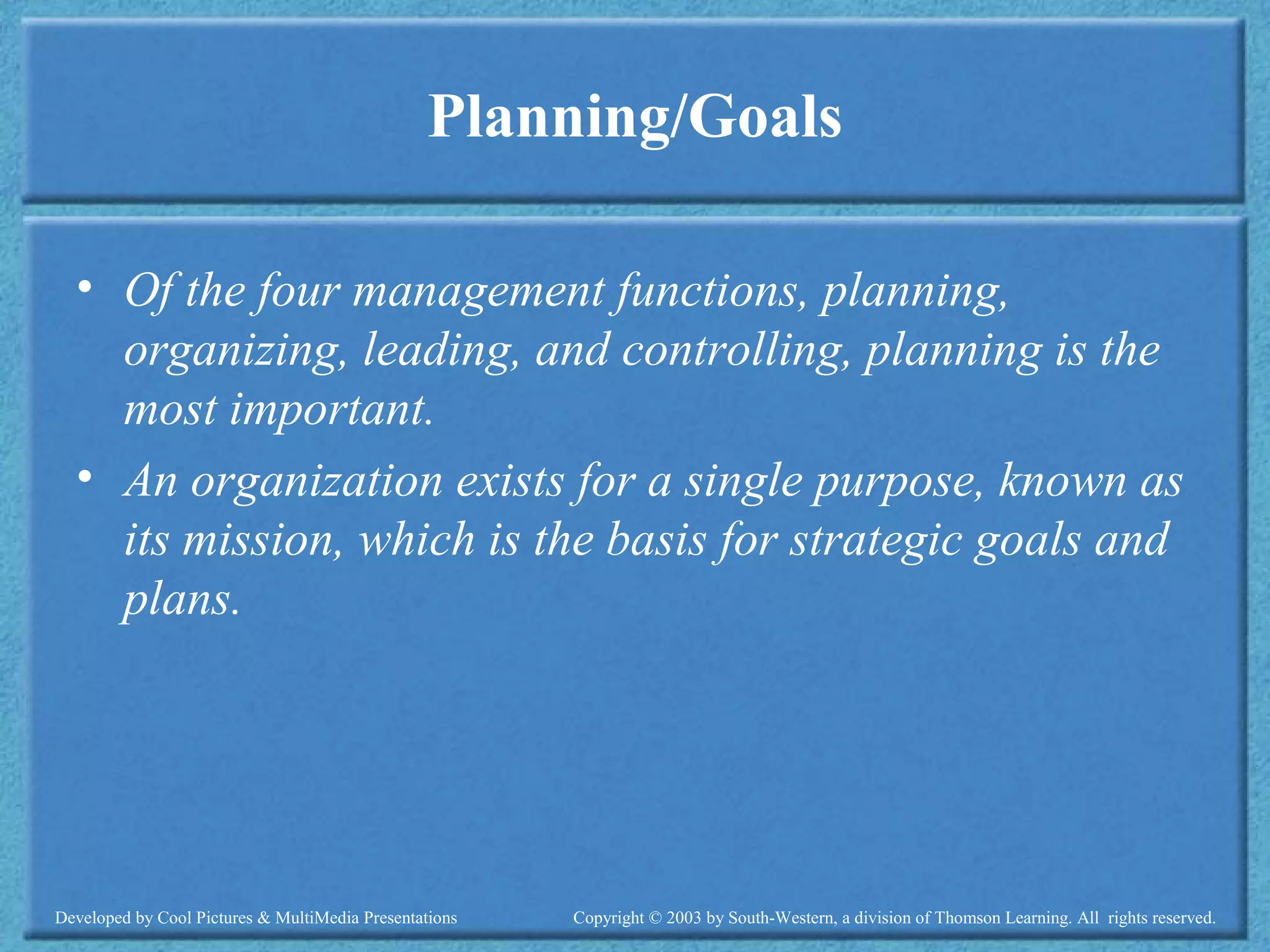
• Of the four management functions, planning,
organizing, leading, and controlling, planning is the
most important.
• An organization exists for a single purpose, known as
its mission, which is the basis for strategic goals and
plans.
Developed by Cool Pictures & MultiMedia Presentations Copyright © 2003 by South-Western, a division of Thomson Learning. All rights reserved.
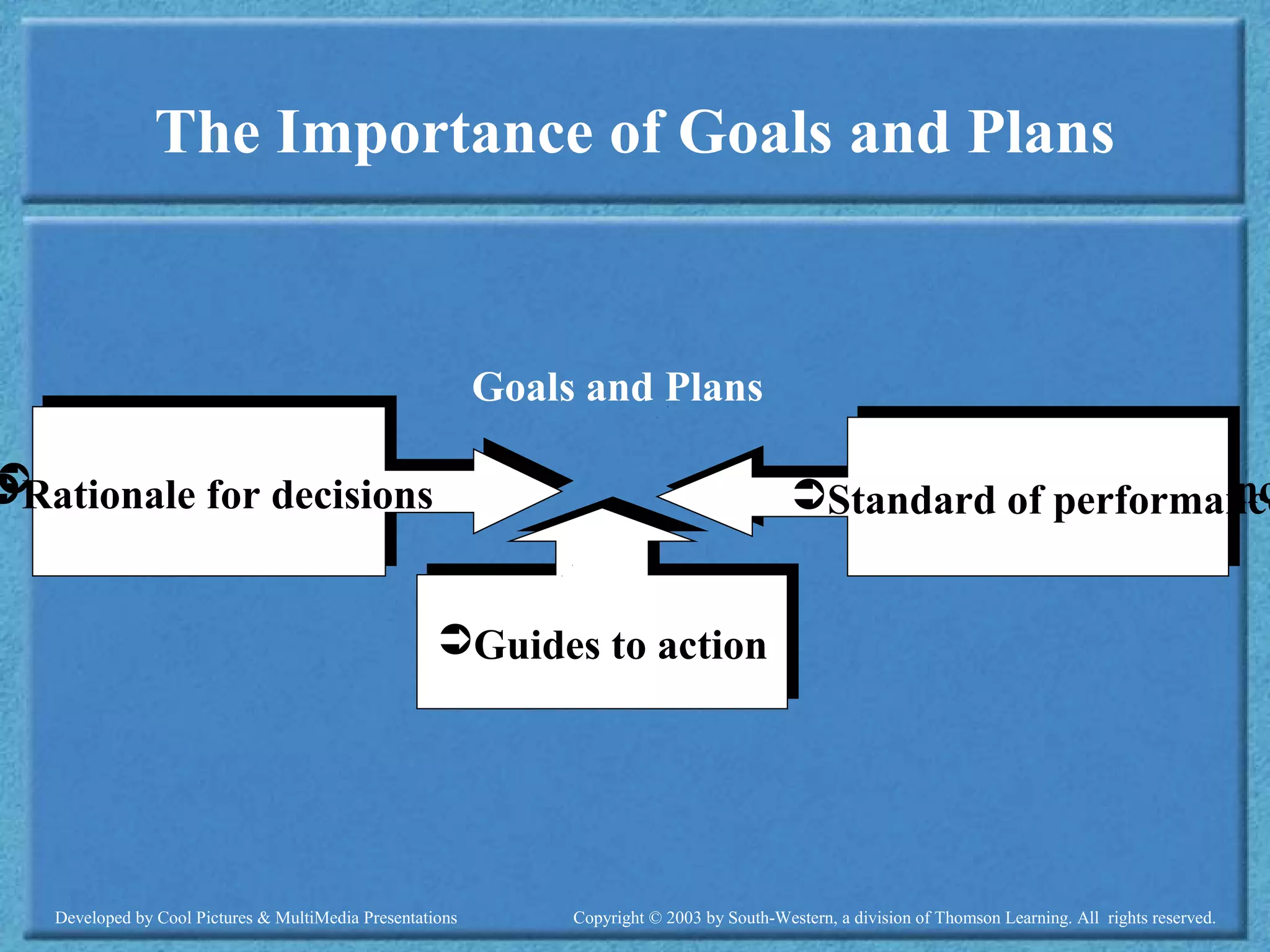
The Importance of Goals and Plans
Guides to actionGuides to action
Rationale for decisionsRationale for decisions Standard of performancStandard of performance
Goals and Plans
Developed by Cool Pictures & MultiMedia Presentations Copyright © 2003 by South-Western, a division of Thomson Learning. All rights reserved.
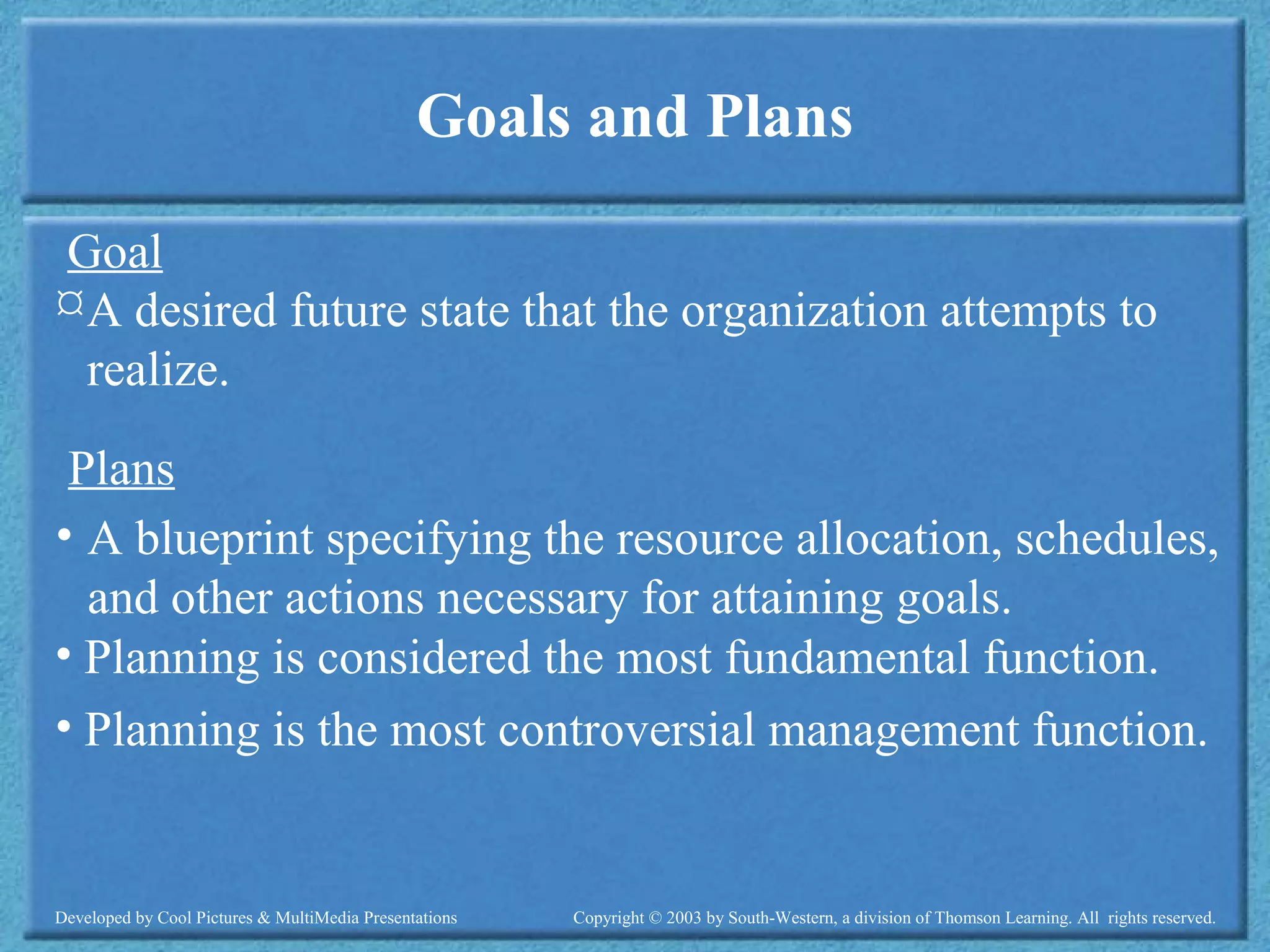
Goals and Plans
• A blueprint specifying the resource allocation, schedules,
and other actions necessary for attaining goals.
• Planning is considered the most fundamental function.
• Planning is the most controversial management function.
Plans
Goal
A desired future state that the organization attempts to
realize.
Developed by Cool Pictures & MultiMedia Presentations Copyright © 2003 by South-Western, a division of Thomson Learning. All rights reserved.
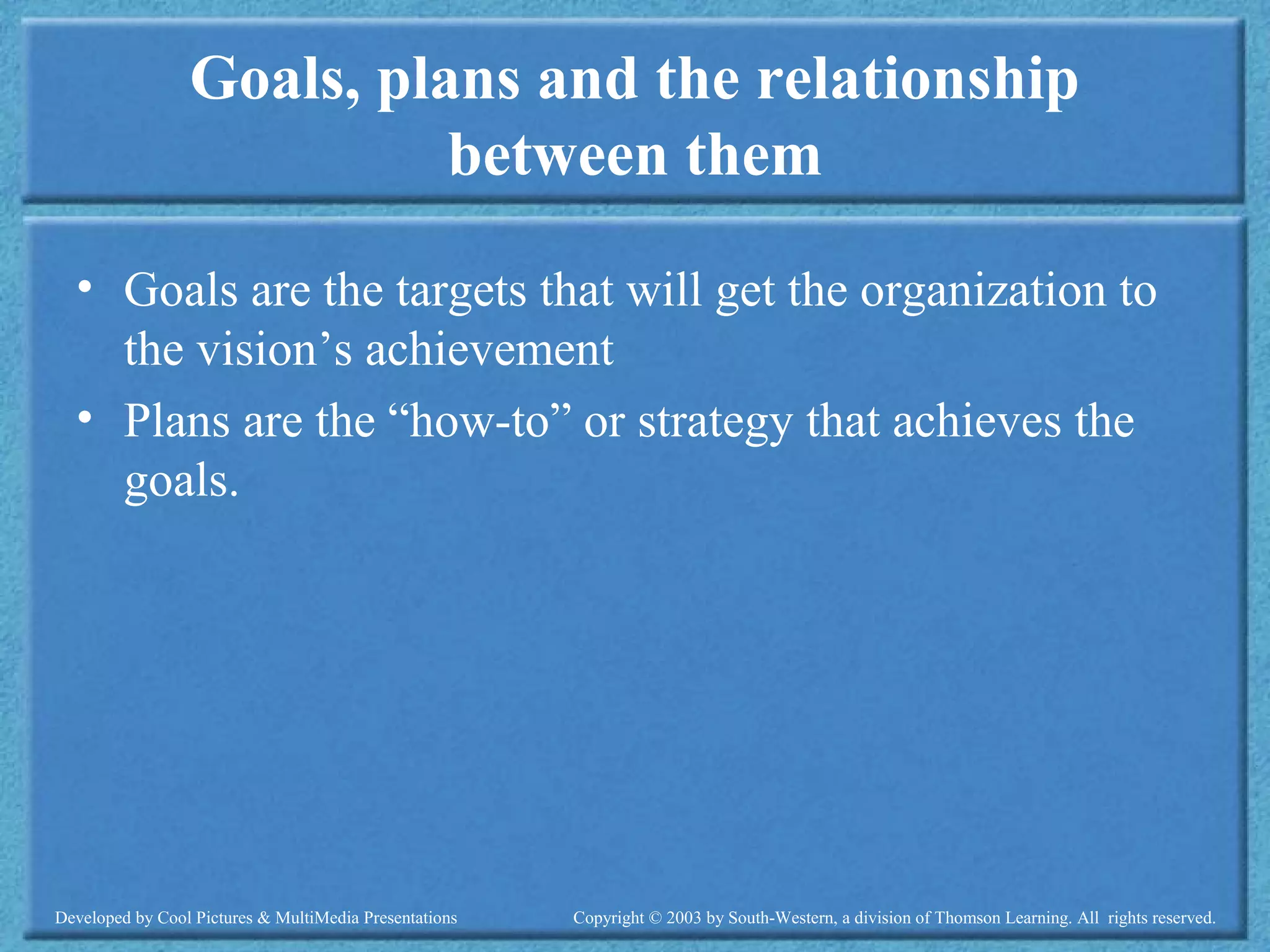
Goals, plans and the relationship
between them
• Goals are the targets that will get the organization to
the vision’s achievement
• Plans are the “how-to” or strategy that achieves the
goals.
Developed by Cool Pictures & MultiMedia Presentations Copyright © 2003 by South-Western, a division of Thomson Learning. All rights reserved.
Who Does the Planning?
• Traditional Approach
– Top management or central planning department
• Modern Approach
– Decentralized planning staff
– Interdepartmental task force composed of line managers.
• Planning under the New Paradigm
– Plans developed from the bottom up
– Managers are facilitators, helping workers to develop plans to
achieve goals
Developed by Cool Pictures & MultiMedia Presentations Copyright © 2003 by South-Western, a division of Thomson Learning. All rights reserved.
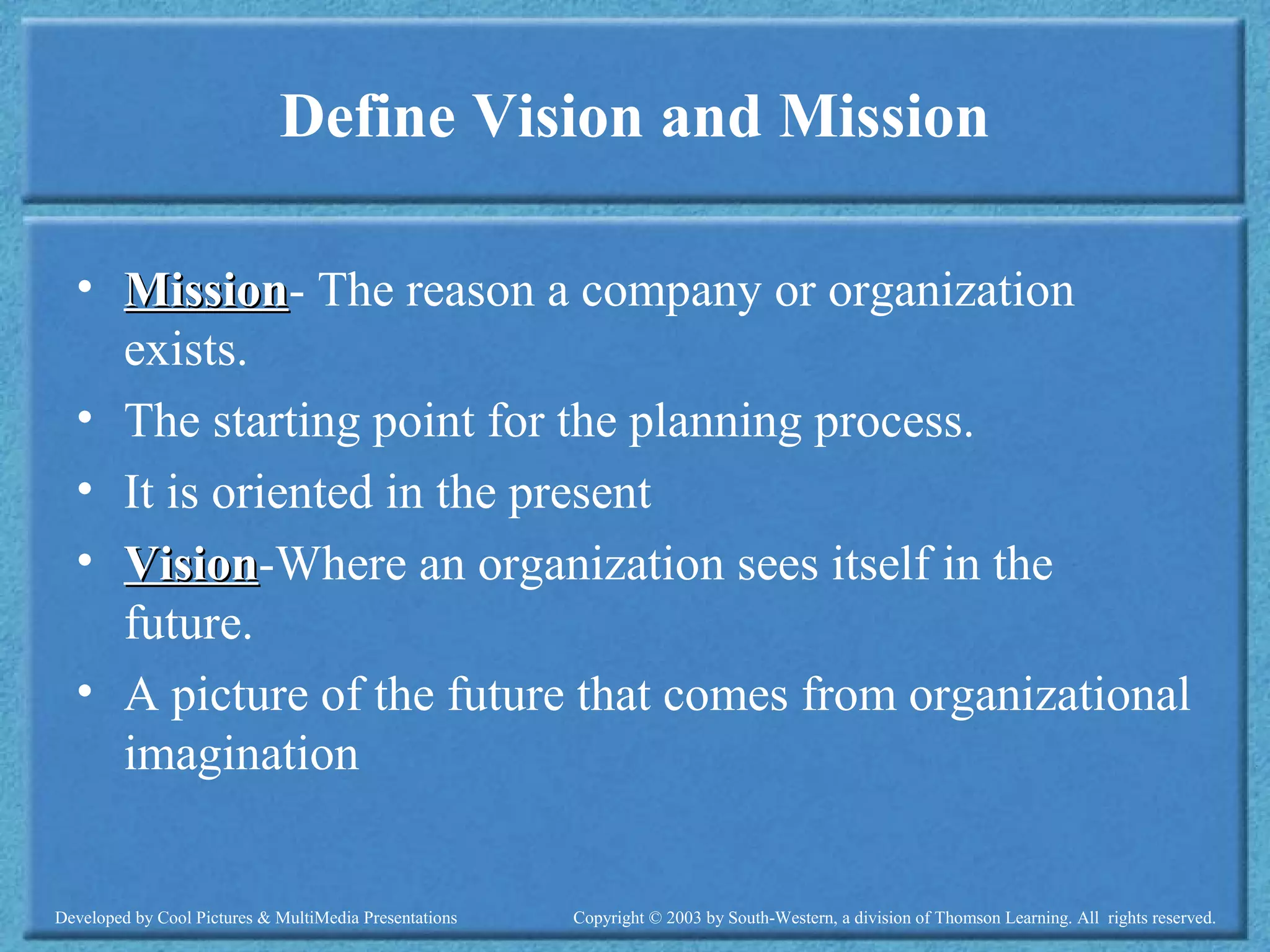
Define Vision and Mission
• MissionMission- The reason a company or organization
exists.
• The starting point for the planning process.
• It is oriented in the present
• VisionVision-Where an organization sees itself in the
future.
• A picture of the future that comes from organizational
imagination
Developed by Cool Pictures & MultiMedia Presentations Copyright © 2003 by South-Western, a division of Thomson Learning. All rights reserved.
Goals and plans within the organization
are defined in a hierarchical fashion:
Strategic, Tactical Operational.
Developed by Cool Pictures & MultiMedia Presentations Copyright © 2003 by South-Western, a division of Thomson Learning. All rights reserved.
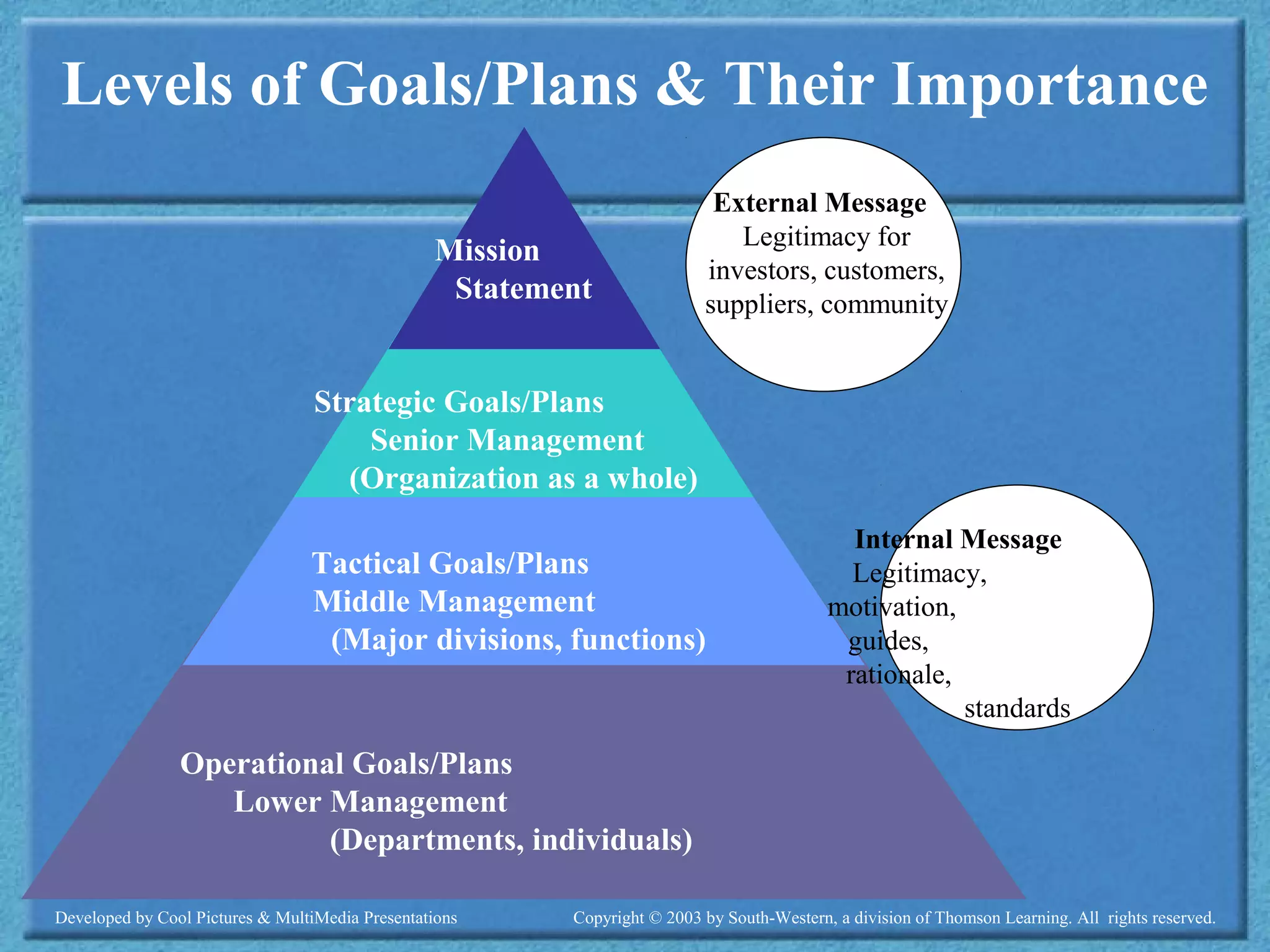
Mission
Statement
Strategic Goals/Plans
Senior Management
(Organization as a whole)
Tactical Goals/Plans
Middle Management
(Major divisions, functions)
Operational Goals/Plans
Lower Management
(Departments, individuals)
Internal Message
Legitimacy,
motivation,
guides,
rationale,
standards
External Message
Legitimacy for
investors, customers,
suppliers, community
Levels of Goals/Plans & Their Importance
Developed by Cool Pictures & MultiMedia Presentations Copyright © 2003 by South-Western, a division of Thomson Learning. All rights reserved.
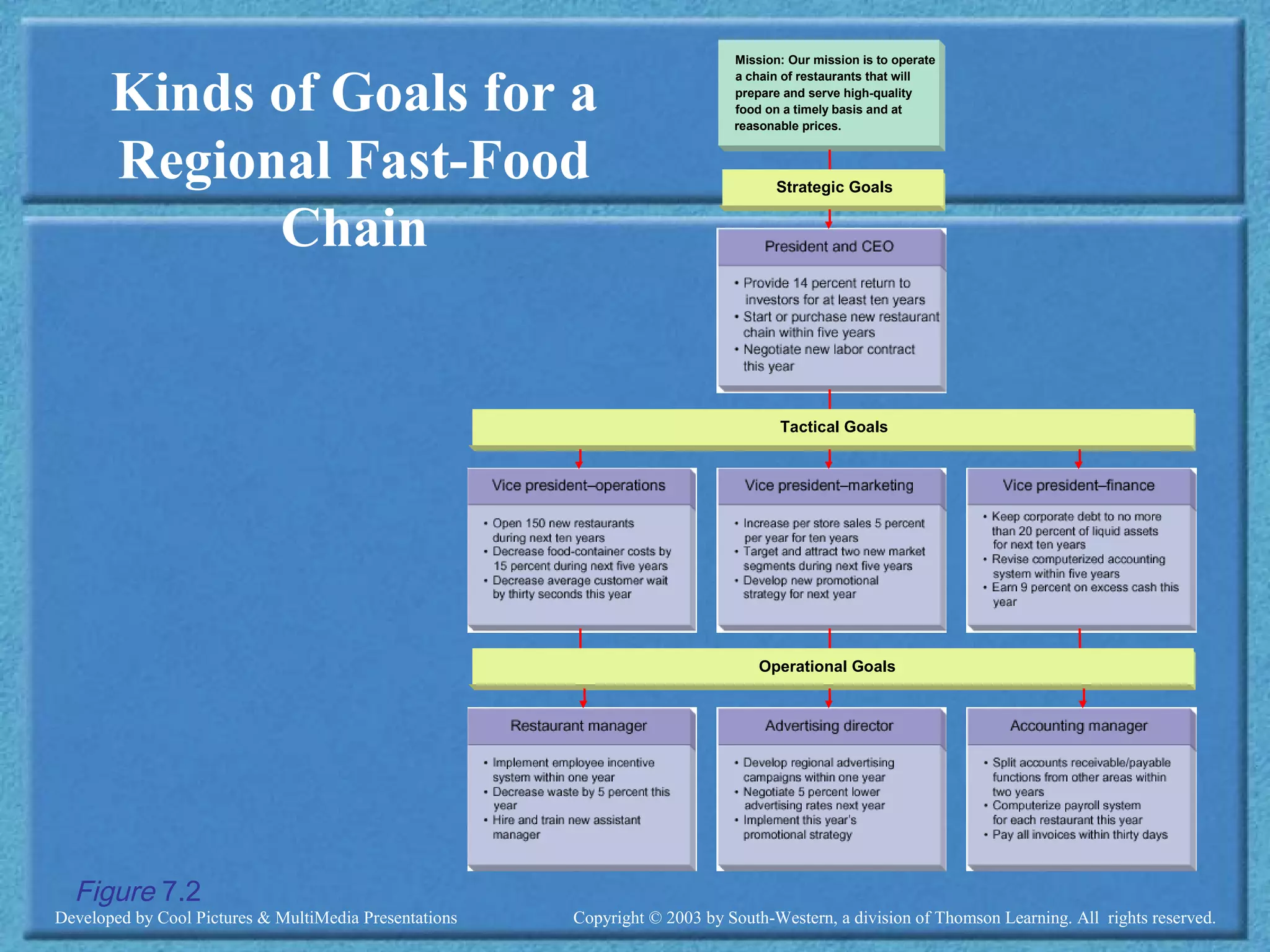
Kinds of Goals for a
Regional Fast-Food
Chain
Accounting manager
ï Split accounts receivable/payable
functions from other areas within
two years
ï Computerize payroll system
for each restaurant this year
ï Pay all invoices within thirty days
Advertising director
ï Develop regional advertising
campaigns within one year
ï Negotiate 5 percent lower
advertising rates next year
ï Implement this yearís
promotional strategy
Restaurant manager
ï Implement employee incentive
system within one year
ï Decrease waste by 5 percent this
year
ï Hire and train new assistant
manager
Vice president ñfinance
ï Keep corporate debt to no more
than 20 percent of liquid assets
for next ten years
ï Revise computerized accounting
system within five years
ï Earn 9 percent on excess cash this
year
President and CEO
ï Provide 14 percent return to
investors for at least ten years
ï Start or purchase new restaurant
chain within five years
ï Negotiate new labor contract
this year
Mission: Our mission is to operate
a chain of restaurants that will
prepare and serve high-quality
food on a timely basis and at
reasonable prices.
Vice president ñmarketing
ï Increase per store sales 5 percent
per year for ten years
ï Target and attract two new market
segments during next five years
ï Develop new promotional
strategy for next year
Vice president ñoperations
ï Open 150 new restaurants
during next ten years
ï Decrease food-container costs by
15 percent during next five years
ï Decrease average customer wait
by thirty seconds this year
Strategic Goals
Tactical Goals
Operational Goals
Figure 7.2
Developed by Cool Pictures & MultiMedia Presentations Copyright © 2003 by South-Western, a division of Thomson Learning. All rights reserved.
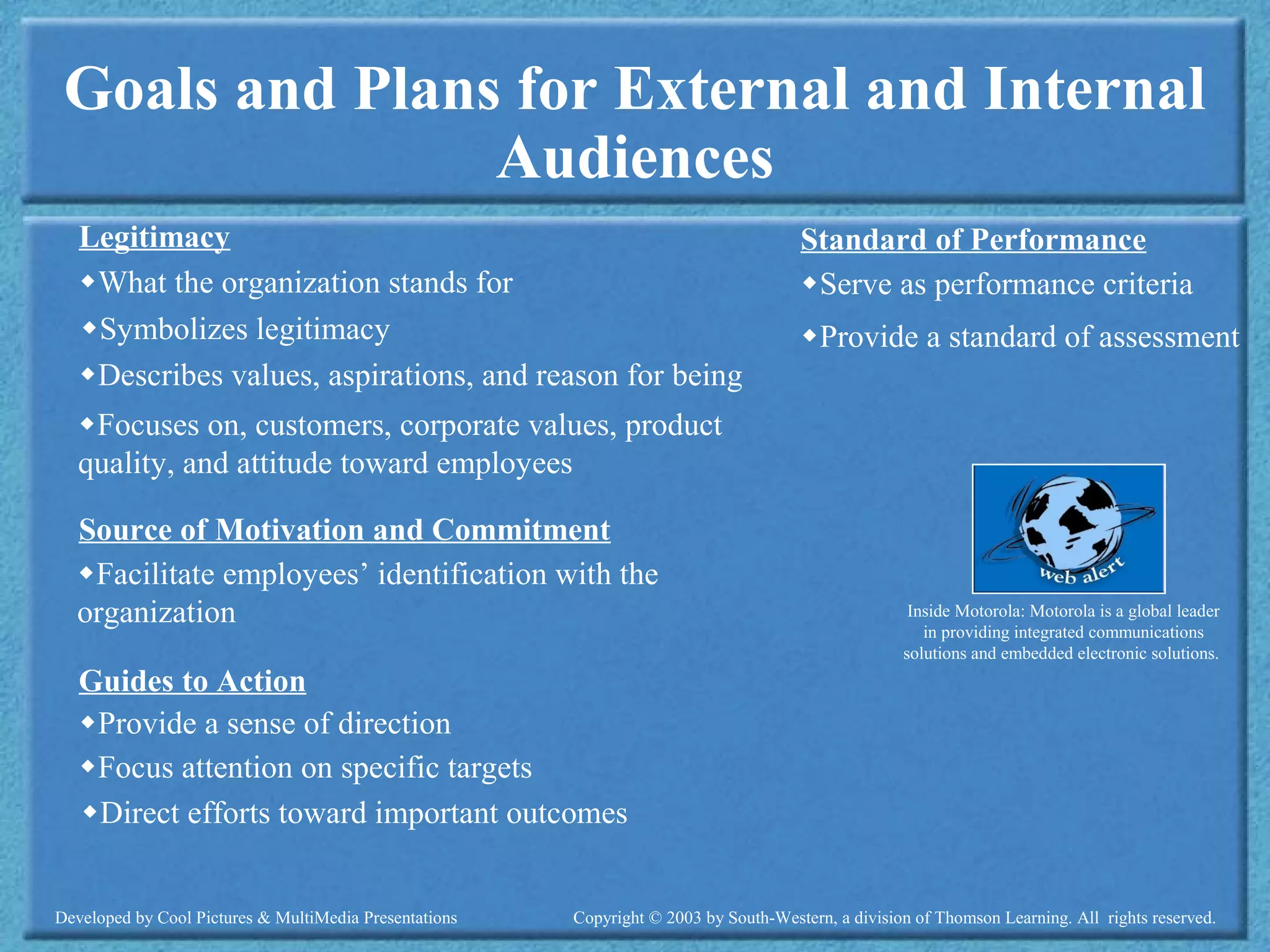
Goals and Plans for External and Internal
Audiences
Legitimacy
Symbolizes legitimacy
Describes values, aspirations, and reason for being
Focuses on, customers, corporate values, product
quality, and attitude toward employees
Source of Motivation and Commitment
Facilitate employees’ identification with the
organization
Guides to Action
Provide a sense of direction
Focus attention on specific targets
Direct efforts toward important outcomes
What the organization stands for
Standard of Performance
Serve as performance criteria
Provide a standard of assessment
Inside Motorola: Motorola is a global leader
in providing integrated communications
solutions and embedded electronic solutions.
Developed by Cool Pictures & MultiMedia Presentations Copyright © 2003 by South-Western, a division of Thomson Learning. All rights reserved.
Strategic Goals and Plans
Strategic Goals
• Where the organization wants to be in the future
• Pertain to the organization as a whole
• Strategic Plans
• Action Steps used to attain strategic goals
• Blueprint that defines the organizational activities and resource
allocations
• Tends to be long term
Developed by Cool Pictures & MultiMedia Presentations Copyright © 2003 by South-Western, a division of Thomson Learning. All rights reserved.
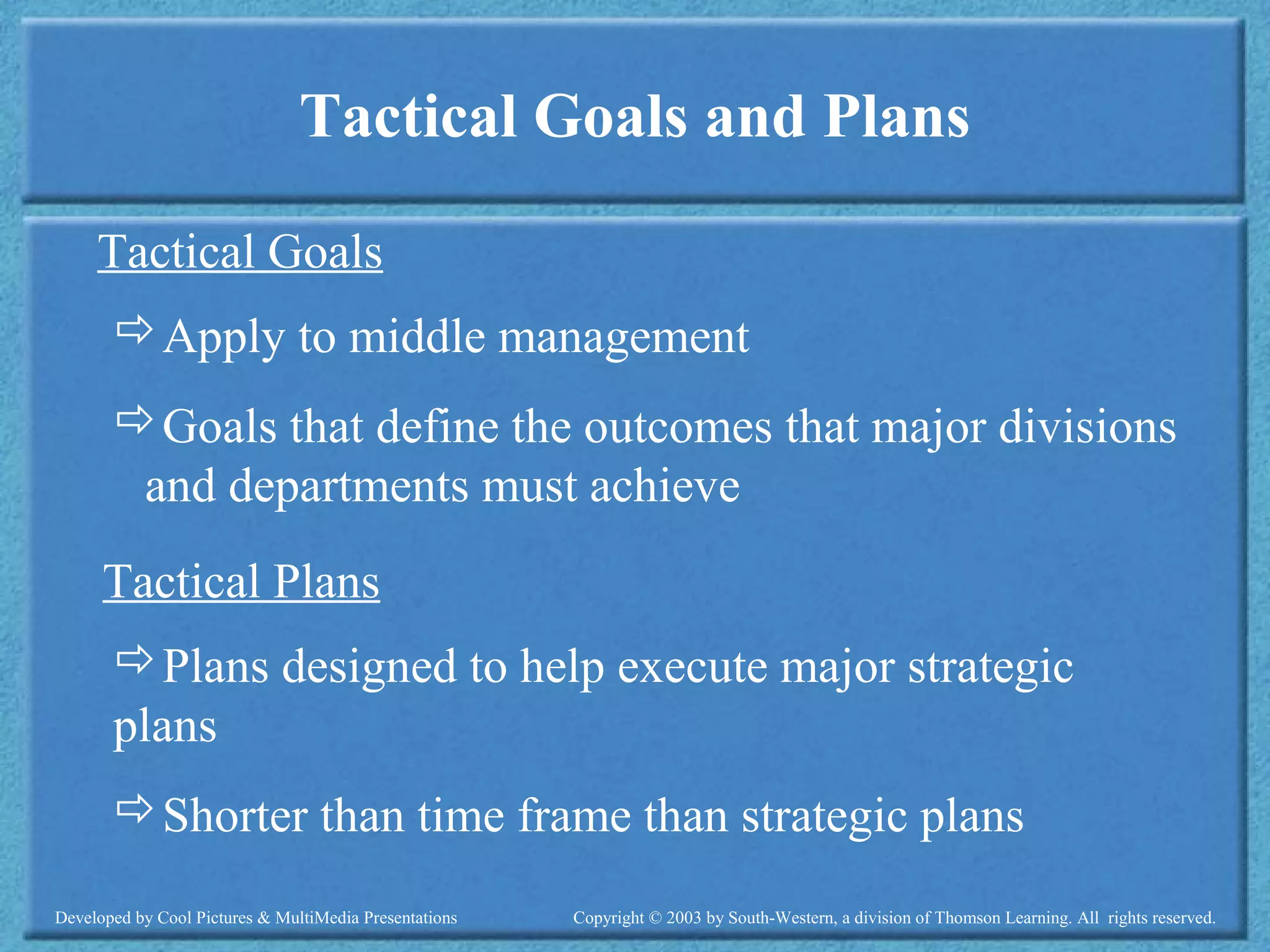
Tactical Goals and Plans
Tactical Goals
Apply to middle management
Goals that define the outcomes that major divisions
and departments must achieve
Tactical Plans
Plans designed to help execute major strategic
plans
Shorter than time frame than strategic plans
Developed by Cool Pictures & MultiMedia Presentations Copyright © 2003 by South-Western, a division of Thomson Learning. All rights reserved.
Developing and Executing Tactical
Plans
Developing tactical plans
• Recognize and understand
overarching strategic plans
and tactical goals
• Specify relevant resource and
time issues
• Recognize and identify human
resource commitments
Executing tactical plans
• Evaluate each course of action
in light of its goal
• Obtain and distribute
information and resources
• Monitor horizontal and vertical
communication and integration
of activities
• Monitor ongoing activities for
goal achievement
Figure 7.4
Developed by Cool Pictures & MultiMedia Presentations Copyright © 2003 by South-Western, a division of Thomson Learning. All rights reserved.
Operational Goals and Plans
Operational Goals
 Specific, measurable results expected from
departments, work groups, and individuals
Operational Plans
Organization’s lower levels that specify action
steps toward achieving operational goals
Tool for daily and weekly operations
Schedules are an important component
Developed by Cool Pictures & MultiMedia Presentations Copyright © 2003 by South-Western, a division of Thomson Learning. All rights reserved.
Types of Operational Plans
Plan Description
Single-use plan Developed to carry out a course of action not likely to
be repeated in the future
Program Single-use plan for a large set of activities
Project Single-use plan of less scope and complexity than a
program
Standing plan Developed for activities that recur regularly over a pe-
riod of time
Policy Standing plan specifying the organization’s general
response to a designated problem or situation
Standard operating procedure Standing plan outlining steps to be followed in particu-
lar circumstances
Rules and regulations Standing plans describing exactly how specific activi-
ties are to be carried out
Table 7.1
Developed by Cool Pictures & MultiMedia Presentations Copyright © 2003 by South-Western, a division of Thomson Learning. All rights reserved.
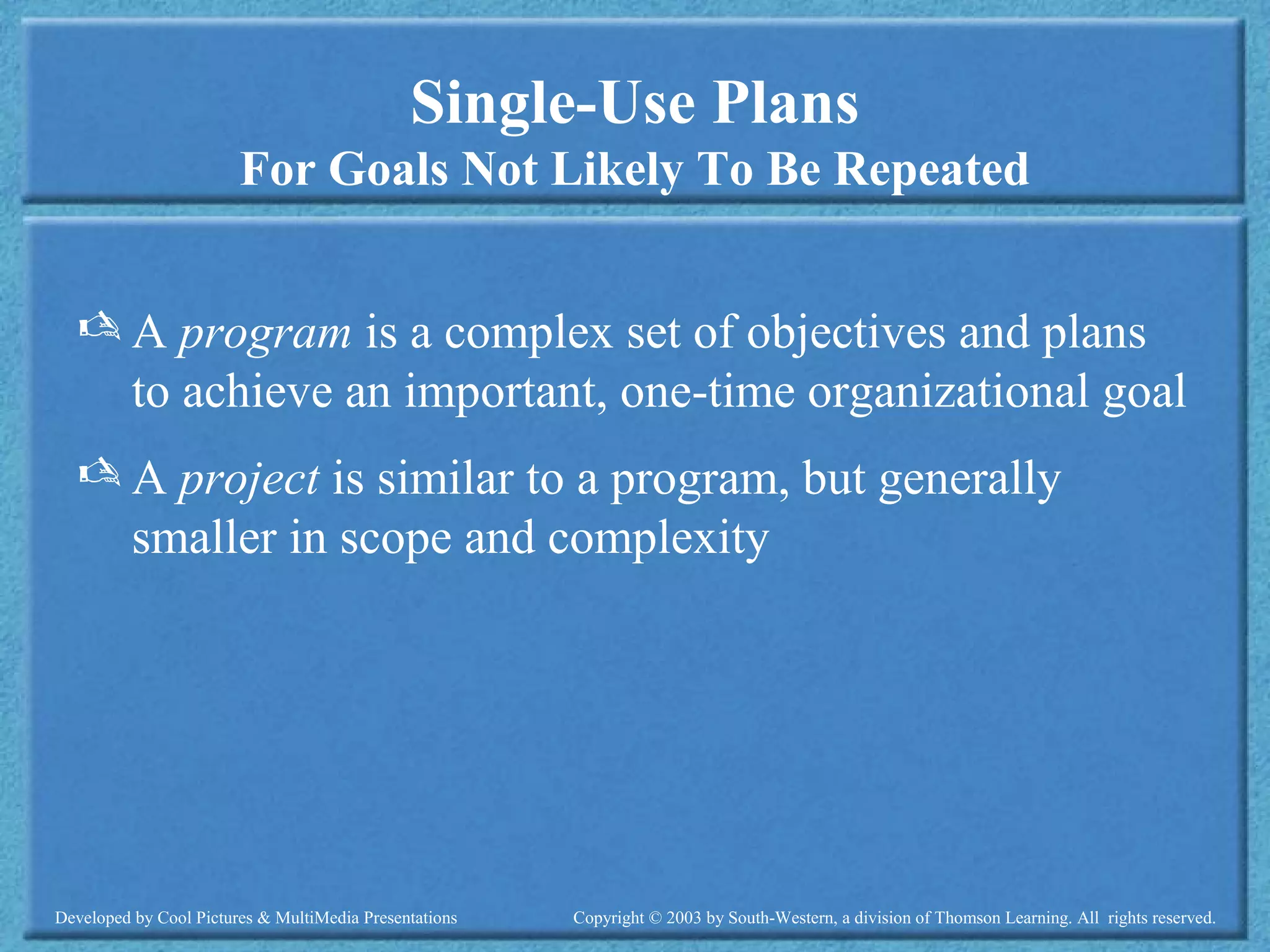
Single-Use Plans
For Goals Not Likely To Be Repeated
 A program is a complex set of objectives and plans
to achieve an important, one-time organizational goal
 A project is similar to a program, but generally
smaller in scope and complexity
Developed by Cool Pictures & MultiMedia Presentations Copyright © 2003 by South-Western, a division of Thomson Learning. All rights reserved.
Standing Plans
A policy is a general guide to action and provides
direction for people within the organization
Rules describe how a specific action is to be
performed
Procedures define a precise series of steps to be
used in achieving a specific job
Developed by Cool Pictures & MultiMedia Presentations Copyright © 2003 by South-Western, a division of Thomson Learning. All rights reserved.
Contingency Planning
Ongoing planning process
Action point 1 Action point 2 Action point 3 Action point 4
Develop plan,
considering
contingency events
Implement plan and
formally identify
contingency events
Specify indicators
for the contingency
events and develop
contingency plans for
each possible event
Successfully complete
plan or contingency
plan
Monitor contingency event indicators and
implement contingency plan if necessary
Figure 7.3
Developed by Cool Pictures & MultiMedia Presentations Copyright © 2003 by South-Western, a division of Thomson Learning. All rights reserved.
Considerations For Contingency
Planning
• Identify uncontrollable factors;
– recession
– inflation
– technological developments
• Minimizing Impact of Uncontrollable Factors
– forecast for worst-case scenarios
Developed by Cool Pictures & MultiMedia Presentations Copyright © 2003 by South-Western, a division of Thomson Learning. All rights reserved.
Criteria for effective Goals
• Specific
• Measurable
• Time Constrained
• Achievable
• Relate to something important
Developed by Cool Pictures & MultiMedia Presentations Copyright © 2003 by South-Western, a division of Thomson Learning. All rights reserved.
Characteristics of Effective
Goal Setting
Goal Characteristics
Specific and measurable
Cover key result areas
Challenging but realistic
Defined time period
Linked to rewards
Developed by Cool Pictures & MultiMedia Presentations Copyright © 2003 by South-Western, a division of Thomson Learning. All rights reserved.
Barriers to Goal Setting and Planning
Major Barriers Inappropriate goals
Improper reward system
Dynamic and complex environment
Reluctance to establish goals
Resistance to change
Constraints
Overcoming the Barriers Understanding the purposes of goals and planning
Communication and participation
Consistency, revision, and updating
Effective reward systems
Table 7.2

Planning compiled

  • 1.
    Developed by CoolPictures & MultiMedia Presentations Copyright © 2003 by South-Western, a division of Thomson Learning. All rights reserved. Organizational Planning and Goal Setting
  • 2.
    Developed by CoolPictures & MultiMedia Presentations Copyright © 2003 by South-Western, a division of Thomson Learning. All rights reserved. Planning/Goals • Of the four management functions, planning, organizing, leading, and controlling, planning is the most important. • An organization exists for a single purpose, known as its mission, which is the basis for strategic goals and plans.
  • 3.
    Developed by CoolPictures & MultiMedia Presentations Copyright © 2003 by South-Western, a division of Thomson Learning. All rights reserved. The Importance of Goals and Plans Guides to actionGuides to action Rationale for decisionsRationale for decisions Standard of performancStandard of performance Goals and Plans
  • 4.
    Developed by CoolPictures & MultiMedia Presentations Copyright © 2003 by South-Western, a division of Thomson Learning. All rights reserved. Goals and Plans • A blueprint specifying the resource allocation, schedules, and other actions necessary for attaining goals. • Planning is considered the most fundamental function. • Planning is the most controversial management function. Plans Goal A desired future state that the organization attempts to realize.
  • 5.
    Developed by CoolPictures & MultiMedia Presentations Copyright © 2003 by South-Western, a division of Thomson Learning. All rights reserved. Goals, plans and the relationship between them • Goals are the targets that will get the organization to the vision’s achievement • Plans are the “how-to” or strategy that achieves the goals.
  • 6.
    Developed by CoolPictures & MultiMedia Presentations Copyright © 2003 by South-Western, a division of Thomson Learning. All rights reserved. Who Does the Planning? • Traditional Approach – Top management or central planning department • Modern Approach – Decentralized planning staff – Interdepartmental task force composed of line managers. • Planning under the New Paradigm – Plans developed from the bottom up – Managers are facilitators, helping workers to develop plans to achieve goals
  • 7.
    Developed by CoolPictures & MultiMedia Presentations Copyright © 2003 by South-Western, a division of Thomson Learning. All rights reserved. Define Vision and Mission • MissionMission- The reason a company or organization exists. • The starting point for the planning process. • It is oriented in the present • VisionVision-Where an organization sees itself in the future. • A picture of the future that comes from organizational imagination
  • 8.
    Developed by CoolPictures & MultiMedia Presentations Copyright © 2003 by South-Western, a division of Thomson Learning. All rights reserved. Goals and plans within the organization are defined in a hierarchical fashion: Strategic, Tactical Operational.
  • 9.
    Developed by CoolPictures & MultiMedia Presentations Copyright © 2003 by South-Western, a division of Thomson Learning. All rights reserved. Mission Statement Strategic Goals/Plans Senior Management (Organization as a whole) Tactical Goals/Plans Middle Management (Major divisions, functions) Operational Goals/Plans Lower Management (Departments, individuals) Internal Message Legitimacy, motivation, guides, rationale, standards External Message Legitimacy for investors, customers, suppliers, community Levels of Goals/Plans & Their Importance
  • 10.
    Developed by CoolPictures & MultiMedia Presentations Copyright © 2003 by South-Western, a division of Thomson Learning. All rights reserved. Kinds of Goals for a Regional Fast-Food Chain Accounting manager ï Split accounts receivable/payable functions from other areas within two years ï Computerize payroll system for each restaurant this year ï Pay all invoices within thirty days Advertising director ï Develop regional advertising campaigns within one year ï Negotiate 5 percent lower advertising rates next year ï Implement this yearís promotional strategy Restaurant manager ï Implement employee incentive system within one year ï Decrease waste by 5 percent this year ï Hire and train new assistant manager Vice president ñfinance ï Keep corporate debt to no more than 20 percent of liquid assets for next ten years ï Revise computerized accounting system within five years ï Earn 9 percent on excess cash this year President and CEO ï Provide 14 percent return to investors for at least ten years ï Start or purchase new restaurant chain within five years ï Negotiate new labor contract this year Mission: Our mission is to operate a chain of restaurants that will prepare and serve high-quality food on a timely basis and at reasonable prices. Vice president ñmarketing ï Increase per store sales 5 percent per year for ten years ï Target and attract two new market segments during next five years ï Develop new promotional strategy for next year Vice president ñoperations ï Open 150 new restaurants during next ten years ï Decrease food-container costs by 15 percent during next five years ï Decrease average customer wait by thirty seconds this year Strategic Goals Tactical Goals Operational Goals Figure 7.2
  • 11.
    Developed by CoolPictures & MultiMedia Presentations Copyright © 2003 by South-Western, a division of Thomson Learning. All rights reserved. Goals and Plans for External and Internal Audiences Legitimacy Symbolizes legitimacy Describes values, aspirations, and reason for being Focuses on, customers, corporate values, product quality, and attitude toward employees Source of Motivation and Commitment Facilitate employees’ identification with the organization Guides to Action Provide a sense of direction Focus attention on specific targets Direct efforts toward important outcomes What the organization stands for Standard of Performance Serve as performance criteria Provide a standard of assessment Inside Motorola: Motorola is a global leader in providing integrated communications solutions and embedded electronic solutions.
  • 12.
    Developed by CoolPictures & MultiMedia Presentations Copyright © 2003 by South-Western, a division of Thomson Learning. All rights reserved. Strategic Goals and Plans Strategic Goals • Where the organization wants to be in the future • Pertain to the organization as a whole • Strategic Plans • Action Steps used to attain strategic goals • Blueprint that defines the organizational activities and resource allocations • Tends to be long term
  • 13.
    Developed by CoolPictures & MultiMedia Presentations Copyright © 2003 by South-Western, a division of Thomson Learning. All rights reserved. Tactical Goals and Plans Tactical Goals Apply to middle management Goals that define the outcomes that major divisions and departments must achieve Tactical Plans Plans designed to help execute major strategic plans Shorter than time frame than strategic plans
  • 14.
    Developed by CoolPictures & MultiMedia Presentations Copyright © 2003 by South-Western, a division of Thomson Learning. All rights reserved. Developing and Executing Tactical Plans Developing tactical plans • Recognize and understand overarching strategic plans and tactical goals • Specify relevant resource and time issues • Recognize and identify human resource commitments Executing tactical plans • Evaluate each course of action in light of its goal • Obtain and distribute information and resources • Monitor horizontal and vertical communication and integration of activities • Monitor ongoing activities for goal achievement Figure 7.4
  • 15.
    Developed by CoolPictures & MultiMedia Presentations Copyright © 2003 by South-Western, a division of Thomson Learning. All rights reserved. Operational Goals and Plans Operational Goals  Specific, measurable results expected from departments, work groups, and individuals Operational Plans Organization’s lower levels that specify action steps toward achieving operational goals Tool for daily and weekly operations Schedules are an important component
  • 16.
    Developed by CoolPictures & MultiMedia Presentations Copyright © 2003 by South-Western, a division of Thomson Learning. All rights reserved. Types of Operational Plans Plan Description Single-use plan Developed to carry out a course of action not likely to be repeated in the future Program Single-use plan for a large set of activities Project Single-use plan of less scope and complexity than a program Standing plan Developed for activities that recur regularly over a pe- riod of time Policy Standing plan specifying the organization’s general response to a designated problem or situation Standard operating procedure Standing plan outlining steps to be followed in particu- lar circumstances Rules and regulations Standing plans describing exactly how specific activi- ties are to be carried out Table 7.1
  • 17.
    Developed by CoolPictures & MultiMedia Presentations Copyright © 2003 by South-Western, a division of Thomson Learning. All rights reserved. Single-Use Plans For Goals Not Likely To Be Repeated  A program is a complex set of objectives and plans to achieve an important, one-time organizational goal  A project is similar to a program, but generally smaller in scope and complexity
  • 18.
    Developed by CoolPictures & MultiMedia Presentations Copyright © 2003 by South-Western, a division of Thomson Learning. All rights reserved. Standing Plans A policy is a general guide to action and provides direction for people within the organization Rules describe how a specific action is to be performed Procedures define a precise series of steps to be used in achieving a specific job
  • 19.
    Developed by CoolPictures & MultiMedia Presentations Copyright © 2003 by South-Western, a division of Thomson Learning. All rights reserved. Contingency Planning Ongoing planning process Action point 1 Action point 2 Action point 3 Action point 4 Develop plan, considering contingency events Implement plan and formally identify contingency events Specify indicators for the contingency events and develop contingency plans for each possible event Successfully complete plan or contingency plan Monitor contingency event indicators and implement contingency plan if necessary Figure 7.3
  • 20.
    Developed by CoolPictures & MultiMedia Presentations Copyright © 2003 by South-Western, a division of Thomson Learning. All rights reserved. Considerations For Contingency Planning • Identify uncontrollable factors; – recession – inflation – technological developments • Minimizing Impact of Uncontrollable Factors – forecast for worst-case scenarios
  • 21.
    Developed by CoolPictures & MultiMedia Presentations Copyright © 2003 by South-Western, a division of Thomson Learning. All rights reserved. Criteria for effective Goals • Specific • Measurable • Time Constrained • Achievable • Relate to something important
  • 22.
    Developed by CoolPictures & MultiMedia Presentations Copyright © 2003 by South-Western, a division of Thomson Learning. All rights reserved. Characteristics of Effective Goal Setting Goal Characteristics Specific and measurable Cover key result areas Challenging but realistic Defined time period Linked to rewards
  • 23.
    Developed by CoolPictures & MultiMedia Presentations Copyright © 2003 by South-Western, a division of Thomson Learning. All rights reserved. Barriers to Goal Setting and Planning Major Barriers Inappropriate goals Improper reward system Dynamic and complex environment Reluctance to establish goals Resistance to change Constraints Overcoming the Barriers Understanding the purposes of goals and planning Communication and participation Consistency, revision, and updating Effective reward systems Table 7.2