3
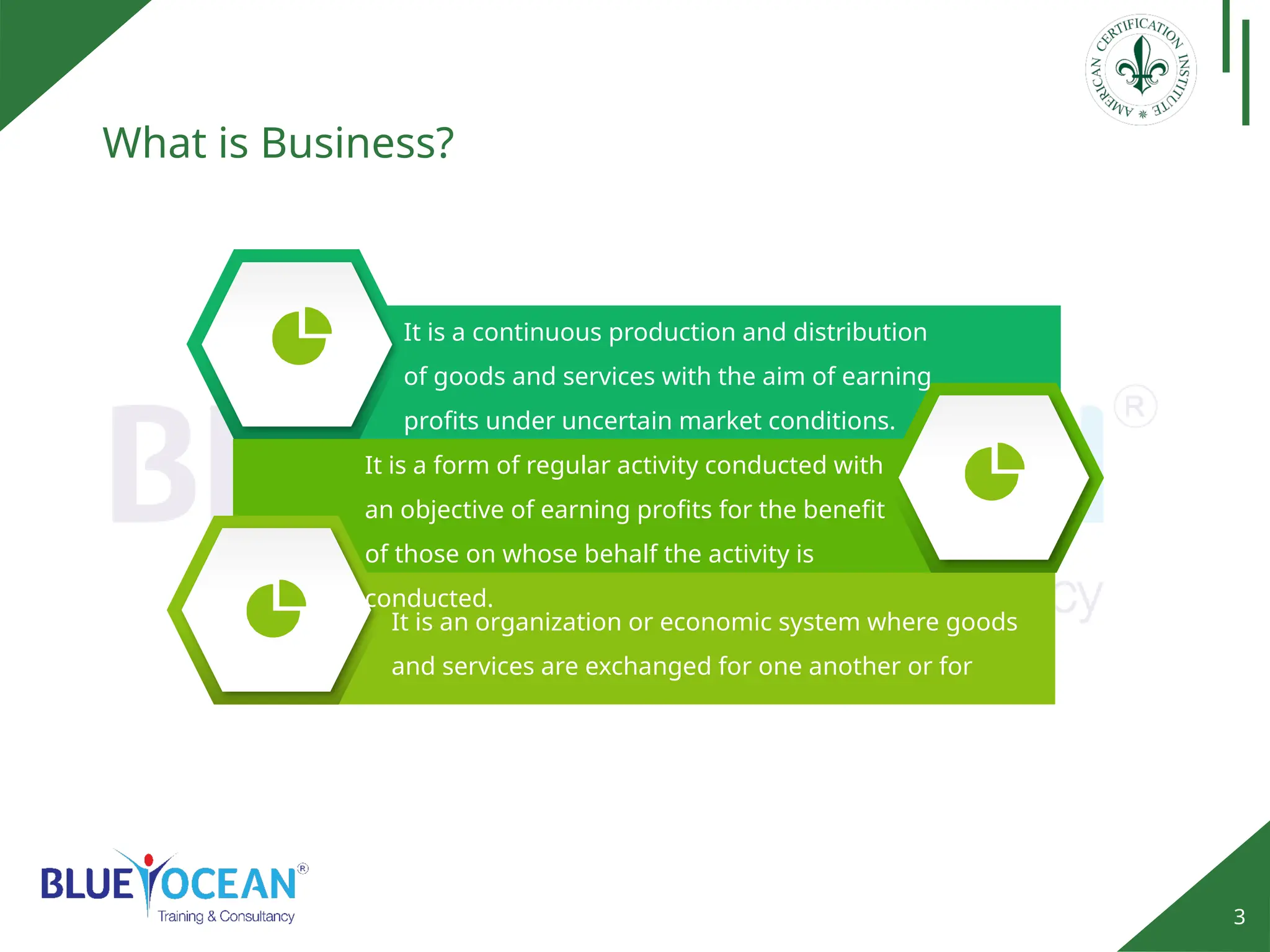
What is Business?
It is a continuous production and distribution
of goods and services with the aim of earning
profits under uncertain market conditions.
It is a form of regular activity conducted with
an objective of earning profits for the benefit
of those on whose behalf the activity is
conducted.
It is an organization or economic system where goods
and services are exchanged for one another or for
money.
4
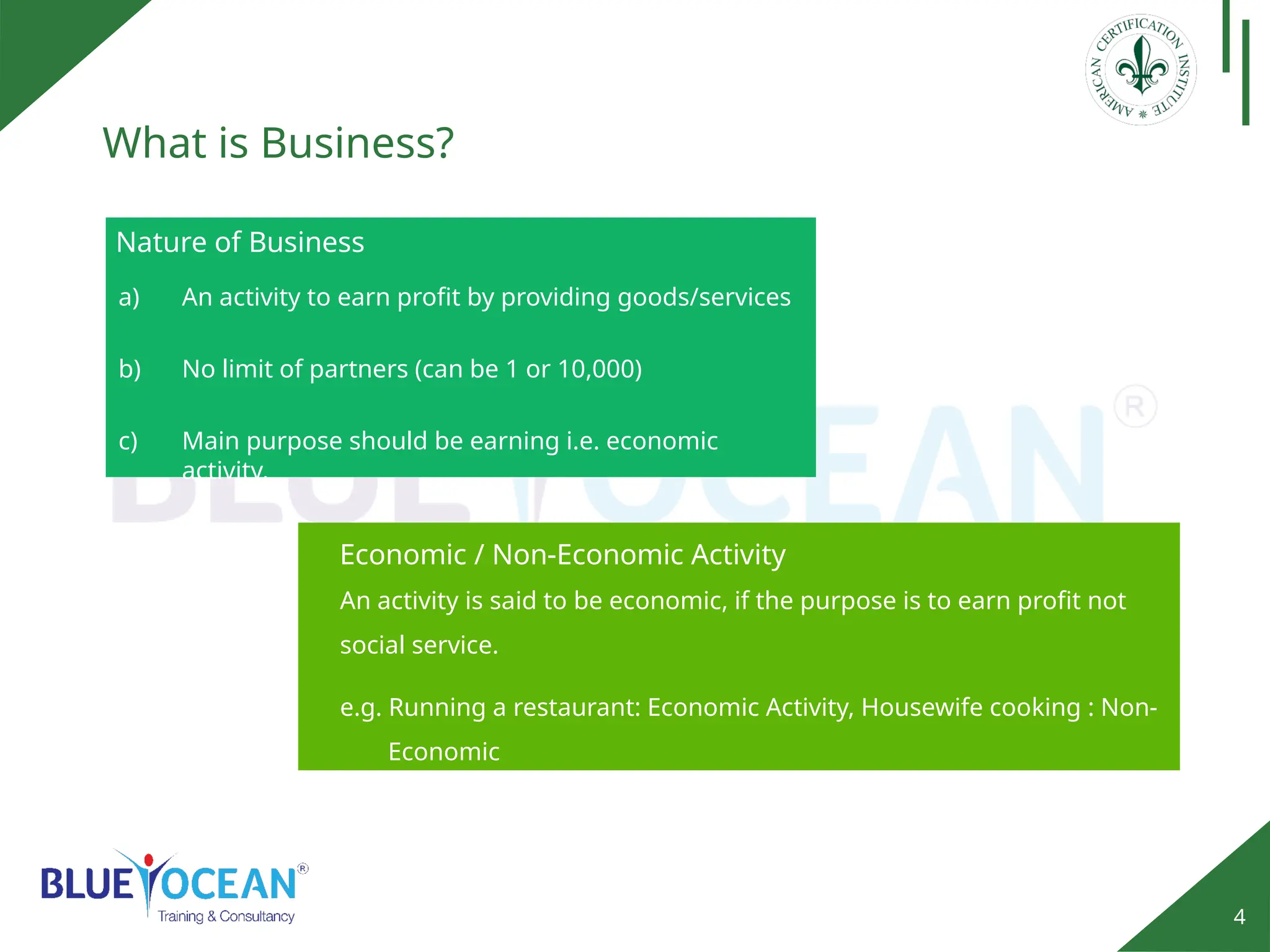
What is Business?
Nature of Business
a) An activity to earn profit by providing goods/services
b) No limit of partners (can be 1 or 10,000)
c) Main purpose should be earning i.e. economic
activity.
An activity is said to be economic, if the purpose is to earn profit not
social service.
e.g. Running a restaurant: Economic Activity, Housewife cooking : Non-
Economic
Economic / Non-Economic Activity
5
Characteristics of Business
1. Exchange of goods and services
2. Deals in numerous transactions
3. Profit is the main objective
4. Business skills for economic success
5. Risks and uncertainties
6. Buyer and seller
7. Connected with production
8. Marketing and distribution of goods
9. Deals in goods and services
1. Consumer goods
2. Producer goods
10. Social obligation
11. To satisfy human wants
6
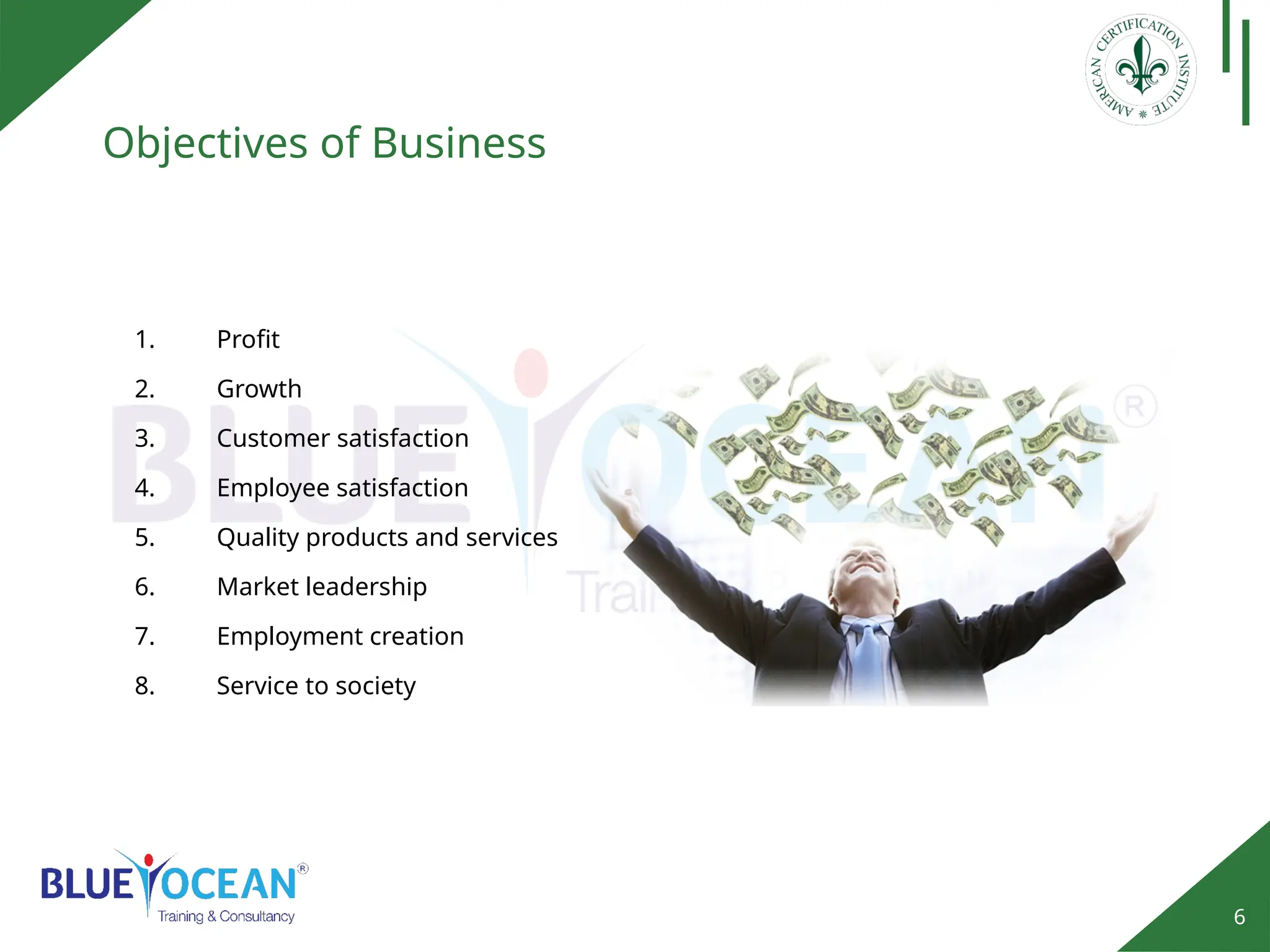
Objectives of Business
1. Profit
2. Growth
3. Customer satisfaction
4. Employee satisfaction
5. Quality products and services
6. Market leadership
7. Employment creation
8. Service to society
7
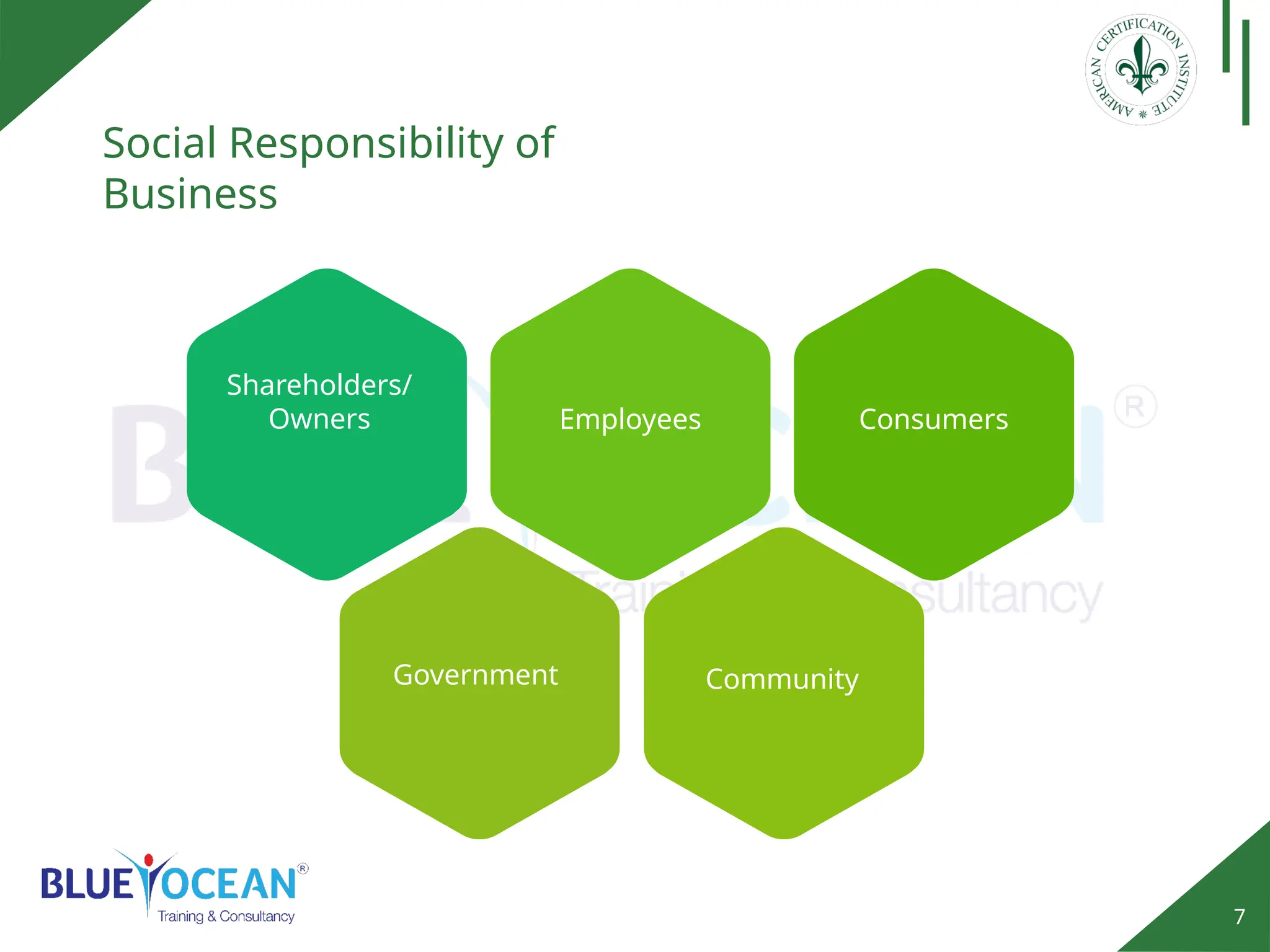
Social Responsibility of
Business
Shareholders/
Owners Employees Consumers
Government Community
8
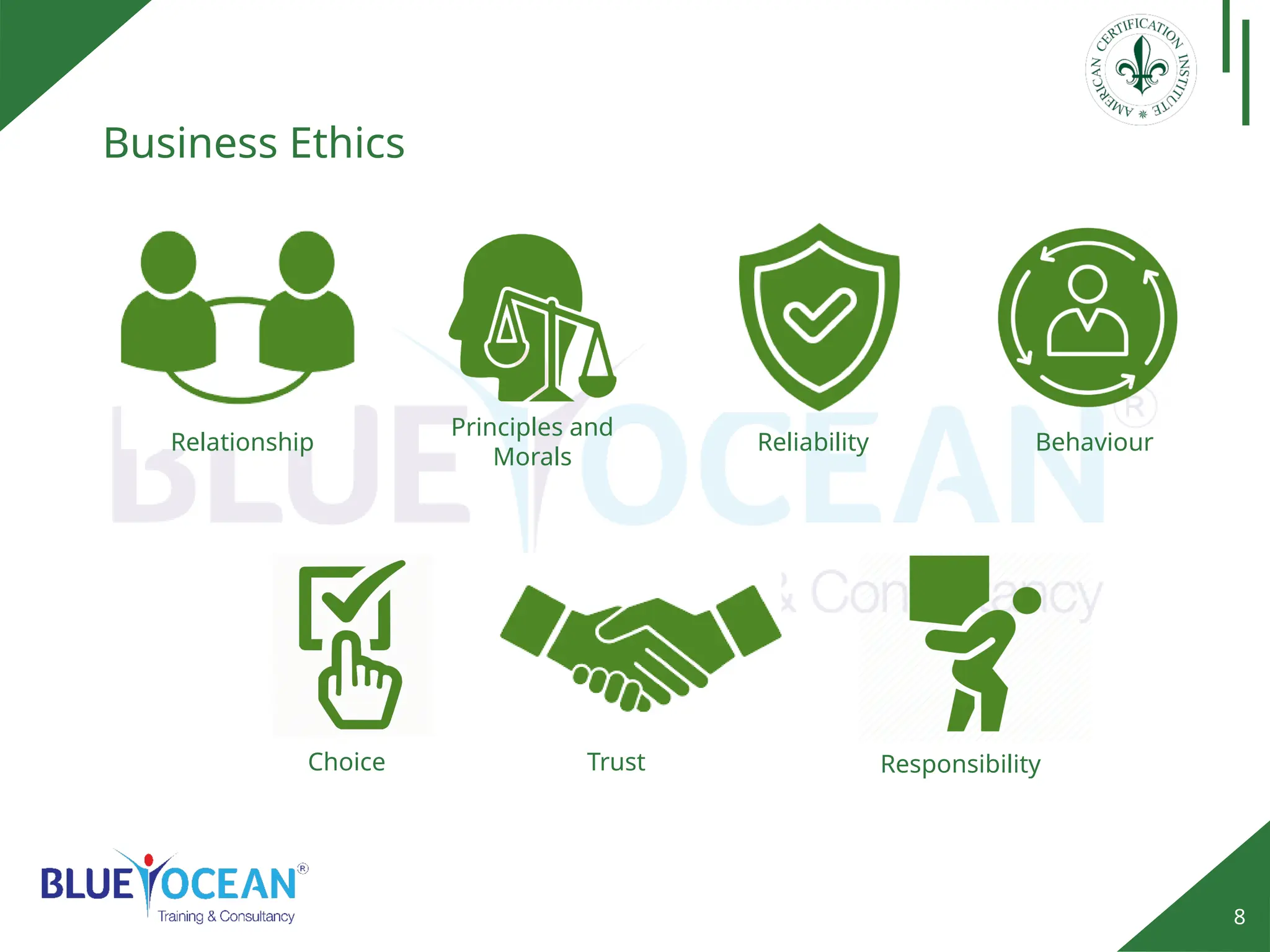
Business Ethics
Relationship
Responsibility
Trust
Reliability
Principles and
Morals
Choice
Behaviour
9
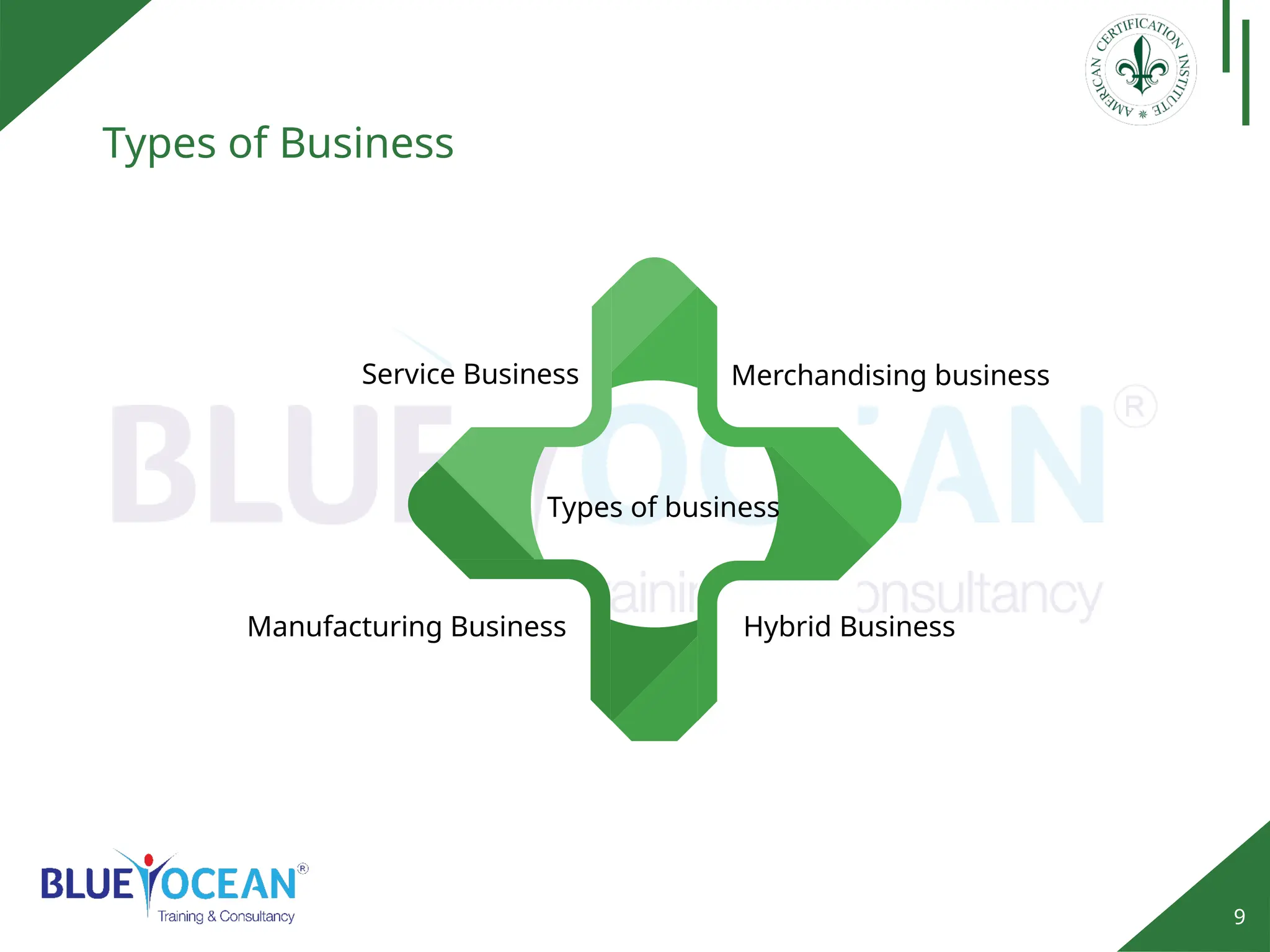
Types of Business
Types of business
Merchandising business
Service Business
Manufacturing Business Hybrid Business
10
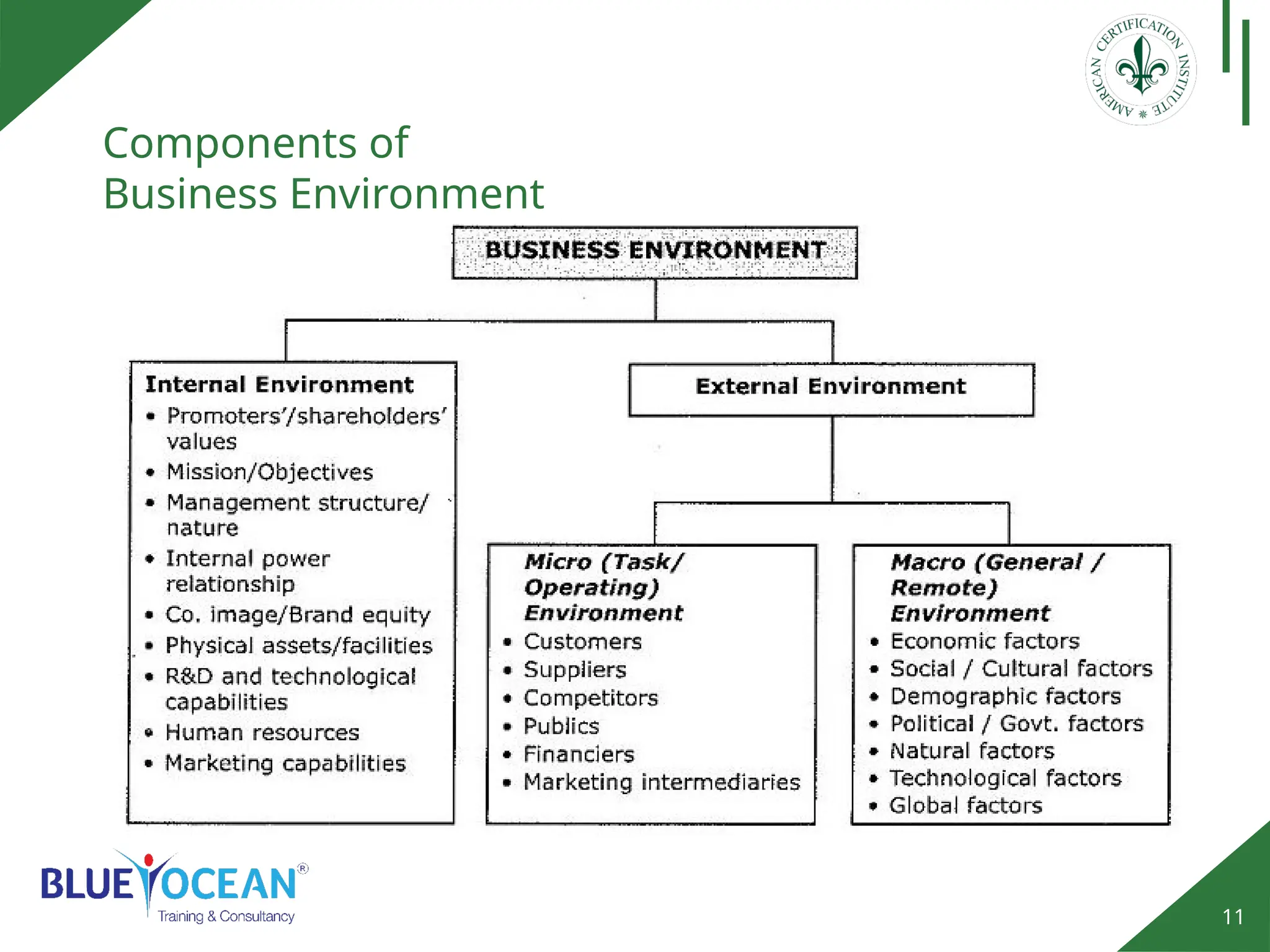
Business Environment
Every business organisation need physical resources, human resources, entities and
other factors to operate and these factors can affect its performance, profitability,
growth and even survival. The sum of all these factors and forces is called Business
Environment. There are two types of Business Environment – Internal Environment and
External Environment
11
Components of
Business Environment
12
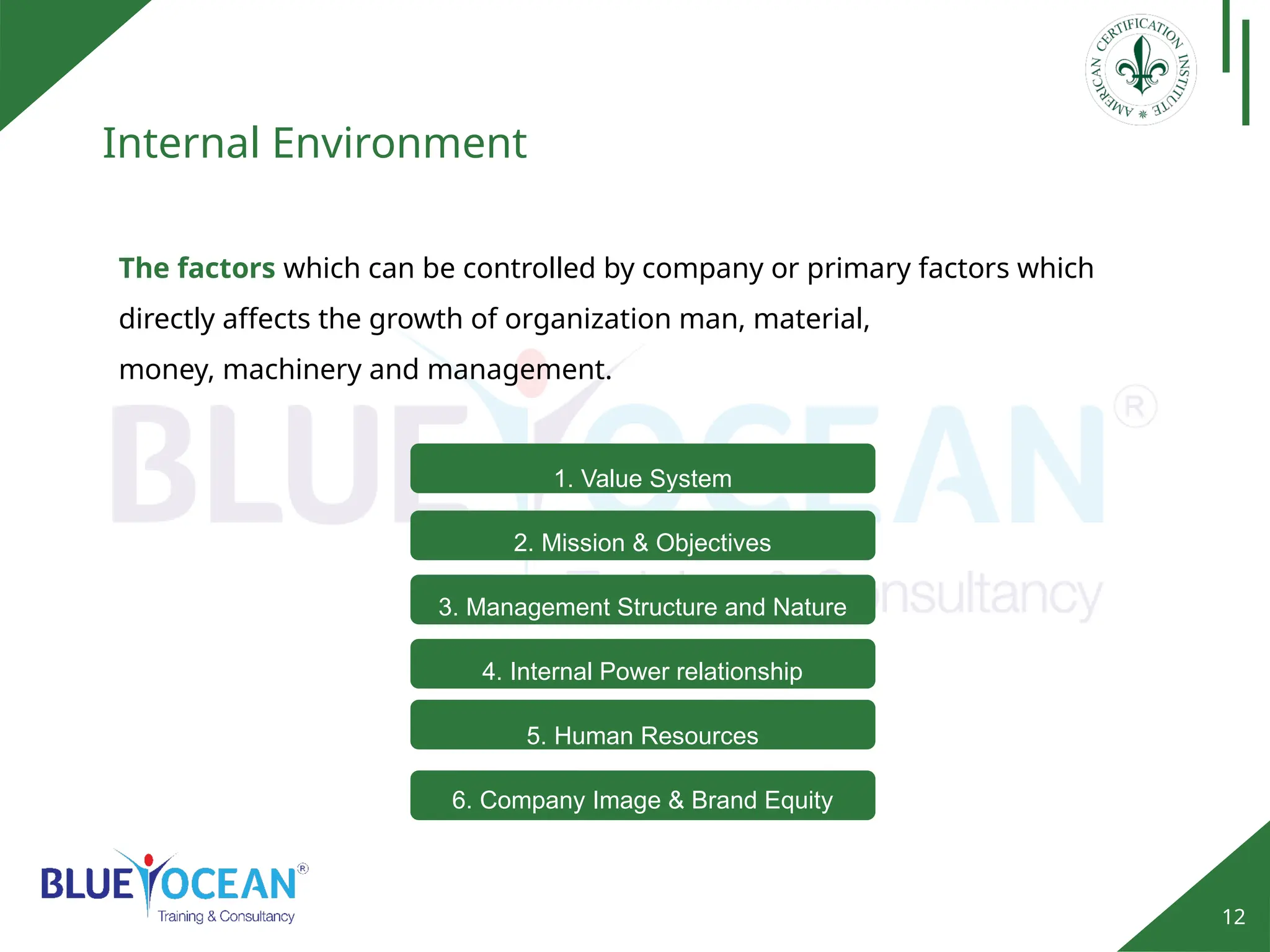
Internal Environment
The factors which can be controlled by company or primary factors which
directly affects the growth of organization man, material,
money, machinery and management.
1. Value System
2. Mission & Objectives
3. Management Structure and Nature
4. Internal Power relationship
5. Human Resources
6. Company Image & Brand Equity
13
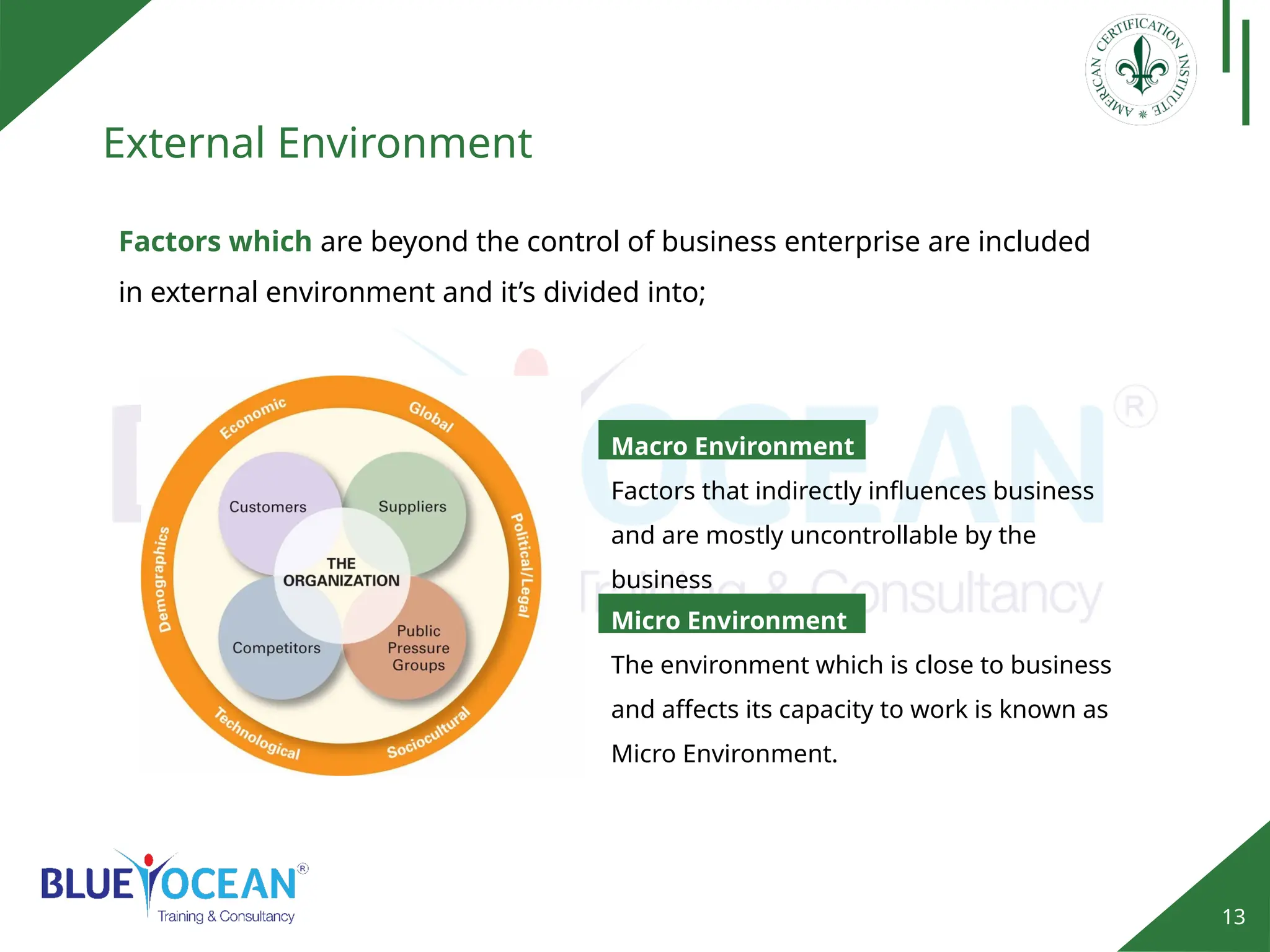
External Environment
Factors which are beyond the control of business enterprise are included
in external environment and it’s divided into;
Micro Environment
The environment which is close to business
and affects its capacity to work is known as
Micro Environment.
Macro Environment
Factors that indirectly influences business
and are mostly uncontrollable by the
business
14
Business vs Organisation
Business Organisation
15
Organisational Structure
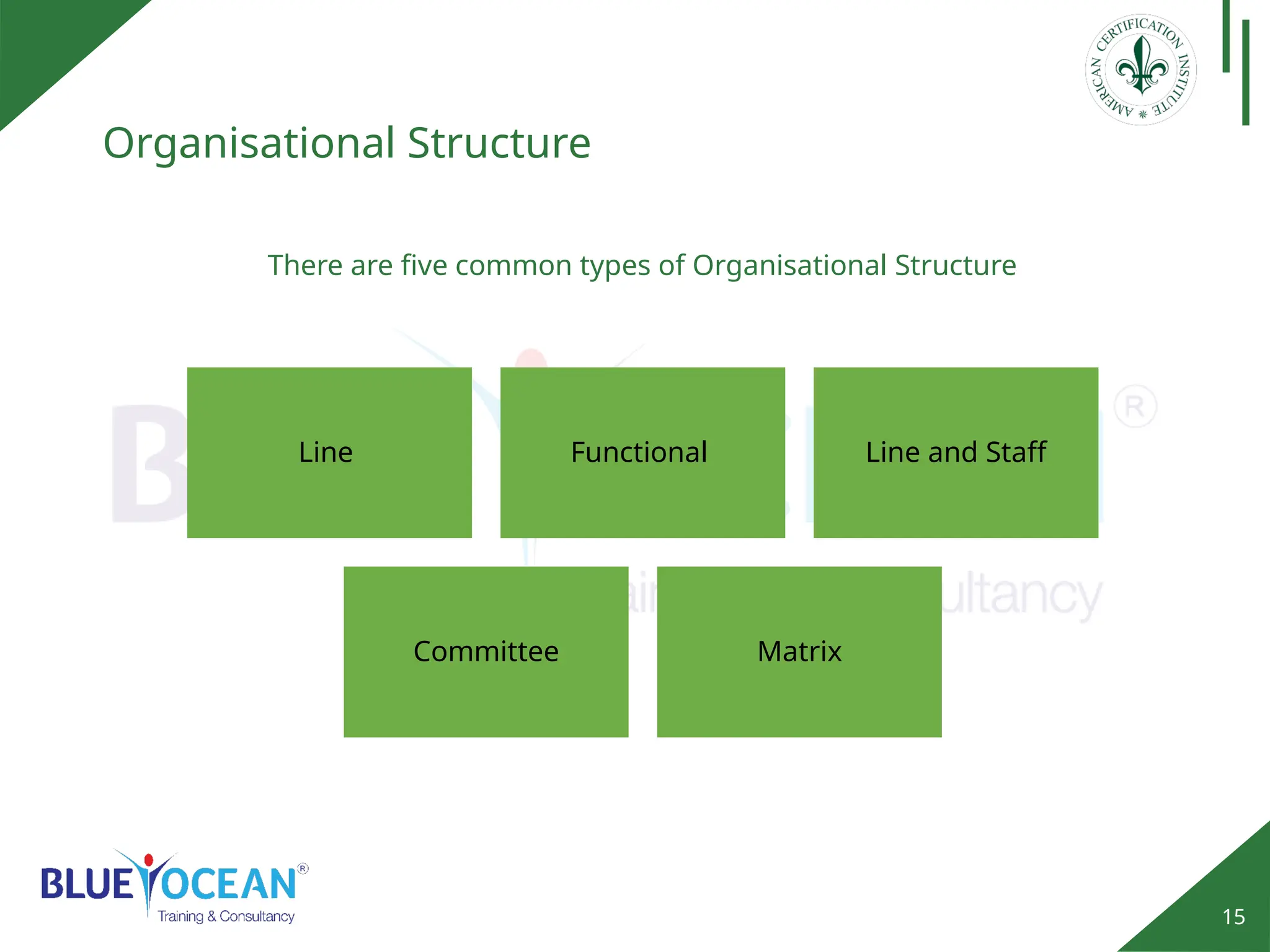
There are five common types of Organisational Structure
Line Functional Line and Staff
Committee Matrix
16
Organisational Structure
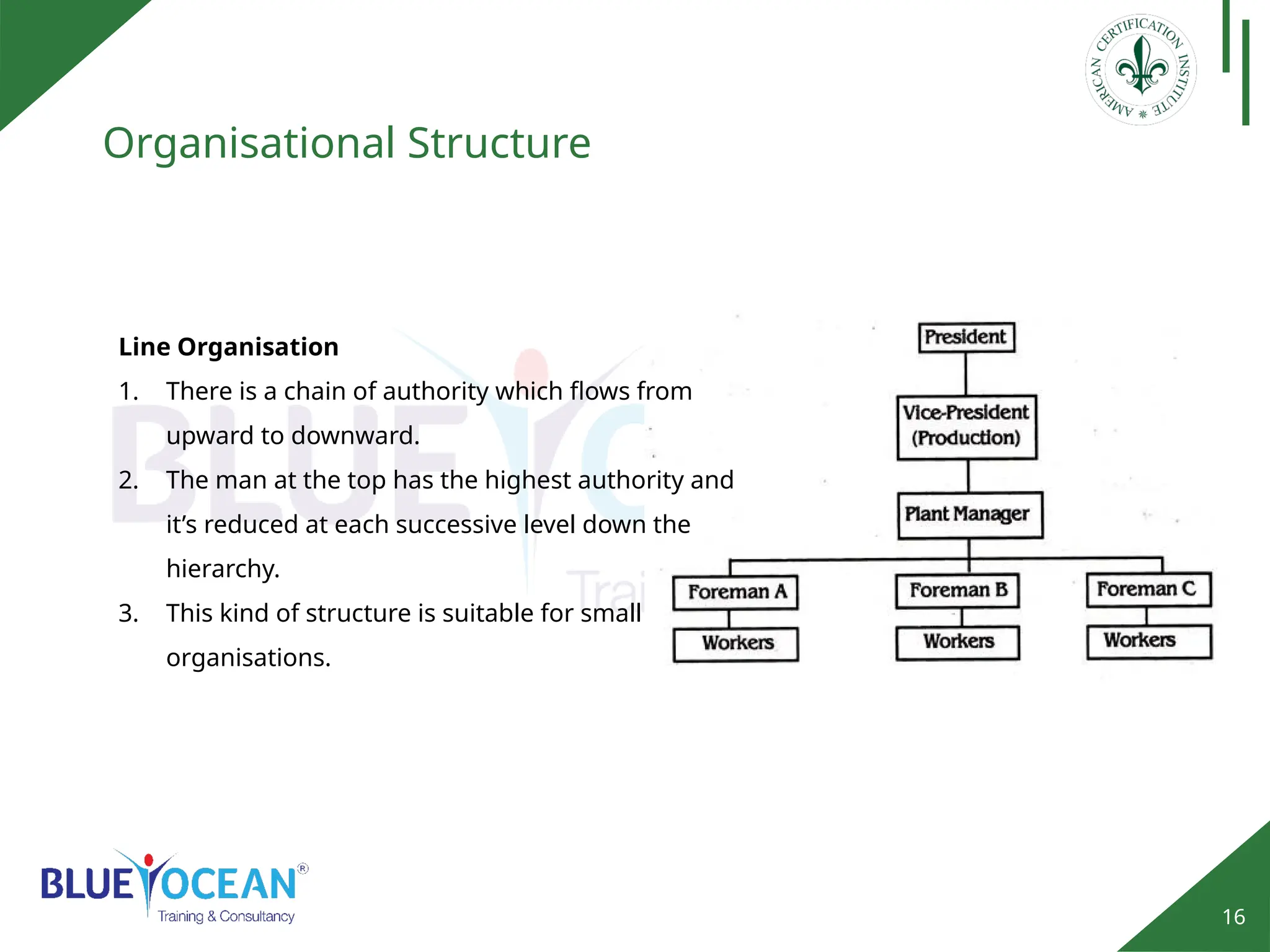
Line Organisation
1. There is a chain of authority which flows from
upward to downward.
2. The man at the top has the highest authority and
it’s reduced at each successive level down the
hierarchy.
3. This kind of structure is suitable for small
organisations.
17
Organisational Structure
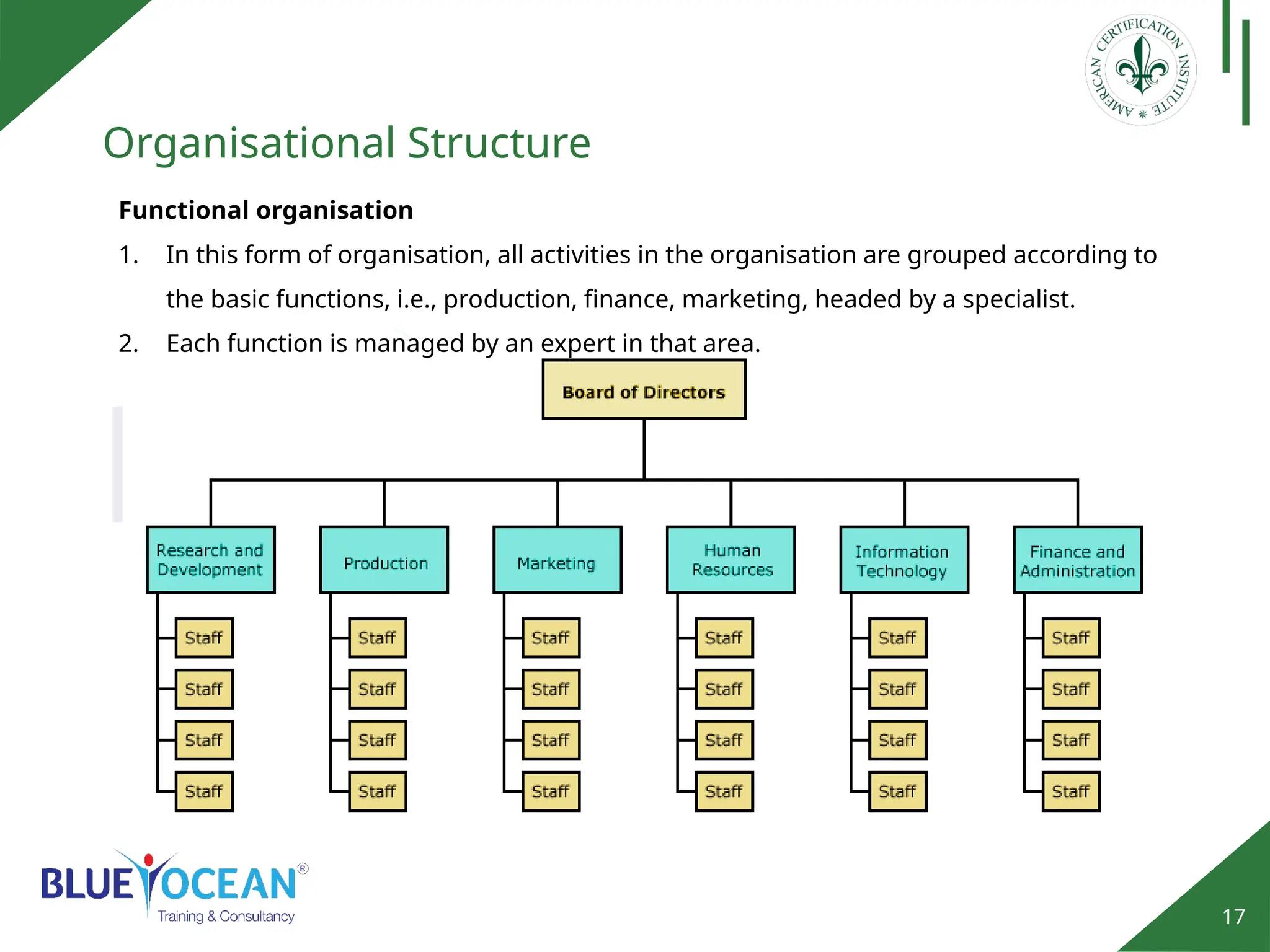
Functional organisation
1. In this form of organisation, all activities in the organisation are grouped according to
the basic functions, i.e., production, finance, marketing, headed by a specialist.
2. Each function is managed by an expert in that area.
18
Organisational Structure
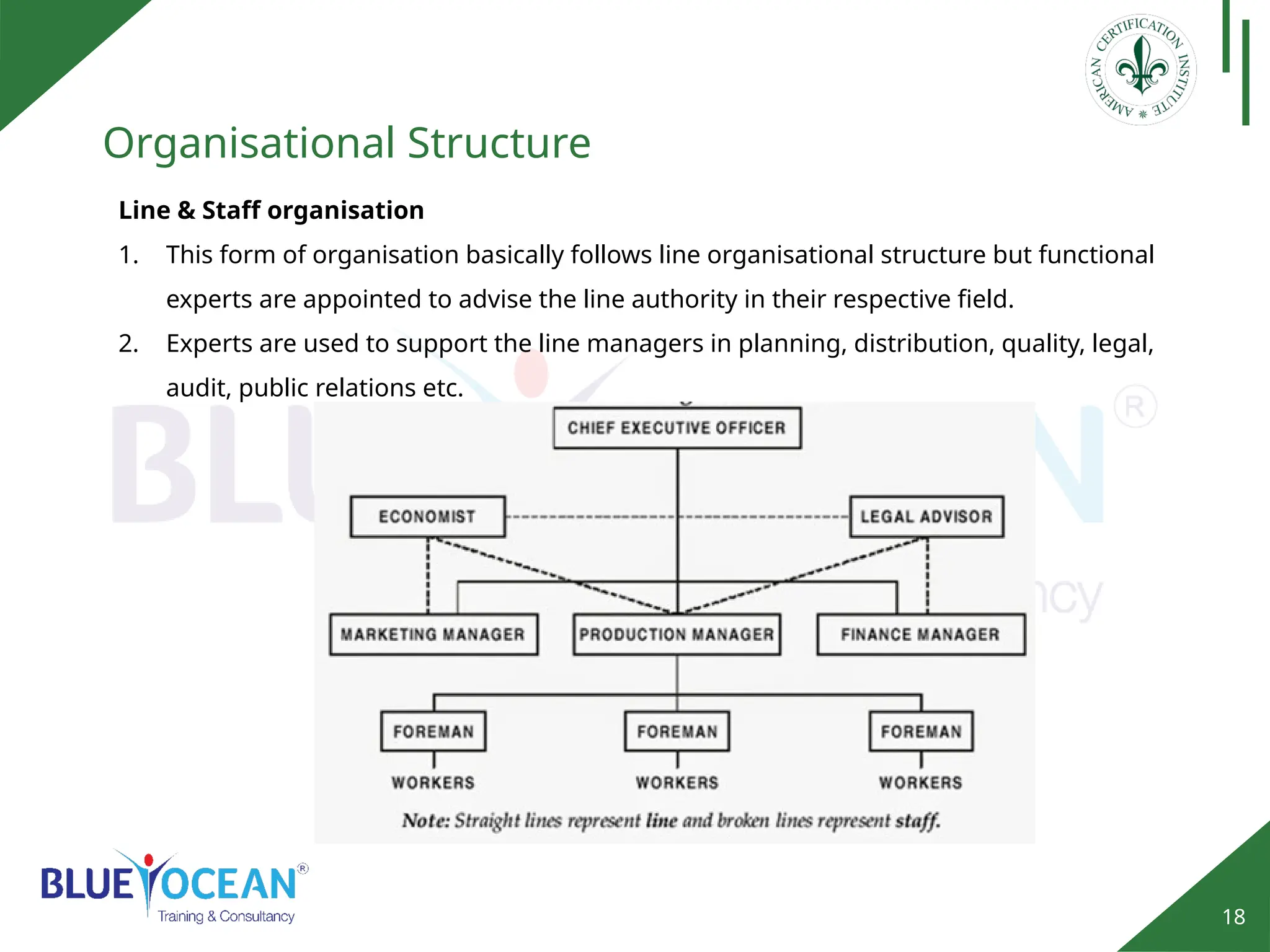
Line & Staff organisation
1. This form of organisation basically follows line organisational structure but functional
experts are appointed to advise the line authority in their respective field.
2. Experts are used to support the line managers in planning, distribution, quality, legal,
audit, public relations etc.
19
Organisational Structure
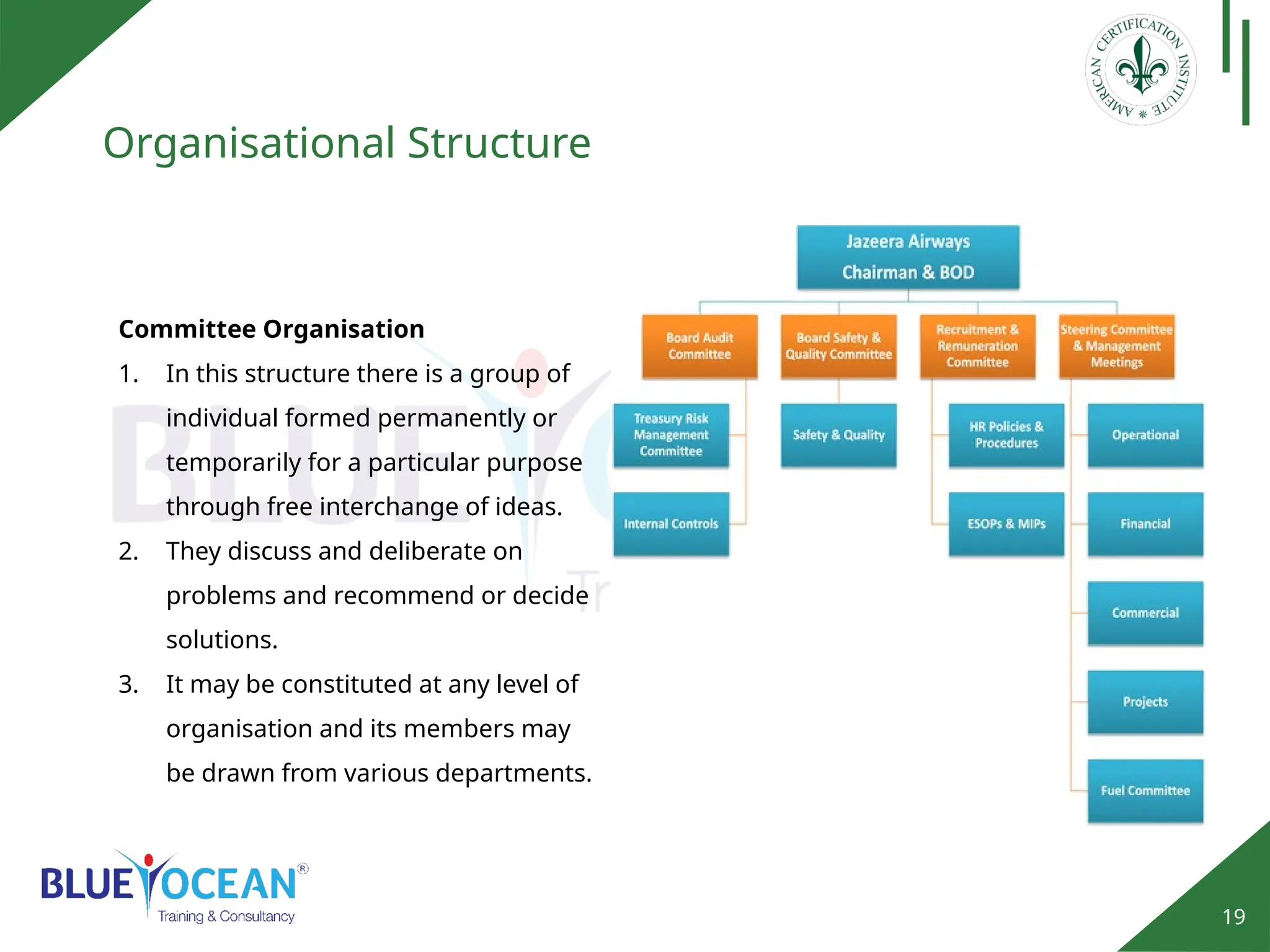
Committee Organisation
1. In this structure there is a group of
individual formed permanently or
temporarily for a particular purpose
through free interchange of ideas.
2. They discuss and deliberate on
problems and recommend or decide
solutions.
3. It may be constituted at any level of
organisation and its members may
be drawn from various departments.
20
Organizational Structure
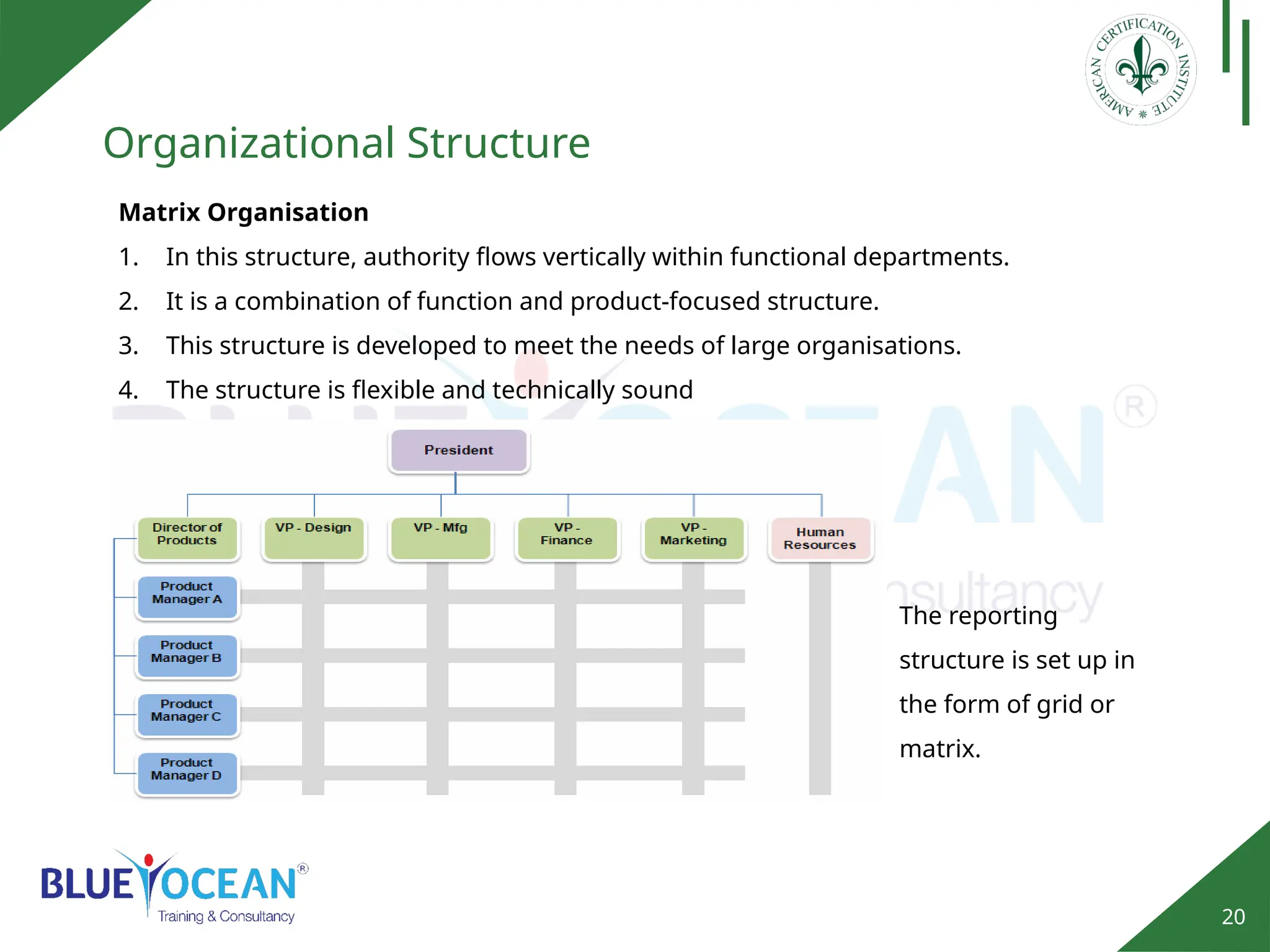
Matrix Organisation
1. In this structure, authority flows vertically within functional departments.
2. It is a combination of function and product-focused structure.
3. This structure is developed to meet the needs of large organisations.
4. The structure is flexible and technically sound
The reporting
structure is set up in
the form of grid or
matrix.
21
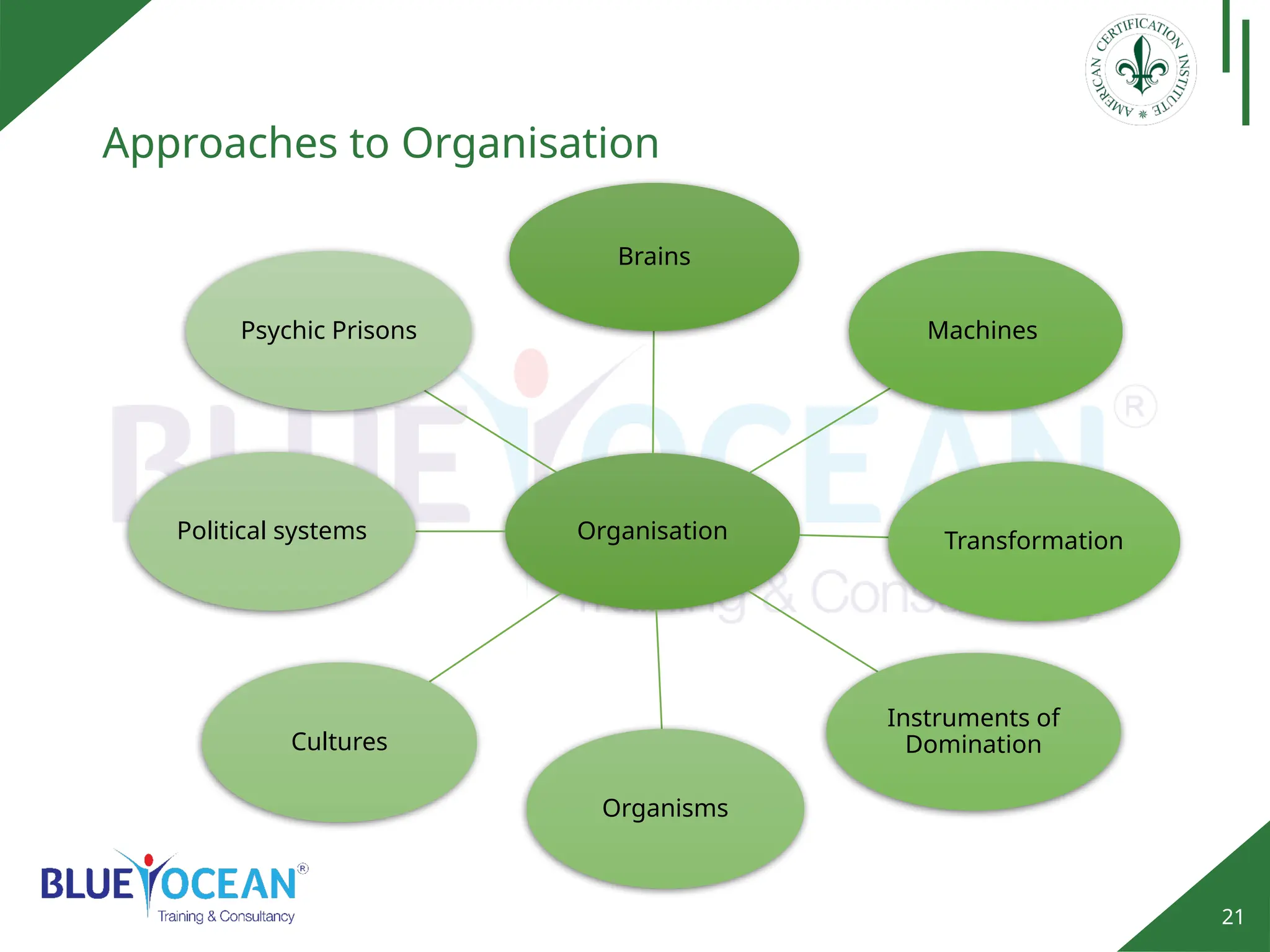
Approaches to Organisation
Organisation
Brains
Machines
Transformation
Instruments of
Domination
Organisms
Cultures
Political systems
Psychic Prisons
22
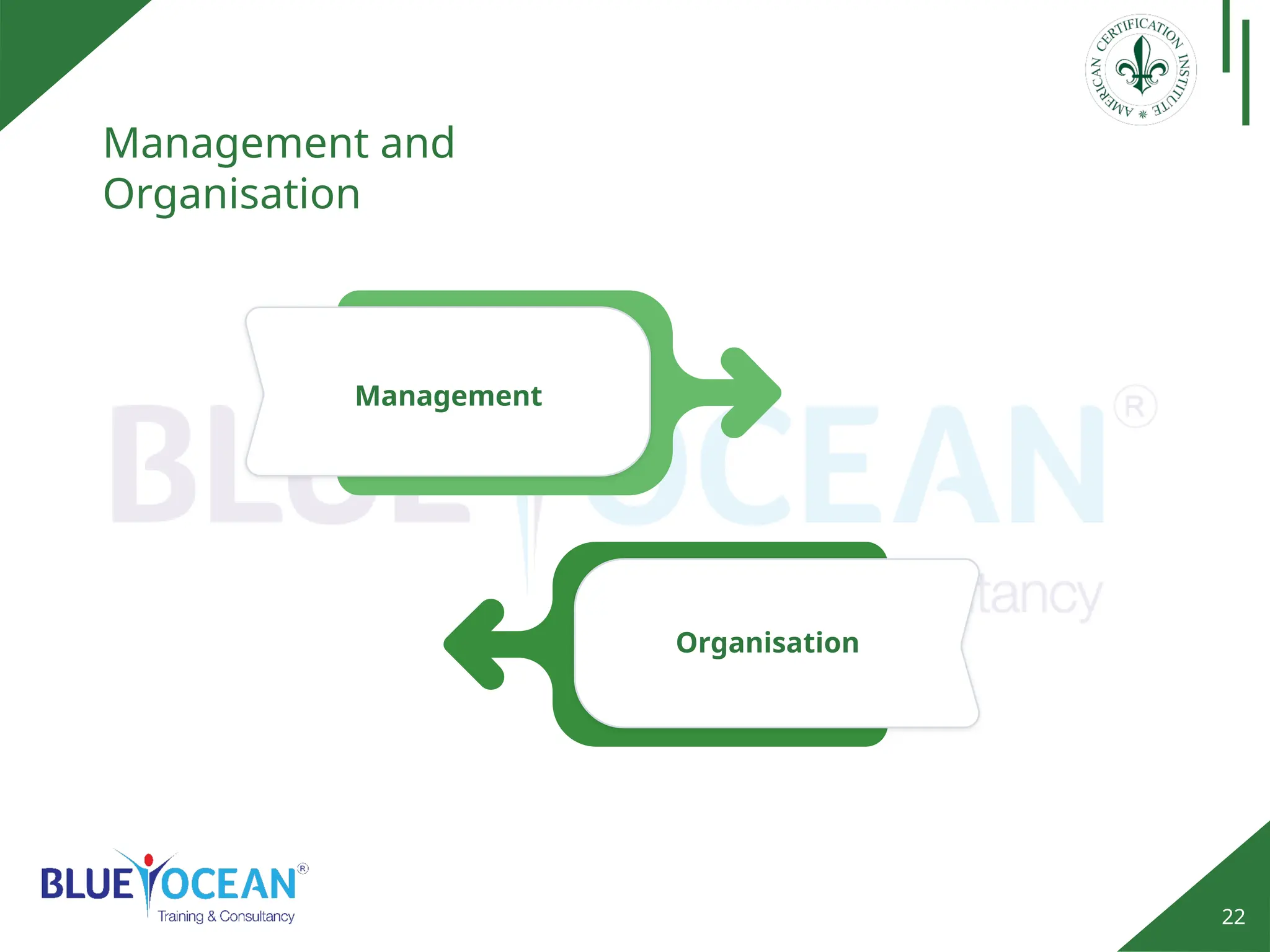
Management and
Organisation
Management
Organisation
23
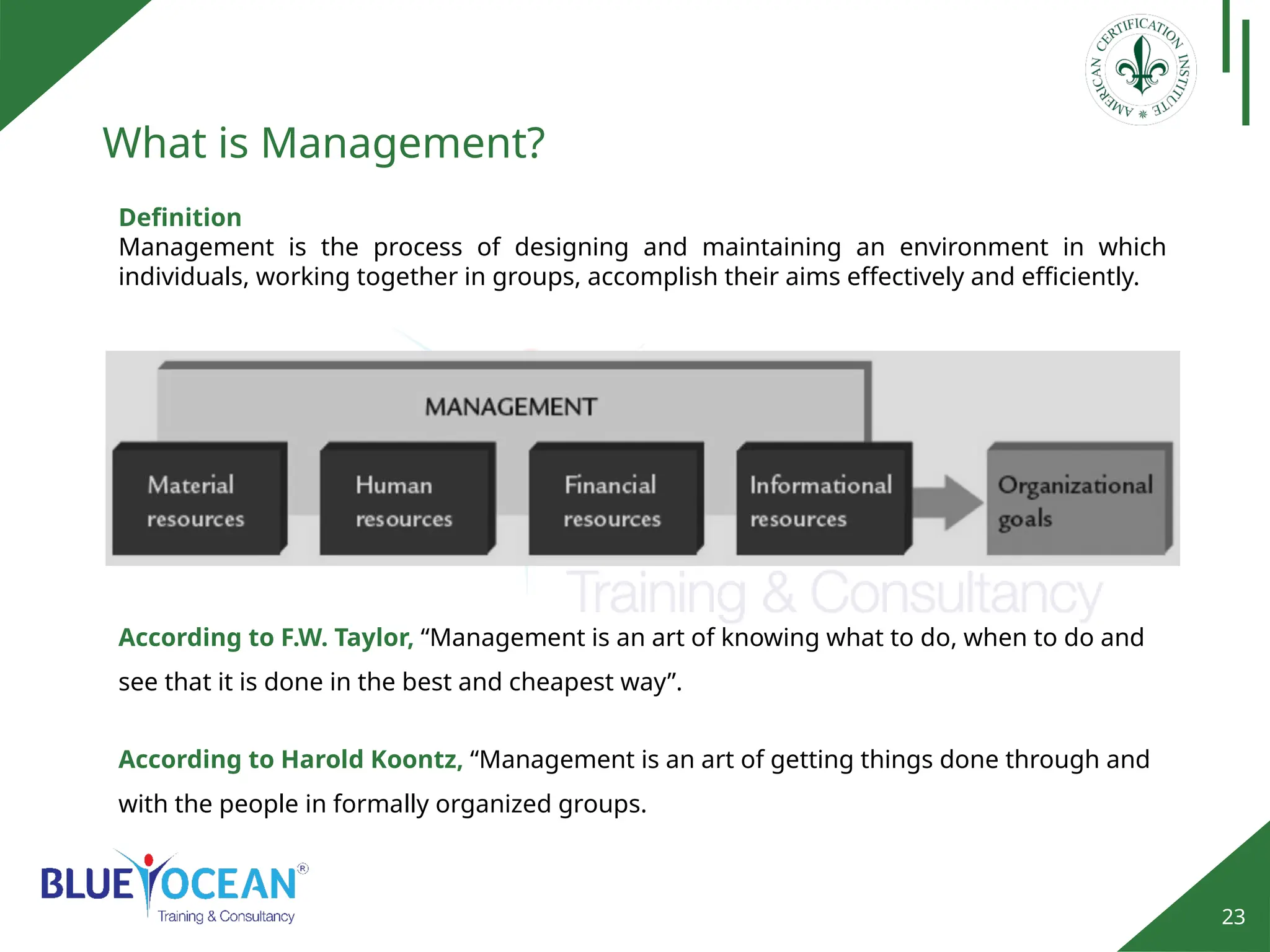
What is Management?
Definition
Management is the process of designing and maintaining an environment in which
individuals, working together in groups, accomplish their aims effectively and efficiently.
According to F.W. Taylor, “Management is an art of knowing what to do, when to do and
see that it is done in the best and cheapest way”.
According to Harold Koontz, “Management is an art of getting things done through and
with the people in formally organized groups.
24
What is Management?
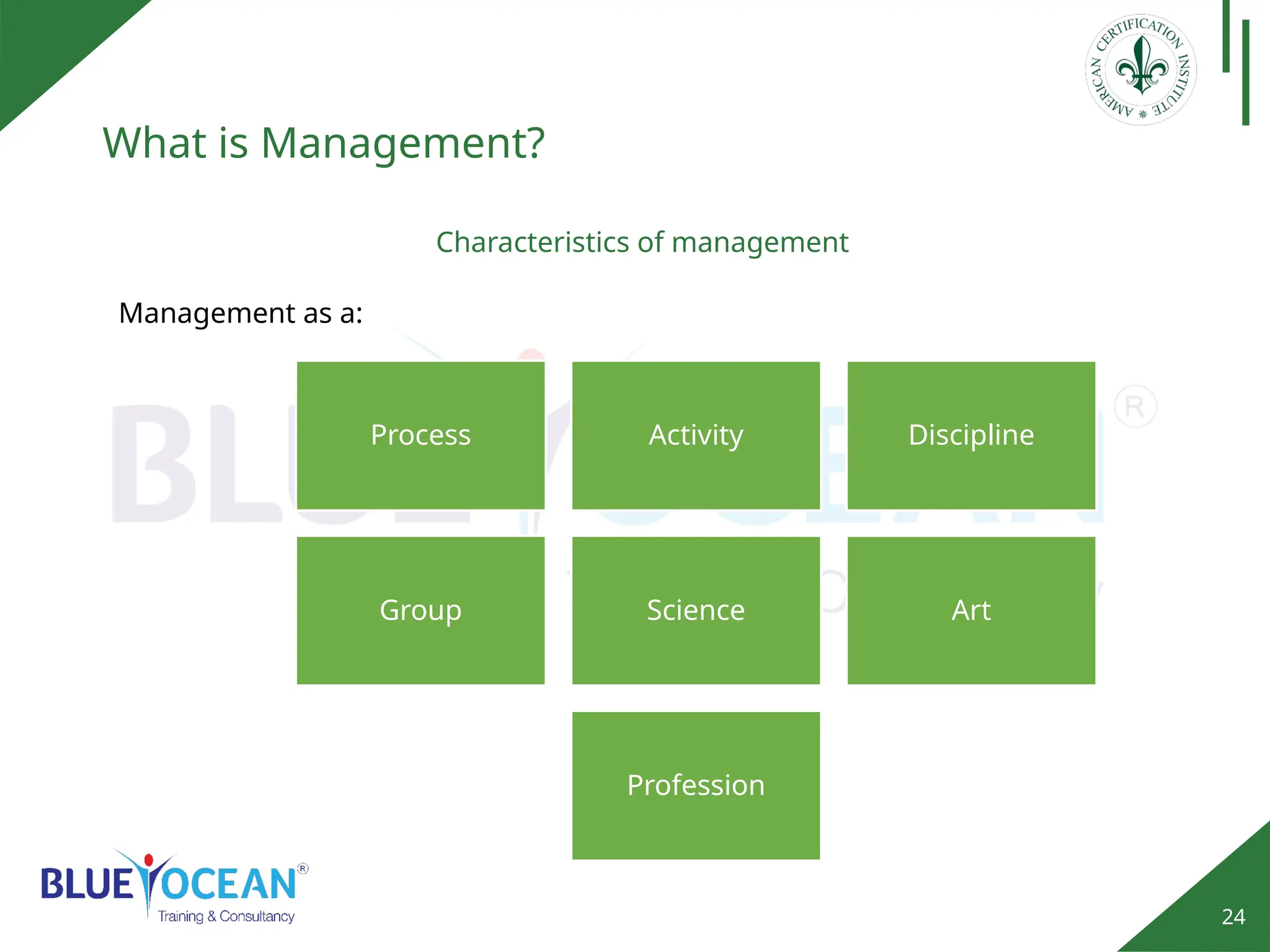
Characteristics of management
Management as a:
Process Activity Discipline
Group Science Art
Profession
25
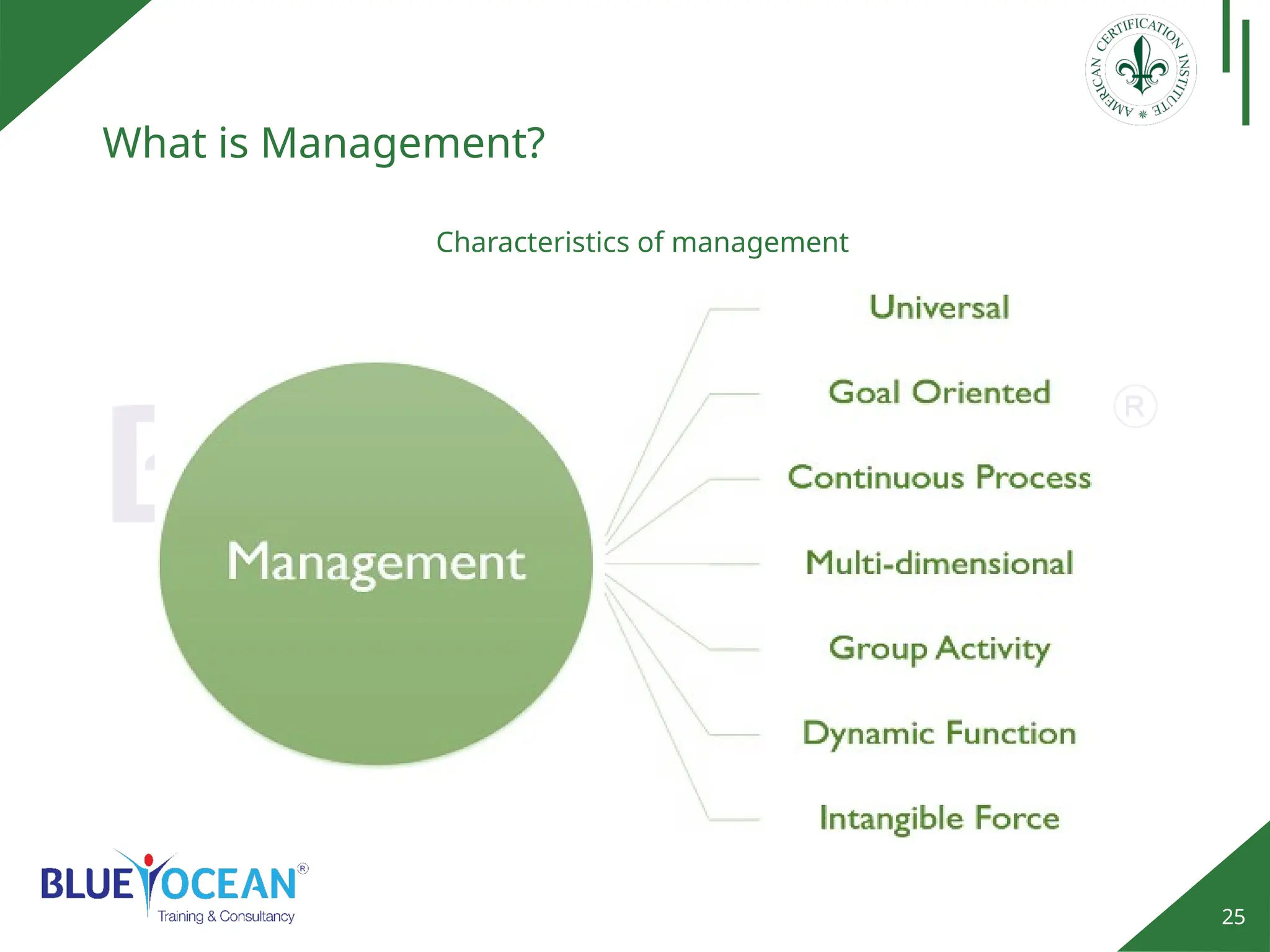
What is Management?
Characteristics of management
26
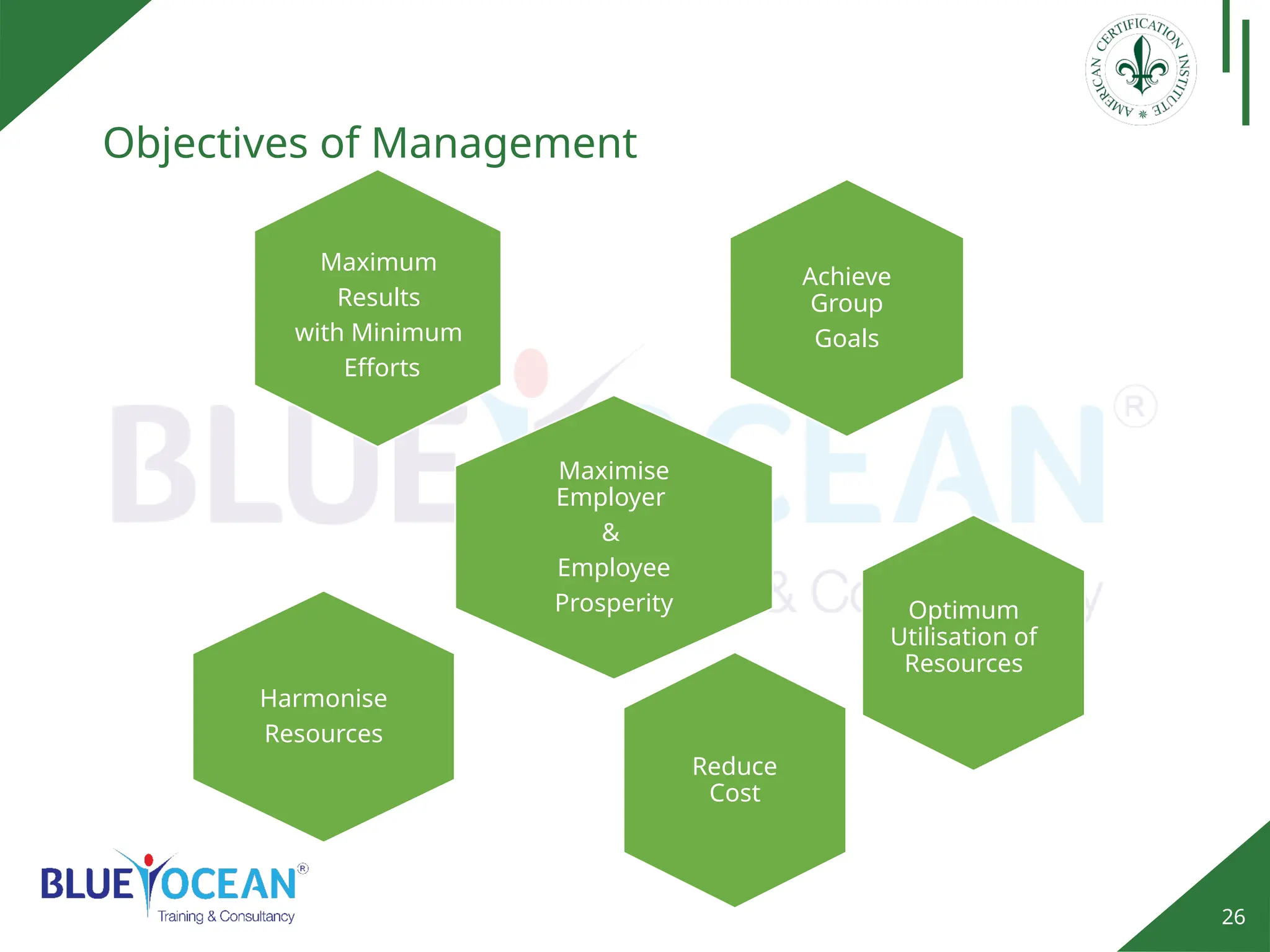
Objectives of Management
Achieve
Group
Goals
Maximise
Employer
&
Employee
Prosperity
Maximum
Results
with Minimum
Efforts
Reduce
Cost
Optimum
Utilisation of
Resources
Harmonise
Resources
27
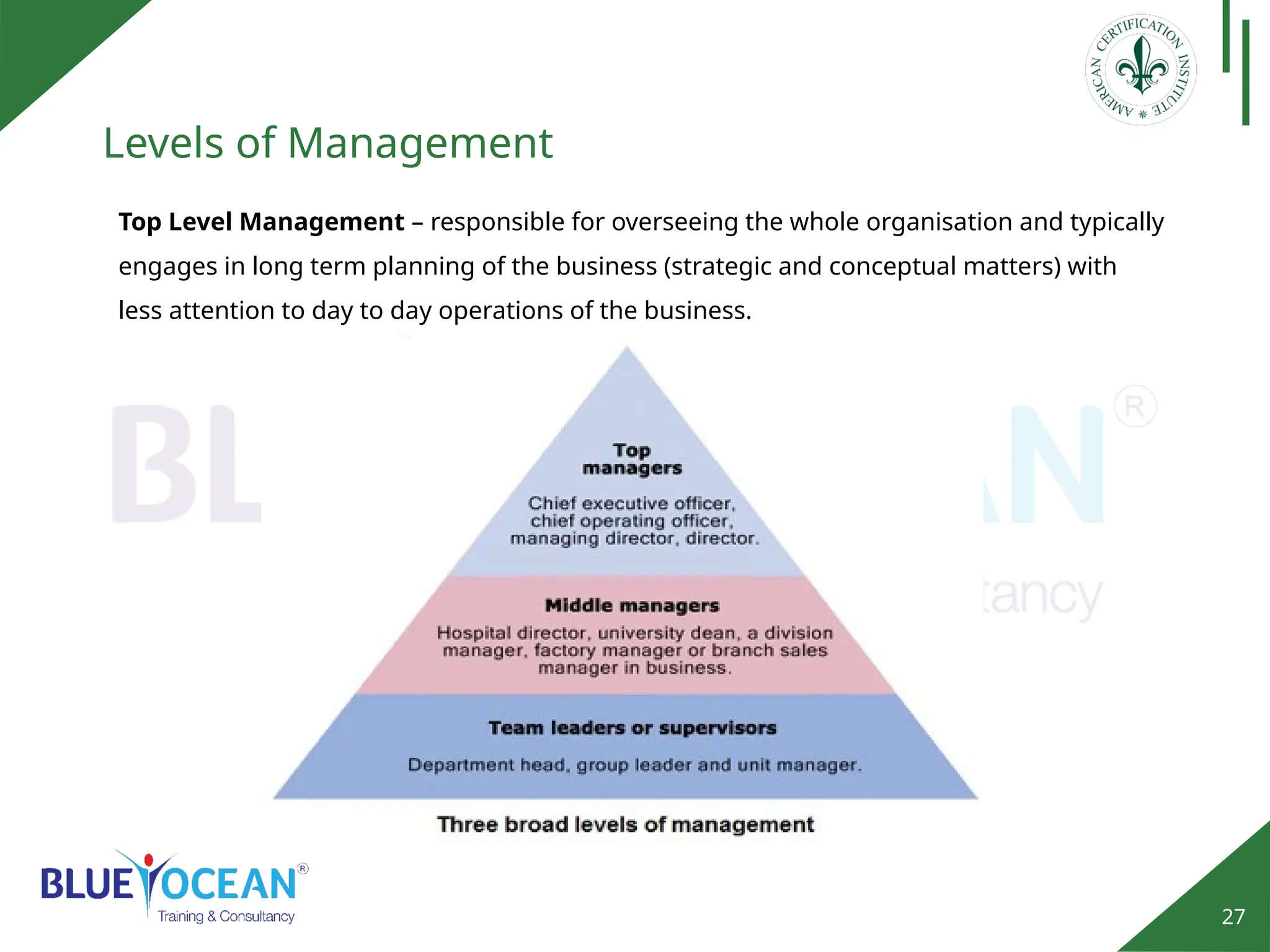
Levels of Management
Top Level Management – responsible for overseeing the whole organisation and typically
engages in long term planning of the business (strategic and conceptual matters) with
less attention to day to day operations of the business.
28
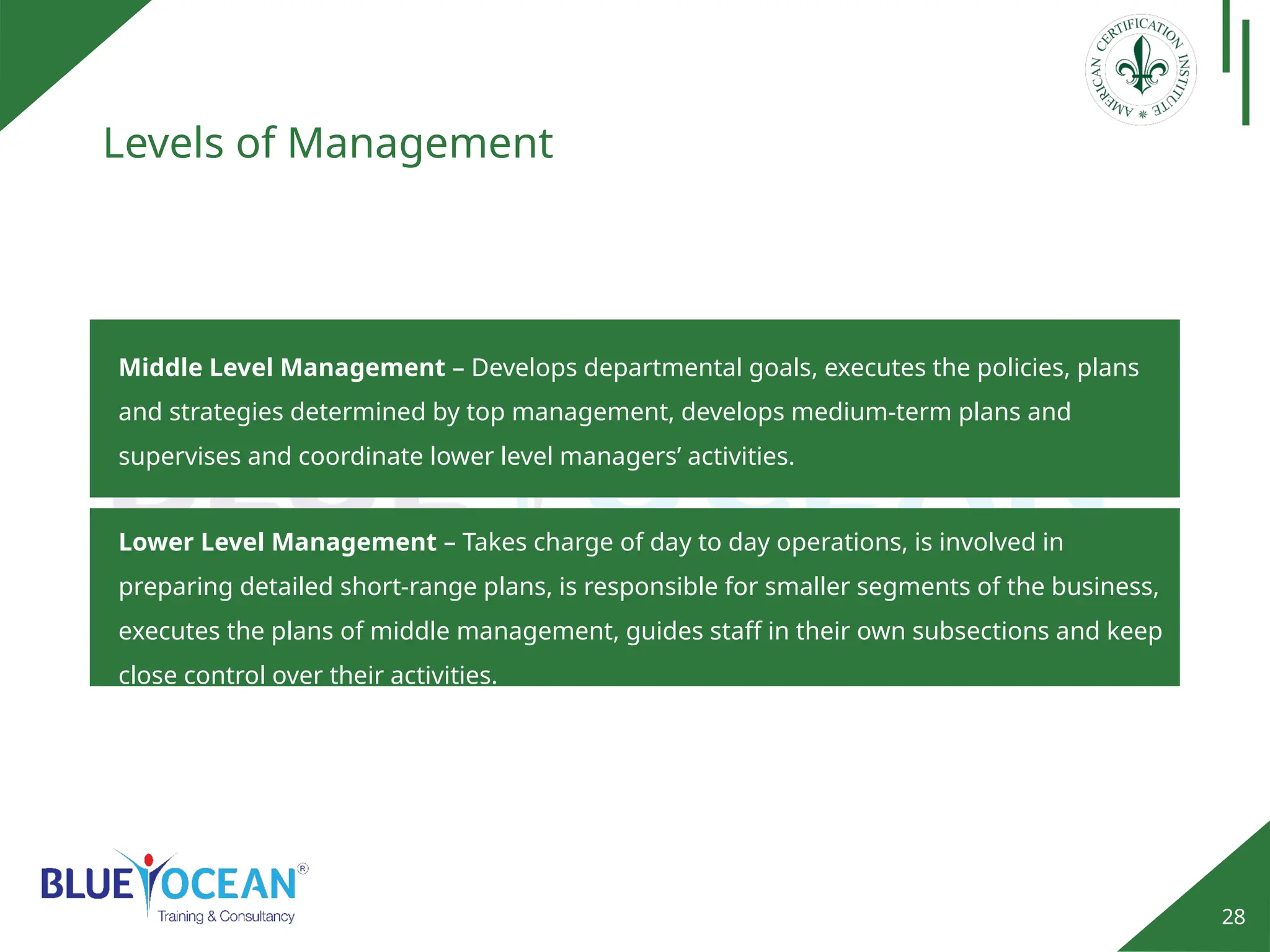
Levels of Management
Lower Level Management – Takes charge of day to day operations, is involved in
preparing detailed short-range plans, is responsible for smaller segments of the business,
executes the plans of middle management, guides staff in their own subsections and keep
close control over their activities.
Middle Level Management – Develops departmental goals, executes the policies, plans
and strategies determined by top management, develops medium-term plans and
supervises and coordinate lower level managers’ activities.
29
Functions of Management
Planning
Basic function of the Management. Planning is deciding in advance – what to do, when to
do & how to do. It bridges the gap from where we are and where we want to be. It is a
future course of action.
Organising
The process of bringing together physical, financial, human resources and developing
productive relationship among them for achievement of organisational goals.
30
Functions of Management
Controlling
The process of checking the progression, whether every activity or process is moving
towards the goals, if not corrective actions are taken.
Directing
The process of influencing, guiding, supervising, motivating staff for achieving the
organisational goals.
Staffing
The process of acquiring, training, appraising and compensating a workforce of sufficient
quantity and quality to create positive impact on the effectiveness of the organization.
31
Functions of Management
All Managers carry out managerial functions, however the time spent for each function
may differ. Top level managers spend more time on planning, Middle Level managers
spends more time on organising and Lower level managers spends more time on
Directing and Controlling.
32
Managerial Skills
Technical Skills
The ability to use special
proficiency or expertise to
perform particular tasks.
Conceptual Skills
The ability to think analytically (to
see the bigger picture).
Human Skills
The ability to work effectively
with people.
33
Managerial Skills
Leadership — ability to influence others to perform tasks
Self‐objectivity — ability to evaluate oneself realistically
Analytic thinking — ability to interpret and explain patterns in information
Behavioral flexibility — ability to modify personal behavior to react objectively rather
than subjectively to accomplish organizational goals
Oral communication — ability to express ideas clearly in words
Written communication — ability to express ideas clearly in writing
Personal impact — ability to create a good impression and instill confidence
Resistance to stress — ability to perform under stressful conditions
Tolerance for uncertainty — ability to perform in ambiguous situations
34
Office administration
35
Office Administration
What is Office?
36
Office Administration
Office administration is the process of overseeing the day-to-day
operations that ensures operational needs of an office is
efficiently addressed and business functions smoothly.
Office administration is one of the key elements
associated with a high level of workplace productivity
and efficiency. It is very difficult to run an organization
without a good office administrator.
37
Role of an Office
Administrator
Office administrators are responsible for a
wide range of tasks for effective functioning of
an organisation:
1. Manage department budget & expenses
2. Schedule appointments & meeting
3. Prepare reports, presentation,
memorandum, business communication
and proposal
4. Manage Administrative Personnel
5. Filing & records management
6. Managing office supplies
7. Maintenance of office equipment
38
Skill Set of an Office Administrator
The importance of an office administrator to an
organization is substantial due to the duties that
they are entrusted with. Therefore, specialized
training is required for the employee to work
efficiently and productively, these being;
 Payroll training that involves the responsibility in
ensuring that all employees receive their pay
slips on time.
 To have good communication skills in order to
coordinate with other employees around the
organization.
39
Skill Set of an Office Administrator
 The ability of being able to supervise support
workers
 The ability of adapting to changing
environments and new technologies that
could be implemented e.g. New software
installation.
 Show good initiative
 To be able to work under pressure when
given a task that is of vital importance to the
organization.
40
Roles of an Office / Business
Administrator
There are an extensive range of roles that can be associated with an office administrator,
these being; organizations advertise junior office administrator vacancies targeted at
students who are currently studying or who have left secondary school or college, the
opportunity to gain experience or build a career through full-time work or an internship
over the course of a summer break.
Roles of Office / Business Administrator
41
Roles of an Office / Business
Administrator
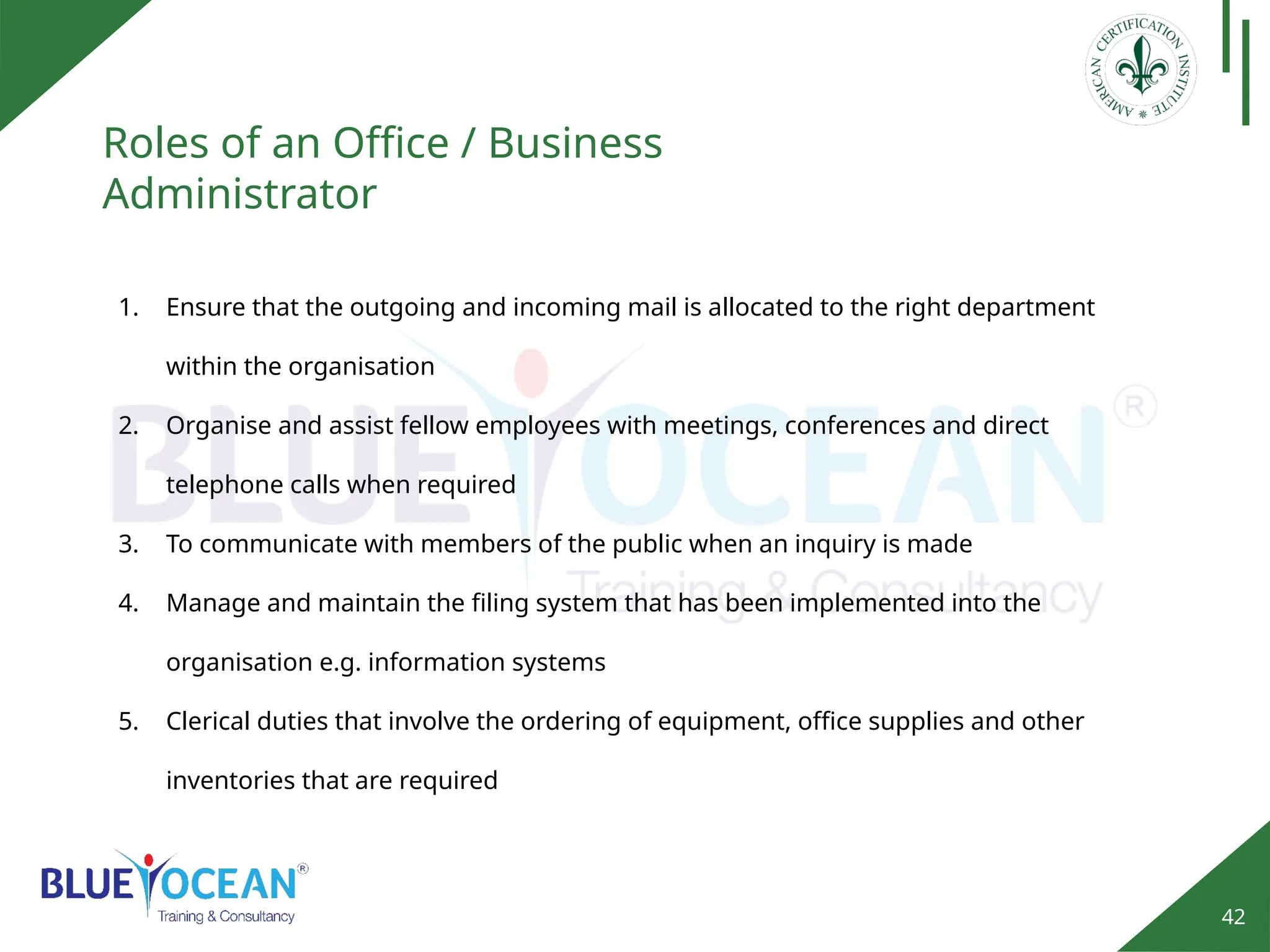
Receptionists play a key role in the organisation’s
management, as they are entrusted with
arranging
and greeting the clients, suppliers and visitors
directly via emails, phone calls or direct mail.
The employee undertaking the role of a
receptionist must show good organisational,
communication and customer service skills in
order to ensure efficiency with the organisation.
Other responsibilities that a receptionist is
entrusted with are;
42
Roles of an Office / Business
Administrator
1. Ensure that the outgoing and incoming mail is allocated to the right department
within the organisation
2. Organise and assist fellow employees with meetings, conferences and direct
telephone calls when required
3. To communicate with members of the public when an inquiry is made
4. Manage and maintain the filing system that has been implemented into the
organisation e.g. information systems
5. Clerical duties that involve the ordering of equipment, office supplies and other
inventories that are required
43
Roles of an Office / Business
Administrator
Personal Assistants are commonly associated with an office manager that help maintain
the efficiency of their day-to-day work, this is through providing secretarial support and
assistance. Becoming a personal assistant requires the employee to have experience in
previous administrative jobs, in which entailed the use of computers and information
systems.
Like any other role that is related to an office administrator, the job title of personal
assistant requires the employee to be organized, show professionalism and the ability to
work under pressure when given a task of vital importance. The duties that a personal
assistant must carry out each day are the following;
44
Roles of an Office / Business
Administrator
1. The task of inputting, filing and managing the data that is stored within the
organization's office system
2. Personal assistants act as a first hand to the office manager so they must ensure that
all contacts from third party individuals are processed through them
3. To arrange transportation and meetings that are of importance to the office manager
4. Ensure that documents, reports ad presentations are set up prior to any meetings
5. Process emails and letters that are received in correspondence to the office manager
45
Roles of an Office / Business
Administrator
An office manager has the responsibility of ensuring that an organisation's office duties
are completed efficiently and effectively, while also supervising other staff members.
The role of an office manager is more demanding than other administrative positions,
including such skills and qualifications as strong administrative experience, competency in
human resources, reporting skills, delegation, management processes and the ability to
communicate with other members of the organisation.
46
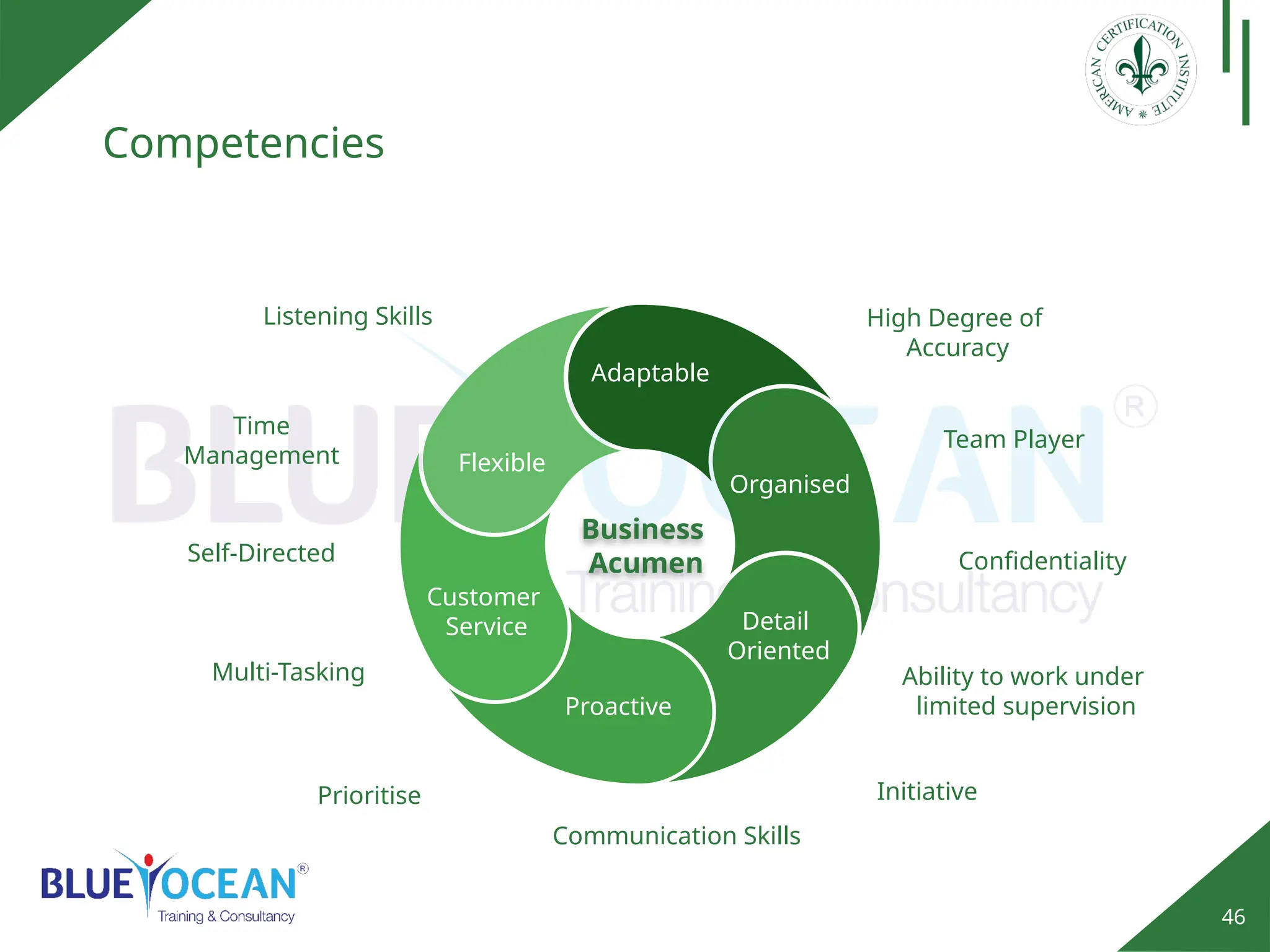
Competencies
Organised
Proactive
Detail
Oriented
Adaptable
Customer
Service
Flexible
Business
Acumen
High Degree of
Accuracy
Team Player
Confidentiality
Ability to work under
limited supervision
Initiative
Communication Skills
Multi-Tasking
Self-Directed
Listening Skills
Time
Management
Prioritise
49
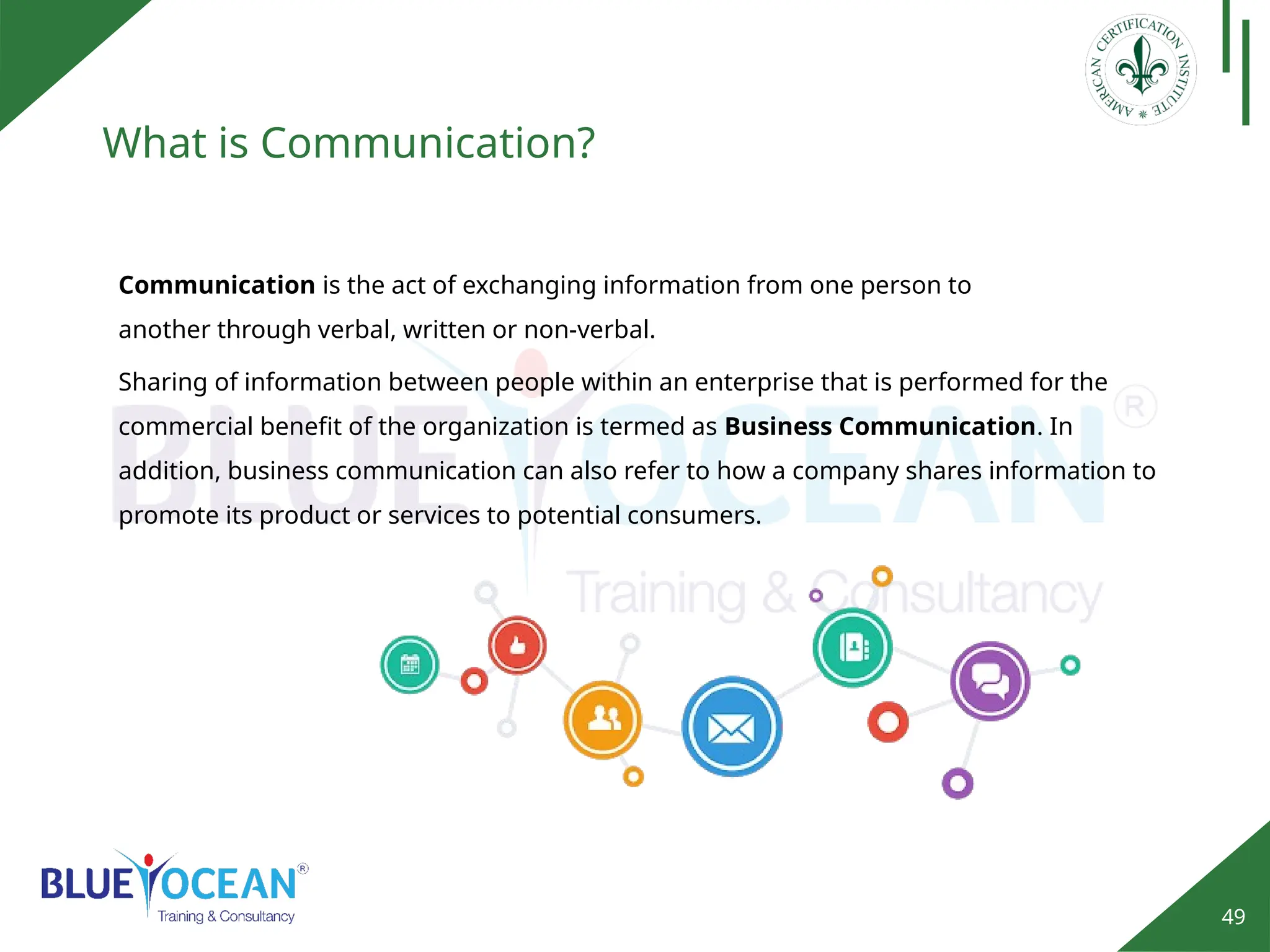
What is Communication?
Sharing of information between people within an enterprise that is performed for the
commercial benefit of the organization is termed as Business Communication. In
addition, business communication can also refer to how a company shares information to
promote its product or services to potential consumers.
Communication is the act of exchanging information from one person to
another through verbal, written or non-verbal.
50
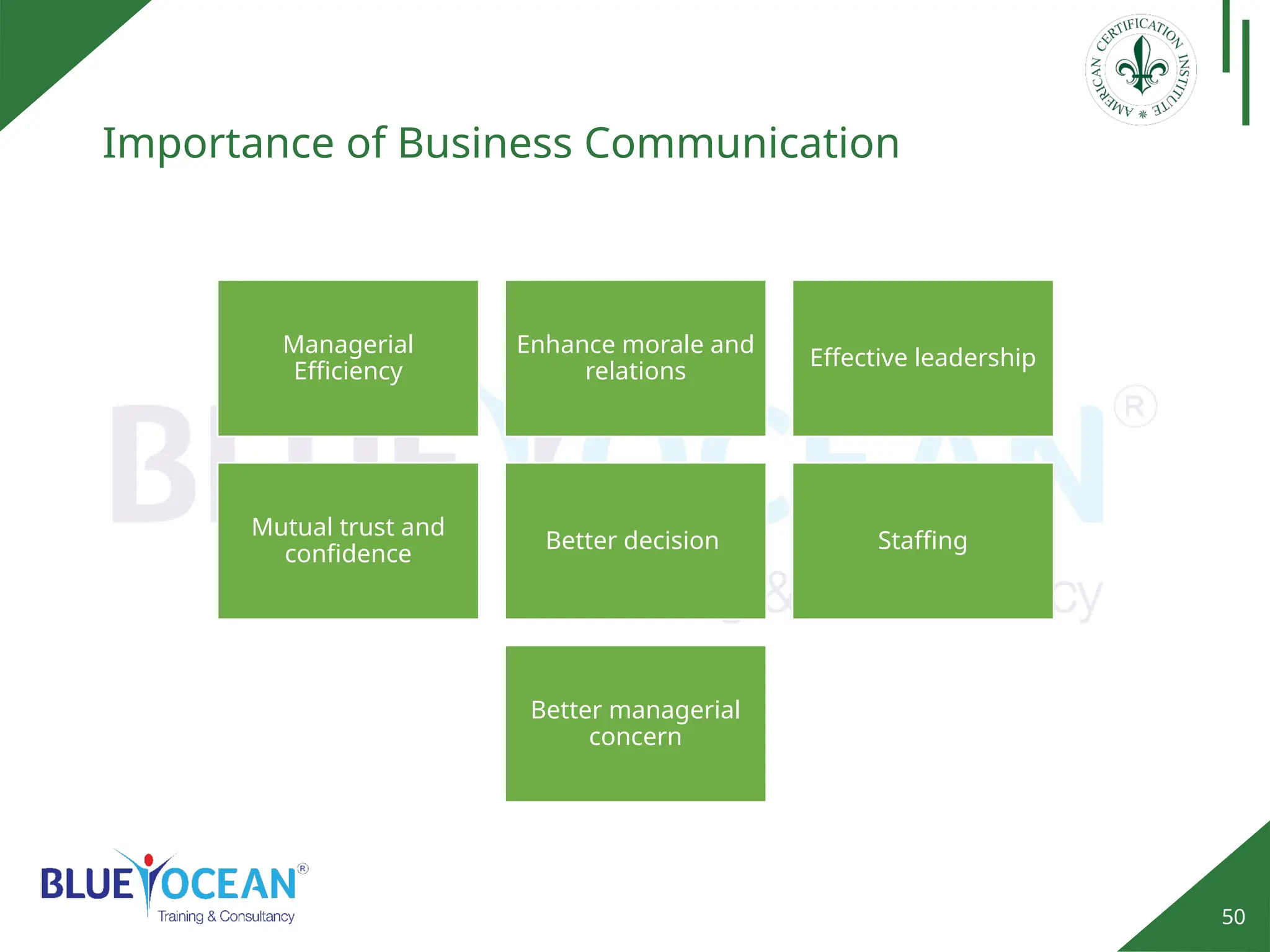
Importance of Business Communication
Managerial
Efficiency
Enhance morale and
relations
Effective leadership
Mutual trust and
confidence
Better decision Staffing
Better managerial
concern
51
Process of Communication
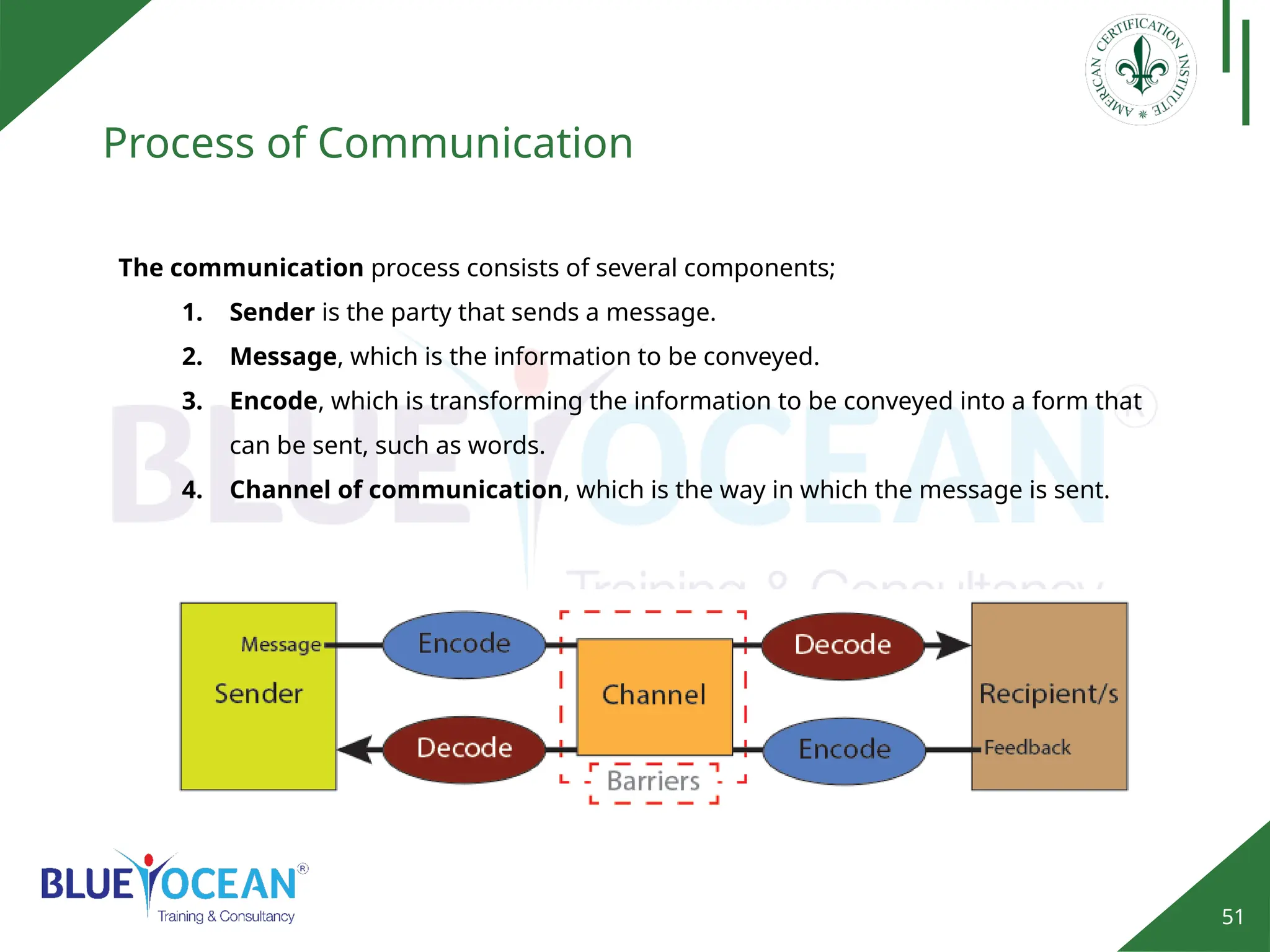
The communication process consists of several components;
1. Sender is the party that sends a message.
2. Message, which is the information to be conveyed.
3. Encode, which is transforming the information to be conveyed into a form that
can be sent, such as words.
4. Channel of communication, which is the way in which the message is sent.
52
Process of Communication
Channels of communication include speaking, writing, video transmission, audio
transmission, electronic transmission through emails, text messages and faxes and even
nonverbal communication, such as body language. know the target of her
communication.
5. Receiver, the target of communication, who will receive the message.
6. Decode , which means mentally processing the message into understanding.
7. Feedback, which is a message sent by the receiver back to the sender.
53
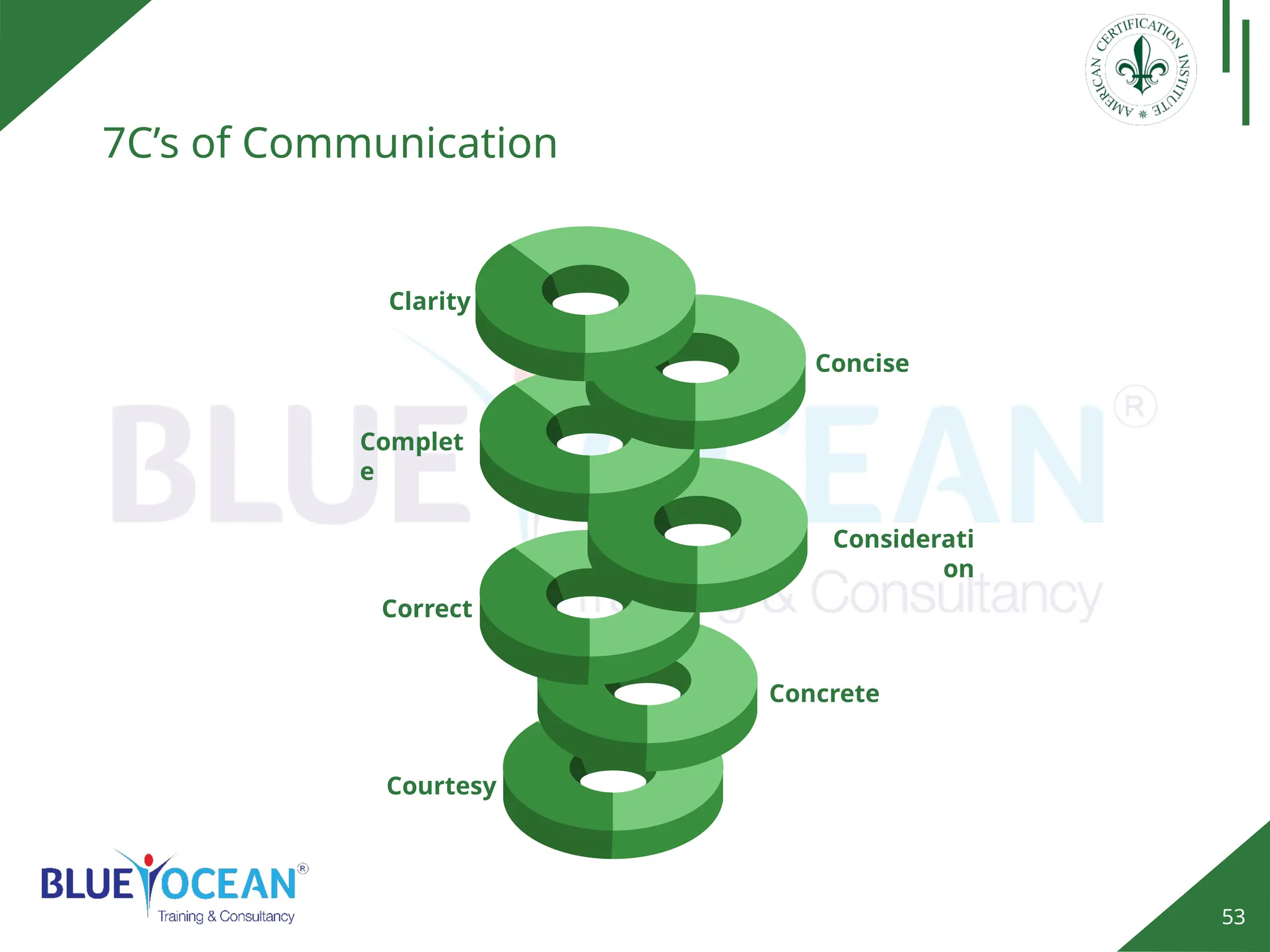
7C’s of Communication
Courtesy
Concrete
Correct
Considerati
on
Complet
e
Concise
Clarity
54
7C’s of Communication
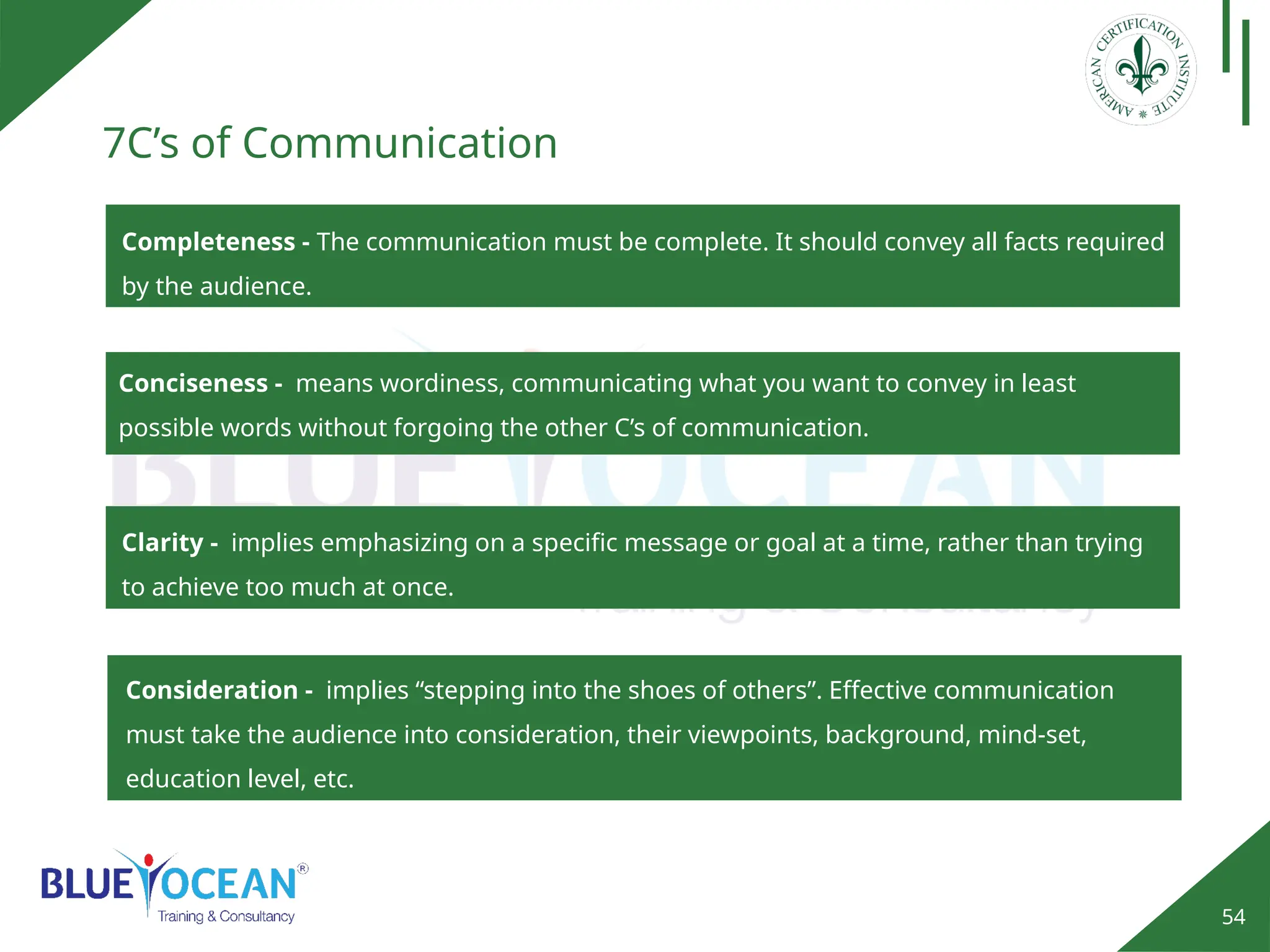
Completeness - The communication must be complete. It should convey all facts required
by the audience.
Conciseness - means wordiness, communicating what you want to convey in least
possible words without forgoing the other C’s of communication.
Consideration - implies “stepping into the shoes of others”. Effective communication
must take the audience into consideration, their viewpoints, background, mind-set,
education level, etc.
Clarity - implies emphasizing on a specific message or goal at a time, rather than trying
to achieve too much at once.
55
7C’s of Communication
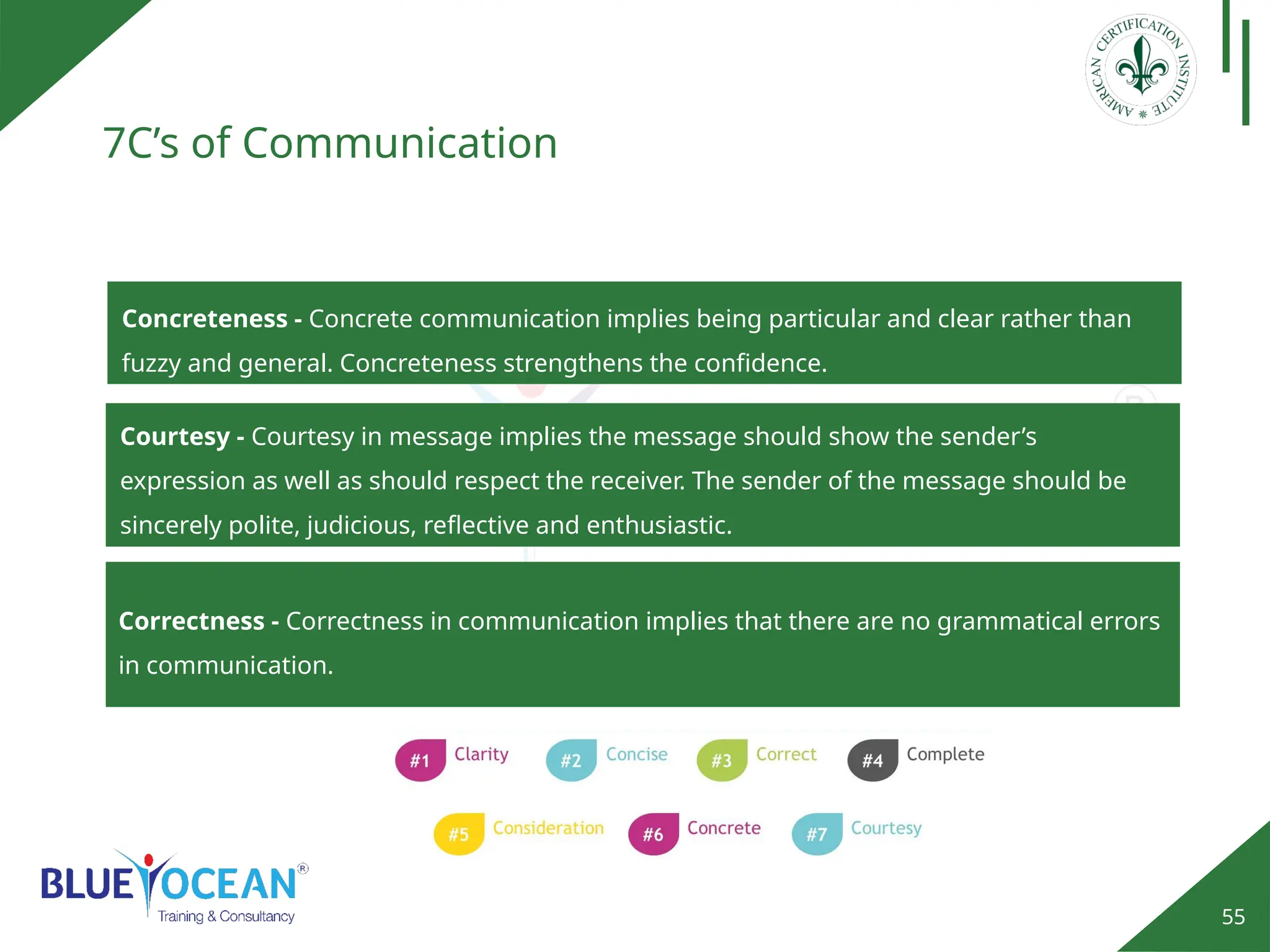
Concreteness - Concrete communication implies being particular and clear rather than
fuzzy and general. Concreteness strengthens the confidence.
Courtesy - Courtesy in message implies the message should show the sender’s
expression as well as should respect the receiver. The sender of the message should be
sincerely polite, judicious, reflective and enthusiastic.
Correctness - Correctness in communication implies that there are no grammatical errors
in communication.
56
Types of Communication
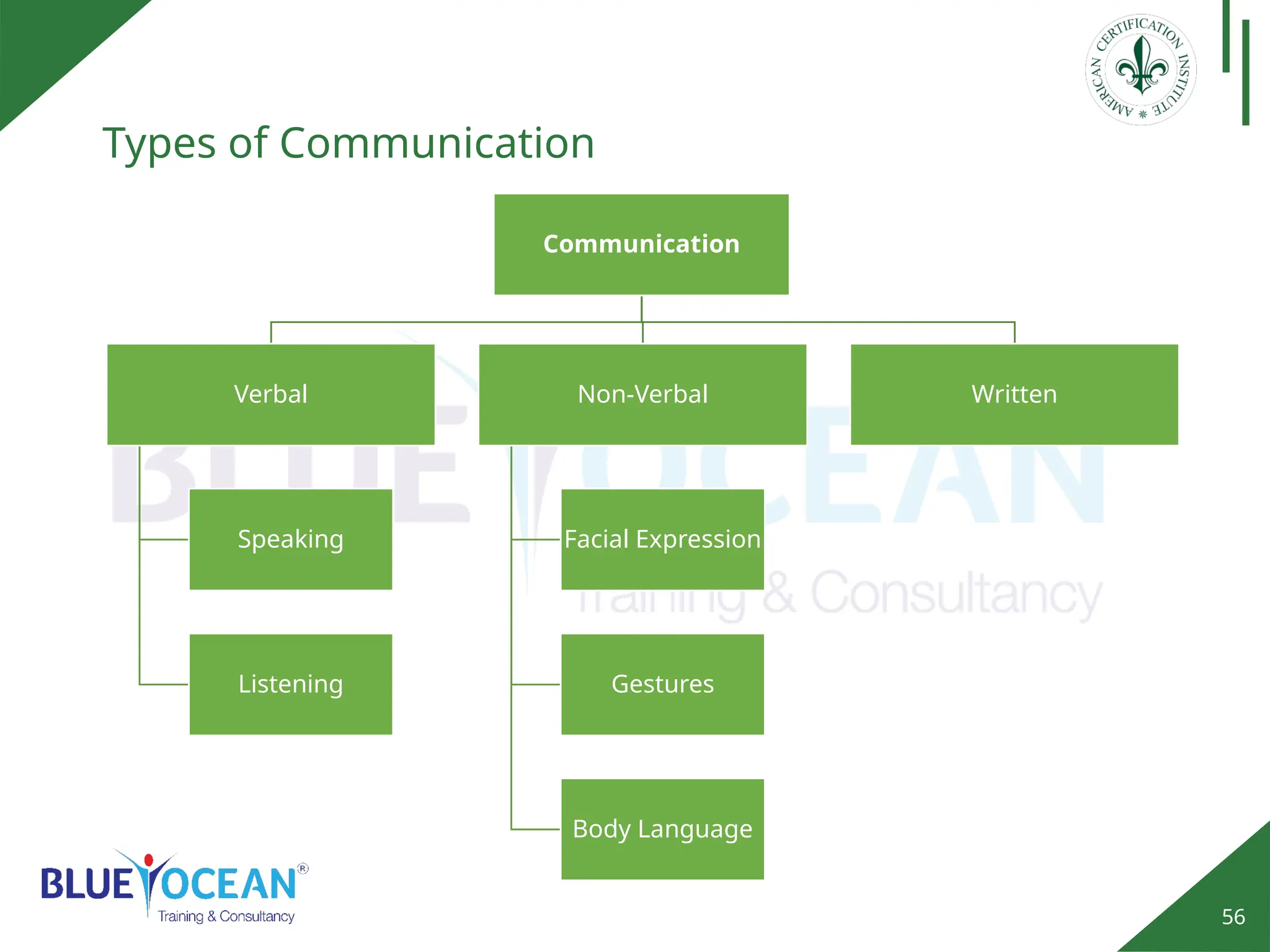
Communication
Verbal
Speaking
Listening
Non-Verbal
Facial Expression
Gestures
Body Language
Written
57
Types of Communication
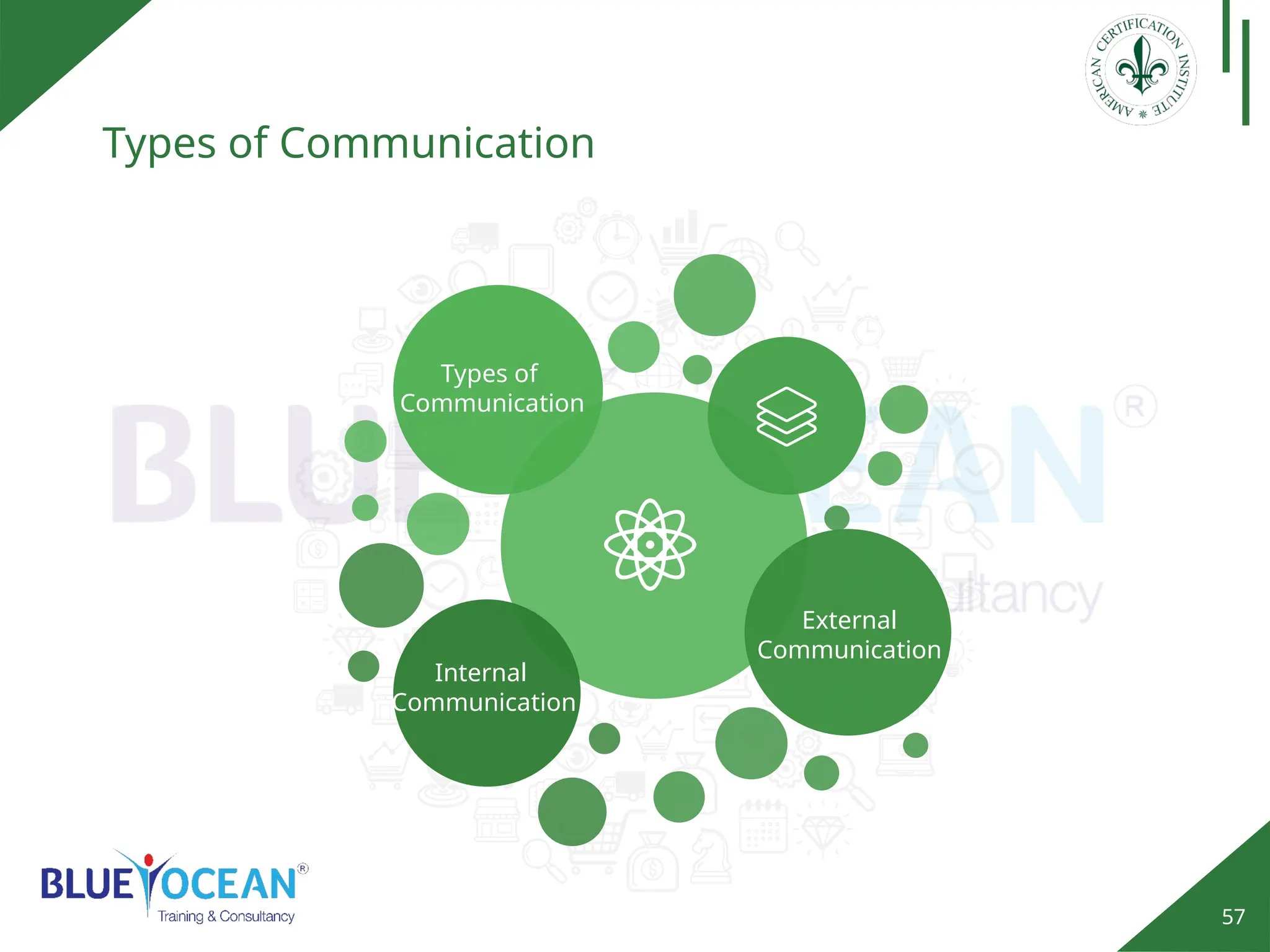
Types of
Communication
Internal
Communication
External
Communication
58
Types of Communication
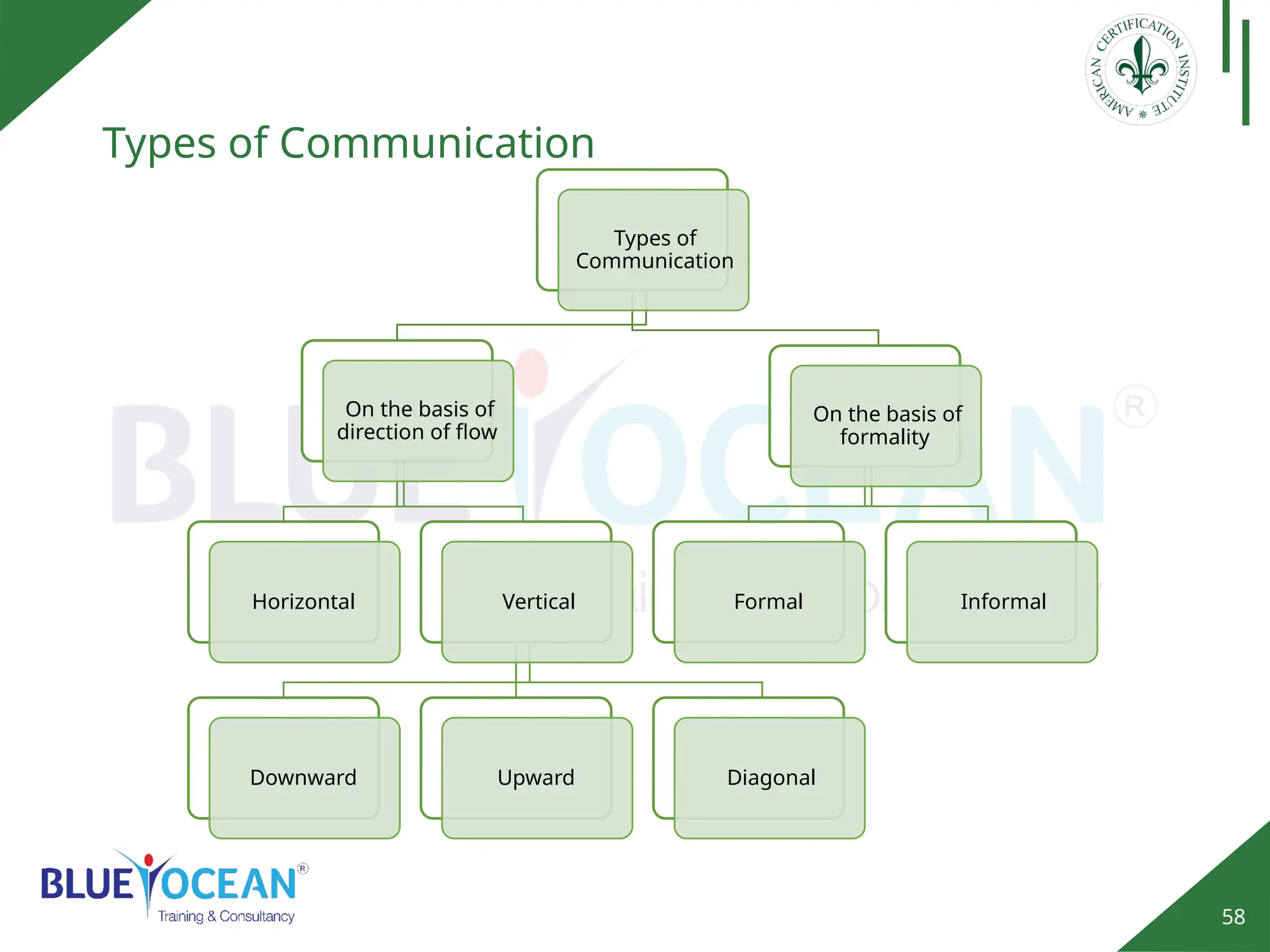
Types of
Communication
On the basis of
direction of flow
Horizontal Vertical
Downward Upward Diagonal
On the basis of
formality
Formal Informal
59
Means of Communication
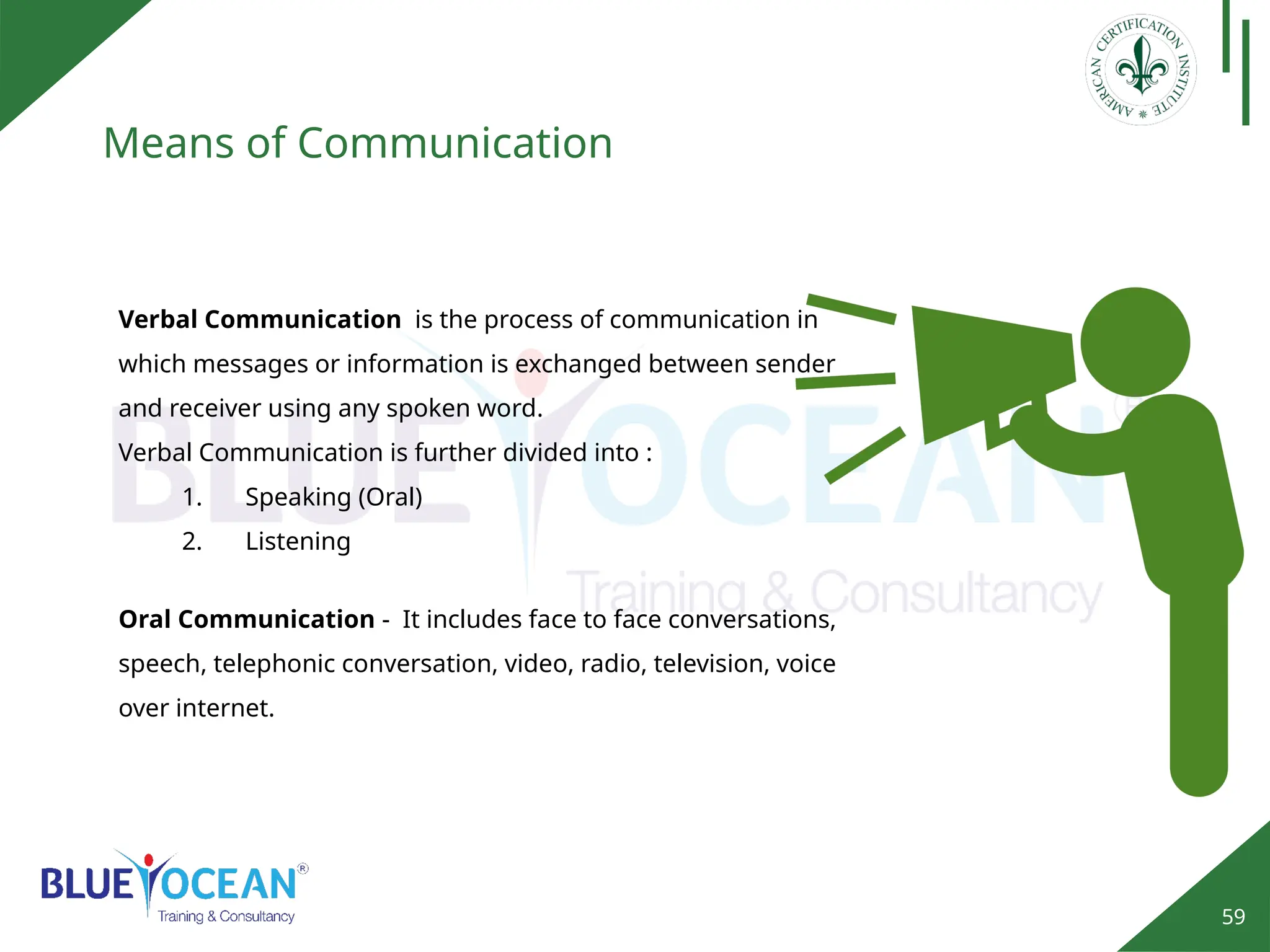
Verbal Communication is the process of communication in
which messages or information is exchanged between sender
and receiver using any spoken word.
Verbal Communication is further divided into :
1. Speaking (Oral)
2. Listening
Oral Communication - It includes face to face conversations,
speech, telephonic conversation, video, radio, television, voice
over internet.
60
Means of Communication
Advantage - Oral communication provides
1. Instant feedback,
2. Opportunity to cross verify,
3. Clarity in understanding,
4. Opportunity for questioning & paraphrasing,
5. Increases speed of communication.
Listening is the ability to accurately receive and interpret messages in the communication
process. Listening is key to all effective communication. Without the ability to listen
effectively, messages are easily misunderstood. As a result, communication breaks down
and the sender of the message can easily become frustrated or irritated.
61
Listening Skills
Listening is the ability to accurately receive and interpret messages in the communication
process. Listening skills are an important part of effective communication that underpins
all positive human relationships.
Listening is Not the Same as Hearing, hearing refers to the sounds that enter your ears. It
is a physical process that, provided you do not have any hearing problems, happens
automatically. Listening, however, requires more than that: it requires focus and
concentrated effort, both mental and sometimes physical as well.
62
Listening Skills
Listening means paying attention not only to the story, but how it is told, the use of
language and voice, and how the other person uses his or her body.
In other words, it means being aware of both verbal and non-verbal messages. One’s
ability to listen effectively depends on the degree to which you perceive and understand
these messages.
Listening is not a passive process. In fact, the listener can, and should, be at least as
engaged in the process as the speaker. The phrase ‘active listening’ is used to describe this
process of being fully involved.
63
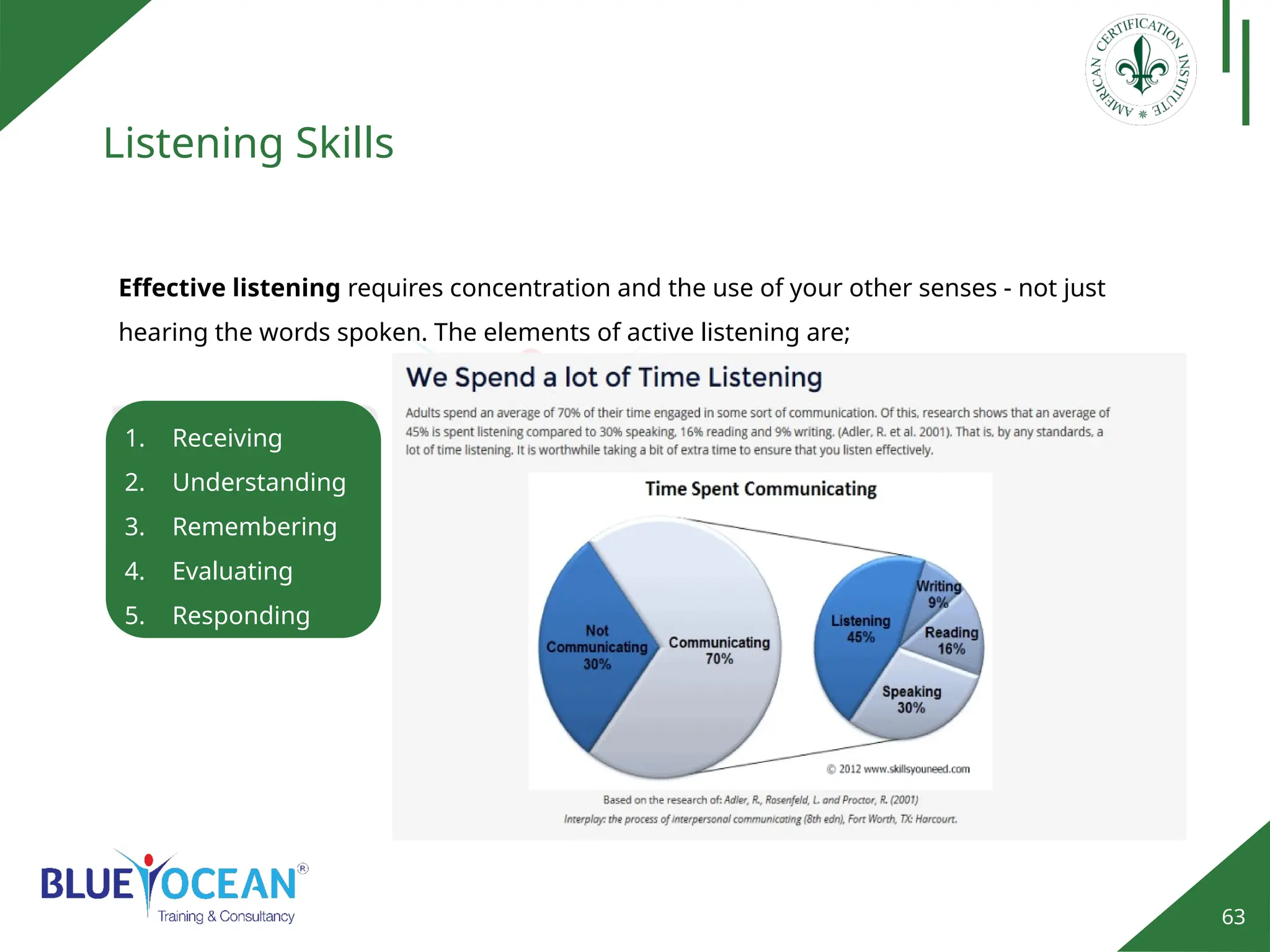
Listening Skills
Effective listening requires concentration and the use of your other senses - not just
hearing the words spoken. The elements of active listening are;
1. Receiving
2. Understanding
3. Remembering
4. Evaluating
5. Responding
64
Non-Verbal Communication
Nonverbal Communication has been defined as exchange of information taking place
without words, which includes facial expressions, touch, body gestures, as well as less
obvious messages such as dress, posture and spatial distance between two or more
people.
There are many different types of non-verbal communication. They include:
Body Movements (Kinesics), for example, hand gestures or nodding or shaking the
head;
Posture or how you stand or sit, whether your arms are crossed, and so on;
65
Non-Verbal Communication
Eye Contact, where the amount of eye contact often determines the level of trust and
trustworthiness;
Para-language, or aspects of the voice apart from speech, such as pitch, tone, and speed
of speaking;
Closeness or Personal Space (Proxemics), which determines the level of intimacy;
Facial Expressions, including smiling, frowning and even blinking; and
Physiological Changes, for example, sweating or blinking more when nervous.
66
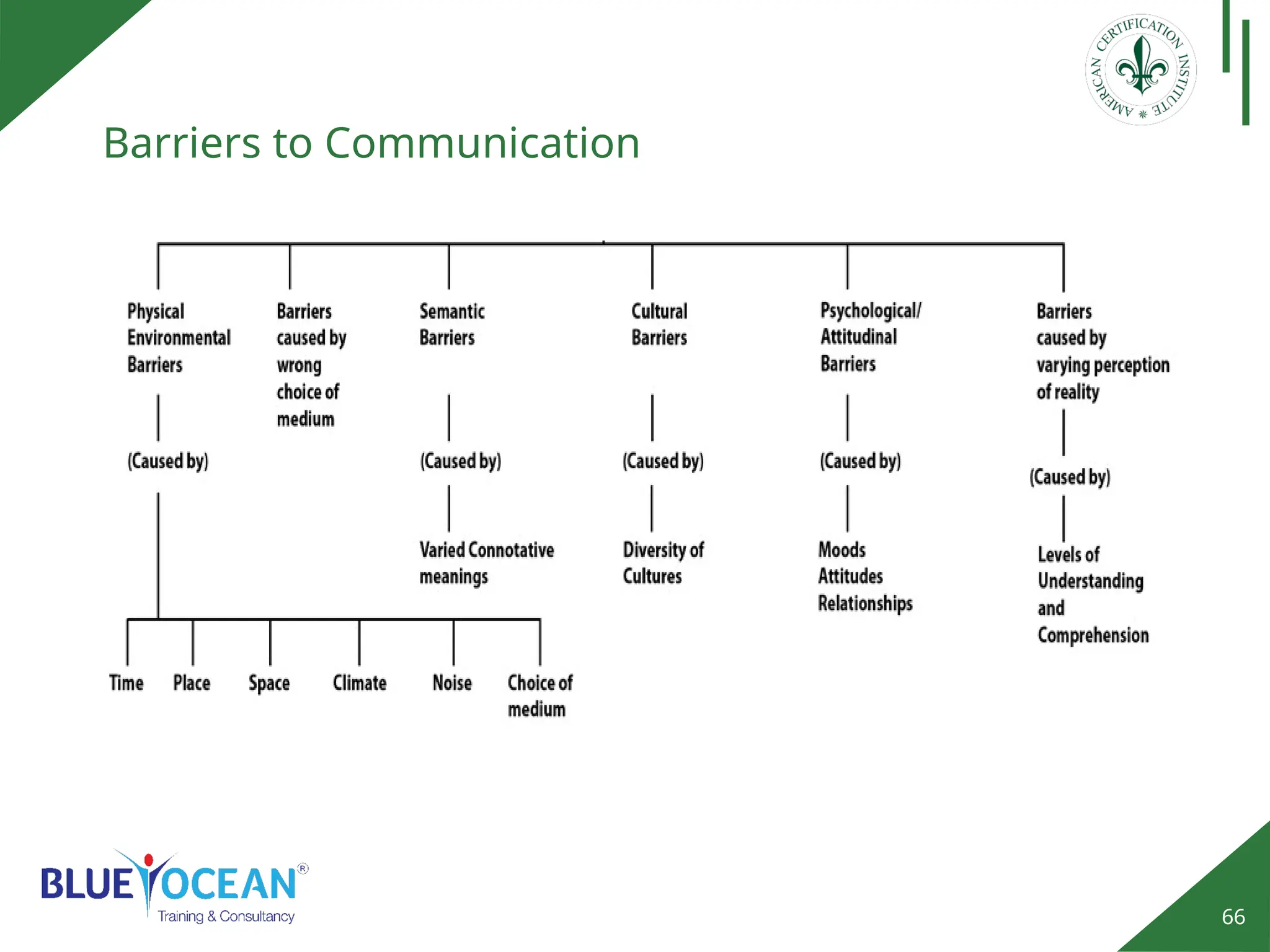
Barriers to Communication
67
Barriers to Communication
How to overcome the barriers of Communication
1. Taking the receiver more seriously, message should be crystal clear and
skilfully delivered.
2. Using multiple channels to communicate instead of one .
3. Ensuring appropriate feedback.
4. Be aware of your own state of mind, emotions, attitude.
5. Avoiding forming groups on the basis of nationality or religion at work.
6. Ensuring the communication is through the right channel/medium.
68
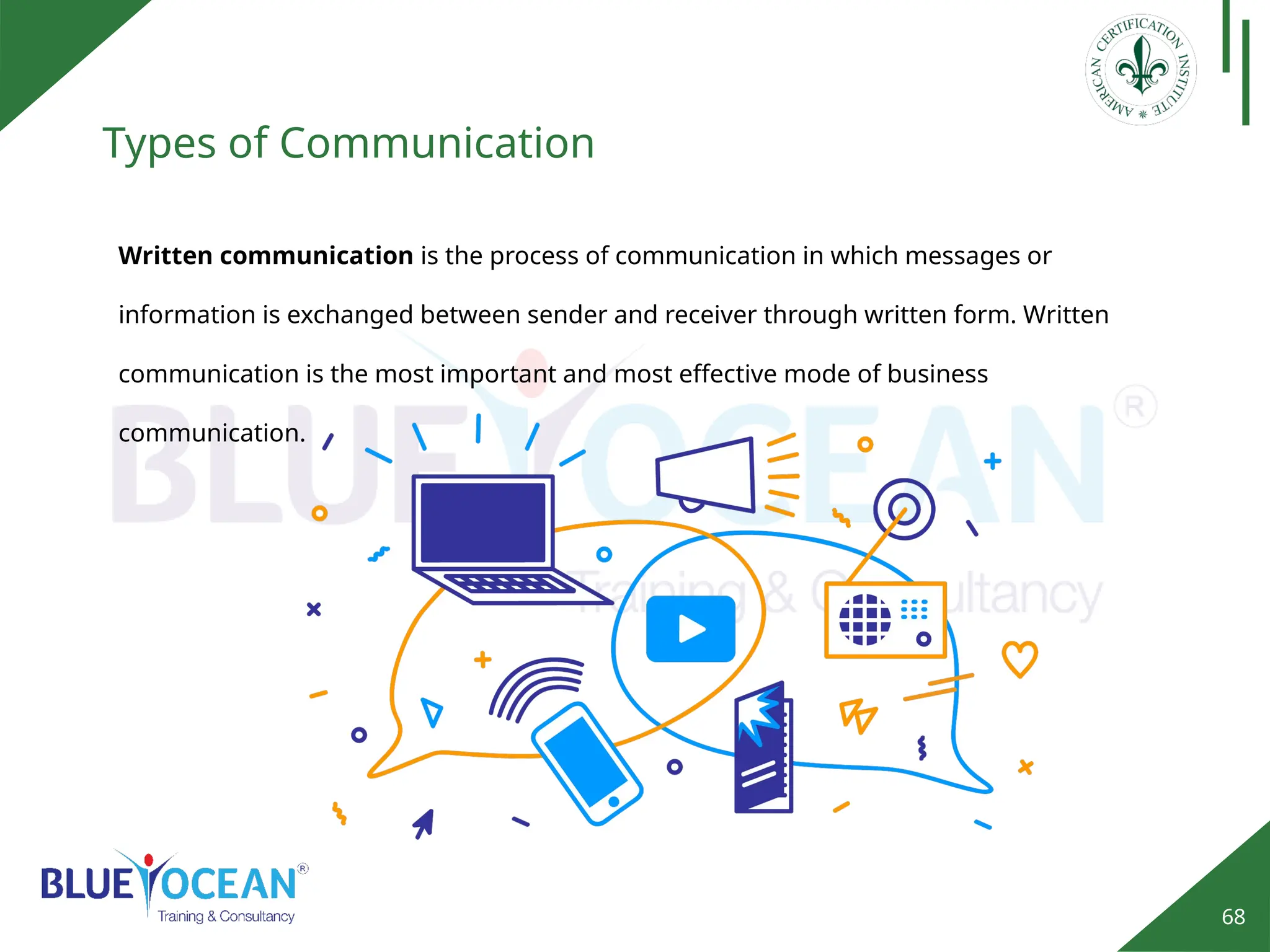
Types of Communication
Written communication is the process of communication in which messages or
information is exchanged between sender and receiver through written form. Written
communication is the most important and most effective mode of business
communication.
69
Types of Communication
Advantages of Written Communication
 Written Communication - provides written proof in case of a dispute.
 Clarity of message compared to other forms of communication
 No personal contact
 Cost effective
Disadvantages of Written Communication
 Delay in communication - it may take a while to get to the intended recipient.
 Lack of secrecy - once it's on paper, anyone can read it.
70
Business Communication
Business Communication involves communicating to external and internal parties for
business / official purpose to achieve a predetermined objective. This may include:
1. CVs, Resumes
2. Email, Website, FAQs
3. Letters, Newsletters, Brochures, Articles, Catalogs
4. Advertisements, Notice Board, Pamphlets, Signs, Press Releases
5. Presentations, multimedia, talks
6. Reports, Manuals, Proposals, Books
71
Business Writing
Business thrives on strong communication skills; written communication, in particular, is
used in all types of businesses in a variety of ways.
Sound business communication styles improve interoffice communications, encourage
success among employees and improve the bottom line. Understanding different forms of
business writing is crucial for overall business.
Business needs people with good communication skills, 85% of recruiters give priority to
effective communication skills. Higher the position the more one needs to improve one’s
business communication ability.
72
Elements of Business Writing
Purpose : Keep in mind the purpose of the communication. Be precise and to the point,
targeting the specific individual or group.
Audience : Depending on the recipient, they are written in varying tones, such as
persuasive, informational, promotional or motivational tone.
Language : First impressions do matter and it affects your Company’s reputation. Keep
the language simple, avoid jargons and easily understood avoid miscommunication.
Grammar : Grammar mistakes can reflect negatively on a Company’s image.
73
Elements of Business Writing
Spelling : Incorrect spellings may convey misinformation, misguiding the reader into
taking the wrong action or their reaction to it may leave your business open to costly legal
action.
Structure of Business Correspondence
1. Salutation
2. Body
3. Closing
Dear Sir/Madam. Introductions doesn’t have be long.
Salutation refers to addressing the recipient, start with a courteous greeting. Formal
correspondence begins with Respected /
74
Elements of Business Writing
Body
 Focus on the objective of your correspondence
a) State the main idea of your correspondence in the first paragraph or in the first
sentence.
b) Don't keep your readers guessing.
c) Emphasize the key words. Place them at the beginning or reiterate at the end.
 Decide how to explain your objective
a) First outline your main ideas before you start drafting
b) Use short sentences to emphasize ideas.
c) Use longer sentences to explain, define or illustrate ideas.
75
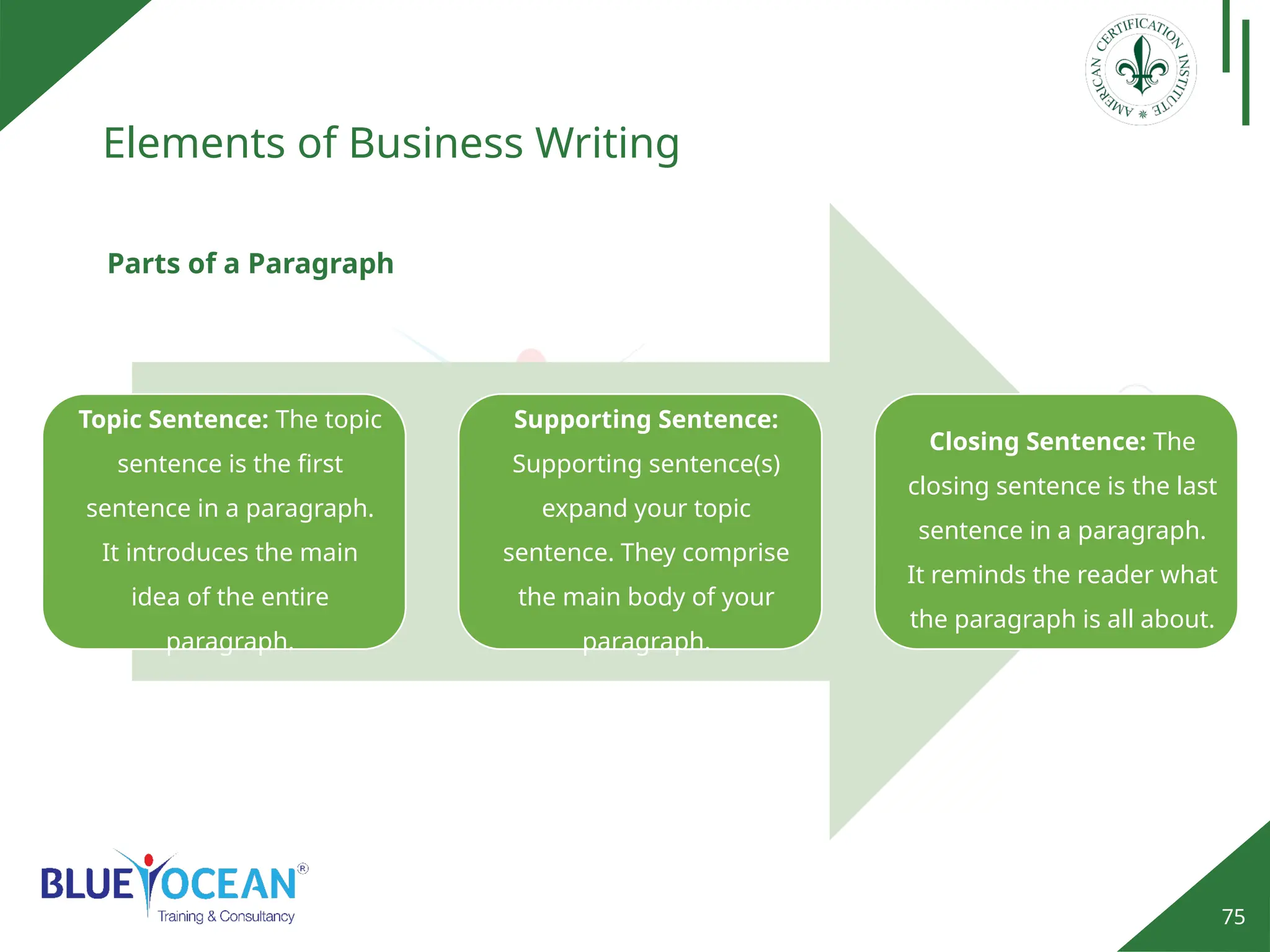
Elements of Business Writing
Parts of a Paragraph
Topic Sentence: The topic
sentence is the first
sentence in a paragraph.
It introduces the main
idea of the entire
paragraph.
Supporting Sentence:
Supporting sentence(s)
expand your topic
sentence. They comprise
the main body of your
paragraph.
Closing Sentence: The
closing sentence is the last
sentence in a paragraph.
It reminds the reader what
the paragraph is all about.
76
Elements of Business Writing
 Use active verbs
a) Don’t overwork the passive voice, instead use active
verbs. Use concrete and specific words that show what you mean
 Actively edit and proofread
a) It's easy to overlook errors, so never forget to proofread your final draft.
Eliminate unnecessary words.
 Use a dictionary
a) When proofreading don’t blindly trust the spellchecker, try using a good
dictionary.
“Yours sincerely” is the most common closing used in formal and semi-formal letters.
When the name of the addressee is not known the phrase, “ Yours faithfully” should be
used.
Closing
77
Forms of Business Writing
Business Writing is categorised in 4 forms;
1. Results-Oriented Business Writing
2. Informational Business Writing
3. Persuasive Business Writing
4. Negative Business Writing
Business Writing is a type of written communication, usually with standard structure and
style. Business writing is a type of Professional Communication, it’s also known
as business communication and professional writing.
78
Forms of Business Writing
Result-Oriented Business Writing
This type of business writing has the goal of producing a specific result. Result-oriented
business writing is marked by active voice, encouraging the reader to do something.
This style of writing should end with a call to action and specific instructions for the reader
to follow. The tone of this type of writing is always motivational and be encouraging in
nature.
79
Forms of Business Writing
Informational Business Writing
This type of business writing mentions only the facts that needs to be communicated to
employees. The words need not be focused on motivating people as the purpose is to
provide information.
The information provided should be written succinctly and clearly. The facts must be
worded in a clear fashion so that the information cannot be misinterpreted. The writer
must also anticipate questions that might arise while reading the facts involved so that the
information is clarified for every reader.
80
Forms of Business Writing
Persuasive Business Writing
This type of business writing is used when personal opinions are being offered to others
instead of concrete facts. The goal is to convince the reader that what is being presented
as the highest possible value proposition. Whenever a proposal is submitted to gain new
work, then it is persuasive business writing that is being used.
Persuasive business writing needs to be about the reader and not the writer. This type of
writing uses a second-person point of view.
81
Forms of Business Writing
Negative business writing
Writing about a negative subject is a challenging, but often inevitable, task for most
business writers. When business has to communicate bad news, this type of business
writing is used.
Negative business writing must be empathetic, but it must also have a firm tone to it.
There cannot be any room left for questions or uncertainty. The essential information that
must be conveyed to the individuals involved in a direct manner so that there is little
confusion.
82
Report Writing
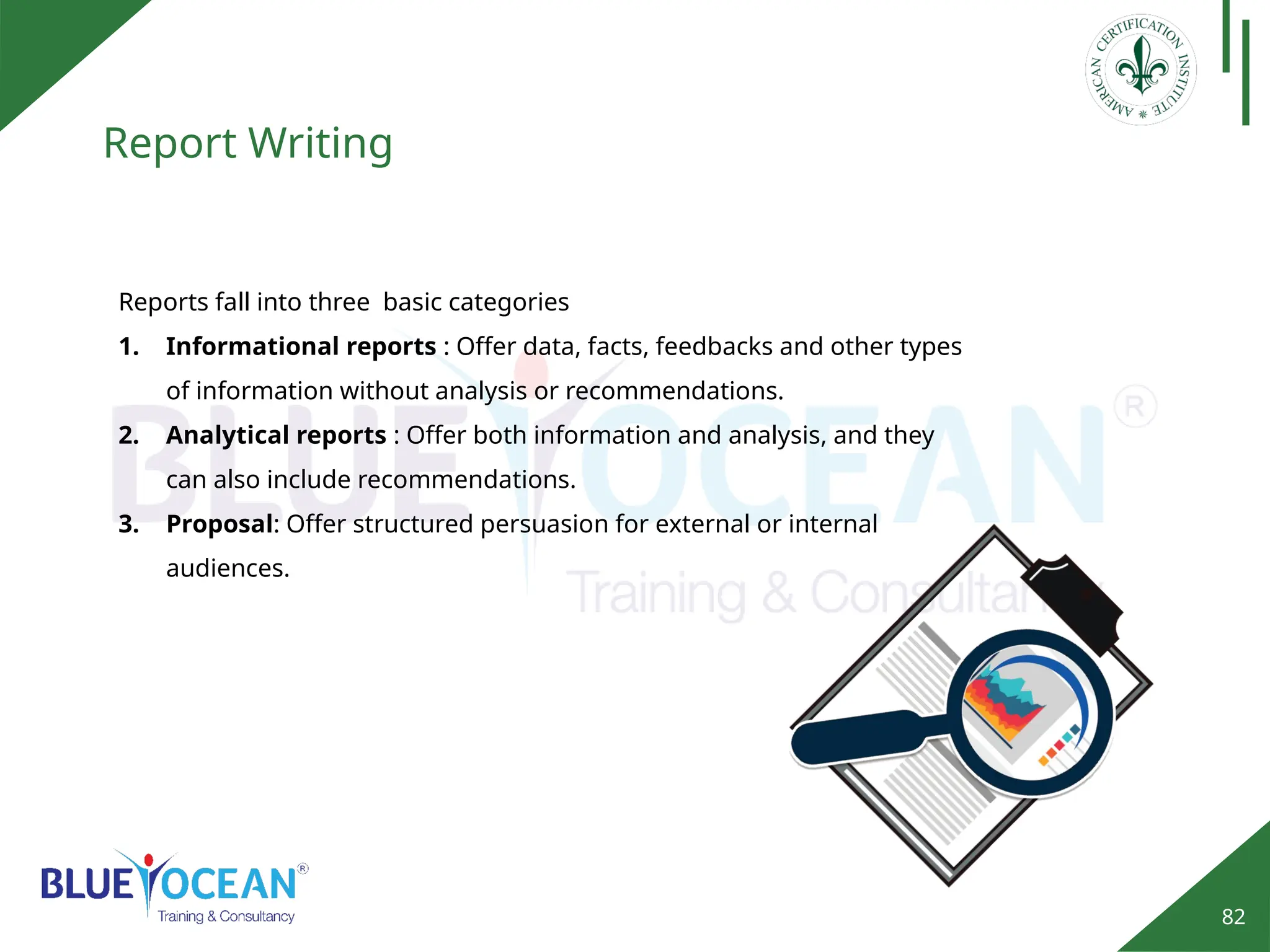
Reports fall into three basic categories
1. Informational reports : Offer data, facts, feedbacks and other types
of information without analysis or recommendations.
2. Analytical reports : Offer both information and analysis, and they
can also include recommendations.
3. Proposal: Offer structured persuasion for external or internal
audiences.
83
Email Etiquettes
Email is a convenient and effective medium to conduct business communication. It is
important that whether for business or personal use that you follow the basics of email
etiquette.
1. ADDRESSING your message
2. Use proper GRAMMAR and ACRONYMS
3. Make sure your emails have proper opening, body and conclusion
4. Be careful while sending large attachments and images .
5. Make appropriate use of TO / From / CC / BCC / Subject
6. While Forwarding emails add TO and CC or BCC and do not forward if the sender
doesn’t want it to forward and do not forward before editing.
84
Organise Effective Meeting
The Office Administrator or Executive Assistant of an organisation is the custodian
organising and managing the business meetings. They makes the arrangements for the
meetings, keeps formal records of the meeting’s process and decisions taken and follows
up on the action plan.
Preparations before the Meeting
 Prepare the agenda for the meeting
 Send out invitation along with the agenda to those who are expected for the
meeting
 Arrange for the venue/meeting place.
 Keep the attendees reminded one day before the meeting
85
Organise Effective Meeting
On the Day of the Meeting
 Ensure the venue is ready, stationeries are in place.
 Keep the list of attendees' names as well as the list of attendees who are unavailable.
 Keep the minutes of previous meeting records ready; The minutes will need to include
a full list of those present and all who sent apologies. Note down any apologies for
absence provided during introductions or proxy attendees.
 Welcome the attendees as they arrive.
 Circulate a signup sheet asking people to give their names, organisation and contact
details.
86
Organise Effective Meeting
Taking Notes during meeting
 Before starting to take notes, be clear of the meeting objective. Try using short
concise points
 Don’t write word to word
 Use your own style and own words
 Use shorthand system if you are aware
 Don’t panic if you missed out something
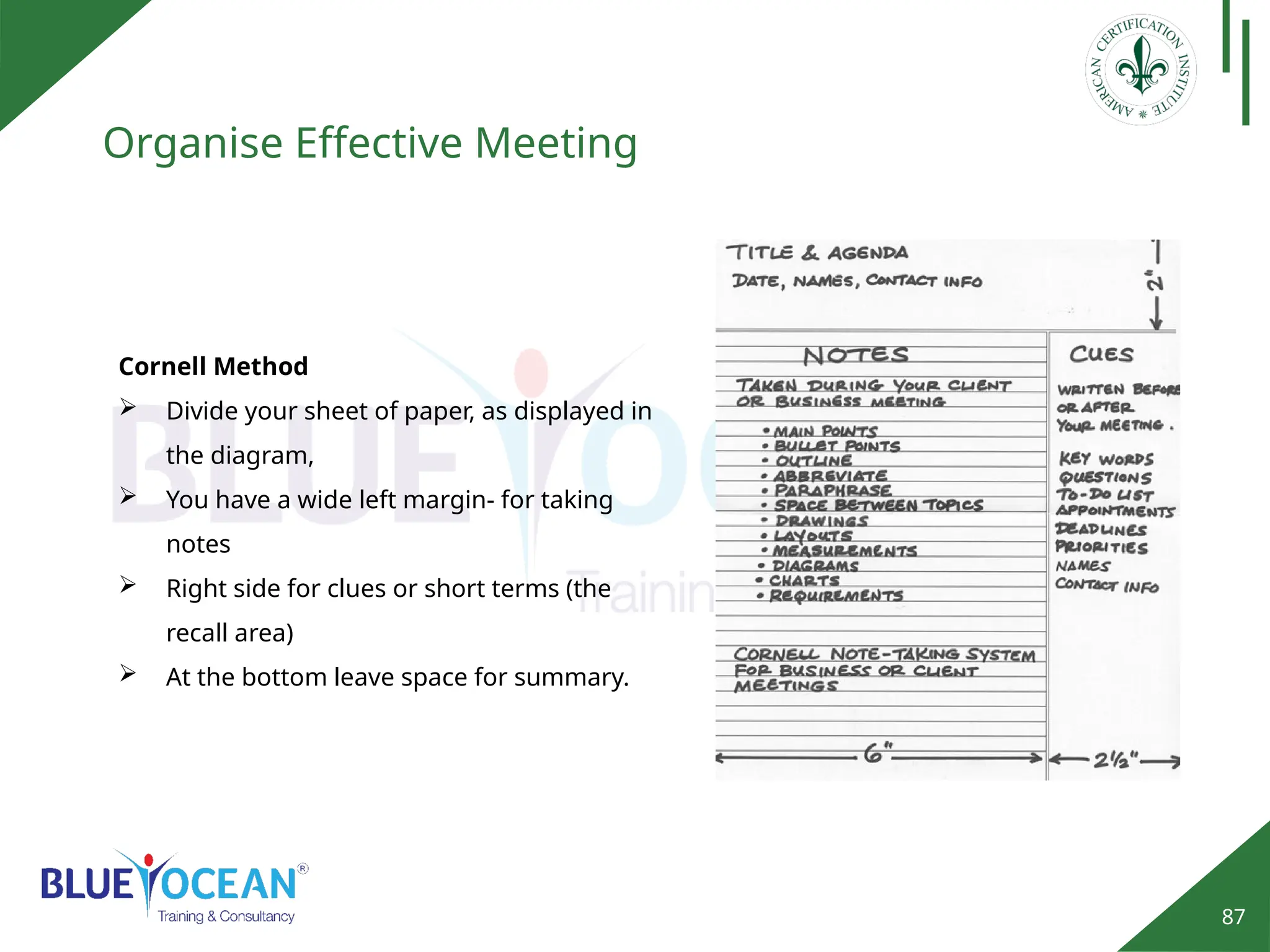
 Use Cornell Method
After the Meeting
 Prepare the minutes within 24hrs of recording
 Circulate the draft minutes to one or two trusted attendees before circulation to
everyone.
 Follow up on the action plan
87
Organise Effective Meeting
Cornell Method
 Divide your sheet of paper, as displayed in
the diagram,
 You have a wide left margin- for taking
notes
 Right side for clues or short terms (the
recall area)
 At the bottom leave space for summary.
88
Presentation Skills
A presentation is a means of communication which can be adapted to various
speaking situations, such as talking to a group, addressing a meeting or briefing
a team.
Presenting information clearly and effectively is a key skill to get your message or opinion
across and, today, presentation skills are required in almost every field.
Delivering an inspirational or captivating presentation requires a lot of preparation and
work. Preparation is the single most important part of making a successful presentation.
89
Presentation Skills
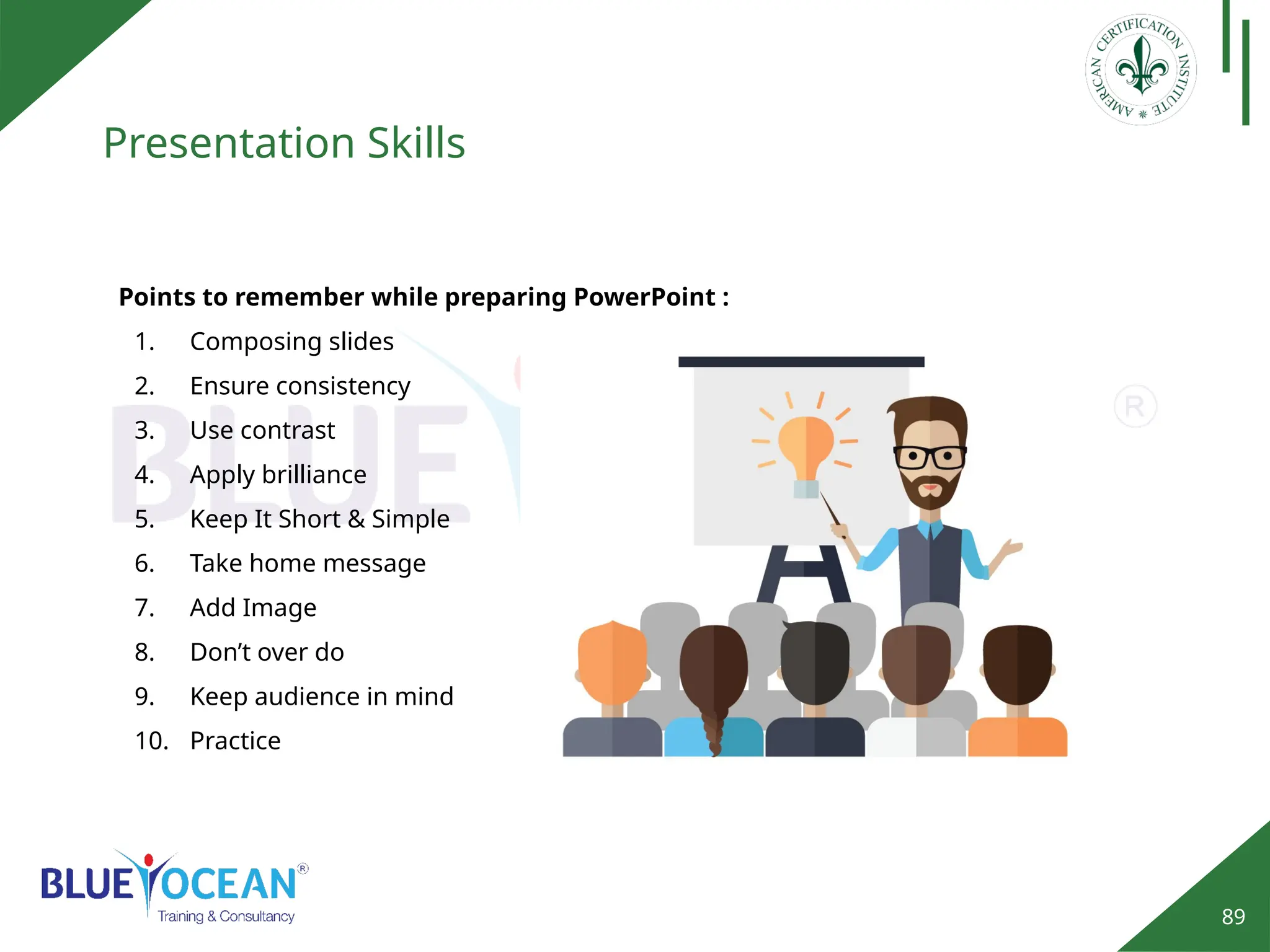
Points to remember while preparing PowerPoint :
1. Composing slides
2. Ensure consistency
3. Use contrast
4. Apply brilliance
5. Keep It Short & Simple
6. Take home message
7. Add Image
8. Don’t over do
9. Keep audience in mind
10. Practice
90
Presentation Skills
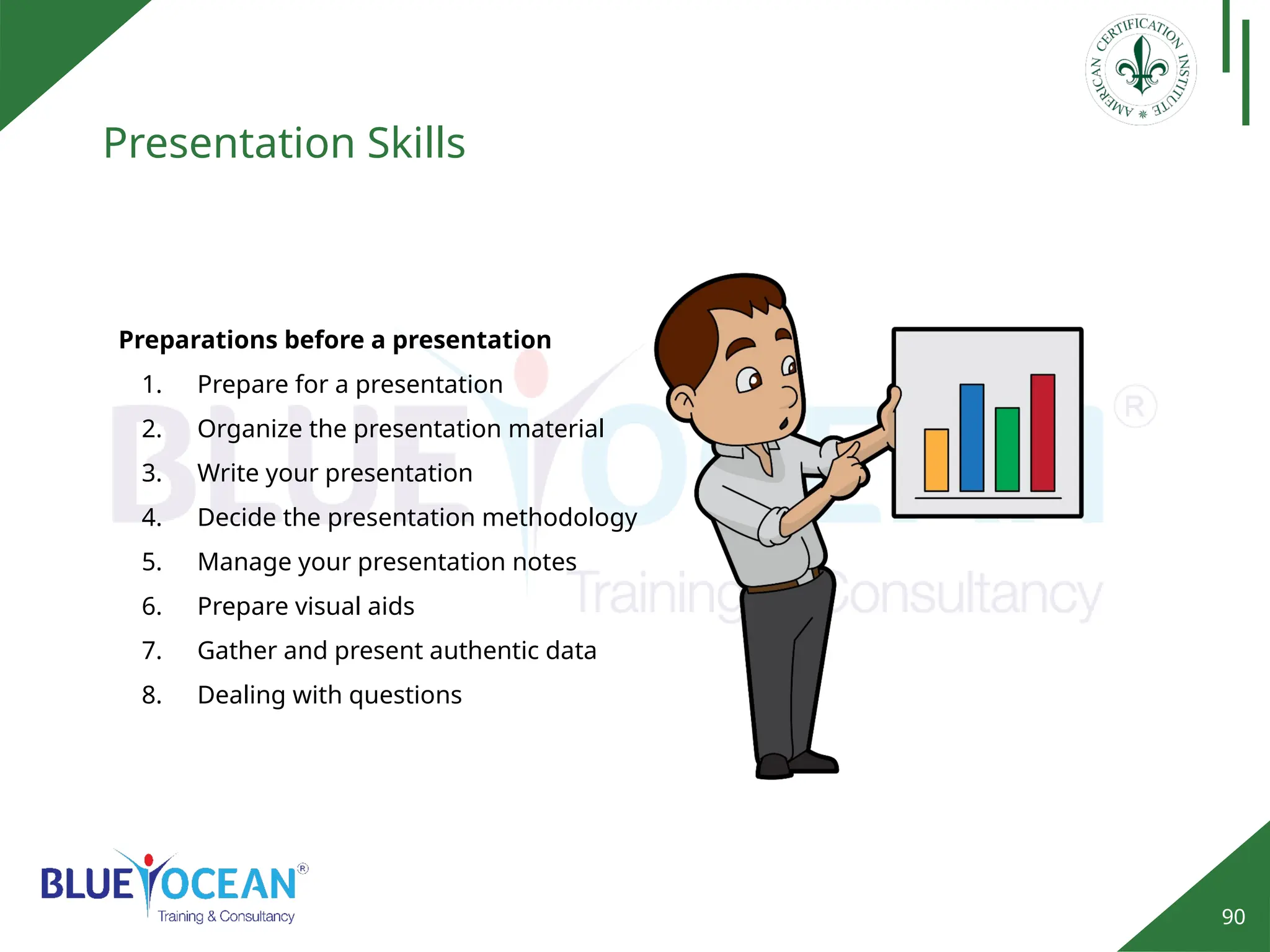
Preparations before a presentation
1. Prepare for a presentation
2. Organize the presentation material
3. Write your presentation
4. Decide the presentation methodology
5. Manage your presentation notes
6. Prepare visual aids
7. Gather and present authentic data
8. Dealing with questions
91
Presentation Skills
Action: Think about a presentation you may have to give
(or the one you could give to develop and practice your
presentation skills and write the subject in the box below:)
1. Choose your subject
The Subject of my presentation is:
92
Presentation Skills
Action: Answer the following questions to get a better understanding of the audience(If
you do not know your audience yet choose a group who you can gear your presentation
towards such as your team or senior managers).
2. Know your audience
Who are your audience members:
What is the common element that unites them.
(Eg. Same job or same information)
93
Presentation Skills
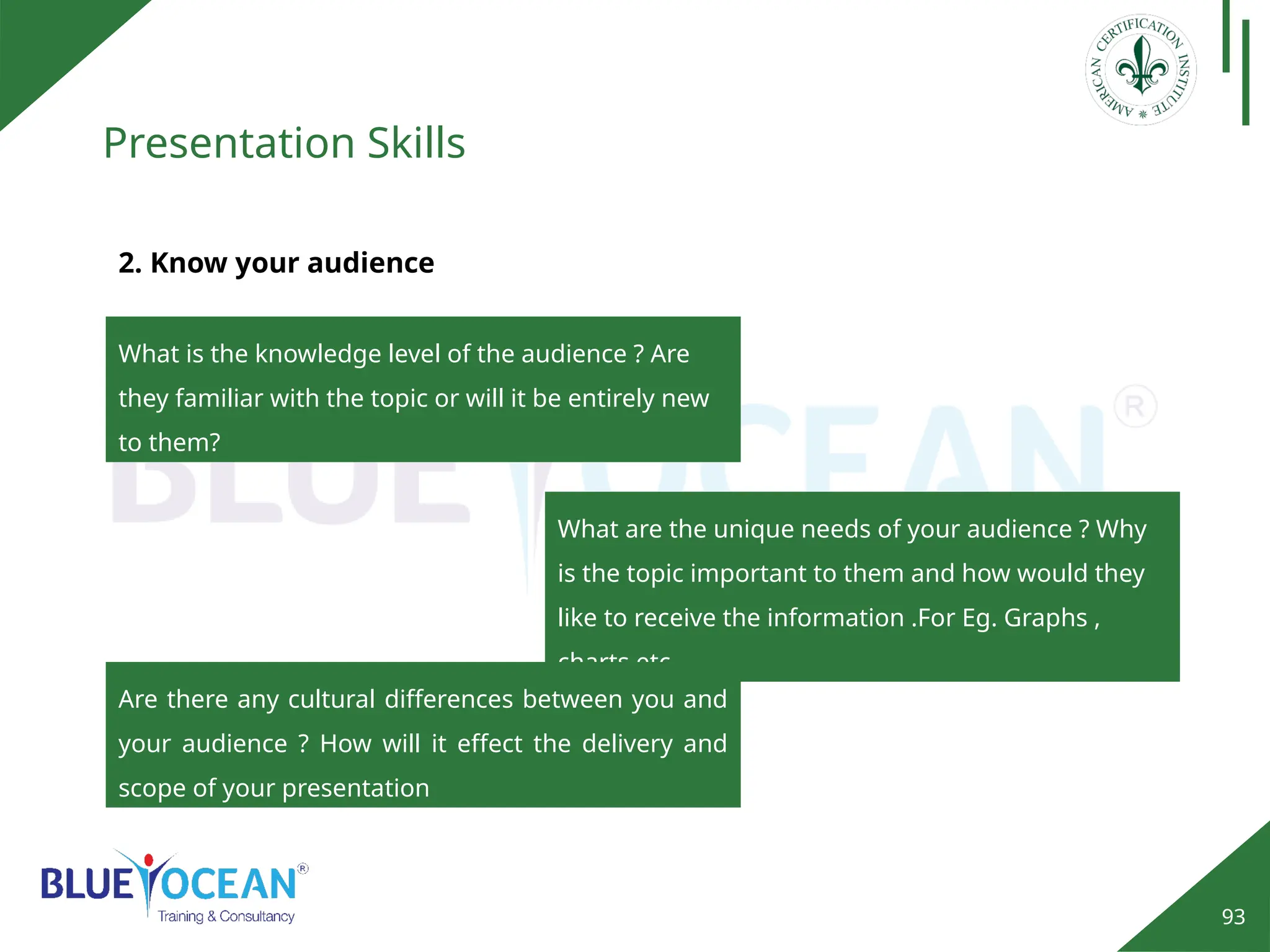
2. Know your audience
What is the knowledge level of the audience ? Are
they familiar with the topic or will it be entirely new
to them?
What are the unique needs of your audience ? Why
is the topic important to them and how would they
like to receive the information .For Eg. Graphs ,
charts etc
Are there any cultural differences between you and
your audience ? How will it effect the delivery and
scope of your presentation
94
Presentation Skills
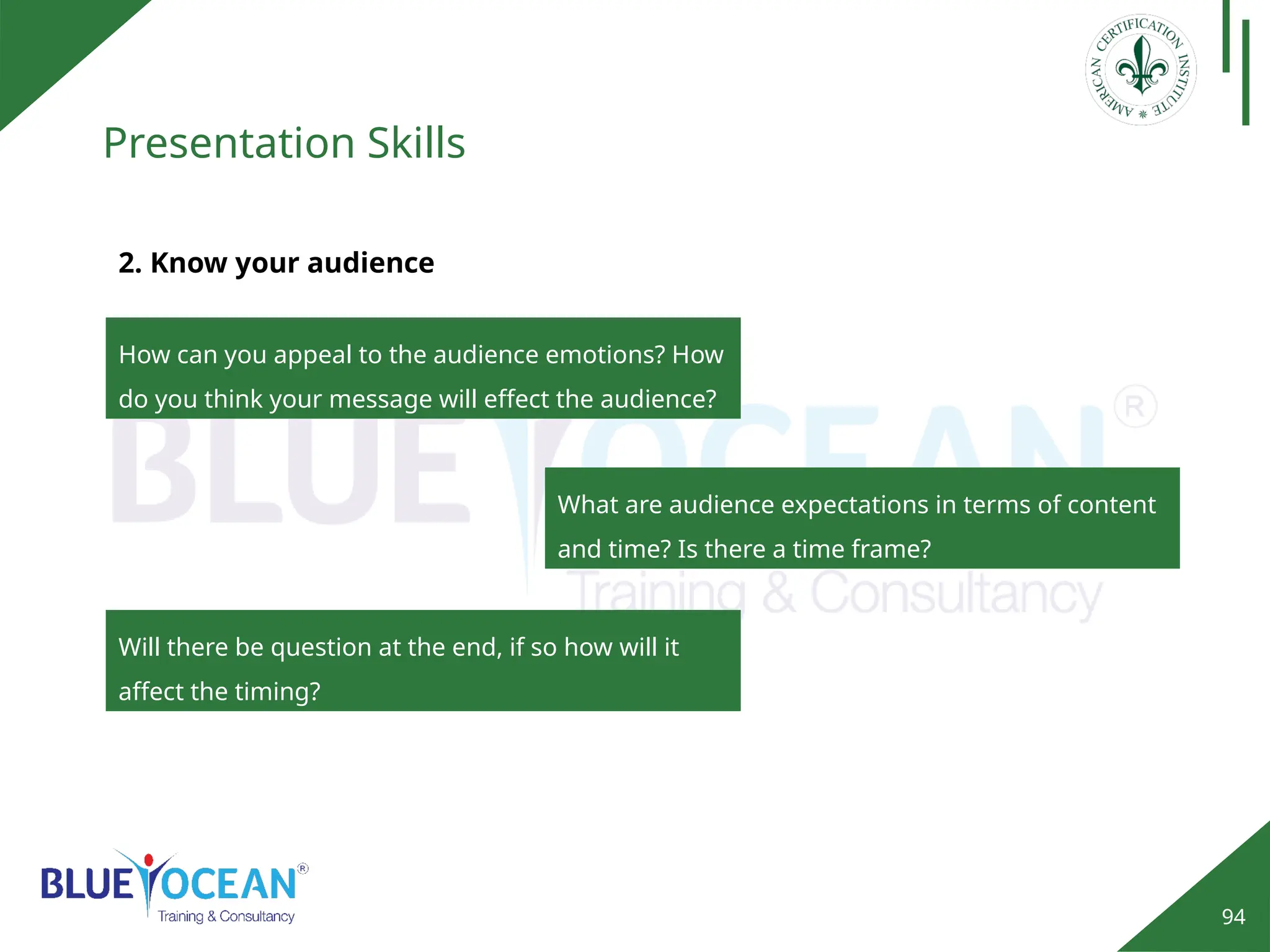
2. Know your audience
How can you appeal to the audience emotions? How
do you think your message will effect the audience?
What are audience expectations in terms of content
and time? Is there a time frame?
Will there be question at the end, if so how will it
affect the timing?
95
Presentation Skills
Ways to improve your presentation skills
1. Practice
2. Transform nervous energy into enthusiasm
3. Attend other presentations
4. Arrive early
5. Adjust your surroundings
6. Meet and greet
7. Use positive visualisation
8. Take deep breath
9. Make eye contact
10. Tell your story
96
Presentation Skills
Ways to improve your presentation skills
11. Use a pointer
12. Smile
13. Work on your pauses
14. Don’t try to cover too much material
15. Actively engage the audience
16. Use power stance
17. Drink water
18. Join Toastmasters
19. Don’t fight the fear –work on it
20. Be professional at all times
97
Presentation Skills
100
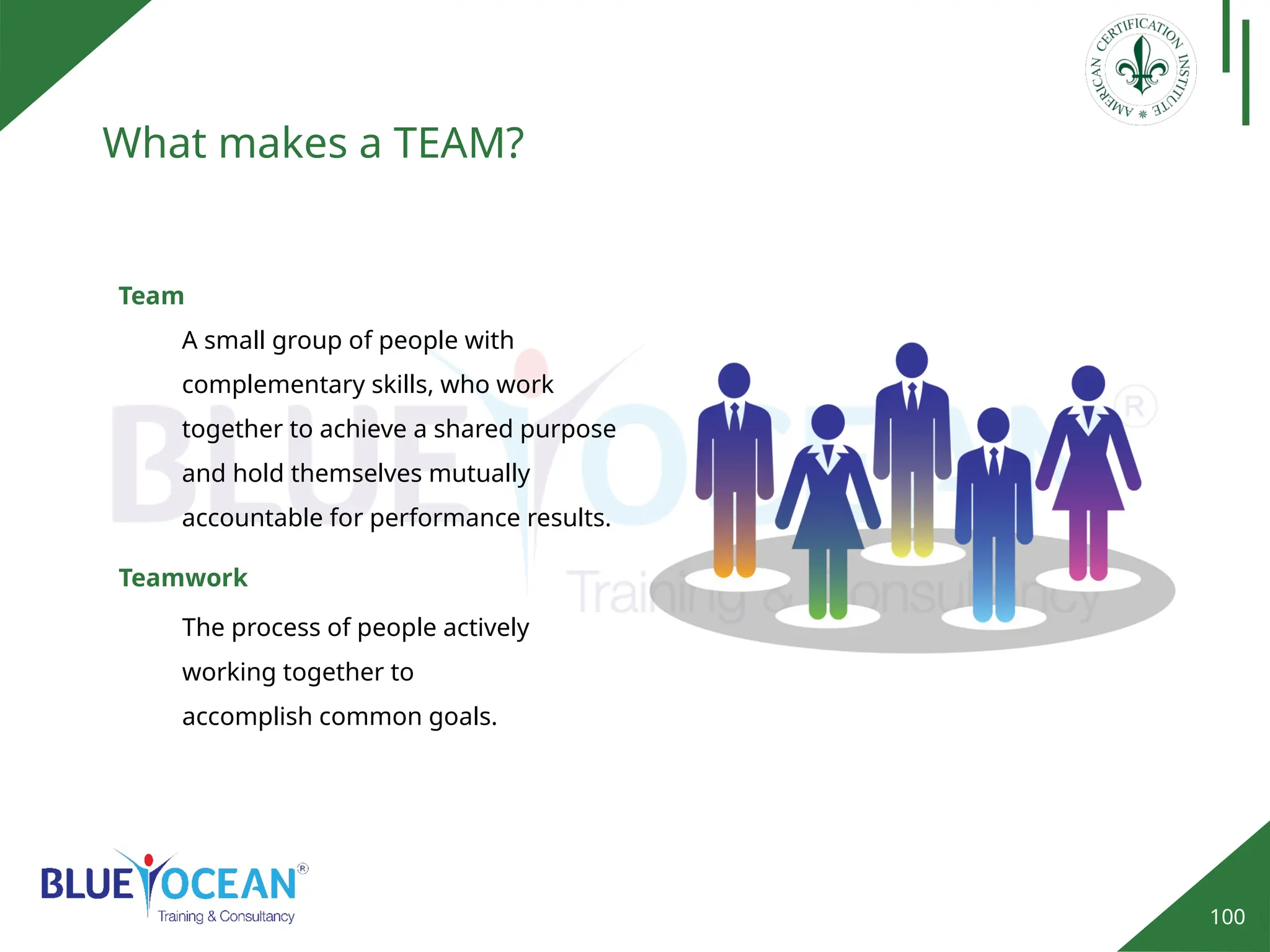
What makes a TEAM?
Teamwork
The process of people actively
working together to
accomplish common goals.
Team
A small group of people with
complementary skills, who work
together to achieve a shared purpose
and hold themselves mutually
accountable for performance results.
101
Team VS Group
Group
A group is a collection of individuals who have
some common characteristics or purpose and
coordinate their individual efforts towards
achieving it.
Team
Team is a group of people who share a common
team purpose and a number of challenging goals.
Members of the team are mutually committed to
the goals and to each other.
102
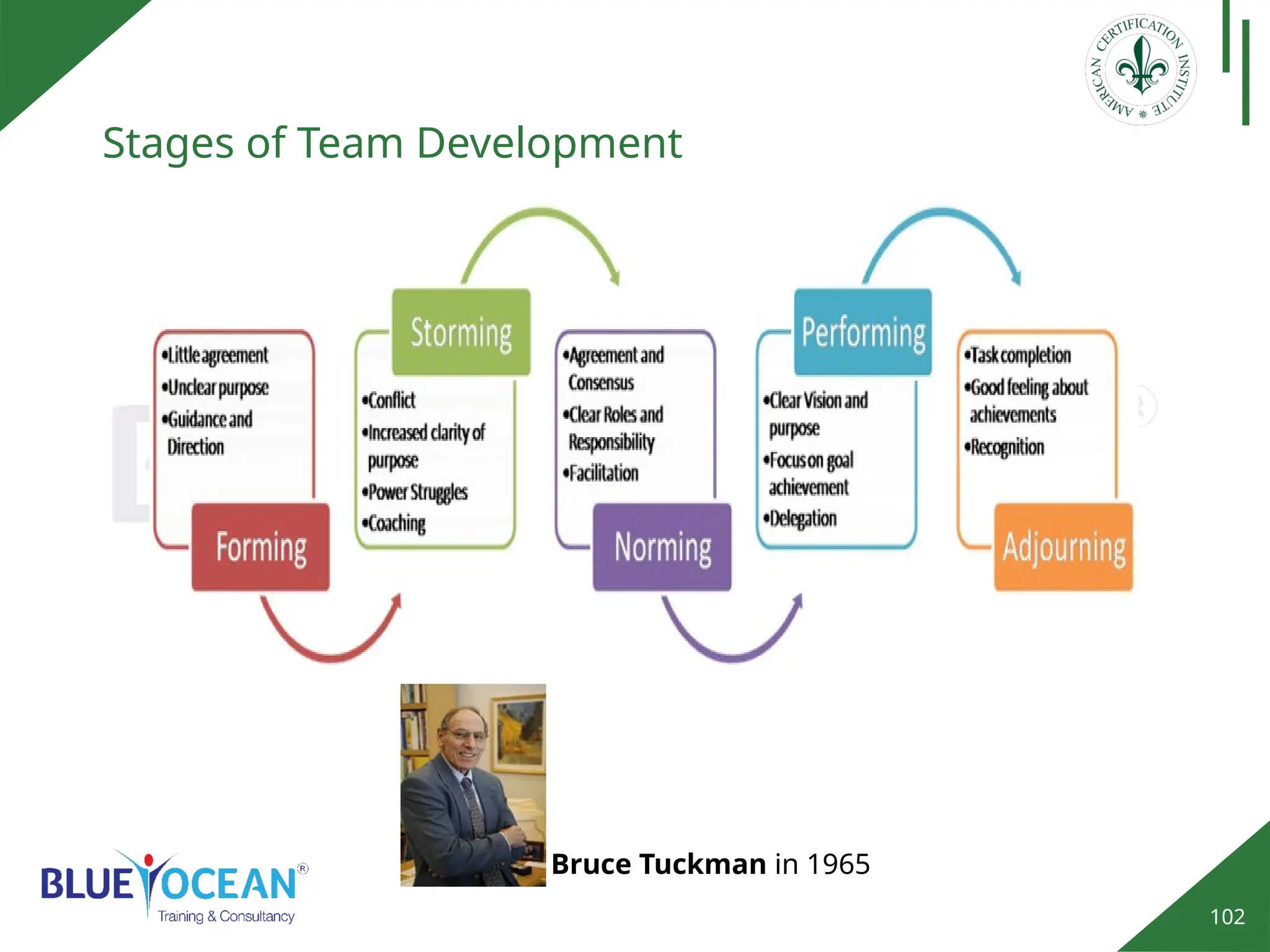
Stages of Team Development
Bruce Tuckman in 1965
103
Stages of Team Development
Forming
The team is formed, and everyone shows their best behaviour. There is a positive and
polite atmosphere. Strong guidance is needed by the facilitator as group tasks are not
clearly defined yet.
Storming
Emerging boundaries become contested and conflicts arise as people tend to bring
different ideas of how to accomplish goals. Control becomes the key concern during this
stage.
104
Stages of Team Development
Norming
This stage is when people begin to recognize ways in which they are alike. They realize
that they are in this together. Hence, they tend to get more social and may forget their
focus in favour of having a good time.
This is the time to help with training if applicable. It becomes important to encourage
them in order to feel comfortable with each other and with systems. Also, the group needs
to stay focused on goal.
Thus, during the norming stage, there is conflict resolution. There is greater involvement
of team members. There is a greater “we” feeling rather than “I” feeling.
105
Stages of Team Development
Performing
This stage is when team members are trained, competent, as well as able to do their own
problem-solving. At this time, ways need to be looked at in order to challenge them as
well as develop them.
The team is mature now. The members understand their roles and responsibilities. They
would require more input in processes. The members would be self-motivated as well as
self-trained. Thus, their efforts need to be recognized. Growth has to be encouraged. This
is done by giving new challenges to the team.
Thus, teams at the stage of performing are self-controlling, practical, loyal as well as
productive. Focus is there on both performance as well as production.
106
Stages of Team Development
Adjourning
When all tasks are completed, it is important to celebrate the team’s positive
achievements. Letting go of the group structure after long periods of intensive teamwork
can also generate uncertainty for individual team members.
107
Building Human Relations
Understanding human relations can help us in our workplace and as a result, assist us in
achieving career success. The better our human relations, the more likely we are to grow
both professionally and personally.
Knowing how to get along with others resolves workplace conflict, manage relationships,
communicate well and make good decisions. Human Relation is a skill or ability to work
effectively through and with other people, its all about building better relationships.
108
Building Human Relations
Develop Your People Skills
Good relationships start with good people skills. People with good interpersonal skills are
usually perceived as optimistic, calm, confident and charismatic, these qualities are often
endearing or appealing to others.
Be Positive
Positivity is attractive and contagious; it will help strengthen your relationships with your
colleagues. No one wants to be around someone who's negative all the time, so start
focusing on the positives around you.
109
Building Human Relations
Appreciate Others
Everyone from your boss to the office cleaner wants to feel appreciated for their work. So
genuinely compliment the people around you when they do something well.
Manage Your Boundaries
All of us want to have friends at work, but, occasionally, a friendship can start to impact
our jobs, especially when a friend or colleague begins to monopolize our time, make sure
to set and manage boundaries properly. It is important to be assertive about your
boundaries and that you know how much time you can devote during the workday for
social interactions.
110
Building Human Relations
Avoid Gossiping
Gossiping is a major relationship killers at work. If you are experiencing conflict with
someone in your group, talk to them directly about the problem. Gossiping about the
situation with other colleagues will only exacerbate the situation and cause mistrust and
animosity.
Listen Actively
Practice active listening skills when you talk to your customers and colleagues. People
respond to those who truly listen to what they have to say. Focus on listening more than
you talk and you will quickly become known as someone who can be trusted.
111
Assertive Skills
Assertiveness is the ability to communicate your needs, feelings, opinions, and beliefs in
an open and honest manner without violating the rights of others.
An honest, direct and appropriate expression of one's feelings, thoughts and beliefs.
Assertiveness is not :
1. A guaranteed way to win every argument
2. A guaranteed way to get what you want
3. A way to get others to feel like you feel
4. A way to get other to think like you think
5. A way to tell everyone everything all the time
112
How to develop Assertive Skills
Being assertive is not necessarily easy, but it is a skill that can be learned. Developing your
assertiveness starts with a good understanding of who you are and a belief in the value
you bring.
When you have that, you have the basis of self-confidence. Assertiveness helps to build
on that self-confidence and provides many other benefits for improving your relationships
at work and in other areas of your life as well.
Some people are naturally more assertive than others. If your disposition tends more
towards being either passive or aggressive, you need to work on your skills.
113
How to develop Assertive Skills
Value YOURSELF and your RIGHTS
1. Understand that your rights, thoughts, feelings, needs and desires are just as
important as everyone else's.
2. But remember they are not more important than anyone else's, either.
3. Recognise your rights and protect them.
4. Believe you deserve to be treated with respect and dignity at all times.
5. Stop apologizing for everything.
114
How to develop Assertive Skills
Express negative thoughts and feelings in a healthy and positive manner
1. Allow yourself to be angry, but always be respectful.
2. Do say what's on your mind, but do it in a way that protects the other person's
feelings.
3. Control your emotions.
4. Stand up for yourself and confront people who challenge you and/or your rights.
115
How to develop Assertive Skills
In general, ASSERTIVE people:
1. Get to "win-win" more easily – they see the value in their opponent and in his/her
position, and can quickly find common ground.
2. Are better problem solvers – they feel empowered to do whatever it takes to find the
best solution.
3. Are less stressed – they know they have personal power and they don't feel
threatened or victimized when things don't go as planned or expected.
4. Are doers – they get things done because they know they can.
116
How to develop Assertive Skills
Learn to say "No" when you need to
1. Know your limits and what will cause you to feel taken advantage of
2. Know that you can't do everything or please everyone and learn to be OK with that.
3. Go with what is right for you.
4. Suggest an alternative for a win-win solution.
When you act assertively you act fairly and with empathy. The power you use comes from
your self-assurance and not from intimidation or bullying.
117
How to Negotiate a Win-Win
Negotiation is a method by which people settle differences. It is a process by which
compromise, or agreement is reached while avoiding argument and dispute.
In any disagreement, individuals understandably aim to achieve the best possible
outcome for their position (or perhaps an organization they represent). However, the
principles of fairness, seeking mutual benefit and maintaining a relationship are the keys
to a successful outcome.
118
How to Negotiate a Win-Win
Effective negotiation helps you :
 to resolve situations where what you want conflicts with what someone else wants.
 The aim of win-win negotiation is to find a solution that is acceptable to both parties,
and leaves both parties feeling that they've won, in some way, after the event.
It is always best to try and find a WIN-WIN solution to a conflict. Many viable solutions
remain just unapplied theory because people don’t put in the effort to find them and
don’t approach the whole process in a constructive, effective way.
119
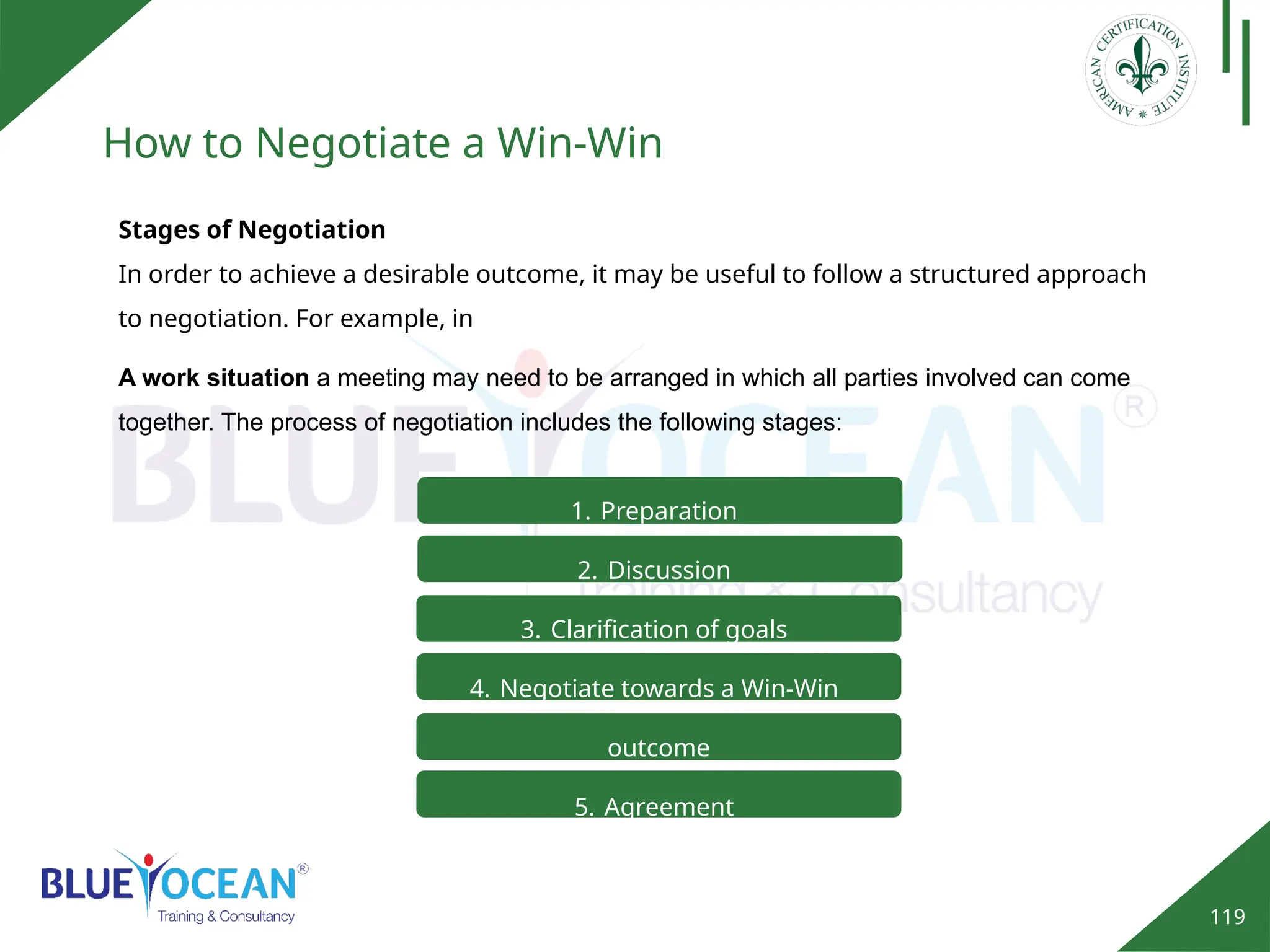
How to Negotiate a Win-Win
Stages of Negotiation
In order to achieve a desirable outcome, it may be useful to follow a structured approach
to negotiation. For example, in
1. Preparation
2. Discussion
3. Clarification of goals
4. Negotiate towards a Win-Win
outcome
5. Agreement
6. Implementation of a course of action
A work situation a meeting may need to be arranged in which all parties involved can come
together. The process of negotiation includes the following stages:
120
How to Negotiate a Win-Win
Failure to Agree
If the process of negotiation breaks down and agreement cannot be reached, then re-
scheduling a further meeting is called for. This avoids all parties becoming embroiled in
Always be aware that:
1. Negotiation is not an arena for the realization of individual achievements.
2. There can be resentment of the need to negotiate by those in authority.
3. Certain features of negotiation may influence a person’s behaviour, for example some
people may become defensive.
heated on or argument, which not only wastes time but can also damages future
relationships.
121
How to RESOLVE conflict
amicably
Conflict is a normal part of any business relationship. After all, two employees can’t be
expected to agree on everything, all the time.
It occurs whenever people disagree over their values, motivations, perceptions, ideas, or
desires. Interpersonal disagreements may be normal, but they’re also costly. Learning
how to deal with conflict rather than avoiding it is crucial.
When conflict is MISMANAGED, it can cause great harm to a relationship, but when
handled in a respectful, positive way, conflict provides an OPPORTUNITY to strengthen
the bond between two people.
122
How to RESOLVE conflict
amicably
What you can do ;
1. Make understanding the priority rather than winning or “being right”
2. Listen to the other person's feelings, in addition to their words
3. Focus on the present rather than the past
4. Be willing to let go of resentment
5. Be willing to agree to disagree and move on
6. Use appropriate humour to reduce tension and anger.
123
Stages of Team Development
Team management refers to the various activities which bind a team together by
bringing the team members closer to achieve the set targets.
For the team members, their team must be
their priority and everything else should take a
back seat. They should be very focused on
their goals.
124
Team Management Skills
In order to build an effective team, the team leader should;
1. Be a mentor to his team rather than being a strict boss
2. Ensure every team member willingly participates
3. Ensure every team member gets complete information
4. Keep team members motivated at all times
5. Gossiping, loose talks, blame game and dirty politics should never find a place in
the team.
6. Encourage new ideas and suggestions from members
7. Avoid criticism, give positive / constructive feedback
8. Transparency and health interaction should be encouraged
9. Avoid conflicts
10. Recognition and Rewards
125
Characteristics of a Good Team
 Team goals are understood by everyone in the team.
 Everyone participates actively and positively.
 Everyone takes initiative to get things done.
 Each teammate trusts the judgement of the others.
 The team is willing to take risks.
 Individual members have thought hard about creative solutions to the problem.
 Members are carefully listened to and receive thoughtful feedback.
 Everyone is supportive of the project and of others.
126
Characteristics of a Good Team
 There is plenty of communication between team members.
 Team decisions are made using organized, logical methods.
 Full team acceptance is expected as decisions are made.
 Dissenting opinions are recorded and may be revisited if future situations dictate.
 Team goals are given realistic time frames.
 Everyone is focused on the ultimate goal of the project, while also digging into the
underlying details.
127
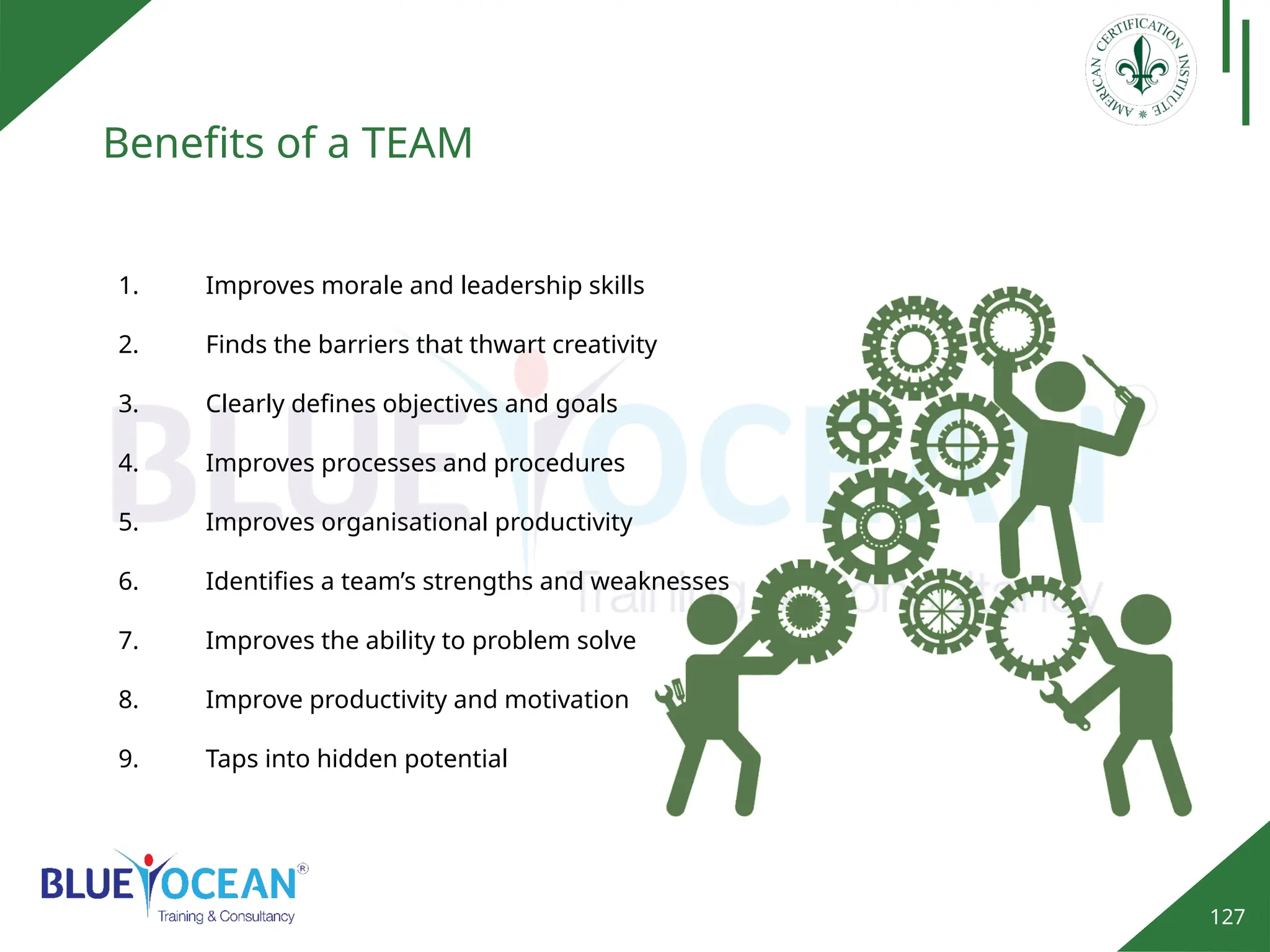
Benefits of a TEAM
1. Improves morale and leadership skills
2. Finds the barriers that thwart creativity
3. Clearly defines objectives and goals
4. Improves processes and procedures
5. Improves organisational productivity
6. Identifies a team’s strengths and weaknesses
7. Improves the ability to problem solve
8. Improve productivity and motivation
9. Taps into hidden potential
128
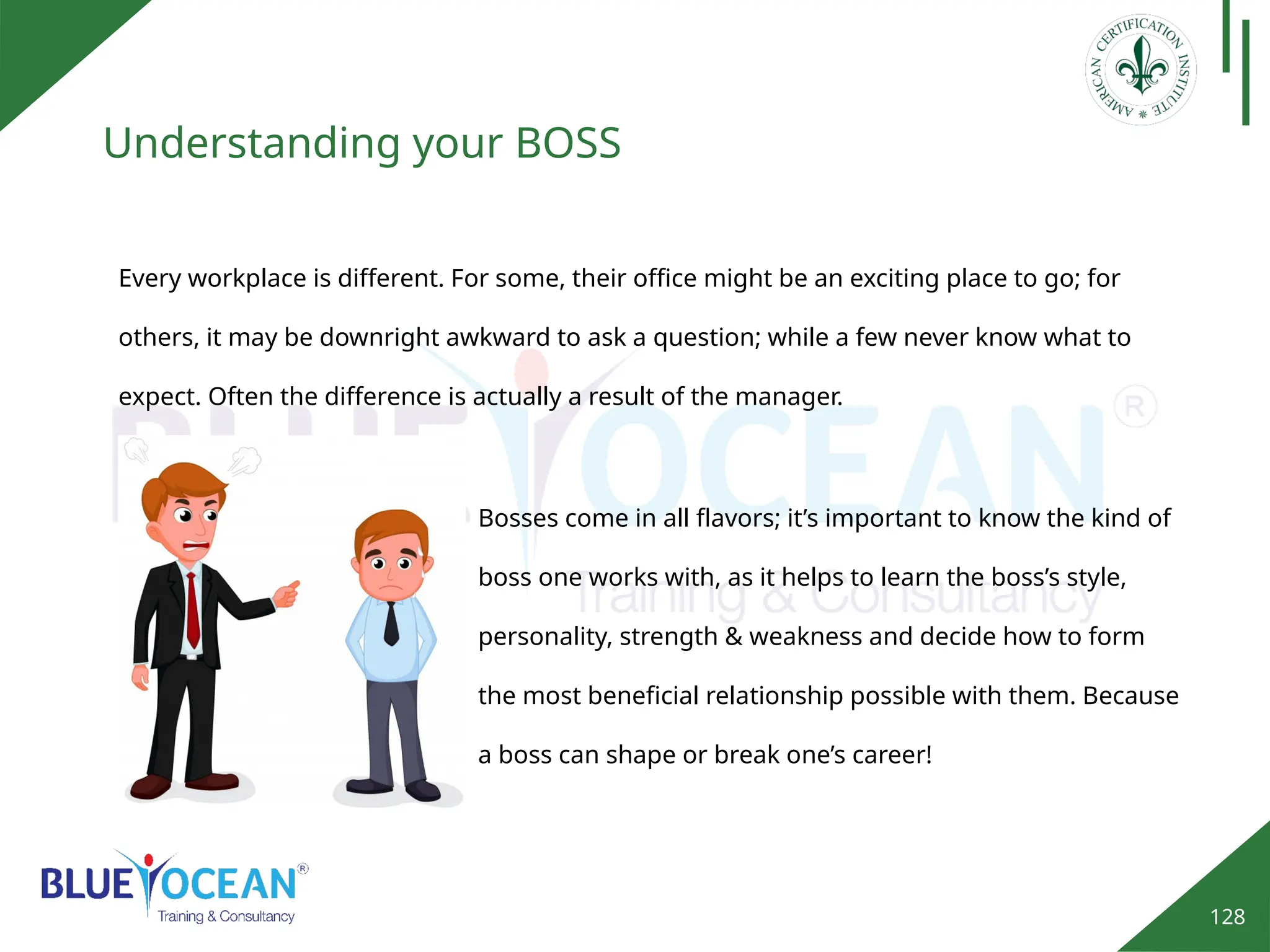
Understanding your BOSS
Every workplace is different. For some, their office might be an exciting place to go; for
others, it may be downright awkward to ask a question; while a few never know what to
expect. Often the difference is actually a result of the manager.
Bosses come in all flavors; it’s important to know the kind of
boss one works with, as it helps to learn the boss’s style,
personality, strength & weakness and decide how to form
the most beneficial relationship possible with them. Because
a boss can shape or break one’s career!
129
Types of BOSS
This type of boss thinks it is essential to be intimidating his or her employees in order to
accomplish their goals. The boss always threatens his staff to keep them acquiescent. He
scares them so much that they’re afraid of him, which actually encourages further
intimidation and he or she gets things done through fear.
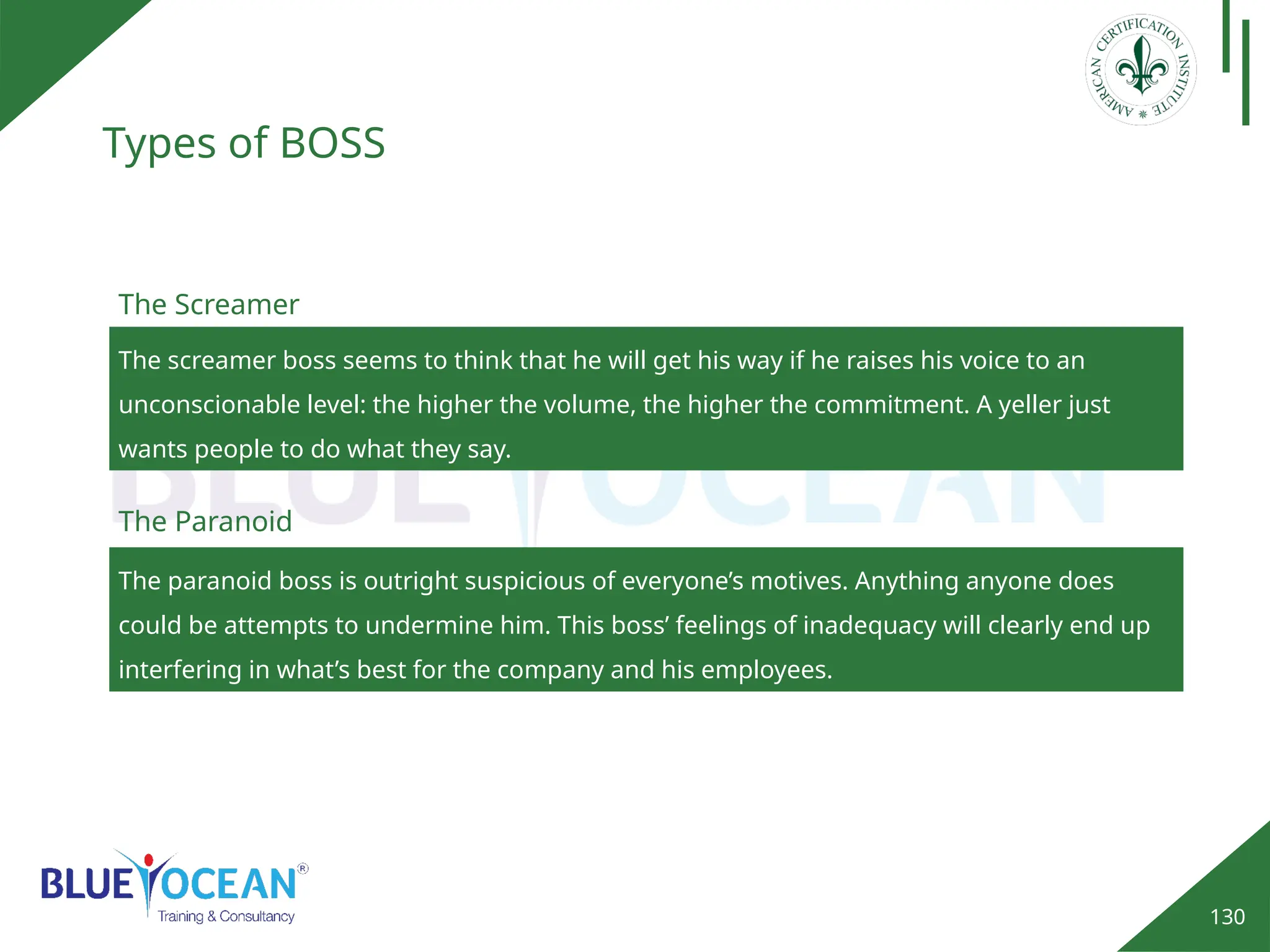
The Fear-monger
The Manipulator
The manipulator boss is extremely intelligent, highly focused, very motivated and always
has a secret plan; one of the most dangerous. He looks at people as a means to an end.
130
Types of BOSS
The screamer boss seems to think that he will get his way if he raises his voice to an
unconscionable level: the higher the volume, the higher the commitment. A yeller just
wants people to do what they say.
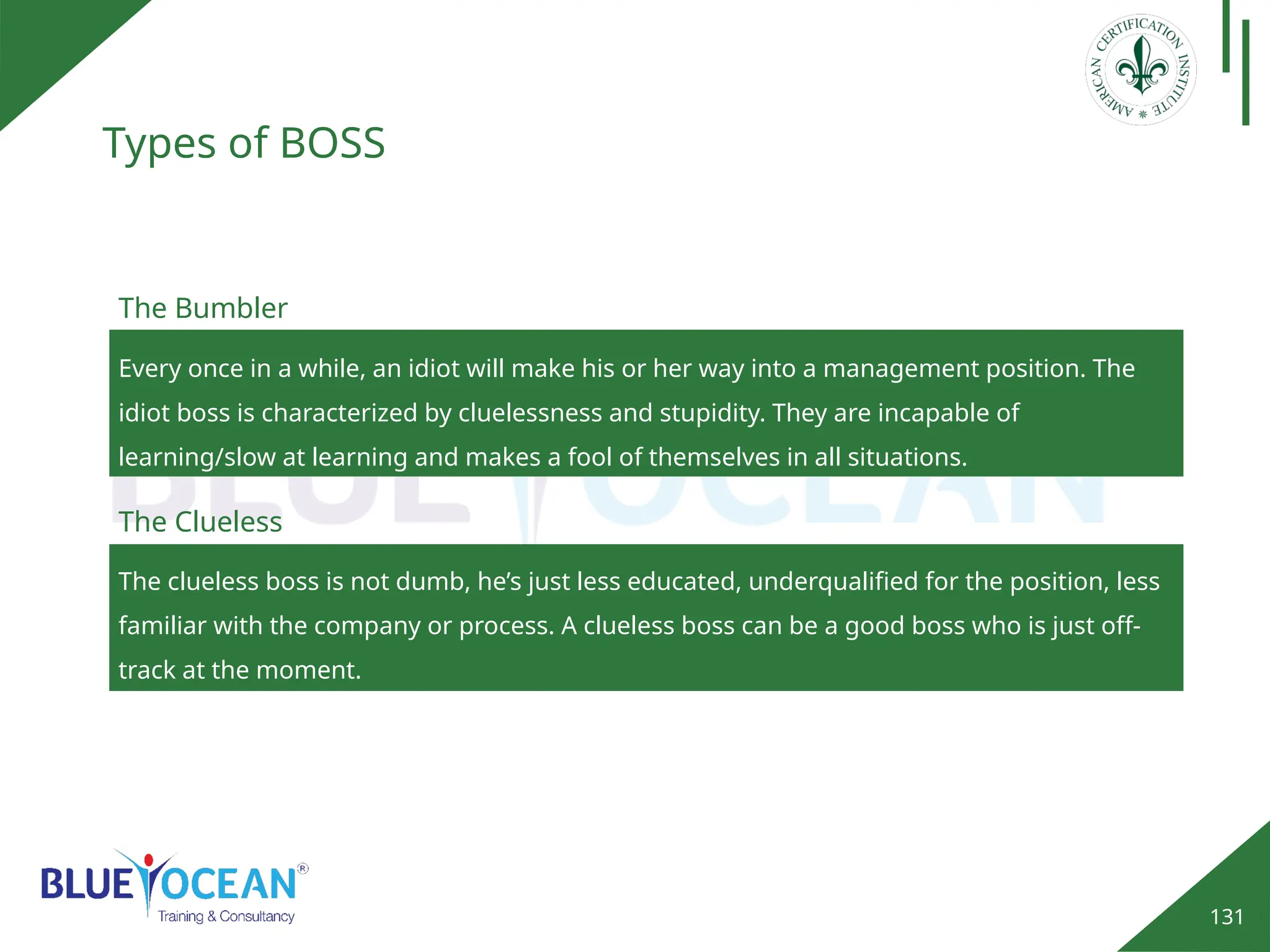
The Screamer
The paranoid boss is outright suspicious of everyone’s motives. Anything anyone does
could be attempts to undermine him. This boss’ feelings of inadequacy will clearly end up
interfering in what’s best for the company and his employees.
The Paranoid
131
Types of BOSS
Every once in a while, an idiot will make his or her way into a management position. The
idiot boss is characterized by cluelessness and stupidity. They are incapable of
learning/slow at learning and makes a fool of themselves in all situations.
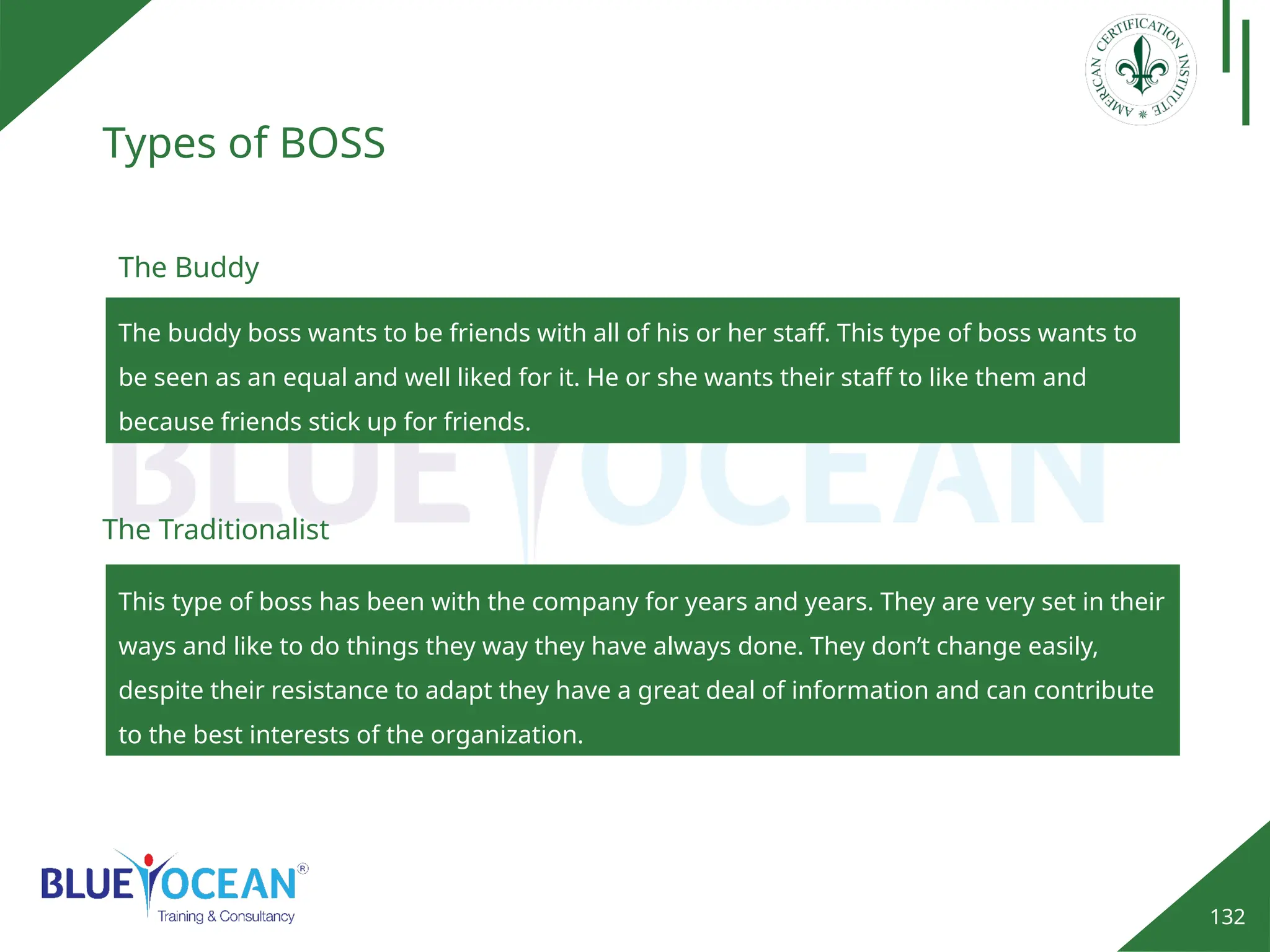
The Bumbler
The clueless boss is not dumb, he’s just less educated, underqualified for the position, less
familiar with the company or process. A clueless boss can be a good boss who is just off-
track at the moment.
The Clueless
132
Types of BOSS
The buddy boss wants to be friends with all of his or her staff. This type of boss wants to
be seen as an equal and well liked for it. He or she wants their staff to like them and
because friends stick up for friends.
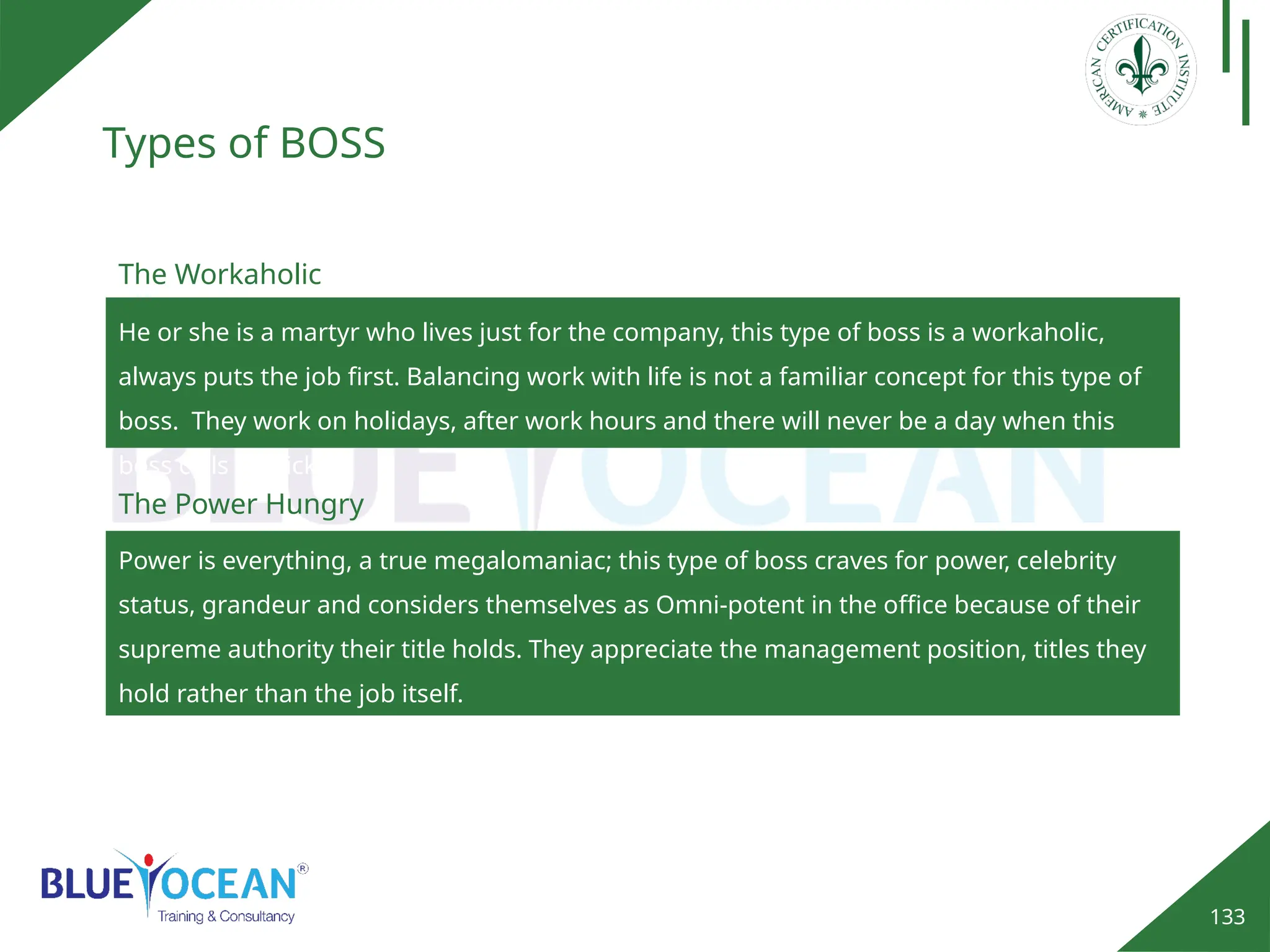
The Buddy
This type of boss has been with the company for years and years. They are very set in their
ways and like to do things they way they have always done. They don’t change easily,
despite their resistance to adapt they have a great deal of information and can contribute
to the best interests of the organization.
The Traditionalist
133
Types of BOSS
Power is everything, a true megalomaniac; this type of boss craves for power, celebrity
status, grandeur and considers themselves as Omni-potent in the office because of their
supreme authority their title holds. They appreciate the management position, titles they
hold rather than the job itself.
The Power Hungry
The Workaholic
He or she is a martyr who lives just for the company, this type of boss is a workaholic,
always puts the job first. Balancing work with life is not a familiar concept for this type of
boss. They work on holidays, after work hours and there will never be a day when this
boss calls off sick.
134
Types of BOSS
Though this boss might present himself as tough, he can barely hide his inadequacies. He
absorbs the world’s worries and worries for the world. He frets about little details. He
arrives at the office in the morning, flushed and frazzled, because he was lying awake the
night before agonizing over numbers and orders
The World-on his Shoulders Boss
The two-minute boss exhibits the characteristics of Power Hungry boss and World-on-his-
shoulders boss. He or she impulsively demands control over situations. This type of a boss
constantly gives the impression that he is way too busy to bother with details. His head is
always somewhere else, somewhere more important.
The 2 Minute Boss
135
Types of BOSS
The eccentric boss has unrealistic expectations for his or her staff. They have a unique way
of completing their work and expects their staff to work in the same manner. They can be
gentle, open to suggestions, innovative ideas but often cause confusion around their
expectations and explanations of projects.
The Eccentric
This non-stick boss is always missing in action. This type of boss is more of a nuisance
than a danger. Any blame slides right off him. He does not give straight answers to
straight questions. But makes his or her appearance for the limelight; prominent in public
affairs.
The Teflon Boss
136
Types of BOSS
The perfectionist is a micro-manager who likes to control everything, involves in every
activity the staff does. It can be the smallest detail, but this type of boss will make changes
to his or her staff work, simply because they can. The behaviour is obsessive and has little
or no trust on his or her staff’s abilities.
The Perfectionist
The lone wolf prefers to ride solo. He stays in his office or works from home, avoiding
human contact, especially employee interaction. He could be a tech whiz who was
promoted based on his outstanding hard skills, but he’s not necessarily a people person.
The Lone Wolf Boss
137
Types of BOSS
The supportive motivator, the ideal boss who treats everyone with fairness regardless of
politics. He communicates, keeps an open-door policy, listens to everyone, motivates and
encourages everyone. He leads by example, provides superior training and a positive work
environment. He provides constructive feedback and supports every effort his staff makes
to succeed. He has vision, is not afraid, and doesn’t scream. He coaches his staff, and
when employees leave, they will talk about him for years to come.
The Great Boss
138
Boss-Subordinate Relationship
Organisations are pressuring managers to deliver better results with fewer people. In the
best of environments bosses can be challenging to deal with. In the worst of environment,
they can be more than challenging-frustrating, perplexing, aggravating and impossible.
Working for a Company is not an easy task. We need to deal with many employees,
customers and suppliers and the most important and difficult person is our BOSS.
Yet they can be managed, it’s the right approach that pays off in developing positive
productive relationships.
139
Boss-Subordinate Relationship
1. Try to understand the reasons for your Boss’s difficult behaviour.
2. Identify the primary motivating factors (what drives your boss).
3. Support their success
4. Work around their weakness and not against them
5. Learn to communicate your ideas your reactions/concerns in a helpful, positive way.
The relationship that one creates and manages with his or her immediate boss is crucial
for their success and career progress. It is important to understand key aspects of this
relationship;
140
Boss-Subordinate Relationship
Managers of all types can provide invaluable learning experiences that can enhance your
career. Managing a difficult Boss is challenging but not impossible.
 Keep your mind focused on Top PERFORMANCE
 Keep the COMMUNICATION flowing
 Keep up with the TIMING
 Be a PROBLEM SOLVER not a complainer
 Plan and ORGANISE your work
 Regularly ASSESS YOURSELF on productivity, quality of work and behaviour
 Bring your BEST SELF to work every day
 Help your boss to be effective
141
Boss-Subordinate Relationship
 Don’t go over your boss’s head if you can avoid it
 Speak up your mind
 Don’t be intimidated by a bully
 Be prepared to discuss criticism when confronted
 Refrain from becoming emotional during the discussion
 Always remain professional
 Maintain the RIGHT MIND-SET at all times
 Be PROACTIVE
 Don’t engage in self defeating behaviour
 Anticipate problems before they come up
Understand you cannot change your boss so adapt yourself if not, take further steps;
142
Leadership Skills
143
Effective Leadership Skills
What are leadership skills?
Leadership skills are the tools ,behaviours and capabilities that a person needs in order to
be successful at motivating and directing others. It is the ability to help people grow in
their own abilities and drive other to achieve their own success.
A born leader?
Many leaders may be so committed to a vision that they naturally find ways to pull others
along with them. Most of us cannot claim to have been born with that level of leadership
ability. You don’t have to be born with leadership skills. They can be learnt .
144
Effective Leadership Skills
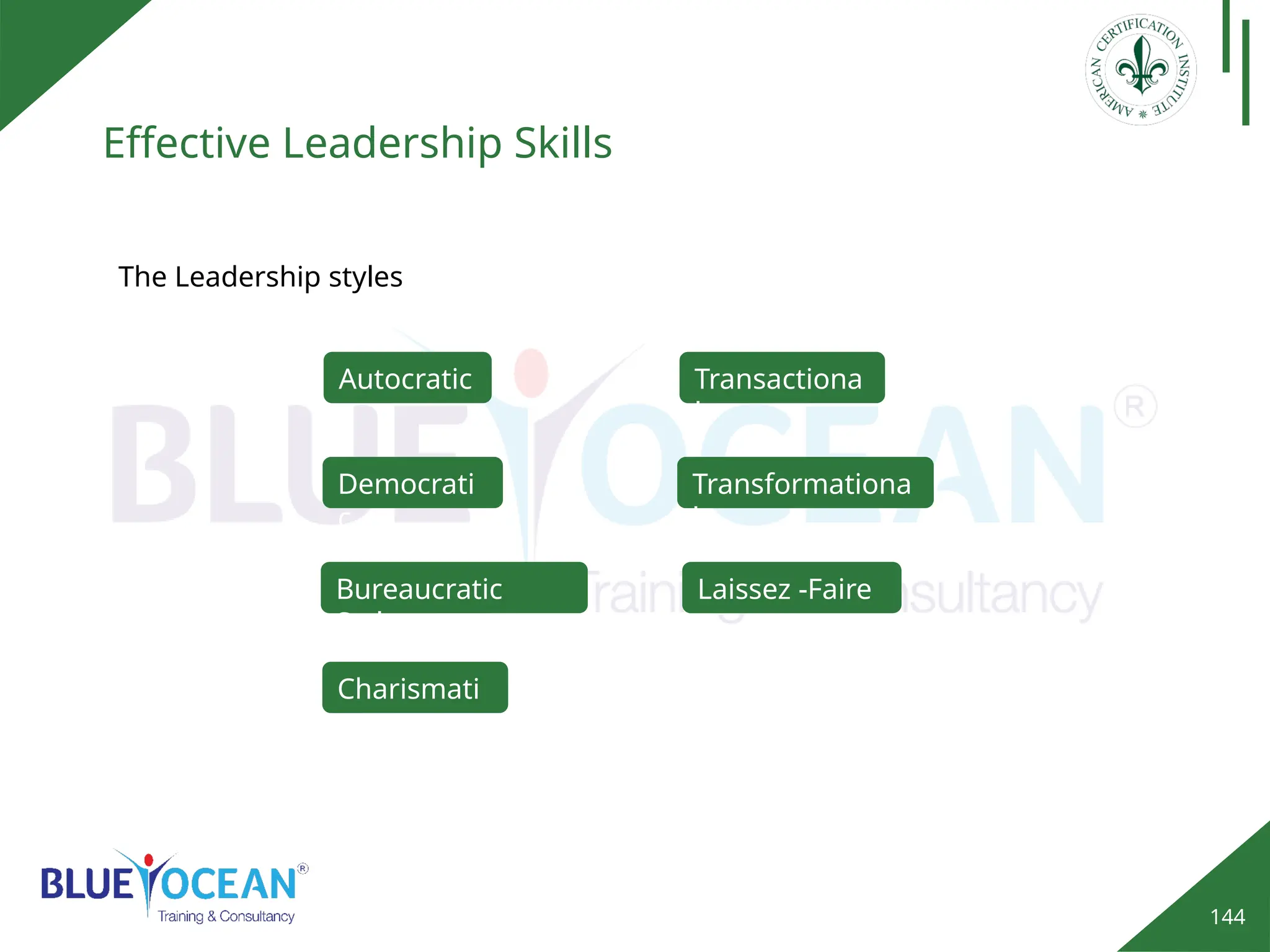
The Leadership styles
Autocratic
Democrati
c
Bureaucratic
Style
Charismati
c
Transactiona
l
Transformationa
l
Laissez -Faire
145
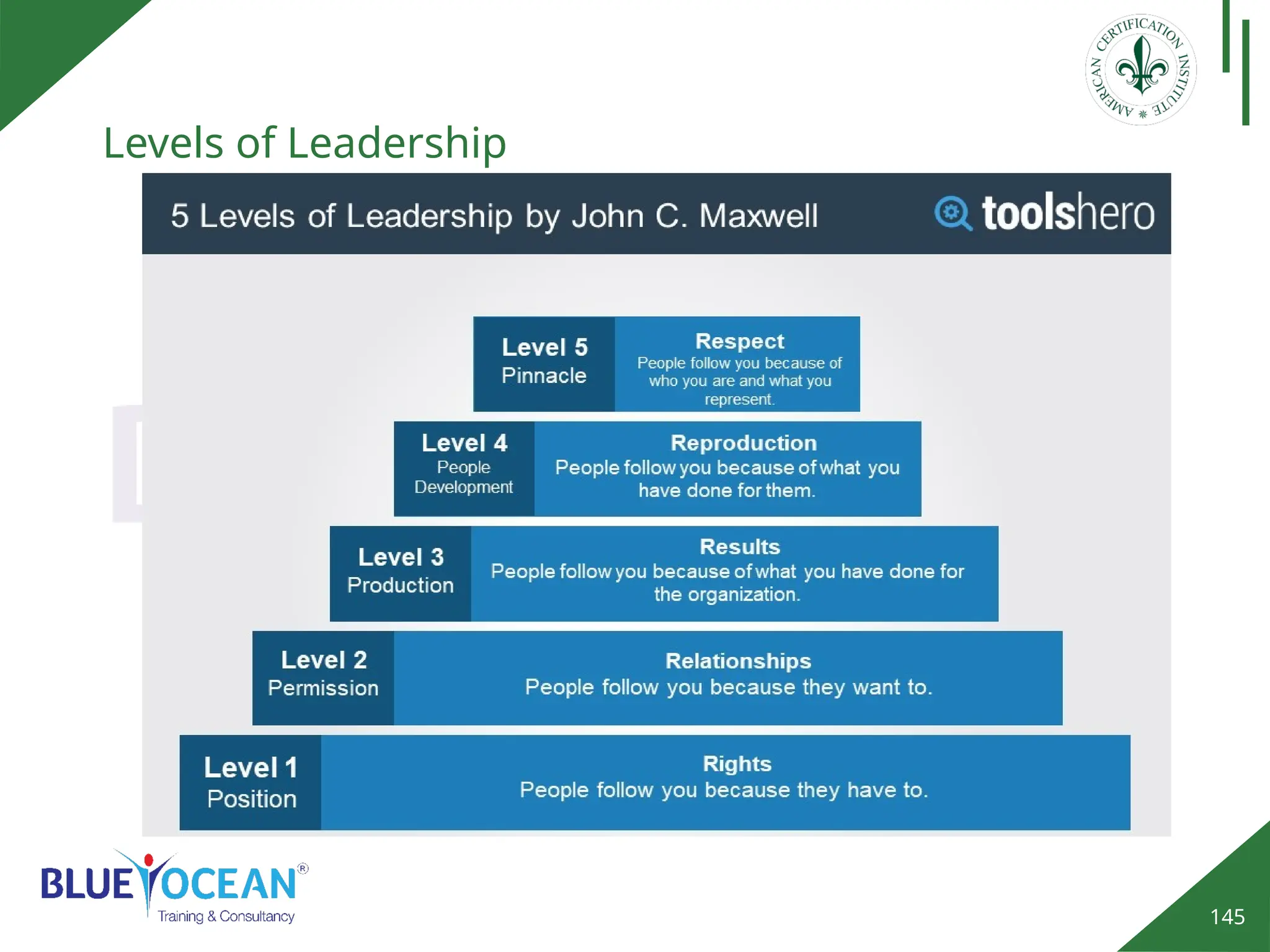
Levels of Leadership
146
Effective Leadership Skills
Characteristics of an effective leader
1. Is committed to a vision or mission
2. Understands his or her role
3. Demonstrates integrity
4. Sets an example
5. Understands how to motivate
others
6. Communicates effectively
7. Is willing to take risks
8. Is adept at problem solving
147
Effective Leadership Skills
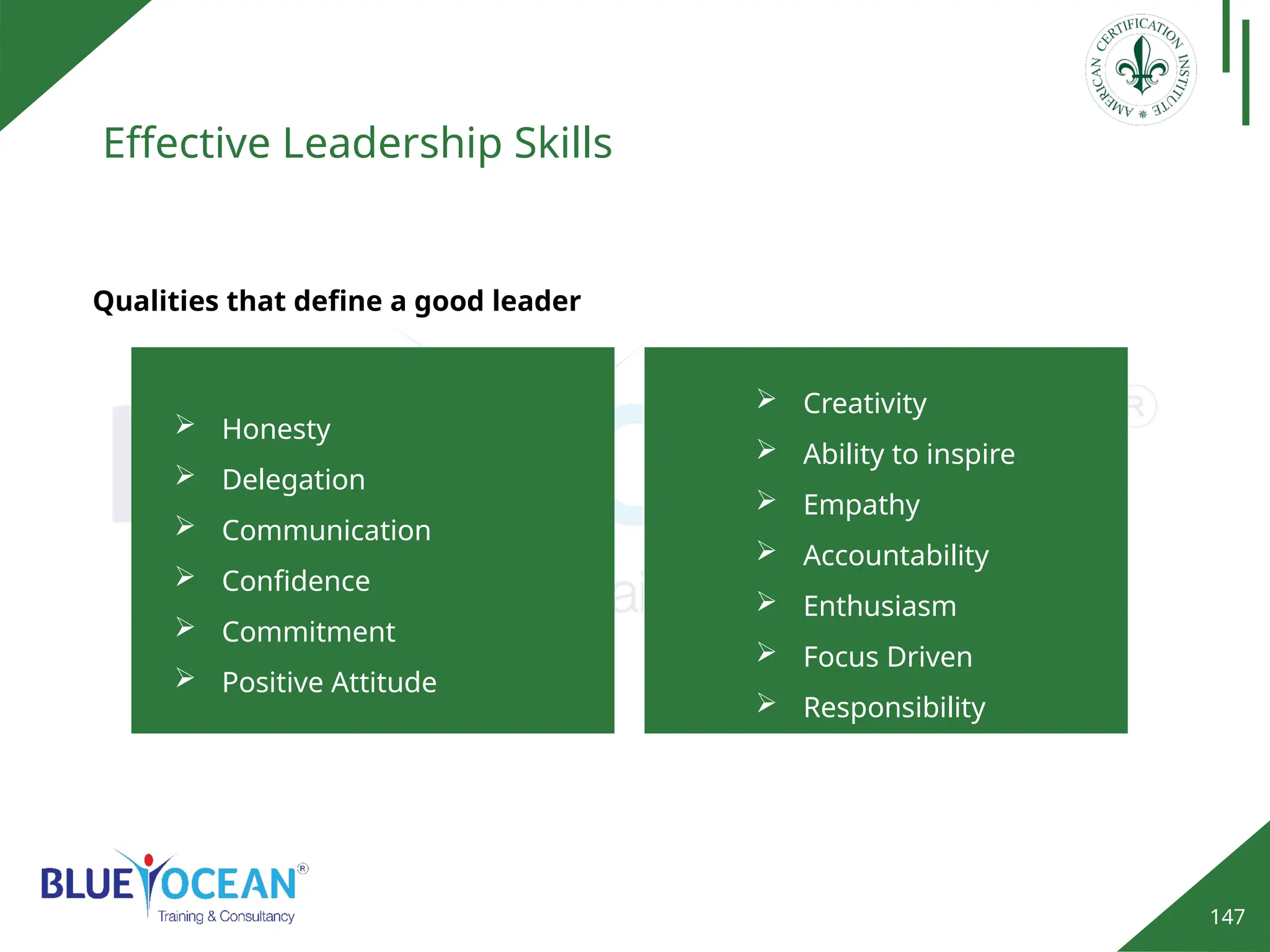
Qualities that define a good leader
 Honesty
 Delegation
 Communication
 Confidence
 Commitment
 Positive Attitude
 Creativity
 Ability to inspire
 Empathy
 Accountability
 Enthusiasm
 Focus Driven
 Responsibility
148
Effective Leadership Skills
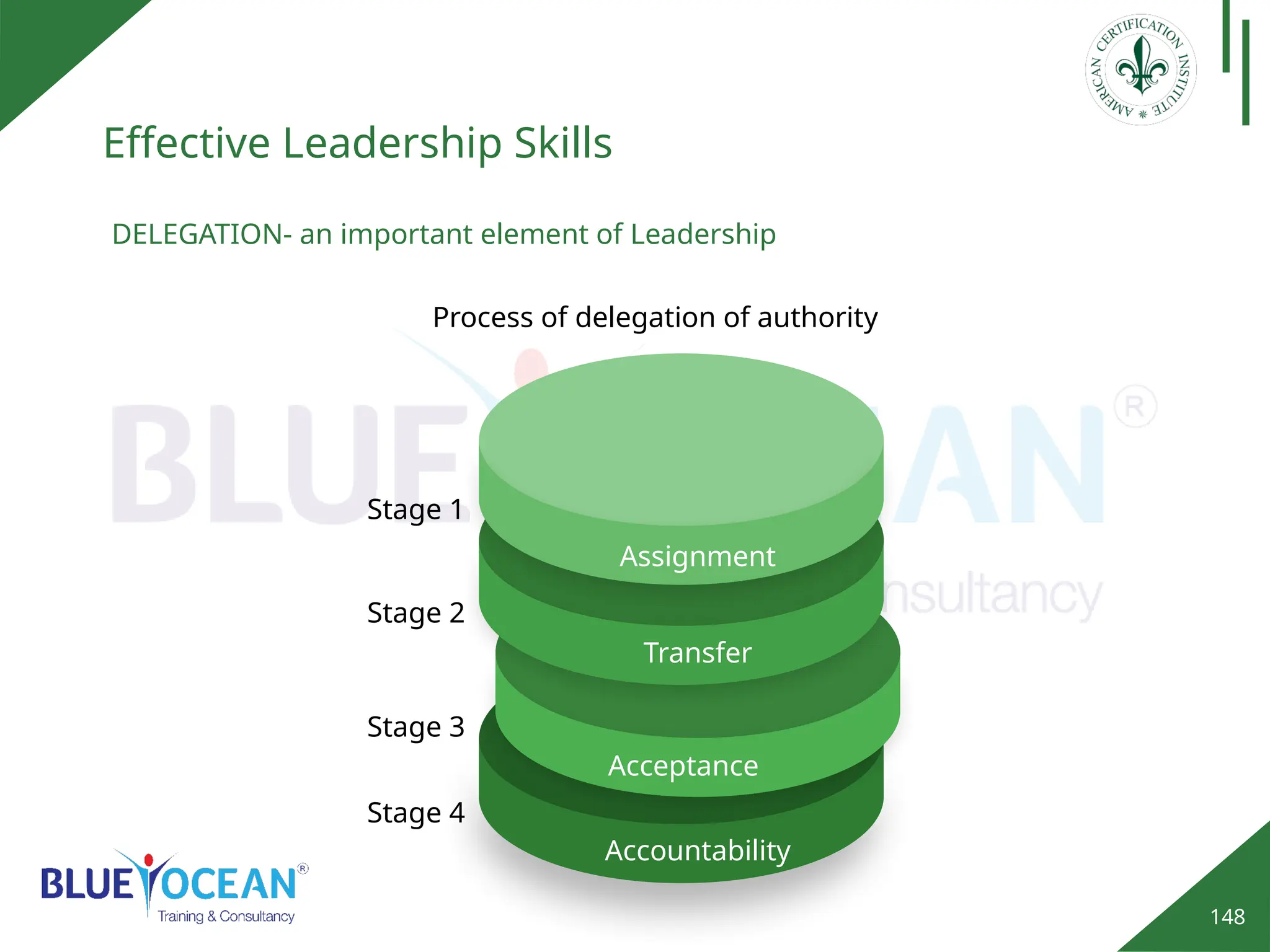
DELEGATION- an important element of Leadership
Assignment
Transfer
Acceptance
Accountability
Stage 3
Stage 4
Stage 2
Stage 1
Process of delegation of authority
149
Effective Leadership Skills
Some people are put in positions of authority, but it is up to the leaders to gain respect
and trust of their followers. Followers need to see their leader doing what is right for the
team; that is supporting, developing, nurturing, and defending in the good times and the
bad. When you establish yourself as a leader, remember that actions speak louder than
words and motivate people to do their best work for the best of their ability.
152
Business Etiquette
Business etiquette is about building professional relationships with other people at
workplace. Etiquette is not about rules & regulations but its about providing basic social
comfort and creating an environment where others feel comfortable and secure.
Business etiquette consists of two things. Firstly, thoughtful consideration of the interests
and feelings of others and secondly, being able to minimise misunderstandings. Etiquette
is all about respecting each other, practicing good manners and displaying good
behaviour.
We need to know how to behave in a given situation, know how to interact with people
that projects a professional business image.
153
Cross-Cultural Business
Etiquettes
Answer - Bow and wait for him to initiate the
handshake.
When conducting business in Australia, it is best to:
a) Act like a local and use as much slang as possible.
b) Don’t waste anyone’s time; be punctual and direct.
c) Purchase local beer and take it to all meetings as a
gift
Answer – Don’t waste anyone’s time; be punctual and
direct.
You have arrived at a business meeting in South Korea and are going to meet the
company’s president. You should:
a) Look him in the eye and extend your hand for a
handshake.
b) Bow and wait for him to initiate the handshake.
c) Nod your head slightly.
154
Cross-Cultural Business
Etiquettes
Answer - Pastries
After meeting a prospective client in China, she gives you her business card. You should:
a) Copy her information and leave the card on the
table.
b) Put it away only after carefully studying its details.
c) Hand it back to her after memorizing her
information.
Answer - Put it away only after carefully studying its
details.
In Japan, you should accept a business card with …
a) both hands b) the left hand c) the right hand
Answer - Both hands
If invited to a house for dinner in Turkey, which of these would you take?
a) Wine b) Pastries c) Flowers
155
Cross-Cultural Business
Etiquettes
Answer - Confidential
Which of these is probably the most important factor to bear in mind when doing business
in Brazil?
a) Brazilians are very wary of foreigners
b) Business is only really done with people they like and trust
c) Brazilians take a very relaxed approach to business
Answer - Business is only really done with people they like and trust
In Great Britain, tapping the side of your nose means that something is:
a) confidential
b) inappropriate
c) very boring
156
Cross-Cultural Business
Etiquettes
Culture
A perceptual structure of human activities that includes behaviors, values, arts, beliefs,
languages, custom, dress, rituals, manners, religion, laws, morality & code of honors
Cross-Culture
Interacting with or comparing two or more cultures & understanding their values, beliefs
& norms.
Learn the language, learn the culture, learn the business protocol and professional
practices of your host country. Understanding the fundamentals makes one proficient
while conducting business with people from different cultural background.
157
Cross-Cultural Business
Etiquettes
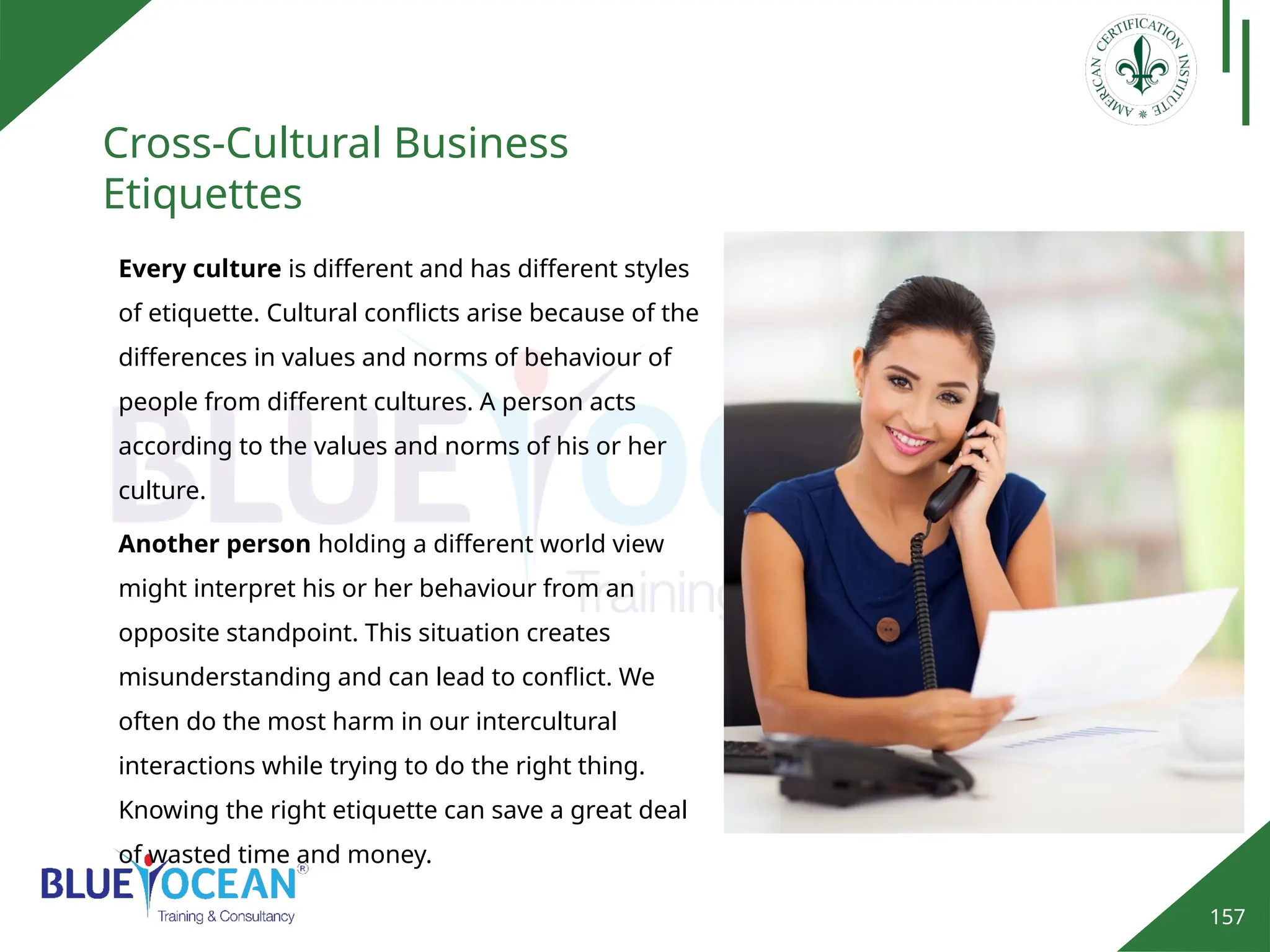
Every culture is different and has different styles
of etiquette. Cultural conflicts arise because of the
differences in values and norms of behaviour of
people from different cultures. A person acts
according to the values and norms of his or her
culture.
Another person holding a different world view
might interpret his or her behaviour from an
opposite standpoint. This situation creates
misunderstanding and can lead to conflict. We
often do the most harm in our intercultural
interactions while trying to do the right thing.
Knowing the right etiquette can save a great deal
of wasted time and money.
158
Cross-Cultural Business
Etiquettes
Greetings & Introduction
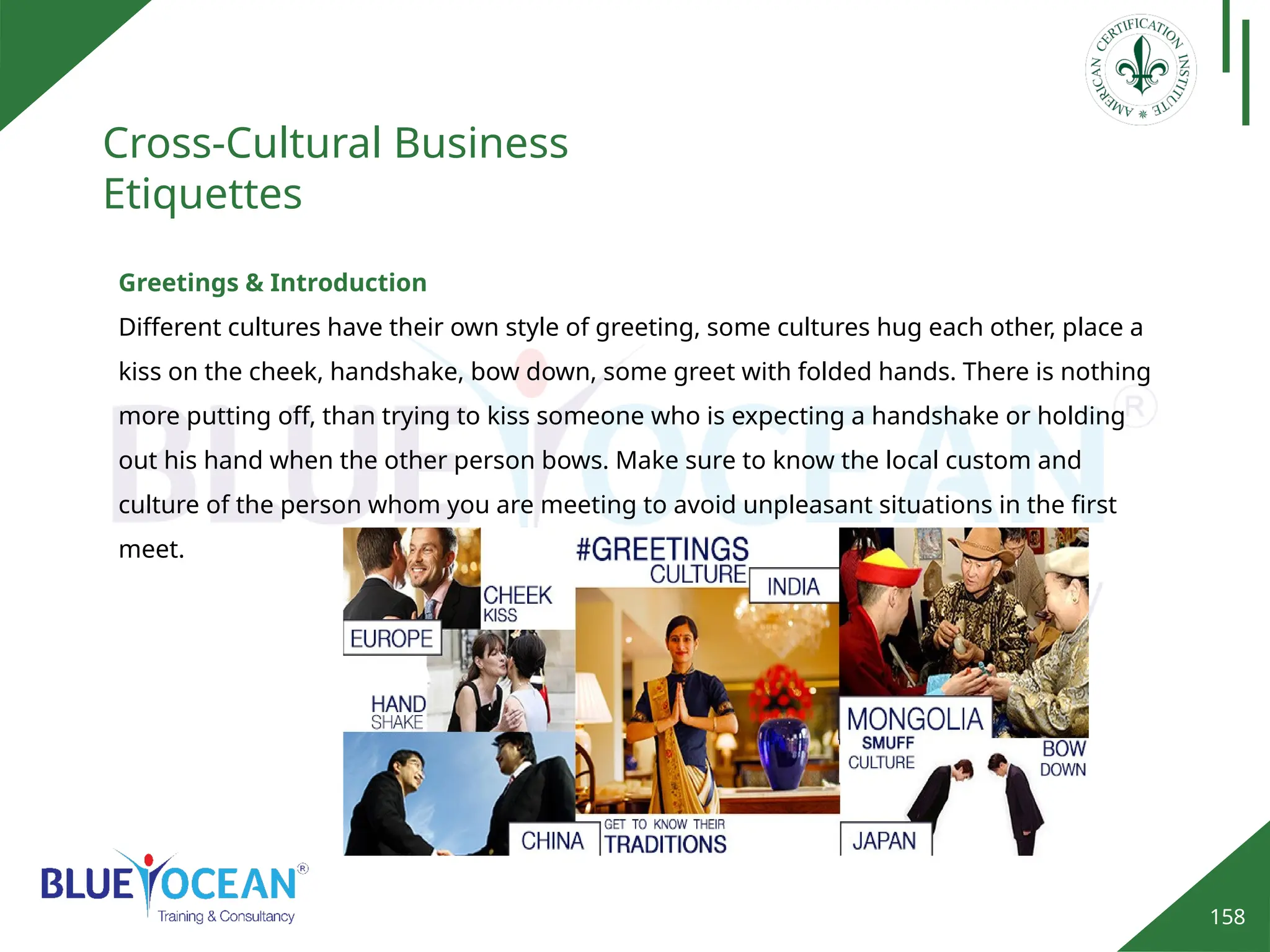
Different cultures have their own style of greeting, some cultures hug each other, place a
kiss on the cheek, handshake, bow down, some greet with folded hands. There is nothing
more putting off, than trying to kiss someone who is expecting a handshake or holding
out his hand when the other person bows. Make sure to know the local custom and
culture of the person whom you are meeting to avoid unpleasant situations in the first
meet.
159
Cross-Cultural Business
Etiquettes
Business Cards
1. As a mark of respect, present it with both hands
2. Never use or receive the card with your left hand
3. Spend few seconds reading the contents before place the card down.
4. Print the card on good quality paper as it represents your company’s image
5. Print the details on English on one side and print the local language on the other side.
Addressing
1. Always use a title when addressing someone such as Mr…or Ms…Doctor ….
2. It is better to address people by their surname
3. Ask them how they prefer to be addressed
160
Cross-Cultural Business
Etiquettes
Personal Space
People from different cultures have different views about personal space. Standing close
or touching another person may be considered appropriate in some culture whereas
inappropriate in some culture.
For example, in the Middle East, men do not touch women they are not related too, and
the same is true of women. In Mexico, it is OK to give a friendly pat on the back, but in
China you should never touch the other person. While in Thailand and India, handshakes
are fine, but you should never touch a person's head.
161
Cross-Cultural Business
Etiquettes
Appearance
As per your UAE customs, everyone are expected to abide by local standards of modesty.
Clothing which covers one’s body completely is considered modest. Traditional clothes on
foreigners may be offensive. Despite the heat, most of the body must always remain
covered.
For Business meetings, Formal suit in dark solid colors are recommended. Minimal jewelry
is advised.
Language
You can buy in any language but to sell you have to speak their language. Communicating
in a foreign language is difficult if the person is not eloquent, it is considered impolite
when someone corrects.
162
Cross-Cultural Business
Etiquettes
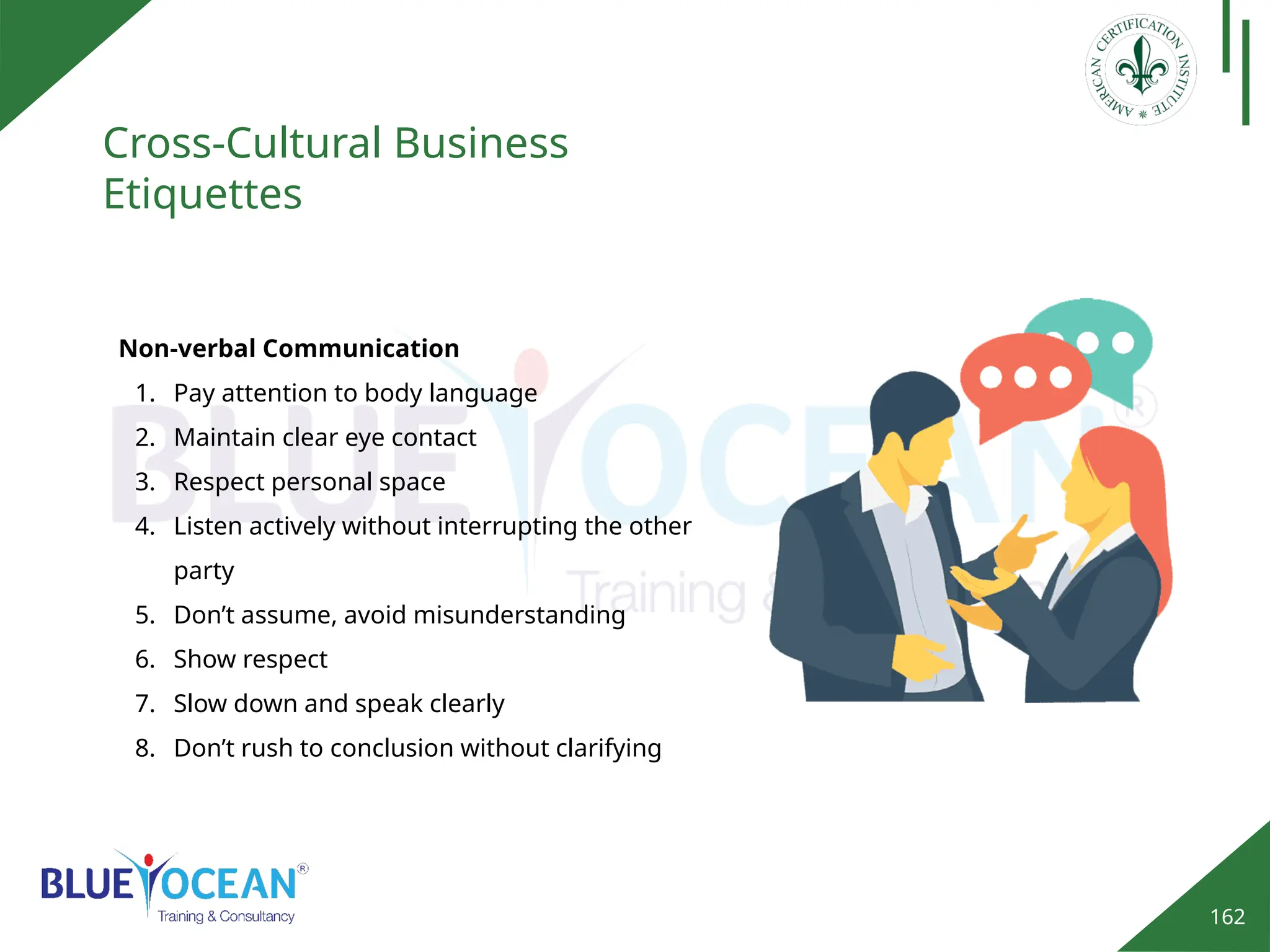
Non-verbal Communication
1. Pay attention to body language
2. Maintain clear eye contact
3. Respect personal space
4. Listen actively without interrupting the other
party
5. Don’t assume, avoid misunderstanding
6. Show respect
7. Slow down and speak clearly
8. Don’t rush to conclusion without clarifying
163
Cross-Cultural Business
Etiquettes
Having insight into the cultural dynamics of a country can be very helpful
to understand why people act the way they do, and the appropriate way
you should act while in that country.
Respecting the local customs & cultural sensitivity will ensure your
success
164
Telephone Etiquettes
Good phone etiquette is important because we cannot see the facial expressions and
body language of the other person and they cannot see us. We must compensate by
choosing our words carefully and using much more tone inflection to convey our message
than if we were face to face.
Telephone etiquette means being respectful to the person you are talking with, showing
consideration for the other person's limitations, allowing that person time to
speak, communicating clearly and much, much more.
Your voice must create a pleasant visual impression over the telephone.
165
Telephone Etiquette Tips
1. Speak directly into the mouthpiece; a headset, which will free hands is an ideal option.
2. Be careful on your voice tone and the language you use.
3. Do not eat or chew gum while talking on the telephone
4. If someone walks into your office while you’re talking on the telephone, ask the caller
if you may put him/her on hold briefly.
5. Don't place the handset in the cradle until you’ve depressed the HOLD button.
6. Don’t lay the receiver on the desk, without placing the caller on hold
7. Return to caller and complete the call as soon as possible.
166
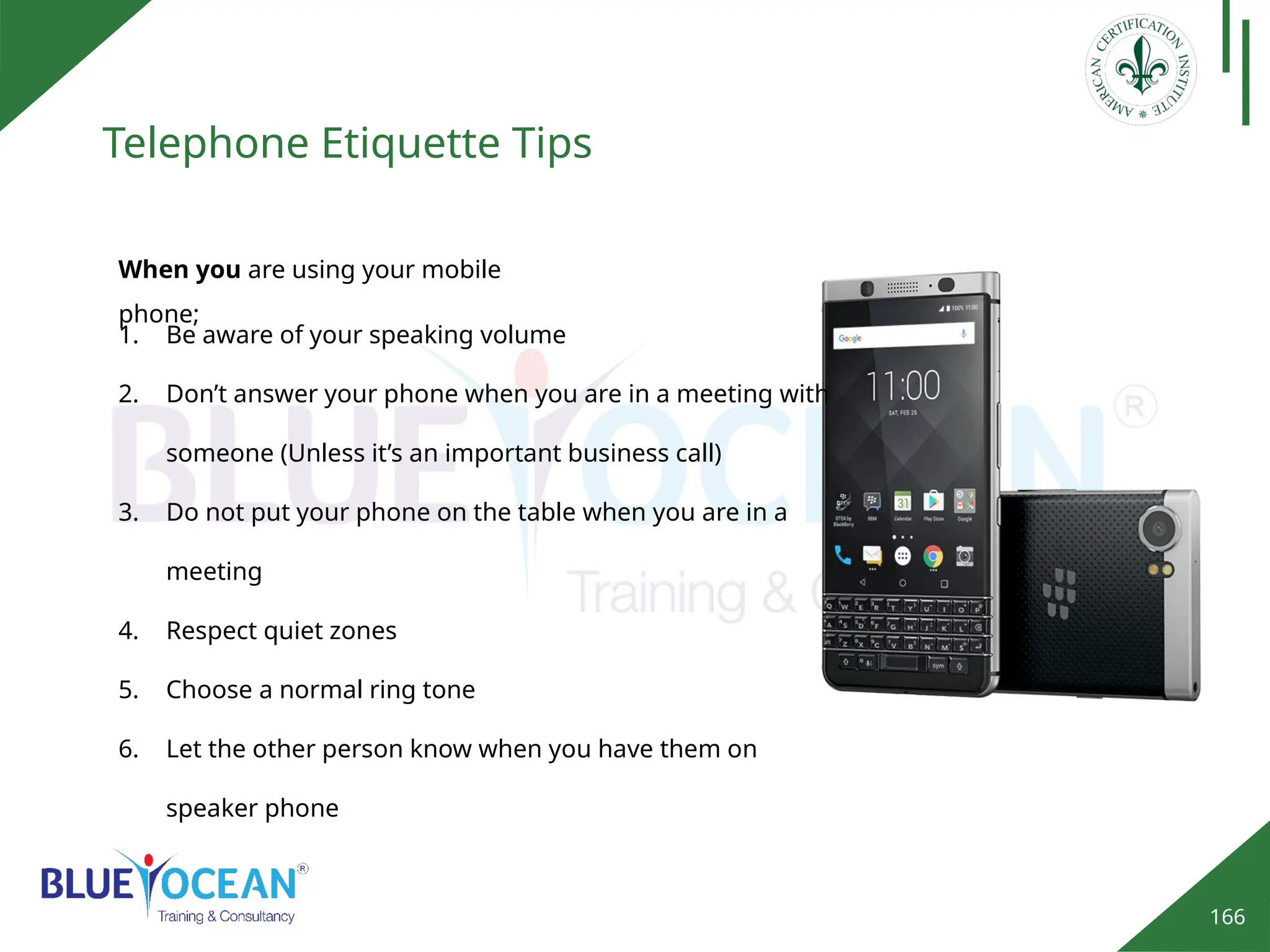
Telephone Etiquette Tips
1. Be aware of your speaking volume
2. Don’t answer your phone when you are in a meeting with
someone (Unless it’s an important business call)
3. Do not put your phone on the table when you are in a
meeting
4. Respect quiet zones
5. Choose a normal ring tone
6. Let the other person know when you have them on
speaker phone
When you are using your mobile
phone;
167
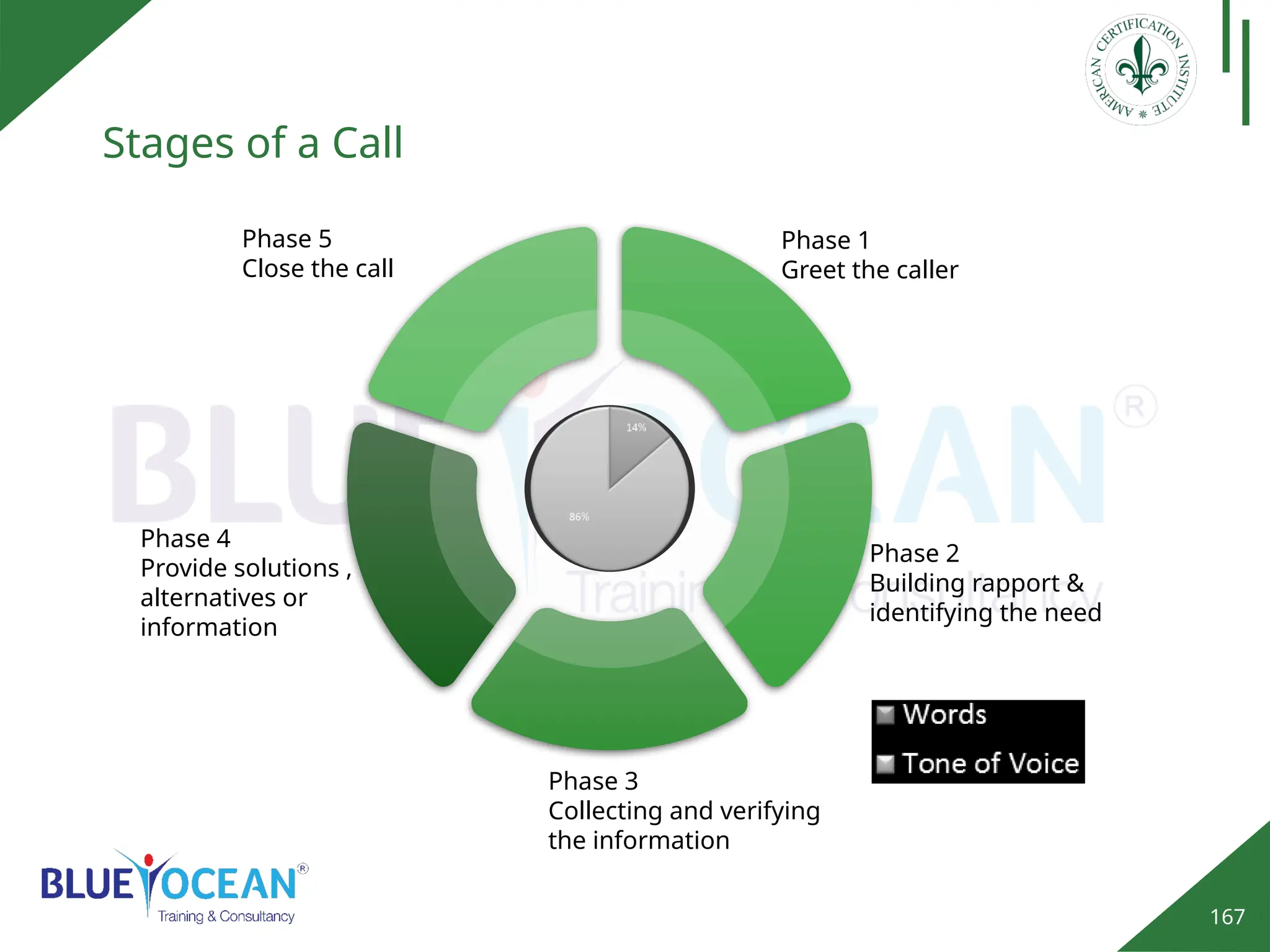
Stages of a Call
Phase 1
Greet the caller
Phase 2
Building rapport &
identifying the need
Phase 3
Collecting and verifying
the information
Phase 4
Provide solutions ,
alternatives or
information
Phase 5
Close the call
168
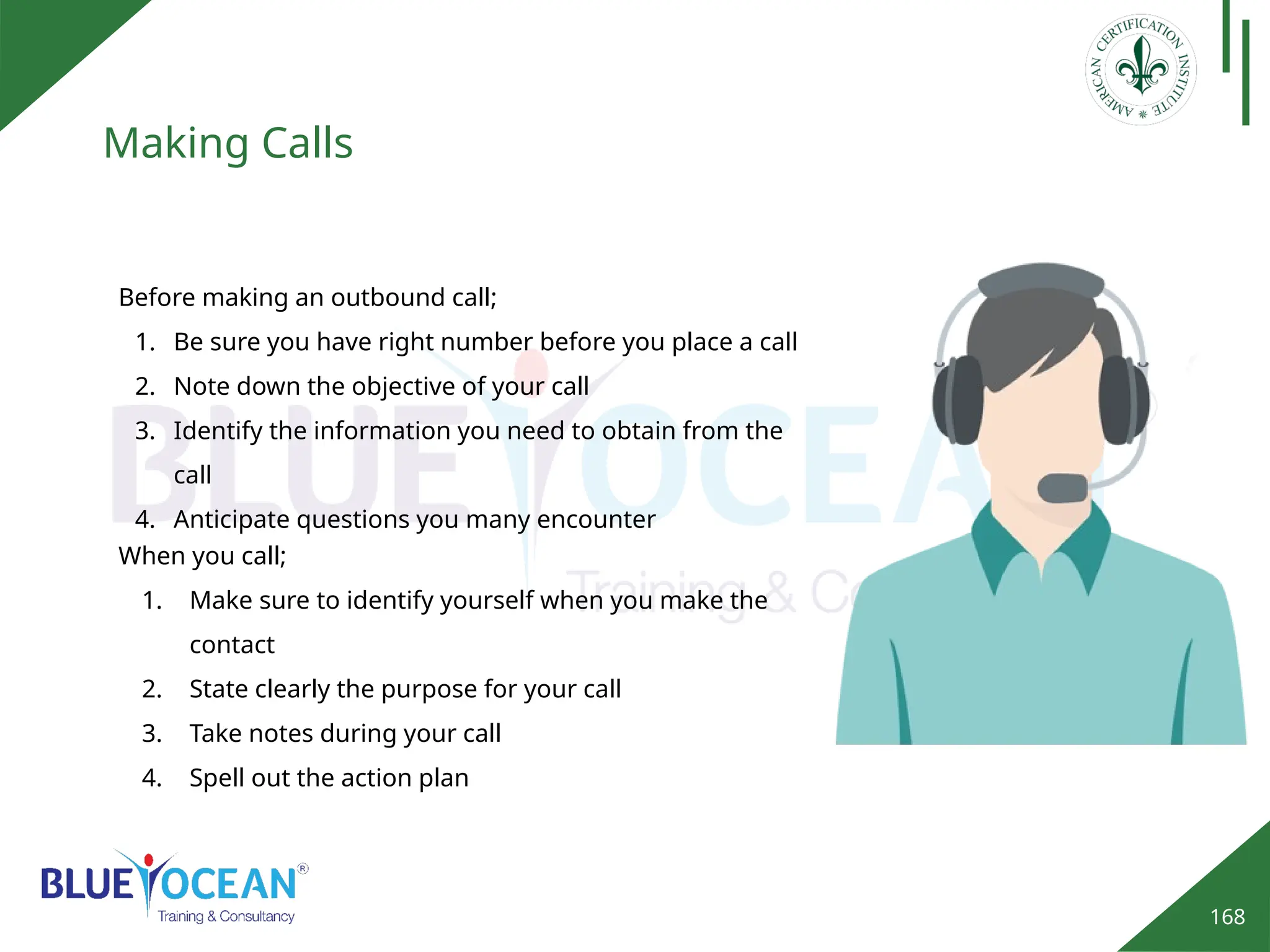
Making Calls
Before making an outbound call;
1. Be sure you have right number before you place a call
2. Note down the objective of your call
3. Identify the information you need to obtain from the
call
4. Anticipate questions you many encounter
When you call;
1. Make sure to identify yourself when you make the
contact
2. State clearly the purpose for your call
3. Take notes during your call
4. Spell out the action plan
169
Answering Calls
1. Answer the call within three rings
2. Answer with a friendly greeting
3. Your greeting should be pleasant and professional
4. Use the right tone and pitch
5. Ask for the caller’s name, company and purpose
6. Good manners show you respect the caller.
7. Give your name. This is a courtesy that serves to personalize as well as allowing
the customer to hold you accountable for your service.
8. Ask the customer how you can help.
9. Never put a customer on hold for more than 30 seconds.
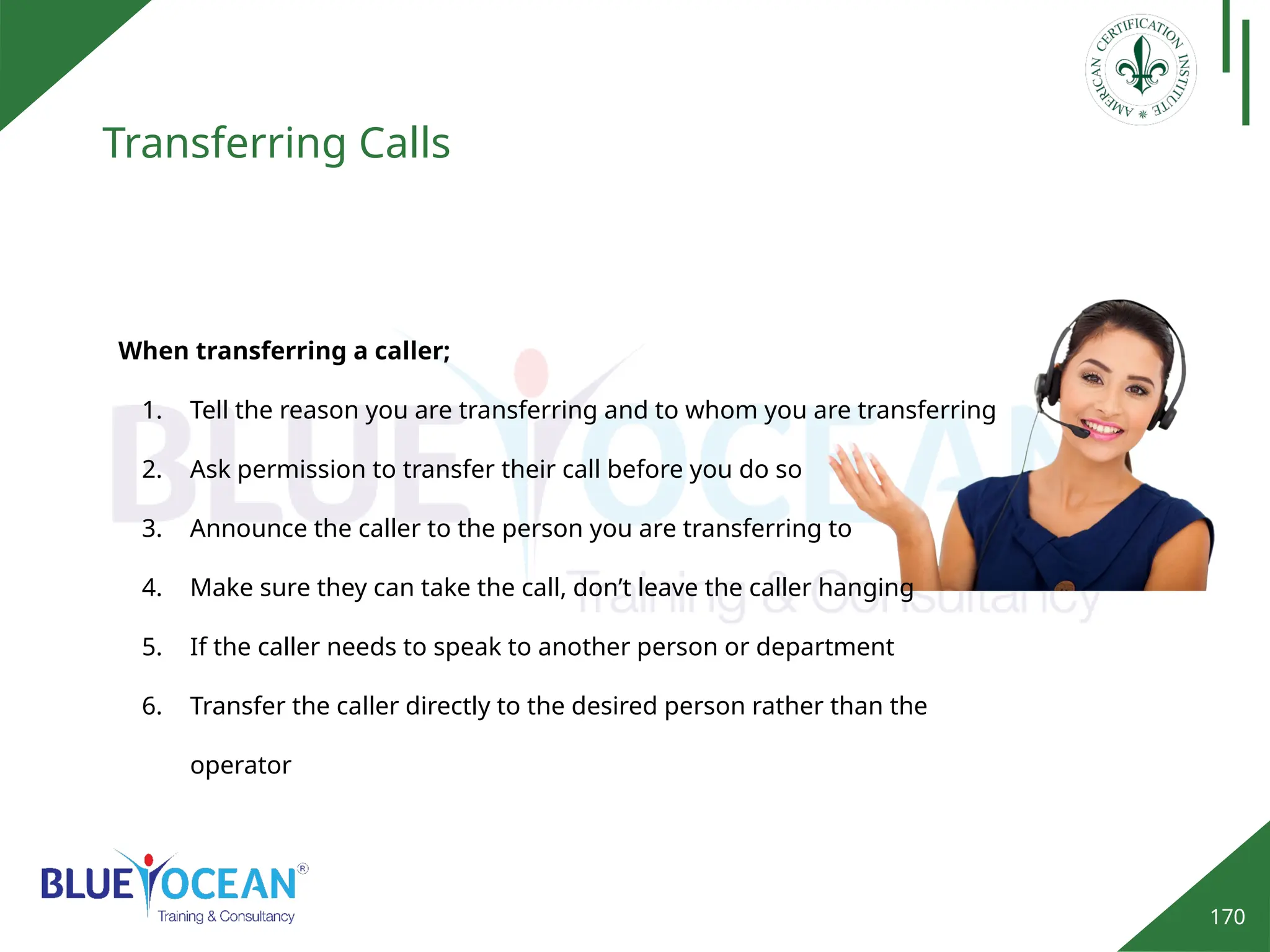
170
Transferring Calls
When transferring a caller;
1. Tell the reason you are transferring and to whom you are transferring
2. Ask permission to transfer their call before you do so
3. Announce the caller to the person you are transferring to
4. Make sure they can take the call, don’t leave the caller hanging
5. If the caller needs to speak to another person or department
6. Transfer the caller directly to the desired person rather than the
operator
171
Placing Call on Hold
When putting a caller on hold;
1. Always ask permission before doing so
2. Be sure to listen to the response from your caller before you place them on hold
3. Check periodically every 30-45 seconds if it takes longer
4. Give them the option to continue to hold or offer to call them back
5. When returning to your caller, thank them for waiting on the line.
6. If your caller can’t hold, offer to take a message or return the call
7. Remember to take down their name and contact number.
8. When placing multiple calls on hold, remember to return to the first caller you
placed on hold first.
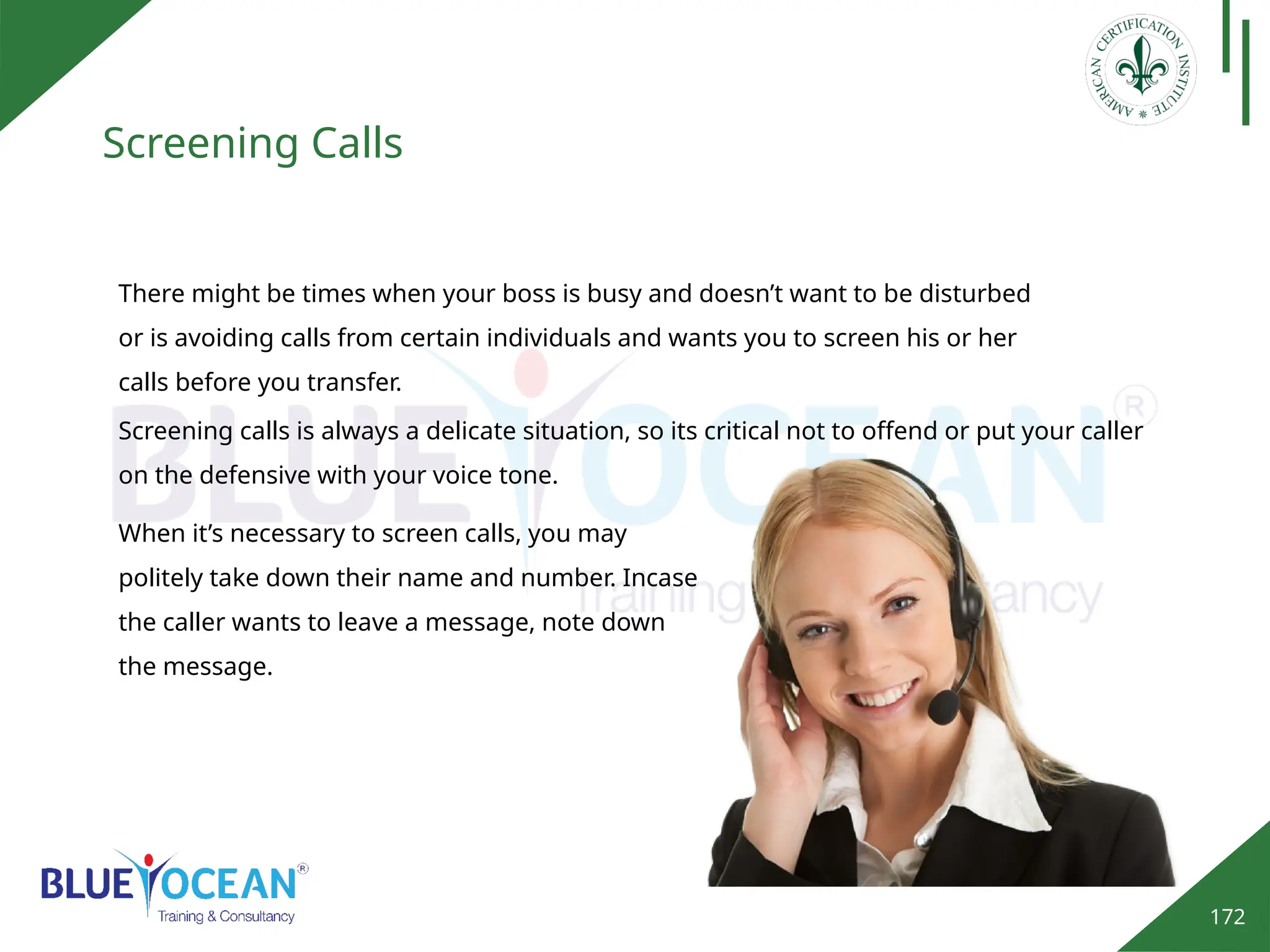
172
Screening Calls
There might be times when your boss is busy and doesn’t want to be disturbed
or is avoiding calls from certain individuals and wants you to screen his or her
calls before you transfer.
Screening calls is always a delicate situation, so its critical not to offend or put your caller
on the defensive with your voice tone.
When it’s necessary to screen calls, you may
politely take down their name and number. Incase
the caller wants to leave a message, note down
the message.
173
Impatient Callers
1. Stay calm. Try to remain diplomatic and polite. Getting angry will only make them
angrier.
2. Always show willingness to resolve the problem or conflict.
3. Try to think like the caller; remember, their problems and concerns are important.
4. Speak slowly and calmly. Be firm with your answers but understanding.
5. If you are in a non-supervisory position: Offer to have your supervisor talk to the caller
or call him/her back if the caller persists. Sometimes the irate caller just wants
someone in a supervisory capacity to listen to their story even if you are unable to
help them.
174
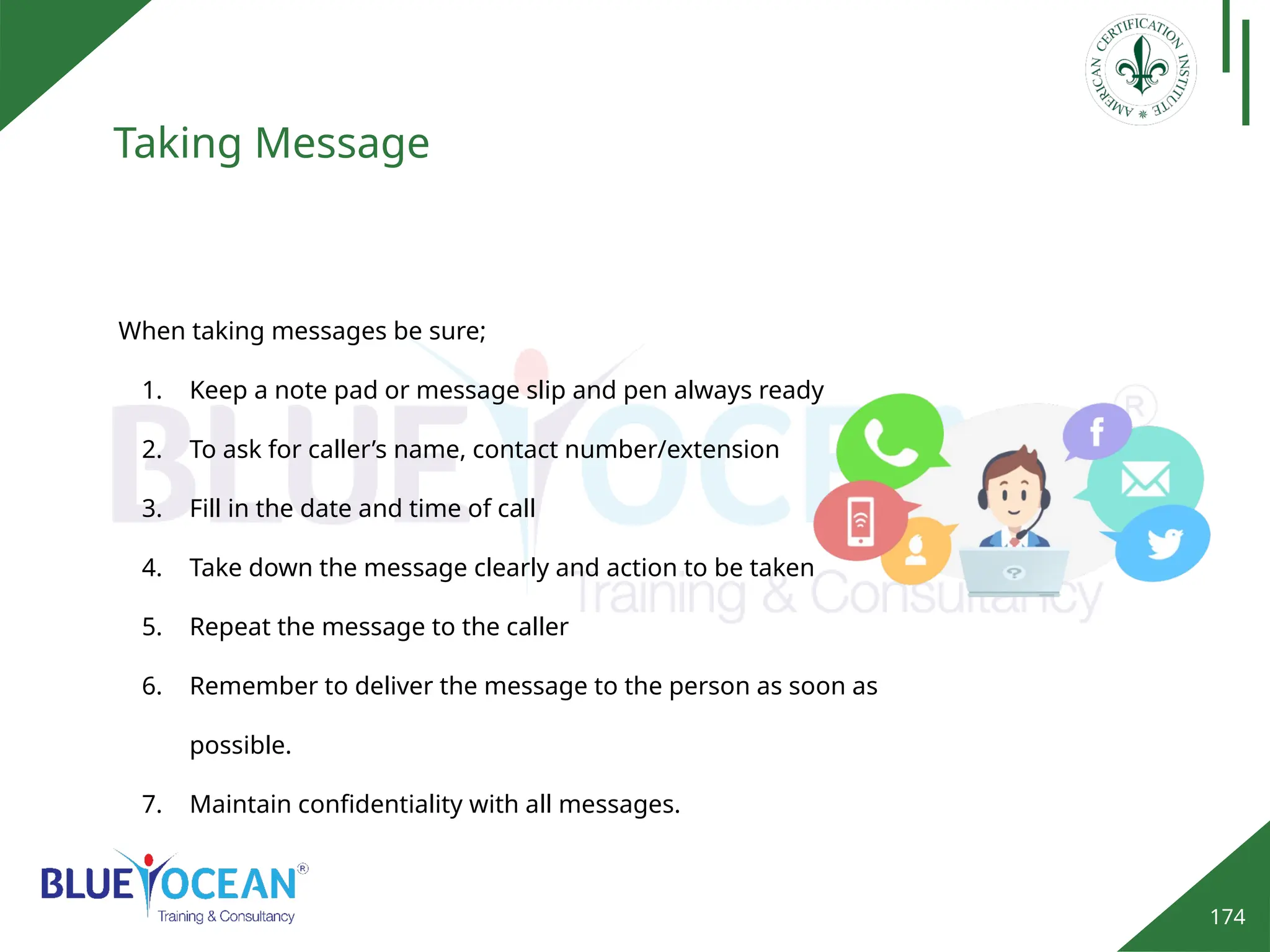
Taking Message
When taking messages be sure;
1. Keep a note pad or message slip and pen always ready
2. To ask for caller’s name, contact number/extension
3. Fill in the date and time of call
4. Take down the message clearly and action to be taken
5. Repeat the message to the caller
6. Remember to deliver the message to the person as soon as
possible.
7. Maintain confidentiality with all messages.
175
Voice Mail Message
1. Speak clearly and slowly.
2. Be sure to leave your name and extension number.
3. It's best to say it at the beginning and end of your message.
4. Leave the date and time you called in the message.
5. Let the person know the best time to call you back.
6. Keep messages short and to the point.
7. Cover one topic in one message; specify what you want the recipient to do.
8. Remember that you want to leave the person you are calling with a good
impression of you.
176
Ending a Call
Many times people find it difficult to end a telephone conversation. There are some
specific things that you can say to close your conversation professionally:
1. Leave the conversation open.
2. End on an "up" note.
3. Before hanging up, be sure that you have answered all the caller's questions
4. Tell the person how much you've enjoyed speaking with him/her.
5. Always end with a pleasantry such as: "Have a nice day" or "It was nice speaking with
you“
6. Use the depress button to end the call before you place the receiver on the cradle.
177
Building Customer
Relationship
The cornerstone of market conditions today are repeat business and customer loyalty.
Losing a customer is, without a doubt, the worst thing that can happen to a business.
Strong relationships and the level of service is one of the key factors for long term
business relationships.
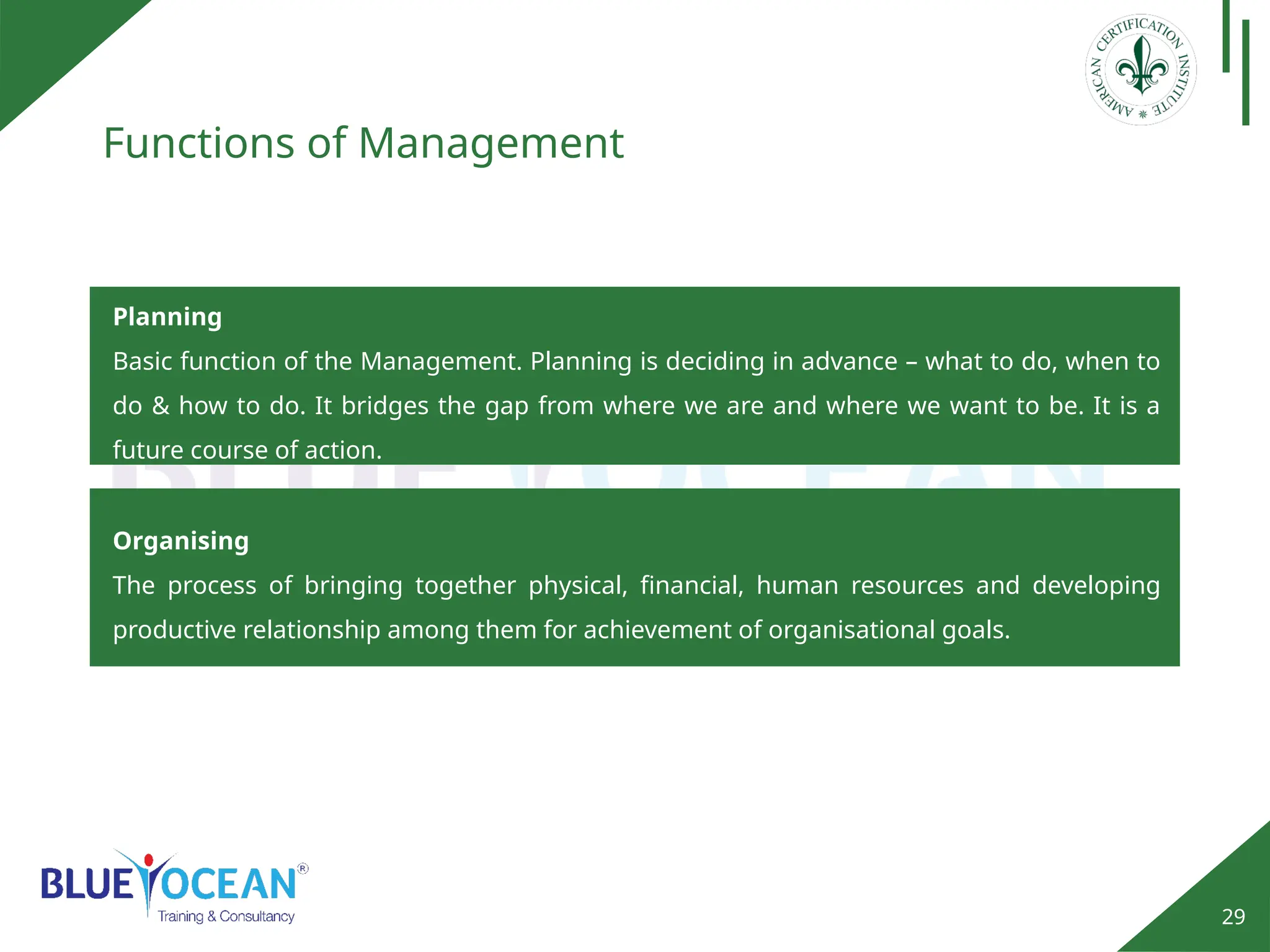
Hence, customer retention has become key for every business in this fast paced and
competitive market. Statistics reveal that nearly 80% of customers are willing to pay more
if they are offered a better experience.
178
Building Customer
Relationship
You could be:
 dealing with customers face to face at a reception desk, or by phone or email from a
contact center
 answering enquiries or complaints about services such as public transport, tourist
attractions, accommodation or finance
 taking bookings or payment by credit card or cash for events, travel, goods or services
 describing products in detail such as financial packages, private health or beauty
treatments or gas and electric supply.
179
Building Customer
Relationship
You should be:
 able to speak clearly, fluently and courteously
 be polite, patient, resilient, helpful and prompt.
 perform multiple task – for example, talk to customers, find information on computer
and input data.
 able to deal with complaints and difficult situations.
 able to stay calm under pressure and to work to meet targets.
 Take time to know your customer, the industry/ company they belong
 Treat every customer as your most important one.
180
Dealing Customer Grievance
Dealing with a customer complaining about your service or products needs to be handled
empathetically, with a strong communication structure, in order to stay in control of the
conversation and to achieve a successful outcome.
A customer complaint well handled can win you a lifelong customer, who remains loyal to
your organisation. The positive side of customer complaint gives us an opportunity to
know about your customer’s preferences, expectation, your product / services without the
added cost of conducting a survey. So complaints are a blessing in disguise!!!
181
Dealing Customer Grievance
Why do customers COMPLAIN?
1. Their expectations have not been
met
2. Poor customer service
3. Transferring from one CSR to
another
4. Rude Staff
5. No Omni-channel Customer Service
6. Not Listening to Customers
7. Hidden Information and Costs
8. Low Quality of Products or Services
9. Keeping an Issue Unresolved
10. Inaccessibility
182
Dealing Customer Grievance
Points to remember when dealing with difficult behaviour:
Show INTEREST
1. Listen carefully
2. Call the customer by name
3. Treat the customer with interest
4. Keep calm and cool
Show SYMPATHY
Get into their shoes and think what would
you feel in their position
Patience Listening & Repeat
Repeat the exact nature of the complaint to the customer so
there are no misunderstandings.
183
Dealing Customer Grievance
CONSIDER HUMAN ERROR
Look into if the customer has made an error if so gently
communicate and be diplomatic.
ADMIT the complaint:
If a mistake has happened, admit it. Not admitting your
mistake makes the customer lose the trust in you.
REFER immediately
If the customer insists on speaking to a manager, refer
immediately.
184
Dealing Customer Grievance
Let the customer talk
1. Let the customer vent their
anger.
2. Just let them talk.
3. Do not interrupt.
4. Do not argue.
INTERRUPT gently
After a while, say you wish to help them
solve the problem by working together.
185
Dealing Customer Grievance
TAKE NOTES Write down all the points.
1. Get the facts.
2. Focus your thoughts.
3. Often seeing the points being written down
takes the heat out of the argument
READ BACK YOUR NOTES
Read back your notes to the customer to show you
care and that you are making sure you have all the
points correct.
186
Dealing Customer Grievance
IF CUSTOMER KEEPS ARGUING
1. Keep repeating that you only want to help them.
2. Perhaps suggest that they call back later so you can make enquiries about the matter.
Never do the following;
Be DEFENSIVE
Do not take the complaints personally.
The customer is angry at the problem
he or she is facing and not at you.
Say a flat ‘NO’
Never say a flat no as an answer; Be
prepared and offer an explanation
and an alternative.
187
Dealing Customer Grievance
BLAME other staff
Do not blame other staff. The customer is
angry at the problem he or she is facing
and not at you.
Give COMMANDS
Do not order the customer about.
Be polite, say ‘Please’ etc.
Never do the
following;
Leave the problem UNSOLVED
If it cannot be solved immediately, keep in contact with the
customer until it IS solved.
188
Dealing Customer Grievance
Never do the
following;
Make PROMISES you cannot keep
If you make unrealistic promises, the customer will
be MORE displeased, and you will turn an already
angry customer into a frustrated one.
Loose your sense of humor
If appropriate, look on the light side. Introduce some
humour and it will help both you and the customer.
Offer COMPENSATION
Unless you are authorized to do so.
191
Time waits for NONE!
Time management is like any other process, it must be planned, monitored and reviewed
regularly. Effective time
management is a skill that is learned and if used regularly can be improved upon. “Time is
the scarcest resource and unless it is managed nothing can be managed” – Peter Drucker
“Time Management” is actually a misnomer, because one does not manage time, for it’s
beyond anyone’s control. It moves on at a predetermined rate, no matter what we do. It is
not a question of managing the clock but managing ourselves with respect to the clock.
Manage yourself, not your
time!!!
192
Benefits of Time Management
When an individual organizes and manages his/her activities focusing on the
result rather than the activities, the benefits are enormous;
1. Greater productivity and efficiency.
2. A better professional reputation.
3. Less stress.
4. Increased opportunities for advancement.
5. Greater opportunities to achieve important
life and career goals.
193
Risk of Missing Time
Time management is not very difficult as a concept, but it’s surprisingly hard to do in
practice. It requires the investment of a little time upfront to prioritise and organise
oneself. But once done, you will find that with minor tweaks, your day, and indeed your
week and month, fall into place in an orderly fashion, with time for everything you need
to do.
1. Missed deadlines.
2. Inefficient workflow.
3. Poor work quality.
4. A poor professional reputation and a stalled
career.
5. Higher stress levels.
Failing to manage oneself can have some very undesirable consequences;
194
Common Time Wasters at
Work
73% say they waste time at work -- at least one hour per day.
They waste time by surfing the web (48%), talking with coworkers (33%), taking care of
personal agendas and calls (49%), and taking long lunches (15%)
Checking email wastes 50% of the workday
When people aren't at their desks, there's a good chance they're getting more coffee. The
average worker drinks 3 cups per day.
They're in the bathroom checking Facebook: 54% of women and 46% of men do this. 77%
of employees who have access to Facebook from work check it daily.
But a lot of time is also wasted on menial work tasks, like fixing coworkers' mistakes (54%),
dealing with office politics (47%), waiting on colleagues (42%), getting dragged to
meetings (42%), and doing administrative work (33%)
195
How to manage time
“Time management” is the process of organizing and planning how to divide your
time between specific activities.
Good time management enables you to work smarter, “not harder” so that you get more
done in less time, even when time is tight, and pressures are high.
It's important that you develop effective strategies for managing your time to balance the
conflicting demands of life.
Failing to manage your time damages your effectiveness and causes stress.
196
Principles of Time
Management
The key principles for effective Time Management
are ;
1. Set clear goals & objectives
2. Plan your work
3. Get organised
4. Prioritise your activities
5. Destroy procrastination
Examine your present situation and assess what goals are important to you and what
action you need to take to achieve your target. Set yourself specific and clearly defined
goals, and make sure that these are realistic and achievable. Have a contingency plan or
alternative route to your goal in case you have to change your plans.
Set clear goals & objectives
197
Get Organised
Once the goals are set, the next step is to organise the goals into manageable targets or
milestones.
1. Manage your energy and your focus
2. Create a task list that reflects your priorities
3. Plan your day, week and month
4. Divide your tasks for the day into achievable
blocks
5. Set realistic deadlines for your activities
6. Allocate responsibilities (if necessary)
7. Schedule work to suit your energy cycle
198
Get Organised
To do list is an effective Time Management
tool
1. Write down what you need to do
2. It is harder to ignore what you have
written down on paper
3. It shows you everything you need to do so
4. It helps you to prioritise your jobs
5. Tick off tasks as you accomplish them
199
Know your Energy Cycle
Everyone has a natural time during the
day when they are "UP" (prime time)
and a natural time when they are
"DOWN" (down time). During prime
time, your brain is "on"; your batteries
are charged and you're able to focus.
During down time, your brain feels
"slow"; it's difficult to muddle through
your work.
200
Know your Energy Cycle
When considering a daily schedule, it is a good idea to keep your energy cycle in mind.
Some people are at their best early in the morning, others peak in the afternoon.
Whenever possible, try to plan your daily schedule to match your prime time. Consider
such ideas as doing work that requires concentration, creativity, and thought during your
prime time. Leave less-demanding activities, such as reading, responding to mail, or
returning phone calls, until after lunch if your prime time is in the morning The challenge
for most people during their prime time is self discipline, resist the urge to do ‘fun”, easy,
trivial things.
201
How to Prioritise
Listing things is one of the most basic ways to manage
time.
In a priority list, you get to rank the order of importance
of each task so that you can pay attention to the most
urgent ones. The idea is to concentrate more on tasks
that need to be completed earlier. For this to work, we
can’t choose to do things based on how easy it is to
complete or based on our personal preferences.
Prioritization benefits your time management by first
highlighting to you what needs your attention first.
202
Priority Matrix
Quadrant 1 – Emergencies & Crises: Urgent and
Important
Quadrant 2 – Long-Term Goals: Not Urgent but Important
Quadrant 3 – Interruptions: Urgent but Not Important
Quadrant 4 – Distractions: Not Urgent and Not Important
The Eisenhower Matrix, also referred to as Urgent-Important Matrix, helps to decide on and
prioritise tasks by urgency and importance, sorting out less urgent and important tasks which
you should either delegate or not do at all.
203
Priority Matrix
204
Difference between Urgent &
Important
Urgent means that a task requires immediate attention. These are the to-do’s that shout
“Now!” Urgent tasks put us in a reactive mode, one marked by a defensive, negative,
hurried and narrowly-focused mindset.
Important tasks are things that contribute to our long-term mission, values, and goals.
Sometimes important tasks are also urgent, but typically they’re not. When we focus on
important activities we operate in a responsive mode, which helps us remain calm,
rational, and open to new opportunities.
It’s a pretty intuitive distinction, yet most of us frequently fall into the trap of believing that
all urgent activities are also important.
205
Priority Matrix
Quadrant 1: Urgent and Important Tasks
Tasks are both urgent and important. They’re tasks that
Quadrant 2: Not Urgent but Important Tasks
Tasks that don’t have a pressing deadline, but nonetheless help you achieve your
important personal and work goals as well as help you fulfill your overall mission in life.
Q2 tasks are typically centered around strengthening relationships, planning for the
future and improving oneself.
require immediate attention and also work towards fulfilling long-term
goals and missions in life. Q1 tasks typically consist of crises, problems, or
deadlines.
206
Priority Matrix
Quadrant 4: Not Urgent and Not Important Tasks
Tasks aren’t urgent and aren’t important. Q4 activities aren’t pressing nor do they help one
achieve long-term goals or fulfill their life’s mission. They’re primarily distractions.
Quadrant 3: Urgent and Not Important Tasks
Tasks are activities that require our attention now (urgent), but don’t help us
achieve our goals or fulfill our mission (not important). Most Q3 tasks are
interruptions from other people and often involve helping them meet their own
goals and fulfill their own priorities.
207
Power of Choice – 80:20 PP
The Pareto principle is the filter that can protect us from ourselves and our natural
response to having too many things on our plate. The Pareto principle separates the vital
few from the many less fruitful activities. Pareto’s concept of focusing on what is going to
make a difference is neatly captured in his own words:
"If you're Noah, and your ark is about to sink, look for the elephants first, because you can
throw over a bunch of cats, dogs, squirrels, and everything else that is just a small animal
and your ark will keep sinking. But if you can find one elephant to get overboard, you're in
much better shape."
208
Pareto’s Principle
Pareto's Principle is named after Vilfredo Pareto (1848-1923), an Italian economist-
sociologist, Professor of Political Economy at Lausanne, Switzerland, who first discovered
and described the '80:20' effect.
The Pareto principle is extremely helpful in bringing swift and easy clarity to complex
situations and problems, especially when deciding where to focus effort and resources.
It's a remarkably quick easy way to assess, understand, and optimise virtually any
situation involving distribution or usage of some kind.
The 80/20 rule means that in anything a few (20%) are vital, and many (80%) are trivial. 20
% of defects are causing 80% of the problem.
209
Pareto’s Principle
Steps to use Pareto’s Principle
The Pareto Principle provides you with a priority system to validate incoming tasks against your
obligations.
The following key points guides on how to use this principle at work;
1. Identify your goals - In other words what is most important.
2. Use the Pareto principle to prioritize your tasks.
3. Ensure that you protect these vital few activities from the trivial many.
The 80 20 rule is a prioritizing system that can dramatically change your life.
210
Pareto’s Principle
1. Identify your Key Result Areas
In today's world of information overload and real-time response, it is not unusual to be
faced with a dozen tasks
that demand your attention. Any incoming information or requests for your time need to
be assessed against your goals and objectives. Your top priorities are those that are
aligned with your performance criteria, key result areas, or goals. After assessment assign
the priority to the incoming task.
Your Key Results Areas are those things that you are measured against at work. In your
personal life they are the pursuit of those things that matter most to you or your family.
211
Pareto’s Principle
2. Use the Pareto Principle to set priorities
List all the activities that you have to do over the next week. But don't fall into the trap of
using your to do list as a way to manage your time.
Now put an A, B or C next to them:
1. 'A' is for your most important activities (those top 20%),
2. 'B' are somewhat important (60%), and
3. 'C' are your least important activities (bottom 20%)
Put a time limit on those activities that you have assigned as most important. How long
are each of your 'A' activities going to take?
212
Pareto’s Principle
3. Protect the vital few from the trivial many
Gather up all of your top priority actions that you have to do next week (if you have
followed the process, each of these actions should have a duration next to them!)
The next step is to make time for these most important activities, rather than trying to find
time later on.
Note: If your goals are not aligned with the 80 20 rule, ask yourself the following
questions:
1. Are these someone else's goals?
2. Do I need to add more goals/objectives?
3. Am I doing what is important?
4. Am I spending too long in the urgent/crises mode of this matrix?
213
Procrastination
Procrastination is when you put off things that you should be focusing on right now. It
has been termed the silent killer and it’s one of the biggest deterrents to our goals.
 Regularly being distracted from work by non-work activities such as checking
Facebook or emails;
 Leaving everything until the last possible moment;
 Constantly worrying about work but not getting anything done;
Procrastination is the tendency to prevaricate, delay or unreasonably postpone a task. It is
a habit that affects everyone to a greater or lesser extent.
Common symptoms of procrastination include:
214
Procrastination
Using Priority Matrix, you have added a few task in Q4 it is perfectly fine when you plan to
do certain tasks at a later stage, because you have decided that they are not sufficiently
urgent. This is not procrastination.
It is sensible planning, enabling you to get more urgent and important tasks completed.
However, if you have identified a task as both important and urgent, and you still keep
putting it off, that is procrastination.
 Spontaneously performing tasks that you wouldn’t normally be enthusiastic
about, such as household chores; Feeling that nothing you do is good
enough;
 A sense of pointlessness or hopelessness as you feel there is too much to
do.
215
Why procrastinate?
There are many reasons why people procrastinate:
1. Sometimes it’s because the task is unpleasant, and they’d rather be doing
something else.
2. Sometimes, they don’t really know how to do a task and so are avoiding it.
3. Perfectionists often procrastinate, because they’re not sure they have the time or
capacity to do a task perfectly.
4. Other people may struggle because they are not sure exactly what task to do.
Procrastination is a parasite eating away at our effectiveness. We need to understand
why and how procrastination operates to control it.
216
Effects of Procrastination
Procrastination has a positive role in checking our forward drive. It also has a strong
negative role in placing
obstacles in our own way. The following explains the status of chronic procrastinators
mind set;
1. Feel guilty of their behaviour
2. Summon unnecessary reminders
3. Miss deadlines, get stressed out
4. Fall short on their goals leads to
depression
5. Always make excuses for inaction
6. Ignore their own strengths
7. Pretend that they are extremely busy
8. Stop being creative
217
Type of Procrastinators
There are six different types of procrastinators:
1. Perfectionist
2. Dreamer
3. Worrier
1. Defier
2. Crisis-Maker
3. Over-doer
Characteristics of Perfectionist Procrastinator :
1. Tend to put forth excessive amounts of time and energy to make sure that everything
they do is perfect.
2. Tend to put off starting tasks due to a fear of failure or doubts about doing it the
“right way.”
3. Tend to see everything in life as things that have to be done, not necessarily what they
want to do.
218
Type of Procrastinators
Strategies for Perfectionist Procrastinators:
1. Strive for excellence rather than perfection
2. Focus on what’s realistic rather than ideal
3. Avoid “all or nothing” thinking
4. Change your “have to”s to “want to”s
5. Give yourself a time limit for completing a task
6. Make a daily “to do” list that’s short and
practical
219
Type of Procrastinators
Characteristics of Dreamer Procrastinator :
1. Tend to recoil from anything that might be difficult
2. Tend to be passive rather than active.
3. Tend to pay little attention to facts or details, making it hard to focus on and perform
difficult tasks.
4. Tend to think of themselves as special people, for whom fate will intervene, making
hard work and efficiency unnecessary.
Strategies for Dreamer Procrastinators
1. Train yourself to differentiate between dreams and goals
2. Develop the habit of thinking with “5 W’s and 1 H”
3. Change your wishs, like to’s, and try to’s to will
220
Type of Procrastinators
Strategies for Dreamer Procrastinators
1. Change your someday’s and soon’s to specific times
2. Plan each major project in writing, using a timeline and specifying each step you will
need to take
3. Seek more interaction with other people
Characteristics of Worrier Procrastinator :
1. Tend to be indecisive and often fail to commit themselves to the specific decisions
they do make.
2. Tend to lack confidence in their own abilities, causing them to avoid or delay doing
things.
221
Type of Procrastinators
Characteristics of Worrier Procrastinator :
1. Tend to be dependent upon others for advice, reassurance, nurturance and help.
2. Tend to have a high resistance to change, preferring the safety of the “known” over
the risk of the “unknown.”
Strategies for Worrier Procrastinators
1. Recognize making no decision, is, in fact, a decision
2. Follow a two-step decision-making process: first commit yourself to the goal, then
determine the steps you’ll take to achieve that goal.
3. Change your I don’t knows to ne thing I do know is…
222
Type of Procrastinators
Strategies for Worrier Procrastinators
1. Change your I can’t statements to compound sentences: I can’t…but I can…
2. Each day, do at least one thing you’ve been consciously putting off
3. Each week, do something that you’re generally uncomfortable doing
4. Break down every large, intimidating project into an assortment of smaller, easier-to
manage tasks.
Characteristics of Defier Procrastinator :
1. Tend to see life in terms of what others expect or require them to do, not what
they themselves would like or want to do.
223
Type of Procrastinators
Characteristics of Defier Procrastinator :
1. Tend to avoid expressing negative feelings; instead they convey those feelings by
procrastinating.
2. Tend to use procrastination as a way of challenging authority.
3. Tend to be pessimistic in nature, undercutting their motivation to complete tasks in a
timely manner.
Strategies for Defier Procrastinators
1. Learn to view what someone else wants or expects as a request, not a demand.
2. Mean what you say
224
Type of Procrastinators
Strategies for Defier Procrastinators
1. If you haven’t done something, own up to it.
2. Strive to act rather than react
3. Do what you know needs to be done
4. Try to work with a team, not against it.
5. Do something specific that will satisfy you because it’s done your way.
Characteristics of Crisis-Maker Procrastinator :
1. Tend to first ignore the task, then feel intensely caught up in it, when faced with
an undesirable task.
225
Type of Procrastinators
Characteristics of Crisis-Maker Procrastinator :
1. Tend to dramatize situations, making themselves the center of attention.
2. Tend to be easily bored and resist the “dullness” of doing things rationally and
methodically.
3. Tend to have a need to prove themselves by living on the edge.
Strategies for Crisis-Maker Procrastinators
1. Identify other self-motivators besides stress.
2. Strive towards changing your thinking style from extremist and general to
moderate and specific.
3. Avoid overdramatic, polarized language
226
Type of Procrastinators
Strategies for Crisis-Maker Procrastinators
1. When discussing a task or responsibility, try to focus on the positive or active,
rather than the negative or reactive.
2. Figure out methods for handling things so that you can avoid or more
successfully manage recurring crises.
3. Create your own motivators to change a boring task to a more interesting one.
4. Understand that you may not feel interested in something until after you get
involved in it.
227
Type of Procrastinators
Characteristics of Over-doer Procrastinator :
1. Tend to suffer from low self-esteem, compelling them to take on more work
than they can handle.
2. Tend to have trouble saying “no” or asking for help.
3. Tend to assume so many different responsibilities and roles that they easily get
distracted from specific tasks and confused about priorities.
4. Tend to lack true self-discipline, especially in regard to personal needs.
5. Tend to find it very difficult to relax without feeling guilty or ashamed.
228
Type of Procrastinators
Strategies for Over-doer Procrastinators
1. Acknowledge the difference between priorities and demands.
2. Try not to depend on others for approval
3. Focus your thoughts on how you are going to gain control over things, not how
things are controlling you.
4. Don’t hesitate to say “no” to others when it’s appropriate.
5. Talk more about your options than your obligations
6. Make and follow daily “to-do” lists that make the best use of your time and
energy
7. Enlist help whenever appropriate.
8. Incorporate an ample amount of leisure activities into your life
229
Dealing with Procrastination
1. Salami Technique
Break-up the tasks into small manageable activities.
Eat the elephant piece by piece. Follow the divide and rule policy. Start small but aim
big. Don’t try to do too much too quickly.
2. Worst First Method
Swallow the large frog before swallowing the smaller ones. Do more difficult task first,
since easier ones are in any case easier to do. Focus more on important rather than
urgent. Attack unpleasant things first.
230
Dealing with Procrastination
3. Prime Time Match
Graph your energy cycle to identify the prime time. Schedule difficult tasks during your
prime time. Protect your prime time to the maximum possible level by living like a
monk. Designate a quite hour.
4. Procrastination log
Keep a procrastination log to identify the areas of procrastination. Accept that
procrastination is common and that you can solve the problem. Write down your
strengths and weaknesses. Don’t procrastinate on breaking the habit of
procrastination. Remember that the horse can be taken to the water but can’t be
forced to drink. Its ultimately your own desire and determination to change the
matters.
231
Dealing with Procrastination
5. Do it now – Approach
The best way to begin a job is to begin it now. There is actually no ‘someday’ (the
eighth day of the week). Trade perfection for practice. Be more decisive than right.
Don’t convert your priorities into posteriorities.
Think About The Negative Consequences If You Don’t Finish
What will happen to you if this job is not done on schedule? Both fear and desire are great
motivators of human behavior. Sometimes you can motivate yourself by the desire for the
rewards of task completion. Sometimes you can motivate yourself into action by thinking
about the negative consequences and what will happen to you if do not get things done
as promised.
234
What is Personal Development
Personal development is a
lifelong process. It is a way for
people to assess their skills and
qualities, consider their aims in
life and set goals in order to
realise and maximise their
potential.
235
Importance of Personal
Development
236
Managing your Personal
Development
237
Self Esteem
238
Self - Esteem
Self-esteem is about how we value ourselves, our perceptions and beliefs in who we are
and what we are
capable of. In simple terms it’s the opinion you have of yourself. Sometimes our self-
esteem can be misaligned with other people's perception of who we are. Low self-esteem
is a negative evaluation of oneself.
This type of evaluation usually occurs when some circumstance we encounter in our life
touches on our sensitivities. We personalize the incident and experience physical,
emotional, and cognitive arousal.
239
Self - Esteem
This is so alarming and confusing that we respond by acting in a self-defeating or self-
destructive manner; we feel upset or emotionally blocked; our thinking narrows; our self-
care deteriorates; we lose our sense of self; we focus on being in control and become self-
absorbed.
Self-esteem varies from situation to situation, from day to day and hour to hour. Some
people feel relaxed and positive with friends and colleagues, but uneasy and shy with
strangers. Everybody is different.
Some people are naturally positive and optimistic, maintaining equilibrium when faced
with constant difficulties, while others are less so.
240
Self - Esteem
Do’s
1. Focus on your goals
2. Focus on your success
3. Use positive affirmations &
quotes
4. Believe in yourself
5. Trust in yourself
6. Respect your yourself
Don’ts
1. Don’t indulge in self criticism
2. Don’t always try to please others
3. Don’t try to be like someone else
4. Don’t take life or yourself so
seriously
241
Identify the “U” in you
01
03
02
04
Strengths
Weaknesses
Threats
Opportunities
SWOT
Analysis
242
Identify the “U” in you
243
Identify the “U” in you
244
Johari Window
Johari Window
(By Joseph Luft And Harry Ingham)
245
Professional Grooming
Projecting a positive professional image as a representative of your Company is vital to
your Company and your personal success. You are the first face your customer or client
gets to see, the impression you project leaves a lasting impression on your customer or
client’s memory.
Appearance
Your appearance is about who you are; Irrespective of your position, there is a specific
image that you would like to project, it is superficial, but people judge you on your looks.
You could be rich, dressed like a star, but if you’re carefree you will be perceived
accordingly. Every day is your important day.
246
Professional Grooming
Appearance - Men
Shave Daily/Trim moustache or beard
Comb your hair properly
Wear crisp, wrinkle free shirts
Smell good, Wear a mild perfume
Clean and Trim your nails
Female
Well groomed hair, choose a professional
hairstyle
Wear minimal make up, avoid too many
jewellery
Smell good, Wear a mild perfume
Avoid using dark nail colors, preferably use a
transparent color.
247
Professional Grooming
‘Clothing makes a man’. The way we dress speaks volumes about the image we want to
communicate across.
Dressing
There are as such no color conditions in the professional work attire or dress outfit for any
organization to object. But in general one should always stick with the general and the
natural neutral color combination for the professional outfit. For men colors for the best
professional SUITS are preferred as: black, grey, brown, navy blue, coke and brown.
The light color collection of shirts is the perfect choice for all professional dress ups. It
works as the main back bone of the suiting. It gives a descent touch to the dressing for
professional environment.
248
Professional Grooming
1. Professional smile with
well pressed clothing
2. Well groomed hair style
3. Natural makeup
4. Minimal jewellery
5. Polished & clean footwear
249
Professional Grooming
Personal Hygiene
Personal Hygiene is the first step to good grooming; it enhances an individual’s physical
and emotional wellbeing.
 Showering. One should need to shower daily to keep a fresh-looking appearance.
 Use of good perfumes, scents and deodorants is must for a professional get up. It
makes you more adorable when someone passes by you.
 There are certain lifestyle changes to make if you have a constant problem with body
odour. Occasional problems can be treated if you know the cause.
250
Professional Grooming
 Your oral hygiene always matters, if you have oral odor problems then try to get rid of
it as soon as possible, because bad odor creates a very embarrassing situation
sometimes.
 The beard on the face should always be well trimmed and tidy in looks, should suit the
office culture.
 The first step to getting a hairstyle is finding out which style is right for your face shape
and professionally acceptable in the office culture.
251
Resume Writing
Why do I need a Professional Resume?
An unprofessional resume is difficult to read, confusing, covered in errors,
or unrelated to the job the person is applying for. Such resumes will get tossed in the trash
right away. An unprofessional resume makes the job seeker look unprofessional and will
cost them a possible job. So
“WRITE A RESUME THAT GENERATES RESULTS”
What is the purpose of your resume?
A resume is a document used by job seekers to help provide
a summary of their skills, abilities and accomplishments. Its purpose is to pass the
employer’s screening process and win an interview opportunity for the job seeker.
252
Resume Writing
How to Write a Resume
Choose a resume type that suits your profile. Taking the time to choose the best type of
resume is well worth the effort.
There are several types of resumes such as
 Chronological,
 Functional,
 Combination
 Targeted
Review resume examples - Read through sample resumes that will provide you with
examples of resume formats which work for almost every type of job seeker. They also
help you see what kind of information to include.
253
Resume Writing
Use a resume template – template serves as a guide that provides framework for the
resume as well as saves time.
Choose the right font and size - that is legible and leaves enough white space on the
page. When you use a particular style, use it consistently.
Use resume keywords - In order to get found, your resume needs to contain keywords
that directly target the jobs you are interested in. This will also help the hiring manager
see how your skills and experiences make you an ideal candidate for the specific job.
Proofread your resume - Be sure to thoroughly check your resume before sending it.
Check for grammar and spelling errors, as well as any inconsistencies.
254
Handling Interview with
Confidence
Aim to connect with interviewers, not impress them
Your energy should be focused on building a rapport with your interviewer rather than
impressing him or her.
Use breathing techniques to boost confidence
At the heart of confidence is feeling relaxed, so breathing and mindfulness exercises are
helpful, focus on your breathing just before an interview that helps to calm nerves.
Imagine yourself succeeding
Picturing yourself being successful at an upcoming job interview will give a boost to your
confidence and self-esteem.
255
Handling Interview with
Confidence
Prepare and rehearse answers out loud
If you go into an interview with prepared answers for most
questions such as your experience, qualifications, reasons for leaving the current job etc,
with preparation, one’s confidence is built, and it takes the pressure off.
Exercise & Dress
Staying fit and dressing appropriately for interviews are helpful practices.
Focus on the Positives
We tend to focus our energies on the negative things that happen to us. To overcome
negative experiences in life, focus on positive ones.
Most people can count only a few really bad experiences in life, while positive ones are
abundant.
256
What is Stress?
Stress is your body's way of responding to any kind of demand. It can be caused by both
good and bad experiences.
Researchers define stress as a physical,
mental, or emotional response to events
that causes bodily or mental tension. In
simple terms, stress is any outside force or
event that has an effect on our body or
mind.
Stress is a part of everyday life and it affects
everyone. There are many different kinds of
stress and not all of them are bad.
257
What is Stress?
When people feel stressed, their bodies respond by releasing chemicals and hormones
into the blood to face the challenge.
Their heart rate increases, brain works faster, and they get a sudden burst of energy. This
response is basic and natural. But too much of stress can have harmful effects if there is
no outlet for this extra energy and strength.
Stress is meant to be temporary; body should return to its natural state after the situation
has passed. Heart rate should slow down, muscles should relax, and breathing should
return to normal. Problems start when it doesn’t.
258
Stress Symptoms
1. Moody & Irritability
2. Heavy pounding of heart
3. Dryness of throat and mouth
4. Impulsive erratic behaviour
5. Inability to concentrate or sleep
6. Urge to emotional breakdown (cry or hide)
7. Nervous laughter
8. Increased smoking or drinking
9. Overeating or avoiding food
Which leads to health issues such as –
10. Headaches, fatigue, back pain and other
aches
259
Type of Stress
Motivates, focuses energy.
Is short-term.
Is perceived as within our coping abilities.
Feels exciting.
Improves performance.
Eustress or positive stress, has the following
characteristics:
In contrast, Distress or negative stress, has the following
characteristics:
Causes anxiety or concern.
Can be short- or long-term.
Is perceived as outside of our coping
abilities.
Feels unpleasant.
Decreases performance.
Can lead to mental and physical problems.
260
What causes stress at work?
1. Being unhappy in your job; low salaries
2. Excessive work loads; Long working hours
3. Having poor management, conflicting demands
4. Conflicts with teammates and supervisors
5. Job insecurity
6. Lack of necessary training to do the job
7. Having to give speeches or making presentations in front of colleagues or clients
8. Facing discrimination or harassment at work, especially if your boss isn't supportive.
9. Commuting and travel schedule
10. Not having enough control over job related decisions
261
Manage Stress
Track your stressors - Keep a journal for a week or two to identify which situations create
the most stress and how you respond to them.
Develop healthy responses - Instead of attempting to fight stress with fast food or
alcohol, do your best to make healthy choices when you feel the tension rise. Exercise is a
great stress-buster. Yoga can be an excellent choice, but any form of physical activity is
beneficial. Also make time for hobbies and favorite activities.
Establish boundaries - In today's
digital world, it's easy to feel pressure
to be available 24 hours a day. Establish
some work-life boundaries for yourself.
262
Manage Stress
Learn how to relax - Techniques such as meditation, deep breathing exercises and
mindfulness (a state in which you actively observe present experiences and thoughts
without judging them) can help melt away stress. Start by taking a few minutes each day
to focus on a simple activity like breathing, walking or enjoying a meal.
Take time to recharge - To avoid the negative effects of chronic stress and burnout, we
need time to replenish
and return to our pre-stress level of functioning. This recovery process requires “switching
off” from work by having periods of time when you are neither engaging in work-related
activities, nor thinking about work.
263
Manage Stress
Get some support. Accepting help from trusted friends and family members can improve
your ability to manage stress.
Talk to your supervisor. Healthy employees are typically more productive, so your boss
has an incentive to create a work environment that promotes employee well-being. Start
by having an open conversation with your supervisor. The purpose of this isn't to lay out a
list of complaints, but rather to come up with an effective plan for managing the stressors
you've identified, so you can perform at your best on the job.
264
Chair Yoga
Chair yoga is a gentle form of yoga that is practiced sitting on a chair or standing using a
chair for support.
Chair yoga is practiced to reduces stress and improve one’s physical and mental fitness.
This gentle style of yoga can be done from a seated position that also incorporates the
breathing and mind-body benefits of a traditional class.
1. It enhances one’s body system; Increases positive
attitude
2. Prevents strain injuries due to prolonged sitting posture
3. Relieves chronic stress patterns in the body
4. Improves concentration and creativity
5. Muscles gets toned and strengthened
6. Increases lung capacity, improved breathing
7. Removes sluggishness and lethargy
265
Chair Yoga
266
Chair Yoga
267
Chair Yoga
270
Office Management: The
concept
Office management is the process of planning,
organizing, staffing, directing and controlling the
administrative functions of an office in order to achieve the
objectives of the organization.
It is the process of utilizing the office resources efficiently to
obtain the best result with less effort and cost. It helps in
receiving, recording and processing, supplying and
retaining information. It is the branch of management
which deals with performance of these functions
271
Importance of Office
Management
1. Achievement of goals
2. Increase office efficiency
3. Smooth flow of work
4. Public relations
5. Minimization of cost
6. Managing change
7. New challenges
272
Elements of Office
Management
Personnel
Means
Environment
Purpose
273
Office Automation
Office automation (OA) refers to the collective hardware, software and processes that
enable automation of the information processing and communication tasks in an
organization.
It involves using computers and software to digitize, store, process and communicate
most routine tasks and processes in a standard office. In simple terms it is a collection of
tools and methods to process written, visual and sound data in a computer-aided manner.
It is intended to provide elements which make it possible to simplify, improve and
automate the activities of a company or a group of people.
274
Office Automation
A comprehensive office automation typically includes:
 Computers for all employees and/or data processing personnel
 Software that enables word processing, creating spreadsheets, managing
accounts and more
 Internet connectivity and email programs to send and receive email messages
 Fax and printing services
 Instant communication such as VoIP and more.
275
Office Automation
Factors to be considered while selecting office machines and furniture are listed below:
Need of the
Machine
Purchase and
operating costs
Durability
Easy to operate
and flexible
Quality and
speed
276
Record Management
A recordkeeping is a system which captures, manages and provides access to
organisational records throughout
Managers and Heads of business units are required to establish
and set up appropriate recordkeeping systems for their business
unit to facilitate the collation and registration of business records.
It can be either electronic or paper-based.
the life cycle of the organisation in order to meet business needs, statutory and fiscal
requirements of business.
277
Record Management
Systematic management of records allows organisations to:
1. know what records they have and locate them easily
2. increase efficiency and effectiveness
3. make savings in administration costs, both in staff time and storage
4. support decision making; be accountable
5. achieve business objectives and targets
6. provide continuity in the event of a disaster
7. meet legislative and regulatory requirements
8. protect the interests of employees, clients and stakeholders
278
Record Management
Five easy steps in creating a simple record keeping system;
CAPTURE the information
Capturing data is the most difficult and the most important part of the process; it’s a
matter of forming the habit of collecting information.
CHECK to make sure the information captured is complete and accurate
RECORD the information
Recording means putting the information into useable form. After everything is checked,
recording takes place.
Consolidate and REVIEW the information.
ACT, based on is captured, checked and recorded.
279
File Management
A filing system is the central record-keeping system for an organisation. It helps to be
organised, systematic, efficient and transparent as well as easy access to records.
There are two types of file management - electronic and manual. Storing files digitally
through computer, CD-roms etc refers to Electronic filing and Manual is the traditional
method of keeping hard-copy documents in cabinets and safes.
Electronic filing has evolved and enabled better management, access and retrieval of
documents. It enables users to sort files by type, size, name, color and date that they were
created or modified. It saves time and maximizes productivity.
280
Electronic Record Keeping
Most businesses use electronic record keeping system as it easier to capture information,
generate reports and manage records.
 Helps to record business transactions, income and expenses, payments to
workers, stock & asset details & requires less space.
 Easy to generate orders, recording sales, invoices, debtor reports, financial
statements, employee pay records, inventory reports. Allows you to back up
records and keep them in a safe place in case of fire or theft.
There are many other advantages to using electronic record keeping;
281
Electronic Record Keeping
Electronic backup
 Set up a secure electronic backup system to ensure records are safely stored and
regularly backed up.
 Daily backups are recommended, particularly for important records.
 Make sure the backup copies are stored in a separate location to your business in case
of fire, theft or a natural disaster.
 For small businesses, the cheapest backup options are CDs and memory sticks. If your
business has large amounts of data, external hard drives are a popular backup option.
282
Cloud Backup
Cloud computing provides a way for business to manage its computing resources and
records online. The term has
evolved over recent years and can be used to describe the
use of a third party for storing and computing needs of each business.
Cloud backup services are becoming more popular and can be automated for each
business needs, one has to be cautious on how the privacy and security of the data is
stored.
283
Manual Record Keeping
Manual record keeping is a paper-based record keeping system. There are certain
advantages to using manual record keeping;
 Less expensive to set up.
 Correcting entries may be easier with manual systems.
 The risk of corrupted data is much less.
 Data loss is less of a risk, particularly if records are stored in a fire-proof environment.
 Problems with duplicate copies of the same records are generally avoided.
284
Types of Filing
Spike
Filing
Pigeon hole
filing
Box filing
285
Types of Filing
Flat
Filing
Slide Bar Stick
Files
Arch
Filing
Pocket
Folders
Cabinet
Filing
286
Types of Filing
Guide card
Filing
Suspension
Filing
Lateral Filing
287
Tips for Effective File
Management
Avoid saving unnecessary documents
 Having too many unnecessary documents adds to clutter and makes it harder in
the future.
Follow a consistent method for naming files and folders
 Follow a pattern for naming files & folders based on the activity
Store related documents together
 Store reports, presentations, notes, spread sheets related to a particular project in
a single folder rather than storing them separate
Separate ongoing work from completed work
 Keeping current and completed work separate avoid confusion
288
Tips for Effective File
Management
Avoid over filing folders
 If you have large number of files in one folder, break them into smaller groups
Make digital copies of paper documents with a scanner
 If you don’t have much space to store paper documents or archive documents
without destroying them completely.
Spending precious time looking for documents leads to uninvited stress. Simple good file
management habits can hugely simplify your working life!
289
Filing Methods
Alphabetical
Filing documents alphabetically is a simple and time-proven system. The name of each file
folder corresponds to the name of each document. A key drawback of an alphabetical system is
that it is often necessary to have an index to keep track of a large number of documents.
Numerical
Businesses that mainly generate numbered documents, such as invoices, often create a
numerical filing system that stores files using the assigned document numbers. With this file
system, a crucial element is labeling each file cabinet drawer with the sequence of numbers it
contains.
This system might also require an index for quick access.
290
Filing Methods
Geographic
Geographic filing systems operate generally by county or country and then alphabetically
or numerically by account name or number. Reasons for this type of filing is countries
have differing laws and licenses, a commercial enterprise may have to consider these
constraints as of primary importance.
Subject-wise
This is the arranging of material by given subject. It is filing by descriptive feature instead
of by name or number. Such filing involves choosing a word or phrase to stand for each
subject or to point out one phase of it.
291
Filing Methods
Date
Filing documents by date accessing information generated at a specific time. Yearly file
sections are the foundation of a date-based filing system, and each month of the year is a
subsection of this system. With this method, businesses commonly keep the freshest files
in the front of both the yearly section and the monthly sections.
Combinations
When using alphabetical, chronological or subject-wise filing system chances of retrieving
documents could be challenging at times. To achieve the desired efficiency, businesses
often combine elements of two or more filing systems.
292
File Management
Space
A file drawer or shelf should be filled to no more than 90% of its capacity. Tightly packed
files slow filing and finding to a crawl.
Index Guide
Folder Tabs
Folder tabs should be visible immediately upon opening the file. A well-run file must have
folders of uniform size and tab styles. Mixing folder heights and tab positions can reduce
the efficiency of a filing system.
All active files should have a guide every 10 to 15 folders. Anything less means you are
wasting time pushing and pulling folders back and forth, looking for the required record.
293
File Management
Folder Tab Identification
Identification on the tabs should be typewritten. Handwritten labels or labels with the
names crossed out and re-typed should never be permitted.
Cross Indexing
Make a reference in one file of related or helpful/additional data held in another file.
File Overload
Don't overload your files to hold more than its capacity. If more files are placed in a folder
than it can hold, the tab will slump down and out of sight.
294
File Management
Noting Files In Use
A file borrowed without a record of who has it, when it was removed from the filing system
etc, is a file lost! Make sure you have a 'file in use' set of slips to be filled out showing the
user, date out, date due back etc.
Maintaining Security
Some files will certainly contain highly confidential data; make sure you control who may
access what and keep a secure system for sensitive files.
295
Office Inventory Management
The key to managing any inventory, is
attention. If you pay attention to what you
have, how much you use and how often you
need more, you can create an office
inventory method that works for you and
saves you money.
Office supplies cost money. Spending too much on office stationery items that’s needed
for office such as inks, toners, pens, paper, pencil, eraser, tape, etc is a waste of money
that could be spent for more productive activities.
296
Tips - Inventory Management
Limit Access
Open supply rooms may be a convenient option, allowing employees to retrieve supplies
as they need but it’s an inefficient method when trying to keep the storeroom under
control. The first issue is tracking, those managing the supplies lose the ability to know
what is on hand at any given time. So Limit the access to the supply closet.
Have a Written Procedure
Having a written procedure for inventory management can make a big difference in
controlling supply stream. Everyone gets to know who is responsible for tracking office
inventory and whom to contact when they need them. It specifies how the inventory gets
tracked. Everyone is aware of the details of how the office supplies are managed.
297
Tips - Inventory Management
Tracking means keeping a log or account of what is purchased, how quickly it gets used
and how often it is ordered. There are several ways to track the inventory, one can do it
manually or through a tracking software.
Tracking
Grouping
A method to help tracking is grouping like items together. It is the best system for
organizing storage space. This will help eliminate extra time spent looking for the right
item. It will also make stocking easier and more accurate.
298
Tips - Inventory Management
Setting Reorder Point
A reorder point for office supplies is the same as it is for maintenance supplies, production
supplies and product
stock it is the level of inventory that triggers you to order more. Determine the reorder
−
level for each item by assessing how quickly your company consumes the product and
how quickly the product can be replaced.
When deciding your reorder point, you should take into consideration how much you use
of an item and how quickly. You should also account for delivery time and possible delays.
299
Basic accounting
300
Basic financial accounting
Financial accounting is the process of recording, summarizing and reporting the myriad
of transactions resulting from business operations over a period of time.
These transactions are summarized in the preparation of financial statements, including
the balance sheet, income statement and cash flow statement, that encapsulate the
company's operating performance over a specified period.
An office/business administrator is responsible for managing the organization.
Accounting activities help administrators make important decisions regarding the
operation of the business.
301
How to make a Petty Cash
Account
302
The Petty Cash Procedure
1. Keeping records of all the payments made and amounts received
2. Regularly checking the petty cash book is balanced (when the money in the fund is
low, they have to request that cash be withdrawn from the bank in order to replenish
the money that has been paid out.)
3. It’s also vital to ensure that you have a sturdy and lockable petty cash box where you
keep all the money safe. You should keep this cash box in a safe place (e.g. a safe or
drawer that can be locked).
For example, a business might decide that £50 is enough money to have in the petty cash
fund over a particular period
303
Basic Accounting
An Invoice is a commercial document issued by a seller to a buyer
indicating the products ,quantities and monetary terms. ... The
invoice project consists of two functional elements: an enhanced
searchable database for customer, products, billing generation
system and an inventory system.
What is an Invoice
304
Invoice
GRAND OFFICE EQUIPMENT
P.O. Box 532 Sharjah
U. A. E.
Tele: 06 564 78 91
Fax: 06 564 78 92
INVOICE
To:
AMRICO
P.O. Box 2546
Abu Dhabi
Date: 12th
May 2013
Invoice No: INV12/13
P.O. No: ORD/789/13
Terms: 30 days
Item
description Catalogue no. Qty Unit
Price(AED) Total Price
Office Chairs (blue) 45 25 160.0
0 4,000.00
Executive Table 56 10 300.0
0
3,000.00
Venetian Blinds 69 25 50.00 1,250.00
Cupboards Grey 10 25 200.00 5,000.00
Total 13,250.00
Less 12% trade discount 1,590.00
Amount due 11,660.00
_____________________ ______________________
Customer’s signature Accounts department
305
Events Management
306
Events Management
Event planning is about thousands of small processes
running smoothly to enable the event to be efficient. To manage the key aspects of an
event like registration, budgeting, and agenda planning, one should control the
administrative processes.
In the context of event planning, administrative processes relate to the development
and tracking of event information.
307
Events Management
The five Cs of Event
Management:
1) Conceptualizing
2) Costing
3) Canvassing
4) Customizing
5) Carrying out ,Culmination
and Control
308
Events Management
Customers go to an event to get an enjoyable experience. Timely
and orderly completion of the event brings excellence in the minds of the audience.
309
Travel Management
There’s a lot that goes into planning business travel. If your job requires you to be on
the road often, managing all your trips can seem like a second job in itself. Many
companies choose to take this work off employees’ plates by having administrative
assistants handle travel booking.
Though technology has made business travellers increasingly comfortable managing their
trips, a significant portion still work with an admin (a catch-all term for administrative
assistants, executive assistants, office managers, or any other employees who arrange
business trips on behalf of colleagues).
310
Travel Management
Employees outside the C-suite also work with admins. Having someone else arrange
business trips for you is undoubtedly a nice perk, but there are reasons beyond
convenience why a company might have a team of admins to help with travel.
An experienced travel booker can ensure that:
1. Trips comply with company policy.
2. Expenses are submitted properly.
3. Alternate arrangements can be made in the
event of a travel disruption.
311
Travel Management
Making travel arrangements for your executive and keeping him or her as productive
and stress-free as possible on the road requires planning. There are a lot of details to
figure out, reservations to make, and schedules to coordinate. Best thing you can do is be
as organized as possible and be ready to solve travel problems in the moment.
Following best practices will help make the travel planning process before, during and
after a trip as simple and stress-free as possible.
312
Travel Management
 Develop travel planning template and checklist
 Travel profile form
 Traveler planning intake checklist
 Travel itinerary template
 Develop a relationship with travel agency
 Prepare your executive before and after the trip
 Technology is your friend
Points to remember :
313
Travel Management
Points to remember :
Develop travel planning template and
checklist:
 Travel profile form
 Traveler planning intake checklist
 Travel itinerary template
314
Travel Management
Points to remember :
 Develop a relationship with travel agency
 Prepare your executive before and after the
trip
 Technology is your friend
317
Human Resource
Organizations are made up through people. Without people organizations cannot exist.
Other resources depreciate with time. Man is the most valuable resource which
appreciates with time is a right environment is given to him and hence termed “Human
Resource”.
Human Resource consists of those groups of people who are ready to provide their service
for the benefit of the organization.
According to Michael J. Jucius, “Human resource are a whole consisting of inter-related,
inter-dependent, and interacting physiological, psychological, sociological and ethical
components.
318
Human Resource Management
Human Resource Management, the task concerned with managing the people
resources, is the most crucial and challenging task of the organization. It was previously
referred to as personnel management.
It can be defined as acquiring the right talent, training and developing them and
motivating them to sustain in the workforce to effectively attain objectives of the
organization.
According to Byars and Rue “ HRM encompasses those activities that are designed to
provide for and coordinate the human resources of an organisation .
319
Nature of HRM
Nature of HRM is explained as follows
:
 Universal in Nature
 Action – Oriented
 Focused on People Dimension
 Growth-Oriented
 Cordial Integration
 Challenging Function
 Supplementary Service
 Multi-Disciplinary Function
 Ongoing Process
320
Scope of HRM
HRM has a very wide application. HRM encompasses all the areas during
the service of an employee from the time he enters, until he quits .Scope
of HRM includes the following areas:
1. Procurement
2. Training and Development
3. Job Analysis and Job Description
4. Compensation/Rewards
5. Employee Records
6. Welfare
7. Industrial Relations
321
Objectives of HRM
Objectives of HRM are :
1. To assist in securing the goals set by the organization.
2. To help the employees in securing the personal goals for individual
growth.
3. To make maximum utilization of employee’s Potential.
4. To procure efficient employees within the organization .
5. To enhance job satisfaction
6. To improve quality of work life
322
Objectives of HRM
Objectives of HRM are :
1. To update the Employees regarding Managerial Policies
2. To fulfill social responsibility
3. To maintain discipline among employees
4. To increase organizational productivity
5. To Focus on Quality Performance
6. To Develop Harmony in the work culture
7. To create respectful environment
323
Objectives of HRM
Importance of HRM at different
levels :
1. At corporate level
2. At professional level
3. At social Level
4. At national Level
324
Functions of HRM
MANAGERIAL FUNCTION: A manager’s first and foremost job is to manage people. All
the managers regardless of their departments carry out managerial functions .
1. Planning
2. Organizing
3. Directing
4. Coordinating
5. Controlling
325
Functions of HRM
OPERATIONAL FUNCTIONS: Operational functions are the special activities which human
resource people have to perform for each and every department of the organization.
These are the regular functions of the human resource department. It focuses on all
activities which are included in the employment function. These functions are:
1) Employment
2) Human Resource Development
3) Compensation
4) Human Relations
326
Organization of HR
Department
Figure : 1 HRM in a Small–Scale Unit
Owner/
Manager
Product
Manager
Office
Manage
r
Sales
Manager
Accountan
t
Personal
Assistant
There is no individual HR Department in small-scale units
to organize personnel activities. Indeed there may be no
personnel manager. Certain jobs may be outsourced while a lower ranked employee may
be given duty of executing these programs. HR Department functions with managers for
performing various duties. Size of unit determines the position of HR Department within
the organizational structure.
327
Organization of HR
Department
Figure : 2 HRM in a Large–Scale Unit
Chairman/MD
Director
Productio
n
Director
Personnel/
HRM
Director
Finance
Director
Marketin
g
Personal
Assistant
Director
R & D
In a large-Scale industry , the human resource department is headed by
Chairman/Managing Director. The organization having a single unit will be benefited by
this structure. But a centralized HR Department is needed in case of an organization
having number of production units situated in various regions of the nation. The Hr
department is responsible for the day-to- day tasks while the central department is
responsible for handing extensive policies and administrative matters.
328
Roles of HR Manager
Several Roles are fulfilled by HR Manager. The nature and extent of these roles depend on
what top management and staffs want from the HR Manager. Three roles are typically
identified for HR Manager:
Roles of HR
Manager
Administrative Roles
i) Policy-Maker
ii) Administrative
Expert
iii) Advisor
iv) Housekeeper
v) Counsellor
vii) Legal Advisor
Operational Roles
i) Recruiter
ii) Trainer and
Motivator
iii) Liaison
Officer/Linking pin
iv) Mediator
v) Employee Champion
Strategic Rules
i) Strategic Partner
ii) Change
Champion
329
Roles of HR Manager
ADMINISTRATIVE ROLES:
i) Policy-Maker: HR Manager acts as a policy-maker in an organization. He assists
the top management in designing the policies for hiring and retaining talent,
welfare activities, personnel records, wage and salary administration, work
conditions etc.
ii) Administrative Expert: To meet the variable needs of the stakeholders, the HR
Manager performs several administrative functions such as managing employee
records, HR related, database, handling employee benefit claims, responding to
questions concerning leaves, medical and transport facilities etc.
330
Roles of HR Manager
ADMINISTRATIVE ROLES:
iii) Advisor: HR Manager as an advisor advises, suggests, counsels and provides
assistance to the line managers in order to enable them to perform their tasks. For
example: Resolving grievances, dispute settlement and hiring and training of employees.
iv) Housekeeper: As a housekeeper, HR Manager aids the organization in managing
various activities such as recruitment, prior-employment testing, background verification,
wage and salary administration, employee benefits and pension administration, programs
for employees well being, record maintenance etc.
331
Roles of HR Manager
ADMINISTRATIVE ROLES:
v) Counselor: As a counselor, it is the duty of an HR Manger to share the employee’s
problems pertaining to their job, superiors, peers, family well being, economic, social
status etc.
iv) Welfare Officer: It is the responsibility of the HR Manager to take care of all the
welfare activities being carried-out in an organization. HR Manager being a Welfare Officer
offers various facilities such as cafeteria, health care institution, academic institutions,
clubs, libraries, consumer stores etc.
v) Legal advisor: As a legal advisor, an HR Manager helps in redressing grievances,
dispute settlement, handling disciplinary issues, facilitating
332
Roles of HR Manager
ADMINISTRATIVE ROLES:
collective bargaining, facilitating a platform for joint consultation, interpreting and
implementing, the labour laws, making contact with the Lawyers for lawsuits, filing and
handling cases in various courts etc.
2) Operational Roles: By nature these roles are tactical and include the following:
i) Recruiter: In present scenario, it has become a global war of talent. It is important for
an HR manager to look for the talent considering the increased level competition for
individual having the required set of qualifications, skills and work experience. HR
managers are required to apply all their experience for a good cause at the time of
planning the
333
Roles of HR Manager
ADMINISTRATIVE ROLES:
Rewards for the new employees, keeping the monetary burden of the organization low.
ii) Trainer and Motivator: HR manager needs to identify employees who require training
and development at regular intervals, arrange proper training and development programs
for them and providing them valuable intrinsic as well as extrinsic rewards.
iii) Liaison Officer: HR manager acts as a liaison officer in an organization, who works as
a bridge between different departments within and outside the organization.This role
includes building and maintaining a good relationship within and outside the organization
334
Roles of HR Manager
iv) Mediator: At the time of conflict and grievances, the organization always needs a
mediator to resolve problems and conflicts between employees and management.
v) Employee Champion: Occasionally, HR Managers are supposed to be the ‘Employee
Advocates’. To discover the area of interest of employees, an HR Manager needs to look
into their hearts.
STRATEGIC ROLES:
As per the changing conditions, roles of HR Manager are also changing. HR Managers are
now coming out of their comfort zone and act like a ‘Change Champion’. These include:
335
Roles of HR Manager
i)Strategic Partner: Acting as strategic partner, HR Manager ensures the reliability and
capability of employees contributing towards the organizational goals.
ii) Change Champion: HR manager as a change champion persuades the organization
about the incorporation and sustenance of isolated and independent organizational
actions through systematic change process.
Organizational objectives can only be accomplished through the talented people.
Therefore, in order to remain competitive in the dynamic environment, the HR has to
constantly assist and train their workers to maintain utmost efficiency and ensure best
work ethics are followed and hence making a move to a better working environment.
336
Roles of HR Manager
Human Resource always remains central to the organization. As dynamic and effective
people can construct dynamic enterprises, only Efficient workers are capable and have
inspiration of turning dreams to reality.
Organizational objectives can only be
accomplished through the talented people.
Therefore, in order to remain competitive in the
dynamic environment, it should be constant
endeavor of organization to energize, assist and
train their workers to maintain utmost efficiency
Write A Google Review
Visit the below URL (Make sure you are logged into
your Google account).
https://g.page/BlueOceanAcademy/review
Rate the business from 1 to 5 stars
(the greater numbers indicate a positive experience),
Write about your experience, and click “POST” when
you’re done.
Or
1. Log into your Google account, and search for Blue
Ocean Academy in Google.
2. Find the reviews area (next to the star rating in your
search results, or under Blue Ocean Academy’s name
in the sidebar in Google search) and click on the blue
box that says “WRITE A REVIEW.”
3. Rate the business from 1 to 5 stars (the greater
numbers indicate a positive experience), Write about
your experience, and click “POST” when you’re done.
That’s it !!
COA F1.pptx secretarial skills that help as office admin

COA F1.pptx secretarial skills that help as office admin

  • 3.
    3 What is Business? Itis a continuous production and distribution of goods and services with the aim of earning profits under uncertain market conditions. It is a form of regular activity conducted with an objective of earning profits for the benefit of those on whose behalf the activity is conducted. It is an organization or economic system where goods and services are exchanged for one another or for money.
  • 4.
    4 What is Business? Natureof Business a) An activity to earn profit by providing goods/services b) No limit of partners (can be 1 or 10,000) c) Main purpose should be earning i.e. economic activity. An activity is said to be economic, if the purpose is to earn profit not social service. e.g. Running a restaurant: Economic Activity, Housewife cooking : Non- Economic Economic / Non-Economic Activity
  • 5.
    5 Characteristics of Business 1.Exchange of goods and services 2. Deals in numerous transactions 3. Profit is the main objective 4. Business skills for economic success 5. Risks and uncertainties 6. Buyer and seller 7. Connected with production 8. Marketing and distribution of goods 9. Deals in goods and services 1. Consumer goods 2. Producer goods 10. Social obligation 11. To satisfy human wants
  • 6.
    6 Objectives of Business 1.Profit 2. Growth 3. Customer satisfaction 4. Employee satisfaction 5. Quality products and services 6. Market leadership 7. Employment creation 8. Service to society
  • 7.
    7 Social Responsibility of Business Shareholders/ OwnersEmployees Consumers Government Community
  • 8.
  • 9.
    9 Types of Business Typesof business Merchandising business Service Business Manufacturing Business Hybrid Business
  • 10.
    10 Business Environment Every businessorganisation need physical resources, human resources, entities and other factors to operate and these factors can affect its performance, profitability, growth and even survival. The sum of all these factors and forces is called Business Environment. There are two types of Business Environment – Internal Environment and External Environment
  • 11.
  • 12.
    12 Internal Environment The factorswhich can be controlled by company or primary factors which directly affects the growth of organization man, material, money, machinery and management. 1. Value System 2. Mission & Objectives 3. Management Structure and Nature 4. Internal Power relationship 5. Human Resources 6. Company Image & Brand Equity
  • 13.
    13 External Environment Factors whichare beyond the control of business enterprise are included in external environment and it’s divided into; Micro Environment The environment which is close to business and affects its capacity to work is known as Micro Environment. Macro Environment Factors that indirectly influences business and are mostly uncontrollable by the business
  • 14.
  • 15.
    15 Organisational Structure There arefive common types of Organisational Structure Line Functional Line and Staff Committee Matrix
  • 16.
    16 Organisational Structure Line Organisation 1.There is a chain of authority which flows from upward to downward. 2. The man at the top has the highest authority and it’s reduced at each successive level down the hierarchy. 3. This kind of structure is suitable for small organisations.
  • 17.
    17 Organisational Structure Functional organisation 1.In this form of organisation, all activities in the organisation are grouped according to the basic functions, i.e., production, finance, marketing, headed by a specialist. 2. Each function is managed by an expert in that area.
  • 18.
    18 Organisational Structure Line &Staff organisation 1. This form of organisation basically follows line organisational structure but functional experts are appointed to advise the line authority in their respective field. 2. Experts are used to support the line managers in planning, distribution, quality, legal, audit, public relations etc.
  • 19.
    19 Organisational Structure Committee Organisation 1.In this structure there is a group of individual formed permanently or temporarily for a particular purpose through free interchange of ideas. 2. They discuss and deliberate on problems and recommend or decide solutions. 3. It may be constituted at any level of organisation and its members may be drawn from various departments.
  • 20.
    20 Organizational Structure Matrix Organisation 1.In this structure, authority flows vertically within functional departments. 2. It is a combination of function and product-focused structure. 3. This structure is developed to meet the needs of large organisations. 4. The structure is flexible and technically sound The reporting structure is set up in the form of grid or matrix.
  • 21.
    21 Approaches to Organisation Organisation Brains Machines Transformation Instrumentsof Domination Organisms Cultures Political systems Psychic Prisons
  • 22.
  • 23.
    23 What is Management? Definition Managementis the process of designing and maintaining an environment in which individuals, working together in groups, accomplish their aims effectively and efficiently. According to F.W. Taylor, “Management is an art of knowing what to do, when to do and see that it is done in the best and cheapest way”. According to Harold Koontz, “Management is an art of getting things done through and with the people in formally organized groups.
  • 24.
    24 What is Management? Characteristicsof management Management as a: Process Activity Discipline Group Science Art Profession
  • 25.
  • 26.
    26 Objectives of Management Achieve Group Goals Maximise Employer & Employee Prosperity Maximum Results withMinimum Efforts Reduce Cost Optimum Utilisation of Resources Harmonise Resources
  • 27.
    27 Levels of Management TopLevel Management – responsible for overseeing the whole organisation and typically engages in long term planning of the business (strategic and conceptual matters) with less attention to day to day operations of the business.
  • 28.
    28 Levels of Management LowerLevel Management – Takes charge of day to day operations, is involved in preparing detailed short-range plans, is responsible for smaller segments of the business, executes the plans of middle management, guides staff in their own subsections and keep close control over their activities. Middle Level Management – Develops departmental goals, executes the policies, plans and strategies determined by top management, develops medium-term plans and supervises and coordinate lower level managers’ activities.
  • 29.
    29 Functions of Management Planning Basicfunction of the Management. Planning is deciding in advance – what to do, when to do & how to do. It bridges the gap from where we are and where we want to be. It is a future course of action. Organising The process of bringing together physical, financial, human resources and developing productive relationship among them for achievement of organisational goals.
  • 30.
    30 Functions of Management Controlling Theprocess of checking the progression, whether every activity or process is moving towards the goals, if not corrective actions are taken. Directing The process of influencing, guiding, supervising, motivating staff for achieving the organisational goals. Staffing The process of acquiring, training, appraising and compensating a workforce of sufficient quantity and quality to create positive impact on the effectiveness of the organization.
  • 31.
    31 Functions of Management AllManagers carry out managerial functions, however the time spent for each function may differ. Top level managers spend more time on planning, Middle Level managers spends more time on organising and Lower level managers spends more time on Directing and Controlling.
  • 32.
    32 Managerial Skills Technical Skills Theability to use special proficiency or expertise to perform particular tasks. Conceptual Skills The ability to think analytically (to see the bigger picture). Human Skills The ability to work effectively with people.
  • 33.
    33 Managerial Skills Leadership —ability to influence others to perform tasks Self‐objectivity — ability to evaluate oneself realistically Analytic thinking — ability to interpret and explain patterns in information Behavioral flexibility — ability to modify personal behavior to react objectively rather than subjectively to accomplish organizational goals Oral communication — ability to express ideas clearly in words Written communication — ability to express ideas clearly in writing Personal impact — ability to create a good impression and instill confidence Resistance to stress — ability to perform under stressful conditions Tolerance for uncertainty — ability to perform in ambiguous situations
  • 34.
  • 35.
  • 36.
    36 Office Administration Office administrationis the process of overseeing the day-to-day operations that ensures operational needs of an office is efficiently addressed and business functions smoothly. Office administration is one of the key elements associated with a high level of workplace productivity and efficiency. It is very difficult to run an organization without a good office administrator.
  • 37.
    37 Role of anOffice Administrator Office administrators are responsible for a wide range of tasks for effective functioning of an organisation: 1. Manage department budget & expenses 2. Schedule appointments & meeting 3. Prepare reports, presentation, memorandum, business communication and proposal 4. Manage Administrative Personnel 5. Filing & records management 6. Managing office supplies 7. Maintenance of office equipment
  • 38.
    38 Skill Set ofan Office Administrator The importance of an office administrator to an organization is substantial due to the duties that they are entrusted with. Therefore, specialized training is required for the employee to work efficiently and productively, these being;  Payroll training that involves the responsibility in ensuring that all employees receive their pay slips on time.  To have good communication skills in order to coordinate with other employees around the organization.
  • 39.
    39 Skill Set ofan Office Administrator  The ability of being able to supervise support workers  The ability of adapting to changing environments and new technologies that could be implemented e.g. New software installation.  Show good initiative  To be able to work under pressure when given a task that is of vital importance to the organization.
  • 40.
    40 Roles of anOffice / Business Administrator There are an extensive range of roles that can be associated with an office administrator, these being; organizations advertise junior office administrator vacancies targeted at students who are currently studying or who have left secondary school or college, the opportunity to gain experience or build a career through full-time work or an internship over the course of a summer break. Roles of Office / Business Administrator
  • 41.
    41 Roles of anOffice / Business Administrator Receptionists play a key role in the organisation’s management, as they are entrusted with arranging and greeting the clients, suppliers and visitors directly via emails, phone calls or direct mail. The employee undertaking the role of a receptionist must show good organisational, communication and customer service skills in order to ensure efficiency with the organisation. Other responsibilities that a receptionist is entrusted with are;
  • 42.
    42 Roles of anOffice / Business Administrator 1. Ensure that the outgoing and incoming mail is allocated to the right department within the organisation 2. Organise and assist fellow employees with meetings, conferences and direct telephone calls when required 3. To communicate with members of the public when an inquiry is made 4. Manage and maintain the filing system that has been implemented into the organisation e.g. information systems 5. Clerical duties that involve the ordering of equipment, office supplies and other inventories that are required
  • 43.
    43 Roles of anOffice / Business Administrator Personal Assistants are commonly associated with an office manager that help maintain the efficiency of their day-to-day work, this is through providing secretarial support and assistance. Becoming a personal assistant requires the employee to have experience in previous administrative jobs, in which entailed the use of computers and information systems. Like any other role that is related to an office administrator, the job title of personal assistant requires the employee to be organized, show professionalism and the ability to work under pressure when given a task of vital importance. The duties that a personal assistant must carry out each day are the following;
  • 44.
    44 Roles of anOffice / Business Administrator 1. The task of inputting, filing and managing the data that is stored within the organization's office system 2. Personal assistants act as a first hand to the office manager so they must ensure that all contacts from third party individuals are processed through them 3. To arrange transportation and meetings that are of importance to the office manager 4. Ensure that documents, reports ad presentations are set up prior to any meetings 5. Process emails and letters that are received in correspondence to the office manager
  • 45.
    45 Roles of anOffice / Business Administrator An office manager has the responsibility of ensuring that an organisation's office duties are completed efficiently and effectively, while also supervising other staff members. The role of an office manager is more demanding than other administrative positions, including such skills and qualifications as strong administrative experience, competency in human resources, reporting skills, delegation, management processes and the ability to communicate with other members of the organisation.
  • 46.
    46 Competencies Organised Proactive Detail Oriented Adaptable Customer Service Flexible Business Acumen High Degree of Accuracy TeamPlayer Confidentiality Ability to work under limited supervision Initiative Communication Skills Multi-Tasking Self-Directed Listening Skills Time Management Prioritise
  • 49.
    49 What is Communication? Sharingof information between people within an enterprise that is performed for the commercial benefit of the organization is termed as Business Communication. In addition, business communication can also refer to how a company shares information to promote its product or services to potential consumers. Communication is the act of exchanging information from one person to another through verbal, written or non-verbal.
  • 50.
    50 Importance of BusinessCommunication Managerial Efficiency Enhance morale and relations Effective leadership Mutual trust and confidence Better decision Staffing Better managerial concern
  • 51.
    51 Process of Communication Thecommunication process consists of several components; 1. Sender is the party that sends a message. 2. Message, which is the information to be conveyed. 3. Encode, which is transforming the information to be conveyed into a form that can be sent, such as words. 4. Channel of communication, which is the way in which the message is sent.
  • 52.
    52 Process of Communication Channelsof communication include speaking, writing, video transmission, audio transmission, electronic transmission through emails, text messages and faxes and even nonverbal communication, such as body language. know the target of her communication. 5. Receiver, the target of communication, who will receive the message. 6. Decode , which means mentally processing the message into understanding. 7. Feedback, which is a message sent by the receiver back to the sender.
  • 53.
  • 54.
    54 7C’s of Communication Completeness- The communication must be complete. It should convey all facts required by the audience. Conciseness - means wordiness, communicating what you want to convey in least possible words without forgoing the other C’s of communication. Consideration - implies “stepping into the shoes of others”. Effective communication must take the audience into consideration, their viewpoints, background, mind-set, education level, etc. Clarity - implies emphasizing on a specific message or goal at a time, rather than trying to achieve too much at once.
  • 55.
    55 7C’s of Communication Concreteness- Concrete communication implies being particular and clear rather than fuzzy and general. Concreteness strengthens the confidence. Courtesy - Courtesy in message implies the message should show the sender’s expression as well as should respect the receiver. The sender of the message should be sincerely polite, judicious, reflective and enthusiastic. Correctness - Correctness in communication implies that there are no grammatical errors in communication.
  • 56.
  • 57.
    57 Types of Communication Typesof Communication Internal Communication External Communication
  • 58.
    58 Types of Communication Typesof Communication On the basis of direction of flow Horizontal Vertical Downward Upward Diagonal On the basis of formality Formal Informal
  • 59.
    59 Means of Communication VerbalCommunication is the process of communication in which messages or information is exchanged between sender and receiver using any spoken word. Verbal Communication is further divided into : 1. Speaking (Oral) 2. Listening Oral Communication - It includes face to face conversations, speech, telephonic conversation, video, radio, television, voice over internet.
  • 60.
    60 Means of Communication Advantage- Oral communication provides 1. Instant feedback, 2. Opportunity to cross verify, 3. Clarity in understanding, 4. Opportunity for questioning & paraphrasing, 5. Increases speed of communication. Listening is the ability to accurately receive and interpret messages in the communication process. Listening is key to all effective communication. Without the ability to listen effectively, messages are easily misunderstood. As a result, communication breaks down and the sender of the message can easily become frustrated or irritated.
  • 61.
    61 Listening Skills Listening isthe ability to accurately receive and interpret messages in the communication process. Listening skills are an important part of effective communication that underpins all positive human relationships. Listening is Not the Same as Hearing, hearing refers to the sounds that enter your ears. It is a physical process that, provided you do not have any hearing problems, happens automatically. Listening, however, requires more than that: it requires focus and concentrated effort, both mental and sometimes physical as well.
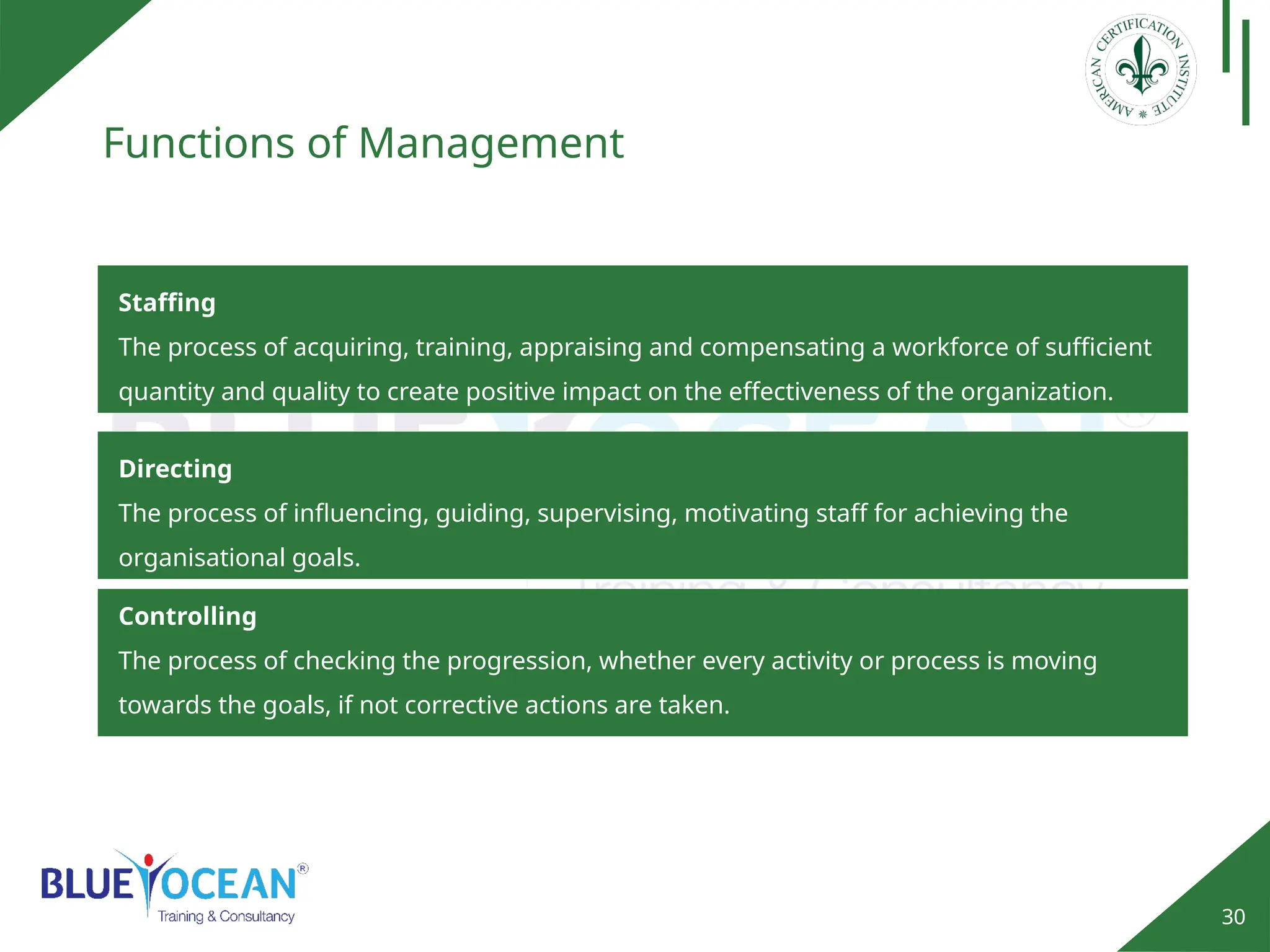
  • 62.
    62 Listening Skills Listening meanspaying attention not only to the story, but how it is told, the use of language and voice, and how the other person uses his or her body. In other words, it means being aware of both verbal and non-verbal messages. One’s ability to listen effectively depends on the degree to which you perceive and understand these messages. Listening is not a passive process. In fact, the listener can, and should, be at least as engaged in the process as the speaker. The phrase ‘active listening’ is used to describe this process of being fully involved.
  • 63.
    63 Listening Skills Effective listeningrequires concentration and the use of your other senses - not just hearing the words spoken. The elements of active listening are; 1. Receiving 2. Understanding 3. Remembering 4. Evaluating 5. Responding
  • 64.
    64 Non-Verbal Communication Nonverbal Communicationhas been defined as exchange of information taking place without words, which includes facial expressions, touch, body gestures, as well as less obvious messages such as dress, posture and spatial distance between two or more people. There are many different types of non-verbal communication. They include: Body Movements (Kinesics), for example, hand gestures or nodding or shaking the head; Posture or how you stand or sit, whether your arms are crossed, and so on;
  • 65.
    65 Non-Verbal Communication Eye Contact,where the amount of eye contact often determines the level of trust and trustworthiness; Para-language, or aspects of the voice apart from speech, such as pitch, tone, and speed of speaking; Closeness or Personal Space (Proxemics), which determines the level of intimacy; Facial Expressions, including smiling, frowning and even blinking; and Physiological Changes, for example, sweating or blinking more when nervous.
  • 66.
  • 67.
    67 Barriers to Communication Howto overcome the barriers of Communication 1. Taking the receiver more seriously, message should be crystal clear and skilfully delivered. 2. Using multiple channels to communicate instead of one . 3. Ensuring appropriate feedback. 4. Be aware of your own state of mind, emotions, attitude. 5. Avoiding forming groups on the basis of nationality or religion at work. 6. Ensuring the communication is through the right channel/medium.
  • 68.
    68 Types of Communication Writtencommunication is the process of communication in which messages or information is exchanged between sender and receiver through written form. Written communication is the most important and most effective mode of business communication.
  • 69.
    69 Types of Communication Advantagesof Written Communication  Written Communication - provides written proof in case of a dispute.  Clarity of message compared to other forms of communication  No personal contact  Cost effective Disadvantages of Written Communication  Delay in communication - it may take a while to get to the intended recipient.  Lack of secrecy - once it's on paper, anyone can read it.
  • 70.
    70 Business Communication Business Communicationinvolves communicating to external and internal parties for business / official purpose to achieve a predetermined objective. This may include: 1. CVs, Resumes 2. Email, Website, FAQs 3. Letters, Newsletters, Brochures, Articles, Catalogs 4. Advertisements, Notice Board, Pamphlets, Signs, Press Releases 5. Presentations, multimedia, talks 6. Reports, Manuals, Proposals, Books
  • 71.
    71 Business Writing Business thriveson strong communication skills; written communication, in particular, is used in all types of businesses in a variety of ways. Sound business communication styles improve interoffice communications, encourage success among employees and improve the bottom line. Understanding different forms of business writing is crucial for overall business. Business needs people with good communication skills, 85% of recruiters give priority to effective communication skills. Higher the position the more one needs to improve one’s business communication ability.
  • 72.
    72 Elements of BusinessWriting Purpose : Keep in mind the purpose of the communication. Be precise and to the point, targeting the specific individual or group. Audience : Depending on the recipient, they are written in varying tones, such as persuasive, informational, promotional or motivational tone. Language : First impressions do matter and it affects your Company’s reputation. Keep the language simple, avoid jargons and easily understood avoid miscommunication. Grammar : Grammar mistakes can reflect negatively on a Company’s image.
  • 73.
    73 Elements of BusinessWriting Spelling : Incorrect spellings may convey misinformation, misguiding the reader into taking the wrong action or their reaction to it may leave your business open to costly legal action. Structure of Business Correspondence 1. Salutation 2. Body 3. Closing Dear Sir/Madam. Introductions doesn’t have be long. Salutation refers to addressing the recipient, start with a courteous greeting. Formal correspondence begins with Respected /
  • 74.
    74 Elements of BusinessWriting Body  Focus on the objective of your correspondence a) State the main idea of your correspondence in the first paragraph or in the first sentence. b) Don't keep your readers guessing. c) Emphasize the key words. Place them at the beginning or reiterate at the end.  Decide how to explain your objective a) First outline your main ideas before you start drafting b) Use short sentences to emphasize ideas. c) Use longer sentences to explain, define or illustrate ideas.
  • 75.
    75 Elements of BusinessWriting Parts of a Paragraph Topic Sentence: The topic sentence is the first sentence in a paragraph. It introduces the main idea of the entire paragraph. Supporting Sentence: Supporting sentence(s) expand your topic sentence. They comprise the main body of your paragraph. Closing Sentence: The closing sentence is the last sentence in a paragraph. It reminds the reader what the paragraph is all about.
  • 76.
    76 Elements of BusinessWriting  Use active verbs a) Don’t overwork the passive voice, instead use active verbs. Use concrete and specific words that show what you mean  Actively edit and proofread a) It's easy to overlook errors, so never forget to proofread your final draft. Eliminate unnecessary words.  Use a dictionary a) When proofreading don’t blindly trust the spellchecker, try using a good dictionary. “Yours sincerely” is the most common closing used in formal and semi-formal letters. When the name of the addressee is not known the phrase, “ Yours faithfully” should be used. Closing
  • 77.
    77 Forms of BusinessWriting Business Writing is categorised in 4 forms; 1. Results-Oriented Business Writing 2. Informational Business Writing 3. Persuasive Business Writing 4. Negative Business Writing Business Writing is a type of written communication, usually with standard structure and style. Business writing is a type of Professional Communication, it’s also known as business communication and professional writing.
  • 78.
    78 Forms of BusinessWriting Result-Oriented Business Writing This type of business writing has the goal of producing a specific result. Result-oriented business writing is marked by active voice, encouraging the reader to do something. This style of writing should end with a call to action and specific instructions for the reader to follow. The tone of this type of writing is always motivational and be encouraging in nature.
  • 79.
    79 Forms of BusinessWriting Informational Business Writing This type of business writing mentions only the facts that needs to be communicated to employees. The words need not be focused on motivating people as the purpose is to provide information. The information provided should be written succinctly and clearly. The facts must be worded in a clear fashion so that the information cannot be misinterpreted. The writer must also anticipate questions that might arise while reading the facts involved so that the information is clarified for every reader.
  • 80.
    80 Forms of BusinessWriting Persuasive Business Writing This type of business writing is used when personal opinions are being offered to others instead of concrete facts. The goal is to convince the reader that what is being presented as the highest possible value proposition. Whenever a proposal is submitted to gain new work, then it is persuasive business writing that is being used. Persuasive business writing needs to be about the reader and not the writer. This type of writing uses a second-person point of view.
  • 81.
    81 Forms of BusinessWriting Negative business writing Writing about a negative subject is a challenging, but often inevitable, task for most business writers. When business has to communicate bad news, this type of business writing is used. Negative business writing must be empathetic, but it must also have a firm tone to it. There cannot be any room left for questions or uncertainty. The essential information that must be conveyed to the individuals involved in a direct manner so that there is little confusion.
  • 82.
    82 Report Writing Reports fallinto three basic categories 1. Informational reports : Offer data, facts, feedbacks and other types of information without analysis or recommendations. 2. Analytical reports : Offer both information and analysis, and they can also include recommendations. 3. Proposal: Offer structured persuasion for external or internal audiences.
  • 83.
    83 Email Etiquettes Email isa convenient and effective medium to conduct business communication. It is important that whether for business or personal use that you follow the basics of email etiquette. 1. ADDRESSING your message 2. Use proper GRAMMAR and ACRONYMS 3. Make sure your emails have proper opening, body and conclusion 4. Be careful while sending large attachments and images . 5. Make appropriate use of TO / From / CC / BCC / Subject 6. While Forwarding emails add TO and CC or BCC and do not forward if the sender doesn’t want it to forward and do not forward before editing.
  • 84.
    84 Organise Effective Meeting TheOffice Administrator or Executive Assistant of an organisation is the custodian organising and managing the business meetings. They makes the arrangements for the meetings, keeps formal records of the meeting’s process and decisions taken and follows up on the action plan. Preparations before the Meeting  Prepare the agenda for the meeting  Send out invitation along with the agenda to those who are expected for the meeting  Arrange for the venue/meeting place.  Keep the attendees reminded one day before the meeting
  • 85.
    85 Organise Effective Meeting Onthe Day of the Meeting  Ensure the venue is ready, stationeries are in place.  Keep the list of attendees' names as well as the list of attendees who are unavailable.  Keep the minutes of previous meeting records ready; The minutes will need to include a full list of those present and all who sent apologies. Note down any apologies for absence provided during introductions or proxy attendees.  Welcome the attendees as they arrive.  Circulate a signup sheet asking people to give their names, organisation and contact details.
  • 86.
    86 Organise Effective Meeting TakingNotes during meeting  Before starting to take notes, be clear of the meeting objective. Try using short concise points  Don’t write word to word  Use your own style and own words  Use shorthand system if you are aware  Don’t panic if you missed out something  Use Cornell Method After the Meeting  Prepare the minutes within 24hrs of recording  Circulate the draft minutes to one or two trusted attendees before circulation to everyone.  Follow up on the action plan
  • 87.
    87 Organise Effective Meeting CornellMethod  Divide your sheet of paper, as displayed in the diagram,  You have a wide left margin- for taking notes  Right side for clues or short terms (the recall area)  At the bottom leave space for summary.
  • 88.
    88 Presentation Skills A presentationis a means of communication which can be adapted to various speaking situations, such as talking to a group, addressing a meeting or briefing a team. Presenting information clearly and effectively is a key skill to get your message or opinion across and, today, presentation skills are required in almost every field. Delivering an inspirational or captivating presentation requires a lot of preparation and work. Preparation is the single most important part of making a successful presentation.
  • 89.
    89 Presentation Skills Points toremember while preparing PowerPoint : 1. Composing slides 2. Ensure consistency 3. Use contrast 4. Apply brilliance 5. Keep It Short & Simple 6. Take home message 7. Add Image 8. Don’t over do 9. Keep audience in mind 10. Practice
  • 90.
    90 Presentation Skills Preparations beforea presentation 1. Prepare for a presentation 2. Organize the presentation material 3. Write your presentation 4. Decide the presentation methodology 5. Manage your presentation notes 6. Prepare visual aids 7. Gather and present authentic data 8. Dealing with questions
  • 91.
    91 Presentation Skills Action: Thinkabout a presentation you may have to give (or the one you could give to develop and practice your presentation skills and write the subject in the box below:) 1. Choose your subject The Subject of my presentation is:
  • 92.
    92 Presentation Skills Action: Answerthe following questions to get a better understanding of the audience(If you do not know your audience yet choose a group who you can gear your presentation towards such as your team or senior managers). 2. Know your audience Who are your audience members: What is the common element that unites them. (Eg. Same job or same information)
  • 93.
    93 Presentation Skills 2. Knowyour audience What is the knowledge level of the audience ? Are they familiar with the topic or will it be entirely new to them? What are the unique needs of your audience ? Why is the topic important to them and how would they like to receive the information .For Eg. Graphs , charts etc Are there any cultural differences between you and your audience ? How will it effect the delivery and scope of your presentation
  • 94.
    94 Presentation Skills 2. Knowyour audience How can you appeal to the audience emotions? How do you think your message will effect the audience? What are audience expectations in terms of content and time? Is there a time frame? Will there be question at the end, if so how will it affect the timing?
  • 95.
    95 Presentation Skills Ways toimprove your presentation skills 1. Practice 2. Transform nervous energy into enthusiasm 3. Attend other presentations 4. Arrive early 5. Adjust your surroundings 6. Meet and greet 7. Use positive visualisation 8. Take deep breath 9. Make eye contact 10. Tell your story
  • 96.
    96 Presentation Skills Ways toimprove your presentation skills 11. Use a pointer 12. Smile 13. Work on your pauses 14. Don’t try to cover too much material 15. Actively engage the audience 16. Use power stance 17. Drink water 18. Join Toastmasters 19. Don’t fight the fear –work on it 20. Be professional at all times
  • 97.
  • 100.
    100 What makes aTEAM? Teamwork The process of people actively working together to accomplish common goals. Team A small group of people with complementary skills, who work together to achieve a shared purpose and hold themselves mutually accountable for performance results.
  • 101.
    101 Team VS Group Group Agroup is a collection of individuals who have some common characteristics or purpose and coordinate their individual efforts towards achieving it. Team Team is a group of people who share a common team purpose and a number of challenging goals. Members of the team are mutually committed to the goals and to each other.
  • 102.
    102 Stages of TeamDevelopment Bruce Tuckman in 1965
  • 103.
    103 Stages of TeamDevelopment Forming The team is formed, and everyone shows their best behaviour. There is a positive and polite atmosphere. Strong guidance is needed by the facilitator as group tasks are not clearly defined yet. Storming Emerging boundaries become contested and conflicts arise as people tend to bring different ideas of how to accomplish goals. Control becomes the key concern during this stage.
  • 104.
    104 Stages of TeamDevelopment Norming This stage is when people begin to recognize ways in which they are alike. They realize that they are in this together. Hence, they tend to get more social and may forget their focus in favour of having a good time. This is the time to help with training if applicable. It becomes important to encourage them in order to feel comfortable with each other and with systems. Also, the group needs to stay focused on goal. Thus, during the norming stage, there is conflict resolution. There is greater involvement of team members. There is a greater “we” feeling rather than “I” feeling.
  • 105.
    105 Stages of TeamDevelopment Performing This stage is when team members are trained, competent, as well as able to do their own problem-solving. At this time, ways need to be looked at in order to challenge them as well as develop them. The team is mature now. The members understand their roles and responsibilities. They would require more input in processes. The members would be self-motivated as well as self-trained. Thus, their efforts need to be recognized. Growth has to be encouraged. This is done by giving new challenges to the team. Thus, teams at the stage of performing are self-controlling, practical, loyal as well as productive. Focus is there on both performance as well as production.
  • 106.
    106 Stages of TeamDevelopment Adjourning When all tasks are completed, it is important to celebrate the team’s positive achievements. Letting go of the group structure after long periods of intensive teamwork can also generate uncertainty for individual team members.
  • 107.
    107 Building Human Relations Understandinghuman relations can help us in our workplace and as a result, assist us in achieving career success. The better our human relations, the more likely we are to grow both professionally and personally. Knowing how to get along with others resolves workplace conflict, manage relationships, communicate well and make good decisions. Human Relation is a skill or ability to work effectively through and with other people, its all about building better relationships.
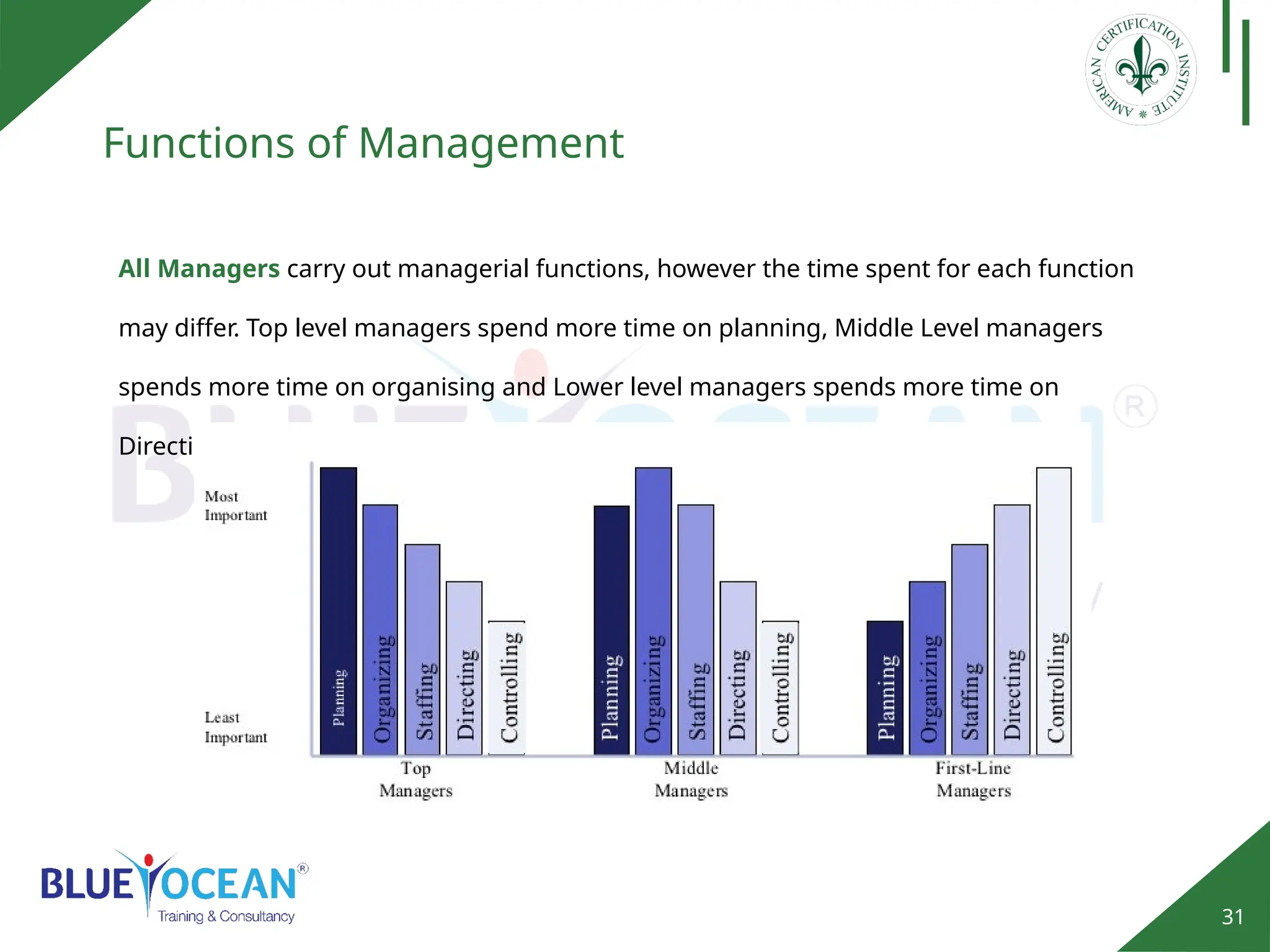
  • 108.
    108 Building Human Relations DevelopYour People Skills Good relationships start with good people skills. People with good interpersonal skills are usually perceived as optimistic, calm, confident and charismatic, these qualities are often endearing or appealing to others. Be Positive Positivity is attractive and contagious; it will help strengthen your relationships with your colleagues. No one wants to be around someone who's negative all the time, so start focusing on the positives around you.
  • 109.
    109 Building Human Relations AppreciateOthers Everyone from your boss to the office cleaner wants to feel appreciated for their work. So genuinely compliment the people around you when they do something well. Manage Your Boundaries All of us want to have friends at work, but, occasionally, a friendship can start to impact our jobs, especially when a friend or colleague begins to monopolize our time, make sure to set and manage boundaries properly. It is important to be assertive about your boundaries and that you know how much time you can devote during the workday for social interactions.
  • 110.
    110 Building Human Relations AvoidGossiping Gossiping is a major relationship killers at work. If you are experiencing conflict with someone in your group, talk to them directly about the problem. Gossiping about the situation with other colleagues will only exacerbate the situation and cause mistrust and animosity. Listen Actively Practice active listening skills when you talk to your customers and colleagues. People respond to those who truly listen to what they have to say. Focus on listening more than you talk and you will quickly become known as someone who can be trusted.
  • 111.
    111 Assertive Skills Assertiveness isthe ability to communicate your needs, feelings, opinions, and beliefs in an open and honest manner without violating the rights of others. An honest, direct and appropriate expression of one's feelings, thoughts and beliefs. Assertiveness is not : 1. A guaranteed way to win every argument 2. A guaranteed way to get what you want 3. A way to get others to feel like you feel 4. A way to get other to think like you think 5. A way to tell everyone everything all the time
  • 112.
    112 How to developAssertive Skills Being assertive is not necessarily easy, but it is a skill that can be learned. Developing your assertiveness starts with a good understanding of who you are and a belief in the value you bring. When you have that, you have the basis of self-confidence. Assertiveness helps to build on that self-confidence and provides many other benefits for improving your relationships at work and in other areas of your life as well. Some people are naturally more assertive than others. If your disposition tends more towards being either passive or aggressive, you need to work on your skills.
  • 113.
    113 How to developAssertive Skills Value YOURSELF and your RIGHTS 1. Understand that your rights, thoughts, feelings, needs and desires are just as important as everyone else's. 2. But remember they are not more important than anyone else's, either. 3. Recognise your rights and protect them. 4. Believe you deserve to be treated with respect and dignity at all times. 5. Stop apologizing for everything.
  • 114.
    114 How to developAssertive Skills Express negative thoughts and feelings in a healthy and positive manner 1. Allow yourself to be angry, but always be respectful. 2. Do say what's on your mind, but do it in a way that protects the other person's feelings. 3. Control your emotions. 4. Stand up for yourself and confront people who challenge you and/or your rights.
  • 115.
    115 How to developAssertive Skills In general, ASSERTIVE people: 1. Get to "win-win" more easily – they see the value in their opponent and in his/her position, and can quickly find common ground. 2. Are better problem solvers – they feel empowered to do whatever it takes to find the best solution. 3. Are less stressed – they know they have personal power and they don't feel threatened or victimized when things don't go as planned or expected. 4. Are doers – they get things done because they know they can.
  • 116.
    116 How to developAssertive Skills Learn to say "No" when you need to 1. Know your limits and what will cause you to feel taken advantage of 2. Know that you can't do everything or please everyone and learn to be OK with that. 3. Go with what is right for you. 4. Suggest an alternative for a win-win solution. When you act assertively you act fairly and with empathy. The power you use comes from your self-assurance and not from intimidation or bullying.
  • 117.
    117 How to Negotiatea Win-Win Negotiation is a method by which people settle differences. It is a process by which compromise, or agreement is reached while avoiding argument and dispute. In any disagreement, individuals understandably aim to achieve the best possible outcome for their position (or perhaps an organization they represent). However, the principles of fairness, seeking mutual benefit and maintaining a relationship are the keys to a successful outcome.
  • 118.
    118 How to Negotiatea Win-Win Effective negotiation helps you :  to resolve situations where what you want conflicts with what someone else wants.  The aim of win-win negotiation is to find a solution that is acceptable to both parties, and leaves both parties feeling that they've won, in some way, after the event. It is always best to try and find a WIN-WIN solution to a conflict. Many viable solutions remain just unapplied theory because people don’t put in the effort to find them and don’t approach the whole process in a constructive, effective way.
  • 119.
    119 How to Negotiatea Win-Win Stages of Negotiation In order to achieve a desirable outcome, it may be useful to follow a structured approach to negotiation. For example, in 1. Preparation 2. Discussion 3. Clarification of goals 4. Negotiate towards a Win-Win outcome 5. Agreement 6. Implementation of a course of action A work situation a meeting may need to be arranged in which all parties involved can come together. The process of negotiation includes the following stages:
  • 120.
    120 How to Negotiatea Win-Win Failure to Agree If the process of negotiation breaks down and agreement cannot be reached, then re- scheduling a further meeting is called for. This avoids all parties becoming embroiled in Always be aware that: 1. Negotiation is not an arena for the realization of individual achievements. 2. There can be resentment of the need to negotiate by those in authority. 3. Certain features of negotiation may influence a person’s behaviour, for example some people may become defensive. heated on or argument, which not only wastes time but can also damages future relationships.
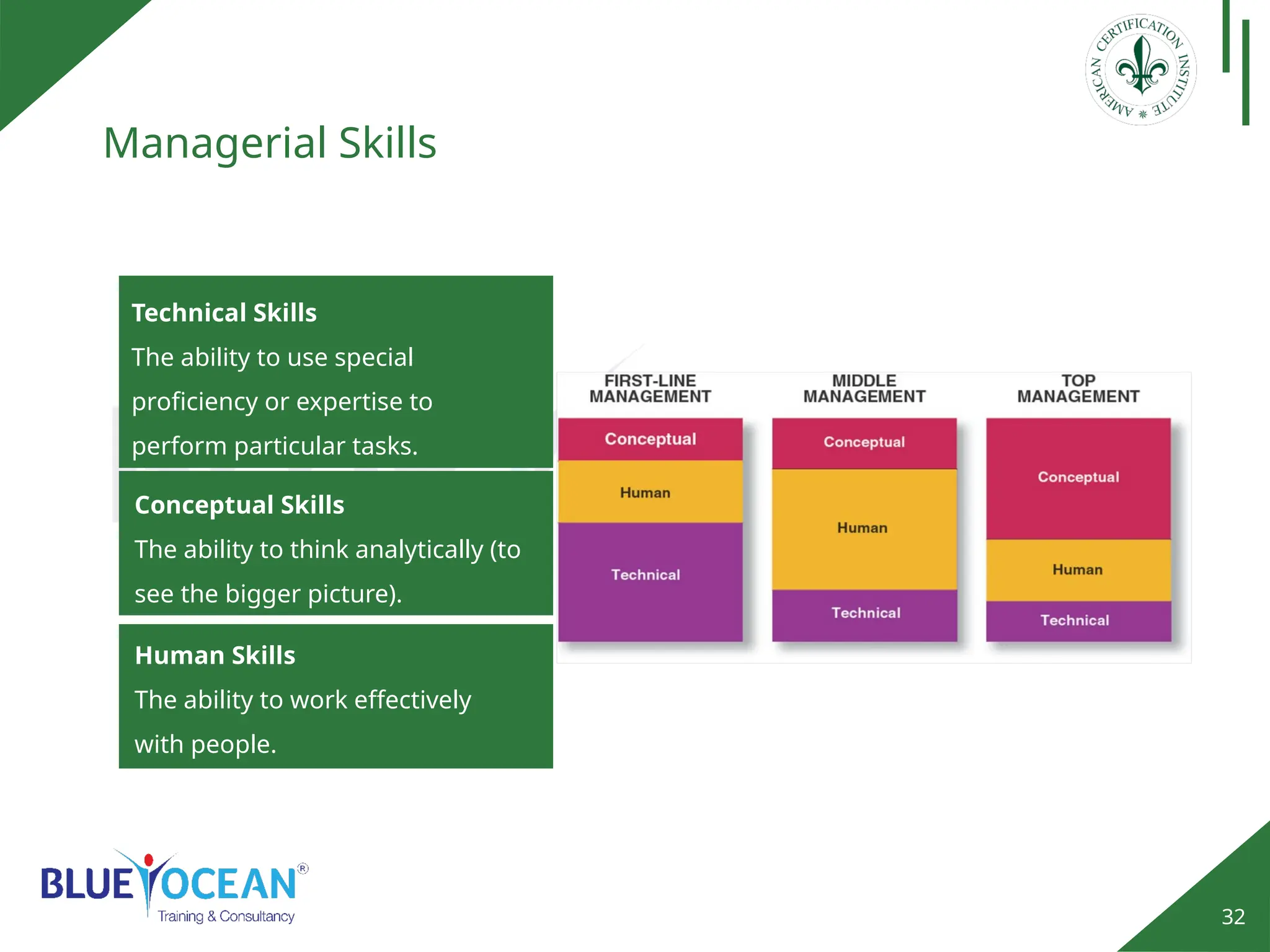
  • 121.
    121 How to RESOLVEconflict amicably Conflict is a normal part of any business relationship. After all, two employees can’t be expected to agree on everything, all the time. It occurs whenever people disagree over their values, motivations, perceptions, ideas, or desires. Interpersonal disagreements may be normal, but they’re also costly. Learning how to deal with conflict rather than avoiding it is crucial. When conflict is MISMANAGED, it can cause great harm to a relationship, but when handled in a respectful, positive way, conflict provides an OPPORTUNITY to strengthen the bond between two people.
  • 122.
    122 How to RESOLVEconflict amicably What you can do ; 1. Make understanding the priority rather than winning or “being right” 2. Listen to the other person's feelings, in addition to their words 3. Focus on the present rather than the past 4. Be willing to let go of resentment 5. Be willing to agree to disagree and move on 6. Use appropriate humour to reduce tension and anger.
  • 123.
    123 Stages of TeamDevelopment Team management refers to the various activities which bind a team together by bringing the team members closer to achieve the set targets. For the team members, their team must be their priority and everything else should take a back seat. They should be very focused on their goals.
  • 124.
    124 Team Management Skills Inorder to build an effective team, the team leader should; 1. Be a mentor to his team rather than being a strict boss 2. Ensure every team member willingly participates 3. Ensure every team member gets complete information 4. Keep team members motivated at all times 5. Gossiping, loose talks, blame game and dirty politics should never find a place in the team. 6. Encourage new ideas and suggestions from members 7. Avoid criticism, give positive / constructive feedback 8. Transparency and health interaction should be encouraged 9. Avoid conflicts 10. Recognition and Rewards
  • 125.
    125 Characteristics of aGood Team  Team goals are understood by everyone in the team.  Everyone participates actively and positively.  Everyone takes initiative to get things done.  Each teammate trusts the judgement of the others.  The team is willing to take risks.  Individual members have thought hard about creative solutions to the problem.  Members are carefully listened to and receive thoughtful feedback.  Everyone is supportive of the project and of others.
  • 126.
    126 Characteristics of aGood Team  There is plenty of communication between team members.  Team decisions are made using organized, logical methods.  Full team acceptance is expected as decisions are made.  Dissenting opinions are recorded and may be revisited if future situations dictate.  Team goals are given realistic time frames.  Everyone is focused on the ultimate goal of the project, while also digging into the underlying details.
  • 127.
    127 Benefits of aTEAM 1. Improves morale and leadership skills 2. Finds the barriers that thwart creativity 3. Clearly defines objectives and goals 4. Improves processes and procedures 5. Improves organisational productivity 6. Identifies a team’s strengths and weaknesses 7. Improves the ability to problem solve 8. Improve productivity and motivation 9. Taps into hidden potential
  • 128.
    128 Understanding your BOSS Everyworkplace is different. For some, their office might be an exciting place to go; for others, it may be downright awkward to ask a question; while a few never know what to expect. Often the difference is actually a result of the manager. Bosses come in all flavors; it’s important to know the kind of boss one works with, as it helps to learn the boss’s style, personality, strength & weakness and decide how to form the most beneficial relationship possible with them. Because a boss can shape or break one’s career!
  • 129.
    129 Types of BOSS Thistype of boss thinks it is essential to be intimidating his or her employees in order to accomplish their goals. The boss always threatens his staff to keep them acquiescent. He scares them so much that they’re afraid of him, which actually encourages further intimidation and he or she gets things done through fear. The Fear-monger The Manipulator The manipulator boss is extremely intelligent, highly focused, very motivated and always has a secret plan; one of the most dangerous. He looks at people as a means to an end.
  • 130.
    130 Types of BOSS Thescreamer boss seems to think that he will get his way if he raises his voice to an unconscionable level: the higher the volume, the higher the commitment. A yeller just wants people to do what they say. The Screamer The paranoid boss is outright suspicious of everyone’s motives. Anything anyone does could be attempts to undermine him. This boss’ feelings of inadequacy will clearly end up interfering in what’s best for the company and his employees. The Paranoid
  • 131.
    131 Types of BOSS Everyonce in a while, an idiot will make his or her way into a management position. The idiot boss is characterized by cluelessness and stupidity. They are incapable of learning/slow at learning and makes a fool of themselves in all situations. The Bumbler The clueless boss is not dumb, he’s just less educated, underqualified for the position, less familiar with the company or process. A clueless boss can be a good boss who is just off- track at the moment. The Clueless
  • 132.
    132 Types of BOSS Thebuddy boss wants to be friends with all of his or her staff. This type of boss wants to be seen as an equal and well liked for it. He or she wants their staff to like them and because friends stick up for friends. The Buddy This type of boss has been with the company for years and years. They are very set in their ways and like to do things they way they have always done. They don’t change easily, despite their resistance to adapt they have a great deal of information and can contribute to the best interests of the organization. The Traditionalist
  • 133.
    133 Types of BOSS Poweris everything, a true megalomaniac; this type of boss craves for power, celebrity status, grandeur and considers themselves as Omni-potent in the office because of their supreme authority their title holds. They appreciate the management position, titles they hold rather than the job itself. The Power Hungry The Workaholic He or she is a martyr who lives just for the company, this type of boss is a workaholic, always puts the job first. Balancing work with life is not a familiar concept for this type of boss. They work on holidays, after work hours and there will never be a day when this boss calls off sick.
  • 134.
    134 Types of BOSS Thoughthis boss might present himself as tough, he can barely hide his inadequacies. He absorbs the world’s worries and worries for the world. He frets about little details. He arrives at the office in the morning, flushed and frazzled, because he was lying awake the night before agonizing over numbers and orders The World-on his Shoulders Boss The two-minute boss exhibits the characteristics of Power Hungry boss and World-on-his- shoulders boss. He or she impulsively demands control over situations. This type of a boss constantly gives the impression that he is way too busy to bother with details. His head is always somewhere else, somewhere more important. The 2 Minute Boss
  • 135.
    135 Types of BOSS Theeccentric boss has unrealistic expectations for his or her staff. They have a unique way of completing their work and expects their staff to work in the same manner. They can be gentle, open to suggestions, innovative ideas but often cause confusion around their expectations and explanations of projects. The Eccentric This non-stick boss is always missing in action. This type of boss is more of a nuisance than a danger. Any blame slides right off him. He does not give straight answers to straight questions. But makes his or her appearance for the limelight; prominent in public affairs. The Teflon Boss
  • 136.
    136 Types of BOSS Theperfectionist is a micro-manager who likes to control everything, involves in every activity the staff does. It can be the smallest detail, but this type of boss will make changes to his or her staff work, simply because they can. The behaviour is obsessive and has little or no trust on his or her staff’s abilities. The Perfectionist The lone wolf prefers to ride solo. He stays in his office or works from home, avoiding human contact, especially employee interaction. He could be a tech whiz who was promoted based on his outstanding hard skills, but he’s not necessarily a people person. The Lone Wolf Boss
  • 137.
    137 Types of BOSS Thesupportive motivator, the ideal boss who treats everyone with fairness regardless of politics. He communicates, keeps an open-door policy, listens to everyone, motivates and encourages everyone. He leads by example, provides superior training and a positive work environment. He provides constructive feedback and supports every effort his staff makes to succeed. He has vision, is not afraid, and doesn’t scream. He coaches his staff, and when employees leave, they will talk about him for years to come. The Great Boss
  • 138.
    138 Boss-Subordinate Relationship Organisations arepressuring managers to deliver better results with fewer people. In the best of environments bosses can be challenging to deal with. In the worst of environment, they can be more than challenging-frustrating, perplexing, aggravating and impossible. Working for a Company is not an easy task. We need to deal with many employees, customers and suppliers and the most important and difficult person is our BOSS. Yet they can be managed, it’s the right approach that pays off in developing positive productive relationships.
  • 139.
    139 Boss-Subordinate Relationship 1. Tryto understand the reasons for your Boss’s difficult behaviour. 2. Identify the primary motivating factors (what drives your boss). 3. Support their success 4. Work around their weakness and not against them 5. Learn to communicate your ideas your reactions/concerns in a helpful, positive way. The relationship that one creates and manages with his or her immediate boss is crucial for their success and career progress. It is important to understand key aspects of this relationship;
  • 140.
    140 Boss-Subordinate Relationship Managers ofall types can provide invaluable learning experiences that can enhance your career. Managing a difficult Boss is challenging but not impossible.  Keep your mind focused on Top PERFORMANCE  Keep the COMMUNICATION flowing  Keep up with the TIMING  Be a PROBLEM SOLVER not a complainer  Plan and ORGANISE your work  Regularly ASSESS YOURSELF on productivity, quality of work and behaviour  Bring your BEST SELF to work every day  Help your boss to be effective
  • 141.
    141 Boss-Subordinate Relationship  Don’tgo over your boss’s head if you can avoid it  Speak up your mind  Don’t be intimidated by a bully  Be prepared to discuss criticism when confronted  Refrain from becoming emotional during the discussion  Always remain professional  Maintain the RIGHT MIND-SET at all times  Be PROACTIVE  Don’t engage in self defeating behaviour  Anticipate problems before they come up Understand you cannot change your boss so adapt yourself if not, take further steps;
  • 142.
  • 143.
    143 Effective Leadership Skills Whatare leadership skills? Leadership skills are the tools ,behaviours and capabilities that a person needs in order to be successful at motivating and directing others. It is the ability to help people grow in their own abilities and drive other to achieve their own success. A born leader? Many leaders may be so committed to a vision that they naturally find ways to pull others along with them. Most of us cannot claim to have been born with that level of leadership ability. You don’t have to be born with leadership skills. They can be learnt .
  • 144.
    144 Effective Leadership Skills TheLeadership styles Autocratic Democrati c Bureaucratic Style Charismati c Transactiona l Transformationa l Laissez -Faire
  • 145.
  • 146.
    146 Effective Leadership Skills Characteristicsof an effective leader 1. Is committed to a vision or mission 2. Understands his or her role 3. Demonstrates integrity 4. Sets an example 5. Understands how to motivate others 6. Communicates effectively 7. Is willing to take risks 8. Is adept at problem solving
  • 147.
    147 Effective Leadership Skills Qualitiesthat define a good leader  Honesty  Delegation  Communication  Confidence  Commitment  Positive Attitude  Creativity  Ability to inspire  Empathy  Accountability  Enthusiasm  Focus Driven  Responsibility
  • 148.
    148 Effective Leadership Skills DELEGATION-an important element of Leadership Assignment Transfer Acceptance Accountability Stage 3 Stage 4 Stage 2 Stage 1 Process of delegation of authority
  • 149.
    149 Effective Leadership Skills Somepeople are put in positions of authority, but it is up to the leaders to gain respect and trust of their followers. Followers need to see their leader doing what is right for the team; that is supporting, developing, nurturing, and defending in the good times and the bad. When you establish yourself as a leader, remember that actions speak louder than words and motivate people to do their best work for the best of their ability.
  • 152.
    152 Business Etiquette Business etiquetteis about building professional relationships with other people at workplace. Etiquette is not about rules & regulations but its about providing basic social comfort and creating an environment where others feel comfortable and secure. Business etiquette consists of two things. Firstly, thoughtful consideration of the interests and feelings of others and secondly, being able to minimise misunderstandings. Etiquette is all about respecting each other, practicing good manners and displaying good behaviour. We need to know how to behave in a given situation, know how to interact with people that projects a professional business image.
  • 153.
    153 Cross-Cultural Business Etiquettes Answer -Bow and wait for him to initiate the handshake. When conducting business in Australia, it is best to: a) Act like a local and use as much slang as possible. b) Don’t waste anyone’s time; be punctual and direct. c) Purchase local beer and take it to all meetings as a gift Answer – Don’t waste anyone’s time; be punctual and direct. You have arrived at a business meeting in South Korea and are going to meet the company’s president. You should: a) Look him in the eye and extend your hand for a handshake. b) Bow and wait for him to initiate the handshake. c) Nod your head slightly.
  • 154.
    154 Cross-Cultural Business Etiquettes Answer -Pastries After meeting a prospective client in China, she gives you her business card. You should: a) Copy her information and leave the card on the table. b) Put it away only after carefully studying its details. c) Hand it back to her after memorizing her information. Answer - Put it away only after carefully studying its details. In Japan, you should accept a business card with … a) both hands b) the left hand c) the right hand Answer - Both hands If invited to a house for dinner in Turkey, which of these would you take? a) Wine b) Pastries c) Flowers
  • 155.
    155 Cross-Cultural Business Etiquettes Answer -Confidential Which of these is probably the most important factor to bear in mind when doing business in Brazil? a) Brazilians are very wary of foreigners b) Business is only really done with people they like and trust c) Brazilians take a very relaxed approach to business Answer - Business is only really done with people they like and trust In Great Britain, tapping the side of your nose means that something is: a) confidential b) inappropriate c) very boring
  • 156.
    156 Cross-Cultural Business Etiquettes Culture A perceptualstructure of human activities that includes behaviors, values, arts, beliefs, languages, custom, dress, rituals, manners, religion, laws, morality & code of honors Cross-Culture Interacting with or comparing two or more cultures & understanding their values, beliefs & norms. Learn the language, learn the culture, learn the business protocol and professional practices of your host country. Understanding the fundamentals makes one proficient while conducting business with people from different cultural background.
  • 157.
    157 Cross-Cultural Business Etiquettes Every cultureis different and has different styles of etiquette. Cultural conflicts arise because of the differences in values and norms of behaviour of people from different cultures. A person acts according to the values and norms of his or her culture. Another person holding a different world view might interpret his or her behaviour from an opposite standpoint. This situation creates misunderstanding and can lead to conflict. We often do the most harm in our intercultural interactions while trying to do the right thing. Knowing the right etiquette can save a great deal of wasted time and money.
  • 158.
    158 Cross-Cultural Business Etiquettes Greetings &Introduction Different cultures have their own style of greeting, some cultures hug each other, place a kiss on the cheek, handshake, bow down, some greet with folded hands. There is nothing more putting off, than trying to kiss someone who is expecting a handshake or holding out his hand when the other person bows. Make sure to know the local custom and culture of the person whom you are meeting to avoid unpleasant situations in the first meet.
  • 159.
    159 Cross-Cultural Business Etiquettes Business Cards 1.As a mark of respect, present it with both hands 2. Never use or receive the card with your left hand 3. Spend few seconds reading the contents before place the card down. 4. Print the card on good quality paper as it represents your company’s image 5. Print the details on English on one side and print the local language on the other side. Addressing 1. Always use a title when addressing someone such as Mr…or Ms…Doctor …. 2. It is better to address people by their surname 3. Ask them how they prefer to be addressed
  • 160.
    160 Cross-Cultural Business Etiquettes Personal Space Peoplefrom different cultures have different views about personal space. Standing close or touching another person may be considered appropriate in some culture whereas inappropriate in some culture. For example, in the Middle East, men do not touch women they are not related too, and the same is true of women. In Mexico, it is OK to give a friendly pat on the back, but in China you should never touch the other person. While in Thailand and India, handshakes are fine, but you should never touch a person's head.
  • 161.
    161 Cross-Cultural Business Etiquettes Appearance As peryour UAE customs, everyone are expected to abide by local standards of modesty. Clothing which covers one’s body completely is considered modest. Traditional clothes on foreigners may be offensive. Despite the heat, most of the body must always remain covered. For Business meetings, Formal suit in dark solid colors are recommended. Minimal jewelry is advised. Language You can buy in any language but to sell you have to speak their language. Communicating in a foreign language is difficult if the person is not eloquent, it is considered impolite when someone corrects.
  • 162.
    162 Cross-Cultural Business Etiquettes Non-verbal Communication 1.Pay attention to body language 2. Maintain clear eye contact 3. Respect personal space 4. Listen actively without interrupting the other party 5. Don’t assume, avoid misunderstanding 6. Show respect 7. Slow down and speak clearly 8. Don’t rush to conclusion without clarifying
  • 163.
    163 Cross-Cultural Business Etiquettes Having insightinto the cultural dynamics of a country can be very helpful to understand why people act the way they do, and the appropriate way you should act while in that country. Respecting the local customs & cultural sensitivity will ensure your success
  • 164.
    164 Telephone Etiquettes Good phoneetiquette is important because we cannot see the facial expressions and body language of the other person and they cannot see us. We must compensate by choosing our words carefully and using much more tone inflection to convey our message than if we were face to face. Telephone etiquette means being respectful to the person you are talking with, showing consideration for the other person's limitations, allowing that person time to speak, communicating clearly and much, much more. Your voice must create a pleasant visual impression over the telephone.
  • 165.
    165 Telephone Etiquette Tips 1.Speak directly into the mouthpiece; a headset, which will free hands is an ideal option. 2. Be careful on your voice tone and the language you use. 3. Do not eat or chew gum while talking on the telephone 4. If someone walks into your office while you’re talking on the telephone, ask the caller if you may put him/her on hold briefly. 5. Don't place the handset in the cradle until you’ve depressed the HOLD button. 6. Don’t lay the receiver on the desk, without placing the caller on hold 7. Return to caller and complete the call as soon as possible.
  • 166.
    166 Telephone Etiquette Tips 1.Be aware of your speaking volume 2. Don’t answer your phone when you are in a meeting with someone (Unless it’s an important business call) 3. Do not put your phone on the table when you are in a meeting 4. Respect quiet zones 5. Choose a normal ring tone 6. Let the other person know when you have them on speaker phone When you are using your mobile phone;
  • 167.
    167 Stages of aCall Phase 1 Greet the caller Phase 2 Building rapport & identifying the need Phase 3 Collecting and verifying the information Phase 4 Provide solutions , alternatives or information Phase 5 Close the call
  • 168.
    168 Making Calls Before makingan outbound call; 1. Be sure you have right number before you place a call 2. Note down the objective of your call 3. Identify the information you need to obtain from the call 4. Anticipate questions you many encounter When you call; 1. Make sure to identify yourself when you make the contact 2. State clearly the purpose for your call 3. Take notes during your call 4. Spell out the action plan
  • 169.
    169 Answering Calls 1. Answerthe call within three rings 2. Answer with a friendly greeting 3. Your greeting should be pleasant and professional 4. Use the right tone and pitch 5. Ask for the caller’s name, company and purpose 6. Good manners show you respect the caller. 7. Give your name. This is a courtesy that serves to personalize as well as allowing the customer to hold you accountable for your service. 8. Ask the customer how you can help. 9. Never put a customer on hold for more than 30 seconds.
  • 170.
    170 Transferring Calls When transferringa caller; 1. Tell the reason you are transferring and to whom you are transferring 2. Ask permission to transfer their call before you do so 3. Announce the caller to the person you are transferring to 4. Make sure they can take the call, don’t leave the caller hanging 5. If the caller needs to speak to another person or department 6. Transfer the caller directly to the desired person rather than the operator
  • 171.
    171 Placing Call onHold When putting a caller on hold; 1. Always ask permission before doing so 2. Be sure to listen to the response from your caller before you place them on hold 3. Check periodically every 30-45 seconds if it takes longer 4. Give them the option to continue to hold or offer to call them back 5. When returning to your caller, thank them for waiting on the line. 6. If your caller can’t hold, offer to take a message or return the call 7. Remember to take down their name and contact number. 8. When placing multiple calls on hold, remember to return to the first caller you placed on hold first.
  • 172.
    172 Screening Calls There mightbe times when your boss is busy and doesn’t want to be disturbed or is avoiding calls from certain individuals and wants you to screen his or her calls before you transfer. Screening calls is always a delicate situation, so its critical not to offend or put your caller on the defensive with your voice tone. When it’s necessary to screen calls, you may politely take down their name and number. Incase the caller wants to leave a message, note down the message.
  • 173.
    173 Impatient Callers 1. Staycalm. Try to remain diplomatic and polite. Getting angry will only make them angrier. 2. Always show willingness to resolve the problem or conflict. 3. Try to think like the caller; remember, their problems and concerns are important. 4. Speak slowly and calmly. Be firm with your answers but understanding. 5. If you are in a non-supervisory position: Offer to have your supervisor talk to the caller or call him/her back if the caller persists. Sometimes the irate caller just wants someone in a supervisory capacity to listen to their story even if you are unable to help them.
  • 174.
    174 Taking Message When takingmessages be sure; 1. Keep a note pad or message slip and pen always ready 2. To ask for caller’s name, contact number/extension 3. Fill in the date and time of call 4. Take down the message clearly and action to be taken 5. Repeat the message to the caller 6. Remember to deliver the message to the person as soon as possible. 7. Maintain confidentiality with all messages.
  • 175.
    175 Voice Mail Message 1.Speak clearly and slowly. 2. Be sure to leave your name and extension number. 3. It's best to say it at the beginning and end of your message. 4. Leave the date and time you called in the message. 5. Let the person know the best time to call you back. 6. Keep messages short and to the point. 7. Cover one topic in one message; specify what you want the recipient to do. 8. Remember that you want to leave the person you are calling with a good impression of you.
  • 176.
    176 Ending a Call Manytimes people find it difficult to end a telephone conversation. There are some specific things that you can say to close your conversation professionally: 1. Leave the conversation open. 2. End on an "up" note. 3. Before hanging up, be sure that you have answered all the caller's questions 4. Tell the person how much you've enjoyed speaking with him/her. 5. Always end with a pleasantry such as: "Have a nice day" or "It was nice speaking with you“ 6. Use the depress button to end the call before you place the receiver on the cradle.
  • 177.
    177 Building Customer Relationship The cornerstoneof market conditions today are repeat business and customer loyalty. Losing a customer is, without a doubt, the worst thing that can happen to a business. Strong relationships and the level of service is one of the key factors for long term business relationships. Hence, customer retention has become key for every business in this fast paced and competitive market. Statistics reveal that nearly 80% of customers are willing to pay more if they are offered a better experience.

  • 178.
    178 Building Customer Relationship You couldbe:  dealing with customers face to face at a reception desk, or by phone or email from a contact center  answering enquiries or complaints about services such as public transport, tourist attractions, accommodation or finance  taking bookings or payment by credit card or cash for events, travel, goods or services  describing products in detail such as financial packages, private health or beauty treatments or gas and electric supply.
  • 179.
    179 Building Customer Relationship You shouldbe:  able to speak clearly, fluently and courteously  be polite, patient, resilient, helpful and prompt.  perform multiple task – for example, talk to customers, find information on computer and input data.  able to deal with complaints and difficult situations.  able to stay calm under pressure and to work to meet targets.  Take time to know your customer, the industry/ company they belong  Treat every customer as your most important one.
  • 180.
    180 Dealing Customer Grievance Dealingwith a customer complaining about your service or products needs to be handled empathetically, with a strong communication structure, in order to stay in control of the conversation and to achieve a successful outcome. A customer complaint well handled can win you a lifelong customer, who remains loyal to your organisation. The positive side of customer complaint gives us an opportunity to know about your customer’s preferences, expectation, your product / services without the added cost of conducting a survey. So complaints are a blessing in disguise!!!
  • 181.
    181 Dealing Customer Grievance Whydo customers COMPLAIN? 1. Their expectations have not been met 2. Poor customer service 3. Transferring from one CSR to another 4. Rude Staff 5. No Omni-channel Customer Service 6. Not Listening to Customers 7. Hidden Information and Costs 8. Low Quality of Products or Services 9. Keeping an Issue Unresolved 10. Inaccessibility
  • 182.
    182 Dealing Customer Grievance Pointsto remember when dealing with difficult behaviour: Show INTEREST 1. Listen carefully 2. Call the customer by name 3. Treat the customer with interest 4. Keep calm and cool Show SYMPATHY Get into their shoes and think what would you feel in their position Patience Listening & Repeat Repeat the exact nature of the complaint to the customer so there are no misunderstandings.
  • 183.
    183 Dealing Customer Grievance CONSIDERHUMAN ERROR Look into if the customer has made an error if so gently communicate and be diplomatic. ADMIT the complaint: If a mistake has happened, admit it. Not admitting your mistake makes the customer lose the trust in you. REFER immediately If the customer insists on speaking to a manager, refer immediately.
  • 184.
    184 Dealing Customer Grievance Letthe customer talk 1. Let the customer vent their anger. 2. Just let them talk. 3. Do not interrupt. 4. Do not argue. INTERRUPT gently After a while, say you wish to help them solve the problem by working together.
  • 185.
    185 Dealing Customer Grievance TAKENOTES Write down all the points. 1. Get the facts. 2. Focus your thoughts. 3. Often seeing the points being written down takes the heat out of the argument READ BACK YOUR NOTES Read back your notes to the customer to show you care and that you are making sure you have all the points correct.
  • 186.
    186 Dealing Customer Grievance IFCUSTOMER KEEPS ARGUING 1. Keep repeating that you only want to help them. 2. Perhaps suggest that they call back later so you can make enquiries about the matter. Never do the following; Be DEFENSIVE Do not take the complaints personally. The customer is angry at the problem he or she is facing and not at you. Say a flat ‘NO’ Never say a flat no as an answer; Be prepared and offer an explanation and an alternative.
  • 187.
    187 Dealing Customer Grievance BLAMEother staff Do not blame other staff. The customer is angry at the problem he or she is facing and not at you. Give COMMANDS Do not order the customer about. Be polite, say ‘Please’ etc. Never do the following; Leave the problem UNSOLVED If it cannot be solved immediately, keep in contact with the customer until it IS solved.
  • 188.
    188 Dealing Customer Grievance Neverdo the following; Make PROMISES you cannot keep If you make unrealistic promises, the customer will be MORE displeased, and you will turn an already angry customer into a frustrated one. Loose your sense of humor If appropriate, look on the light side. Introduce some humour and it will help both you and the customer. Offer COMPENSATION Unless you are authorized to do so.
  • 191.
    191 Time waits forNONE! Time management is like any other process, it must be planned, monitored and reviewed regularly. Effective time management is a skill that is learned and if used regularly can be improved upon. “Time is the scarcest resource and unless it is managed nothing can be managed” – Peter Drucker “Time Management” is actually a misnomer, because one does not manage time, for it’s beyond anyone’s control. It moves on at a predetermined rate, no matter what we do. It is not a question of managing the clock but managing ourselves with respect to the clock. Manage yourself, not your time!!!
  • 192.
    192 Benefits of TimeManagement When an individual organizes and manages his/her activities focusing on the result rather than the activities, the benefits are enormous; 1. Greater productivity and efficiency. 2. A better professional reputation. 3. Less stress. 4. Increased opportunities for advancement. 5. Greater opportunities to achieve important life and career goals.
  • 193.
    193 Risk of MissingTime Time management is not very difficult as a concept, but it’s surprisingly hard to do in practice. It requires the investment of a little time upfront to prioritise and organise oneself. But once done, you will find that with minor tweaks, your day, and indeed your week and month, fall into place in an orderly fashion, with time for everything you need to do. 1. Missed deadlines. 2. Inefficient workflow. 3. Poor work quality. 4. A poor professional reputation and a stalled career. 5. Higher stress levels. Failing to manage oneself can have some very undesirable consequences;
  • 194.
    194 Common Time Wastersat Work 73% say they waste time at work -- at least one hour per day. They waste time by surfing the web (48%), talking with coworkers (33%), taking care of personal agendas and calls (49%), and taking long lunches (15%) Checking email wastes 50% of the workday When people aren't at their desks, there's a good chance they're getting more coffee. The average worker drinks 3 cups per day. They're in the bathroom checking Facebook: 54% of women and 46% of men do this. 77% of employees who have access to Facebook from work check it daily. But a lot of time is also wasted on menial work tasks, like fixing coworkers' mistakes (54%), dealing with office politics (47%), waiting on colleagues (42%), getting dragged to meetings (42%), and doing administrative work (33%)
  • 195.
    195 How to managetime “Time management” is the process of organizing and planning how to divide your time between specific activities. Good time management enables you to work smarter, “not harder” so that you get more done in less time, even when time is tight, and pressures are high. It's important that you develop effective strategies for managing your time to balance the conflicting demands of life. Failing to manage your time damages your effectiveness and causes stress.
  • 196.
    196 Principles of Time Management Thekey principles for effective Time Management are ; 1. Set clear goals & objectives 2. Plan your work 3. Get organised 4. Prioritise your activities 5. Destroy procrastination Examine your present situation and assess what goals are important to you and what action you need to take to achieve your target. Set yourself specific and clearly defined goals, and make sure that these are realistic and achievable. Have a contingency plan or alternative route to your goal in case you have to change your plans. Set clear goals & objectives
  • 197.
    197 Get Organised Once thegoals are set, the next step is to organise the goals into manageable targets or milestones. 1. Manage your energy and your focus 2. Create a task list that reflects your priorities 3. Plan your day, week and month 4. Divide your tasks for the day into achievable blocks 5. Set realistic deadlines for your activities 6. Allocate responsibilities (if necessary) 7. Schedule work to suit your energy cycle
  • 198.
    198 Get Organised To dolist is an effective Time Management tool 1. Write down what you need to do 2. It is harder to ignore what you have written down on paper 3. It shows you everything you need to do so 4. It helps you to prioritise your jobs 5. Tick off tasks as you accomplish them
  • 199.
    199 Know your EnergyCycle Everyone has a natural time during the day when they are "UP" (prime time) and a natural time when they are "DOWN" (down time). During prime time, your brain is "on"; your batteries are charged and you're able to focus. During down time, your brain feels "slow"; it's difficult to muddle through your work.
  • 200.
    200 Know your EnergyCycle When considering a daily schedule, it is a good idea to keep your energy cycle in mind. Some people are at their best early in the morning, others peak in the afternoon. Whenever possible, try to plan your daily schedule to match your prime time. Consider such ideas as doing work that requires concentration, creativity, and thought during your prime time. Leave less-demanding activities, such as reading, responding to mail, or returning phone calls, until after lunch if your prime time is in the morning The challenge for most people during their prime time is self discipline, resist the urge to do ‘fun”, easy, trivial things.
  • 201.
    201 How to Prioritise Listingthings is one of the most basic ways to manage time. In a priority list, you get to rank the order of importance of each task so that you can pay attention to the most urgent ones. The idea is to concentrate more on tasks that need to be completed earlier. For this to work, we can’t choose to do things based on how easy it is to complete or based on our personal preferences. Prioritization benefits your time management by first highlighting to you what needs your attention first.
  • 202.
    202 Priority Matrix Quadrant 1– Emergencies & Crises: Urgent and Important Quadrant 2 – Long-Term Goals: Not Urgent but Important Quadrant 3 – Interruptions: Urgent but Not Important Quadrant 4 – Distractions: Not Urgent and Not Important The Eisenhower Matrix, also referred to as Urgent-Important Matrix, helps to decide on and prioritise tasks by urgency and importance, sorting out less urgent and important tasks which you should either delegate or not do at all.
  • 203.
  • 204.
    204 Difference between Urgent& Important Urgent means that a task requires immediate attention. These are the to-do’s that shout “Now!” Urgent tasks put us in a reactive mode, one marked by a defensive, negative, hurried and narrowly-focused mindset. Important tasks are things that contribute to our long-term mission, values, and goals. Sometimes important tasks are also urgent, but typically they’re not. When we focus on important activities we operate in a responsive mode, which helps us remain calm, rational, and open to new opportunities. It’s a pretty intuitive distinction, yet most of us frequently fall into the trap of believing that all urgent activities are also important.
  • 205.
    205 Priority Matrix Quadrant 1:Urgent and Important Tasks Tasks are both urgent and important. They’re tasks that Quadrant 2: Not Urgent but Important Tasks Tasks that don’t have a pressing deadline, but nonetheless help you achieve your important personal and work goals as well as help you fulfill your overall mission in life. Q2 tasks are typically centered around strengthening relationships, planning for the future and improving oneself. require immediate attention and also work towards fulfilling long-term goals and missions in life. Q1 tasks typically consist of crises, problems, or deadlines.
  • 206.
    206 Priority Matrix Quadrant 4:Not Urgent and Not Important Tasks Tasks aren’t urgent and aren’t important. Q4 activities aren’t pressing nor do they help one achieve long-term goals or fulfill their life’s mission. They’re primarily distractions. Quadrant 3: Urgent and Not Important Tasks Tasks are activities that require our attention now (urgent), but don’t help us achieve our goals or fulfill our mission (not important). Most Q3 tasks are interruptions from other people and often involve helping them meet their own goals and fulfill their own priorities.
  • 207.
    207 Power of Choice– 80:20 PP The Pareto principle is the filter that can protect us from ourselves and our natural response to having too many things on our plate. The Pareto principle separates the vital few from the many less fruitful activities. Pareto’s concept of focusing on what is going to make a difference is neatly captured in his own words: "If you're Noah, and your ark is about to sink, look for the elephants first, because you can throw over a bunch of cats, dogs, squirrels, and everything else that is just a small animal and your ark will keep sinking. But if you can find one elephant to get overboard, you're in much better shape."
  • 208.
    208 Pareto’s Principle Pareto's Principleis named after Vilfredo Pareto (1848-1923), an Italian economist- sociologist, Professor of Political Economy at Lausanne, Switzerland, who first discovered and described the '80:20' effect. The Pareto principle is extremely helpful in bringing swift and easy clarity to complex situations and problems, especially when deciding where to focus effort and resources. It's a remarkably quick easy way to assess, understand, and optimise virtually any situation involving distribution or usage of some kind. The 80/20 rule means that in anything a few (20%) are vital, and many (80%) are trivial. 20 % of defects are causing 80% of the problem.
  • 209.
    209 Pareto’s Principle Steps touse Pareto’s Principle The Pareto Principle provides you with a priority system to validate incoming tasks against your obligations. The following key points guides on how to use this principle at work; 1. Identify your goals - In other words what is most important. 2. Use the Pareto principle to prioritize your tasks. 3. Ensure that you protect these vital few activities from the trivial many. The 80 20 rule is a prioritizing system that can dramatically change your life.
  • 210.
    210 Pareto’s Principle 1. Identifyyour Key Result Areas In today's world of information overload and real-time response, it is not unusual to be faced with a dozen tasks that demand your attention. Any incoming information or requests for your time need to be assessed against your goals and objectives. Your top priorities are those that are aligned with your performance criteria, key result areas, or goals. After assessment assign the priority to the incoming task. Your Key Results Areas are those things that you are measured against at work. In your personal life they are the pursuit of those things that matter most to you or your family.
  • 211.
    211 Pareto’s Principle 2. Usethe Pareto Principle to set priorities List all the activities that you have to do over the next week. But don't fall into the trap of using your to do list as a way to manage your time. Now put an A, B or C next to them: 1. 'A' is for your most important activities (those top 20%), 2. 'B' are somewhat important (60%), and 3. 'C' are your least important activities (bottom 20%) Put a time limit on those activities that you have assigned as most important. How long are each of your 'A' activities going to take?
  • 212.
    212 Pareto’s Principle 3. Protectthe vital few from the trivial many Gather up all of your top priority actions that you have to do next week (if you have followed the process, each of these actions should have a duration next to them!) The next step is to make time for these most important activities, rather than trying to find time later on. Note: If your goals are not aligned with the 80 20 rule, ask yourself the following questions: 1. Are these someone else's goals? 2. Do I need to add more goals/objectives? 3. Am I doing what is important? 4. Am I spending too long in the urgent/crises mode of this matrix?
  • 213.
    213 Procrastination Procrastination is whenyou put off things that you should be focusing on right now. It has been termed the silent killer and it’s one of the biggest deterrents to our goals.  Regularly being distracted from work by non-work activities such as checking Facebook or emails;  Leaving everything until the last possible moment;  Constantly worrying about work but not getting anything done; Procrastination is the tendency to prevaricate, delay or unreasonably postpone a task. It is a habit that affects everyone to a greater or lesser extent. Common symptoms of procrastination include:
  • 214.
    214 Procrastination Using Priority Matrix,you have added a few task in Q4 it is perfectly fine when you plan to do certain tasks at a later stage, because you have decided that they are not sufficiently urgent. This is not procrastination. It is sensible planning, enabling you to get more urgent and important tasks completed. However, if you have identified a task as both important and urgent, and you still keep putting it off, that is procrastination.  Spontaneously performing tasks that you wouldn’t normally be enthusiastic about, such as household chores; Feeling that nothing you do is good enough;  A sense of pointlessness or hopelessness as you feel there is too much to do.
  • 215.
    215 Why procrastinate? There aremany reasons why people procrastinate: 1. Sometimes it’s because the task is unpleasant, and they’d rather be doing something else. 2. Sometimes, they don’t really know how to do a task and so are avoiding it. 3. Perfectionists often procrastinate, because they’re not sure they have the time or capacity to do a task perfectly. 4. Other people may struggle because they are not sure exactly what task to do. Procrastination is a parasite eating away at our effectiveness. We need to understand why and how procrastination operates to control it.
  • 216.
    216 Effects of Procrastination Procrastinationhas a positive role in checking our forward drive. It also has a strong negative role in placing obstacles in our own way. The following explains the status of chronic procrastinators mind set; 1. Feel guilty of their behaviour 2. Summon unnecessary reminders 3. Miss deadlines, get stressed out 4. Fall short on their goals leads to depression 5. Always make excuses for inaction 6. Ignore their own strengths 7. Pretend that they are extremely busy 8. Stop being creative
  • 217.
    217 Type of Procrastinators Thereare six different types of procrastinators: 1. Perfectionist 2. Dreamer 3. Worrier 1. Defier 2. Crisis-Maker 3. Over-doer Characteristics of Perfectionist Procrastinator : 1. Tend to put forth excessive amounts of time and energy to make sure that everything they do is perfect. 2. Tend to put off starting tasks due to a fear of failure or doubts about doing it the “right way.” 3. Tend to see everything in life as things that have to be done, not necessarily what they want to do.
  • 218.
    218 Type of Procrastinators Strategiesfor Perfectionist Procrastinators: 1. Strive for excellence rather than perfection 2. Focus on what’s realistic rather than ideal 3. Avoid “all or nothing” thinking 4. Change your “have to”s to “want to”s 5. Give yourself a time limit for completing a task 6. Make a daily “to do” list that’s short and practical
  • 219.
    219 Type of Procrastinators Characteristicsof Dreamer Procrastinator : 1. Tend to recoil from anything that might be difficult 2. Tend to be passive rather than active. 3. Tend to pay little attention to facts or details, making it hard to focus on and perform difficult tasks. 4. Tend to think of themselves as special people, for whom fate will intervene, making hard work and efficiency unnecessary. Strategies for Dreamer Procrastinators 1. Train yourself to differentiate between dreams and goals 2. Develop the habit of thinking with “5 W’s and 1 H” 3. Change your wishs, like to’s, and try to’s to will
  • 220.
    220 Type of Procrastinators Strategiesfor Dreamer Procrastinators 1. Change your someday’s and soon’s to specific times 2. Plan each major project in writing, using a timeline and specifying each step you will need to take 3. Seek more interaction with other people Characteristics of Worrier Procrastinator : 1. Tend to be indecisive and often fail to commit themselves to the specific decisions they do make. 2. Tend to lack confidence in their own abilities, causing them to avoid or delay doing things.
  • 221.
    221 Type of Procrastinators Characteristicsof Worrier Procrastinator : 1. Tend to be dependent upon others for advice, reassurance, nurturance and help. 2. Tend to have a high resistance to change, preferring the safety of the “known” over the risk of the “unknown.” Strategies for Worrier Procrastinators 1. Recognize making no decision, is, in fact, a decision 2. Follow a two-step decision-making process: first commit yourself to the goal, then determine the steps you’ll take to achieve that goal. 3. Change your I don’t knows to ne thing I do know is…
  • 222.
    222 Type of Procrastinators Strategiesfor Worrier Procrastinators 1. Change your I can’t statements to compound sentences: I can’t…but I can… 2. Each day, do at least one thing you’ve been consciously putting off 3. Each week, do something that you’re generally uncomfortable doing 4. Break down every large, intimidating project into an assortment of smaller, easier-to manage tasks. Characteristics of Defier Procrastinator : 1. Tend to see life in terms of what others expect or require them to do, not what they themselves would like or want to do.
  • 223.
    223 Type of Procrastinators Characteristicsof Defier Procrastinator : 1. Tend to avoid expressing negative feelings; instead they convey those feelings by procrastinating. 2. Tend to use procrastination as a way of challenging authority. 3. Tend to be pessimistic in nature, undercutting their motivation to complete tasks in a timely manner. Strategies for Defier Procrastinators 1. Learn to view what someone else wants or expects as a request, not a demand. 2. Mean what you say
  • 224.
    224 Type of Procrastinators Strategiesfor Defier Procrastinators 1. If you haven’t done something, own up to it. 2. Strive to act rather than react 3. Do what you know needs to be done 4. Try to work with a team, not against it. 5. Do something specific that will satisfy you because it’s done your way. Characteristics of Crisis-Maker Procrastinator : 1. Tend to first ignore the task, then feel intensely caught up in it, when faced with an undesirable task.
  • 225.
    225 Type of Procrastinators Characteristicsof Crisis-Maker Procrastinator : 1. Tend to dramatize situations, making themselves the center of attention. 2. Tend to be easily bored and resist the “dullness” of doing things rationally and methodically. 3. Tend to have a need to prove themselves by living on the edge. Strategies for Crisis-Maker Procrastinators 1. Identify other self-motivators besides stress. 2. Strive towards changing your thinking style from extremist and general to moderate and specific. 3. Avoid overdramatic, polarized language
  • 226.
    226 Type of Procrastinators Strategiesfor Crisis-Maker Procrastinators 1. When discussing a task or responsibility, try to focus on the positive or active, rather than the negative or reactive. 2. Figure out methods for handling things so that you can avoid or more successfully manage recurring crises. 3. Create your own motivators to change a boring task to a more interesting one. 4. Understand that you may not feel interested in something until after you get involved in it.
  • 227.
    227 Type of Procrastinators Characteristicsof Over-doer Procrastinator : 1. Tend to suffer from low self-esteem, compelling them to take on more work than they can handle. 2. Tend to have trouble saying “no” or asking for help. 3. Tend to assume so many different responsibilities and roles that they easily get distracted from specific tasks and confused about priorities. 4. Tend to lack true self-discipline, especially in regard to personal needs. 5. Tend to find it very difficult to relax without feeling guilty or ashamed.
  • 228.
    228 Type of Procrastinators Strategiesfor Over-doer Procrastinators 1. Acknowledge the difference between priorities and demands. 2. Try not to depend on others for approval 3. Focus your thoughts on how you are going to gain control over things, not how things are controlling you. 4. Don’t hesitate to say “no” to others when it’s appropriate. 5. Talk more about your options than your obligations 6. Make and follow daily “to-do” lists that make the best use of your time and energy 7. Enlist help whenever appropriate. 8. Incorporate an ample amount of leisure activities into your life
  • 229.
    229 Dealing with Procrastination 1.Salami Technique Break-up the tasks into small manageable activities. Eat the elephant piece by piece. Follow the divide and rule policy. Start small but aim big. Don’t try to do too much too quickly. 2. Worst First Method Swallow the large frog before swallowing the smaller ones. Do more difficult task first, since easier ones are in any case easier to do. Focus more on important rather than urgent. Attack unpleasant things first.
  • 230.
    230 Dealing with Procrastination 3.Prime Time Match Graph your energy cycle to identify the prime time. Schedule difficult tasks during your prime time. Protect your prime time to the maximum possible level by living like a monk. Designate a quite hour. 4. Procrastination log Keep a procrastination log to identify the areas of procrastination. Accept that procrastination is common and that you can solve the problem. Write down your strengths and weaknesses. Don’t procrastinate on breaking the habit of procrastination. Remember that the horse can be taken to the water but can’t be forced to drink. Its ultimately your own desire and determination to change the matters.
  • 231.
    231 Dealing with Procrastination 5.Do it now – Approach The best way to begin a job is to begin it now. There is actually no ‘someday’ (the eighth day of the week). Trade perfection for practice. Be more decisive than right. Don’t convert your priorities into posteriorities. Think About The Negative Consequences If You Don’t Finish What will happen to you if this job is not done on schedule? Both fear and desire are great motivators of human behavior. Sometimes you can motivate yourself by the desire for the rewards of task completion. Sometimes you can motivate yourself into action by thinking about the negative consequences and what will happen to you if do not get things done as promised.
  • 234.
    234 What is PersonalDevelopment Personal development is a lifelong process. It is a way for people to assess their skills and qualities, consider their aims in life and set goals in order to realise and maximise their potential.
  • 235.
  • 236.
  • 237.
  • 238.
    238 Self - Esteem Self-esteemis about how we value ourselves, our perceptions and beliefs in who we are and what we are capable of. In simple terms it’s the opinion you have of yourself. Sometimes our self- esteem can be misaligned with other people's perception of who we are. Low self-esteem is a negative evaluation of oneself. This type of evaluation usually occurs when some circumstance we encounter in our life touches on our sensitivities. We personalize the incident and experience physical, emotional, and cognitive arousal.
  • 239.
    239 Self - Esteem Thisis so alarming and confusing that we respond by acting in a self-defeating or self- destructive manner; we feel upset or emotionally blocked; our thinking narrows; our self- care deteriorates; we lose our sense of self; we focus on being in control and become self- absorbed. Self-esteem varies from situation to situation, from day to day and hour to hour. Some people feel relaxed and positive with friends and colleagues, but uneasy and shy with strangers. Everybody is different. Some people are naturally positive and optimistic, maintaining equilibrium when faced with constant difficulties, while others are less so.
  • 240.
    240 Self - Esteem Do’s 1.Focus on your goals 2. Focus on your success 3. Use positive affirmations & quotes 4. Believe in yourself 5. Trust in yourself 6. Respect your yourself Don’ts 1. Don’t indulge in self criticism 2. Don’t always try to please others 3. Don’t try to be like someone else 4. Don’t take life or yourself so seriously
  • 241.
    241 Identify the “U”in you 01 03 02 04 Strengths Weaknesses Threats Opportunities SWOT Analysis
  • 242.
  • 243.
  • 244.
    244 Johari Window Johari Window (ByJoseph Luft And Harry Ingham)
  • 245.
    245 Professional Grooming Projecting apositive professional image as a representative of your Company is vital to your Company and your personal success. You are the first face your customer or client gets to see, the impression you project leaves a lasting impression on your customer or client’s memory. Appearance Your appearance is about who you are; Irrespective of your position, there is a specific image that you would like to project, it is superficial, but people judge you on your looks. You could be rich, dressed like a star, but if you’re carefree you will be perceived accordingly. Every day is your important day.
  • 246.
    246 Professional Grooming Appearance -Men Shave Daily/Trim moustache or beard Comb your hair properly Wear crisp, wrinkle free shirts Smell good, Wear a mild perfume Clean and Trim your nails Female Well groomed hair, choose a professional hairstyle Wear minimal make up, avoid too many jewellery Smell good, Wear a mild perfume Avoid using dark nail colors, preferably use a transparent color.
  • 247.
    247 Professional Grooming ‘Clothing makesa man’. The way we dress speaks volumes about the image we want to communicate across. Dressing There are as such no color conditions in the professional work attire or dress outfit for any organization to object. But in general one should always stick with the general and the natural neutral color combination for the professional outfit. For men colors for the best professional SUITS are preferred as: black, grey, brown, navy blue, coke and brown. The light color collection of shirts is the perfect choice for all professional dress ups. It works as the main back bone of the suiting. It gives a descent touch to the dressing for professional environment.
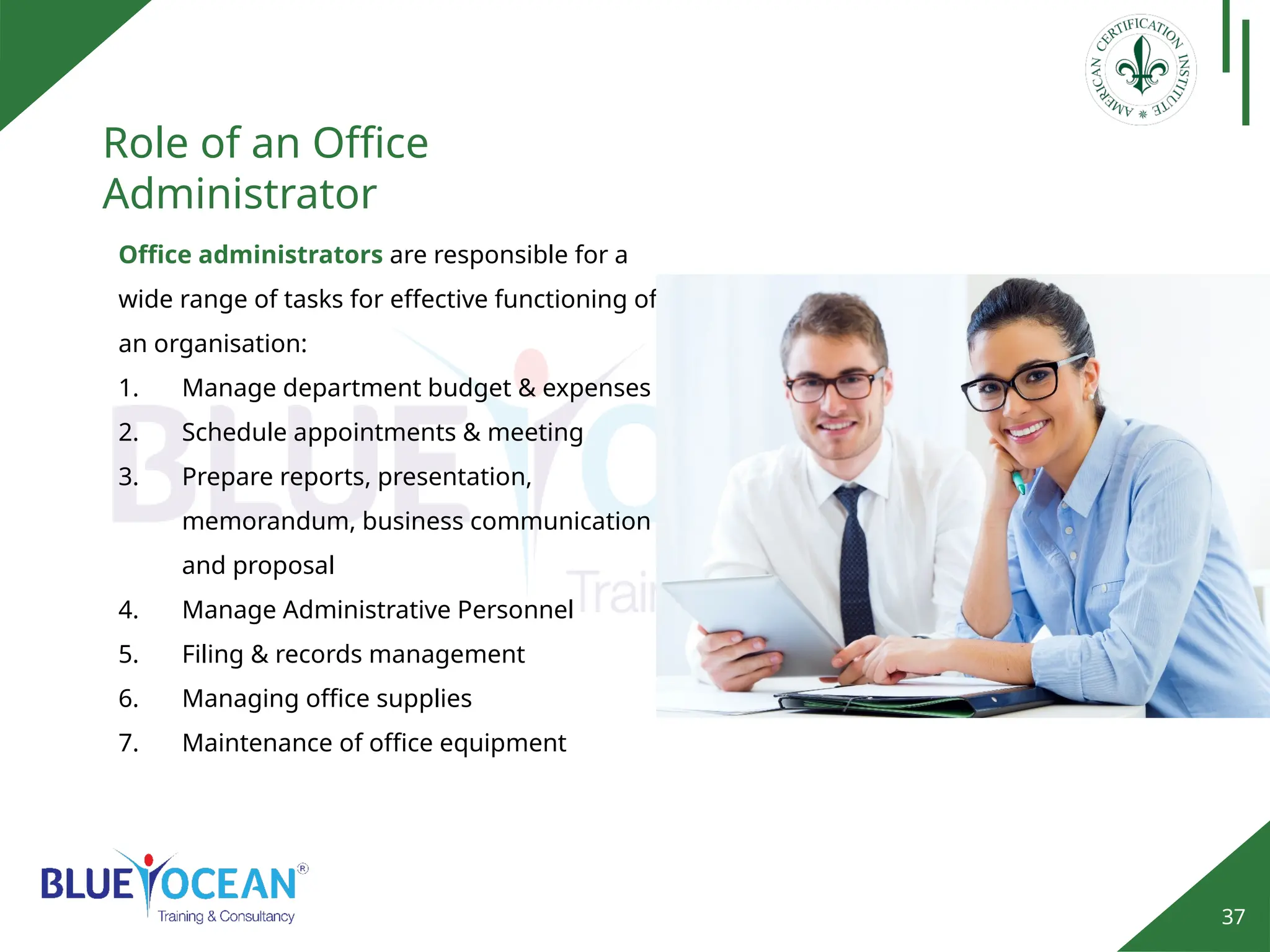
  • 248.
    248 Professional Grooming 1. Professionalsmile with well pressed clothing 2. Well groomed hair style 3. Natural makeup 4. Minimal jewellery 5. Polished & clean footwear
  • 249.
    249 Professional Grooming Personal Hygiene PersonalHygiene is the first step to good grooming; it enhances an individual’s physical and emotional wellbeing.  Showering. One should need to shower daily to keep a fresh-looking appearance.  Use of good perfumes, scents and deodorants is must for a professional get up. It makes you more adorable when someone passes by you.  There are certain lifestyle changes to make if you have a constant problem with body odour. Occasional problems can be treated if you know the cause.
  • 250.
    250 Professional Grooming  Youroral hygiene always matters, if you have oral odor problems then try to get rid of it as soon as possible, because bad odor creates a very embarrassing situation sometimes.  The beard on the face should always be well trimmed and tidy in looks, should suit the office culture.  The first step to getting a hairstyle is finding out which style is right for your face shape and professionally acceptable in the office culture.
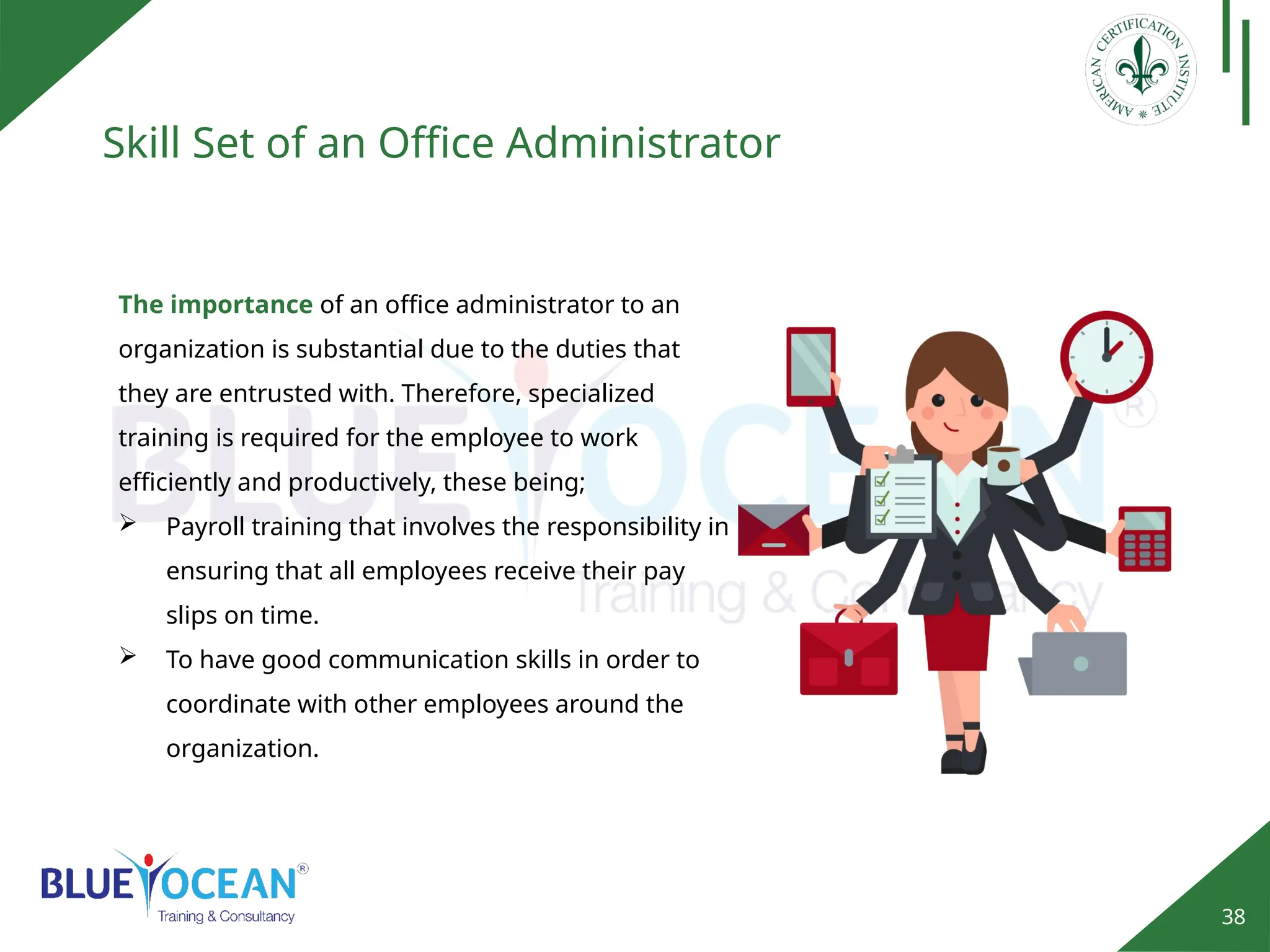
  • 251.
    251 Resume Writing Why doI need a Professional Resume? An unprofessional resume is difficult to read, confusing, covered in errors, or unrelated to the job the person is applying for. Such resumes will get tossed in the trash right away. An unprofessional resume makes the job seeker look unprofessional and will cost them a possible job. So “WRITE A RESUME THAT GENERATES RESULTS” What is the purpose of your resume? A resume is a document used by job seekers to help provide a summary of their skills, abilities and accomplishments. Its purpose is to pass the employer’s screening process and win an interview opportunity for the job seeker.


  • 252.
    252 Resume Writing How toWrite a Resume Choose a resume type that suits your profile. Taking the time to choose the best type of resume is well worth the effort. There are several types of resumes such as  Chronological,  Functional,  Combination  Targeted Review resume examples - Read through sample resumes that will provide you with examples of resume formats which work for almost every type of job seeker. They also help you see what kind of information to include.
  • 253.
    253 Resume Writing Use aresume template – template serves as a guide that provides framework for the resume as well as saves time. Choose the right font and size - that is legible and leaves enough white space on the page. When you use a particular style, use it consistently. Use resume keywords - In order to get found, your resume needs to contain keywords that directly target the jobs you are interested in. This will also help the hiring manager see how your skills and experiences make you an ideal candidate for the specific job. Proofread your resume - Be sure to thoroughly check your resume before sending it. Check for grammar and spelling errors, as well as any inconsistencies.
  • 254.
    254 Handling Interview with Confidence Aimto connect with interviewers, not impress them Your energy should be focused on building a rapport with your interviewer rather than impressing him or her. Use breathing techniques to boost confidence At the heart of confidence is feeling relaxed, so breathing and mindfulness exercises are helpful, focus on your breathing just before an interview that helps to calm nerves. Imagine yourself succeeding Picturing yourself being successful at an upcoming job interview will give a boost to your confidence and self-esteem.
  • 255.
    255 Handling Interview with Confidence Prepareand rehearse answers out loud If you go into an interview with prepared answers for most questions such as your experience, qualifications, reasons for leaving the current job etc, with preparation, one’s confidence is built, and it takes the pressure off. Exercise & Dress Staying fit and dressing appropriately for interviews are helpful practices. Focus on the Positives We tend to focus our energies on the negative things that happen to us. To overcome negative experiences in life, focus on positive ones. Most people can count only a few really bad experiences in life, while positive ones are abundant.
  • 256.
    256 What is Stress? Stressis your body's way of responding to any kind of demand. It can be caused by both good and bad experiences. Researchers define stress as a physical, mental, or emotional response to events that causes bodily or mental tension. In simple terms, stress is any outside force or event that has an effect on our body or mind. Stress is a part of everyday life and it affects everyone. There are many different kinds of stress and not all of them are bad.
  • 257.
    257 What is Stress? Whenpeople feel stressed, their bodies respond by releasing chemicals and hormones into the blood to face the challenge. Their heart rate increases, brain works faster, and they get a sudden burst of energy. This response is basic and natural. But too much of stress can have harmful effects if there is no outlet for this extra energy and strength. Stress is meant to be temporary; body should return to its natural state after the situation has passed. Heart rate should slow down, muscles should relax, and breathing should return to normal. Problems start when it doesn’t.
  • 258.
    258 Stress Symptoms 1. Moody& Irritability 2. Heavy pounding of heart 3. Dryness of throat and mouth 4. Impulsive erratic behaviour 5. Inability to concentrate or sleep 6. Urge to emotional breakdown (cry or hide) 7. Nervous laughter 8. Increased smoking or drinking 9. Overeating or avoiding food Which leads to health issues such as – 10. Headaches, fatigue, back pain and other aches
  • 259.
    259 Type of Stress Motivates,focuses energy. Is short-term. Is perceived as within our coping abilities. Feels exciting. Improves performance. Eustress or positive stress, has the following characteristics: In contrast, Distress or negative stress, has the following characteristics: Causes anxiety or concern. Can be short- or long-term. Is perceived as outside of our coping abilities. Feels unpleasant. Decreases performance. Can lead to mental and physical problems.
  • 260.
    260 What causes stressat work? 1. Being unhappy in your job; low salaries 2. Excessive work loads; Long working hours 3. Having poor management, conflicting demands 4. Conflicts with teammates and supervisors 5. Job insecurity 6. Lack of necessary training to do the job 7. Having to give speeches or making presentations in front of colleagues or clients 8. Facing discrimination or harassment at work, especially if your boss isn't supportive. 9. Commuting and travel schedule 10. Not having enough control over job related decisions
  • 261.
    261 Manage Stress Track yourstressors - Keep a journal for a week or two to identify which situations create the most stress and how you respond to them. Develop healthy responses - Instead of attempting to fight stress with fast food or alcohol, do your best to make healthy choices when you feel the tension rise. Exercise is a great stress-buster. Yoga can be an excellent choice, but any form of physical activity is beneficial. Also make time for hobbies and favorite activities. Establish boundaries - In today's digital world, it's easy to feel pressure to be available 24 hours a day. Establish some work-life boundaries for yourself.
  • 262.
    262 Manage Stress Learn howto relax - Techniques such as meditation, deep breathing exercises and mindfulness (a state in which you actively observe present experiences and thoughts without judging them) can help melt away stress. Start by taking a few minutes each day to focus on a simple activity like breathing, walking or enjoying a meal. Take time to recharge - To avoid the negative effects of chronic stress and burnout, we need time to replenish and return to our pre-stress level of functioning. This recovery process requires “switching off” from work by having periods of time when you are neither engaging in work-related activities, nor thinking about work.
  • 263.
    263 Manage Stress Get somesupport. Accepting help from trusted friends and family members can improve your ability to manage stress. Talk to your supervisor. Healthy employees are typically more productive, so your boss has an incentive to create a work environment that promotes employee well-being. Start by having an open conversation with your supervisor. The purpose of this isn't to lay out a list of complaints, but rather to come up with an effective plan for managing the stressors you've identified, so you can perform at your best on the job.
  • 264.
    264 Chair Yoga Chair yogais a gentle form of yoga that is practiced sitting on a chair or standing using a chair for support. Chair yoga is practiced to reduces stress and improve one’s physical and mental fitness. This gentle style of yoga can be done from a seated position that also incorporates the breathing and mind-body benefits of a traditional class. 1. It enhances one’s body system; Increases positive attitude 2. Prevents strain injuries due to prolonged sitting posture 3. Relieves chronic stress patterns in the body 4. Improves concentration and creativity 5. Muscles gets toned and strengthened 6. Increases lung capacity, improved breathing 7. Removes sluggishness and lethargy
  • 265.
  • 266.
  • 267.
  • 270.
    270 Office Management: The concept Officemanagement is the process of planning, organizing, staffing, directing and controlling the administrative functions of an office in order to achieve the objectives of the organization. It is the process of utilizing the office resources efficiently to obtain the best result with less effort and cost. It helps in receiving, recording and processing, supplying and retaining information. It is the branch of management which deals with performance of these functions
  • 271.
    271 Importance of Office Management 1.Achievement of goals 2. Increase office efficiency 3. Smooth flow of work 4. Public relations 5. Minimization of cost 6. Managing change 7. New challenges
  • 272.
  • 273.
    273 Office Automation Office automation(OA) refers to the collective hardware, software and processes that enable automation of the information processing and communication tasks in an organization. It involves using computers and software to digitize, store, process and communicate most routine tasks and processes in a standard office. In simple terms it is a collection of tools and methods to process written, visual and sound data in a computer-aided manner. It is intended to provide elements which make it possible to simplify, improve and automate the activities of a company or a group of people.
  • 274.
    274 Office Automation A comprehensiveoffice automation typically includes:  Computers for all employees and/or data processing personnel  Software that enables word processing, creating spreadsheets, managing accounts and more  Internet connectivity and email programs to send and receive email messages  Fax and printing services  Instant communication such as VoIP and more.
  • 275.
    275 Office Automation Factors tobe considered while selecting office machines and furniture are listed below: Need of the Machine Purchase and operating costs Durability Easy to operate and flexible Quality and speed
  • 276.
    276 Record Management A recordkeepingis a system which captures, manages and provides access to organisational records throughout Managers and Heads of business units are required to establish and set up appropriate recordkeeping systems for their business unit to facilitate the collation and registration of business records. It can be either electronic or paper-based. the life cycle of the organisation in order to meet business needs, statutory and fiscal requirements of business.
  • 277.
    277 Record Management Systematic managementof records allows organisations to: 1. know what records they have and locate them easily 2. increase efficiency and effectiveness 3. make savings in administration costs, both in staff time and storage 4. support decision making; be accountable 5. achieve business objectives and targets 6. provide continuity in the event of a disaster 7. meet legislative and regulatory requirements 8. protect the interests of employees, clients and stakeholders
  • 278.
    278 Record Management Five easysteps in creating a simple record keeping system; CAPTURE the information Capturing data is the most difficult and the most important part of the process; it’s a matter of forming the habit of collecting information. CHECK to make sure the information captured is complete and accurate RECORD the information Recording means putting the information into useable form. After everything is checked, recording takes place. Consolidate and REVIEW the information. ACT, based on is captured, checked and recorded.
  • 279.
    279 File Management A filingsystem is the central record-keeping system for an organisation. It helps to be organised, systematic, efficient and transparent as well as easy access to records. There are two types of file management - electronic and manual. Storing files digitally through computer, CD-roms etc refers to Electronic filing and Manual is the traditional method of keeping hard-copy documents in cabinets and safes. Electronic filing has evolved and enabled better management, access and retrieval of documents. It enables users to sort files by type, size, name, color and date that they were created or modified. It saves time and maximizes productivity.
  • 280.
    280 Electronic Record Keeping Mostbusinesses use electronic record keeping system as it easier to capture information, generate reports and manage records.  Helps to record business transactions, income and expenses, payments to workers, stock & asset details & requires less space.  Easy to generate orders, recording sales, invoices, debtor reports, financial statements, employee pay records, inventory reports. Allows you to back up records and keep them in a safe place in case of fire or theft. There are many other advantages to using electronic record keeping;
  • 281.
    281 Electronic Record Keeping Electronicbackup  Set up a secure electronic backup system to ensure records are safely stored and regularly backed up.  Daily backups are recommended, particularly for important records.  Make sure the backup copies are stored in a separate location to your business in case of fire, theft or a natural disaster.  For small businesses, the cheapest backup options are CDs and memory sticks. If your business has large amounts of data, external hard drives are a popular backup option.
  • 282.
    282 Cloud Backup Cloud computingprovides a way for business to manage its computing resources and records online. The term has evolved over recent years and can be used to describe the use of a third party for storing and computing needs of each business. Cloud backup services are becoming more popular and can be automated for each business needs, one has to be cautious on how the privacy and security of the data is stored.
  • 283.
    283 Manual Record Keeping Manualrecord keeping is a paper-based record keeping system. There are certain advantages to using manual record keeping;  Less expensive to set up.  Correcting entries may be easier with manual systems.  The risk of corrupted data is much less.  Data loss is less of a risk, particularly if records are stored in a fire-proof environment.  Problems with duplicate copies of the same records are generally avoided.
  • 284.
  • 285.
    285 Types of Filing Flat Filing SlideBar Stick Files Arch Filing Pocket Folders Cabinet Filing
  • 286.
    286 Types of Filing Guidecard Filing Suspension Filing Lateral Filing
  • 287.
    287 Tips for EffectiveFile Management Avoid saving unnecessary documents  Having too many unnecessary documents adds to clutter and makes it harder in the future. Follow a consistent method for naming files and folders  Follow a pattern for naming files & folders based on the activity Store related documents together  Store reports, presentations, notes, spread sheets related to a particular project in a single folder rather than storing them separate Separate ongoing work from completed work  Keeping current and completed work separate avoid confusion
  • 288.
    288 Tips for EffectiveFile Management Avoid over filing folders  If you have large number of files in one folder, break them into smaller groups Make digital copies of paper documents with a scanner  If you don’t have much space to store paper documents or archive documents without destroying them completely. Spending precious time looking for documents leads to uninvited stress. Simple good file management habits can hugely simplify your working life!
  • 289.
    289 Filing Methods Alphabetical Filing documentsalphabetically is a simple and time-proven system. The name of each file folder corresponds to the name of each document. A key drawback of an alphabetical system is that it is often necessary to have an index to keep track of a large number of documents. Numerical Businesses that mainly generate numbered documents, such as invoices, often create a numerical filing system that stores files using the assigned document numbers. With this file system, a crucial element is labeling each file cabinet drawer with the sequence of numbers it contains. This system might also require an index for quick access.
  • 290.
    290 Filing Methods Geographic Geographic filingsystems operate generally by county or country and then alphabetically or numerically by account name or number. Reasons for this type of filing is countries have differing laws and licenses, a commercial enterprise may have to consider these constraints as of primary importance. Subject-wise This is the arranging of material by given subject. It is filing by descriptive feature instead of by name or number. Such filing involves choosing a word or phrase to stand for each subject or to point out one phase of it.
  • 291.
    291 Filing Methods Date Filing documentsby date accessing information generated at a specific time. Yearly file sections are the foundation of a date-based filing system, and each month of the year is a subsection of this system. With this method, businesses commonly keep the freshest files in the front of both the yearly section and the monthly sections. Combinations When using alphabetical, chronological or subject-wise filing system chances of retrieving documents could be challenging at times. To achieve the desired efficiency, businesses often combine elements of two or more filing systems.
  • 292.
    292 File Management Space A filedrawer or shelf should be filled to no more than 90% of its capacity. Tightly packed files slow filing and finding to a crawl. Index Guide Folder Tabs Folder tabs should be visible immediately upon opening the file. A well-run file must have folders of uniform size and tab styles. Mixing folder heights and tab positions can reduce the efficiency of a filing system. All active files should have a guide every 10 to 15 folders. Anything less means you are wasting time pushing and pulling folders back and forth, looking for the required record.
  • 293.
    293 File Management Folder TabIdentification Identification on the tabs should be typewritten. Handwritten labels or labels with the names crossed out and re-typed should never be permitted. Cross Indexing Make a reference in one file of related or helpful/additional data held in another file. File Overload Don't overload your files to hold more than its capacity. If more files are placed in a folder than it can hold, the tab will slump down and out of sight.
  • 294.
    294 File Management Noting FilesIn Use A file borrowed without a record of who has it, when it was removed from the filing system etc, is a file lost! Make sure you have a 'file in use' set of slips to be filled out showing the user, date out, date due back etc. Maintaining Security Some files will certainly contain highly confidential data; make sure you control who may access what and keep a secure system for sensitive files.
  • 295.
    295 Office Inventory Management Thekey to managing any inventory, is attention. If you pay attention to what you have, how much you use and how often you need more, you can create an office inventory method that works for you and saves you money. Office supplies cost money. Spending too much on office stationery items that’s needed for office such as inks, toners, pens, paper, pencil, eraser, tape, etc is a waste of money that could be spent for more productive activities.
  • 296.
    296 Tips - InventoryManagement Limit Access Open supply rooms may be a convenient option, allowing employees to retrieve supplies as they need but it’s an inefficient method when trying to keep the storeroom under control. The first issue is tracking, those managing the supplies lose the ability to know what is on hand at any given time. So Limit the access to the supply closet. Have a Written Procedure Having a written procedure for inventory management can make a big difference in controlling supply stream. Everyone gets to know who is responsible for tracking office inventory and whom to contact when they need them. It specifies how the inventory gets tracked. Everyone is aware of the details of how the office supplies are managed.
  • 297.
    297 Tips - InventoryManagement Tracking means keeping a log or account of what is purchased, how quickly it gets used and how often it is ordered. There are several ways to track the inventory, one can do it manually or through a tracking software. Tracking Grouping A method to help tracking is grouping like items together. It is the best system for organizing storage space. This will help eliminate extra time spent looking for the right item. It will also make stocking easier and more accurate.
  • 298.
    298 Tips - InventoryManagement Setting Reorder Point A reorder point for office supplies is the same as it is for maintenance supplies, production supplies and product stock it is the level of inventory that triggers you to order more. Determine the reorder − level for each item by assessing how quickly your company consumes the product and how quickly the product can be replaced. When deciding your reorder point, you should take into consideration how much you use of an item and how quickly. You should also account for delivery time and possible delays.
  • 299.
  • 300.
    300 Basic financial accounting Financialaccounting is the process of recording, summarizing and reporting the myriad of transactions resulting from business operations over a period of time. These transactions are summarized in the preparation of financial statements, including the balance sheet, income statement and cash flow statement, that encapsulate the company's operating performance over a specified period. An office/business administrator is responsible for managing the organization. Accounting activities help administrators make important decisions regarding the operation of the business.
  • 301.
    301 How to makea Petty Cash Account
  • 302.
    302 The Petty CashProcedure 1. Keeping records of all the payments made and amounts received 2. Regularly checking the petty cash book is balanced (when the money in the fund is low, they have to request that cash be withdrawn from the bank in order to replenish the money that has been paid out.) 3. It’s also vital to ensure that you have a sturdy and lockable petty cash box where you keep all the money safe. You should keep this cash box in a safe place (e.g. a safe or drawer that can be locked). For example, a business might decide that £50 is enough money to have in the petty cash fund over a particular period
  • 303.
    303 Basic Accounting An Invoiceis a commercial document issued by a seller to a buyer indicating the products ,quantities and monetary terms. ... The invoice project consists of two functional elements: an enhanced searchable database for customer, products, billing generation system and an inventory system. What is an Invoice
  • 304.
    304 Invoice GRAND OFFICE EQUIPMENT P.O.Box 532 Sharjah U. A. E. Tele: 06 564 78 91 Fax: 06 564 78 92 INVOICE To: AMRICO P.O. Box 2546 Abu Dhabi Date: 12th May 2013 Invoice No: INV12/13 P.O. No: ORD/789/13 Terms: 30 days Item description Catalogue no. Qty Unit Price(AED) Total Price Office Chairs (blue) 45 25 160.0 0 4,000.00 Executive Table 56 10 300.0 0 3,000.00 Venetian Blinds 69 25 50.00 1,250.00 Cupboards Grey 10 25 200.00 5,000.00 Total 13,250.00 Less 12% trade discount 1,590.00 Amount due 11,660.00 _____________________ ______________________ Customer’s signature Accounts department
  • 305.
  • 306.
    306 Events Management Event planningis about thousands of small processes running smoothly to enable the event to be efficient. To manage the key aspects of an event like registration, budgeting, and agenda planning, one should control the administrative processes. In the context of event planning, administrative processes relate to the development and tracking of event information.
  • 307.
    307 Events Management The fiveCs of Event Management: 1) Conceptualizing 2) Costing 3) Canvassing 4) Customizing 5) Carrying out ,Culmination and Control
  • 308.
    308 Events Management Customers goto an event to get an enjoyable experience. Timely and orderly completion of the event brings excellence in the minds of the audience.
  • 309.
    309 Travel Management There’s alot that goes into planning business travel. If your job requires you to be on the road often, managing all your trips can seem like a second job in itself. Many companies choose to take this work off employees’ plates by having administrative assistants handle travel booking. Though technology has made business travellers increasingly comfortable managing their trips, a significant portion still work with an admin (a catch-all term for administrative assistants, executive assistants, office managers, or any other employees who arrange business trips on behalf of colleagues).
  • 310.
    310 Travel Management Employees outsidethe C-suite also work with admins. Having someone else arrange business trips for you is undoubtedly a nice perk, but there are reasons beyond convenience why a company might have a team of admins to help with travel. An experienced travel booker can ensure that: 1. Trips comply with company policy. 2. Expenses are submitted properly. 3. Alternate arrangements can be made in the event of a travel disruption.
  • 311.
    311 Travel Management Making travelarrangements for your executive and keeping him or her as productive and stress-free as possible on the road requires planning. There are a lot of details to figure out, reservations to make, and schedules to coordinate. Best thing you can do is be as organized as possible and be ready to solve travel problems in the moment. Following best practices will help make the travel planning process before, during and after a trip as simple and stress-free as possible.
  • 312.
    312 Travel Management  Developtravel planning template and checklist  Travel profile form  Traveler planning intake checklist  Travel itinerary template  Develop a relationship with travel agency  Prepare your executive before and after the trip  Technology is your friend Points to remember :
  • 313.
    313 Travel Management Points toremember : Develop travel planning template and checklist:  Travel profile form  Traveler planning intake checklist  Travel itinerary template
  • 314.
    314 Travel Management Points toremember :  Develop a relationship with travel agency  Prepare your executive before and after the trip  Technology is your friend
  • 317.
    317 Human Resource Organizations aremade up through people. Without people organizations cannot exist. Other resources depreciate with time. Man is the most valuable resource which appreciates with time is a right environment is given to him and hence termed “Human Resource”. Human Resource consists of those groups of people who are ready to provide their service for the benefit of the organization. According to Michael J. Jucius, “Human resource are a whole consisting of inter-related, inter-dependent, and interacting physiological, psychological, sociological and ethical components.
  • 318.
    318 Human Resource Management HumanResource Management, the task concerned with managing the people resources, is the most crucial and challenging task of the organization. It was previously referred to as personnel management. It can be defined as acquiring the right talent, training and developing them and motivating them to sustain in the workforce to effectively attain objectives of the organization. According to Byars and Rue “ HRM encompasses those activities that are designed to provide for and coordinate the human resources of an organisation .
  • 319.
    319 Nature of HRM Natureof HRM is explained as follows :  Universal in Nature  Action – Oriented  Focused on People Dimension  Growth-Oriented  Cordial Integration  Challenging Function  Supplementary Service  Multi-Disciplinary Function  Ongoing Process
  • 320.
    320 Scope of HRM HRMhas a very wide application. HRM encompasses all the areas during the service of an employee from the time he enters, until he quits .Scope of HRM includes the following areas: 1. Procurement 2. Training and Development 3. Job Analysis and Job Description 4. Compensation/Rewards 5. Employee Records 6. Welfare 7. Industrial Relations
  • 321.
    321 Objectives of HRM Objectivesof HRM are : 1. To assist in securing the goals set by the organization. 2. To help the employees in securing the personal goals for individual growth. 3. To make maximum utilization of employee’s Potential. 4. To procure efficient employees within the organization . 5. To enhance job satisfaction 6. To improve quality of work life
  • 322.
    322 Objectives of HRM Objectivesof HRM are : 1. To update the Employees regarding Managerial Policies 2. To fulfill social responsibility 3. To maintain discipline among employees 4. To increase organizational productivity 5. To Focus on Quality Performance 6. To Develop Harmony in the work culture 7. To create respectful environment
  • 323.
    323 Objectives of HRM Importanceof HRM at different levels : 1. At corporate level 2. At professional level 3. At social Level 4. At national Level
  • 324.
    324 Functions of HRM MANAGERIALFUNCTION: A manager’s first and foremost job is to manage people. All the managers regardless of their departments carry out managerial functions . 1. Planning 2. Organizing 3. Directing 4. Coordinating 5. Controlling
  • 325.
    325 Functions of HRM OPERATIONALFUNCTIONS: Operational functions are the special activities which human resource people have to perform for each and every department of the organization. These are the regular functions of the human resource department. It focuses on all activities which are included in the employment function. These functions are: 1) Employment 2) Human Resource Development 3) Compensation 4) Human Relations
  • 326.
    326 Organization of HR Department Figure: 1 HRM in a Small–Scale Unit Owner/ Manager Product Manager Office Manage r Sales Manager Accountan t Personal Assistant There is no individual HR Department in small-scale units to organize personnel activities. Indeed there may be no personnel manager. Certain jobs may be outsourced while a lower ranked employee may be given duty of executing these programs. HR Department functions with managers for performing various duties. Size of unit determines the position of HR Department within the organizational structure.
  • 327.
    327 Organization of HR Department Figure: 2 HRM in a Large–Scale Unit Chairman/MD Director Productio n Director Personnel/ HRM Director Finance Director Marketin g Personal Assistant Director R & D In a large-Scale industry , the human resource department is headed by Chairman/Managing Director. The organization having a single unit will be benefited by this structure. But a centralized HR Department is needed in case of an organization having number of production units situated in various regions of the nation. The Hr department is responsible for the day-to- day tasks while the central department is responsible for handing extensive policies and administrative matters.
  • 328.
    328 Roles of HRManager Several Roles are fulfilled by HR Manager. The nature and extent of these roles depend on what top management and staffs want from the HR Manager. Three roles are typically identified for HR Manager: Roles of HR Manager Administrative Roles i) Policy-Maker ii) Administrative Expert iii) Advisor iv) Housekeeper v) Counsellor vii) Legal Advisor Operational Roles i) Recruiter ii) Trainer and Motivator iii) Liaison Officer/Linking pin iv) Mediator v) Employee Champion Strategic Rules i) Strategic Partner ii) Change Champion
  • 329.
    329 Roles of HRManager ADMINISTRATIVE ROLES: i) Policy-Maker: HR Manager acts as a policy-maker in an organization. He assists the top management in designing the policies for hiring and retaining talent, welfare activities, personnel records, wage and salary administration, work conditions etc. ii) Administrative Expert: To meet the variable needs of the stakeholders, the HR Manager performs several administrative functions such as managing employee records, HR related, database, handling employee benefit claims, responding to questions concerning leaves, medical and transport facilities etc.
  • 330.
    330 Roles of HRManager ADMINISTRATIVE ROLES: iii) Advisor: HR Manager as an advisor advises, suggests, counsels and provides assistance to the line managers in order to enable them to perform their tasks. For example: Resolving grievances, dispute settlement and hiring and training of employees. iv) Housekeeper: As a housekeeper, HR Manager aids the organization in managing various activities such as recruitment, prior-employment testing, background verification, wage and salary administration, employee benefits and pension administration, programs for employees well being, record maintenance etc.
  • 331.
    331 Roles of HRManager ADMINISTRATIVE ROLES: v) Counselor: As a counselor, it is the duty of an HR Manger to share the employee’s problems pertaining to their job, superiors, peers, family well being, economic, social status etc. iv) Welfare Officer: It is the responsibility of the HR Manager to take care of all the welfare activities being carried-out in an organization. HR Manager being a Welfare Officer offers various facilities such as cafeteria, health care institution, academic institutions, clubs, libraries, consumer stores etc. v) Legal advisor: As a legal advisor, an HR Manager helps in redressing grievances, dispute settlement, handling disciplinary issues, facilitating
  • 332.
    332 Roles of HRManager ADMINISTRATIVE ROLES: collective bargaining, facilitating a platform for joint consultation, interpreting and implementing, the labour laws, making contact with the Lawyers for lawsuits, filing and handling cases in various courts etc. 2) Operational Roles: By nature these roles are tactical and include the following: i) Recruiter: In present scenario, it has become a global war of talent. It is important for an HR manager to look for the talent considering the increased level competition for individual having the required set of qualifications, skills and work experience. HR managers are required to apply all their experience for a good cause at the time of planning the
  • 333.
    333 Roles of HRManager ADMINISTRATIVE ROLES: Rewards for the new employees, keeping the monetary burden of the organization low. ii) Trainer and Motivator: HR manager needs to identify employees who require training and development at regular intervals, arrange proper training and development programs for them and providing them valuable intrinsic as well as extrinsic rewards. iii) Liaison Officer: HR manager acts as a liaison officer in an organization, who works as a bridge between different departments within and outside the organization.This role includes building and maintaining a good relationship within and outside the organization
  • 334.
    334 Roles of HRManager iv) Mediator: At the time of conflict and grievances, the organization always needs a mediator to resolve problems and conflicts between employees and management. v) Employee Champion: Occasionally, HR Managers are supposed to be the ‘Employee Advocates’. To discover the area of interest of employees, an HR Manager needs to look into their hearts. STRATEGIC ROLES: As per the changing conditions, roles of HR Manager are also changing. HR Managers are now coming out of their comfort zone and act like a ‘Change Champion’. These include:
  • 335.
    335 Roles of HRManager i)Strategic Partner: Acting as strategic partner, HR Manager ensures the reliability and capability of employees contributing towards the organizational goals. ii) Change Champion: HR manager as a change champion persuades the organization about the incorporation and sustenance of isolated and independent organizational actions through systematic change process. Organizational objectives can only be accomplished through the talented people. Therefore, in order to remain competitive in the dynamic environment, the HR has to constantly assist and train their workers to maintain utmost efficiency and ensure best work ethics are followed and hence making a move to a better working environment.
  • 336.
    336 Roles of HRManager Human Resource always remains central to the organization. As dynamic and effective people can construct dynamic enterprises, only Efficient workers are capable and have inspiration of turning dreams to reality. Organizational objectives can only be accomplished through the talented people. Therefore, in order to remain competitive in the dynamic environment, it should be constant endeavor of organization to energize, assist and train their workers to maintain utmost efficiency
  • 337.
    Write A GoogleReview Visit the below URL (Make sure you are logged into your Google account). https://g.page/BlueOceanAcademy/review Rate the business from 1 to 5 stars (the greater numbers indicate a positive experience), Write about your experience, and click “POST” when you’re done. Or 1. Log into your Google account, and search for Blue Ocean Academy in Google. 2. Find the reviews area (next to the star rating in your search results, or under Blue Ocean Academy’s name in the sidebar in Google search) and click on the blue box that says “WRITE A REVIEW.” 3. Rate the business from 1 to 5 stars (the greater numbers indicate a positive experience), Write about your experience, and click “POST” when you’re done. That’s it !!