NVIDIA GPU Technology
Siggraph Asia 2010


                                                                    NVIDIA GPU Technology
                                                                    Siggraph Asia 2010


                        Introduction to CUDA C
                        Samuel Gateau | Seoul | December 16, 2010
NVIDIA GPU Technology
Siggraph Asia 2010
                        Who should you thank for this talk?
                          Jason Sanders


                          Senior Software Engineer, NVIDIA


                          Co-author of CUDA by Example
NVIDIA GPU Technology
Siggraph Asia 2010
                        What is CUDA?
                           CUDA Architecture
                             — Expose general-purpose GPU computing as first-class capability
                             — Retain traditional DirectX/OpenGL graphics performance


                           CUDA C
                             — Based on industry-standard C
                             — A handful of language extensions to allow heterogeneous programs
                             — Straightforward APIs to manage devices, memory, etc.


                           This talk will introduce you to CUDA C
NVIDIA GPU Technology

                        Introduction to CUDA C
Siggraph Asia 2010


                           What will you learn today?
                             — Start from ―Hello, World!‖
                             — Write and launch CUDA C kernels
                             — Manage GPU memory
                             — Run parallel kernels in CUDA C
                             — Parallel communication and synchronization
                             — Race conditions and atomic operations
NVIDIA GPU Technology

                        CUDA C Prerequisites
Siggraph Asia 2010


                           You (probably) need experience with C or C++


                           You do not need any GPU experience


                           You do not need any graphics experience


                           You do not need any parallel programming experience
NVIDIA GPU Technology

                        CUDA C: The Basics
Siggraph Asia 2010


                          Terminology
                            Host – The CPU and its memory (host memory)
                            Device – The GPU and its memory (device memory)
                                     Host                               Device


                                            Note: Figure Not to Scale
NVIDIA GPU Technology

                        Hello, World!
Siggraph Asia 2010


                              int main( void ) {
                                  printf( "Hello, World!n" );
                                  return 0;
                              }

                          This basic program is just standard C that runs on the host

                          NVIDIA’s compiler (nvcc) will not complain about CUDA programs
                           with no device code

                          At its simplest, CUDA C is just C!
NVIDIA GPU Technology

                        Hello, World! with Device Code
Siggraph Asia 2010

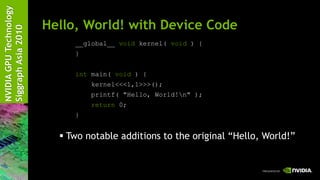
                             __global__ void kernel( void ) {
                             }


                             int main( void ) {
                                 kernel<<<1,1>>>();
                                 printf( "Hello, World!n" );
                                 return 0;
                             }


                           Two notable additions to the original ―Hello, World!‖
NVIDIA GPU Technology

                        Hello, World! with Device Code
Siggraph Asia 2010

                               __global__ void kernel( void ) {
                               }


                            CUDA C keyword __global__ indicates that a function
                              — Runs on the device
                              — Called from host code


                            nvcc splits source file into host and device components
                              — NVIDIA’s compiler handles device functions like kernel()
                              — Standard host compiler handles host functions like main()
                                   gcc
                                   Microsoft Visual C
NVIDIA GPU Technology

                        Hello, World! with Device Code
Siggraph Asia 2010

                              int main( void ) {
                                   kernel<<< 1, 1 >>>();
                                   printf( "Hello, World!n" );
                                   return 0;
                              }


                           Triple angle brackets mark a call from host code to device code
                              — Sometimes called a ―kernel launch‖
                              — We’ll discuss the parameters inside the angle brackets later


                           This is all that’s required to execute a function on the GPU!

                           The function kernel() does nothing, so this is fairly anticlimactic…
NVIDIA GPU Technology
                        A More Complex Example
Siggraph Asia 2010


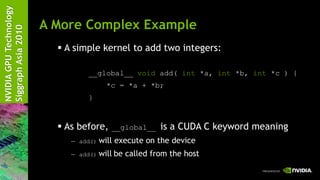
                           A simple kernel to add two integers:

                                 __global__ void add( int *a, int *b, int *c ) {
                                         *c = *a + *b;
                                 }


                           As before,    __global__    is a CUDA C keyword meaning
                             — add()   will execute on the device
                             — add()   will be called from the host
NVIDIA GPU Technology
                        A More Complex Example
Siggraph Asia 2010


                           Notice that we use pointers for our variables:

                                 __global__ void add( int *a, int *b, int *c ) {
                                     *c = *a + *b;
                                 }

                           add() runs on the device…so a, b, and c must point to
                            device memory


                           How do we allocate memory on the GPU?
NVIDIA GPU Technology
Siggraph Asia 2010
                        Memory Management
                          Host and device memory are distinct entities
                            — Device pointers point to GPU memory
                                May be passed to and from host code
                                May not be dereferenced from host code

                            — Host pointers point to CPU memory
                                May be passed to and from device code
                                May not be dereferenced from device code


                          Basic CUDA API for dealing with device memory
                            — cudaMalloc(), cudaFree(), cudaMemcpy()
                            — Similar to their C equivalents, malloc(), free(), memcpy()
NVIDIA GPU Technology
Siggraph Asia 2010      A More Complex Example: add()

                           Using our add()kernel:

                               __global__ void add( int *a, int *b, int *c ) {
                                  *c = *a + *b;
                               }


                           Let’s take a look at main()…
NVIDIA GPU Technology
Siggraph Asia 2010      A More Complex Example: main()
                          int main( void ) {
                             int a, b, c;                   // host copies of a, b, c
                             int *dev_a, *dev_b, *dev_c;    // device copies of a, b, c
                             int size = sizeof( int );      // we need space for an integer


                             // allocate device copies of a, b, c
                             cudaMalloc( (void**)&dev_a, size );
                             cudaMalloc( (void**)&dev_b, size );
                             cudaMalloc( (void**)&dev_c, size );


                             a = 2;
                             b = 7;
NVIDIA GPU Technology
Siggraph Asia 2010      A More Complex Example: main() (cont)
                               // copy inputs to device
                               cudaMemcpy( dev_a, &a, size, cudaMemcpyHostToDevice );
                               cudaMemcpy( dev_b, &b, size, cudaMemcpyHostToDevice );


                               // launch add() kernel on GPU, passing parameters
                               add<<< 1, 1 >>>( dev_a, dev_b, dev_c );


                               // copy device result back to host copy of c
                               cudaMemcpy( &c, dev_c, size, cudaMemcpyDeviceToHost );


                               cudaFree( dev_a );
                               cudaFree( dev_b );
                               cudaFree( dev_c );
                               return 0;
                           }
NVIDIA GPU Technology
Siggraph Asia 2010
                        Parallel Programming in CUDA C
                           But wait…GPU computing is about massive parallelism

                           So how do we run code in parallel on the device?

                           Solution lies in the parameters between the triple angle brackets:

                                       add<<< 1, 1 >>>( dev_a, dev_b, dev_c );


                                       add<<< N, 1 >>>( dev_a, dev_b, dev_c );


                           Instead of executing add() once, add() executed N times in parallel
NVIDIA GPU Technology
Siggraph Asia 2010
                        Parallel Programming in CUDA C
                           With add() running in parallel…let’s do vector addition

                           Terminology: Each parallel invocation of add() referred to as a block

                           Kernel can refer to its block’s index with the variable blockIdx.x

                           Each block adds a value from a[] and b[], storing the result in c[]:

                                __global__ void add( int *a, int *b, int *c ) {
                                    c[blockIdx.x] = a[blockIdx.x] + b[blockIdx.x];
                                }

                           By using blockIdx.x to index arrays, each block handles different indices
NVIDIA GPU Technology
Siggraph Asia 2010
                        Parallel Programming in CUDA C
                           We write this code:
                                 __global__ void add( int *a, int *b, int *c ) {
                                     c[blockIdx.x] = a[blockIdx.x] + b[blockIdx.x];
                                 }

                           This is what runs in parallel on the device:
                                   Block 0                     Block 1
                                   c[0] = a[0] + b[0];         c[1] = a[1] + b[1];

                                   Block 2                     Block 3
                                   c[2] = a[2] + b[2];         c[3] = a[3] + b[3];
NVIDIA GPU Technology
Siggraph Asia 2010      Parallel Addition: add()

                          Using our newly parallelized add()kernel:


                              __global__ void add( int *a, int *b, int *c ) {
                                 c[blockIdx.x] = a[blockIdx.x] + b[blockIdx.x];
                             }


                          Let’s take a look at main()…
NVIDIA GPU Technology
Siggraph Asia 2010      Parallel Addition: main()
                          #define N   512
                          int main( void ) {
                             int *a, *b, *c;                   // host copies of a, b, c
                             int *dev_a, *dev_b, *dev_c;       // device copies of a, b, c
                             int size = N * sizeof( int );     // we need space for 512 integers

                             // allocate device copies of a, b, c
                             cudaMalloc( (void**)&dev_a, size );
                             cudaMalloc( (void**)&dev_b, size );
                             cudaMalloc( (void**)&dev_c, size );

                             a = (int*)malloc( size );
                             b = (int*)malloc( size );
                             c = (int*)malloc( size );

                             random_ints( a, N );
                             random_ints( b, N );
NVIDIA GPU Technology
Siggraph Asia 2010      Parallel Addition: main() (cont)
                               // copy inputs to device
                               cudaMemcpy( dev_a, a, size, cudaMemcpyHostToDevice );
                               cudaMemcpy( dev_b, b, size, cudaMemcpyHostToDevice );


                               // launch add() kernel with N parallel blocks
                               add<<< N, 1 >>>( dev_a, dev_b, dev_c );


                               // copy device result back to host copy of c
                               cudaMemcpy( c, dev_c, size, cudaMemcpyDeviceToHost );


                               free( a ); free( b ); free( c );
                               cudaFree( dev_a );
                               cudaFree( dev_b );
                               cudaFree( dev_c );
                               return 0;
                           }
NVIDIA GPU Technology
Siggraph Asia 2010
                        Review
                          Difference between ―host‖ and ―device‖
                            — Host = CPU
                            — Device = GPU


                          Using __global__ to declare a function as device code
                            — Runs on device
                            — Called from host


                          Passing parameters from host code to a device function
NVIDIA GPU Technology
Siggraph Asia 2010
                        Review (cont)
                           Basic device memory management
                             — cudaMalloc()
                             — cudaMemcpy()
                             — cudaFree()


                           Launching parallel kernels
                             — Launch N copies of add() with: add<<< N, 1 >>>();
                             — Used blockIdx.x to access block’s index
NVIDIA GPU Technology
Siggraph Asia 2010
                        Threads
                          Terminology: A block can be split into parallel threads


                          Let’s change vector addition to use parallel threads instead of parallel blocks:

                             __global__ void add( int *a, int *b, int *c ) {
                                    c[ threadIdx.x ] = a[ threadIdx.x ] + b[ threadIdx.x ];
                                        blockIdx.x         blockIdx.x         blockIdx.x
                               }


                          We use threadIdx.x instead of blockIdx.x in add()


                          main() will require one change as well…
NVIDIA GPU Technology
Siggraph Asia 2010      Parallel Addition (Threads): main()
                           #define N   512
                           int main( void ) {
                               int *a, *b, *c;                        //host copies of a, b, c
                               int *dev_a, *dev_b, *dev_c;            //device copies of a, b, c
                               int size = N * sizeof( int );          //we need space for 512 integers


                               // allocate device copies of a, b, c
                               cudaMalloc( (void**)&dev_a, size );
                               cudaMalloc( (void**)&dev_b, size );
                               cudaMalloc( (void**)&dev_c, size );


                               a = (int*)malloc( size );
                               b = (int*)malloc( size );
                               c = (int*)malloc( size );


                               random_ints( a, N );
                               random_ints( b, N );
NVIDIA GPU Technology
Siggraph Asia 2010      Parallel Addition (Threads): main() (cont)
                              // copy inputs to device
                              cudaMemcpy( dev_a, a, size, cudaMemcpyHostToDevice );
                              cudaMemcpy( dev_b, b, size, cudaMemcpyHostToDevice );


                              // launch add() kernel with N threads
                                                            blocks
                              add<<< 1, N >>>( dev_a, dev_b, dev_c );
                                     N, 1


                              // copy device result back to host copy of c
                              cudaMemcpy( c, dev_c, size, cudaMemcpyDeviceToHost );


                              free( a ); free( b );   free( c );
                              cudaFree( dev_a );
                              cudaFree( dev_b );
                              cudaFree( dev_c );
                              return 0;
                          }
NVIDIA GPU Technology
Siggraph Asia 2010      Using Threads And Blocks
                          We’ve seen parallel vector addition using
                            — Many blocks with 1 thread apiece
                            — 1 block with many threads


                          Let’s adapt vector addition to use lots of both blocks and threads


                          After using threads and blocks together, we’ll talk about why threads


                          First let’s discuss data indexing…
NVIDIA GPU Technology
Siggraph Asia 2010
                        Indexing Arrays With Threads And Blocks
                          No longer as simple as just using threadIdx.x or blockIdx.x as indices


                          To index array with 1 thread per entry (using 8 threads/block)

                                 threadIdx.x     threadIdx.x      threadIdx.x      threadIdx.x
                              0 1 2 3 4 5 6 7 0 1 2 3 4 5 6 7 0 1 2 3 4 5 6 7 0 1 2 3 4 5 6 7

                               blockIdx.x = 0   blockIdx.x = 1   blockIdx.x = 2   blockIdx.x = 3


                          If we have M threads/block, a unique array index for each entry given by
                                     int index = threadIdx.x + blockIdx.x * M;

                                     int index =           x       +        y       * width;
NVIDIA GPU Technology
Siggraph Asia 2010
                        Indexing Arrays: Example
                           In this example, the red entry would have an index of 21:
                               0   1   2   3   4   5   6   7   8   9 10 11 12 13 14 15 16 17 18 19 20 21


                               M = 8 threads/block


                                                                                         blockIdx.x = 2

                                   int index = threadIdx.x + blockIdx.x * M;
                                                               =           5               +           2   * 8;
                                                               = 21;
NVIDIA GPU Technology
Siggraph Asia 2010
                        Addition with Threads and Blocks
                           The blockDim.x is a built-in variable for threads per block:
                               int index= threadIdx.x + blockIdx.x * blockDim.x;


                           A combined version of our vector addition kernel to use blocks and threads:
                               __global__ void add( int *a, int *b, int *c ) {
                                    int index = threadIdx.x + blockIdx.x * blockDim.x;
                                    c[index] = a[index] + b[index];
                               }


                           So what changes in main() when we use both blocks and threads?
NVIDIA GPU Technology
Siggraph Asia 2010      Parallel Addition (Blocks/Threads): main()
                           #define N   (2048*2048)
                           #define THREADS_PER_BLOCK 512
                           int main( void ) {
                               int *a, *b, *c;                        // host copies of a, b, c
                               int *dev_a, *dev_b, *dev_c;            // device copies of a, b, c
                               int size = N * sizeof( int );          // we need space for N integers


                               // allocate device copies of a, b, c
                               cudaMalloc( (void**)&dev_a, size );
                               cudaMalloc( (void**)&dev_b, size );
                               cudaMalloc( (void**)&dev_c, size );


                               a = (int*)malloc( size );
                               b = (int*)malloc( size );
                               c = (int*)malloc( size );


                               random_ints( a, N );
                               random_ints( b, N );
NVIDIA GPU Technology
Siggraph Asia 2010      Parallel Addition (Blocks/Threads): main()
                              // copy inputs to device
                              cudaMemcpy( dev_a, a, size, cudaMemcpyHostToDevice );
                              cudaMemcpy( dev_b, b, size, cudaMemcpyHostToDevice );


                              // launch add() kernel with blocks and threads
                              add<<< N/THREADS_PER_BLOCK, THREADS_PER_BLOCK >>>( dev_a, dev_b, dev_c );


                              // copy device result back to host copy of c
                              cudaMemcpy( c, dev_c, size, cudaMemcpyDeviceToHost );


                              free( a ); free( b ); free( c );
                              cudaFree( dev_a );
                              cudaFree( dev_b );
                              cudaFree( dev_c );
                              return 0;
                          }
NVIDIA GPU Technology
Siggraph Asia 2010
                        Why Bother With Threads?
                           Threads seem unnecessary
                             — Added a level of abstraction and complexity
                             — What did we gain?


                           Unlike parallel blocks, parallel threads have mechanisms to
                             — Communicate
                             — Synchronize


                           Let’s see how…
NVIDIA GPU Technology
Siggraph Asia 2010
                        Dot Product
                          Unlike vector addition, dot product is a reduction from vectors to a scalar

                                                a        b
                                                a0   *   b0
                                                                          c
                                                a1
                                                a2
                                                     *
                                                     *
                                                         b1
                                                         b2
                                                                    +
                                                a3   *   b3


                                                 c = a∙b
                                                 c = (a0, a1, a2, a3) ∙ (b0, b1, b2, b3)
                                                 c = a0 b0 + a1 b1 + a2 b2 + a3 b3
NVIDIA GPU Technology
Siggraph Asia 2010
                        Dot Product
                          Parallel threads have no problem computing the pairwise products:

                                                a        b
                                                a0   *   b0
                                                a1
                                                a2
                                                     *
                                                     *
                                                         b1
                                                         b2
                                                                   +
                                                a3   *   b3


                          So we can start a dot product CUDA kernel by doing just that:
                                  __global__ void dot( int *a, int *b, int *c )   {
                                      // Each thread computes a pairwise product
                                      int temp = a[threadIdx.x] * b[threadIdx.x];
NVIDIA GPU Technology
Siggraph Asia 2010
                        Dot Product
                          But we need to share data between threads to compute the final sum:

                                               a        b
                                               a0   *   b0
                                               a1
                                               a2
                                                    *
                                                    *
                                                        b1
                                                        b2
                                                                 +
                                               a3   *   b3


                               __global__ void dot( int *a, int *b, int *c )   {
                                   // Each thread computes a pairwise product
                                   int temp = a[threadIdx.x] * b[threadIdx.x];

                                    // Can’t compute the final sum
                                    // Each thread’s copy of ‘temp’ is private
                               }
NVIDIA GPU Technology
Siggraph Asia 2010
                        Sharing Data Between Threads
                         Terminology: A block of threads shares memory called…shared memory


                         Extremely fast, on-chip memory (user-managed cache)


                         Declared with the __shared__ CUDA keyword


                         Not visible to threads in other blocks running in parallel
                              Block 0               Block 1               Block 2
                                    Threads               Threads               Threads
                                                                                            …
                                Shared Memory         Shared Memory         Shared Memory
NVIDIA GPU Technology
Siggraph Asia 2010
                        Parallel Dot Product: dot()
                           We perform parallel multiplication, serial addition:

                           #define N 512
                           __global__ void dot( int *a, int *b, int *c ) {
                                 // Shared memory for results of multiplication
                                 __shared__ int temp[N];
                                 temp[threadIdx.x] = a[threadIdx.x] * b[threadIdx.x];

                                 // Thread 0 sums the pairwise products
                                 if( 0 == threadIdx.x ) {
                                     int sum = 0;
                                     for( int i = 0; i < N; i++ )
                                         sum += temp[i];
                                     *c = sum;
                                 }
                           }
NVIDIA GPU Technology
Siggraph Asia 2010
                        Parallel Dot Product Recap
                           We perform parallel, pairwise multiplications


                           Shared memory stores each thread’s result


                           We sum these pairwise products from a single thread


                           Sounds good…but we’ve made a huge mistake
NVIDIA GPU Technology
Siggraph Asia 2010
                        Faulty Dot Product Exposed!
                          Step 1: In parallel each thread writes a pairwise product
                                      parallel,


                                __shared__ int temp


                          Step 2: Thread 0 reads and sums the products
                                __shared__ int temp


                          But there’s an assumption hidden in Step 1…
NVIDIA GPU Technology
Siggraph Asia 2010
                        Read-Before-Write Hazard
                          Suppose thread 0 finishes its write in step 1


                          Then thread 0 reads index 12 in step 2


                                                                      This read returns garbage!
                          Before thread 12 writes to index 12 in step 1?
NVIDIA GPU Technology
Siggraph Asia 2010
                        Synchronization
                           We need threads to wait between the sections of dot():
                            __global__ void dot( int *a, int *b, int *c ) {
                                 __shared__ int temp[N];
                                 temp[threadIdx.x] = a[threadIdx.x] * b[threadIdx.x];

                                 // * NEED THREADS TO SYNCHRONIZE HERE *
                                 // No thread can advance until all threads
                                 // have reached this point in the code

                                 // Thread 0 sums the pairwise products
                                 if( 0 == threadIdx.x ) {
                                     int sum = 0;
                                     for( int i = 0; i < N; i++ )
                                         sum += temp[i];
                                     *c = sum;
                                 }
                            }
NVIDIA GPU Technology
Siggraph Asia 2010
                        __syncthreads()
                          We can synchronize threads with the function __syncthreads()


                          Threads in the block wait until all threads have hit the __syncthreads()
                                Thread 0                   __syncthreads()
                                Thread 1           __syncthreads()
                                Thread 2                 __syncthreads()
                                Thread 3                           __syncthreads()
                                Thread 4         __syncthreads()
                                  …


                          Threads are only synchronized within a block
NVIDIA GPU Technology
Siggraph Asia 2010      Parallel Dot Product: dot()
                          __global__ void dot( int *a, int *b, int *c ) {
                                __shared__ int temp[N];
                               temp[threadIdx.x] = a[threadIdx.x] * b[threadIdx.x];

                                __syncthreads();

                                if( 0 == threadIdx.x ) {
                                    int sum = 0;
                                    for( int i = 0; i < N; i++ )
                                        sum += temp[i];
                                    *c = sum;
                                }
                          }

                          With a properly synchronized dot() routine, let’s look at main()
NVIDIA GPU Technology
Siggraph Asia 2010      Parallel Dot Product: main()
                            #define N   512
                            int main( void ) {
                                int *a, *b, *c;                        // copies of a, b, c
                                int *dev_a, *dev_b, *dev_c;            // device copies of a, b, c
                                int size = N * sizeof( int );          // we need space for 512 integers


                                // allocate device copies of a, b, c
                                cudaMalloc( (void**)&dev_a, size );
                                cudaMalloc( (void**)&dev_b, size );
                                cudaMalloc( (void**)&dev_c, sizeof( int ) );


                                a = (int *)malloc( size );
                                b = (int *)malloc( size );
                                c = (int *)malloc( sizeof( int ) );


                                random_ints( a, N );
                                random_ints( b, N );
NVIDIA GPU Technology
Siggraph Asia 2010      Parallel Dot Product: main()
                               // copy inputs to device
                               cudaMemcpy( dev_a, a, size, cudaMemcpyHostToDevice );
                               cudaMemcpy( dev_b, b, size, cudaMemcpyHostToDevice );


                               // launch dot() kernel with 1 block and N threads
                               dot<<< 1, N >>>( dev_a, dev_b, dev_c );


                               // copy device result back to host copy of c
                               cudaMemcpy( c, dev_c, sizeof( int ) , cudaMemcpyDeviceToHost );


                               free( a ); free( b ); free( c );
                               cudaFree( dev_a );
                               cudaFree( dev_b );
                               cudaFree( dev_c );
                               return 0;
                           }
NVIDIA GPU Technology
Siggraph Asia 2010
                        Review
                         Launching kernels with parallel threads
                           — Launch add() with N threads: add<<< 1, N >>>();
                           — Used threadIdx.x to access thread’s index


                         Using both blocks and threads
                           — Used (threadIdx.x + blockIdx.x * blockDim.x) to index input/output
                           — N/THREADS_PER_BLOCK blocks and THREADS_PER_BLOCK threads gave us N threads total
NVIDIA GPU Technology
Siggraph Asia 2010
                        Review (cont)
                         Using __shared__ to declare memory as shared memory
                           — Data shared among threads in a block
                           — Not visible to threads in other parallel blocks


                         Using __syncthreads() as a barrier
                           — No thread executes instructions after __syncthreads() until all
                             threads have reached the __syncthreads()
                           — Needs to be used to prevent data hazards
NVIDIA GPU Technology
Siggraph Asia 2010
                        Multiblock Dot Product
                           Recall our dot product launch:
                                // launch dot() kernel with 1 block and N threads
                                dot<<< 1, N >>>( dev_a, dev_b, dev_c );


                           Launching with one block will not utilize much of the GPU


                           Let’s write a multiblock version of dot product
NVIDIA GPU Technology
Siggraph Asia 2010
                        Multiblock Dot Product: Algorithm
                          Each block computes a sum of its pairwise products like before:

                                       Block 0
                                      a       b
                                     a0    *   b0
                                                          sum
                                     a1
                                     a2
                                           *
                                           *
                                               b1
                                               b2
                                                      +
                                     a3
                                     …     *   b3


                                        Block 1…
                                    a             b
                                    a512   *   b512
                                                          sum
                                    a513
                                    a514
                                           *
                                           *
                                               b513
                                               b514
                                                      +
                                    a515   *   b515
                                    …

                                               …
NVIDIA GPU Technology
Siggraph Asia 2010
                        Multiblock Dot Product: Algorithm
                          And then contributes its sum to the final result:

                                       Block 0
                                      a       b
                                     a0    *   b0
                                                           sum
                                     a1
                                     a2
                                           *
                                           *
                                               b1
                                               b2
                                                       +
                                     a3
                                     …     *   b3


                                               …
                                                                           c

                                         Block 1
                                     a             b
                                    a512   *   b512
                                                           sum
                                    a513
                                    a514
                                           *
                                           *
                                               b513
                                               b514
                                                       +
                                    a515   *   b515
                                     …

                                               …
NVIDIA GPU Technology
Siggraph Asia 2010
                        Multiblock Dot Product: dot()
                             #define N (2048*2048)
                             #define THREADS_PER_BLOCK 512
                             __global__ void dot( int *a, int *b, int *c ) {
                                 __shared__ int temp[THREADS_PER_BLOCK];
                                 int index = threadIdx.x + blockIdx.x * blockDim.x;
                                 temp[threadIdx.x] = a[index] * b[index];

                                 __syncthreads();

                                 if( 0 == threadIdx.x ) {
                                     int sum = 0;
                                     for( int i = 0; i < THREADS_PER_BLOCK; i++ )
                                         sum += temp[i];
                                     atomicAdd(
                                     *c += sum; c , sum );
                                 }
                             }

                          But we have a race condition…
                          We can fix it with one of CUDA’s atomic operations
NVIDIA GPU Technology
Siggraph Asia 2010
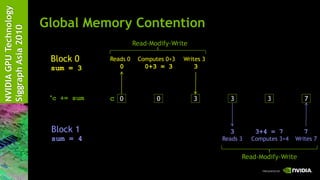
                        Race Conditions
                          Terminology: A race condition occurs when program behavior depends upon
                           relative timing of two (or more) event sequences

                          What actually takes place to execute the line in question: *c += sum;
                             — Read value at address c
                             — Add sum to value              Terminology: Read-Modify-Write
                             — Write result to address c


                          What if two threads are trying to do this at the same time?
                                  Thread 0, Block 0                   Thread 0, Block 1
                                     — Read value at address c            — Read value at address c
                                     — Add sum to value                   — Add sum to value
                                     — Write result to address c          — Write result to address c
NVIDIA GPU Technology
Siggraph Asia 2010
                        Global Memory Contention
                                               Read-Modify-Write

                         Block 0     Reads 0    Computes 0+3   Writes 3
                         sum = 3        0         0+3 = 3          3


                         *c += sum   c 0              0            3        3            3            7


                         Block 1                                            3        3+4 = 7          7
                         sum = 4                                          Reads 3   Computes 3+4   Writes 7


                                                                                Read-Modify-Write
NVIDIA GPU Technology
Siggraph Asia 2010
                        Global Memory Contention
                                                         Read-Modify-Write

                         Block 0     Reads 0              Computes 0+3                  Writes 3
                         sum = 3        0                   0+3 = 3                        3


                         *c += sum   c 0         0              0             0            3          4


                         Block 1                 0                        0+4 = 4                     4
                         sum = 4               Reads 0                   Computes 0+4              Writes 4


                                                                    Read-Modify-Write
NVIDIA GPU Technology
Siggraph Asia 2010
                        Atomic Operations
                          Terminology: Read-modify-write uninterruptible when atomic

                          Many atomic operations on memory available with CUDA C
                                 atomicAdd()        atomicInc()
                                 atomicSub()        atomicDec()
                                 atomicMin()        atomicExch()
                                 atomicMax()        atomicCAS()

                          Predictable result when simultaneous access to memory required

                          We need to atomically add sum to c in our multiblock dot product
NVIDIA GPU Technology
Siggraph Asia 2010
                        Multiblock Dot Product: dot()
                            __global__ void dot( int *a, int *b, int *c ) {
                                 __shared__ int temp[THREADS_PER_BLOCK];
                                 int index = threadIdx.x + blockIdx.x * blockDim.x;
                                 temp[threadIdx.x] = a[index] * b[index];

                                 __syncthreads();

                                 if( 0 == threadIdx.x ) {
                                     int sum = 0;
                                     for( int i = 0; i < THREADS_PER_BLOCK; i++ )
                                         sum += temp[i];
                                     atomicAdd( c , sum );
                                 }
                             }


                          Now let’s fix up main() to handle a multiblock dot product
NVIDIA GPU Technology
Siggraph Asia 2010      Parallel Dot Product: main()
                           #define N (2048*2048)
                           #define THREADS_PER_BLOCK 512
                           int main( void ) {
                               int *a, *b, *c;                       // host copies of a, b, c
                               int *dev_a, *dev_b, *dev_c;           // device copies of a, b, c
                               int size = N * sizeof( int );         // we need space for N ints

                               // allocate   device copies of a, b, c
                               cudaMalloc(   (void**)&dev_a, size );
                               cudaMalloc(   (void**)&dev_b, size );
                               cudaMalloc(   (void**)&dev_c, sizeof( int ) );

                               a = (int *)malloc( size );
                               b = (int *)malloc( size );
                               c = (int *)malloc( sizeof( int ) );

                               random_ints( a, N );
                               random_ints( b, N );
NVIDIA GPU Technology
Siggraph Asia 2010      Parallel Dot Product: main()
                               // copy inputs to device
                               cudaMemcpy( dev_a, a, size, cudaMemcpyHostToDevice );
                               cudaMemcpy( dev_b, b, size, cudaMemcpyHostToDevice );


                               // launch dot() kernel
                               dot<<< N/THREADS_PER_BLOCK, THREADS_PER_BLOCK >>>( dev_a, dev_b, dev_c );


                               // copy device result back to host copy of c
                               cudaMemcpy( c, dev_c, sizeof( int ) , cudaMemcpyDeviceToHost );


                               free( a ); free( b ); free( c );
                               cudaFree( dev_a );
                               cudaFree( dev_b );
                               cudaFree( dev_c );
                               return 0;
                           }
NVIDIA GPU Technology
Siggraph Asia 2010
                        Review
                          Race conditions
                            — Behavior depends upon relative timing of multiple event sequences
                            — Can occur when an implied read-modify-write is interruptible


                          Atomic operations
                            — CUDA provides read-modify-write operations guaranteed to be atomic
                            — Atomics ensure correct results when multiple threads modify memory
NVIDIA GPU Technology
Siggraph Asia 2010      To Learn More CUDA C
                           Check out CUDA by Example
                             — Parallel Programming in CUDA C
                             — Thread Cooperation
                             — Constant Memory and Events
                             — Texture Memory
                             — Graphics Interoperability
                             — Atomics
                             — Streams
                             — CUDA C on Multiple GPUs
                             — Other CUDA Resources


                           For sale here at GTC

                           http://developer.nvidia.com/object/cuda-by-example.html
NVIDIA GPU Technology
Siggraph Asia 2010      Questions
                           First my questions


                           Now your questions…

[02][cuda c 프로그래밍 소개] gateau intro to_cuda_c

  • 1.
    NVIDIA GPU Technology SiggraphAsia 2010 NVIDIA GPU Technology Siggraph Asia 2010 Introduction to CUDA C Samuel Gateau | Seoul | December 16, 2010
  • 2.
    NVIDIA GPU Technology SiggraphAsia 2010 Who should you thank for this talk?  Jason Sanders  Senior Software Engineer, NVIDIA  Co-author of CUDA by Example
  • 3.
    NVIDIA GPU Technology SiggraphAsia 2010 What is CUDA?  CUDA Architecture — Expose general-purpose GPU computing as first-class capability — Retain traditional DirectX/OpenGL graphics performance  CUDA C — Based on industry-standard C — A handful of language extensions to allow heterogeneous programs — Straightforward APIs to manage devices, memory, etc.  This talk will introduce you to CUDA C
  • 4.
    NVIDIA GPU Technology Introduction to CUDA C Siggraph Asia 2010  What will you learn today? — Start from ―Hello, World!‖ — Write and launch CUDA C kernels — Manage GPU memory — Run parallel kernels in CUDA C — Parallel communication and synchronization — Race conditions and atomic operations
  • 5.
    NVIDIA GPU Technology CUDA C Prerequisites Siggraph Asia 2010  You (probably) need experience with C or C++  You do not need any GPU experience  You do not need any graphics experience  You do not need any parallel programming experience
  • 6.
    NVIDIA GPU Technology CUDA C: The Basics Siggraph Asia 2010  Terminology  Host – The CPU and its memory (host memory)  Device – The GPU and its memory (device memory) Host Device Note: Figure Not to Scale
  • 7.
    NVIDIA GPU Technology Hello, World! Siggraph Asia 2010 int main( void ) { printf( "Hello, World!n" ); return 0; }  This basic program is just standard C that runs on the host  NVIDIA’s compiler (nvcc) will not complain about CUDA programs with no device code  At its simplest, CUDA C is just C!
  • 8.
    NVIDIA GPU Technology Hello, World! with Device Code Siggraph Asia 2010 __global__ void kernel( void ) { } int main( void ) { kernel<<<1,1>>>(); printf( "Hello, World!n" ); return 0; }  Two notable additions to the original ―Hello, World!‖
  • 9.
    NVIDIA GPU Technology Hello, World! with Device Code Siggraph Asia 2010 __global__ void kernel( void ) { }  CUDA C keyword __global__ indicates that a function — Runs on the device — Called from host code  nvcc splits source file into host and device components — NVIDIA’s compiler handles device functions like kernel() — Standard host compiler handles host functions like main()  gcc  Microsoft Visual C
  • 10.
    NVIDIA GPU Technology Hello, World! with Device Code Siggraph Asia 2010 int main( void ) { kernel<<< 1, 1 >>>(); printf( "Hello, World!n" ); return 0; }  Triple angle brackets mark a call from host code to device code — Sometimes called a ―kernel launch‖ — We’ll discuss the parameters inside the angle brackets later  This is all that’s required to execute a function on the GPU!  The function kernel() does nothing, so this is fairly anticlimactic…
  • 11.
    NVIDIA GPU Technology A More Complex Example Siggraph Asia 2010  A simple kernel to add two integers: __global__ void add( int *a, int *b, int *c ) { *c = *a + *b; }  As before, __global__ is a CUDA C keyword meaning — add() will execute on the device — add() will be called from the host
  • 12.
    NVIDIA GPU Technology A More Complex Example Siggraph Asia 2010  Notice that we use pointers for our variables: __global__ void add( int *a, int *b, int *c ) { *c = *a + *b; }  add() runs on the device…so a, b, and c must point to device memory  How do we allocate memory on the GPU?
  • 13.
    NVIDIA GPU Technology SiggraphAsia 2010 Memory Management  Host and device memory are distinct entities — Device pointers point to GPU memory  May be passed to and from host code  May not be dereferenced from host code — Host pointers point to CPU memory  May be passed to and from device code  May not be dereferenced from device code  Basic CUDA API for dealing with device memory — cudaMalloc(), cudaFree(), cudaMemcpy() — Similar to their C equivalents, malloc(), free(), memcpy()
  • 14.
    NVIDIA GPU Technology SiggraphAsia 2010 A More Complex Example: add()  Using our add()kernel: __global__ void add( int *a, int *b, int *c ) { *c = *a + *b; }  Let’s take a look at main()…
  • 15.
    NVIDIA GPU Technology SiggraphAsia 2010 A More Complex Example: main() int main( void ) { int a, b, c; // host copies of a, b, c int *dev_a, *dev_b, *dev_c; // device copies of a, b, c int size = sizeof( int ); // we need space for an integer // allocate device copies of a, b, c cudaMalloc( (void**)&dev_a, size ); cudaMalloc( (void**)&dev_b, size ); cudaMalloc( (void**)&dev_c, size ); a = 2; b = 7;
  • 16.
    NVIDIA GPU Technology SiggraphAsia 2010 A More Complex Example: main() (cont) // copy inputs to device cudaMemcpy( dev_a, &a, size, cudaMemcpyHostToDevice ); cudaMemcpy( dev_b, &b, size, cudaMemcpyHostToDevice ); // launch add() kernel on GPU, passing parameters add<<< 1, 1 >>>( dev_a, dev_b, dev_c ); // copy device result back to host copy of c cudaMemcpy( &c, dev_c, size, cudaMemcpyDeviceToHost ); cudaFree( dev_a ); cudaFree( dev_b ); cudaFree( dev_c ); return 0; }
  • 17.
    NVIDIA GPU Technology SiggraphAsia 2010 Parallel Programming in CUDA C  But wait…GPU computing is about massive parallelism  So how do we run code in parallel on the device?  Solution lies in the parameters between the triple angle brackets: add<<< 1, 1 >>>( dev_a, dev_b, dev_c ); add<<< N, 1 >>>( dev_a, dev_b, dev_c );  Instead of executing add() once, add() executed N times in parallel
  • 18.
    NVIDIA GPU Technology SiggraphAsia 2010 Parallel Programming in CUDA C  With add() running in parallel…let’s do vector addition  Terminology: Each parallel invocation of add() referred to as a block  Kernel can refer to its block’s index with the variable blockIdx.x  Each block adds a value from a[] and b[], storing the result in c[]: __global__ void add( int *a, int *b, int *c ) { c[blockIdx.x] = a[blockIdx.x] + b[blockIdx.x]; }  By using blockIdx.x to index arrays, each block handles different indices
  • 19.
    NVIDIA GPU Technology SiggraphAsia 2010 Parallel Programming in CUDA C  We write this code: __global__ void add( int *a, int *b, int *c ) { c[blockIdx.x] = a[blockIdx.x] + b[blockIdx.x]; }  This is what runs in parallel on the device: Block 0 Block 1 c[0] = a[0] + b[0]; c[1] = a[1] + b[1]; Block 2 Block 3 c[2] = a[2] + b[2]; c[3] = a[3] + b[3];
  • 20.
    NVIDIA GPU Technology SiggraphAsia 2010 Parallel Addition: add()  Using our newly parallelized add()kernel: __global__ void add( int *a, int *b, int *c ) { c[blockIdx.x] = a[blockIdx.x] + b[blockIdx.x]; }  Let’s take a look at main()…
  • 21.
    NVIDIA GPU Technology SiggraphAsia 2010 Parallel Addition: main() #define N 512 int main( void ) { int *a, *b, *c; // host copies of a, b, c int *dev_a, *dev_b, *dev_c; // device copies of a, b, c int size = N * sizeof( int ); // we need space for 512 integers // allocate device copies of a, b, c cudaMalloc( (void**)&dev_a, size ); cudaMalloc( (void**)&dev_b, size ); cudaMalloc( (void**)&dev_c, size ); a = (int*)malloc( size ); b = (int*)malloc( size ); c = (int*)malloc( size ); random_ints( a, N ); random_ints( b, N );
  • 22.
    NVIDIA GPU Technology SiggraphAsia 2010 Parallel Addition: main() (cont) // copy inputs to device cudaMemcpy( dev_a, a, size, cudaMemcpyHostToDevice ); cudaMemcpy( dev_b, b, size, cudaMemcpyHostToDevice ); // launch add() kernel with N parallel blocks add<<< N, 1 >>>( dev_a, dev_b, dev_c ); // copy device result back to host copy of c cudaMemcpy( c, dev_c, size, cudaMemcpyDeviceToHost ); free( a ); free( b ); free( c ); cudaFree( dev_a ); cudaFree( dev_b ); cudaFree( dev_c ); return 0; }
  • 23.
    NVIDIA GPU Technology SiggraphAsia 2010 Review  Difference between ―host‖ and ―device‖ — Host = CPU — Device = GPU  Using __global__ to declare a function as device code — Runs on device — Called from host  Passing parameters from host code to a device function
  • 24.
    NVIDIA GPU Technology SiggraphAsia 2010 Review (cont)  Basic device memory management — cudaMalloc() — cudaMemcpy() — cudaFree()  Launching parallel kernels — Launch N copies of add() with: add<<< N, 1 >>>(); — Used blockIdx.x to access block’s index
  • 25.
    NVIDIA GPU Technology SiggraphAsia 2010 Threads  Terminology: A block can be split into parallel threads  Let’s change vector addition to use parallel threads instead of parallel blocks: __global__ void add( int *a, int *b, int *c ) { c[ threadIdx.x ] = a[ threadIdx.x ] + b[ threadIdx.x ]; blockIdx.x blockIdx.x blockIdx.x }  We use threadIdx.x instead of blockIdx.x in add()  main() will require one change as well…
  • 26.
    NVIDIA GPU Technology SiggraphAsia 2010 Parallel Addition (Threads): main() #define N 512 int main( void ) { int *a, *b, *c; //host copies of a, b, c int *dev_a, *dev_b, *dev_c; //device copies of a, b, c int size = N * sizeof( int ); //we need space for 512 integers // allocate device copies of a, b, c cudaMalloc( (void**)&dev_a, size ); cudaMalloc( (void**)&dev_b, size ); cudaMalloc( (void**)&dev_c, size ); a = (int*)malloc( size ); b = (int*)malloc( size ); c = (int*)malloc( size ); random_ints( a, N ); random_ints( b, N );
  • 27.
    NVIDIA GPU Technology SiggraphAsia 2010 Parallel Addition (Threads): main() (cont) // copy inputs to device cudaMemcpy( dev_a, a, size, cudaMemcpyHostToDevice ); cudaMemcpy( dev_b, b, size, cudaMemcpyHostToDevice ); // launch add() kernel with N threads blocks add<<< 1, N >>>( dev_a, dev_b, dev_c ); N, 1 // copy device result back to host copy of c cudaMemcpy( c, dev_c, size, cudaMemcpyDeviceToHost ); free( a ); free( b ); free( c ); cudaFree( dev_a ); cudaFree( dev_b ); cudaFree( dev_c ); return 0; }
  • 28.
    NVIDIA GPU Technology SiggraphAsia 2010 Using Threads And Blocks  We’ve seen parallel vector addition using — Many blocks with 1 thread apiece — 1 block with many threads  Let’s adapt vector addition to use lots of both blocks and threads  After using threads and blocks together, we’ll talk about why threads  First let’s discuss data indexing…
  • 29.
    NVIDIA GPU Technology SiggraphAsia 2010 Indexing Arrays With Threads And Blocks  No longer as simple as just using threadIdx.x or blockIdx.x as indices  To index array with 1 thread per entry (using 8 threads/block) threadIdx.x threadIdx.x threadIdx.x threadIdx.x 0 1 2 3 4 5 6 7 0 1 2 3 4 5 6 7 0 1 2 3 4 5 6 7 0 1 2 3 4 5 6 7 blockIdx.x = 0 blockIdx.x = 1 blockIdx.x = 2 blockIdx.x = 3  If we have M threads/block, a unique array index for each entry given by int index = threadIdx.x + blockIdx.x * M; int index = x + y * width;
  • 30.
    NVIDIA GPU Technology SiggraphAsia 2010 Indexing Arrays: Example  In this example, the red entry would have an index of 21: 0 1 2 3 4 5 6 7 8 9 10 11 12 13 14 15 16 17 18 19 20 21 M = 8 threads/block blockIdx.x = 2 int index = threadIdx.x + blockIdx.x * M; = 5 + 2 * 8; = 21;
  • 31.
    NVIDIA GPU Technology SiggraphAsia 2010 Addition with Threads and Blocks  The blockDim.x is a built-in variable for threads per block: int index= threadIdx.x + blockIdx.x * blockDim.x;  A combined version of our vector addition kernel to use blocks and threads: __global__ void add( int *a, int *b, int *c ) { int index = threadIdx.x + blockIdx.x * blockDim.x; c[index] = a[index] + b[index]; }  So what changes in main() when we use both blocks and threads?
  • 32.
    NVIDIA GPU Technology SiggraphAsia 2010 Parallel Addition (Blocks/Threads): main() #define N (2048*2048) #define THREADS_PER_BLOCK 512 int main( void ) { int *a, *b, *c; // host copies of a, b, c int *dev_a, *dev_b, *dev_c; // device copies of a, b, c int size = N * sizeof( int ); // we need space for N integers // allocate device copies of a, b, c cudaMalloc( (void**)&dev_a, size ); cudaMalloc( (void**)&dev_b, size ); cudaMalloc( (void**)&dev_c, size ); a = (int*)malloc( size ); b = (int*)malloc( size ); c = (int*)malloc( size ); random_ints( a, N ); random_ints( b, N );
  • 33.
    NVIDIA GPU Technology SiggraphAsia 2010 Parallel Addition (Blocks/Threads): main() // copy inputs to device cudaMemcpy( dev_a, a, size, cudaMemcpyHostToDevice ); cudaMemcpy( dev_b, b, size, cudaMemcpyHostToDevice ); // launch add() kernel with blocks and threads add<<< N/THREADS_PER_BLOCK, THREADS_PER_BLOCK >>>( dev_a, dev_b, dev_c ); // copy device result back to host copy of c cudaMemcpy( c, dev_c, size, cudaMemcpyDeviceToHost ); free( a ); free( b ); free( c ); cudaFree( dev_a ); cudaFree( dev_b ); cudaFree( dev_c ); return 0; }
  • 34.
    NVIDIA GPU Technology SiggraphAsia 2010 Why Bother With Threads?  Threads seem unnecessary — Added a level of abstraction and complexity — What did we gain?  Unlike parallel blocks, parallel threads have mechanisms to — Communicate — Synchronize  Let’s see how…
  • 35.
    NVIDIA GPU Technology SiggraphAsia 2010 Dot Product  Unlike vector addition, dot product is a reduction from vectors to a scalar a b a0 * b0 c a1 a2 * * b1 b2 + a3 * b3 c = a∙b c = (a0, a1, a2, a3) ∙ (b0, b1, b2, b3) c = a0 b0 + a1 b1 + a2 b2 + a3 b3
  • 36.
    NVIDIA GPU Technology SiggraphAsia 2010 Dot Product  Parallel threads have no problem computing the pairwise products: a b a0 * b0 a1 a2 * * b1 b2 + a3 * b3  So we can start a dot product CUDA kernel by doing just that: __global__ void dot( int *a, int *b, int *c ) { // Each thread computes a pairwise product int temp = a[threadIdx.x] * b[threadIdx.x];
  • 37.
    NVIDIA GPU Technology SiggraphAsia 2010 Dot Product  But we need to share data between threads to compute the final sum: a b a0 * b0 a1 a2 * * b1 b2 + a3 * b3 __global__ void dot( int *a, int *b, int *c ) { // Each thread computes a pairwise product int temp = a[threadIdx.x] * b[threadIdx.x]; // Can’t compute the final sum // Each thread’s copy of ‘temp’ is private }
  • 38.
    NVIDIA GPU Technology SiggraphAsia 2010 Sharing Data Between Threads  Terminology: A block of threads shares memory called…shared memory  Extremely fast, on-chip memory (user-managed cache)  Declared with the __shared__ CUDA keyword  Not visible to threads in other blocks running in parallel Block 0 Block 1 Block 2 Threads Threads Threads … Shared Memory Shared Memory Shared Memory
  • 39.
    NVIDIA GPU Technology SiggraphAsia 2010 Parallel Dot Product: dot()  We perform parallel multiplication, serial addition: #define N 512 __global__ void dot( int *a, int *b, int *c ) { // Shared memory for results of multiplication __shared__ int temp[N]; temp[threadIdx.x] = a[threadIdx.x] * b[threadIdx.x]; // Thread 0 sums the pairwise products if( 0 == threadIdx.x ) { int sum = 0; for( int i = 0; i < N; i++ ) sum += temp[i]; *c = sum; } }
  • 40.
    NVIDIA GPU Technology SiggraphAsia 2010 Parallel Dot Product Recap  We perform parallel, pairwise multiplications  Shared memory stores each thread’s result  We sum these pairwise products from a single thread  Sounds good…but we’ve made a huge mistake
  • 41.
    NVIDIA GPU Technology SiggraphAsia 2010 Faulty Dot Product Exposed!  Step 1: In parallel each thread writes a pairwise product parallel, __shared__ int temp  Step 2: Thread 0 reads and sums the products __shared__ int temp  But there’s an assumption hidden in Step 1…
  • 42.
    NVIDIA GPU Technology SiggraphAsia 2010 Read-Before-Write Hazard  Suppose thread 0 finishes its write in step 1  Then thread 0 reads index 12 in step 2 This read returns garbage!  Before thread 12 writes to index 12 in step 1?
  • 43.
    NVIDIA GPU Technology SiggraphAsia 2010 Synchronization  We need threads to wait between the sections of dot(): __global__ void dot( int *a, int *b, int *c ) { __shared__ int temp[N]; temp[threadIdx.x] = a[threadIdx.x] * b[threadIdx.x]; // * NEED THREADS TO SYNCHRONIZE HERE * // No thread can advance until all threads // have reached this point in the code // Thread 0 sums the pairwise products if( 0 == threadIdx.x ) { int sum = 0; for( int i = 0; i < N; i++ ) sum += temp[i]; *c = sum; } }
  • 44.
    NVIDIA GPU Technology SiggraphAsia 2010 __syncthreads()  We can synchronize threads with the function __syncthreads()  Threads in the block wait until all threads have hit the __syncthreads() Thread 0 __syncthreads() Thread 1 __syncthreads() Thread 2 __syncthreads() Thread 3 __syncthreads() Thread 4 __syncthreads() …  Threads are only synchronized within a block
  • 45.
    NVIDIA GPU Technology SiggraphAsia 2010 Parallel Dot Product: dot() __global__ void dot( int *a, int *b, int *c ) { __shared__ int temp[N]; temp[threadIdx.x] = a[threadIdx.x] * b[threadIdx.x]; __syncthreads(); if( 0 == threadIdx.x ) { int sum = 0; for( int i = 0; i < N; i++ ) sum += temp[i]; *c = sum; } }  With a properly synchronized dot() routine, let’s look at main()
  • 46.
    NVIDIA GPU Technology SiggraphAsia 2010 Parallel Dot Product: main() #define N 512 int main( void ) { int *a, *b, *c; // copies of a, b, c int *dev_a, *dev_b, *dev_c; // device copies of a, b, c int size = N * sizeof( int ); // we need space for 512 integers // allocate device copies of a, b, c cudaMalloc( (void**)&dev_a, size ); cudaMalloc( (void**)&dev_b, size ); cudaMalloc( (void**)&dev_c, sizeof( int ) ); a = (int *)malloc( size ); b = (int *)malloc( size ); c = (int *)malloc( sizeof( int ) ); random_ints( a, N ); random_ints( b, N );
  • 47.
    NVIDIA GPU Technology SiggraphAsia 2010 Parallel Dot Product: main() // copy inputs to device cudaMemcpy( dev_a, a, size, cudaMemcpyHostToDevice ); cudaMemcpy( dev_b, b, size, cudaMemcpyHostToDevice ); // launch dot() kernel with 1 block and N threads dot<<< 1, N >>>( dev_a, dev_b, dev_c ); // copy device result back to host copy of c cudaMemcpy( c, dev_c, sizeof( int ) , cudaMemcpyDeviceToHost ); free( a ); free( b ); free( c ); cudaFree( dev_a ); cudaFree( dev_b ); cudaFree( dev_c ); return 0; }
  • 48.
    NVIDIA GPU Technology SiggraphAsia 2010 Review  Launching kernels with parallel threads — Launch add() with N threads: add<<< 1, N >>>(); — Used threadIdx.x to access thread’s index  Using both blocks and threads — Used (threadIdx.x + blockIdx.x * blockDim.x) to index input/output — N/THREADS_PER_BLOCK blocks and THREADS_PER_BLOCK threads gave us N threads total
  • 49.
    NVIDIA GPU Technology SiggraphAsia 2010 Review (cont)  Using __shared__ to declare memory as shared memory — Data shared among threads in a block — Not visible to threads in other parallel blocks  Using __syncthreads() as a barrier — No thread executes instructions after __syncthreads() until all threads have reached the __syncthreads() — Needs to be used to prevent data hazards
  • 50.
    NVIDIA GPU Technology SiggraphAsia 2010 Multiblock Dot Product  Recall our dot product launch: // launch dot() kernel with 1 block and N threads dot<<< 1, N >>>( dev_a, dev_b, dev_c );  Launching with one block will not utilize much of the GPU  Let’s write a multiblock version of dot product
  • 51.
    NVIDIA GPU Technology SiggraphAsia 2010 Multiblock Dot Product: Algorithm  Each block computes a sum of its pairwise products like before: Block 0 a b a0 * b0 sum a1 a2 * * b1 b2 + a3 … * b3 Block 1… a b a512 * b512 sum a513 a514 * * b513 b514 + a515 * b515 … …
  • 52.
    NVIDIA GPU Technology SiggraphAsia 2010 Multiblock Dot Product: Algorithm  And then contributes its sum to the final result: Block 0 a b a0 * b0 sum a1 a2 * * b1 b2 + a3 … * b3 … c Block 1 a b a512 * b512 sum a513 a514 * * b513 b514 + a515 * b515 … …
  • 53.
    NVIDIA GPU Technology SiggraphAsia 2010 Multiblock Dot Product: dot() #define N (2048*2048) #define THREADS_PER_BLOCK 512 __global__ void dot( int *a, int *b, int *c ) { __shared__ int temp[THREADS_PER_BLOCK]; int index = threadIdx.x + blockIdx.x * blockDim.x; temp[threadIdx.x] = a[index] * b[index]; __syncthreads(); if( 0 == threadIdx.x ) { int sum = 0; for( int i = 0; i < THREADS_PER_BLOCK; i++ ) sum += temp[i]; atomicAdd( *c += sum; c , sum ); } }  But we have a race condition…  We can fix it with one of CUDA’s atomic operations
  • 54.
    NVIDIA GPU Technology SiggraphAsia 2010 Race Conditions  Terminology: A race condition occurs when program behavior depends upon relative timing of two (or more) event sequences  What actually takes place to execute the line in question: *c += sum; — Read value at address c — Add sum to value Terminology: Read-Modify-Write — Write result to address c  What if two threads are trying to do this at the same time?  Thread 0, Block 0  Thread 0, Block 1 — Read value at address c — Read value at address c — Add sum to value — Add sum to value — Write result to address c — Write result to address c
  • 55.
    NVIDIA GPU Technology SiggraphAsia 2010 Global Memory Contention Read-Modify-Write Block 0 Reads 0 Computes 0+3 Writes 3 sum = 3 0 0+3 = 3 3 *c += sum c 0 0 3 3 3 7 Block 1 3 3+4 = 7 7 sum = 4 Reads 3 Computes 3+4 Writes 7 Read-Modify-Write
  • 56.
    NVIDIA GPU Technology SiggraphAsia 2010 Global Memory Contention Read-Modify-Write Block 0 Reads 0 Computes 0+3 Writes 3 sum = 3 0 0+3 = 3 3 *c += sum c 0 0 0 0 3 4 Block 1 0 0+4 = 4 4 sum = 4 Reads 0 Computes 0+4 Writes 4 Read-Modify-Write
  • 57.
    NVIDIA GPU Technology SiggraphAsia 2010 Atomic Operations  Terminology: Read-modify-write uninterruptible when atomic  Many atomic operations on memory available with CUDA C  atomicAdd()  atomicInc()  atomicSub()  atomicDec()  atomicMin()  atomicExch()  atomicMax()  atomicCAS()  Predictable result when simultaneous access to memory required  We need to atomically add sum to c in our multiblock dot product
  • 58.
    NVIDIA GPU Technology SiggraphAsia 2010 Multiblock Dot Product: dot() __global__ void dot( int *a, int *b, int *c ) { __shared__ int temp[THREADS_PER_BLOCK]; int index = threadIdx.x + blockIdx.x * blockDim.x; temp[threadIdx.x] = a[index] * b[index]; __syncthreads(); if( 0 == threadIdx.x ) { int sum = 0; for( int i = 0; i < THREADS_PER_BLOCK; i++ ) sum += temp[i]; atomicAdd( c , sum ); } }  Now let’s fix up main() to handle a multiblock dot product
  • 59.
    NVIDIA GPU Technology SiggraphAsia 2010 Parallel Dot Product: main() #define N (2048*2048) #define THREADS_PER_BLOCK 512 int main( void ) { int *a, *b, *c; // host copies of a, b, c int *dev_a, *dev_b, *dev_c; // device copies of a, b, c int size = N * sizeof( int ); // we need space for N ints // allocate device copies of a, b, c cudaMalloc( (void**)&dev_a, size ); cudaMalloc( (void**)&dev_b, size ); cudaMalloc( (void**)&dev_c, sizeof( int ) ); a = (int *)malloc( size ); b = (int *)malloc( size ); c = (int *)malloc( sizeof( int ) ); random_ints( a, N ); random_ints( b, N );
  • 60.
    NVIDIA GPU Technology SiggraphAsia 2010 Parallel Dot Product: main() // copy inputs to device cudaMemcpy( dev_a, a, size, cudaMemcpyHostToDevice ); cudaMemcpy( dev_b, b, size, cudaMemcpyHostToDevice ); // launch dot() kernel dot<<< N/THREADS_PER_BLOCK, THREADS_PER_BLOCK >>>( dev_a, dev_b, dev_c ); // copy device result back to host copy of c cudaMemcpy( c, dev_c, sizeof( int ) , cudaMemcpyDeviceToHost ); free( a ); free( b ); free( c ); cudaFree( dev_a ); cudaFree( dev_b ); cudaFree( dev_c ); return 0; }
  • 61.
    NVIDIA GPU Technology SiggraphAsia 2010 Review  Race conditions — Behavior depends upon relative timing of multiple event sequences — Can occur when an implied read-modify-write is interruptible  Atomic operations — CUDA provides read-modify-write operations guaranteed to be atomic — Atomics ensure correct results when multiple threads modify memory
  • 62.
    NVIDIA GPU Technology SiggraphAsia 2010 To Learn More CUDA C  Check out CUDA by Example — Parallel Programming in CUDA C — Thread Cooperation — Constant Memory and Events — Texture Memory — Graphics Interoperability — Atomics — Streams — CUDA C on Multiple GPUs — Other CUDA Resources  For sale here at GTC  http://developer.nvidia.com/object/cuda-by-example.html
  • 63.
    NVIDIA GPU Technology SiggraphAsia 2010 Questions  First my questions  Now your questions…