Author(s): Rebecca W. Van Dyke, M.D., 2012

License: Unless otherwise noted, this material is made available under the terms
of the Creative Commons Attribution – Share Alike 3.0 License:
http://creativecommons.org/licenses/by-sa/3.0/

We have reviewed this material in accordance with U.S. Copyright Law and have tried to maximize your ability to use,
share, and adapt it. The citation key on the following slide provides information about how you may share and adapt this
material.

Copyright holders of content included in this material should contact open.michigan@umich.edu with any questions,
corrections, or clarification regarding the use of content.

For more information about how to cite these materials visit http://open.umich.edu/education/about/terms-of-use.

Any medical information in this material is intended to inform and educate and is not a tool for self-diagnosis or a
replacement for medical evaluation, advice, diagnosis or treatment by a healthcare professional. Please speak to your
physician if you have questions about your medical condition.

Viewer discretion is advised: Some medical content is graphic and may not be suitable for all viewers.
Attribution Key
                   for more information see: http://open.umich.edu/wiki/AttributionPolicy


Use + Share + Adapt
  { Content the copyright holder, author, or law permits you to use, share and adapt. }
              Public Domain – Government: Works that are produced by the U.S. Government. (17 USC § 105)
              Public Domain – Expired: Works that are no longer protected due to an expired copyright term.
              Public Domain – Self Dedicated: Works that a copyright holder has dedicated to the public domain.

              Creative Commons – Zero Waiver

              Creative Commons – Attribution License
              Creative Commons – Attribution Share Alike License
              Creative Commons – Attribution Noncommercial License
              Creative Commons – Attribution Noncommercial Share Alike License
              GNU – Free Documentation License

Make Your Own Assessment
   { Content Open.Michigan believes can be used, shared, and adapted because it is ineligible for copyright. }
              Public Domain – Ineligible: Works that are ineligible for copyright protection in the U.S. (17 USC § 102(b)) *laws in
              your jurisdiction may differ
  { Content Open.Michigan has used under a Fair Use determination. }
              Fair Use: Use of works that is determined to be Fair consistent with the U.S. Copyright Act. (17 USC § 107) *laws in
              your jurisdiction may differ
              Our determination DOES NOT mean that all uses of this 3rd-party content are Fair Uses and we DO NOT guarantee
              that your use of the content is Fair.
              To use this content you should do your own independent analysis to determine whether or not your use will be Fair.
M2 GI Sequence

     Cholestatic Liver Diseases
              Rebecca W. Van Dyke, MD


Winter 2012
Learning Objectives
•    At the end of this lecture the student should be able to:
•
•   1. Define cholestatic and hepatocellular liver disease, provide examples of both
    and be able to interpret panels of liver tests.
•
•   2. Define the difference between intrahepatic and extrahepatic cholestasis and
    outline approaches to distinguishing them.
•
•   3. Define the pathophysiology of representative cholestatic diseases, including
    drug-induced cholestasis, primary biliary cirrhosis, primary sclerosing
    cholangitis and bile duct obstruction.
•
•   4. Outline an approach to the evaluation of the jaundiced patient.
•
•   5. Define acute and chronic hepatocellular liver disease and provide
    representative examples.
Industry Relationship
         Disclosures
 Industry Supported Research and
       Outside Relationships
• None
Common Types of Liver Disease
Hepatocellular: Injury to hepatocytes (necrosis/apoptosis)
                  Consequences:
                     decreased synthetic/metabolic activity
                     release of intracellular contents (AST/ALT)


Cholestasis: Impaired bile formation (hepatocytes)
             Impaired bile flow (bile ducts/ductules)
               Consequences:
                   build up in blood of substances normally
                           excreted in bile (bilirubin, bile acids)
                   synthesis/release of apical membrane
                           proteins (AP)
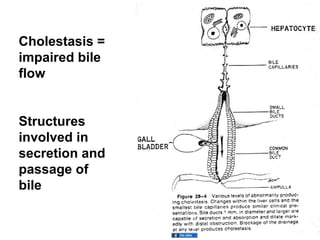
Cholestasis =
impaired bile
flow


Structures
involved in
secretion and
passage of
bile
Cholestatic Liver Disease
Classification of cholestatic diseases:

1. A functional impairment in bile formation at the level
             of the hepatocyte.

2. A structural interference with normal bile secretion and
              flow at the level of small intrahepatic bile ducts.

3. A structural interference with normal bile flow at the
              level of large and extrahepatic bile ducts.
Cholestatic Liver Disease

Biochemical cholestasis:    increased serum bilirubin
                            increased serum alkaline phosphatase

Clinical cholestasis:       jaundice
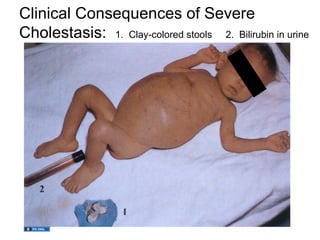
                            dark urine/clay-colored feces
                            pruritus

Pathological cholestasis:   bile plugs in dilated canaliculi
                            increased bile pigment in hepatocytes
                            bile lakes/bile infarcts
                            biliary infection (acute cholangitis)
Tests for Evaluating Cholestasis
• Screening tests that suggest cholestasis
  – Color change in skin/sclerae/stool/urine
  – Laboratory biochemical tests (Alk Phos, Bilirubin)


• Diagnostic tests to establish proof of disease
  – Liver biopsy
  – Indirect visualization of dilated bile ducts and/or masses
    compressing bile ducts/stones (CT, U/S)
  – Direct visualization of lumen of bile ducts allowing
    identification of plumbing problems
     • ERCP - endoscopic retrograde cholangiopancreatography
     • MRCP - magnetic resonance cholangiopancreatography
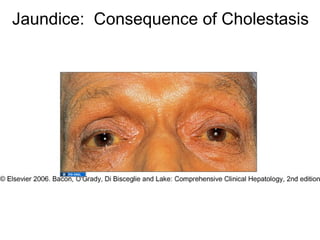
Jaundice: Consequence of Cholestasis
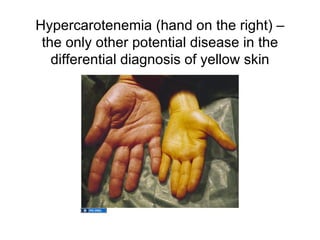
Hypercarotenemia (hand on the right) –
 the only other potential disease in the
   differential diagnosis of yellow skin
Clinical Consequences of Severe
Cholestasis: 1. Clay-colored stools 2. Bilirubin in urine
Cholestasis: Specific Examples
1. Intrahepatic cholestasis due to decreased bile formation:
                    Sepsis
                    Estrogens

2. Intrahepatic cholestasis due to diseases that alter
intrahepatic bile ducts:
                     Primary biliary cirrhosis
                     Infiltration of liver with tumor/granulomas

3. Intrahepatic cholestasis due to any severe liver disease:
                    Viral hepatitis

4. Extrahepatic bile duct obstruction:
                     Tumor, gallstones, duct strictures
                     Primary sclerosing cholangitis
Cholestasis:
Specific Abnormalities in Bile Formation

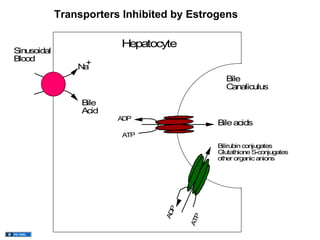
Transporters involved in uptake and biliary secretion
of bilirubin and/or bile acids may be inhibited by
various agents, leading to cholestasis and jaundice.

Examples:           Estrogens
                    Endotoxin/tumor necrosis factor
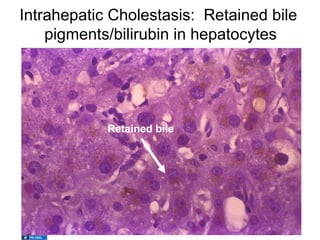
Intrahepatic Cholestasis: Retained bile
    pigments/bilirubin in hepatocytes


            Retained bile
Transporters Inhibited by Estrogens

                         Hepatocyte
Sinusoidal
Blood
                 N+
                  a
                                                Bile
                                                Canaliculus

                  Bile
                  Acid
                         ADP
                                              Bile acids
                         ATP
                                              Bilirubin conjugates
                                              G lutathione S-conjugates
                                              other organic anions

                                    P
                                  AD


                                          P
                                        AT
Intrahepatic Cholestasis


Intrahepatic cholestasis due to diseases that
compress and/or destroy intrahepatic bile ducts:

      Primary Biliary Cirrhosis

      Infiltration of liver with tumor/granulomas
Primary Biliary Cirrhosis
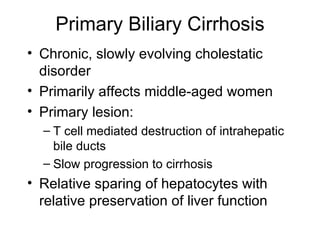
• Chronic, slowly evolving cholestatic
  disorder
• Primarily affects middle-aged women
• Primary lesion:
  – T cell mediated destruction of intrahepatic
    bile ducts
  – Slow progression to cirrhosis
• Relative sparing of hepatocytes with
  relative preservation of liver function
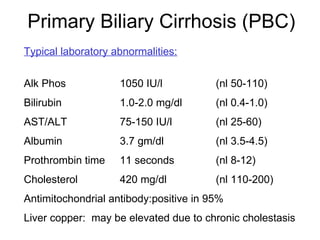
Primary Biliary Cirrhosis (PBC)
Typical laboratory abnormalities:


Alk Phos            1050 IU/l           (nl 50-110)
Bilirubin           1.0-2.0 mg/dl       (nl 0.4-1.0)
AST/ALT             75-150 IU/l         (nl 25-60)
Albumin             3.7 gm/dl           (nl 3.5-4.5)
Prothrombin time    11 seconds          (nl 8-12)
Cholesterol         420 mg/dl           (nl 110-200)
Antimitochondrial antibody:positive in 95%
Liver copper: may be elevated due to chronic cholestasis
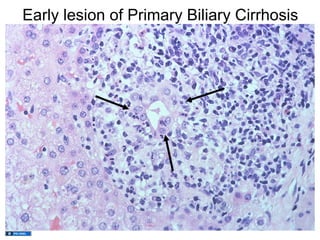
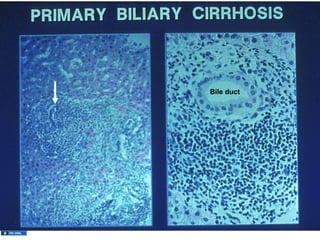
Early lesion of Primary Biliary Cirrhosis
Bile duct
Primary Biliary Cirrhosis (PBC)
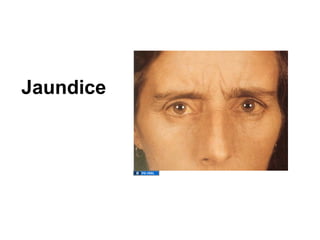
Clinical Findings:

     Jaundice

     Pruritus (related to retention of bile acids
                 and other substances)

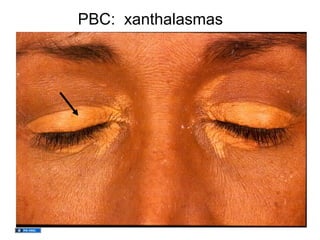
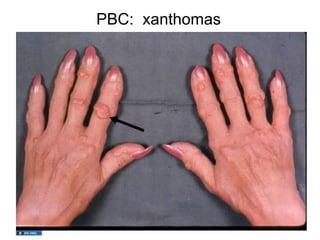
     Xanthomas/xanthalasmas
       (cholesterol deposits in skin)
Jaundice
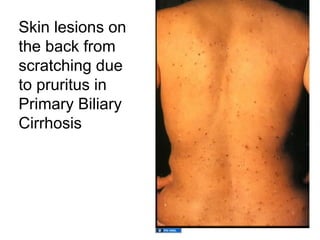
Skin lesions on
the back from
scratching due
to pruritus in
Primary Biliary
Cirrhosis
PBC: xanthalasmas
PBC: xanthomas
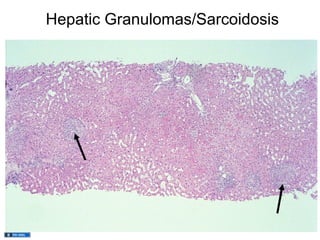
Infiltrative/Granulomatous Diseases
Often present with cholestasis:
             elevated alkaline phosphatase
             with or without jaundice

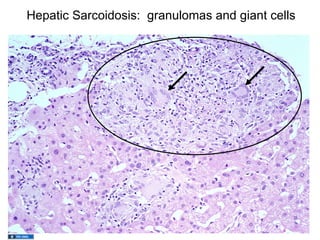
Increased alk phos due to compression of small
             intrahepatic bile ducts by expanding
             granulomas

Examples:           tuberculosis
                    sarcoidosis
Hepatic Granulomas/Sarcoidosis
Hepatic Sarcoidosis: granulomas and giant cells
Extrahepatic Biliary
    Obstruction
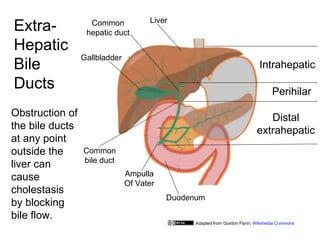
Liver
Extra-             Common
                  hepatic duct
Hepatic
                 Gallbladder
Bile                                                                        Intrahepatic
Ducts                                                                             Perihilar

Obstruction of                                                                Distal
the bile ducts                                                             extrahepatic
at any point
outside the      Common
                 bile duct
liver can
cause                          Ampulla
                               Of Vater
cholestasis
                                          Duodenum
by blocking
bile flow.
                                                Adapted from Gordon Flynn, Wikimedia Commons
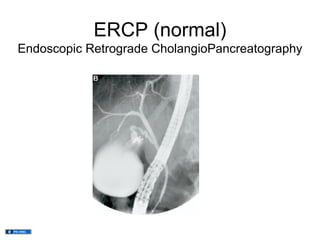
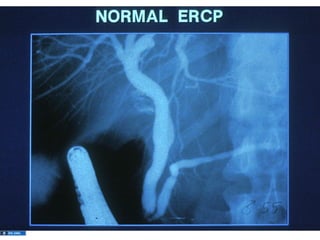
ERCP (normal)
Endoscopic Retrograde CholangioPancreatography
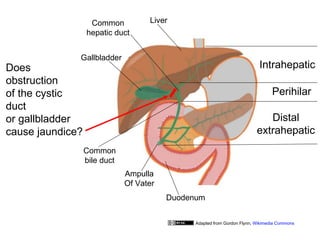
Common           Liver
                  hepatic duct


              Gallbladder
Does                                                                       Intrahepatic
obstruction
of the cystic                                                                    Perihilar
duct
or gallbladder                                                               Distal
cause jaundice?                                                           extrahepatic
                  Common
                  bile duct
                              Ampulla
                              Of Vater
                                         Duodenum


                                               Adapted from Gordon Flynn, Wikimedia Commons
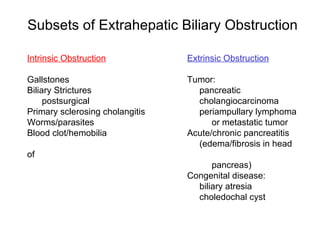
Subsets of Extrahepatic Biliary Obstruction

Intrinsic Obstruction            Extrinsic Obstruction

Gallstones                       Tumor:
Biliary Strictures                 pancreatic
     postsurgical                  cholangiocarcinoma
Primary sclerosing cholangitis     periampullary lymphoma
Worms/parasites                        or metastatic tumor
Blood clot/hemobilia             Acute/chronic pancreatitis
                                   (edema/fibrosis in head
of
                                       pancreas)
                                 Congenital disease:
                                   biliary atresia
                                   choledochal cyst
Primary Sclerosing Cholangitis
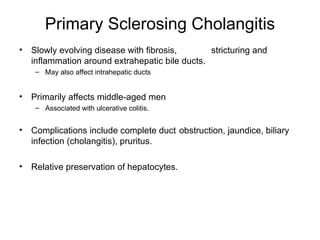
•   Slowly evolving disease with fibrosis,       stricturing and
    inflammation around extrahepatic bile ducts.
     – May also affect intrahepatic ducts


•   Primarily affects middle-aged men
     – Associated with ulcerative colitis.


•   Complications include complete duct obstruction, jaundice, biliary
    infection (cholangitis), pruritus.

•   Relative preservation of hepatocytes.
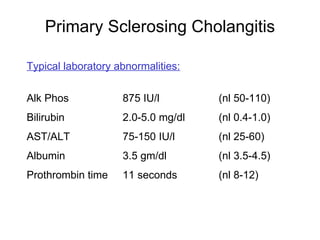
Primary Sclerosing Cholangitis

Typical laboratory abnormalities:


Alk Phos            875 IU/l        (nl 50-110)
Bilirubin           2.0-5.0 mg/dl   (nl 0.4-1.0)
AST/ALT             75-150 IU/l     (nl 25-60)
Albumin             3.5 gm/dl       (nl 3.5-4.5)
Prothrombin time    11 seconds      (nl 8-12)
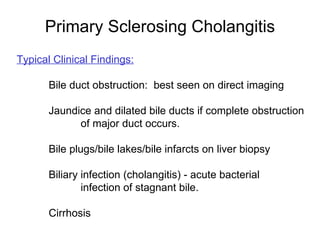
Primary Sclerosing Cholangitis
Typical Clinical Findings:

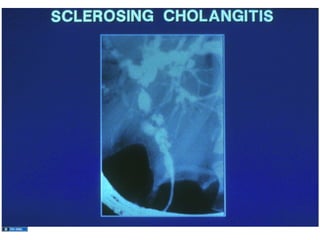
       Bile duct obstruction: best seen on direct imaging

       Jaundice and dilated bile ducts if complete obstruction
             of major duct occurs.

       Bile plugs/bile lakes/bile infarcts on liver biopsy

       Biliary infection (cholangitis) - acute bacterial
               infection of stagnant bile.

       Cirrhosis
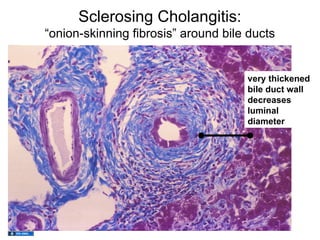
Sclerosing Cholangitis:
“onion-skinning fibrosis” around bile ducts


                                     very thickened
                                     bile duct wall
                                     decreases
                                     luminal
                                     diameter
Biliary obstruction
• When bile ducts are obstructed, what
  happens to the bile?

• What happens to the bile duct upstream
  of the obstruction?
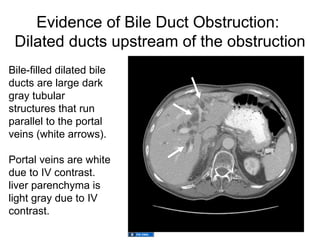
Evidence of Bile Duct Obstruction:
 Dilated ducts upstream of the obstruction
Bile-filled dilated bile
ducts are large dark
gray tubular
structures that run
parallel to the portal
veins (white arrows).

Portal veins are white
due to IV contrast.
liver parenchyma is
light gray due to IV
contrast.
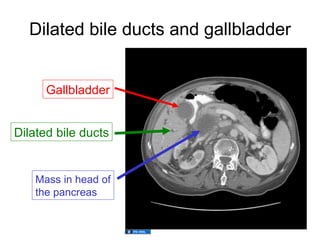
Dilated bile ducts and gallbladder


      Gallbladder


Dilated bile ducts


    Mass in head of
    the pancreas
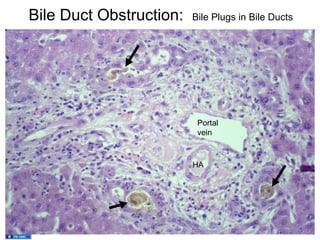
Bile Duct Obstruction:   Bile Plugs in Bile Ducts


                          Portal
                          vein


                         HA
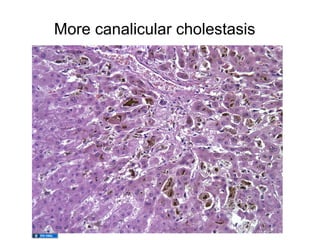
More canalicular cholestasis
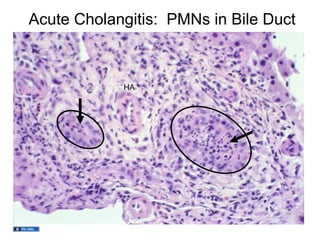
Acute Cholangitis: PMNs in Bile Duct


            HA
Other Causes of Extra-hepatic
      Biliary Obstruction
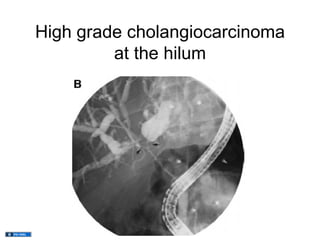
High grade cholangiocarcinoma
         at the hilum
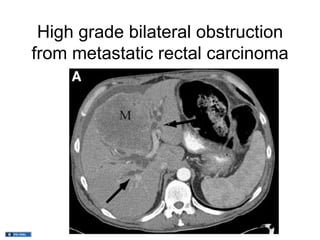
High grade bilateral obstruction
from metastatic rectal carcinoma
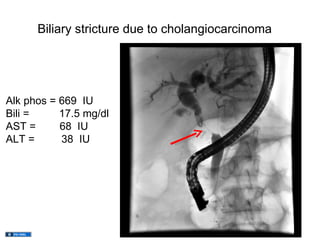
Biliary stricture due to cholangiocarcinoma


Alk phos = 669 IU
Bili =     17.5 mg/dl
AST =      68 IU
ALT =      38 IU
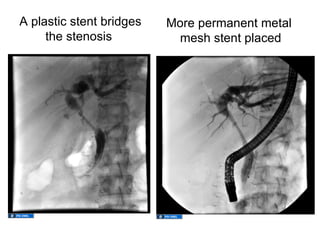
A plastic stent bridges   More permanent metal
     the stenosis           mesh stent placed
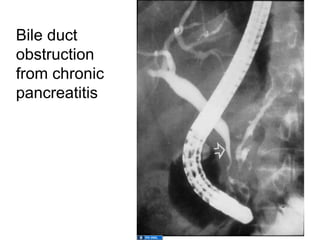
Bile duct
obstruction
from chronic
pancreatitis
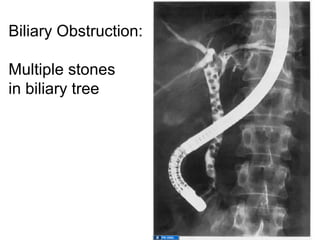
Biliary Obstruction:

Multiple stones
in biliary tree
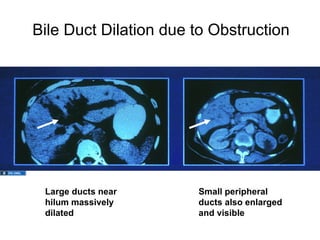
Bile Duct Dilation due to Obstruction


 Large ducts near      Small peripheral
 hilum massively       ducts also enlarged
 dilated               and visible
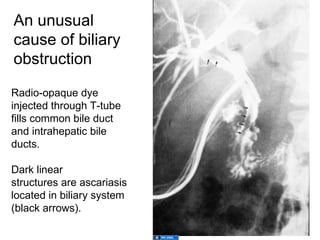
An unusual
cause of biliary
obstruction

Radio-opaque dye
injected through T-tube
fills common bile duct
and intrahepatic bile
ducts.

Dark linear
structures are ascariasis
located in biliary system
(black arrows).
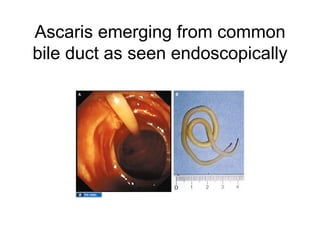
Ascaris emerging from common
bile duct as seen endoscopically
Consequences of Cholestasis
• Secondary liver damage
  – Bile acid-induced hepatocyte injury
  – Secondary biliary cirrhosis


• Failure of substances secreted in bile to
  reach intestine
  – Bile acid deficiency in gut
  – Fat malabsorption/fat-soluble vitamin
    malabsorption
SUMMARY:
 EVALUATION OF CHOLESTASIS AND/OR JAUNDICE

1. Suspect cholestasis based on history, physical exam,
            lab tests.

2. Look for clues to mechanical obstruction of ducts and/or
              mass lesions (radiologic studies).

3. Visualize, diagnose and treat mechanical obstruction.

4. Consider intrahepatic cholestasis, obtain liver biopsy.


      See algorithms in syllabus and in textbook
Additional Source Information
                              for more information see: http://open.umich.edu/wiki/CitationPolicy

Slide 32 & 34: Adapted from Gordon Flynn, Wikimedia Commons, http://commons.wikimedia.org/wiki/File:Digestive_system_with_liver.png, CC:BY-
SA, http://creativecommons.org/licenses/by-sa/2.5/deed.en

02.03.12: Cholestatic Liver Diseases

  • 1.
    Author(s): Rebecca W.Van Dyke, M.D., 2012 License: Unless otherwise noted, this material is made available under the terms of the Creative Commons Attribution – Share Alike 3.0 License: http://creativecommons.org/licenses/by-sa/3.0/ We have reviewed this material in accordance with U.S. Copyright Law and have tried to maximize your ability to use, share, and adapt it. The citation key on the following slide provides information about how you may share and adapt this material. Copyright holders of content included in this material should contact open.michigan@umich.edu with any questions, corrections, or clarification regarding the use of content. For more information about how to cite these materials visit http://open.umich.edu/education/about/terms-of-use. Any medical information in this material is intended to inform and educate and is not a tool for self-diagnosis or a replacement for medical evaluation, advice, diagnosis or treatment by a healthcare professional. Please speak to your physician if you have questions about your medical condition. Viewer discretion is advised: Some medical content is graphic and may not be suitable for all viewers.
  • 2.
    Attribution Key for more information see: http://open.umich.edu/wiki/AttributionPolicy Use + Share + Adapt { Content the copyright holder, author, or law permits you to use, share and adapt. } Public Domain – Government: Works that are produced by the U.S. Government. (17 USC § 105) Public Domain – Expired: Works that are no longer protected due to an expired copyright term. Public Domain – Self Dedicated: Works that a copyright holder has dedicated to the public domain. Creative Commons – Zero Waiver Creative Commons – Attribution License Creative Commons – Attribution Share Alike License Creative Commons – Attribution Noncommercial License Creative Commons – Attribution Noncommercial Share Alike License GNU – Free Documentation License Make Your Own Assessment { Content Open.Michigan believes can be used, shared, and adapted because it is ineligible for copyright. } Public Domain – Ineligible: Works that are ineligible for copyright protection in the U.S. (17 USC § 102(b)) *laws in your jurisdiction may differ { Content Open.Michigan has used under a Fair Use determination. } Fair Use: Use of works that is determined to be Fair consistent with the U.S. Copyright Act. (17 USC § 107) *laws in your jurisdiction may differ Our determination DOES NOT mean that all uses of this 3rd-party content are Fair Uses and we DO NOT guarantee that your use of the content is Fair. To use this content you should do your own independent analysis to determine whether or not your use will be Fair.
  • 3.
    M2 GI Sequence Cholestatic Liver Diseases Rebecca W. Van Dyke, MD Winter 2012
  • 4.
    Learning Objectives • At the end of this lecture the student should be able to: • • 1. Define cholestatic and hepatocellular liver disease, provide examples of both and be able to interpret panels of liver tests. • • 2. Define the difference between intrahepatic and extrahepatic cholestasis and outline approaches to distinguishing them. • • 3. Define the pathophysiology of representative cholestatic diseases, including drug-induced cholestasis, primary biliary cirrhosis, primary sclerosing cholangitis and bile duct obstruction. • • 4. Outline an approach to the evaluation of the jaundiced patient. • • 5. Define acute and chronic hepatocellular liver disease and provide representative examples.
  • 5.
    Industry Relationship Disclosures Industry Supported Research and Outside Relationships • None
  • 6.
    Common Types ofLiver Disease Hepatocellular: Injury to hepatocytes (necrosis/apoptosis) Consequences: decreased synthetic/metabolic activity release of intracellular contents (AST/ALT) Cholestasis: Impaired bile formation (hepatocytes) Impaired bile flow (bile ducts/ductules) Consequences: build up in blood of substances normally excreted in bile (bilirubin, bile acids) synthesis/release of apical membrane proteins (AP)
  • 7.
  • 8.
    Cholestatic Liver Disease Classificationof cholestatic diseases: 1. A functional impairment in bile formation at the level of the hepatocyte. 2. A structural interference with normal bile secretion and flow at the level of small intrahepatic bile ducts. 3. A structural interference with normal bile flow at the level of large and extrahepatic bile ducts.
  • 9.
    Cholestatic Liver Disease Biochemicalcholestasis: increased serum bilirubin increased serum alkaline phosphatase Clinical cholestasis: jaundice dark urine/clay-colored feces pruritus Pathological cholestasis: bile plugs in dilated canaliculi increased bile pigment in hepatocytes bile lakes/bile infarcts biliary infection (acute cholangitis)
  • 10.
    Tests for EvaluatingCholestasis • Screening tests that suggest cholestasis – Color change in skin/sclerae/stool/urine – Laboratory biochemical tests (Alk Phos, Bilirubin) • Diagnostic tests to establish proof of disease – Liver biopsy – Indirect visualization of dilated bile ducts and/or masses compressing bile ducts/stones (CT, U/S) – Direct visualization of lumen of bile ducts allowing identification of plumbing problems • ERCP - endoscopic retrograde cholangiopancreatography • MRCP - magnetic resonance cholangiopancreatography
  • 11.
  • 12.
    Hypercarotenemia (hand onthe right) – the only other potential disease in the differential diagnosis of yellow skin
  • 13.
    Clinical Consequences ofSevere Cholestasis: 1. Clay-colored stools 2. Bilirubin in urine
  • 14.
    Cholestasis: Specific Examples 1.Intrahepatic cholestasis due to decreased bile formation: Sepsis Estrogens 2. Intrahepatic cholestasis due to diseases that alter intrahepatic bile ducts: Primary biliary cirrhosis Infiltration of liver with tumor/granulomas 3. Intrahepatic cholestasis due to any severe liver disease: Viral hepatitis 4. Extrahepatic bile duct obstruction: Tumor, gallstones, duct strictures Primary sclerosing cholangitis
  • 15.
    Cholestasis: Specific Abnormalities inBile Formation Transporters involved in uptake and biliary secretion of bilirubin and/or bile acids may be inhibited by various agents, leading to cholestasis and jaundice. Examples: Estrogens Endotoxin/tumor necrosis factor
  • 16.
    Intrahepatic Cholestasis: Retainedbile pigments/bilirubin in hepatocytes Retained bile
  • 17.
    Transporters Inhibited byEstrogens Hepatocyte Sinusoidal Blood N+ a Bile Canaliculus Bile Acid ADP Bile acids ATP Bilirubin conjugates G lutathione S-conjugates other organic anions P AD P AT
  • 18.
    Intrahepatic Cholestasis Intrahepatic cholestasisdue to diseases that compress and/or destroy intrahepatic bile ducts: Primary Biliary Cirrhosis Infiltration of liver with tumor/granulomas
  • 19.
    Primary Biliary Cirrhosis •Chronic, slowly evolving cholestatic disorder • Primarily affects middle-aged women • Primary lesion: – T cell mediated destruction of intrahepatic bile ducts – Slow progression to cirrhosis • Relative sparing of hepatocytes with relative preservation of liver function
  • 20.
    Primary Biliary Cirrhosis(PBC) Typical laboratory abnormalities: Alk Phos 1050 IU/l (nl 50-110) Bilirubin 1.0-2.0 mg/dl (nl 0.4-1.0) AST/ALT 75-150 IU/l (nl 25-60) Albumin 3.7 gm/dl (nl 3.5-4.5) Prothrombin time 11 seconds (nl 8-12) Cholesterol 420 mg/dl (nl 110-200) Antimitochondrial antibody:positive in 95% Liver copper: may be elevated due to chronic cholestasis
  • 21.
    Early lesion ofPrimary Biliary Cirrhosis
  • 22.
  • 23.
    Primary Biliary Cirrhosis(PBC) Clinical Findings: Jaundice Pruritus (related to retention of bile acids and other substances) Xanthomas/xanthalasmas (cholesterol deposits in skin)
  • 24.
  • 25.
    Skin lesions on theback from scratching due to pruritus in Primary Biliary Cirrhosis
  • 26.
  • 27.
  • 28.
    Infiltrative/Granulomatous Diseases Often presentwith cholestasis: elevated alkaline phosphatase with or without jaundice Increased alk phos due to compression of small intrahepatic bile ducts by expanding granulomas Examples: tuberculosis sarcoidosis
  • 29.
  • 30.
  • 31.
  • 32.
    Liver Extra- Common hepatic duct Hepatic Gallbladder Bile Intrahepatic Ducts Perihilar Obstruction of Distal the bile ducts extrahepatic at any point outside the Common bile duct liver can cause Ampulla Of Vater cholestasis Duodenum by blocking bile flow. Adapted from Gordon Flynn, Wikimedia Commons
  • 33.
    ERCP (normal) Endoscopic RetrogradeCholangioPancreatography
  • 34.
    Common Liver hepatic duct Gallbladder Does Intrahepatic obstruction of the cystic Perihilar duct or gallbladder Distal cause jaundice? extrahepatic Common bile duct Ampulla Of Vater Duodenum Adapted from Gordon Flynn, Wikimedia Commons
  • 35.
    Subsets of ExtrahepaticBiliary Obstruction Intrinsic Obstruction Extrinsic Obstruction Gallstones Tumor: Biliary Strictures pancreatic postsurgical cholangiocarcinoma Primary sclerosing cholangitis periampullary lymphoma Worms/parasites or metastatic tumor Blood clot/hemobilia Acute/chronic pancreatitis (edema/fibrosis in head of pancreas) Congenital disease: biliary atresia choledochal cyst
  • 36.
    Primary Sclerosing Cholangitis • Slowly evolving disease with fibrosis, stricturing and inflammation around extrahepatic bile ducts. – May also affect intrahepatic ducts • Primarily affects middle-aged men – Associated with ulcerative colitis. • Complications include complete duct obstruction, jaundice, biliary infection (cholangitis), pruritus. • Relative preservation of hepatocytes.
  • 37.
    Primary Sclerosing Cholangitis Typicallaboratory abnormalities: Alk Phos 875 IU/l (nl 50-110) Bilirubin 2.0-5.0 mg/dl (nl 0.4-1.0) AST/ALT 75-150 IU/l (nl 25-60) Albumin 3.5 gm/dl (nl 3.5-4.5) Prothrombin time 11 seconds (nl 8-12)
  • 38.
    Primary Sclerosing Cholangitis TypicalClinical Findings: Bile duct obstruction: best seen on direct imaging Jaundice and dilated bile ducts if complete obstruction of major duct occurs. Bile plugs/bile lakes/bile infarcts on liver biopsy Biliary infection (cholangitis) - acute bacterial infection of stagnant bile. Cirrhosis
  • 39.
    Sclerosing Cholangitis: “onion-skinning fibrosis”around bile ducts very thickened bile duct wall decreases luminal diameter
  • 41.
    Biliary obstruction • Whenbile ducts are obstructed, what happens to the bile? • What happens to the bile duct upstream of the obstruction?
  • 43.
    Evidence of BileDuct Obstruction: Dilated ducts upstream of the obstruction Bile-filled dilated bile ducts are large dark gray tubular structures that run parallel to the portal veins (white arrows). Portal veins are white due to IV contrast. liver parenchyma is light gray due to IV contrast.
  • 44.
    Dilated bile ductsand gallbladder Gallbladder Dilated bile ducts Mass in head of the pancreas
  • 45.
    Bile Duct Obstruction: Bile Plugs in Bile Ducts Portal vein HA
  • 46.
  • 47.
    Acute Cholangitis: PMNsin Bile Duct HA
  • 48.
    Other Causes ofExtra-hepatic Biliary Obstruction
  • 49.
  • 50.
    High grade bilateralobstruction from metastatic rectal carcinoma
  • 51.
    Biliary stricture dueto cholangiocarcinoma Alk phos = 669 IU Bili = 17.5 mg/dl AST = 68 IU ALT = 38 IU
  • 52.
    A plastic stentbridges More permanent metal the stenosis mesh stent placed
  • 53.
  • 54.
  • 55.
    Bile Duct Dilationdue to Obstruction Large ducts near Small peripheral hilum massively ducts also enlarged dilated and visible
  • 56.
    An unusual cause ofbiliary obstruction Radio-opaque dye injected through T-tube fills common bile duct and intrahepatic bile ducts. Dark linear structures are ascariasis located in biliary system (black arrows).
  • 57.
    Ascaris emerging fromcommon bile duct as seen endoscopically
  • 58.
    Consequences of Cholestasis •Secondary liver damage – Bile acid-induced hepatocyte injury – Secondary biliary cirrhosis • Failure of substances secreted in bile to reach intestine – Bile acid deficiency in gut – Fat malabsorption/fat-soluble vitamin malabsorption
  • 59.
    SUMMARY: EVALUATION OFCHOLESTASIS AND/OR JAUNDICE 1. Suspect cholestasis based on history, physical exam, lab tests. 2. Look for clues to mechanical obstruction of ducts and/or mass lesions (radiologic studies). 3. Visualize, diagnose and treat mechanical obstruction. 4. Consider intrahepatic cholestasis, obtain liver biopsy. See algorithms in syllabus and in textbook
  • 60.
    Additional Source Information for more information see: http://open.umich.edu/wiki/CitationPolicy Slide 32 & 34: Adapted from Gordon Flynn, Wikimedia Commons, http://commons.wikimedia.org/wiki/File:Digestive_system_with_liver.png, CC:BY- SA, http://creativecommons.org/licenses/by-sa/2.5/deed.en