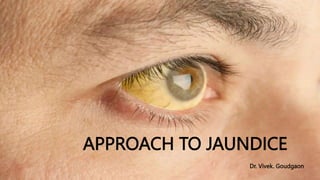
APPROACH TO JAUNDICE
Dr. Vivek. Goudgaon
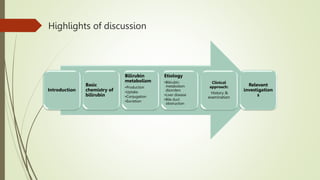
Highlights of discussion
Introduction
Basic
chemistry of
bilirubin
Bilirubin
metabolism
•Production
•Uptake
•Conjugation
•Excretion
Etiology
•Bilirubin
metabolism
disorders
•Liver disease
•Bile duct
obstruction
Clinical
approach:
History &
examination
Relevant
investigation
s
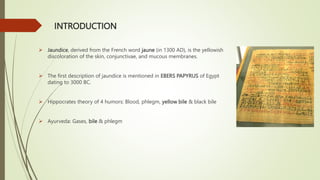
INTRODUCTION
 Jaundice, derived from the French word jaune (in 1300 AD), is the yellowish
discoloration of the skin, conjunctivae, and mucous membranes.
 The first description of jaundice is mentioned in EBERS PAPYRUS of Egypt
dating to 3000 BC.
 Hippocrates theory of 4 humors: Blood, phlegm, yellow bile & black bile
 Ayurveda: Gases, bile & phlegm
 Clinical jaundice: Jaundice detected by physical examination when serum bilirubin > 3mg/dl
 Latent jaundice: ↑ serum bilirubin but not detected by physical examination.
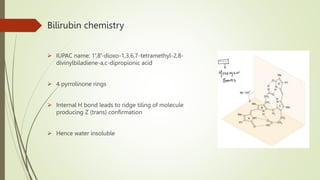
Bilirubin chemistry
 IUPAC name: 1′,8′-dioxo-1,3,6,7-tetramethyl-2,8-
divinylbiladiene-a,c-dipropionic acid
 4 pyrrolinone rings
 Internal H bond leads to ridge tiling of molecule
producing Z (trans) confirmation
 Hence water insoluble
BILIRUBIN METABOLISM
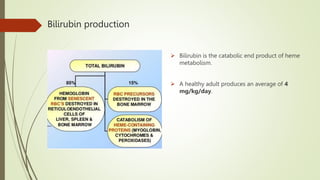
Bilirubin production
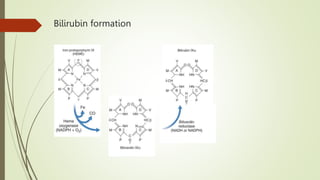
 Bilirubin is the catabolic end product of heme
metabolism.
 A healthy adult produces an average of 4
mg/kg/day.
Bilirubin formation
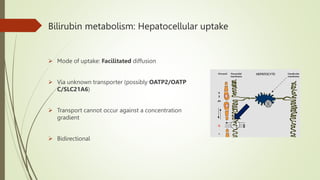
Bilirubin metabolism: Hepatocellular uptake
 Mode of uptake: Facilitated diffusion
 Via unknown transporter (possibly OATP2/OATP
C/SLC21A6)
 Transport cannot occur against a concentration
gradient
 Bidirectional
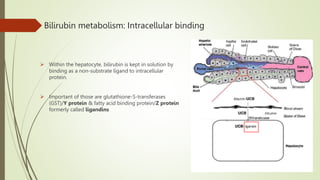
Bilirubin metabolism: Intracellular binding
 Within the hepatocyte, bilirubin is kept in solution by
binding as a non-substrate ligand to intracellular
protein.
 Important of those are glutathione-S-transferases
(GST)/Y protein & fatty acid binding protein/Z protein
formerly called ligandins
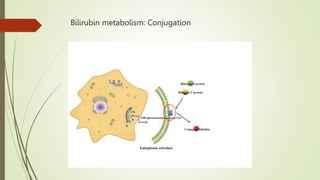
Bilirubin metabolism: Conjugation
 Bilirubin is conjugated with one or two glucuronic acid moieties by a specific UDP-
glucuronosyltransferase to form bilirubin monoglucuronide (BMG) and diglucuronide (BDG),
respectively
 Significance
• Glucuronide conjugates are highly soluble in water
• Excretion of bilirubin across the bile canalicular membrane into bile
Bilirubin metabolism: Conjugation
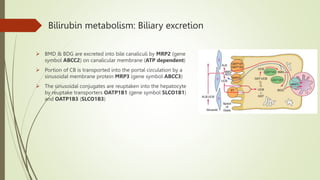
Bilirubin metabolism: Biliary excretion
 BMD & BDG are excreted into bile canaliculi by MRP2 (gene
symbol ABCC2) on canalicular membrane (ATP dependent)
 Portion of CB is transported into the portal circulation by a
sinusoidal membrane protein MRP3 (gene symbol ABCC3)
 The sinusoidal conjugates are reuptaken into the hepatocyte
by reuptake transporters OATP1B1 (gene symbol SLCO1B1)
and OATP1B3 (SLCO1B3)
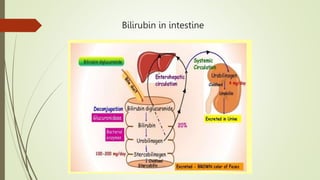
Bilirubin in intestine
ETIOLOGY
Etiology
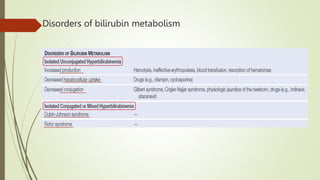
Bilirubin metabolism disorders
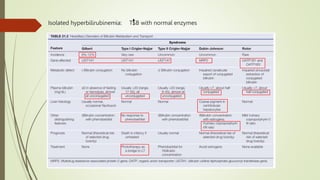
(Isolated hyperbilirubinemia)
• Unconjugated
Hyperbilirubinemia
• Conjugated or Mixed
Hyperbilirubinemia
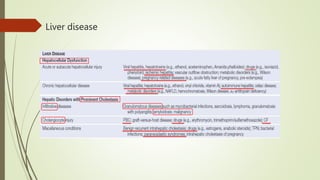
Liver Disease
• Hepatocellular
Dysfunction
• Hepatic Disorders with
Prominent Cholestasis
[INTRAHEPATIC]
Obstruction of the Bile
Ducts [EXTRAHEPATIC]
• Intrinsic causes
• Extrinsic causes
Disorders of bilirubin metabolism
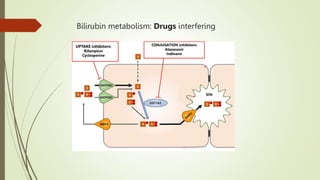
Bilirubin metabolism: Drugs interfering
UPTAKE inhibitors:
Rifampicin
Cyclosporine
CONJUGATION inhibitors:
Atazanavir
Indinavir
Isolated hyperbilirubinemia: TSB with normal enzymes
Etiology
Bilirubin metabolism disorders
(Isolated hyperbilirubinemia)
Liver Disease
Obstruction of the Bile
Ducts [EXTRAHEPATIC]
Liver disease
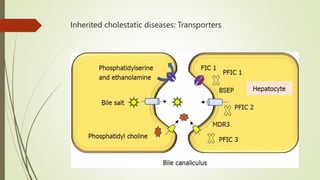
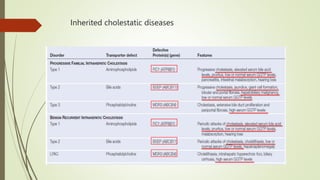
Inherited cholestatic diseases: Transporters
Inherited cholestatic diseases
Etiology
Bilirubin metabolism disorders
(Isolated hyperbilirubinemia)
Liver Disease
Obstruction of the Bile
Ducts [EXTRAHEPATIC]
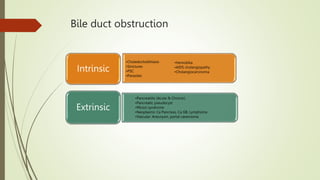
Bile duct obstruction
•Choledocholithiasis
•Strictures
•PSC
•Parasites
Intrinsic
•Pancreatitis (Acute & Chronic)
•Pancreatic pseudocyst
•Mirizzi syndrome
•Neoplasms: Ca Pancreas, Ca GB, Lymphoma
•Vascular: Aneurysm, portal cavernoma
Extrinsic
•Hemobilia
•AIDS cholangiopathy
•Cholangiocarcinoma
CLINICAL APPROACH
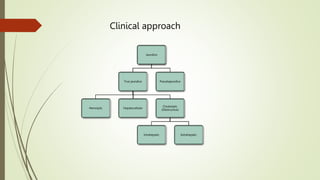
Clinical approach
Jaundice
True jaundice
Hemolytic Hepatocellular
Cholestatic
(Obstructive)
Intrahepatic Extrahepatic
Pseudojaundice
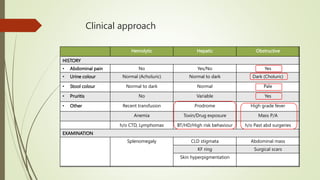
Hemolytic Hepatic Obstructive
HISTORY
• Abdominal pain No Yes/No Yes
• Urine colour Normal (Acholuric) Normal to dark Dark (Choluric)
• Stool colour Normal to dark Normal Pale
• Pruritis No Variable Yes
• Other Recent transfusion Prodrome High grade fever
Anemia Toxin/Drug exposure Mass P/A
h/o CTD, Lymphomas BT/HD/High risk behaviour h/o Past abd surgeries
EXAMINATION
Splenomegaly CLD stigmata Abdominal mass
KF ring Surgical scars
Skin hyperpigmentation
Clinical approach
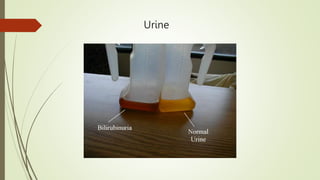
Urine
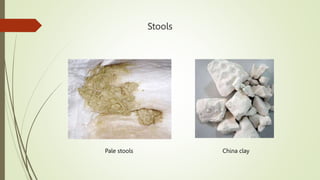
Stools
Pale stools China clay
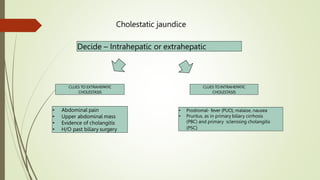
Cholestatic jaundice
Decide – Intrahepatic or extrahepatic
CLUES TO EXTRAHEPATIC
CHOLESTASIS
• Abdominal pain
• Upper abdominal mass
• Evidence of cholangitis
• H/O past biliary surgery
CLUES TO INTRAHEPATIC
CHOLESTASIS
• Prodromal- fever (PUO), malaise, nausea
• Pruritus, as in primary biliary cirrhosis
(PBC) and primary sclerosing cholangitis
(PSC)
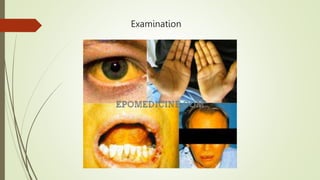
Examination
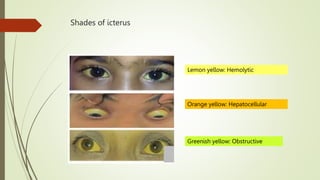
Shades of icterus
Lemon yellow: Hemolytic
Orange yellow: Hepatocellular
Greenish yellow: Obstructive
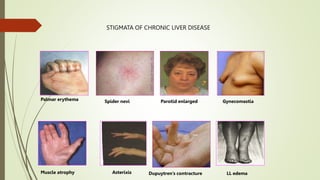
Palmar erythema Spider nevi Parotid enlarged Gynecomastia
Muscle atrophy Asterixis Dupuytren’s contracture LL edema
STIGMATA OF CHRONIC LIVER DISEASE
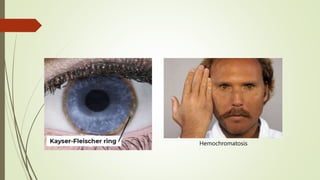
Hemochromatosis
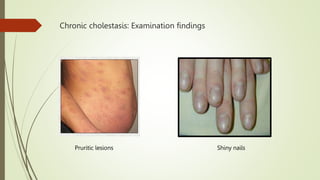
Chronic cholestasis: Examination findings
Pruritic lesions Shiny nails
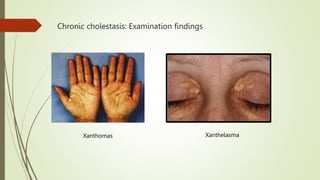
Xanthomas Xanthelasma
Chronic cholestasis: Examination findings
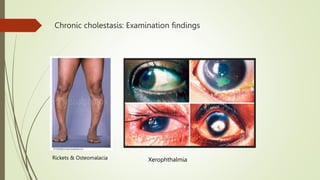
Rickets & Osteomalacia Xerophthalmia
Chronic cholestasis: Examination findings
ESSENTIAL INVESTIGATIONS
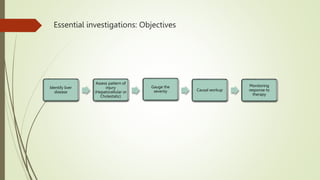
Essential investigations: Objectives
Identify liver
disease
Gauge the
severity
Assess pattern of
injury
(Hepatocellular or
Cholestatic)
Causal workup
Monitoring
response to
therapy
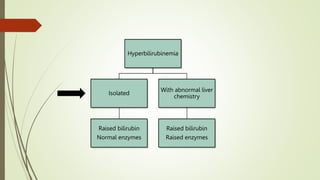
Hyperbilirubinemia
Isolated
Raised bilirubin
Normal enzymes
With abnormal liver
chemistry
Raised bilirubin
Raised enzymes
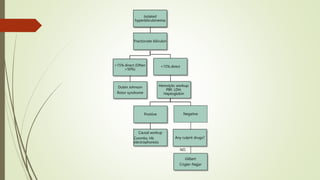
Hemolytic workup:
PBF, LDH,
Haptoglobin
Causal workup
Coombs, Hb
electrophoresis
Any culprit drugs?
NO
Isolated
hyperbilirubinemia
Fractionate bilirubin
>15% direct (Often
>50%)
Dubin Johnson
Rotor syndrome
<15% direct
Positive Negative
Gilbert
Crigler-Najjar
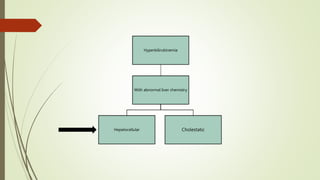
Hyperbilirubinemia
With abnormal liver chemistry
Hepatocellular Cholestatic
Hepatocellular
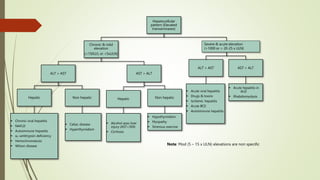
pattern (Elevated
transaminases)
Chronic & mild
elevation
(<150U/L or <5xULN)
ALT > AST
Hepatic
 Chronic viral hepatitis
 NAFLD
 Autoimmune hepatitis
 α1–antitrypsin deficiency
 Hemochromatosis
 Wilson disease
Non hepatic
 Celiac disease
 Hyperthyroidism
AST > ALT
Hepatic
 Alcohol asso liver
injury (AST<300)
 Cirrhosis
Non hepatic
 Hypothyroidism
 Myopathy
 Strenous exercise
ALT > AST
 Acute viral hepatitis
 Drugs & toxins
 Ischemic hepatitis
 Acute BCS
 Autoimmune hepatitis
AST > ALT
 Acute hepatitis in
ALD
 Rhabdomyolysis
Severe & acute elevation
(>1000 or > 20-25 x ULN)
Note: Mod (5 – 15 x ULN) elevations are non specific
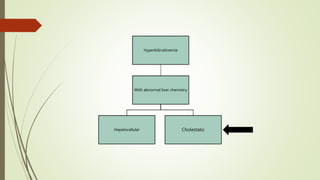
Hyperbilirubinemia
With abnormal liver chemistry
Hepatocellular Cholestatic
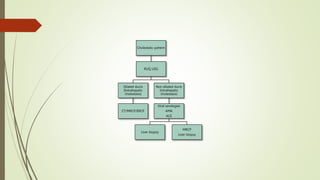
Cholestatic pattern
RUQ USG
Dilated ducts
(Extrahepatic
cholestasis)
CT/MRCP/ERCP
Non dilated ducts
(Intrahepatic
cholestasis)
Viral serologies
AMA
ACE
Liver biopsy
MRCP
Liver biopsy
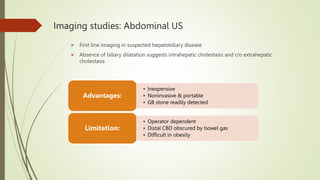
Imaging studies: Abdominal US
 First line imaging in suspected hepatobiliary disease
 Absence of biliary dilatation suggests intrahepatic cholestasis and r/o extrahepatic
cholestasis
• Inexpensive
• Noninvasive & portable
• GB stone readily detected
Advantages:
• Operator dependent
• Distal CBD obscured by bowel gas
• Difficult in obesity
Limitation:
Abdominal CT
 Permits accurate measurement of the caliber of biliary tree.
 Detects intrahepatic SOL as small as 5mm.
• Noninvasive
• Higher resolution than USG
• Not operator dependent
• Superior images in obese persons
Advantages:
• Potential for contrast induced nephrotoxicity,
anaphylaxis
• Ionizing radiation
Disadvantages:
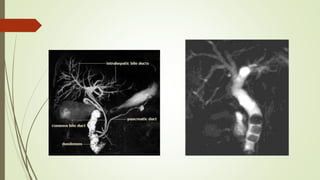
Magnetic Resonance Cholangiopancreaticography (MRCP)
 Permits rapid clear-cut delineation of the biliary tree.
 Superior to conventional ultrasound or CT for detection of biliary tract obstruction.
• Noninvasive
• Imaging of bile ducts superior to ultrasound and CT
Advantages
• May miss small caliber bile duct disease
Disadvantages
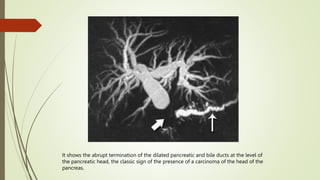
It shows the abrupt termination of the dilated pancreatic and bile ducts at the level of
the pancreatic head, the classic sign of the presence of a carcinoma of the head of the
pancreas.
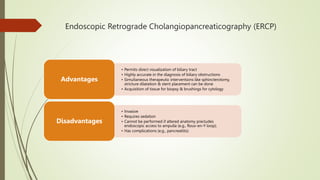
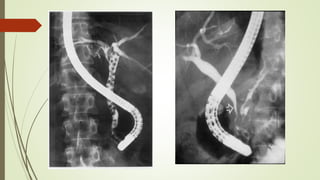
Endoscopic Retrograde Cholangiopancreaticography (ERCP)
• Permits direct visualization of biliary tract
• Highly accurate in the diagnosis of biliary obstructions
• Simultaneous therapeutic interventions like sphincterotomy,
stricture dilatation & stent placement can be done
• Acquisition of tissue for biopsy & brushings for cytology
Advantages
• Invasive
• Requires sedation
• Cannot be performed if altered anatomy precludes
endoscopic access to ampulla (e.g., Roux-en-Y loop);
• Has complications (e.g., pancreatitis)
Disadvantages
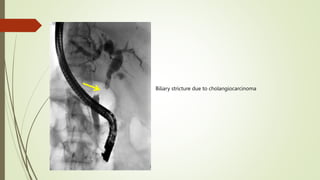
Biliary stricture due to cholangiocarcinoma
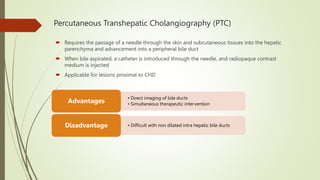
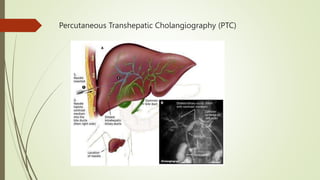
Percutaneous Transhepatic Cholangiography (PTC)
 Requires the passage of a needle through the skin and subcutaneous tissues into the hepatic
parenchyma and advancement into a peripheral bile duct
 When bile aspirated, a catheter is introduced through the needle, and radiopaque contrast
medium is injected
 Applicable for lesions proximal to CHD
• Direct imaging of bile ducts
• Simultaneous therapeutic intervention
Advantages
• Difficult with non dilated intra hepatic bile ducts
Disadvantage
Percutaneous Transhepatic Cholangiography (PTC)
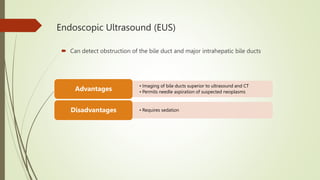
Endoscopic Ultrasound (EUS)
 Can detect obstruction of the bile duct and major intrahepatic bile ducts
• Imaging of bile ducts superior to ultrasound and CT
• Permits needle aspiration of suspected neoplasms
Advantages
• Requires sedation
Disadvantages
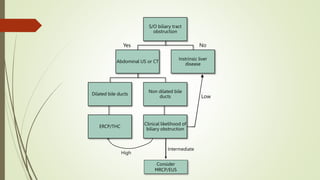
S/O biliary tract
obstruction
Abdominal US or CT
Dilated bile ducts
ERCP/THC
Non dilated bile
ducts
Clinical likelihood of
biliary obstruction
Instrinsic liver
disease
Consider
MRCP/EUS
High
Intermediate
Low
Yes No
Approach to Jaundice

Approach to Jaundice

  • 1.
    APPROACH TO JAUNDICE Dr.Vivek. Goudgaon
  • 2.
    Highlights of discussion Introduction Basic chemistryof bilirubin Bilirubin metabolism •Production •Uptake •Conjugation •Excretion Etiology •Bilirubin metabolism disorders •Liver disease •Bile duct obstruction Clinical approach: History & examination Relevant investigation s
  • 3.
    INTRODUCTION  Jaundice, derivedfrom the French word jaune (in 1300 AD), is the yellowish discoloration of the skin, conjunctivae, and mucous membranes.  The first description of jaundice is mentioned in EBERS PAPYRUS of Egypt dating to 3000 BC.  Hippocrates theory of 4 humors: Blood, phlegm, yellow bile & black bile  Ayurveda: Gases, bile & phlegm
  • 4.
     Clinical jaundice:Jaundice detected by physical examination when serum bilirubin > 3mg/dl  Latent jaundice: ↑ serum bilirubin but not detected by physical examination.
  • 5.
    Bilirubin chemistry  IUPACname: 1′,8′-dioxo-1,3,6,7-tetramethyl-2,8- divinylbiladiene-a,c-dipropionic acid  4 pyrrolinone rings  Internal H bond leads to ridge tiling of molecule producing Z (trans) confirmation  Hence water insoluble
  • 6.
  • 7.
    Bilirubin production  Bilirubinis the catabolic end product of heme metabolism.  A healthy adult produces an average of 4 mg/kg/day.
  • 8.
  • 9.
    Bilirubin metabolism: Hepatocellularuptake  Mode of uptake: Facilitated diffusion  Via unknown transporter (possibly OATP2/OATP C/SLC21A6)  Transport cannot occur against a concentration gradient  Bidirectional
  • 10.
    Bilirubin metabolism: Intracellularbinding  Within the hepatocyte, bilirubin is kept in solution by binding as a non-substrate ligand to intracellular protein.  Important of those are glutathione-S-transferases (GST)/Y protein & fatty acid binding protein/Z protein formerly called ligandins
  • 11.
    Bilirubin metabolism: Conjugation Bilirubin is conjugated with one or two glucuronic acid moieties by a specific UDP- glucuronosyltransferase to form bilirubin monoglucuronide (BMG) and diglucuronide (BDG), respectively  Significance • Glucuronide conjugates are highly soluble in water • Excretion of bilirubin across the bile canalicular membrane into bile
  • 12.
  • 13.
    Bilirubin metabolism: Biliaryexcretion  BMD & BDG are excreted into bile canaliculi by MRP2 (gene symbol ABCC2) on canalicular membrane (ATP dependent)  Portion of CB is transported into the portal circulation by a sinusoidal membrane protein MRP3 (gene symbol ABCC3)  The sinusoidal conjugates are reuptaken into the hepatocyte by reuptake transporters OATP1B1 (gene symbol SLCO1B1) and OATP1B3 (SLCO1B3)
  • 14.
  • 15.
  • 16.
    Etiology Bilirubin metabolism disorders (Isolatedhyperbilirubinemia) • Unconjugated Hyperbilirubinemia • Conjugated or Mixed Hyperbilirubinemia Liver Disease • Hepatocellular Dysfunction • Hepatic Disorders with Prominent Cholestasis [INTRAHEPATIC] Obstruction of the Bile Ducts [EXTRAHEPATIC] • Intrinsic causes • Extrinsic causes
  • 17.
  • 18.
    Bilirubin metabolism: Drugsinterfering UPTAKE inhibitors: Rifampicin Cyclosporine CONJUGATION inhibitors: Atazanavir Indinavir
  • 19.
  • 20.
    Etiology Bilirubin metabolism disorders (Isolatedhyperbilirubinemia) Liver Disease Obstruction of the Bile Ducts [EXTRAHEPATIC]
  • 21.
  • 22.
  • 23.
  • 24.
    Etiology Bilirubin metabolism disorders (Isolatedhyperbilirubinemia) Liver Disease Obstruction of the Bile Ducts [EXTRAHEPATIC]
  • 25.
    Bile duct obstruction •Choledocholithiasis •Strictures •PSC •Parasites Intrinsic •Pancreatitis(Acute & Chronic) •Pancreatic pseudocyst •Mirizzi syndrome •Neoplasms: Ca Pancreas, Ca GB, Lymphoma •Vascular: Aneurysm, portal cavernoma Extrinsic •Hemobilia •AIDS cholangiopathy •Cholangiocarcinoma
  • 26.
  • 27.
    Clinical approach Jaundice True jaundice HemolyticHepatocellular Cholestatic (Obstructive) Intrahepatic Extrahepatic Pseudojaundice
  • 28.
    Hemolytic Hepatic Obstructive HISTORY •Abdominal pain No Yes/No Yes • Urine colour Normal (Acholuric) Normal to dark Dark (Choluric) • Stool colour Normal to dark Normal Pale • Pruritis No Variable Yes • Other Recent transfusion Prodrome High grade fever Anemia Toxin/Drug exposure Mass P/A h/o CTD, Lymphomas BT/HD/High risk behaviour h/o Past abd surgeries EXAMINATION Splenomegaly CLD stigmata Abdominal mass KF ring Surgical scars Skin hyperpigmentation Clinical approach
  • 29.
  • 30.
  • 31.
    Cholestatic jaundice Decide –Intrahepatic or extrahepatic CLUES TO EXTRAHEPATIC CHOLESTASIS • Abdominal pain • Upper abdominal mass • Evidence of cholangitis • H/O past biliary surgery CLUES TO INTRAHEPATIC CHOLESTASIS • Prodromal- fever (PUO), malaise, nausea • Pruritus, as in primary biliary cirrhosis (PBC) and primary sclerosing cholangitis (PSC)
  • 32.
  • 33.
    Shades of icterus Lemonyellow: Hemolytic Orange yellow: Hepatocellular Greenish yellow: Obstructive
  • 34.
    Palmar erythema Spidernevi Parotid enlarged Gynecomastia Muscle atrophy Asterixis Dupuytren’s contracture LL edema STIGMATA OF CHRONIC LIVER DISEASE
  • 35.
  • 36.
    Chronic cholestasis: Examinationfindings Pruritic lesions Shiny nails
  • 37.
  • 38.
    Rickets & OsteomalaciaXerophthalmia Chronic cholestasis: Examination findings
  • 39.
  • 40.
    Essential investigations: Objectives Identifyliver disease Gauge the severity Assess pattern of injury (Hepatocellular or Cholestatic) Causal workup Monitoring response to therapy
  • 41.
    Hyperbilirubinemia Isolated Raised bilirubin Normal enzymes Withabnormal liver chemistry Raised bilirubin Raised enzymes
  • 42.
    Hemolytic workup: PBF, LDH, Haptoglobin Causalworkup Coombs, Hb electrophoresis Any culprit drugs? NO Isolated hyperbilirubinemia Fractionate bilirubin >15% direct (Often >50%) Dubin Johnson Rotor syndrome <15% direct Positive Negative Gilbert Crigler-Najjar
  • 43.
    Hyperbilirubinemia With abnormal liverchemistry Hepatocellular Cholestatic
  • 44.
    Hepatocellular pattern (Elevated transaminases) Chronic &mild elevation (<150U/L or <5xULN) ALT > AST Hepatic  Chronic viral hepatitis  NAFLD  Autoimmune hepatitis  α1–antitrypsin deficiency  Hemochromatosis  Wilson disease Non hepatic  Celiac disease  Hyperthyroidism AST > ALT Hepatic  Alcohol asso liver injury (AST<300)  Cirrhosis Non hepatic  Hypothyroidism  Myopathy  Strenous exercise ALT > AST  Acute viral hepatitis  Drugs & toxins  Ischemic hepatitis  Acute BCS  Autoimmune hepatitis AST > ALT  Acute hepatitis in ALD  Rhabdomyolysis Severe & acute elevation (>1000 or > 20-25 x ULN) Note: Mod (5 – 15 x ULN) elevations are non specific
  • 45.
    Hyperbilirubinemia With abnormal liverchemistry Hepatocellular Cholestatic
  • 46.
    Cholestatic pattern RUQ USG Dilatedducts (Extrahepatic cholestasis) CT/MRCP/ERCP Non dilated ducts (Intrahepatic cholestasis) Viral serologies AMA ACE Liver biopsy MRCP Liver biopsy
  • 47.
    Imaging studies: AbdominalUS  First line imaging in suspected hepatobiliary disease  Absence of biliary dilatation suggests intrahepatic cholestasis and r/o extrahepatic cholestasis • Inexpensive • Noninvasive & portable • GB stone readily detected Advantages: • Operator dependent • Distal CBD obscured by bowel gas • Difficult in obesity Limitation:
  • 48.
    Abdominal CT  Permitsaccurate measurement of the caliber of biliary tree.  Detects intrahepatic SOL as small as 5mm. • Noninvasive • Higher resolution than USG • Not operator dependent • Superior images in obese persons Advantages: • Potential for contrast induced nephrotoxicity, anaphylaxis • Ionizing radiation Disadvantages:
  • 49.
    Magnetic Resonance Cholangiopancreaticography(MRCP)  Permits rapid clear-cut delineation of the biliary tree.  Superior to conventional ultrasound or CT for detection of biliary tract obstruction. • Noninvasive • Imaging of bile ducts superior to ultrasound and CT Advantages • May miss small caliber bile duct disease Disadvantages
  • 51.
    It shows theabrupt termination of the dilated pancreatic and bile ducts at the level of the pancreatic head, the classic sign of the presence of a carcinoma of the head of the pancreas.
  • 52.
    Endoscopic Retrograde Cholangiopancreaticography(ERCP) • Permits direct visualization of biliary tract • Highly accurate in the diagnosis of biliary obstructions • Simultaneous therapeutic interventions like sphincterotomy, stricture dilatation & stent placement can be done • Acquisition of tissue for biopsy & brushings for cytology Advantages • Invasive • Requires sedation • Cannot be performed if altered anatomy precludes endoscopic access to ampulla (e.g., Roux-en-Y loop); • Has complications (e.g., pancreatitis) Disadvantages
  • 54.
    Biliary stricture dueto cholangiocarcinoma
  • 55.
    Percutaneous Transhepatic Cholangiography(PTC)  Requires the passage of a needle through the skin and subcutaneous tissues into the hepatic parenchyma and advancement into a peripheral bile duct  When bile aspirated, a catheter is introduced through the needle, and radiopaque contrast medium is injected  Applicable for lesions proximal to CHD • Direct imaging of bile ducts • Simultaneous therapeutic intervention Advantages • Difficult with non dilated intra hepatic bile ducts Disadvantage
  • 56.
  • 57.
    Endoscopic Ultrasound (EUS) Can detect obstruction of the bile duct and major intrahepatic bile ducts • Imaging of bile ducts superior to ultrasound and CT • Permits needle aspiration of suspected neoplasms Advantages • Requires sedation Disadvantages
  • 58.
    S/O biliary tract obstruction AbdominalUS or CT Dilated bile ducts ERCP/THC Non dilated bile ducts Clinical likelihood of biliary obstruction Instrinsic liver disease Consider MRCP/EUS High Intermediate Low Yes No