Semester 1: Physiology Body Fluid Compartments and Introduction to Action Potentials Week 1
Contact us: Julie:  [email_address] Jenesha:  [email_address]
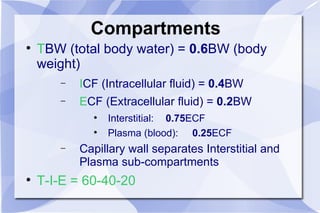
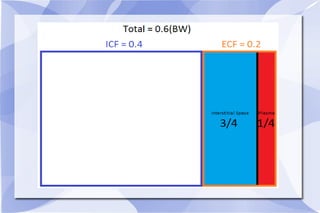
Compartments T BW (total body water) =  0.6 BW (body weight) I CF (Intracellular fluid) =  0.4 BW E CF (Extracellular fluid) =  0.2 BW Interstitial: 0.75 ECF Plasma (blood):   0.25 ECF Capillary wall separates Interstitial and Plasma sub-compartments T-I-E = 60-40-20
 
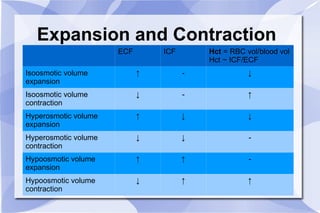
Expansion and Contraction ECF ICF Hct  = RBC vol/blood vol Hct ~ ICF/ECF Isoosmotic volume expansion ↑ - ↓ Isoosmotic volume contraction ↓ - ↑ Hyperosmotic volume expansion ↑ ↓ ↓ Hyperosmotic volume contraction ↓ ↓ - Hypoosmotic volume expansion ↑ ↑ - Hypoosmotic volume contraction ↓ ↑ ↑
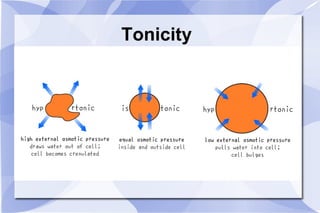
Tonicity
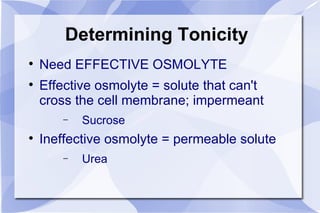
Determining Tonicity Need EFFECTIVE OSMOLYTE Effective osmolyte = solute that can't cross the cell membrane; impermeant Sucrose Ineffective osmolyte = permeable solute Urea
π = σ(nCRT) π =  Osmotic pressure σ  = reflection coefficient (0-1) 0 = ineffective osmolyte 1 = impermeant N = dissociable particles C = total [solute] R = gas constant T = Kelvin Determining Tonicity
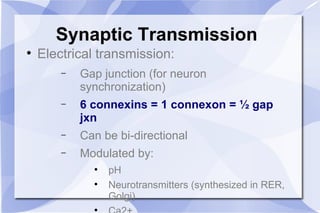
Synaptic Transmission Electrical transmission: Gap junction (for neuron synchronization) 6 connexins = 1 connexon = ½ gap jxn Can be bi-directional Modulated by: pH Neurotransmitters (synthesized in RER, Golgi) Ca2+
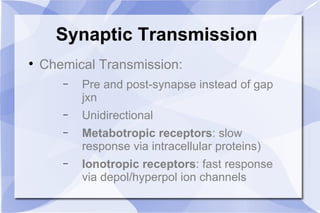
Synaptic Transmission Chemical Transmission: Pre and post-synapse instead of gap jxn Unidirectional Metabotropic receptors : slow response via intracellular proteins) Ionotropic receptors : fast response via depol/hyperpol ion channels
Major Neurotransmitters Acetylcholine (Ach) Excitatory : Glutamate Inhibitory : GABA and Glycine (in vesicles) Amines: Dopamine Norepinephrine/Epinephrine Histamine Seratonin
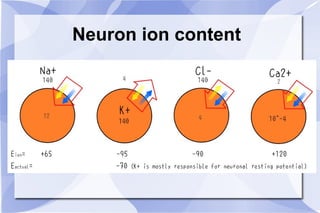
Neuron ion content
Depolarization/Action Potential Gates: M-gate = activation gate H-gate = inactivation gate (plug) N-gate = slow-closing K+ channel Temporal/Spatial Summation -> Threshold EPSP depolarization (Na+) IPSP hyperpolarization (Cl-) At resting state: M-gate closed, H and N-gates open Depolarization: All gates open Repolarization: H-gates close After absolute refractory period: All gates closed
Love, Julie  and  Jenesha

Physio1: Week 1

  • 1.
    Semester 1: PhysiologyBody Fluid Compartments and Introduction to Action Potentials Week 1
  • 2.
    Contact us: Julie: [email_address] Jenesha: [email_address]
  • 3.
    Compartments T BW(total body water) = 0.6 BW (body weight) I CF (Intracellular fluid) = 0.4 BW E CF (Extracellular fluid) = 0.2 BW Interstitial: 0.75 ECF Plasma (blood): 0.25 ECF Capillary wall separates Interstitial and Plasma sub-compartments T-I-E = 60-40-20
  • 4.
  • 5.
    Expansion and ContractionECF ICF Hct = RBC vol/blood vol Hct ~ ICF/ECF Isoosmotic volume expansion ↑ - ↓ Isoosmotic volume contraction ↓ - ↑ Hyperosmotic volume expansion ↑ ↓ ↓ Hyperosmotic volume contraction ↓ ↓ - Hypoosmotic volume expansion ↑ ↑ - Hypoosmotic volume contraction ↓ ↑ ↑
  • 6.
  • 7.
    Determining Tonicity NeedEFFECTIVE OSMOLYTE Effective osmolyte = solute that can't cross the cell membrane; impermeant Sucrose Ineffective osmolyte = permeable solute Urea
  • 8.
    π = σ(nCRT)π = Osmotic pressure σ = reflection coefficient (0-1) 0 = ineffective osmolyte 1 = impermeant N = dissociable particles C = total [solute] R = gas constant T = Kelvin Determining Tonicity
  • 9.
    Synaptic Transmission Electricaltransmission: Gap junction (for neuron synchronization) 6 connexins = 1 connexon = ½ gap jxn Can be bi-directional Modulated by: pH Neurotransmitters (synthesized in RER, Golgi) Ca2+
  • 10.
    Synaptic Transmission ChemicalTransmission: Pre and post-synapse instead of gap jxn Unidirectional Metabotropic receptors : slow response via intracellular proteins) Ionotropic receptors : fast response via depol/hyperpol ion channels
  • 11.
    Major Neurotransmitters Acetylcholine(Ach) Excitatory : Glutamate Inhibitory : GABA and Glycine (in vesicles) Amines: Dopamine Norepinephrine/Epinephrine Histamine Seratonin
  • 12.
  • 13.
    Depolarization/Action Potential Gates:M-gate = activation gate H-gate = inactivation gate (plug) N-gate = slow-closing K+ channel Temporal/Spatial Summation -> Threshold EPSP depolarization (Na+) IPSP hyperpolarization (Cl-) At resting state: M-gate closed, H and N-gates open Depolarization: All gates open Repolarization: H-gates close After absolute refractory period: All gates closed
  • 14.
    Love, Julie and Jenesha