Non-Invasive Guided GDT
Suraphong Lorsomradee, MD.,PhD.
Associate Professor, Division of Cardiac Anesthesia,
Chiang Mai University Hospital
THAILAND
GDT EducASIA: Simple Bedside Monitor
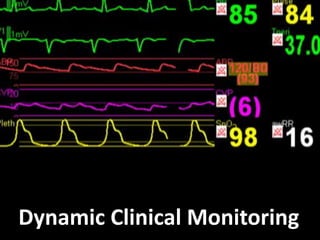
Dynamic Clinical Monitoring
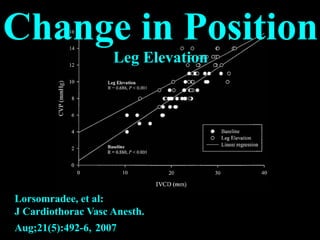
Lorsomradee, et al:
J Cardiothorac Vasc Anesth.
Aug;21(5):492-6, 2007
Change in Position
Leg Elevation
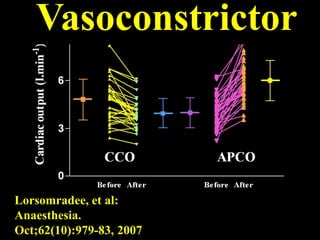
Lorsomradee, et al:
Anaesthesia.
Oct;62(10):979-83, 2007
Vasoconstrictor
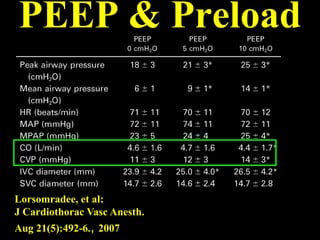
PEEP & Preload
Lorsomradee, et al:
J Cardiothorac Vasc Anesth.
Aug 21(5):492-6., 2007
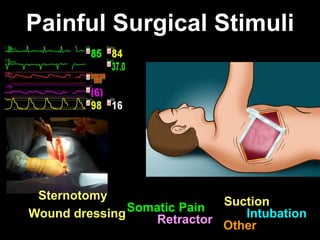
Painful Surgical Stimuli
Sternotomy SuctionSomatic PainWound dressing IntubationRetractor Other
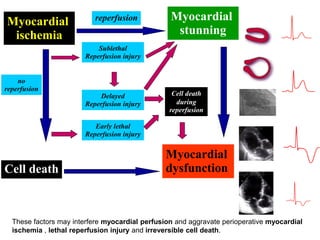
Myocardial
ischemia
Cell death
Myocardial
dysfunction
Myocardial
stunning
reperfusion
no
reperfusion
Sublethal
Reperfusion injury
Delayed
Reperfusion injury
Early lethal
Reperfusion injury
Cell death
during
reperfusion
These factors may interfere myocardial perfusion and aggravate perioperative myocardial
ischemia , lethal reperfusion injury and irreversible cell death.
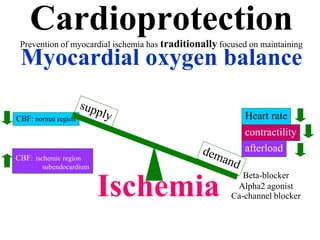
CardioprotectionPrevention of myocardial ischemia has traditionally focused on maintaining
Myocardial oxygen balance
Heart rate
contractility
afterload
CBF: normal region
CBF: ischemic region
subendocardium
Ischemia
Beta-blocker
Alpha2 agonist
Ca-channel blocker
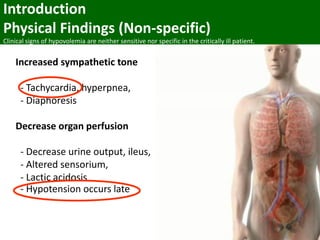
Introduction
Physical Findings (Non-specific)
Clinical signs of hypovolemia are neither sensitive nor specific in the critically ill patient.
Increased sympathetic tone
- Tachycardia, hyperpnea,
- Diaphoresis
Decrease organ perfusion
- Decrease urine output, ileus,
- Altered sensorium,
- Lactic acidosis
- Hypotension occurs late
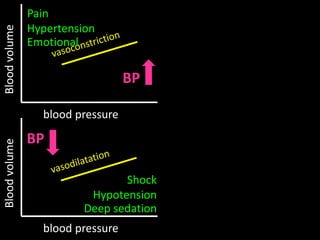
blood pressure
Bloodvolume
blood pressure
Bloodvolume Pain
Hypertension
Emotional
Shock
Hypotension
Deep sedation
BP
BP
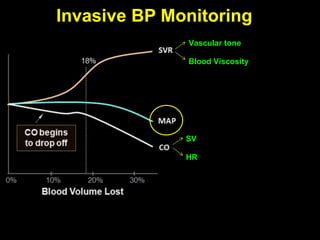
SV
HR
Vascular tone
Blood Viscosity
Invasive BP Monitoring
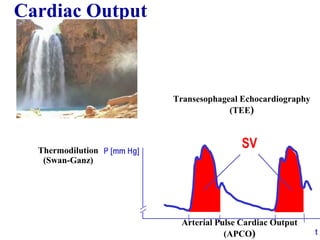
Arterial Pulse Cardiac Output
(APCO)
Transesophageal Echocardiography
(TEE)
Thermodilution
(Swan-Ganz)
Cardiac Output
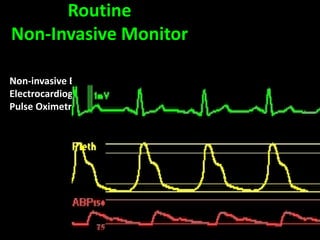
Non-invasive Blood Pressure (NIBP)
Electrocardiography (ECG)
Pulse Oximetry (SpO2)
Routine
Non-Invasive Monitor
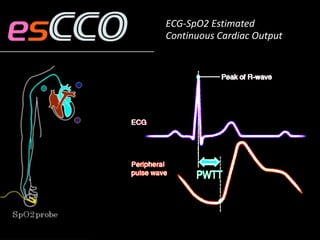
ECG-SpO2 Estimated
Continuous Cardiac Output
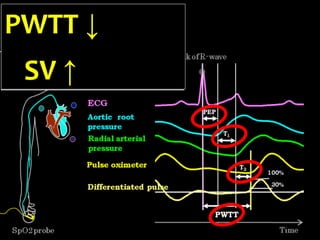
PEP(Pre-ejection Period)
Reflects cardiac contractility
PEP ↓ ⇒ SV ↑
PWTT1
Reflects Blood Pressure
PWTT1 ↓ ⇒ SV ↑
PWTT2
Reflects SVR
PWTT2 ↓ ⇒ SV ↑
PWTT ↓
SV ↑
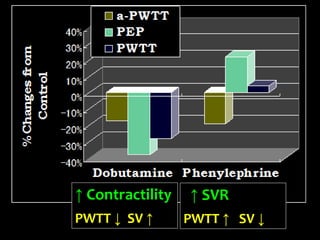
↑ Contractility
PWTT ↓ SV ↑
↑ SVR
PWTT ↑ SV ↓
Inverse Correlation between PWTT and SV
-8
-6
-4
-2
0
2
4
-100 -80 -60 -40 -20 0 20 40 60 80 100
ΔPWTT[ms]
ΔSV[cc]
y=-0.0511*x-0.876
r=-0.71(p<0.001)
n=560
Animal Experiment: Correlation between
the change of PWTT and SV since the
starting time (Sugo. et. al. IEEE, 1998)
Positive inotropic:
Dobutamine
Negative inotropic:
Propranolol/pentobarbital
Vasoconstriction:
Phenylephrine
Vasodilation:
Nitroglycerin
Hypovolemia:
Removal/ transfusion of blood
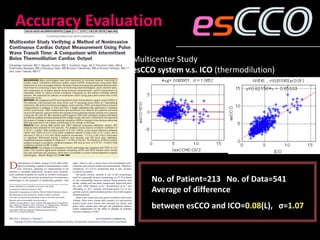
Accuracy Evaluation
Multicenter Study
esCCO system v.s. ICO (thermodilution)
No. of Patient=213 No. of Data=541
Average of difference
between esCCO and ICO=0.08(L), σ=1.07
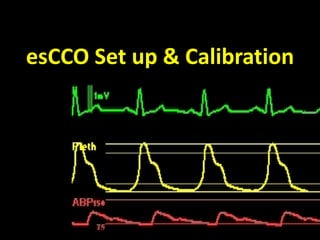
esCCO Set up & Calibration
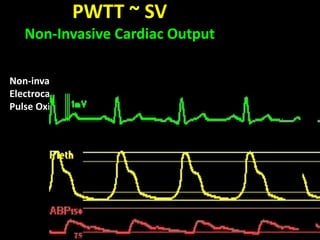
Non-invasive Blood Pressure (NIBP)
Electrocardiography (ECG)
Pulse Oximetry (SpO2)
PWTT ~ SV
Non-Invasive Cardiac Output
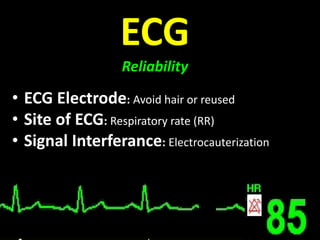
• ECG Electrode: Avoid hair or reused
• Site of ECG: Respiratory rate (RR)
• Signal Interferance: Electrocauterization
ECG
Reliability
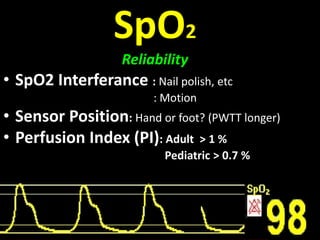
SpO2
Reliability
• SpO2 Interferance : Nail polish, etc
: Motion
• Sensor Position: Hand or foot? (PWTT longer)
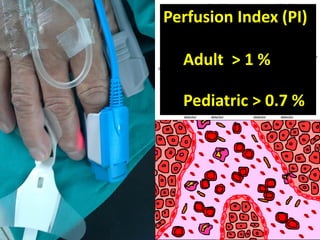
• Perfusion Index (PI): Adult > 1 %
Pediatric > 0.7 %
Perfusion Index (PI)
Adult > 1 %
Pediatric > 0.7 %
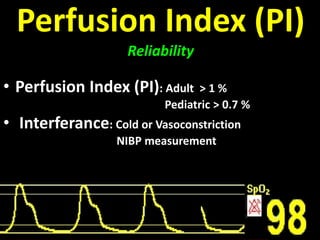
Perfusion Index (PI)
Reliability
• Perfusion Index (PI): Adult > 1 %
Pediatric > 0.7 %
• Interferance: Cold or Vasoconstriction
NIBP measurement
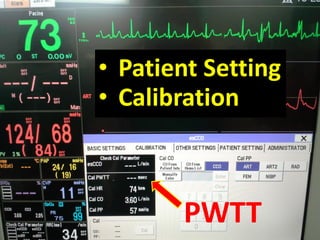
• Patient Setting
• Calibration
PWTT
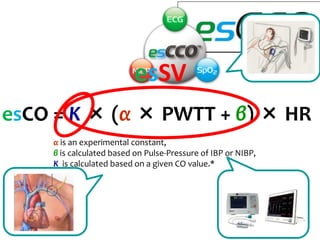
esCO = K × (α × PWTT + β) × HR
α is an experimental constant,
β is calculated based on Pulse-Pressure of IBP or NIBP,
K is calculated based on a given CO value.*
esSV
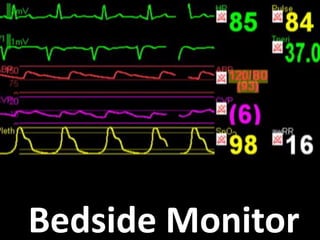
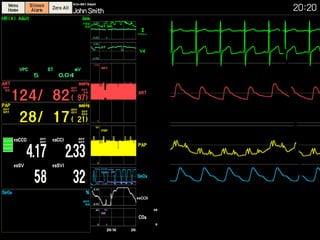
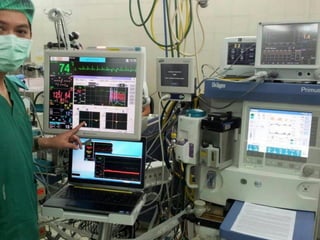
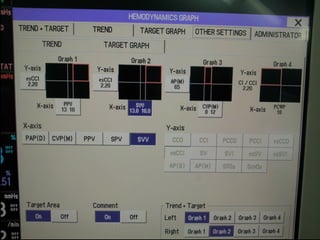
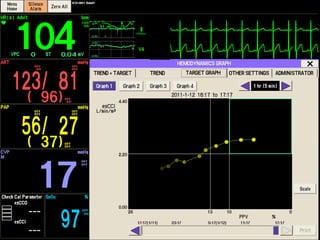
Bedside Monitor
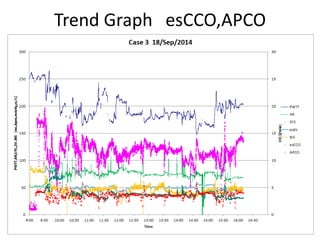
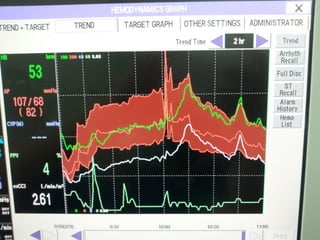
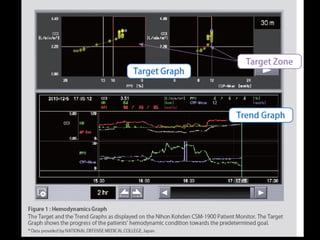
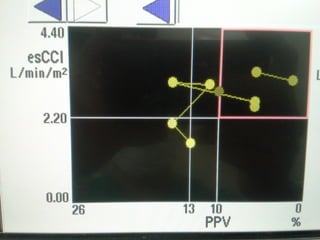
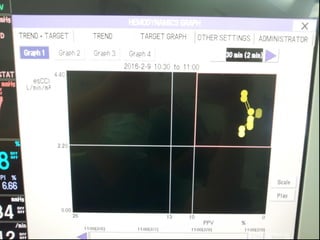
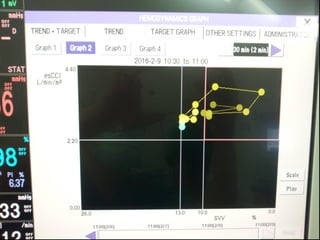
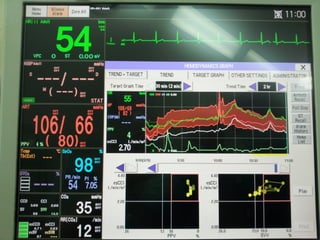
Trend Graph esCCO,APCO
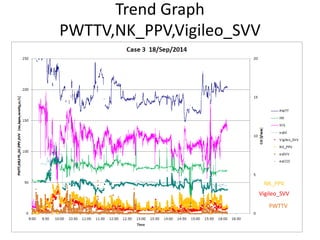
Trend Graph
PWTTV,NK_PPV,Vigileo_SVV
NK_PPV
Vigileo_SVV
PWTTV
Tips and Tricks
Hemodynamic Monitoring
• Trend
• Change after intervention
• Titration
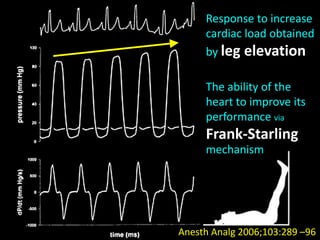
Response to increase
cardiac load obtained
by leg elevation
The ability of the
heart to improve its
performance via
Frank-Starling
mechanism
Anesth Analg 2006;103:289 –96
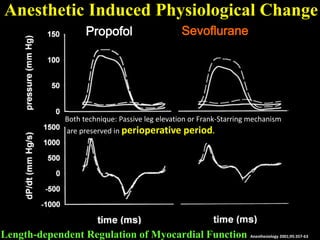
SevofluranePropofol
Anesthetic Induced Physiological Change
Length-dependent Regulation of Myocardial Function Anesthesiology 2001;95:357-63
Both technique: Passive leg elevation or Frank-Starring mechanism
are preserved in perioperative period.
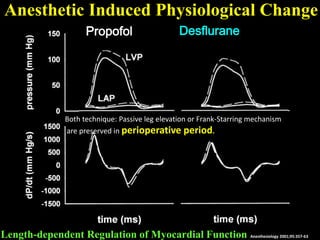
DesfluranePropofol
Anesthetic Induced Physiological Change
Length-dependent Regulation of Myocardial Function Anesthesiology 2001;95:357-63
Both technique: Passive leg elevation or Frank-Starring mechanism
are preserved in perioperative period.
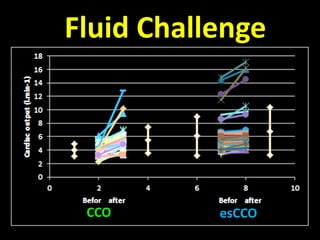
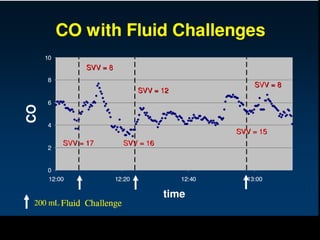
Fluid Challenge
CCO esCCO
“Fluid Challenge Test”
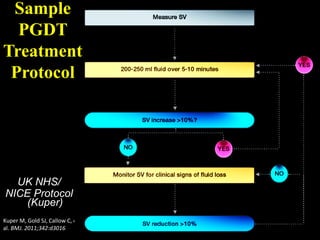
PGDT Treatment Protocol
UK NHS/
NICE Protocol
(Kuper)
Kuper M, Gold SJ, Callow C, et
al. BMJ. 2011;342:d3016.
Sample
PGDT
Treatment
Protocol
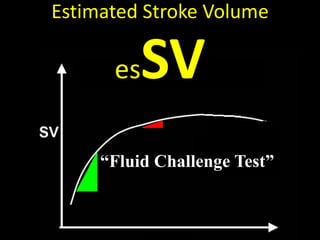
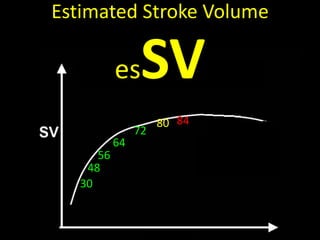
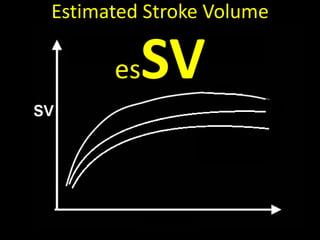
Estimated Stroke Volume
esSV
“Fluid Challenge Test”
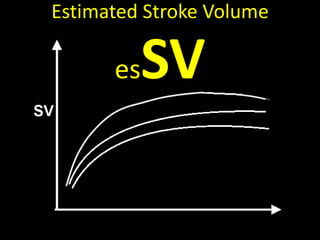
Estimated Stroke Volume
esSV
Estimated Stroke Volume
esSV
30
48
56
64
72
80 84
Estimated Stroke Volume
esSV
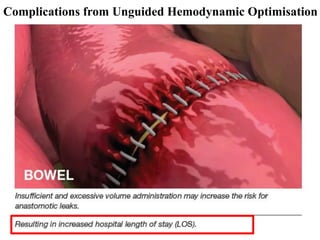
Complications from Unguided Hemodynamic Optimisation
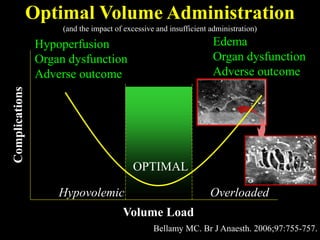
Bellamy MC. Br J Anaesth. 2006;97:755-757.
Complications
Volume Load
OPTIMAL
Edema
Organ dysfunction
Adverse outcome
Hypoperfusion
Organ dysfunction
Adverse outcome
OverloadedHypovolemic
Optimal Volume Administration
(and the impact of excessive and insufficient administration)
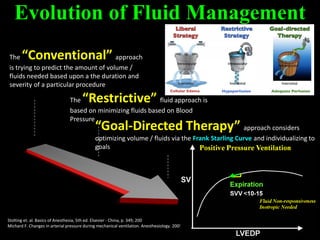
Evolution of Fluid Management
The “Conventional” approach
is trying to predict the amount of volume /
fluids needed based upon a the duration and
severity of a particular procedure
Stolting et. al. Basics of Anesthesia, 5th ed. Elsevier - China, p. 349, 200
Michard F. Changes in arterial pressure during mechanical ventilation. Anesthesiology. 2005; 103: 419-28 7
The “Restrictive” fluid approach is
based on minimizing fluids based on Blood
Pressure
“Goal-Directed Therapy” approach considers
optimizing volume / fluids via the Frank Starling Curve and individualizing to
goals
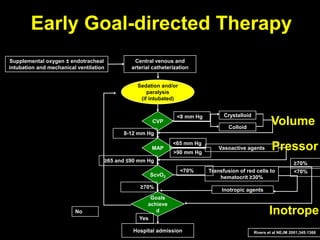
Early Goal-directed Therapy
Supplemental oxygen ± endotracheal
intubation and mechanical ventilation
Central venous and
arterial catheterization
CVP
Crystalloid
Colloid
<8 mm Hg
MAP
8-12 mm Hg
Vasoactive agents
<65 mm Hg
>90 mm Hg
ScvO2
≥65 and ≤90 mm Hg
Goals
achieve
d
≥70%
Hospital admission
Yes
No
Sedation and/or
paralysis
(if intubated)
Transfusion of red cells to
hematocrit ≥30%
<70%
Inotropic agents
<70%
≥70%
Rivers et al NEJM 2001;345:1368
Volume
Pressor
Inotrope
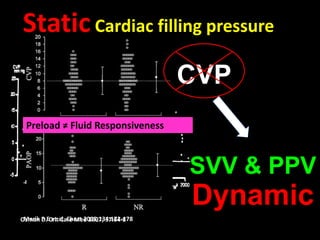
StaticCardiac filling pressure
Marik P E et al. Chest 2008;134:172-178Osman D. Crit Care Med 2007; 37:64-8
Preload ≠ Fluid Responsiveness
CVP
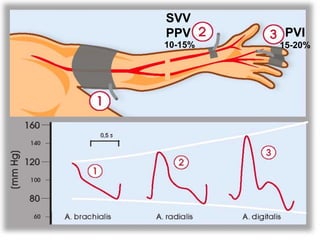
SVV & PPV
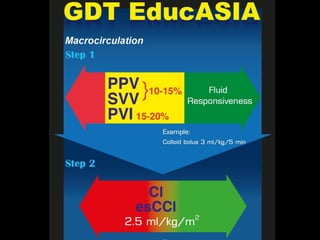
Dynamic
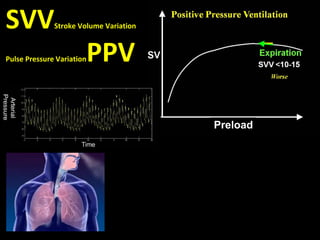
SVVStroke Volume Variation
Pulse Pressure VariationPPV
Preload
SVV
PPV
10-15%
PVI
15-20%
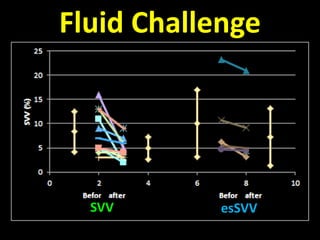
Fluid Challenge
SVV esSVV
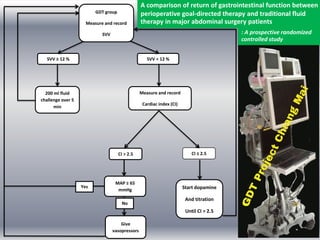
SVV ≥ 12 % SVV < 12 %
200 ml fluid
challenge over 5
min
Measure and record
Cardiac index (CI)
CI > 2.5 CI ≤ 2.5
Start dopamine
And titration
Until CI > 2.5
GDT group
Measure and record
SVV
Give
vasopressors
No
MAP ≥ 65
mmHg
Yes
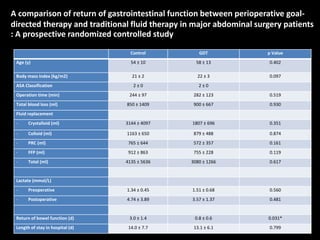
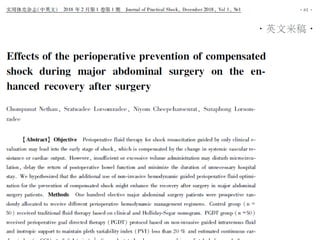
A comparison of return of gastrointestinal function between
perioperative goal-directed therapy and traditional fluid
therapy in major abdominal surgery patients
: A prospective randomized
controlled study
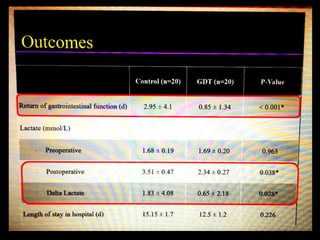
Control GDT p Value
Age (y) 54 ± 10 58 ± 13 0.402
Body mass index (kg/m2) 21 ± 2 22 ± 3 0.097
ASA Classification 2 ± 0 2 ± 0
Operation time (min) 244 ± 97 282 ± 123 0.519
Total blood loss (ml) 850 ± 1409 900 ± 667 0.930
Fluid replacement
- Crystalloid (ml) 3144 ± 4097 1807 ± 696 0.351
- Colloid (ml) 1163 ± 650 879 ± 488 0.874
- PRC (ml) 765 ± 644 572 ± 357 0.161
- FFP (ml) 912 ± 863 755 ± 228 0.119
- Total (ml) 4135 ± 5636 3080 ± 1266 0.617
Lactate (mmol/L)
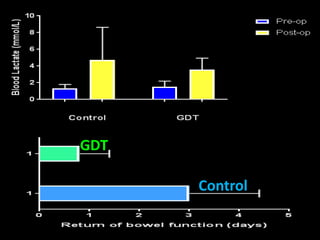
- Preoperative 1.34 ± 0.45 1.51 ± 0.68 0.560
- Postoperative 4.74 ± 3.89 3.57 ± 1.37 0.481
Return of bowel function (d) 3.0 ± 1.4 0.8 ± 0.6 0.031*
Length of stay in hospital (d) 14.0 ± 7.7 13.1 ± 6.1 0.799
A comparison of return of gastrointestinal function between perioperative goal-
directed therapy and traditional fluid therapy in major abdominal surgery patients
: A prospective randomized controlled study
Control
GDT
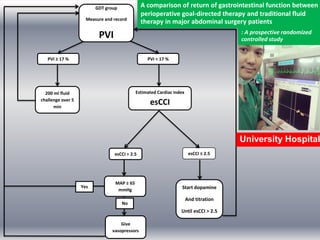
PVI ≥ 17 % PVI < 17 %
200 ml fluid
challenge over 5
min
Estimated Cardiac index
esCCI
esCCI > 2.5 esCCI ≤ 2.5
Start dopamine
And titration
Until esCCI > 2.5
GDT group
Measure and record
PVI
Give
vasopressors
No
MAP ≥ 65
mmHg
Yes
A comparison of return of gastrointestinal function between
perioperative goal-directed therapy and traditional fluid
therapy in major abdominal surgery patients
: A prospective randomized
controlled study
University Hospital
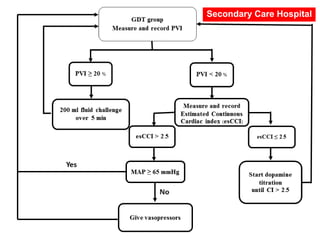
Control
PVI guided GDT
Secondary Care Hospital
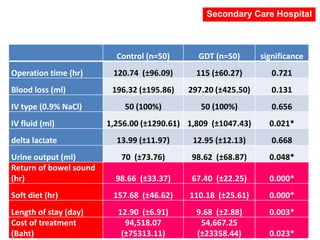
Control (n=50) GDT (n=50) significance
Operation time (hr) 120.74 (±96.09) 115 (±60.27) 0.721
Blood loss (ml) 196.32 (±195.86) 297.20 (±425.50) 0.131
IV type (0.9% NaCl) 50 (100%) 50 (100%) 0.656
IV fluid (ml) 1,256.00 (±1290.61) 1,809 (±1047.43) 0.021*
delta lactate 13.99 (±11.97) 12.95 (±12.13) 0.668
Urine output (ml) 70 (±73.76) 98.62 (±68.87) 0.048*
Return of bowel sound
(hr) 98.66 (±33.37) 67.40 (±22.25) 0.000*
Soft diet (hr) 157.68 (±46.62) 110.18 (±25.61) 0.000*
Length of stay (day) 12.90 (±6.91) 9.68 (±2.88) 0.003*
Cost of treatment
(Baht)
94,518.07
(±75313.11)
54,667.25
(±23358.44) 0.023*
Secondary Care Hospital
●
●●
●
●
●
●
●
●
●
●
●
= [(38 - 17) x 80] / 1.2
= 1400 dyn.s/cm5
SVR = [(MAP-CVP) x 80] / CO
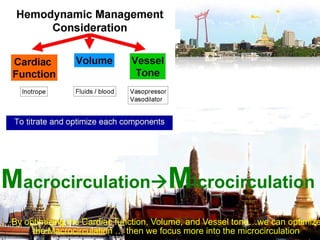
Cardiac
Output
Stroke Volume
Contractility
AfterloadPreload
Heart Rate
MacrocirculationMicrocirculation
By optimizing the Cardiac function, Volume, and Vessel tone…we can optimize
the Macrocirculation … then we focus more into the microcirculation
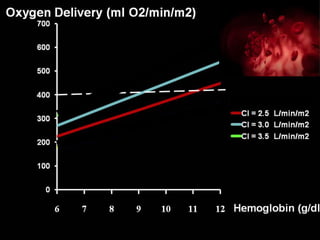
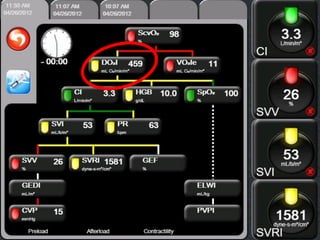
= [(1.39 x Hb x SaO2)+(0.003 x PaO2)] x CI x 10
= [(1.39 x 6.2 x 0.97)+(0.003 x 100)] x 2.3 x 10
= 199.1 ml O2/min/m2
DO2I = CaO2 x CI x 10
The End
Thank you for
your attention

Non invasive guided gdt

  • 1.
    Non-Invasive Guided GDT SuraphongLorsomradee, MD.,PhD. Associate Professor, Division of Cardiac Anesthesia, Chiang Mai University Hospital THAILAND GDT EducASIA: Simple Bedside Monitor
  • 2.
  • 3.
    Lorsomradee, et al: JCardiothorac Vasc Anesth. Aug;21(5):492-6, 2007 Change in Position Leg Elevation
  • 4.
  • 5.
    PEEP & Preload Lorsomradee,et al: J Cardiothorac Vasc Anesth. Aug 21(5):492-6., 2007
  • 6.
    Painful Surgical Stimuli SternotomySuctionSomatic PainWound dressing IntubationRetractor Other
  • 7.
    Myocardial ischemia Cell death Myocardial dysfunction Myocardial stunning reperfusion no reperfusion Sublethal Reperfusion injury Delayed Reperfusioninjury Early lethal Reperfusion injury Cell death during reperfusion These factors may interfere myocardial perfusion and aggravate perioperative myocardial ischemia , lethal reperfusion injury and irreversible cell death.
  • 8.
    CardioprotectionPrevention of myocardialischemia has traditionally focused on maintaining Myocardial oxygen balance Heart rate contractility afterload CBF: normal region CBF: ischemic region subendocardium Ischemia Beta-blocker Alpha2 agonist Ca-channel blocker
  • 9.
    Introduction Physical Findings (Non-specific) Clinicalsigns of hypovolemia are neither sensitive nor specific in the critically ill patient. Increased sympathetic tone - Tachycardia, hyperpnea, - Diaphoresis Decrease organ perfusion - Decrease urine output, ileus, - Altered sensorium, - Lactic acidosis - Hypotension occurs late
  • 10.
    blood pressure Bloodvolume blood pressure BloodvolumePain Hypertension Emotional Shock Hypotension Deep sedation BP BP
  • 11.
  • 12.
    Arterial Pulse CardiacOutput (APCO) Transesophageal Echocardiography (TEE) Thermodilution (Swan-Ganz) Cardiac Output
  • 13.
    Non-invasive Blood Pressure(NIBP) Electrocardiography (ECG) Pulse Oximetry (SpO2) Routine Non-Invasive Monitor
  • 14.
  • 15.
    PEP(Pre-ejection Period) Reflects cardiaccontractility PEP ↓ ⇒ SV ↑ PWTT1 Reflects Blood Pressure PWTT1 ↓ ⇒ SV ↑ PWTT2 Reflects SVR PWTT2 ↓ ⇒ SV ↑ PWTT ↓ SV ↑
  • 16.
    ↑ Contractility PWTT ↓SV ↑ ↑ SVR PWTT ↑ SV ↓
  • 17.
    Inverse Correlation betweenPWTT and SV -8 -6 -4 -2 0 2 4 -100 -80 -60 -40 -20 0 20 40 60 80 100 ΔPWTT[ms] ΔSV[cc] y=-0.0511*x-0.876 r=-0.71(p<0.001) n=560 Animal Experiment: Correlation between the change of PWTT and SV since the starting time (Sugo. et. al. IEEE, 1998) Positive inotropic: Dobutamine Negative inotropic: Propranolol/pentobarbital Vasoconstriction: Phenylephrine Vasodilation: Nitroglycerin Hypovolemia: Removal/ transfusion of blood
  • 18.
    Accuracy Evaluation Multicenter Study esCCOsystem v.s. ICO (thermodilution) No. of Patient=213 No. of Data=541 Average of difference between esCCO and ICO=0.08(L), σ=1.07
  • 19.
    esCCO Set up& Calibration
  • 20.
    Non-invasive Blood Pressure(NIBP) Electrocardiography (ECG) Pulse Oximetry (SpO2) PWTT ~ SV Non-Invasive Cardiac Output
  • 21.
    • ECG Electrode:Avoid hair or reused • Site of ECG: Respiratory rate (RR) • Signal Interferance: Electrocauterization ECG Reliability
  • 22.
    SpO2 Reliability • SpO2 Interferance: Nail polish, etc : Motion • Sensor Position: Hand or foot? (PWTT longer) • Perfusion Index (PI): Adult > 1 % Pediatric > 0.7 %
  • 23.
    Perfusion Index (PI) Adult> 1 % Pediatric > 0.7 %
  • 24.
    Perfusion Index (PI) Reliability •Perfusion Index (PI): Adult > 1 % Pediatric > 0.7 % • Interferance: Cold or Vasoconstriction NIBP measurement
  • 25.
    • Patient Setting •Calibration PWTT
  • 26.
    esCO = K× (α × PWTT + β) × HR α is an experimental constant, β is calculated based on Pulse-Pressure of IBP or NIBP, K is calculated based on a given CO value.* esSV
  • 27.
  • 29.
  • 30.
  • 31.
    Tips and Tricks HemodynamicMonitoring • Trend • Change after intervention • Titration
  • 32.
    Response to increase cardiacload obtained by leg elevation The ability of the heart to improve its performance via Frank-Starling mechanism Anesth Analg 2006;103:289 –96
  • 33.
    SevofluranePropofol Anesthetic Induced PhysiologicalChange Length-dependent Regulation of Myocardial Function Anesthesiology 2001;95:357-63 Both technique: Passive leg elevation or Frank-Starring mechanism are preserved in perioperative period.
  • 34.
    DesfluranePropofol Anesthetic Induced PhysiologicalChange Length-dependent Regulation of Myocardial Function Anesthesiology 2001;95:357-63 Both technique: Passive leg elevation or Frank-Starring mechanism are preserved in perioperative period.
  • 35.
  • 36.
  • 37.
    UK NHS/ NICE Protocol (Kuper) KuperM, Gold SJ, Callow C, et al. BMJ. 2011;342:d3016. Sample PGDT Treatment Protocol
  • 38.
  • 39.
  • 40.
  • 41.
  • 42.
    Complications from UnguidedHemodynamic Optimisation
  • 43.
    Bellamy MC. BrJ Anaesth. 2006;97:755-757. Complications Volume Load OPTIMAL Edema Organ dysfunction Adverse outcome Hypoperfusion Organ dysfunction Adverse outcome OverloadedHypovolemic Optimal Volume Administration (and the impact of excessive and insufficient administration)
  • 44.
    Evolution of FluidManagement The “Conventional” approach is trying to predict the amount of volume / fluids needed based upon a the duration and severity of a particular procedure Stolting et. al. Basics of Anesthesia, 5th ed. Elsevier - China, p. 349, 200 Michard F. Changes in arterial pressure during mechanical ventilation. Anesthesiology. 2005; 103: 419-28 7 The “Restrictive” fluid approach is based on minimizing fluids based on Blood Pressure “Goal-Directed Therapy” approach considers optimizing volume / fluids via the Frank Starling Curve and individualizing to goals
  • 45.
    Early Goal-directed Therapy Supplementaloxygen ± endotracheal intubation and mechanical ventilation Central venous and arterial catheterization CVP Crystalloid Colloid <8 mm Hg MAP 8-12 mm Hg Vasoactive agents <65 mm Hg >90 mm Hg ScvO2 ≥65 and ≤90 mm Hg Goals achieve d ≥70% Hospital admission Yes No Sedation and/or paralysis (if intubated) Transfusion of red cells to hematocrit ≥30% <70% Inotropic agents <70% ≥70% Rivers et al NEJM 2001;345:1368 Volume Pressor Inotrope
  • 46.
    StaticCardiac filling pressure MarikP E et al. Chest 2008;134:172-178Osman D. Crit Care Med 2007; 37:64-8 Preload ≠ Fluid Responsiveness CVP SVV & PPV Dynamic
  • 47.
    SVVStroke Volume Variation PulsePressure VariationPPV Preload
  • 48.
  • 49.
  • 51.
    SVV ≥ 12% SVV < 12 % 200 ml fluid challenge over 5 min Measure and record Cardiac index (CI) CI > 2.5 CI ≤ 2.5 Start dopamine And titration Until CI > 2.5 GDT group Measure and record SVV Give vasopressors No MAP ≥ 65 mmHg Yes A comparison of return of gastrointestinal function between perioperative goal-directed therapy and traditional fluid therapy in major abdominal surgery patients : A prospective randomized controlled study
  • 52.
    Control GDT pValue Age (y) 54 ± 10 58 ± 13 0.402 Body mass index (kg/m2) 21 ± 2 22 ± 3 0.097 ASA Classification 2 ± 0 2 ± 0 Operation time (min) 244 ± 97 282 ± 123 0.519 Total blood loss (ml) 850 ± 1409 900 ± 667 0.930 Fluid replacement - Crystalloid (ml) 3144 ± 4097 1807 ± 696 0.351 - Colloid (ml) 1163 ± 650 879 ± 488 0.874 - PRC (ml) 765 ± 644 572 ± 357 0.161 - FFP (ml) 912 ± 863 755 ± 228 0.119 - Total (ml) 4135 ± 5636 3080 ± 1266 0.617 Lactate (mmol/L) - Preoperative 1.34 ± 0.45 1.51 ± 0.68 0.560 - Postoperative 4.74 ± 3.89 3.57 ± 1.37 0.481 Return of bowel function (d) 3.0 ± 1.4 0.8 ± 0.6 0.031* Length of stay in hospital (d) 14.0 ± 7.7 13.1 ± 6.1 0.799 A comparison of return of gastrointestinal function between perioperative goal- directed therapy and traditional fluid therapy in major abdominal surgery patients : A prospective randomized controlled study
  • 53.
  • 62.
    PVI ≥ 17% PVI < 17 % 200 ml fluid challenge over 5 min Estimated Cardiac index esCCI esCCI > 2.5 esCCI ≤ 2.5 Start dopamine And titration Until esCCI > 2.5 GDT group Measure and record PVI Give vasopressors No MAP ≥ 65 mmHg Yes A comparison of return of gastrointestinal function between perioperative goal-directed therapy and traditional fluid therapy in major abdominal surgery patients : A prospective randomized controlled study University Hospital
  • 63.
  • 64.
  • 66.
    Control (n=50) GDT(n=50) significance Operation time (hr) 120.74 (±96.09) 115 (±60.27) 0.721 Blood loss (ml) 196.32 (±195.86) 297.20 (±425.50) 0.131 IV type (0.9% NaCl) 50 (100%) 50 (100%) 0.656 IV fluid (ml) 1,256.00 (±1290.61) 1,809 (±1047.43) 0.021* delta lactate 13.99 (±11.97) 12.95 (±12.13) 0.668 Urine output (ml) 70 (±73.76) 98.62 (±68.87) 0.048* Return of bowel sound (hr) 98.66 (±33.37) 67.40 (±22.25) 0.000* Soft diet (hr) 157.68 (±46.62) 110.18 (±25.61) 0.000* Length of stay (day) 12.90 (±6.91) 9.68 (±2.88) 0.003* Cost of treatment (Baht) 94,518.07 (±75313.11) 54,667.25 (±23358.44) 0.023* Secondary Care Hospital
  • 67.
    ● ●● ● ● ● ● ● ● ● ● ● = [(38 -17) x 80] / 1.2 = 1400 dyn.s/cm5 SVR = [(MAP-CVP) x 80] / CO
  • 69.
    Cardiac Output Stroke Volume Contractility AfterloadPreload Heart Rate MacrocirculationMicrocirculation Byoptimizing the Cardiac function, Volume, and Vessel tone…we can optimize the Macrocirculation … then we focus more into the microcirculation
  • 72.
    = [(1.39 xHb x SaO2)+(0.003 x PaO2)] x CI x 10 = [(1.39 x 6.2 x 0.97)+(0.003 x 100)] x 2.3 x 10 = 199.1 ml O2/min/m2 DO2I = CaO2 x CI x 10
  • 74.
    The End Thank youfor your attention