*for educational purposes only*
North America
last major prehistoric cultural development
AD 700
Over a great area of the Southeast and the mid-
continent
Intensive cultivation of corn, beans, squash, and
other crops
Politically & culturally each large town
*for educational purposes only*
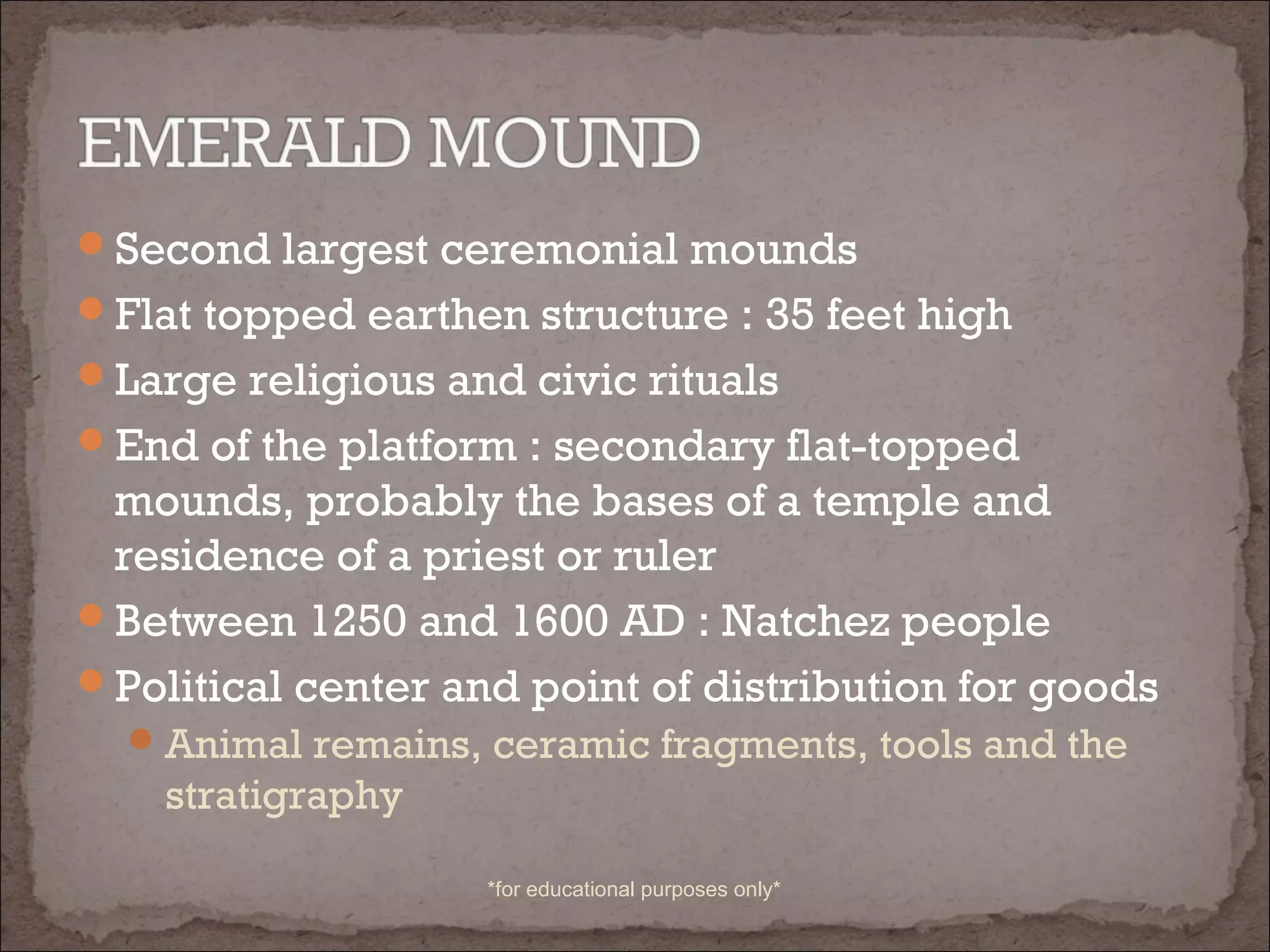
Second largest ceremonial mounds
Flat topped earthen structure : 35 feet high
Large religious and civic rituals
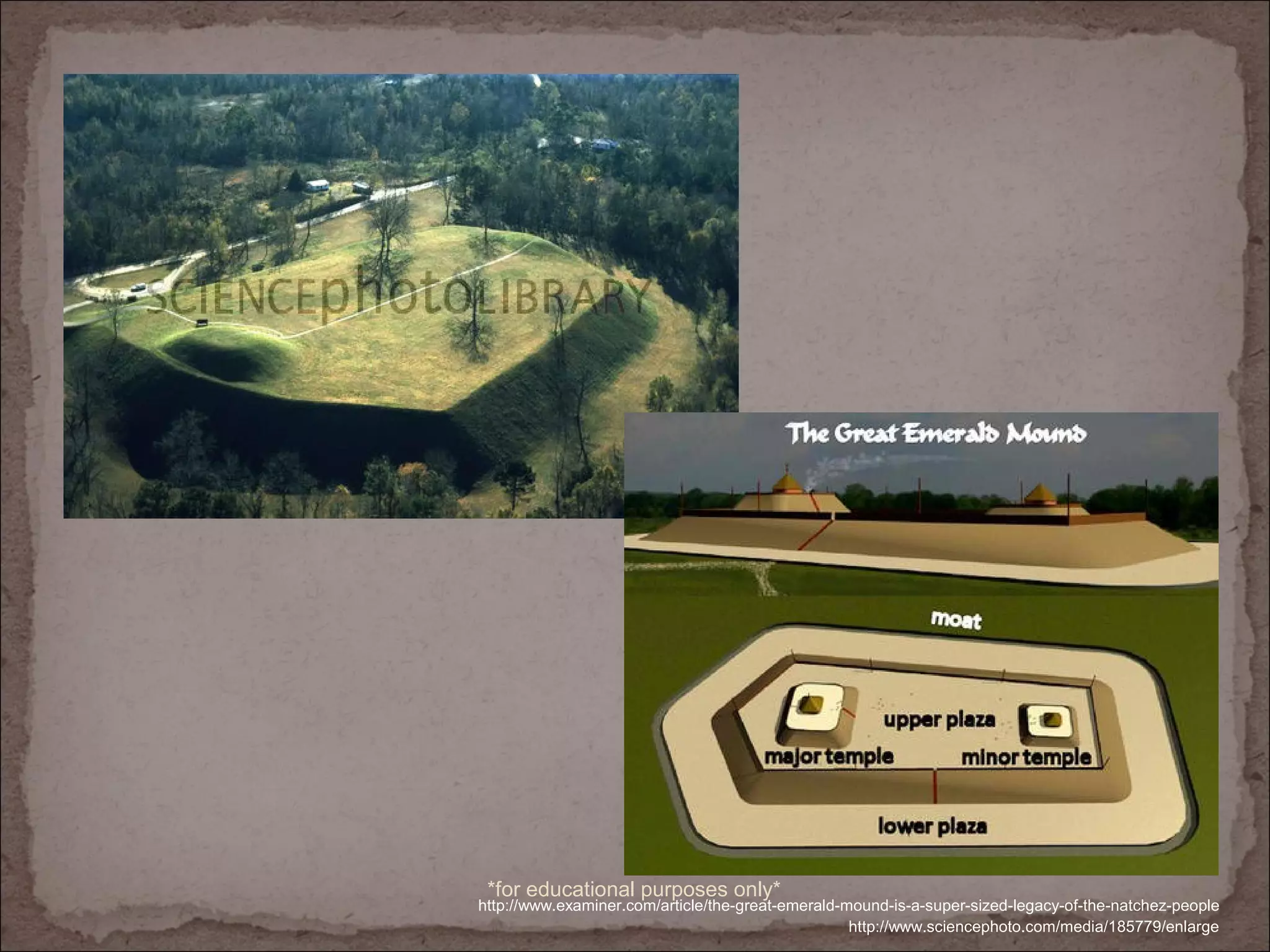
End of the platform : secondary flat-topped
mounds, probably the bases of a temple and
residence of a priest or ruler
Between 1250 and 1600 AD : Natchez people
Political center and point of distribution for goods
Animal remains, ceramic fragments, tools and the
stratigraphy
*for educational purposes only*
http://www.sciencephoto.com/media/185779/enlarge
http://www.examiner.com/article/the-great-emerald-mound-is-a-super-sized-legacy-of-the-natchez-people
*for educational purposes only*
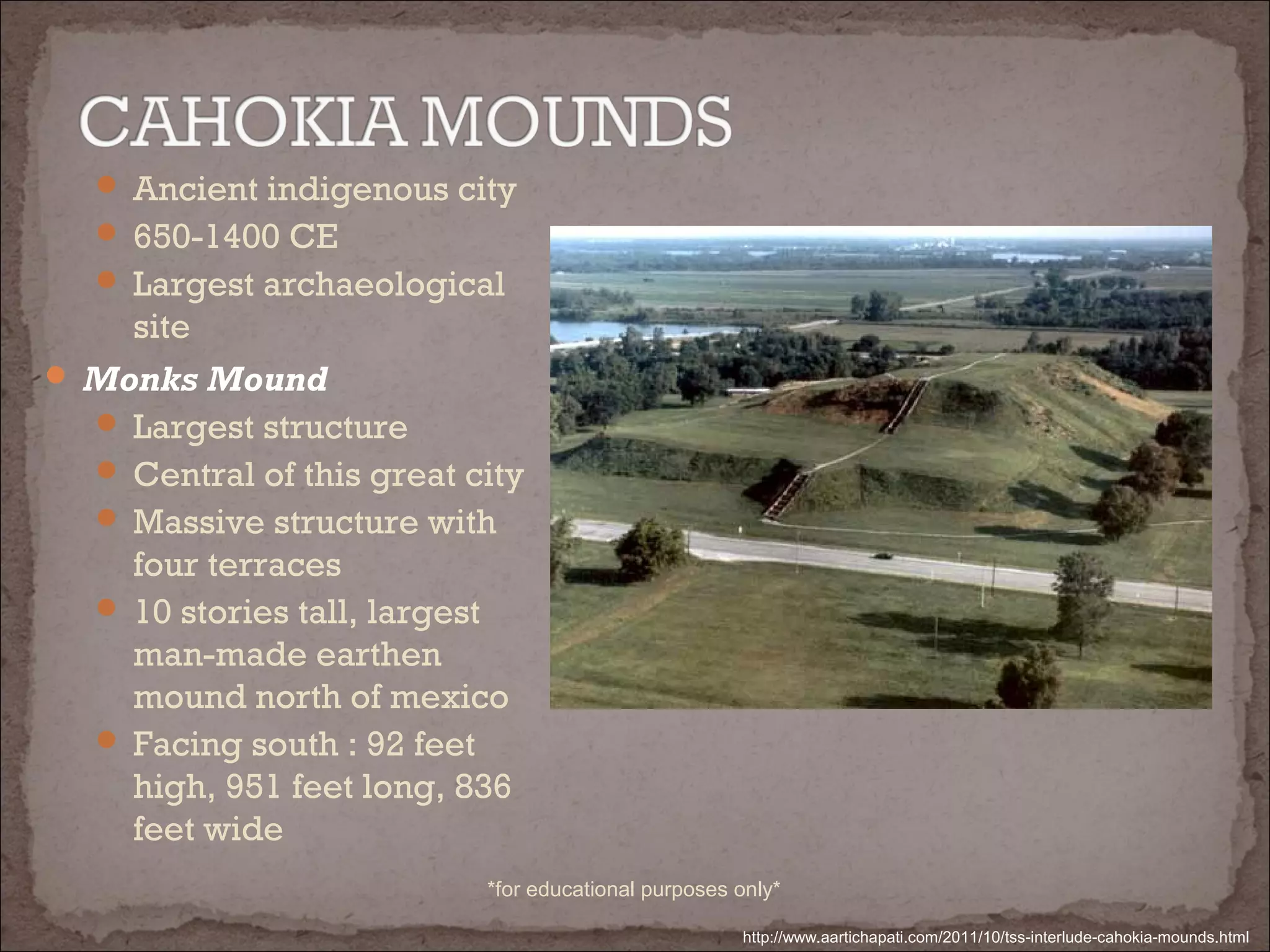
 Ancient indigenous city
 650-1400 CE
 Largest archaeological
site
 Monks Mound
 Largest structure
 Central of this great city
 Massive structure with
four terraces
 10 stories tall, largest
man-made earthen
mound north of mexico
 Facing south : 92 feet
high, 951 feet long, 836
feet wide
http://www.aartichapati.com/2011/10/tss-interlude-cahokia-mounds.html
*for educational purposes only*
Prehistoric archaelogical site
1650-700 BC northeastern louissiana
Core: 500 acres
Center of the site : six concentric curved earthen ridges
separated by flat corridors of earth
Dividing the ridges into 3 sections are 2 ramps that
slope inwardly leading to Bayou Macon.
Ridge : 3 feet high
Approx. diameter : 3 quarters of a mile
*for educational purposes only*
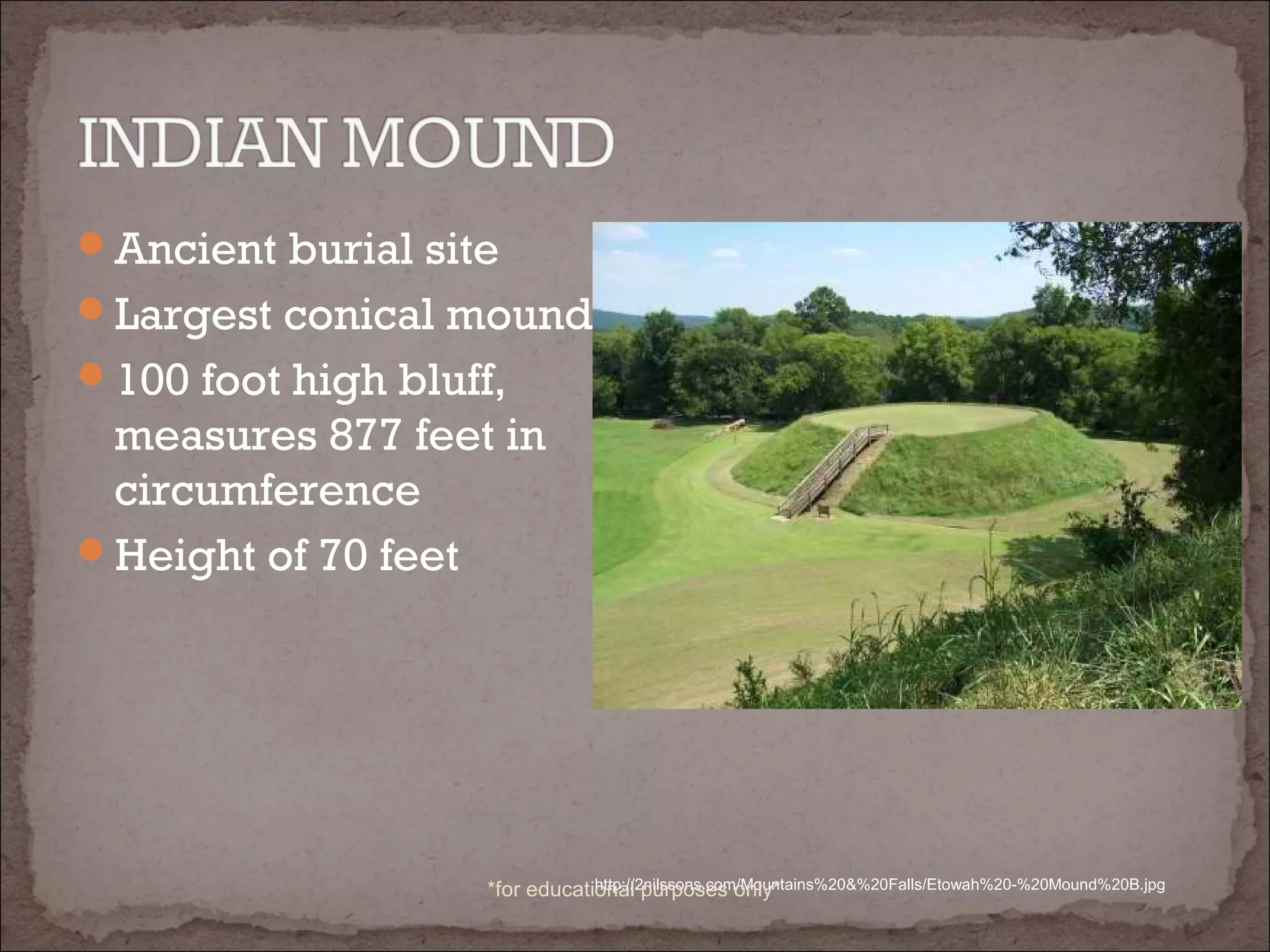
Ancient burial site
Largest conical mound
100 foot high bluff,
measures 877 feet in
circumference
Height of 70 feet
http://2nilssons.com/Mountains%20&%20Falls/Etowah%20-%20Mound%20B.jpg*for educational purposes only*
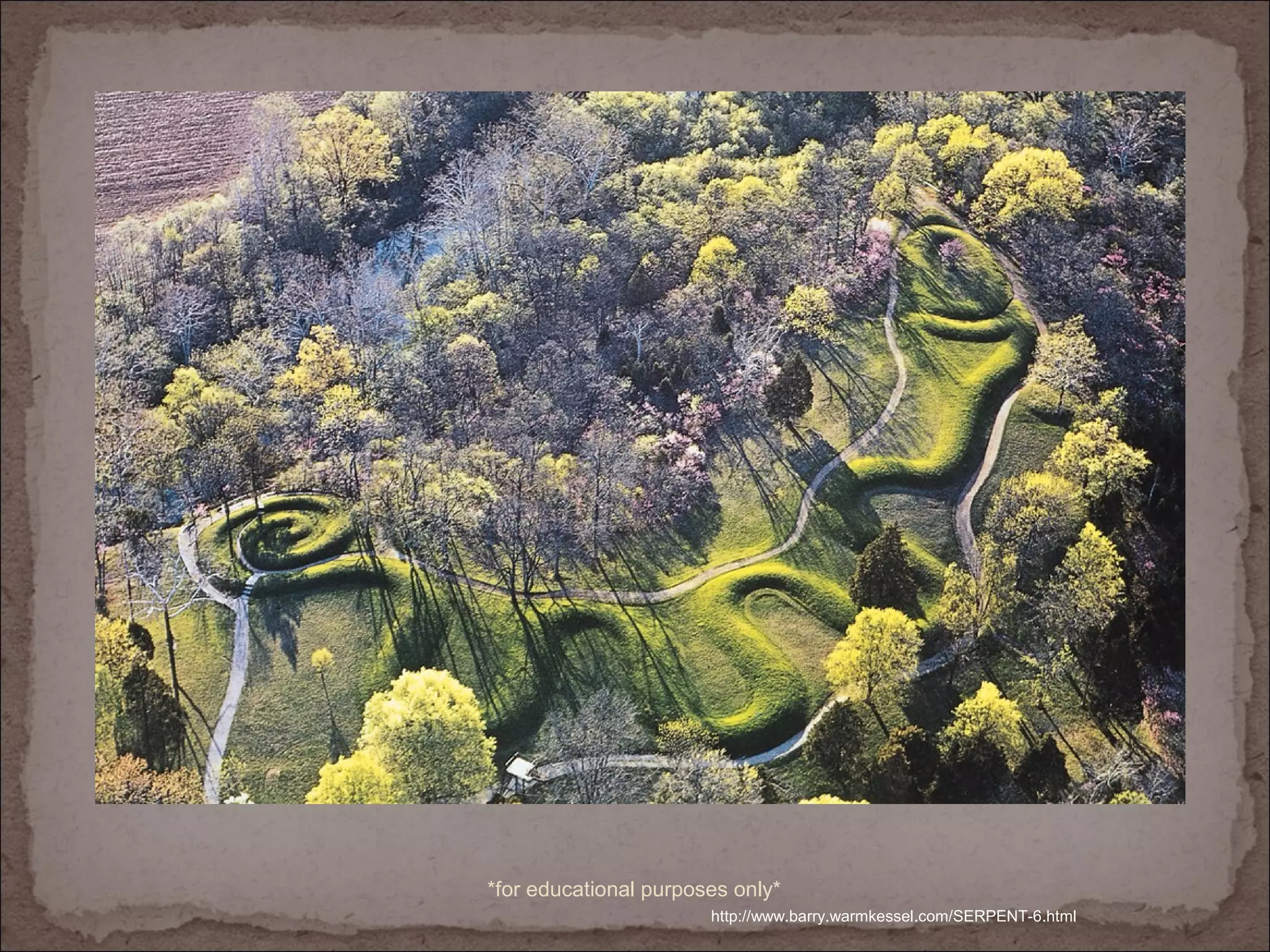
Largest effigy mound in the world
Does not contain human remains
1,330 feet in length, 3 feet in height
Head of the serpent : aligned to summer solstice
sunset
Coils : point to the winter solstice sunrise
Adena Indians (800 BC – AD 100)
*for educational purposes only*
http://www.barry.warmkessel.com/SERPENT-6.html
*for educational purposes only*
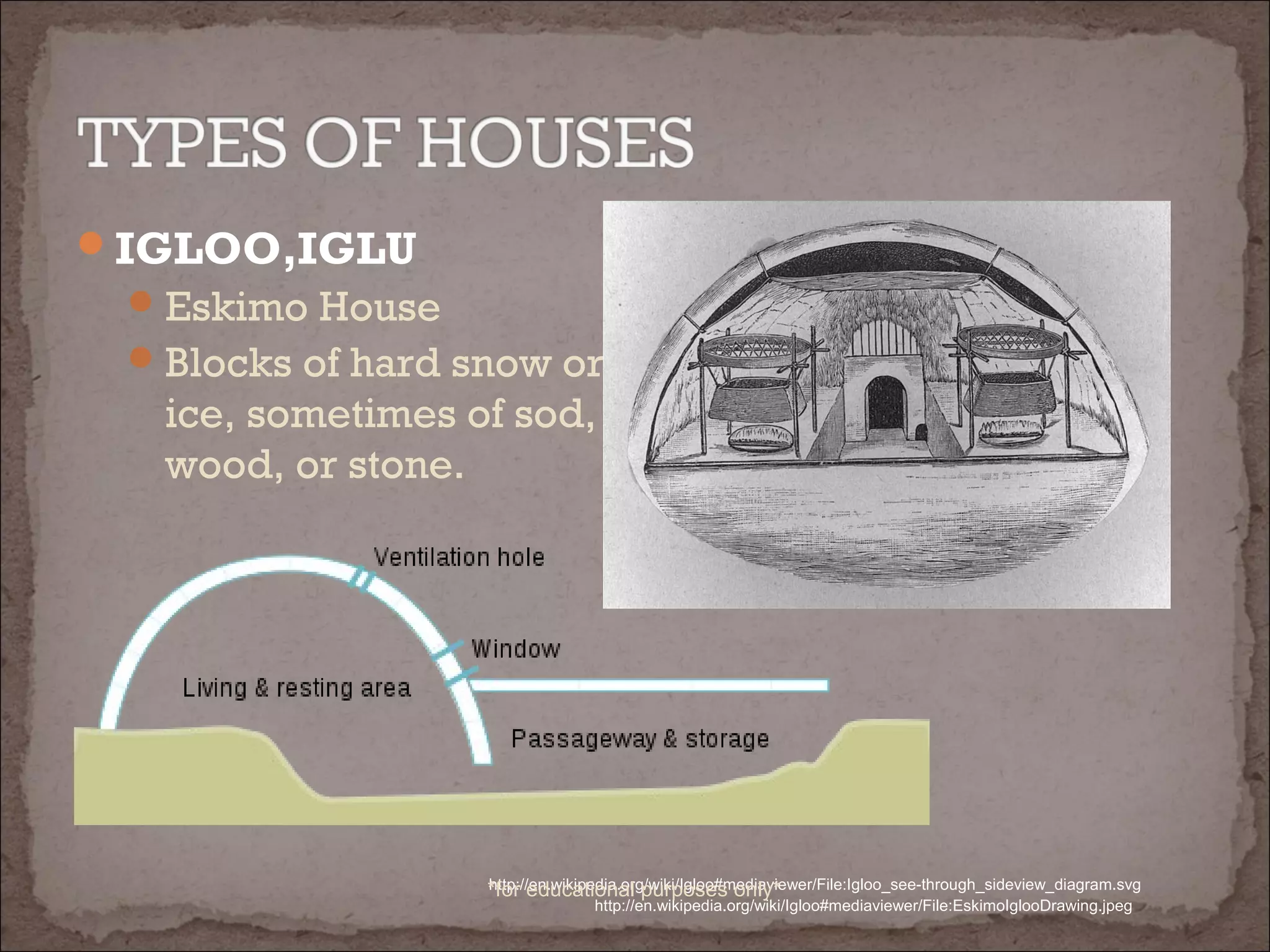
IGLOO,IGLU
Eskimo House
Blocks of hard snow or
ice, sometimes of sod,
wood, or stone.
http://en.wikipedia.org/wiki/Igloo#mediaviewer/File:EskimoIglooDrawing.jpeg
http://en.wikipedia.org/wiki/Igloo#mediaviewer/File:Igloo_see-through_sideview_diagram.svg*for educational purposes only*
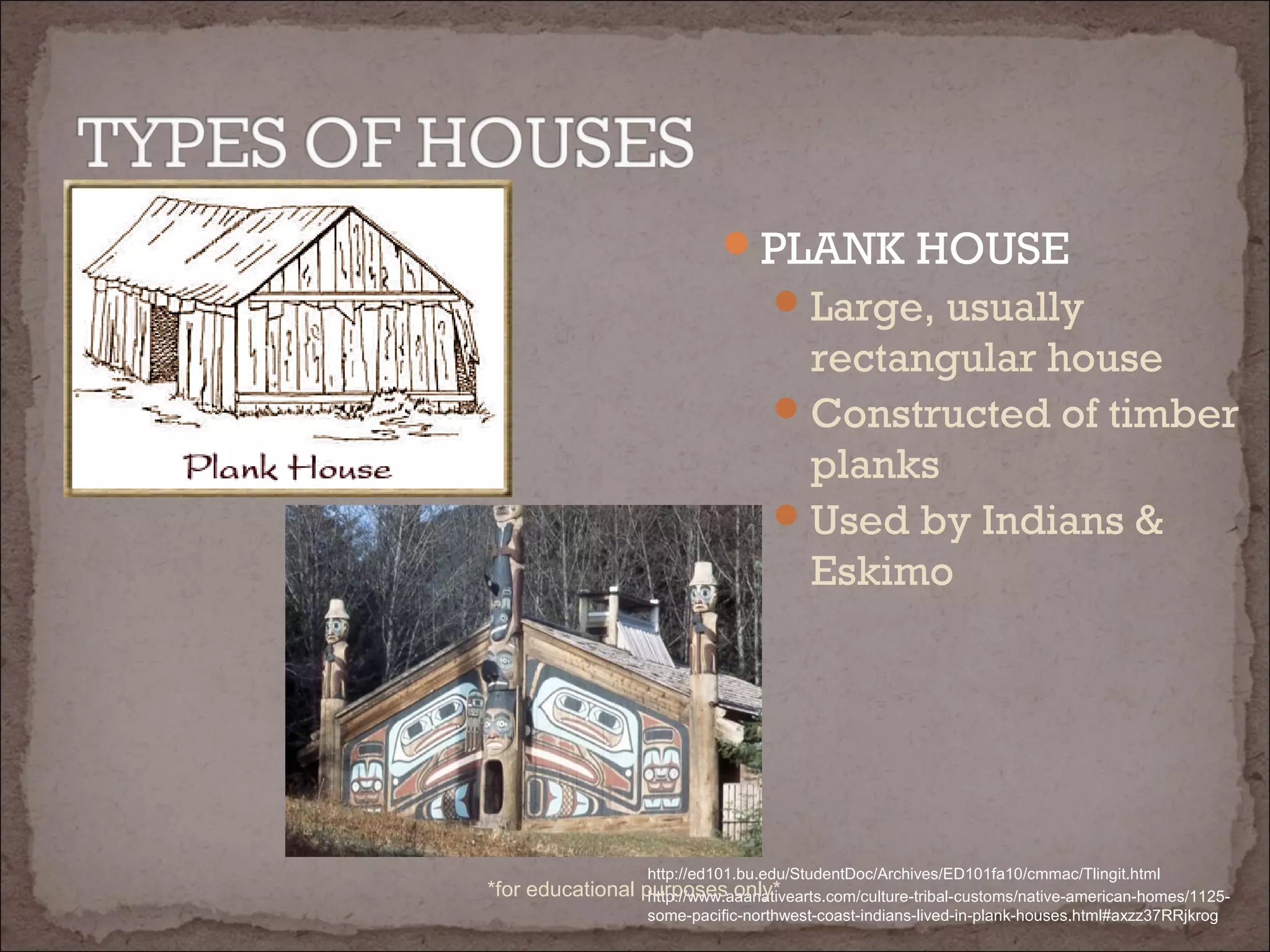
PLANK HOUSE
Large, usually
rectangular house
Constructed of timber
planks
Used by Indians &
Eskimo
http://www.aaanativearts.com/culture-tribal-customs/native-american-homes/1125-
some-pacific-northwest-coast-indians-lived-in-plank-houses.html#axzz37RRjkrog
http://ed101.bu.edu/StudentDoc/Archives/ED101fa10/cmmac/Tlingit.html
*for educational purposes only*
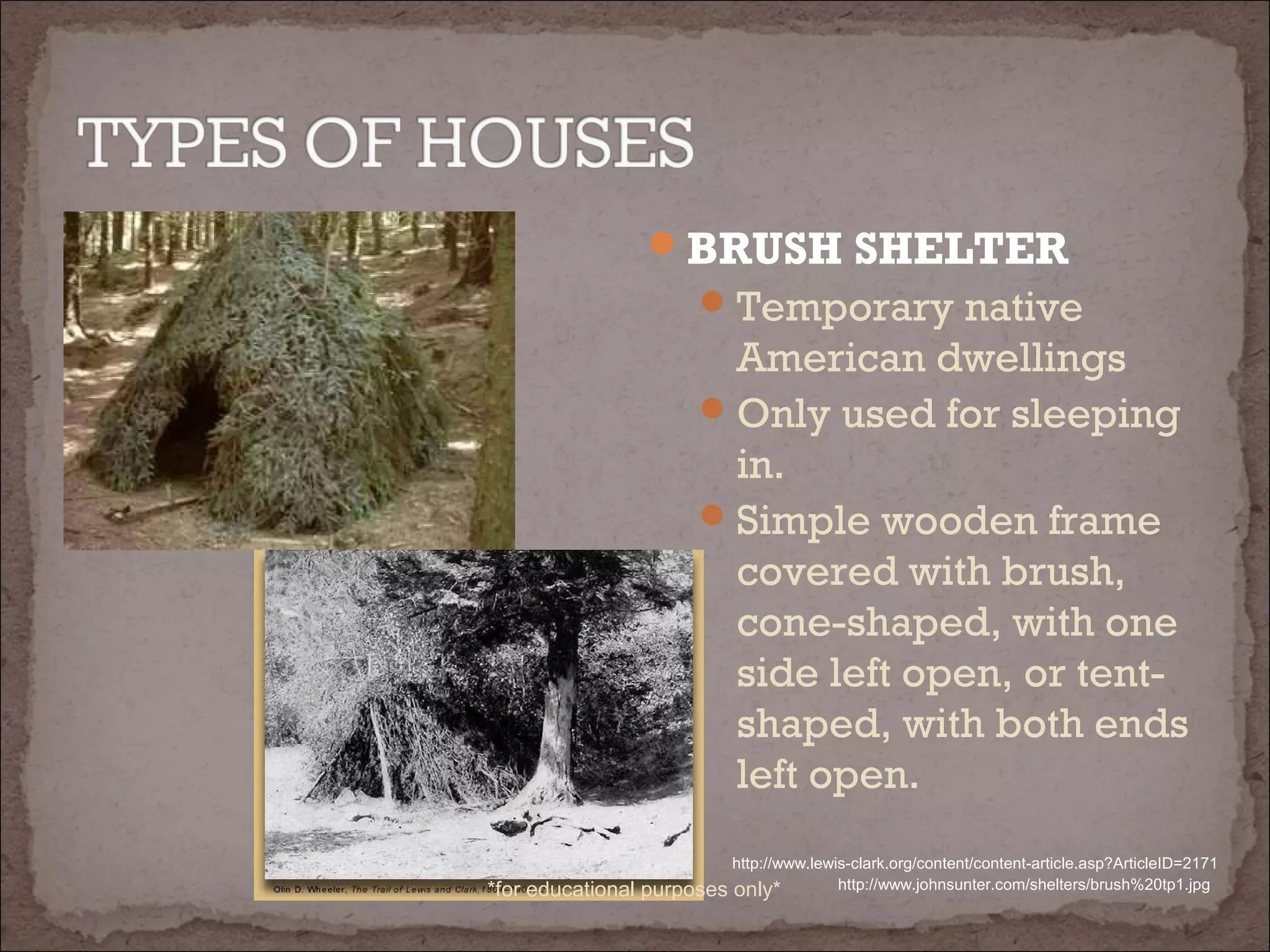
BRUSH SHELTER
Temporary native
American dwellings
Only used for sleeping
in.
Simple wooden frame
covered with brush,
cone-shaped, with one
side left open, or tent-
shaped, with both ends
left open.
http://www.johnsunter.com/shelters/brush%20tp1.jpg
http://www.lewis-clark.org/content/content-article.asp?ArticleID=2171
*for educational purposes only*
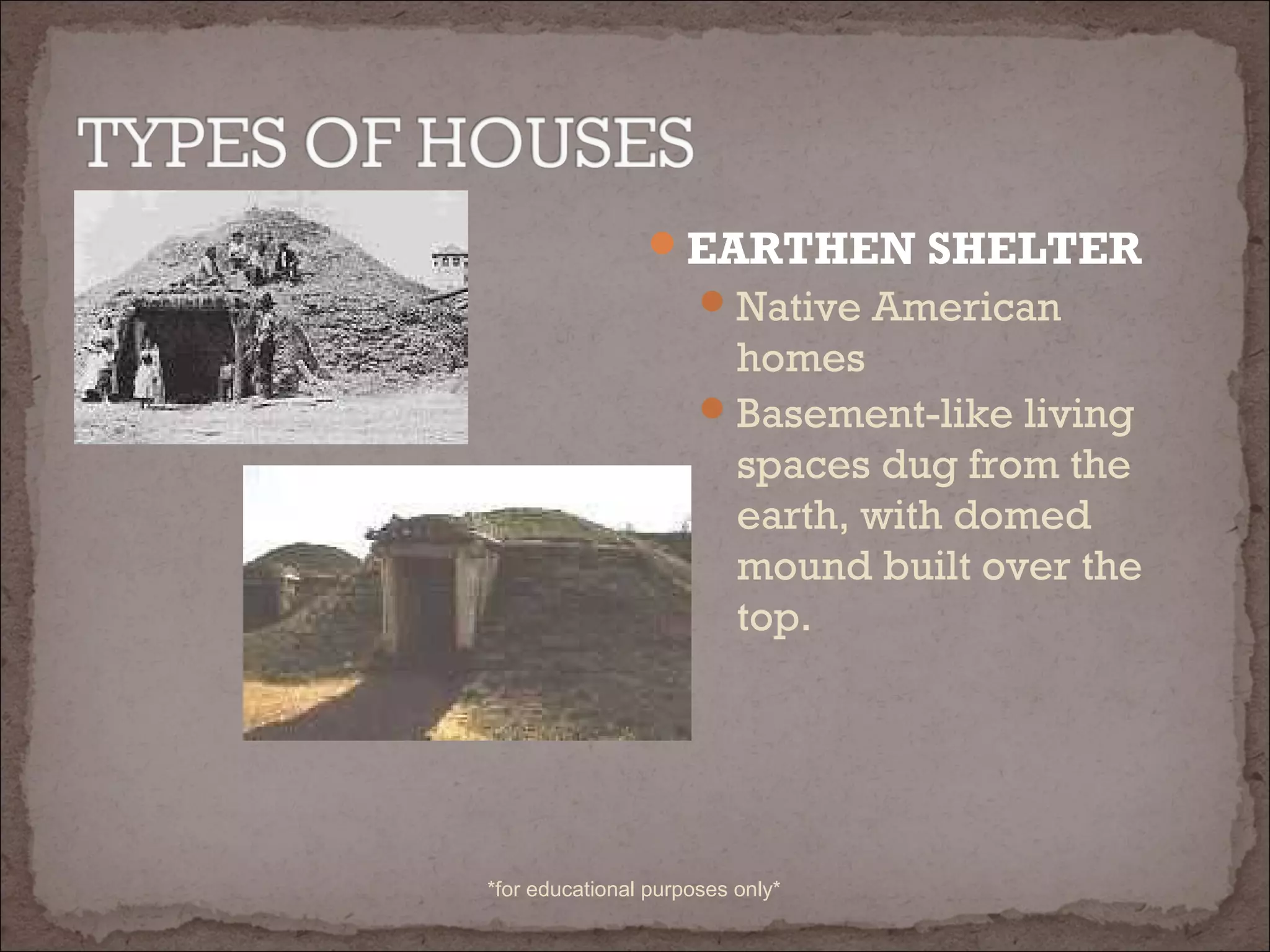
EARTHEN SHELTER
Native American
homes
Basement-like living
spaces dug from the
earth, with domed
mound built over the
top.
*for educational purposes only*
PUEBLO
 Communal and defensive
structure
 Built of adobe or stone
 Many-storied terraced
 Flat roofs of the chambers
by ladders
 Built on the desert floor in
valley, or cliff walls of
mesas.
KIVA
 Large underground
 Used by men for religious
ceremonies & councils
http://en.wikipedia.org/wiki/File:USA_09669_Taos_Pueblo_Luca_Galuzzi_2007.jpg
http://www.crowcanyon.org/educationproducts/peoples_mesa_verde/pueblo_I_overview.asp*for educational purposes only*
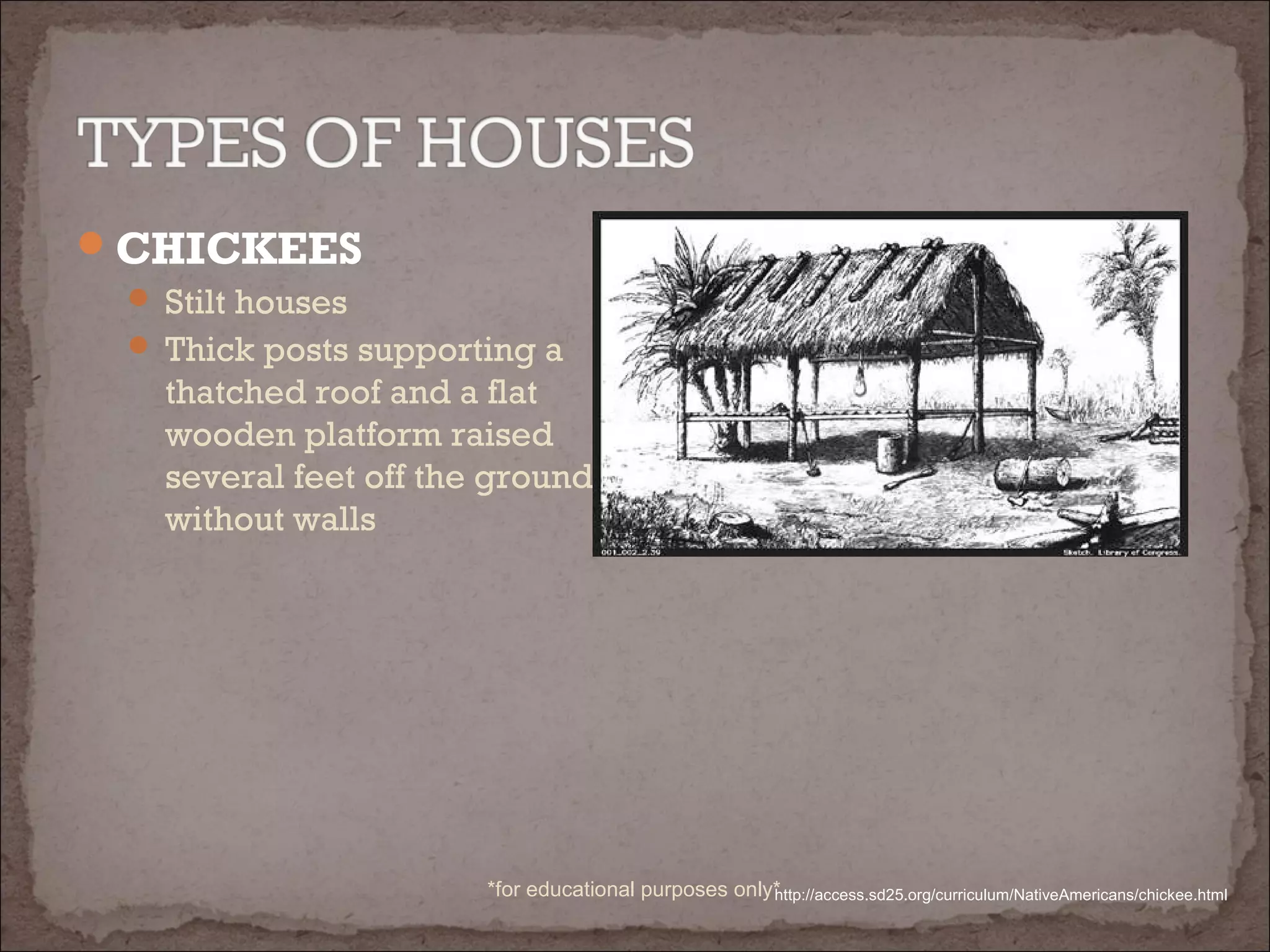
CHICKEES
 Stilt houses
 Thick posts supporting a
thatched roof and a flat
wooden platform raised
several feet off the ground
without walls
http://access.sd25.org/curriculum/NativeAmericans/chickee.html*for educational purposes only*
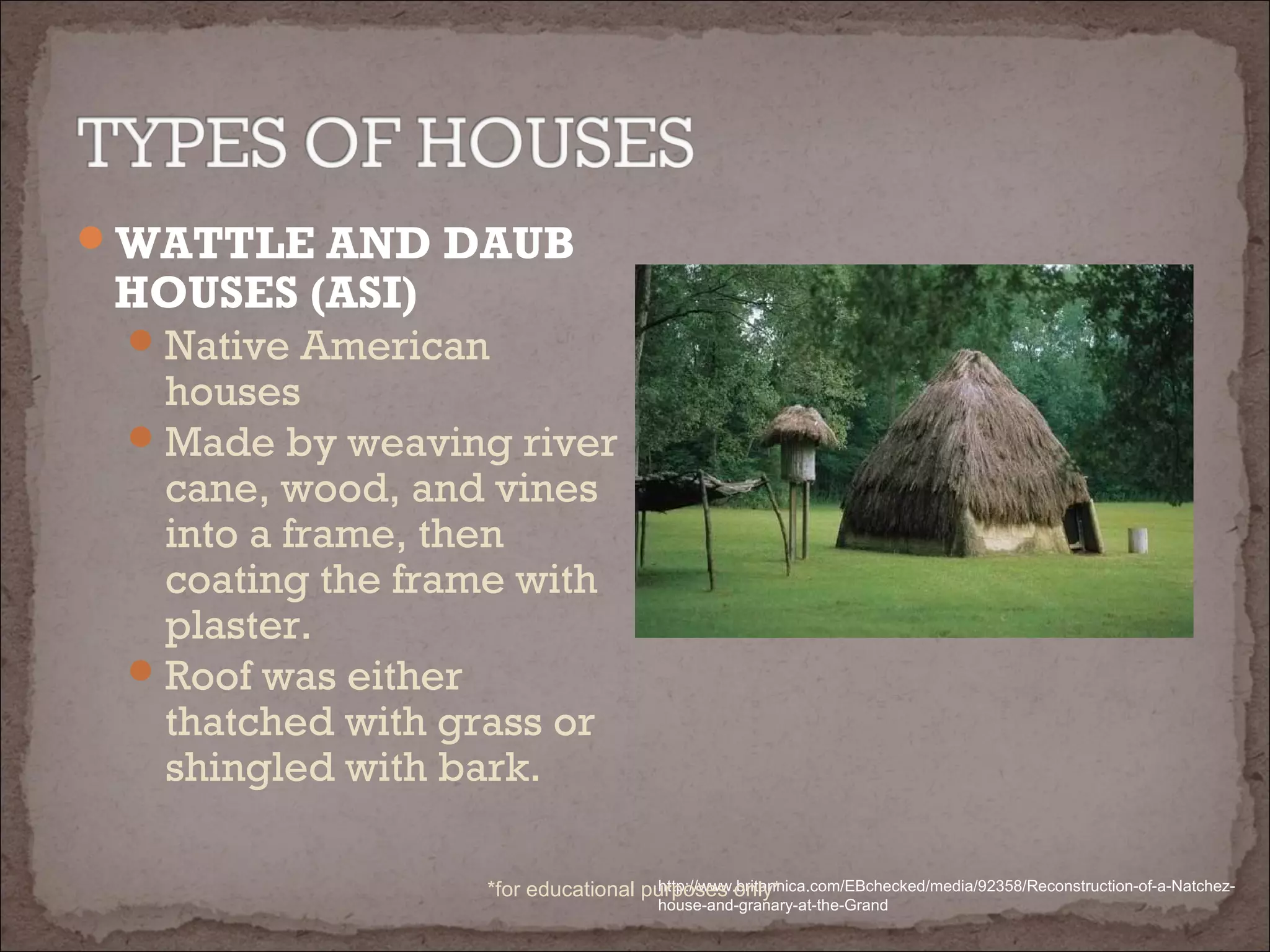
WATTLE AND DAUB
HOUSES (ASI)
Native American
houses
Made by weaving river
cane, wood, and vines
into a frame, then
coating the frame with
plaster.
Roof was either
thatched with grass or
shingled with bark.
http://www.britannica.com/EBchecked/media/92358/Reconstruction-of-a-Natchez-
house-and-granary-at-the-Grand
*for educational purposes only*
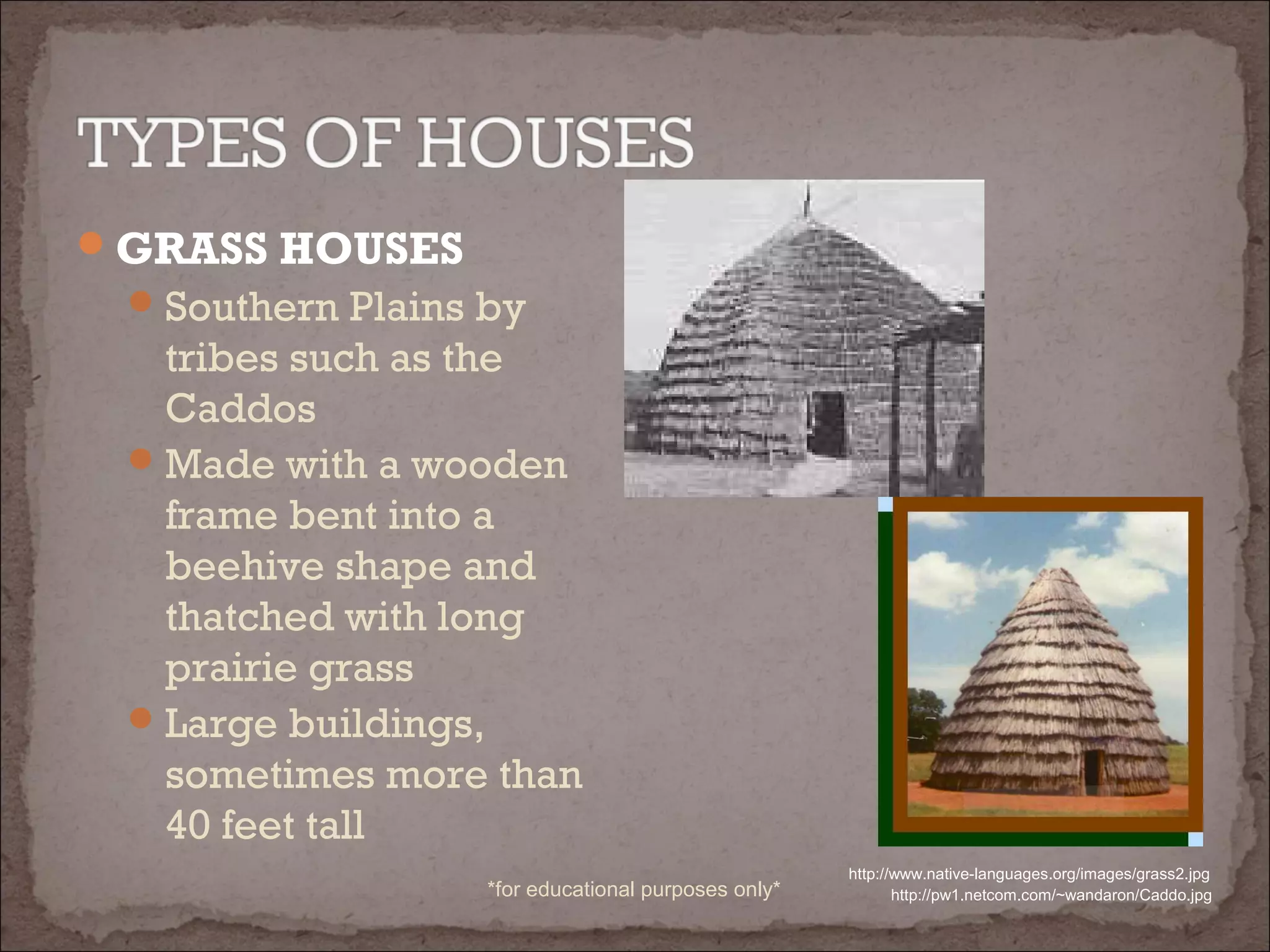
GRASS HOUSES
Southern Plains by
tribes such as the
Caddos
Made with a wooden
frame bent into a
beehive shape and
thatched with long
prairie grass
Large buildings,
sometimes more than
40 feet tall
http://www.native-languages.org/images/grass2.jpg
http://pw1.netcom.com/~wandaron/Caddo.jpg*for educational purposes only*
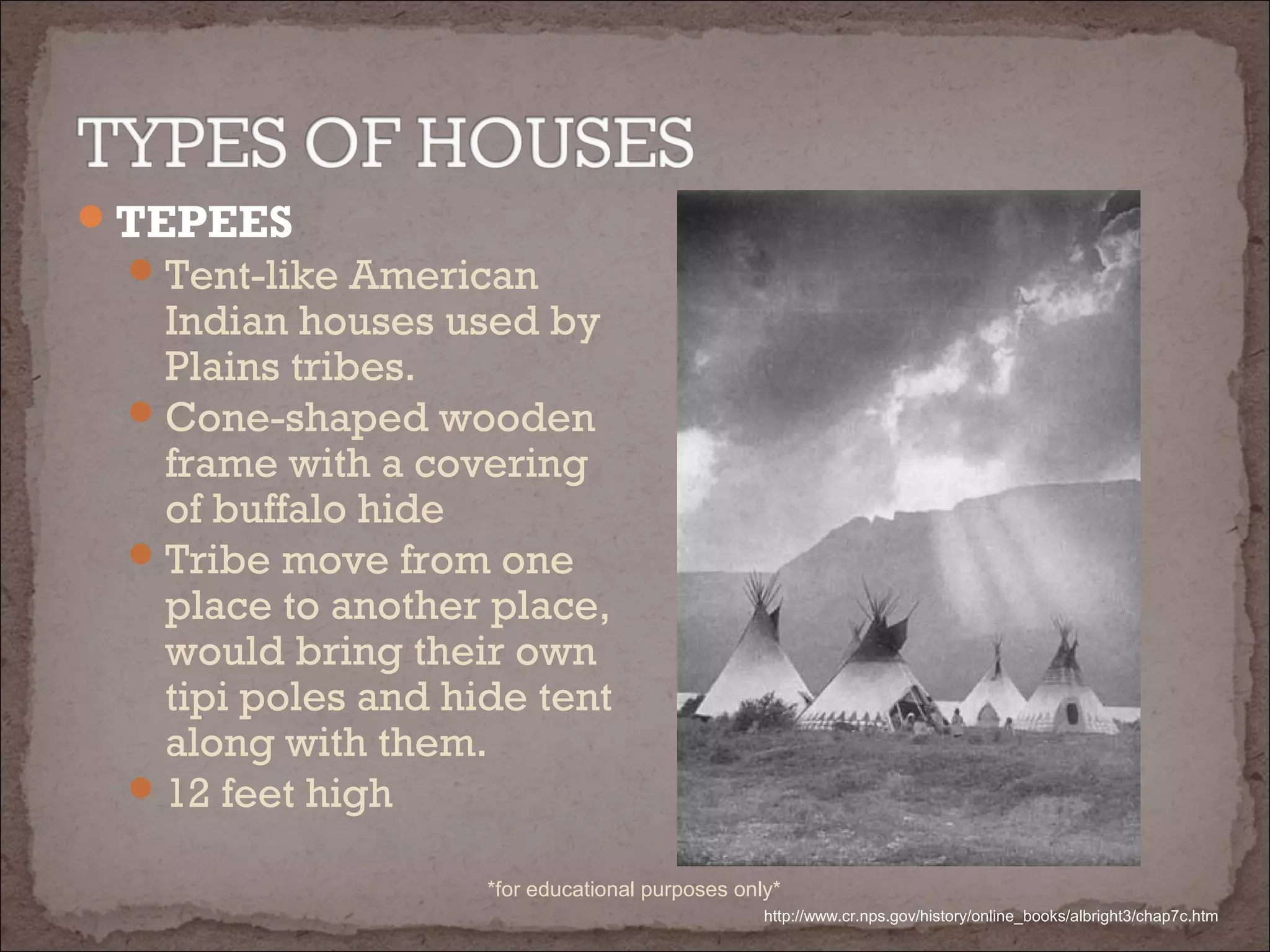
TEPEES
Tent-like American
Indian houses used by
Plains tribes.
Cone-shaped wooden
frame with a covering
of buffalo hide
Tribe move from one
place to another place,
would bring their own
tipi poles and hide tent
along with them.
12 feet high
http://www.cr.nps.gov/history/online_books/albright3/chap7c.htm
*for educational purposes only*
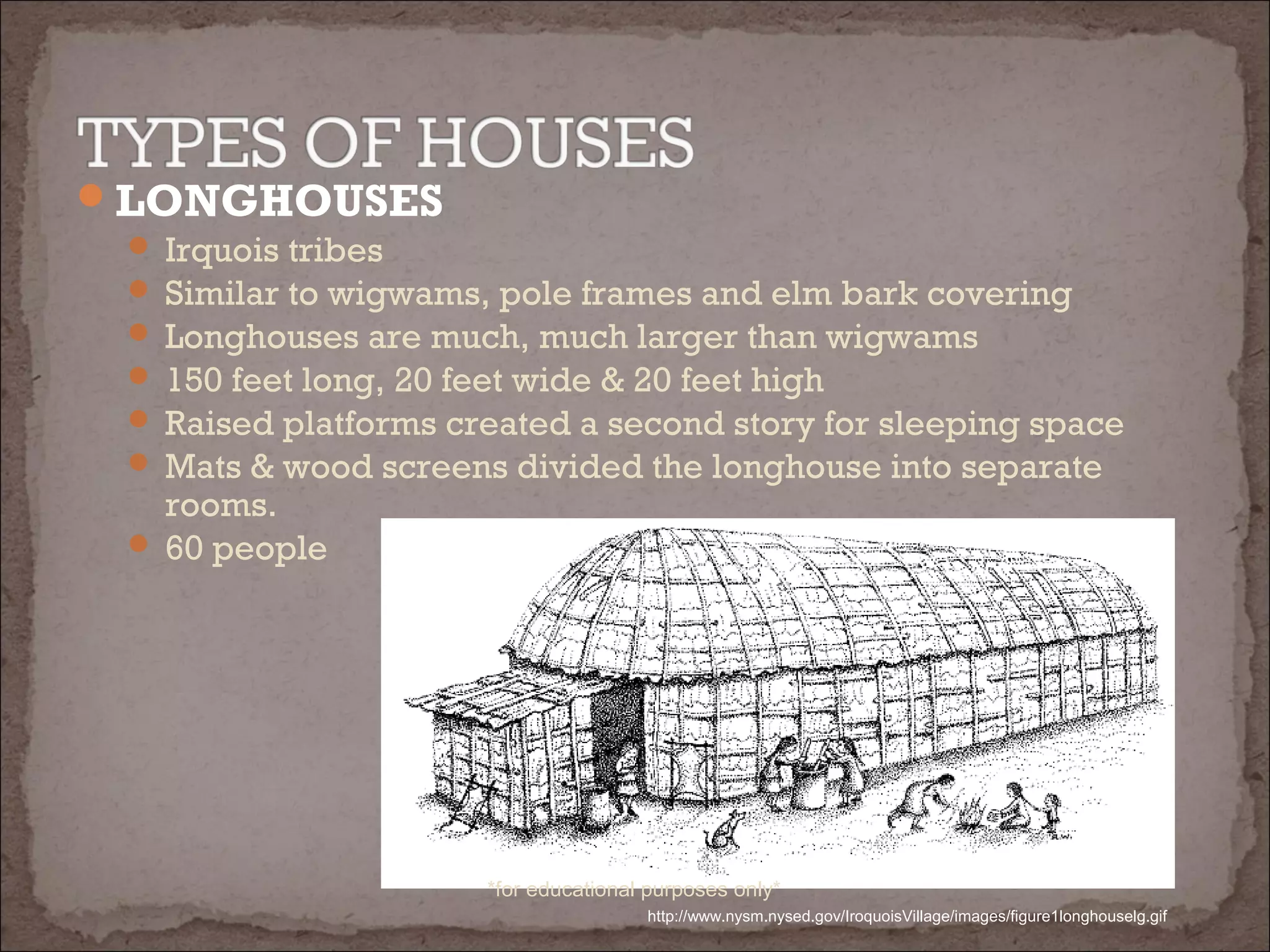
LONGHOUSES
 Irquois tribes
 Similar to wigwams, pole frames and elm bark covering
 Longhouses are much, much larger than wigwams
 150 feet long, 20 feet wide & 20 feet high
 Raised platforms created a second story for sleeping space
 Mats & wood screens divided the longhouse into separate
rooms.
 60 people
http://www.nysm.nysed.gov/IroquoisVillage/images/figure1longhouselg.gif
*for educational purposes only*
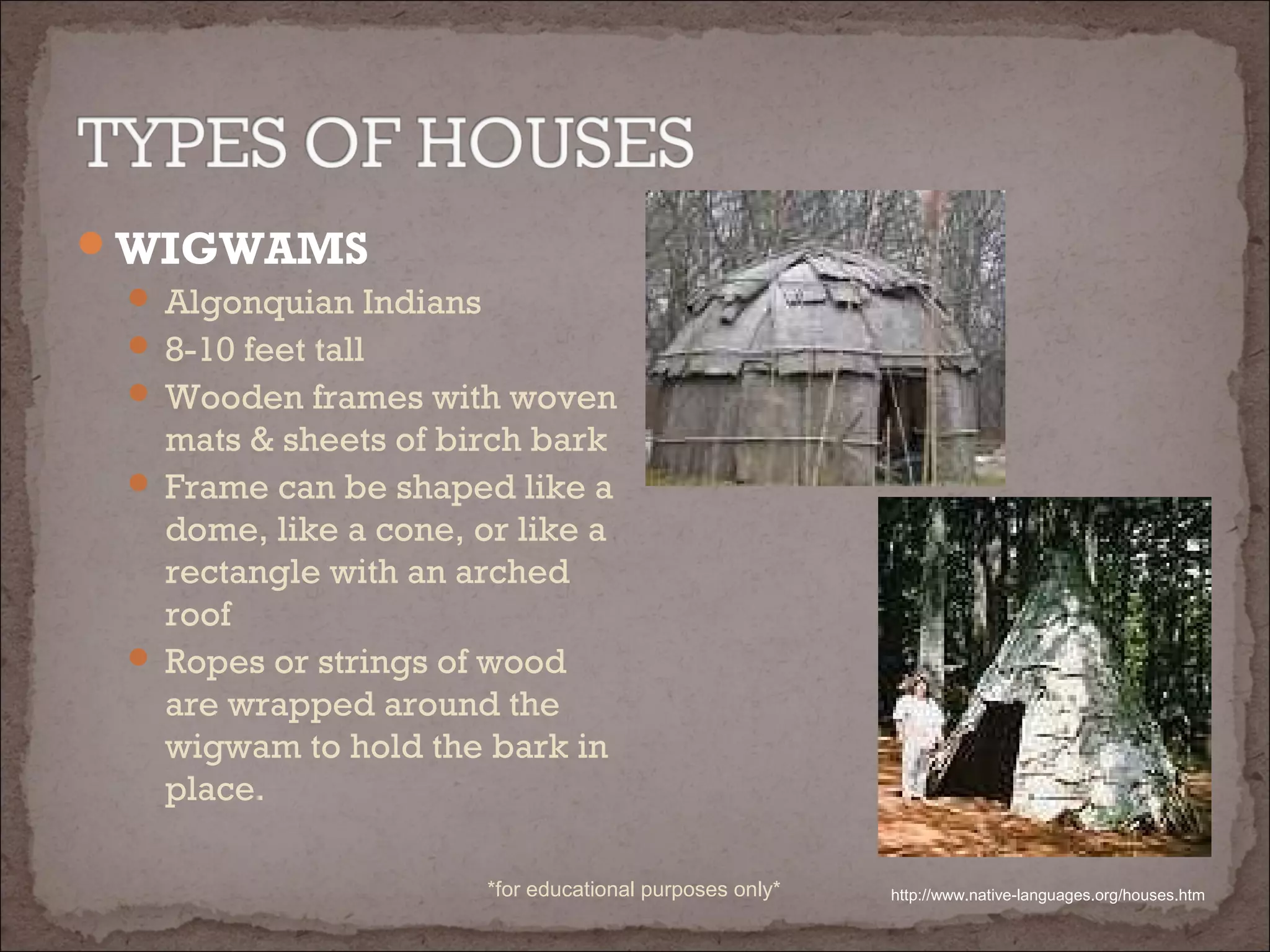
WIGWAMS
 Algonquian Indians
 8-10 feet tall
 Wooden frames with woven
mats & sheets of birch bark
 Frame can be shaped like a
dome, like a cone, or like a
rectangle with an arched
roof
 Ropes or strings of wood
are wrapped around the
wigwam to hold the bark in
place.
http://www.native-languages.org/houses.htm*for educational purposes only*
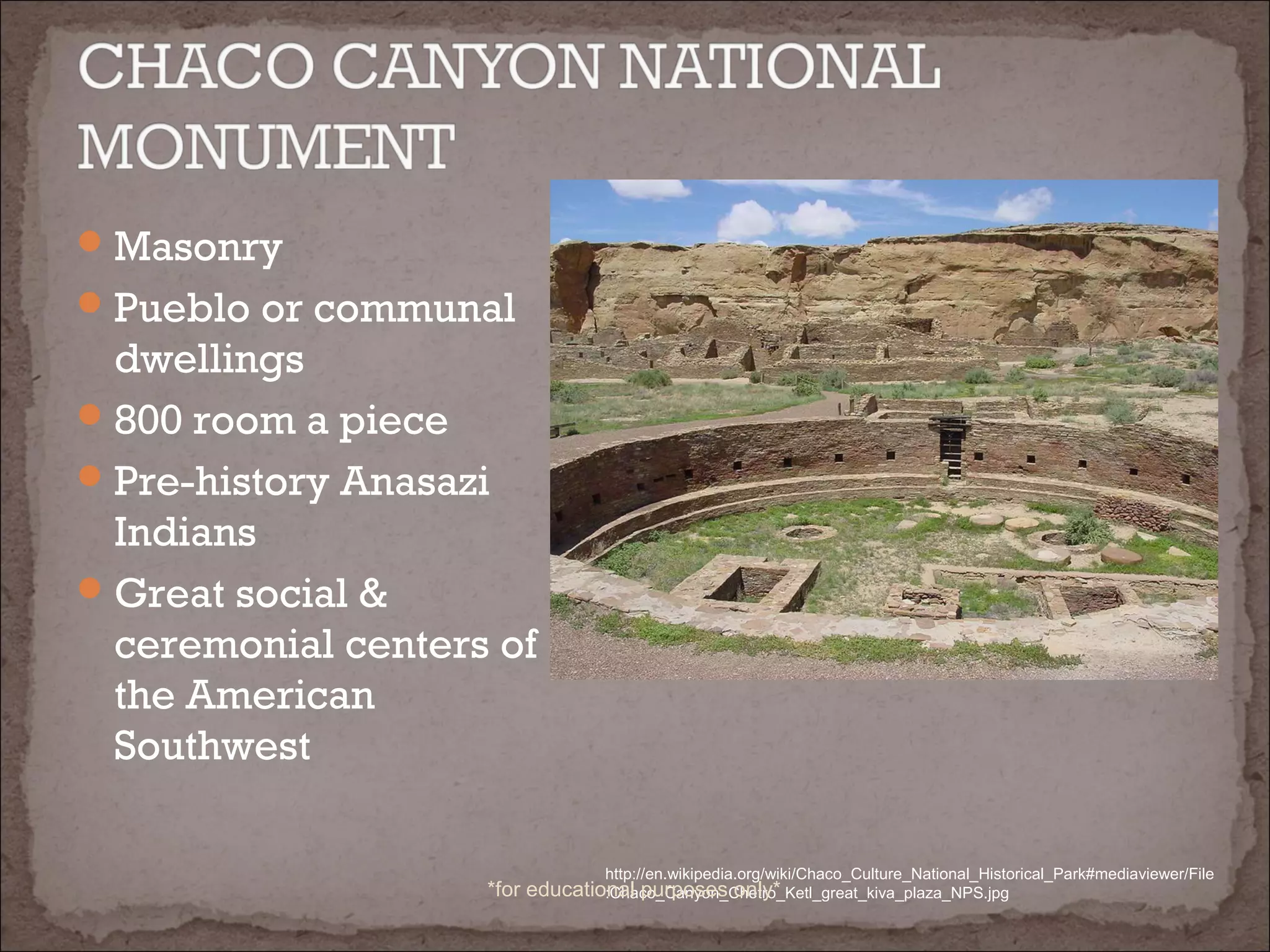
Masonry
Pueblo or communal
dwellings
800 room a piece
Pre-history Anasazi
Indians
Great social &
ceremonial centers of
the American
Southwest
http://en.wikipedia.org/wiki/Chaco_Culture_National_Historical_Park#mediaviewer/File
:Chaco_Canyon_Chetro_Ketl_great_kiva_plaza_NPS.jpg*for educational purposes only*
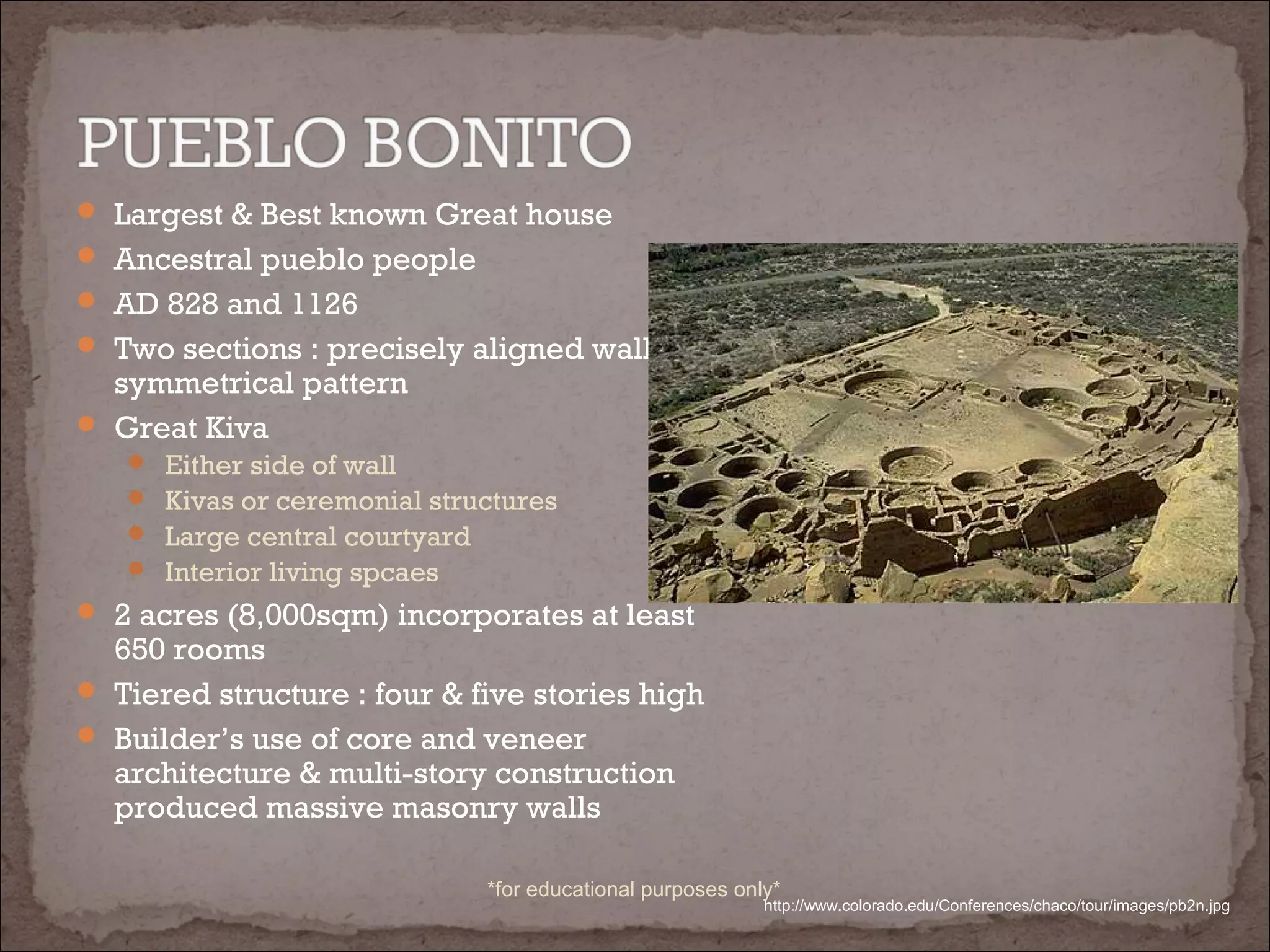
 Largest & Best known Great house
 Ancestral pueblo people
 AD 828 and 1126
 Two sections : precisely aligned wall,
symmetrical pattern
 Great Kiva
 Either side of wall
 Kivas or ceremonial structures
 Large central courtyard
 Interior living spcaes
 2 acres (8,000sqm) incorporates at least
650 rooms
 Tiered structure : four & five stories high
 Builder’s use of core and veneer
architecture & multi-story construction
produced massive masonry walls
http://www.colorado.edu/Conferences/chaco/tour/images/pb2n.jpg
*for educational purposes only*
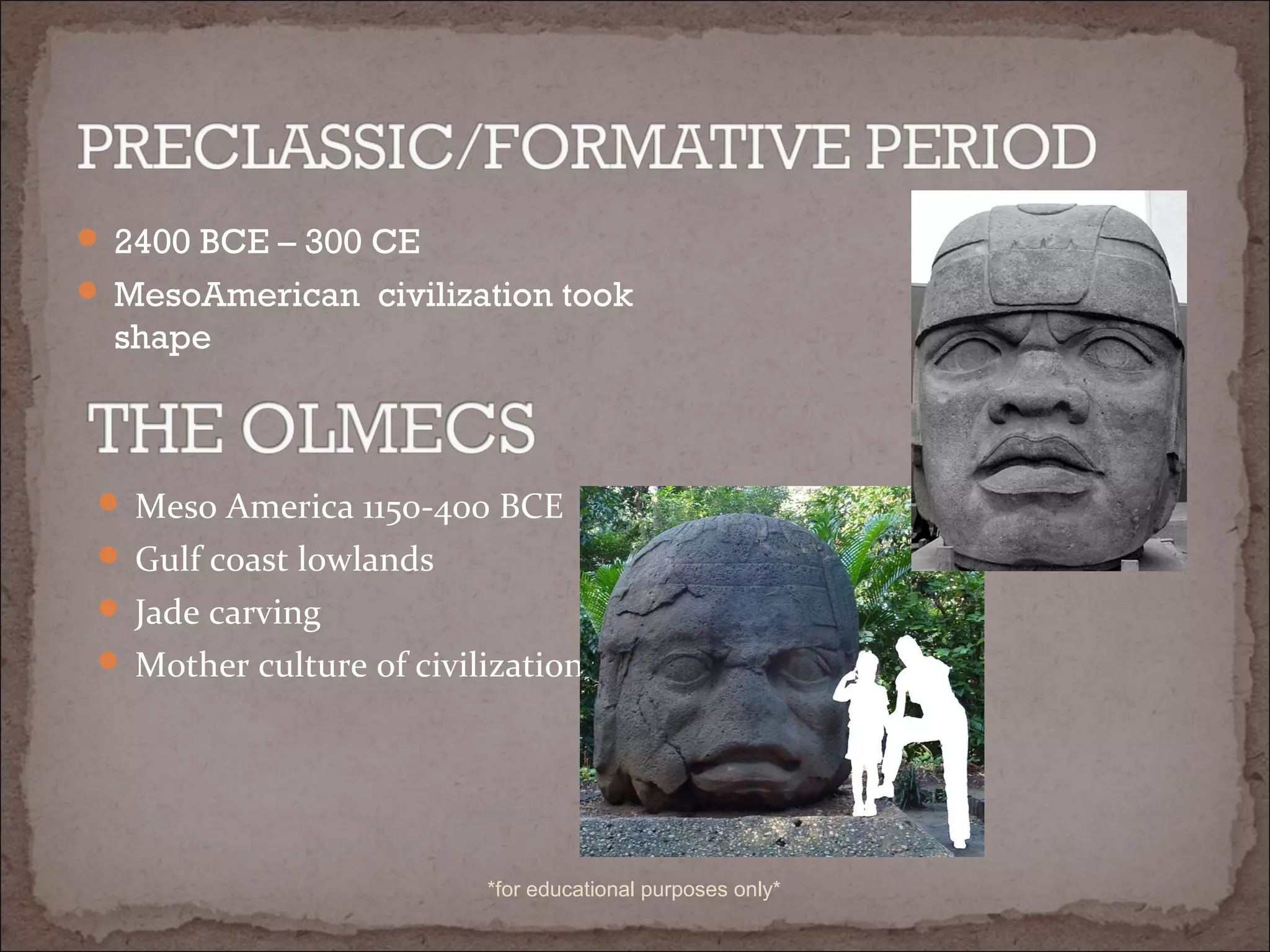
 2400 BCE – 300 CE
 MesoAmerican civilization took
shape
 Meso America 1150-400 BCE
 Gulf coast lowlands
 Jade carving
 Mother culture of civilization
*for educational purposes only*
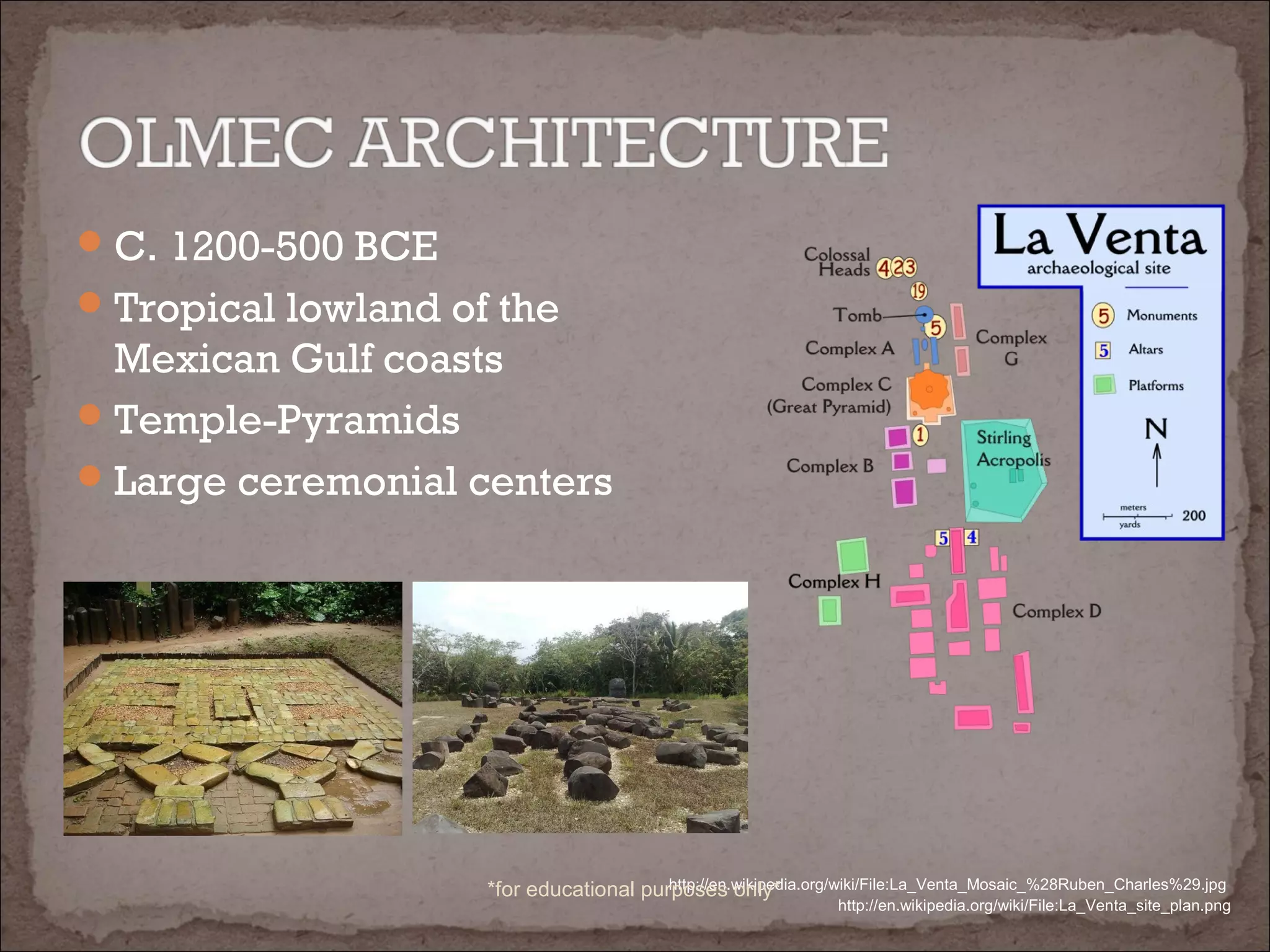
C. 1200-500 BCE
Tropical lowland of the
Mexican Gulf coasts
Temple-Pyramids
Large ceremonial centers
http://en.wikipedia.org/wiki/File:La_Venta_site_plan.png
http://en.wikipedia.org/wiki/File:La_Venta_Mosaic_%28Ruben_Charles%29.jpg*for educational purposes only*
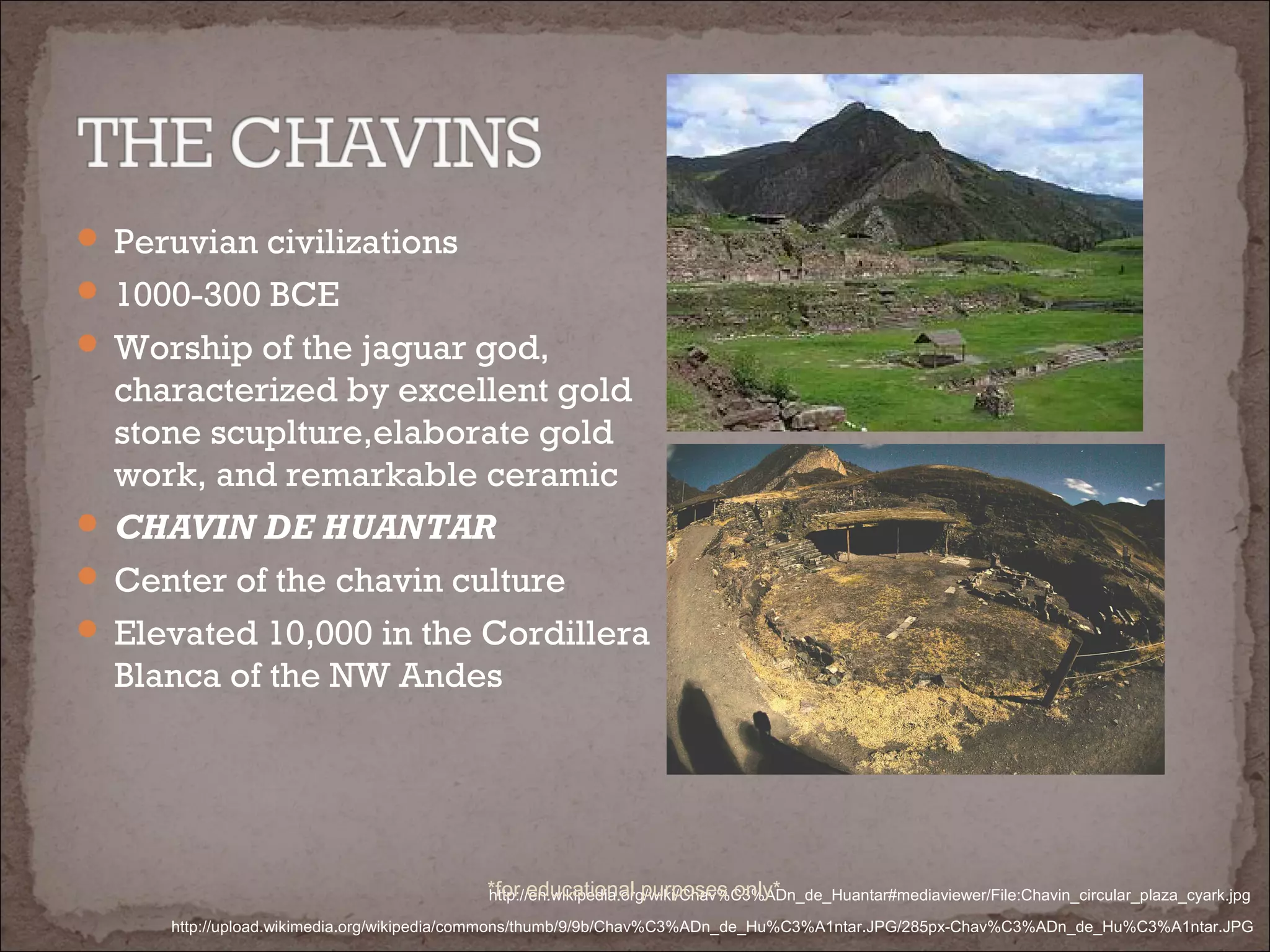
 Peruvian civilizations
 1000-300 BCE
 Worship of the jaguar god,
characterized by excellent gold
stone scuplture,elaborate gold
work, and remarkable ceramic
 CHAVIN DE HUANTAR
 Center of the chavin culture
 Elevated 10,000 in the Cordillera
Blanca of the NW Andes
http://upload.wikimedia.org/wikipedia/commons/thumb/9/9b/Chav%C3%ADn_de_Hu%C3%A1ntar.JPG/285px-Chav%C3%ADn_de_Hu%C3%A1ntar.JPG
http://en.wikipedia.org/wiki/Chav%C3%ADn_de_Huantar#mediaviewer/File:Chavin_circular_plaza_cyark.jpg*for educational purposes only*
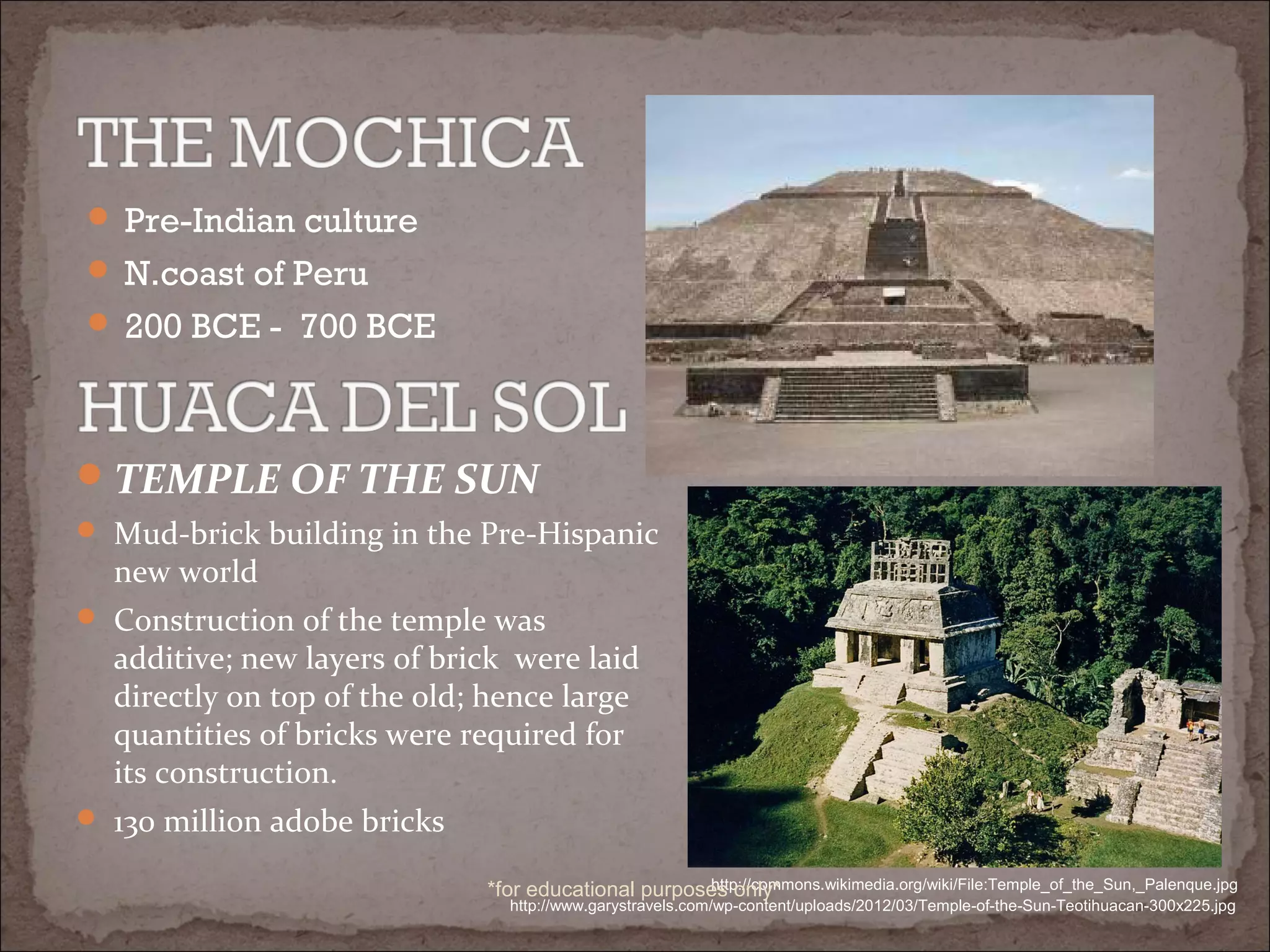
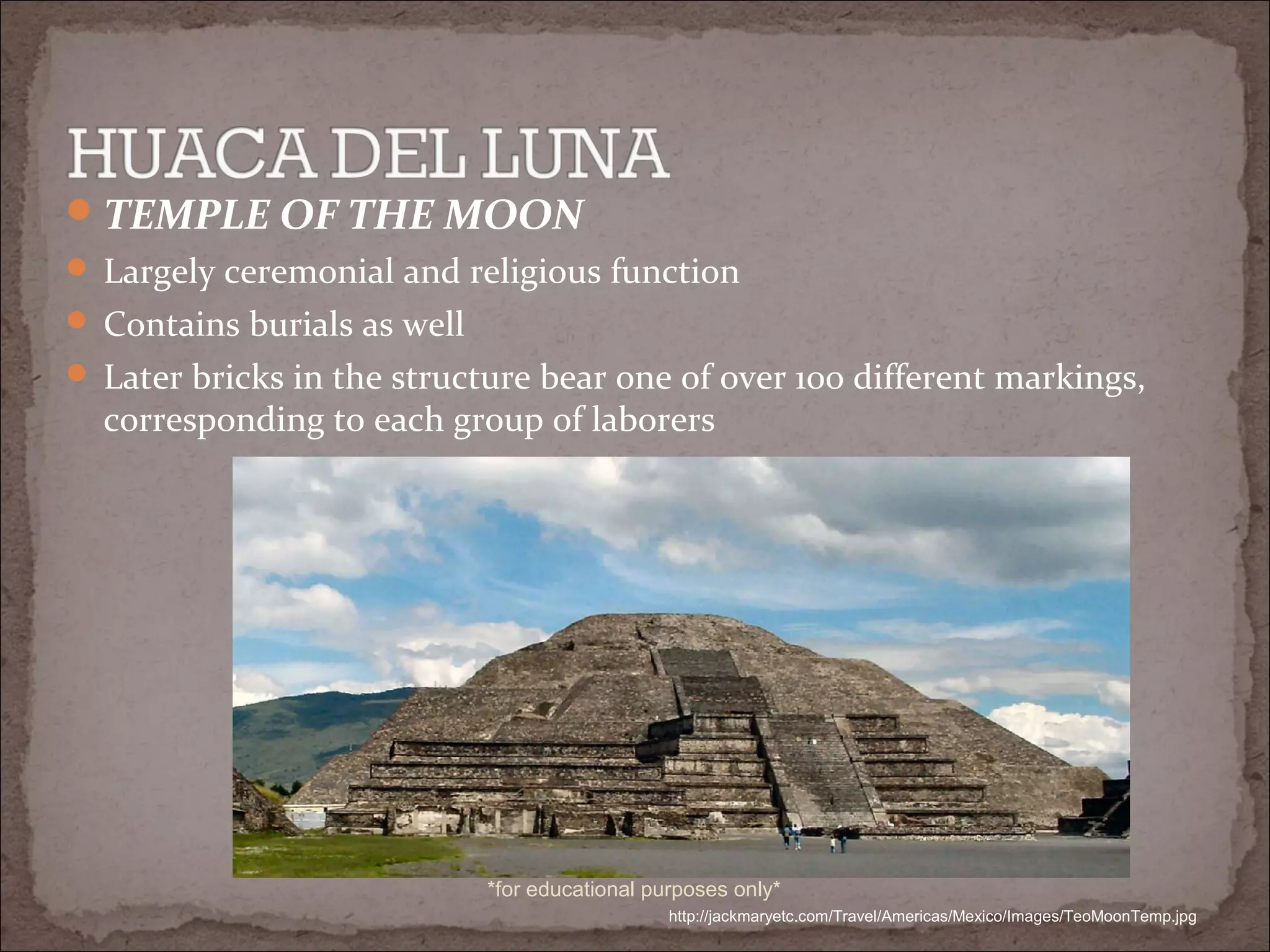
 Pre-Indian culture
 N.coast of Peru
 200 BCE - 700 BCE
TEMPLE OF THE SUN
 Mud-brick building in the Pre-Hispanic
new world
 Construction of the temple was
additive; new layers of brick were laid
directly on top of the old; hence large
quantities of bricks were required for
its construction.
 130 million adobe bricks
http://www.garystravels.com/wp-content/uploads/2012/03/Temple-of-the-Sun-Teotihuacan-300x225.jpg
http://commons.wikimedia.org/wiki/File:Temple_of_the_Sun,_Palenque.jpg*for educational purposes only*
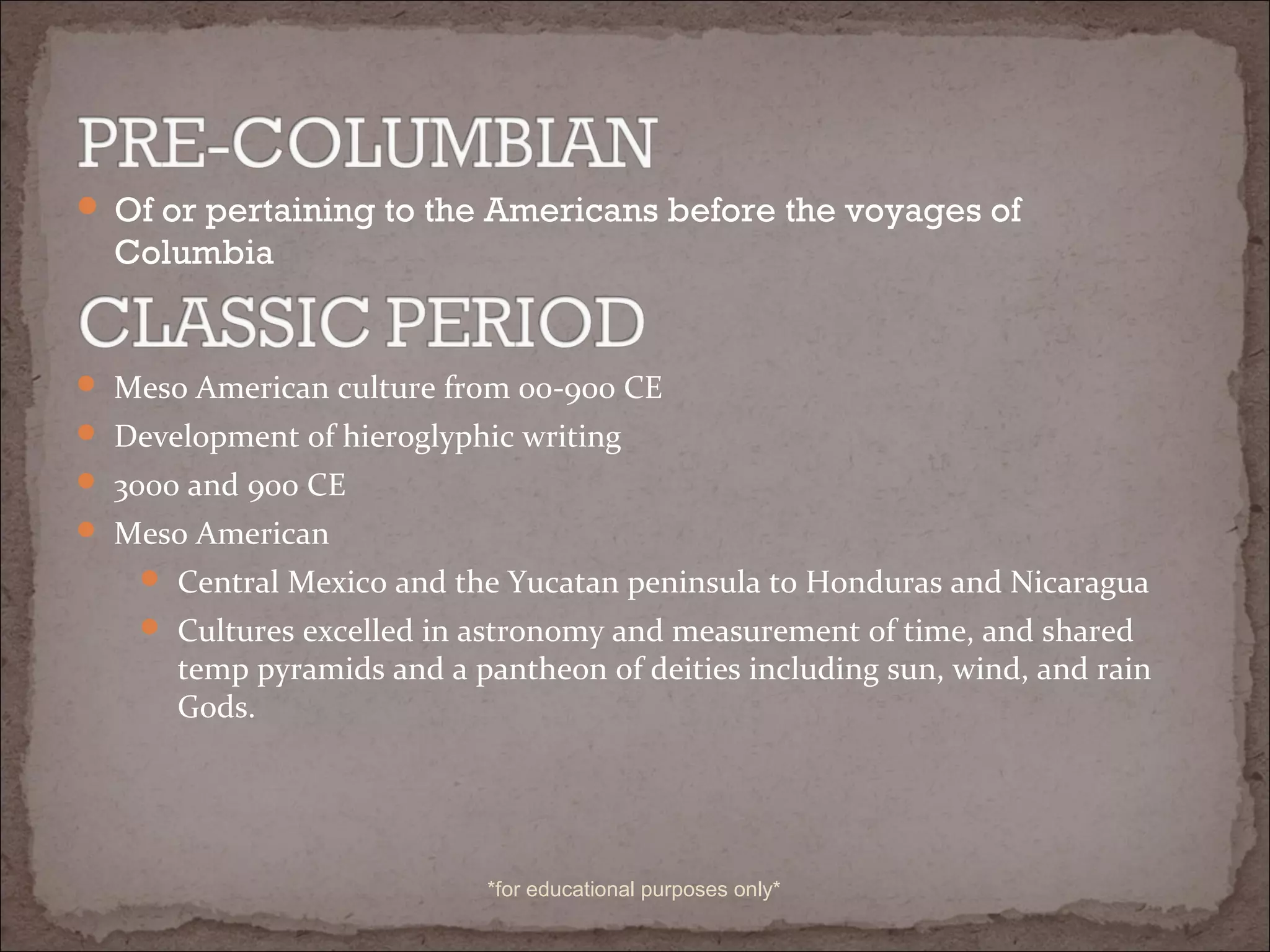
TEMPLE OF THE MOON
 Largely ceremonial and religious function
 Contains burials as well
 Later bricks in the structure bear one of over 100 different markings,
corresponding to each group of laborers
http://jackmaryetc.com/Travel/Americas/Mexico/Images/TeoMoonTemp.jpg
*for educational purposes only*
 Of or pertaining to the Americans before the voyages of
Columbia
 Meso American culture from 00-900 CE
 Development of hieroglyphic writing
 3000 and 900 CE
 Meso American
 Central Mexico and the Yucatan peninsula to Honduras and Nicaragua
 Cultures excelled in astronomy and measurement of time, and shared
temp pyramids and a pantheon of deities including sun, wind, and rain
Gods.
*for educational purposes only*
Past & present Indians of Guatemala, Belize
Created one of American’s greatest civilizations
Major Capitals
Tikal
Palenque
Seipan
Copan
Calakmul
Motul de San Jose
Hieroglyphic writing
*for educational purposes only*
 1 CE – to its peak in 9 CE
 Character
 Magnificent ceremonial centers
 Temple-pyramids
 Ritual Ball courts
 Spacious plazas
 Palaces
Sculptured façade
Lower than temple-pyramids
Numerous rooms
Arranged around courts along with temples
*for educational purposes only*
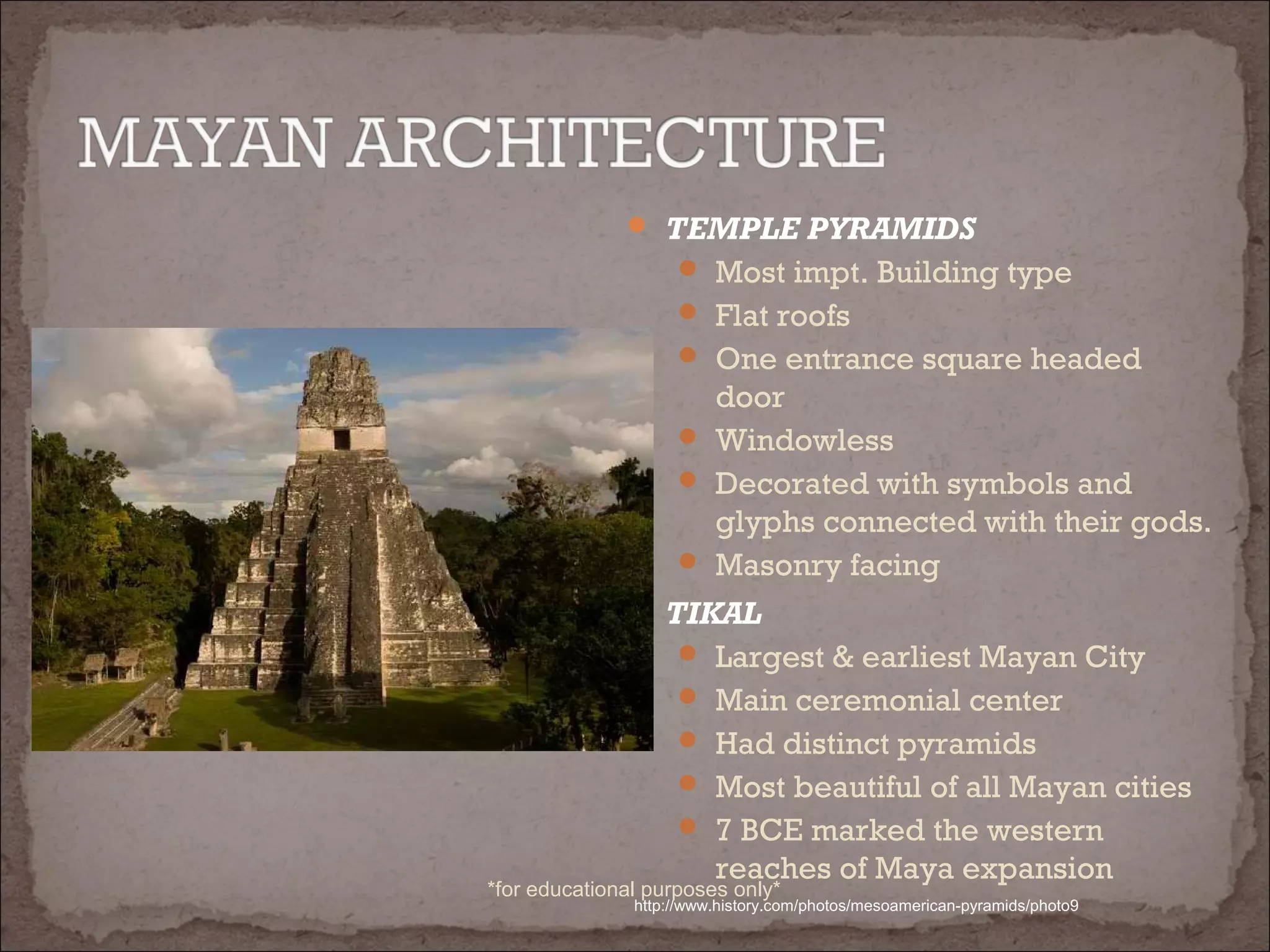
 TEMPLE PYRAMIDS
 Most impt. Building type
 Flat roofs
 One entrance square headed
door
 Windowless
 Decorated with symbols and
glyphs connected with their gods.
 Masonry facing
 TIKAL
 Largest & earliest Mayan City
 Main ceremonial center
 Had distinct pyramids
 Most beautiful of all Mayan cities
 7 BCE marked the western
reaches of Maya expansion
http://www.history.com/photos/mesoamerican-pyramids/photo9
*for educational purposes only*
 PALENQUE
 Medium size site
 Has finest architecture, sculpture, roof
comb and bas-relief carvings
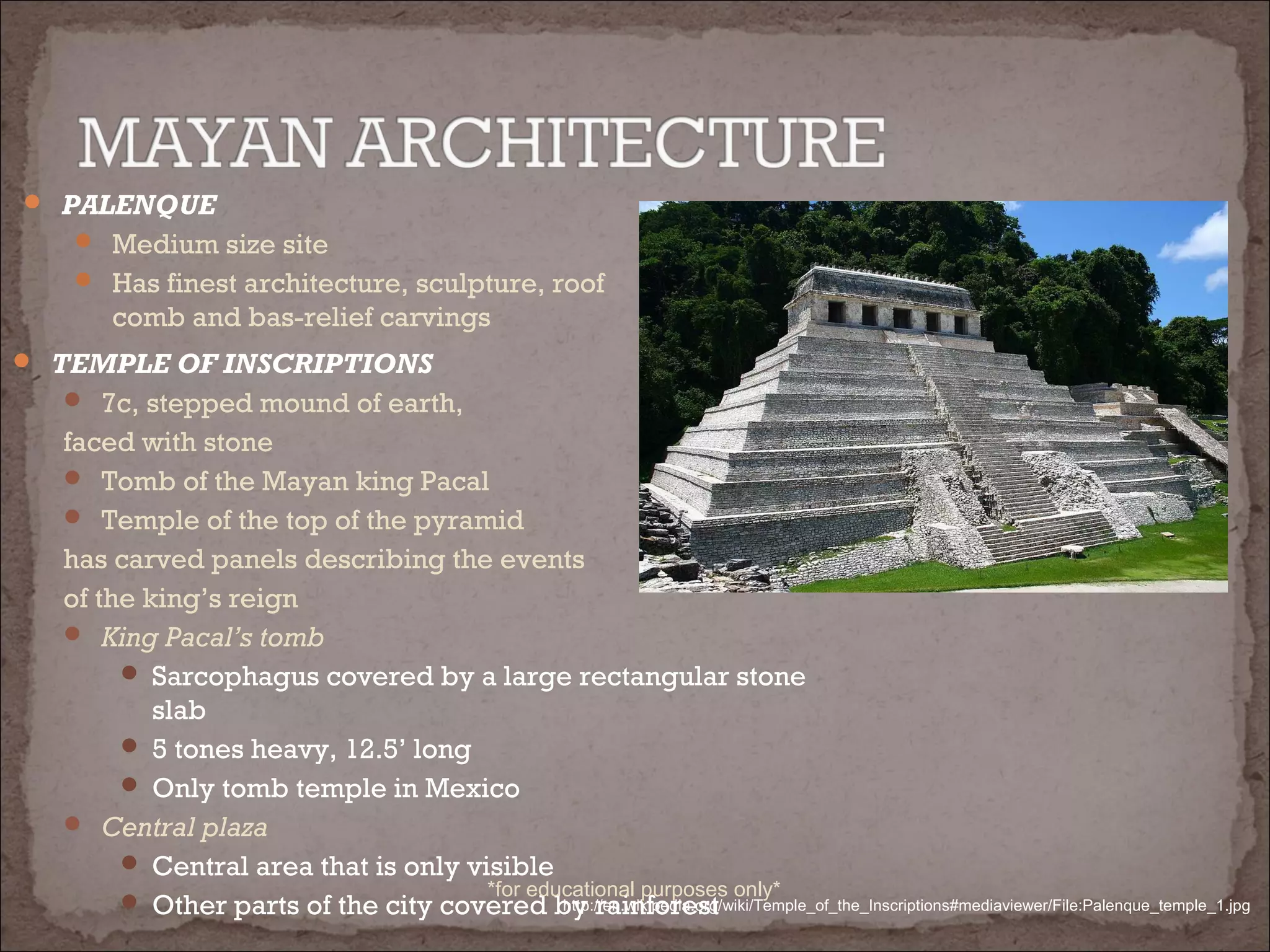
 TEMPLE OF INSCRIPTIONS
 7c, stepped mound of earth,
faced with stone
 Tomb of the Mayan king Pacal
 Temple of the top of the pyramid
has carved panels describing the events
of the king’s reign
 King Pacal’s tomb
 Sarcophagus covered by a large rectangular stone
slab
 5 tones heavy, 12.5’ long
 Only tomb temple in Mexico
 Central plaza
 Central area that is only visible
 Other parts of the city covered by rainforesthttp://en.wikipedia.org/wiki/Temple_of_the_Inscriptions#mediaviewer/File:Palenque_temple_1.jpg
*for educational purposes only*
 Held power over Mexico
 Built : Tenochtitian; walled
compound, center of Aztec
religion
 Practice human sacrifice,
believing it pleases the gods
 Pyramidal temples were similar
to Mayans
 They had many gods &
goddesses.
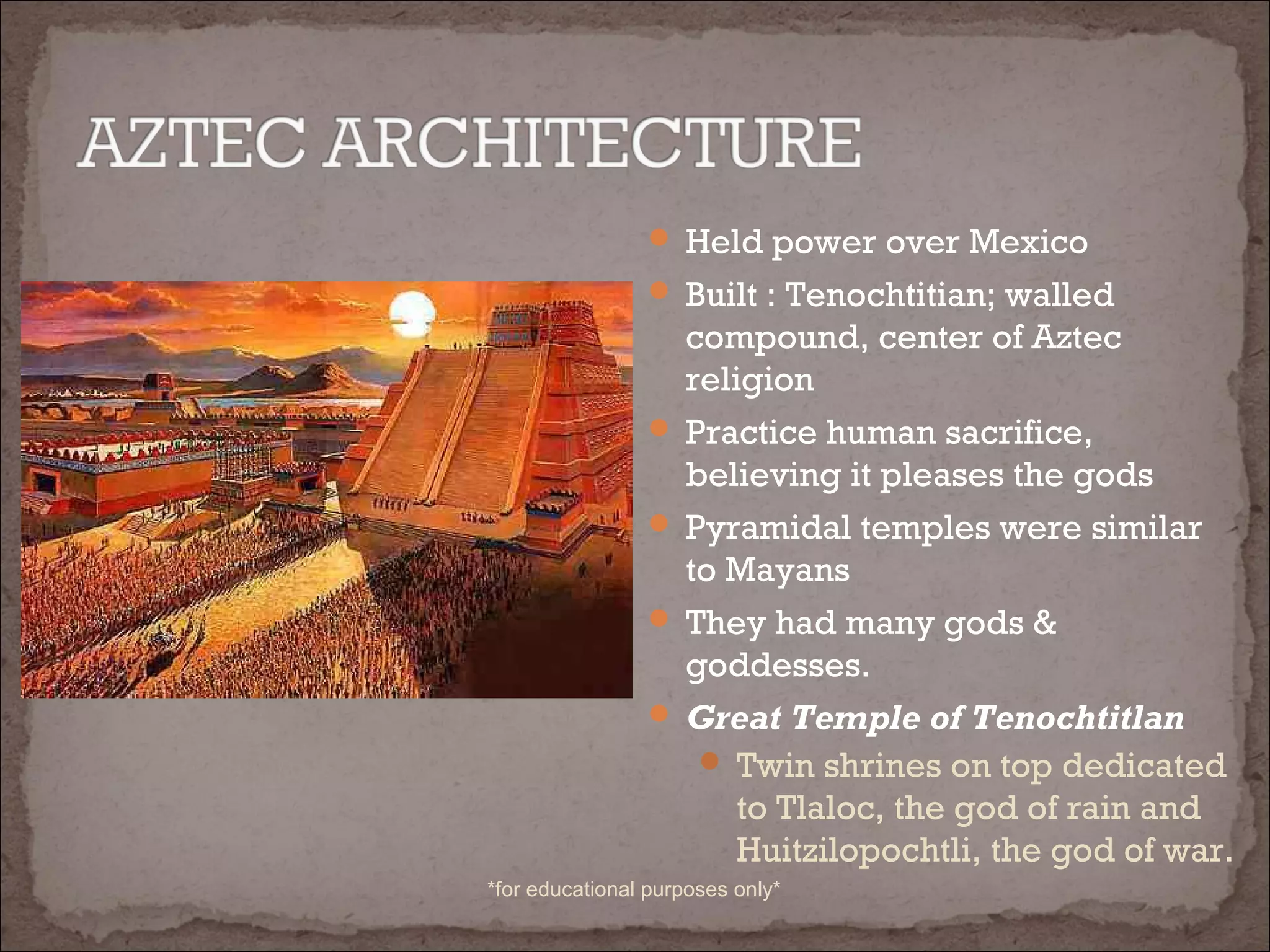
 Great Temple of Tenochtitlan
 Twin shrines on top dedicated
to Tlaloc, the god of rain and
Huitzilopochtli, the god of war.
*for educational purposes only*
 South America’s first great builders
 15th
century
 Buildings were irregularly shaped stones;
which skilled stonemasons ground to fit
tighter perfectly
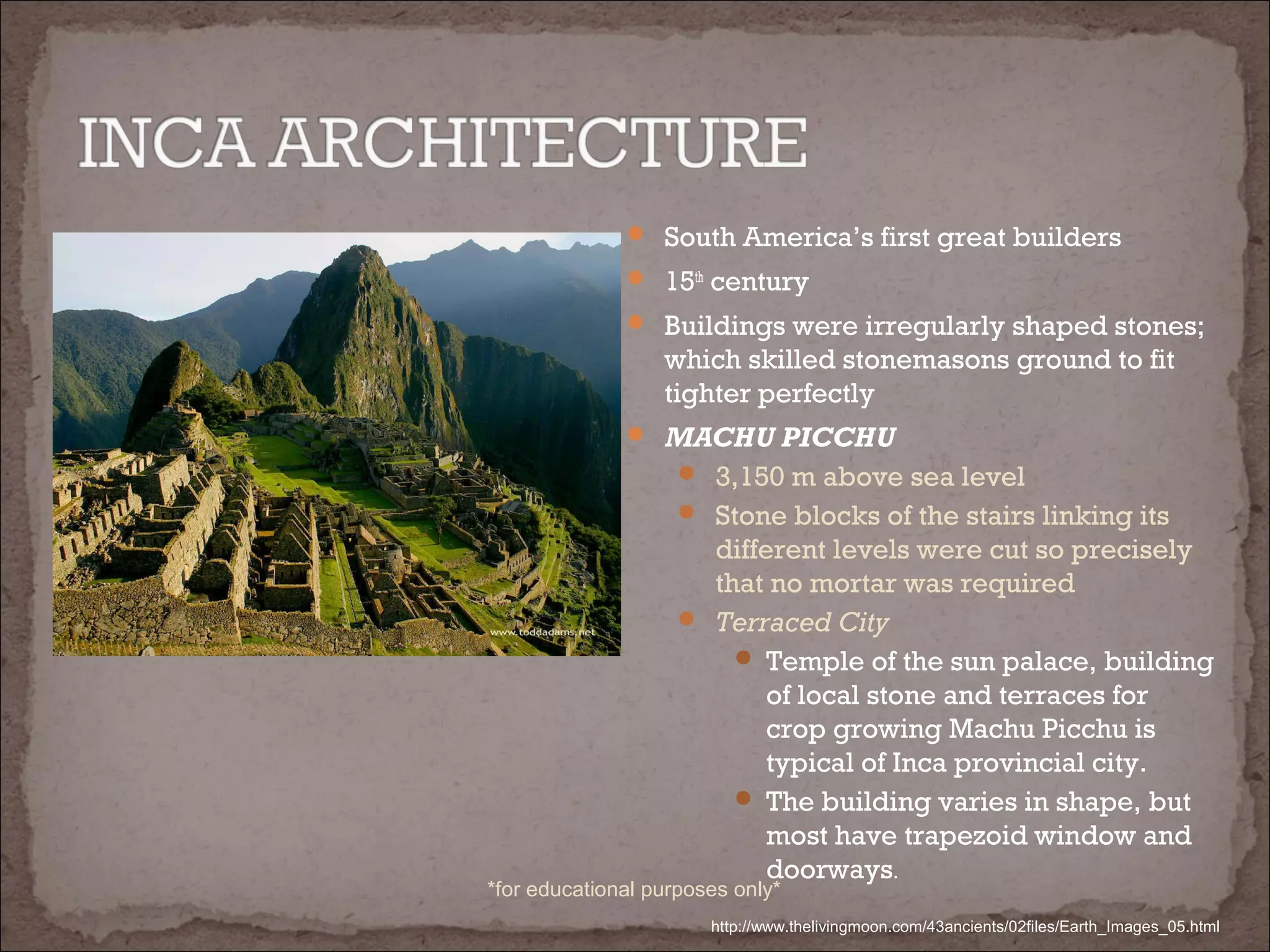
 MACHU PICCHU
 3,150 m above sea level
 Stone blocks of the stairs linking its
different levels were cut so precisely
that no mortar was required
 Terraced City
 Temple of the sun palace, building
of local stone and terraces for
crop growing Machu Picchu is
typical of Inca provincial city.
 The building varies in shape, but
most have trapezoid window and
doorways.
http://www.thelivingmoon.com/43ancients/02files/Earth_Images_05.html
*for educational purposes only*
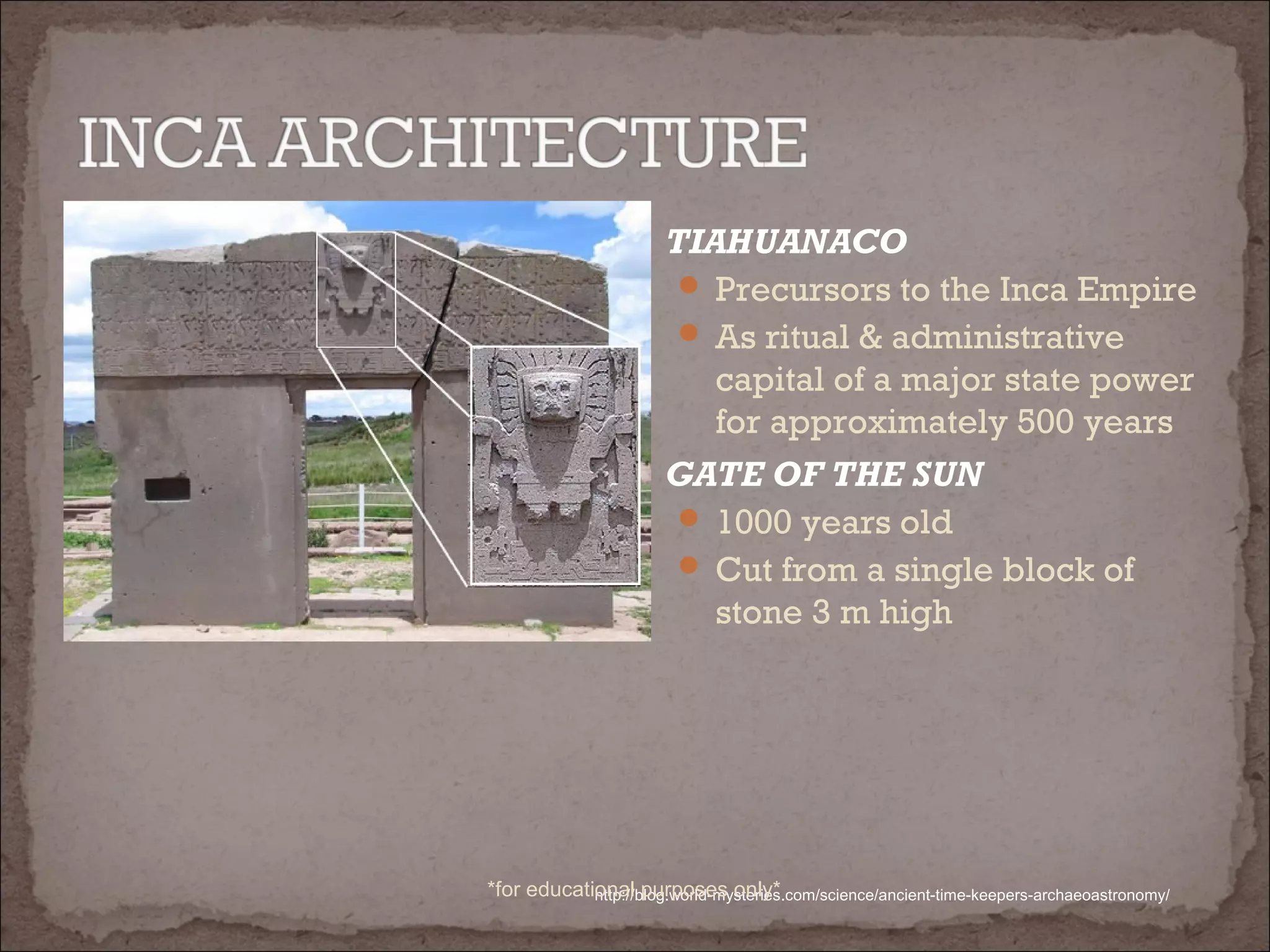
 TIAHUANACO
 Precursors to the Inca Empire
 As ritual & administrative
capital of a major state power
for approximately 500 years
 GATE OF THE SUN
 1000 years old
 Cut from a single block of
stone 3 m high
http://blog.world-mysteries.com/science/ancient-time-keepers-archaeoastronomy/*for educational purposes only*

03 architecture of the ancient america

  • 1.
  • 2.
    North America last majorprehistoric cultural development AD 700 Over a great area of the Southeast and the mid- continent Intensive cultivation of corn, beans, squash, and other crops Politically & culturally each large town *for educational purposes only*
  • 3.
    Second largest ceremonialmounds Flat topped earthen structure : 35 feet high Large religious and civic rituals End of the platform : secondary flat-topped mounds, probably the bases of a temple and residence of a priest or ruler Between 1250 and 1600 AD : Natchez people Political center and point of distribution for goods Animal remains, ceramic fragments, tools and the stratigraphy *for educational purposes only*
  • 4.
  • 5.
     Ancient indigenouscity  650-1400 CE  Largest archaeological site  Monks Mound  Largest structure  Central of this great city  Massive structure with four terraces  10 stories tall, largest man-made earthen mound north of mexico  Facing south : 92 feet high, 951 feet long, 836 feet wide http://www.aartichapati.com/2011/10/tss-interlude-cahokia-mounds.html *for educational purposes only*
  • 6.
    Prehistoric archaelogical site 1650-700BC northeastern louissiana Core: 500 acres Center of the site : six concentric curved earthen ridges separated by flat corridors of earth Dividing the ridges into 3 sections are 2 ramps that slope inwardly leading to Bayou Macon. Ridge : 3 feet high Approx. diameter : 3 quarters of a mile *for educational purposes only*
  • 7.
    Ancient burial site Largestconical mound 100 foot high bluff, measures 877 feet in circumference Height of 70 feet http://2nilssons.com/Mountains%20&%20Falls/Etowah%20-%20Mound%20B.jpg*for educational purposes only*
  • 8.
    Largest effigy moundin the world Does not contain human remains 1,330 feet in length, 3 feet in height Head of the serpent : aligned to summer solstice sunset Coils : point to the winter solstice sunrise Adena Indians (800 BC – AD 100) *for educational purposes only*
  • 9.
  • 10.
    IGLOO,IGLU Eskimo House Blocks ofhard snow or ice, sometimes of sod, wood, or stone. http://en.wikipedia.org/wiki/Igloo#mediaviewer/File:EskimoIglooDrawing.jpeg http://en.wikipedia.org/wiki/Igloo#mediaviewer/File:Igloo_see-through_sideview_diagram.svg*for educational purposes only*
  • 11.
    PLANK HOUSE Large, usually rectangularhouse Constructed of timber planks Used by Indians & Eskimo http://www.aaanativearts.com/culture-tribal-customs/native-american-homes/1125- some-pacific-northwest-coast-indians-lived-in-plank-houses.html#axzz37RRjkrog http://ed101.bu.edu/StudentDoc/Archives/ED101fa10/cmmac/Tlingit.html *for educational purposes only*
  • 12.
    BRUSH SHELTER Temporary native Americandwellings Only used for sleeping in. Simple wooden frame covered with brush, cone-shaped, with one side left open, or tent- shaped, with both ends left open. http://www.johnsunter.com/shelters/brush%20tp1.jpg http://www.lewis-clark.org/content/content-article.asp?ArticleID=2171 *for educational purposes only*
  • 13.
    EARTHEN SHELTER Native American homes Basement-likeliving spaces dug from the earth, with domed mound built over the top. *for educational purposes only*
  • 14.
    PUEBLO  Communal anddefensive structure  Built of adobe or stone  Many-storied terraced  Flat roofs of the chambers by ladders  Built on the desert floor in valley, or cliff walls of mesas. KIVA  Large underground  Used by men for religious ceremonies & councils http://en.wikipedia.org/wiki/File:USA_09669_Taos_Pueblo_Luca_Galuzzi_2007.jpg http://www.crowcanyon.org/educationproducts/peoples_mesa_verde/pueblo_I_overview.asp*for educational purposes only*
  • 15.
    CHICKEES  Stilt houses Thick posts supporting a thatched roof and a flat wooden platform raised several feet off the ground without walls http://access.sd25.org/curriculum/NativeAmericans/chickee.html*for educational purposes only*
  • 16.
    WATTLE AND DAUB HOUSES(ASI) Native American houses Made by weaving river cane, wood, and vines into a frame, then coating the frame with plaster. Roof was either thatched with grass or shingled with bark. http://www.britannica.com/EBchecked/media/92358/Reconstruction-of-a-Natchez- house-and-granary-at-the-Grand *for educational purposes only*
  • 17.
    GRASS HOUSES Southern Plainsby tribes such as the Caddos Made with a wooden frame bent into a beehive shape and thatched with long prairie grass Large buildings, sometimes more than 40 feet tall http://www.native-languages.org/images/grass2.jpg http://pw1.netcom.com/~wandaron/Caddo.jpg*for educational purposes only*
  • 18.
    TEPEES Tent-like American Indian housesused by Plains tribes. Cone-shaped wooden frame with a covering of buffalo hide Tribe move from one place to another place, would bring their own tipi poles and hide tent along with them. 12 feet high http://www.cr.nps.gov/history/online_books/albright3/chap7c.htm *for educational purposes only*
  • 19.
    LONGHOUSES  Irquois tribes Similar to wigwams, pole frames and elm bark covering  Longhouses are much, much larger than wigwams  150 feet long, 20 feet wide & 20 feet high  Raised platforms created a second story for sleeping space  Mats & wood screens divided the longhouse into separate rooms.  60 people http://www.nysm.nysed.gov/IroquoisVillage/images/figure1longhouselg.gif *for educational purposes only*
  • 20.
    WIGWAMS  Algonquian Indians 8-10 feet tall  Wooden frames with woven mats & sheets of birch bark  Frame can be shaped like a dome, like a cone, or like a rectangle with an arched roof  Ropes or strings of wood are wrapped around the wigwam to hold the bark in place. http://www.native-languages.org/houses.htm*for educational purposes only*
  • 21.
    Masonry Pueblo or communal dwellings 800room a piece Pre-history Anasazi Indians Great social & ceremonial centers of the American Southwest http://en.wikipedia.org/wiki/Chaco_Culture_National_Historical_Park#mediaviewer/File :Chaco_Canyon_Chetro_Ketl_great_kiva_plaza_NPS.jpg*for educational purposes only*
  • 22.
     Largest &Best known Great house  Ancestral pueblo people  AD 828 and 1126  Two sections : precisely aligned wall, symmetrical pattern  Great Kiva  Either side of wall  Kivas or ceremonial structures  Large central courtyard  Interior living spcaes  2 acres (8,000sqm) incorporates at least 650 rooms  Tiered structure : four & five stories high  Builder’s use of core and veneer architecture & multi-story construction produced massive masonry walls http://www.colorado.edu/Conferences/chaco/tour/images/pb2n.jpg *for educational purposes only*
  • 23.
     2400 BCE– 300 CE  MesoAmerican civilization took shape  Meso America 1150-400 BCE  Gulf coast lowlands  Jade carving  Mother culture of civilization *for educational purposes only*
  • 24.
    C. 1200-500 BCE Tropicallowland of the Mexican Gulf coasts Temple-Pyramids Large ceremonial centers http://en.wikipedia.org/wiki/File:La_Venta_site_plan.png http://en.wikipedia.org/wiki/File:La_Venta_Mosaic_%28Ruben_Charles%29.jpg*for educational purposes only*
  • 25.
     Peruvian civilizations 1000-300 BCE  Worship of the jaguar god, characterized by excellent gold stone scuplture,elaborate gold work, and remarkable ceramic  CHAVIN DE HUANTAR  Center of the chavin culture  Elevated 10,000 in the Cordillera Blanca of the NW Andes http://upload.wikimedia.org/wikipedia/commons/thumb/9/9b/Chav%C3%ADn_de_Hu%C3%A1ntar.JPG/285px-Chav%C3%ADn_de_Hu%C3%A1ntar.JPG http://en.wikipedia.org/wiki/Chav%C3%ADn_de_Huantar#mediaviewer/File:Chavin_circular_plaza_cyark.jpg*for educational purposes only*
  • 26.
     Pre-Indian culture N.coast of Peru  200 BCE - 700 BCE TEMPLE OF THE SUN  Mud-brick building in the Pre-Hispanic new world  Construction of the temple was additive; new layers of brick were laid directly on top of the old; hence large quantities of bricks were required for its construction.  130 million adobe bricks http://www.garystravels.com/wp-content/uploads/2012/03/Temple-of-the-Sun-Teotihuacan-300x225.jpg http://commons.wikimedia.org/wiki/File:Temple_of_the_Sun,_Palenque.jpg*for educational purposes only*
  • 27.
    TEMPLE OF THEMOON  Largely ceremonial and religious function  Contains burials as well  Later bricks in the structure bear one of over 100 different markings, corresponding to each group of laborers http://jackmaryetc.com/Travel/Americas/Mexico/Images/TeoMoonTemp.jpg *for educational purposes only*
  • 28.
     Of orpertaining to the Americans before the voyages of Columbia  Meso American culture from 00-900 CE  Development of hieroglyphic writing  3000 and 900 CE  Meso American  Central Mexico and the Yucatan peninsula to Honduras and Nicaragua  Cultures excelled in astronomy and measurement of time, and shared temp pyramids and a pantheon of deities including sun, wind, and rain Gods. *for educational purposes only*
  • 29.
    Past & presentIndians of Guatemala, Belize Created one of American’s greatest civilizations Major Capitals Tikal Palenque Seipan Copan Calakmul Motul de San Jose Hieroglyphic writing *for educational purposes only*
  • 30.
     1 CE– to its peak in 9 CE  Character  Magnificent ceremonial centers  Temple-pyramids  Ritual Ball courts  Spacious plazas  Palaces Sculptured façade Lower than temple-pyramids Numerous rooms Arranged around courts along with temples *for educational purposes only*
  • 31.
     TEMPLE PYRAMIDS Most impt. Building type  Flat roofs  One entrance square headed door  Windowless  Decorated with symbols and glyphs connected with their gods.  Masonry facing  TIKAL  Largest & earliest Mayan City  Main ceremonial center  Had distinct pyramids  Most beautiful of all Mayan cities  7 BCE marked the western reaches of Maya expansion http://www.history.com/photos/mesoamerican-pyramids/photo9 *for educational purposes only*
  • 32.
     PALENQUE  Mediumsize site  Has finest architecture, sculpture, roof comb and bas-relief carvings  TEMPLE OF INSCRIPTIONS  7c, stepped mound of earth, faced with stone  Tomb of the Mayan king Pacal  Temple of the top of the pyramid has carved panels describing the events of the king’s reign  King Pacal’s tomb  Sarcophagus covered by a large rectangular stone slab  5 tones heavy, 12.5’ long  Only tomb temple in Mexico  Central plaza  Central area that is only visible  Other parts of the city covered by rainforesthttp://en.wikipedia.org/wiki/Temple_of_the_Inscriptions#mediaviewer/File:Palenque_temple_1.jpg *for educational purposes only*
  • 33.
     Held powerover Mexico  Built : Tenochtitian; walled compound, center of Aztec religion  Practice human sacrifice, believing it pleases the gods  Pyramidal temples were similar to Mayans  They had many gods & goddesses.  Great Temple of Tenochtitlan  Twin shrines on top dedicated to Tlaloc, the god of rain and Huitzilopochtli, the god of war. *for educational purposes only*
  • 34.
     South America’sfirst great builders  15th century  Buildings were irregularly shaped stones; which skilled stonemasons ground to fit tighter perfectly  MACHU PICCHU  3,150 m above sea level  Stone blocks of the stairs linking its different levels were cut so precisely that no mortar was required  Terraced City  Temple of the sun palace, building of local stone and terraces for crop growing Machu Picchu is typical of Inca provincial city.  The building varies in shape, but most have trapezoid window and doorways. http://www.thelivingmoon.com/43ancients/02files/Earth_Images_05.html *for educational purposes only*
  • 35.
     TIAHUANACO  Precursorsto the Inca Empire  As ritual & administrative capital of a major state power for approximately 500 years  GATE OF THE SUN  1000 years old  Cut from a single block of stone 3 m high http://blog.world-mysteries.com/science/ancient-time-keepers-archaeoastronomy/*for educational purposes only*