Introduction to Fiber
Optics
What are optical fibers
 Thin strands of pure glass
 Carry data over long distances
 At very high speeds
 Fiber can be bent or twisted
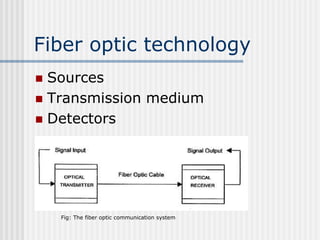
Fiber optic technology
 Sources
 Transmission medium
 Detectors
Fig: The fiber optic communication system
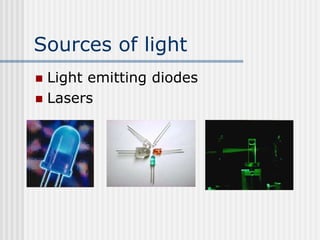
Sources of light
 Light emitting diodes
 Lasers
Sources
 Modulate electrical signals into
optical signals
 Mostly modulate at 850nm, 1300nm
and 1550 nm
 Lasers give high intensity, high
frequency light
 LEDs are economical
Transmission medium
 Optical fiber is replacing copper
 Light is used as the carrier of
information
 Much higher data rate
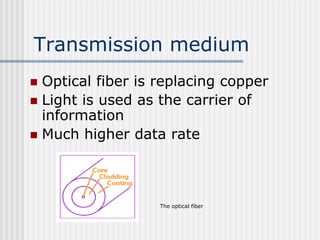
The optical fiber
Physics of optical fibers
 Index of refraction of material : ratio
of speed of light in vacuum to speed
of light in medium
 Refraction of light : bending of
light as it travels from one
media to another
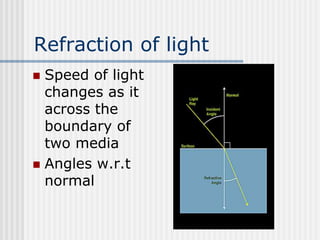
Refraction of light
 Speed of light
changes as it
across the
boundary of
two media
 Angles w.r.t
normal
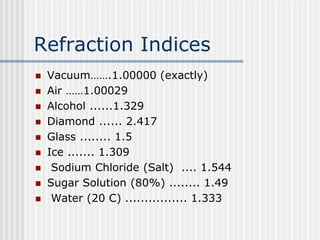
Refraction Indices
 Vacuum…….1.00000 (exactly)
 Air ……1.00029
 Alcohol ......1.329
 Diamond ...... 2.417
 Glass ........ 1.5
 Ice ....... 1.309
 Sodium Chloride (Salt) .... 1.544
 Sugar Solution (80%) ........ 1.49
 Water (20 C) ................ 1.333
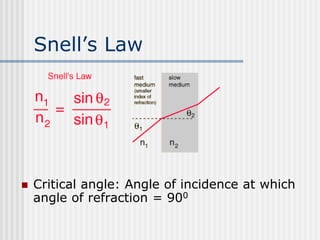
Snell’s Law
 Critical angle: Angle of incidence at which
angle of refraction = 900
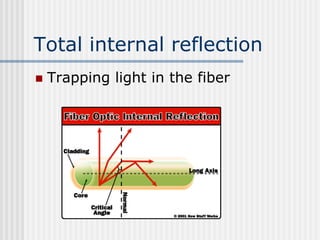
Total internal reflection
 Trapping light in the fiber
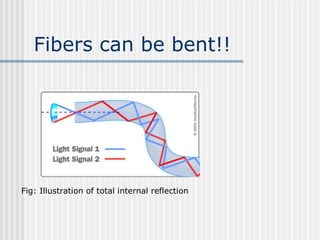
Fibers can be bent!!
Fig: Illustration of total internal reflection
Types of optical fibers
 Single mode
 only one signal can be transmitted
 use of single frequency
 Multi mode
 Several signals can be transmitted
 Several frequencies used to modulate
the signal
Losses in optical fibers
 Attenuation loss
 Dispersion loss
 Waveguide loss
Splices and Connectors
 To connect to fibers mechanically or
by fusion
 Lot of signal loss possible
 Very accurate alignment necessary
 Most important cost factor
 Now being replaced by optical
amplifiers
Optical Receivers
 Must be very sensitive
 Capable of picking up and amplifying
signals of nanowatts
 Photodiodes and phototransistors
 These devices get ‘turned ON’ by
light
 Produce photocurrent
Advantages of optical fibers
 Can carry much more information
 Much higher data rates
 Much longer distances than co-axial
cables
 Immune to electromagnetic noise
 Light in weight
 Unaffected by atmospheric agents

Photonics.ppt

  • 1.
  • 2.
    What are opticalfibers  Thin strands of pure glass  Carry data over long distances  At very high speeds  Fiber can be bent or twisted
  • 3.
    Fiber optic technology Sources  Transmission medium  Detectors Fig: The fiber optic communication system
  • 4.
    Sources of light Light emitting diodes  Lasers
  • 5.
    Sources  Modulate electricalsignals into optical signals  Mostly modulate at 850nm, 1300nm and 1550 nm  Lasers give high intensity, high frequency light  LEDs are economical
  • 6.
    Transmission medium  Opticalfiber is replacing copper  Light is used as the carrier of information  Much higher data rate The optical fiber
  • 7.
    Physics of opticalfibers  Index of refraction of material : ratio of speed of light in vacuum to speed of light in medium  Refraction of light : bending of light as it travels from one media to another
  • 8.
    Refraction of light Speed of light changes as it across the boundary of two media  Angles w.r.t normal
  • 9.
    Refraction Indices  Vacuum…….1.00000(exactly)  Air ……1.00029  Alcohol ......1.329  Diamond ...... 2.417  Glass ........ 1.5  Ice ....... 1.309  Sodium Chloride (Salt) .... 1.544  Sugar Solution (80%) ........ 1.49  Water (20 C) ................ 1.333
  • 10.
    Snell’s Law  Criticalangle: Angle of incidence at which angle of refraction = 900
  • 11.
    Total internal reflection Trapping light in the fiber
  • 12.
    Fibers can bebent!! Fig: Illustration of total internal reflection
  • 13.
    Types of opticalfibers  Single mode  only one signal can be transmitted  use of single frequency  Multi mode  Several signals can be transmitted  Several frequencies used to modulate the signal
  • 14.
    Losses in opticalfibers  Attenuation loss  Dispersion loss  Waveguide loss
  • 15.
    Splices and Connectors To connect to fibers mechanically or by fusion  Lot of signal loss possible  Very accurate alignment necessary  Most important cost factor  Now being replaced by optical amplifiers
  • 16.
    Optical Receivers  Mustbe very sensitive  Capable of picking up and amplifying signals of nanowatts  Photodiodes and phototransistors  These devices get ‘turned ON’ by light  Produce photocurrent
  • 17.
    Advantages of opticalfibers  Can carry much more information  Much higher data rates  Much longer distances than co-axial cables  Immune to electromagnetic noise  Light in weight  Unaffected by atmospheric agents