
UMAP Doctoral Consortium - July 2014, Aalborg, Denmark
Hybrid Solution of the Cold-Start Problem in
Context-Aware Recommender Systems
Matthias Braunhofer

!
Free University of Bozen - Bolzano

Piazza Domenicani 3, 39100 Bolzano, Italy

mbraunhofer@unibz.it
UMAP Doctoral Consortium - July 2014, Aalborg, Denmark
Outline
2
• Context-Aware Recommenders and the Cold-Start Problem
• Related Work
• Basic Context-Aware Rating Prediction Models
• Hybrid Context-Aware Rating Prediction Models
• Conclusions and Open Issues
UMAP Doctoral Consortium - July 2014, Aalborg, Denmark
Outline
2
• Context-Aware Recommenders and the Cold-Start Problem
• Related Work
• Basic Context-Aware Rating Prediction Models
• Hybrid Context-Aware Rating Prediction Models
• Conclusions and Open Issues
UMAP Doctoral Consortium - July 2014, Aalborg, Denmark
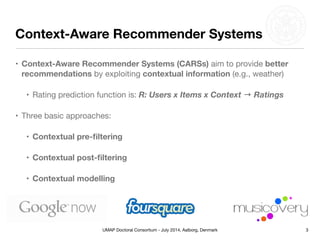
• Context-Aware Recommender Systems (CARSs) aim to provide better
recommendations by exploiting contextual information (e.g., weather)

• Rating prediction function is: R: Users x Items x Context → Ratings

• Three basic approaches: 

• Contextual pre-filtering
• Contextual post-filtering
• Contextual modelling
Context-Aware Recommender Systems
3
UMAP Doctoral Consortium - July 2014, Aalborg, Denmark
Cold-Start Problem
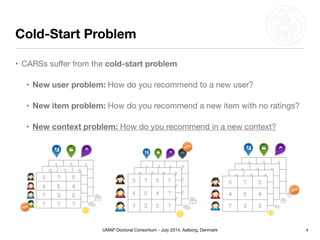
• CARSs suffer from the cold-start problem
• New user problem: How do you recommend to a new user?

• New item problem: How do you recommend a new item with no ratings?

• New context problem: How do you recommend in a new context?
4
1 ? 1 ?
2 5 ?
? 3 ?
3 ? 5 ?
2 5 ?
? 3 ?
5 ? 5 ?
4 5 4 ?
? 3 5 ?
1 ? 1
2 5
? 3
3 ? 5
2 5
? 3
5 ? 5
4 5 4
? 3 5
? ? ?
? ? ?
1 ? 1
2 5
? 3
3 ? 5
2 5
? 3
5 ? 5
4 5 4
? 3 5
UMAP Doctoral Consortium - July 2014, Aalborg, Denmark
Our Solution: Hybrid CARS
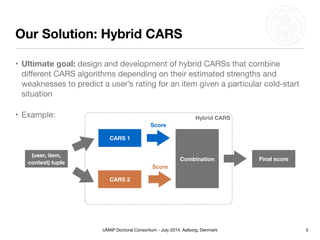
• Ultimate goal: design and development of hybrid CARSs that combine
different CARS algorithms depending on their estimated strengths and
weaknesses to predict a user’s rating for an item given a particular cold-start
situation

• Example:
5
(user, item,
context) tuple
CARS 1
CARS 2
Combination Final score
Score
Score
Hybrid CARS
UMAP Doctoral Consortium - July 2014, Aalborg, Denmark
Key Steps
• Identify candidate basic context-aware rating prediction models

• Analyse candidate rating prediction models (what are their strengths and
weaknesses under cold-start situations?)

• Design, develop and evaluate novel hybrid CARSs

• Integrate the best-performing hybrid CARS into our STS (South Tyrol
Suggests) mobile app

• Evaluate it through a live user study
6
UMAP Doctoral Consortium - July 2014, Aalborg, Denmark
Outline
7
• Context-Aware Recommenders
• Related Work
• Basic Context-Aware Rating Prediction Models
• Hybrid
• Conclusions and Open Issues
UMAP Doctoral Consortium - July 2014, Aalborg, Denmark
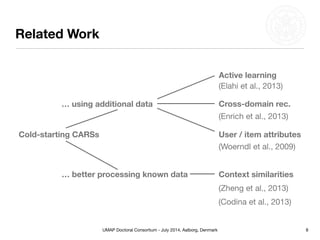
Related Work
8
Cold-starting CARSs
… using additional data
… better processing known data
Active learning
(Elahi et al., 2013)
Cross-domain rec.
(Enrich et al., 2013)
User / item attributes
(Woerndl et al., 2009)
Context similarities
(Zheng et al., 2013)
(Codina et al., 2013)
UMAP Doctoral Consortium - July 2014, Aalborg, Denmark
Outline
9
• Context-Aware Recommenders
• Related Work
• Basic Context-Aware Rating Prediction Models
• Conclusions and Open Issues
• Hybrid Context-Aware Rating Prediction Models
UMAP Doctoral Consortium - July 2014, Aalborg, Denmark
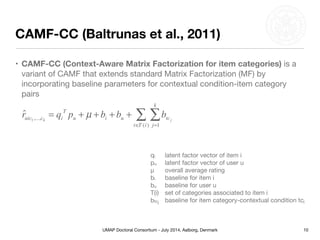
CAMF-CC (Baltrunas et al., 2011)
• CAMF-CC (Context-Aware Matrix Factorization for item categories) is a
variant of CAMF that extends standard Matrix Factorization (MF) by
incorporating baseline parameters for contextual condition-item category
pairs
10
ˆruic1,...,ck
= qi
T
pu + µ + bi + bu + btcj
j=1
k
∑
t∈T (i)
∑
qi 	 latent factor vector of item i

pu	 latent factor vector of user u

μ	 overall average rating

bi	 baseline for item i

bu	 baseline for user u

T(i)	 set of categories associated to item i

btcj	 baseline for item category-contextual condition tcj
UMAP Doctoral Consortium - July 2014, Aalborg, Denmark
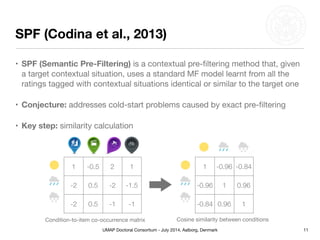
SPF (Codina et al., 2013)
• SPF (Semantic Pre-Filtering) is a contextual pre-filtering method that, given
a target contextual situation, uses a standard MF model learnt from all the
ratings tagged with contextual situations identical or similar to the target one 

• Conjecture: addresses cold-start problems caused by exact pre-filtering
• Key step: similarity calculation
11
1 -0.5 2 1
-2 0.5 -2 -1.5
-2 0.5 -1 -1
1 -0.96 -0.84
-0.96 1 0.96
-0.84 0.96 1
Condition-to-item co-occurrence matrix Cosine similarity between conditions
UMAP Doctoral Consortium - July 2014, Aalborg, Denmark
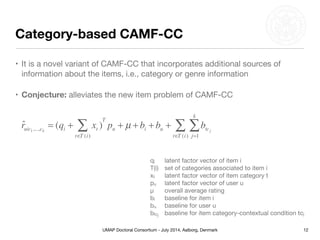
Category-based CAMF-CC
• It is a novel variant of CAMF-CC that incorporates additional sources of
information about the items, i.e., category or genre information

• Conjecture: alleviates the new item problem of CAMF-CC
12
ˆruic1,...,ck
= (qi + xt )
t∈T (i)
∑
T
pu + µ + bi + bu + btcj
j=1
k
∑
t∈T (i)
∑
qi 	 latent factor vector of item i

T(i)	 set of categories associated to item i

xt	 latent factor vector of item category t

pu	 latent factor vector of user u

μ	 overall average rating

bi	 baseline for item i

bu	 baseline for user u

btcj	 baseline for item category-contextual condition tcj
UMAP Doctoral Consortium - July 2014, Aalborg, Denmark
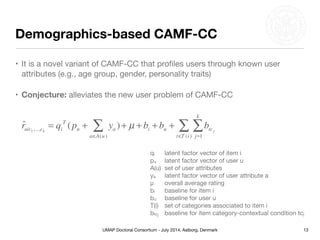
Demographics-based CAMF-CC
• It is a novel variant of CAMF-CC that profiles users through known user
attributes (e.g., age group, gender, personality traits)

• Conjecture: alleviates the new user problem of CAMF-CC
13
ˆruic1,...,ck
= qi
T
(pu + ya )
a∈A(u)
∑ + µ + bi + bu + btcj
j=1
k
∑
t∈T (i)
∑
qi 	 latent factor vector of item i

pu	 latent factor vector of user u

A(u)	 set of user attributes

ya	 latent factor vector of user attribute a

μ	 overall average rating

bi	 baseline for item i

bu	 baseline for user u

T(i)	 set of categories associated to item i

btcj	 baseline for item category-contextual condition tcj
UMAP Doctoral Consortium - July 2014, Aalborg, Denmark
Evaluation
Discussion
• Offline evaluation of cold-start performance of CARSs is a complex task:
• Not done before

• Requires large (enough) contextually-tagged rating datasets with user and
item attributes

• Must consider multiple perspectives: new users, new items, new
contextual situations, mixtures of elementary cold-start cases, different
degrees of coldness, different types of user and item attribute information
available
14
UMAP Doctoral Consortium - July 2014, Aalborg, Denmark
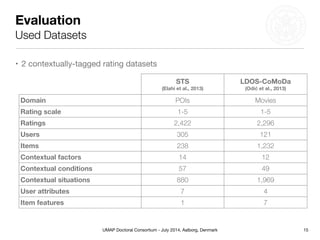
• 2 contextually-tagged rating datasets
STS
(Elahi et al., 2013)
LDOS-CoMoDa
(Odić et al., 2013)
Domain POIs Movies
Rating scale 1-5 1-5
Ratings 2,422 2,296
Users 305 121
Items 238 1,232
Contextual factors 14 12
Contextual conditions 57 49
Contextual situations 880 1,969
User attributes 7 4
Item features 1 7
Evaluation
Used Datasets
15
UMAP Doctoral Consortium - July 2014, Aalborg, Denmark
Evaluation
Evaluation Procedure
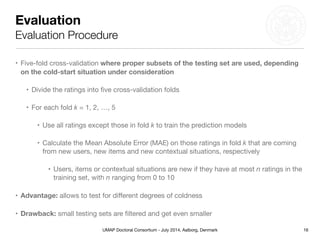
• Five-fold cross-validation where proper subsets of the testing set are used, depending
on the cold-start situation under consideration
• Divide the ratings into five cross-validation folds

• For each fold k = 1, 2, …, 5

• Use all ratings except those in fold k to train the prediction models

• Calculate the Mean Absolute Error (MAE) on those ratings in fold k that are coming
from new users, new items and new contextual situations, respectively 

• Users, items or contextual situations are new if they have at most n ratings in the
training set, with n ranging from 0 to 10

• Advantage: allows to test for different degrees of coldness

• Drawback: small testing sets are filtered and get even smaller
16
UMAP Doctoral Consortium - July 2014, Aalborg, Denmark
Evaluation
Obtained Results (1/3)
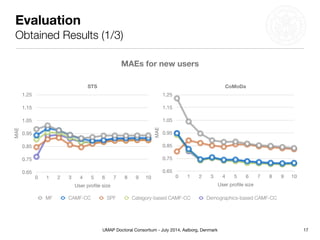
MAEs for new users
17
CoMoDa
MAE
0.65
0.75
0.85
0.95
1.05
1.15
1.25
User profile size
0 1 2 3 4 5 6 7 8 9 10
MF CAMF-CC SPF Category-based CAMF-CC Demographics-based CAMF-CC
STS
MAE
0.65
0.75
0.85
0.95
1.05
1.15
1.25
User profile size
0 1 2 3 4 5 6 7 8 9 10
UMAP Doctoral Consortium - July 2014, Aalborg, Denmark
Evaluation
Obtained Results (2/3)
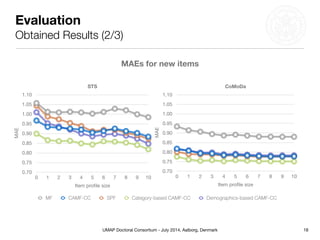
MAEs for new items
18
CoMoDa
MAE
0.70
0.75
0.80
0.85
0.90
0.95
1.00
1.05
1.10
Item profile size
0 1 2 3 4 5 6 7 8 9 10
MF CAMF-CC SPF Category-based CAMF-CC Demographics-based CAMF-CC
STS
MAE
0.70
0.75
0.80
0.85
0.90
0.95
1.00
1.05
1.10
Item profile size
0 1 2 3 4 5 6 7 8 9 10
UMAP Doctoral Consortium - July 2014, Aalborg, Denmark
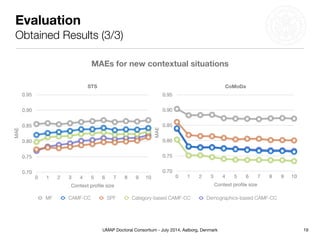
Evaluation
Obtained Results (3/3)
MAEs for new contextual situations
19
CoMoDa
MAE
0.70
0.75
0.80
0.85
0.90
0.95
Context profile size
0 1 2 3 4 5 6 7 8 9 10
MF CAMF-CC SPF Category-based CAMF-CC Demographics-based CAMF-CC
STS
MAE
0.70
0.75
0.80
0.85
0.90
0.95
Context profile size
0 1 2 3 4 5 6 7 8 9 10
UMAP Doctoral Consortium - July 2014, Aalborg, Denmark
Outline
20
• Context-Aware Recommenders
• Related Work
• Basic Context-Aware Rating Prediction Models
• Conclusions and Open Issues
• Hybrid Context-Aware Rating Prediction Models
UMAP Doctoral Consortium - July 2014, Aalborg, Denmark
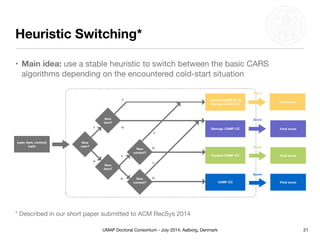
Heuristic Switching*
• Main idea: use a stable heuristic to switch between the basic CARS
algorithms depending on the encountered cold-start situation
21
(user, item, context)
tuple
Final score
Y Demogr.-CAMF-CC
Content-CAMF-CC
CAMF-CC
New
item?
N
Y
N
New
context?
New
context?
Y
N
New
item?
New
user?
Content-CAMF-CC &
Demogr.-CAMF-CC
Y
N
Y
N
Final score
Final score
Final score
Score
Score
Score
Score
* Described in our short paper submitted to ACM RecSys 2014
UMAP Doctoral Consortium - July 2014, Aalborg, Denmark
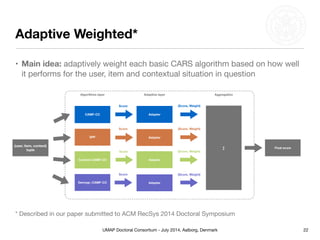
Adaptive Weighted*
• Main idea: adaptively weight each basic CARS algorithm based on how well
it performs for the user, item and contextual situation in question
22
(user, item, context)
tuple
CAMF-CC
SPF
Content-CAMF-CC
Demogr.-CAMF-CC
Adapter
Adapter
Adapter
Adapter
Score
Score
Score
Score
(Score, Weight)
(Score, Weight)
(Score, Weight)
(Score, Weight)
∑ Final score
Algorithms layer Adaptive layer Aggregation
* Described in our paper submitted to ACM RecSys 2014 Doctoral Symposium
UMAP Doctoral Consortium - July 2014, Aalborg, Denmark
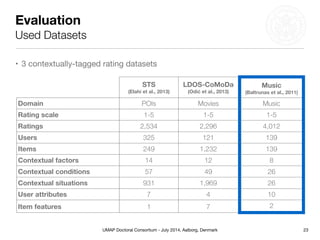
• 3 contextually-tagged rating datasets
STS
(Elahi et al., 2013)
LDOS-CoMoDa
(Odić et al., 2013)
Music
(Baltrunas et al., 2011)
Domain POIs Movies Music
Rating scale 1-5 1-5 1-5
Ratings 2,534 2,296 4,012
Users 325 121 139
Items 249 1,232 139
Contextual factors 14 12 8
Contextual conditions 57 49 26
Contextual situations 931 1,969 26
User attributes 7 4 10
Item features 1 7 2
Evaluation
Used Datasets
23
UMAP Doctoral Consortium - July 2014, Aalborg, Denmark
Evaluation
Evaluation Procedure
24
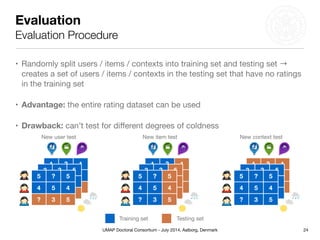
• Randomly split users / items / contexts into training set and testing set →
creates a set of users / items / contexts in the testing set that have no ratings
in the training set

• Advantage: the entire rating dataset can be used 

• Drawback: can’t test for different degrees of coldness
1 ? 1
2 5
? 3
3 ? 5
2 5
? 3
5 ? 5
4 5 4
? 3 5
1 ? 1
2 5
? 3
3 ? 5
2 5
? 3
5 ? 5
4 5 4
? 3 5
1 ? 1
2 5
? 3
3 ? 5
2 5
? 3
5 ? 5
4 5 4
? 3 5
New user test New item test New context test
Training set Testing set
UMAP Doctoral Consortium - July 2014, Aalborg, Denmark
Evaluation
Summary of Obtained Results
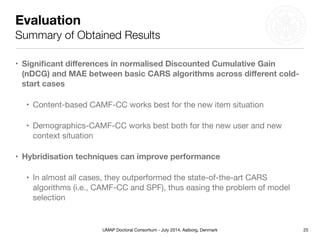
• Significant differences in normalised Discounted Cumulative Gain
(nDCG) and MAE between basic CARS algorithms across different cold-
start cases
• Content-based CAMF-CC works best for the new item situation

• Demographics-CAMF-CC works best both for the new user and new
context situation 

• Hybridisation techniques can improve performance
• In almost all cases, they outperformed the state-of-the-art CARS
algorithms (i.e., CAMF-CC and SPF), thus easing the problem of model
selection
25
UMAP Doctoral Consortium - July 2014, Aalborg, Denmark
Outline
26
• Context-Aware Recommenders
• Related Work
• Basic Context-Aware Rating Prediction Models
• Conclusions and Open Issues
• Hybrid Context-Aware Rating Prediction Models
UMAP Doctoral Consortium - July 2014, Aalborg, Denmark
Conclusions
• Basic CARS algorithms perform very differently in the different cold-start
situations

• Knowledge of strengths and weaknesses of each basic CARS algorithm in the
various cold-start situations allows the development of hybrid techniques 

• First developed and tested hybrid CARS algorithms are able to outperform
the state-of-the-art CARS algorithms (i.e., CAMF-CC and SPF)
27
UMAP Doctoral Consortium - July 2014, Aalborg, Denmark
Open Issues
• Review additional knowledge sources which may be used to incorporate
additional information about users, items and contextual situations

• Check the availability of large-scale, contextually-tagged datasets with item
and user attributes

• Revise the used evaluation procedure and evaluation metrics 

• Identify the best-performing hybridisation method for cold-start situations

• Design and execute a live user study
28
UMAP Doctoral Consortium - July 2014, Aalborg, Denmark
Questions or Comments?
Thank you.

Hybrid Solution of the Cold-Start Problem in Context-Aware Recommender Systems

  • 1.
    UMAP Doctoral Consortium- July 2014, Aalborg, Denmark Hybrid Solution of the Cold-Start Problem in Context-Aware Recommender Systems Matthias Braunhofer ! Free University of Bozen - Bolzano Piazza Domenicani 3, 39100 Bolzano, Italy mbraunhofer@unibz.it
  • 2.
    UMAP Doctoral Consortium- July 2014, Aalborg, Denmark Outline 2 • Context-Aware Recommenders and the Cold-Start Problem • Related Work • Basic Context-Aware Rating Prediction Models • Hybrid Context-Aware Rating Prediction Models • Conclusions and Open Issues
  • 3.
    UMAP Doctoral Consortium- July 2014, Aalborg, Denmark Outline 2 • Context-Aware Recommenders and the Cold-Start Problem • Related Work • Basic Context-Aware Rating Prediction Models • Hybrid Context-Aware Rating Prediction Models • Conclusions and Open Issues
  • 4.
    UMAP Doctoral Consortium- July 2014, Aalborg, Denmark • Context-Aware Recommender Systems (CARSs) aim to provide better recommendations by exploiting contextual information (e.g., weather) • Rating prediction function is: R: Users x Items x Context → Ratings • Three basic approaches: • Contextual pre-filtering • Contextual post-filtering • Contextual modelling Context-Aware Recommender Systems 3
  • 5.
    UMAP Doctoral Consortium- July 2014, Aalborg, Denmark Cold-Start Problem • CARSs suffer from the cold-start problem • New user problem: How do you recommend to a new user? • New item problem: How do you recommend a new item with no ratings? • New context problem: How do you recommend in a new context? 4 1 ? 1 ? 2 5 ? ? 3 ? 3 ? 5 ? 2 5 ? ? 3 ? 5 ? 5 ? 4 5 4 ? ? 3 5 ? 1 ? 1 2 5 ? 3 3 ? 5 2 5 ? 3 5 ? 5 4 5 4 ? 3 5 ? ? ? ? ? ? 1 ? 1 2 5 ? 3 3 ? 5 2 5 ? 3 5 ? 5 4 5 4 ? 3 5
  • 6.
    UMAP Doctoral Consortium- July 2014, Aalborg, Denmark Our Solution: Hybrid CARS • Ultimate goal: design and development of hybrid CARSs that combine different CARS algorithms depending on their estimated strengths and weaknesses to predict a user’s rating for an item given a particular cold-start situation • Example: 5 (user, item, context) tuple CARS 1 CARS 2 Combination Final score Score Score Hybrid CARS
  • 7.
    UMAP Doctoral Consortium- July 2014, Aalborg, Denmark Key Steps • Identify candidate basic context-aware rating prediction models • Analyse candidate rating prediction models (what are their strengths and weaknesses under cold-start situations?) • Design, develop and evaluate novel hybrid CARSs • Integrate the best-performing hybrid CARS into our STS (South Tyrol Suggests) mobile app • Evaluate it through a live user study 6
  • 8.
    UMAP Doctoral Consortium- July 2014, Aalborg, Denmark Outline 7 • Context-Aware Recommenders • Related Work • Basic Context-Aware Rating Prediction Models • Hybrid • Conclusions and Open Issues
  • 9.
    UMAP Doctoral Consortium- July 2014, Aalborg, Denmark Related Work 8 Cold-starting CARSs … using additional data … better processing known data Active learning (Elahi et al., 2013) Cross-domain rec. (Enrich et al., 2013) User / item attributes (Woerndl et al., 2009) Context similarities (Zheng et al., 2013) (Codina et al., 2013)
  • 10.
    UMAP Doctoral Consortium- July 2014, Aalborg, Denmark Outline 9 • Context-Aware Recommenders • Related Work • Basic Context-Aware Rating Prediction Models • Conclusions and Open Issues • Hybrid Context-Aware Rating Prediction Models
  • 11.
    UMAP Doctoral Consortium- July 2014, Aalborg, Denmark CAMF-CC (Baltrunas et al., 2011) • CAMF-CC (Context-Aware Matrix Factorization for item categories) is a variant of CAMF that extends standard Matrix Factorization (MF) by incorporating baseline parameters for contextual condition-item category pairs 10 ˆruic1,...,ck = qi T pu + µ + bi + bu + btcj j=1 k ∑ t∈T (i) ∑ qi latent factor vector of item i pu latent factor vector of user u μ overall average rating bi baseline for item i bu baseline for user u T(i) set of categories associated to item i btcj baseline for item category-contextual condition tcj
  • 12.
    UMAP Doctoral Consortium- July 2014, Aalborg, Denmark SPF (Codina et al., 2013) • SPF (Semantic Pre-Filtering) is a contextual pre-filtering method that, given a target contextual situation, uses a standard MF model learnt from all the ratings tagged with contextual situations identical or similar to the target one • Conjecture: addresses cold-start problems caused by exact pre-filtering • Key step: similarity calculation 11 1 -0.5 2 1 -2 0.5 -2 -1.5 -2 0.5 -1 -1 1 -0.96 -0.84 -0.96 1 0.96 -0.84 0.96 1 Condition-to-item co-occurrence matrix Cosine similarity between conditions
  • 13.
    UMAP Doctoral Consortium- July 2014, Aalborg, Denmark Category-based CAMF-CC • It is a novel variant of CAMF-CC that incorporates additional sources of information about the items, i.e., category or genre information • Conjecture: alleviates the new item problem of CAMF-CC 12 ˆruic1,...,ck = (qi + xt ) t∈T (i) ∑ T pu + µ + bi + bu + btcj j=1 k ∑ t∈T (i) ∑ qi latent factor vector of item i T(i) set of categories associated to item i xt latent factor vector of item category t pu latent factor vector of user u μ overall average rating bi baseline for item i bu baseline for user u btcj baseline for item category-contextual condition tcj
  • 14.
    UMAP Doctoral Consortium- July 2014, Aalborg, Denmark Demographics-based CAMF-CC • It is a novel variant of CAMF-CC that profiles users through known user attributes (e.g., age group, gender, personality traits) • Conjecture: alleviates the new user problem of CAMF-CC 13 ˆruic1,...,ck = qi T (pu + ya ) a∈A(u) ∑ + µ + bi + bu + btcj j=1 k ∑ t∈T (i) ∑ qi latent factor vector of item i pu latent factor vector of user u A(u) set of user attributes ya latent factor vector of user attribute a μ overall average rating bi baseline for item i bu baseline for user u T(i) set of categories associated to item i btcj baseline for item category-contextual condition tcj
  • 15.
    UMAP Doctoral Consortium- July 2014, Aalborg, Denmark Evaluation Discussion • Offline evaluation of cold-start performance of CARSs is a complex task: • Not done before • Requires large (enough) contextually-tagged rating datasets with user and item attributes • Must consider multiple perspectives: new users, new items, new contextual situations, mixtures of elementary cold-start cases, different degrees of coldness, different types of user and item attribute information available 14
  • 16.
    UMAP Doctoral Consortium- July 2014, Aalborg, Denmark • 2 contextually-tagged rating datasets STS (Elahi et al., 2013) LDOS-CoMoDa (Odić et al., 2013) Domain POIs Movies Rating scale 1-5 1-5 Ratings 2,422 2,296 Users 305 121 Items 238 1,232 Contextual factors 14 12 Contextual conditions 57 49 Contextual situations 880 1,969 User attributes 7 4 Item features 1 7 Evaluation Used Datasets 15
  • 17.
    UMAP Doctoral Consortium- July 2014, Aalborg, Denmark Evaluation Evaluation Procedure • Five-fold cross-validation where proper subsets of the testing set are used, depending on the cold-start situation under consideration • Divide the ratings into five cross-validation folds • For each fold k = 1, 2, …, 5 • Use all ratings except those in fold k to train the prediction models • Calculate the Mean Absolute Error (MAE) on those ratings in fold k that are coming from new users, new items and new contextual situations, respectively • Users, items or contextual situations are new if they have at most n ratings in the training set, with n ranging from 0 to 10 • Advantage: allows to test for different degrees of coldness • Drawback: small testing sets are filtered and get even smaller 16
  • 18.
    UMAP Doctoral Consortium- July 2014, Aalborg, Denmark Evaluation Obtained Results (1/3) MAEs for new users 17 CoMoDa MAE 0.65 0.75 0.85 0.95 1.05 1.15 1.25 User profile size 0 1 2 3 4 5 6 7 8 9 10 MF CAMF-CC SPF Category-based CAMF-CC Demographics-based CAMF-CC STS MAE 0.65 0.75 0.85 0.95 1.05 1.15 1.25 User profile size 0 1 2 3 4 5 6 7 8 9 10
  • 19.
    UMAP Doctoral Consortium- July 2014, Aalborg, Denmark Evaluation Obtained Results (2/3) MAEs for new items 18 CoMoDa MAE 0.70 0.75 0.80 0.85 0.90 0.95 1.00 1.05 1.10 Item profile size 0 1 2 3 4 5 6 7 8 9 10 MF CAMF-CC SPF Category-based CAMF-CC Demographics-based CAMF-CC STS MAE 0.70 0.75 0.80 0.85 0.90 0.95 1.00 1.05 1.10 Item profile size 0 1 2 3 4 5 6 7 8 9 10
  • 20.
    UMAP Doctoral Consortium- July 2014, Aalborg, Denmark Evaluation Obtained Results (3/3) MAEs for new contextual situations 19 CoMoDa MAE 0.70 0.75 0.80 0.85 0.90 0.95 Context profile size 0 1 2 3 4 5 6 7 8 9 10 MF CAMF-CC SPF Category-based CAMF-CC Demographics-based CAMF-CC STS MAE 0.70 0.75 0.80 0.85 0.90 0.95 Context profile size 0 1 2 3 4 5 6 7 8 9 10
  • 21.
    UMAP Doctoral Consortium- July 2014, Aalborg, Denmark Outline 20 • Context-Aware Recommenders • Related Work • Basic Context-Aware Rating Prediction Models • Conclusions and Open Issues • Hybrid Context-Aware Rating Prediction Models
  • 22.
    UMAP Doctoral Consortium- July 2014, Aalborg, Denmark Heuristic Switching* • Main idea: use a stable heuristic to switch between the basic CARS algorithms depending on the encountered cold-start situation 21 (user, item, context) tuple Final score Y Demogr.-CAMF-CC Content-CAMF-CC CAMF-CC New item? N Y N New context? New context? Y N New item? New user? Content-CAMF-CC & Demogr.-CAMF-CC Y N Y N Final score Final score Final score Score Score Score Score * Described in our short paper submitted to ACM RecSys 2014
  • 23.
    UMAP Doctoral Consortium- July 2014, Aalborg, Denmark Adaptive Weighted* • Main idea: adaptively weight each basic CARS algorithm based on how well it performs for the user, item and contextual situation in question 22 (user, item, context) tuple CAMF-CC SPF Content-CAMF-CC Demogr.-CAMF-CC Adapter Adapter Adapter Adapter Score Score Score Score (Score, Weight) (Score, Weight) (Score, Weight) (Score, Weight) ∑ Final score Algorithms layer Adaptive layer Aggregation * Described in our paper submitted to ACM RecSys 2014 Doctoral Symposium
  • 24.
    UMAP Doctoral Consortium- July 2014, Aalborg, Denmark • 3 contextually-tagged rating datasets STS (Elahi et al., 2013) LDOS-CoMoDa (Odić et al., 2013) Music (Baltrunas et al., 2011) Domain POIs Movies Music Rating scale 1-5 1-5 1-5 Ratings 2,534 2,296 4,012 Users 325 121 139 Items 249 1,232 139 Contextual factors 14 12 8 Contextual conditions 57 49 26 Contextual situations 931 1,969 26 User attributes 7 4 10 Item features 1 7 2 Evaluation Used Datasets 23
  • 25.
    UMAP Doctoral Consortium- July 2014, Aalborg, Denmark Evaluation Evaluation Procedure 24 • Randomly split users / items / contexts into training set and testing set → creates a set of users / items / contexts in the testing set that have no ratings in the training set • Advantage: the entire rating dataset can be used • Drawback: can’t test for different degrees of coldness 1 ? 1 2 5 ? 3 3 ? 5 2 5 ? 3 5 ? 5 4 5 4 ? 3 5 1 ? 1 2 5 ? 3 3 ? 5 2 5 ? 3 5 ? 5 4 5 4 ? 3 5 1 ? 1 2 5 ? 3 3 ? 5 2 5 ? 3 5 ? 5 4 5 4 ? 3 5 New user test New item test New context test Training set Testing set
  • 26.
    UMAP Doctoral Consortium- July 2014, Aalborg, Denmark Evaluation Summary of Obtained Results • Significant differences in normalised Discounted Cumulative Gain (nDCG) and MAE between basic CARS algorithms across different cold- start cases • Content-based CAMF-CC works best for the new item situation • Demographics-CAMF-CC works best both for the new user and new context situation • Hybridisation techniques can improve performance • In almost all cases, they outperformed the state-of-the-art CARS algorithms (i.e., CAMF-CC and SPF), thus easing the problem of model selection 25
  • 27.
    UMAP Doctoral Consortium- July 2014, Aalborg, Denmark Outline 26 • Context-Aware Recommenders • Related Work • Basic Context-Aware Rating Prediction Models • Conclusions and Open Issues • Hybrid Context-Aware Rating Prediction Models
  • 28.
    UMAP Doctoral Consortium- July 2014, Aalborg, Denmark Conclusions • Basic CARS algorithms perform very differently in the different cold-start situations • Knowledge of strengths and weaknesses of each basic CARS algorithm in the various cold-start situations allows the development of hybrid techniques • First developed and tested hybrid CARS algorithms are able to outperform the state-of-the-art CARS algorithms (i.e., CAMF-CC and SPF) 27
  • 29.
    UMAP Doctoral Consortium- July 2014, Aalborg, Denmark Open Issues • Review additional knowledge sources which may be used to incorporate additional information about users, items and contextual situations • Check the availability of large-scale, contextually-tagged datasets with item and user attributes • Revise the used evaluation procedure and evaluation metrics • Identify the best-performing hybridisation method for cold-start situations • Design and execute a live user study 28
  • 30.
    UMAP Doctoral Consortium- July 2014, Aalborg, Denmark Questions or Comments? Thank you.