Regulatory outlook for real-
world emissions
Vicente Franco, Peter Mock
vicente@theicct.org
International Conference: Engine Optimisation for RDE
20-21 January 2015. NH Hotel Frankfurt-Mörfelden, Germany
Regulatory outlook for real-world emissions
 Current challenges: results from Diesel
PC meta-study
 Advanced systems and trends for
emission measurement
 Technologies to meet 2020 targets
3
Real Driving
Emissions
Current challenges:
results from Diesel PC
meta-study
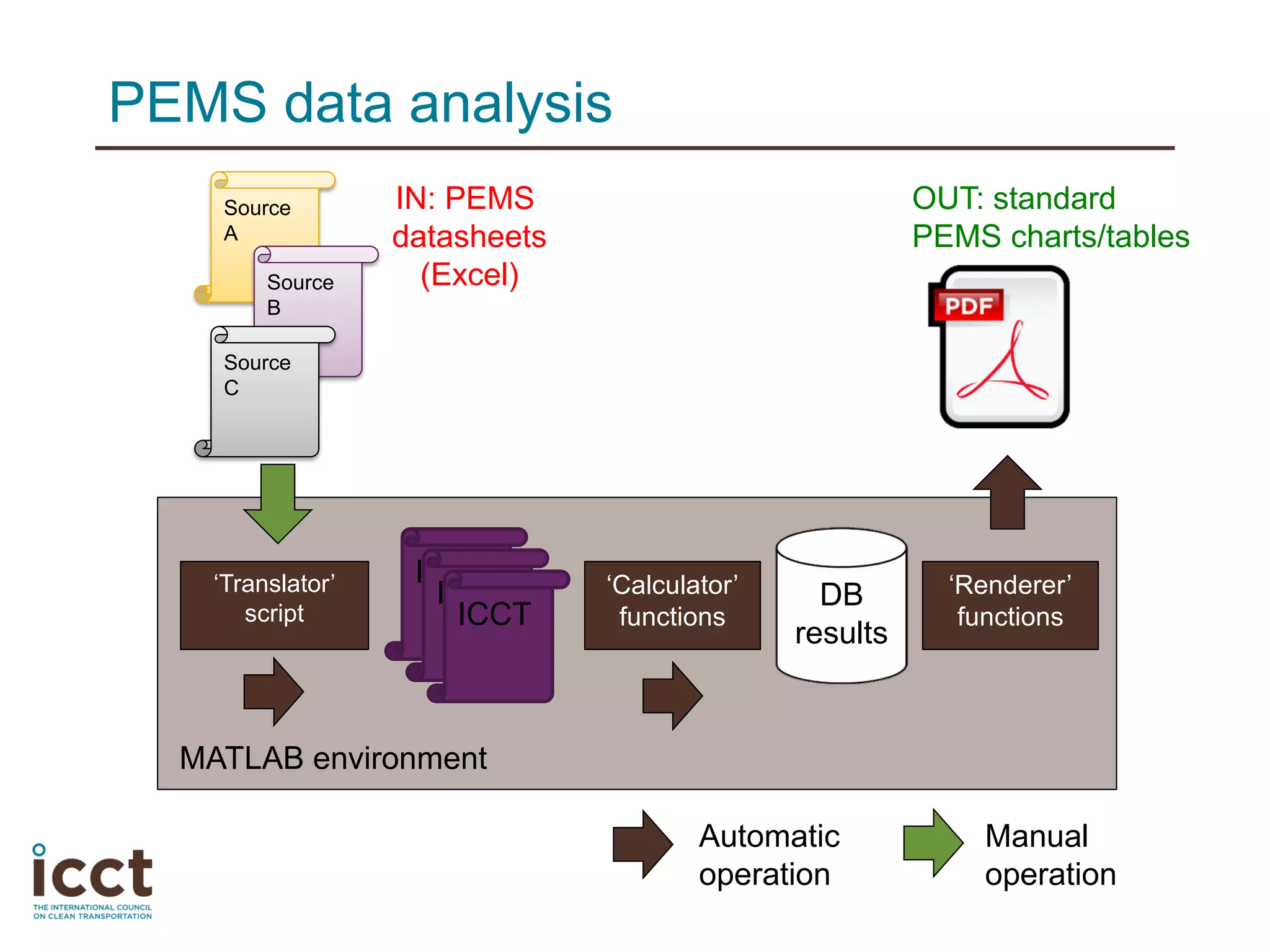
‘Translator’
script
Source
A
Source
B
Source
C
ICCT
ICCT
ICCT
‘Calculator’
functions
MATLAB environment
DB
results
‘Renderer’
functions
IN: PEMS
datasheets
(Excel)
OUT: standard
PEMS charts/tables
Automatic
operation
Manual
operation
PEMS data analysis
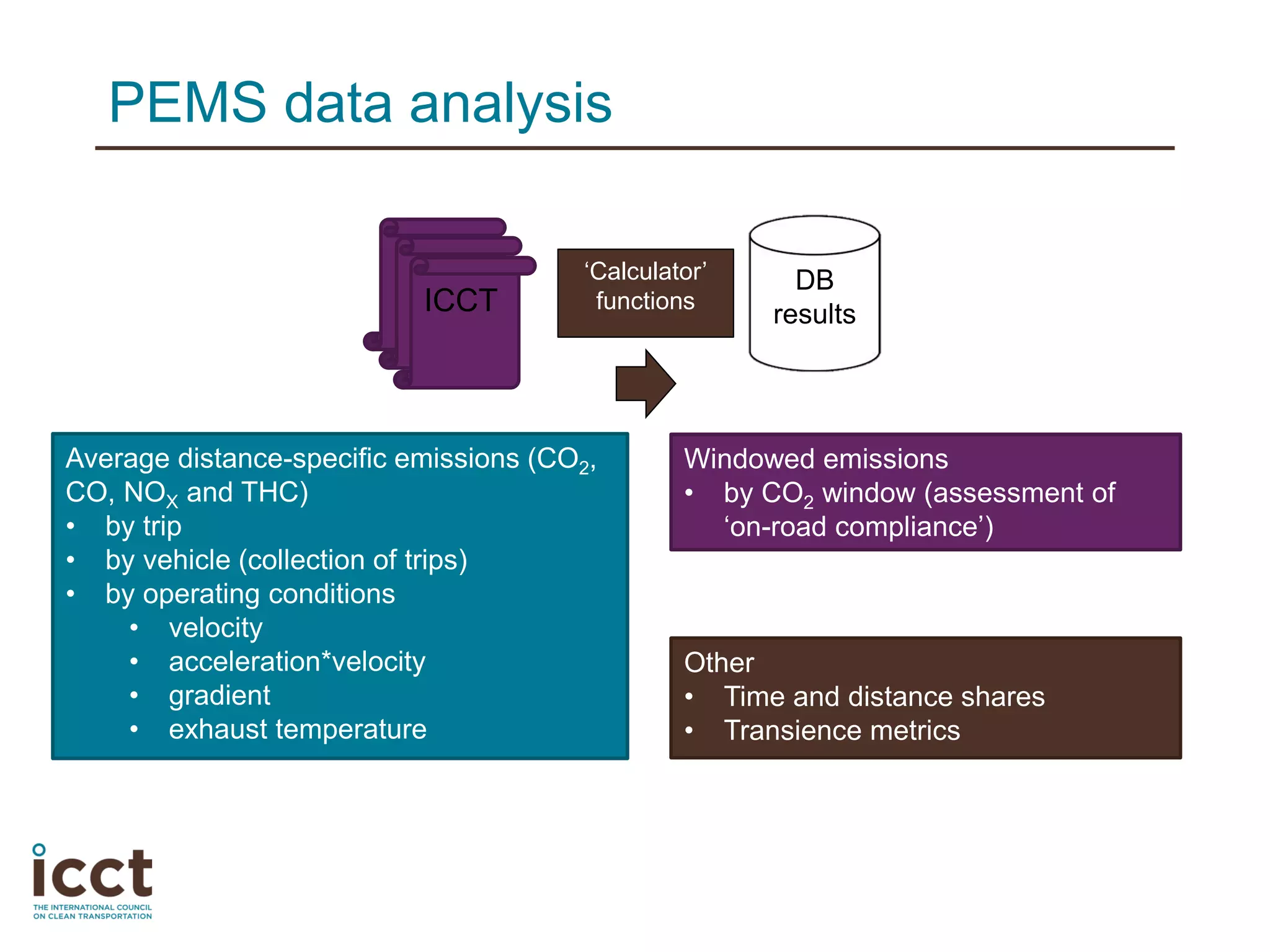
Windowed emissions
• by CO2 window (assessment of
‘on-road compliance’)
Other
• Time and distance shares
• Transience metrics
Average distance-specific emissions (CO2,
CO, NOX and THC)
• by trip
• by vehicle (collection of trips)
• by operating conditions
• velocity
• acceleration*velocity
• gradient
• exhaust temperature
ICCT
ICCT
ICCT
‘Calculator’
functions
DB
results
PEMS data analysis
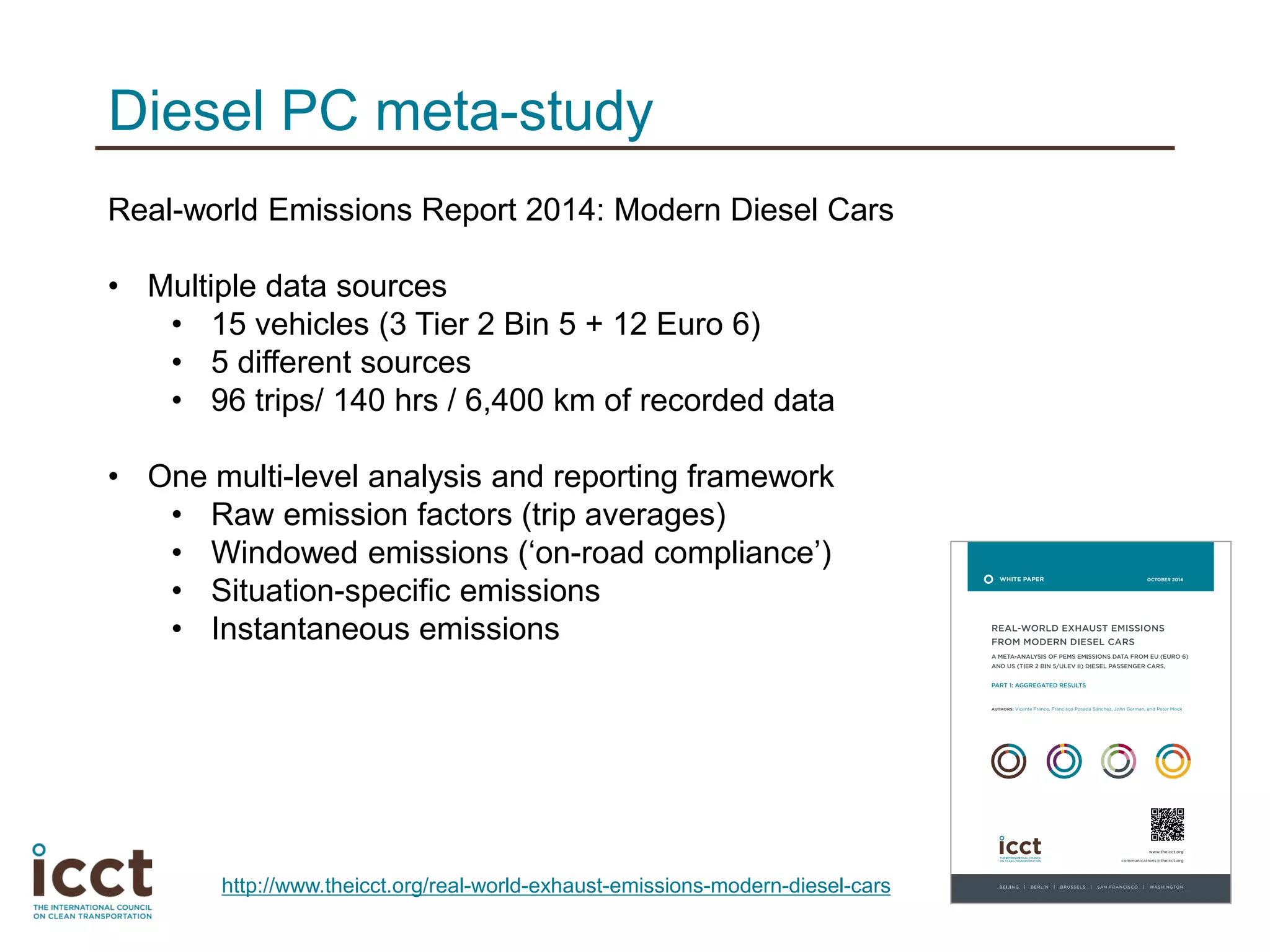
Diesel PC meta-study
Real-world Emissions Report 2014: Modern Diesel Cars
• Multiple data sources
• 15 vehicles (3 Tier 2 Bin 5 + 12 Euro 6)
• 5 different sources
• 96 trips/ 140 hrs / 6,400 km of recorded data
• One multi-level analysis and reporting framework
• Raw emission factors (trip averages)
• Windowed emissions (‘on-road compliance’)
• Situation-specific emissions
• Instantaneous emissions
http://www.theicct.org/real-world-exhaust-emissions-modern-diesel-cars
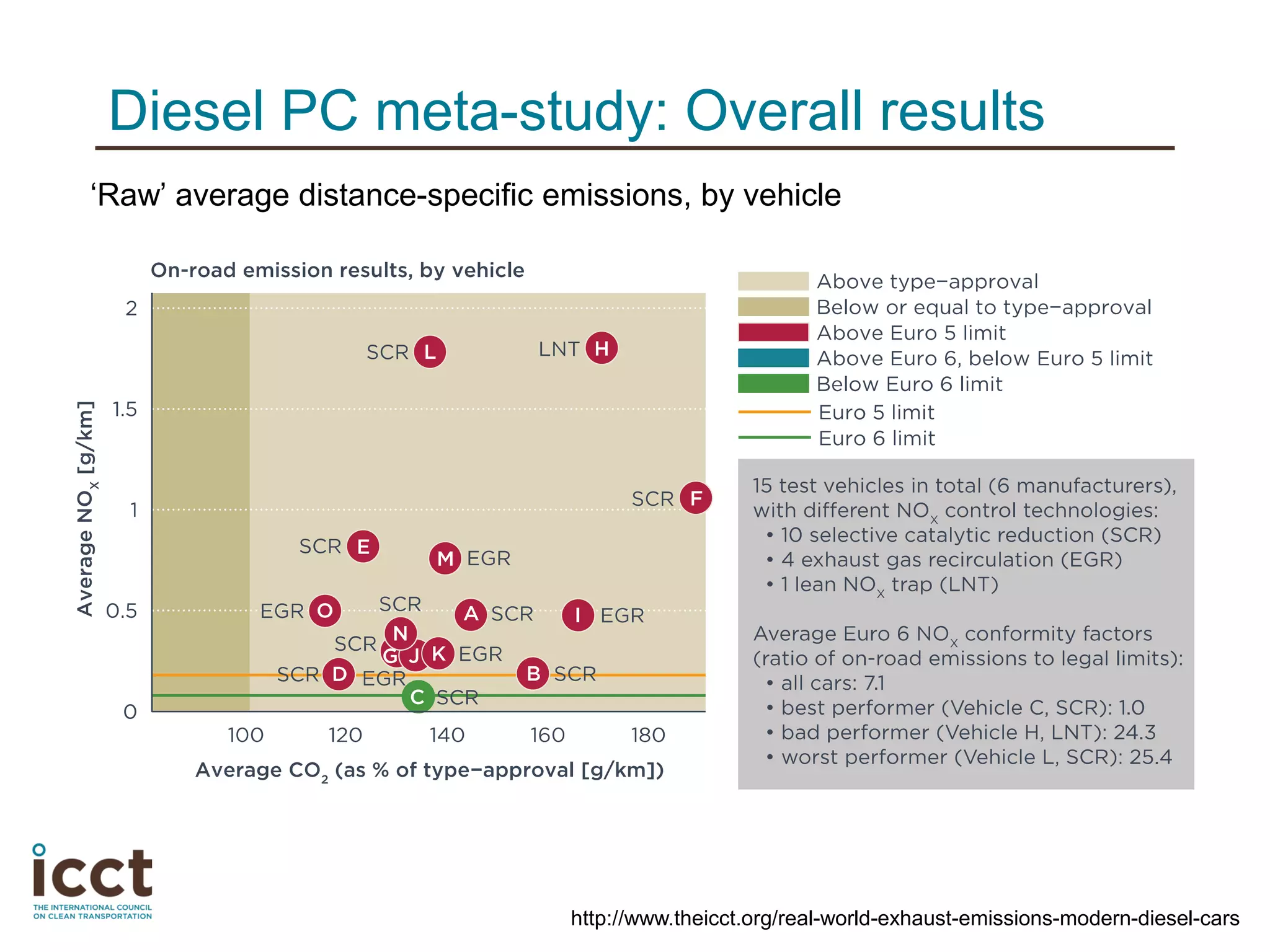
‘Raw’ average distance-specific emissions, by vehicle
Diesel PC meta-study: Overall results
http://www.theicct.org/real-world-exhaust-emissions-modern-diesel-cars
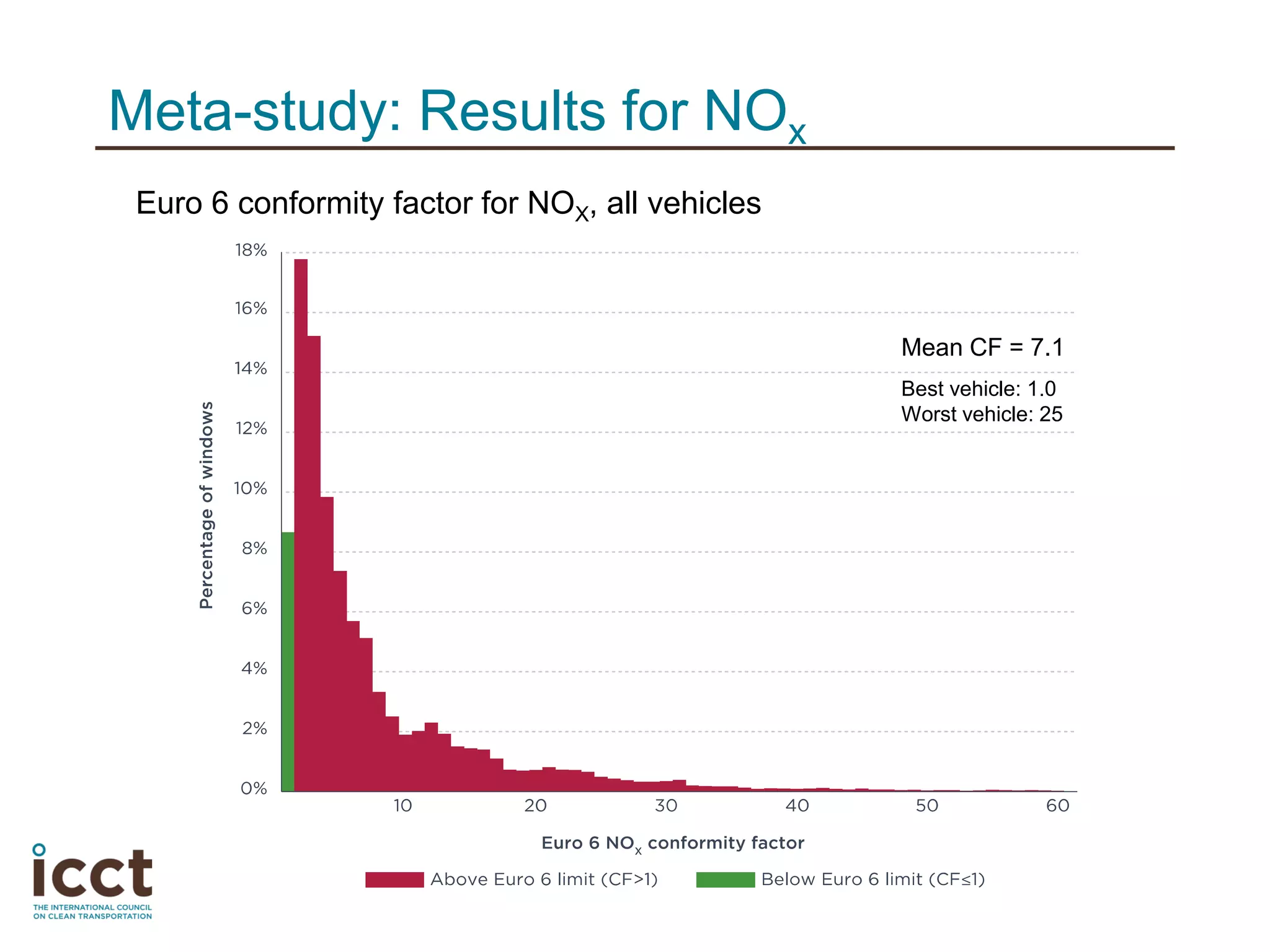
Euro 6 conformity factor for NOX, all vehicles
Meta-study: Results for NOx
Mean CF = 7.1
Best vehicle: 1.0
Worst vehicle: 25
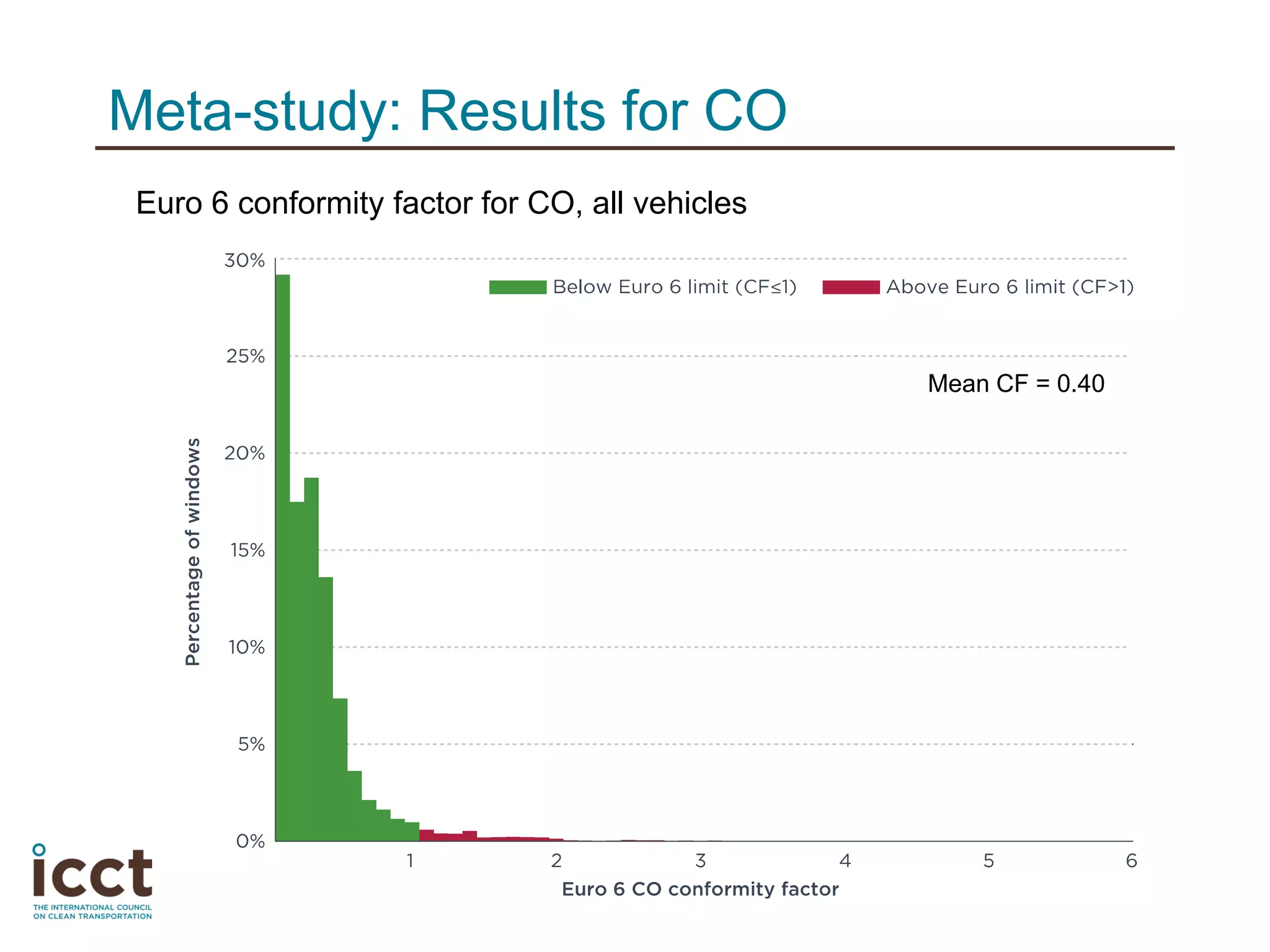
Euro 6 conformity factor for CO, all vehicles
Meta-study: Results for CO
Mean CF = 0.40
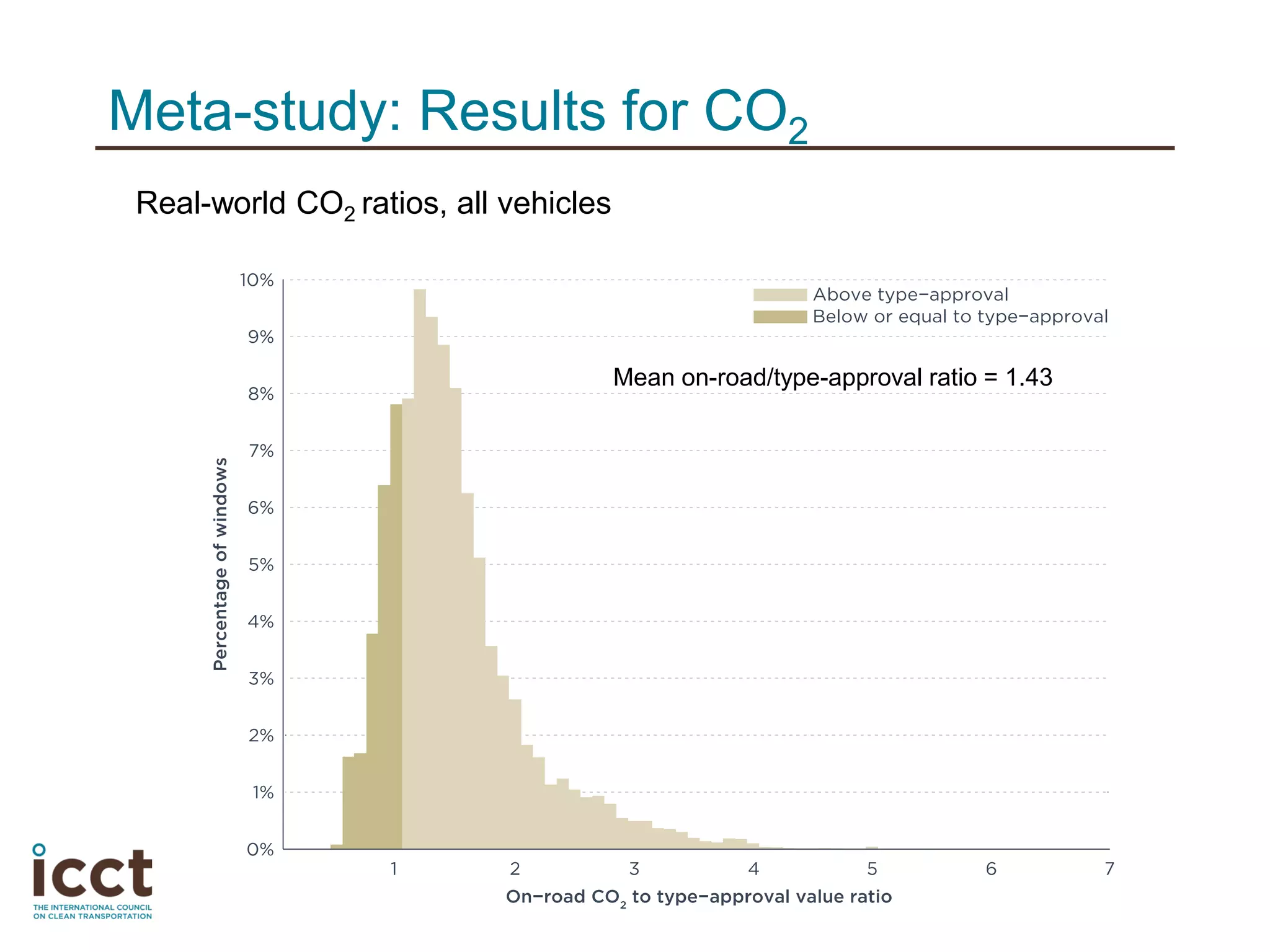
Real-world CO2 ratios, all vehicles
Meta-study: Results for CO2
Mean on-road/type-approval ratio = 1.43
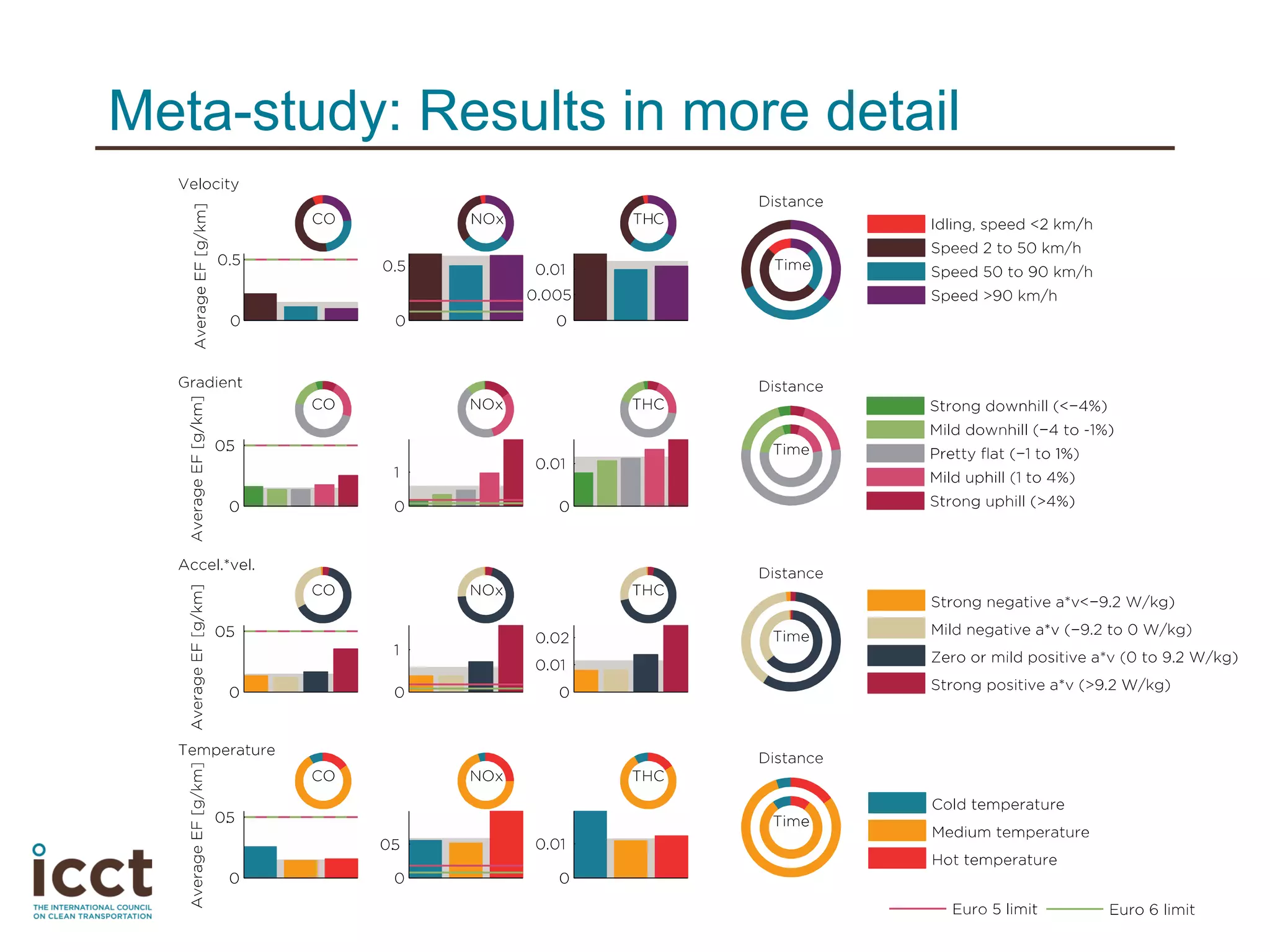
Meta-study: Results in more detail
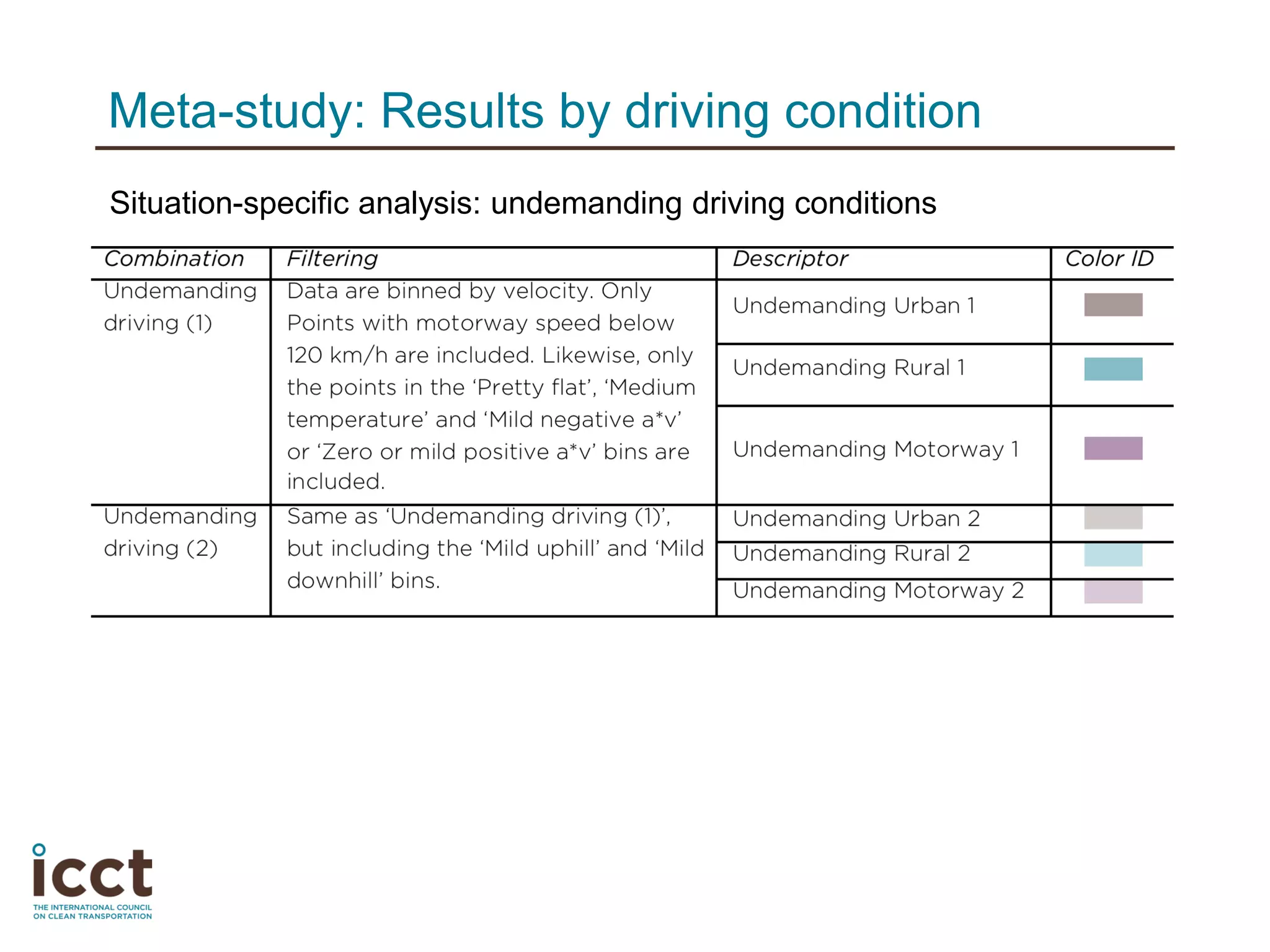
Situation-specific analysis: undemanding driving conditions
Meta-study: Results by driving condition
NOX emission factors [mg/km]
Meta-study: Results by driving condition
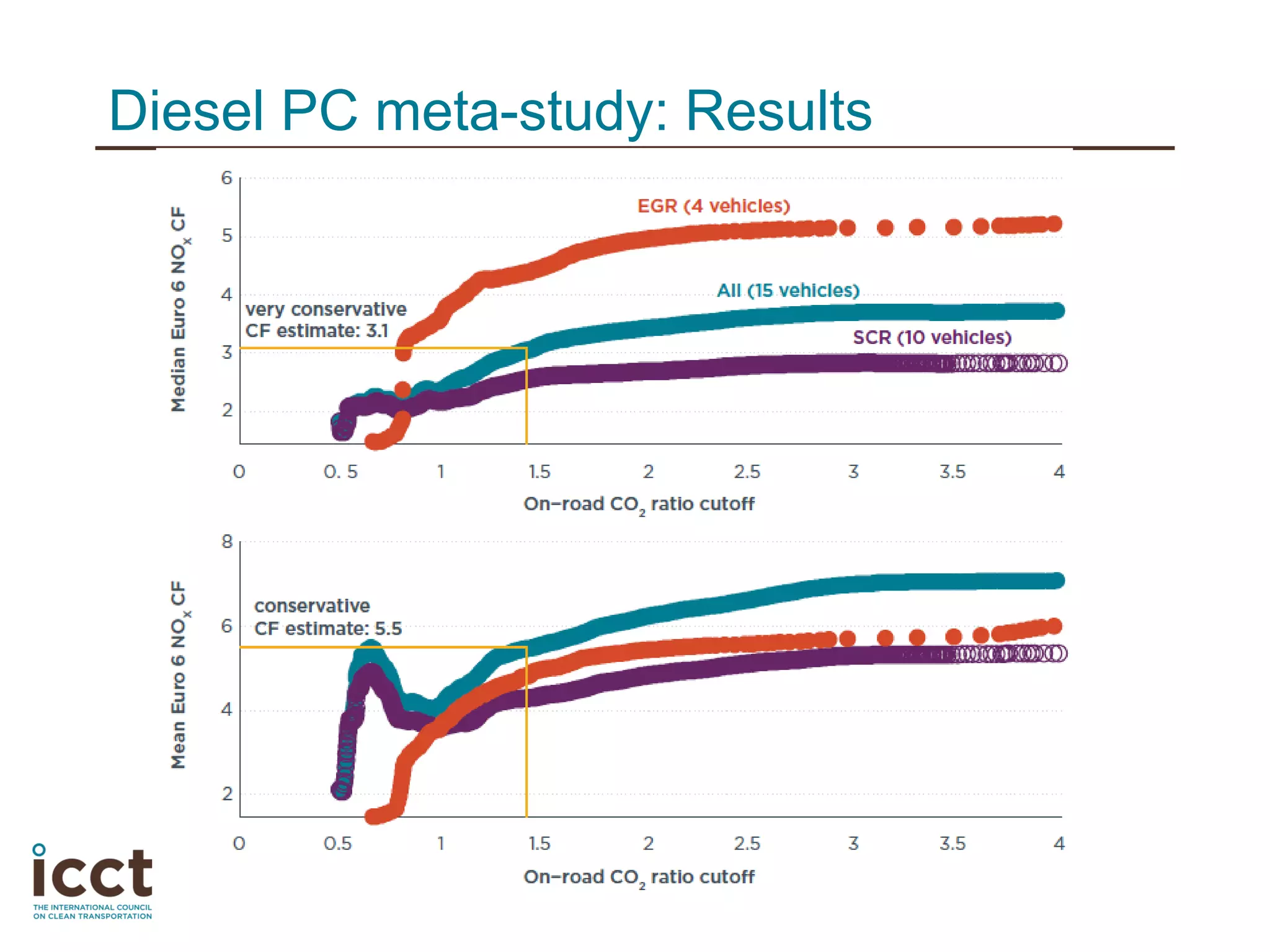
Diesel PC meta-study: Results
15
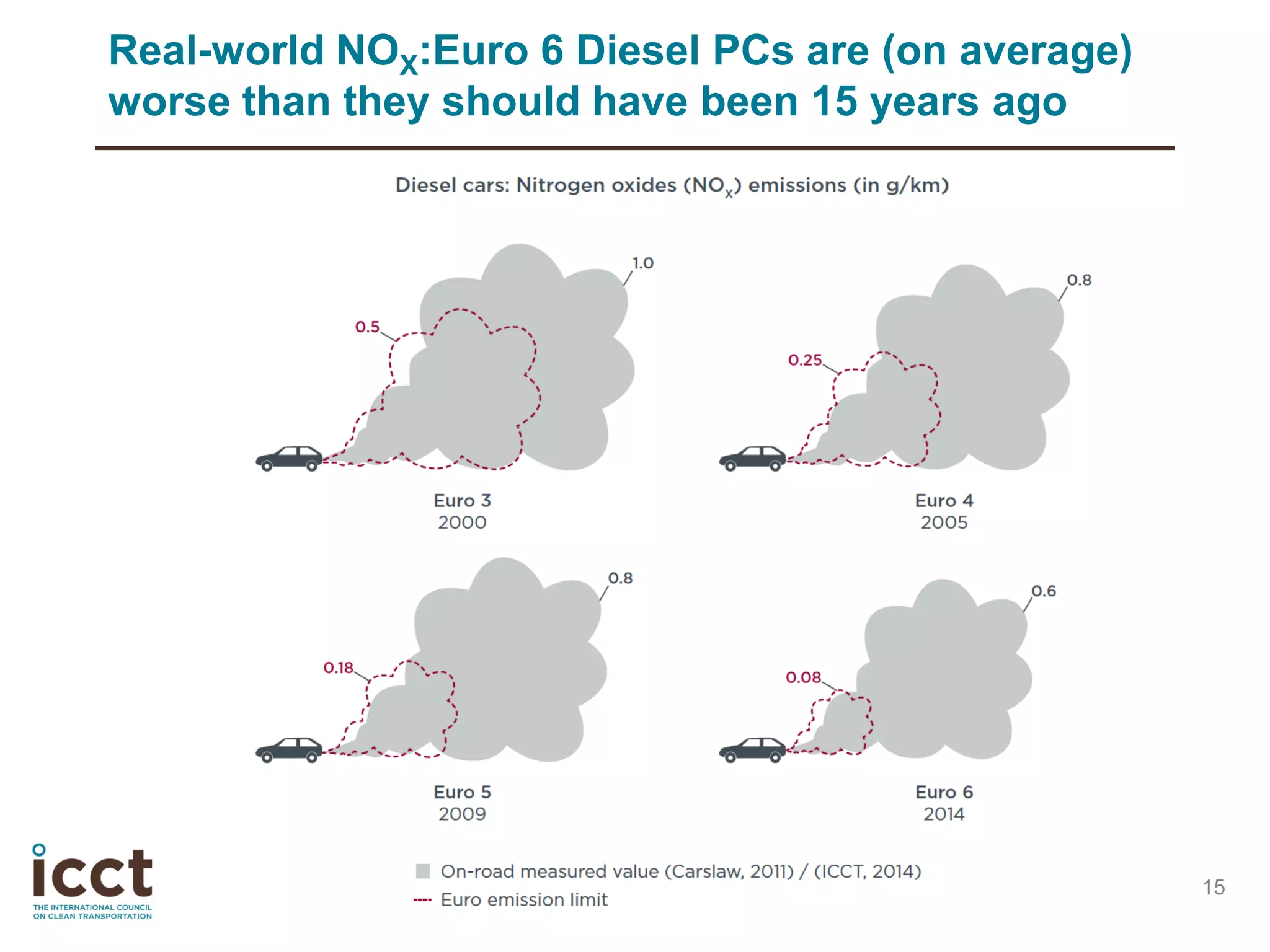
Real-world NOX:Euro 6 Diesel PCs are (on average)
worse than they should have been 15 years ago
16
Real Driving
Emissions
Advanced systems and
tends for emission
measurement
17
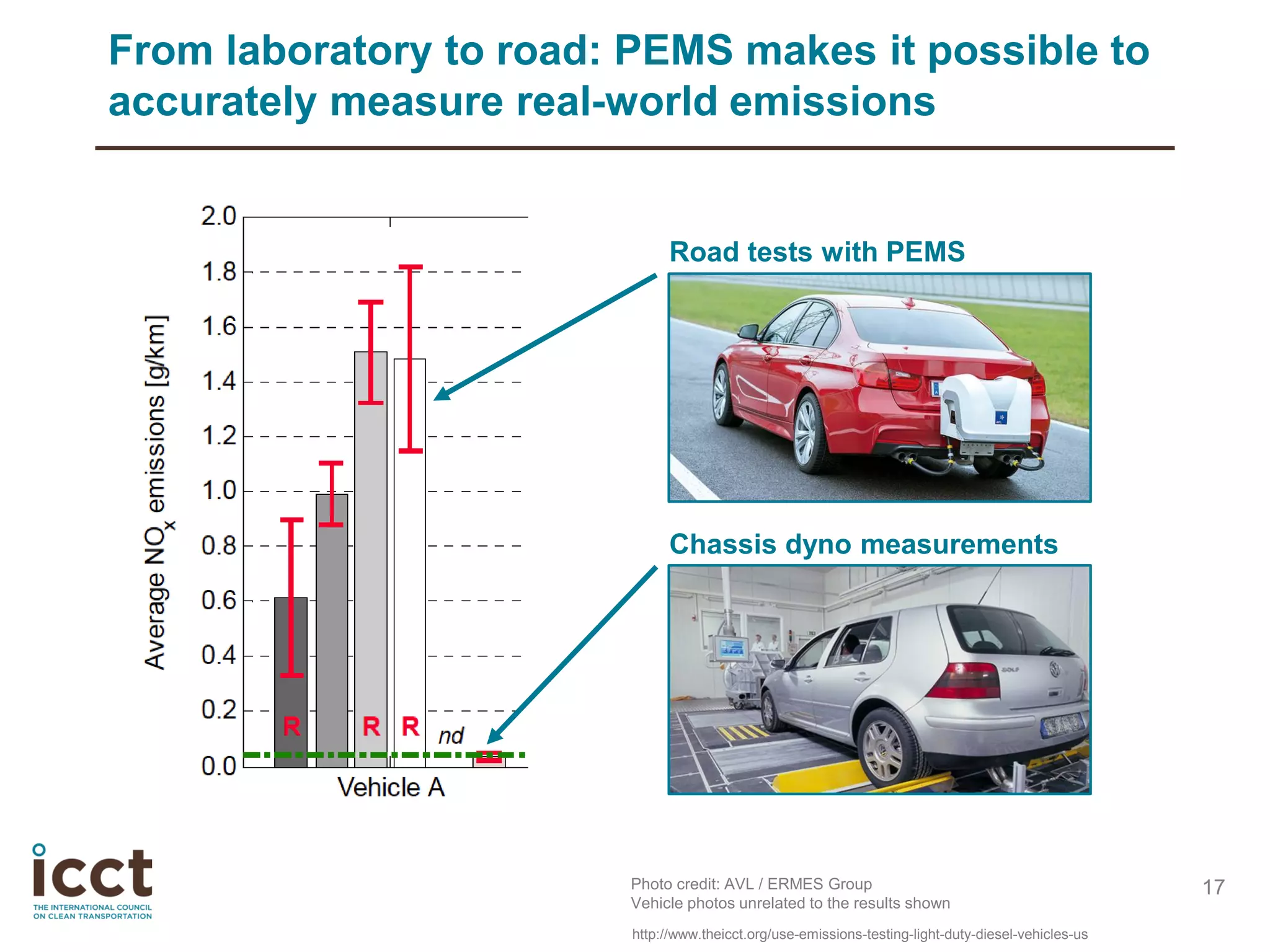
From laboratory to road: PEMS makes it possible to
accurately measure real-world emissions
Road tests with PEMS
Chassis dyno measurements
Photo credit: AVL / ERMES Group
Vehicle photos unrelated to the results shown
http://www.theicct.org/use-emissions-testing-light-duty-diesel-vehicles-us
18
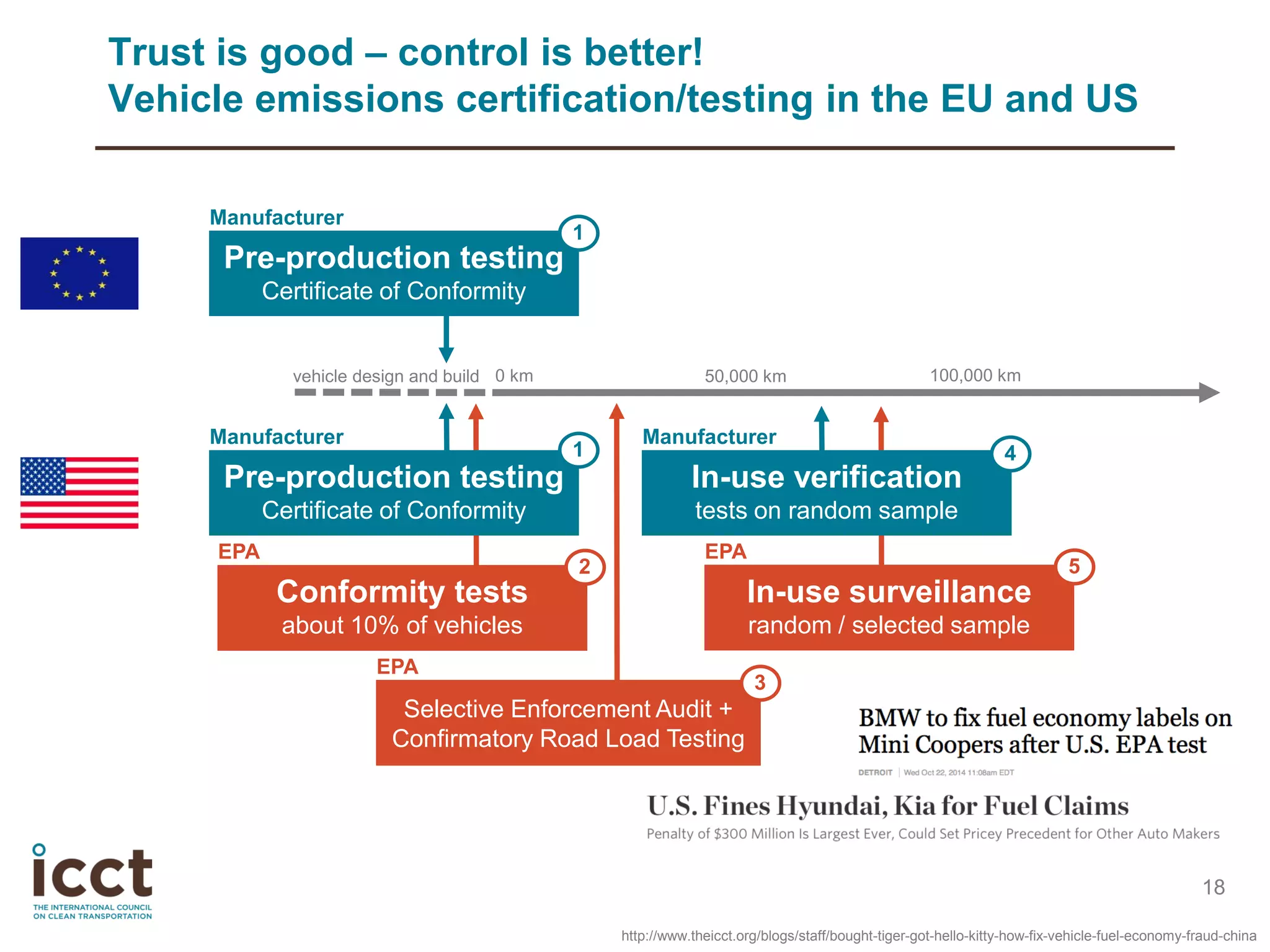
Trust is good – control is better!
Vehicle emissions certification/testing in the EU and US
Pre-production testing
Certificate of Conformity
Manufacturer
Conformity tests
about 10% of vehicles
EPA
vehicle design and build 0 km 100,000 km50,000 km
Selective Enforcement Audit +
Confirmatory Road Load Testing
EPA
In-use verification
tests on random sample
Manufacturer
In-use surveillance
random / selected sample
EPA
1
2
3
4
5
Pre-production testing
Certificate of Conformity
Manufacturer
1
http://www.theicct.org/blogs/staff/bought-tiger-got-hello-kitty-how-fix-vehicle-fuel-economy-fraud-china
19
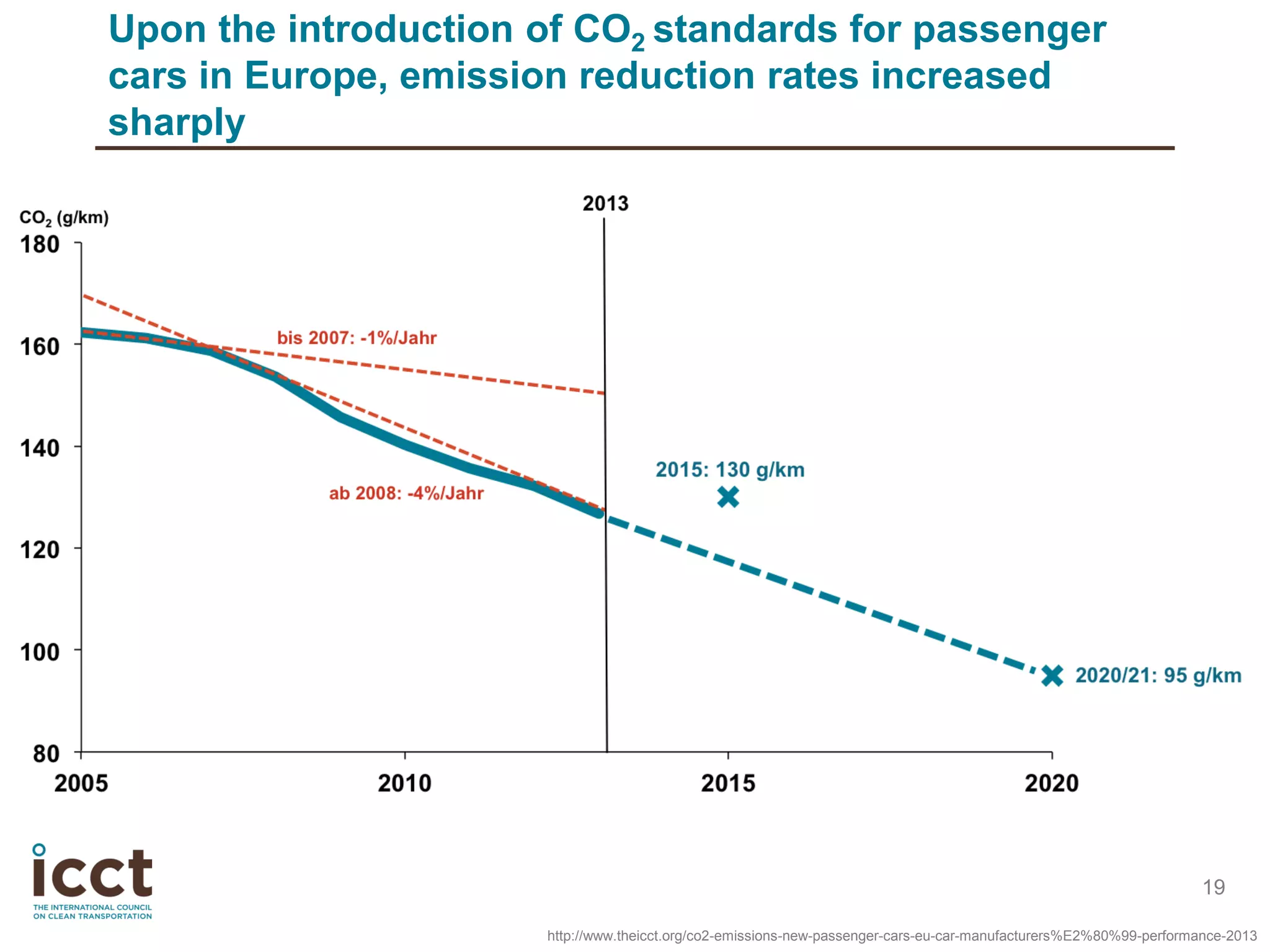
Upon the introduction of CO2 standards for passenger
cars in Europe, emission reduction rates increased
sharply
http://www.theicct.org/co2-emissions-new-passenger-cars-eu-car-manufacturers%E2%80%99-performance-2013
20
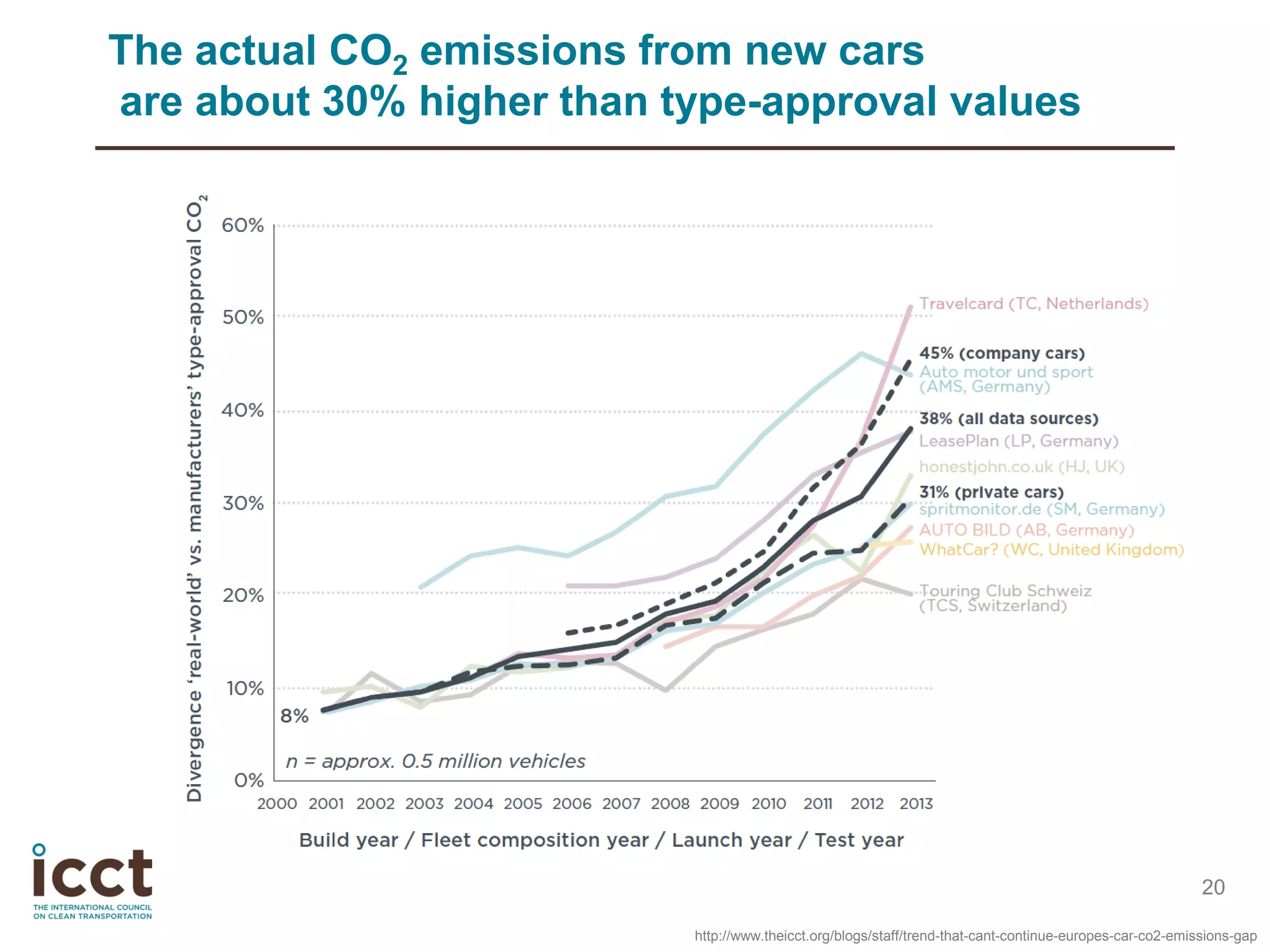
The actual CO2 emissions from new cars
are about 30% higher than type-approval values
http://www.theicct.org/blogs/staff/trend-that-cant-continue-europes-car-co2-emissions-gap
21
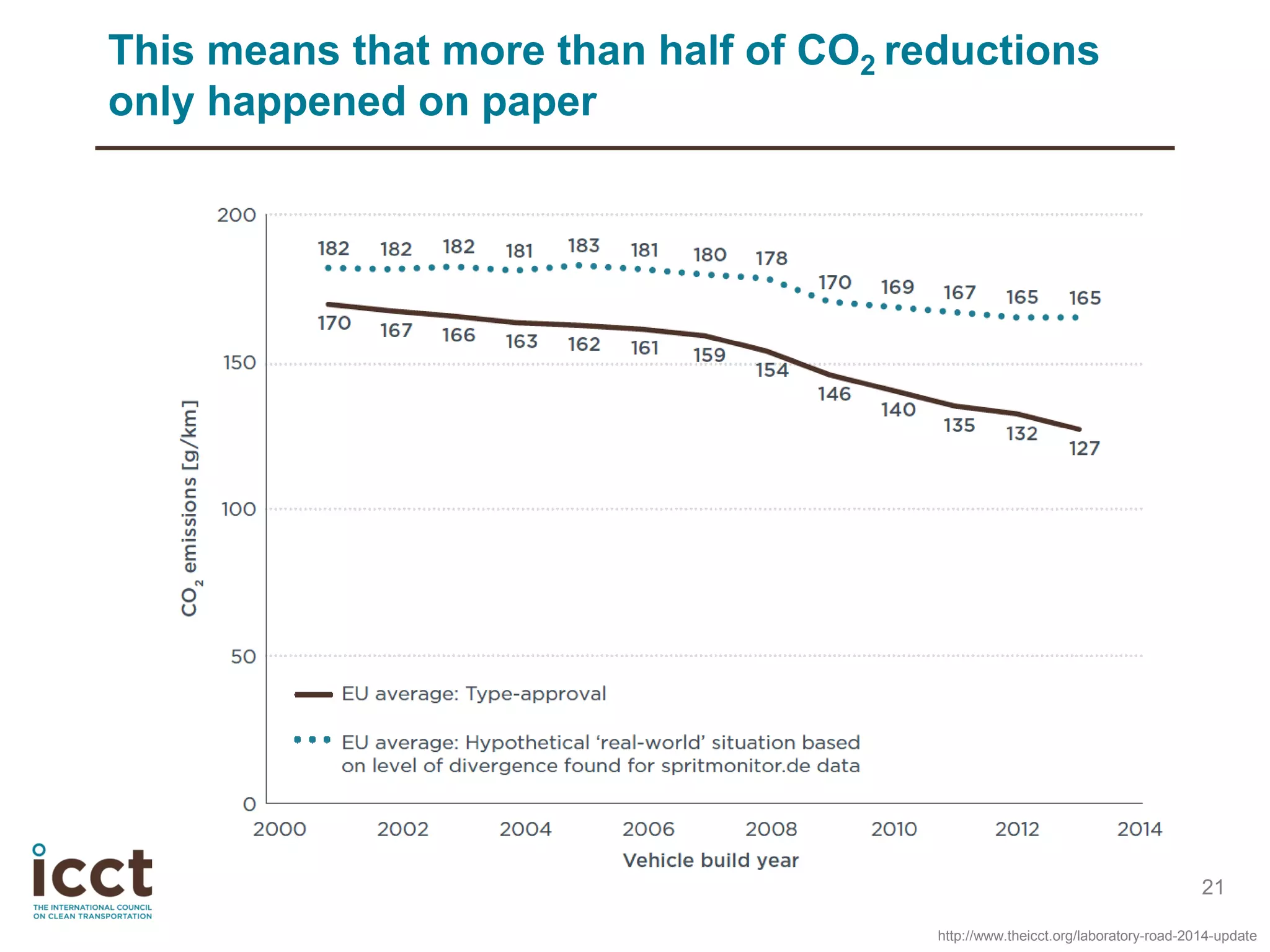
This means that more than half of CO2 reductions
only happened on paper
http://www.theicct.org/laboratory-road-2014-update
22
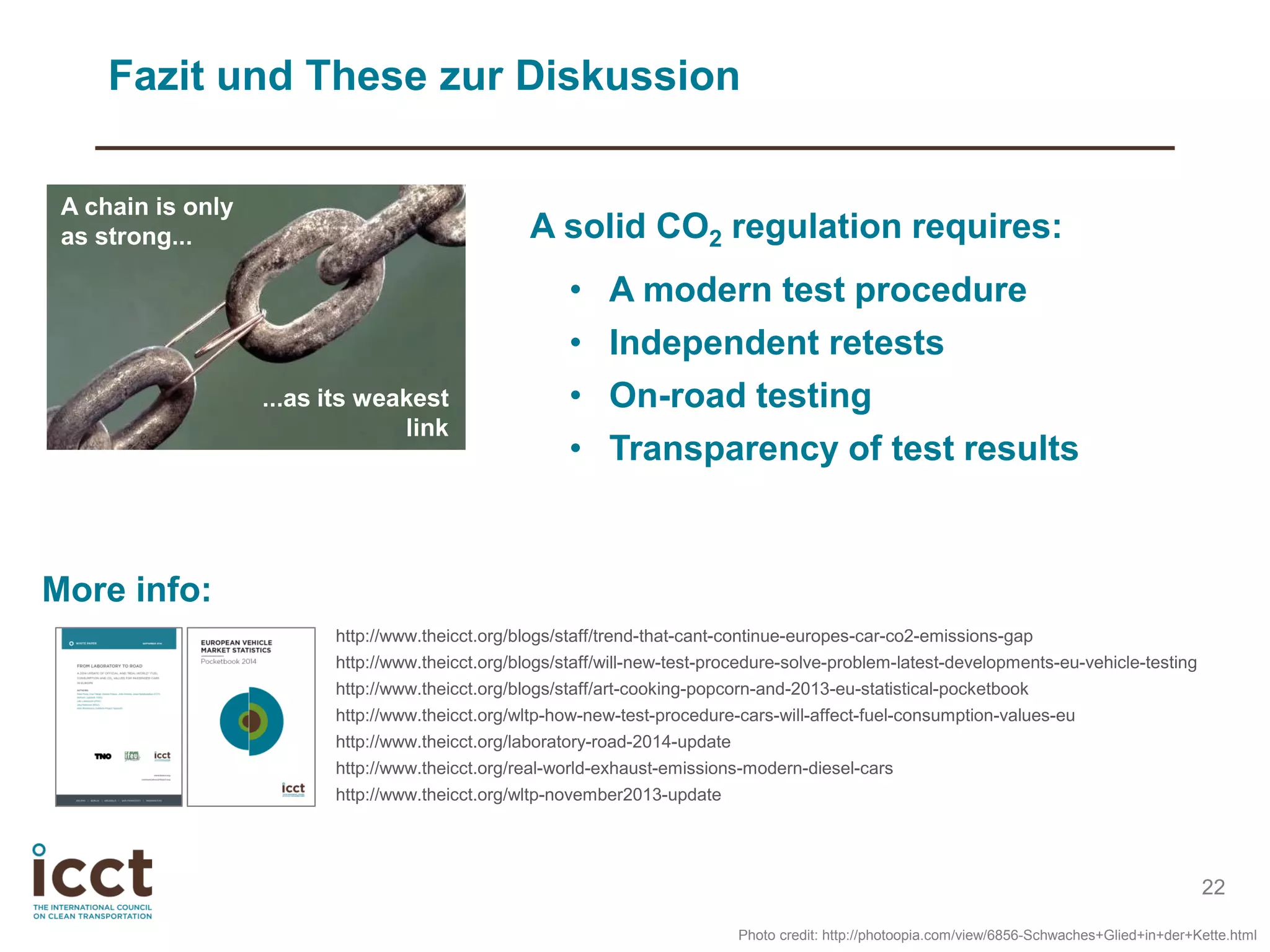
A chain is only
as strong...
...as its weakest
link
A solid CO2 regulation requires:
• A modern test procedure
• Independent retests
• On-road testing
• Transparency of test results
Fazit und These zur Diskussion
Photo credit: http://photoopia.com/view/6856-Schwaches+Glied+in+der+Kette.html
http://www.theicct.org/blogs/staff/trend-that-cant-continue-europes-car-co2-emissions-gap
http://www.theicct.org/blogs/staff/will-new-test-procedure-solve-problem-latest-developments-eu-vehicle-testing
http://www.theicct.org/blogs/staff/art-cooking-popcorn-and-2013-eu-statistical-pocketbook
http://www.theicct.org/wltp-how-new-test-procedure-cars-will-affect-fuel-consumption-values-eu
http://www.theicct.org/laboratory-road-2014-update
http://www.theicct.org/real-world-exhaust-emissions-modern-diesel-cars
http://www.theicct.org/wltp-november2013-update
More info:
23
Real Driving
Emissions
Technologies to meet
2020 targets
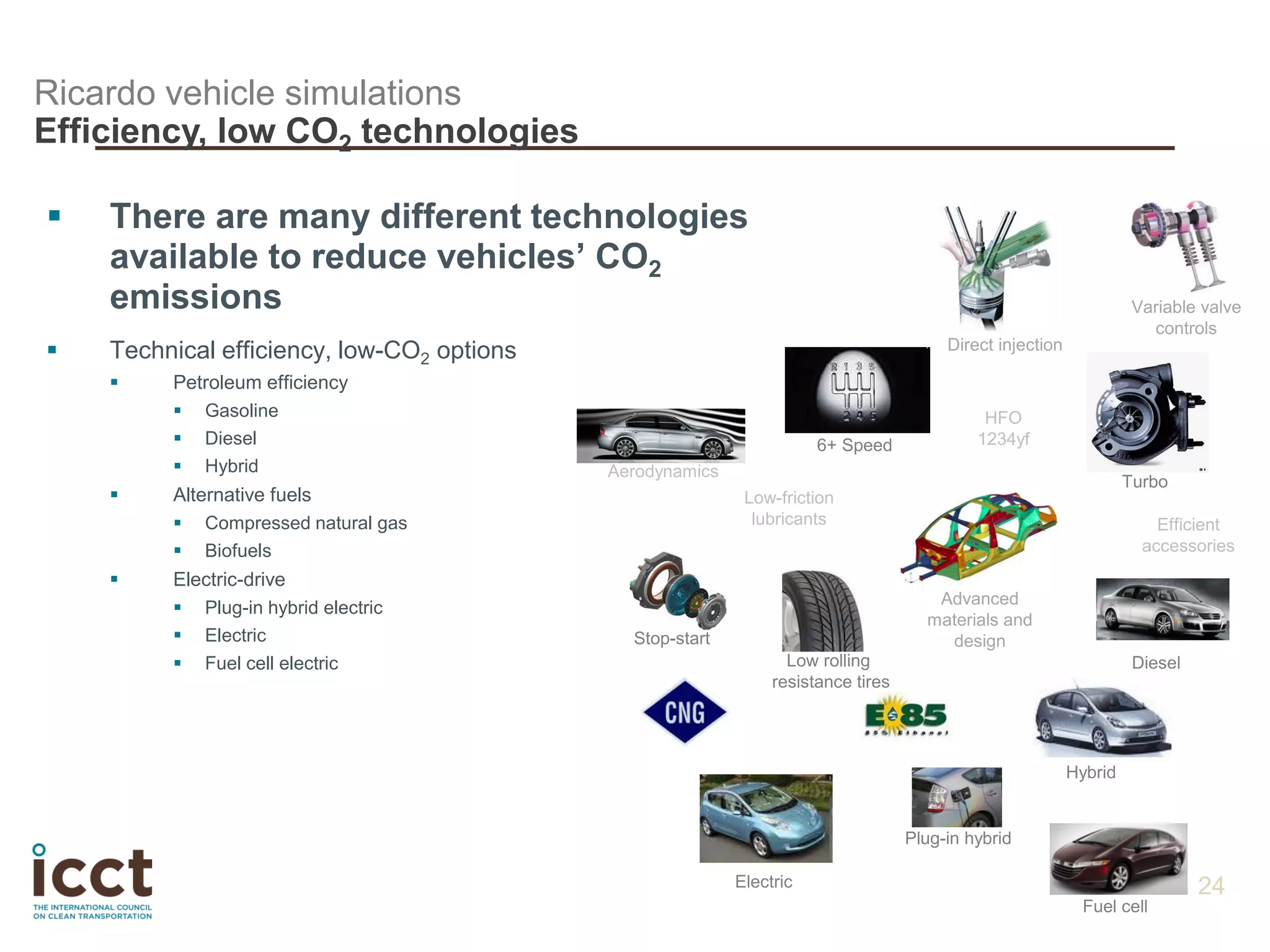
 There are many different technologies
available to reduce vehicles’ CO2
emissions
 Technical efficiency, low-CO2 options
 Petroleum efficiency
 Gasoline
 Diesel
 Hybrid
 Alternative fuels
 Compressed natural gas
 Biofuels
 Electric-drive
 Plug-in hybrid electric
 Electric
 Fuel cell electric
24Electric
Turbo
Hybrid
Plug-in hybrid
Fuel cell
Stop-start
Advanced
materials and
design
Low rolling
resistance tires
Aerodynamics
Efficient
accessories
Direct injection
Diesel
6+ Speed
Variable valve
controls
Low-friction
lubricants
HFO
1234yf
Ricardo vehicle simulations
Efficiency, low CO2 technologies
0
500
1000
1500
2000
2500
3000
-60%-50%-40%-30%-20%-10%0%
Additionaldirectmanufacturingcosts[EUR]
relativeto2010baseline
95g/km
corresponding
fleet targets
90g/km
80g/km
70g/km
60g/km
Ford Focus2010
159 g/km
2012
109 g/km
-31%
2010
164 g/km
2012
79 g/km
(hybrid)
-52%
Toyota Yaris
2020
CO2 / fuel consumption
relative to 2010 baseline
95 g/km in 2020:
Fuel cost savings: ≈350-450 € / year [BEUC, 2012]
Avoided oil imports: ≈160 million tons 2020-2030 [EC, 2012]
Reduction in CO2: ≈420 million tons 2020-2030 [EC, 2012]
Investment in technology: <1000 € / vehicle [ICCT, 2013]
26
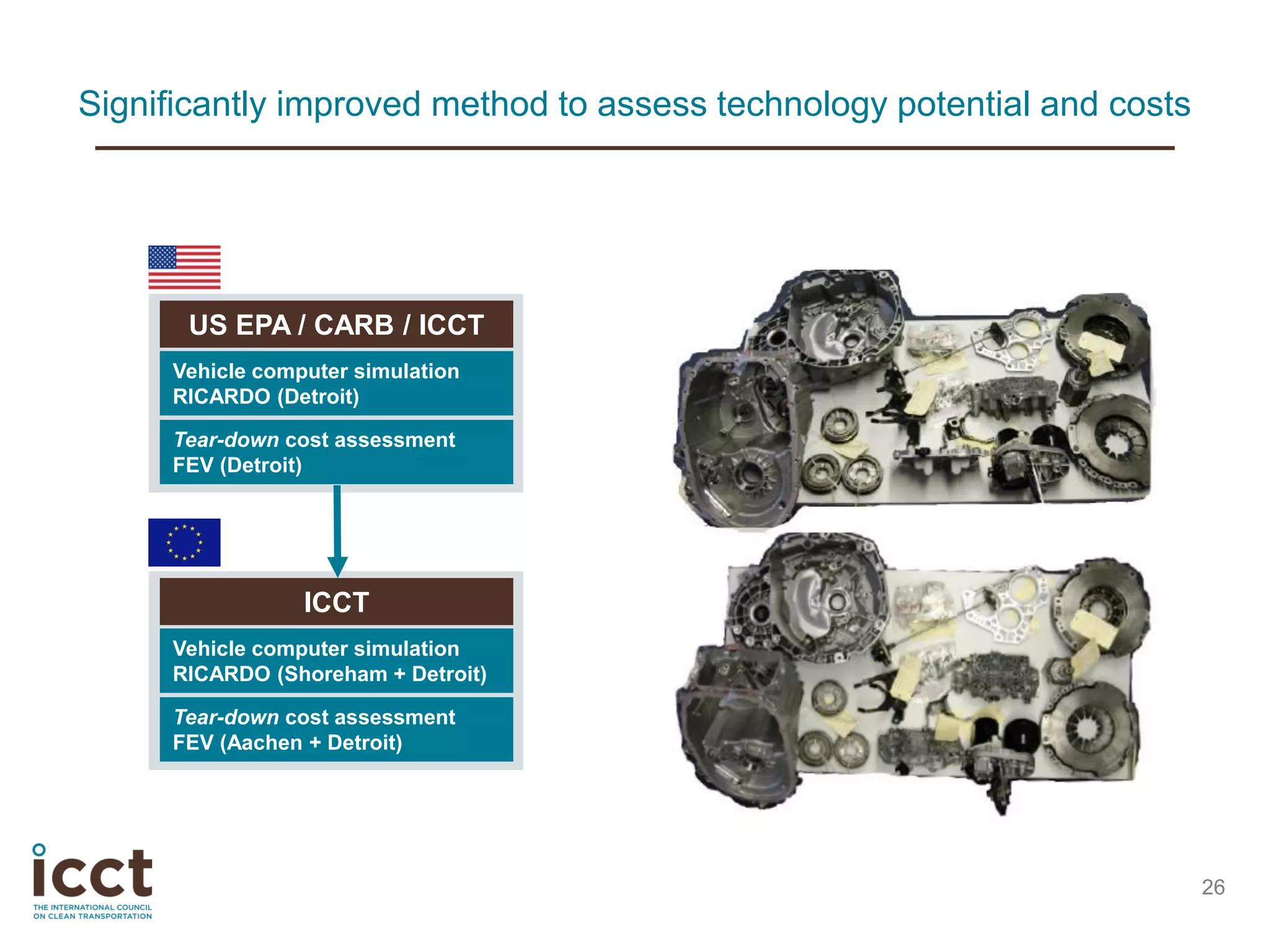
US EPA / CARB / ICCT
Vehicle computer simulation
RICARDO (Detroit)
Tear-down cost assessment
FEV (Detroit)
ICCT
Vehicle computer simulation
RICARDO (Shoreham + Detroit)
Tear-down cost assessment
FEV (Aachen + Detroit)
Significantly improved method to assess technology potential and costs
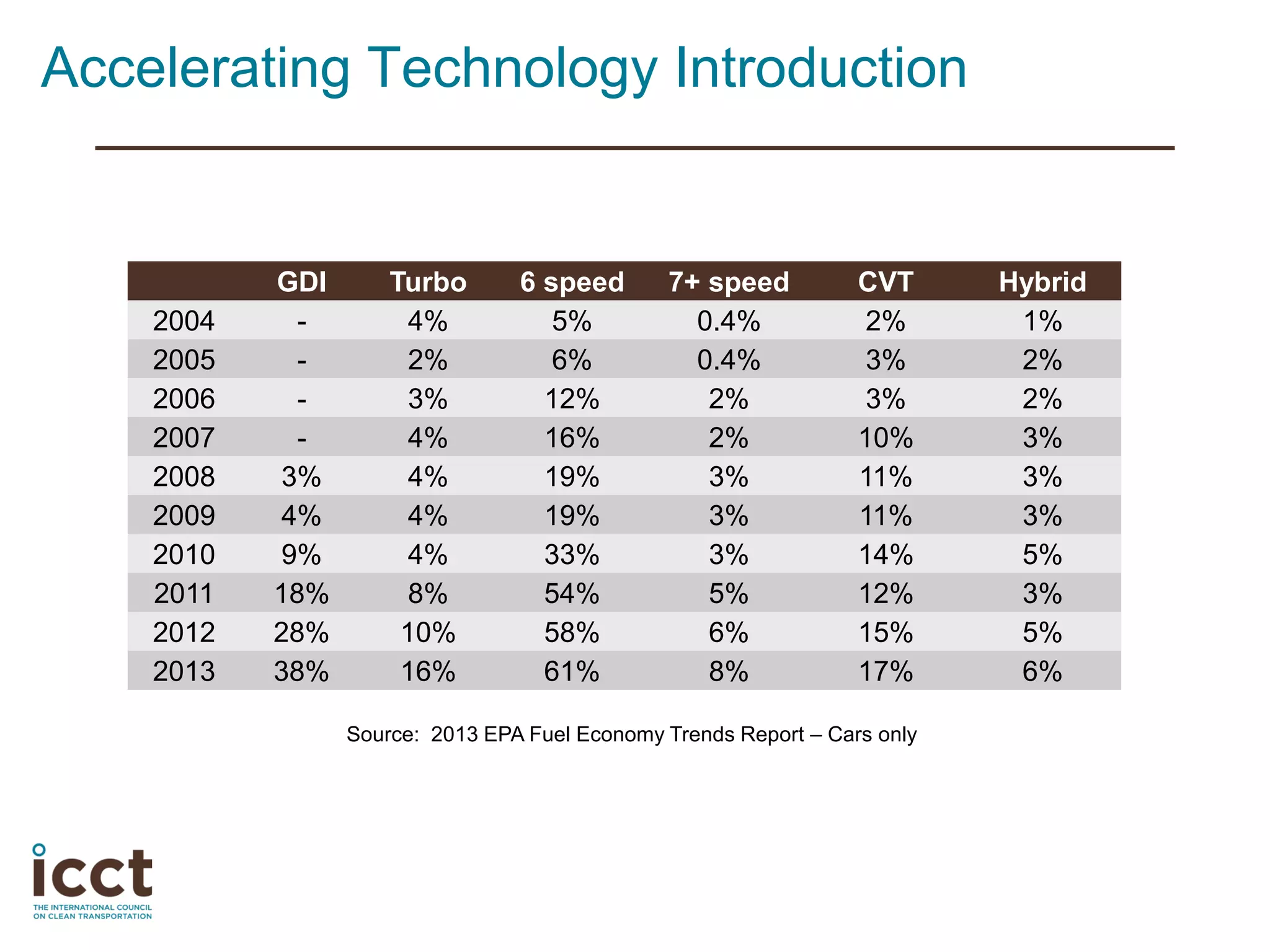
Accelerating Technology Introduction
Source: 2013 EPA Fuel Economy Trends Report – Cars only
GDI Turbo 6 speed 7+ speed CVT Hybrid
2004 - 4% 5% 0.4% 2% 1%
2005 - 2% 6% 0.4% 3% 2%
2006 - 3% 12% 2% 3% 2%
2007 - 4% 16% 2% 10% 3%
2008 3% 4% 19% 3% 11% 3%
2009 4% 4% 19% 3% 11% 3%
2010 9% 4% 33% 3% 14% 5%
2011 18% 8% 54% 5% 12% 3%
2012 28% 10% 58% 6% 15% 5%
2013 38% 16% 61% 8% 17% 6%
28
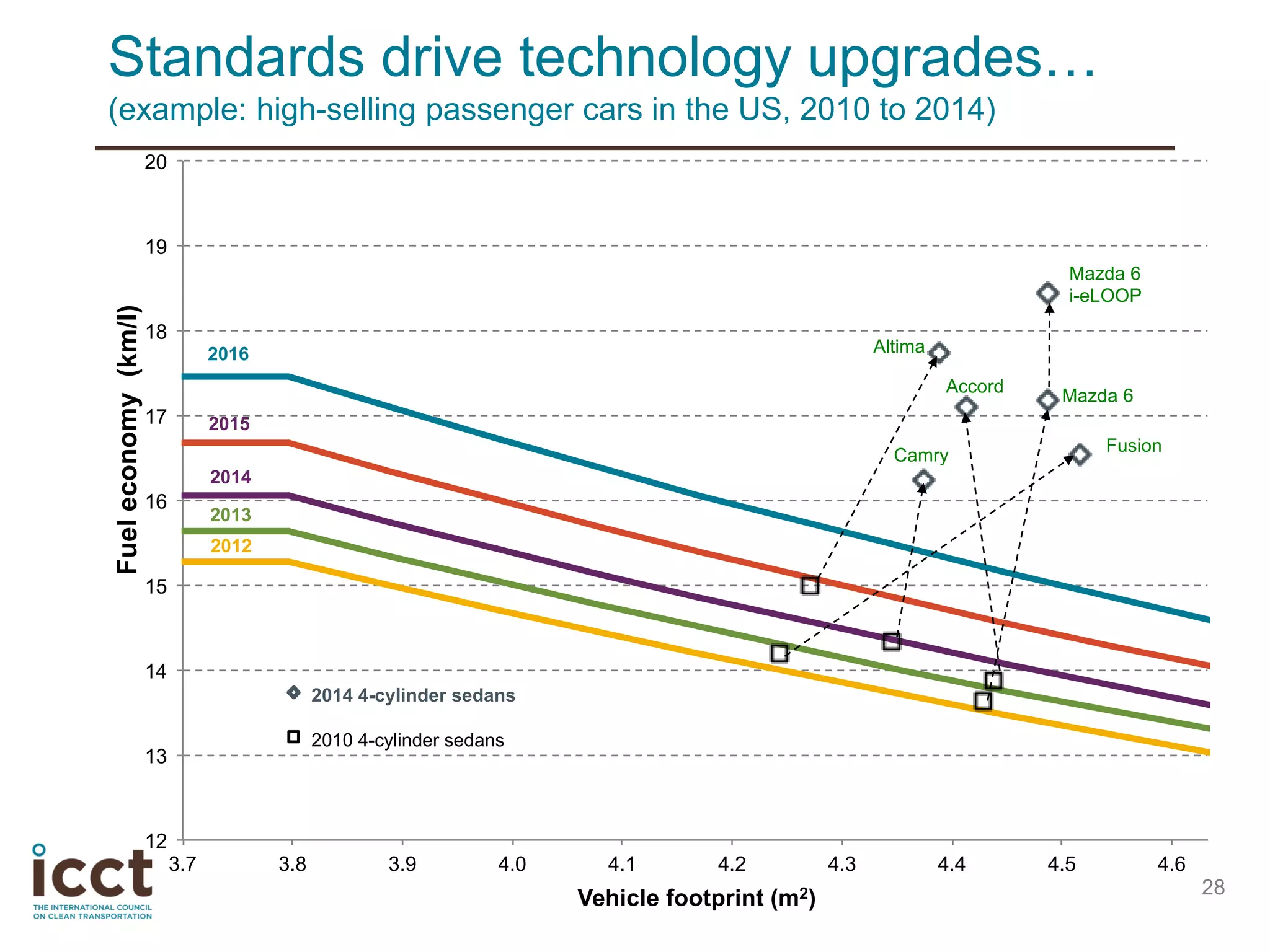
Standards drive technology upgrades…
(example: high-selling passenger cars in the US, 2010 to 2014)
12
13
14
15
16
17
18
19
20
3.7 3.8 3.9 4.0 4.1 4.2 4.3 4.4 4.5 4.6
Fueleconomy(km/l)
Vehicle footprint (m2)
2014 4-cylinder sedans
2010 4-cylinder sedans
Fusion
2012
2013
2014
2015
2016
Accord
Camry
Mazda 6
Mazda 6
i-eLOOP
Altima
Thank you for your attention!
Vicente Franco, Peter Mock
vicente@theicct.org
International Conference: Engine Optimisation for RDE
20-21 January 2015. NH Hotel Frankfurt-Mörfelden, Germany

Regulatory Outlook for real-world emissions - ICCT

  • 1.
    Regulatory outlook forreal- world emissions Vicente Franco, Peter Mock vicente@theicct.org International Conference: Engine Optimisation for RDE 20-21 January 2015. NH Hotel Frankfurt-Mörfelden, Germany
  • 2.
    Regulatory outlook forreal-world emissions  Current challenges: results from Diesel PC meta-study  Advanced systems and trends for emission measurement  Technologies to meet 2020 targets
  • 3.
  • 4.
  • 5.
    Windowed emissions • byCO2 window (assessment of ‘on-road compliance’) Other • Time and distance shares • Transience metrics Average distance-specific emissions (CO2, CO, NOX and THC) • by trip • by vehicle (collection of trips) • by operating conditions • velocity • acceleration*velocity • gradient • exhaust temperature ICCT ICCT ICCT ‘Calculator’ functions DB results PEMS data analysis
  • 6.
    Diesel PC meta-study Real-worldEmissions Report 2014: Modern Diesel Cars • Multiple data sources • 15 vehicles (3 Tier 2 Bin 5 + 12 Euro 6) • 5 different sources • 96 trips/ 140 hrs / 6,400 km of recorded data • One multi-level analysis and reporting framework • Raw emission factors (trip averages) • Windowed emissions (‘on-road compliance’) • Situation-specific emissions • Instantaneous emissions http://www.theicct.org/real-world-exhaust-emissions-modern-diesel-cars
  • 7.
    ‘Raw’ average distance-specificemissions, by vehicle Diesel PC meta-study: Overall results http://www.theicct.org/real-world-exhaust-emissions-modern-diesel-cars
  • 8.
    Euro 6 conformityfactor for NOX, all vehicles Meta-study: Results for NOx Mean CF = 7.1 Best vehicle: 1.0 Worst vehicle: 25
  • 9.
    Euro 6 conformityfactor for CO, all vehicles Meta-study: Results for CO Mean CF = 0.40
  • 10.
    Real-world CO2 ratios,all vehicles Meta-study: Results for CO2 Mean on-road/type-approval ratio = 1.43
  • 11.
  • 12.
    Situation-specific analysis: undemandingdriving conditions Meta-study: Results by driving condition
  • 13.
    NOX emission factors[mg/km] Meta-study: Results by driving condition
  • 14.
  • 15.
    15 Real-world NOX:Euro 6Diesel PCs are (on average) worse than they should have been 15 years ago
  • 16.
    16 Real Driving Emissions Advanced systemsand tends for emission measurement
  • 17.
    17 From laboratory toroad: PEMS makes it possible to accurately measure real-world emissions Road tests with PEMS Chassis dyno measurements Photo credit: AVL / ERMES Group Vehicle photos unrelated to the results shown http://www.theicct.org/use-emissions-testing-light-duty-diesel-vehicles-us
  • 18.
    18 Trust is good– control is better! Vehicle emissions certification/testing in the EU and US Pre-production testing Certificate of Conformity Manufacturer Conformity tests about 10% of vehicles EPA vehicle design and build 0 km 100,000 km50,000 km Selective Enforcement Audit + Confirmatory Road Load Testing EPA In-use verification tests on random sample Manufacturer In-use surveillance random / selected sample EPA 1 2 3 4 5 Pre-production testing Certificate of Conformity Manufacturer 1 http://www.theicct.org/blogs/staff/bought-tiger-got-hello-kitty-how-fix-vehicle-fuel-economy-fraud-china
  • 19.
    19 Upon the introductionof CO2 standards for passenger cars in Europe, emission reduction rates increased sharply http://www.theicct.org/co2-emissions-new-passenger-cars-eu-car-manufacturers%E2%80%99-performance-2013
  • 20.
    20 The actual CO2emissions from new cars are about 30% higher than type-approval values http://www.theicct.org/blogs/staff/trend-that-cant-continue-europes-car-co2-emissions-gap
  • 21.
    21 This means thatmore than half of CO2 reductions only happened on paper http://www.theicct.org/laboratory-road-2014-update
  • 22.
    22 A chain isonly as strong... ...as its weakest link A solid CO2 regulation requires: • A modern test procedure • Independent retests • On-road testing • Transparency of test results Fazit und These zur Diskussion Photo credit: http://photoopia.com/view/6856-Schwaches+Glied+in+der+Kette.html http://www.theicct.org/blogs/staff/trend-that-cant-continue-europes-car-co2-emissions-gap http://www.theicct.org/blogs/staff/will-new-test-procedure-solve-problem-latest-developments-eu-vehicle-testing http://www.theicct.org/blogs/staff/art-cooking-popcorn-and-2013-eu-statistical-pocketbook http://www.theicct.org/wltp-how-new-test-procedure-cars-will-affect-fuel-consumption-values-eu http://www.theicct.org/laboratory-road-2014-update http://www.theicct.org/real-world-exhaust-emissions-modern-diesel-cars http://www.theicct.org/wltp-november2013-update More info:
  • 23.
  • 24.
     There aremany different technologies available to reduce vehicles’ CO2 emissions  Technical efficiency, low-CO2 options  Petroleum efficiency  Gasoline  Diesel  Hybrid  Alternative fuels  Compressed natural gas  Biofuels  Electric-drive  Plug-in hybrid electric  Electric  Fuel cell electric 24Electric Turbo Hybrid Plug-in hybrid Fuel cell Stop-start Advanced materials and design Low rolling resistance tires Aerodynamics Efficient accessories Direct injection Diesel 6+ Speed Variable valve controls Low-friction lubricants HFO 1234yf Ricardo vehicle simulations Efficiency, low CO2 technologies
  • 25.
    0 500 1000 1500 2000 2500 3000 -60%-50%-40%-30%-20%-10%0% Additionaldirectmanufacturingcosts[EUR] relativeto2010baseline 95g/km corresponding fleet targets 90g/km 80g/km 70g/km 60g/km Ford Focus2010 159g/km 2012 109 g/km -31% 2010 164 g/km 2012 79 g/km (hybrid) -52% Toyota Yaris 2020 CO2 / fuel consumption relative to 2010 baseline 95 g/km in 2020: Fuel cost savings: ≈350-450 € / year [BEUC, 2012] Avoided oil imports: ≈160 million tons 2020-2030 [EC, 2012] Reduction in CO2: ≈420 million tons 2020-2030 [EC, 2012] Investment in technology: <1000 € / vehicle [ICCT, 2013]
  • 26.
    26 US EPA /CARB / ICCT Vehicle computer simulation RICARDO (Detroit) Tear-down cost assessment FEV (Detroit) ICCT Vehicle computer simulation RICARDO (Shoreham + Detroit) Tear-down cost assessment FEV (Aachen + Detroit) Significantly improved method to assess technology potential and costs
  • 27.
    Accelerating Technology Introduction Source:2013 EPA Fuel Economy Trends Report – Cars only GDI Turbo 6 speed 7+ speed CVT Hybrid 2004 - 4% 5% 0.4% 2% 1% 2005 - 2% 6% 0.4% 3% 2% 2006 - 3% 12% 2% 3% 2% 2007 - 4% 16% 2% 10% 3% 2008 3% 4% 19% 3% 11% 3% 2009 4% 4% 19% 3% 11% 3% 2010 9% 4% 33% 3% 14% 5% 2011 18% 8% 54% 5% 12% 3% 2012 28% 10% 58% 6% 15% 5% 2013 38% 16% 61% 8% 17% 6%
  • 28.
    28 Standards drive technologyupgrades… (example: high-selling passenger cars in the US, 2010 to 2014) 12 13 14 15 16 17 18 19 20 3.7 3.8 3.9 4.0 4.1 4.2 4.3 4.4 4.5 4.6 Fueleconomy(km/l) Vehicle footprint (m2) 2014 4-cylinder sedans 2010 4-cylinder sedans Fusion 2012 2013 2014 2015 2016 Accord Camry Mazda 6 Mazda 6 i-eLOOP Altima
  • 29.
    Thank you foryour attention! Vicente Franco, Peter Mock vicente@theicct.org International Conference: Engine Optimisation for RDE 20-21 January 2015. NH Hotel Frankfurt-Mörfelden, Germany