Embedding BCE
Through Business Process
    Improvement and
  Internal Engagement


             John Burke
Project Staff
          John Burke, Project Manager
          Clive Alderson, Project Consultant


Slide 2
Objective - 1
  Identifying the key business processes and
  system implications involved and analysing
  the related coherence and efficiency of
  these
Objective - 2
  Producing case studies which illustrate
  different models and degrees of business
  integration for different approaches to BCE
Objective - 3
  Devising change plans in each of the five cases
  to enable BCE functions to be more effectively
  embedded by identifying areas for process
  improvement, actions, resources and change
  agents needed in each of the five cases which
  would result in better integrated strategic BCE
  operations
Objective - 4
  Producing an infoKit which distils the
  learning from the above activities and
  highlights recommended business process
  improvement steps and methods for better
  integration of BCE operations within
  institutions
Objective - 5
  Base-lining and developing the level and
  nature of engagement between central
  functions, (including libraries, administration
  and information management/IT) and BCE
  operations
Objective - 6
  Producing a resource for managers of the
  central functions within an institution, with
  advice and guidance on BCE and how to
  support it. This will demonstrates the benefits
  for the institution and promote enhanced
  internal engagement and better integrated
  BCE
Project Partners
    University of Glamorgan
    Keele University
    Newcastle University
    Shrewsbury College of Art & Technology
    University of Strathclyde
Partner Activity
     Initial Start-Up Meeting, November 2008
     Internal Launch Event
     Interviews with key members of staff
     Self-Evaluation Workshop
     Development Plan
     Dissemination Event
Structure
    Policy and Strategy
    Processes and Systems
    Partnerships and Resources
    Roles and Skills
    Customer Perceptions
    Key Performance Results
Findings – Policy and Strategy
    Strategies exist or are being written
    Lots of activity is taking place
    Planning is undertaken at middle or lower
     level, with an eye to strategic direction
    Senior Management are given overall
     responsibility
    Not all areas perceive themselves involved
Findings – Processes & Systems
    Central co-ordinating units
    “I say – there’s noisy students here!”
    Is embedded a good thing?
    IP is a key issue
    Inflexibility is a key issue
    Speed of response is a key issue
    Recognition of value is a key issue
Findings – Partnerships/Resources
    Strategic partnerships
    Commercial Partnerships
    CPD Partnerships
    Knowledge Transfer Partnerships
    Third Party Partnerships
    Supply Chains
Findings – Roles and Skills
    Compronday vooz la lingo?
    Marketing is 2-way
    The Mighty CRM – or is it...?
    Reality checks required
    Need for development and internal
     engagement
Findings – Customer Perceptions
    Participation figures are only part of it...
    Repeat Business
    Surveys
Findings – Performance Results
    Problems of measuring impact
    External benchmarking and evaluation
    Working to standards
    Setting the targets
Findings – IT !!!!!
     Academics did not mention IT until prompted
     The IP issue
     VPN (leading to VLE or external web site?)
     Information Systems
     Little or no use of Web2
     Little or no differentiation between core and
      BCE within IT teams (same as HR & Finance)
John Burke
       Senior Adviser, JISC infoNet
Tel:       07940 081165
Email:     j.burke@northumbrian.ac.uk
Twitter:   johnburke1
Blog:      http://jbep.blogspot.com

JISC infoNet:   http://www.jiscinfonet.ac.uk
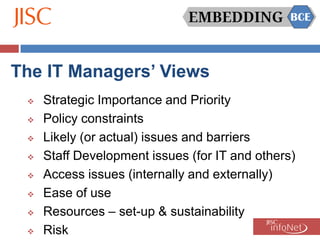
The IT Managers’ Views
    Strategic Importance and Priority
    Policy constraints
    Likely (or actual) issues and barriers
    Staff Development issues (for IT and others)
    Access issues (internally and externally)
    Ease of use
    Resources – set-up & sustainability
    Risk

02 Embedding Bce

  • 1.
    Embedding BCE Through BusinessProcess Improvement and Internal Engagement John Burke
  • 2.
    Project Staff John Burke, Project Manager Clive Alderson, Project Consultant Slide 2
  • 3.
    Objective - 1 Identifying the key business processes and system implications involved and analysing the related coherence and efficiency of these
  • 4.
    Objective - 2 Producing case studies which illustrate different models and degrees of business integration for different approaches to BCE
  • 5.
    Objective - 3 Devising change plans in each of the five cases to enable BCE functions to be more effectively embedded by identifying areas for process improvement, actions, resources and change agents needed in each of the five cases which would result in better integrated strategic BCE operations
  • 6.
    Objective - 4 Producing an infoKit which distils the learning from the above activities and highlights recommended business process improvement steps and methods for better integration of BCE operations within institutions
  • 7.
    Objective - 5 Base-lining and developing the level and nature of engagement between central functions, (including libraries, administration and information management/IT) and BCE operations
  • 8.
    Objective - 6 Producing a resource for managers of the central functions within an institution, with advice and guidance on BCE and how to support it. This will demonstrates the benefits for the institution and promote enhanced internal engagement and better integrated BCE
  • 9.
    Project Partners  University of Glamorgan  Keele University  Newcastle University  Shrewsbury College of Art & Technology  University of Strathclyde
  • 10.
    Partner Activity  Initial Start-Up Meeting, November 2008  Internal Launch Event  Interviews with key members of staff  Self-Evaluation Workshop  Development Plan  Dissemination Event
  • 11.
    Structure  Policy and Strategy  Processes and Systems  Partnerships and Resources  Roles and Skills  Customer Perceptions  Key Performance Results
  • 12.
    Findings – Policyand Strategy  Strategies exist or are being written  Lots of activity is taking place  Planning is undertaken at middle or lower level, with an eye to strategic direction  Senior Management are given overall responsibility  Not all areas perceive themselves involved
  • 13.
    Findings – Processes& Systems  Central co-ordinating units  “I say – there’s noisy students here!”  Is embedded a good thing?  IP is a key issue  Inflexibility is a key issue  Speed of response is a key issue  Recognition of value is a key issue
  • 14.
    Findings – Partnerships/Resources  Strategic partnerships  Commercial Partnerships  CPD Partnerships  Knowledge Transfer Partnerships  Third Party Partnerships  Supply Chains
  • 15.
    Findings – Rolesand Skills  Compronday vooz la lingo?  Marketing is 2-way  The Mighty CRM – or is it...?  Reality checks required  Need for development and internal engagement
  • 16.
    Findings – CustomerPerceptions  Participation figures are only part of it...  Repeat Business  Surveys
  • 17.
    Findings – PerformanceResults  Problems of measuring impact  External benchmarking and evaluation  Working to standards  Setting the targets
  • 18.
    Findings – IT!!!!!  Academics did not mention IT until prompted  The IP issue  VPN (leading to VLE or external web site?)  Information Systems  Little or no use of Web2  Little or no differentiation between core and BCE within IT teams (same as HR & Finance)
  • 19.
    John Burke Senior Adviser, JISC infoNet Tel: 07940 081165 Email: j.burke@northumbrian.ac.uk Twitter: johnburke1 Blog: http://jbep.blogspot.com JISC infoNet: http://www.jiscinfonet.ac.uk
  • 20.
    The IT Managers’Views  Strategic Importance and Priority  Policy constraints  Likely (or actual) issues and barriers  Staff Development issues (for IT and others)  Access issues (internally and externally)  Ease of use  Resources – set-up & sustainability  Risk